Colour Models and its ApplicationHLS and YIQAnirbanSahaThird yearComputer Science and TechnologyBengal College of Engineering and Technology1
Modules:2Prerequisite : Frequency, Light, Dominant frequency, Definitions.YIQ model: Introduction, Application.HLS model: Introduction, Discussion, Application.
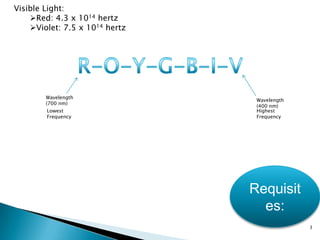
Visible Light: Red: 4.3 x 10¹⁴ hertz
Violet: 7.5 x 10¹⁴ hertzR-O-Y-G-B-I-VWavelength(700 nm)Wavelength(400 nm)Lowest FrequencyHighestFrequencyRequisites:3
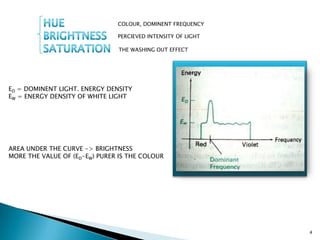
4HUEBRIGHTNESSSATURATIONCOLOUR, DOMINENT FREQUENCYPERCIEVED INTENSITY OF LIGHTTHE WASHING OUT EFFECTED = DOMINENT LIGHT. ENERGY DENSITYEW = ENERGY DENSITY OF WHITE LIGHTAREA UNDER THE CURVE -> BRIGHTNESSMORE THE VALUE OF (ED-EW) PURER IS THE COLOUR
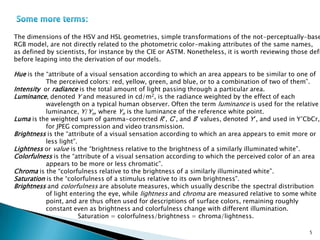
5Some more terms:The dimensions of the HSV and HSL geometries, simple transformations of the not-perceptually-based RGB model, are not directly related to the photometric color-making attributes of the same names, as defined by scientists, for instance by the CIE or ASTM. Nonetheless, it is worth reviewing those definitions before leaping into the derivation of our models.Hue is the “attribute of a visual sensation according to which an area appears to be similar to one of 	The perceived colors: red, yellow, green, and blue, or to a combination of two of them”.Intensity  or radiance is the total amount of light passing through a particular area.Luminance, denoted Y and measured in cd/m2, is the radiance weighted by the effect of each 	wavelength on a typical human observer. Often the term luminance is used for the relative	luminance, Y/Yn, where Yn is the luminance of the reference white point.Luma is the weighted sum of gamma-corrected R′, G′, and B′ values, denoted Y′, and used in Y′CbCr, 	for JPEG compression and video transmission.Brightness is the “attribute of a visual sensation according to which an area appears to emit more or 	less light”.Lightness or value is the “brightness relative to the brightness of a similarly illuminated white”.Colorfulness is the “attribute of a visual sensation according to which the perceived color of an area 	appears to be more or less chromatic”.Chroma is the “colorfulness relative to the brightness of a similarly illuminated white”.Saturation is the “colorfulness of a stimulus relative to its own brightness”.Brightness and colorfulness are absolute measures, which usually describe the spectral distribution 	of light entering the eye, while lightness and chroma are measured relative to some white 	point, and are thus often used for descriptions of surface colors, remaining roughly 	constant even as brightness and colorfulness change with different illumination. 		Saturation = colorfulness/brightness = chroma/lightness.
YIQmodel6
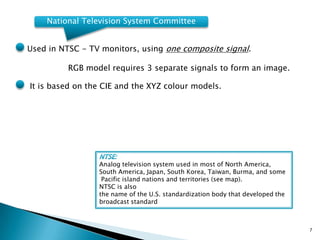
National Television System CommitteeUsed in NTSC - TV monitors, using one composite signal.                RGB model requires 3 separate signals to form an image.It is based on the CIE and the XYZ colour models.NTSE: Analog television system used in most of North America,South America, Japan, South Korea, Taiwan, Burma, and some Pacific island nations and territories (see map). NTSC is also the name of the U.S. standardization body that developed the broadcast standard7
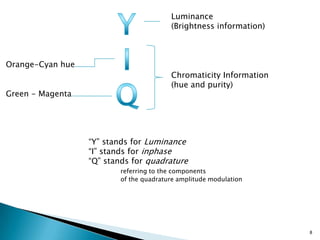
YIQLuminance (Brightness information)Orange-Cyan hueChromaticity Information (hue and purity)Green - Magenta8“Y” stands for Luminance“I” stands for inphase“Q” stands for quadraturereferring to the components 	of the quadrature amplitude modulation
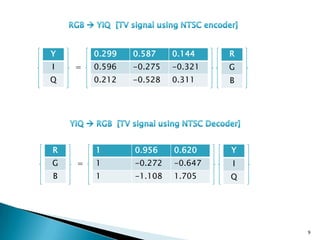
RGB  YIQ  [TV signal using NTSC encoder] 9=YIQ  RGB  [TV signal using NTSC Decoder] =9
HSV and HSL models10
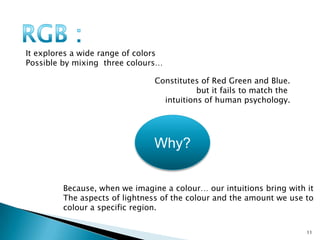
RGB :It explores a wide range of colors Possible by mixing  three colours…Constitutes of Red Green and Blue.but it fails to match the intuitions of human psychology.Why?Because, when we imagine a colour… our intuitions bring with it The aspects of lightness of the colour and the amount we use tocolour a specific region.11
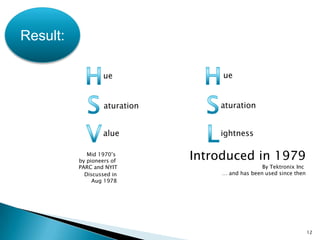
Result:HSVHSLueueaturationaturationalueightnessIntroduced in 1979By Tektronix Inc… and has been used since thenMid 1970’s by pioneers of PARC and NYITDiscussed in Aug 197812
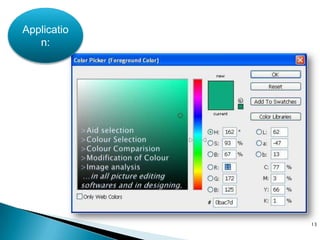
Application:>Aid selection>Colour Selection>ColourComparision>Modification of Colour>Image analysis…in all picture editing softwares and in designing.13
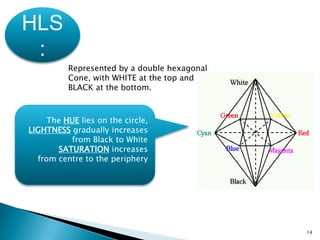
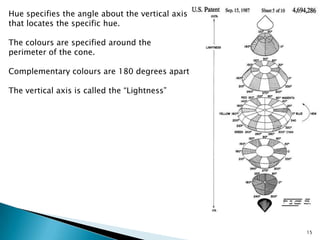
HLS:Represented by a double hexagonalCone, with WHITE at the top and BLACK at the bottom.The HUE lies on the circle, LIGHTNESSgradually increases from Black to WhiteSATURATION increases from centre to the periphery14
15Hue specifies the angle about the vertical axis that locates the specific hue.The colours are specified around the perimeter of the cone.Complementary colours are 180 degrees apartThe vertical axis is called the “Lightness”

Colour models

  • 1.
    Colour Models andits ApplicationHLS and YIQAnirbanSahaThird yearComputer Science and TechnologyBengal College of Engineering and Technology1
  • 2.
    Modules:2Prerequisite : Frequency,Light, Dominant frequency, Definitions.YIQ model: Introduction, Application.HLS model: Introduction, Discussion, Application.
  • 3.
    Visible Light: Red:4.3 x 10¹⁴ hertz
  • 4.
    Violet: 7.5 x10¹⁴ hertzR-O-Y-G-B-I-VWavelength(700 nm)Wavelength(400 nm)Lowest FrequencyHighestFrequencyRequisites:3
  • 5.
    4HUEBRIGHTNESSSATURATIONCOLOUR, DOMINENT FREQUENCYPERCIEVEDINTENSITY OF LIGHTTHE WASHING OUT EFFECTED = DOMINENT LIGHT. ENERGY DENSITYEW = ENERGY DENSITY OF WHITE LIGHTAREA UNDER THE CURVE -> BRIGHTNESSMORE THE VALUE OF (ED-EW) PURER IS THE COLOUR
  • 6.
    5Some more terms:Thedimensions of the HSV and HSL geometries, simple transformations of the not-perceptually-based RGB model, are not directly related to the photometric color-making attributes of the same names, as defined by scientists, for instance by the CIE or ASTM. Nonetheless, it is worth reviewing those definitions before leaping into the derivation of our models.Hue is the “attribute of a visual sensation according to which an area appears to be similar to one of The perceived colors: red, yellow, green, and blue, or to a combination of two of them”.Intensity  or radiance is the total amount of light passing through a particular area.Luminance, denoted Y and measured in cd/m2, is the radiance weighted by the effect of each wavelength on a typical human observer. Often the term luminance is used for the relative luminance, Y/Yn, where Yn is the luminance of the reference white point.Luma is the weighted sum of gamma-corrected R′, G′, and B′ values, denoted Y′, and used in Y′CbCr, for JPEG compression and video transmission.Brightness is the “attribute of a visual sensation according to which an area appears to emit more or less light”.Lightness or value is the “brightness relative to the brightness of a similarly illuminated white”.Colorfulness is the “attribute of a visual sensation according to which the perceived color of an area appears to be more or less chromatic”.Chroma is the “colorfulness relative to the brightness of a similarly illuminated white”.Saturation is the “colorfulness of a stimulus relative to its own brightness”.Brightness and colorfulness are absolute measures, which usually describe the spectral distribution  of light entering the eye, while lightness and chroma are measured relative to some white point, and are thus often used for descriptions of surface colors, remaining roughly constant even as brightness and colorfulness change with different illumination. Saturation = colorfulness/brightness = chroma/lightness.
  • 7.
  • 8.
    National Television SystemCommitteeUsed in NTSC - TV monitors, using one composite signal. RGB model requires 3 separate signals to form an image.It is based on the CIE and the XYZ colour models.NTSE: Analog television system used in most of North America,South America, Japan, South Korea, Taiwan, Burma, and some Pacific island nations and territories (see map). NTSC is also the name of the U.S. standardization body that developed the broadcast standard7
  • 9.
    YIQLuminance (Brightness information)Orange-CyanhueChromaticity Information (hue and purity)Green - Magenta8“Y” stands for Luminance“I” stands for inphase“Q” stands for quadraturereferring to the components of the quadrature amplitude modulation
  • 10.
    RGB  YIQ [TV signal using NTSC encoder] 9=YIQ  RGB [TV signal using NTSC Decoder] =9
  • 11.
    HSV and HSLmodels10
  • 12.
    RGB :It exploresa wide range of colors Possible by mixing three colours…Constitutes of Red Green and Blue.but it fails to match the intuitions of human psychology.Why?Because, when we imagine a colour… our intuitions bring with it The aspects of lightness of the colour and the amount we use tocolour a specific region.11
  • 13.
    Result:HSVHSLueueaturationaturationalueightnessIntroduced in 1979ByTektronix Inc… and has been used since thenMid 1970’s by pioneers of PARC and NYITDiscussed in Aug 197812
  • 14.
    Application:>Aid selection>Colour Selection>ColourComparision>Modificationof Colour>Image analysis…in all picture editing softwares and in designing.13
  • 15.
    HLS:Represented by adouble hexagonalCone, with WHITE at the top and BLACK at the bottom.The HUE lies on the circle, LIGHTNESSgradually increases from Black to WhiteSATURATION increases from centre to the periphery14
  • 16.
    15Hue specifies theangle about the vertical axis that locates the specific hue.The colours are specified around the perimeter of the cone.Complementary colours are 180 degrees apartThe vertical axis is called the “Lightness”
  • 17.
    16Thank You.AnirbanSahaPh: 9903055542Third year email: saha.a2006@gmail.comComputer Science and Technology Blog at: http://sahaanirban.wordpress.comBengal College of Engineering and Technology Twitter: @sahaanirban