A color model is a specification of a 3D color co-ordinate
system and a visible subset in the co-ordinate System within
all colors in a particular color range lie.
There are main four types of color models:-
(1) RGB
(2) CMY
(3) YIQ
(4) CIE
But these models are not easy to use because they does not
relate directly to intuitive color notations of hue, saturation
and brightness.
Therefore another class of color model has been developed.
These includes :- HSV
HLS
The human eye can perceive about 382000(!) different colors.
The distance between two color in the color cube is not a
measure.
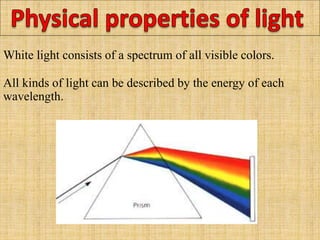
White light consists of a spectrum of all visible colors.
All kinds of light can be described by the energy of each
wavelength.
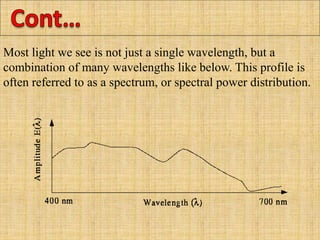
Most light we see is not just a single wavelength, but a
combination of many wavelengths like below. This profile is
often referred to as a spectrum, or spectral power distribution.
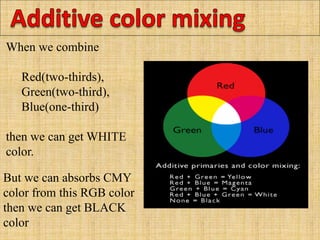
When we combine
Red(two-thirds),
Green(two-third),
Blue(one-third)
then we can get WHITE
color.
But we can absorbs CMY
color from this RGB color
then we can get BLACK
color
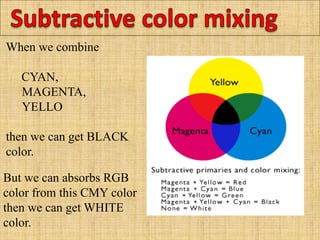
When we combine
CYAN,
MAGENTA,
YELLO
then we can get BLACK
color.
But we can absorbs RGB
color from this CMY color
then we can get WHITE
color.
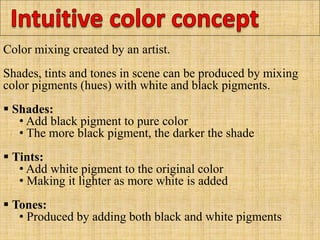
Color mixing created by an artist.
Shades, tints and tones in scene can be produced by mixing
color pigments (hues) with white and black pigments.
 Shades:
• Add black pigment to pure color
• The more black pigment, the darker the shade
 Tints:
• Add white pigment to the original color
• Making it lighter as more white is added
 Tones:
• Produced by adding both black and white pigments
It is the presentation of different basics of achromatic and
chromatic light :-
 Achromatic light:
• It can visual only two color combinations that is of black
and white color pigments.
• Its attributes are intensity, luminance and brightness.
• Its visual as in black & white television or display
monitors.
 Chromatic light:
• It consist of colored light and their combinations, which
produce visual sensation.
• Its attributes are hue, saturation, lightness and brightness
of different colors.
• Its visual as in color television or display.
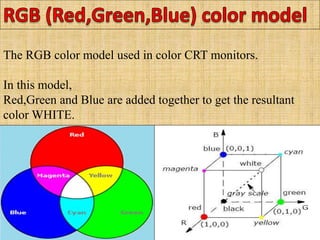
The RGB color model used in color CRT monitors.
In this model,
Red,Green and Blue are added together to get the resultant
color WHITE.
Each color point within the bounds of the cube is represented
as the triple (R,G,B).where value for R,G,B are assigned in the
range from 0 to 1.
Here RGB color place together at 120 degree.
RED + GREEN + BLUE = WHITE(contribute)
All other colors are generated from these three primary colors.
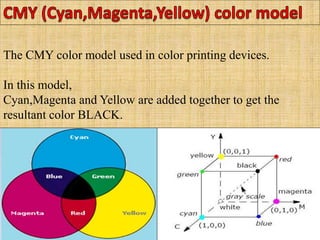
The CMY color model used in color printing devices.
In this model,
Cyan,Magenta and Yellow are added together to get the
resultant color BLACK.
Each color point within the bounds of the cube is represented
as the triple (C,M,Y).where value for C,M,Y are also assigned
in the range from 0 to 1.
Here CMY color also place together at 120 degree.
CYAN+ MAGENTA + YELLO = BLACK(contribute)
All other colors are generated from these three primary colors.
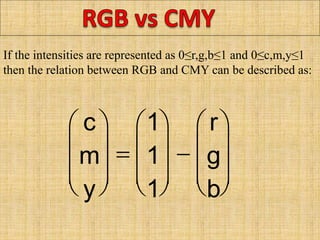
If the intensities are represented as 0≤r,g,b≤1 and 0≤c,m,y≤1
then the relation between RGB and CMY can be described as:




c
m
y 








1
1
1








r
g
b



RGB
+ Cartesian coordinate system
+ linear
+ hardware-based (easy to transform to video)
+ tristimulus-based
- hard to use to pick and name colors
- doesn’t cover gamut of perceivable colors
- non-uniform: equal geometric distance => unequal
perceptual distance
CIE
+ covers gamut of perceived colors
+ based on human perception (matching experiments)
+ linear
+ contains all other spaces
- non-uniform (but variations such as CIE Lab are closer
to Munsell, which is uniform)
- xy-plot of chromaticity horseshoe diagram doesn’t
show luminance
HSV
+ easy to convert to RGB
+ easy to specify colors
- nonlinear
- doesn’t cover gamut of perceivable colors
- nonuniform
For printing & art industry the CMY model is not enough.
So,Fourth primary color K is added to CMY model.
K stands for BLACK color.
Used in electrostatic/ink-jet plotters that deposit pigment
on paper
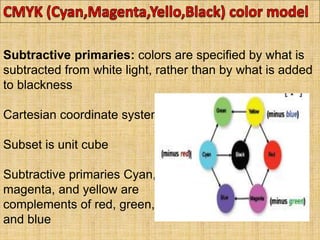
Cyan, magenta, and yellow are complements of red,
green, and blue
Subtractive primaries: colors are specified by what is
subtracted from white light, rather than by what is added
to blackness
Cartesian coordinate system
Subset is unit cube
Subtractive primaries Cyan,
magenta, and yellow are
complements of red, green,
and blue
The YIQ color model is a recoding of RGB color model.
YIQ color model is used for television broadcasting.
The
Y-channel contains luminance information(sufficient for Black
& White television sets)
And
I-channel & Q-channel contains color information.
For recoding RGB to YIQ , HSV & HLS color models are
used.
Inphase = RED – YELLOW
Quadrature = BLUE – YELLOW
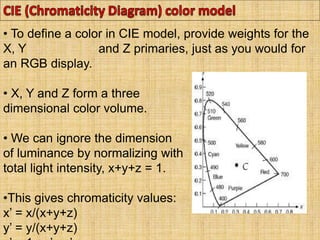
• To define a color in CIE model, provide weights for the
X, Y and Z primaries, just as you would for
an RGB display.
• X, Y and Z form a three
dimensional color volume.
• We can ignore the dimension
of luminance by normalizing with
total light intensity, x+y+z = 1.
•This gives chromaticity values:
x’ = x/(x+y+z)
y’ = y/(x+y+z)
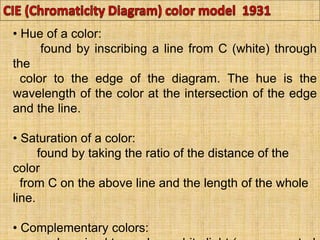
• Hue of a color:
found by inscribing a line from C (white) through
the
color to the edge of the diagram. The hue is the
wavelength of the color at the intersection of the edge
and the line.
• Saturation of a color:
found by taking the ratio of the distance of the
color
from C on the above line and the length of the whole
line.
• Complementary colors:
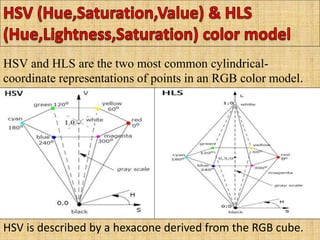
HSV and HLS are the two most common cylindrical-
coordinate representations of points in an RGB color model.
HSV is described by a hexacone derived from the RGB cube.
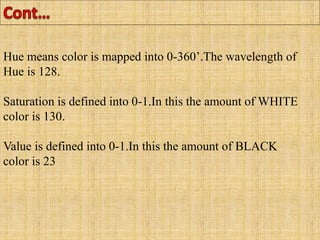
Hue means color is mapped into 0-360’.The wavelength of
Hue is 128.
Saturation is defined into 0-1.In this the amount of WHITE
color is 130.
Value is defined into 0-1.In this the amount of BLACK
color is 23
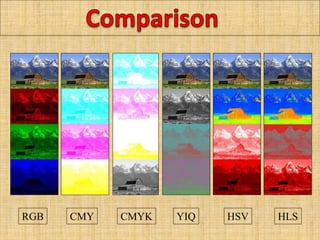
CMY CMYK YIQ HSV HLSRGB
Color models

Color models

  • 2.
    A color modelis a specification of a 3D color co-ordinate system and a visible subset in the co-ordinate System within all colors in a particular color range lie. There are main four types of color models:- (1) RGB (2) CMY (3) YIQ (4) CIE
  • 3.
    But these modelsare not easy to use because they does not relate directly to intuitive color notations of hue, saturation and brightness. Therefore another class of color model has been developed. These includes :- HSV HLS The human eye can perceive about 382000(!) different colors. The distance between two color in the color cube is not a measure.
  • 4.
    White light consistsof a spectrum of all visible colors. All kinds of light can be described by the energy of each wavelength.
  • 5.
    Most light wesee is not just a single wavelength, but a combination of many wavelengths like below. This profile is often referred to as a spectrum, or spectral power distribution.
  • 6.
    When we combine Red(two-thirds), Green(two-third), Blue(one-third) thenwe can get WHITE color. But we can absorbs CMY color from this RGB color then we can get BLACK color
  • 7.
    When we combine CYAN, MAGENTA, YELLO thenwe can get BLACK color. But we can absorbs RGB color from this CMY color then we can get WHITE color.
  • 8.
    Color mixing createdby an artist. Shades, tints and tones in scene can be produced by mixing color pigments (hues) with white and black pigments.  Shades: • Add black pigment to pure color • The more black pigment, the darker the shade  Tints: • Add white pigment to the original color • Making it lighter as more white is added  Tones: • Produced by adding both black and white pigments
  • 9.
    It is thepresentation of different basics of achromatic and chromatic light :-  Achromatic light: • It can visual only two color combinations that is of black and white color pigments. • Its attributes are intensity, luminance and brightness. • Its visual as in black & white television or display monitors.  Chromatic light: • It consist of colored light and their combinations, which produce visual sensation. • Its attributes are hue, saturation, lightness and brightness of different colors. • Its visual as in color television or display.
  • 10.
    The RGB colormodel used in color CRT monitors. In this model, Red,Green and Blue are added together to get the resultant color WHITE.
  • 11.
    Each color pointwithin the bounds of the cube is represented as the triple (R,G,B).where value for R,G,B are assigned in the range from 0 to 1. Here RGB color place together at 120 degree. RED + GREEN + BLUE = WHITE(contribute) All other colors are generated from these three primary colors.
  • 12.
    The CMY colormodel used in color printing devices. In this model, Cyan,Magenta and Yellow are added together to get the resultant color BLACK.
  • 13.
    Each color pointwithin the bounds of the cube is represented as the triple (C,M,Y).where value for C,M,Y are also assigned in the range from 0 to 1. Here CMY color also place together at 120 degree. CYAN+ MAGENTA + YELLO = BLACK(contribute) All other colors are generated from these three primary colors.
  • 14.
    If the intensitiesare represented as 0≤r,g,b≤1 and 0≤c,m,y≤1 then the relation between RGB and CMY can be described as:     c m y          1 1 1         r g b   
  • 15.
    RGB + Cartesian coordinatesystem + linear + hardware-based (easy to transform to video) + tristimulus-based - hard to use to pick and name colors - doesn’t cover gamut of perceivable colors - non-uniform: equal geometric distance => unequal perceptual distance
  • 16.
    CIE + covers gamutof perceived colors + based on human perception (matching experiments) + linear + contains all other spaces - non-uniform (but variations such as CIE Lab are closer to Munsell, which is uniform) - xy-plot of chromaticity horseshoe diagram doesn’t show luminance
  • 17.
    HSV + easy toconvert to RGB + easy to specify colors - nonlinear - doesn’t cover gamut of perceivable colors - nonuniform
  • 18.
    For printing &art industry the CMY model is not enough. So,Fourth primary color K is added to CMY model. K stands for BLACK color. Used in electrostatic/ink-jet plotters that deposit pigment on paper Cyan, magenta, and yellow are complements of red, green, and blue
  • 19.
    Subtractive primaries: colorsare specified by what is subtracted from white light, rather than by what is added to blackness Cartesian coordinate system Subset is unit cube Subtractive primaries Cyan, magenta, and yellow are complements of red, green, and blue
  • 20.
    The YIQ colormodel is a recoding of RGB color model. YIQ color model is used for television broadcasting. The Y-channel contains luminance information(sufficient for Black & White television sets) And I-channel & Q-channel contains color information. For recoding RGB to YIQ , HSV & HLS color models are used. Inphase = RED – YELLOW Quadrature = BLUE – YELLOW
  • 21.
    • To definea color in CIE model, provide weights for the X, Y and Z primaries, just as you would for an RGB display. • X, Y and Z form a three dimensional color volume. • We can ignore the dimension of luminance by normalizing with total light intensity, x+y+z = 1. •This gives chromaticity values: x’ = x/(x+y+z) y’ = y/(x+y+z)
  • 22.
    • Hue ofa color: found by inscribing a line from C (white) through the color to the edge of the diagram. The hue is the wavelength of the color at the intersection of the edge and the line. • Saturation of a color: found by taking the ratio of the distance of the color from C on the above line and the length of the whole line. • Complementary colors:
  • 23.
    HSV and HLSare the two most common cylindrical- coordinate representations of points in an RGB color model. HSV is described by a hexacone derived from the RGB cube.
  • 24.
    Hue means coloris mapped into 0-360’.The wavelength of Hue is 128. Saturation is defined into 0-1.In this the amount of WHITE color is 130. Value is defined into 0-1.In this the amount of BLACK color is 23
  • 25.
    CMY CMYK YIQHSV HLSRGB