Measurement of
Colour
HOW MATERIALS MODIFY LIGHT
• Scattering
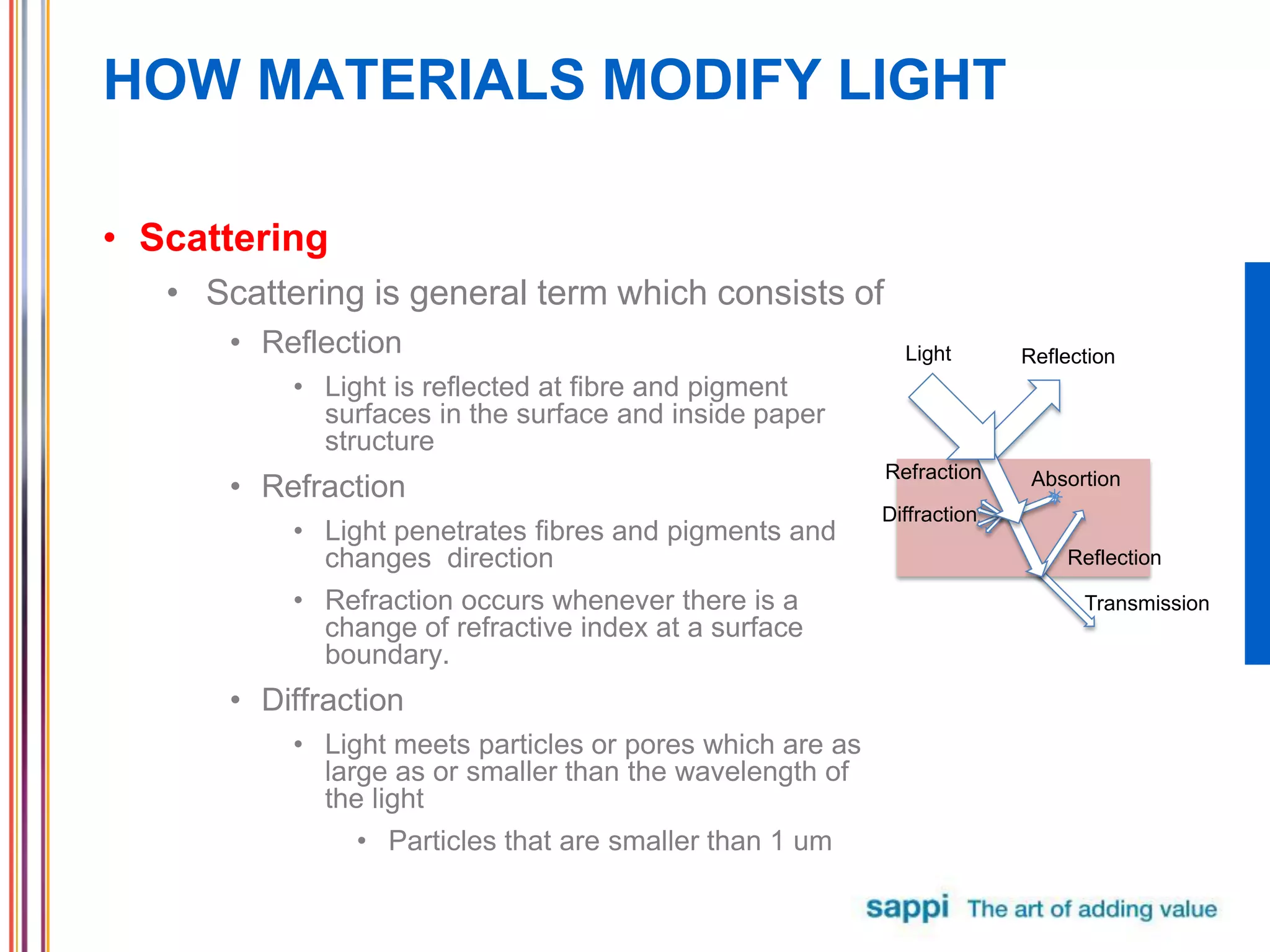
• Scattering is general term which consists of
• Reflection
• Light is reflected at fibre and pigment
surfaces in the surface and inside paper
structure
• Refraction
• Light penetrates fibres and pigments and
changes direction
• Refraction occurs whenever there is a
change of refractive index at a surface
boundary.
• Diffraction
• Light meets particles or pores which are as
large as or smaller than the wavelength of
the light
• Particles that are smaller than 1 um
Light Reflection
Absortion
Transmission
Refraction
Reflection
Diffraction
HOW MATERIALS MODIFY LIGHT
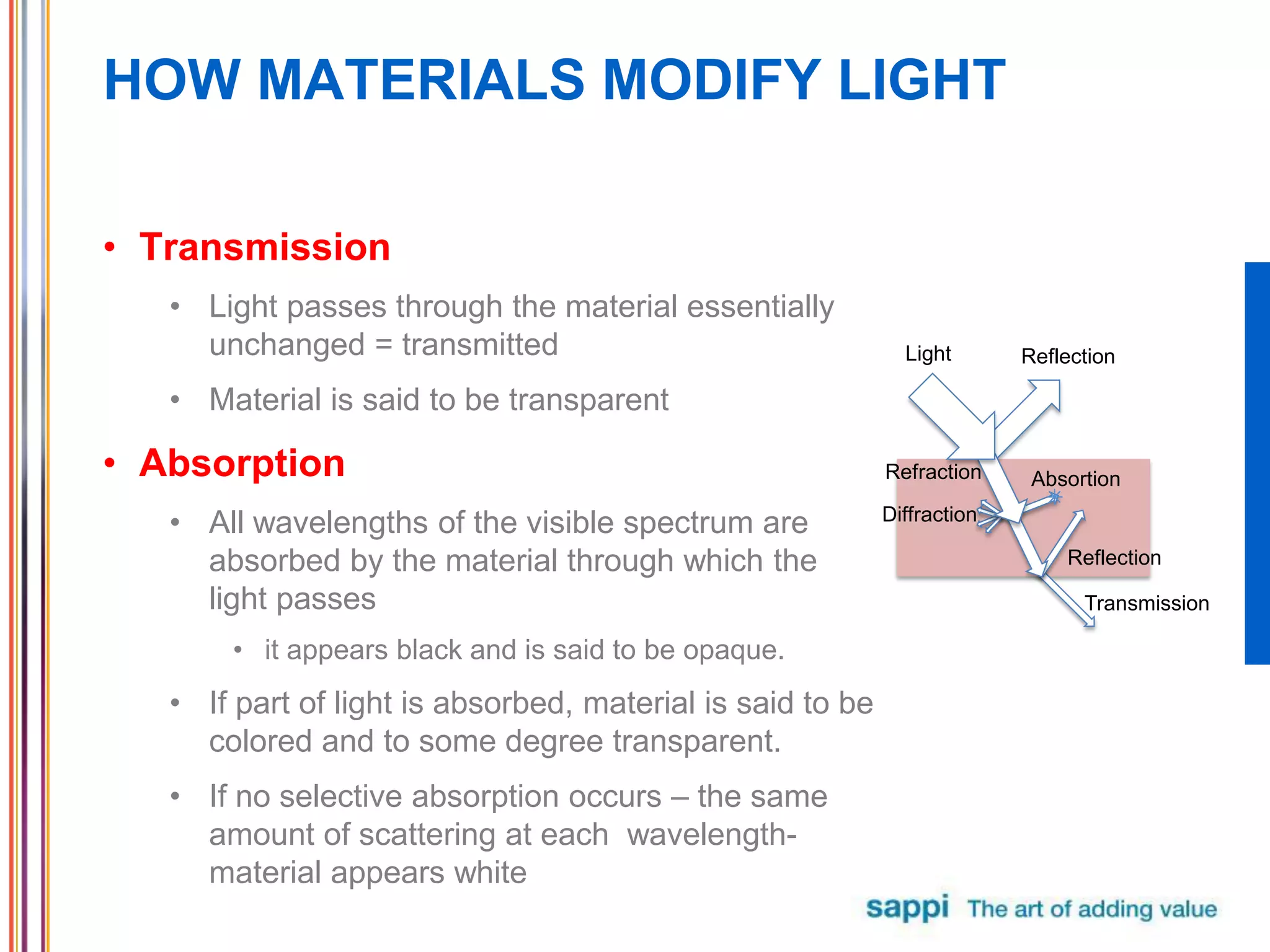
• Transmission
• Light passes through the material essentially
unchanged = transmitted
• Material is said to be transparent
• Absorption
• All wavelengths of the visible spectrum are
absorbed by the material through which the
light passes
• it appears black and is said to be opaque.
• If part of light is absorbed, material is said to be
colored and to some degree transparent.
• If no selective absorption occurs – the same
amount of scattering at each wavelength-
material appears white
Light Reflection
Absortion
Transmission
Refraction
Reflection
Diffraction
HOW MATERIALS MODIFY LIGHT
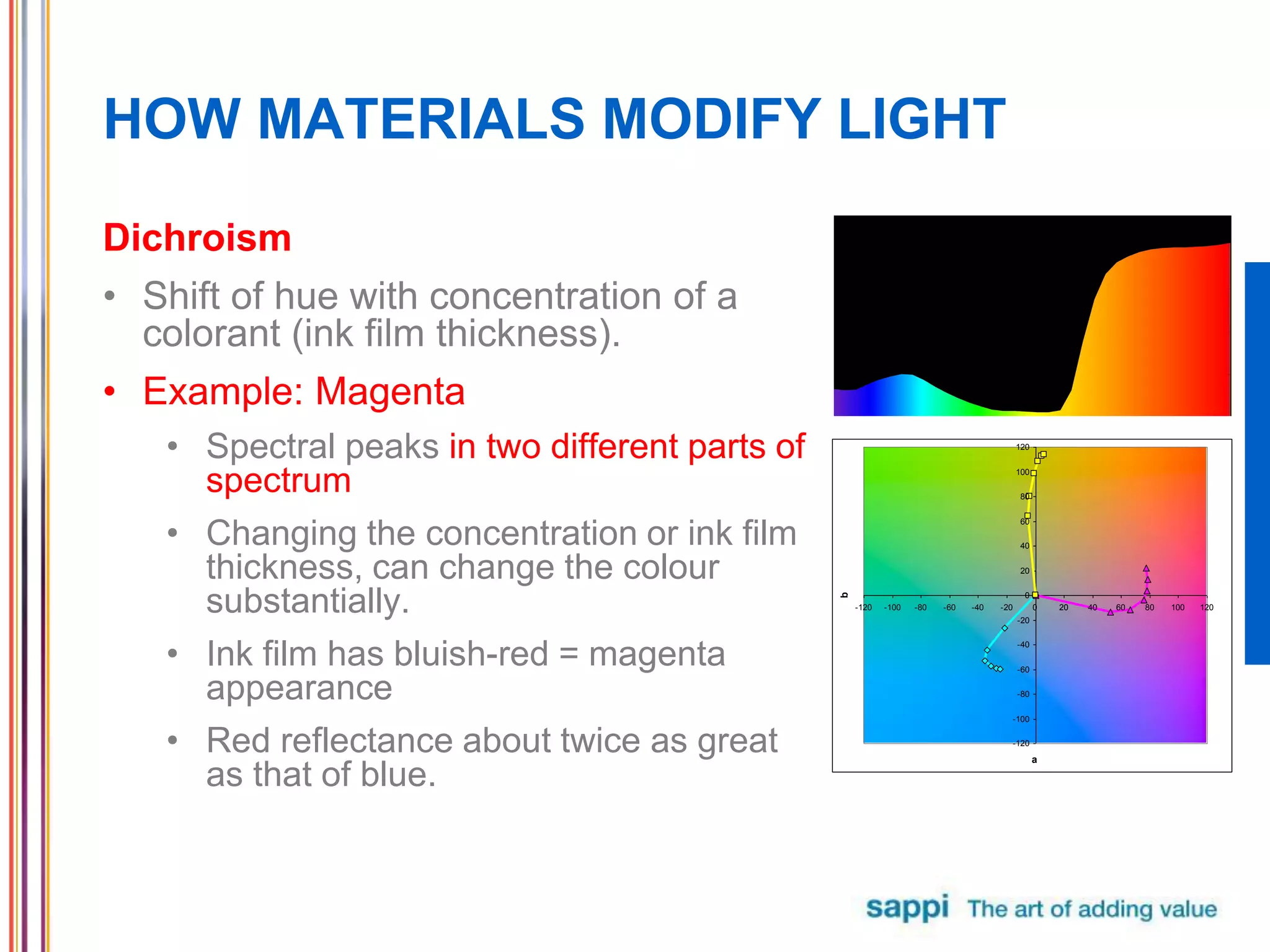
Dichroism
• Shift of hue with concentration of a
colorant (ink film thickness).
• Example: Magenta
• Spectral peaks in two different parts of
spectrum
• Changing the concentration or ink film
thickness, can change the colour
substantially.
• Ink film has bluish-red = magenta
appearance
• Red reflectance about twice as great
as that of blue.
Magenta
0
0,5
1
380
400
420
440
460
480
500
520
540
560
580
600
620
640
660
680
700
720
nm
-120
-100
-80
-60
-40
-20
0
20
40
60
80
100
120
-120 -100 -80 -60 -40 -20 0 20 40 60 80 100 120
a
b
PRINCIPLES OF SPECTROSCOPY AND
DENSITOMETRY
• Science of the measurement of color - spectroscopy.
• Spectroscopy
– Used to measure all electromagnetic spectra, not just visible.
– Unsaturated molecules absorb UV light- UV spectrum is
measured
– Technique of measuring absorption (transmission) by molecules.
• Densitometry
– used in multicolour printing
– broad-band filters are used.
Measuring devices
• Tabletop devices
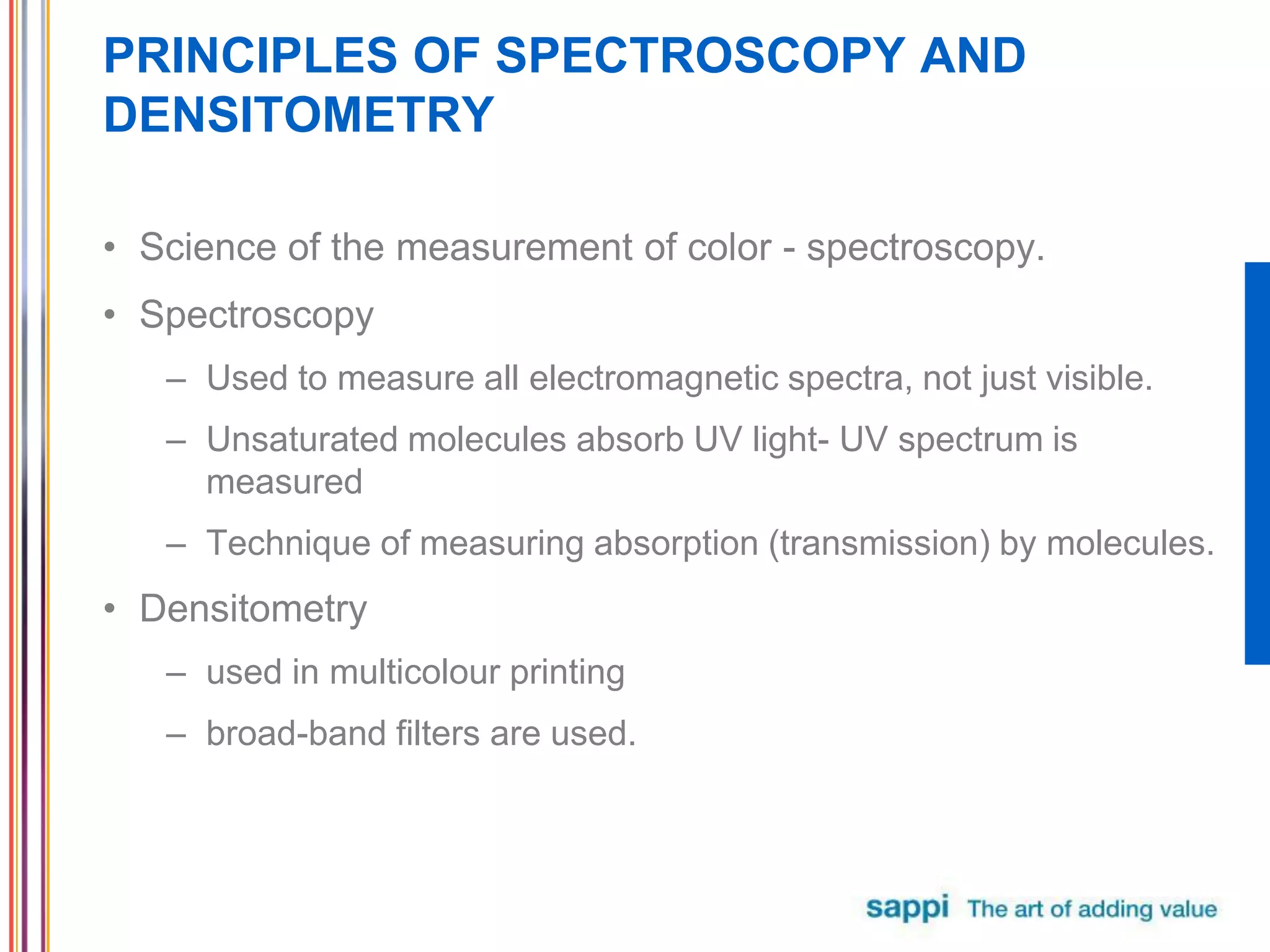
– Used in paper industry (Elrepho, ColourTouch)
– From the spectral data several optical measures
are calculated
– colour, brightness, opacity, whiteness
– Measurement geometry: d/0°
– Light source: Pulsed Xenon lamp, D65 filtered
– UV levels: D65 and C, automatically controlled
Measuring devices
• Handheld devices
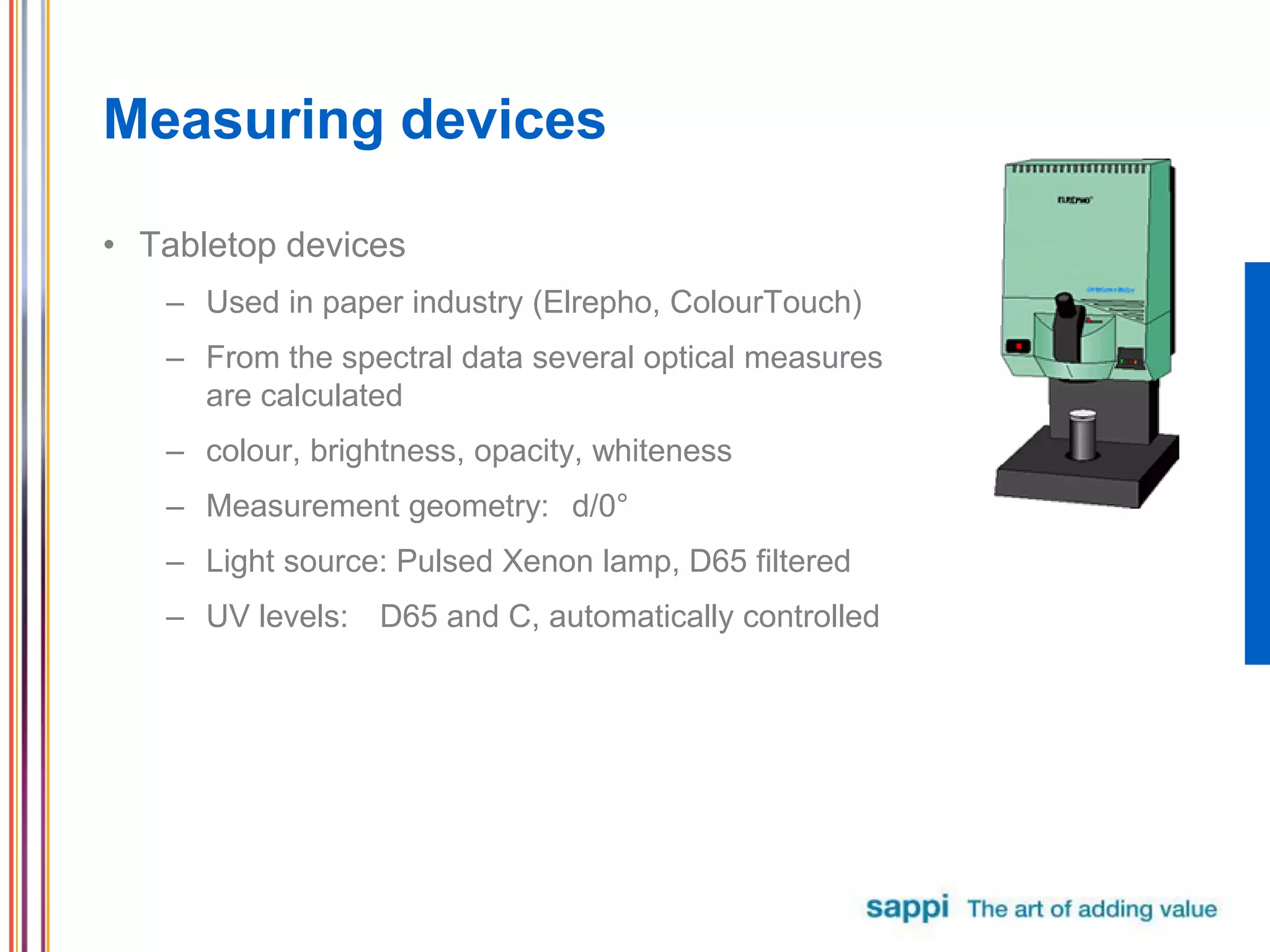
– Used in printing industry (X-rite, Techkon)
– From the spectral data several optical measures
are calculated like colour, print density
– Measurement geometry: 45°/ 0°
– Light source: Gas filled tungsten, type A
illumination
– UV levels: Specified by light source
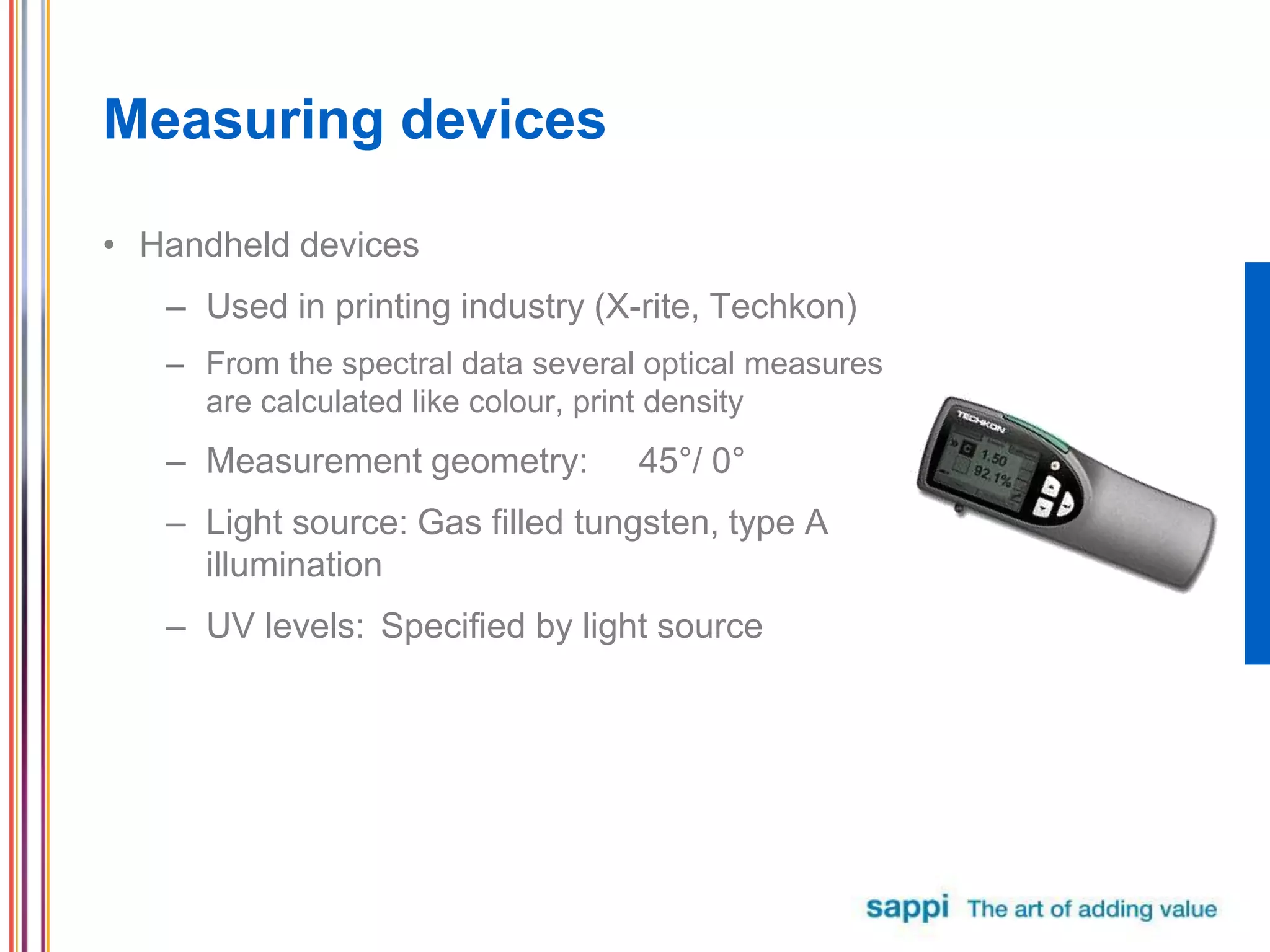
Colour measurements are based on
spectral response
• Different variables can be
calculated from spectrum as
– Colour expressed in
L*a*b*colour space
– Print density which uses
filters to block unwanted
wavelengths White paper
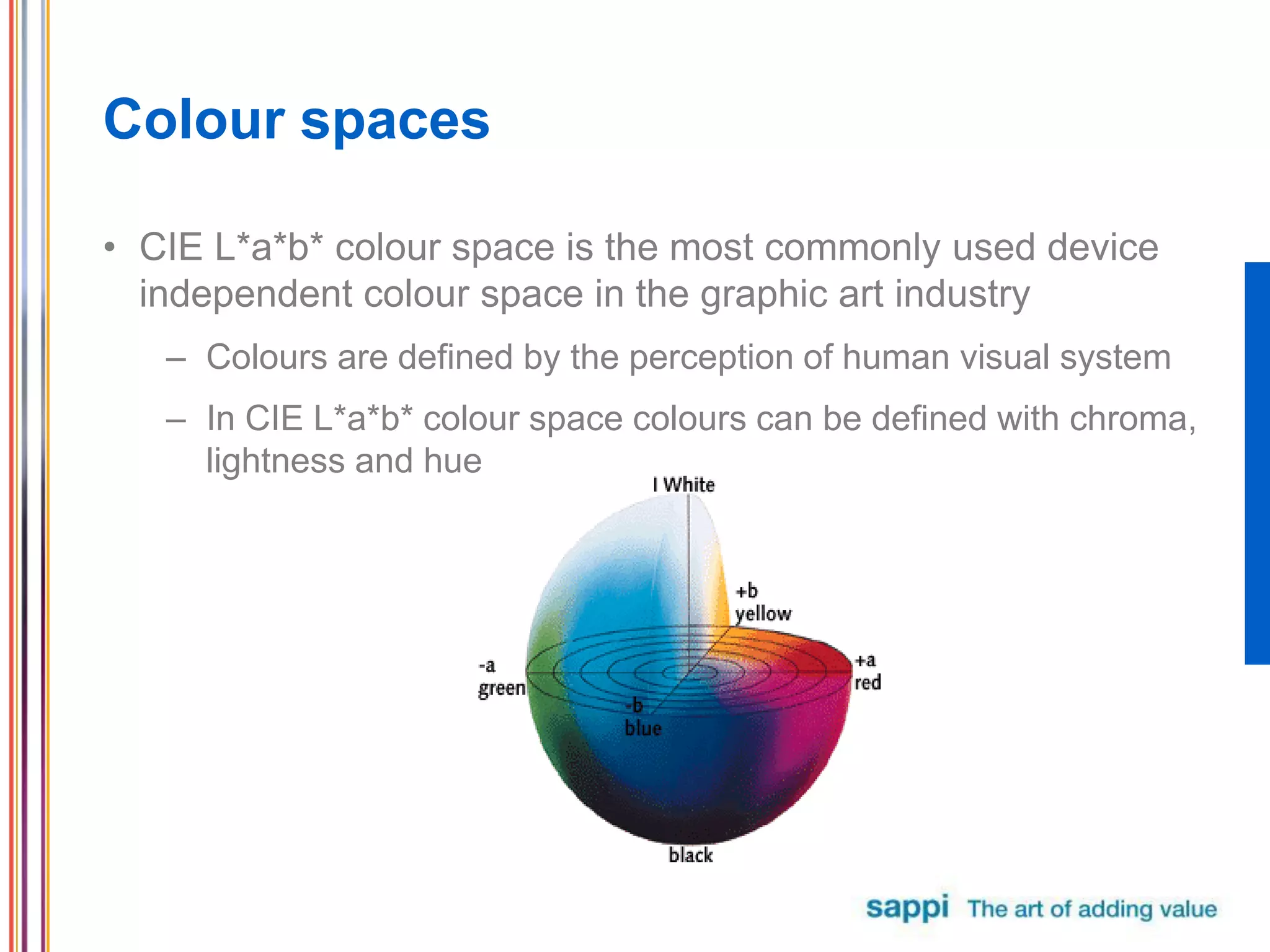
Colour spaces
• CIE L*a*b* colour space is the most commonly used device
independent colour space in the graphic art industry
– Colours are defined by the perception of human visual system
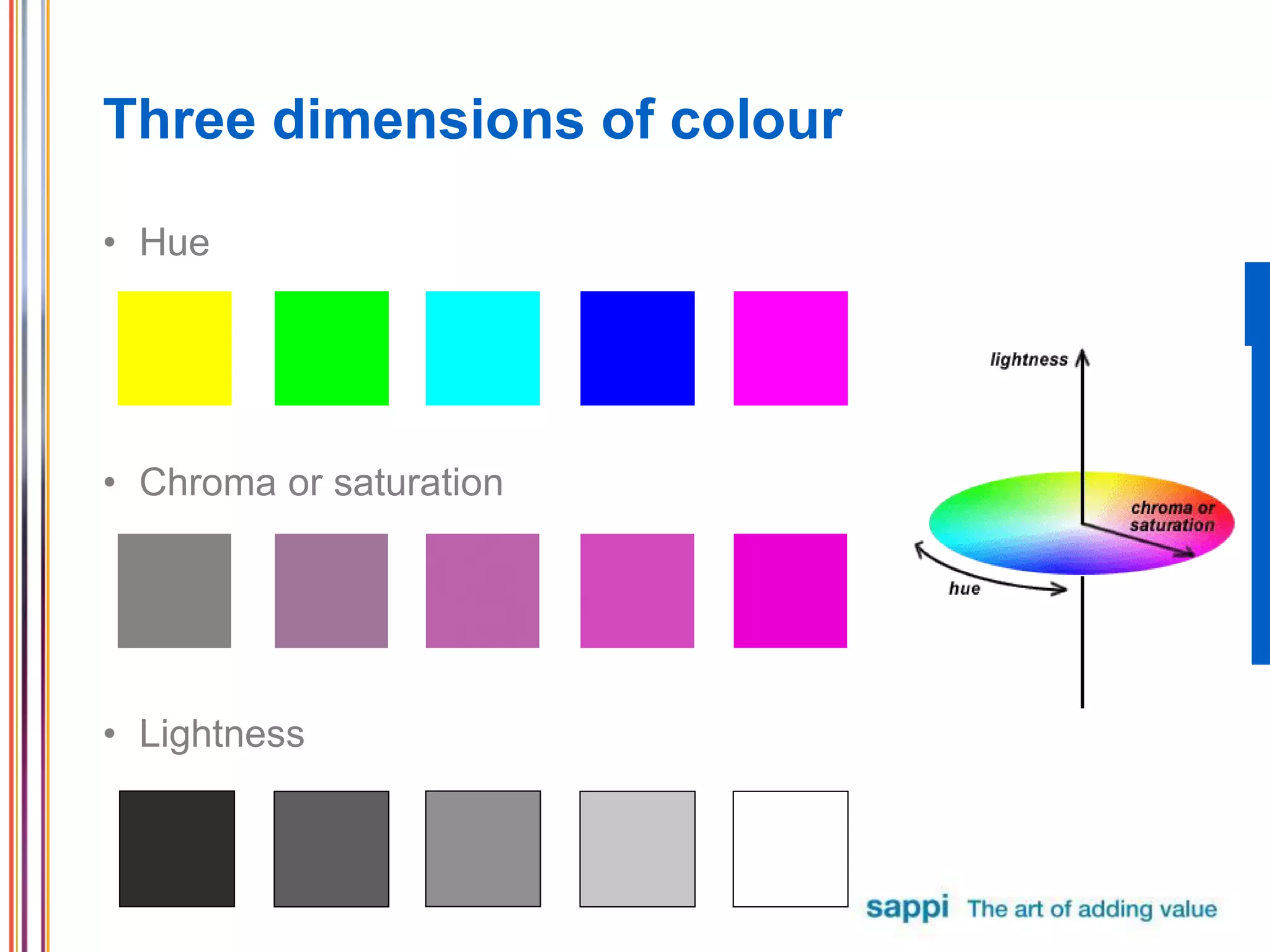
– In CIE L*a*b* colour space colours can be defined with chroma,
lightness and hue
Three dimensions of colour
• Hue
• Chroma or saturation
• Lightness
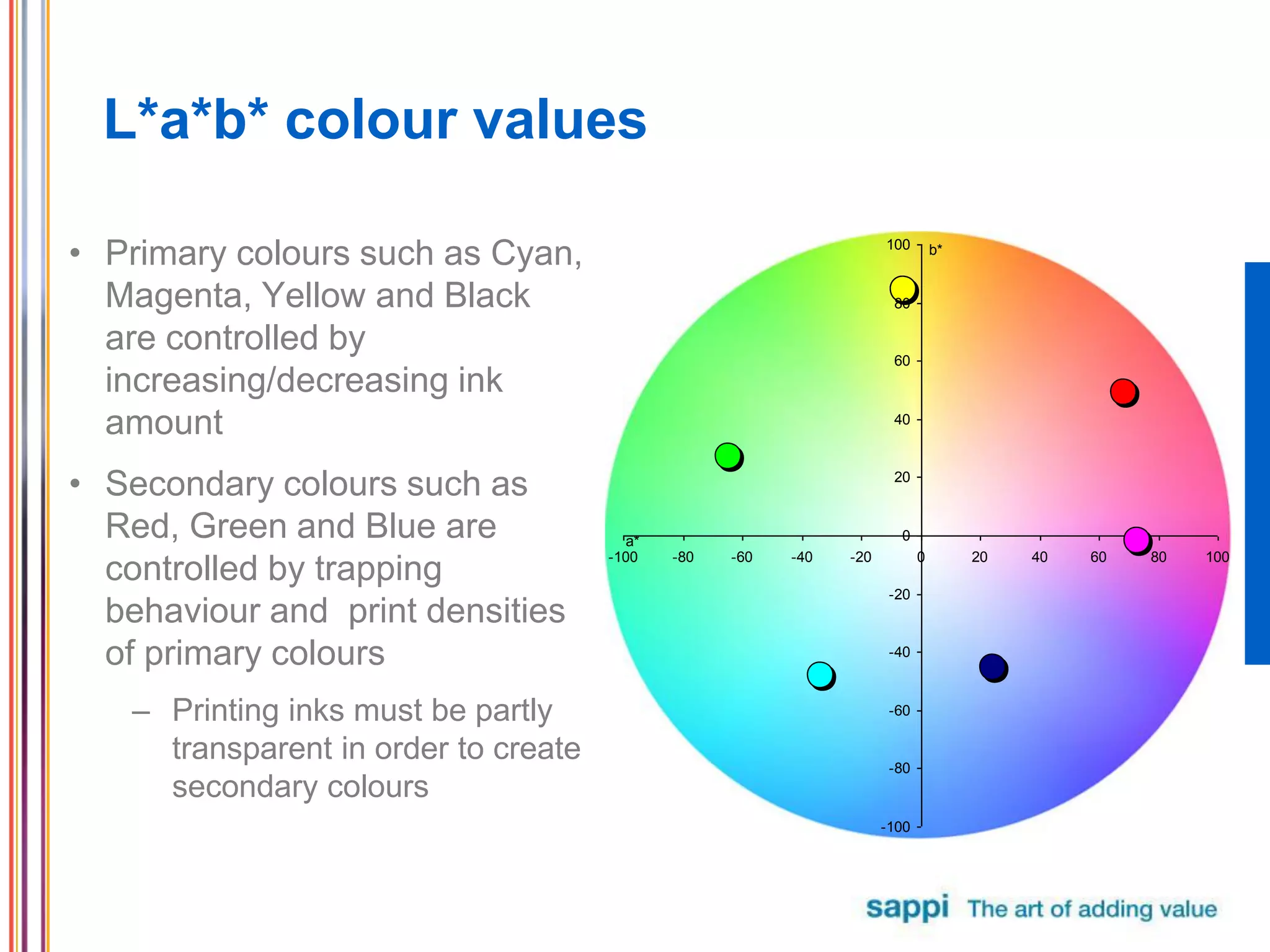
L*a*b* colour values
• Primary colours such as Cyan,
Magenta, Yellow and Black
are controlled by
increasing/decreasing ink
amount
• Secondary colours such as
Red, Green and Blue are
controlled by trapping
behaviour and print densities
of primary colours
– Printing inks must be partly
transparent in order to create
secondary colours
-100
-80
-60
-40
-20
0
20
40
60
80
100
-100 -80 -60 -40 -20 0 20 40 60 80 100
b*
a*
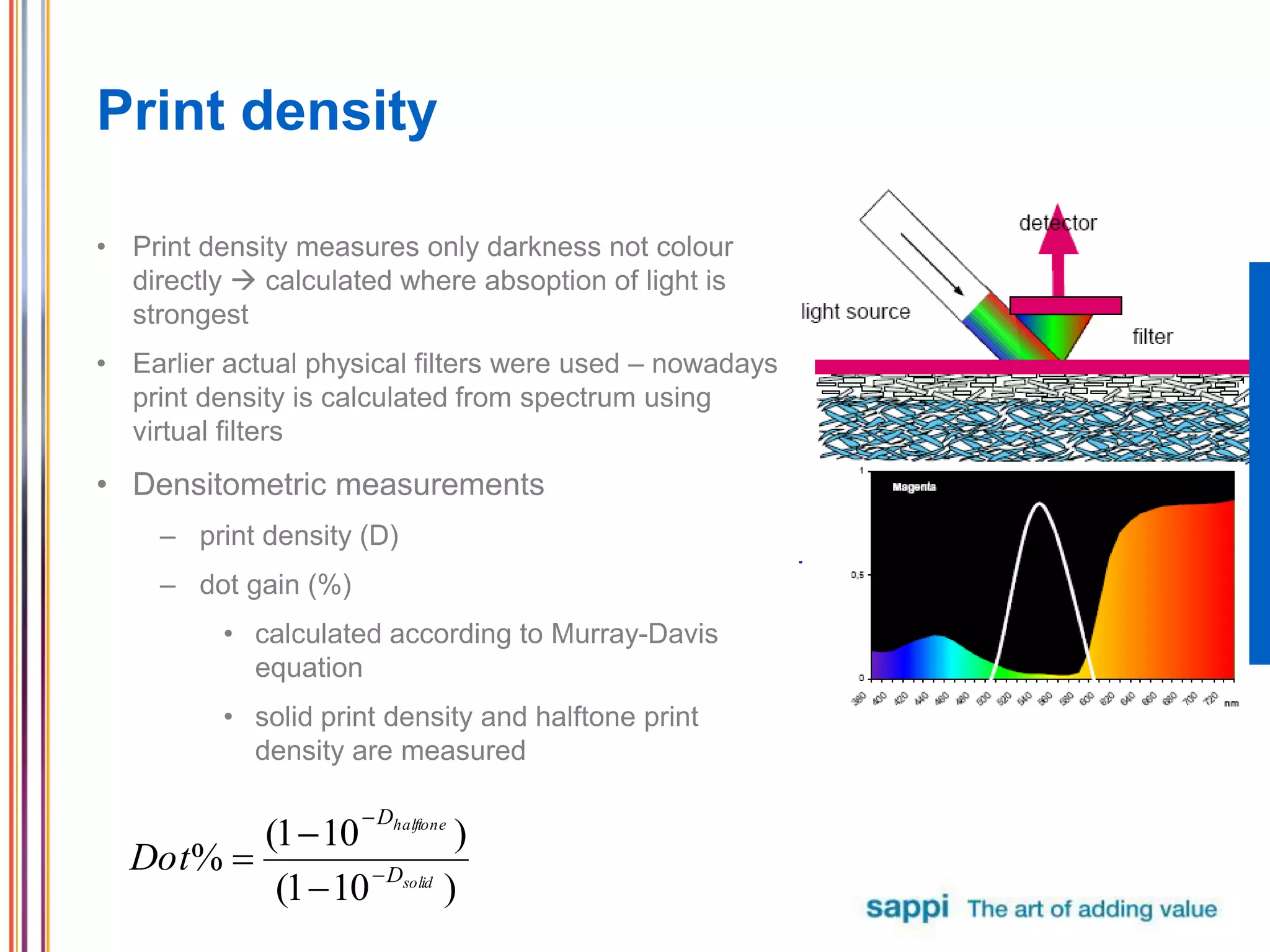
Print density
• Print density measures only darkness not colour
directly  calculated where absoption of light is
strongest
• Earlier actual physical filters were used – nowadays
print density is calculated from spectrum using
virtual filters
• Densitometric measurements
– print density (D)
– dot gain (%)
• calculated according to Murray-Davis
equation
• solid print density and halftone print
density are measured
)101(
)101(
% solid
halftone
D
D
Dot 




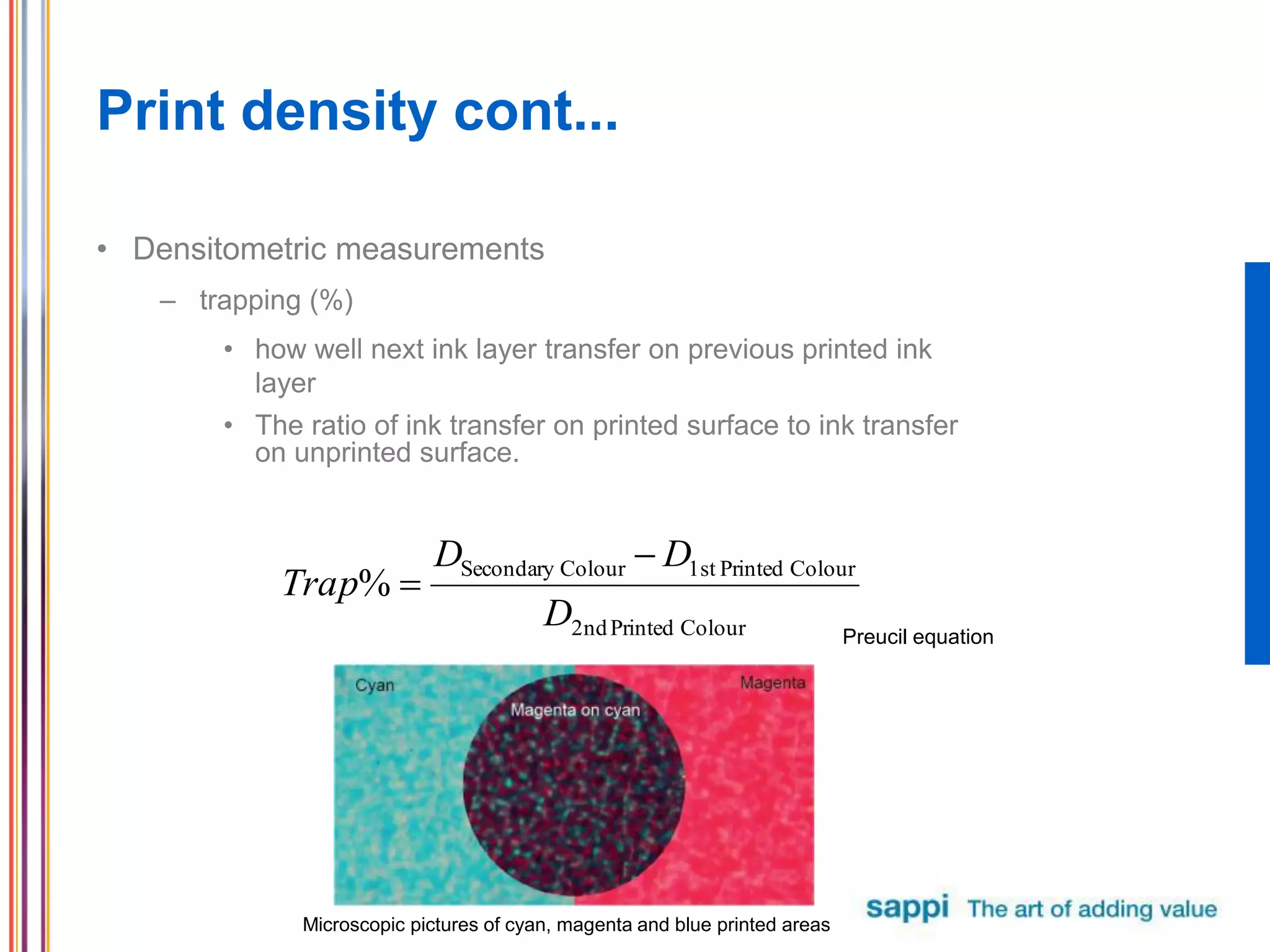
Print density cont...
• Densitometric measurements
– trapping (%)
• how well next ink layer transfer on previous printed ink
layer
• The ratio of ink transfer on printed surface to ink transfer
on unprinted surface.
Microscopic pictures of cyan, magenta and blue printed areas
ColourPrinted2nd
ColourPrinted1stColourSecondary
%
D
DD
Trap


Preucil equation
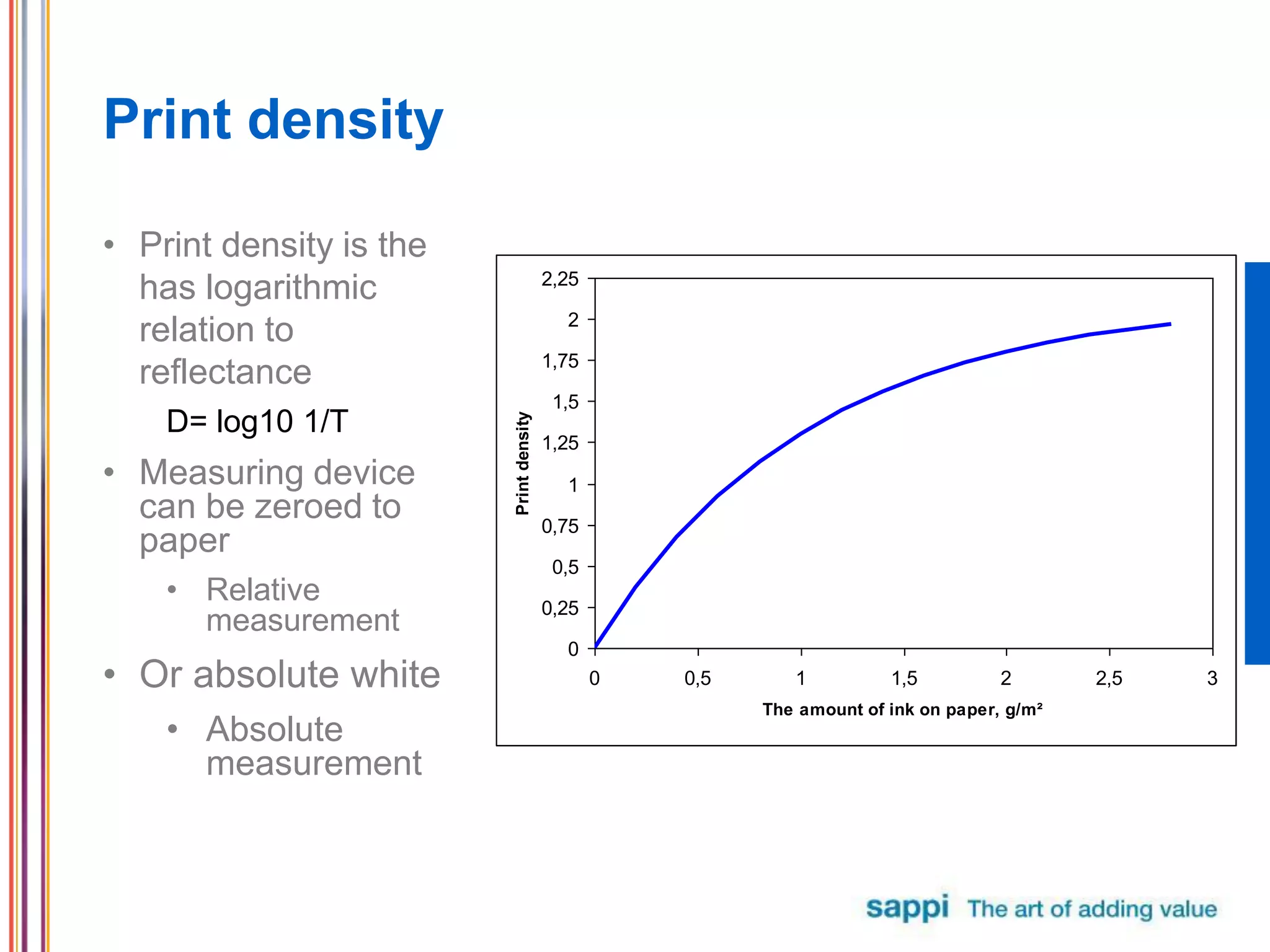
Print density
• Print density is the
has logarithmic
relation to
reflectance
D= log10 1/T
• Measuring device
can be zeroed to
paper
• Relative
measurement
• Or absolute white
• Absolute
measurement
0
0,25
0,5
0,75
1
1,25
1,5
1,75
2
2,25
0 0,5 1 1,5 2 2,5 3
The amount of ink on paper, g/m²
Printdensity

Measurement of colour

  • 1.
  • 2.
    HOW MATERIALS MODIFYLIGHT • Scattering • Scattering is general term which consists of • Reflection • Light is reflected at fibre and pigment surfaces in the surface and inside paper structure • Refraction • Light penetrates fibres and pigments and changes direction • Refraction occurs whenever there is a change of refractive index at a surface boundary. • Diffraction • Light meets particles or pores which are as large as or smaller than the wavelength of the light • Particles that are smaller than 1 um Light Reflection Absortion Transmission Refraction Reflection Diffraction
  • 3.
    HOW MATERIALS MODIFYLIGHT • Transmission • Light passes through the material essentially unchanged = transmitted • Material is said to be transparent • Absorption • All wavelengths of the visible spectrum are absorbed by the material through which the light passes • it appears black and is said to be opaque. • If part of light is absorbed, material is said to be colored and to some degree transparent. • If no selective absorption occurs – the same amount of scattering at each wavelength- material appears white Light Reflection Absortion Transmission Refraction Reflection Diffraction
  • 4.
    HOW MATERIALS MODIFYLIGHT Dichroism • Shift of hue with concentration of a colorant (ink film thickness). • Example: Magenta • Spectral peaks in two different parts of spectrum • Changing the concentration or ink film thickness, can change the colour substantially. • Ink film has bluish-red = magenta appearance • Red reflectance about twice as great as that of blue. Magenta 0 0,5 1 380 400 420 440 460 480 500 520 540 560 580 600 620 640 660 680 700 720 nm -120 -100 -80 -60 -40 -20 0 20 40 60 80 100 120 -120 -100 -80 -60 -40 -20 0 20 40 60 80 100 120 a b
  • 5.
    PRINCIPLES OF SPECTROSCOPYAND DENSITOMETRY • Science of the measurement of color - spectroscopy. • Spectroscopy – Used to measure all electromagnetic spectra, not just visible. – Unsaturated molecules absorb UV light- UV spectrum is measured – Technique of measuring absorption (transmission) by molecules. • Densitometry – used in multicolour printing – broad-band filters are used.
  • 6.
    Measuring devices • Tabletopdevices – Used in paper industry (Elrepho, ColourTouch) – From the spectral data several optical measures are calculated – colour, brightness, opacity, whiteness – Measurement geometry: d/0° – Light source: Pulsed Xenon lamp, D65 filtered – UV levels: D65 and C, automatically controlled
  • 7.
    Measuring devices • Handhelddevices – Used in printing industry (X-rite, Techkon) – From the spectral data several optical measures are calculated like colour, print density – Measurement geometry: 45°/ 0° – Light source: Gas filled tungsten, type A illumination – UV levels: Specified by light source
  • 8.
    Colour measurements arebased on spectral response • Different variables can be calculated from spectrum as – Colour expressed in L*a*b*colour space – Print density which uses filters to block unwanted wavelengths White paper
  • 9.
    Colour spaces • CIEL*a*b* colour space is the most commonly used device independent colour space in the graphic art industry – Colours are defined by the perception of human visual system – In CIE L*a*b* colour space colours can be defined with chroma, lightness and hue
  • 10.
    Three dimensions ofcolour • Hue • Chroma or saturation • Lightness
  • 11.
    L*a*b* colour values •Primary colours such as Cyan, Magenta, Yellow and Black are controlled by increasing/decreasing ink amount • Secondary colours such as Red, Green and Blue are controlled by trapping behaviour and print densities of primary colours – Printing inks must be partly transparent in order to create secondary colours -100 -80 -60 -40 -20 0 20 40 60 80 100 -100 -80 -60 -40 -20 0 20 40 60 80 100 b* a*
  • 12.
    Print density • Printdensity measures only darkness not colour directly  calculated where absoption of light is strongest • Earlier actual physical filters were used – nowadays print density is calculated from spectrum using virtual filters • Densitometric measurements – print density (D) – dot gain (%) • calculated according to Murray-Davis equation • solid print density and halftone print density are measured )101( )101( % solid halftone D D Dot     
  • 13.
    Print density cont... •Densitometric measurements – trapping (%) • how well next ink layer transfer on previous printed ink layer • The ratio of ink transfer on printed surface to ink transfer on unprinted surface. Microscopic pictures of cyan, magenta and blue printed areas ColourPrinted2nd ColourPrinted1stColourSecondary % D DD Trap   Preucil equation
  • 14.
    Print density • Printdensity is the has logarithmic relation to reflectance D= log10 1/T • Measuring device can be zeroed to paper • Relative measurement • Or absolute white • Absolute measurement 0 0,25 0,5 0,75 1 1,25 1,5 1,75 2 2,25 0 0,5 1 1,5 2 2,5 3 The amount of ink on paper, g/m² Printdensity