COS
Granch Berhe
2
3
4
5
6
7
8
9
Color order
systems
And Color spaces
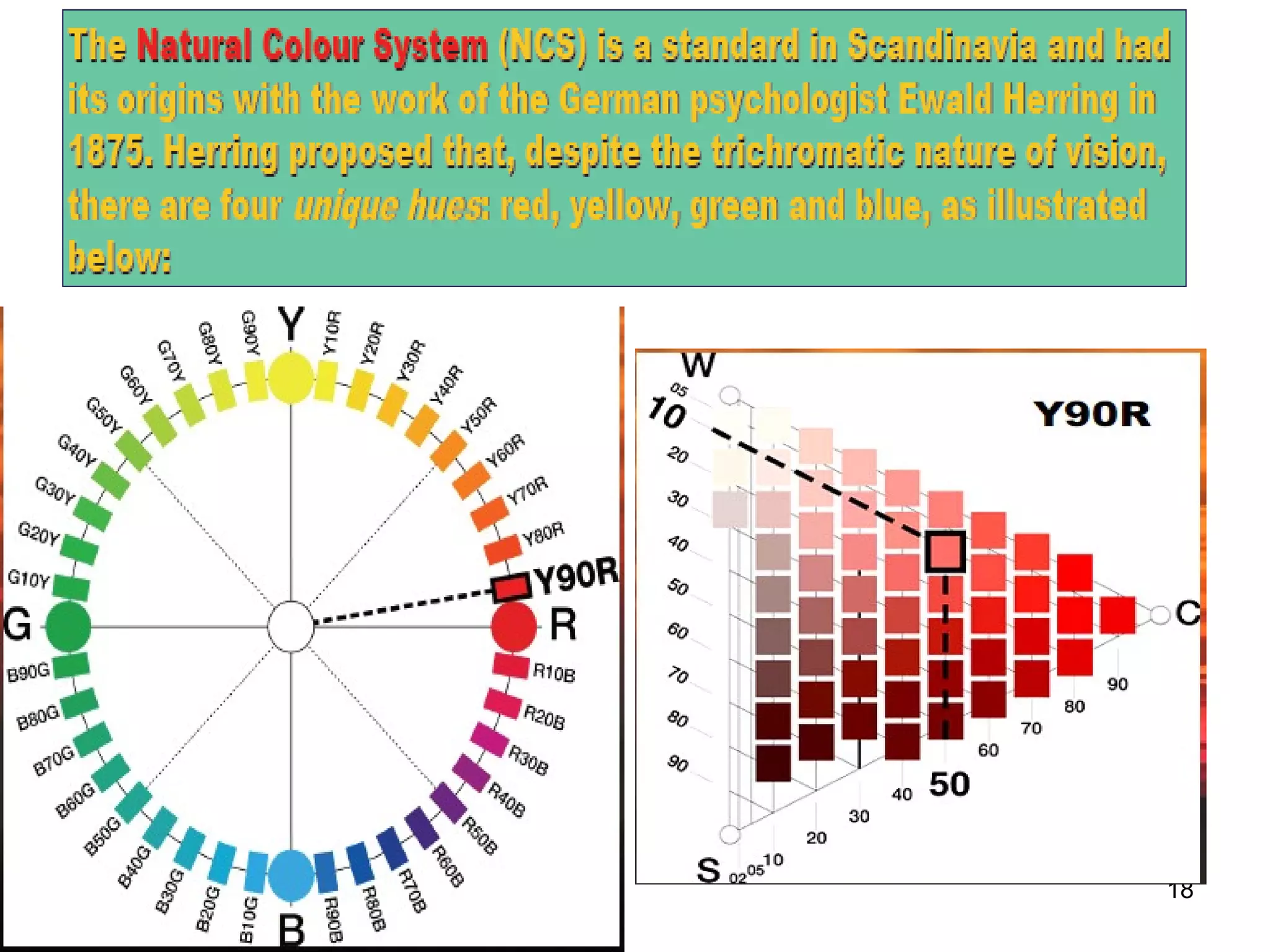
NCS
XYZ
Munsell
CIE Lab
CIE xyY
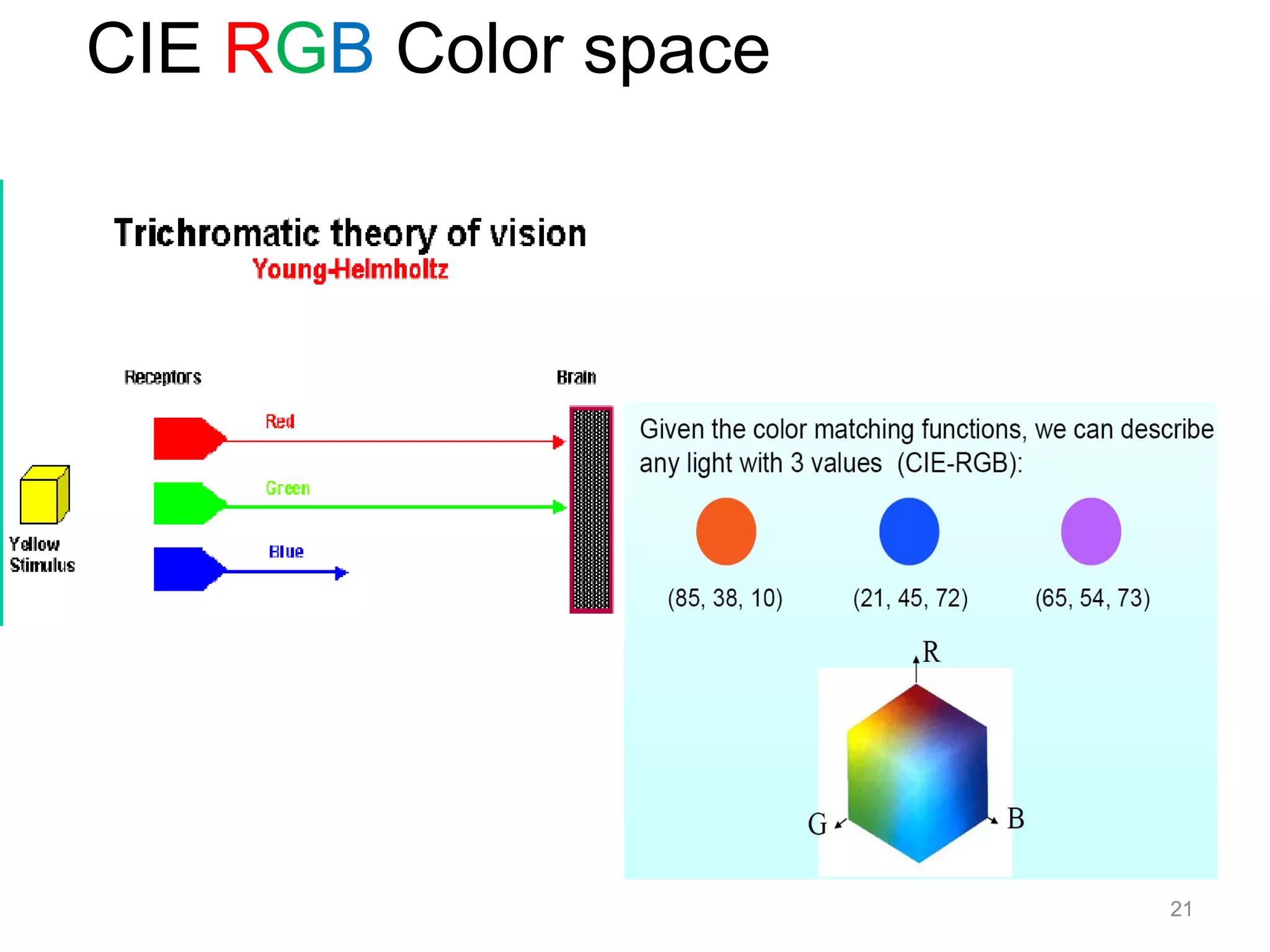
CIE RGB
11
12
13
14
15
16
17
18
20
Color systems
21
CIE RGB Color space
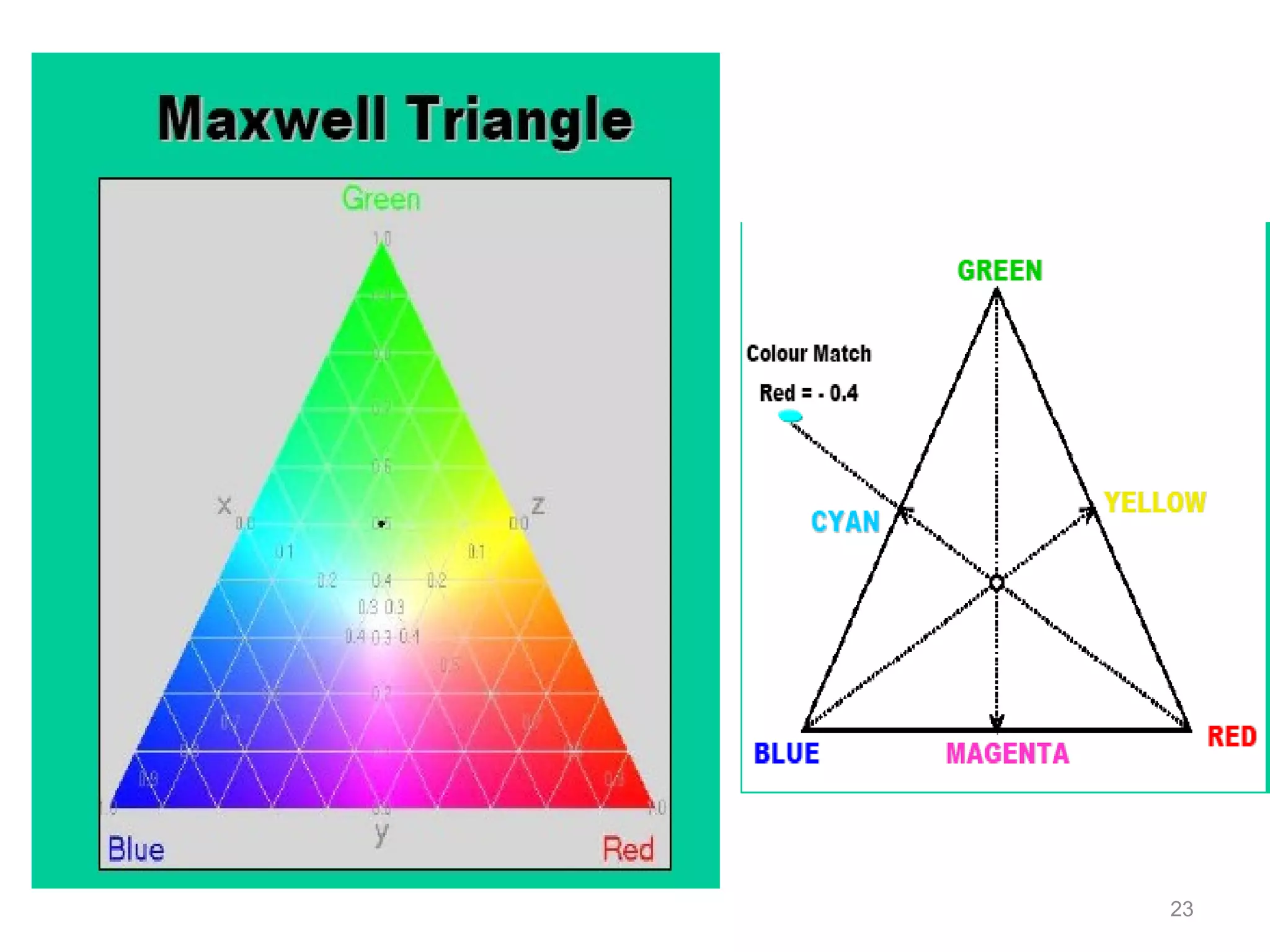
23
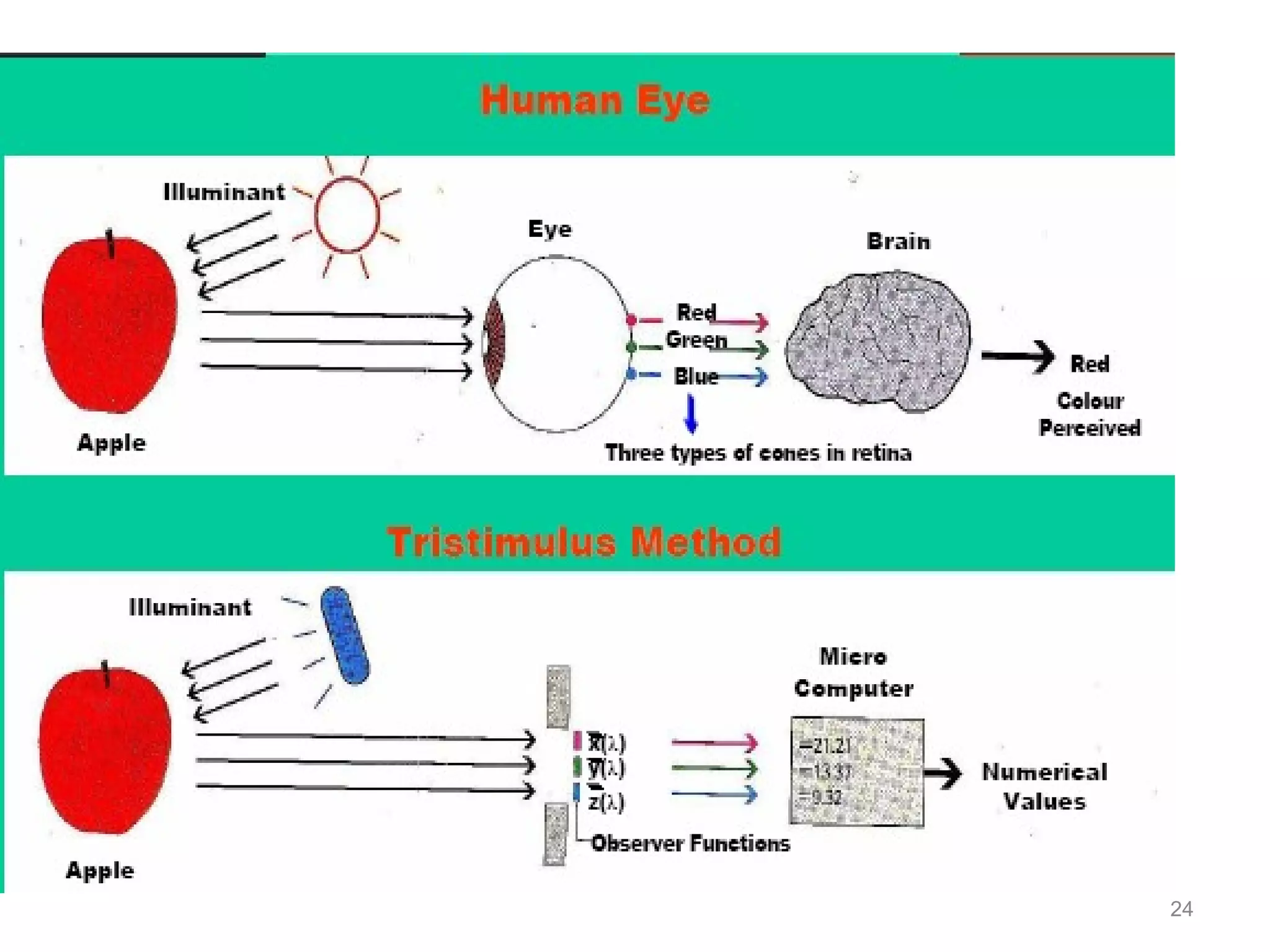
24
25
26
27
28
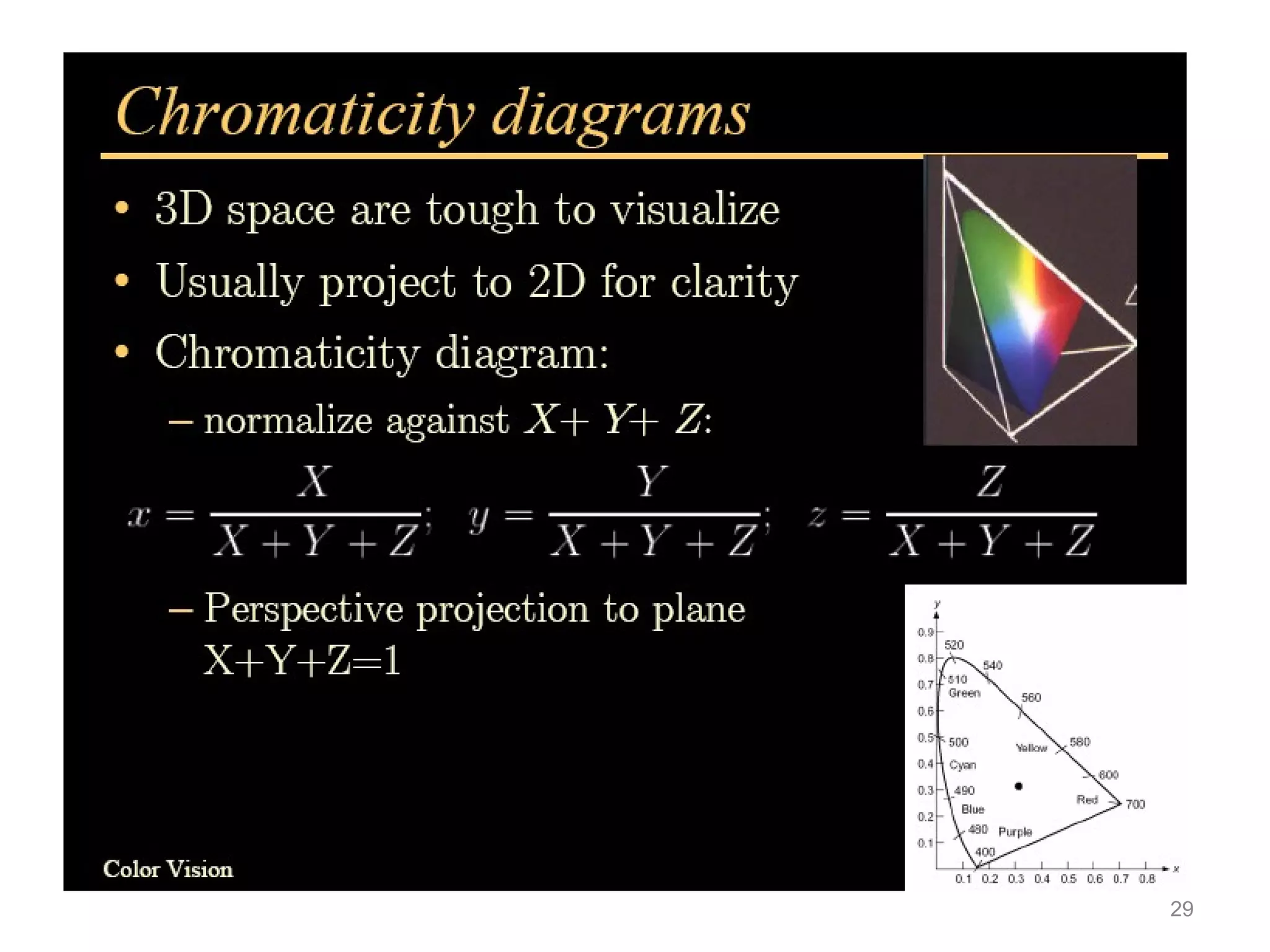
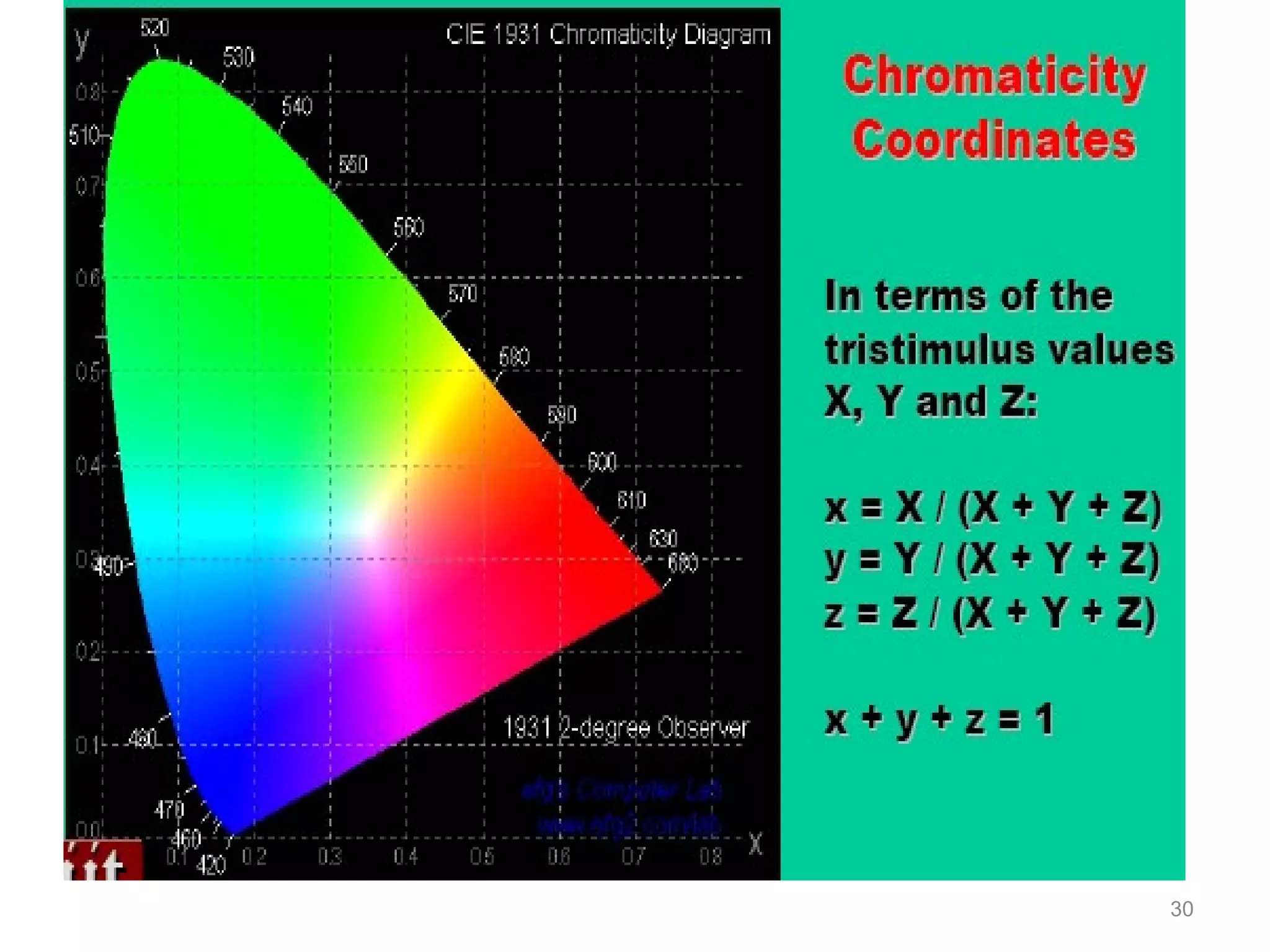
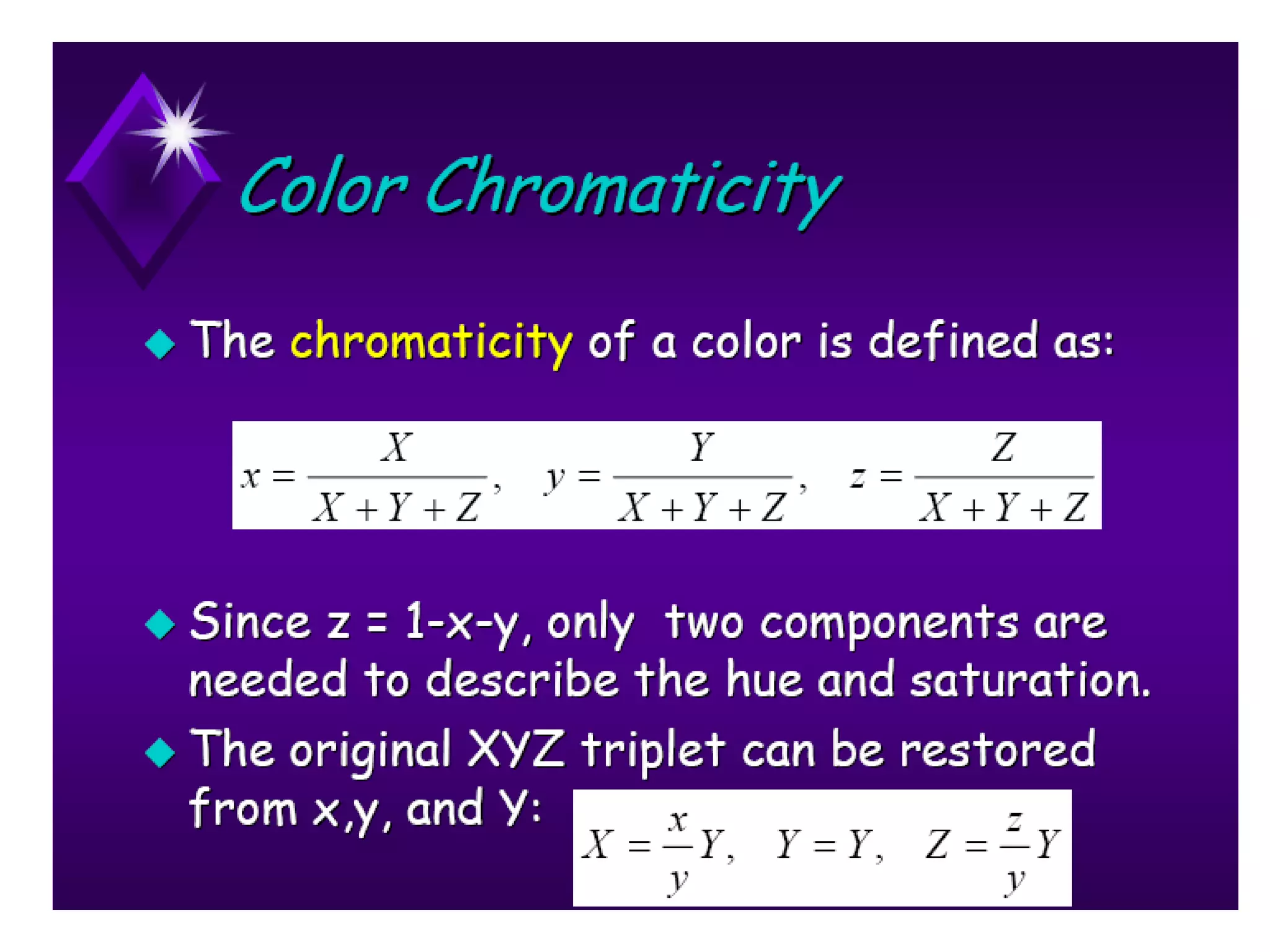
Chromaticity values and diagrams
29
30
31
33
Dominant wave length and Purity Color representation
34
CIE (Y,x,y) Color Solid
• Tristimulus values, unfortunately, have limited use as color
specifications because they correlate poorly with visual
attributes. While Y relates to value (lightness), X and Z do
not correlate to hue and chroma. As a result, when the 1931
CIE standard observer was established, the commission
recommended using the chromaticity coordinates xyz. These
coordinates are used to form the chromaticity diagrams. The
notation Yxy specifies colors by identifying value (Y) and the
color as viewed in the chromaticity diagram (x,y).
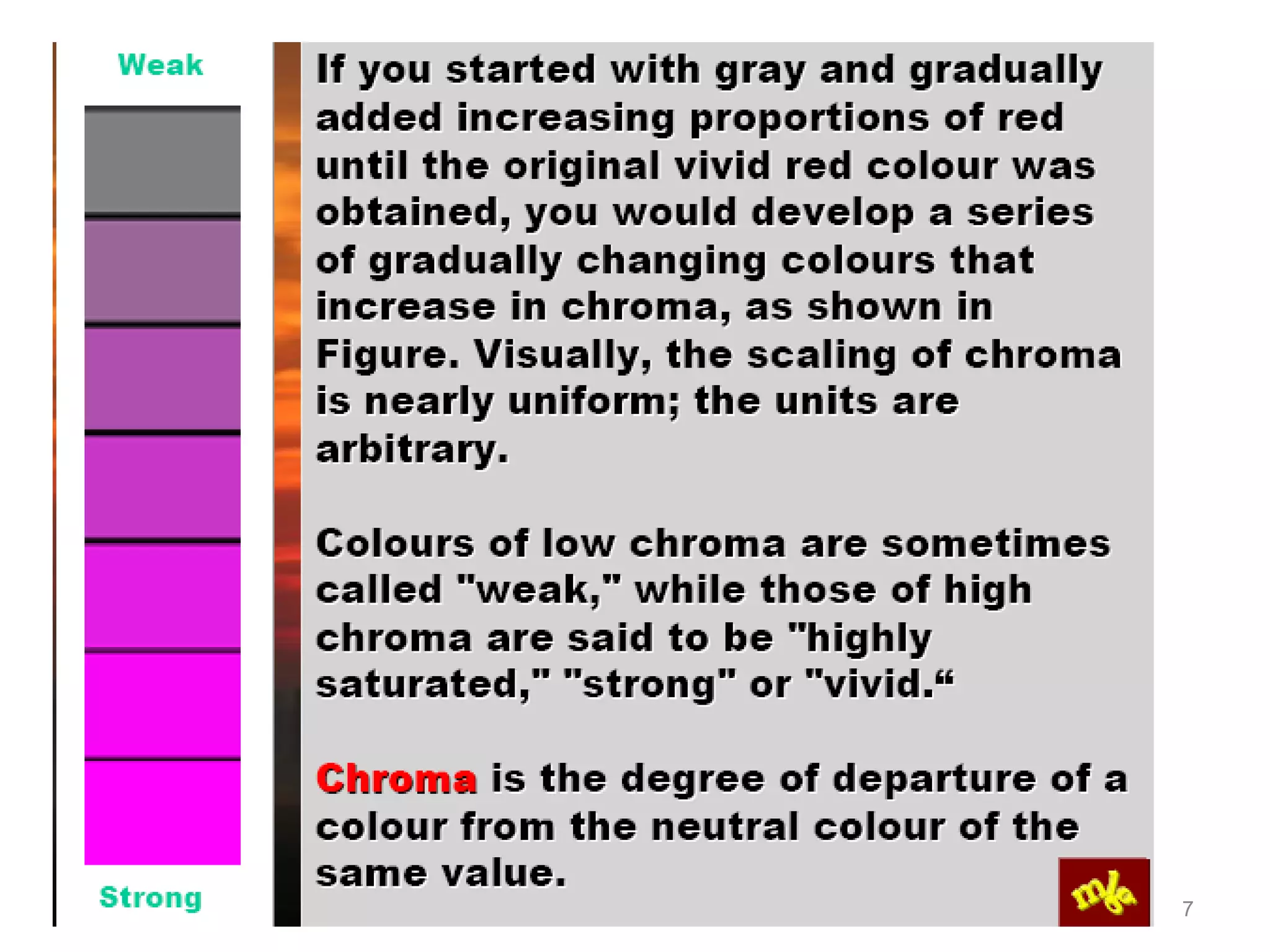
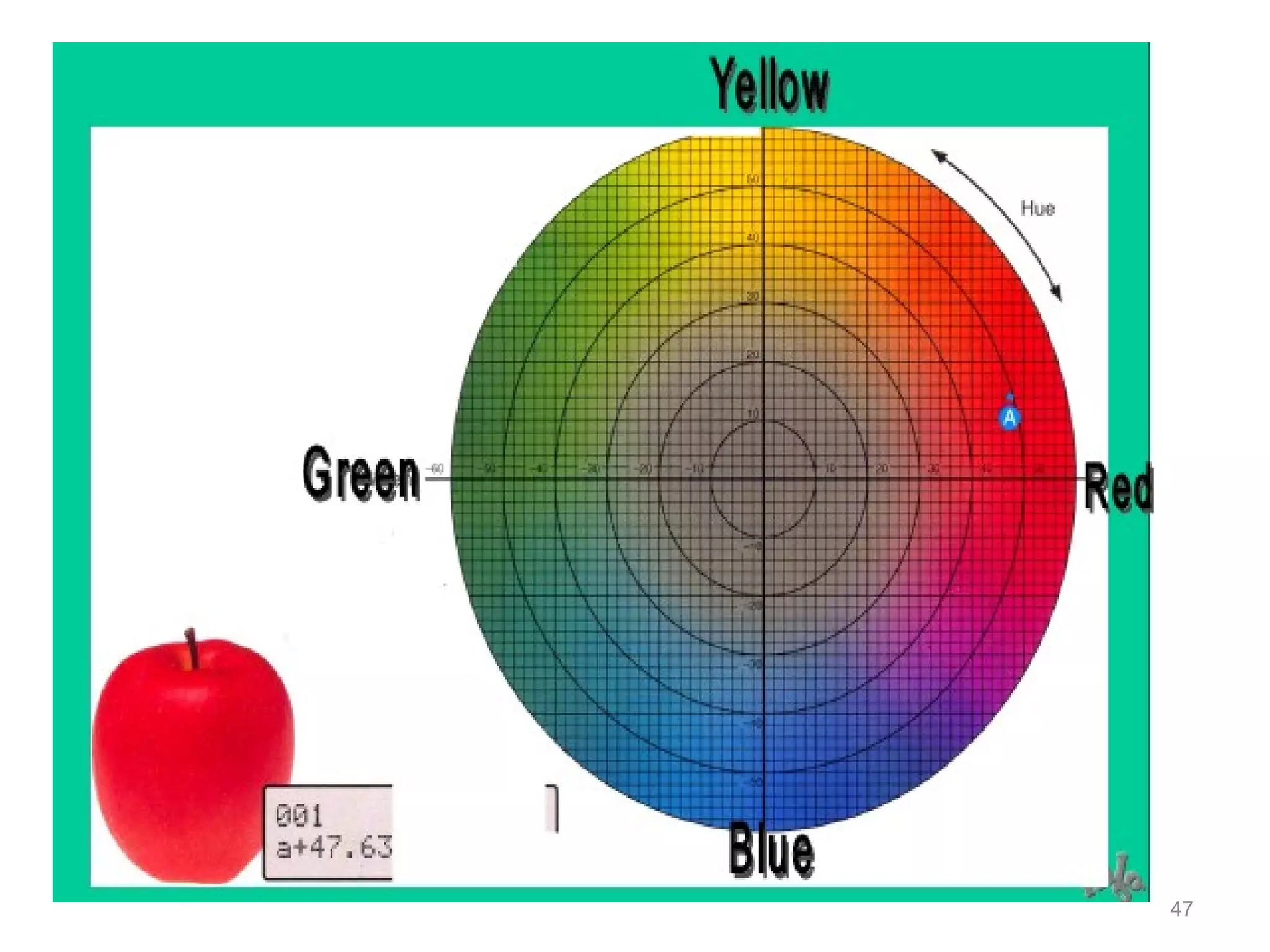
• Hue is represented at all points around the perimeter of the
chromaticity diagram. Chroma, or saturation, is represented
by a movement from the central white (neutral) area out
toward the diagram’s perimeter, where 100% saturation
equals pure hue.
44
45
46
LCH
• While CIELAB uses Cartesian coordinates to
calculate a color in a color space, CIELCH uses
polar coordinates. This color expression can be
derived from CIELAB. The L* defines lightness, C*
specifies Chroma and h° denotes hue angle, an
angular measurement. The L*C*h° expression
offers an advantage over CIELAB in that it’s very
easy to relate to the earlier systems based on
physical samples, like the Munsell Color Scale.
47
48
5. colour order system

5. colour order system

  • 1.
  • 2.
  • 3.
  • 4.
  • 5.
  • 6.
  • 7.
  • 8.
  • 9.
    9 Color order systems And Colorspaces NCS XYZ Munsell CIE Lab CIE xyY CIE RGB
  • 11.
  • 12.
  • 13.
  • 14.
  • 15.
  • 16.
  • 17.
  • 18.
  • 20.
  • 21.
  • 23.
  • 24.
  • 25.
  • 26.
  • 27.
  • 28.
  • 29.
  • 30.
  • 31.
  • 33.
    33 Dominant wave lengthand Purity Color representation
  • 34.
    34 CIE (Y,x,y) ColorSolid • Tristimulus values, unfortunately, have limited use as color specifications because they correlate poorly with visual attributes. While Y relates to value (lightness), X and Z do not correlate to hue and chroma. As a result, when the 1931 CIE standard observer was established, the commission recommended using the chromaticity coordinates xyz. These coordinates are used to form the chromaticity diagrams. The notation Yxy specifies colors by identifying value (Y) and the color as viewed in the chromaticity diagram (x,y). • Hue is represented at all points around the perimeter of the chromaticity diagram. Chroma, or saturation, is represented by a movement from the central white (neutral) area out toward the diagram’s perimeter, where 100% saturation equals pure hue.
  • 44.
  • 45.
  • 46.
    46 LCH • While CIELABuses Cartesian coordinates to calculate a color in a color space, CIELCH uses polar coordinates. This color expression can be derived from CIELAB. The L* defines lightness, C* specifies Chroma and h° denotes hue angle, an angular measurement. The L*C*h° expression offers an advantage over CIELAB in that it’s very easy to relate to the earlier systems based on physical samples, like the Munsell Color Scale.
  • 47.
  • 48.