CHAPTER-4
COLOUR MEASURING INSTRUMENTS
Granch Berhe
There are three major classes of measuring
instruments available to the colouring of textile
industry. They are:
• Colourimeters
• 0/45° and 45/0° geometry spectrophotometers
• Integrating sphere geometry spectrophotometers
Colourimeters
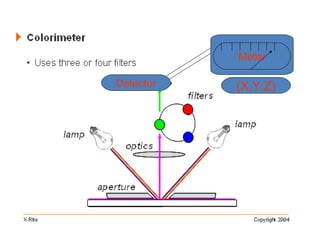
• colourimeters were the pioneers of colour measuring
instruments. colourimeters view a sample through at least
three filters measuring the quantity of light reflected from the
sample and passed through each of the filters. The filters
were originally designed to mimic the response of the red,
blue and green cones of the eye as closely as possible. This,
at first glance, would seem to have merit since it attempted to
imitate the eye of the standard observer. An important
deficiency of colourimeters is they cannot separate the pure
colour from the appearance of an object. Additionally, a
colourimeter is unable to detect if an object’s colour will
appear differently under different light sources. Therefore,
colourimeters have limited capability when compared with
current technology.
Meter
Detector (X,Y,Z)
Reflectance Spectrophotometer
• Reflectance spectrophotometers measure the
amount of light reflected by a surface as a function
of wavelength to produce a reflectance spectrum.
The reflectance spectrum of a sample can be used,
in conjunction with the CIE standard observer
function and the relative spectral energy
distribution of an illuminant, to calculate the CIE
XYZ tristimulus values for that sample under that
illuminant.
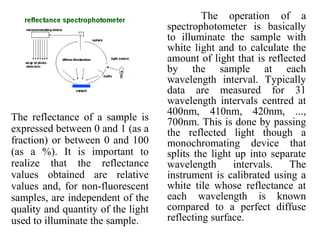
The operation of a
spectrophotometer is basically
to illuminate the sample with
white light and to calculate the
amount of light that is reflected
by the sample at each
wavelength interval. Typically
data are measured for 31
wavelength intervals centred at
400nm, 410nm, 420nm, ...,
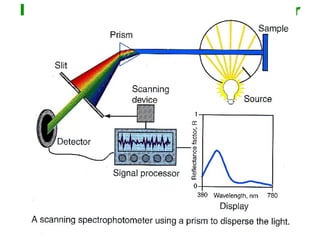
700nm. This is done by passing
the reflected light though a
monochromating device that
splits the light up into separate
wavelength intervals. The
instrument is calibrated using a
white tile whose reflectance at
each wavelength is known
compared to a perfect diffuse
reflecting surface.
The reflectance of a sample is
expressed between 0 and 1 (as a
fraction) or between 0 and 100
(as a %). It is important to
realize that the reflectance
values obtained are relative
values and, for non-fluorescent
samples, are independent of the
quality and quantity of the light
used to illuminate the sample.
Reflectance Spectrophotometer
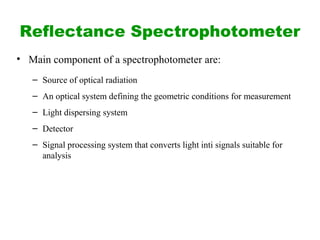
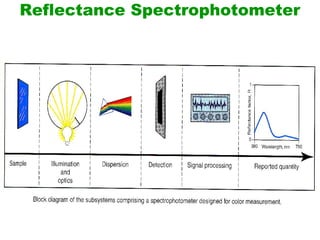
• Main component of a spectrophotometer are:
– Source of optical radiation
– An optical system defining the geometric conditions for measurement
– Light dispersing system
– Detector
– Signal processing system that converts light inti signals suitable for
analysis
Reflectance Spectrophotometer

4. colour measuring instruments

  • 1.
  • 2.
    There are threemajor classes of measuring instruments available to the colouring of textile industry. They are: • Colourimeters • 0/45° and 45/0° geometry spectrophotometers • Integrating sphere geometry spectrophotometers
  • 3.
    Colourimeters • colourimeters werethe pioneers of colour measuring instruments. colourimeters view a sample through at least three filters measuring the quantity of light reflected from the sample and passed through each of the filters. The filters were originally designed to mimic the response of the red, blue and green cones of the eye as closely as possible. This, at first glance, would seem to have merit since it attempted to imitate the eye of the standard observer. An important deficiency of colourimeters is they cannot separate the pure colour from the appearance of an object. Additionally, a colourimeter is unable to detect if an object’s colour will appear differently under different light sources. Therefore, colourimeters have limited capability when compared with current technology.
  • 4.
  • 5.
    Reflectance Spectrophotometer • Reflectancespectrophotometers measure the amount of light reflected by a surface as a function of wavelength to produce a reflectance spectrum. The reflectance spectrum of a sample can be used, in conjunction with the CIE standard observer function and the relative spectral energy distribution of an illuminant, to calculate the CIE XYZ tristimulus values for that sample under that illuminant.
  • 6.
    The operation ofa spectrophotometer is basically to illuminate the sample with white light and to calculate the amount of light that is reflected by the sample at each wavelength interval. Typically data are measured for 31 wavelength intervals centred at 400nm, 410nm, 420nm, ..., 700nm. This is done by passing the reflected light though a monochromating device that splits the light up into separate wavelength intervals. The instrument is calibrated using a white tile whose reflectance at each wavelength is known compared to a perfect diffuse reflecting surface. The reflectance of a sample is expressed between 0 and 1 (as a fraction) or between 0 and 100 (as a %). It is important to realize that the reflectance values obtained are relative values and, for non-fluorescent samples, are independent of the quality and quantity of the light used to illuminate the sample.
  • 7.
    Reflectance Spectrophotometer • Maincomponent of a spectrophotometer are: – Source of optical radiation – An optical system defining the geometric conditions for measurement – Light dispersing system – Detector – Signal processing system that converts light inti signals suitable for analysis
  • 8.
  • 9.
  • 10.