Course: Machine Vision
Light and Color
Session 03
D5627 – I Gede Putra Kusuma Negara, B.Eng., PhD
Outline
• The Physics of Color
• Human Color Perception
• Representing Color
• A Model of Image Color
The Physics of Color
What is color?
• Color is a psychological property of our visual experiences when we
look at objects and lights, not a physical property of those objects or
lights (S. Palmer, Vision Science: Photons to Phenomenology)
• Color is the result of interaction between physical light in the
environment and our visual system
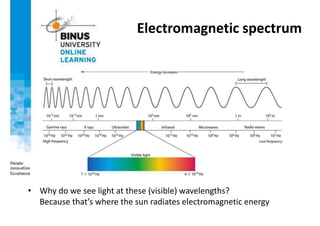
Electromagnetic spectrum
• Why do we see light at these (visible) wavelengths?
Because that’s where the sun radiates electromagnetic energy
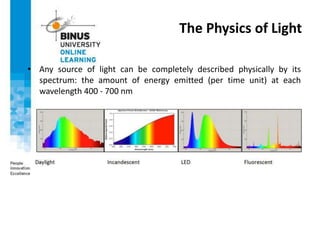
The Physics of Light
• Any source of light can be completely described physically by its
spectrum: the amount of energy emitted (per time unit) at each
wavelength 400 - 700 nm
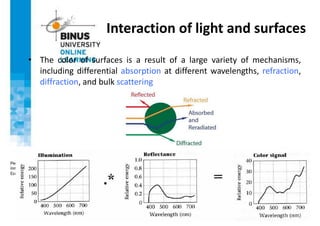
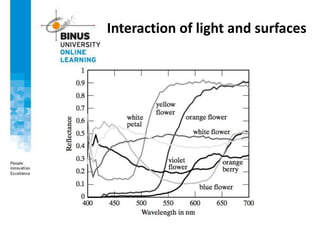
Interaction of light and surfaces
• The color of surfaces is a result of a large variety of mechanisms,
including differential absorption at different wavelengths, refraction,
diffraction, and bulk scattering
Interaction of light and surfaces
Human Color Perception
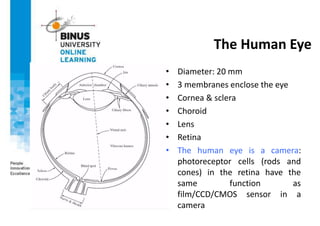
The Human Eye
• Diameter: 20 mm
• 3 membranes enclose the eye
• Cornea & sclera
• Choroid
• Lens
• Retina
• The human eye is a camera:
photoreceptor cells (rods and
cones) in the retina have the
same function as
film/CCD/CMOS sensor in a
camera
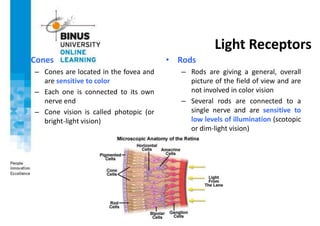
Light Receptors
• Cones
– Cones are located in the fovea and
are sensitive to color
– Each one is connected to its own
nerve end
– Cone vision is called photopic (or
bright-light vision)
• Rods
– Rods are giving a general, overall
picture of the field of view and are
not involved in color vision
– Several rods are connected to a
single nerve and are sensitive to
low levels of illumination (scotopic
or dim-light vision)
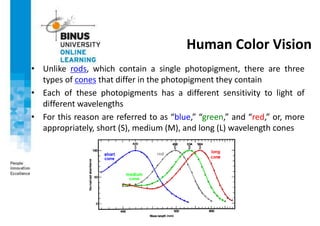
Human Color Vision
• Unlike rods, which contain a single photopigment, there are three
types of cones that differ in the photopigment they contain
• Each of these photopigments has a different sensitivity to light of
different wavelengths
• For this reason are referred to as “blue,” “green,” and “red,” or, more
appropriately, short (S), medium (M), and long (L) wavelength cones
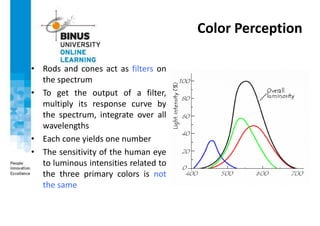
Color Perception
• Rods and cones act as filters on
the spectrum
• To get the output of a filter,
multiply its response curve by
the spectrum, integrate over all
wavelengths
• Each cone yields one number
• The sensitivity of the human eye
to luminous intensities related to
the three primary colors is not
the same
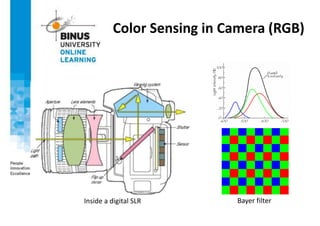
Color Sensing in Camera (RGB)
Bayer filter
Inside a digital SLR
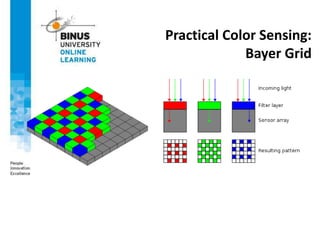
Practical Color Sensing:
Bayer Grid
Representing Color
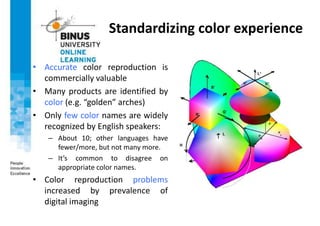
Standardizing color experience
• Accurate color reproduction is
commercially valuable
• Many products are identified by
color (e.g. “golden” arches)
• Only few color names are widely
recognized by English speakers:
– About 10; other languages have
fewer/more, but not many more.
– It’s common to disagree on
appropriate color names.
• Color reproduction problems
increased by prevalence of
digital imaging
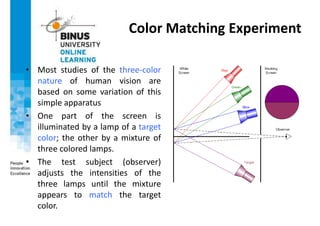
Color Matching Experiment
• Most studies of the three-color
nature of human vision are
based on some variation of this
simple apparatus
• One part of the screen is
illuminated by a lamp of a target
color; the other by a mixture of
three colored lamps.
• The test subject (observer)
adjusts the intensities of the
three lamps until the mixture
appears to match the target
color.
Trichromacy
• Three numbers seem to be sufficient for encoding color
• In color matching experiments, most people can match any given light
with three primaries
• Exception: color blindness
• For the same light and same primaries, most people select the same
weights
• Trichromatic color theory dates back to 18th century (Thomas Young)
Additive vs. Subtractive
Color Matching
Additive
• Many colors can be represented
as a mixture of A, B, C:
M=a A + b B + c C
• Where the = sign should be read
as “matches”
• Gives a color description system:
two people who agree on A, B, C
need only supply (a, b, c) to
describe a color
Subtractive
• Some colors can’t be matched
like this M=a A + b B + c C,
instead, must write:
M+a A = b B+c C
• Interpret this as (-a, b, c)
• Problem for building monitors:
Choose R, G, B such that
positive linear combinations
match a large set of colors
Grassman’s Laws
• Additive matching is linear
• If two test lights can be matched with the same set of
weights, then they match each other:
– Suppose A = u1 P1 + u2 P2 + u3 P3 and B = u1 P1 + u2 P2 + u3 P3.
Then A = B.
• If we mix two test lights, then mixing the matches will
match the result:
– Suppose A = u1 P1 + u2 P2 + u3 P3 and B = v1 P1 + v2 P2 + v3 P3.
Then A+B = (u1+v1) P1 + (u2+v2) P2 + (u3+v3) P3.
• If we scale the test light, then the matches get scaled
by the same amount:
– Suppose A = u1 P1 + u2 P2 + u3 P3.
Then kA = (ku1) P1 + (ku2) P2 + (ku3) P3.
Color Matching Functions
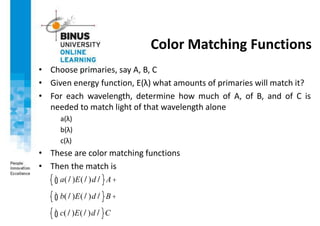
• Choose primaries, say A, B, C
• Given energy function, E(λ) what amounts of primaries will match it?
• For each wavelength, determine how much of A, of B, and of C is
needed to match light of that wavelength alone
a(λ)
b(λ)
c(λ)
• These are color matching functions
• Then the match is
a(l)E(l)dl
ò
{ }A+
b(l)E(l)dl
ò
{ }B+
c(l)E(l)dl
ò
{ }C
Linear Color Spaces: RGB
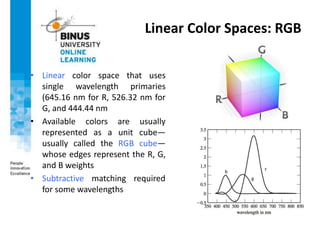
• Linear color space that uses
single wavelength primaries
(645.16 nm for R, 526.32 nm for
G, and 444.44 nm
• Available colors are usually
represented as a unit cube—
usually called the RGB cube—
whose edges represent the R, G,
and B weights
• Subtractive matching required
for some wavelengths
Linear color spaces: CIE XYZ
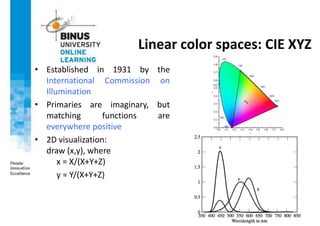
• Established in 1931 by the
International Commission on
Illumination
• Primaries are imaginary, but
matching functions are
everywhere positive
• 2D visualization:
draw (x,y), where
x = X/(X+Y+Z)
y = Y/(X+Y+Z)
Nonlinear color spaces:
Uniform color spaces
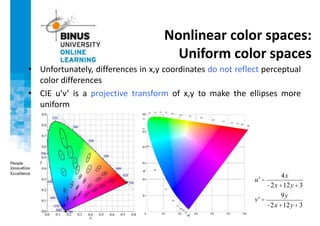
• Unfortunately, differences in x,y coordinates do not reflect perceptual
color differences
• CIE u’v’ is a projective transform of x,y to make the ellipses more
uniform
u' =
4x
-2x +12y+3
v' =
9y
-2x +12y+3
Nonlinear color spaces: HSV
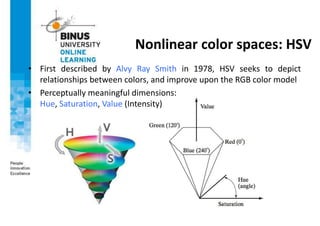
• First described by Alvy Ray Smith in 1978, HSV seeks to depict
relationships between colors, and improve upon the RGB color model
• Perceptually meaningful dimensions:
Hue, Saturation, Value (Intensity)
A Model of Image Color
The Use of Color
in Computer Vision
• Color histogram for indexing and retrieval
Swain and Ballard, Color Indexing, IJCV 1991
• Skin detection
M. Jones and J. Rehg, Statistical Color Models with Application to
Skin Detection, IJCV 2002
• Image segmentation and retrieval
C. Carson, S. Belongie, H. Greenspan, and Ji. Malik, Blobworld:
Image segmentation using Expectation-Maximization and its
application to image querying, ICVIS 1999
• Robot soccer
M. Sridharan and P. Stone, Towards Eliminating Manual Color
Calibration at RoboCup. RoboCup-2005: Robot Soccer World Cup
IX, Springer Verlag, 2006
Acknowledgment
Some of slides in this PowerPoint presentation are adaptation from
various slides, many thanks to:
1. D.A. Forsyth, Department of Computer Science, University of Illinois
at Urbana – Champaign (http://luthuli.cs.uiuc.edu/~daf/)
2. Professor William Hoff, Department of Electrical Engineering &
Computer Science (http://inside.mines.edu/~whoff/)
3. James Hays, Computer Science Department, Brown University,
(http://cs.brown.edu/~hays/)
Thank You

PPT s03-machine vision-s2

  • 1.
    Course: Machine Vision Lightand Color Session 03 D5627 – I Gede Putra Kusuma Negara, B.Eng., PhD
  • 2.
    Outline • The Physicsof Color • Human Color Perception • Representing Color • A Model of Image Color
  • 3.
  • 4.
    What is color? •Color is a psychological property of our visual experiences when we look at objects and lights, not a physical property of those objects or lights (S. Palmer, Vision Science: Photons to Phenomenology) • Color is the result of interaction between physical light in the environment and our visual system
  • 5.
    Electromagnetic spectrum • Whydo we see light at these (visible) wavelengths? Because that’s where the sun radiates electromagnetic energy
  • 6.
    The Physics ofLight • Any source of light can be completely described physically by its spectrum: the amount of energy emitted (per time unit) at each wavelength 400 - 700 nm
  • 7.
    Interaction of lightand surfaces • The color of surfaces is a result of a large variety of mechanisms, including differential absorption at different wavelengths, refraction, diffraction, and bulk scattering
  • 8.
  • 9.
  • 10.
    The Human Eye •Diameter: 20 mm • 3 membranes enclose the eye • Cornea & sclera • Choroid • Lens • Retina • The human eye is a camera: photoreceptor cells (rods and cones) in the retina have the same function as film/CCD/CMOS sensor in a camera
  • 11.
    Light Receptors • Cones –Cones are located in the fovea and are sensitive to color – Each one is connected to its own nerve end – Cone vision is called photopic (or bright-light vision) • Rods – Rods are giving a general, overall picture of the field of view and are not involved in color vision – Several rods are connected to a single nerve and are sensitive to low levels of illumination (scotopic or dim-light vision)
  • 12.
    Human Color Vision •Unlike rods, which contain a single photopigment, there are three types of cones that differ in the photopigment they contain • Each of these photopigments has a different sensitivity to light of different wavelengths • For this reason are referred to as “blue,” “green,” and “red,” or, more appropriately, short (S), medium (M), and long (L) wavelength cones
  • 13.
    Color Perception • Rodsand cones act as filters on the spectrum • To get the output of a filter, multiply its response curve by the spectrum, integrate over all wavelengths • Each cone yields one number • The sensitivity of the human eye to luminous intensities related to the three primary colors is not the same
  • 14.
    Color Sensing inCamera (RGB) Bayer filter Inside a digital SLR
  • 15.
  • 16.
  • 17.
    Standardizing color experience •Accurate color reproduction is commercially valuable • Many products are identified by color (e.g. “golden” arches) • Only few color names are widely recognized by English speakers: – About 10; other languages have fewer/more, but not many more. – It’s common to disagree on appropriate color names. • Color reproduction problems increased by prevalence of digital imaging
  • 18.
    Color Matching Experiment •Most studies of the three-color nature of human vision are based on some variation of this simple apparatus • One part of the screen is illuminated by a lamp of a target color; the other by a mixture of three colored lamps. • The test subject (observer) adjusts the intensities of the three lamps until the mixture appears to match the target color.
  • 19.
    Trichromacy • Three numbersseem to be sufficient for encoding color • In color matching experiments, most people can match any given light with three primaries • Exception: color blindness • For the same light and same primaries, most people select the same weights • Trichromatic color theory dates back to 18th century (Thomas Young)
  • 20.
    Additive vs. Subtractive ColorMatching Additive • Many colors can be represented as a mixture of A, B, C: M=a A + b B + c C • Where the = sign should be read as “matches” • Gives a color description system: two people who agree on A, B, C need only supply (a, b, c) to describe a color Subtractive • Some colors can’t be matched like this M=a A + b B + c C, instead, must write: M+a A = b B+c C • Interpret this as (-a, b, c) • Problem for building monitors: Choose R, G, B such that positive linear combinations match a large set of colors
  • 21.
    Grassman’s Laws • Additivematching is linear • If two test lights can be matched with the same set of weights, then they match each other: – Suppose A = u1 P1 + u2 P2 + u3 P3 and B = u1 P1 + u2 P2 + u3 P3. Then A = B. • If we mix two test lights, then mixing the matches will match the result: – Suppose A = u1 P1 + u2 P2 + u3 P3 and B = v1 P1 + v2 P2 + v3 P3. Then A+B = (u1+v1) P1 + (u2+v2) P2 + (u3+v3) P3. • If we scale the test light, then the matches get scaled by the same amount: – Suppose A = u1 P1 + u2 P2 + u3 P3. Then kA = (ku1) P1 + (ku2) P2 + (ku3) P3.
  • 22.
    Color Matching Functions •Choose primaries, say A, B, C • Given energy function, E(λ) what amounts of primaries will match it? • For each wavelength, determine how much of A, of B, and of C is needed to match light of that wavelength alone a(λ) b(λ) c(λ) • These are color matching functions • Then the match is a(l)E(l)dl ò { }A+ b(l)E(l)dl ò { }B+ c(l)E(l)dl ò { }C
  • 23.
    Linear Color Spaces:RGB • Linear color space that uses single wavelength primaries (645.16 nm for R, 526.32 nm for G, and 444.44 nm • Available colors are usually represented as a unit cube— usually called the RGB cube— whose edges represent the R, G, and B weights • Subtractive matching required for some wavelengths
  • 24.
    Linear color spaces:CIE XYZ • Established in 1931 by the International Commission on Illumination • Primaries are imaginary, but matching functions are everywhere positive • 2D visualization: draw (x,y), where x = X/(X+Y+Z) y = Y/(X+Y+Z)
  • 25.
    Nonlinear color spaces: Uniformcolor spaces • Unfortunately, differences in x,y coordinates do not reflect perceptual color differences • CIE u’v’ is a projective transform of x,y to make the ellipses more uniform u' = 4x -2x +12y+3 v' = 9y -2x +12y+3
  • 26.
    Nonlinear color spaces:HSV • First described by Alvy Ray Smith in 1978, HSV seeks to depict relationships between colors, and improve upon the RGB color model • Perceptually meaningful dimensions: Hue, Saturation, Value (Intensity)
  • 27.
    A Model ofImage Color
  • 28.
    The Use ofColor in Computer Vision • Color histogram for indexing and retrieval Swain and Ballard, Color Indexing, IJCV 1991 • Skin detection M. Jones and J. Rehg, Statistical Color Models with Application to Skin Detection, IJCV 2002 • Image segmentation and retrieval C. Carson, S. Belongie, H. Greenspan, and Ji. Malik, Blobworld: Image segmentation using Expectation-Maximization and its application to image querying, ICVIS 1999 • Robot soccer M. Sridharan and P. Stone, Towards Eliminating Manual Color Calibration at RoboCup. RoboCup-2005: Robot Soccer World Cup IX, Springer Verlag, 2006
  • 29.
    Acknowledgment Some of slidesin this PowerPoint presentation are adaptation from various slides, many thanks to: 1. D.A. Forsyth, Department of Computer Science, University of Illinois at Urbana – Champaign (http://luthuli.cs.uiuc.edu/~daf/) 2. Professor William Hoff, Department of Electrical Engineering & Computer Science (http://inside.mines.edu/~whoff/) 3. James Hays, Computer Science Department, Brown University, (http://cs.brown.edu/~hays/)
  • 30.