
Chapter 12
“Stoichiometry”
                  Mr. Mole
Section 12.1
The Arithmetic of Equations
OBJECTIVES:
• Explain how balanced
  equations apply to both
  chemistry and everyday
  life.
Section 12.1
The Arithmetic of Equations
OBJECTIVES:
• Interpret balanced chemical
  equations in terms of: a) moles,
  b) representative particles,
  c) mass, and d) gas volume
  (Liters) at STP.
Section 12.1
The Arithmetic of Equations
OBJECTIVES:
• Identify the quantities that
  are always conserved in
  chemical reactions.
Let’s make some Cookies!
When baking cookies, a recipe
is usually used, telling the exact
amount of each ingredient.
 • If you need more, you can
   double or triple the amount
Thus, a recipe is much like a
balanced equation.
Stoichiometry is…
 Greek for “measuring elements”
Pronounced “stoy kee ahm uh tree”
 Defined as: calculations of the
 quantities in chemical reactions,
 based on a balanced equation.
 There are 4 ways to interpret a
 balanced chemical equation
#1. In terms of Particles
An Element is made of atoms
A Molecular compound (made
of only nonmetals) is made up
of molecules (Don’t forget the diatomic elements)
Ionic Compounds (made of a
metal and nonmetal parts) are
made of formula units
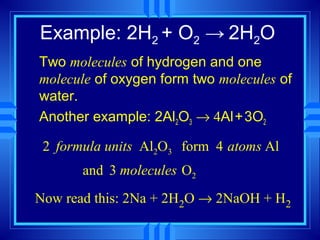
Example: 2H2 + O2 → 2H2O
Two molecules of hydrogen and one
molecule of oxygen form two molecules of
water.
Another example: 2Al2O3 → 4Al + 3O2

 2 formula units Al2O3 form 4 atoms Al
       and 3 molecules O2
Now read this: 2Na + 2H2O → 2NaOH + H2
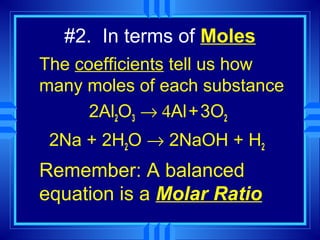
#2. In terms of Moles
The coefficients tell us how
many moles of each substance
      2Al2O3 → 4Al + 3O2
 2Na + 2H2O → 2NaOH + H2
Remember: A balanced
equation is a Molar Ratio
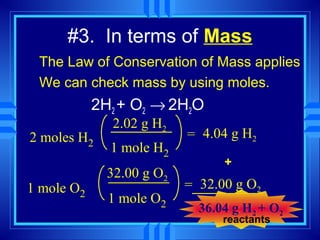
#3. In terms of Mass
 The Law of Conservation of Mass applies
 We can check mass by using moles.
            2H2 + O2 → 2H2O
              2.02 g H2
2 moles H2                 = 4.04 g H2
              1 mole H2
                                  +
              32.00 g O2
1 mole O2                  = 32.00 g O2
              1 mole O2
                             36.04 g H +
                             36.04 g H22 + O 2
                                 reactants
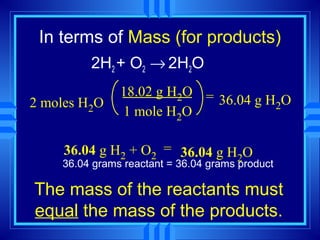
In terms of Mass (for products)
         2H2 + O2 → 2H2O
               18.02 g H2O =
2 moles H2O                  36.04 g H2O
               1 mole H2O

     36.04 g H2 + O2 = 36.04 g H2O
    36.04 grams reactant = 36.04 grams product

The mass of the reactants must
equal the mass of the products.
#4. In terms of Volume
 At STP, 1 mol of any gas = 22.4 L
    2H2 + O2       → 2H2O
 (2 x 22.4 L H2) + (1 x 22.4 L O2) → (2 x 22.4 L H2O)

67.2 Liters of reactant ≠ 44.8 Liters of product!
NOTE: mass and atoms are
 ALWAYS conserved - however,
 molecules, formula units, moles, and
 volumes will not necessarily be
 conserved!
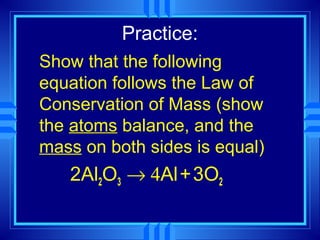
Practice:
Show that the following
equation follows the Law of
Conservation of Mass (show
the atoms balance, and the
mass on both sides is equal)
   2Al2O3 → 4Al + 3O2
Section 12.2
  Chemical Calculations
OBJECTIVES:
• Construct “mole ratios” from
  balanced chemical
  equations, and apply these
  ratios in mole-mole
  stoichiometric calculations.
Section 12.2
  Chemical Calculations
OBJECTIVES:
• Calculate stoichiometric
  quantities from balanced
  chemical equations using
  units of moles, mass,
  representative particles, and
  volumes of gases at STP.
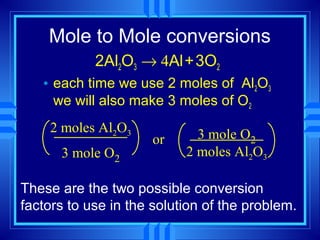
Mole to Mole conversions
            2Al2O3 → 4Al + 3O2
   • each time we use 2 moles of Al2O3
     we will also make 3 moles of O2
    2 moles Al2O3            3 mole O2
                     or
      3 mole O2            2 moles Al2O3

These are the two possible conversion
factors to use in the solution of the problem.
Mole to Mole conversions
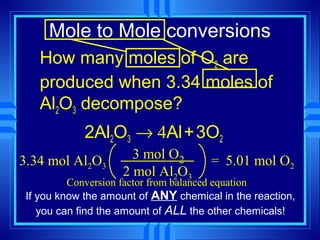
   How many moles of O2 are
   produced when 3.34 moles of
   Al2O3 decompose?
             2Al2O3 → 4Al + 3O2
3.34 mol Al2O3        3 mol O2        = 5.01 mol O2
                    2 mol Al2O3
          Conversion factor from balanced equation
 If you know the amount of ANY chemical in the reaction,
    you can find the amount of ALL the other chemicals!
Practice:
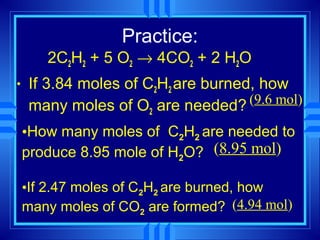
       2C2H2 + 5 O2 → 4CO2 + 2 H2O
•   If 3.84 moles of C2H2 are burned, how
    many moles of O2 are needed?    (9.6 mol)

    •How many moles of C2H2 are needed to
    produce 8.95 mole of H2O? (8.95 mol)

    •If 2.47 moles of C2H2 are burned, how
    many moles of CO2 are formed? (4.94 mol)
How do you get good at this?
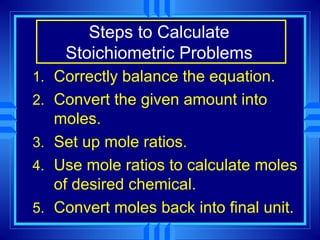
Steps to Calculate
    Stoichiometric Problems
1. Correctly balance the equation.
2. Convert the given amount into
   moles.
3. Set up mole ratios.
4. Use mole ratios to calculate moles
   of desired chemical.
5. Convert moles back into final unit.
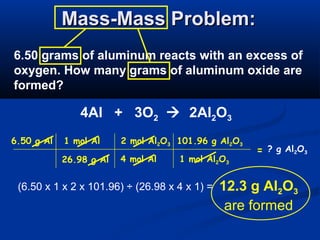
Mass-Mass Problem:
6.50 grams of aluminum reacts with an excess of
oxygen. How many grams of aluminum oxide are
formed?

               4Al + 3O2  2Al2O3
6.50 g Al   1 mol Al     2 mol Al2O3 101.96 g Al2O3
                                                      = ? g Al2O3
            26.98 g Al   4 mol Al    1 mol Al2O3


 (6.50 x 1 x 2 x 101.96) ÷ (26.98 x 4 x 1) =   12.3 g Al2O3
                                                are formed
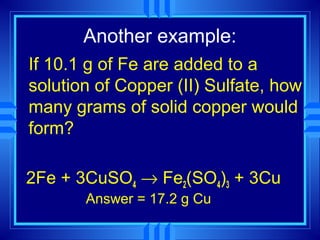
Another example:
If 10.1 g of Fe are added to a
solution of Copper (II) Sulfate, how
many grams of solid copper would
form?

2Fe + 3CuSO4 → Fe2(SO4)3 + 3Cu
       Answer = 17.2 g Cu
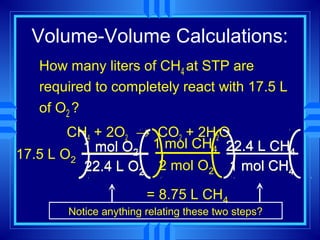
Volume-Volume Calculations:
   How many liters of CH4 at STP are
   required to completely react with 17.5 L
   of O2 ?
        CH4 + 2O2 → CO2 + 2H2O
          1 mol O2 1 mol CH4 22.4 L CH4
17.5 L O2
          22.4 L O2 2 mol O2 1 mol CH4
                       = 8.75 L CH4
       Notice anything relating these two steps?
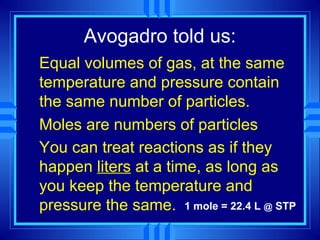
Avogadro told us:
Equal volumes of gas, at the same
temperature and pressure contain
the same number of particles.
Moles are numbers of particles
You can treat reactions as if they
happen liters at a time, as long as
you keep the temperature and
pressure the same. 1 mole = 22.4 L @ STP
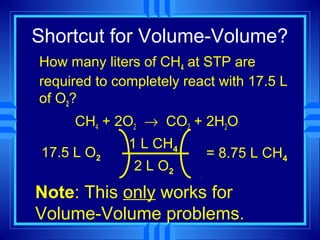
Shortcut for Volume-Volume?
How many liters of CH4 at STP are
required to completely react with 17.5 L
of O2?
      CH4 + 2O2 → CO2 + 2H2O
              1 L CH4
 17.5 L O2                = 8.75 L CH4
               2 L O2
Note: This only works for
Volume-Volume problems.
Section 12.3
Limiting Reagent & Percent Yield
OBJECTIVES:
 • Identify the limiting reagent in
   a reaction.
Section 12.3
Limiting Reagent & Percent Yield
OBJECTIVES:
 • Calculate theoretical yield,
   percent yield, and the amount
   of excess reagent that remains
   unreacted given appropriate
   information.
“Limiting” Reagent
If you are given one dozen loaves of
bread, a gallon of mustard, and three
pieces of salami, how many salami
sandwiches can you make?
The limiting reagent is the reactant you
run out of first.
The excess reagent is the one you have
left over.
The limiting reagent determines how much
product you can make
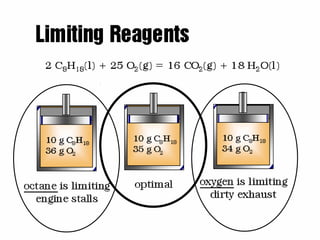
Limiting Reagents - Combustion
How do you find out which is limited?
  The chemical that makes the least
  amount of product is the “limiting
  reagent”.
  You can recognize limiting reagent
  problems because they will give
  you 2 amounts of chemical
  Do two stoichiometry problems,
  one for each reagent you are given.
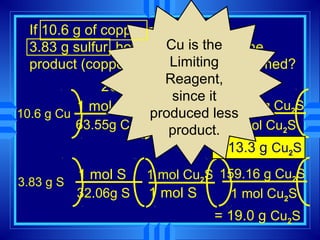
If 10.6 g of copper reacts with
                         Cu is the
  3.83 g sulfur, how many grams of the
                         Limiting
  product (copper (I) sulfide) will be formed?
                         Reagent,
               2Cu + S → Cu2S
                          since it
           1 mol Cu 1 mol Cu2S less
                      produced
                                   159.16 g Cu2S
10.6 g Cu
          63.55g Cu 2 mol Cu
                         product. 1 mol Cu2S
                                  = 13.3 g Cu2S
         1 mol S     1 mol Cu2S 159.16 g Cu2S
3.83 g S
          32.06g S   1 mol S      1 mol Cu2S
                                 = 19.0 g Cu2S
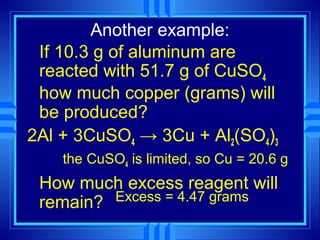
Another example:
 If 10.3 g of aluminum are
 reacted with 51.7 g of CuSO4
 how much copper (grams) will
 be produced?
2Al + 3CuSO4 → 3Cu + Al2(SO4)3
    the CuSO4 is limited, so Cu = 20.6 g
 How much excess reagent will
 remain? Excess = 4.47 grams
The Concept of:


A little different type of yield than
you had in Driver’s Education
class.
What is Yield?
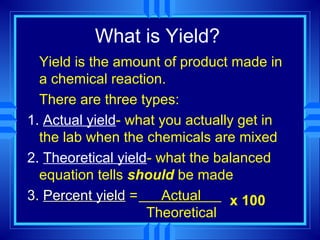
  Yield is the amount of product made in
  a chemical reaction.
  There are three types:
1. Actual yield- what you actually get in
  the lab when the chemicals are mixed
2. Theoretical yield- what the balanced
  equation tells should be made
3. Percent yield =     Actual    x 100
                    Theoretical
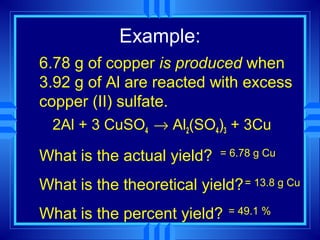
Example:
6.78 g of copper is produced when
3.92 g of Al are reacted with excess
copper (II) sulfate.
  2Al + 3 CuSO4 → Al2(SO4)3 + 3Cu

What is the actual yield?    = 6.78 g Cu


What is the theoretical yield? = 13.8 g Cu
What is the percent yield?    = 49.1 %
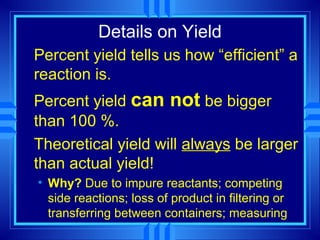
Details on Yield
Percent yield tells us how “efficient” a
reaction is.
Percent yield can not be bigger
than 100 %.
Theoretical yield will always be larger
than actual yield!
• Why? Due to impure reactants; competing
  side reactions; loss of product in filtering or
  transferring between containers; measuring
Chemistry - Chp 12 - Stoichiometry - PowerPoint

Chemistry - Chp 12 - Stoichiometry - PowerPoint

  • 1.
  • 2.
    Section 12.1 The Arithmeticof Equations OBJECTIVES: • Explain how balanced equations apply to both chemistry and everyday life.
  • 3.
    Section 12.1 The Arithmeticof Equations OBJECTIVES: • Interpret balanced chemical equations in terms of: a) moles, b) representative particles, c) mass, and d) gas volume (Liters) at STP.
  • 4.
    Section 12.1 The Arithmeticof Equations OBJECTIVES: • Identify the quantities that are always conserved in chemical reactions.
  • 5.
    Let’s make someCookies! When baking cookies, a recipe is usually used, telling the exact amount of each ingredient. • If you need more, you can double or triple the amount Thus, a recipe is much like a balanced equation.
  • 6.
    Stoichiometry is… Greekfor “measuring elements” Pronounced “stoy kee ahm uh tree” Defined as: calculations of the quantities in chemical reactions, based on a balanced equation. There are 4 ways to interpret a balanced chemical equation
  • 7.
    #1. In termsof Particles An Element is made of atoms A Molecular compound (made of only nonmetals) is made up of molecules (Don’t forget the diatomic elements) Ionic Compounds (made of a metal and nonmetal parts) are made of formula units
  • 8.
    Example: 2H2 +O2 → 2H2O Two molecules of hydrogen and one molecule of oxygen form two molecules of water. Another example: 2Al2O3 → 4Al + 3O2 2 formula units Al2O3 form 4 atoms Al and 3 molecules O2 Now read this: 2Na + 2H2O → 2NaOH + H2
  • 9.
    #2. In termsof Moles The coefficients tell us how many moles of each substance 2Al2O3 → 4Al + 3O2 2Na + 2H2O → 2NaOH + H2 Remember: A balanced equation is a Molar Ratio
  • 10.
    #3. In termsof Mass The Law of Conservation of Mass applies We can check mass by using moles. 2H2 + O2 → 2H2O 2.02 g H2 2 moles H2 = 4.04 g H2 1 mole H2 + 32.00 g O2 1 mole O2 = 32.00 g O2 1 mole O2 36.04 g H + 36.04 g H22 + O 2 reactants
  • 11.
    In terms ofMass (for products) 2H2 + O2 → 2H2O 18.02 g H2O = 2 moles H2O 36.04 g H2O 1 mole H2O 36.04 g H2 + O2 = 36.04 g H2O 36.04 grams reactant = 36.04 grams product The mass of the reactants must equal the mass of the products.
  • 12.
    #4. In termsof Volume At STP, 1 mol of any gas = 22.4 L 2H2 + O2 → 2H2O (2 x 22.4 L H2) + (1 x 22.4 L O2) → (2 x 22.4 L H2O) 67.2 Liters of reactant ≠ 44.8 Liters of product! NOTE: mass and atoms are ALWAYS conserved - however, molecules, formula units, moles, and volumes will not necessarily be conserved!
  • 13.
    Practice: Show that thefollowing equation follows the Law of Conservation of Mass (show the atoms balance, and the mass on both sides is equal) 2Al2O3 → 4Al + 3O2
  • 14.
    Section 12.2 Chemical Calculations OBJECTIVES: • Construct “mole ratios” from balanced chemical equations, and apply these ratios in mole-mole stoichiometric calculations.
  • 15.
    Section 12.2 Chemical Calculations OBJECTIVES: • Calculate stoichiometric quantities from balanced chemical equations using units of moles, mass, representative particles, and volumes of gases at STP.
  • 16.
    Mole to Moleconversions 2Al2O3 → 4Al + 3O2 • each time we use 2 moles of Al2O3 we will also make 3 moles of O2 2 moles Al2O3 3 mole O2 or 3 mole O2 2 moles Al2O3 These are the two possible conversion factors to use in the solution of the problem.
  • 17.
    Mole to Moleconversions How many moles of O2 are produced when 3.34 moles of Al2O3 decompose? 2Al2O3 → 4Al + 3O2 3.34 mol Al2O3 3 mol O2 = 5.01 mol O2 2 mol Al2O3 Conversion factor from balanced equation If you know the amount of ANY chemical in the reaction, you can find the amount of ALL the other chemicals!
  • 18.
    Practice: 2C2H2 + 5 O2 → 4CO2 + 2 H2O • If 3.84 moles of C2H2 are burned, how many moles of O2 are needed? (9.6 mol) •How many moles of C2H2 are needed to produce 8.95 mole of H2O? (8.95 mol) •If 2.47 moles of C2H2 are burned, how many moles of CO2 are formed? (4.94 mol)
  • 19.
    How do youget good at this?
  • 20.
    Steps to Calculate Stoichiometric Problems 1. Correctly balance the equation. 2. Convert the given amount into moles. 3. Set up mole ratios. 4. Use mole ratios to calculate moles of desired chemical. 5. Convert moles back into final unit.
  • 21.
    Mass-Mass Problem: 6.50 gramsof aluminum reacts with an excess of oxygen. How many grams of aluminum oxide are formed? 4Al + 3O2  2Al2O3 6.50 g Al 1 mol Al 2 mol Al2O3 101.96 g Al2O3 = ? g Al2O3 26.98 g Al 4 mol Al 1 mol Al2O3 (6.50 x 1 x 2 x 101.96) ÷ (26.98 x 4 x 1) = 12.3 g Al2O3 are formed
  • 22.
    Another example: If 10.1g of Fe are added to a solution of Copper (II) Sulfate, how many grams of solid copper would form? 2Fe + 3CuSO4 → Fe2(SO4)3 + 3Cu Answer = 17.2 g Cu
  • 23.
    Volume-Volume Calculations: How many liters of CH4 at STP are required to completely react with 17.5 L of O2 ? CH4 + 2O2 → CO2 + 2H2O 1 mol O2 1 mol CH4 22.4 L CH4 17.5 L O2 22.4 L O2 2 mol O2 1 mol CH4 = 8.75 L CH4 Notice anything relating these two steps?
  • 24.
    Avogadro told us: Equalvolumes of gas, at the same temperature and pressure contain the same number of particles. Moles are numbers of particles You can treat reactions as if they happen liters at a time, as long as you keep the temperature and pressure the same. 1 mole = 22.4 L @ STP
  • 25.
    Shortcut for Volume-Volume? Howmany liters of CH4 at STP are required to completely react with 17.5 L of O2? CH4 + 2O2 → CO2 + 2H2O 1 L CH4 17.5 L O2 = 8.75 L CH4 2 L O2 Note: This only works for Volume-Volume problems.
  • 26.
    Section 12.3 Limiting Reagent& Percent Yield OBJECTIVES: • Identify the limiting reagent in a reaction.
  • 27.
    Section 12.3 Limiting Reagent& Percent Yield OBJECTIVES: • Calculate theoretical yield, percent yield, and the amount of excess reagent that remains unreacted given appropriate information.
  • 28.
    “Limiting” Reagent If youare given one dozen loaves of bread, a gallon of mustard, and three pieces of salami, how many salami sandwiches can you make? The limiting reagent is the reactant you run out of first. The excess reagent is the one you have left over. The limiting reagent determines how much product you can make
  • 29.
  • 30.
    How do youfind out which is limited? The chemical that makes the least amount of product is the “limiting reagent”. You can recognize limiting reagent problems because they will give you 2 amounts of chemical Do two stoichiometry problems, one for each reagent you are given.
  • 31.
    If 10.6 gof copper reacts with Cu is the 3.83 g sulfur, how many grams of the Limiting product (copper (I) sulfide) will be formed? Reagent, 2Cu + S → Cu2S since it 1 mol Cu 1 mol Cu2S less produced 159.16 g Cu2S 10.6 g Cu 63.55g Cu 2 mol Cu product. 1 mol Cu2S = 13.3 g Cu2S 1 mol S 1 mol Cu2S 159.16 g Cu2S 3.83 g S 32.06g S 1 mol S 1 mol Cu2S = 19.0 g Cu2S
  • 32.
    Another example: If10.3 g of aluminum are reacted with 51.7 g of CuSO4 how much copper (grams) will be produced? 2Al + 3CuSO4 → 3Cu + Al2(SO4)3 the CuSO4 is limited, so Cu = 20.6 g How much excess reagent will remain? Excess = 4.47 grams
  • 33.
    The Concept of: Alittle different type of yield than you had in Driver’s Education class.
  • 34.
    What is Yield? Yield is the amount of product made in a chemical reaction. There are three types: 1. Actual yield- what you actually get in the lab when the chemicals are mixed 2. Theoretical yield- what the balanced equation tells should be made 3. Percent yield = Actual x 100 Theoretical
  • 35.
    Example: 6.78 g ofcopper is produced when 3.92 g of Al are reacted with excess copper (II) sulfate. 2Al + 3 CuSO4 → Al2(SO4)3 + 3Cu What is the actual yield? = 6.78 g Cu What is the theoretical yield? = 13.8 g Cu What is the percent yield? = 49.1 %
  • 36.
    Details on Yield Percentyield tells us how “efficient” a reaction is. Percent yield can not be bigger than 100 %. Theoretical yield will always be larger than actual yield! • Why? Due to impure reactants; competing side reactions; loss of product in filtering or transferring between containers; measuring