STOICHIOMETRY LET’S ROCK WITH STOICHIOMETRY!!!
Let’s rock it!!! http://www.youtube.com/watch?v=rWCv-ymhpfY
Sounds complicated??? Sounds like too much to handle??? No WORRIES….let’s explore!!!
FUN with STOICHIOMETRY!!! Balancing chemical equations Ratio and Proportion Limiting Reagent All You Know About Stoichiometry
BALANCING CHEMICAL EQUATIONS UNDERSTANDING THE PURPOSE OF COEFFICIENTS AND SUBSCRIPTS
Which one would you pick??? ( yellow /  red ) Zn + HCl ---> ZnCl 2  + H 2 Zn + 2HCl ---> ZnCl 2  + H 2 (keep your choice in your mind…you might want to change your choice later  )
More fun…fun…fun… http://funbasedlearning.com/chemistry/chemBalancer/default.htm
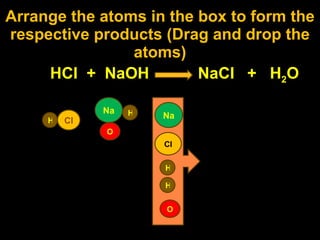
Arrange the atoms in the box to form the respective products (Drag and drop the atoms) HCI  +  NaOH  NaCI  +  H 2 O H Na O H H CI Na O H CI
Arrange the atoms to form the respective products H 2 SO 4   +  2NaOH  Na 2 SO 4   +  2H 2 O H H S Na O O O O O H H Na O H H H H O O O O O O Na Na S
Arrange the atoms to form the reactants and the products 2Mg   +  O 2  2 MgO REACTANTS Mg Mg O O PRODUCTS Mg Mg O O
The law of conservation of mass states that matter can neither be created nor destroyed Thus, in a chemical reaction atoms are neither  created nor  destroyed, only rearranged in a chemical reaction Thus, the number of a particular atom is the same on both sides of a chemical equation
C 2 H 4  + O 2  CO 2  + H 2 O  C H O LEFT RIGHT 2 4 2 3 2 1 F I R S T
 
Add coefficient 2 in front of CO2 – that balances the carbon (C) Then add coefficient 2 in front of H 2 O – that balances the hydrogen (H) Finally re-calculate how many oxygen atoms you have Now you have 6 oxygen atoms all together on your right To balance that add coefficient 3 in front of O 2  – that balances the oxygen  S E C O N D

C 2 H 4  + 3O 2   2CO 2  + 2H 2 O  C H O LEFT RIGHT 2 4 6 6 4 2 F I N A L L Y
Coefficient and subscript 5 H 2 What number represents  the coefficient?  5 What number represents  the Subscript? 2 How many “H’s” do you  have? 10
How many Aluminium and Chlorine atoms are present in 2 Aluminium chloride molecules? 2AICI 3 Aluminium =  Chlorine  = 6 2
SUBSCRIPT AND COEFFICIENT Balance the following equation using the  coefficient given AI  +  HCI  AICI 3   +    H 2 3 2 6 2
2AI  +  6HCI    2AICI 3   +  3H 2 AI H CI H CI H CI H CI H CI H CI AI AI CI CI CI AI CI CI CI H H H H H H Are  the number of each atom present on the left (reactant) and the right (product) the same?
SHARPEN YOUR SKILLS!!! HOME http://funbasedlearning.com/chemistry/chemBalancer/default.htm
RATIOS & PROPORTION!!!
Mary was home alone…. She was craving for pancakes … She  remembered  that her mum always kept a stock of pancake mixture in the kitchen … She grabbed the box... And started reading the  instructions…
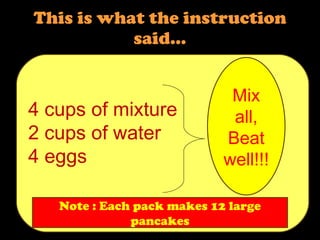
This is what the instruction said… 4 cups of mixture 2 cups of water 4 eggs Mix all, Beat well!!! Note : Each pack makes 12 large pancakes
But 12 is too many!!! She wanted only 3… Hmm…can you help her with the pancake mixture?
4 cups of mixture 2 cups of water 4 eggs 12 pancakes  ?eggs 3 pancakes  ? cups of mixture ? cups of water Can you help her with the correct measurements to make just 3 pancakes???
Consider the equation once again…. Look at the proportion of the mixture to the number of pancakes… 4 cups of mixture makes 12 pancakes… 4 cups of mixture 12 pancakes 3 pancakes ? cups of mixture 12/4 ? Can you decide how many cups of mixture will be needed?
That was pretty simple!!! Now, can you get the proportion of the rest of the ingredients for Mary? (work it out on a piece of paper and check to see later if you have got the proportions correct)
4 cups of mixture 2 cups of water 4 eggs 12 pancakes  ?eggs 3 pancakes  ? cups of mixture ? cups of water 1 egg 3 pancakes  1 cup of mixture ½ cup of water ÷4 ÷4 ÷4 ÷4
The pancakes turned out so well for a first timer…Mary loved it !!! THANK YOU!
Can you apply the same idea here??? 1 mole of hydrochloric acid react with 1 mole of Sodium hydroxide solution to form 1 mole of sodium chloride and 1 mole of water. Can you figure out how many moles of water will be produced if 0.5 mole of acid is used???
How many moles of water produced??? HCl  +  NaOH  NaCl  +  H 2 O 1 1 1 1 Can you determine how many mole of water will be produced if 0.5 mole of acid is used???
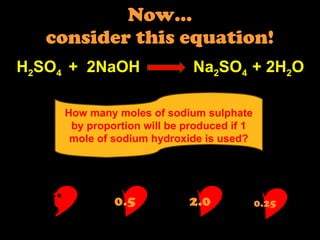
Now… consider this equation! H 2 SO 4  +  2NaOH  Na 2 SO 4  + 2H 2 O How many moles of sodium sulphate by proportion will be produced if 1 mole of sodium hydroxide is used? 1.0 0.5 2.0 0.25
Now let’s get into the lab and do some ‘real’ stuffs!!! (download the virtual lab above!!!then we can get into action….) http://www.chemcollective.org/vlab/vlab.php
One final task before getting started!!! Explore  the reagents and the apparatus provided in the virtual lab… Explore your virtual lab!!! Get familiarized with it…
Get your task sheet and get going with your virtual lab… You are suppose to complete the task given using your virtual lab tools Get the word document  ‘ FUN WITH VIRTUAL LAB’ http://www.scribd.com/doc/66347972
Now more exciting activities… Beginner Intermediate Advance
For BEGINNERS….
John was making tables for a school project…he needs help… 1m 2  of plank makes 2 table tops. He was thinking how  many table tops can be made out of 2m 2 of plank? tell him… 6 8 3 4
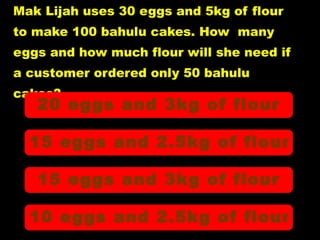
Mak Lijah uses 30 eggs and 5kg of flour to make 100 bahulu cakes. How  many  eggs and how much flour will she need if  a customer ordered only 50 bahulu  cakes? 20 eggs and 3kg of flour 15 eggs and 2.5kg of flour 15 eggs and 3kg of flour 10 eggs and 2.5kg of flour
1 mol of hydrochloric acid react with 1 mol of sodium hydroxide solution to  produce 1 mol of sodium chloride salt  and 1mol of water. How many moles of water will be produced if 0.8 mol of acid  was used? HCI + NaOH  NaCI +  H 2 O 0.8 mol 1.0 mol 0.6 mol 0.5 mol
Based on the above chemical equation, can you  deduce how many moles of water will be  produced if 0.5 mole of sulphuric acid is used? H 2 SO 4  + 2NaOH    NA 2 SO 4  + 2H 2 O 0.5 mol 1.5 mol 1.0 mol 0.3 mol
 
For INTERMEDIATES…
Sulphuric acid react with magnesium to  produce magnesium sulphate and hydrogen  gas. Pick the correct equation representing the chemical reaction above. H 2 SO 4    +   Mg                2MgSO 4    +   H 2 H 2 SO 4    +   Mg                MgSO 4    +   H 2 H 2 SO 4    +   2Mg                Mg 2 SO 4    +   H 2 2H 2 SO 4    +   Mg                2MgSO 4    +   H 2
    H 2 SO 4   +  Mg  MgSO 4  + H 2 Tip : You may need paper, pen and a calculator If 24g of magnesium is used in the above  reaction, how many moles of hydrogen gas will be produced?[Relative atomic mass of  magnesium: 24] 2 moles 0.5 mole 1 mole 3 moles
How many moles of hydrogen gas will  be produced if Hydrochloric acid is  used instead of sulphuric acid? (the  mass of the magnesium used is still the  same)  2HCI  +  Mg  MgCI 2  + H 2 2 moles 0.5 mole 1 mole 3 moles
 
For ADVANCE…
2AI + 6HCI  2AICI 3  + 3H 2 30cm 3  of hydrochloric acid with the  concentration of 0.2 moldm -3  was used in this  experiment. What is the volume of  hydrogen  gas that will be produced? [Molar volume of gas: 24 dm 3 mol -1 ] 60cm 3 0.06cm 3 72dm 3 72cm 3
C 2 H 4  + 3O 2   2CO 2  + 2H 2 O What is the minimum volume of oxygen gas is  required for you to produce 0.6 moles of carbon dioxide gas? [molar volume of gas: 24 dm 3 mol -1 ] 0.9 dm 3 22 dm 3 21.6 dm 3 0.3 dm 3
Al + 3Cu(NO 3 ) 2    2Al(NO 3 )  3 +3Cu How many grams of copper will be  produced if 0.3 moles of Aluminium is used?  (Copper (II)nitrate solution is used in excess &  RAM of Copper :64 ) 20.1g 28.8g 16.9g 10.3g
HOME
 
More + Less = LESS http://www.youtube.com/watch?v=RO1kErdVqqw
Can you answer these questions??? Why only 30.5cm 3  of hydrogen gas liberated  although the same amount of acid was used in both experiments? Why does the amount of hydrogen gas  liberated remain at 61cm 3  although zinc was  used in excess? (think about it…and jot down what ever you  think the reason is on a piece of paper…)
OBJECTIVE At the end of the lesson: Determine which of two reactants is a limiting reagent Calculate the amount in moles or grams of a product, given the amounts in moles or masses in grams of two reactants, one which is in excess .
LET’S BUILD STOOLS 1 TOP and 3 LEGS  1 STOOL
LET’S BUILD STOOLS 1 TOP and 6 LEGS  ?
THE TOP
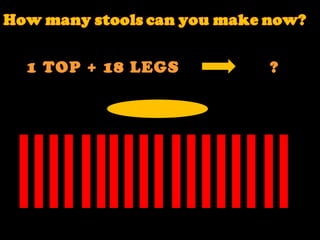
1 TOP + 18 LEGS  ?
Yes…you are right!!! It is always the top which determines the maximum number of stools that can be built… therefore the top is the limiting factor…
What is a limiting reactant? A limiting reactant is the reactant that limits the amount of another reactant that can combine and the amount of product that can be formed in a chemical reaction The excess reactant is the substance that is not used up completely in a reaction
5  oxygen molecules 5 carbon atoms 10 oxygen molecules 5 carbon dioxide molecules
Which one is the limiting reagent in the reaction between carbon and oxygen? Which reagent was used in excess? What need to be added to increase the amount of carbon dioxide produced? Carbon atoms Oxygen molecules Carbon atoms
 
Let’s do this together… What is the maximum mass of sodium chloride  that can be formed when 50cm 3  of hydrochloric  acid with the molarity of 1.0 mol dm -3  reacts  with 25cm 3  of sodium hydroxide solution with  the same molarity?
HCI + NaOH  NaCI +H 2 O V= 50cm 3  M=1.0mol/   dm 3  V= 25cm 3  M=1.0mol/   dm 3  Mass=?  How would you determine what is the maximum mass of sodium chloride that can be produced ?
 
Inspect the equation to check if it was balance Calculate the number of mole of the reactants given to you Determine the limiting reagent Calculate the maximum mass of sodium  chloride that can be obtained
Now more exciting activities… Beginner Intermediate Advance
For BEGINNERS….
To complete a car, four tires will be  needed for each cars. How many  cars can be completed if there are  100 cars and only 320 tires  available? 85 95 90 80
Mg + H 2 SO 4   MgSO 4 + H 2 0.5 mol  1.0 mol If 0.5 mol magnesium and 1.0mol of sulphuric  acid is reacts together in a n experiment, only  0.5mol of hydrogen gas was produced. Which one is the limiting reagent in the above  reaction? magnesium Sulphuric acid hydrogen Magnesium sulphate
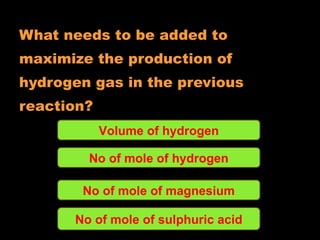
What needs to be added to  maximize the production of hydrogen gas in the previous reaction? Volume of hydrogen No of mole of hydrogen No of mole of magnesium No of mole of sulphuric acid
 
For INTERMEDIATES…
When copper (II) chloride reacts with  sodium nitrate, copper (II) nitrate and  sodium chloride are formed. Select a  balanced equation for the above reaction 2CuCI 2  + NaNO 3  2NaCI  + CuNO 3 CuCI 2  + 2NaNO 3  2NaCI + Cu(NO 3 ) 2 2CuCI 2  + NaNO 3  NaCI  + 2CuNO 3 CuCI 2  + 2NaNO 3  NaCI  + Cu(NO 3 ) 2
If 15 grams of copper (II) chloride  reacts with 20 grams of sodium  nitrate, how much sodium chloride  can be formed? 11g 13g 10g 12g
What is the limiting reagent for the  reaction in the previous question? Copper chloride Copper  Sodium nitrate Sodium chloride
 
For the ADVANCED…
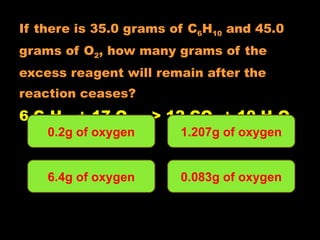
If there is 35.0 grams of C 6 H 10  and 45.0  grams of O 2 , how many grams of the  excess reagent will remain after the  reaction ceases? 6 C 6 H 10  + 17 O 2  ---> 12 CO 2  + 10 H 2 O 0.2g of oxygen 6.4g of oxygen 1.207g of oxygen 0.083g of oxygen
Aluminum reacts with chlorine gas to form  Aluminum chloride via the following reaction: Al + 3Cl 2  ---> 2AlCl 3  .How many grams of  aluminum chloride could be produced from  34.0g of aluminum and 39.0 g of chlorine gas? 48.9g 50.9g 49.9g 51.9g
Suppose 316.0 g  of  aluminum sulfide  reacts with 493.0 g of water. What mass  of the excess reactant remains? The unbalanced equation is: Al 2 S 3  + H 2 O ---> Al(OH) 3  + H 2 S 265.5 g of aluminium sulphide 493 g of aluminium sulphide 265.5 g of water 227.5 g of water
HOME
 
OBJECTIVE Applying all the three important  concepts in stoichiometry : (i)  Balancing chemical equations (ii)  Ratio and proportion (iii) Limiting reagent
STOICHIOMETRY Well…it is not that difficult! there are only five steps to remember…
Interpret the question to form a chemical equation Recognize unbalanced and balanced reaction equations  Balance the unbalanced equation Explain excess and limiting reagent Calculate the mass of the yield
We have discovered all these  steps separately in our previous  lessons…now we will look at  some worked examples which  combines all these steps to help  you solve stoichiometry problems….
Let us look at some solved examples…
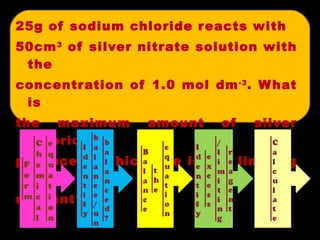
25g of sodium chloride reacts with  50cm 3  of silver nitrate solution with the  concentration of 1.0 mol dm -3 . What is  the maximum amount of silver chloride  produced? Which one is the limiting  reagent?
Interpret the question to form a chemical equation 25g of sodium chloride reacts with 50cm 3  of silver nitrate solution with the  concentration of 1.0 mol dm -3 . What is  the maximum amount of silver chloride  produced? Which one is the limiting  reagent? NaCI +  AgNO 3   AgCI +  NaNO 3
Recognize unbalanced and balanced reaction equations  NaCI +  AgNO 3   AgCI +  NaNO 3 Na Cl Ag 1 1 1 1 1 1 NO 3 1 1 BALANCED
This reaction is a balanced  one… no coefficient needs  to be added for balancing  purposes… Balance the unbalanced equation
Explain excess and limiting reagent NaCI +  AgNO 3   AgCI +  NaNO 3 n NaCI   = Mass/ RMM = 25/(23 + 35.5) = 0.42 mol n AgNO3   = Mass/ RMM   =  50/[108+14+3(16)]   = 0.29 mol The limiting reagent in this experiment is Silver nitrate as the number of moles of it used is fewer than the number of moles of sodium chloride used
Mass of yield, AgCI  = 0.29 mol X (108 + 35.5) gmol -1 = 41.62g Calculate the mass of the yield n= mass/RMM So, mass = n X RMM
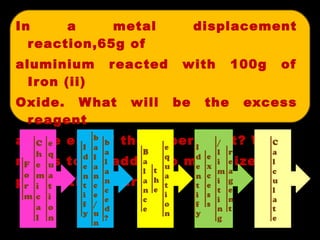
In a metal displacement reaction,65g of  aluminium reacted with 100g of Iron (ii) Oxide. What will be the excess reagent  at the end of the experiment? What  needs to be added to maximize the production of Iron?
Interpret the question to form a chemical equation In a metal displacement reaction,65g of  aluminium reacted with 150g of Iron (ii) Oxide. What will be the excess reagent  at the end of the experiment? What needs to be added to maximize the production of Iron? Al +  Fe 2 O 3   Al 2 O 3   +  Fe
Recognize unbalanced and balanced reaction equations  Al +  Fe 2 O 3   Al 2 O 3   +  Fe Al Fe O 1 2 3 3 1 2 UNBALANCED
Balance the unbalanced equation Al +  Fe 2 O 3   Al 2 O 3  + Fe Al Fe O 1 2 3 3 1 1 BALANCED! X 2 X 2 2Al +  Fe 2 O 3   Al 2 O 3  + 2Fe
Explain excess and limiting reagent 2Al +  Fe 2 O 3   Al 2 O 3  + 2Fe n Al   = Mass/ RMM = 65/27 = 2.41 mol n  =Mass/ RMM = 150/[2(56) + 3(16)]   = 0.94mol The Excess reagent in this experiment is Aluminium as the number of moles of it used is more than the number of moles of Iron (II) Oxide used Fe 2 O 3
Calculate the mass of the yield No calculation for the amount of yield for this question, but it requires you to decide which reactant needs to be added to maximize the mass of yield Increase the mass of Iron(II) Oxide as it is the limiting reagent in this experiment!
50cm 3  of Sodium Hydroxide with the  concentration of 0.2mol/dm 3  was used to  neutralize 35cm 3  of sulphuric acid with  the same concentration. What will be the  maximum mass of water produced?  Which one is the limiting reagent in the  above reaction?
Interpret the question to form a chemical equation 50cm 3  of Sodium Hydroxide with the  concentration of 0.2mol/dm 3  was used to  neutralize 35cm 3  of sulphuric acid with  the same concentration. What will be the  maximum mass of water produced?  Which one is the limiting reagent in the  above reaction? NaOH + H 2 SO 4   Na 2 SO 4 +H 2 O
Recognize unbalanced and balanced reaction equation  NaOH + H 2 SO 4   Na 2 SO 4 +H 2 O Na O H 1 5 3 2 5 2 S 1 1 UNBALANCED
Balance the unbalanced equation NaOH + H 2 SO 4   Na 2 SO 4 +H 2 O 2NaOH + H 2 SO 4   Na 2 SO 4 + 2H 2 O Balancing the number of Sodium atoms, oxygen and hydrogen atoms will balance out the other elements…You don’t really have to balance each and everyone of them… BALANCED!
Explain excess and limiting reagent 2NaOH + H 2 SO 4   Na 2 SO 4 + 2H 2 O n NaOH   = MV/1000 = (50 X 0.2)/1000 = 0.01 mol n  =MV/ 1000 = (35 X 0.2)/1000   = 0.007mol The limiting reagent in this experiment is sulphuric acid as the number of moles of it used is fewer than the number of mol of sodium hydroxide solution used H 2 SO 4 H 2 SO 4
From the equation, two moles of water is  produced by proportion. Meaning the  number of moles of water produced is = 0.007 X 2 = 0.014mol Mass of yield, H 2 O = 0.014 mol X [2(1) + 16] gmol -1 = 0.252 g Calculate the mass of the yield n= mass/RMM So, mass = n X RMM
More and more fun activities… Please try to solve them before looking at the solutions!!! http://misterguch.brinkster.net/PRA004.pdf http://misterguch.brinkster.net/PRA048.pdf   http://misterguch.brinkster.net/PRA019.pdf
HOME
This equation is balanced… Now you can proceed to the next step! HCI + NaOH  NaCI +H 2 O BACK
n = MV n HCI  = MV = [(1.0 mol/dm 3 ) (50 cm 3  )]÷1000 = 0.05 mol n NaOH  = MV = [(1.0 mol/dm 3 ) (25 cm 3  )]÷1000 = 0.025 mol BACK
n HCI  = 0.05 mol n NaOH  = 0.025 mol NaOH will be the limiting reagent as it is the limited one here. Only  0.025 mol of it is present. BACK
From the equation, 1 mol of sodium hydroxide solution  produces 1 mole of sodium chloride salt Therefore,  0.025mol of sodium hydroxide  solution would produce 0.025 mol of  sodium chloride salt
n HCI  =  n NaCI    =  0.025  mol Mass  = No. of mol x Relative molecular mass = 0.025mol x (23 + 35.5) = 0.025mol x 58.5 g/mol = 1.46g BACK
CORRECT!!!
WRONG!!! TRY AGAIN… 
CORRECT!!!
WRONG!!! TRY AGAIN… 
CORRECT!!!
WRONG!!! TRY AGAIN… 
CORRECT!!!
WRONG!!! TRY AGAIN… 
CORRECT!!!
WRONG!!! TRY AGAIN… 
CORRECT!!!
WRONG!!! TRY AGAIN… 
CORRECT!!!
WRONG!!! TRY AGAIN… 
CORRECT!!!
WRONG!!! TRY AGAIN… 
CORRECT!!!
WRONG!!! TRY AGAIN… 
CORRECT!!!
WRONG!!! TRY AGAIN… 
CORRECT!!!
WRONG!!! TRY AGAIN… 
CORRECT!!!
WRONG!!! TRY AGAIN… 
CORRECT!!!
WRONG!!! TRY AGAIN… 
CORRECT!!!
WRONG!!! TRY AGAIN… 
CORRECT!!!
WRONG!!! TRY AGAIN… 
CORRECT!!!
WRONG!!! TRY AGAIN… 
CORRECT!!!
WRONG!!! TRY AGAIN… 
CORRECT!!!
WRONG!!! TRY AGAIN… 
CORRECT!!!
WRONG!!! TRY AGAIN… 
CORRECT!!!
WRONG!!! TRY AGAIN… 
CORRECT!!!
WRONG!!! TRY AGAIN… 

Stoichiometry

  • 1.
    STOICHIOMETRY LET’S ROCKWITH STOICHIOMETRY!!!
  • 2.
    Let’s rock it!!!http://www.youtube.com/watch?v=rWCv-ymhpfY
  • 3.
    Sounds complicated??? Soundslike too much to handle??? No WORRIES….let’s explore!!!
  • 4.
    FUN with STOICHIOMETRY!!!Balancing chemical equations Ratio and Proportion Limiting Reagent All You Know About Stoichiometry
  • 5.
    BALANCING CHEMICAL EQUATIONSUNDERSTANDING THE PURPOSE OF COEFFICIENTS AND SUBSCRIPTS
  • 6.
    Which one wouldyou pick??? ( yellow / red ) Zn + HCl ---> ZnCl 2  + H 2 Zn + 2HCl ---> ZnCl 2  + H 2 (keep your choice in your mind…you might want to change your choice later )
  • 7.
  • 8.
    Arrange the atomsin the box to form the respective products (Drag and drop the atoms) HCI + NaOH NaCI + H 2 O H Na O H H CI Na O H CI
  • 9.
    Arrange the atomsto form the respective products H 2 SO 4 + 2NaOH Na 2 SO 4 + 2H 2 O H H S Na O O O O O H H Na O H H H H O O O O O O Na Na S
  • 10.
    Arrange the atomsto form the reactants and the products 2Mg + O 2 2 MgO REACTANTS Mg Mg O O PRODUCTS Mg Mg O O
  • 11.
    The law ofconservation of mass states that matter can neither be created nor destroyed Thus, in a chemical reaction atoms are neither created nor destroyed, only rearranged in a chemical reaction Thus, the number of a particular atom is the same on both sides of a chemical equation
  • 12.
    C 2 H4 + O 2 CO 2 + H 2 O C H O LEFT RIGHT 2 4 2 3 2 1 F I R S T
  • 13.
  • 14.
    Add coefficient 2in front of CO2 – that balances the carbon (C) Then add coefficient 2 in front of H 2 O – that balances the hydrogen (H) Finally re-calculate how many oxygen atoms you have Now you have 6 oxygen atoms all together on your right To balance that add coefficient 3 in front of O 2 – that balances the oxygen S E C O N D
  • 15.
    C 2 H4 + 3O 2 2CO 2 + 2H 2 O C H O LEFT RIGHT 2 4 6 6 4 2 F I N A L L Y
  • 16.
    Coefficient and subscript5 H 2 What number represents the coefficient? 5 What number represents the Subscript? 2 How many “H’s” do you have? 10
  • 17.
    How many Aluminiumand Chlorine atoms are present in 2 Aluminium chloride molecules? 2AICI 3 Aluminium = Chlorine = 6 2
  • 18.
    SUBSCRIPT AND COEFFICIENTBalance the following equation using the coefficient given AI + HCI AICI 3 + H 2 3 2 6 2
  • 19.
    2AI + 6HCI 2AICI 3 + 3H 2 AI H CI H CI H CI H CI H CI H CI AI AI CI CI CI AI CI CI CI H H H H H H Are the number of each atom present on the left (reactant) and the right (product) the same?
  • 20.
    SHARPEN YOUR SKILLS!!!HOME http://funbasedlearning.com/chemistry/chemBalancer/default.htm
  • 21.
  • 22.
    Mary was homealone…. She was craving for pancakes … She remembered that her mum always kept a stock of pancake mixture in the kitchen … She grabbed the box... And started reading the instructions…
  • 23.
    This is whatthe instruction said… 4 cups of mixture 2 cups of water 4 eggs Mix all, Beat well!!! Note : Each pack makes 12 large pancakes
  • 24.
    But 12 istoo many!!! She wanted only 3… Hmm…can you help her with the pancake mixture?
  • 25.
    4 cups ofmixture 2 cups of water 4 eggs 12 pancakes ?eggs 3 pancakes ? cups of mixture ? cups of water Can you help her with the correct measurements to make just 3 pancakes???
  • 26.
    Consider the equationonce again…. Look at the proportion of the mixture to the number of pancakes… 4 cups of mixture makes 12 pancakes… 4 cups of mixture 12 pancakes 3 pancakes ? cups of mixture 12/4 ? Can you decide how many cups of mixture will be needed?
  • 27.
    That was prettysimple!!! Now, can you get the proportion of the rest of the ingredients for Mary? (work it out on a piece of paper and check to see later if you have got the proportions correct)
  • 28.
    4 cups ofmixture 2 cups of water 4 eggs 12 pancakes ?eggs 3 pancakes ? cups of mixture ? cups of water 1 egg 3 pancakes 1 cup of mixture ½ cup of water ÷4 ÷4 ÷4 ÷4
  • 29.
    The pancakes turnedout so well for a first timer…Mary loved it !!! THANK YOU!
  • 30.
    Can you applythe same idea here??? 1 mole of hydrochloric acid react with 1 mole of Sodium hydroxide solution to form 1 mole of sodium chloride and 1 mole of water. Can you figure out how many moles of water will be produced if 0.5 mole of acid is used???
  • 31.
    How many molesof water produced??? HCl + NaOH NaCl + H 2 O 1 1 1 1 Can you determine how many mole of water will be produced if 0.5 mole of acid is used???
  • 32.
    Now… consider thisequation! H 2 SO 4 + 2NaOH Na 2 SO 4 + 2H 2 O How many moles of sodium sulphate by proportion will be produced if 1 mole of sodium hydroxide is used? 1.0 0.5 2.0 0.25
  • 33.
    Now let’s getinto the lab and do some ‘real’ stuffs!!! (download the virtual lab above!!!then we can get into action….) http://www.chemcollective.org/vlab/vlab.php
  • 34.
    One final taskbefore getting started!!! Explore the reagents and the apparatus provided in the virtual lab… Explore your virtual lab!!! Get familiarized with it…
  • 35.
    Get your tasksheet and get going with your virtual lab… You are suppose to complete the task given using your virtual lab tools Get the word document ‘ FUN WITH VIRTUAL LAB’ http://www.scribd.com/doc/66347972
  • 36.
    Now more excitingactivities… Beginner Intermediate Advance
  • 37.
  • 38.
    John was makingtables for a school project…he needs help… 1m 2 of plank makes 2 table tops. He was thinking how many table tops can be made out of 2m 2 of plank? tell him… 6 8 3 4
  • 39.
    Mak Lijah uses30 eggs and 5kg of flour to make 100 bahulu cakes. How many eggs and how much flour will she need if a customer ordered only 50 bahulu cakes? 20 eggs and 3kg of flour 15 eggs and 2.5kg of flour 15 eggs and 3kg of flour 10 eggs and 2.5kg of flour
  • 40.
    1 mol ofhydrochloric acid react with 1 mol of sodium hydroxide solution to produce 1 mol of sodium chloride salt and 1mol of water. How many moles of water will be produced if 0.8 mol of acid was used? HCI + NaOH NaCI + H 2 O 0.8 mol 1.0 mol 0.6 mol 0.5 mol
  • 41.
    Based on theabove chemical equation, can you deduce how many moles of water will be produced if 0.5 mole of sulphuric acid is used? H 2 SO 4 + 2NaOH NA 2 SO 4 + 2H 2 O 0.5 mol 1.5 mol 1.0 mol 0.3 mol
  • 42.
  • 43.
  • 44.
    Sulphuric acid reactwith magnesium to produce magnesium sulphate and hydrogen gas. Pick the correct equation representing the chemical reaction above. H 2 SO 4 + Mg 2MgSO 4 + H 2 H 2 SO 4 + Mg MgSO 4 + H 2 H 2 SO 4 + 2Mg Mg 2 SO 4 + H 2 2H 2 SO 4 + Mg 2MgSO 4 + H 2
  • 45.
    H 2 SO 4 + Mg MgSO 4 + H 2 Tip : You may need paper, pen and a calculator If 24g of magnesium is used in the above reaction, how many moles of hydrogen gas will be produced?[Relative atomic mass of magnesium: 24] 2 moles 0.5 mole 1 mole 3 moles
  • 46.
    How many molesof hydrogen gas will be produced if Hydrochloric acid is used instead of sulphuric acid? (the mass of the magnesium used is still the same) 2HCI + Mg MgCI 2 + H 2 2 moles 0.5 mole 1 mole 3 moles
  • 47.
  • 48.
  • 49.
    2AI + 6HCI 2AICI 3 + 3H 2 30cm 3 of hydrochloric acid with the concentration of 0.2 moldm -3 was used in this experiment. What is the volume of hydrogen gas that will be produced? [Molar volume of gas: 24 dm 3 mol -1 ] 60cm 3 0.06cm 3 72dm 3 72cm 3
  • 50.
    C 2 H4 + 3O 2 2CO 2 + 2H 2 O What is the minimum volume of oxygen gas is required for you to produce 0.6 moles of carbon dioxide gas? [molar volume of gas: 24 dm 3 mol -1 ] 0.9 dm 3 22 dm 3 21.6 dm 3 0.3 dm 3
  • 51.
    Al + 3Cu(NO3 ) 2 2Al(NO 3 ) 3 +3Cu How many grams of copper will be produced if 0.3 moles of Aluminium is used? (Copper (II)nitrate solution is used in excess & RAM of Copper :64 ) 20.1g 28.8g 16.9g 10.3g
  • 52.
  • 53.
  • 54.
    More + Less= LESS http://www.youtube.com/watch?v=RO1kErdVqqw
  • 55.
    Can you answerthese questions??? Why only 30.5cm 3 of hydrogen gas liberated although the same amount of acid was used in both experiments? Why does the amount of hydrogen gas liberated remain at 61cm 3 although zinc was used in excess? (think about it…and jot down what ever you think the reason is on a piece of paper…)
  • 56.
    OBJECTIVE At theend of the lesson: Determine which of two reactants is a limiting reagent Calculate the amount in moles or grams of a product, given the amounts in moles or masses in grams of two reactants, one which is in excess .
  • 57.
    LET’S BUILD STOOLS1 TOP and 3 LEGS 1 STOOL
  • 58.
    LET’S BUILD STOOLS1 TOP and 6 LEGS ?
  • 59.
  • 60.
    1 TOP +18 LEGS ?
  • 61.
    Yes…you are right!!!It is always the top which determines the maximum number of stools that can be built… therefore the top is the limiting factor…
  • 62.
    What is alimiting reactant? A limiting reactant is the reactant that limits the amount of another reactant that can combine and the amount of product that can be formed in a chemical reaction The excess reactant is the substance that is not used up completely in a reaction
  • 63.
    5 oxygenmolecules 5 carbon atoms 10 oxygen molecules 5 carbon dioxide molecules
  • 64.
    Which one isthe limiting reagent in the reaction between carbon and oxygen? Which reagent was used in excess? What need to be added to increase the amount of carbon dioxide produced? Carbon atoms Oxygen molecules Carbon atoms
  • 65.
  • 66.
    Let’s do thistogether… What is the maximum mass of sodium chloride that can be formed when 50cm 3 of hydrochloric acid with the molarity of 1.0 mol dm -3 reacts with 25cm 3 of sodium hydroxide solution with the same molarity?
  • 67.
    HCI + NaOH NaCI +H 2 O V= 50cm 3 M=1.0mol/ dm 3 V= 25cm 3 M=1.0mol/ dm 3 Mass=? How would you determine what is the maximum mass of sodium chloride that can be produced ?
  • 68.
  • 69.
    Inspect the equationto check if it was balance Calculate the number of mole of the reactants given to you Determine the limiting reagent Calculate the maximum mass of sodium chloride that can be obtained
  • 70.
    Now more excitingactivities… Beginner Intermediate Advance
  • 71.
  • 72.
    To complete acar, four tires will be needed for each cars. How many cars can be completed if there are 100 cars and only 320 tires available? 85 95 90 80
  • 73.
    Mg + H2 SO 4 MgSO 4 + H 2 0.5 mol 1.0 mol If 0.5 mol magnesium and 1.0mol of sulphuric acid is reacts together in a n experiment, only 0.5mol of hydrogen gas was produced. Which one is the limiting reagent in the above reaction? magnesium Sulphuric acid hydrogen Magnesium sulphate
  • 74.
    What needs tobe added to maximize the production of hydrogen gas in the previous reaction? Volume of hydrogen No of mole of hydrogen No of mole of magnesium No of mole of sulphuric acid
  • 75.
  • 76.
  • 77.
    When copper (II)chloride reacts with sodium nitrate, copper (II) nitrate and sodium chloride are formed. Select a balanced equation for the above reaction 2CuCI 2 + NaNO 3 2NaCI + CuNO 3 CuCI 2 + 2NaNO 3 2NaCI + Cu(NO 3 ) 2 2CuCI 2 + NaNO 3 NaCI + 2CuNO 3 CuCI 2 + 2NaNO 3 NaCI + Cu(NO 3 ) 2
  • 78.
    If 15 gramsof copper (II) chloride reacts with 20 grams of sodium nitrate, how much sodium chloride can be formed? 11g 13g 10g 12g
  • 79.
    What is thelimiting reagent for the reaction in the previous question? Copper chloride Copper Sodium nitrate Sodium chloride
  • 80.
  • 81.
  • 82.
    If there is35.0 grams of C 6 H 10  and 45.0 grams of O 2 , how many grams of the excess reagent will remain after the reaction ceases? 6 C 6 H 10  + 17 O 2  ---> 12 CO 2  + 10 H 2 O 0.2g of oxygen 6.4g of oxygen 1.207g of oxygen 0.083g of oxygen
  • 83.
    Aluminum reacts withchlorine gas to form Aluminum chloride via the following reaction: Al + 3Cl 2  ---> 2AlCl 3 .How many grams of aluminum chloride could be produced from 34.0g of aluminum and 39.0 g of chlorine gas? 48.9g 50.9g 49.9g 51.9g
  • 84.
    Suppose 316.0 g of aluminum sulfide reacts with 493.0 g of water. What mass of the excess reactant remains? The unbalanced equation is: Al 2 S 3  + H 2 O ---> Al(OH) 3  + H 2 S 265.5 g of aluminium sulphide 493 g of aluminium sulphide 265.5 g of water 227.5 g of water
  • 85.
  • 86.
  • 87.
    OBJECTIVE Applying allthe three important concepts in stoichiometry : (i) Balancing chemical equations (ii) Ratio and proportion (iii) Limiting reagent
  • 88.
    STOICHIOMETRY Well…it isnot that difficult! there are only five steps to remember…
  • 89.
    Interpret the questionto form a chemical equation Recognize unbalanced and balanced reaction equations Balance the unbalanced equation Explain excess and limiting reagent Calculate the mass of the yield
  • 90.
    We have discoveredall these steps separately in our previous lessons…now we will look at some worked examples which combines all these steps to help you solve stoichiometry problems….
  • 91.
    Let us lookat some solved examples…
  • 92.
    25g of sodiumchloride reacts with 50cm 3 of silver nitrate solution with the concentration of 1.0 mol dm -3 . What is the maximum amount of silver chloride produced? Which one is the limiting reagent?
  • 93.
    Interpret the questionto form a chemical equation 25g of sodium chloride reacts with 50cm 3 of silver nitrate solution with the concentration of 1.0 mol dm -3 . What is the maximum amount of silver chloride produced? Which one is the limiting reagent? NaCI + AgNO 3 AgCI + NaNO 3
  • 94.
    Recognize unbalanced andbalanced reaction equations NaCI + AgNO 3 AgCI + NaNO 3 Na Cl Ag 1 1 1 1 1 1 NO 3 1 1 BALANCED
  • 95.
    This reaction isa balanced one… no coefficient needs to be added for balancing purposes… Balance the unbalanced equation
  • 96.
    Explain excess andlimiting reagent NaCI + AgNO 3 AgCI + NaNO 3 n NaCI = Mass/ RMM = 25/(23 + 35.5) = 0.42 mol n AgNO3 = Mass/ RMM = 50/[108+14+3(16)] = 0.29 mol The limiting reagent in this experiment is Silver nitrate as the number of moles of it used is fewer than the number of moles of sodium chloride used
  • 97.
    Mass of yield,AgCI = 0.29 mol X (108 + 35.5) gmol -1 = 41.62g Calculate the mass of the yield n= mass/RMM So, mass = n X RMM
  • 98.
    In a metaldisplacement reaction,65g of aluminium reacted with 100g of Iron (ii) Oxide. What will be the excess reagent at the end of the experiment? What needs to be added to maximize the production of Iron?
  • 99.
    Interpret the questionto form a chemical equation In a metal displacement reaction,65g of aluminium reacted with 150g of Iron (ii) Oxide. What will be the excess reagent at the end of the experiment? What needs to be added to maximize the production of Iron? Al + Fe 2 O 3 Al 2 O 3 + Fe
  • 100.
    Recognize unbalanced andbalanced reaction equations Al + Fe 2 O 3 Al 2 O 3 + Fe Al Fe O 1 2 3 3 1 2 UNBALANCED
  • 101.
    Balance the unbalancedequation Al + Fe 2 O 3 Al 2 O 3 + Fe Al Fe O 1 2 3 3 1 1 BALANCED! X 2 X 2 2Al + Fe 2 O 3 Al 2 O 3 + 2Fe
  • 102.
    Explain excess andlimiting reagent 2Al + Fe 2 O 3 Al 2 O 3 + 2Fe n Al = Mass/ RMM = 65/27 = 2.41 mol n =Mass/ RMM = 150/[2(56) + 3(16)] = 0.94mol The Excess reagent in this experiment is Aluminium as the number of moles of it used is more than the number of moles of Iron (II) Oxide used Fe 2 O 3
  • 103.
    Calculate the massof the yield No calculation for the amount of yield for this question, but it requires you to decide which reactant needs to be added to maximize the mass of yield Increase the mass of Iron(II) Oxide as it is the limiting reagent in this experiment!
  • 104.
    50cm 3 of Sodium Hydroxide with the concentration of 0.2mol/dm 3 was used to neutralize 35cm 3 of sulphuric acid with the same concentration. What will be the maximum mass of water produced? Which one is the limiting reagent in the above reaction?
  • 105.
    Interpret the questionto form a chemical equation 50cm 3 of Sodium Hydroxide with the concentration of 0.2mol/dm 3 was used to neutralize 35cm 3 of sulphuric acid with the same concentration. What will be the maximum mass of water produced? Which one is the limiting reagent in the above reaction? NaOH + H 2 SO 4 Na 2 SO 4 +H 2 O
  • 106.
    Recognize unbalanced andbalanced reaction equation NaOH + H 2 SO 4 Na 2 SO 4 +H 2 O Na O H 1 5 3 2 5 2 S 1 1 UNBALANCED
  • 107.
    Balance the unbalancedequation NaOH + H 2 SO 4 Na 2 SO 4 +H 2 O 2NaOH + H 2 SO 4 Na 2 SO 4 + 2H 2 O Balancing the number of Sodium atoms, oxygen and hydrogen atoms will balance out the other elements…You don’t really have to balance each and everyone of them… BALANCED!
  • 108.
    Explain excess andlimiting reagent 2NaOH + H 2 SO 4 Na 2 SO 4 + 2H 2 O n NaOH = MV/1000 = (50 X 0.2)/1000 = 0.01 mol n =MV/ 1000 = (35 X 0.2)/1000 = 0.007mol The limiting reagent in this experiment is sulphuric acid as the number of moles of it used is fewer than the number of mol of sodium hydroxide solution used H 2 SO 4 H 2 SO 4
  • 109.
    From the equation,two moles of water is produced by proportion. Meaning the number of moles of water produced is = 0.007 X 2 = 0.014mol Mass of yield, H 2 O = 0.014 mol X [2(1) + 16] gmol -1 = 0.252 g Calculate the mass of the yield n= mass/RMM So, mass = n X RMM
  • 110.
    More and morefun activities… Please try to solve them before looking at the solutions!!! http://misterguch.brinkster.net/PRA004.pdf http://misterguch.brinkster.net/PRA048.pdf http://misterguch.brinkster.net/PRA019.pdf
  • 111.
  • 112.
    This equation isbalanced… Now you can proceed to the next step! HCI + NaOH NaCI +H 2 O BACK
  • 113.
    n = MVn HCI = MV = [(1.0 mol/dm 3 ) (50 cm 3 )]÷1000 = 0.05 mol n NaOH = MV = [(1.0 mol/dm 3 ) (25 cm 3 )]÷1000 = 0.025 mol BACK
  • 114.
    n HCI = 0.05 mol n NaOH = 0.025 mol NaOH will be the limiting reagent as it is the limited one here. Only 0.025 mol of it is present. BACK
  • 115.
    From the equation,1 mol of sodium hydroxide solution produces 1 mole of sodium chloride salt Therefore, 0.025mol of sodium hydroxide solution would produce 0.025 mol of sodium chloride salt
  • 116.
    n HCI = n NaCI = 0.025 mol Mass = No. of mol x Relative molecular mass = 0.025mol x (23 + 35.5) = 0.025mol x 58.5 g/mol = 1.46g BACK
  • 117.
  • 118.
  • 119.
  • 120.
  • 121.
  • 122.
  • 123.
  • 124.
  • 125.
  • 126.
  • 127.
  • 128.
  • 129.
  • 130.
  • 131.
  • 132.
  • 133.
  • 134.
  • 135.
  • 136.
  • 137.
  • 138.
  • 139.
  • 140.
  • 141.
  • 142.
  • 143.
  • 144.
  • 145.
  • 146.
  • 147.
  • 148.
  • 149.
  • 150.
  • 151.
  • 152.
  • 153.
  • 154.
  • 155.
  • 156.
  • 157.
  • 158.
  • 159.
  • 160.
  • 161.