

Basic
                Concepts on
                Stoichiometry


  Mr. Ronnie Z. Valenciano Jr.
Bachelor of Secondary Education
  Major in Biological Science
What is a MOLE?
• It is the SI unit of the quantity of matter.
• It represents a specific quantity of atoms, ions
  or molecules.
                      23

     1 mole = 6.02 x 10 Avogadro’s number
Mole – Mass Relationship
Steps:
1. Get the molecular mass of the given
   substance.
2. Then use the conversion factor remembering
   that one mole of any substance has a mass,
   in grams, equal to its molecular (atomic)
   mass.
3. Accomplish the mathematical equation.
Exercises on mole – mass relationship.


• What is the mass of 2 mol of NH3?
• A container holds 45 g of sugar (C6H12O6).
  How many moles of sugar are present?
• How many moles are present in 27.0 g of
  water?
Balancing Equations

     Steps:
1. Determine the reactants and
    products.
2. Assemble the parts of the
    chemical reaction.
3. Balance the equation
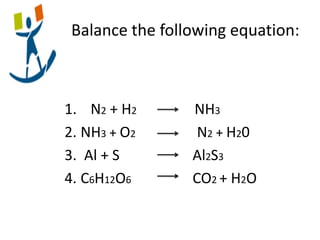
Balance the following equation:


1. N2 + H2       NH3
2. NH3 + O2       N2 + H20
3. Al + S        Al2S3
4. C6H12O6       CO2 + H2O
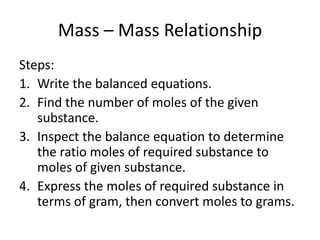
Mass – Mass Relationship
Steps:
1. Write the balanced equations.
2. Find the number of moles of the given
   substance.
3. Inspect the balance equation to determine
   the ratio moles of required substance to
   moles of given substance.
4. Express the moles of required substance in
   terms of gram, then convert moles to grams.
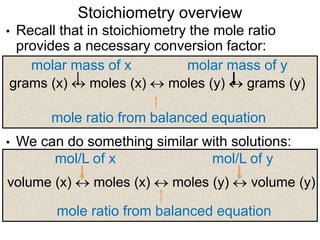
Stoichiometry overview
•Recall that in stoichiometry the mole ratio
 provides a necessary conversion factor:
   molar mass of x           molar mass of y
grams (x)     moles (x)   moles (y)    grams (y)

         mole ratio from balanced equation
•   We can do something similar with solutions:
         mol/L of x              mol/L of y
volume (x)      moles (x)   moles (y)   volume (y)

          mole ratio from balanced equation
Problem Solving
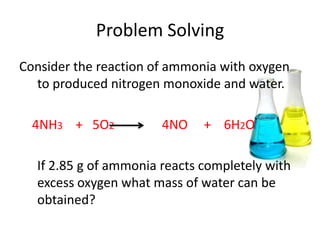
Consider the reaction of ammonia with oxygen
  to produced nitrogen monoxide and water.

  4NH3 + 5O2           4NO    + 6H2O

  If 2.85 g of ammonia reacts completely with
  excess oxygen what mass of water can be
  obtained?
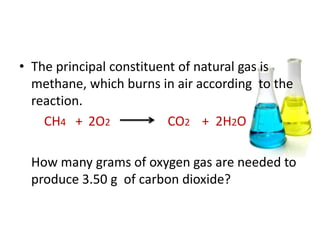
• The principal constituent of natural gas is
  methane, which burns in air according to the
  reaction.
    CH4 + 2O2             CO2 + 2H2O

  How many grams of oxygen gas are needed to
  produce 3.50 g of carbon dioxide?
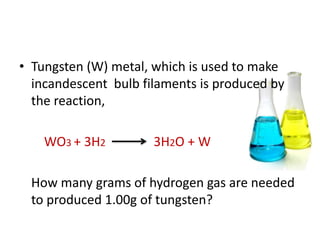
• Tungsten (W) metal, which is used to make
  incandescent bulb filaments is produced by
  the reaction,

    WO3 + 3H2         3H2O + W

 How many grams of hydrogen gas are needed
 to produced 1.00g of tungsten?
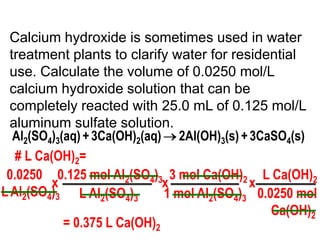
Calcium hydroxide is sometimes used in water
  treatment plants to clarify water for residential
  use. Calculate the volume of 0.0250 mol/L
  calcium hydroxide solution that can be
  completely reacted with 25.0 mL of 0.125 mol/L
  aluminum sulfate solution.
   Al2(SO4)3(aq) + 3Ca(OH)2(aq) 2Al(OH)3(s) + 3CaSO4(s)
   # L Ca(OH)2=
 0.0250 0.125 mol Al2(SO4)3 3 mol Ca(OH)2 L Ca(OH)2
          x                    x              x
L Al2(SO4)3 L Al2(SO4)3        1 mol Al2(SO4)3 0.0250 mol
                                                  Ca(OH)2
             = 0.375 L Ca(OH)2
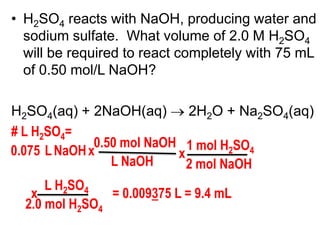
• H2SO4 reacts with NaOH, producing water and
  sodium sulfate. What volume of 2.0 M H2SO4
  will be required to react completely with 75 mL
  of 0.50 mol/L NaOH?

H2SO4(aq) + 2NaOH(aq)        2H2O + Na2SO4(aq)
# L H2SO4=
              0.50 mol NaOH 1 mol H2SO4
0.075 L NaOH x             x
                 L NaOH      2 mol NaOH
      L H2SO4
   x            = 0.009375 L = 9.4 mL
  2.0 mol H2SO4
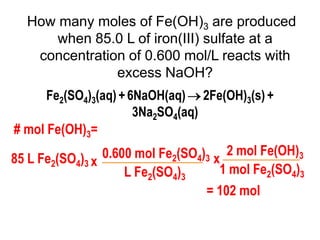
How many moles of Fe(OH)3 are produced
      when 85.0 L of iron(III) sulfate at a
   concentration of 0.600 mol/L reacts with
               excess NaOH?
      Fe2(SO4)3(aq) + 6NaOH(aq) 2Fe(OH)3(s) +
                       3Na2SO4(aq)
# mol Fe(OH)3=

85 L Fe2(SO4)3 x 0.600 mol Fe2(SO4)3 x 2 mol Fe(OH)3
                     L Fe2(SO4)3      1 mol Fe2(SO4)3
                                   = 102 mol

Balancing equations

  • 1.
    Basic Concepts on Stoichiometry Mr. Ronnie Z. Valenciano Jr. Bachelor of Secondary Education Major in Biological Science
  • 3.
    What is aMOLE? • It is the SI unit of the quantity of matter. • It represents a specific quantity of atoms, ions or molecules. 23 1 mole = 6.02 x 10 Avogadro’s number
  • 4.
    Mole – MassRelationship Steps: 1. Get the molecular mass of the given substance. 2. Then use the conversion factor remembering that one mole of any substance has a mass, in grams, equal to its molecular (atomic) mass. 3. Accomplish the mathematical equation.
  • 5.
    Exercises on mole– mass relationship. • What is the mass of 2 mol of NH3? • A container holds 45 g of sugar (C6H12O6). How many moles of sugar are present? • How many moles are present in 27.0 g of water?
  • 6.
    Balancing Equations Steps: 1. Determine the reactants and products. 2. Assemble the parts of the chemical reaction. 3. Balance the equation
  • 7.
    Balance the followingequation: 1. N2 + H2 NH3 2. NH3 + O2 N2 + H20 3. Al + S Al2S3 4. C6H12O6 CO2 + H2O
  • 8.
    Mass – MassRelationship Steps: 1. Write the balanced equations. 2. Find the number of moles of the given substance. 3. Inspect the balance equation to determine the ratio moles of required substance to moles of given substance. 4. Express the moles of required substance in terms of gram, then convert moles to grams.
  • 9.
    Stoichiometry overview •Recall thatin stoichiometry the mole ratio provides a necessary conversion factor: molar mass of x molar mass of y grams (x) moles (x) moles (y) grams (y) mole ratio from balanced equation • We can do something similar with solutions: mol/L of x mol/L of y volume (x) moles (x) moles (y) volume (y) mole ratio from balanced equation
  • 10.
    Problem Solving Consider thereaction of ammonia with oxygen to produced nitrogen monoxide and water. 4NH3 + 5O2 4NO + 6H2O If 2.85 g of ammonia reacts completely with excess oxygen what mass of water can be obtained?
  • 11.
    • The principalconstituent of natural gas is methane, which burns in air according to the reaction. CH4 + 2O2 CO2 + 2H2O How many grams of oxygen gas are needed to produce 3.50 g of carbon dioxide?
  • 12.
    • Tungsten (W)metal, which is used to make incandescent bulb filaments is produced by the reaction, WO3 + 3H2 3H2O + W How many grams of hydrogen gas are needed to produced 1.00g of tungsten?
  • 13.
    Calcium hydroxide issometimes used in water treatment plants to clarify water for residential use. Calculate the volume of 0.0250 mol/L calcium hydroxide solution that can be completely reacted with 25.0 mL of 0.125 mol/L aluminum sulfate solution. Al2(SO4)3(aq) + 3Ca(OH)2(aq) 2Al(OH)3(s) + 3CaSO4(s) # L Ca(OH)2= 0.0250 0.125 mol Al2(SO4)3 3 mol Ca(OH)2 L Ca(OH)2 x x x L Al2(SO4)3 L Al2(SO4)3 1 mol Al2(SO4)3 0.0250 mol Ca(OH)2 = 0.375 L Ca(OH)2
  • 14.
    • H2SO4 reactswith NaOH, producing water and sodium sulfate. What volume of 2.0 M H2SO4 will be required to react completely with 75 mL of 0.50 mol/L NaOH? H2SO4(aq) + 2NaOH(aq) 2H2O + Na2SO4(aq) # L H2SO4= 0.50 mol NaOH 1 mol H2SO4 0.075 L NaOH x x L NaOH 2 mol NaOH L H2SO4 x = 0.009375 L = 9.4 mL 2.0 mol H2SO4
  • 15.
    How many molesof Fe(OH)3 are produced when 85.0 L of iron(III) sulfate at a concentration of 0.600 mol/L reacts with excess NaOH? Fe2(SO4)3(aq) + 6NaOH(aq) 2Fe(OH)3(s) + 3Na2SO4(aq) # mol Fe(OH)3= 85 L Fe2(SO4)3 x 0.600 mol Fe2(SO4)3 x 2 mol Fe(OH)3 L Fe2(SO4)3 1 mol Fe2(SO4)3 = 102 mol