Empirical Formulas Chapter 7 section 3
Empirical Formulas An empirical formula shows the simplest ratio among atoms in a compound.
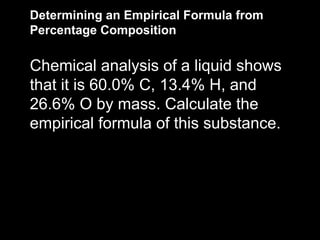
Determining an Empirical Formula from Percentage Composition Chemical analysis of a liquid shows that it is 60.0% C, 13.4% H, and 26.6% O by mass. Calculate the empirical formula of this substance.
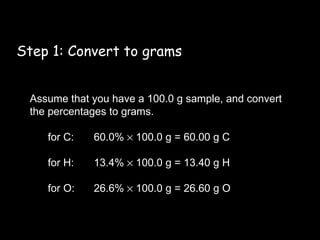
Step 1: Convert to grams Assume that you have a 100.0 g sample, and convert the percentages to grams. for C: 60.0%    100.0 g = 60.00 g C for H: 13.4%    100.0 g = 13.40 g H for O: 26.6%    100.0 g = 26.60 g O
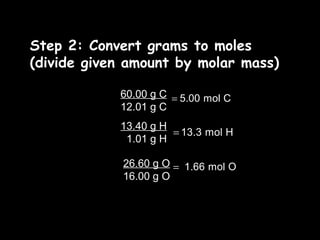
Step 2: Convert grams to moles (divide given amount by molar mass) 60.00 g C 12.01 g C 13.40 g H 1.01 g H 26.60 g O 16.00 g O
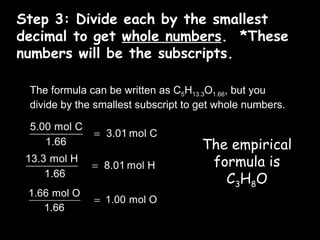
Step 3: Divide each by the smallest decimal to get  whole numbers .  *These numbers will be the subscripts. The formula can be written as C 5 H 13.3 O 1.66 , but you divide by the smallest subscript to get whole numbers. The empirical formula is C 3 H 8 O
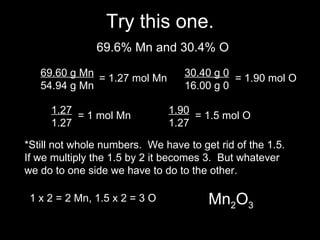
Try this one. 69.60 g Mn 54.94 g Mn 30.40 g 0 16.00 g 0 = 1.27 mol Mn = 1.90 mol O 1.27 1.27 = 1 mol Mn 1.90 1.27 = 1.5 mol O *Still not whole numbers.  We have to get rid of the 1.5. If we multiply the 1.5 by 2 it becomes 3.  But whatever  we do to one side we have to do to the other. 1 x 2 = 2 Mn, 1.5 x 2 = 3 O Mn 2 O 3 69.6% Mn and 30.4% O
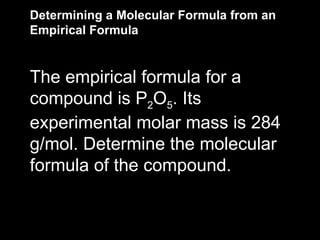
Determining a Molecular Formula from an Empirical Formula The empirical formula for a compound is P 2 O 5 . Its experimental molar mass is 284 g/mol. Determine the molecular formula of the compound.
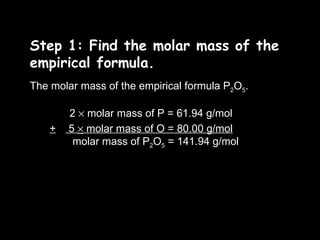
Step 1: Find the molar mass of the empirical formula. The molar mass of the empirical formula P 2 O 5 . 2    molar mass of P = 61.94 g/mol +  5    molar mass of O = 80.00 g/mol molar mass of P 2 O 5  = 141.94 g/mol
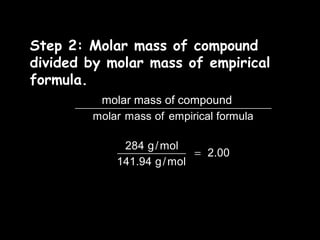
Step 2: Molar mass of compound divided by molar mass of empirical formula. molar mass of compound
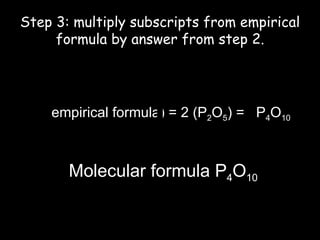
Step 3: multiply subscripts from empirical formula by answer from step 2. n  (empirical formula) = 2 (P 2 O 5 ) =  P 4 O 10 Molecular formula P 4 O 10
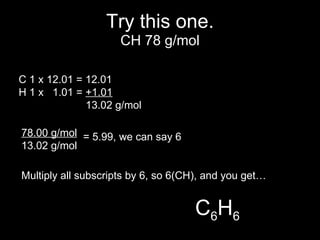
Try this one. C 1 x 12.01 = 12.01 H 1 x  1.01 =  +1.01   13.02 g/mol 78.00 g/mol 13.02 g/mol = 5.99, we can say 6 Multiply all subscripts by 6, so 6(CH), and you get… C 6 H 6 CH 78 g/mol
Homework Empirical vs. Molecular worksheet 1-18 Read chapter 7 section 3. Look at the examples.

Empirical formulas

  • 1.
  • 2.
    Empirical Formulas Anempirical formula shows the simplest ratio among atoms in a compound.
  • 3.
    Determining an EmpiricalFormula from Percentage Composition Chemical analysis of a liquid shows that it is 60.0% C, 13.4% H, and 26.6% O by mass. Calculate the empirical formula of this substance.
  • 4.
    Step 1: Convertto grams Assume that you have a 100.0 g sample, and convert the percentages to grams. for C: 60.0%  100.0 g = 60.00 g C for H: 13.4%  100.0 g = 13.40 g H for O: 26.6%  100.0 g = 26.60 g O
  • 5.
    Step 2: Convertgrams to moles (divide given amount by molar mass) 60.00 g C 12.01 g C 13.40 g H 1.01 g H 26.60 g O 16.00 g O
  • 6.
    Step 3: Divideeach by the smallest decimal to get whole numbers . *These numbers will be the subscripts. The formula can be written as C 5 H 13.3 O 1.66 , but you divide by the smallest subscript to get whole numbers. The empirical formula is C 3 H 8 O
  • 7.
    Try this one.69.60 g Mn 54.94 g Mn 30.40 g 0 16.00 g 0 = 1.27 mol Mn = 1.90 mol O 1.27 1.27 = 1 mol Mn 1.90 1.27 = 1.5 mol O *Still not whole numbers. We have to get rid of the 1.5. If we multiply the 1.5 by 2 it becomes 3. But whatever we do to one side we have to do to the other. 1 x 2 = 2 Mn, 1.5 x 2 = 3 O Mn 2 O 3 69.6% Mn and 30.4% O
  • 8.
    Determining a MolecularFormula from an Empirical Formula The empirical formula for a compound is P 2 O 5 . Its experimental molar mass is 284 g/mol. Determine the molecular formula of the compound.
  • 9.
    Step 1: Findthe molar mass of the empirical formula. The molar mass of the empirical formula P 2 O 5 . 2  molar mass of P = 61.94 g/mol + 5  molar mass of O = 80.00 g/mol molar mass of P 2 O 5 = 141.94 g/mol
  • 10.
    Step 2: Molarmass of compound divided by molar mass of empirical formula. molar mass of compound
  • 11.
    Step 3: multiplysubscripts from empirical formula by answer from step 2. n (empirical formula) = 2 (P 2 O 5 ) = P 4 O 10 Molecular formula P 4 O 10
  • 12.
    Try this one.C 1 x 12.01 = 12.01 H 1 x 1.01 = +1.01 13.02 g/mol 78.00 g/mol 13.02 g/mol = 5.99, we can say 6 Multiply all subscripts by 6, so 6(CH), and you get… C 6 H 6 CH 78 g/mol
  • 13.
    Homework Empirical vs.Molecular worksheet 1-18 Read chapter 7 section 3. Look at the examples.