Stoichiometry
Lancaster High School
StoichiometryStoichiometry
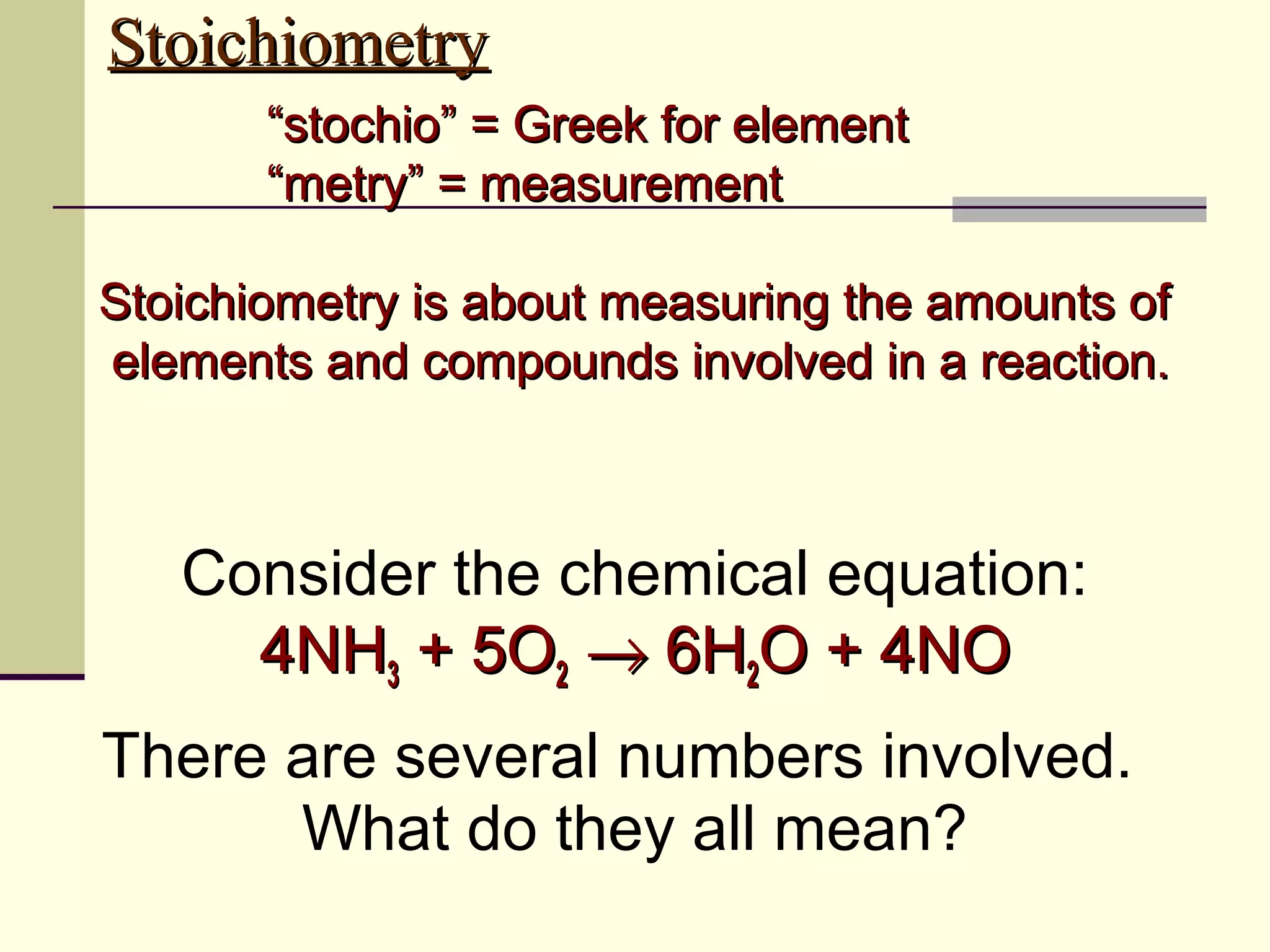
Consider the chemical equation:
4NH4NH33 + 5O+ 5O22 →→ 6H6H22O + 4NOO + 4NO
There are several numbers involved.
What do they all mean?
““stochio” = Greek for elementstochio” = Greek for element
““metry” = measurementmetry” = measurement
Stoichiometry is about measuring the amounts ofStoichiometry is about measuring the amounts of
elements and compounds involved in a reaction.elements and compounds involved in a reaction.
StoichiometryStoichiometry
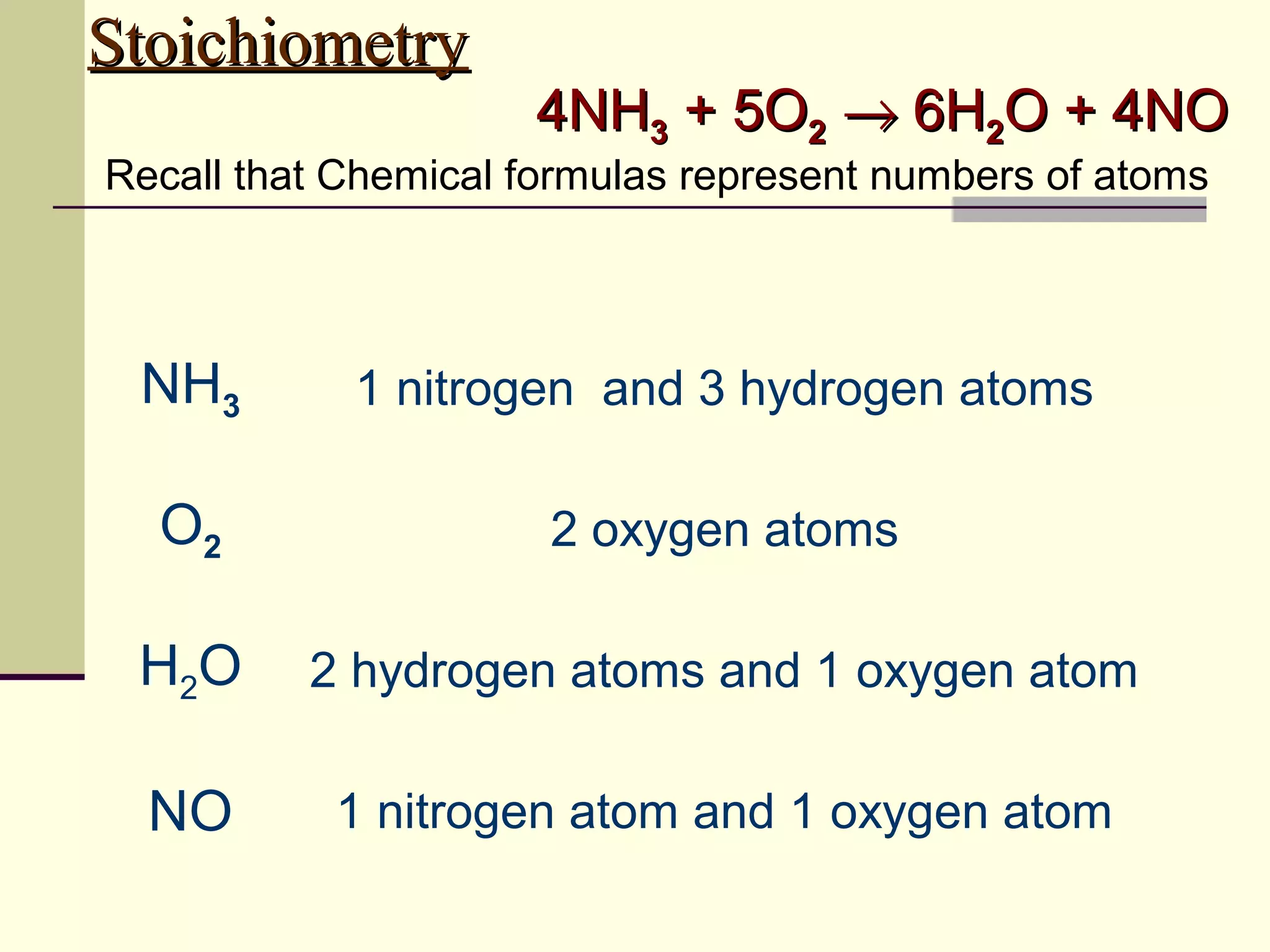
Recall that Chemical formulas represent numbers of atoms
4NH4NH33 + 5O+ 5O22 →→ 6H6H22O + 4NOO + 4NO
NH3 1 nitrogen and 3 hydrogen atoms
O2 2 oxygen atoms
H2O 2 hydrogen atoms and 1 oxygen atom
NO 1 nitrogen atom and 1 oxygen atom
StoichiometryStoichiometry
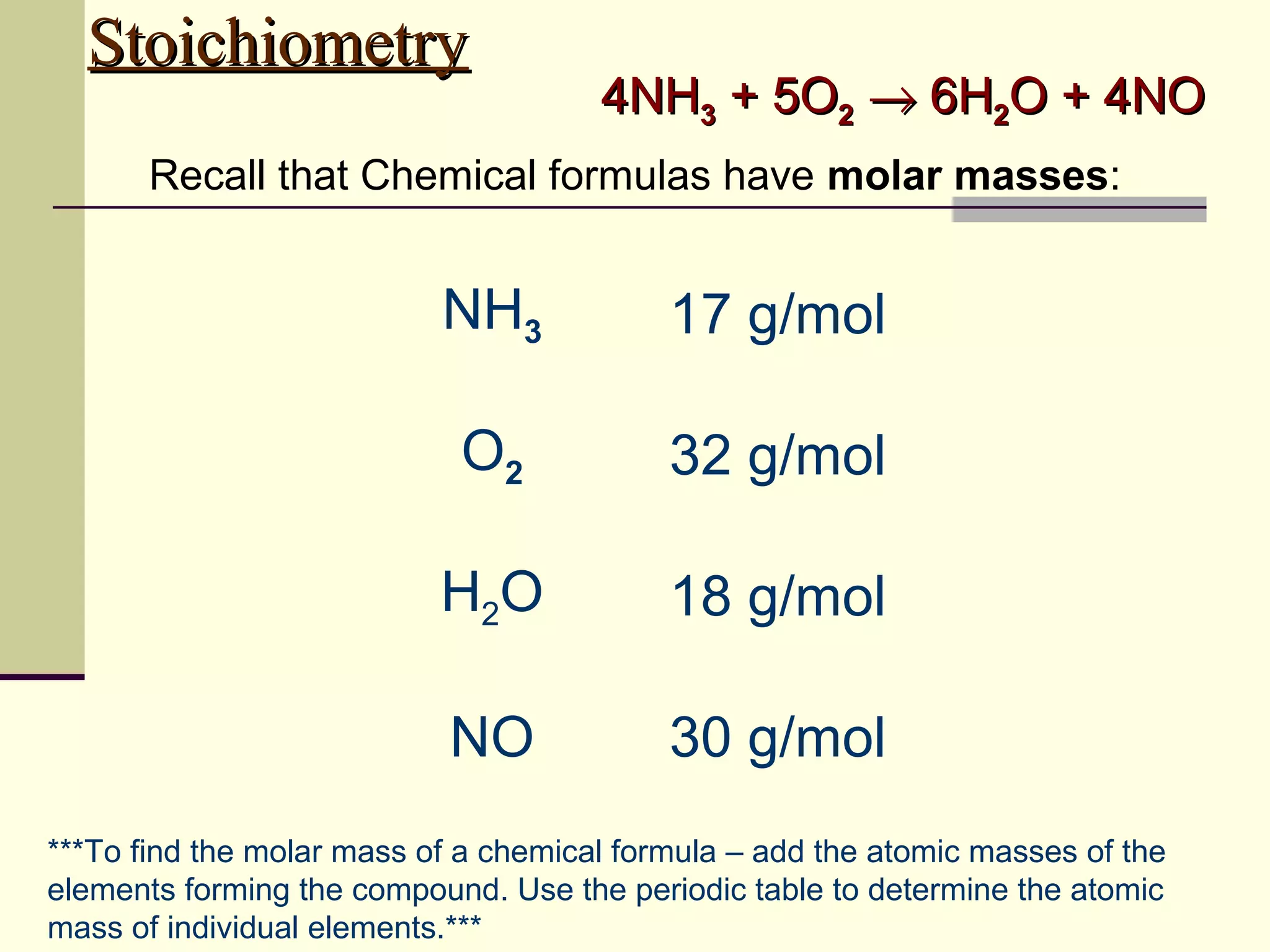
Recall that Chemical formulas have molar masses:
4NH4NH33 + 5O+ 5O22 →→ 6H6H22O + 4NOO + 4NO
NH3 17 g/mol
O2 32 g/mol
H2O 18 g/mol
NO 30 g/mol
***To find the molar mass of a chemical formula – add the atomic masses of the
elements forming the compound. Use the periodic table to determine the atomic
mass of individual elements.***
StoichiometryStoichiometry
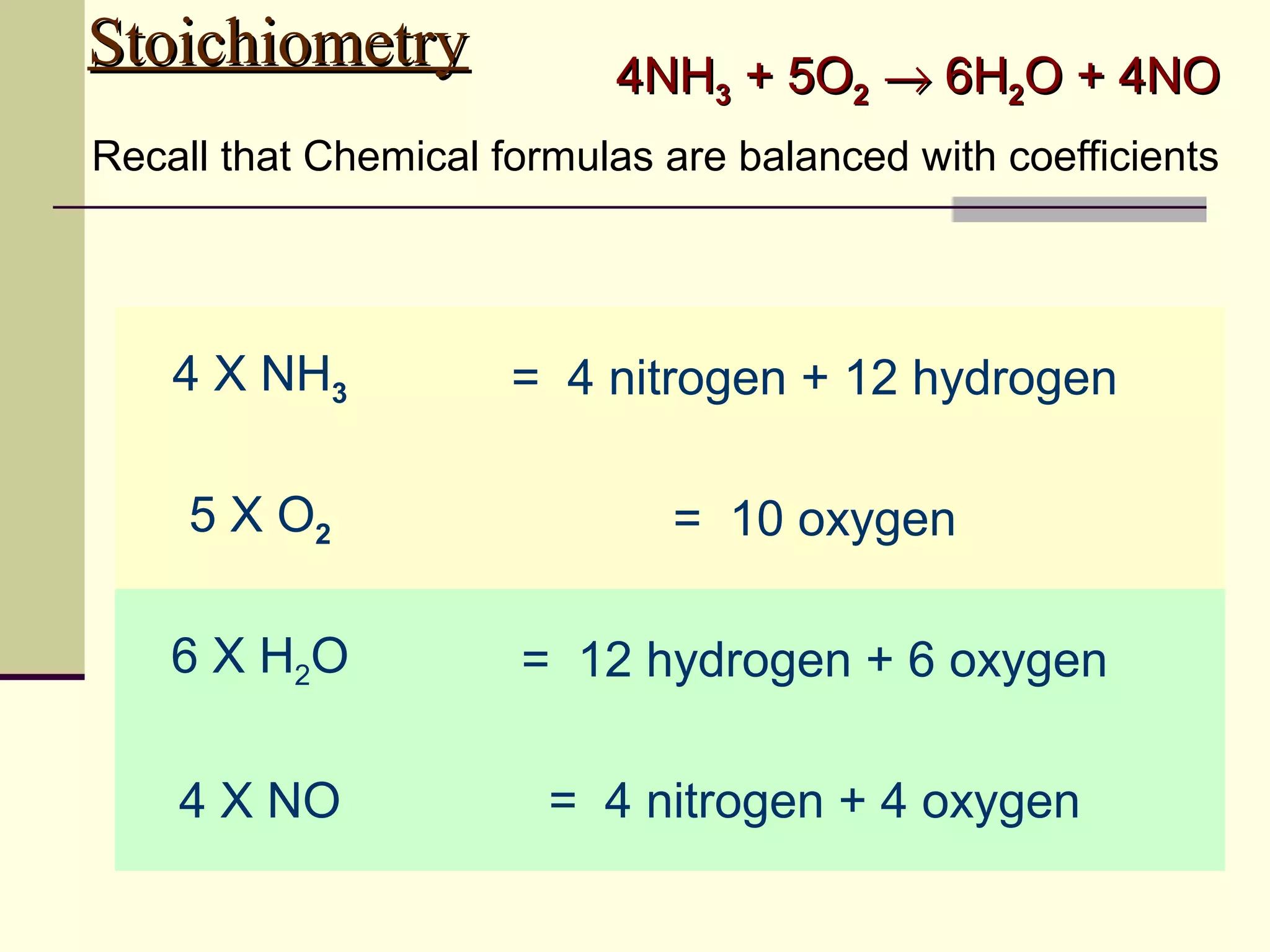
Recall that Chemical formulas are balanced with coefficients
4NH4NH33 + 5O+ 5O22 →→ 6H6H22O + 4NOO + 4NO
4 X NH3 = 4 nitrogen + 12 hydrogen
5 X O2 = 10 oxygen
6 X H2O = 12 hydrogen + 6 oxygen
4 X NO = 4 nitrogen + 4 oxygen
StoichiometryStoichiometry
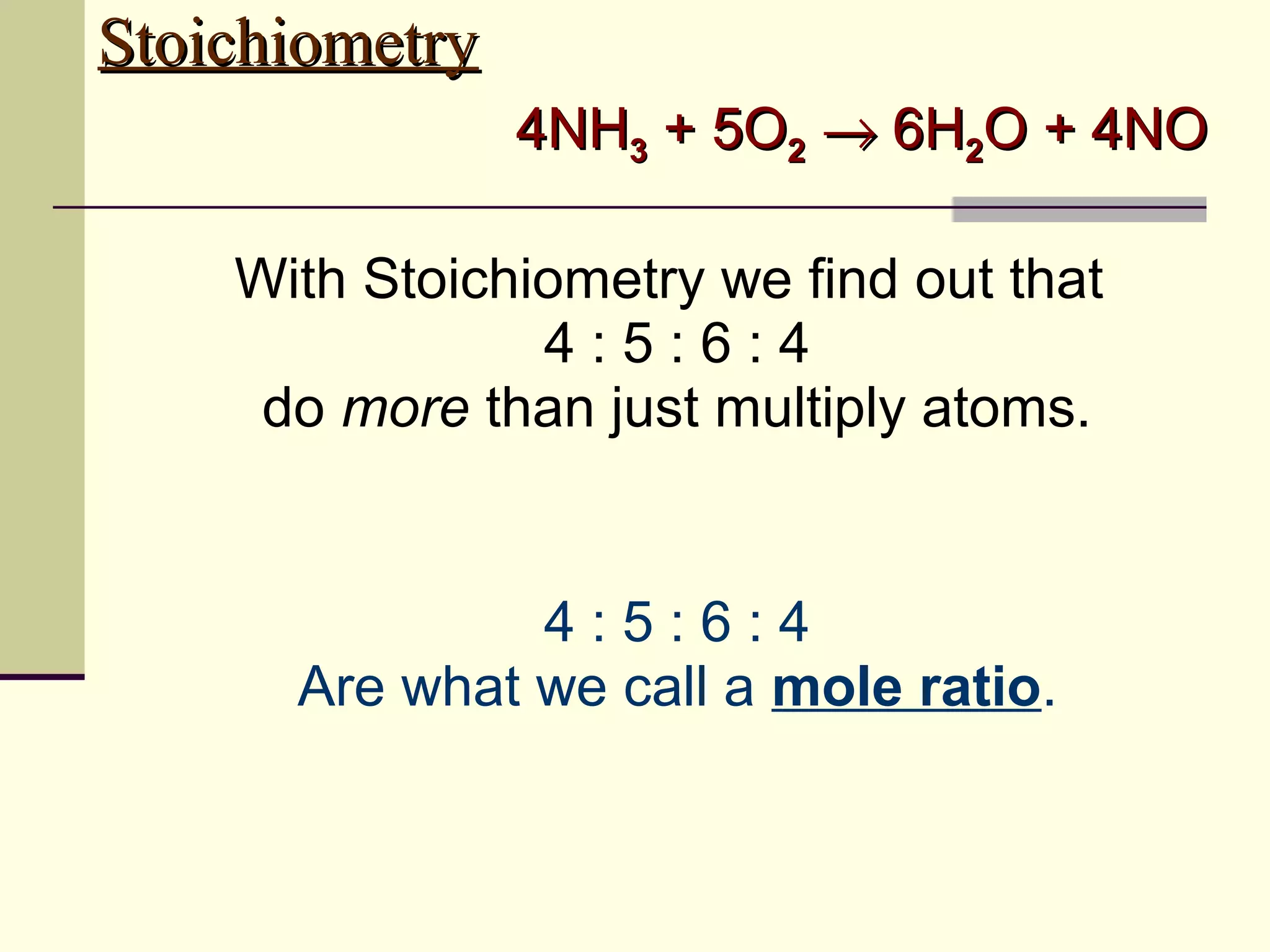
With Stoichiometry we find out that
4 : 5 : 6 : 4
do more than just multiply atoms.
4NH4NH33 + 5O+ 5O22 →→ 6H6H22O + 4NOO + 4NO
4 : 5 : 6 : 4
Are what we call a mole ratio.
StoichiometryStoichiometry
4NH4NH33 + 5O+ 5O22 →→ 6H6H22O + 4NOO + 4NO
4 : 5 : 6 : 4
Can mean either:
4 molecules of NH3 react with 5 molecules of O2
to produce 6 molecules of H2O and 4 molecules of NO
OR
4 moles of NH3 react with 5 moles of O2
to produce 6 moles of H2O and 4 moles of NO
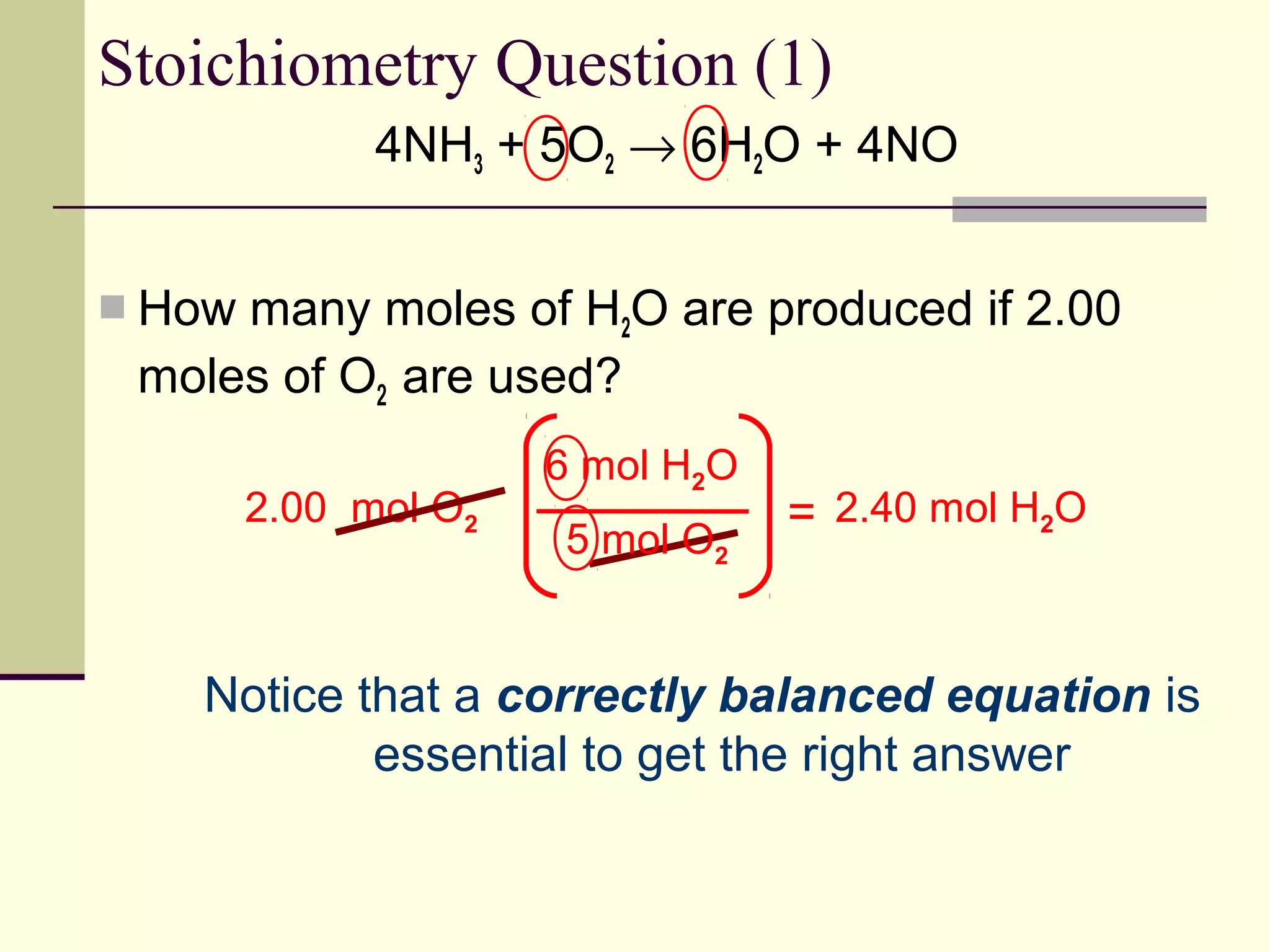
4NH3 + 5O2 → 6H2O + 4NO
 How many moles of H2O are produced if 2.00
moles of O2 are used?
Stoichiometry Question (1)
2.00 mol O2 2.40 mol H2O=
Notice that a correctly balanced equation is
essential to get the right answer
6 mol H2O
5 mol O2
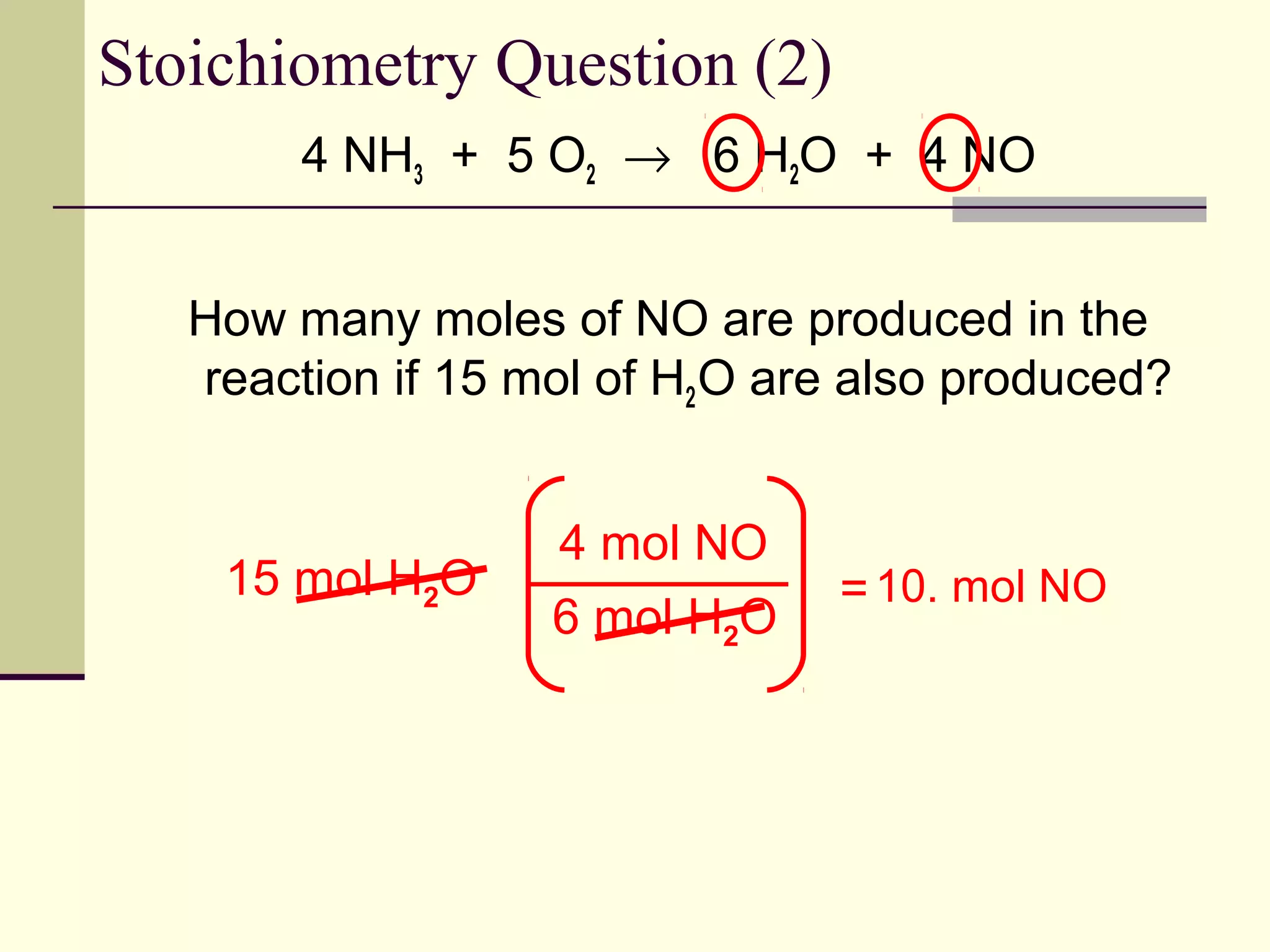
4 mol NO
6 mol H2O
4 NH3 + 5 O2 → 6 H2O + 4 NO
How many moles of NO are produced in the
reaction if 15 mol of H2O are also produced?
Stoichiometry Question (2)
15 mol H2O 10. mol NO=
18.02 g H2O
1 mol H2O
6 mol H2O
4 mol NH3
4 NH3 + 5 O2 → 6 H2O + 4 NO
How many grams of H2O are produced if 2.2 mol
of NH3 are combined with excess oxygen?
Stoichiometry Question (3)
2.2 mol NH3
59 g
H2O
=
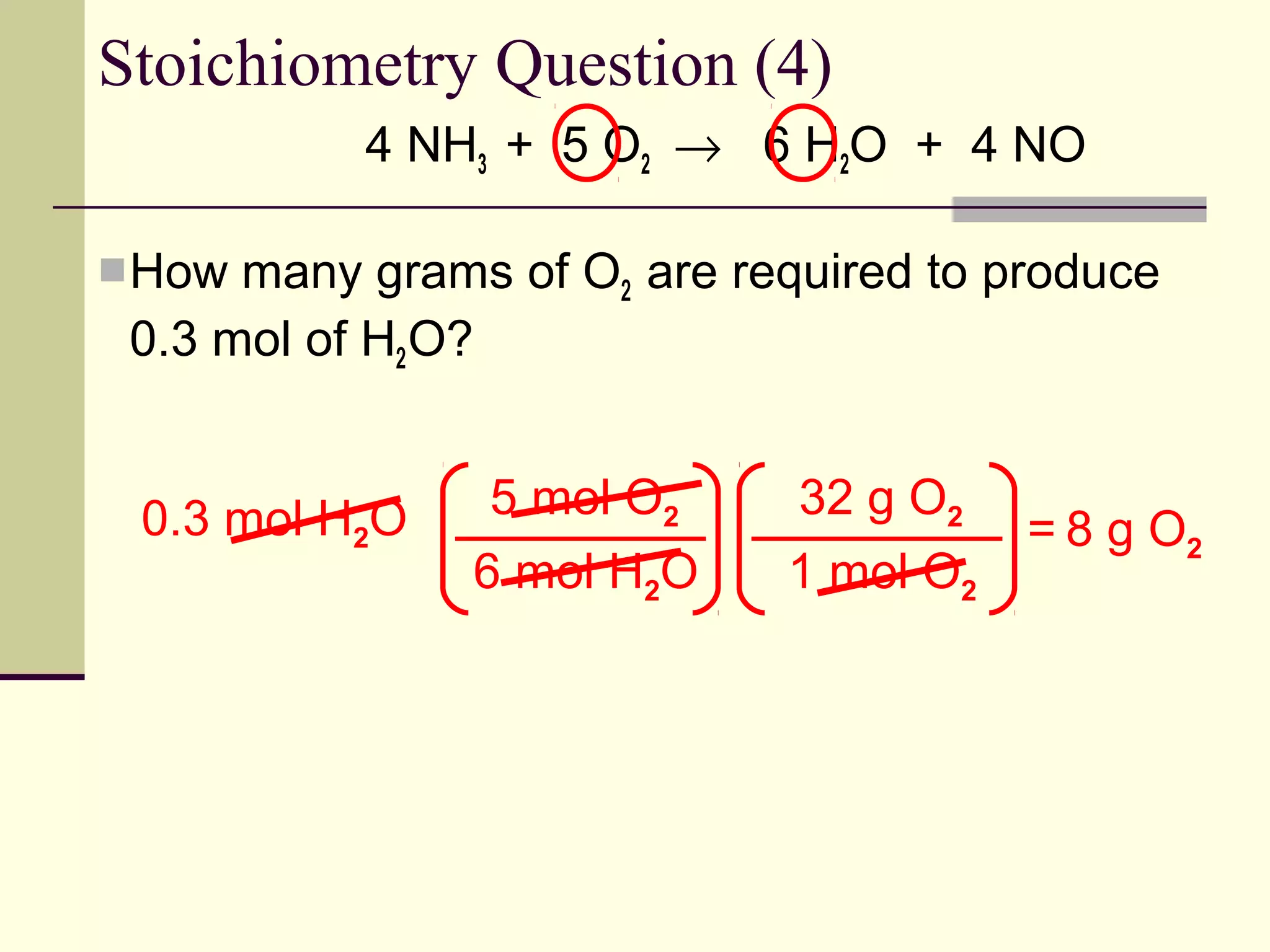
5 mol O2
6 mol H2O
32 g O2
1 mol O2
4 NH3 + 5 O2 → 6 H2O + 4 NO
How many grams of O2 are required to produce
0.3 mol of H2O?
Stoichiometry Question (4)
0.3 mol H2O 8 g O2=
4 NH3 + 5 O2 → 6 H2O + 4 NO
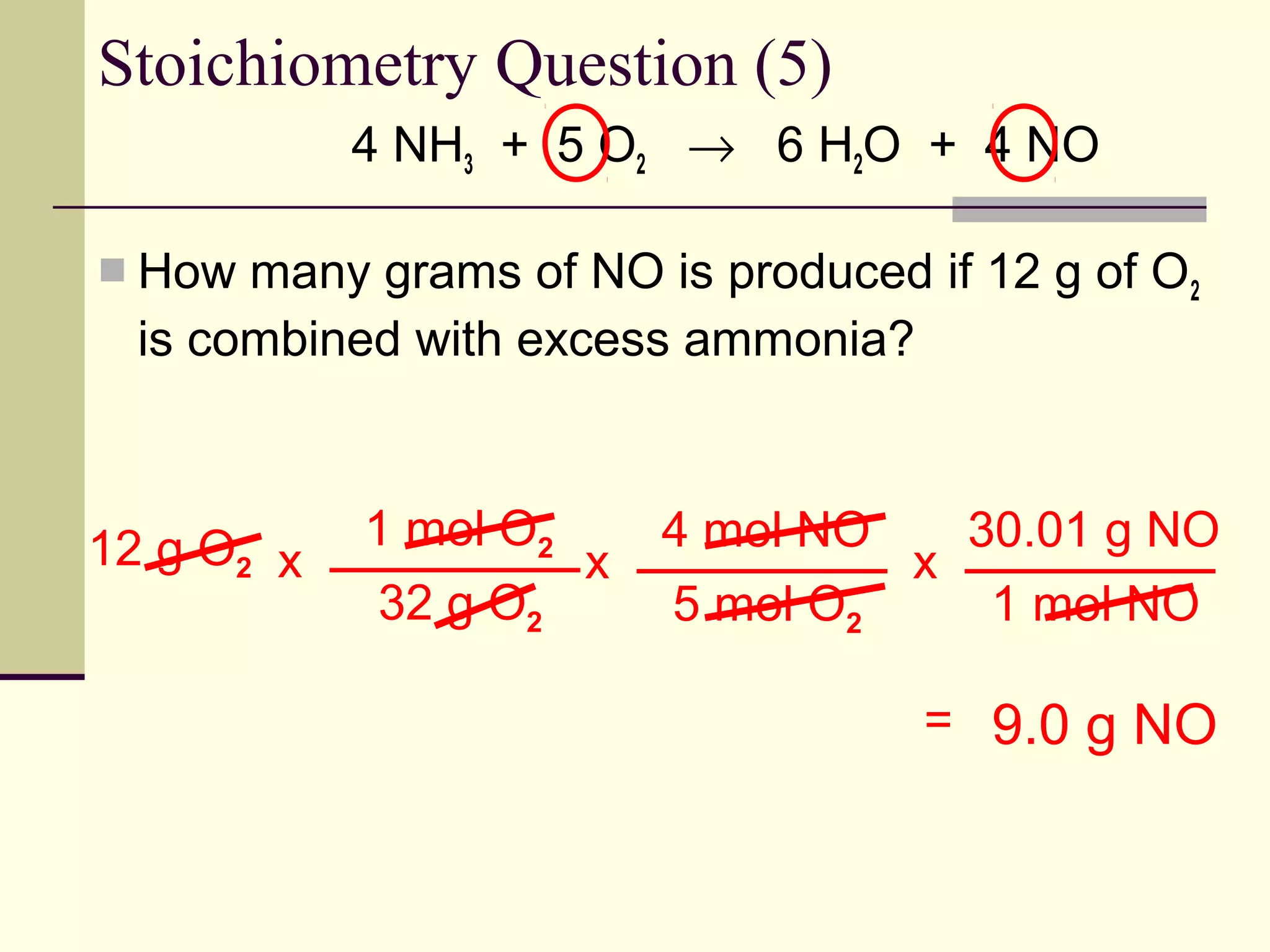
 How many grams of NO is produced if 12 g of O2
is combined with excess ammonia?
4 mol NO
5 mol O2
x
Stoichiometry Question (5)
12 g O2
9.0 g NO=
30.01 g NO
1 mol NO
x
1 mol O2
32 g O2
x
Moving along the stoichiometry path
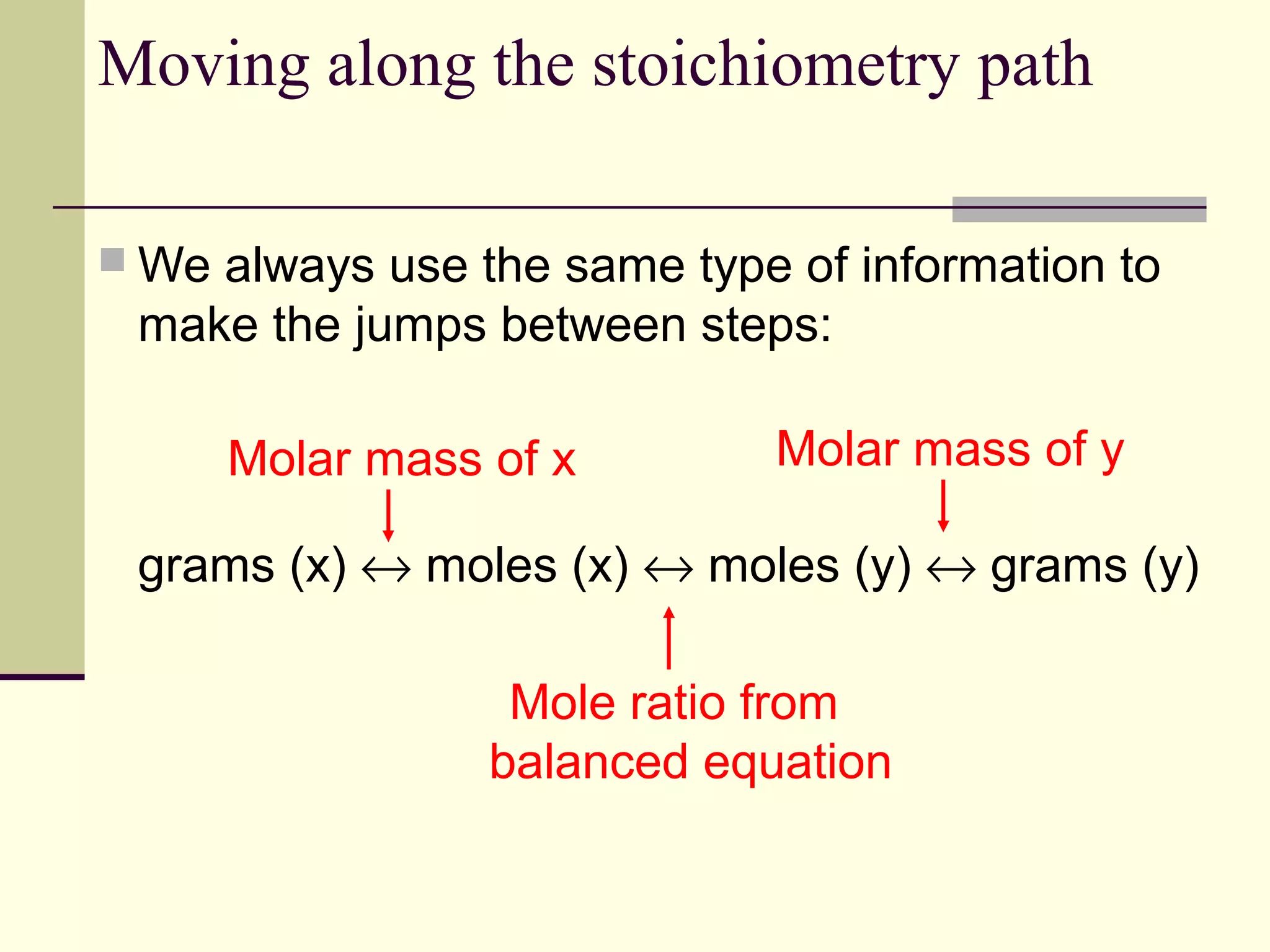
 We always use the same type of information to
make the jumps between steps:
grams (x) ↔ moles (x) ↔ moles (y) ↔ grams (y)
Molar mass of x Molar mass of y
Mole ratio from
balanced equation
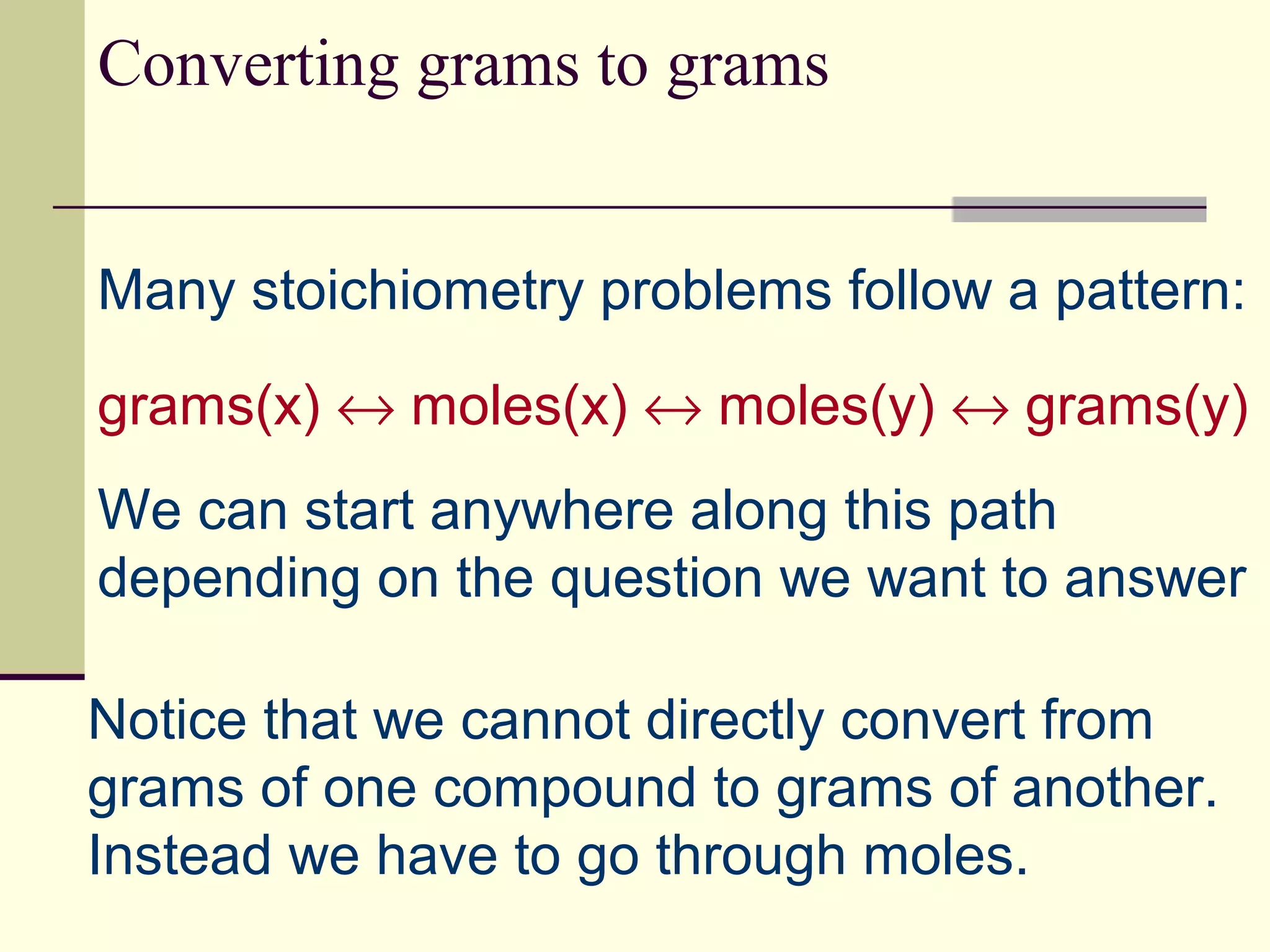
Many stoichiometry problems follow a pattern:
grams(x) ↔ moles(x) ↔ moles(y) ↔ grams(y)
Converting grams to grams
We can start anywhere along this path
depending on the question we want to answer
Notice that we cannot directly convert from
grams of one compound to grams of another.
Instead we have to go through moles.
Have we learned it yet?
Try these on your own - 4 NH3 + 5 O2 → 6 H2O + 4 NO
a) How many moles of H2O can be made using 1.6 mol NH3?
b) what mass of NH3 is needed to make 0.75 mol NO?
c) how many grams of NO can be made from 47 g of NH3?
4 NH3 + 5 O2 → 6 H2O + 4 NO
a)
b)
c)
Answers
6 mol H2O
4 mol NH3
x1.6 mol NH3
2.4 mol
H2O
=
4 mol NH3
4 mol NO
x0.75 mol NO 13 g
NH3
=
17.04 g NH3
1 mol NH3
x
4 mol NO
4 mol NH3
x47 g NH3
83 g NO=
30.01 g NO
1 mol NO
x
1 mol NH3
17.04gNH3
x

Introduction to stoichiometry

  • 1.
  • 2.
    StoichiometryStoichiometry Consider the chemicalequation: 4NH4NH33 + 5O+ 5O22 →→ 6H6H22O + 4NOO + 4NO There are several numbers involved. What do they all mean? ““stochio” = Greek for elementstochio” = Greek for element ““metry” = measurementmetry” = measurement Stoichiometry is about measuring the amounts ofStoichiometry is about measuring the amounts of elements and compounds involved in a reaction.elements and compounds involved in a reaction.
  • 3.
    StoichiometryStoichiometry Recall that Chemicalformulas represent numbers of atoms 4NH4NH33 + 5O+ 5O22 →→ 6H6H22O + 4NOO + 4NO NH3 1 nitrogen and 3 hydrogen atoms O2 2 oxygen atoms H2O 2 hydrogen atoms and 1 oxygen atom NO 1 nitrogen atom and 1 oxygen atom
  • 4.
    StoichiometryStoichiometry Recall that Chemicalformulas have molar masses: 4NH4NH33 + 5O+ 5O22 →→ 6H6H22O + 4NOO + 4NO NH3 17 g/mol O2 32 g/mol H2O 18 g/mol NO 30 g/mol ***To find the molar mass of a chemical formula – add the atomic masses of the elements forming the compound. Use the periodic table to determine the atomic mass of individual elements.***
  • 5.
    StoichiometryStoichiometry Recall that Chemicalformulas are balanced with coefficients 4NH4NH33 + 5O+ 5O22 →→ 6H6H22O + 4NOO + 4NO 4 X NH3 = 4 nitrogen + 12 hydrogen 5 X O2 = 10 oxygen 6 X H2O = 12 hydrogen + 6 oxygen 4 X NO = 4 nitrogen + 4 oxygen
  • 6.
    StoichiometryStoichiometry With Stoichiometry wefind out that 4 : 5 : 6 : 4 do more than just multiply atoms. 4NH4NH33 + 5O+ 5O22 →→ 6H6H22O + 4NOO + 4NO 4 : 5 : 6 : 4 Are what we call a mole ratio.
  • 7.
    StoichiometryStoichiometry 4NH4NH33 + 5O+5O22 →→ 6H6H22O + 4NOO + 4NO 4 : 5 : 6 : 4 Can mean either: 4 molecules of NH3 react with 5 molecules of O2 to produce 6 molecules of H2O and 4 molecules of NO OR 4 moles of NH3 react with 5 moles of O2 to produce 6 moles of H2O and 4 moles of NO
  • 8.
    4NH3 + 5O2→ 6H2O + 4NO  How many moles of H2O are produced if 2.00 moles of O2 are used? Stoichiometry Question (1) 2.00 mol O2 2.40 mol H2O= Notice that a correctly balanced equation is essential to get the right answer 6 mol H2O 5 mol O2
  • 9.
    4 mol NO 6mol H2O 4 NH3 + 5 O2 → 6 H2O + 4 NO How many moles of NO are produced in the reaction if 15 mol of H2O are also produced? Stoichiometry Question (2) 15 mol H2O 10. mol NO=
  • 10.
    18.02 g H2O 1mol H2O 6 mol H2O 4 mol NH3 4 NH3 + 5 O2 → 6 H2O + 4 NO How many grams of H2O are produced if 2.2 mol of NH3 are combined with excess oxygen? Stoichiometry Question (3) 2.2 mol NH3 59 g H2O =
  • 11.
    5 mol O2 6mol H2O 32 g O2 1 mol O2 4 NH3 + 5 O2 → 6 H2O + 4 NO How many grams of O2 are required to produce 0.3 mol of H2O? Stoichiometry Question (4) 0.3 mol H2O 8 g O2=
  • 12.
    4 NH3 +5 O2 → 6 H2O + 4 NO  How many grams of NO is produced if 12 g of O2 is combined with excess ammonia? 4 mol NO 5 mol O2 x Stoichiometry Question (5) 12 g O2 9.0 g NO= 30.01 g NO 1 mol NO x 1 mol O2 32 g O2 x
  • 13.
    Moving along thestoichiometry path  We always use the same type of information to make the jumps between steps: grams (x) ↔ moles (x) ↔ moles (y) ↔ grams (y) Molar mass of x Molar mass of y Mole ratio from balanced equation
  • 14.
    Many stoichiometry problemsfollow a pattern: grams(x) ↔ moles(x) ↔ moles(y) ↔ grams(y) Converting grams to grams We can start anywhere along this path depending on the question we want to answer Notice that we cannot directly convert from grams of one compound to grams of another. Instead we have to go through moles.
  • 15.
    Have we learnedit yet? Try these on your own - 4 NH3 + 5 O2 → 6 H2O + 4 NO a) How many moles of H2O can be made using 1.6 mol NH3? b) what mass of NH3 is needed to make 0.75 mol NO? c) how many grams of NO can be made from 47 g of NH3?
  • 16.
    4 NH3 +5 O2 → 6 H2O + 4 NO a) b) c) Answers 6 mol H2O 4 mol NH3 x1.6 mol NH3 2.4 mol H2O = 4 mol NH3 4 mol NO x0.75 mol NO 13 g NH3 = 17.04 g NH3 1 mol NH3 x 4 mol NO 4 mol NH3 x47 g NH3 83 g NO= 30.01 g NO 1 mol NO x 1 mol NH3 17.04gNH3 x