The Mole and 
Stoichiometry 
The Avagadro Mystery Revealed
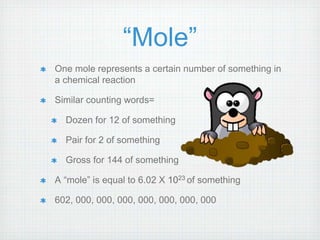
“Mole” 
One mole represents a certain number of something in 
a chemical reaction 
Similar counting words= 
Dozen for 12 of something 
Pair for 2 of something 
Gross for 144 of something 
A “mole” is equal to 6.02 X 10²³ of something 
602, 000, 000, 000, 000, 000, 000, 000
How Big is a Mole?
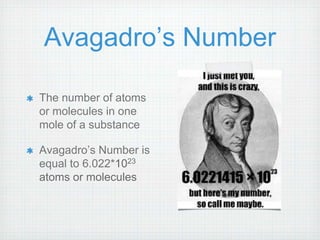
Avagadro’s Number 
The number of atoms 
or molecules in one 
mole of a substance 
Avagadro’s Number is 
equal to 6.022*1023 
atoms or molecules
Molecular Mass vs. Molar 
Mass 
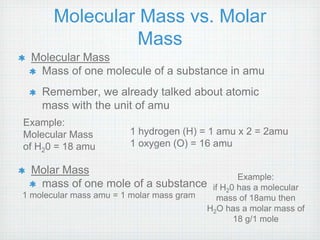
Molecular Mass 
Mass of one molecule of a substance in amu 
Remember, we already talked about atomic 
mass with the unit of amu 
Example: 
Molecular Mass 
of H20 = 18 amu 
Molar Mass 
1 hydrogen (H) = 1 amu x 2 = 2amu 
1 oxygen (O) = 16 amu 
mass of one mole of a substance 
1 molecular mass amu = 1 molar mass gram 
Example: 
if H20 has a molecular 
mass of 18amu then 
H2O has a molar mass of 
18 g/1 mole
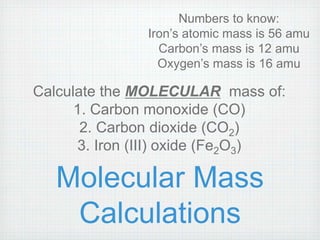
Numbers to know: 
Iron’s atomic mass is 56 amu 
Carbon’s mass is 12 amu 
Oxygen’s mass is 16 amu 
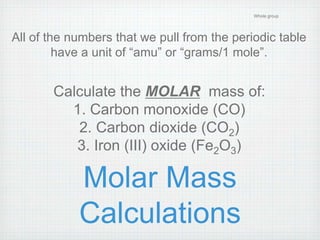
Calculate the MOLECULAR mass of: 
1. Carbon monoxide (CO) 
2. Carbon dioxide (CO2) 
3. Iron (III) oxide (Fe2O3) 
Molecular Mass 
Calculations
Molar Mass 
Calculations 
Whole group 
All of the numbers that we pull from the periodic table 
have a unit of “amu” or “grams/1 mole”. 
Calculate the MOLAR mass of: 
1. Carbon monoxide (CO) 
2. Carbon dioxide (CO2) 
3. Iron (III) oxide (Fe2O3)
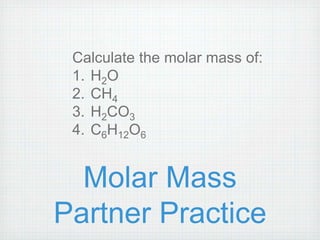
Calculate the molar mass of: 
1. H2O 
2. CH4 
3. H2CO3 
4. C6H12O6 
Molar Mass 
Partner Practice
Stoichiometry 
Why do we need to balance 
equations? 
How does this connect to our 
Chemical Bonding unit? 
How can we solve problems using 
stoichiometry?
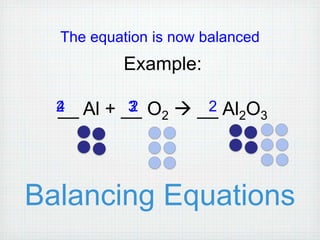
The equation is now balanced 
Example: 
24 32 2 
__ Al + __ O2 
 __ Al2O3 
Balancing Equations
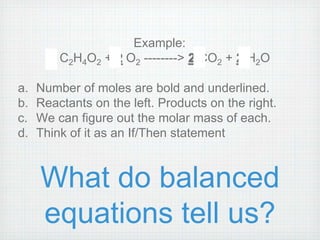
Example: 
1 C2H4O2 + 2 O2 --------> 2 CO2 + 2 H2O 
a. Number of moles are bold and underlined. 
b. Reactants on the left. Products on the right. 
c. We can figure out the molar mass of each. 
d. Think of it as an If/Then statement 
What do balanced 
equations tell us?
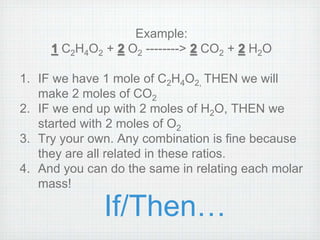
Example: 
1 C2H4O2 + 2 O2 --------> 2 CO2 + 2 H2O 
1. IF we have 1 mole of C2H4O2, THEN we will 
make 2 moles of CO2 
2. IF we end up with 2 moles of H2O, THEN we 
started with 2 moles of O2 
3. Try your own. Any combination is fine because 
they are all related in these ratios. 
4. And you can do the same in relating each molar 
If/Then… 
mass!
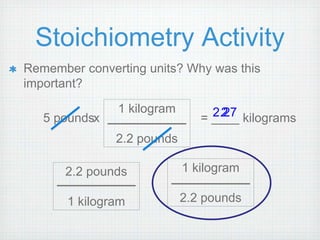
Stoichiometry Activity 
Remember converting units? Why was this 
important? 
x 2.227 
5 pounds = ____ kilograms 
2.2 pounds 
1 kilogram 
1 kilogram 
2.2 pounds 
1 kilogram 
2.2 pounds
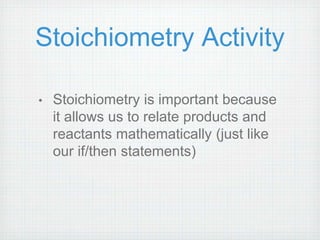
Stoichiometry Activity 
• Stoichiometry is important because 
it allows us to relate products and 
reactants mathematically (just like 
our if/then statements)
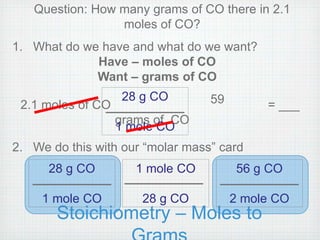
Question: How many grams of CO there in 2.1 
moles of CO? 
1. What do we have and what do we want? 
Have – moles of CO 
Want – grams of CO 
28 g CO 
2.1 moles of CO = ___ 
2. We do this with our “molar mass” card 
Stoichiometry – Moles to 
Grams 
56 g CO 
2 mole CO 
1 mole CO 
28 g CO 
28 g CO 
1 mole CO 
grams of CO 
1 mole CO 
59
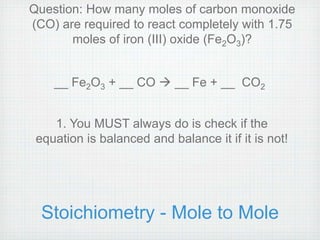
Question: How many moles of carbon monoxide 
(CO) are required to react completely with 1.75 
moles of iron (III) oxide (Fe2O3)? 
__ Fe2O3 + __ CO  __ Fe + __ CO2 
1. You MUST always do is check if the 
equation is balanced and balance it if it is not! 
Stoichiometry - Mole to Mole
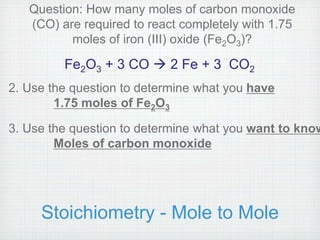
Question: How many moles of carbon monoxide 
(CO) are required to react completely with 1.75 
moles of iron (III) oxide (Fe2O3)? 
Fe2O3 + 3 CO  2 Fe + 3 CO2 
2. Use the question to determine what you have 
1.75 moles of Fe2O3 
3. Use the question to determine what you want to know 
Moles of carbon monoxide 
Stoichiometry - Mole to Mole
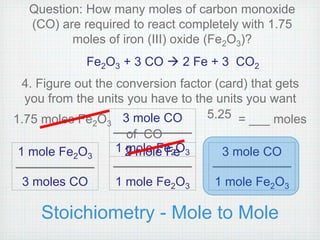
Question: How many moles of carbon monoxide 
(CO) are required to react completely with 1.75 
moles of iron (III) oxide (Fe2O3)? 
Fe2O3 + 3 CO  2 Fe + 3 CO2 
4. Figure out the conversion factor (card) that gets 
you from the units you have to the units you want 
3 mole CO 
5.25 
1.75 moles Fe2O3 = ___ moles 
3 mole CO 
1 mole Fe2O3 
of CO 
1 mole Fe2O3 
3 moles CO 
1 mole Fe2O3 
2 mole Fe 
1 mole Fe2O3 
Stoichiometry - Mole to Mole
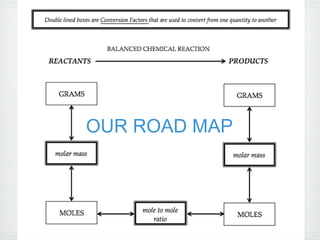
OUR ROAD MAP
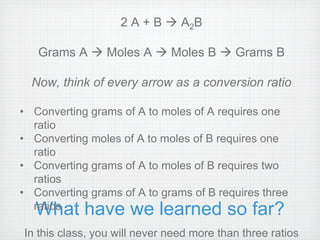
2 A + B  A2B 
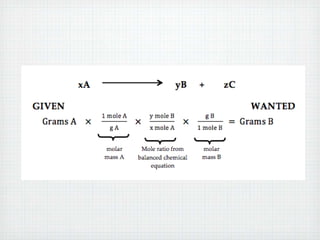
Grams A  Moles A  Moles B  Grams B 
Now, think of every arrow as a conversion ratio 
• Converting grams of A to moles of A requires one 
ratio 
• Converting moles of A to moles of B requires one 
ratio 
• Converting grams of A to moles of B requires two 
ratios 
• Converting grams of A to grams of B requires three 
What have we learned so far? 
ratios 
In this class, you will never need more than three ratios
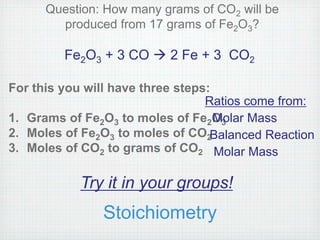
Question: How many grams of CO2 will be 
produced from 17 grams of Fe2O3? 
Fe2O3 + 3 CO  2 Fe + 3 CO2 
For this you will have three steps: 
Ratios come from: 
1. Grams of Fe2O3 to moles of Fe2O3 
2. Moles of Fe2O3 to moles of CO2 
3. Moles of CO2 to grams of CO2 
Molar Mass 
Balanced Reaction 
Molar Mass 
Try it in your groups! 
Stoichiometry
What are the 
Questions?

Stoichiometry PowerPoint

  • 1.
    The Mole and Stoichiometry The Avagadro Mystery Revealed
  • 2.
    “Mole” One molerepresents a certain number of something in a chemical reaction Similar counting words= Dozen for 12 of something Pair for 2 of something Gross for 144 of something A “mole” is equal to 6.02 X 10²³ of something 602, 000, 000, 000, 000, 000, 000, 000
  • 3.
    How Big isa Mole?
  • 4.
    Avagadro’s Number Thenumber of atoms or molecules in one mole of a substance Avagadro’s Number is equal to 6.022*1023 atoms or molecules
  • 5.
    Molecular Mass vs.Molar Mass Molecular Mass Mass of one molecule of a substance in amu Remember, we already talked about atomic mass with the unit of amu Example: Molecular Mass of H20 = 18 amu Molar Mass 1 hydrogen (H) = 1 amu x 2 = 2amu 1 oxygen (O) = 16 amu mass of one mole of a substance 1 molecular mass amu = 1 molar mass gram Example: if H20 has a molecular mass of 18amu then H2O has a molar mass of 18 g/1 mole
  • 6.
    Numbers to know: Iron’s atomic mass is 56 amu Carbon’s mass is 12 amu Oxygen’s mass is 16 amu Calculate the MOLECULAR mass of: 1. Carbon monoxide (CO) 2. Carbon dioxide (CO2) 3. Iron (III) oxide (Fe2O3) Molecular Mass Calculations
  • 7.
    Molar Mass Calculations Whole group All of the numbers that we pull from the periodic table have a unit of “amu” or “grams/1 mole”. Calculate the MOLAR mass of: 1. Carbon monoxide (CO) 2. Carbon dioxide (CO2) 3. Iron (III) oxide (Fe2O3)
  • 8.
    Calculate the molarmass of: 1. H2O 2. CH4 3. H2CO3 4. C6H12O6 Molar Mass Partner Practice
  • 9.
    Stoichiometry Why dowe need to balance equations? How does this connect to our Chemical Bonding unit? How can we solve problems using stoichiometry?
  • 10.
    The equation isnow balanced Example: 24 32 2 __ Al + __ O2  __ Al2O3 Balancing Equations
  • 11.
    Example: 1 C2H4O2+ 2 O2 --------> 2 CO2 + 2 H2O a. Number of moles are bold and underlined. b. Reactants on the left. Products on the right. c. We can figure out the molar mass of each. d. Think of it as an If/Then statement What do balanced equations tell us?
  • 12.
    Example: 1 C2H4O2+ 2 O2 --------> 2 CO2 + 2 H2O 1. IF we have 1 mole of C2H4O2, THEN we will make 2 moles of CO2 2. IF we end up with 2 moles of H2O, THEN we started with 2 moles of O2 3. Try your own. Any combination is fine because they are all related in these ratios. 4. And you can do the same in relating each molar If/Then… mass!
  • 13.
    Stoichiometry Activity Rememberconverting units? Why was this important? x 2.227 5 pounds = ____ kilograms 2.2 pounds 1 kilogram 1 kilogram 2.2 pounds 1 kilogram 2.2 pounds
  • 14.
    Stoichiometry Activity •Stoichiometry is important because it allows us to relate products and reactants mathematically (just like our if/then statements)
  • 15.
    Question: How manygrams of CO there in 2.1 moles of CO? 1. What do we have and what do we want? Have – moles of CO Want – grams of CO 28 g CO 2.1 moles of CO = ___ 2. We do this with our “molar mass” card Stoichiometry – Moles to Grams 56 g CO 2 mole CO 1 mole CO 28 g CO 28 g CO 1 mole CO grams of CO 1 mole CO 59
  • 16.
    Question: How manymoles of carbon monoxide (CO) are required to react completely with 1.75 moles of iron (III) oxide (Fe2O3)? __ Fe2O3 + __ CO  __ Fe + __ CO2 1. You MUST always do is check if the equation is balanced and balance it if it is not! Stoichiometry - Mole to Mole
  • 17.
    Question: How manymoles of carbon monoxide (CO) are required to react completely with 1.75 moles of iron (III) oxide (Fe2O3)? Fe2O3 + 3 CO  2 Fe + 3 CO2 2. Use the question to determine what you have 1.75 moles of Fe2O3 3. Use the question to determine what you want to know Moles of carbon monoxide Stoichiometry - Mole to Mole
  • 18.
    Question: How manymoles of carbon monoxide (CO) are required to react completely with 1.75 moles of iron (III) oxide (Fe2O3)? Fe2O3 + 3 CO  2 Fe + 3 CO2 4. Figure out the conversion factor (card) that gets you from the units you have to the units you want 3 mole CO 5.25 1.75 moles Fe2O3 = ___ moles 3 mole CO 1 mole Fe2O3 of CO 1 mole Fe2O3 3 moles CO 1 mole Fe2O3 2 mole Fe 1 mole Fe2O3 Stoichiometry - Mole to Mole
  • 19.
  • 20.
    2 A +B  A2B Grams A  Moles A  Moles B  Grams B Now, think of every arrow as a conversion ratio • Converting grams of A to moles of A requires one ratio • Converting moles of A to moles of B requires one ratio • Converting grams of A to moles of B requires two ratios • Converting grams of A to grams of B requires three What have we learned so far? ratios In this class, you will never need more than three ratios
  • 21.
    Question: How manygrams of CO2 will be produced from 17 grams of Fe2O3? Fe2O3 + 3 CO  2 Fe + 3 CO2 For this you will have three steps: Ratios come from: 1. Grams of Fe2O3 to moles of Fe2O3 2. Moles of Fe2O3 to moles of CO2 3. Moles of CO2 to grams of CO2 Molar Mass Balanced Reaction Molar Mass Try it in your groups! Stoichiometry
  • 23.
    What are the Questions?