Chapter 12 - Stoichiometry

                         I ‘m back!


 Objective: To learn how to use a complete
chemical equation to calculate quantities of a
                 substance
Chemical Equations
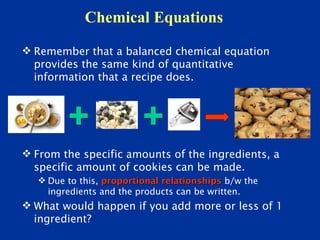
 Remember that a balanced chemical equation
  provides the same kind of quantitative
  information that a recipe does.


 From the specific amounts of the ingredients, a
  specific amount of cookies can be made.
    Due to this, proportional relationships b/w the
     ingredients and the products can be written.
 What would happen if you add more or less of 1
  ingredient?
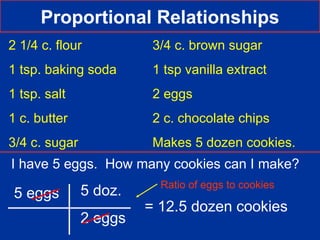
Proportional Relationships
2 1/4 c. flour              3/4 c. brown sugar
1 tsp. baking soda          1 tsp vanilla extract
1 tsp. salt                 2 eggs
1 c. butter                 2 c. chocolate chips
3/4 c. sugar                Makes 5 dozen cookies.
 1) 1 tsp. baking soda = 2 c. chocolate chips
 2) 1 c butter= 2 eggs
 3) 5 dz cookies = 1tsp. Salt
 4) 5 dz cookies = ¾ c. sugar
 ETC.
Proportional Relationships
2 1/4 c. flour           3/4 c. brown sugar
1 tsp. baking soda       1 tsp vanilla extract
1 tsp. salt              2 eggs
1 c. butter              2 c. chocolate chips
3/4 c. sugar             Makes 5 dozen cookies.
I have 5 eggs. How many cookies can I make?
                          Ratio of eggs to cookies
 5 eggs        5 doz.
                        = 12.5 dozen cookies
               2 eggs
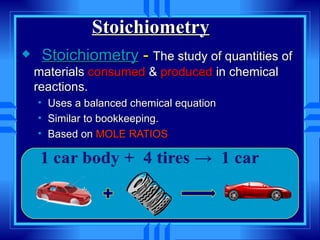
Stoichiometry
x       Stoichiometry - The study of quantities of
    materials consumed & produced in chemical
    reactions.
    •    Uses a balanced chemical equation
    •    Similar to bookkeeping.
    •    Based on MOLE RATIOS
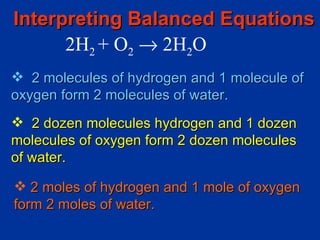
Interpreting Balanced Equations
      2H2 + O2 → 2H2O
 2 molecules of hydrogen and 1 molecule of
oxygen form 2 molecules of water.
 2 dozen molecules hydrogen and 1 dozen
molecules of oxygen form 2 dozen molecules
of water.

 2 moles of hydrogen and 1 mole of oxygen
form 2 moles of water.
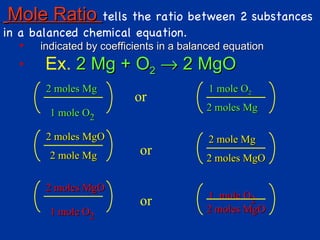
Mole Ratio tells the ratio between 2 substances
in a balanced chemical equation.
  •   indicated by coefficients in a balanced equation
  •    Ex. 2 Mg + O2 → 2 MgO
       2 moles Mg                         1 mole O2
                          or
                                         2 moles Mg
        1 mole O2

       2 moles MgO                        2 mole Mg
        2 mole Mg          or            2 moles MgO

       2 moles MgO
                                         1 mole O2
                           or
        1 mole O2                        2 moles MgO
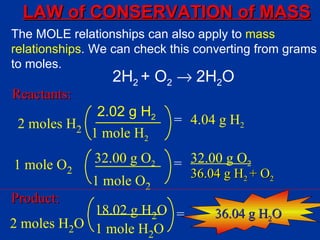
LAW of CONSERVATION of MASS
The MOLE relationships can also apply to mass
relationships. We can check this converting from grams
to moles.
                 2H2 + O2 → 2H2O
Reactants:
               2.02 g H2
 2 moles H2                 = 4.04 g H2
              1 mole H2

1 mole O2     32.00 g O2    = 32.00 g O2
                               36.04 g H2 + O2
              1 mole O2
Product:
            18.02 g H2O =          36.04 g H2O
2 moles H2O 1 mole H O
                     2
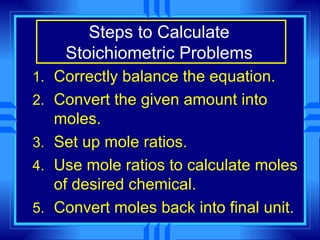
Steps to Calculate
    Stoichiometric Problems
1. Correctly balance the equation.
2. Convert the given amount into
   moles.
3. Set up mole ratios.
4. Use mole ratios to calculate moles
   of desired chemical.
5. Convert moles back into final unit.
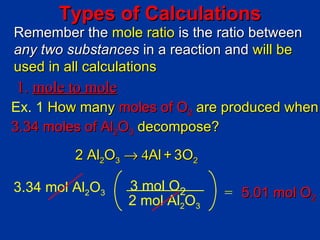
Types of Calculations
Remember the mole ratio is the ratio between
any two substances in a reaction and will be
used in all calculations
1. mole to mole
Ex. 1 How many moles of O2 are produced when
3.34 moles of Al2O3 decompose?
         2 Al2O3 → 4Al + 3O2

3.34 mol Al2O3    3 mol O2      = 5.01 mol O2
                  2 mol Al2O3
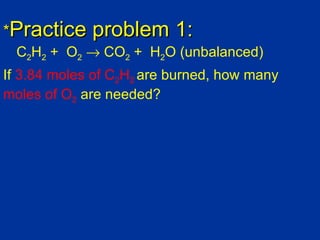
*Practice    problem 1:
  C2H2 + O2 → CO2 + H2O (unbalanced)
If 3.84 moles of C2H2 are burned, how many
moles of O2 are needed?
types of problems (continued)

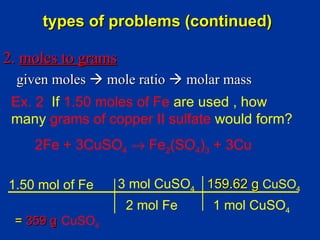
2. moles to grams
 given moles  mole ratio  molar mass
 Ex. 2 If 1.50 moles of Fe are used , how
 many grams of copper II sulfate would form?
    2Fe + 3CuSO4 → Fe2(SO4)3 + 3Cu

1.50 mol of Fe      3 mol CuSO4 159.62 g CuSO4
                     2 mol Fe    1 mol CuSO4
 = 359 g CuSO4
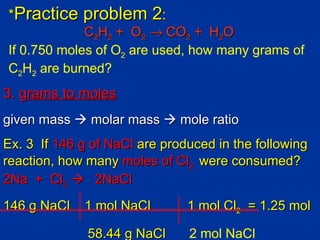
*Practice problem 2:
             C2H2 + O2 → CO2 + H2O
If 0.750 moles of O2 are used, how many grams of
C2H2 are burned?
3. grams to moles
given mass  molar mass  mole ratio
Ex. 3 If 146 g of NaCl are produced in the following
reaction, how many moles of Cl2 were consumed?
2Na + Cl2  2NaCl
146 g NaCl   1 mol NaCl        1 mol Cl2 = 1.25 mol

              58.44 g NaCl     2 mol NaCl
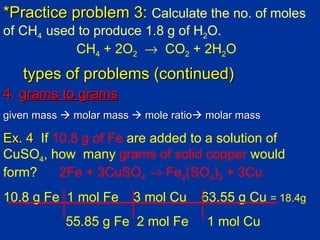
*Practice problem 3: Calculate the no. of moles
of CH4 used to produce 1.8 g of H2O.
           CH4 + 2O2 → CO2 + 2H2O
   types of problems (continued)
4. grams to grams
given mass  molar mass  mole ratio molar mass

Ex. 4 If 10.8 g of Fe are added to a solution of
CuSO4, how many grams of solid copper would
form?     2Fe + 3CuSO4 → Fe2(SO4)3 + 3Cu
10.8 g Fe 1 mol Fe      3 mol Cu    63.55 g Cu = 18.4g
           55.85 g Fe 2 mol Fe       1 mol Cu
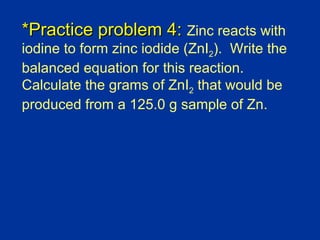
*Practice problem 4: Zinc reacts with
iodine to form zinc iodide (ZnI2). Write the
balanced equation for this reaction.
Calculate the grams of ZnI2 that would be
produced from a 125.0 g sample of Zn.

Ch12 stoichiometry

  • 1.
    Chapter 12 -Stoichiometry I ‘m back! Objective: To learn how to use a complete chemical equation to calculate quantities of a substance
  • 2.
    Chemical Equations  Rememberthat a balanced chemical equation provides the same kind of quantitative information that a recipe does.  From the specific amounts of the ingredients, a specific amount of cookies can be made.  Due to this, proportional relationships b/w the ingredients and the products can be written.  What would happen if you add more or less of 1 ingredient?
  • 3.
    Proportional Relationships 2 1/4c. flour 3/4 c. brown sugar 1 tsp. baking soda 1 tsp vanilla extract 1 tsp. salt 2 eggs 1 c. butter 2 c. chocolate chips 3/4 c. sugar Makes 5 dozen cookies. 1) 1 tsp. baking soda = 2 c. chocolate chips 2) 1 c butter= 2 eggs 3) 5 dz cookies = 1tsp. Salt 4) 5 dz cookies = ¾ c. sugar ETC.
  • 4.
    Proportional Relationships 2 1/4c. flour 3/4 c. brown sugar 1 tsp. baking soda 1 tsp vanilla extract 1 tsp. salt 2 eggs 1 c. butter 2 c. chocolate chips 3/4 c. sugar Makes 5 dozen cookies. I have 5 eggs. How many cookies can I make? Ratio of eggs to cookies 5 eggs 5 doz. = 12.5 dozen cookies 2 eggs
  • 5.
    Stoichiometry x Stoichiometry - The study of quantities of materials consumed & produced in chemical reactions. • Uses a balanced chemical equation • Similar to bookkeeping. • Based on MOLE RATIOS
  • 6.
    Interpreting Balanced Equations 2H2 + O2 → 2H2O  2 molecules of hydrogen and 1 molecule of oxygen form 2 molecules of water.  2 dozen molecules hydrogen and 1 dozen molecules of oxygen form 2 dozen molecules of water.  2 moles of hydrogen and 1 mole of oxygen form 2 moles of water.
  • 7.
    Mole Ratio tellsthe ratio between 2 substances in a balanced chemical equation. • indicated by coefficients in a balanced equation • Ex. 2 Mg + O2 → 2 MgO 2 moles Mg 1 mole O2 or 2 moles Mg 1 mole O2 2 moles MgO 2 mole Mg 2 mole Mg or 2 moles MgO 2 moles MgO 1 mole O2 or 1 mole O2 2 moles MgO
  • 8.
    LAW of CONSERVATIONof MASS The MOLE relationships can also apply to mass relationships. We can check this converting from grams to moles. 2H2 + O2 → 2H2O Reactants: 2.02 g H2 2 moles H2 = 4.04 g H2 1 mole H2 1 mole O2 32.00 g O2 = 32.00 g O2 36.04 g H2 + O2 1 mole O2 Product: 18.02 g H2O = 36.04 g H2O 2 moles H2O 1 mole H O 2
  • 9.
    Steps to Calculate Stoichiometric Problems 1. Correctly balance the equation. 2. Convert the given amount into moles. 3. Set up mole ratios. 4. Use mole ratios to calculate moles of desired chemical. 5. Convert moles back into final unit.
  • 10.
    Types of Calculations Rememberthe mole ratio is the ratio between any two substances in a reaction and will be used in all calculations 1. mole to mole Ex. 1 How many moles of O2 are produced when 3.34 moles of Al2O3 decompose? 2 Al2O3 → 4Al + 3O2 3.34 mol Al2O3 3 mol O2 = 5.01 mol O2 2 mol Al2O3
  • 11.
    *Practice problem 1: C2H2 + O2 → CO2 + H2O (unbalanced) If 3.84 moles of C2H2 are burned, how many moles of O2 are needed?
  • 12.
    types of problems(continued) 2. moles to grams given moles  mole ratio  molar mass Ex. 2 If 1.50 moles of Fe are used , how many grams of copper II sulfate would form? 2Fe + 3CuSO4 → Fe2(SO4)3 + 3Cu 1.50 mol of Fe 3 mol CuSO4 159.62 g CuSO4 2 mol Fe 1 mol CuSO4 = 359 g CuSO4
  • 13.
    *Practice problem 2: C2H2 + O2 → CO2 + H2O If 0.750 moles of O2 are used, how many grams of C2H2 are burned? 3. grams to moles given mass  molar mass  mole ratio Ex. 3 If 146 g of NaCl are produced in the following reaction, how many moles of Cl2 were consumed? 2Na + Cl2  2NaCl 146 g NaCl 1 mol NaCl 1 mol Cl2 = 1.25 mol 58.44 g NaCl 2 mol NaCl
  • 14.
    *Practice problem 3:Calculate the no. of moles of CH4 used to produce 1.8 g of H2O. CH4 + 2O2 → CO2 + 2H2O types of problems (continued) 4. grams to grams given mass  molar mass  mole ratio molar mass Ex. 4 If 10.8 g of Fe are added to a solution of CuSO4, how many grams of solid copper would form? 2Fe + 3CuSO4 → Fe2(SO4)3 + 3Cu 10.8 g Fe 1 mol Fe 3 mol Cu 63.55 g Cu = 18.4g 55.85 g Fe 2 mol Fe 1 mol Cu
  • 15.
    *Practice problem 4:Zinc reacts with iodine to form zinc iodide (ZnI2). Write the balanced equation for this reaction. Calculate the grams of ZnI2 that would be produced from a 125.0 g sample of Zn.

Editor's Notes

  • #6 8 car bodies
  • #16 http://www.sciencegeek.net/Chemistry/Powerpoint/Unit4/Unit4_files/frame.htm