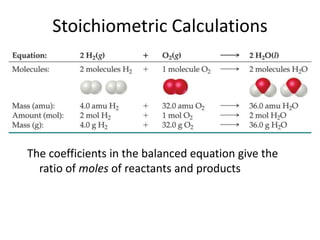
Stoichiometric CalculationsThe coefficients in the balanced equation give the ratio of moles of reactants and products
Stoichiometric Calculations	From the mass of Substance A you can use the ratio of the coefficients of A and B to calculate the mass of Substance B formed (if it’s a product) or used (if it’s a reactant)
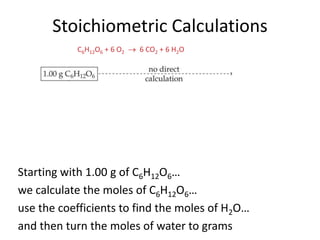
Stoichiometric CalculationsC6H12O6 + 6 O2  6 CO2 + 6 H2O	Starting with 1.00 g of C6H12O6… 	we calculate the moles of C6H12O6…	use the coefficients to find the moles of H2O…	and then turn the moles of water to grams
Sample #1CH4 +2O22H2O + CO2How many moles of CH4 are needed to make 13 moles of water?
Sample #2CH4 +2O22H2O + CO2How many moles of water are made from 10g of Oxygen?
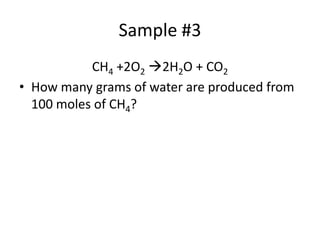
Sample #3CH4 +2O22H2O + CO2How many grams of water are produced from 100 moles of CH4?
Sample #4CH4 +2O22H2O + CO2How many grams of Oxygen are needed in order to produce 200 g of carbon dioxide?
Limiting Reactants	The limiting reactant is the reactant present in the smallest stoichiometric amount
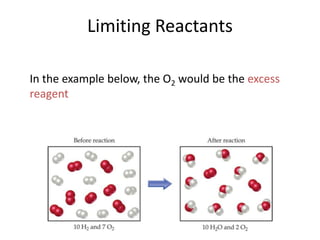
Limiting ReactantsThe limiting reactant is the reactant present in the smallest stoichiometric amountIn other words, it’s the reactant you’ll run out of first (in this case, the H2)
Limiting Reactants	In the example below, the O2 would be the excess reagent
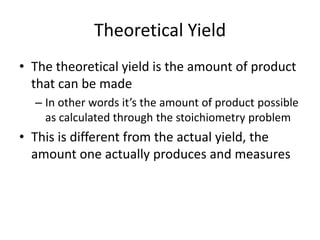
Theoretical YieldThe theoretical yield is the amount of product that can be madeIn other words it’s the amount of product possible as calculated through the stoichiometry problemThis is different from the actual yield, the amount one actually produces and measures
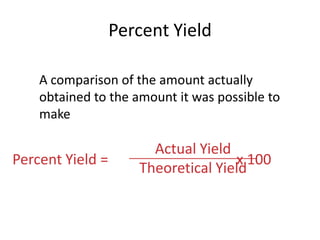
Percent YieldActual YieldTheoretical YieldPercent Yield =					x 100	A comparison of the amount actually obtained to the amount it was possible to make

Stoichiometric Calculations