CHEMICALCHEMICAL
REACTIONSREACTIONS
ChemiCal ReaCtionChemiCal ReaCtion
Chemical ReactionChemical Reaction
It is a process in which the physical
and chemical properties of the original
substances change as new substances
with different physical and chemical
properties are formed.
Two kinds of substances:
1. The substances present before the
change.
2. The substances formed by the change.
Reactants and
Products
• ReactantsReactants
–present at the beginning of the
reaction
• Products
–are the substances formed by the
chemical reaction
Example: burning natural gas
• CH4 + 2O2 > CO2 +2H2O
LAW OF CONSERVATIONLAW OF CONSERVATION
OF MASSOF MASS
EVIDENCES OFEVIDENCES OF
CHEMICAL REACTIONSCHEMICAL REACTIONS
1. Taking and giving off energy1. Taking and giving off energy
• ENDOTHERMIC
– Reactions where energy is absorbed.
– Ex. Cooking of food and Photosynthesis
• EXOTHERMIC
– Reactions that involve the release of
energy.
– Ex. Explosion of firecrackers and burning
of coal
1. Taking and giving off energy1. Taking and giving off energy
2. Color/odor Change2. Color/odor Change
• Ex. Ripening of fruits
3. Evolution of Gas
• The release of gases
• Ex. When you dissolve a tablet of
alkaseltzer in water, bubbles are
produced.
3. Evolution of Gas
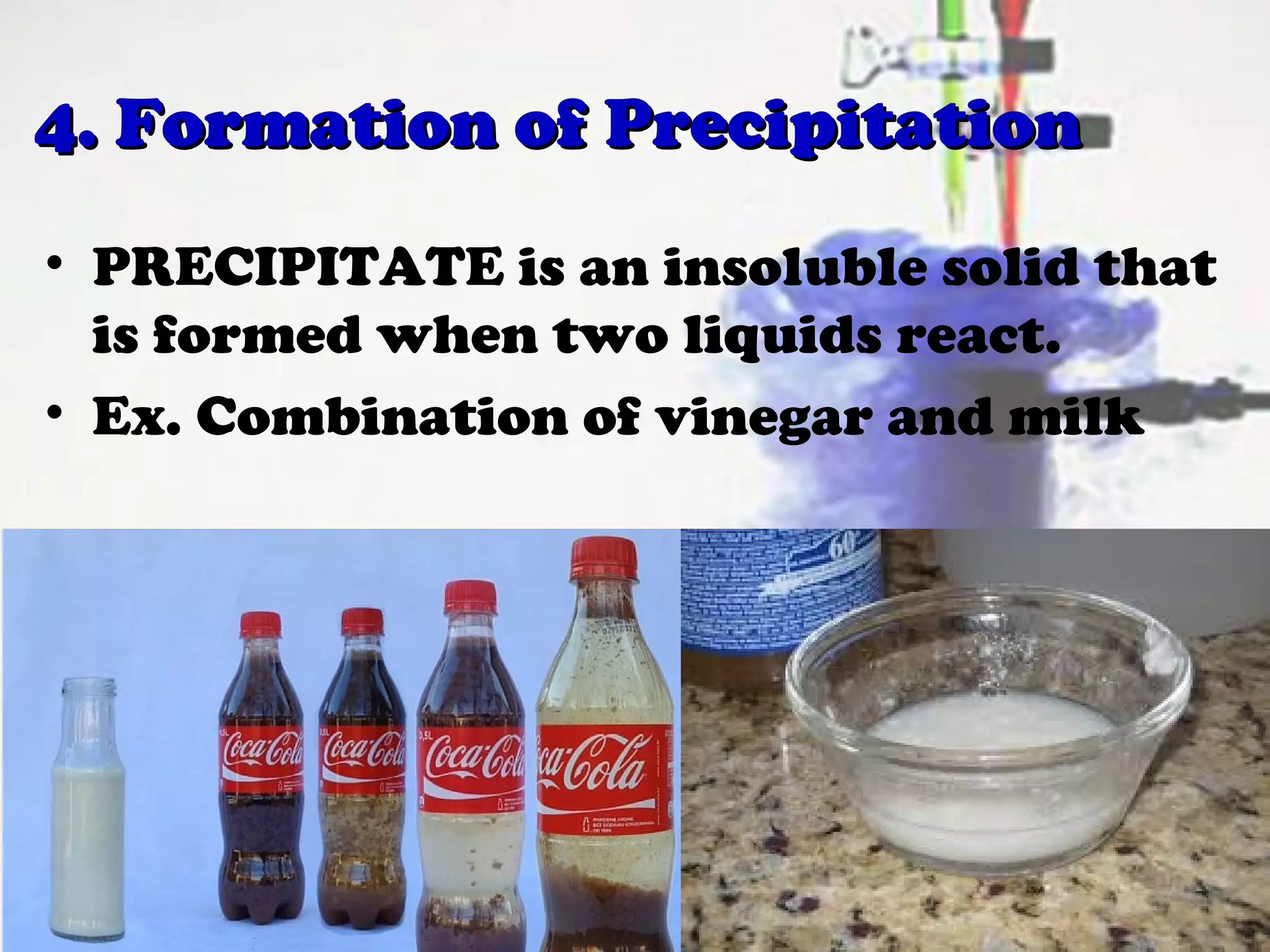
4. Formation of Precipitation4. Formation of Precipitation
• PRECIPITATE is an insoluble solid that
is formed when two liquids react.
• Ex. Combination of vinegar and milk
CHEMICALCHEMICAL
EQUATIONSEQUATIONS
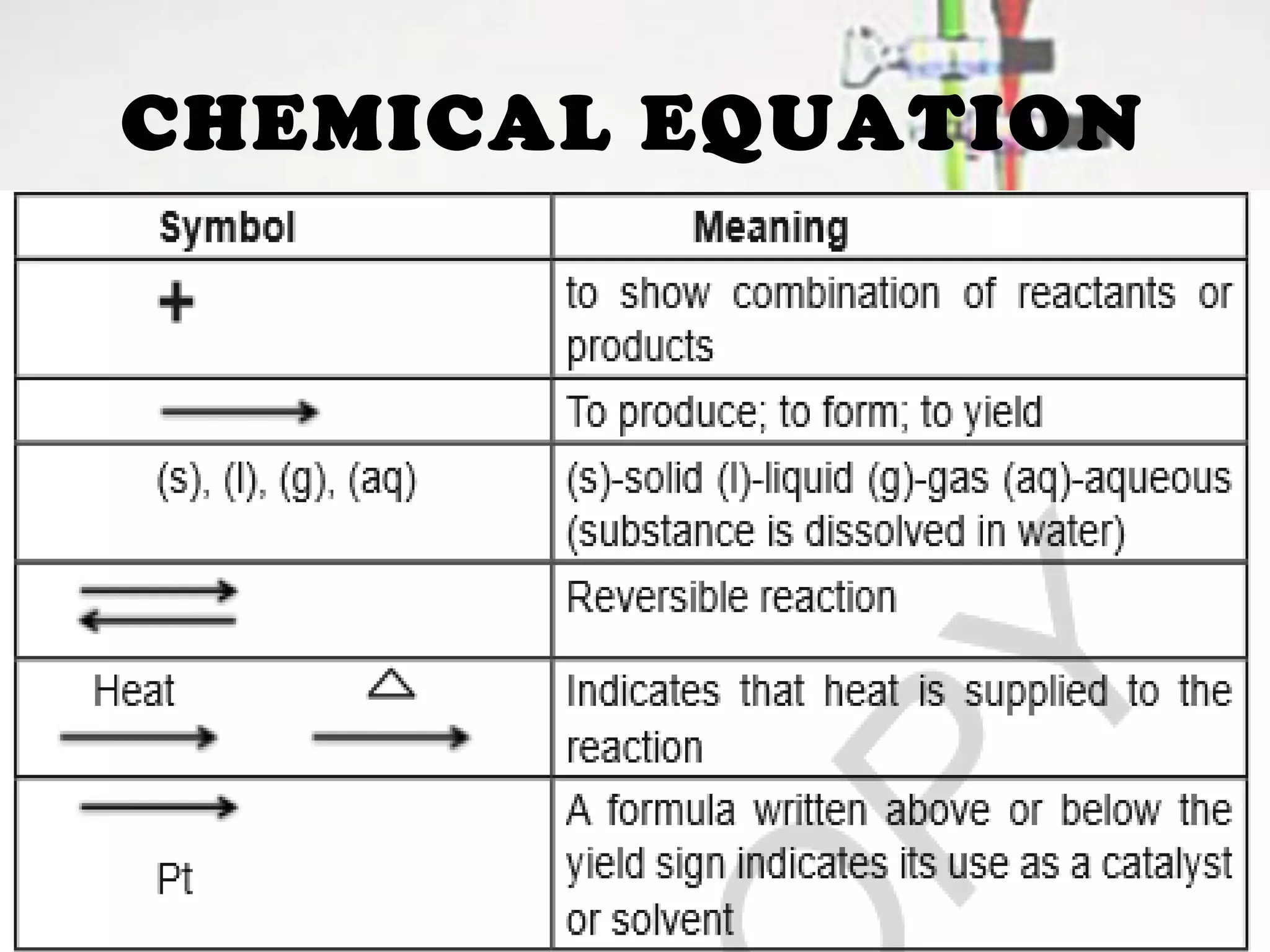
CHEMICAL EQUATION
CHEMICAL EQUATION
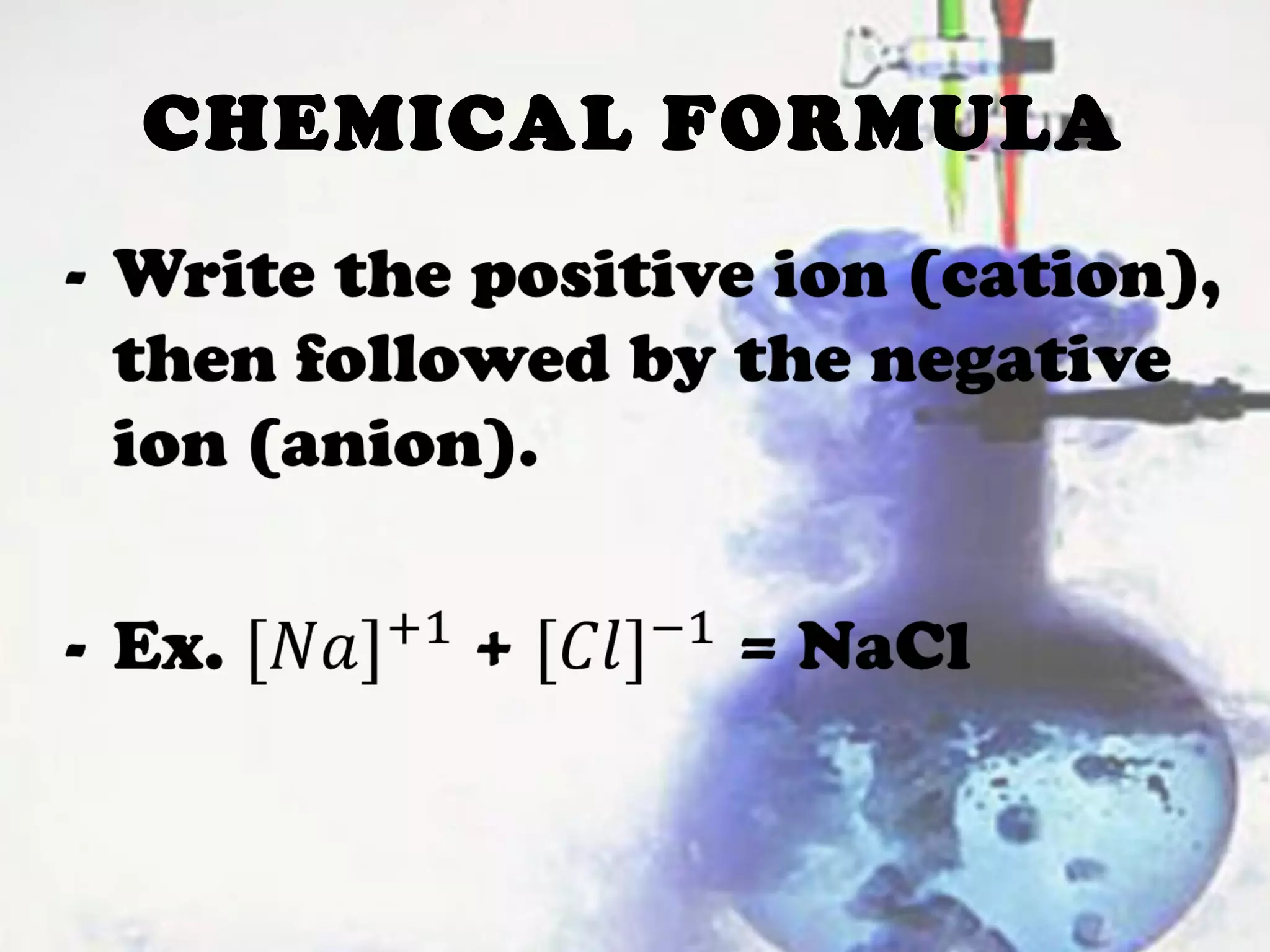
CHEMICAL FORMULA
CHEMICAL FORMULA
CHEMICAL FORMULA
CHEMICAL FORMULA
CHEMICAL FORMULA
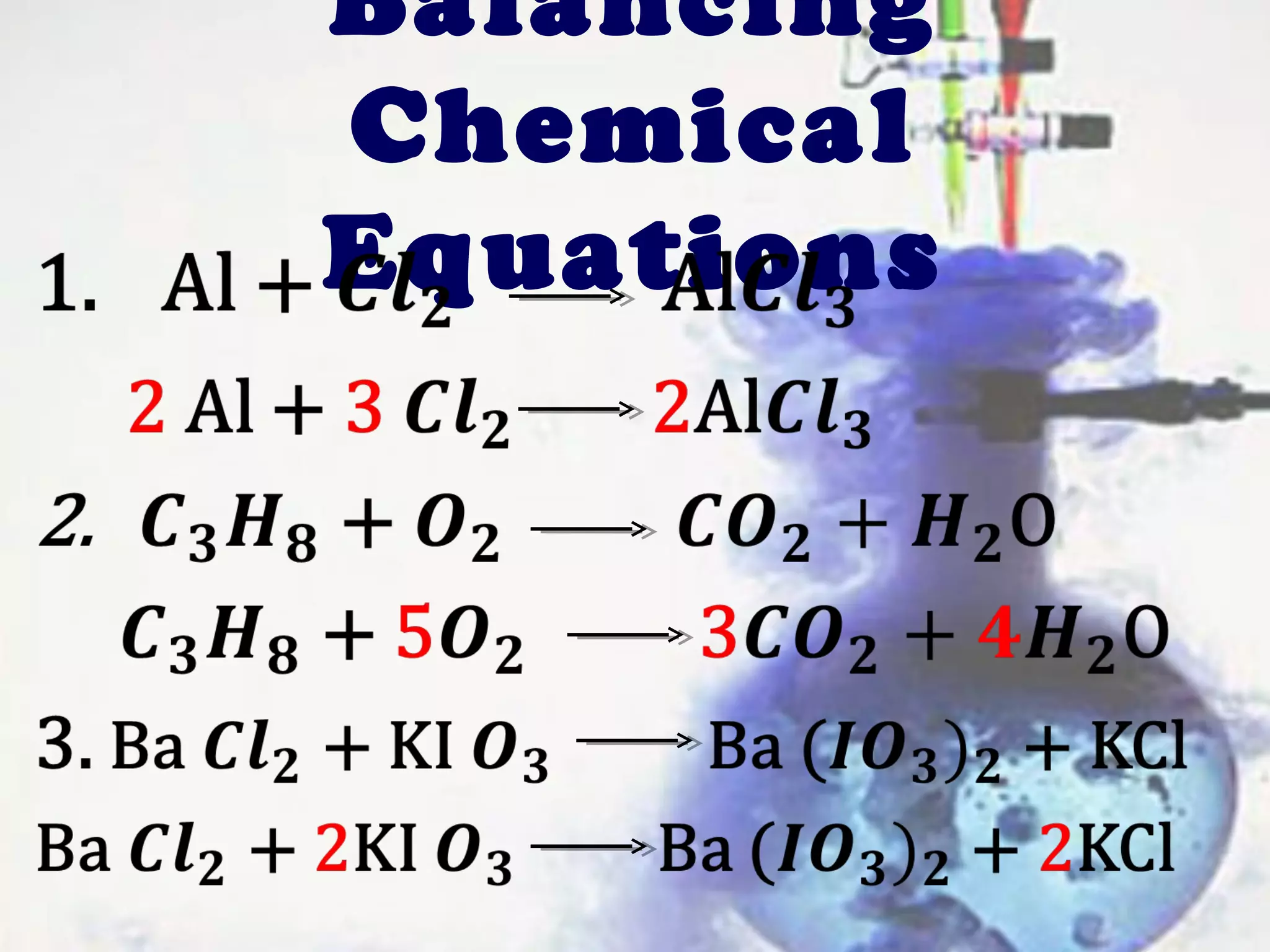
Balancing
Chemical
Equations
BALANCING EQUATION
CH4 + O2 CO2 + H2O
BALANCING EQUATION
• CH4 + O2 -> CO2 + H2O
• Balanced? No
• Reactants: C=1, H=4, O=2
• Products: C=1, H=2, O=3
• H and O not equal
• Use coefficients to balance equations
• CH4 + 2O2 -> CO2 + 2H2O
• C=1, H=4, O=4 -> C=1, H= 4, O=4
Balancing Chemical
Equations
Balancing
Chemical
Equations
Balance the following equations:
TYPES OF CHEMICAL
REACTIONS
A. COMBINATION/ Synthesis
REACTION
• A reaction when 2 or more reactants
combine to form a single product.
• The general formula for this reaction
is : A + B  AB
Example:
N2 +2O2  2 NO2
B. DECOMPOSITION
REACTION
• In this reaction, a single reactant
breaks down into simpler ones. (2 or
more products).
• The general formula for this reaction
is: AB  A + B C
Example:
2 H2O  2H2 +O2
C. SINGLE DISPLACEMENT or
(Replacement) REACTION
• This is when one element replaces another
element from a compound.
• The more active element takes the place of
the less active element in a compound.
• The general formula for this reaction is:
A + BC  AC + B
Example:
D. DOUBLE DISPLACEMENT REACTION
(Metathesis)
• This is when the positive ions (cations) and
negative ions (anions) of different
compounds switch places, forming two
entirely different compounds.
• The general formula for this reaction is:
AB + CD  AD + CB
Example:
E. COMBUSTION (Burning)
REACTION
• This is when oxygen combines with a
hydrocarbon to form a water and
carbon dioxide.
• Example of which is the burning of
butane gas.
C4 H 10 + O2  CO2 + H2O
F. ACID-BASE REACTION
• This is a special kind of double
displacement reaction that takes
place when an acid and base react
with each other.
• The H+ of the acid reacts with the
OH- of the base forming water. The
other product is salt.
Example of which is:
HCI + NaOH  NaCI + H2O
Are a burning vehicle and a
puppy undergoing the same
kind of chemical reaction?
What reaction could this
be?
FACTORS AFFECTINGFACTORS AFFECTING
RATES OF CHEMICALRATES OF CHEMICAL
REACTIONSREACTIONS
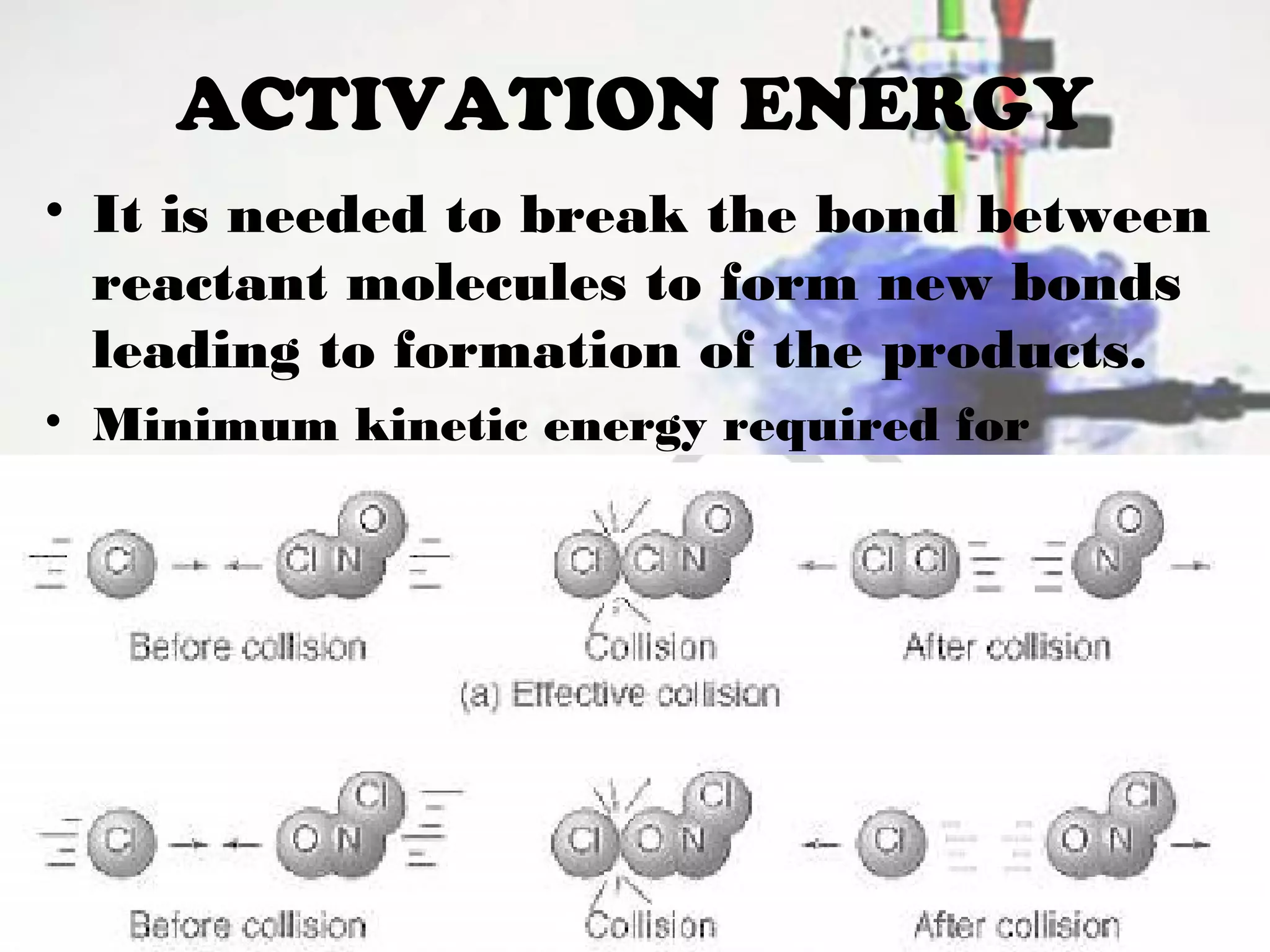
COLLISION THEORY
• explains how collision between
reactant molecules may or may not
result in a successful chemical
reaction.
• Effective collisions between
molecules, which result in the
formation of products, only occur
when the following two conditions
are met:
a. the colliding molecules should possess a
minimum kinetic energy, known as activation
Svante Arrhenius (1888)
• suggested that particles must possess a
certain minimum amount of kinetic energy
in order to react. The energy diagram is
shown below.
ACTIVATION ENERGY
• It is needed to break the bond between
reactant molecules to form new bonds
leading to formation of the products.
• Minimum kinetic energy required for
reaction.
A. TEMPERATURE
• The higher the
temperature, the higher
the rate of reaction.
B. PARTICLE SIZE OR
SURFACE AREA
• Smaller particles size have bigger
surface area.
• Bigger surface area means bigger
exposed portions of a solid which
are available points of contact
between reactants.
C. CATALYST
• A catalyst provides an energy
pathway needed to start a
reaction, therefore increasing
the reaction rate.
• The presence of catalyst
speeds up the rate of reaction.
D. CONCENTRATION
It is a measure of the
number of particles in a given
volume.
The higher the concentration,
the faster the rate of reaction.
.
GROUP ACTIVITY:
1. Using any form of media, prepare a visual presentation of a
chemical reaction involved in:
•Group 1: a. Food Processing and preservation
b. Fire control
•Group 2: a. Corrosion Control
b. Photochemical Smog
•Group 3: a. Haber process
b. Catalytic Converter
•Group 4: a. Formation of ozone layer in the stratosphere
b. Formation of acid rain
2. Research on how a specific chemical reaction poses useful
or harmful effects to life and the environment
3. Present and discuss to class your visual presentation

CHEMICAL REACTION (Updated)

  • 1.
  • 2.
  • 3.
    Chemical ReactionChemical Reaction Itis a process in which the physical and chemical properties of the original substances change as new substances with different physical and chemical properties are formed. Two kinds of substances: 1. The substances present before the change. 2. The substances formed by the change.
  • 4.
    Reactants and Products • ReactantsReactants –presentat the beginning of the reaction • Products –are the substances formed by the chemical reaction Example: burning natural gas • CH4 + 2O2 > CO2 +2H2O
  • 5.
    LAW OF CONSERVATIONLAWOF CONSERVATION OF MASSOF MASS
  • 6.
    EVIDENCES OFEVIDENCES OF CHEMICALREACTIONSCHEMICAL REACTIONS
  • 7.
    1. Taking andgiving off energy1. Taking and giving off energy • ENDOTHERMIC – Reactions where energy is absorbed. – Ex. Cooking of food and Photosynthesis • EXOTHERMIC – Reactions that involve the release of energy. – Ex. Explosion of firecrackers and burning of coal
  • 8.
    1. Taking andgiving off energy1. Taking and giving off energy
  • 9.
    2. Color/odor Change2.Color/odor Change • Ex. Ripening of fruits 3. Evolution of Gas • The release of gases • Ex. When you dissolve a tablet of alkaseltzer in water, bubbles are produced.
  • 10.
  • 11.
    4. Formation ofPrecipitation4. Formation of Precipitation • PRECIPITATE is an insoluble solid that is formed when two liquids react. • Ex. Combination of vinegar and milk
  • 12.
  • 13.
  • 14.
  • 15.
  • 16.
  • 17.
  • 18.
  • 19.
  • 20.
  • 23.
  • 24.
    BALANCING EQUATION • CH4+ O2 -> CO2 + H2O • Balanced? No • Reactants: C=1, H=4, O=2 • Products: C=1, H=2, O=3 • H and O not equal • Use coefficients to balance equations • CH4 + 2O2 -> CO2 + 2H2O • C=1, H=4, O=4 -> C=1, H= 4, O=4
  • 25.
  • 26.
  • 28.
  • 29.
  • 30.
    A. COMBINATION/ Synthesis REACTION •A reaction when 2 or more reactants combine to form a single product. • The general formula for this reaction is : A + B  AB Example: N2 +2O2  2 NO2
  • 31.
    B. DECOMPOSITION REACTION • Inthis reaction, a single reactant breaks down into simpler ones. (2 or more products). • The general formula for this reaction is: AB  A + B C Example: 2 H2O  2H2 +O2
  • 32.
    C. SINGLE DISPLACEMENTor (Replacement) REACTION • This is when one element replaces another element from a compound. • The more active element takes the place of the less active element in a compound. • The general formula for this reaction is: A + BC  AC + B Example:
  • 33.
    D. DOUBLE DISPLACEMENTREACTION (Metathesis) • This is when the positive ions (cations) and negative ions (anions) of different compounds switch places, forming two entirely different compounds. • The general formula for this reaction is: AB + CD  AD + CB Example:
  • 35.
    E. COMBUSTION (Burning) REACTION •This is when oxygen combines with a hydrocarbon to form a water and carbon dioxide. • Example of which is the burning of butane gas. C4 H 10 + O2  CO2 + H2O
  • 36.
    F. ACID-BASE REACTION •This is a special kind of double displacement reaction that takes place when an acid and base react with each other. • The H+ of the acid reacts with the OH- of the base forming water. The other product is salt. Example of which is: HCI + NaOH  NaCI + H2O
  • 37.
    Are a burningvehicle and a puppy undergoing the same kind of chemical reaction? What reaction could this be?
  • 38.
    FACTORS AFFECTINGFACTORS AFFECTING RATESOF CHEMICALRATES OF CHEMICAL REACTIONSREACTIONS
  • 39.
    COLLISION THEORY • explainshow collision between reactant molecules may or may not result in a successful chemical reaction. • Effective collisions between molecules, which result in the formation of products, only occur when the following two conditions are met: a. the colliding molecules should possess a minimum kinetic energy, known as activation
  • 40.
    Svante Arrhenius (1888) •suggested that particles must possess a certain minimum amount of kinetic energy in order to react. The energy diagram is shown below.
  • 41.
    ACTIVATION ENERGY • Itis needed to break the bond between reactant molecules to form new bonds leading to formation of the products. • Minimum kinetic energy required for reaction.
  • 42.
    A. TEMPERATURE • Thehigher the temperature, the higher the rate of reaction.
  • 43.
    B. PARTICLE SIZEOR SURFACE AREA • Smaller particles size have bigger surface area. • Bigger surface area means bigger exposed portions of a solid which are available points of contact between reactants.
  • 44.
    C. CATALYST • Acatalyst provides an energy pathway needed to start a reaction, therefore increasing the reaction rate. • The presence of catalyst speeds up the rate of reaction.
  • 45.
    D. CONCENTRATION It isa measure of the number of particles in a given volume. The higher the concentration, the faster the rate of reaction.
  • 46.
  • 47.
    GROUP ACTIVITY: 1. Usingany form of media, prepare a visual presentation of a chemical reaction involved in: •Group 1: a. Food Processing and preservation b. Fire control •Group 2: a. Corrosion Control b. Photochemical Smog •Group 3: a. Haber process b. Catalytic Converter •Group 4: a. Formation of ozone layer in the stratosphere b. Formation of acid rain 2. Research on how a specific chemical reaction poses useful or harmful effects to life and the environment 3. Present and discuss to class your visual presentation