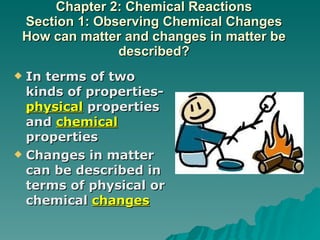
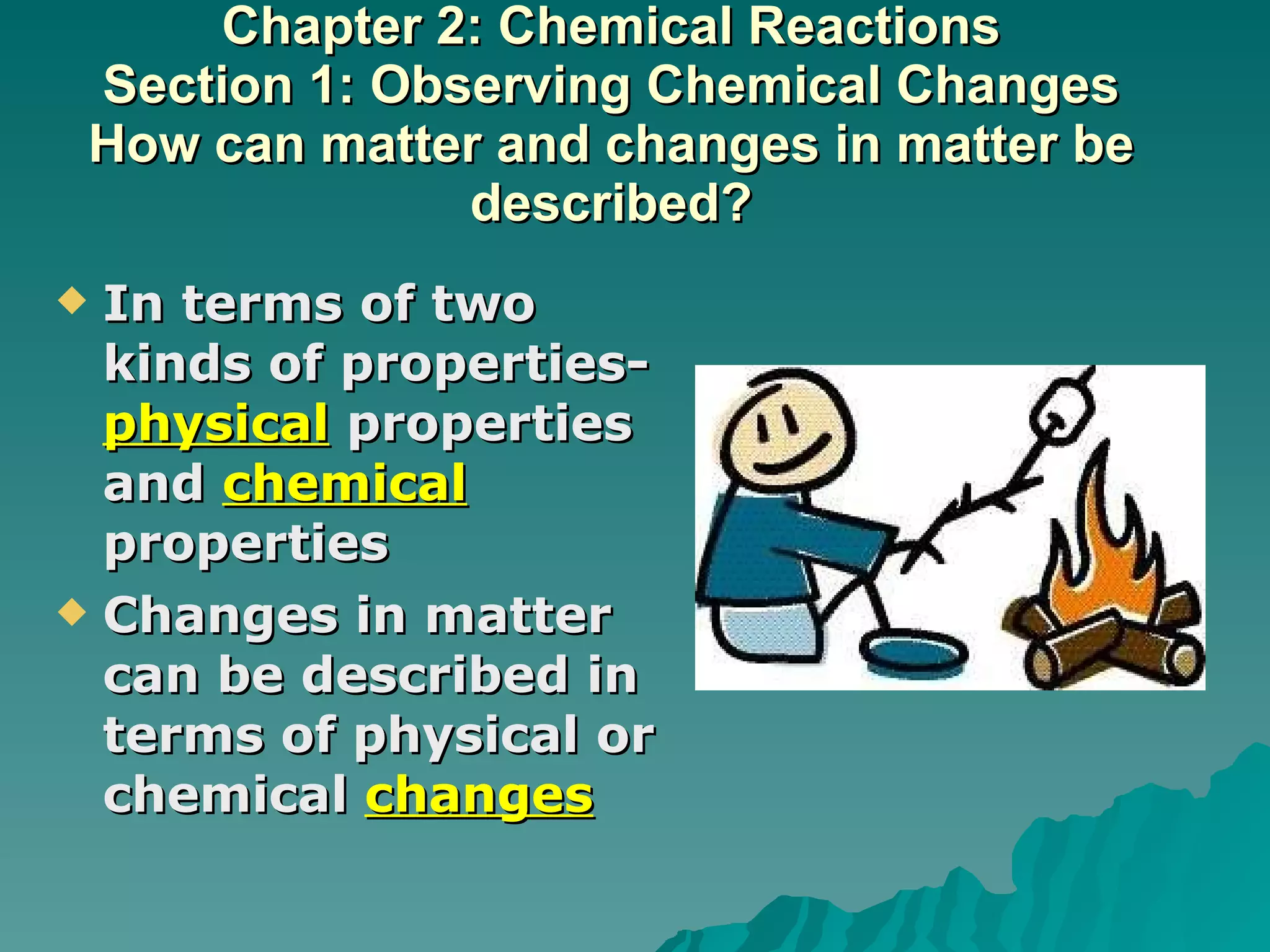
Chapter 2: Chemical Reactions Section 1: Observing Chemical Changes How can matter and changes in matter be described? In terms of two kinds of properties-  physical  properties and  chemical  properties Changes in matter can be described in terms of physical or chemical  changes
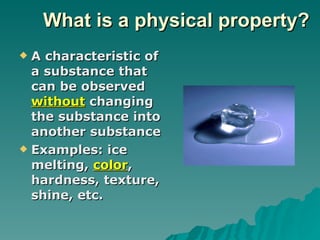
What is a physical property? A characteristic of a substance that can be observed  without  changing the substance into another substance Examples: ice melting,  color , hardness, texture, shine, etc.
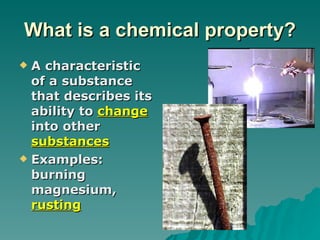
What is a chemical property? A characteristic of a substance that describes its ability to  change  into other  substances Examples: burning magnesium,  rusting
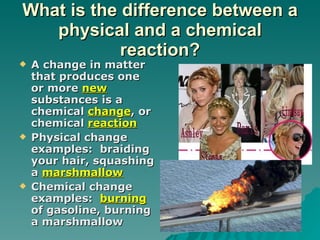
What is the difference between a physical and a chemical reaction? A change in matter that produces one or more  new  substances is a chemical  change , or chemical  reaction Physical change examples:  braiding your hair, squashing a  marshmallow Chemical change examples:  burning  of gasoline, burning a marshmallow
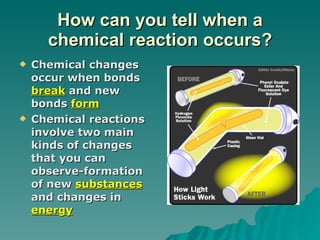
How can you tell when a chemical reaction occurs? Chemical changes occur when bonds  break  and new bonds  form Chemical reactions involve two main kinds of changes that you can observe-formation of new  substances  and changes in  energy
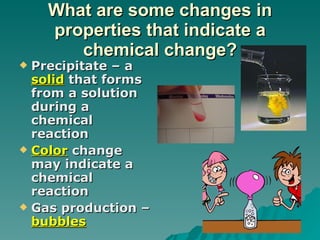
What are some changes in properties that indicate a chemical change? Precipitate – a  solid  that forms from a solution during a chemical reaction Color  change may indicate a chemical reaction Gas production –  bubbles
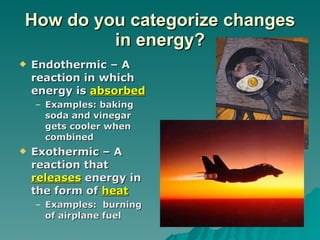
How do you categorize changes in energy? Endothermic – A reaction in which energy is  absorbed Examples: baking soda and vinegar gets cooler when combined Exothermic – A reaction that  releases  energy in the form of  heat Examples:  burning of airplane fuel
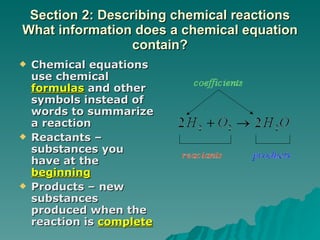
Section 2: Describing chemical reactions What information does a chemical equation contain? Chemical equations use chemical  formulas  and other symbols instead of words to summarize a reaction Reactants – substances you have at the  beginning Products – new substances produced when the reaction is  complete
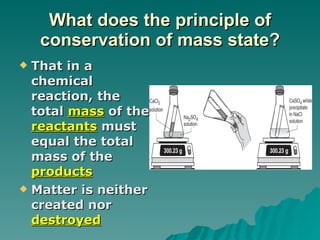
What does the principle of conservation of mass state? That in a chemical reaction, the total  mass  of the  reactants  must equal the total mass of the  products Matter is neither created nor  destroyed
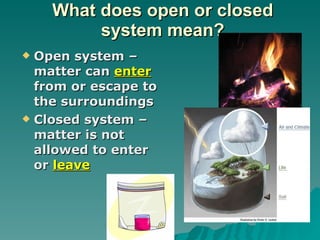
What does open or closed system mean? Open system – matter can  enter  from or escape to the surroundings Closed system – matter is not allowed to enter or  leave
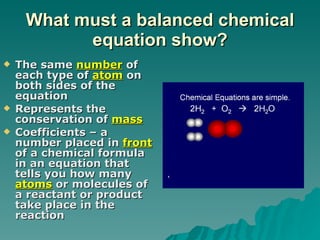
What must a balanced chemical equation show? The same  number  of each type of  atom  on both sides of the equation Represents the conservation of  mass Coefficients – a number placed in  front  of a chemical formula in an equation that tells you how many  atoms  or molecules of a reactant or product take place in the reaction
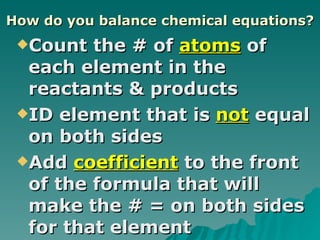
How do you balance chemical equations? Count the # of  atoms  of each element in the reactants & products ID element that is  not  equal on both sides Add  coefficient  to the front of the formula that will make the # = on both sides for that element
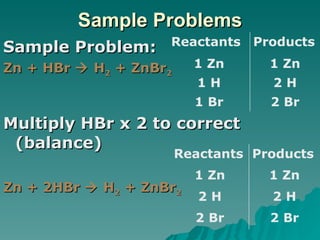
Sample Problems Sample Problem: Zn + HBr    H 2  + ZnBr 2 Multiply HBr x 2 to correct (balance) Zn + 2HBr    H 2  + ZnBr 2 2 Br 1 Br 2 H 1 H 1 Zn 1 Zn Products Reactants 2 Br 2 Br 2 H 2 H 1 Zn 1 Zn Products Reactants
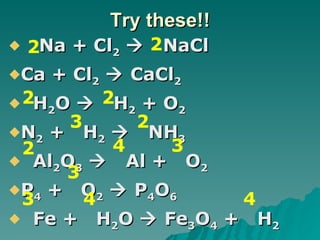
Try these!! Na + Cl 2      NaCl Ca + Cl 2     CaCl 2 H 2 O     H 2  + O 2 N 2  +  H 2      NH 3 Al 2 O 3      Al +  O 2 P 4  +  O 2     P 4 O 6 Fe +  H 2 O    Fe 3 O 4  +  H 2 2   2   2   3   3   2   2   4   3   3   2   4   4
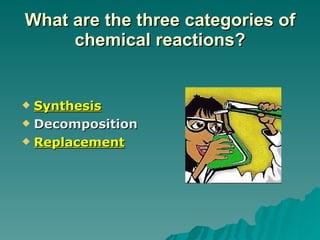
What are the three categories of chemical reactions? Synthesis   Decomposition Replacement
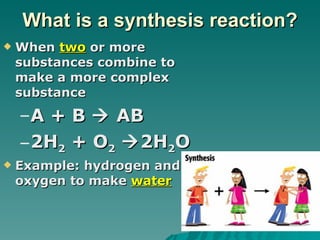
What is a synthesis reaction? When  two  or more substances combine to make a more complex substance A + B    AB 2H 2  + O 2    2H 2 O Example: hydrogen and oxygen to make  water
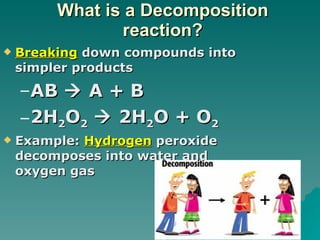
What is a Decomposition reaction? Breaking  down compounds into simpler products AB    A + B 2H 2 O 2     2H 2 O + O 2 Example:  Hydrogen  peroxide decomposes into water and oxygen gas
What is a replacement reaction? When one element  replaces  another in a compound, or when two elements in different compounds  trade  places Example: copper metal obtained by heating copper oxide with carbon Single (one element replaces  another )  AB + C    AC + B Zn + 2HCl    ZnCl 2  + H 2 or double (elements appear to trade places with another  compound ) AB + CD    AC + BD NaCl + AgF    NaF +AgCl
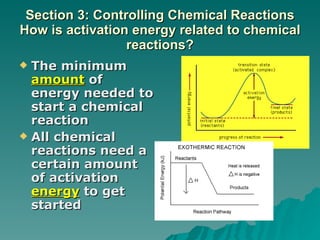
Section 3: Controlling Chemical Reactions How is activation energy related to chemical reactions? The minimum  amount  of energy needed to start a chemical reaction All chemical reactions need a certain amount of activation  energy  to get started
What factors affect the rate of a chemical reaction? Surface  area – the greater the surface area that faster the reaction (ex. Chewing) Temperature  – raising the temperature causes particles to move faster and therefore have more energy; they also come into contact more often; lowering temperature slows things down  Concentration – amount of substance in a given  volume ; increased concentration-increased reaction Catalysts – increases the rate of a  reaction  by decreasing the energy needed to start Enzymes: biological catalysts Inhibitors – material used to  decrease  the rate of reaction (ex. preservatives in food)

Chemical reactions

  • 1.
    Chapter 2: ChemicalReactions Section 1: Observing Chemical Changes How can matter and changes in matter be described? In terms of two kinds of properties- physical properties and chemical properties Changes in matter can be described in terms of physical or chemical changes
  • 2.
    What is aphysical property? A characteristic of a substance that can be observed without changing the substance into another substance Examples: ice melting, color , hardness, texture, shine, etc.
  • 3.
    What is achemical property? A characteristic of a substance that describes its ability to change into other substances Examples: burning magnesium, rusting
  • 4.
    What is thedifference between a physical and a chemical reaction? A change in matter that produces one or more new substances is a chemical change , or chemical reaction Physical change examples: braiding your hair, squashing a marshmallow Chemical change examples: burning of gasoline, burning a marshmallow
  • 5.
    How can youtell when a chemical reaction occurs? Chemical changes occur when bonds break and new bonds form Chemical reactions involve two main kinds of changes that you can observe-formation of new substances and changes in energy
  • 6.
    What are somechanges in properties that indicate a chemical change? Precipitate – a solid that forms from a solution during a chemical reaction Color change may indicate a chemical reaction Gas production – bubbles
  • 7.
    How do youcategorize changes in energy? Endothermic – A reaction in which energy is absorbed Examples: baking soda and vinegar gets cooler when combined Exothermic – A reaction that releases energy in the form of heat Examples: burning of airplane fuel
  • 8.
    Section 2: Describingchemical reactions What information does a chemical equation contain? Chemical equations use chemical formulas and other symbols instead of words to summarize a reaction Reactants – substances you have at the beginning Products – new substances produced when the reaction is complete
  • 9.
    What does theprinciple of conservation of mass state? That in a chemical reaction, the total mass of the reactants must equal the total mass of the products Matter is neither created nor destroyed
  • 10.
    What does openor closed system mean? Open system – matter can enter from or escape to the surroundings Closed system – matter is not allowed to enter or leave
  • 11.
    What must abalanced chemical equation show? The same number of each type of atom on both sides of the equation Represents the conservation of mass Coefficients – a number placed in front of a chemical formula in an equation that tells you how many atoms or molecules of a reactant or product take place in the reaction
  • 12.
    How do youbalance chemical equations? Count the # of atoms of each element in the reactants & products ID element that is not equal on both sides Add coefficient to the front of the formula that will make the # = on both sides for that element
  • 13.
    Sample Problems SampleProblem: Zn + HBr  H 2 + ZnBr 2 Multiply HBr x 2 to correct (balance) Zn + 2HBr  H 2 + ZnBr 2 2 Br 1 Br 2 H 1 H 1 Zn 1 Zn Products Reactants 2 Br 2 Br 2 H 2 H 1 Zn 1 Zn Products Reactants
  • 14.
    Try these!! Na+ Cl 2  NaCl Ca + Cl 2  CaCl 2 H 2 O  H 2 + O 2 N 2 + H 2  NH 3 Al 2 O 3  Al + O 2 P 4 + O 2  P 4 O 6 Fe + H 2 O  Fe 3 O 4 + H 2 2 2 2 3 3 2 2 4 3 3 2 4 4
  • 15.
    What are thethree categories of chemical reactions? Synthesis Decomposition Replacement
  • 16.
    What is asynthesis reaction? When two or more substances combine to make a more complex substance A + B  AB 2H 2 + O 2  2H 2 O Example: hydrogen and oxygen to make water
  • 17.
    What is aDecomposition reaction? Breaking down compounds into simpler products AB  A + B 2H 2 O 2  2H 2 O + O 2 Example: Hydrogen peroxide decomposes into water and oxygen gas
  • 18.
    What is areplacement reaction? When one element replaces another in a compound, or when two elements in different compounds trade places Example: copper metal obtained by heating copper oxide with carbon Single (one element replaces another ) AB + C  AC + B Zn + 2HCl  ZnCl 2 + H 2 or double (elements appear to trade places with another compound ) AB + CD  AC + BD NaCl + AgF  NaF +AgCl
  • 19.
    Section 3: ControllingChemical Reactions How is activation energy related to chemical reactions? The minimum amount of energy needed to start a chemical reaction All chemical reactions need a certain amount of activation energy to get started
  • 20.
    What factors affectthe rate of a chemical reaction? Surface area – the greater the surface area that faster the reaction (ex. Chewing) Temperature – raising the temperature causes particles to move faster and therefore have more energy; they also come into contact more often; lowering temperature slows things down Concentration – amount of substance in a given volume ; increased concentration-increased reaction Catalysts – increases the rate of a reaction by decreasing the energy needed to start Enzymes: biological catalysts Inhibitors – material used to decrease the rate of reaction (ex. preservatives in food)