CHEMICAL
REACTIONS AND
EQUATIONS
CHEMICAL REACTIONS
• A chemical reaction is a process that
leads to the transformation of one set
of chemical substances to another.
• Chemical reactions are chemical
changes in which reactants transform
into products by making or breaking of
bonds(or both) between different
atoms.
Indications of a Chemical
Reaction
• CHANGE IN COLOUR • EVOLUTION OF GAS
• FORMATION OF
PRECIPITATION
• CHANGE IN
TEMPERATURE
CHEMICAL EQUATION
• A chemical equation is the symbolic
representation of a chemical reaction in
the form of symbols and formulae.
• ex:-
magnesium + oxygen = magnesium oxide
• The substances that undergo chemical
change in the reaction (magnesium and
oxygen) are the reactants.
• The new substances (magnesium oxide)
formed during the reactions is the product.
WORDEQUATION
• A word equation is a chemical reaction expressed
in words rather than chemical formulas. It helps
identify the reactants and products in a chemical
reaction.
Sodium + Chlorine → Sodium chloride
• The reactants are written on the left hand side
(LHS) with a plus sign between them.
• Similarly , products are written on the right hand
side (RHS) with a plus sign between them.
• The arrowhead points towards the products, and
shows the direction of the reactions.
SKELETAL EQUATION
• Skeletal equation are those equation which
shows the reactant and product so formed
without balancing them.
• Example :-
Mg + O2 MgO
H + O H2O
• It is also known as unbalanced equation.
BALANCED EQUATION
• The chemical equation needs to be
balanced so that it follows the law of
conservation of mass.
• The chemical equation in which the
number of atoms of each element in the
reactants side is equal to that of the
products side is called a balanced
chemical equation.Example
3CaCO3+2H3PO4→Ca3(PO4)2+3H2CO3
How to balance a equation
• This is a reaction between methane (CH4)
and oxygen (O2), producing carbon dioxide
(CO2) and water (H2O)
In the reaction a compound reacts with oxygen
and produces carbon dioxide and water. It is
often convenient to start balancing with the
compound that contains the maximum number of
atoms. It may be a reactant or a product.
• In this case, the carbon (C) atoms are already
balanced. So now we look at the hydrogen (H)
atoms. There are 4 hydrogen (H) atoms on the
reactants side and 2 hydrogen (H) atoms on
the products side. To balance them, we put a
coefficient of 2 in front of H2O.
• The hydrogen (H) atoms are now balanced.
Due to the coefficient 2 in front of H2O, there
are a total of 4 oxygen (O) atoms on the
products side. To balance the oxygen atoms on
both sides, we put a coefficient of 2 in front of
O2. The chemical equation is now balanced.
WRITINGSYMBOLSOF
PHYSICAL STATES
• The physical states of the reactants and
products are mentioned along with their
chemical formulae.
• The gaseous, liquid, aqueous, and solid
states of reactants and products are
represented by the notations (g), (l), (aq),
and (s), respectively.
• Sometimes the reaction conditions , such
as temperature, pressure, catalyst etc are
indicated above or below the arrow in the
equation
EXAMPLES
CHEMICAL REACTIONS
TYPES
OF
CHEMICALREACTION
TYPES OFCHEMICALREACTION
• COMBINATION REACTION
• DECOMPOSTION REACTION
• DISPLACEMENT REACTION
• DOUBLE DISPLACEMENT
REACTION
• OXIDATION AND REDUCTION
/REDOX REACTION
COMBINATION REACTION
• In a combination reaction, two elements
or one element and one compound or
two compounds combine to give one
single product. For example –
C(s) + O2(g) CO2(g)
2H2(g) + O2(g) 2H2O(g)
DECOMPOSITIONREACTION
• In a decomposition reaction , a single
compound breaks down to produce two or
more similar substences.
• The decomposition reactions take place
when energy is supplied in the form of
heat , electricity or light.
ELECTROLYSIS
• When a substance is decomposed by
passing electric current, the process is
called electrolysis.
• 2H2O(I) 2H2(g) + O2(g)
THERMAL DECOMPOSITION
• When a substance decomposes on
heating it is called thermal decomposition.
• CaCO3(S) CaO(S) + CO2(g)
PHOTOCHEMICAL DECOMPOSITION
• When a substance is decomposed in
presence of sunlight, it is called a
photochemical decomposition.
• 2AgBr 2Ag +Br2
REACTIVITY SERIES
OFMETALS
• Reactivity series of metals is a series in which
the metals arranged in the decreasing order of
their reactivity.
DISPLACEMENT REACTION
• In a displacement reaction ,more reactive
element displaces a less reactive element from
its compound or solution. For example
• Zn(s) + CuSO4(aq) ZnSO4(s) +Cu
In the above reaction Zn is more reactive
than Cu, so Zn displaces Cu from CuSO4.
• 2AgNO3(aq) + Zn(s) → 2Ag(s) + Zn(NO3)2(aq)
In the above reaction Zn is more reactive than
Ag , so Zn displaces Ag from its solution.
DOUBLEDISPLACEMENT
REACTION
• The reaction in which an exchange of ions
between the reactants takes place to give new
products. For example
• BaCl2(aq) + Na2SO4(aq) BaSO4(s) + 2NaCl(aq)
• The white precipitate of BaSO4 is formed
• Double displacement reaction also called
precipitation reaction.
PRECIPITATION REACTION
The reaction in which precipitate is
formed is called a precipitation reaction.
A QUICKRECAP
EXOTHERMIC REACTIONS
• An exothermic reaction is a chemical reaction
that releases energy by light or heat. Most of
the combination reactions are exothermic.
For example
1. Al+Fe2O3→Al2O3+Fe+heat
2.CH4+2O2→CO2+2H2O+heat
3. CaO(s) + H2O(l) → Ca(OH)2(aq)+ heat
ENDOTHERMIC REACTIONS
• Endothermic reaction requires or takes
energy in order for it to proceed.
• Most of the decomposition reactions are
endothermic. For example
1) Melting of ice
2) 6CO2+6H2O+Sunlight→
C6H12O6+6O2
RESPIRATION IS A
EXOTRHERMIC REACTIONS
• In the process of respiration , the complex
substances are broken down into similar
substances and then converted to glucose. In
the whole process, energy (or heat) is released.
• We know that a reaction in which heat is
released along with the formation of products is
known as a exothermic reaction
• Thus , from the above two points we can
conclude that respiration is a exothermic
reaction .
OXIDATION AND REDUCTION
REACTION
• Oxidation is
1) Addition of oxygen
2) Removal of hydrogen
• Any chemical substances following any these
is said to be oxidised.
• Reduction is
1) Removal of oxygen
2) Addition of hydogen
• Any chemical substences following any of
these rules is said to be reduced.
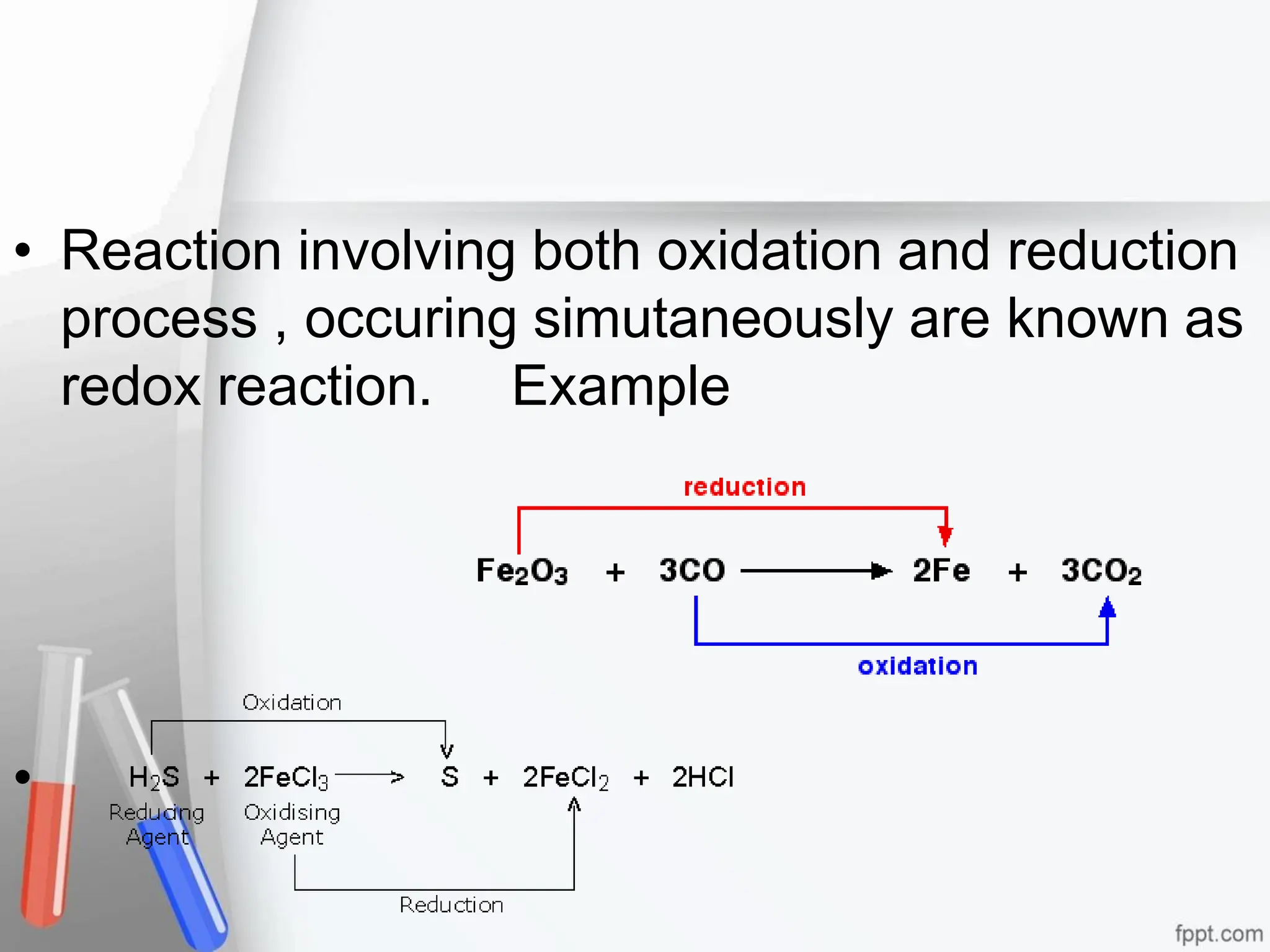
• Reaction involving both oxidation and reduction
process , occuring simutaneously are known as
redox reaction. Example
•
OXIDISING AND REDUCING
AGENT
• An oxidising agent is a substance which help
in oxidation. In the above equation, the ferric
oxide is the oxidising agent/ reduced
substance.
• An reducing agent is a substance which help in
reduction. In the equation, the carbon monoxide is
the reducing agent/oxidised substance.
• Oxidising agents give oxygen to another
substance or remove hydrogen from it.
• Reducing agents remove oxygen from another
substance or give hydrogen to it.
THE EFFECTSOFOXIDATION
REACTIONSIN EVERYDAY LIFE
1)Corrosion
The destruction of metal layer by layer by the
action of air and water is called corrosion.
• Corrosion is a natural process, which converts
a refined metal to a more stable form, such as
its oxide, hydroxide, or sulfide etc.
• Corrosion of Iron:
4Fe(s) +3O2(from air)+xH2O(moisture)→2Fe2O3.xH2O(rust)
• Corrosion of copper:
Cu(s)+H2O(moisture)+CO2(from air)→CuCO3.Cu(OH)2(green)
• Corrosion of silver:
Ag(s)+H2S(from air)→Ag2S(black)+H2(g)
• The rusting of iron can be prevented by painting ,
oiling , galvanizing, anodizing etc
• Galvanization is a method of protecting steel and
iron from rusting by coating them with a thin layer
of zinc
2) Rancidity
• The degradation of oil and fat containing
compound in presence of oxygen is called
rancidity.
• When fats and oils are oxidised, they become
rancid and their smell and taste change.
PREVENTIONOF RANCIDITY
(i) Use of air-tight containers.
(ii) Packaging with nitrogen.
(iii) Refrigeration.
(iv) Addition of antioxidants or
preservatives.
PPT-10 science.pdf,,,,,,,,,,,,,,,,,,,,,,,,,,,,,,,,,,,,

PPT-10 science.pdf,,,,,,,,,,,,,,,,,,,,,,,,,,,,,,,,,,,,

  • 1.
  • 2.
    CHEMICAL REACTIONS • Achemical reaction is a process that leads to the transformation of one set of chemical substances to another. • Chemical reactions are chemical changes in which reactants transform into products by making or breaking of bonds(or both) between different atoms.
  • 3.
    Indications of aChemical Reaction • CHANGE IN COLOUR • EVOLUTION OF GAS
  • 4.
  • 5.
    CHEMICAL EQUATION • Achemical equation is the symbolic representation of a chemical reaction in the form of symbols and formulae. • ex:- magnesium + oxygen = magnesium oxide • The substances that undergo chemical change in the reaction (magnesium and oxygen) are the reactants. • The new substances (magnesium oxide) formed during the reactions is the product.
  • 6.
    WORDEQUATION • A wordequation is a chemical reaction expressed in words rather than chemical formulas. It helps identify the reactants and products in a chemical reaction. Sodium + Chlorine → Sodium chloride • The reactants are written on the left hand side (LHS) with a plus sign between them. • Similarly , products are written on the right hand side (RHS) with a plus sign between them. • The arrowhead points towards the products, and shows the direction of the reactions.
  • 7.
    SKELETAL EQUATION • Skeletalequation are those equation which shows the reactant and product so formed without balancing them. • Example :- Mg + O2 MgO H + O H2O • It is also known as unbalanced equation.
  • 8.
    BALANCED EQUATION • Thechemical equation needs to be balanced so that it follows the law of conservation of mass. • The chemical equation in which the number of atoms of each element in the reactants side is equal to that of the products side is called a balanced chemical equation.Example 3CaCO3+2H3PO4→Ca3(PO4)2+3H2CO3
  • 9.
    How to balancea equation • This is a reaction between methane (CH4) and oxygen (O2), producing carbon dioxide (CO2) and water (H2O) In the reaction a compound reacts with oxygen and produces carbon dioxide and water. It is often convenient to start balancing with the compound that contains the maximum number of atoms. It may be a reactant or a product.
  • 10.
    • In thiscase, the carbon (C) atoms are already balanced. So now we look at the hydrogen (H) atoms. There are 4 hydrogen (H) atoms on the reactants side and 2 hydrogen (H) atoms on the products side. To balance them, we put a coefficient of 2 in front of H2O.
  • 11.
    • The hydrogen(H) atoms are now balanced. Due to the coefficient 2 in front of H2O, there are a total of 4 oxygen (O) atoms on the products side. To balance the oxygen atoms on both sides, we put a coefficient of 2 in front of O2. The chemical equation is now balanced.
  • 12.
    WRITINGSYMBOLSOF PHYSICAL STATES • Thephysical states of the reactants and products are mentioned along with their chemical formulae. • The gaseous, liquid, aqueous, and solid states of reactants and products are represented by the notations (g), (l), (aq), and (s), respectively. • Sometimes the reaction conditions , such as temperature, pressure, catalyst etc are indicated above or below the arrow in the equation
  • 13.
  • 14.
  • 15.
    TYPES OFCHEMICALREACTION • COMBINATIONREACTION • DECOMPOSTION REACTION • DISPLACEMENT REACTION • DOUBLE DISPLACEMENT REACTION • OXIDATION AND REDUCTION /REDOX REACTION
  • 16.
    COMBINATION REACTION • Ina combination reaction, two elements or one element and one compound or two compounds combine to give one single product. For example – C(s) + O2(g) CO2(g) 2H2(g) + O2(g) 2H2O(g)
  • 17.
    DECOMPOSITIONREACTION • In adecomposition reaction , a single compound breaks down to produce two or more similar substences. • The decomposition reactions take place when energy is supplied in the form of heat , electricity or light.
  • 18.
    ELECTROLYSIS • When asubstance is decomposed by passing electric current, the process is called electrolysis. • 2H2O(I) 2H2(g) + O2(g)
  • 19.
    THERMAL DECOMPOSITION • Whena substance decomposes on heating it is called thermal decomposition. • CaCO3(S) CaO(S) + CO2(g)
  • 20.
    PHOTOCHEMICAL DECOMPOSITION • Whena substance is decomposed in presence of sunlight, it is called a photochemical decomposition. • 2AgBr 2Ag +Br2
  • 21.
    REACTIVITY SERIES OFMETALS • Reactivityseries of metals is a series in which the metals arranged in the decreasing order of their reactivity.
  • 22.
    DISPLACEMENT REACTION • Ina displacement reaction ,more reactive element displaces a less reactive element from its compound or solution. For example • Zn(s) + CuSO4(aq) ZnSO4(s) +Cu In the above reaction Zn is more reactive than Cu, so Zn displaces Cu from CuSO4. • 2AgNO3(aq) + Zn(s) → 2Ag(s) + Zn(NO3)2(aq) In the above reaction Zn is more reactive than Ag , so Zn displaces Ag from its solution.
  • 23.
    DOUBLEDISPLACEMENT REACTION • The reactionin which an exchange of ions between the reactants takes place to give new products. For example • BaCl2(aq) + Na2SO4(aq) BaSO4(s) + 2NaCl(aq) • The white precipitate of BaSO4 is formed • Double displacement reaction also called precipitation reaction.
  • 24.
    PRECIPITATION REACTION The reactionin which precipitate is formed is called a precipitation reaction.
  • 25.
  • 26.
    EXOTHERMIC REACTIONS • Anexothermic reaction is a chemical reaction that releases energy by light or heat. Most of the combination reactions are exothermic. For example 1. Al+Fe2O3→Al2O3+Fe+heat 2.CH4+2O2→CO2+2H2O+heat 3. CaO(s) + H2O(l) → Ca(OH)2(aq)+ heat
  • 27.
    ENDOTHERMIC REACTIONS • Endothermicreaction requires or takes energy in order for it to proceed. • Most of the decomposition reactions are endothermic. For example 1) Melting of ice 2) 6CO2+6H2O+Sunlight→ C6H12O6+6O2
  • 28.
    RESPIRATION IS A EXOTRHERMICREACTIONS • In the process of respiration , the complex substances are broken down into similar substances and then converted to glucose. In the whole process, energy (or heat) is released. • We know that a reaction in which heat is released along with the formation of products is known as a exothermic reaction • Thus , from the above two points we can conclude that respiration is a exothermic reaction .
  • 29.
    OXIDATION AND REDUCTION REACTION •Oxidation is 1) Addition of oxygen 2) Removal of hydrogen • Any chemical substances following any these is said to be oxidised. • Reduction is 1) Removal of oxygen 2) Addition of hydogen • Any chemical substences following any of these rules is said to be reduced.
  • 30.
    • Reaction involvingboth oxidation and reduction process , occuring simutaneously are known as redox reaction. Example •
  • 31.
    OXIDISING AND REDUCING AGENT •An oxidising agent is a substance which help in oxidation. In the above equation, the ferric oxide is the oxidising agent/ reduced substance. • An reducing agent is a substance which help in reduction. In the equation, the carbon monoxide is the reducing agent/oxidised substance. • Oxidising agents give oxygen to another substance or remove hydrogen from it. • Reducing agents remove oxygen from another substance or give hydrogen to it.
  • 32.
    THE EFFECTSOFOXIDATION REACTIONSIN EVERYDAYLIFE 1)Corrosion The destruction of metal layer by layer by the action of air and water is called corrosion. • Corrosion is a natural process, which converts a refined metal to a more stable form, such as its oxide, hydroxide, or sulfide etc.
  • 33.
    • Corrosion ofIron: 4Fe(s) +3O2(from air)+xH2O(moisture)→2Fe2O3.xH2O(rust) • Corrosion of copper: Cu(s)+H2O(moisture)+CO2(from air)→CuCO3.Cu(OH)2(green) • Corrosion of silver: Ag(s)+H2S(from air)→Ag2S(black)+H2(g) • The rusting of iron can be prevented by painting , oiling , galvanizing, anodizing etc • Galvanization is a method of protecting steel and iron from rusting by coating them with a thin layer of zinc
  • 34.
    2) Rancidity • Thedegradation of oil and fat containing compound in presence of oxygen is called rancidity. • When fats and oils are oxidised, they become rancid and their smell and taste change.
  • 35.
    PREVENTIONOF RANCIDITY (i) Useof air-tight containers. (ii) Packaging with nitrogen. (iii) Refrigeration. (iv) Addition of antioxidants or preservatives.