Chemical Reactions  Use Models to represent chemical reactions.  Describe chemical reactions using equations.  Investigate chemical and physical change.
Next Tuesday-Lab  If you could bring in one bottle of Elmer’s glue, we will be able to do the lab on Tuesday!!! Thanks.  I need it by Monday!
Chemical Reactions Vocabulary Reactant-participate in the reaction  Product-what is produced by the reaction Exothermic-Release energy  Endothermic-Absorb energy
Brain Storm With a partner-take 1 minute to make a list of chemical reactions that you witness or do every day.
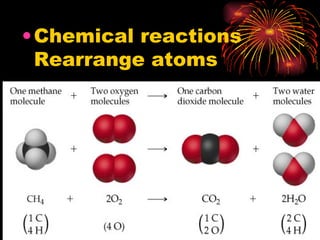
Chemical reactions Rearrange atoms
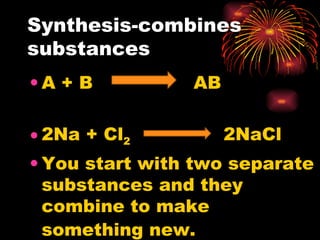
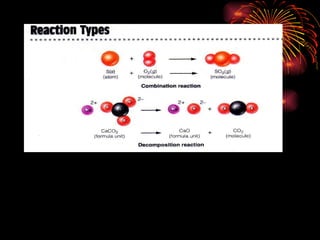
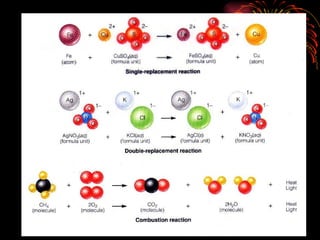
Synthesis-combines substances  A + B  AB 2Na + Cl 2  2NaCl You start with two separate substances and they combine to make something new.
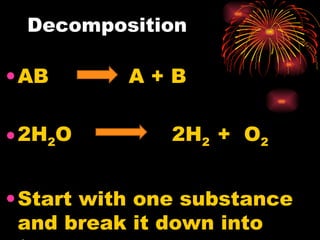
Decomposition  AB  A + B  2H 2 O  2H 2  +  O 2 Start with one substance and break it down into two.
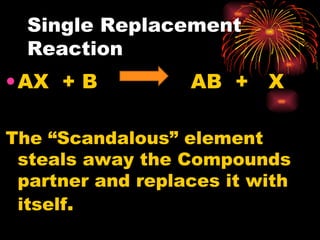
Single Replacement Reaction  AX  + B  AB  +  X The “Scandalous” element steals away the Compounds partner and replaces it with itself .
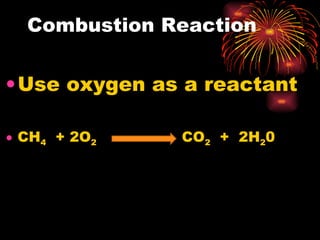
Combustion Reaction Use oxygen as a reactant CH 4   + 2O 2   CO 2   +  2H 2 0
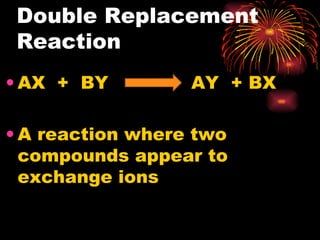
Double Replacement Reaction  AX  +  BY  AY  + BX A reaction where two compounds appear to exchange ions
 
 
Chemical Rxns (reactions) rearrange the atoms in an equation  Occur when substances go through chemical changes to form new substances.  Add energy to break bonds Release energy to form bonds
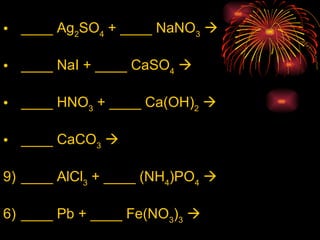
____ Ag 2 SO 4  + ____ NaNO 3    ____ NaI + ____ CaSO 4      ____ HNO 3  + ____ Ca(OH) 2    ____ CaCO 3      ____ AlCl 3  + ____ (NH 4 )PO 4    6) ____ Pb + ____ Fe(NO 3 ) 3   
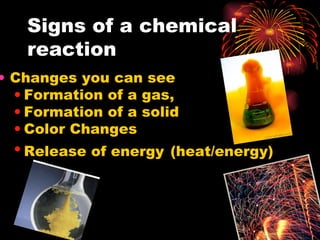
Signs of a chemical reaction Changes you can see Formation of a gas,  Formation of a solid Color Changes Release of energy   (heat/energy)
Law of Conservation of Mass/Energy  Energy is Conserved  The energy you start with is the same energy that you end with just in a different form.  Total amount of energy of reactants must always equal the total amount of energy in the products and their surrounding environment.
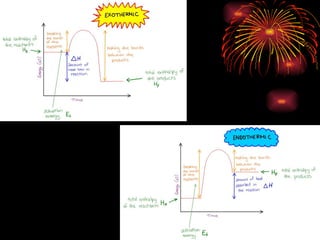
Reactions that release energy are exothermic Reactions that absorb energy are endothermic
Energy and Reactions Reactions that release energy are exothermic- Examples-combustion reactions are always exothermic Products have less energy than the reactants.
 
Reaction Rates Anything that increases contact between particles will increase the rate of reaction.
Most reactions go faster at higher temperatures Large surface area Higher concentrations of reactants react faster
Higher pressure increases reaction rate Catalysts speed up reactions  Enzymes are biological catalysts
Balancing Equations 1.  Get yourself an unbalanced equation .  I might give this to you, or I might make you figure it out.  2.  Draw boxes around all the chemical formulas.   Never, ever, change anything inside the boxes . Ever. Really. If you do, you're  guaranteed  to get the answer wrong.
3.  Make an element inventory .  How are you going to know if the equation is balanced if you don't actually make a list of how many of each atom you have?  4 . Write numbers in front of each of the boxes until the inventory for each element is the same both before and after the reaction.  Whenever you change a number, make sure to update the inventory - otherwise, you run the risk of balancing it incorrectly. When all the numbers in the inventory balance, then the equation can balance.
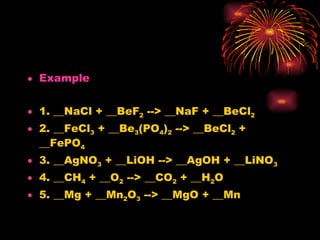
Example 1. __NaCl + __BeF 2  --> __NaF + __BeCl 2 2. __FeCl 3  + __Be 3 (PO 4 ) 2  --> __BeCl 2  + __FePO 4 3. __AgNO 3  + __LiOH --> __AgOH + __LiNO 3 4. __CH 4  + __O 2  --> __CO 2  + __H 2 O 5. __Mg + __Mn 2 O 3  --> __MgO + __Mn
Bill Nye
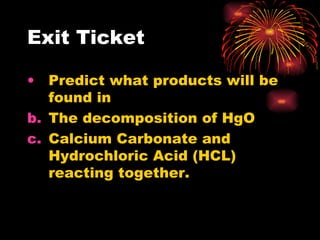
Exit Ticket Predict what products will be found in  The decomposition of HgO Calcium Carbonate and Hydrochloric Acid (HCL) reacting together.
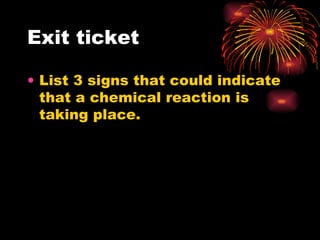
Exit ticket  List 3 signs that could indicate that a chemical reaction is taking place.

Chemical reactions

  • 1.
    Chemical Reactions Use Models to represent chemical reactions. Describe chemical reactions using equations. Investigate chemical and physical change.
  • 2.
    Next Tuesday-Lab If you could bring in one bottle of Elmer’s glue, we will be able to do the lab on Tuesday!!! Thanks. I need it by Monday!
  • 3.
    Chemical Reactions VocabularyReactant-participate in the reaction Product-what is produced by the reaction Exothermic-Release energy Endothermic-Absorb energy
  • 4.
    Brain Storm Witha partner-take 1 minute to make a list of chemical reactions that you witness or do every day.
  • 5.
  • 6.
    Synthesis-combines substances A + B AB 2Na + Cl 2 2NaCl You start with two separate substances and they combine to make something new.
  • 7.
    Decomposition AB A + B 2H 2 O 2H 2 + O 2 Start with one substance and break it down into two.
  • 8.
    Single Replacement Reaction AX + B AB + X The “Scandalous” element steals away the Compounds partner and replaces it with itself .
  • 9.
    Combustion Reaction Useoxygen as a reactant CH 4 + 2O 2 CO 2 + 2H 2 0
  • 10.
    Double Replacement Reaction AX + BY AY + BX A reaction where two compounds appear to exchange ions
  • 11.
  • 12.
  • 13.
    Chemical Rxns (reactions)rearrange the atoms in an equation Occur when substances go through chemical changes to form new substances. Add energy to break bonds Release energy to form bonds
  • 14.
    ____ Ag 2SO 4 + ____ NaNO 3  ____ NaI + ____ CaSO 4  ____ HNO 3 + ____ Ca(OH) 2  ____ CaCO 3  ____ AlCl 3 + ____ (NH 4 )PO 4  6) ____ Pb + ____ Fe(NO 3 ) 3 
  • 15.
    Signs of achemical reaction Changes you can see Formation of a gas, Formation of a solid Color Changes Release of energy (heat/energy)
  • 16.
    Law of Conservationof Mass/Energy Energy is Conserved The energy you start with is the same energy that you end with just in a different form. Total amount of energy of reactants must always equal the total amount of energy in the products and their surrounding environment.
  • 17.
    Reactions that releaseenergy are exothermic Reactions that absorb energy are endothermic
  • 18.
    Energy and ReactionsReactions that release energy are exothermic- Examples-combustion reactions are always exothermic Products have less energy than the reactants.
  • 19.
  • 20.
    Reaction Rates Anythingthat increases contact between particles will increase the rate of reaction.
  • 21.
    Most reactions gofaster at higher temperatures Large surface area Higher concentrations of reactants react faster
  • 22.
    Higher pressure increasesreaction rate Catalysts speed up reactions Enzymes are biological catalysts
  • 23.
    Balancing Equations 1. Get yourself an unbalanced equation .  I might give this to you, or I might make you figure it out. 2. Draw boxes around all the chemical formulas.   Never, ever, change anything inside the boxes . Ever. Really. If you do, you're  guaranteed  to get the answer wrong.
  • 24.
    3. Makean element inventory .  How are you going to know if the equation is balanced if you don't actually make a list of how many of each atom you have?  4 . Write numbers in front of each of the boxes until the inventory for each element is the same both before and after the reaction.  Whenever you change a number, make sure to update the inventory - otherwise, you run the risk of balancing it incorrectly. When all the numbers in the inventory balance, then the equation can balance.
  • 25.
    Example 1. __NaCl+ __BeF 2  --> __NaF + __BeCl 2 2. __FeCl 3  + __Be 3 (PO 4 ) 2  --> __BeCl 2  + __FePO 4 3. __AgNO 3  + __LiOH --> __AgOH + __LiNO 3 4. __CH 4  + __O 2  --> __CO 2  + __H 2 O 5. __Mg + __Mn 2 O 3  --> __MgO + __Mn
  • 26.
  • 27.
    Exit Ticket Predictwhat products will be found in The decomposition of HgO Calcium Carbonate and Hydrochloric Acid (HCL) reacting together.
  • 28.
    Exit ticket List 3 signs that could indicate that a chemical reaction is taking place.

Editor's Notes

  • #5 Give the students time to brainstorm and then write them down.