SYLLABUS OF CHEMISTRY (SCIENCE)
CBSE CLASS 10TH STD.
1. CHEMICAL REACTIONS AND EQUATIONS
2. ACIDS, BASES AND SALTS
3. METALS AND NON ,METALS
4. CARBON AND ITS COMPOUNDS
5. PERIODIC CLASSIFICATION OF ELEMENTS
By Tripurari Prajapati
M.Sc.. Biotechnology
CHAPTER- 1 SCINCE (CBSE CLASS 10)
CONTENTS
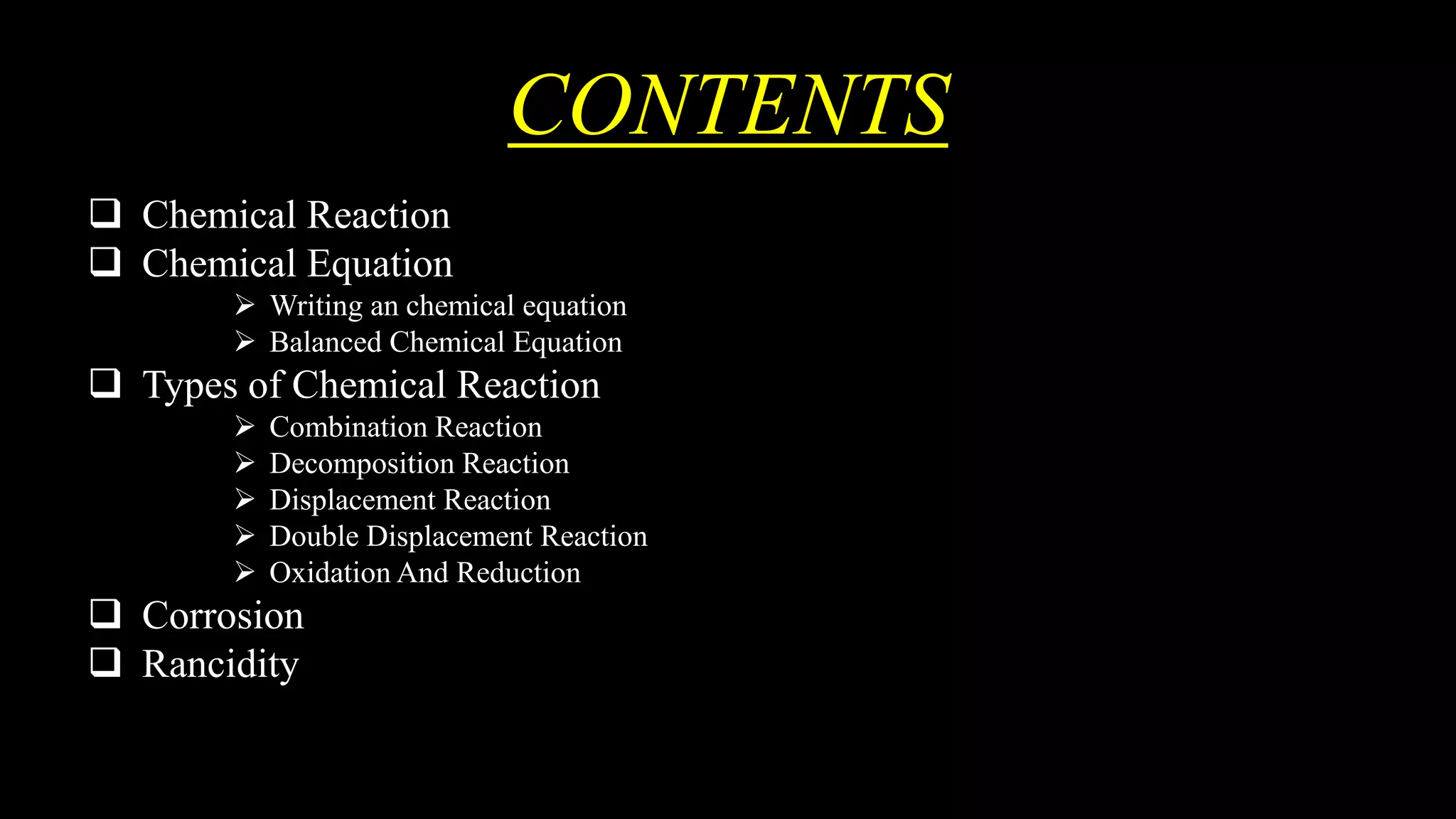
❑ Chemical Reaction
❑ Chemical Equation
➢ Writing an chemical equation
➢ Balanced Chemical Equation
❑ Types of Chemical Reaction
➢ Combination Reaction
➢ Decomposition Reaction
➢ Displacement Reaction
➢ Double Displacement Reaction
➢ Oxidation And Reduction
❑ Corrosion
❑ Rancidity
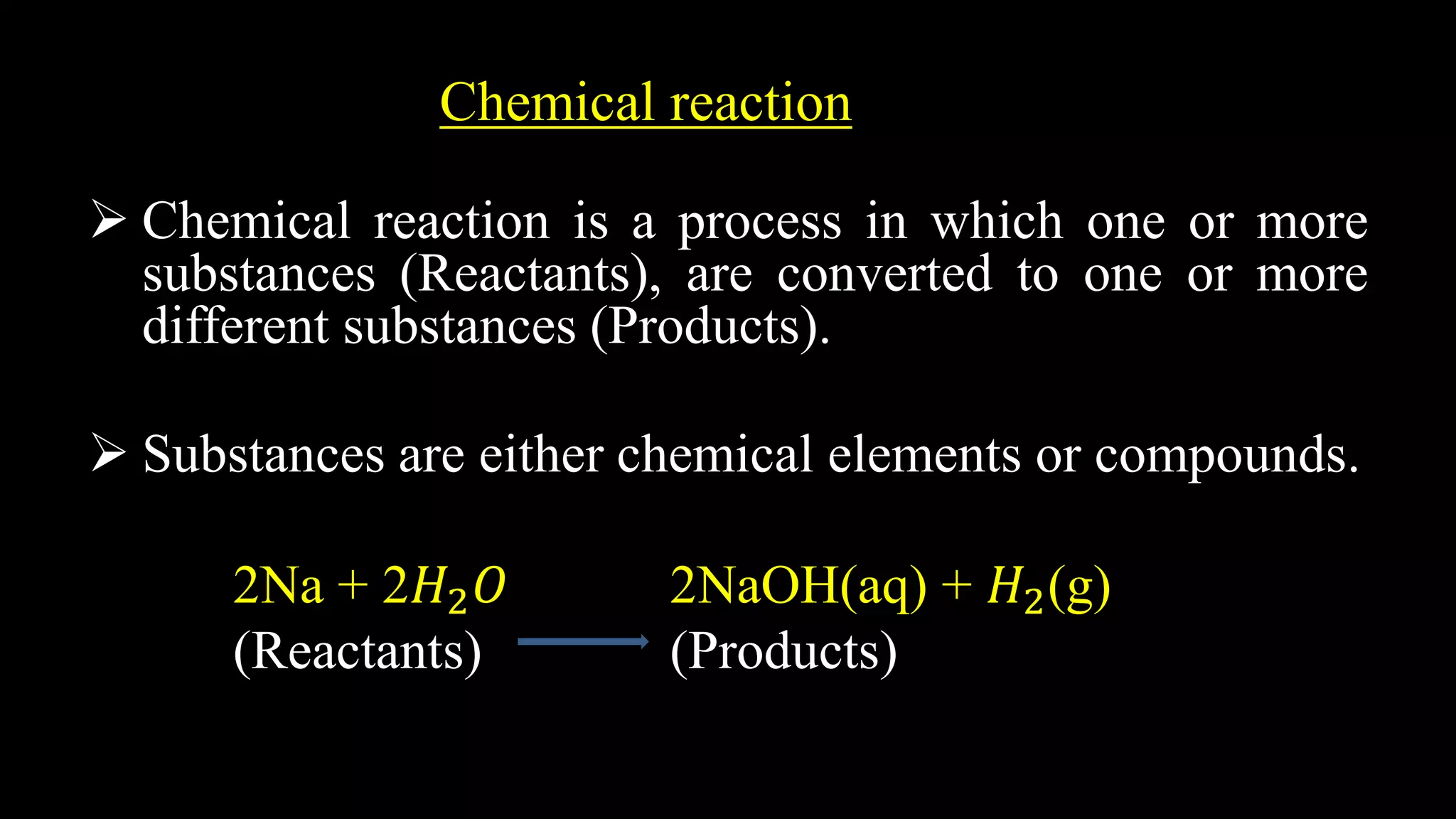
Chemical reaction
➢ Chemical reaction is a process in which one or more
substances (Reactants), are converted to one or more
different substances (Products).
➢ Substances are either chemical elements or compounds.
2Na + 2𝐻2𝑂 2NaOH(aq) + 𝐻2(g)
(Reactants) (Products)
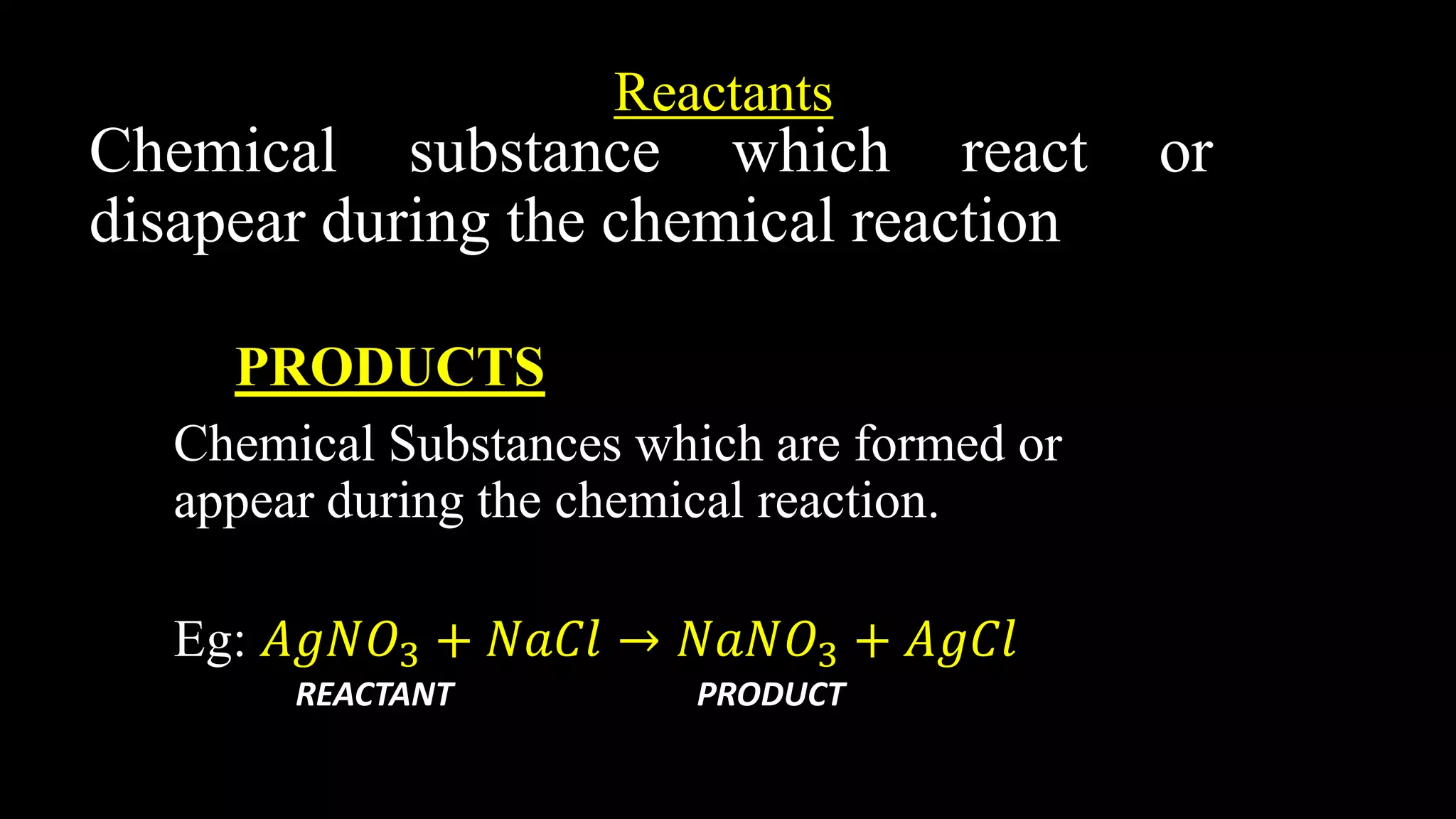
Reactants
Chemical substance which react or
disapear during the chemical reaction
Chemical Substances which are formed or
appear during the chemical reaction.
Eg: 𝐴𝑔𝑁𝑂3 + 𝑁𝑎𝐶𝑙 → 𝑁𝑎𝑁𝑂3 + 𝐴𝑔𝐶𝑙
REACTANT PRODUCT
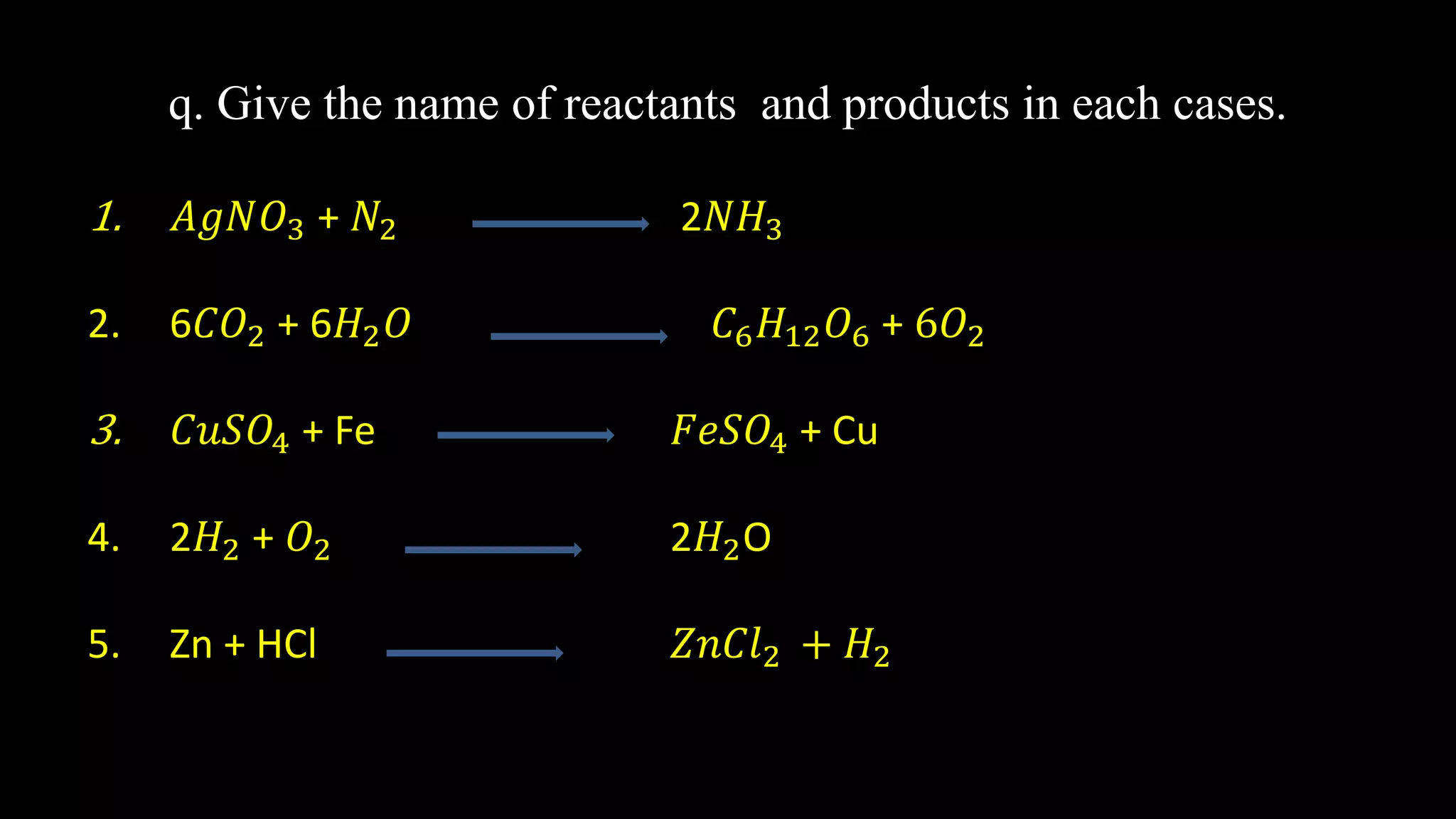
q. Give the name of reactants and products in each cases.
1. 𝐴𝑔𝑁𝑂3 + 𝑁2 2𝑁𝐻3
2. 6𝐶𝑂2 + 6𝐻2𝑂 𝐶6𝐻12𝑂6 + 6𝑂2
3. 𝐶𝑢𝑆𝑂4 + Fe 𝐹𝑒𝑆𝑂4 + Cu
4. 2𝐻2 + 𝑂2 2𝐻2O
5. Zn + HCl 𝑍𝑛𝐶𝑙2 + 𝐻2
Example of chemical reaCTION IN EVERYDAY LIFE
➢Photosynthesis
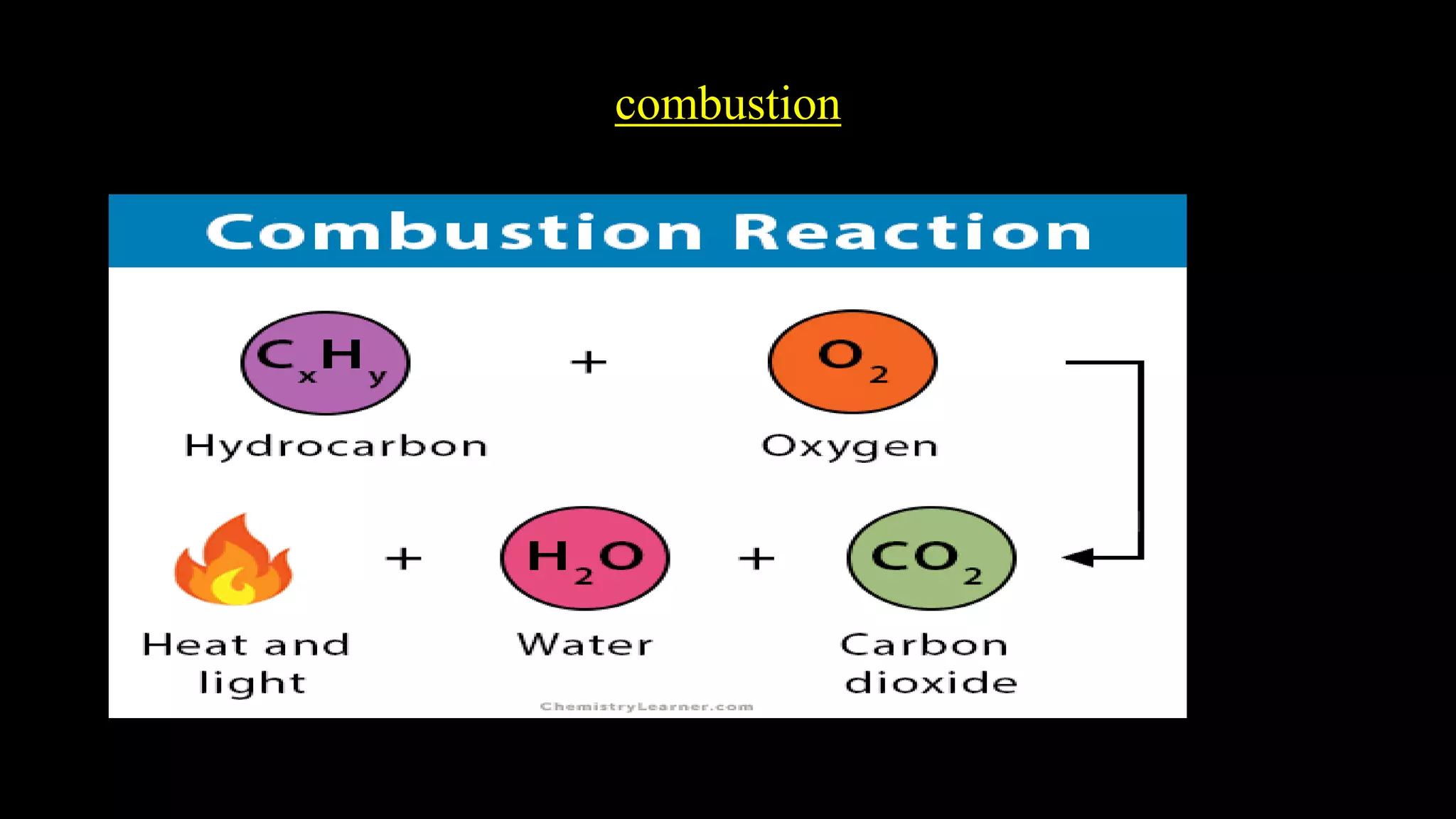
➢Combustion
➢Respiration
➢Rusting
➢Digestion
photosynthesis
combustion
respiration
rusting
Digestion
Identification of chemical reaction
➢It can be determined by 5 factors
i. Change in state
ii. Change in color
iii. Evolution of gas
iv. Change in temperature
v. Formation of precipitate
Change in state
CO(g) + 2𝐻2𝑂(g) 𝐶𝐻3OH(l)
C(s) + 𝑂2(g) 𝐶𝑂2(g)
𝐻2(g) + 𝑂2(g) 2𝐻2O(l)
Change in color
Evolution of gas
Change in temperature
CaO(s) + 𝐻2𝑂(l) 𝐶𝑎(𝑂𝐻)2(s) + Heat
(Quick lime)
Mint + 𝐻2𝑂(l) Temperature decrease
Formation of precipitate
Chemical equation
➢ A chemical equation is the symbolic
representation of a chemical reaction.
➢ A chemical equation can be written in 2 forms:
❖Word equation
eg: Hydrogen + Oxygen Water
❖Symbolic representation
eg: 2𝐻2 + 𝑂2 2𝐻2𝑂
Making a chemical equation more informative
➢ The physical states of the reactants and products
can be represented by using symbols.
➢For solid (s)
➢For liquid (l)
➢For gas (g)
➢For aqueous solutions (aq)
Eg: 2Na(s) + 2𝐻2𝑂(l) 2NaOH(aq) + 𝐻2𝑂(g)
➢ Precipitate can also be represented by using an arrow
pointing downwards ( ).
Eg: 𝑁𝑎2𝑆𝑂4 + 𝐵𝑎𝐶𝑙2 𝑁𝑎𝐶𝑙 + 𝐵𝑎𝑆𝑂4( )
➢ Gaseous state of an evolved gas can be represented by
using an arrow pointing upward direction ( ).
Eg: Zn + HCl 𝑍𝑛𝐶𝑙2 + 𝐻2( )
Types of chemical equation
1) Balanced chemical equation
➢It is an equation for a chemical reaction in which the
number of atoms for each element in the reaction and
the total charge are the same for both the reactants and
the product.
➢Eg: Zn + 𝐻2𝑆𝑂4 𝑍𝑛𝑆𝑂4+ 𝐻2
Unbalanced chemical equation
➢ It is an equation where the number of atoms for elements and
their total charge are not equal in both side.
➢ Eg: Fe + 𝐻2O 𝐹𝑒3𝑂4 + 𝐻2
WHY TO BALANCE A CHEMICAL REACTION
Law of conservation of mass:
➢ Mass can neither be created nor destroyed in a chemical reaction .
➢ That is, the total mass of the elements present in the product of
the chemical reaction has to be equal to the total mass of the
elements present in the reactants.
➢ In other words, the number of atoms of each element remains the
same, before and after a chemical reaction. Hence, we need to
balance a chemical equation.
Examples of balance chemical equation
practice
practice
COMBINATION
COMBINATION REACTION
• A reaction in which two or more reactants combine to form
a single product, is called combination reaction.
• A + B + C ABC
• A + B AB
Eg: CaO(s) + 𝐻2𝑂(l) 𝐶𝑎(𝑂𝐻)2(aq) + Heat
(Quick lime) (Slaked lime)
Examples of combination reaction
• C(s) + 𝑂2(g) 𝐶𝑂2(g)
• 2𝐻2(g) + 𝑂2(g) 2𝐻2𝑂(l)
• S + 𝑂2 𝑆𝑂2
• 𝑁𝐻3 + 𝐻𝐶𝑙 𝑁𝐻4𝐶𝑙
• 𝑆𝑂2 + 𝑂2 𝑆𝑂3
Decomposition reaction
• A reaction in which a single reactant breaks down to
form two or more products, is known as
decomposition reaction.
• ABC A + B + C
• AB A + B
• Eg: 𝐶𝑎𝐶𝑂3(s) 𝐶𝑎𝑂 𝑠 + 𝐶𝑂2(g)
(Limestone) (Quick lime)
Heat
Examples of decomposition reaction
• 2𝐹𝑒𝑆𝑂4(s) 𝐹𝑒2𝑂3(s) + 𝑆𝑂2(g) + 𝑆𝑂3(g)
(Ferrous sulphate) (Ferric oxide)
• 2𝑃𝑏(𝑁𝑂3)2(s) 2PbO(s) +4𝑁𝑂2(g) + 𝑂2(g)
(Lead nitrate) (Lead oxide) (Nitrogen (Oxygen)
• 2AgCl(s) 2Ag(s) + Cl2(g)
Silver Grey
Heat
Heat
Dioxide)
Sunlight
Types of decomposition reaction
1. Thermal decomposition :
Those reactions use the energy in the form of heat
for decomposition of the reactant.
Eg: 𝐶𝑎𝐶𝑂3(s) 𝐶𝑎𝑂 𝑠 + 𝐶𝑂2(g)
(Limestone) (Quick lime)
Heat
2. Electrolysis :
These reaction involve the use of electrical energy
for the decomposition of the reactant molecules.
Eg: 2𝐻2𝑂 2𝐻2 + 𝑂2
2NaCl 2NaOH + 𝐻2 + 𝐶𝑙2
Electric current
Electric current
3. Photolysis :
These reaction involve the use of light
energy for the purpose of decomposition.
Eg: 2NaCl 2𝑁𝑎 + 𝐶𝑙2
𝑂3 𝑔 𝑂2 (𝑔) + 𝑂
Photons
Photons
Exothermic and Endothermic Reaction
Exothermic Reaction :
The reaction which are accompanied by the evolution of heat are called
Exothermic Reaction.
Or
The reactions in which heat is released along with the formation of products
are called exothermic reactions.
Eg: 𝐶𝐻4 + 2𝑂2 𝐶𝑂2 + 2𝐻2𝑂 + Heat
Endothermic Reaction :
The reaction which occur by the absorption of
heat/energy are called endothermic reaction.
Eg: 6𝐶𝑂2 + 12 𝐻2𝑂 𝐶6𝐻12𝑂6 + 6𝑂2 + 6𝐻2𝑂
When a more reactive element displace less reactive
element from its compound, it is called displacement
reaction.
Types of displacement reaction
1. Single displacement reaction
2. Double displacement reaction
Double displacement reaction
The reaction in which two different ions or group of atoms in
different ions or group of atom in the reactant molecules are
displaced by each other is called double displacement reaction.
Also called as precipitate reaction.
Eg: 𝑁𝑎2𝑆𝑂4 + 𝐵𝑎𝐶𝑙2 𝐵𝑎𝑆𝑂4 + 2𝑁𝑎𝐶𝑙
Reactivity Series
Neutralization Reaction
The reaction in which acid react with base to form Salt and water
are called neutralization reaction.
Eg: NaOH + 𝐻2𝑆𝑂4 𝑁𝑎2𝑆𝑂4 + 𝐻2𝑂
Oxidation reactions
• If a substance gains oxygen and looses
hydrogen then it is said to be oxidation.
Eg : 2Mg + 𝑂2 2MgO
Reduction reaction
If a substance gains hydrogen and looses oxygen
then it is said to be reduction reaction.
Eg: CuO + 𝐻2 Cu + 𝐻2O
Redox reaction
When one reactant gets oxidized while the other
gets reduced during a reaction.
Eg:
Effects of redox reaction in everyday life
• RANCIDITY :
When fats and oils are oxidized, they become rancid and
their smell and taste change.
Prevention:
Air tight containers, refrigeration, adding antioxidents.
Eg: Butter, Cheese, Chips etc
2. CORROSION :
A metal when attacked by substances around it such as
acids etc, it is said to corrode and this process is known as
corrosion.
Prevention :
By painting, grease or oil
THANK YOU

CHEMICAL REACTIONS AND EQUATIONS-1.pdf

  • 1.
    SYLLABUS OF CHEMISTRY(SCIENCE) CBSE CLASS 10TH STD. 1. CHEMICAL REACTIONS AND EQUATIONS 2. ACIDS, BASES AND SALTS 3. METALS AND NON ,METALS 4. CARBON AND ITS COMPOUNDS 5. PERIODIC CLASSIFICATION OF ELEMENTS
  • 2.
    By Tripurari Prajapati M.Sc..Biotechnology CHAPTER- 1 SCINCE (CBSE CLASS 10)
  • 3.
    CONTENTS ❑ Chemical Reaction ❑Chemical Equation ➢ Writing an chemical equation ➢ Balanced Chemical Equation ❑ Types of Chemical Reaction ➢ Combination Reaction ➢ Decomposition Reaction ➢ Displacement Reaction ➢ Double Displacement Reaction ➢ Oxidation And Reduction ❑ Corrosion ❑ Rancidity
  • 4.
    Chemical reaction ➢ Chemicalreaction is a process in which one or more substances (Reactants), are converted to one or more different substances (Products). ➢ Substances are either chemical elements or compounds. 2Na + 2𝐻2𝑂 2NaOH(aq) + 𝐻2(g) (Reactants) (Products)
  • 5.
    Reactants Chemical substance whichreact or disapear during the chemical reaction Chemical Substances which are formed or appear during the chemical reaction. Eg: 𝐴𝑔𝑁𝑂3 + 𝑁𝑎𝐶𝑙 → 𝑁𝑎𝑁𝑂3 + 𝐴𝑔𝐶𝑙 REACTANT PRODUCT
  • 6.
    q. Give thename of reactants and products in each cases. 1. 𝐴𝑔𝑁𝑂3 + 𝑁2 2𝑁𝐻3 2. 6𝐶𝑂2 + 6𝐻2𝑂 𝐶6𝐻12𝑂6 + 6𝑂2 3. 𝐶𝑢𝑆𝑂4 + Fe 𝐹𝑒𝑆𝑂4 + Cu 4. 2𝐻2 + 𝑂2 2𝐻2O 5. Zn + HCl 𝑍𝑛𝐶𝑙2 + 𝐻2
  • 7.
    Example of chemicalreaCTION IN EVERYDAY LIFE ➢Photosynthesis ➢Combustion ➢Respiration ➢Rusting ➢Digestion
  • 8.
  • 9.
  • 10.
  • 11.
  • 12.
  • 13.
    Identification of chemicalreaction ➢It can be determined by 5 factors i. Change in state ii. Change in color iii. Evolution of gas iv. Change in temperature v. Formation of precipitate
  • 14.
    Change in state CO(g)+ 2𝐻2𝑂(g) 𝐶𝐻3OH(l) C(s) + 𝑂2(g) 𝐶𝑂2(g) 𝐻2(g) + 𝑂2(g) 2𝐻2O(l)
  • 15.
  • 16.
  • 17.
    Change in temperature CaO(s)+ 𝐻2𝑂(l) 𝐶𝑎(𝑂𝐻)2(s) + Heat (Quick lime) Mint + 𝐻2𝑂(l) Temperature decrease
  • 18.
  • 20.
    Chemical equation ➢ Achemical equation is the symbolic representation of a chemical reaction. ➢ A chemical equation can be written in 2 forms: ❖Word equation eg: Hydrogen + Oxygen Water ❖Symbolic representation eg: 2𝐻2 + 𝑂2 2𝐻2𝑂
  • 21.
    Making a chemicalequation more informative ➢ The physical states of the reactants and products can be represented by using symbols. ➢For solid (s) ➢For liquid (l) ➢For gas (g) ➢For aqueous solutions (aq) Eg: 2Na(s) + 2𝐻2𝑂(l) 2NaOH(aq) + 𝐻2𝑂(g)
  • 22.
    ➢ Precipitate canalso be represented by using an arrow pointing downwards ( ). Eg: 𝑁𝑎2𝑆𝑂4 + 𝐵𝑎𝐶𝑙2 𝑁𝑎𝐶𝑙 + 𝐵𝑎𝑆𝑂4( ) ➢ Gaseous state of an evolved gas can be represented by using an arrow pointing upward direction ( ). Eg: Zn + HCl 𝑍𝑛𝐶𝑙2 + 𝐻2( )
  • 23.
    Types of chemicalequation 1) Balanced chemical equation ➢It is an equation for a chemical reaction in which the number of atoms for each element in the reaction and the total charge are the same for both the reactants and the product. ➢Eg: Zn + 𝐻2𝑆𝑂4 𝑍𝑛𝑆𝑂4+ 𝐻2
  • 24.
    Unbalanced chemical equation ➢It is an equation where the number of atoms for elements and their total charge are not equal in both side. ➢ Eg: Fe + 𝐻2O 𝐹𝑒3𝑂4 + 𝐻2
  • 25.
    WHY TO BALANCEA CHEMICAL REACTION Law of conservation of mass: ➢ Mass can neither be created nor destroyed in a chemical reaction . ➢ That is, the total mass of the elements present in the product of the chemical reaction has to be equal to the total mass of the elements present in the reactants. ➢ In other words, the number of atoms of each element remains the same, before and after a chemical reaction. Hence, we need to balance a chemical equation.
  • 27.
    Examples of balancechemical equation
  • 28.
    Examples of balancechemical equation
  • 29.
  • 30.
  • 32.
  • 35.
    COMBINATION REACTION • Areaction in which two or more reactants combine to form a single product, is called combination reaction. • A + B + C ABC • A + B AB Eg: CaO(s) + 𝐻2𝑂(l) 𝐶𝑎(𝑂𝐻)2(aq) + Heat (Quick lime) (Slaked lime)
  • 36.
    Examples of combinationreaction • C(s) + 𝑂2(g) 𝐶𝑂2(g) • 2𝐻2(g) + 𝑂2(g) 2𝐻2𝑂(l) • S + 𝑂2 𝑆𝑂2 • 𝑁𝐻3 + 𝐻𝐶𝑙 𝑁𝐻4𝐶𝑙 • 𝑆𝑂2 + 𝑂2 𝑆𝑂3
  • 37.
    Decomposition reaction • Areaction in which a single reactant breaks down to form two or more products, is known as decomposition reaction. • ABC A + B + C • AB A + B • Eg: 𝐶𝑎𝐶𝑂3(s) 𝐶𝑎𝑂 𝑠 + 𝐶𝑂2(g) (Limestone) (Quick lime) Heat
  • 38.
    Examples of decompositionreaction • 2𝐹𝑒𝑆𝑂4(s) 𝐹𝑒2𝑂3(s) + 𝑆𝑂2(g) + 𝑆𝑂3(g) (Ferrous sulphate) (Ferric oxide) • 2𝑃𝑏(𝑁𝑂3)2(s) 2PbO(s) +4𝑁𝑂2(g) + 𝑂2(g) (Lead nitrate) (Lead oxide) (Nitrogen (Oxygen) • 2AgCl(s) 2Ag(s) + Cl2(g) Silver Grey Heat Heat Dioxide) Sunlight
  • 39.
    Types of decompositionreaction 1. Thermal decomposition : Those reactions use the energy in the form of heat for decomposition of the reactant. Eg: 𝐶𝑎𝐶𝑂3(s) 𝐶𝑎𝑂 𝑠 + 𝐶𝑂2(g) (Limestone) (Quick lime) Heat
  • 40.
    2. Electrolysis : Thesereaction involve the use of electrical energy for the decomposition of the reactant molecules. Eg: 2𝐻2𝑂 2𝐻2 + 𝑂2 2NaCl 2NaOH + 𝐻2 + 𝐶𝑙2 Electric current Electric current
  • 41.
    3. Photolysis : Thesereaction involve the use of light energy for the purpose of decomposition. Eg: 2NaCl 2𝑁𝑎 + 𝐶𝑙2 𝑂3 𝑔 𝑂2 (𝑔) + 𝑂 Photons Photons
  • 42.
    Exothermic and EndothermicReaction Exothermic Reaction : The reaction which are accompanied by the evolution of heat are called Exothermic Reaction. Or The reactions in which heat is released along with the formation of products are called exothermic reactions. Eg: 𝐶𝐻4 + 2𝑂2 𝐶𝑂2 + 2𝐻2𝑂 + Heat
  • 43.
    Endothermic Reaction : Thereaction which occur by the absorption of heat/energy are called endothermic reaction. Eg: 6𝐶𝑂2 + 12 𝐻2𝑂 𝐶6𝐻12𝑂6 + 6𝑂2 + 6𝐻2𝑂
  • 45.
    When a morereactive element displace less reactive element from its compound, it is called displacement reaction.
  • 46.
    Types of displacementreaction 1. Single displacement reaction 2. Double displacement reaction
  • 49.
    Double displacement reaction Thereaction in which two different ions or group of atoms in different ions or group of atom in the reactant molecules are displaced by each other is called double displacement reaction. Also called as precipitate reaction. Eg: 𝑁𝑎2𝑆𝑂4 + 𝐵𝑎𝐶𝑙2 𝐵𝑎𝑆𝑂4 + 2𝑁𝑎𝐶𝑙
  • 51.
  • 52.
    Neutralization Reaction The reactionin which acid react with base to form Salt and water are called neutralization reaction. Eg: NaOH + 𝐻2𝑆𝑂4 𝑁𝑎2𝑆𝑂4 + 𝐻2𝑂
  • 53.
    Oxidation reactions • Ifa substance gains oxygen and looses hydrogen then it is said to be oxidation. Eg : 2Mg + 𝑂2 2MgO
  • 54.
    Reduction reaction If asubstance gains hydrogen and looses oxygen then it is said to be reduction reaction. Eg: CuO + 𝐻2 Cu + 𝐻2O
  • 55.
    Redox reaction When onereactant gets oxidized while the other gets reduced during a reaction. Eg:
  • 56.
    Effects of redoxreaction in everyday life • RANCIDITY : When fats and oils are oxidized, they become rancid and their smell and taste change. Prevention: Air tight containers, refrigeration, adding antioxidents. Eg: Butter, Cheese, Chips etc
  • 57.
    2. CORROSION : Ametal when attacked by substances around it such as acids etc, it is said to corrode and this process is known as corrosion. Prevention : By painting, grease or oil
  • 58.