Chapter 6.1
Fundamental Particles and Forces
Electric charge is a property of matter
       Along with mass and volume, matter has
       another fundamental property that we call
       electric charge. In order to understand atoms,
       we nee d to understand electric charge
Moo!   because one of the forces that hold atoms
       together comes from electric charge.
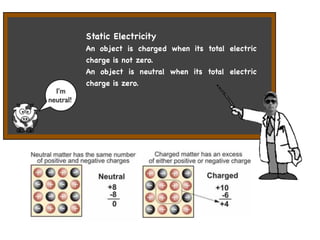
Static Electricity
           An object is charged when its total electric
           charge is not zero.
           An object is neutral when its total electric
           charge is zero.
  I’m
neutral!
The first strong evidence that something existed smaller than an
               atom came in 1897. English physicist J. J. Thomson discovered that
               electricity passing through a gas caused the gas to give off
               particles that were too small to be atoms. Thomson’s new particles
               also had negative electric charge while atoms have zero electric
               charge. Thomson called his particles corpuscles, which were
               eventually named electrons, and proposed that they came from
               the inside of atoms.
 I like plum
               Check out Thomson’s experiment @
pudding!
               http://www.aip.org/history/electron/jj1897.htm


               The Plum Pudding Model
In 1911, Ernest Rutherford, Hans Geiger, and Ernest Marsden did a
             clever experiment to test Thomson’s model of the atom. They
             launched positively-charged helium ions (a charged atom is called
             an ion) at extremely thin gold foil (Figure 6.3). They expected the
             helium ions to be deflected a small amount as they passed
             through the foil. However, a few bounced back in the direction
             they came! The unexpected result prompted Rutherford to remark
             “it was as if you fired a five inch (artillery) shell at a piece of
             tissue paper and it came back and hit you!”
Electrons
are really   Check out the experiment @
  small!
             http://en.wikipedia.org/wiki/Geiger–Marsden_experim


                             Rutherford’s Experiment
The best way to explain the pass-through result was if the gold
          atoms were mostly empty space, allowing most of the helium ions
          to go through virtually undeflected. The best way to explain the
          bounceback result was if nearly all the mass of a gold atom were
          concentrated in a tiny, hard core at the center. Further
          experiments confirmed Rutherford’s ideas and we know that every
          atom has a tiny nucleus, which contains more than 99% of the
          atom’s mass.
 Geiger
 really   Check out the experiment @
counts!
          http://en.wikipedia.org/wiki/Geiger–Marsden_experim


                         Rutherford’s Experiment
The positively charged proton was soon discovered and the
            particle in the nucleus. But there still was a serious the atomic
            model. Protons could only account for about observed mass. This
            problem was solved in 1932 by James Chadwick’s experiments
            revealed another particle in the which has no electric charge and
            similar mass as the proton. Chadwick’s neutral particle was named
            the neutron.

            Try building you own atom (you will need Shockwave)
 Mass =
Protons +
Neutrons!   http://www.pbs.org/wgbh/aso/tryit/atom/#


                           Chadwick’s Experiment
Today we know that atoms are made up of three tiny subatomic
                  particles:
                      Protons
                           mass = 1
                           Charge = 1
                           Found in the nucleus
                      Neutrons
                           mass = 1
  Remember,                Charge = 0
  protons and              Found in nucleus
electrons equal
the atomic #.         Electrons
                           mass = 0
                           Charge = -1
                           Found outside the nucleus
Forces inside the atom:
1. Electromagnetic
Electrons are bound to the nucleus by the
attractive force between electrons (-) and protons
(+). The electrons don’t fall into the nucleus
because they have kinetic energy. The energy of
an electron causes it to move around the nucleus
instead of falling in.
Forces inside the atom:
2. Strong Nuclear Force
Because of electric force, all the positively charged protons in the
nucleus repel each other. What holds the nucleus together? There is
another force that is even stronger than the electric force. We call it
the strong nuclear force. The strong nuclear force is the strongest force
known to science (Figure 6.7). This force attracts neutrons and protons to
each other and works only at the extremely small distances inside the
nucleus. If there are enough neutrons, the attraction from the strong
nuclear force wins out over repulsion from the electromagnetic force and
the nucleus stays together. In every atom heavier than helium, there is
at least one neutron for every proton in the nucleus.
Forces inside the atom:
3. Weak force
There is another nuclear force called the weak force. The weak force is weaker than both the
electric force and the strong nuclear force. If you leave a single neutron outside the nucleus,
the weak force eventually causes it to break down into a proton and an electron. The weak
force does not play an important role in a stable atom, but comes into action in certain special
cases when atoms break apart.
4. Gravity
The force of gravity inside the atom is much weaker even than the weak force. It takes a
relatively large mass to create enough gravity to make a significant force. We know that
particles inside an atom do not have enough mass for gravity to be an important force on the
scale of atoms. But there are many unanswered questions. Understanding how gravity works
inside atoms is an unsolved mystery in science.
How atoms of different elements are different
How is an atom of one element different from an atom of another element?
The atoms of different elements contain different numbers of protons in the
nucleus. For example, all atoms of carbon have six protons in the nucleus and
all atoms of hydrogen have one proton in the nucleus. Because the number of      Atomic
protons is so important, it is called the atomic number. The atomic number of   Number =
                                                                                 Protons!
an element is the number of protons in the nucleus of every atom of that
element.


Atoms of the same element always have the
 same number of protons in the nucleus.
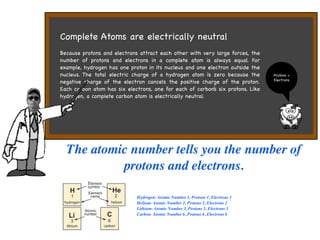
Complete Atoms are electrically neutral
Because protons and electrons attract each other with very large forces, the
number of protons and electrons in a complete atom is always equal. For
example, hydrogen has one proton in its nucleus and one electron outside the
nucleus. The total electric charge of a hydrogen atom is zero because the         Protons =
                                                                                  Electrons
negative charge of the electron cancels the positive charge of the proton.
Each carbon atom has six electrons, one for each of carbon’s six protons. Like
hydrogen, a complete carbon atom is electrically neutral.


  The atomic number tells you the number of
           protons and electrons.

                              Hydrogen- Atomic Number 1, Protons 1, Electrons 1
                              Helium- Atomic Number 2, Protons 2, Electrons 2
                              Lithium- Atomic Number 3, Protons 3, Electrons 3
                              Carbon- Atomic Number 6, Protons 6, Electrons 6
Isotopes
All atoms of the same element have the same number of protons in the nucleus.
However, atoms of the same element may have different numbers of neutrons in the
                                                                                                 Mass # -
nucleus. Isotopes are atoms of the same element that have different numbers of                  Atomic # =
neutrons.                                                                                        Neutrons


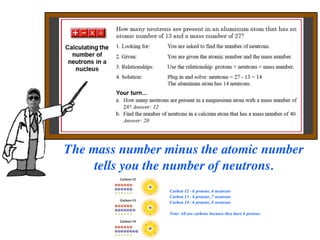
 The mass number minus the atomic number
      tells you the number of neutrons.
                                           Carbon 12 - 6 protons, 6 neutrons
                                           Carbon 13 - 6 protons, 7 neutrons
                                           Carbon 14 - 6 protons, 8 neutrons

                                           Note: All are carbons because they have 6 protons.
Isotopes
All atoms of the same element have the same number of protons in the nucleus.
However, atoms of the same element may have different numbers of neutrons in the
                                                                                                 Mass # -
nucleus. Isotopes are atoms of the same element that have different numbers of                  Atomic # =
neutrons.                                                                                        Neutrons


 The mass number minus the atomic number
      tells you the number of neutrons.
                                           Carbon 12 - 6 protons, 6 neutrons
                                           Carbon 13 - 6 protons, 7 neutrons
                                           Carbon 14 - 6 protons, 8 neutrons

                                           Note: All are carbons because they have 6 protons.
Radioactivity
Almost all elements have one or more isotopes that are stable. “Stable” means the
nucleus stays together. For complex reasons, the nucleus of an atom becomes
unstable if it contains too many or too few neutrons relative to the number of
protons. If the nucleus is unstable, it breaks apart. Carbon has two stable
isotopes, carbon-12 and carbon- 13. Carbon-14 is radioactive because it has an
unstable nucleus. An atom of carbon-14 eventually changes into an atom of
nitrogen-14.

If an atomic nucleus is unstable for any reason, the atom eventually changes into
a more stable form. Radioactivity is a process in which the nucleus spontaneously
emits particles or energy as it changes into a more stable isotope. Radioactivity
can change one element into a completely different element. For example carbon
14 is radioactive and eventually becomes nitrogen 14.
Alpha decay-In alpha decay, the nucleus ejects two protons and two neutrons. Check the periodic
table and you can quickly show that two protons and two neutrons are the nucleus of a helium-4
(4He) atom. Alpha radiation is actually fast-moving 4He nuclei. When alpha decay occurs, the atomic
number is reduced by two because two protons are removed. The atomic mass is reduced by four
because two neutrons go along with the two protons. For example, uranium-238 undergoes alpha
decay to become thorium-234.
Beta decay-Beta decay occurs when a neutron in the nucleus splits into a proton and an electron.
The proton stays in the nucleus, but the high energy electron is ejected and is called beta
radiation. During beta decay, the atomic number increases by one because one new proton is
created. The mass number stays the same because the atom lost a neutron but gained a proton.
Gamma decay-Gamma decay is how the nucleus gets rid of excess energy. In gamma decay the
nucleus emits pure energy in the form of gamma rays. The number of protons and neutrons stays
the same.
Hope this
helps! Agent P
     out...


                 I’m hungry.

Chapter 6.1

  • 1.
  • 2.
    Electric charge isa property of matter Along with mass and volume, matter has another fundamental property that we call electric charge. In order to understand atoms, we nee d to understand electric charge Moo! because one of the forces that hold atoms together comes from electric charge.
  • 3.
    Static Electricity An object is charged when its total electric charge is not zero. An object is neutral when its total electric charge is zero. I’m neutral!
  • 4.
    The first strongevidence that something existed smaller than an atom came in 1897. English physicist J. J. Thomson discovered that electricity passing through a gas caused the gas to give off particles that were too small to be atoms. Thomson’s new particles also had negative electric charge while atoms have zero electric charge. Thomson called his particles corpuscles, which were eventually named electrons, and proposed that they came from the inside of atoms. I like plum Check out Thomson’s experiment @ pudding! http://www.aip.org/history/electron/jj1897.htm The Plum Pudding Model
  • 5.
    In 1911, ErnestRutherford, Hans Geiger, and Ernest Marsden did a clever experiment to test Thomson’s model of the atom. They launched positively-charged helium ions (a charged atom is called an ion) at extremely thin gold foil (Figure 6.3). They expected the helium ions to be deflected a small amount as they passed through the foil. However, a few bounced back in the direction they came! The unexpected result prompted Rutherford to remark “it was as if you fired a five inch (artillery) shell at a piece of tissue paper and it came back and hit you!” Electrons are really Check out the experiment @ small! http://en.wikipedia.org/wiki/Geiger–Marsden_experim Rutherford’s Experiment
  • 6.
    The best wayto explain the pass-through result was if the gold atoms were mostly empty space, allowing most of the helium ions to go through virtually undeflected. The best way to explain the bounceback result was if nearly all the mass of a gold atom were concentrated in a tiny, hard core at the center. Further experiments confirmed Rutherford’s ideas and we know that every atom has a tiny nucleus, which contains more than 99% of the atom’s mass. Geiger really Check out the experiment @ counts! http://en.wikipedia.org/wiki/Geiger–Marsden_experim Rutherford’s Experiment
  • 7.
    The positively chargedproton was soon discovered and the particle in the nucleus. But there still was a serious the atomic model. Protons could only account for about observed mass. This problem was solved in 1932 by James Chadwick’s experiments revealed another particle in the which has no electric charge and similar mass as the proton. Chadwick’s neutral particle was named the neutron. Try building you own atom (you will need Shockwave) Mass = Protons + Neutrons! http://www.pbs.org/wgbh/aso/tryit/atom/# Chadwick’s Experiment
  • 8.
    Today we knowthat atoms are made up of three tiny subatomic particles: Protons mass = 1 Charge = 1 Found in the nucleus Neutrons mass = 1 Remember, Charge = 0 protons and Found in nucleus electrons equal the atomic #. Electrons mass = 0 Charge = -1 Found outside the nucleus
  • 9.
    Forces inside theatom: 1. Electromagnetic Electrons are bound to the nucleus by the attractive force between electrons (-) and protons (+). The electrons don’t fall into the nucleus because they have kinetic energy. The energy of an electron causes it to move around the nucleus instead of falling in.
  • 10.
    Forces inside theatom: 2. Strong Nuclear Force Because of electric force, all the positively charged protons in the nucleus repel each other. What holds the nucleus together? There is another force that is even stronger than the electric force. We call it the strong nuclear force. The strong nuclear force is the strongest force known to science (Figure 6.7). This force attracts neutrons and protons to each other and works only at the extremely small distances inside the nucleus. If there are enough neutrons, the attraction from the strong nuclear force wins out over repulsion from the electromagnetic force and the nucleus stays together. In every atom heavier than helium, there is at least one neutron for every proton in the nucleus.
  • 11.
    Forces inside theatom: 3. Weak force There is another nuclear force called the weak force. The weak force is weaker than both the electric force and the strong nuclear force. If you leave a single neutron outside the nucleus, the weak force eventually causes it to break down into a proton and an electron. The weak force does not play an important role in a stable atom, but comes into action in certain special cases when atoms break apart. 4. Gravity The force of gravity inside the atom is much weaker even than the weak force. It takes a relatively large mass to create enough gravity to make a significant force. We know that particles inside an atom do not have enough mass for gravity to be an important force on the scale of atoms. But there are many unanswered questions. Understanding how gravity works inside atoms is an unsolved mystery in science.
  • 12.
    How atoms ofdifferent elements are different How is an atom of one element different from an atom of another element? The atoms of different elements contain different numbers of protons in the nucleus. For example, all atoms of carbon have six protons in the nucleus and all atoms of hydrogen have one proton in the nucleus. Because the number of Atomic protons is so important, it is called the atomic number. The atomic number of Number = Protons! an element is the number of protons in the nucleus of every atom of that element. Atoms of the same element always have the same number of protons in the nucleus.
  • 13.
    Complete Atoms areelectrically neutral Because protons and electrons attract each other with very large forces, the number of protons and electrons in a complete atom is always equal. For example, hydrogen has one proton in its nucleus and one electron outside the nucleus. The total electric charge of a hydrogen atom is zero because the Protons = Electrons negative charge of the electron cancels the positive charge of the proton. Each carbon atom has six electrons, one for each of carbon’s six protons. Like hydrogen, a complete carbon atom is electrically neutral. The atomic number tells you the number of protons and electrons. Hydrogen- Atomic Number 1, Protons 1, Electrons 1 Helium- Atomic Number 2, Protons 2, Electrons 2 Lithium- Atomic Number 3, Protons 3, Electrons 3 Carbon- Atomic Number 6, Protons 6, Electrons 6
  • 14.
    Isotopes All atoms ofthe same element have the same number of protons in the nucleus. However, atoms of the same element may have different numbers of neutrons in the Mass # - nucleus. Isotopes are atoms of the same element that have different numbers of Atomic # = neutrons. Neutrons The mass number minus the atomic number tells you the number of neutrons. Carbon 12 - 6 protons, 6 neutrons Carbon 13 - 6 protons, 7 neutrons Carbon 14 - 6 protons, 8 neutrons Note: All are carbons because they have 6 protons.
  • 15.
    Isotopes All atoms ofthe same element have the same number of protons in the nucleus. However, atoms of the same element may have different numbers of neutrons in the Mass # - nucleus. Isotopes are atoms of the same element that have different numbers of Atomic # = neutrons. Neutrons The mass number minus the atomic number tells you the number of neutrons. Carbon 12 - 6 protons, 6 neutrons Carbon 13 - 6 protons, 7 neutrons Carbon 14 - 6 protons, 8 neutrons Note: All are carbons because they have 6 protons.
  • 16.
    Radioactivity Almost all elementshave one or more isotopes that are stable. “Stable” means the nucleus stays together. For complex reasons, the nucleus of an atom becomes unstable if it contains too many or too few neutrons relative to the number of protons. If the nucleus is unstable, it breaks apart. Carbon has two stable isotopes, carbon-12 and carbon- 13. Carbon-14 is radioactive because it has an unstable nucleus. An atom of carbon-14 eventually changes into an atom of nitrogen-14. If an atomic nucleus is unstable for any reason, the atom eventually changes into a more stable form. Radioactivity is a process in which the nucleus spontaneously emits particles or energy as it changes into a more stable isotope. Radioactivity can change one element into a completely different element. For example carbon 14 is radioactive and eventually becomes nitrogen 14.
  • 17.
    Alpha decay-In alphadecay, the nucleus ejects two protons and two neutrons. Check the periodic table and you can quickly show that two protons and two neutrons are the nucleus of a helium-4 (4He) atom. Alpha radiation is actually fast-moving 4He nuclei. When alpha decay occurs, the atomic number is reduced by two because two protons are removed. The atomic mass is reduced by four because two neutrons go along with the two protons. For example, uranium-238 undergoes alpha decay to become thorium-234. Beta decay-Beta decay occurs when a neutron in the nucleus splits into a proton and an electron. The proton stays in the nucleus, but the high energy electron is ejected and is called beta radiation. During beta decay, the atomic number increases by one because one new proton is created. The mass number stays the same because the atom lost a neutron but gained a proton. Gamma decay-Gamma decay is how the nucleus gets rid of excess energy. In gamma decay the nucleus emits pure energy in the form of gamma rays. The number of protons and neutrons stays the same.
  • 18.
    Hope this helps! AgentP out... I’m hungry.