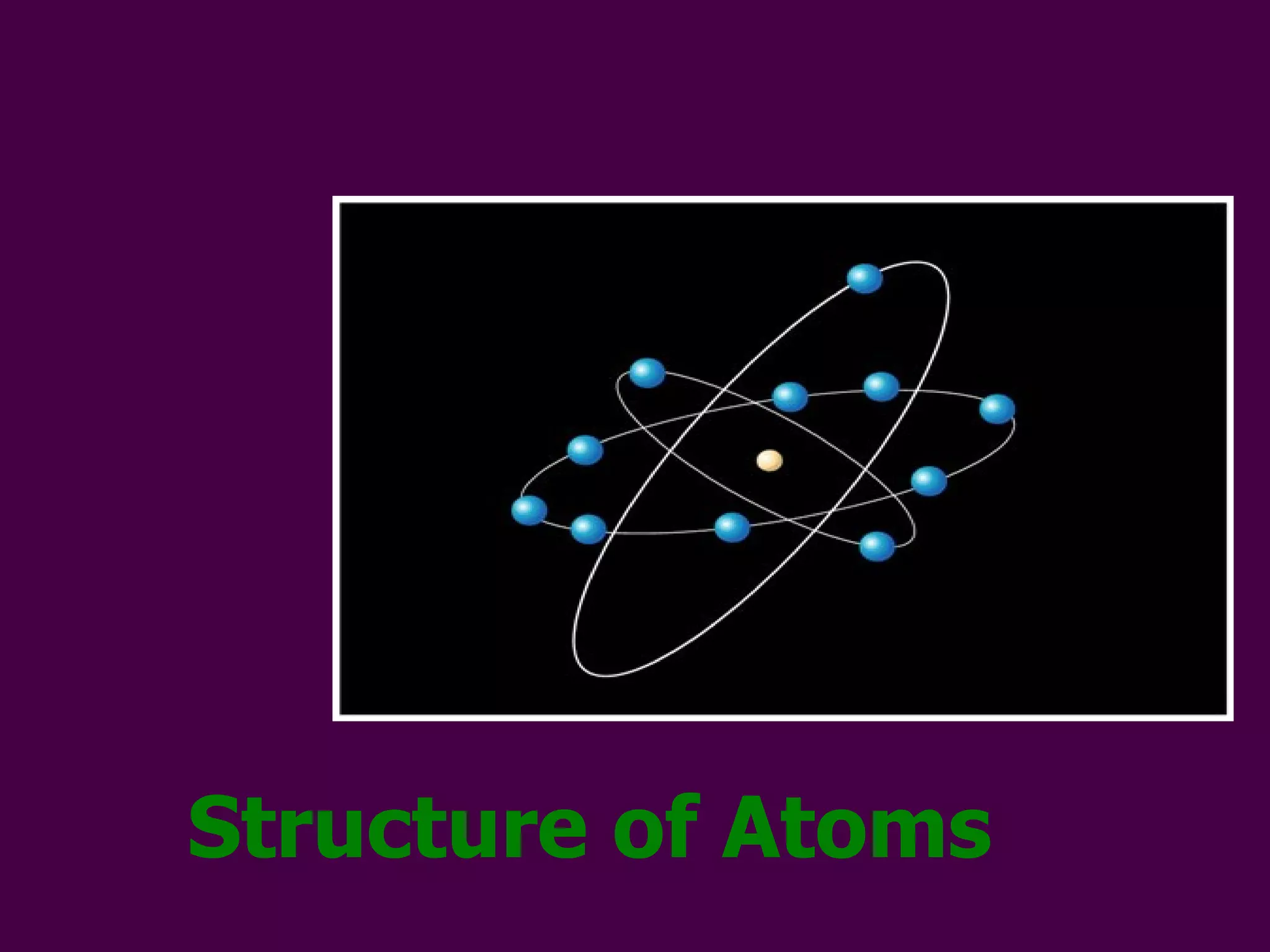
Structure of Atoms
contents


You will learn about:
• Structure of atoms
• Isotopes
• Electron arrangement in atoms
• The Periodic Table
• Ions
structure of atoms
composition
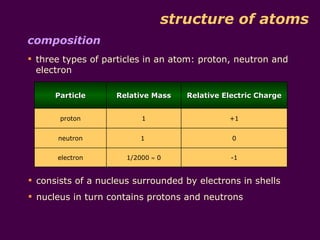
 three types of particles in an atom: proton, neutron and
  electron

      Particle     Relative Mass   Relative Electric Charge


       proton             1                  +1


      neutron             1                   0


      electron        1/2000 ≈ 0              -1


 consists of a nucleus surrounded by electrons in shells
 nucleus in turn contains protons and neutrons
structure of atoms
composition
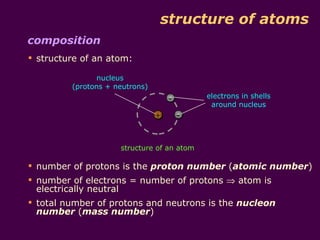
 structure of an atom:

                nucleus
         (protons + neutrons)
                                    -       electrons in shells
                                             around nucleus
                                +       -


                     structure of an atom

 number of protons is the proton number (atomic number)
 number of electrons = number of protons ⇒ atom is
  electrically neutral
 total number of protons and neutrons is the nucleon
  number (mass number)
structure of atoms
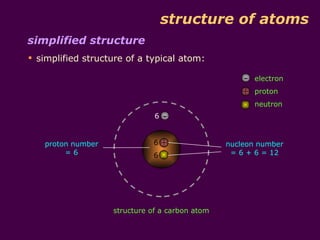
simplified structure
 simplified structure of a typical atom:

                                                    - electron
                                                    + proton
                                                       neutron
                              6   -


   proton number             6+                 nucleon number
        =6                   6                   = 6 + 6 = 12


                   structure of a carbon atom
structure of atoms
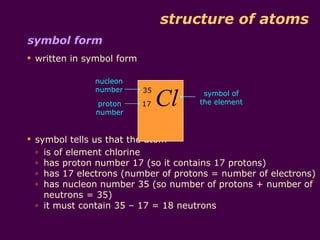
symbol form
 written in symbol form

              nucleon


                                Cl
              number       35         symbol of
               proton      17        the element
               number


 symbol tells us that the atom
  o is of element chlorine

  o has proton number 17 (so it contains 17 protons)

  o has 17 electrons (number of protons = number of electrons)

  o has nucleon number 35 (so number of protons + number of

    neutrons = 35)
  o it must contain 35 – 17 = 18 neutrons
isotopes
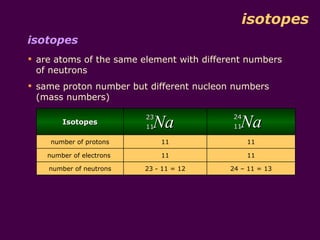
isotopes
 are atoms of the same element with different numbers
  of neutrons
 same proton number but different nucleon numbers
  (mass numbers)

        Isotopes
                          23
                          11Na             24
                                           11 Na
     number of protons         11               11

    number of electrons        11               11

    number of neutrons    23 - 11 = 12     24 – 11 = 13
isotopes
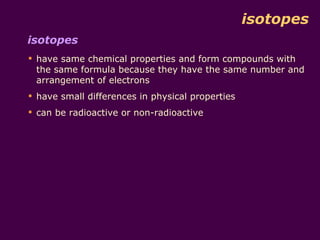
isotopes
 have same chemical properties and form compounds with
  the same formula because they have the same number and
  arrangement of electrons
 have small differences in physical properties
 can be radioactive or non-radioactive
electron arrangement in atoms
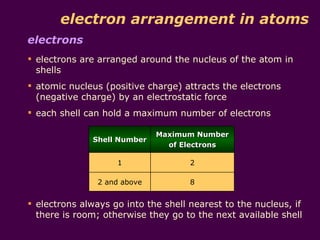
electrons
 electrons are arranged around the nucleus of the atom in
  shells
 atomic nucleus (positive charge) attracts the electrons
  (negative charge) by an electrostatic force
 each shell can hold a maximum number of electrons

                              Maximum Number
              Shell Number
                                of Electrons

                    1                2

                2 and above          8


 electrons always go into the shell nearest to the nucleus, if
  there is room; otherwise they go to the next available shell
electron arrangement in atoms
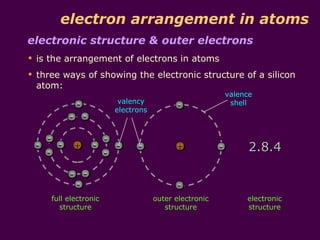
electronic structure & outer electrons
 is the arrangement of electrons in atoms
 three ways of showing the electronic structure of a silicon
  atom:
                                                                      valence
                                    valency                            shell
                   -               electrons         -
               -       -

     -                         -
 -
     -
           -       +       -
                               -
                                   -     -           +            -         2.8.4

               -       -
                   -                                 -
         full electronic                       outer electronic            electronic
           structure                              structure                structure
electron arrangement in atoms
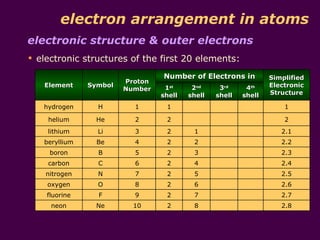
electronic structure & outer electrons
 electronic structures of the first 20 elements:
                                 Number of Electrons in          Simplified
                        Proton
   Element     Symbol             1st     2nd     3rd     4th    Electronic
                        Number
                                 shell   shell   shell   shell   Structure

   hydrogen      H        1       1                                  1

    helium      He        2       2                                  2
    lithium      Li       3       2       1                         2.1
   beryllium     Be       4       2       2                         2.2
     boron       B        5       2       3                         2.3
    carbon       C        6       2       4                         2.4
    nitrogen     N        7       2       5                         2.5
    oxygen       O        8       2       6                         2.6
    fluorine     F        9       2       7                         2.7
     neon       Ne        10      2       8                         2.8
electron arrangement in atoms
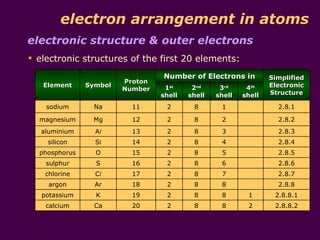
electronic structure & outer electrons
 electronic structures of the first 20 elements:
                                 Number of Electrons in          Simplified
                        Proton
   Element     Symbol             1st     2nd     3rd     4th    Electronic
                        Number
                                 shell   shell   shell   shell   Structure

    sodium      Na        11      2       8       1                2.8.1

  magnesium     Mg        12      2       8       2                2.8.2
   aluminium     Al       13      2       8       3                2.8.3
    silicon      Si       14      2       8       4                2.8.4
  phosphorus     O        15      2       8       5                2.8.5
    sulphur      S        16      2       8       6                2.8.6
    chlorine     Cl       17      2       8       7                2.8.7
     argon       Ar       18      2       8       8                2.8.8
   potassium     K        19      2       8       8       1       2.8.8.1
    calcium      Ca       20      2       8       8       2       2.8.8.2
the Periodic Table
the Periodic Table
 arrangement of elements in a table
 periods show the elements arranged horizontally in order of
  proton number (atomic number)
 across each period, the number of outer shell electrons
  increases from 1 to 8
 groups show the elements with the same number of outer
  electrons arranged in vertical columns
the Periodic Table
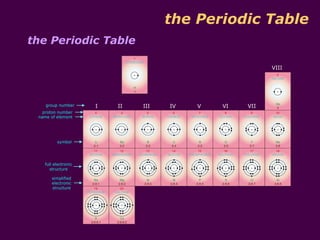
the Periodic Table

                                                        VIII


    group number     I   II   III   IV   V   VI   VII
   proton number
 name of element


         symbol


   full electronic
     structure

      simplified
      electronic
      structure
ions
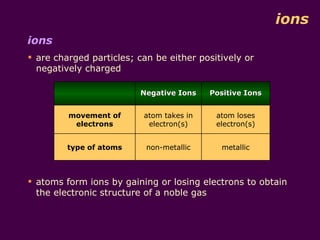
ions
 are charged particles; can be either positively or
  negatively charged

                         Negative Ions    Positive Ions


         movement of      atom takes in    atom loses
          electrons        electron(s)     electron(s)


         type of atoms     non-metallic      metallic


 atoms form ions by gaining or losing electrons to obtain
  the electronic structure of a noble gas
ions
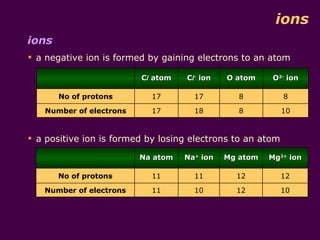
ions
 a negative ion is formed by gaining electrons to an atom

                         Cl atom   Cl- ion   O atom    O2- ion

       No of protons        17       17         8           8

   Number of electrons      17       18         8           10


 a positive ion is formed by losing electrons to an atom

                         Na atom   Na+ ion   Mg atom   Mg2+ ion

       No of protons        11       11        12           12

   Number of electrons      11       10        12           10
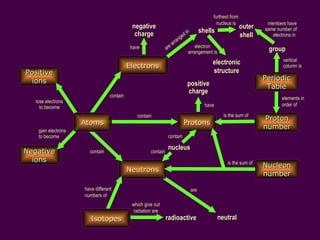
furthest from
                                                                                                     nucleus is             members have
                                            negative                                                               outer   same number of
                                             charge                                in         shells
                                                                            ge
                                                                               d                                   shell      electrons in
                                                                         an
                                                                     ar r
                                           have                are                     electron
                                                                                                                            group
                                                                                   arrangement is

                                                                                                   electronic                      vertical
                                           Electrons                                                                               column is
Positive                                                                                           structure
  ions                                                                                                                     Periodic
                                                                                   positive                                 Table
                                                                                   charge
                                 contain                                                                                          elements in
   lose electrons
     to become                                                                                  have                              order of

                                              contain                                                    is the sum of
                                                                                                                           Proton
                     Atoms                                                   Protons
    gain electrons
                                                                                                                           number
    to become                                                   contain

                                                                nucleus
Negative               contain                       contain
  ions                                                                                                     is the sum of
                                                                                                                           Nucleon
                                           Neutrons
                                                                                                                           number

                     have different                                                     are
                     numbers of
                                            which give out
                                             radiation are
                        Isotopes                               radioactive                             neutral

Structure of the atoms

  • 1.
  • 2.
    contents You will learnabout: • Structure of atoms • Isotopes • Electron arrangement in atoms • The Periodic Table • Ions
  • 3.
    structure of atoms composition three types of particles in an atom: proton, neutron and electron Particle Relative Mass Relative Electric Charge proton 1 +1 neutron 1 0 electron 1/2000 ≈ 0 -1  consists of a nucleus surrounded by electrons in shells  nucleus in turn contains protons and neutrons
  • 4.
    structure of atoms composition structure of an atom: nucleus (protons + neutrons) - electrons in shells around nucleus + - structure of an atom  number of protons is the proton number (atomic number)  number of electrons = number of protons ⇒ atom is electrically neutral  total number of protons and neutrons is the nucleon number (mass number)
  • 5.
    structure of atoms simplifiedstructure  simplified structure of a typical atom: - electron + proton neutron 6 - proton number 6+ nucleon number =6 6 = 6 + 6 = 12 structure of a carbon atom
  • 6.
    structure of atoms symbolform  written in symbol form nucleon Cl number 35 symbol of proton 17 the element number  symbol tells us that the atom o is of element chlorine o has proton number 17 (so it contains 17 protons) o has 17 electrons (number of protons = number of electrons) o has nucleon number 35 (so number of protons + number of neutrons = 35) o it must contain 35 – 17 = 18 neutrons
  • 7.
    isotopes isotopes  are atomsof the same element with different numbers of neutrons  same proton number but different nucleon numbers (mass numbers) Isotopes 23 11Na 24 11 Na number of protons 11 11 number of electrons 11 11 number of neutrons 23 - 11 = 12 24 – 11 = 13
  • 8.
    isotopes isotopes  have samechemical properties and form compounds with the same formula because they have the same number and arrangement of electrons  have small differences in physical properties  can be radioactive or non-radioactive
  • 9.
    electron arrangement inatoms electrons  electrons are arranged around the nucleus of the atom in shells  atomic nucleus (positive charge) attracts the electrons (negative charge) by an electrostatic force  each shell can hold a maximum number of electrons Maximum Number Shell Number of Electrons 1 2 2 and above 8  electrons always go into the shell nearest to the nucleus, if there is room; otherwise they go to the next available shell
  • 10.
    electron arrangement inatoms electronic structure & outer electrons  is the arrangement of electrons in atoms  three ways of showing the electronic structure of a silicon atom: valence valency shell - electrons - - - - - - - - + - - - - + - 2.8.4 - - - - full electronic outer electronic electronic structure structure structure
  • 11.
    electron arrangement inatoms electronic structure & outer electrons  electronic structures of the first 20 elements: Number of Electrons in Simplified Proton Element Symbol 1st 2nd 3rd 4th Electronic Number shell shell shell shell Structure hydrogen H 1 1 1 helium He 2 2 2 lithium Li 3 2 1 2.1 beryllium Be 4 2 2 2.2 boron B 5 2 3 2.3 carbon C 6 2 4 2.4 nitrogen N 7 2 5 2.5 oxygen O 8 2 6 2.6 fluorine F 9 2 7 2.7 neon Ne 10 2 8 2.8
  • 12.
    electron arrangement inatoms electronic structure & outer electrons  electronic structures of the first 20 elements: Number of Electrons in Simplified Proton Element Symbol 1st 2nd 3rd 4th Electronic Number shell shell shell shell Structure sodium Na 11 2 8 1 2.8.1 magnesium Mg 12 2 8 2 2.8.2 aluminium Al 13 2 8 3 2.8.3 silicon Si 14 2 8 4 2.8.4 phosphorus O 15 2 8 5 2.8.5 sulphur S 16 2 8 6 2.8.6 chlorine Cl 17 2 8 7 2.8.7 argon Ar 18 2 8 8 2.8.8 potassium K 19 2 8 8 1 2.8.8.1 calcium Ca 20 2 8 8 2 2.8.8.2
  • 13.
    the Periodic Table thePeriodic Table  arrangement of elements in a table  periods show the elements arranged horizontally in order of proton number (atomic number)  across each period, the number of outer shell electrons increases from 1 to 8  groups show the elements with the same number of outer electrons arranged in vertical columns
  • 14.
    the Periodic Table thePeriodic Table VIII group number I II III IV V VI VII proton number name of element symbol full electronic structure simplified electronic structure
  • 15.
    ions ions  are chargedparticles; can be either positively or negatively charged Negative Ions Positive Ions movement of atom takes in atom loses electrons electron(s) electron(s) type of atoms non-metallic metallic  atoms form ions by gaining or losing electrons to obtain the electronic structure of a noble gas
  • 16.
    ions ions  a negativeion is formed by gaining electrons to an atom Cl atom Cl- ion O atom O2- ion No of protons 17 17 8 8 Number of electrons 17 18 8 10  a positive ion is formed by losing electrons to an atom Na atom Na+ ion Mg atom Mg2+ ion No of protons 11 11 12 12 Number of electrons 11 10 12 10
  • 17.
    furthest from nucleus is members have negative outer same number of charge in shells ge d shell electrons in an ar r have are electron group arrangement is electronic vertical Electrons column is Positive structure ions Periodic positive Table charge contain elements in lose electrons to become have order of contain is the sum of Proton Atoms Protons gain electrons number to become contain nucleus Negative contain contain ions is the sum of Nucleon Neutrons number have different are numbers of which give out radiation are Isotopes radioactive neutral