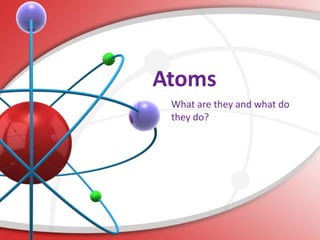
Atoms
 What are they and what do
 they do?
What are atoms?
    •   Atoms are the smallest particles of matter
    •   Atoms make up everything around us
    •   Molecules are combinations of atoms
    •   Elements are only one type of atom
    •   Compounds are made up of different types of atoms


                Hydrogen
                                          Water
                  Gas

2                                                   Dan Kelly - Magic of Electrons - PLTW - Atoms
Atoms vs. Elements
What is the difference between atoms and elements?

Atoms make up elements.

To be an element, it can ONLY have ONE type of atom.

The terms are often used interchangeably.
For example, the Periodic Table of the Elements could also be
written as the …
Periodic Table of Different Types of Atoms.


3                                                  Dan Kelly - Magic of Electrons - PLTW - Atoms
Let’s Recap
What is an atom?
•   Atoms are the smallest particles of matter.

What is an element?
•   Elements are made up of only one type of atom.

What is a molecule?
•   Molecules are combinations of atoms.

What is a compound?
Compounds are made up of different types of atoms.

What are some examples of these?
     4                                               Dan Kelly - Magic of Electrons - PLTW - Atoms
Components of an Atom
What makes up an atom?

    At the center of all atoms is the
    Nucleus.
    The nucleus contains protons
    and neutrons.

    Protons: (+)
    Positively charged atomic particles

    Neutrons:
    Uncharged (neutral) atomic particles

5                                          Dan Kelly - Magic of Electrons - PLTW - Atoms
Components of an Atom
What makes up an atom?

    Orbiting around the nucleus are the
    electrons.

    Electrons: (-)
    Negatively charged atomic
    particles

    Nature prefers balance so if a
    particle is positively charged, it
    will attract negatively charged
    particles and vice-versa.

6                                         Dan Kelly - Magic of Electrons - PLTW - Atoms
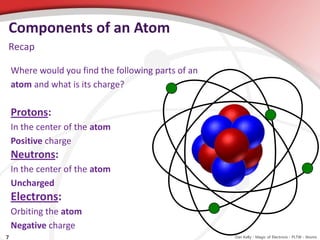
Components of an Atom
Recap

    Where would you find the following parts of an
    atom and what is its charge?

    Protons:
    In the center of the atom
    Positive charge
    Neutrons:
    In the center of the atom
    Uncharged
    Electrons:
    Orbiting the atom
    Negative charge
7                                                    Dan Kelly - Magic of Electrons - PLTW - Atoms
Atomic Number
The atomic number is equal to the
number of protons in the nucleus
of an atom.

The atomic number identifies
the element.

How many protons are in
this nucleus?
(assume the protons are red)


8                                   Dan Kelly - Magic of Electrons - PLTW - Atoms
Periodic Table of Elements


                                                 NASA

    Which element has 4 protons?
9                                  Dan Kelly - Magic of Electrons - PLTW - Atoms
Electrons
This course is titled “Magic of Electrons” and we
will focus mainly on the electrons present in an atom.


                          Why?
It is important to understand how and why electrons move in
order to understand how electricity works.

In the coming presentations we will cover the importance of
electrons and their importance.

10                                                  Dan Kelly - Magic of Electrons - PLTW - Atoms

Atoms

  • 1.
    Atoms What arethey and what do they do?
  • 2.
    What are atoms? • Atoms are the smallest particles of matter • Atoms make up everything around us • Molecules are combinations of atoms • Elements are only one type of atom • Compounds are made up of different types of atoms Hydrogen Water Gas 2 Dan Kelly - Magic of Electrons - PLTW - Atoms
  • 3.
    Atoms vs. Elements Whatis the difference between atoms and elements? Atoms make up elements. To be an element, it can ONLY have ONE type of atom. The terms are often used interchangeably. For example, the Periodic Table of the Elements could also be written as the … Periodic Table of Different Types of Atoms. 3 Dan Kelly - Magic of Electrons - PLTW - Atoms
  • 4.
    Let’s Recap What isan atom? • Atoms are the smallest particles of matter. What is an element? • Elements are made up of only one type of atom. What is a molecule? • Molecules are combinations of atoms. What is a compound? Compounds are made up of different types of atoms. What are some examples of these? 4 Dan Kelly - Magic of Electrons - PLTW - Atoms
  • 5.
    Components of anAtom What makes up an atom? At the center of all atoms is the Nucleus. The nucleus contains protons and neutrons. Protons: (+) Positively charged atomic particles Neutrons: Uncharged (neutral) atomic particles 5 Dan Kelly - Magic of Electrons - PLTW - Atoms
  • 6.
    Components of anAtom What makes up an atom? Orbiting around the nucleus are the electrons. Electrons: (-) Negatively charged atomic particles Nature prefers balance so if a particle is positively charged, it will attract negatively charged particles and vice-versa. 6 Dan Kelly - Magic of Electrons - PLTW - Atoms
  • 7.
    Components of anAtom Recap Where would you find the following parts of an atom and what is its charge? Protons: In the center of the atom Positive charge Neutrons: In the center of the atom Uncharged Electrons: Orbiting the atom Negative charge 7 Dan Kelly - Magic of Electrons - PLTW - Atoms
  • 8.
    Atomic Number The atomicnumber is equal to the number of protons in the nucleus of an atom. The atomic number identifies the element. How many protons are in this nucleus? (assume the protons are red) 8 Dan Kelly - Magic of Electrons - PLTW - Atoms
  • 9.
    Periodic Table ofElements NASA Which element has 4 protons? 9 Dan Kelly - Magic of Electrons - PLTW - Atoms
  • 10.
    Electrons This course istitled “Magic of Electrons” and we will focus mainly on the electrons present in an atom. Why? It is important to understand how and why electrons move in order to understand how electricity works. In the coming presentations we will cover the importance of electrons and their importance. 10 Dan Kelly - Magic of Electrons - PLTW - Atoms

Editor's Notes

  • #3 Demonstration on positive vs. negative
  • #4 Demonstration on positive vs. negativeExplain orbiting free-fall
  • #5 Demonstration on positive vs. negativeExplain orbiting free-fall
  • #6 Demonstration on positive vs.negative
  • #7 Explain where the atomic number is on the periodic table before revealing answer.