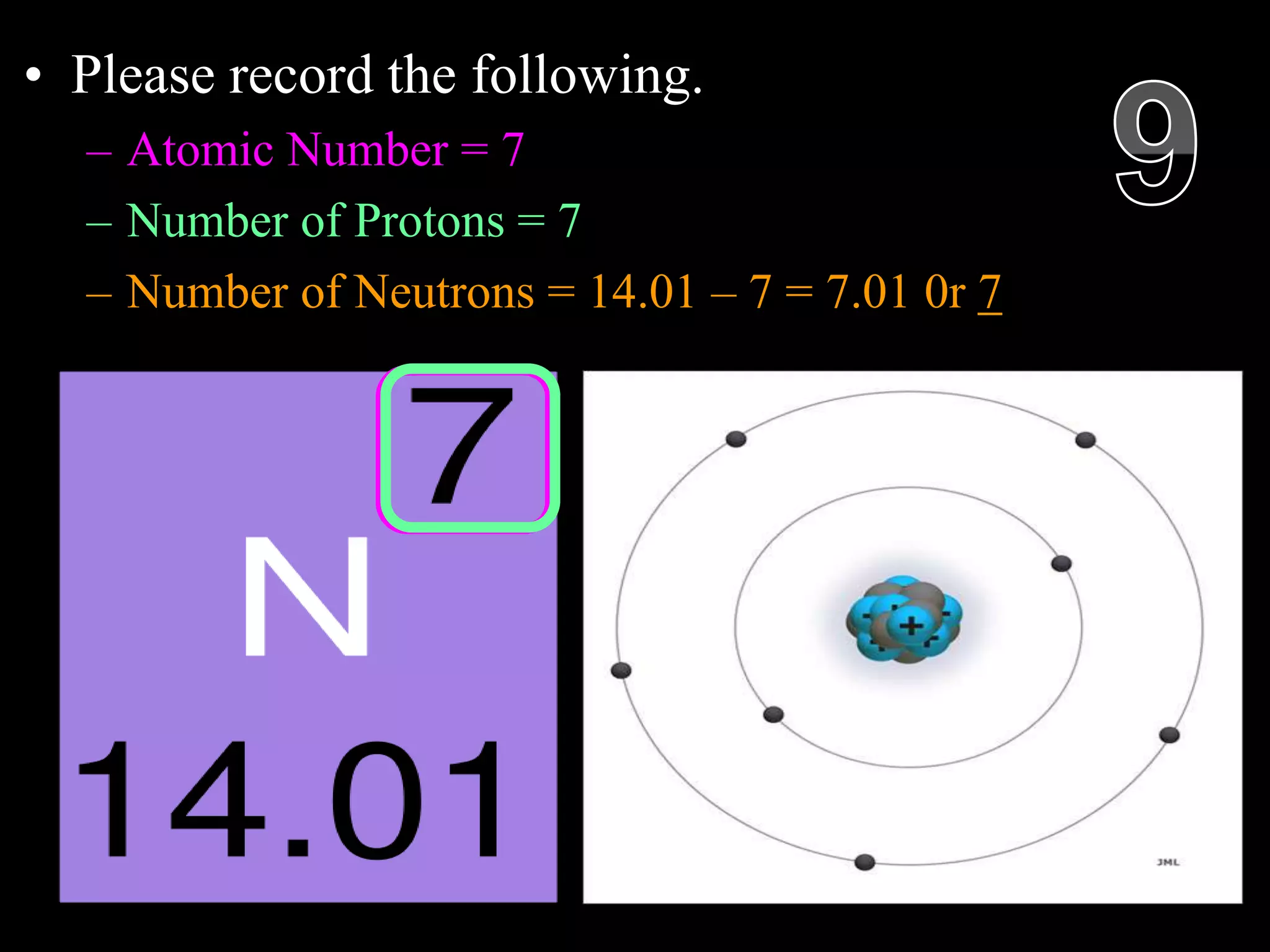
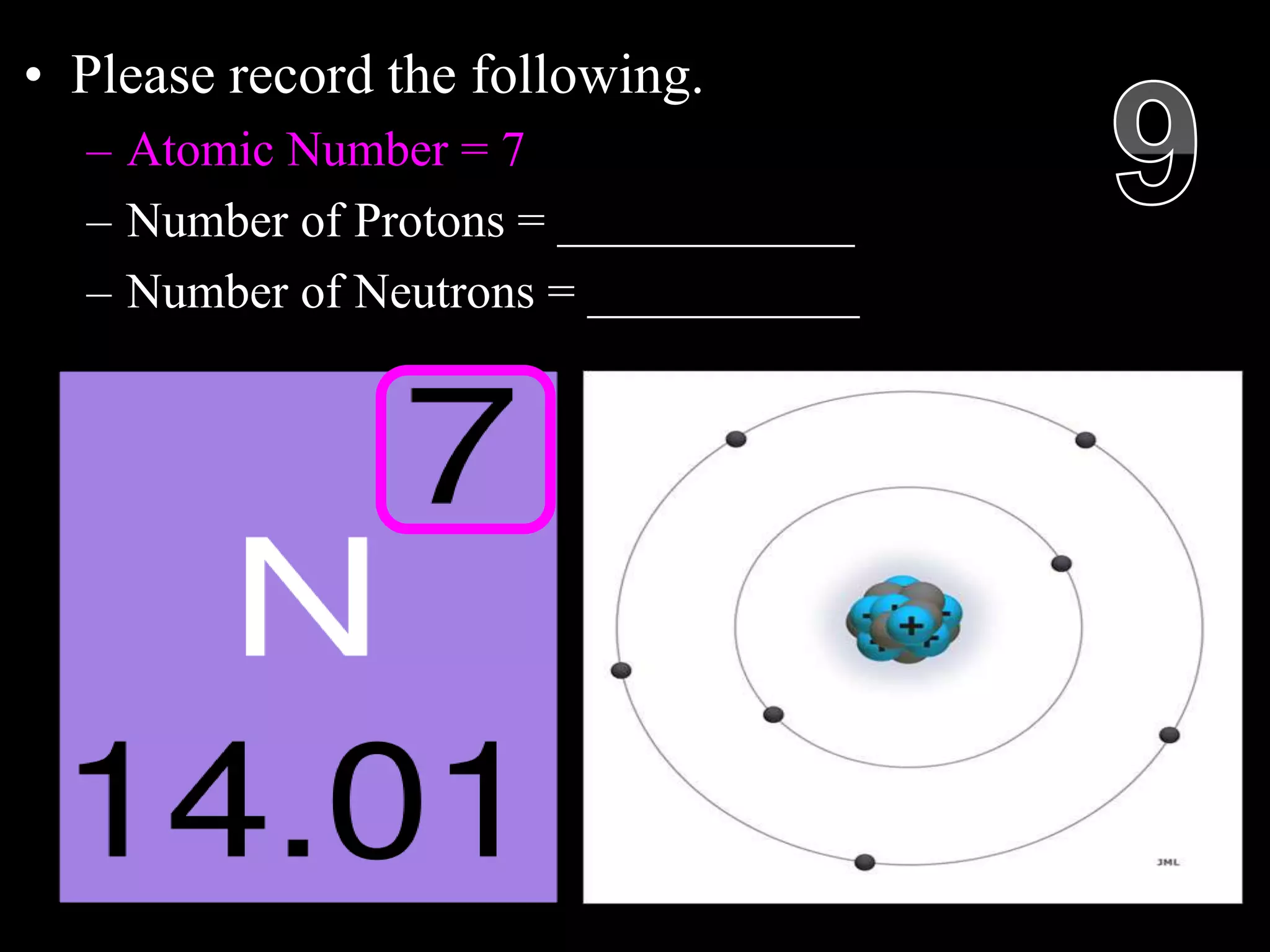
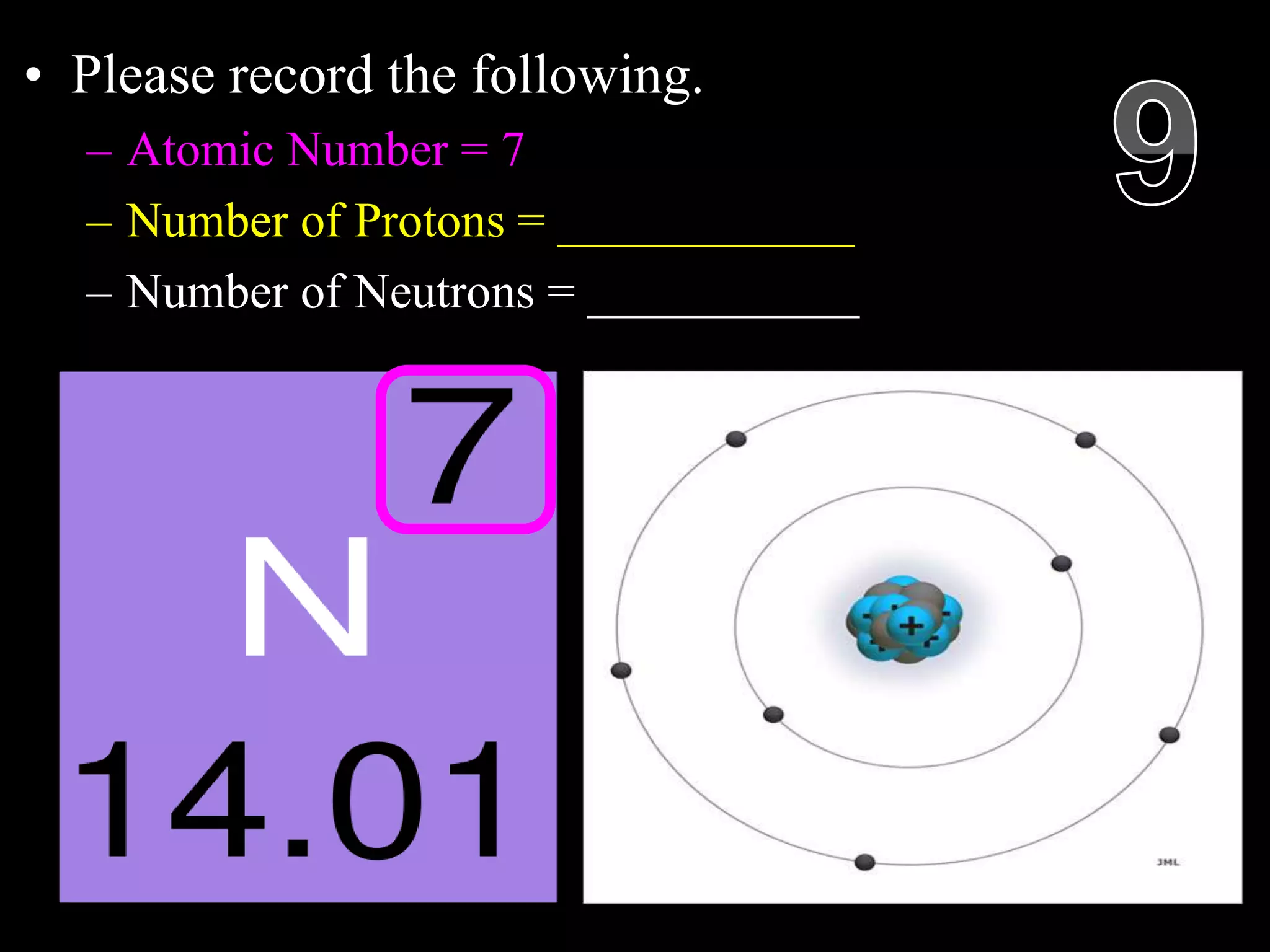
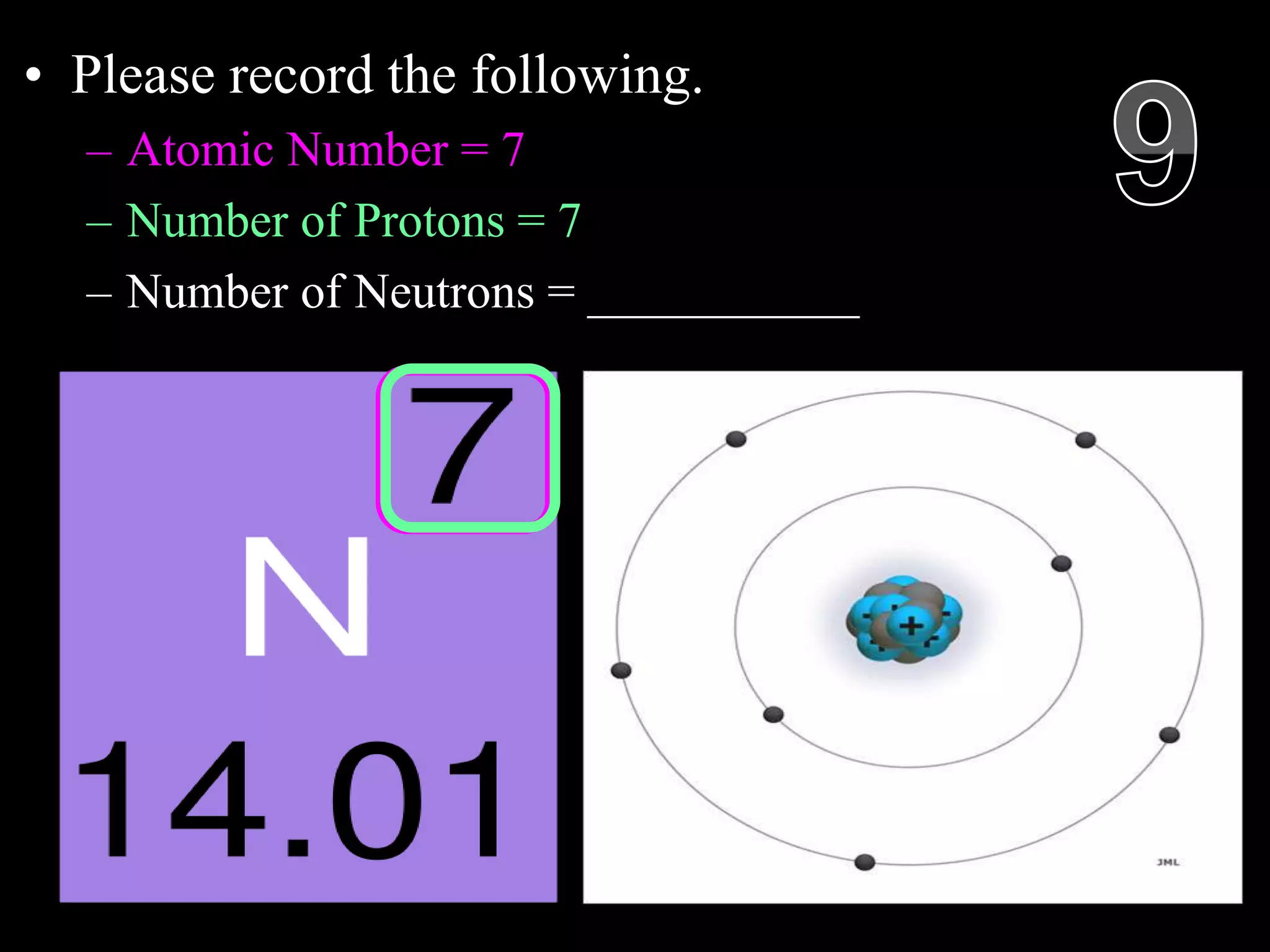
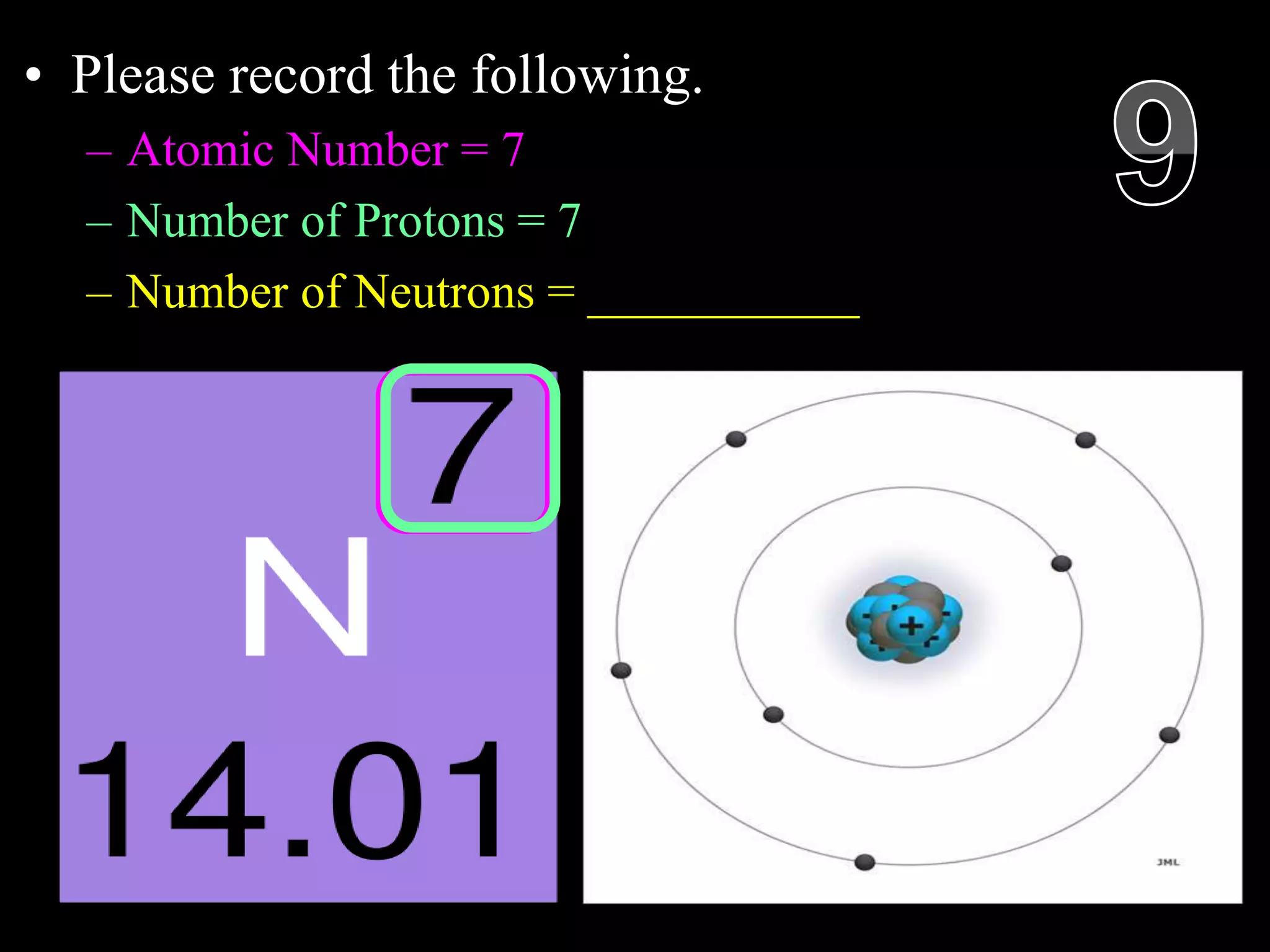
• Please record the following.
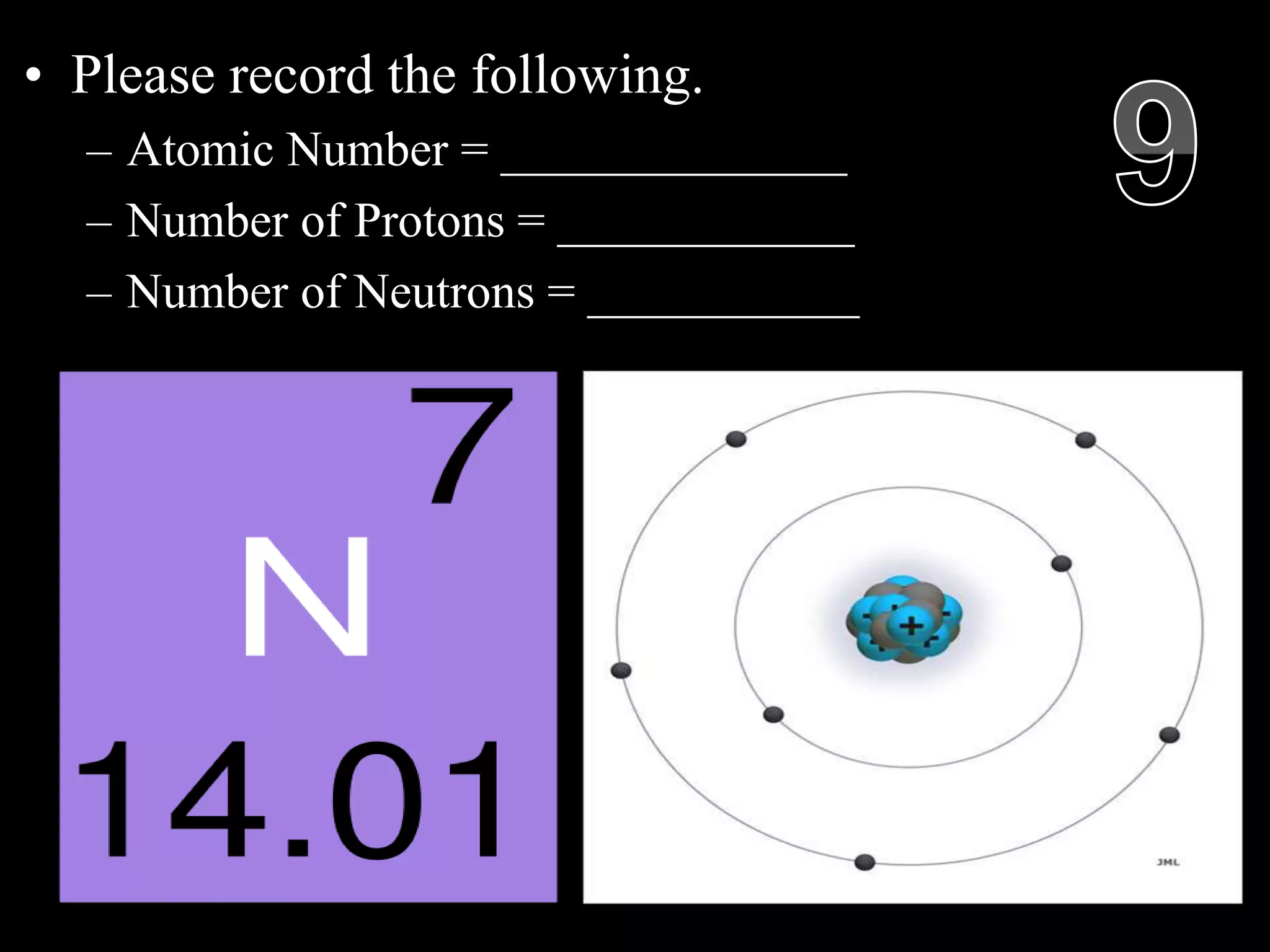
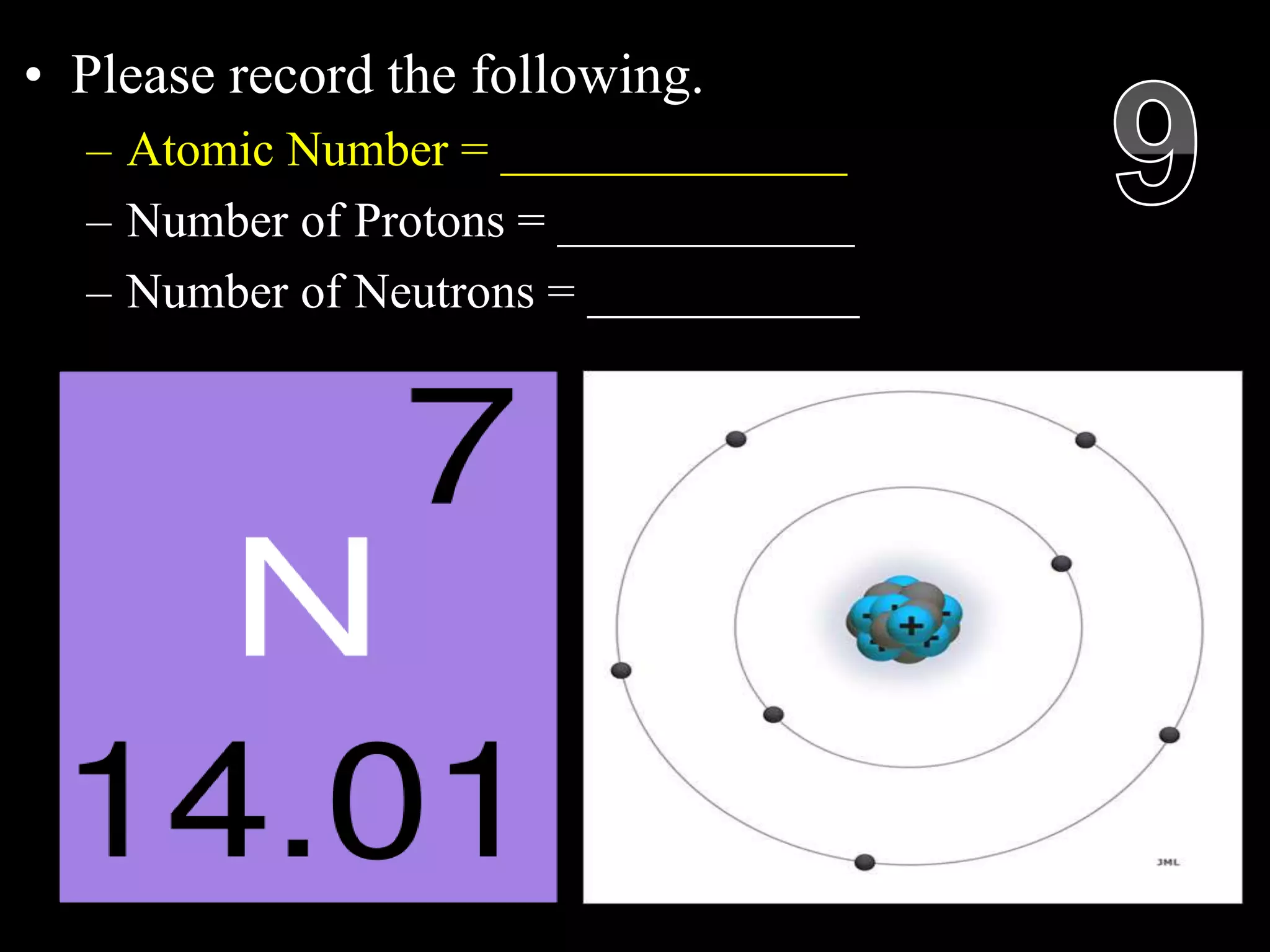
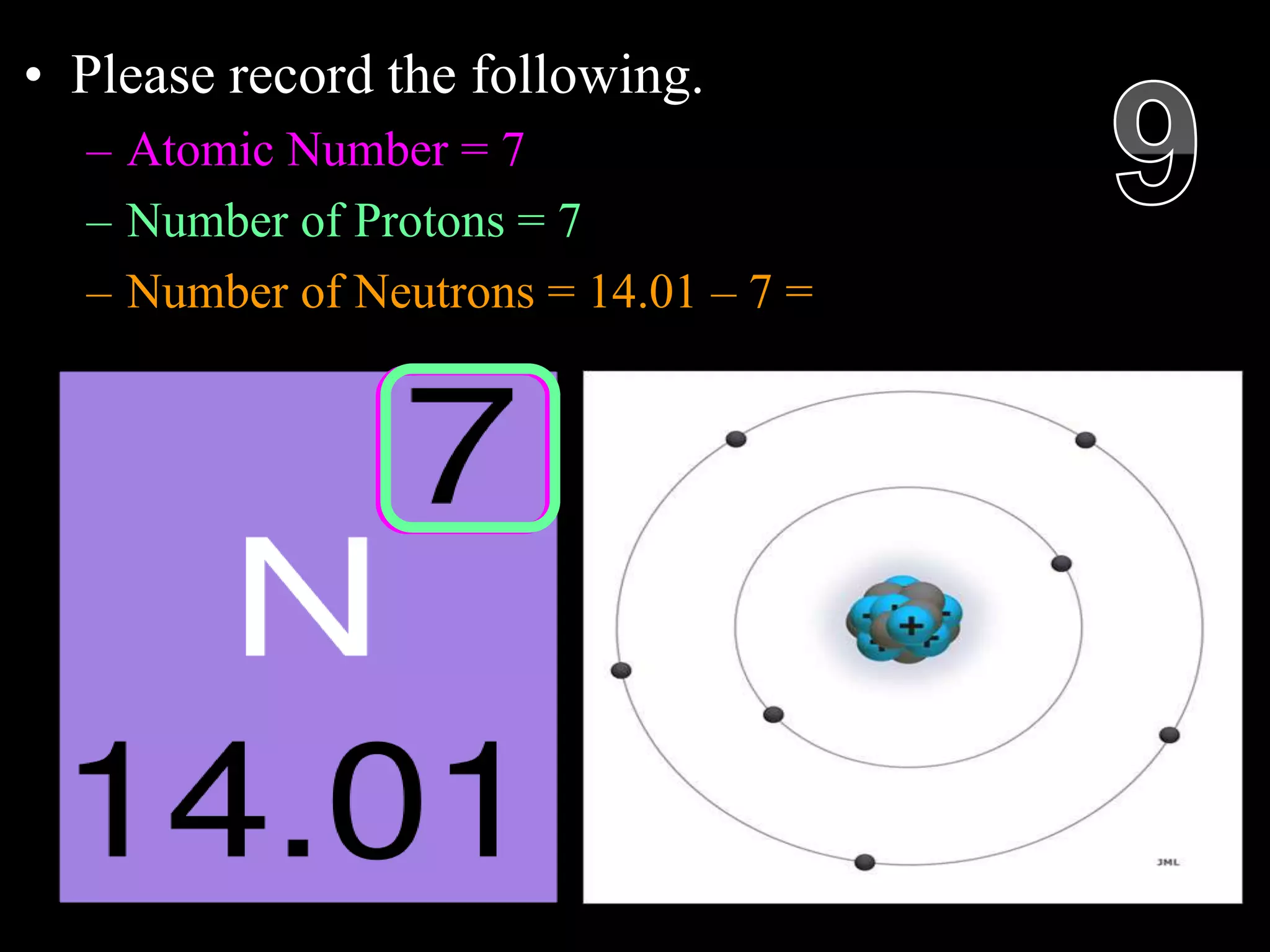
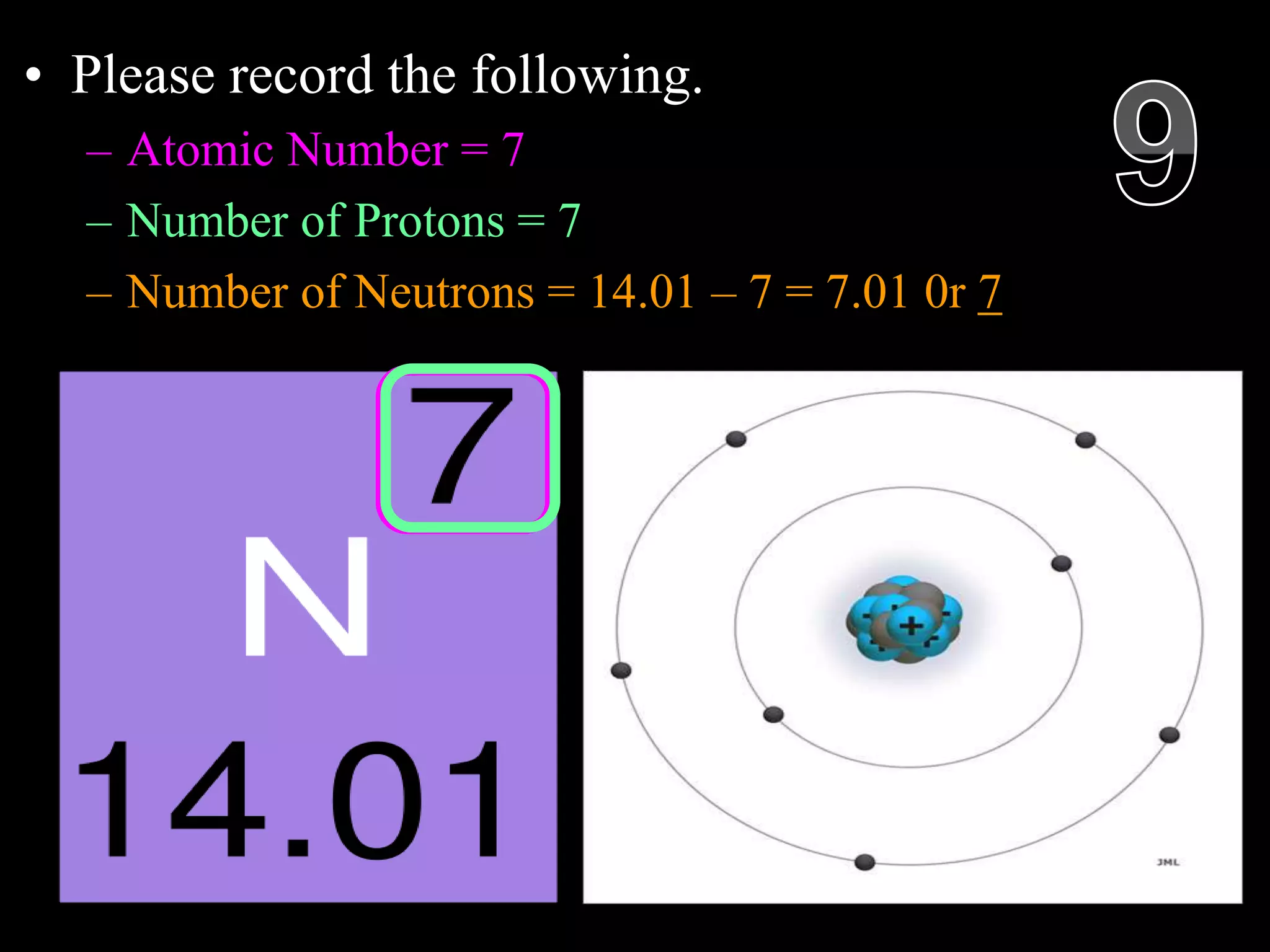
– Atomic Number = 7
– Number of Protons = 7
– Number of Neutrons = 14.01 – 7 = 7.01 0r 7
Copyright © 2010 Ryan P. Murphy
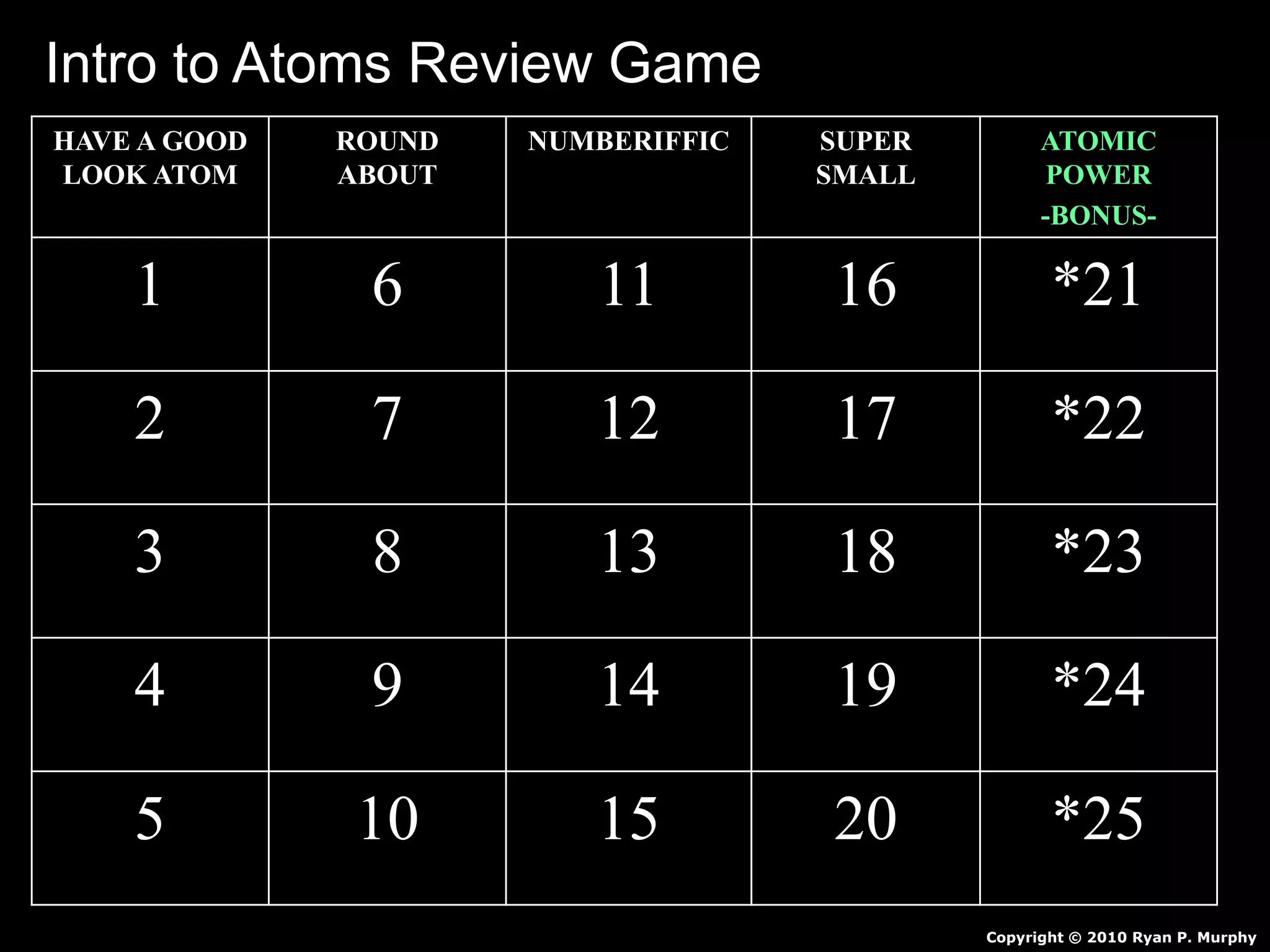
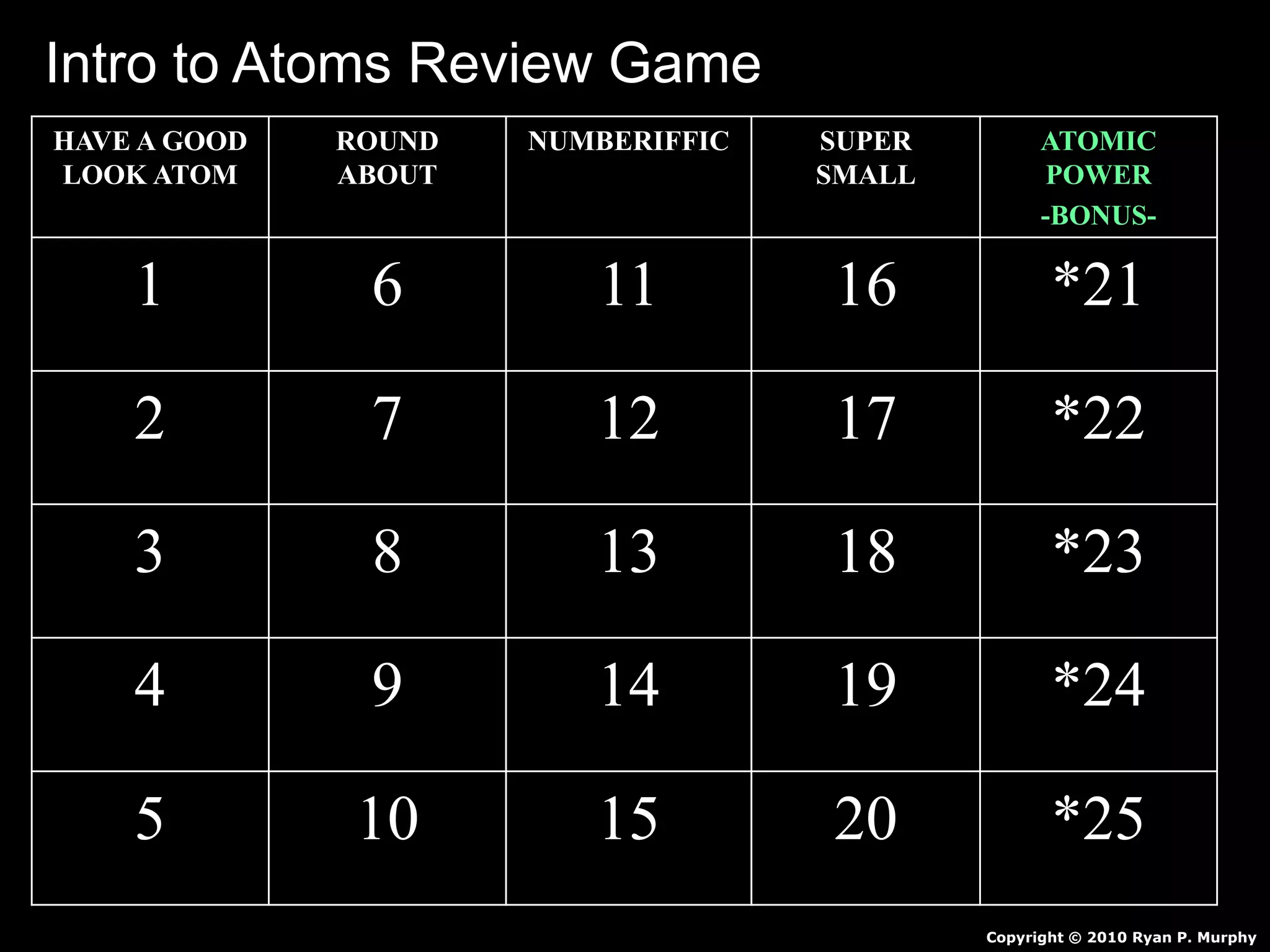
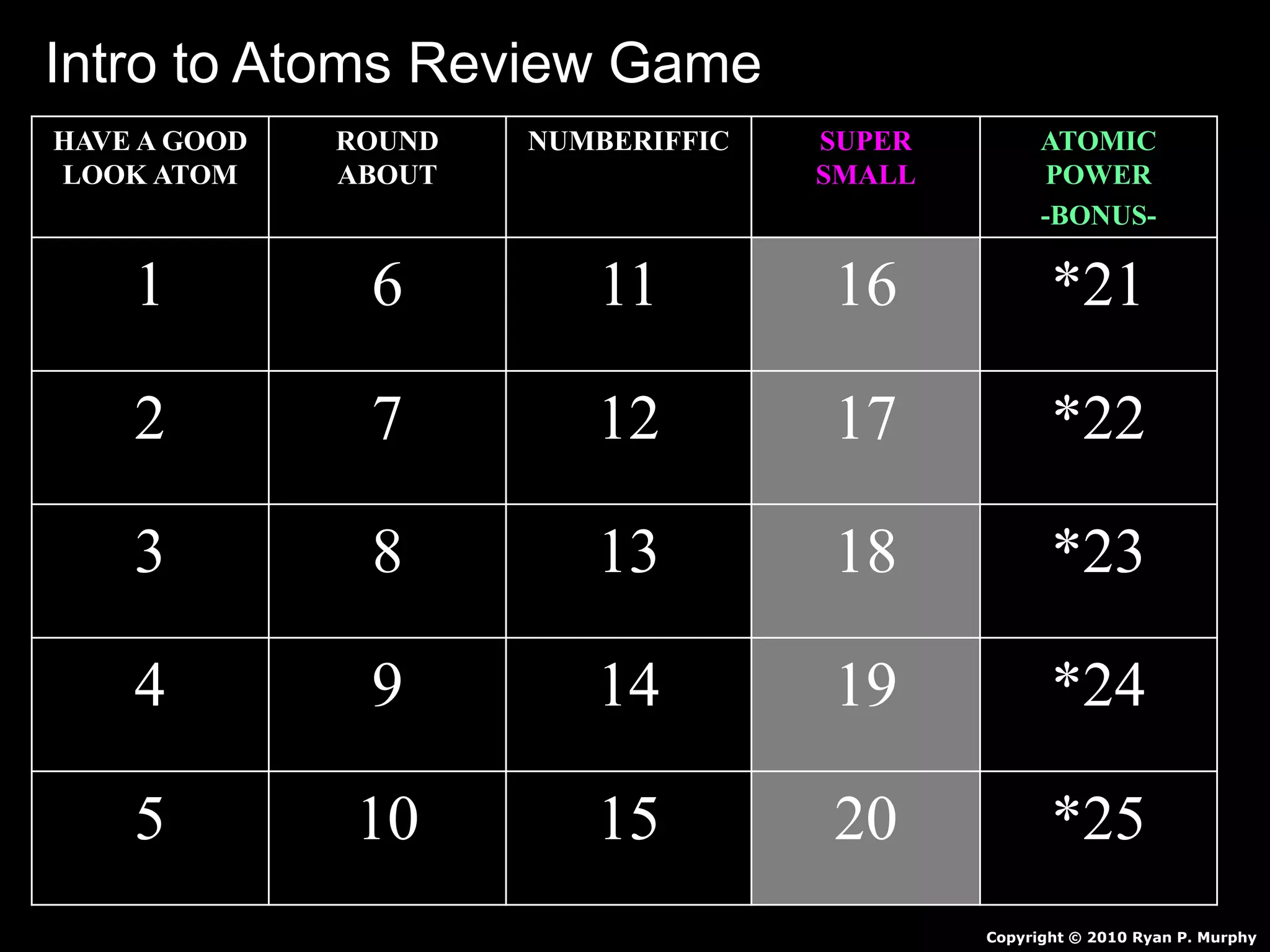
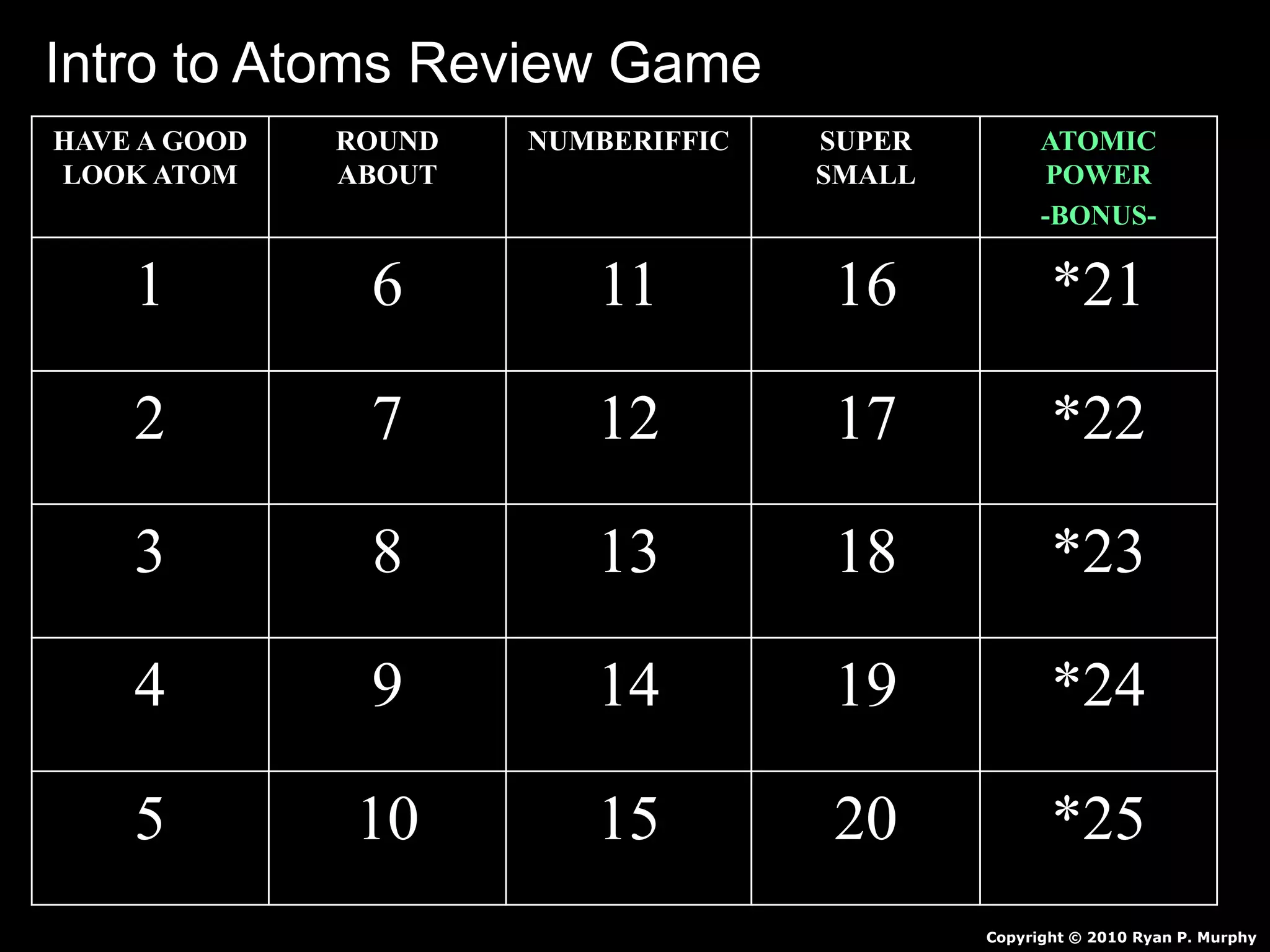
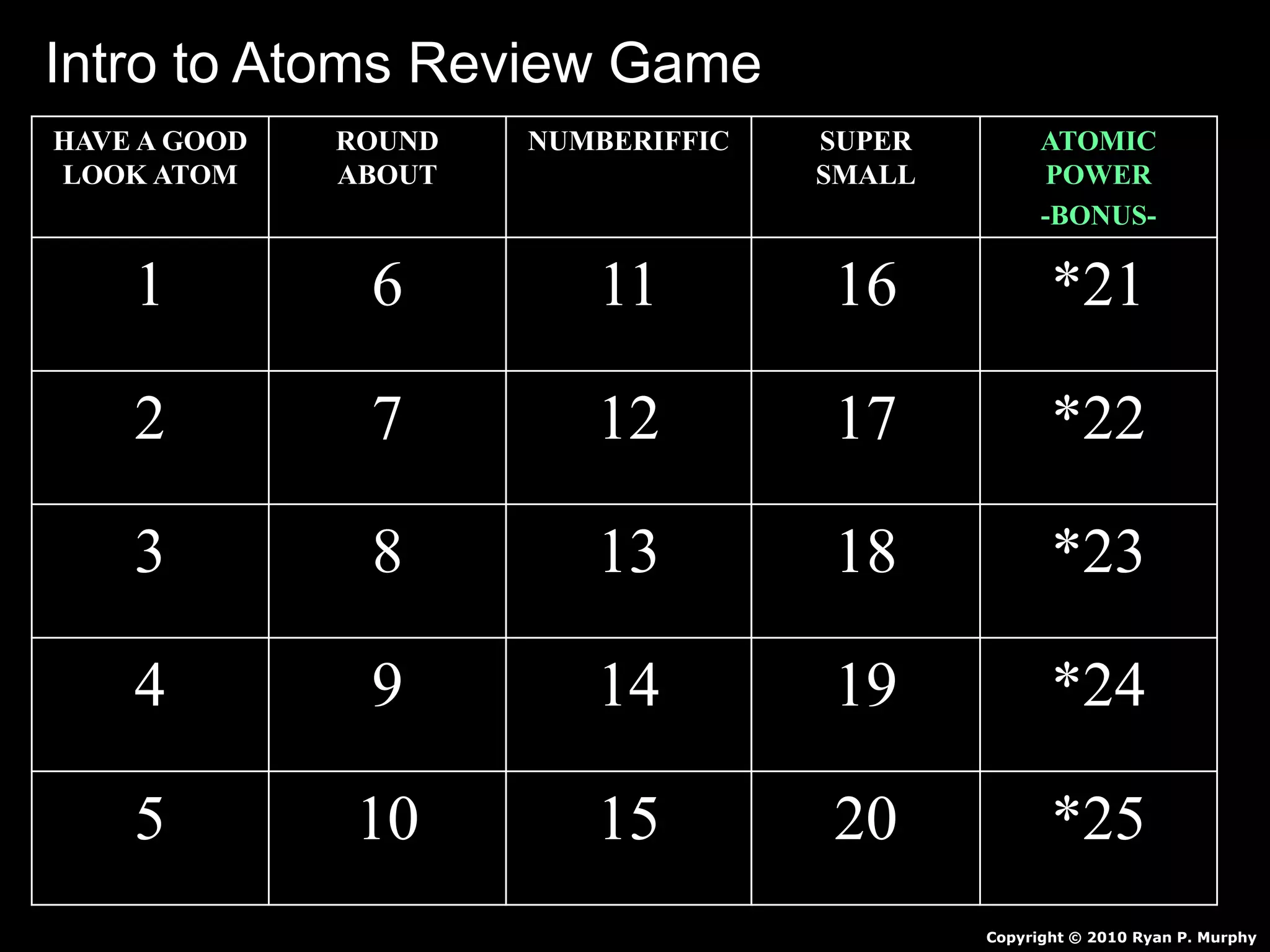
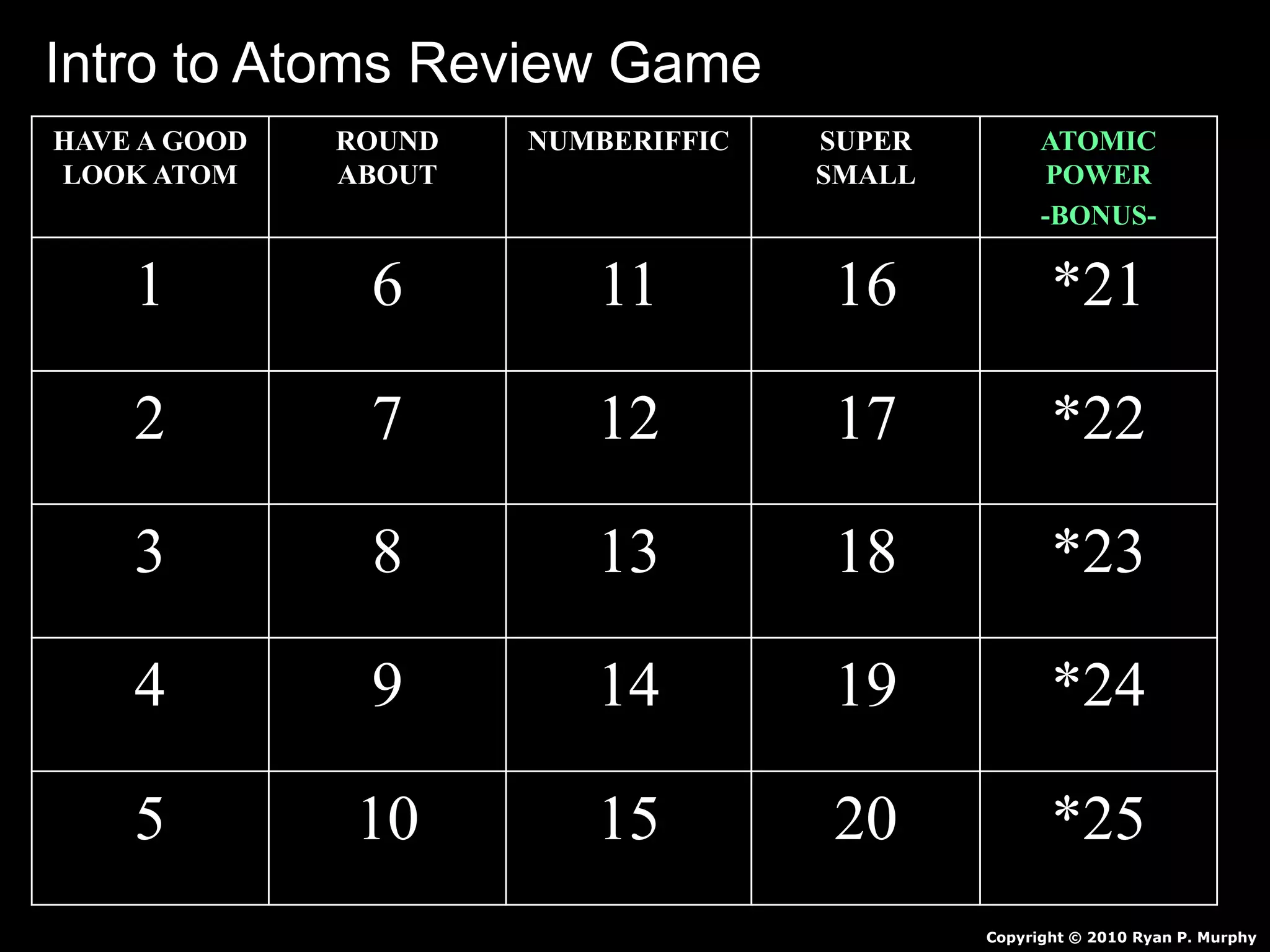
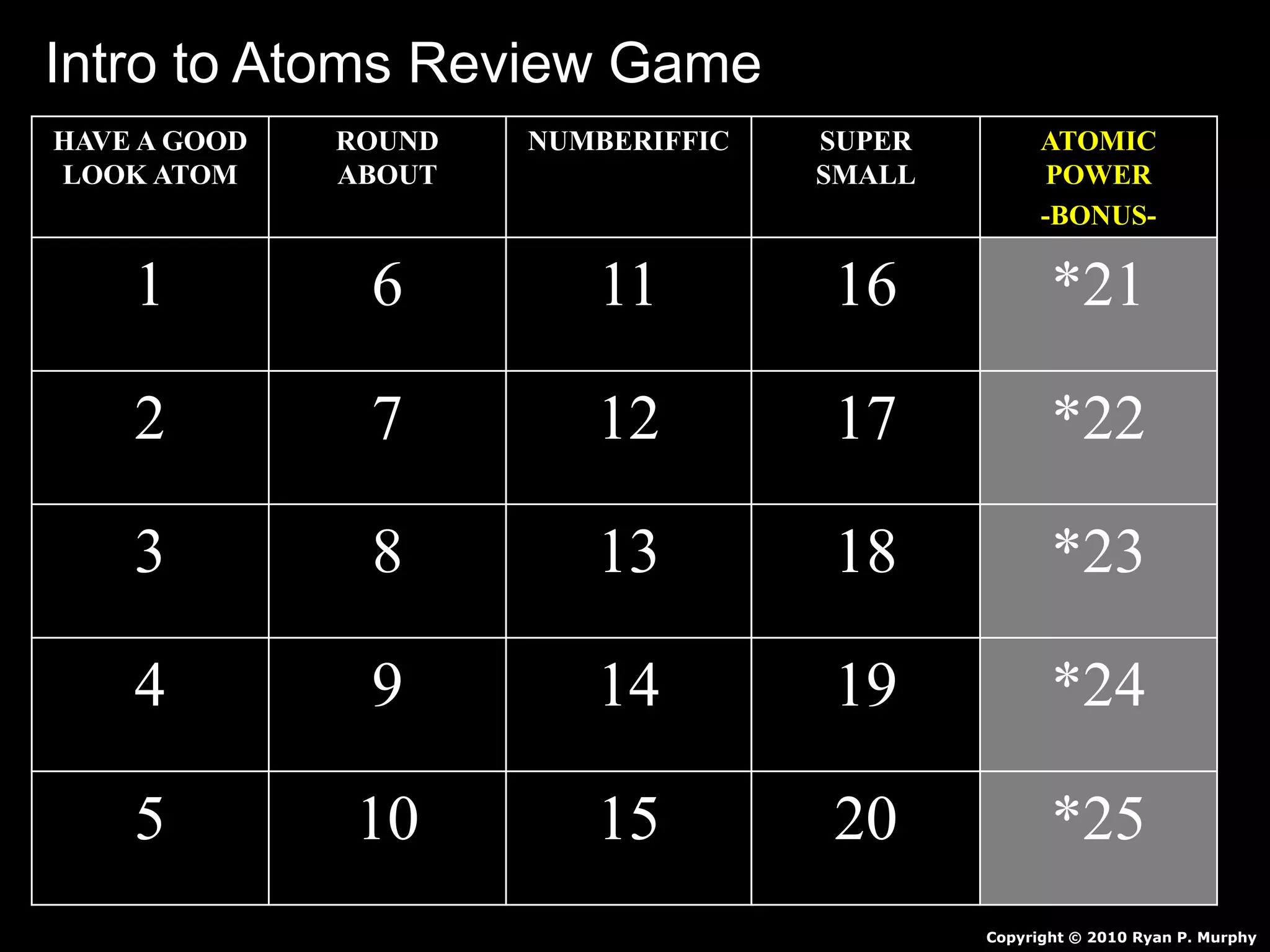
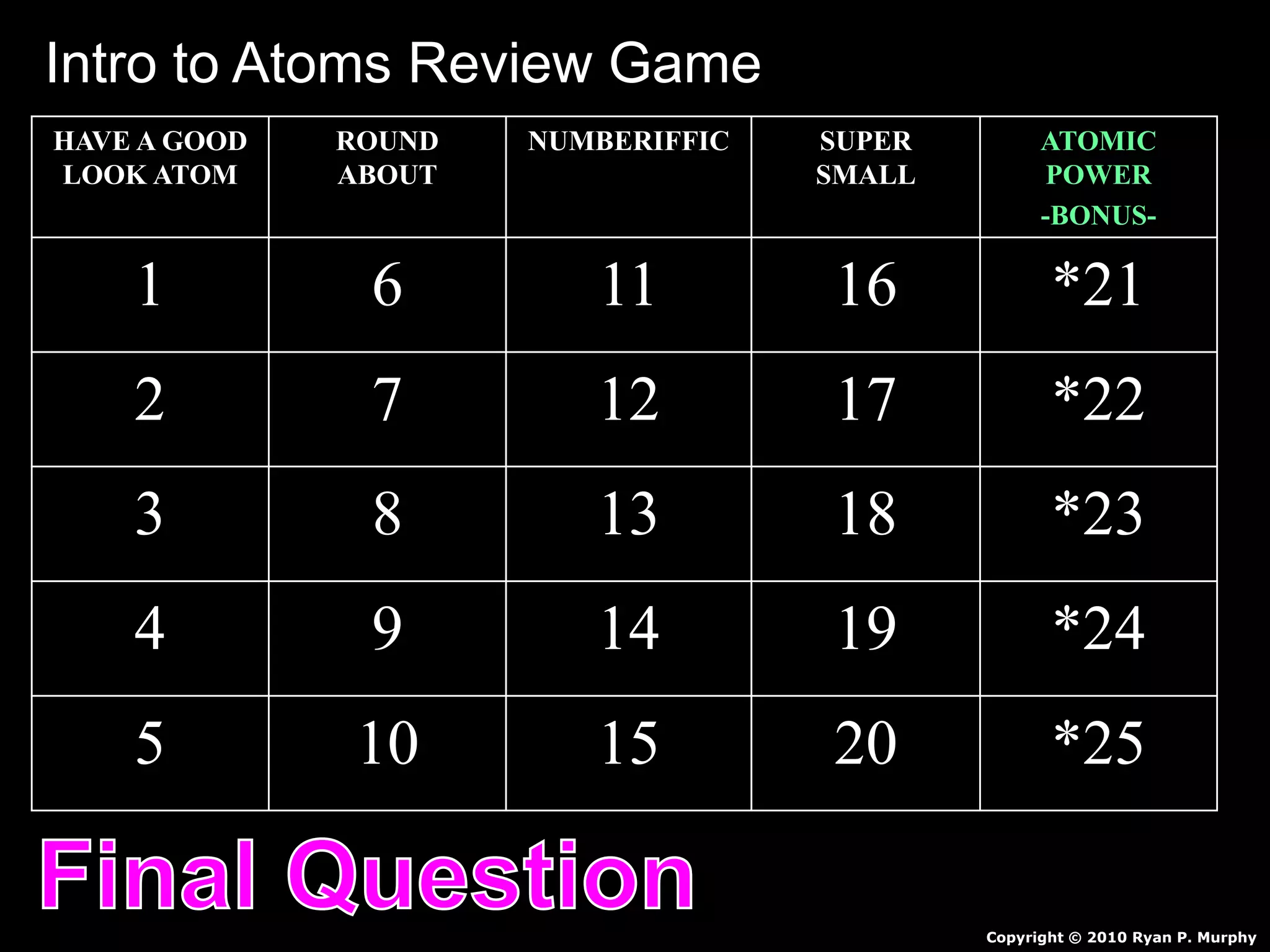
HAVE A GOOD
LOOK ATOM
ROUND
ABOUT
NUMBERIFFIC SUPER
SMALL
ATOMIC
POWER
-BONUS-
1 6 11 16 *21
2 7 12 17 *22
3 8 13 18 *23
4 9 14 19 *24
5 10 15 20 *25
Copyright © 2010 Ryan P. Murphy
Intro to Atoms Review Game
• How to play…
– Don’t play like Jeo_ _ _ _ y.
– Class should be divided into several small groups.
– Groups should use science journal (red slide
notes), homework, and other available materials to
assist you.
– Groups can communicate quietly with each other
but no sharing answers between groups.
• Practice quietly communicating right now?
• Practice Communication Question:
• Your group gets to order one pizza and you can have
two toppings. What does your group want?
Questions 1-20 = 5pts Each
Final Category (Bonus) = 1pt Each
Final Questions = 5 pt wager
If you wager 5 on the last question and get it wrong you lose
5 pts. Wager 5 and get it right you get 5 pts.
Find the Owl =
Secretly write “Owl” in the correct box
worth 1pt.
“I’ll be about
this big.”
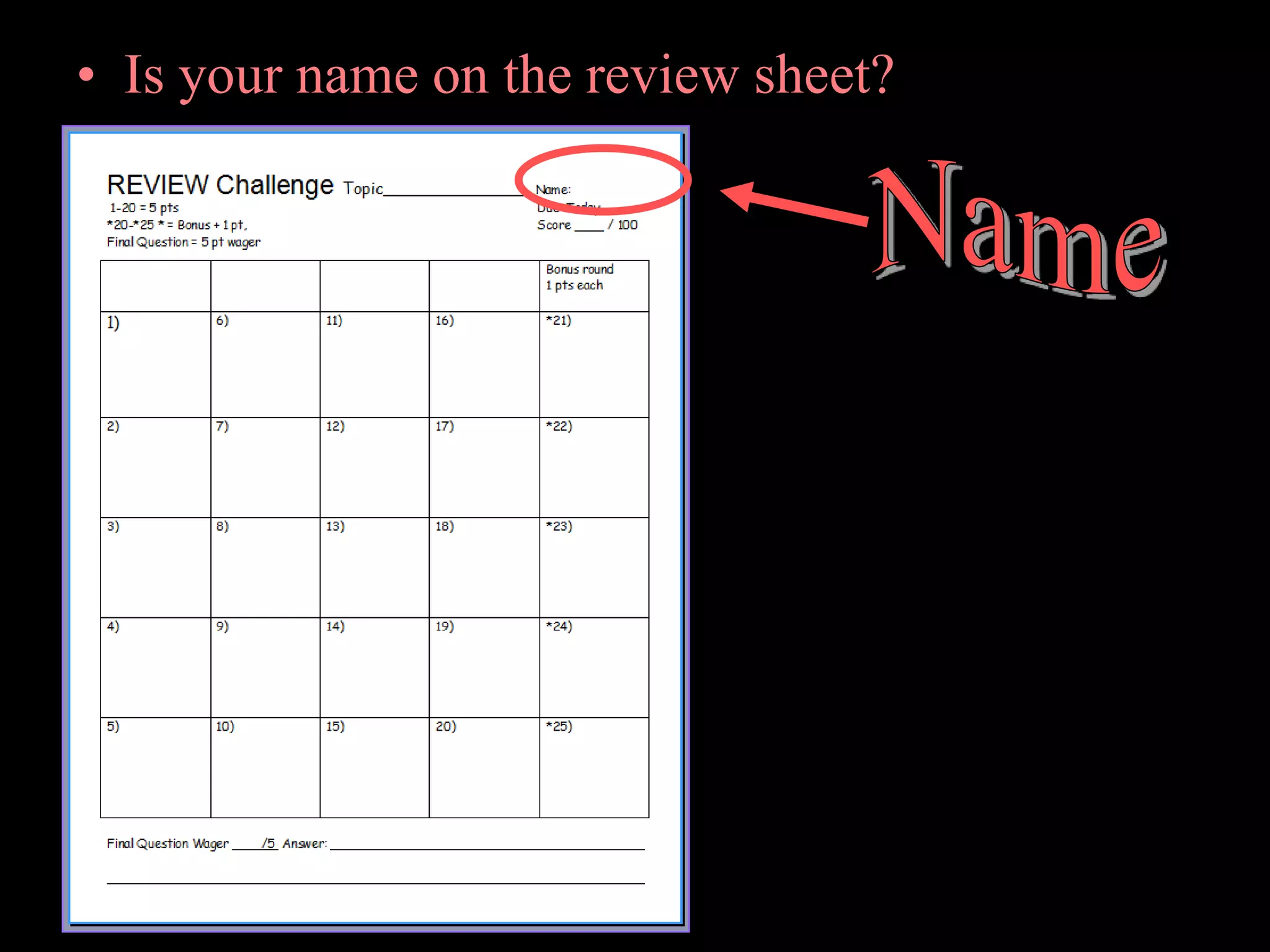
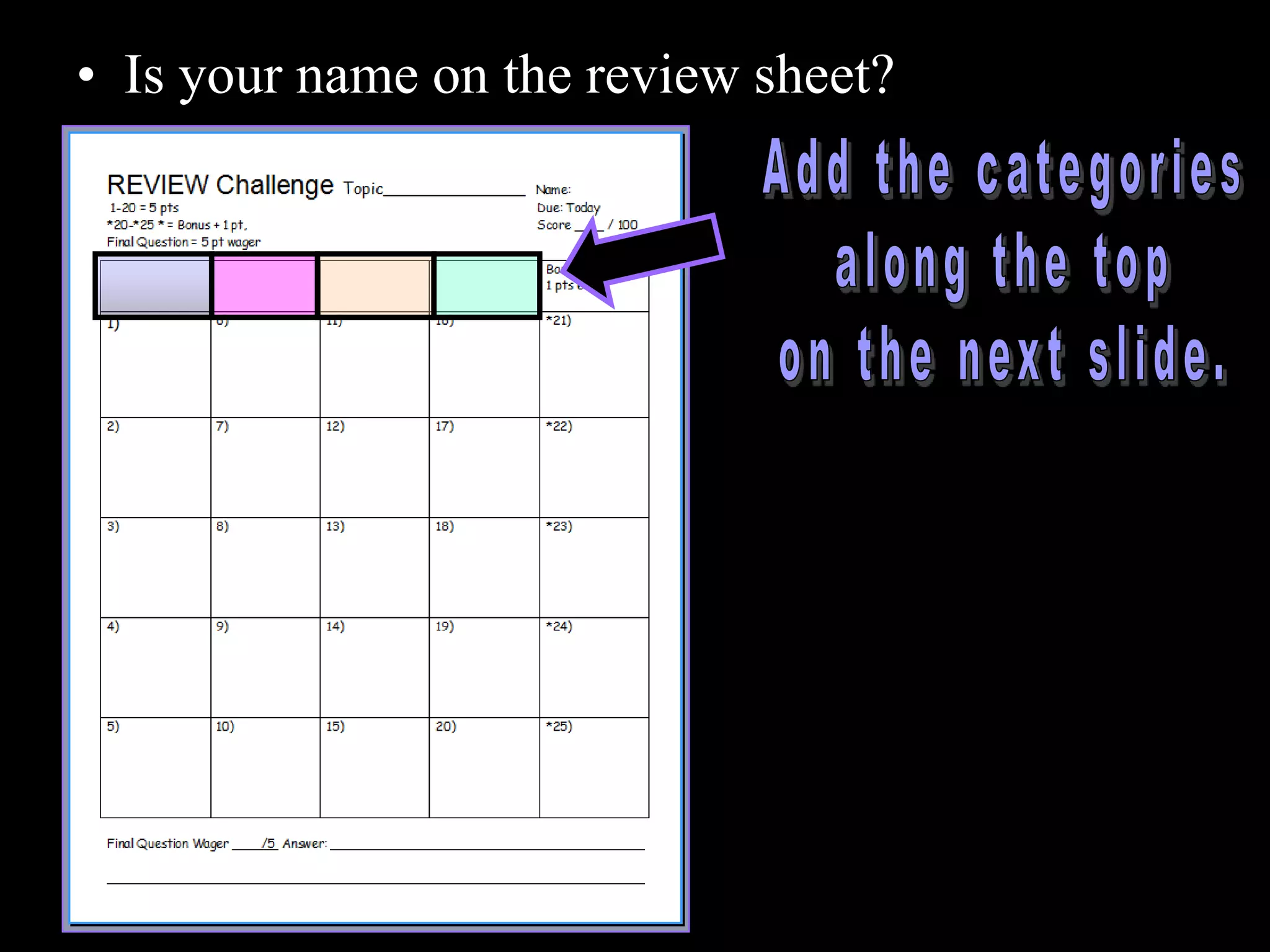
• Is your name on the review sheet?
• http://sciencepowerpoint.com
http://sciencepowerpoint.com/Atoms_Periodic_Table_of_Elements_Unit.html
Areas of Focus within The Atoms and Periodic Table Unit:
Atoms (Atomic Force Microscopes), Rutherford’s Gold Foil Experiment, Cathode
Tube, Atoms, Fundamental Particles, The Nucleus, Isotopes, AMU, Size of
Atoms and Particles, Quarks, Recipe of the Universe, Atomic Theory, Atomic
Symbols, #’;s, Valence Electrons, Octet Rule, SPONCH Atoms, Molecules,
Hydrocarbons (Structure), Alcohols (Structure), Proteins (Structure), Atomic
Bonds, Ionic Bonds, Covalent Bonds, Metallic Bonds, , Precipitation Reactions,
Acids and Bases, Electron Negativity, Polar Bonds, Chemical Change,
Exothermic Reactions, Endothermic Reactions, Laws Conservation of Matter,
Balancing Chemical Equations, Oxidation and Reduction, Periodic Table of the
Elements, Organization of Periodic Table, Transition Metals, Acids and Bases,
Non-Metals, Metals, Metalloids, Ionization.
• This PowerPoint roadmap is one small part of my
Atoms and Periodic Table Unit.
• This unit includes a four part 2000+ slide PowerPoint
roadmap.
• 13 page bundled homework that chronologically
follows slideshow
• 14 pages of unit notes with visuals.
• 3 PowerPoint review games.
• Activity sheets, rubrics, advice page, curriculum
guide, materials list, and much more.
• http://sciencepowerpoint.com
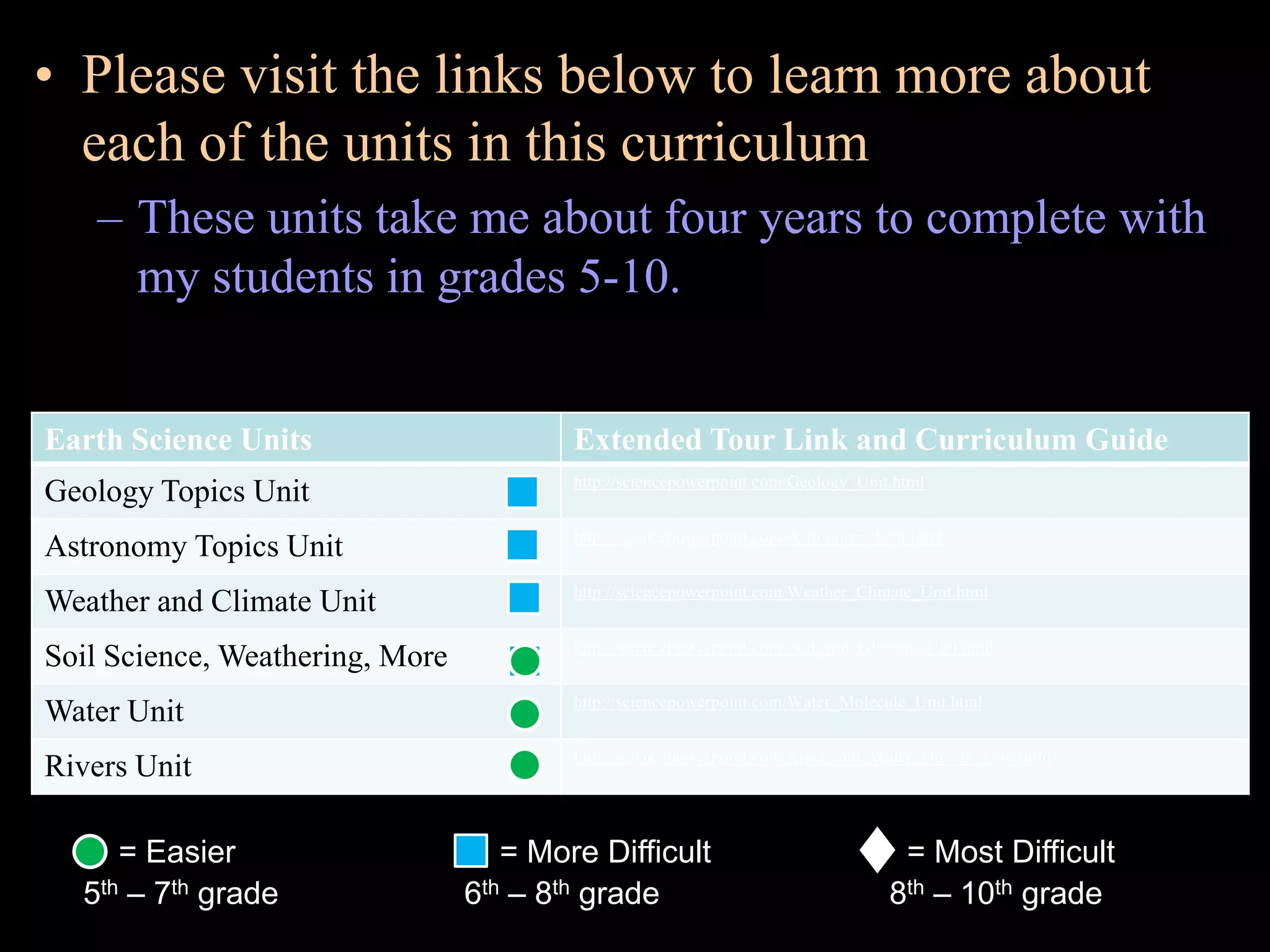
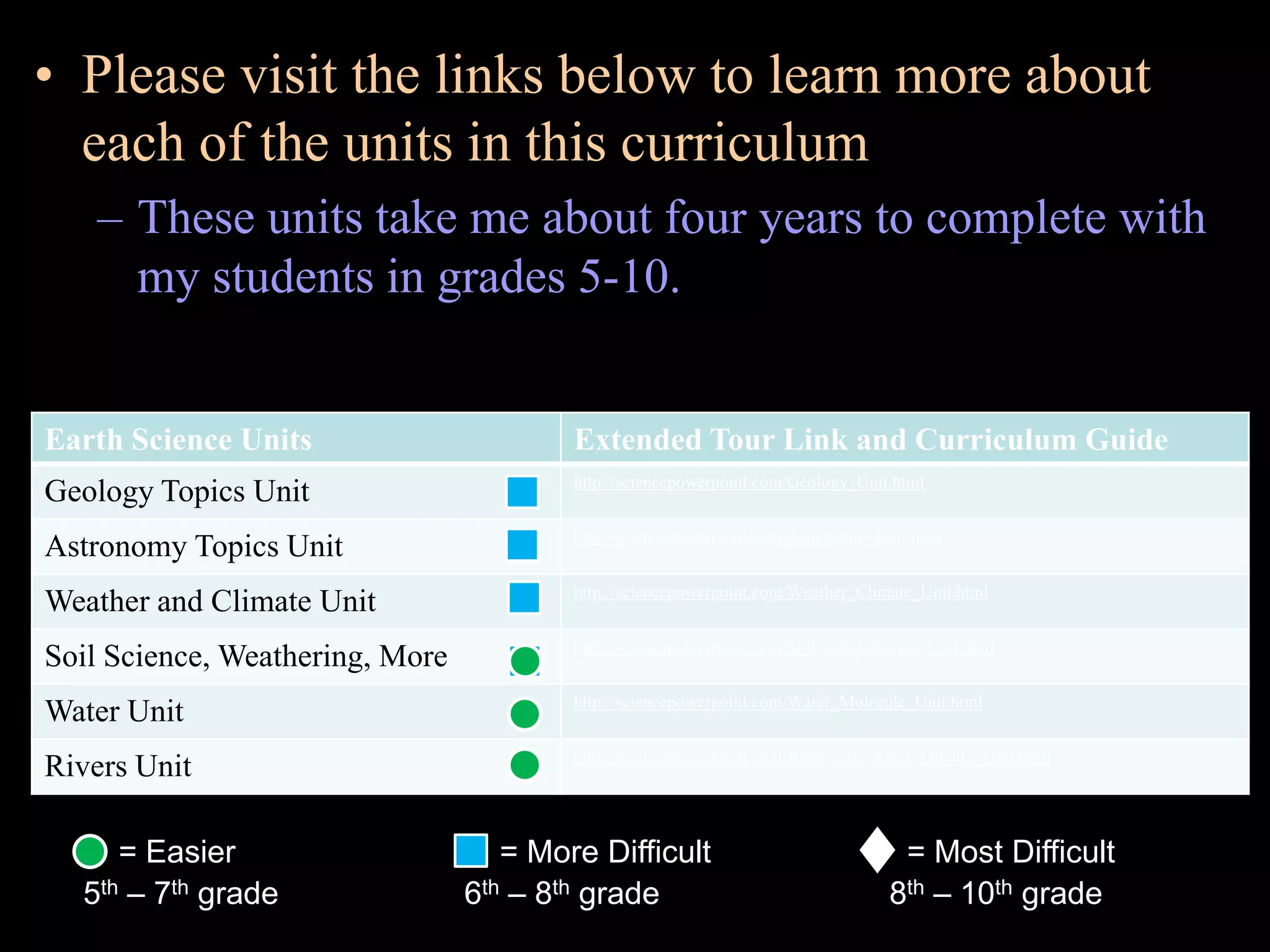
• Please visit the links below to learn more about
each of the units in this curriculum
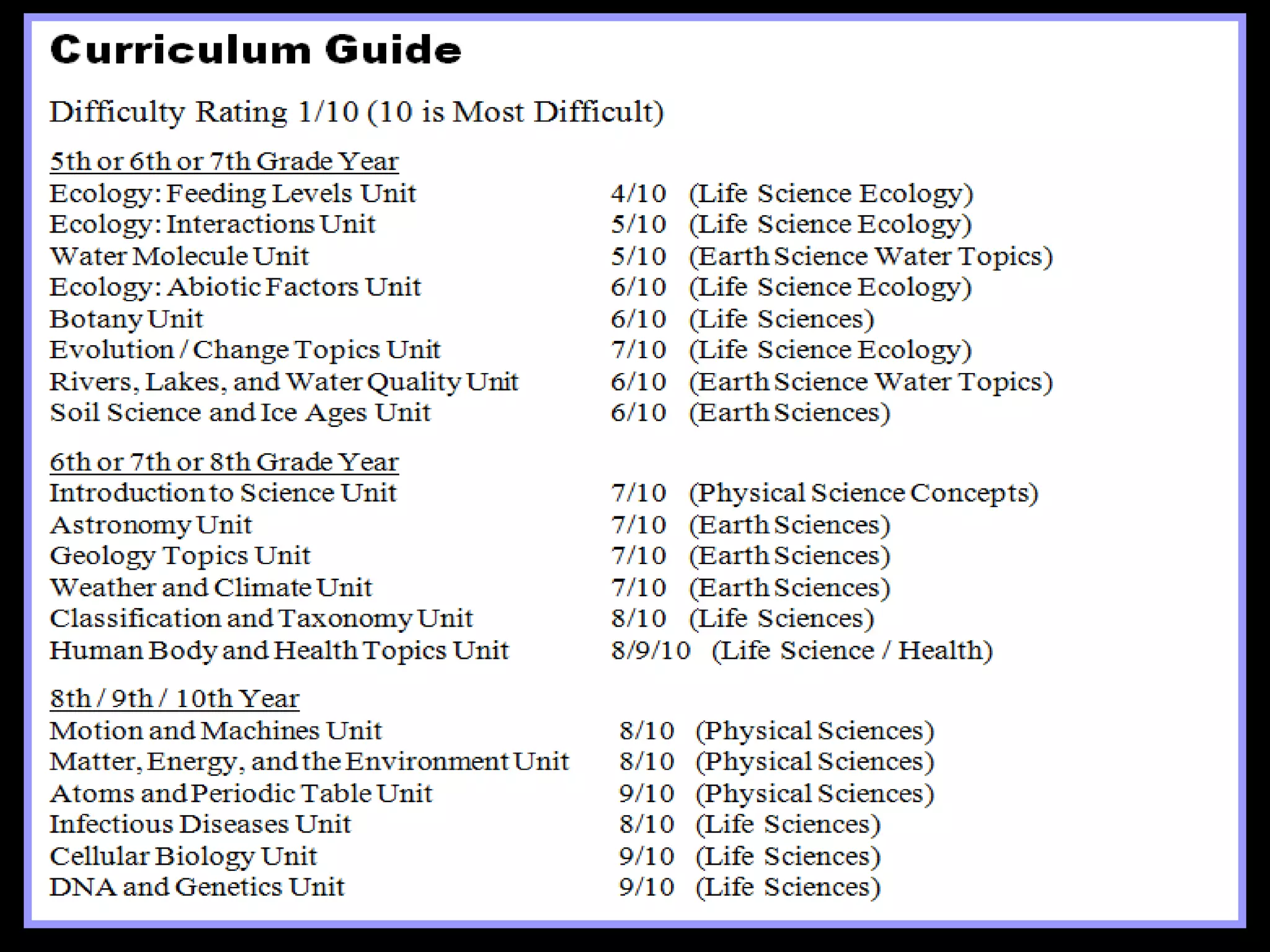
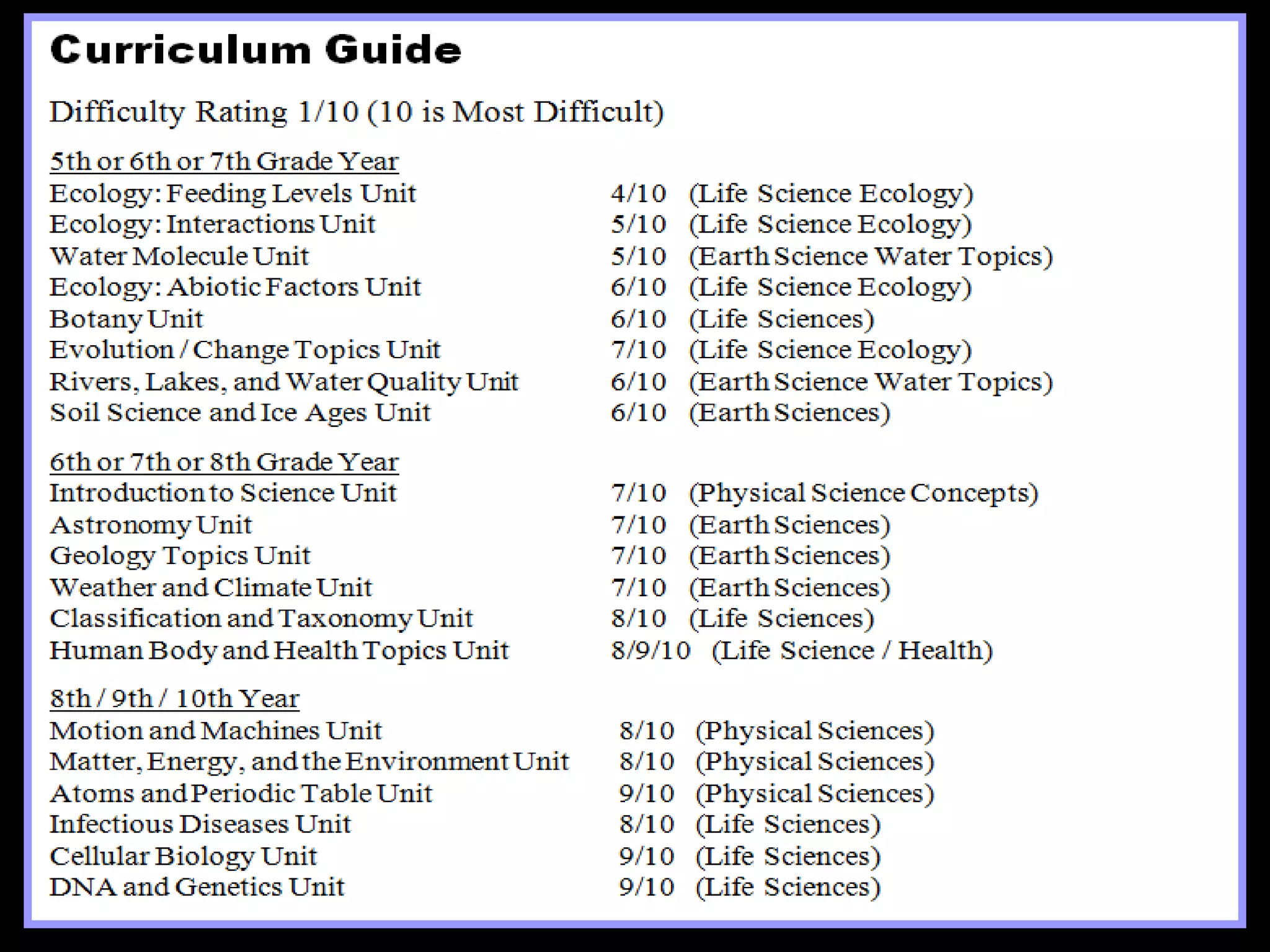
– These units take me about four years to complete with
my students in grades 5-10.
Earth Science Units Extended Tour Link and Curriculum Guide
Geology Topics Unit http://sciencepowerpoint.com/Geology_Unit.html
Astronomy Topics Unit http://sciencepowerpoint.com/Astronomy_Unit.html
Weather and Climate Unit http://sciencepowerpoint.com/Weather_Climate_Unit.html
Soil Science, Weathering, More http://sciencepowerpoint.com/Soil_and_Glaciers_Unit.html
Water Unit http://sciencepowerpoint.com/Water_Molecule_Unit.html
Rivers Unit http://sciencepowerpoint.com/River_and_Water_Quality_Unit.html
= Easier = More Difficult = Most Difficult
5th – 7th grade 6th – 8th grade 8th – 10th grade
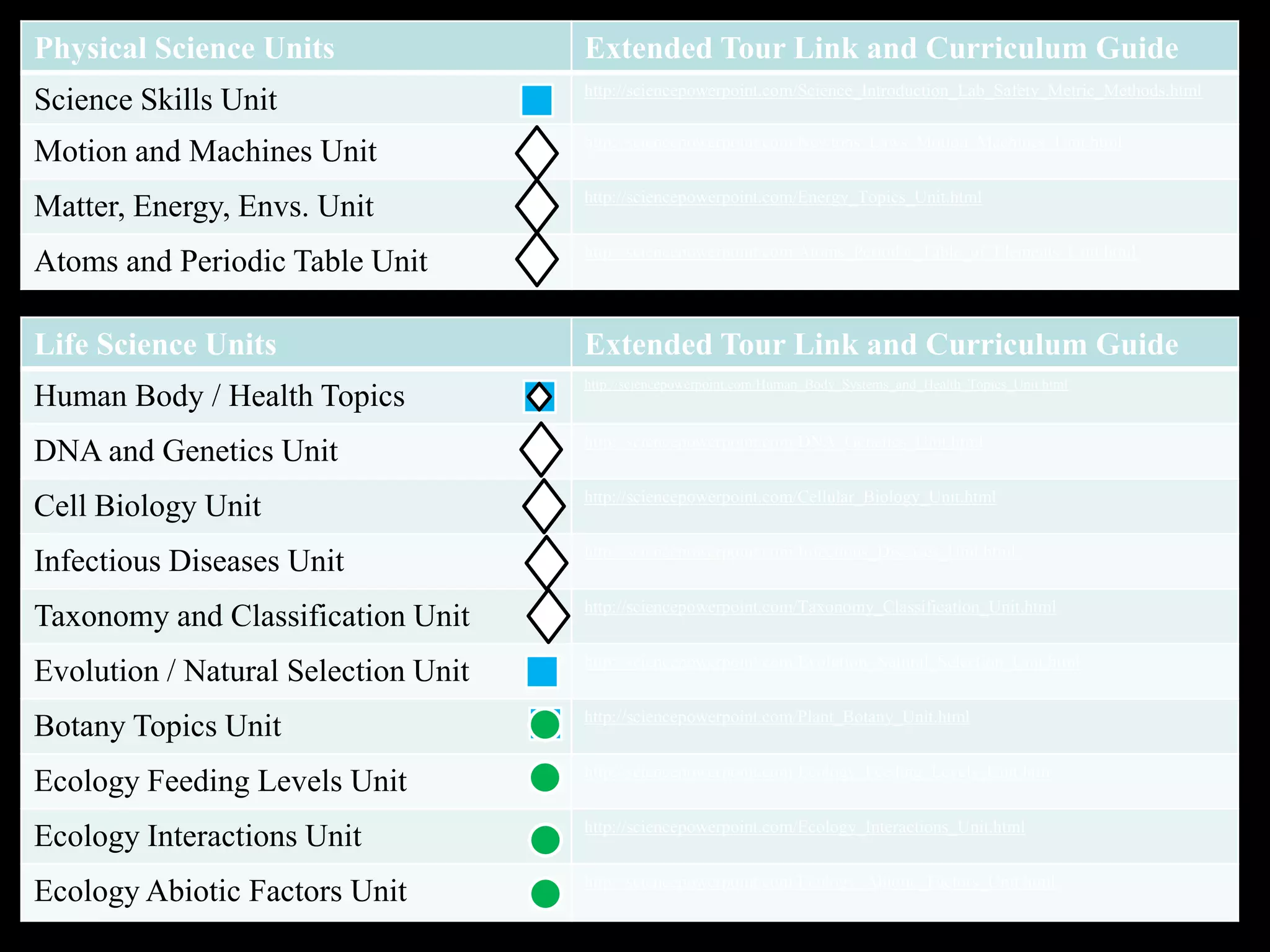
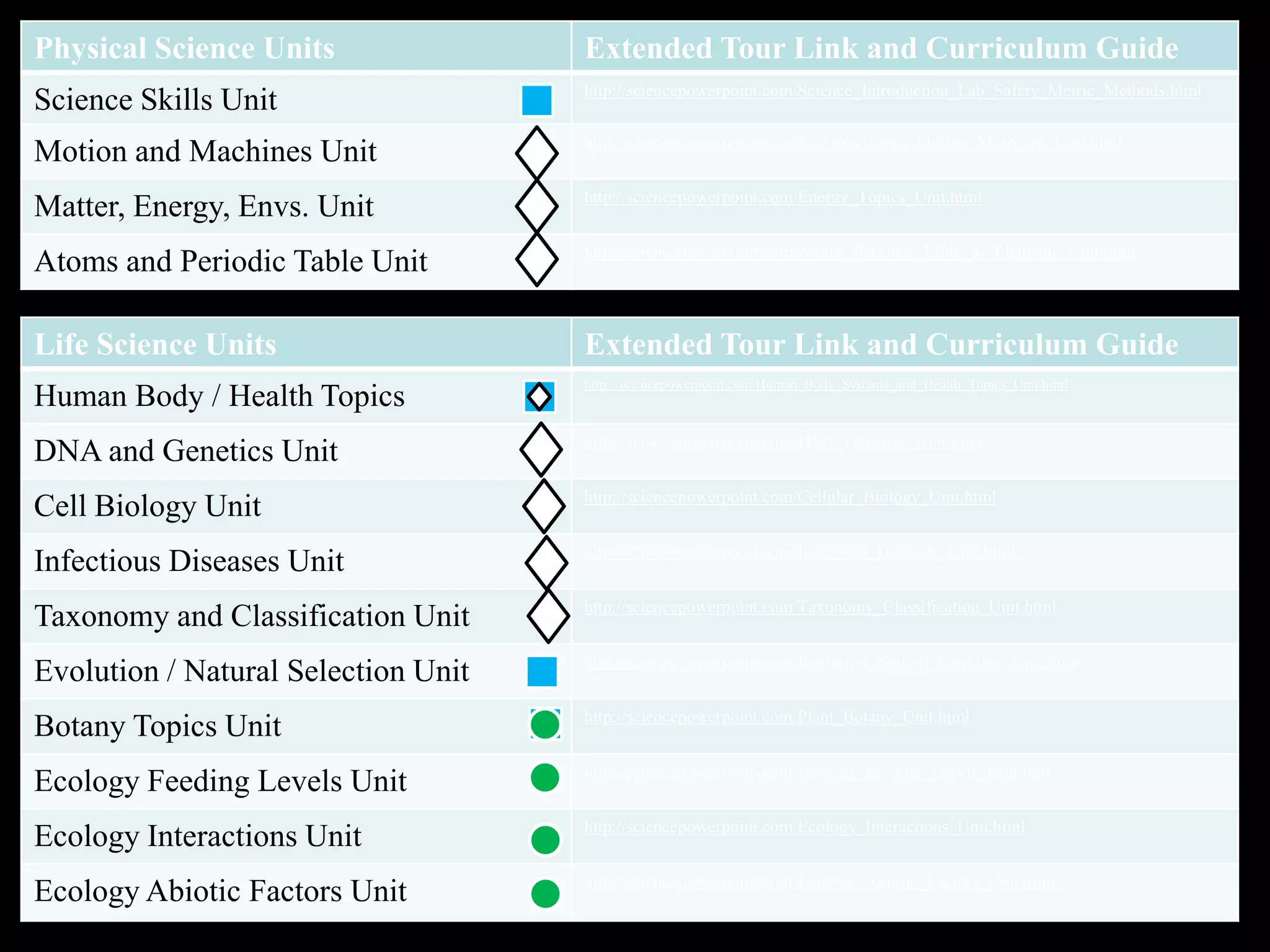
Physical Science Units Extended Tour Link and Curriculum Guide
Science Skills Unit http://sciencepowerpoint.com/Science_Introduction_Lab_Safety_Metric_Methods.html
Motion and Machines Unit http://sciencepowerpoint.com/Newtons_Laws_Motion_Machines_Unit.html
Matter, Energy, Envs. Unit http://sciencepowerpoint.com/Energy_Topics_Unit.html
Atoms and Periodic Table Unit http://sciencepowerpoint.com/Atoms_Periodic_Table_of_Elements_Unit.html
Life Science Units Extended Tour Link and Curriculum Guide
Human Body / Health Topics
http://sciencepowerpoint.com/Human_Body_Systems_and_Health_Topics_Unit.html
DNA and Genetics Unit http://sciencepowerpoint.com/DNA_Genetics_Unit.html
Cell Biology Unit http://sciencepowerpoint.com/Cellular_Biology_Unit.html
Infectious Diseases Unit http://sciencepowerpoint.com/Infectious_Diseases_Unit.html
Taxonomy and Classification Unit http://sciencepowerpoint.com/Taxonomy_Classification_Unit.html
Evolution / Natural Selection Unit http://sciencepowerpoint.com/Evolution_Natural_Selection_Unit.html
Botany Topics Unit http://sciencepowerpoint.com/Plant_Botany_Unit.html
Ecology Feeding Levels Unit http://sciencepowerpoint.com/Ecology_Feeding_Levels_Unit.htm
Ecology Interactions Unit http://sciencepowerpoint.com/Ecology_Interactions_Unit.html
Ecology Abiotic Factors Unit http://sciencepowerpoint.com/Ecology_Abiotic_Factors_Unit.html
• http://sciencepowerpoint.com
• The entire four year curriculum can be found at...
http://sciencepowerpoint.com/ Please feel free to
contact me with any questions you may have. Thank
you for your interest in this curriculum.
Sincerely,
Ryan Murphy M.Ed
www.sciencepowerpoint@gmail.com
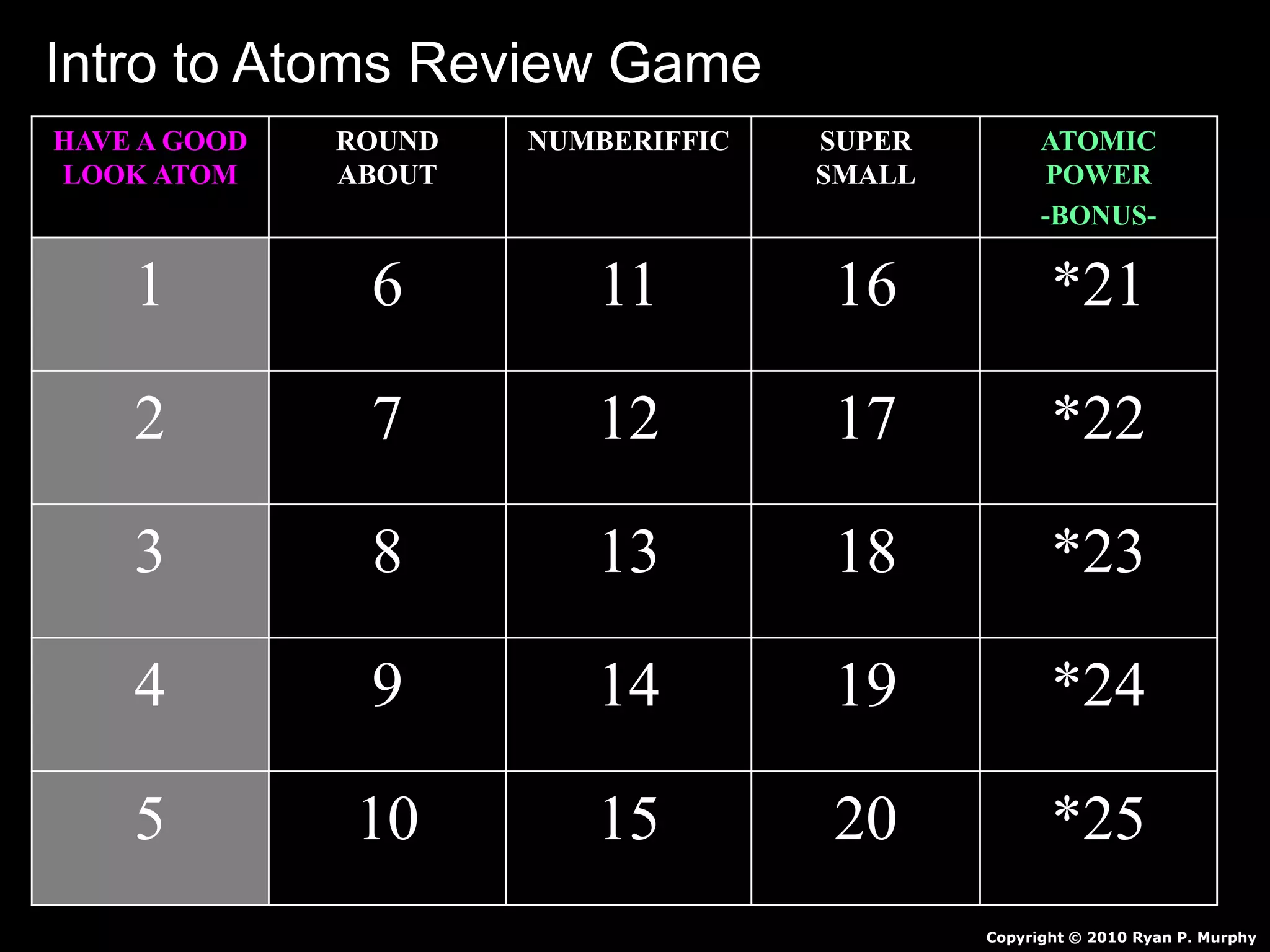
HAVE A GOOD
LOOK ATOM
ROUND
ABOUT
NUMBERIFFIC SUPER
SMALL
ATOMIC
POWER
-BONUS-
1 6 11 16 *21
2 7 12 17 *22
3 8 13 18 *23
4 9 14 19 *24
5 10 15 20 *25
Copyright © 2010 Ryan P. Murphy
Intro to Atoms Review Game
HAVE A GOOD
LOOK ATOM
ROUND
ABOUT
NUMBERIFFIC SUPER
SMALL
ATOMIC
POWER
-BONUS-
1 6 11 16 *21
2 7 12 17 *22
3 8 13 18 *23
4 9 14 19 *24
5 10 15 20 *25
Copyright © 2010 Ryan P. Murphy
Intro to Atoms Review Game
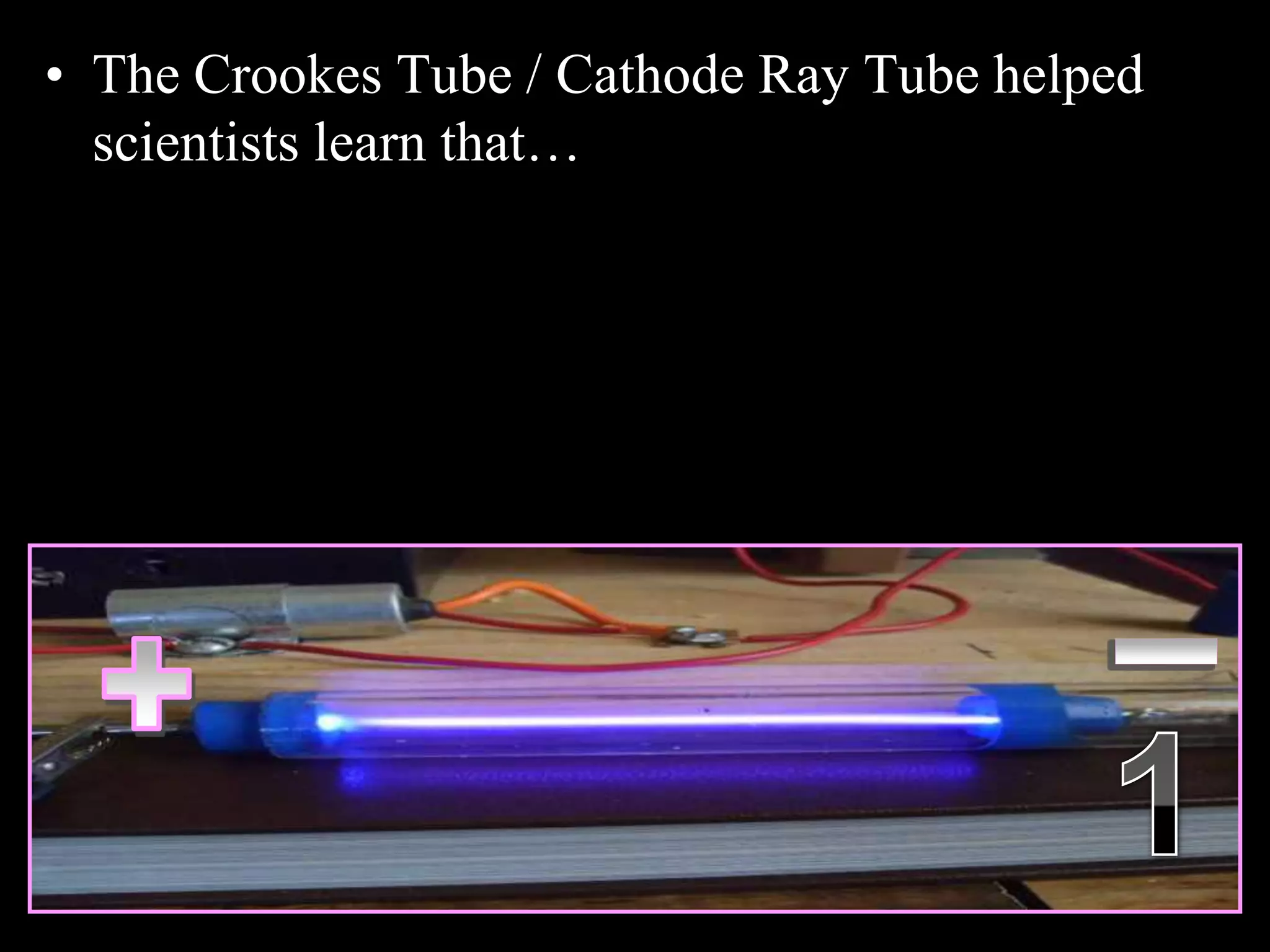
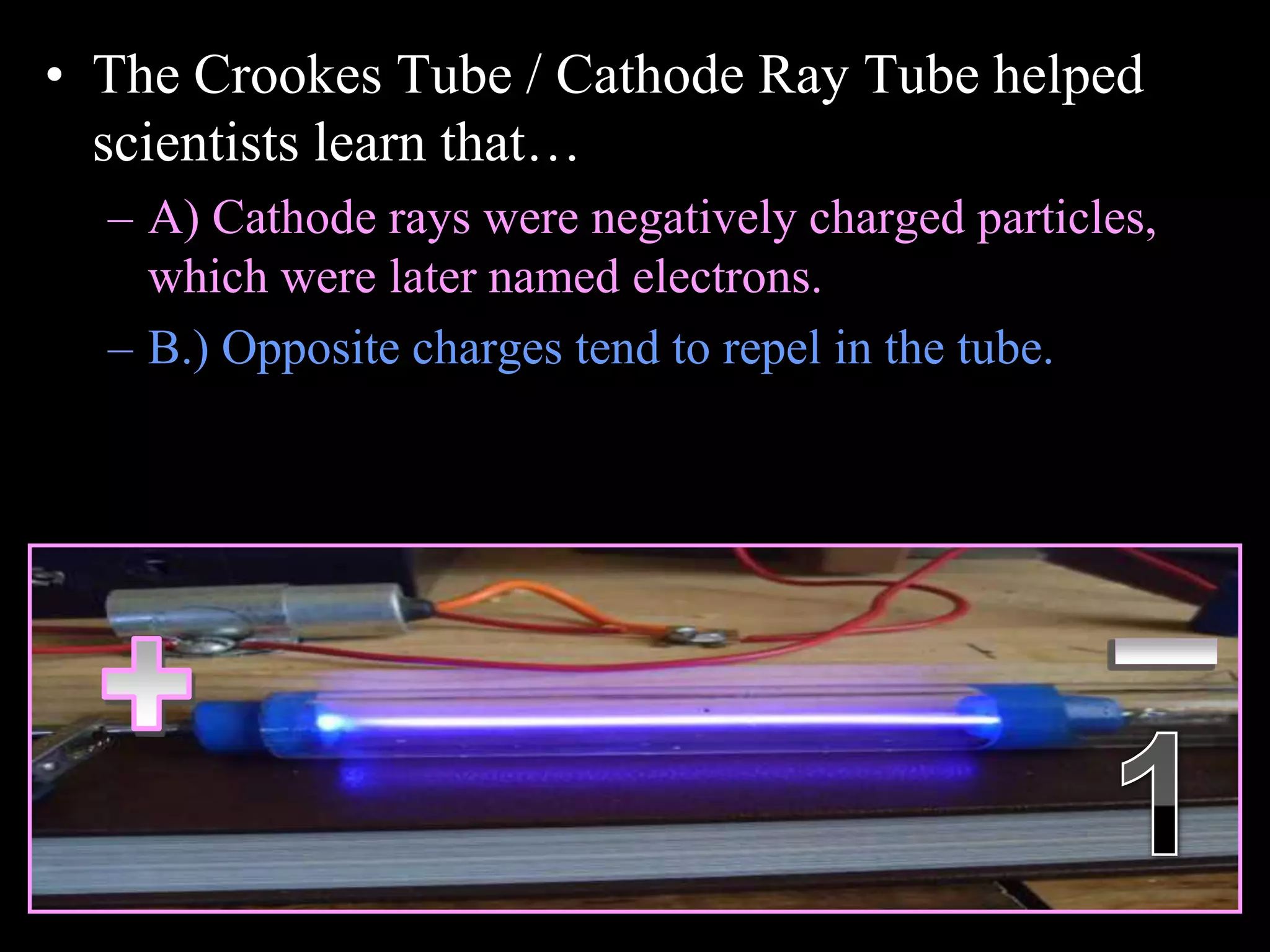
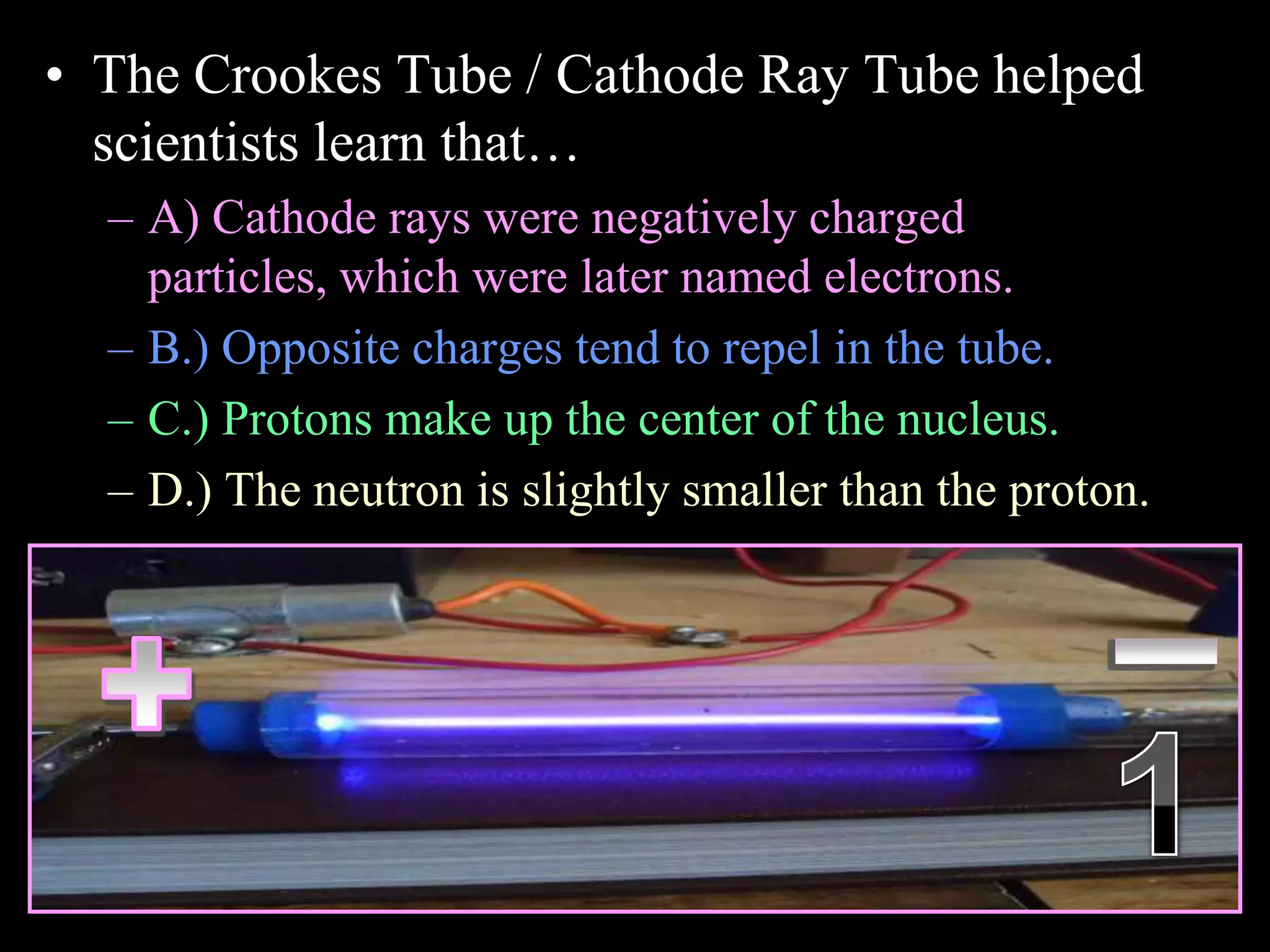
• The Crookes Tube / Cathode Ray Tube helped
scientists learn that…
Copyright © 2010 Ryan P. Murphy
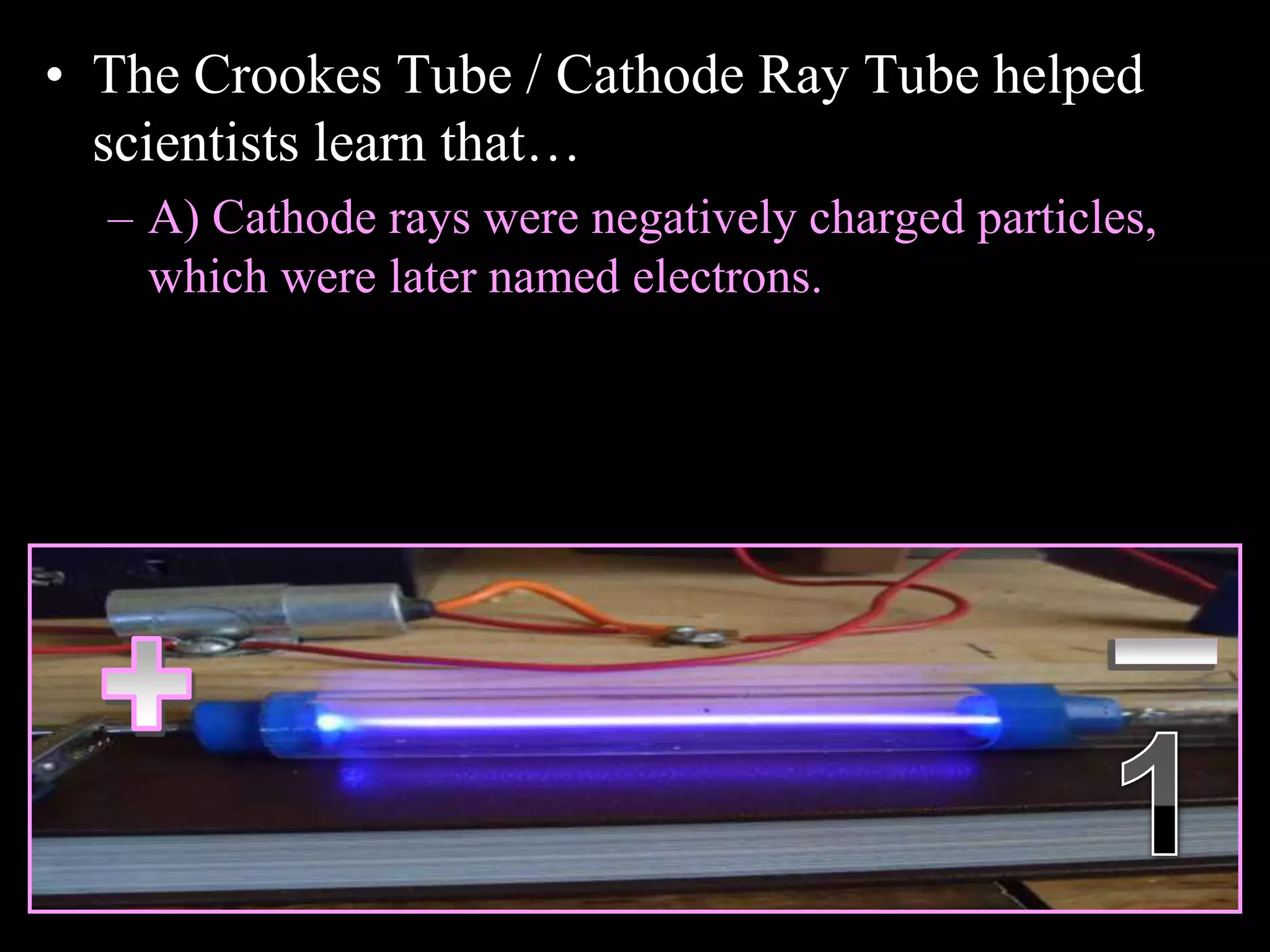
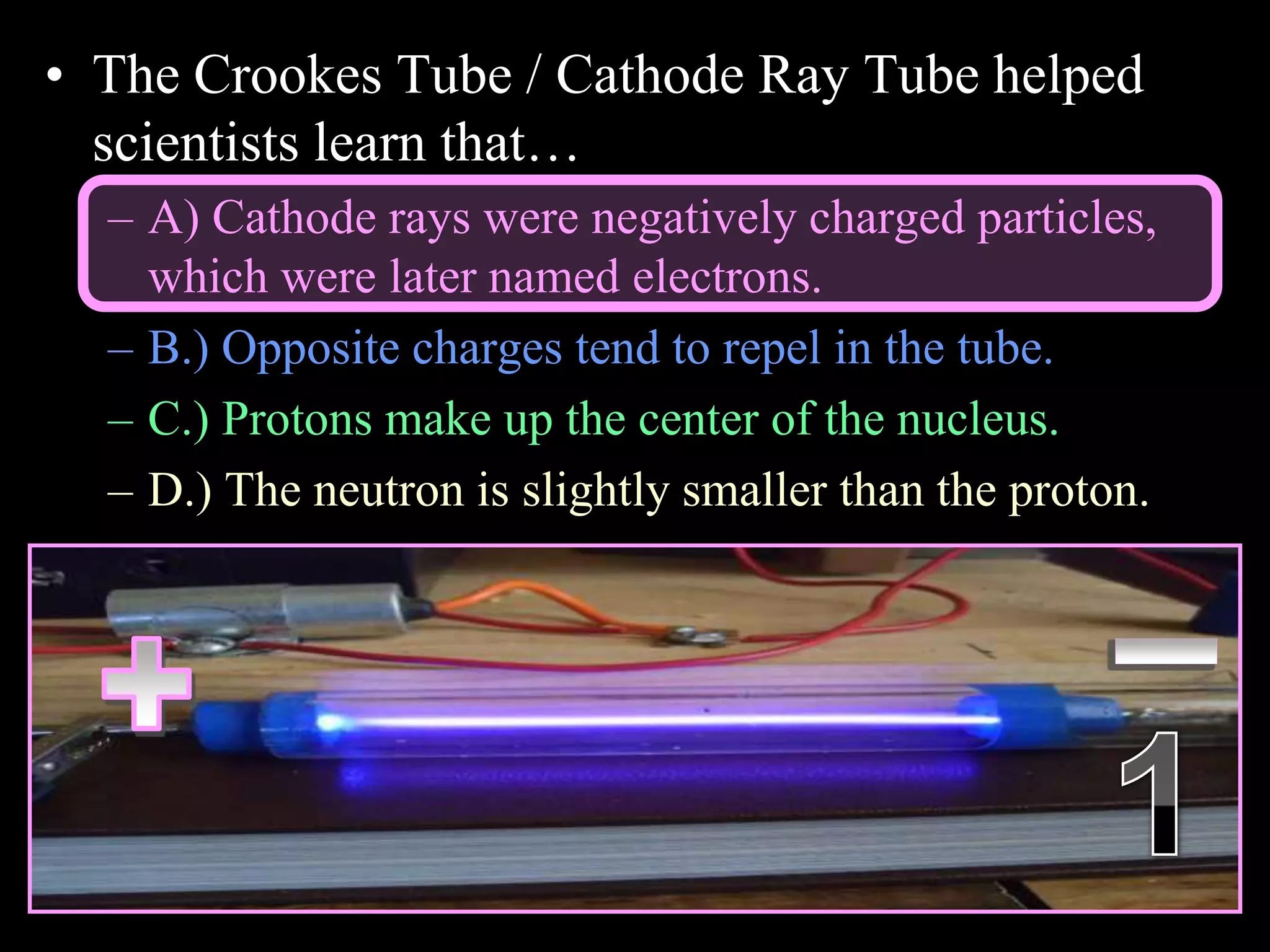
• The Crookes Tube / Cathode Ray Tube helped
scientists learn that…
– A) Cathode rays were negatively charged particles,
which were later named electrons.
Copyright © 2010 Ryan P. Murphy
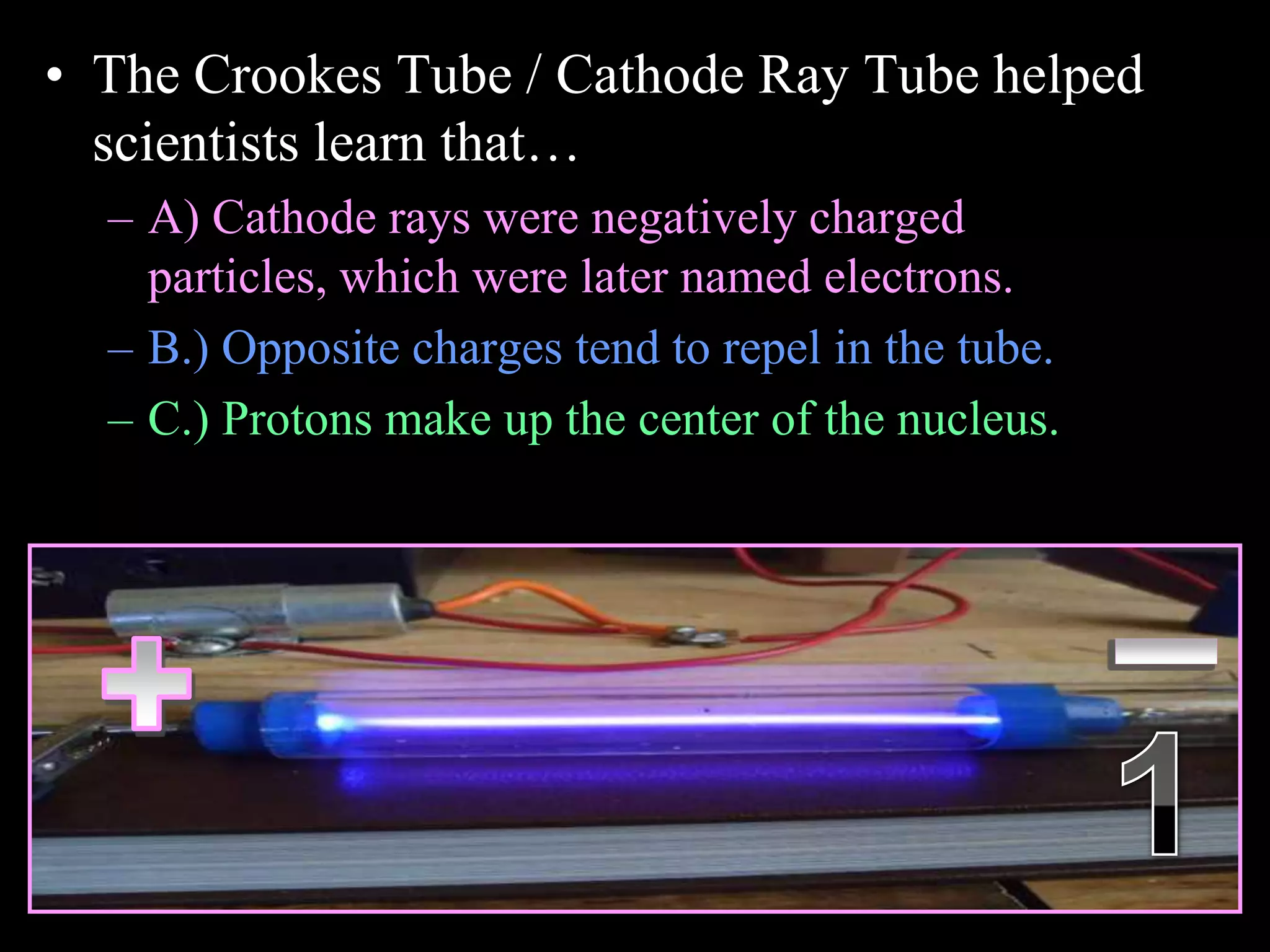
• The Crookes Tube / Cathode Ray Tube helped
scientists learn that…
– A) Cathode rays were negatively charged particles,
which were later named electrons.
– B.) Opposite charges tend to repel in the tube.
Copyright © 2010 Ryan P. Murphy
• The Crookes Tube / Cathode Ray Tube helped
scientists learn that…
– A) Cathode rays were negatively charged
particles, which were later named electrons.
– B.) Opposite charges tend to repel in the tube.
– C.) Protons make up the center of the nucleus.
Copyright © 2010 Ryan P. Murphy
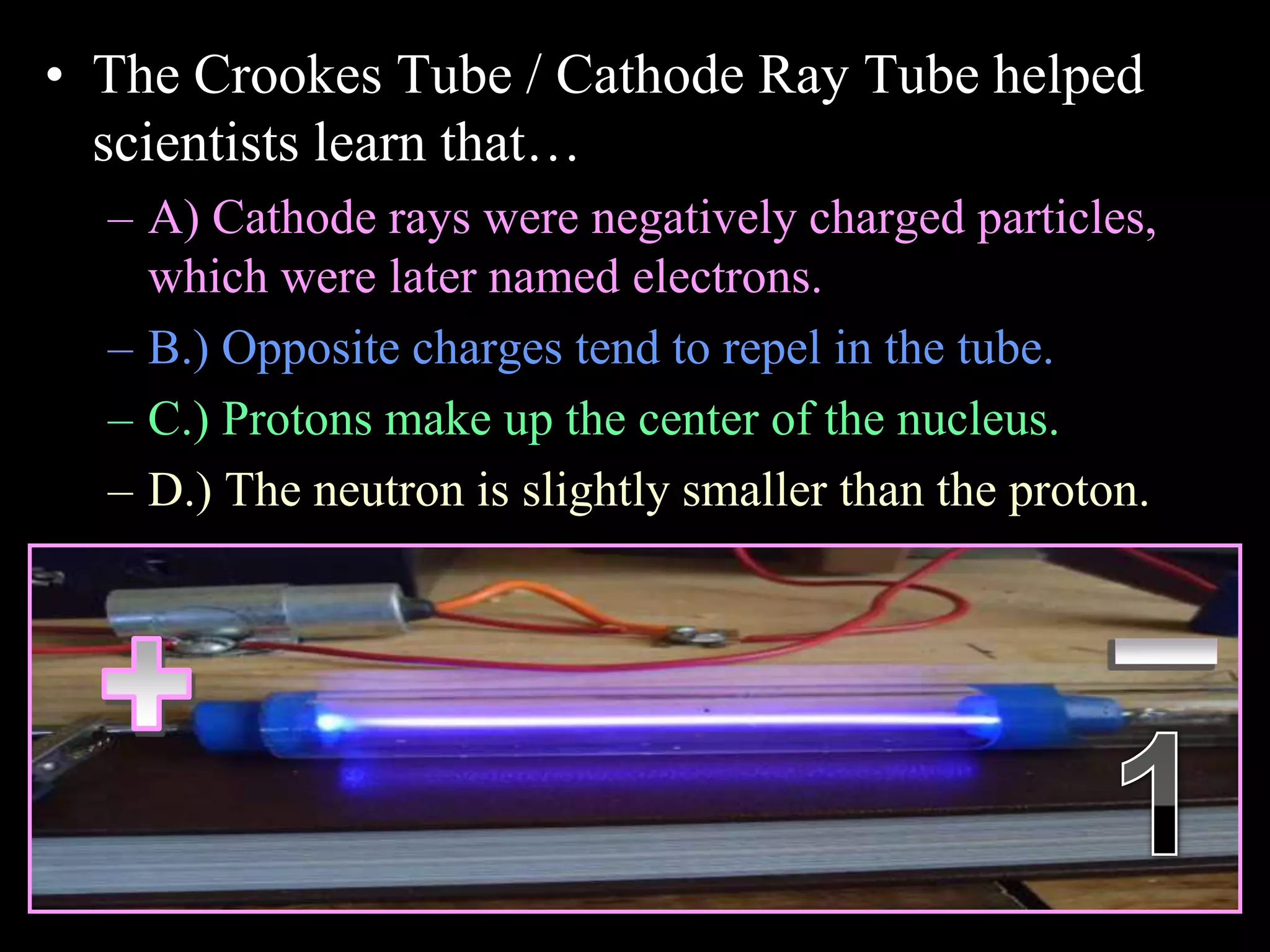
• The Crookes Tube / Cathode Ray Tube helped
scientists learn that…
– A) Cathode rays were negatively charged particles,
which were later named electrons.
– B.) Opposite charges tend to repel in the tube.
– C.) Protons make up the center of the nucleus.
– D.) The neutron is slightly smaller than the proton.
Copyright © 2010 Ryan P. Murphy
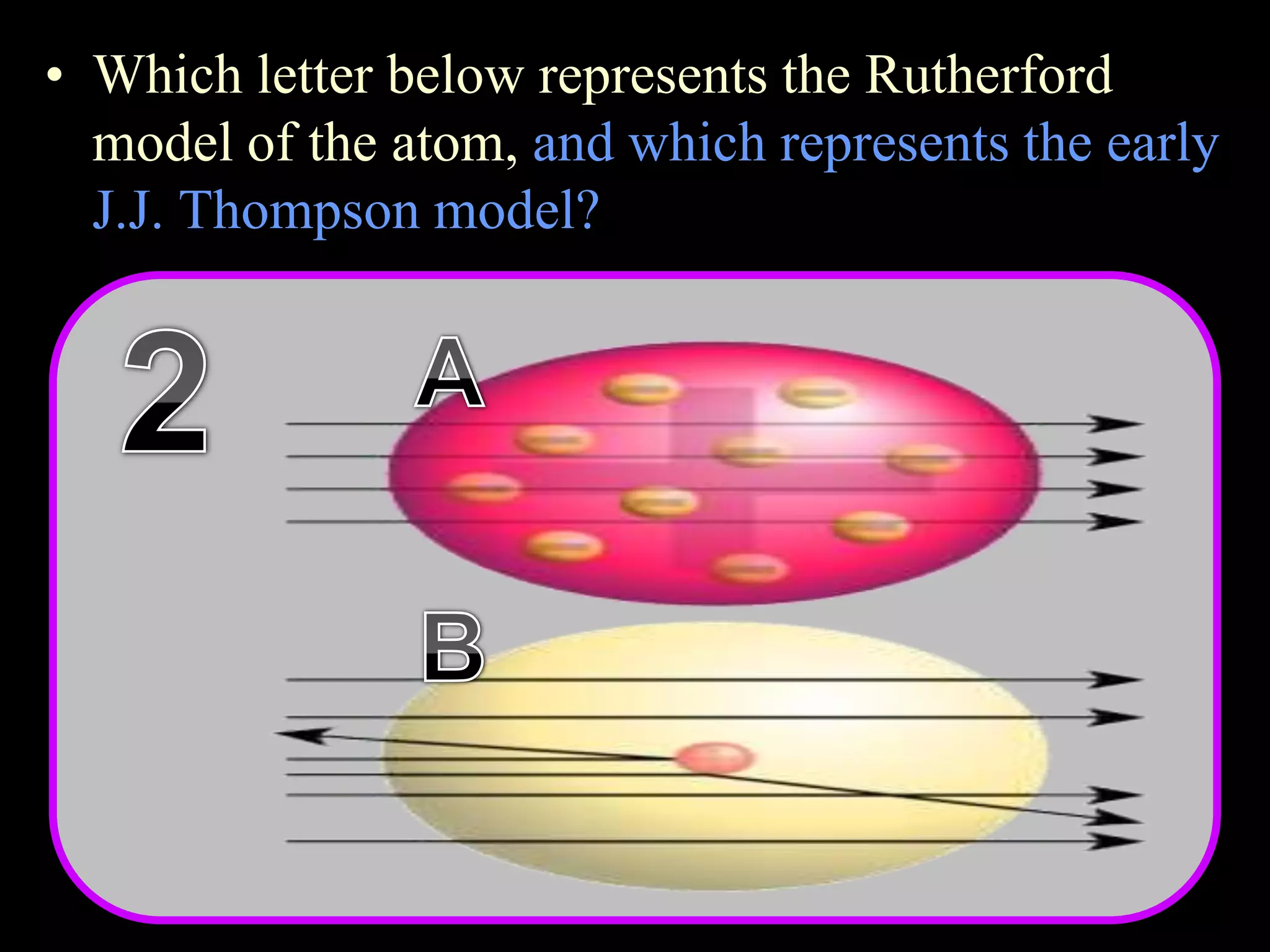
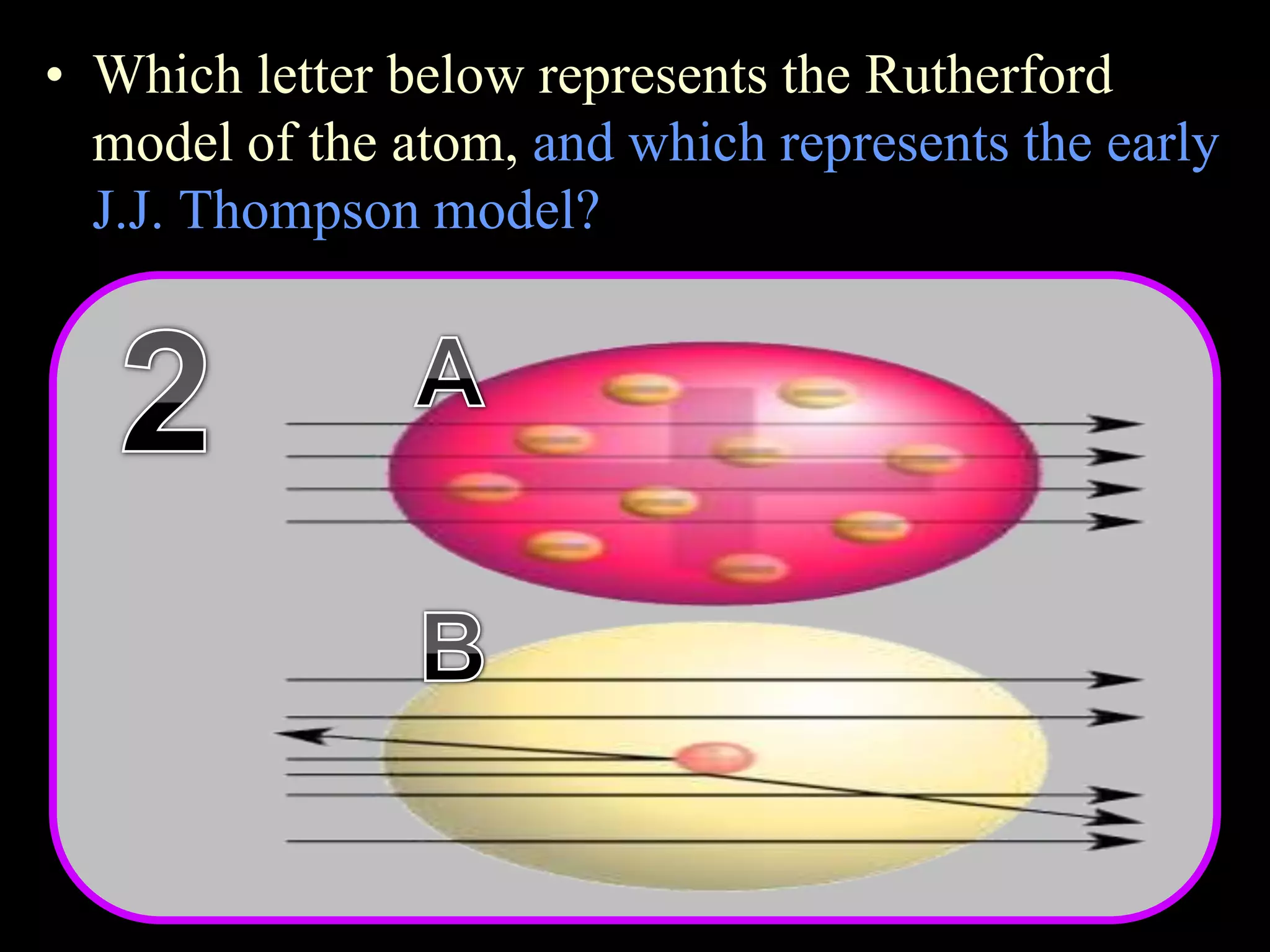
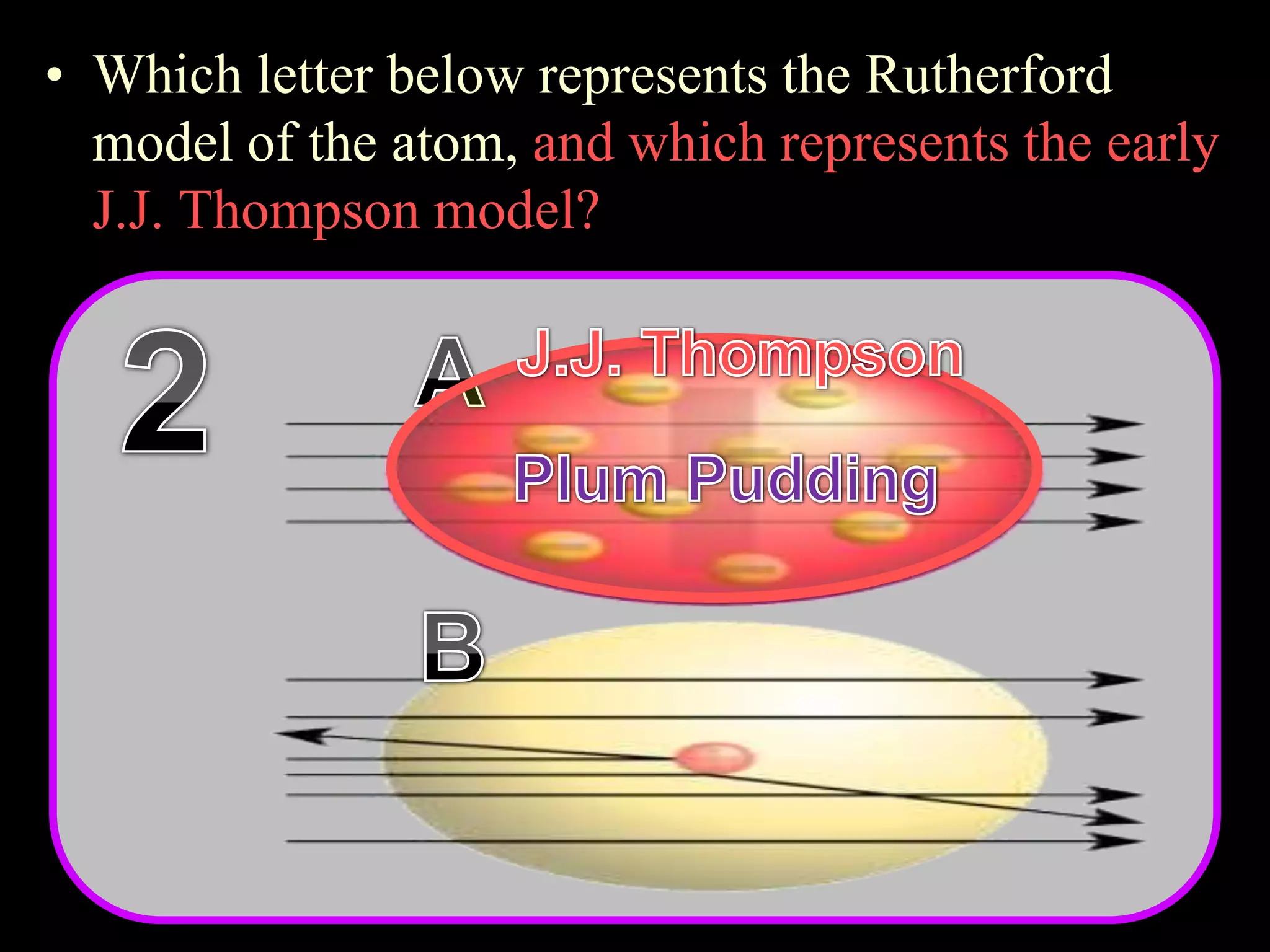
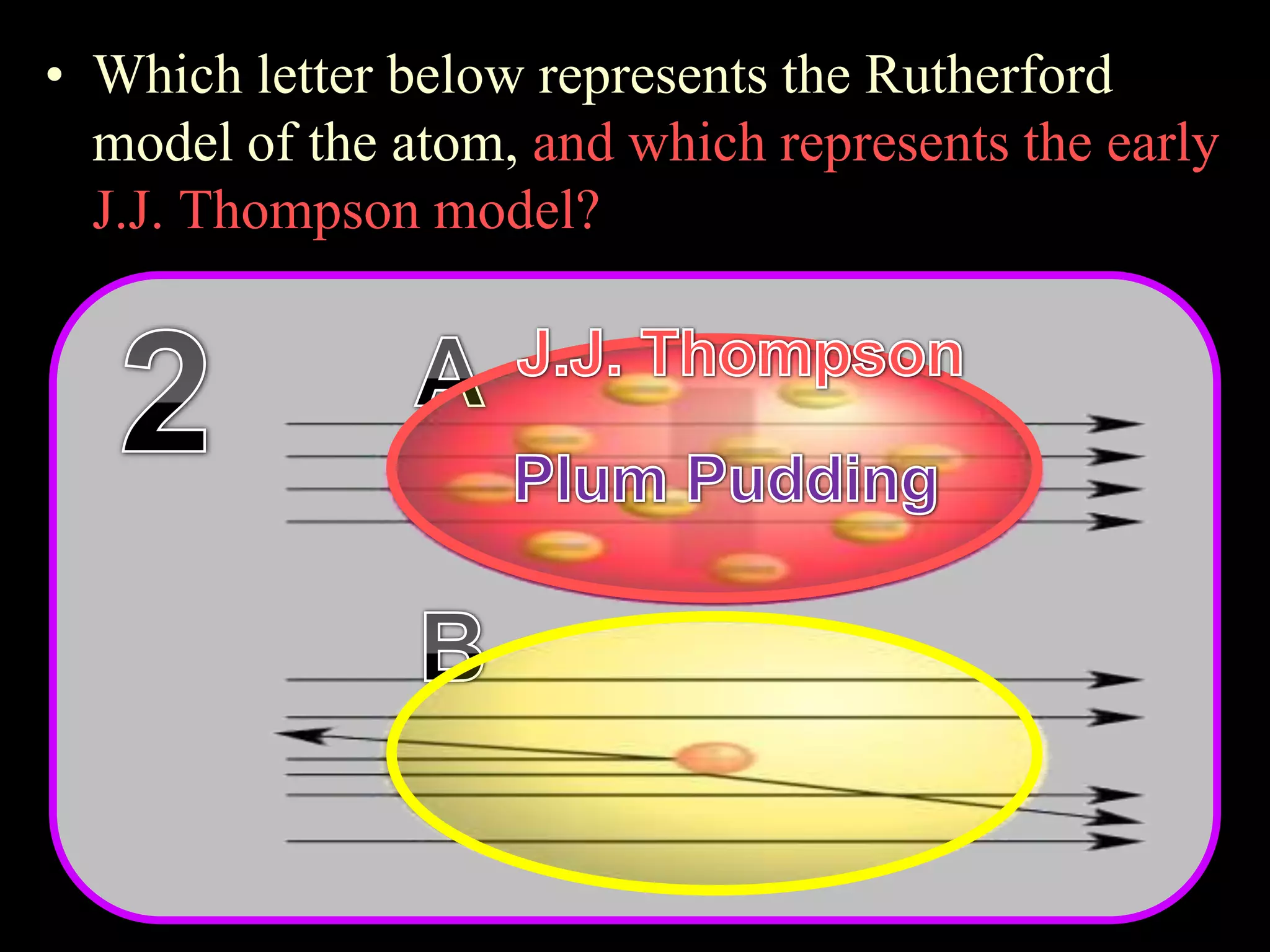
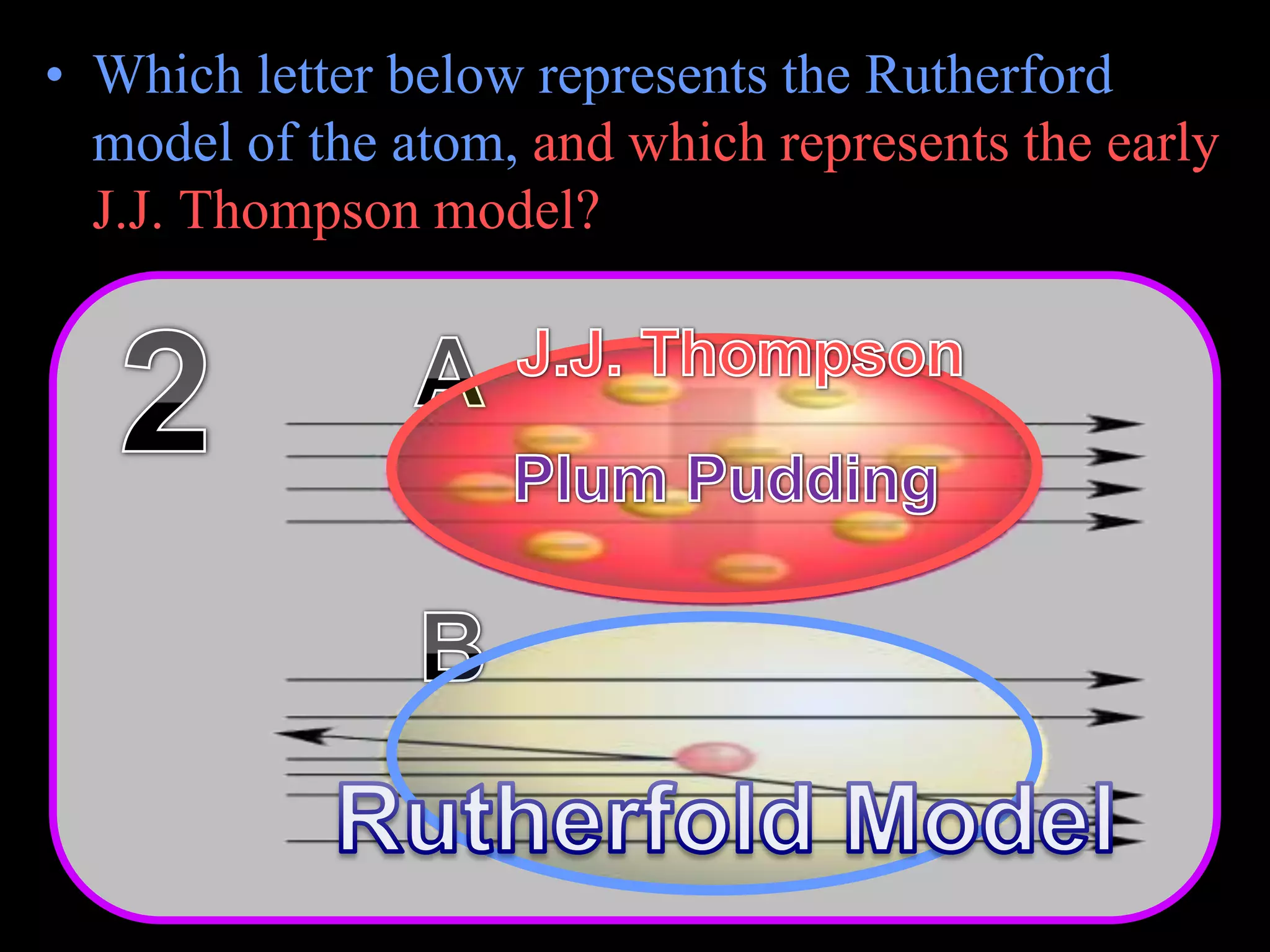
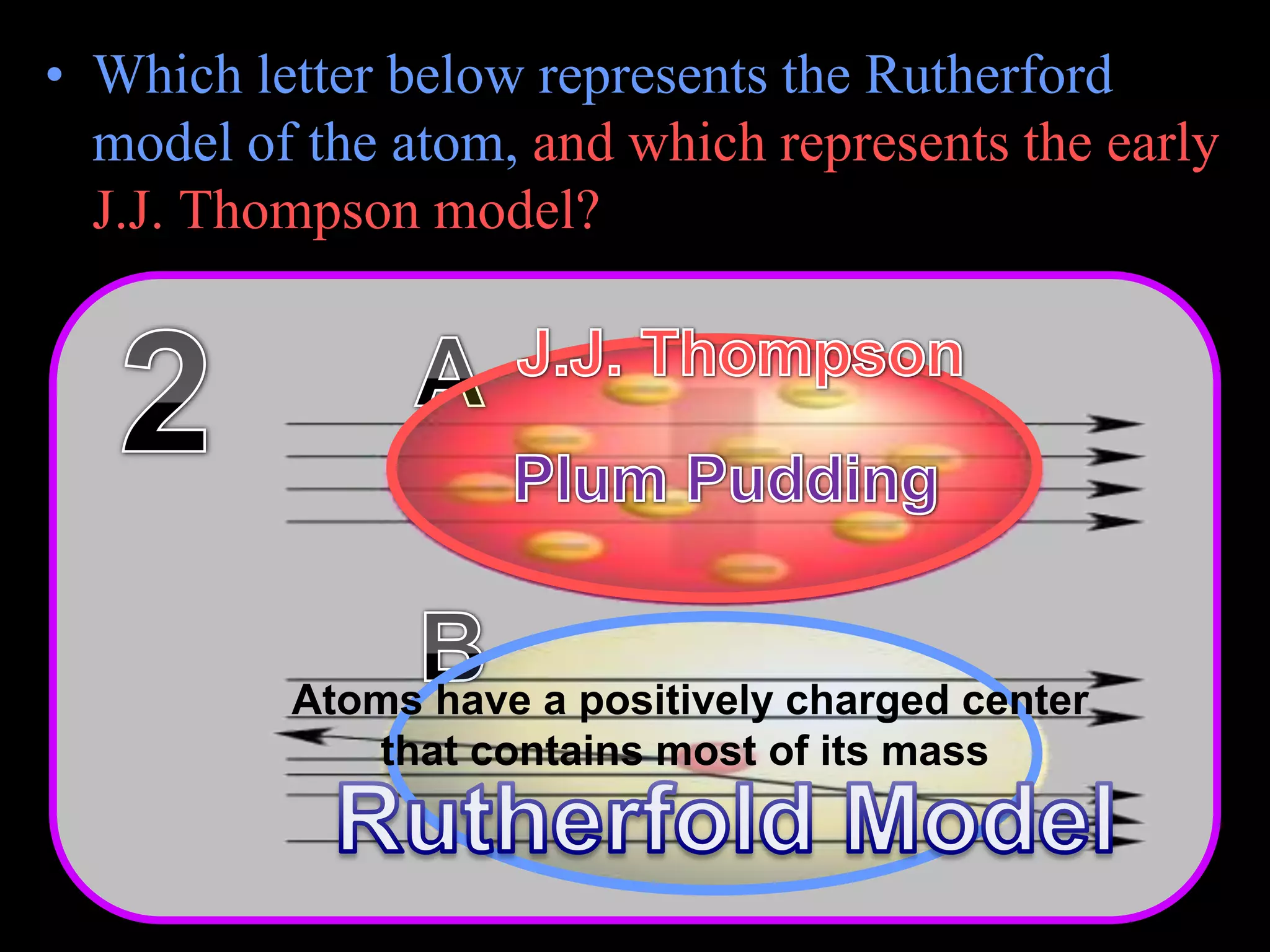
• Which letter below represents the Rutherford
model of the atom, and which represents the early
J.J. Thompson model?
Copyright © 2010 Ryan P. Murphy
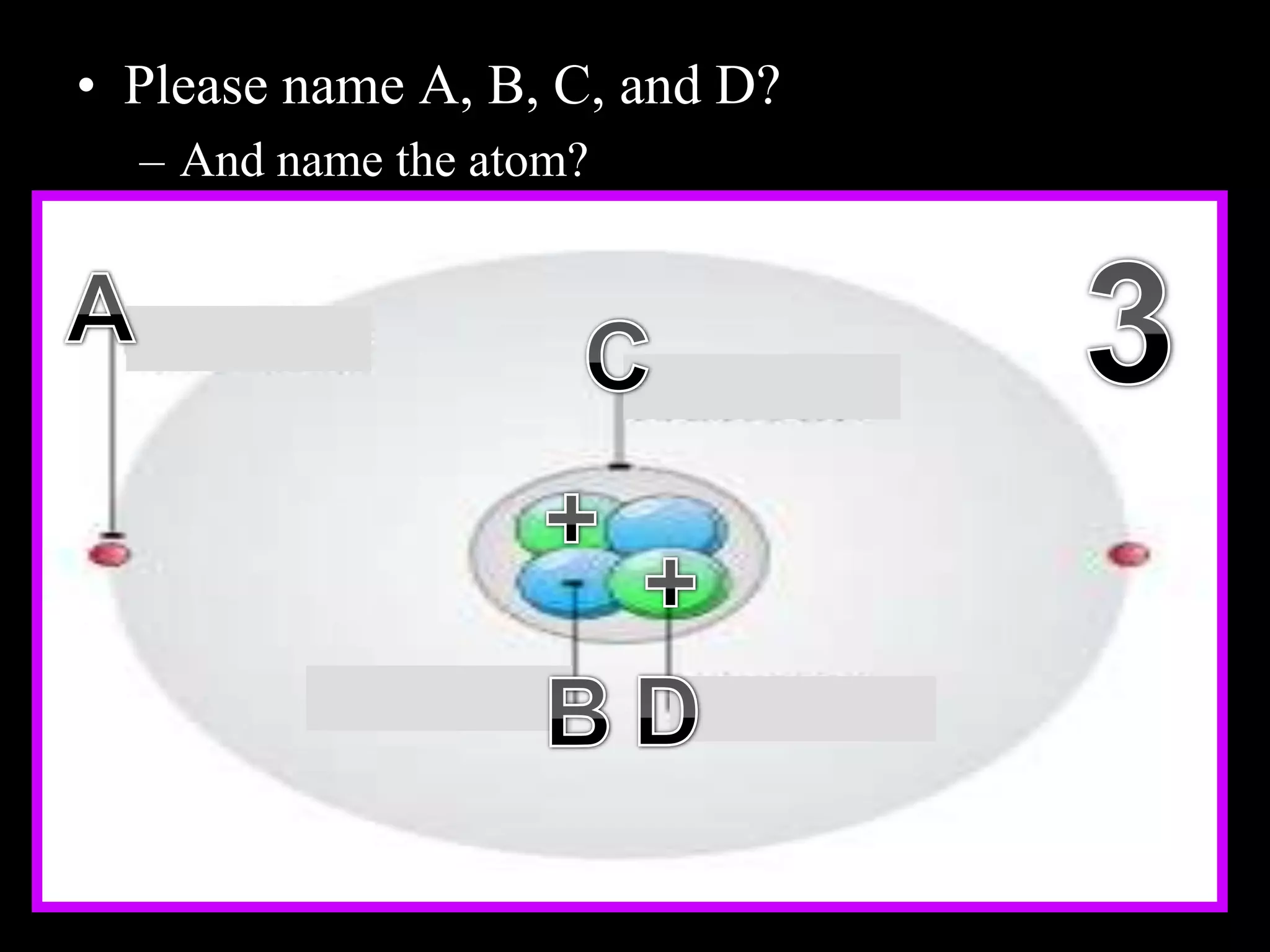
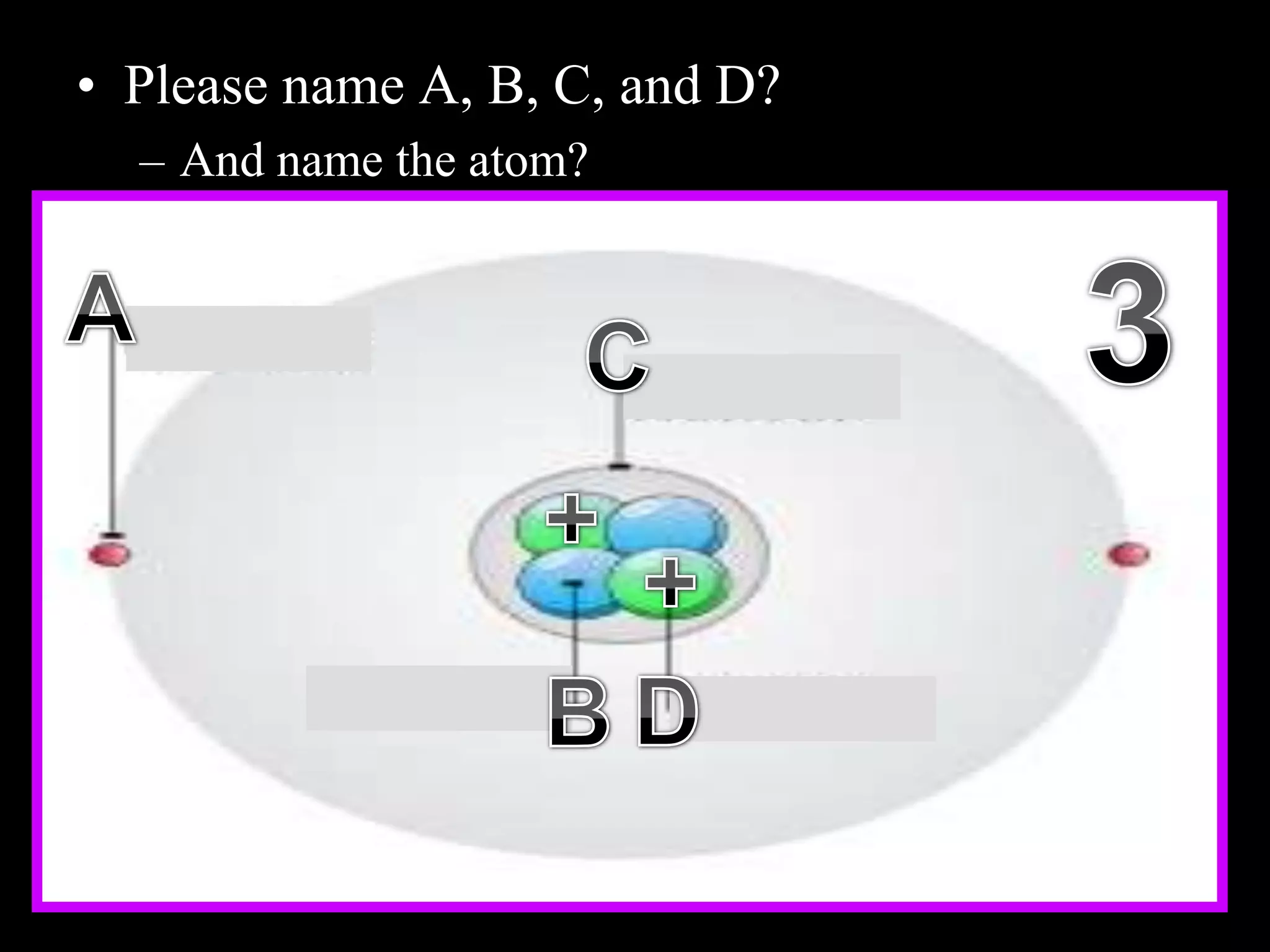
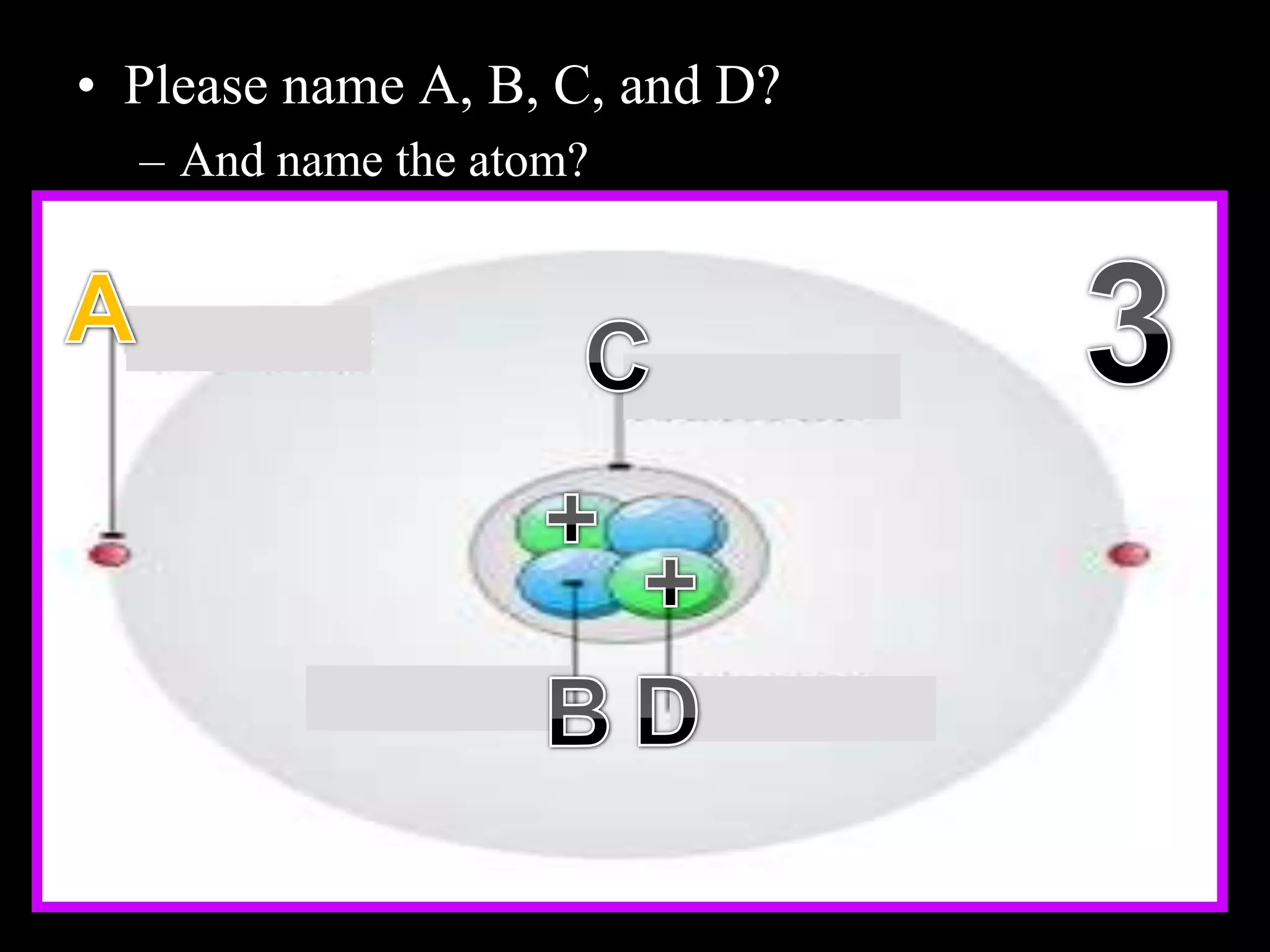
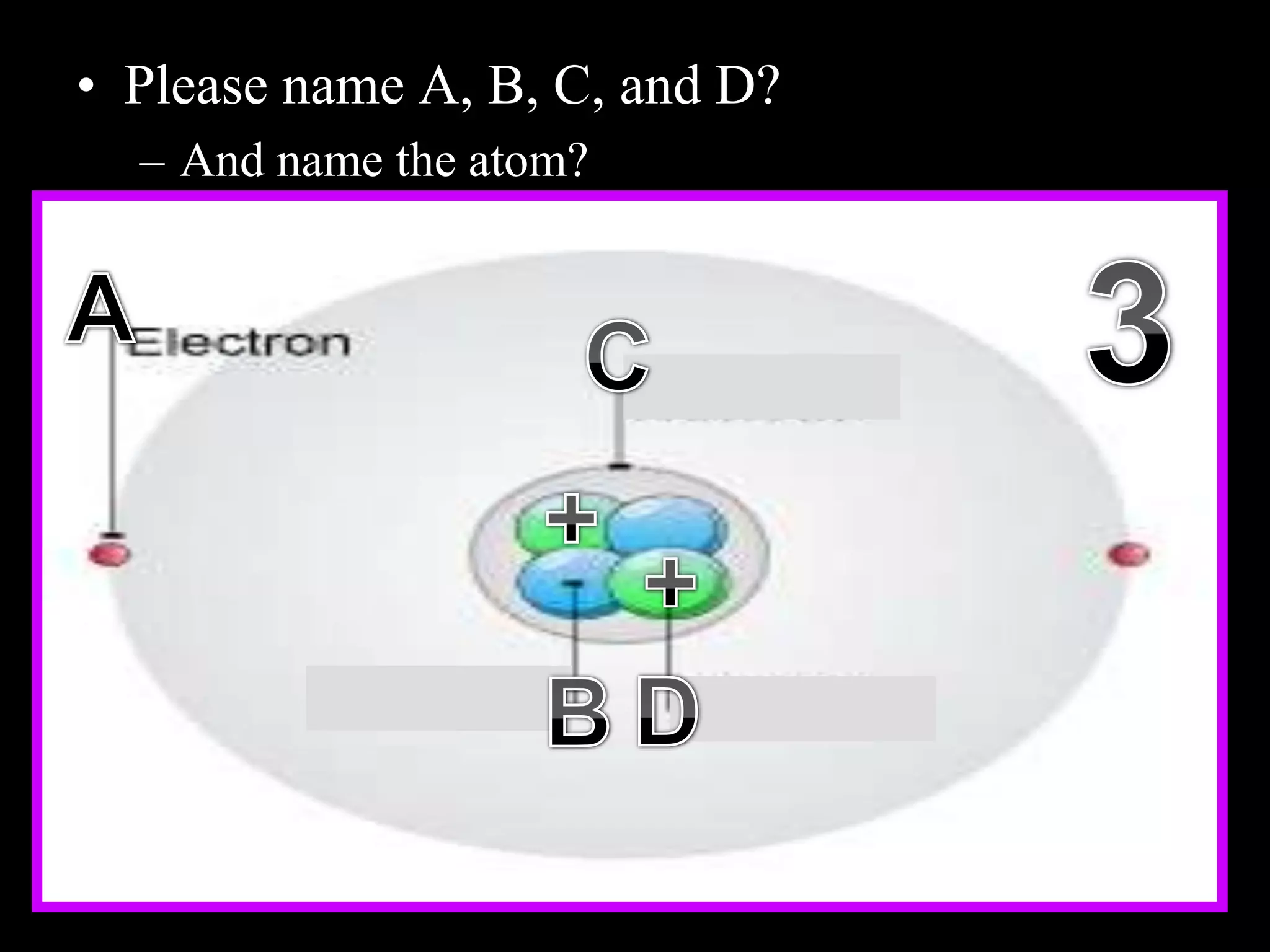
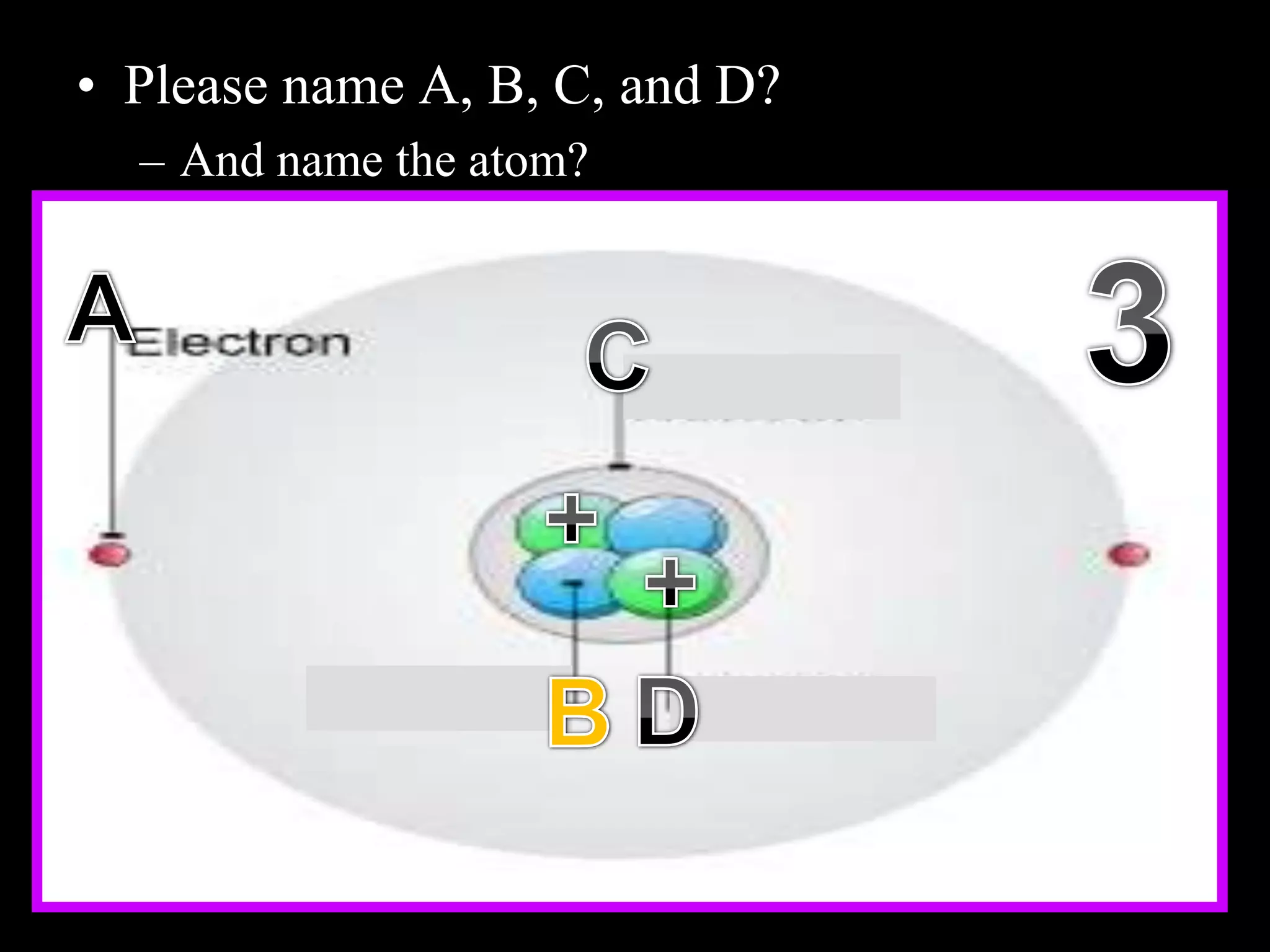
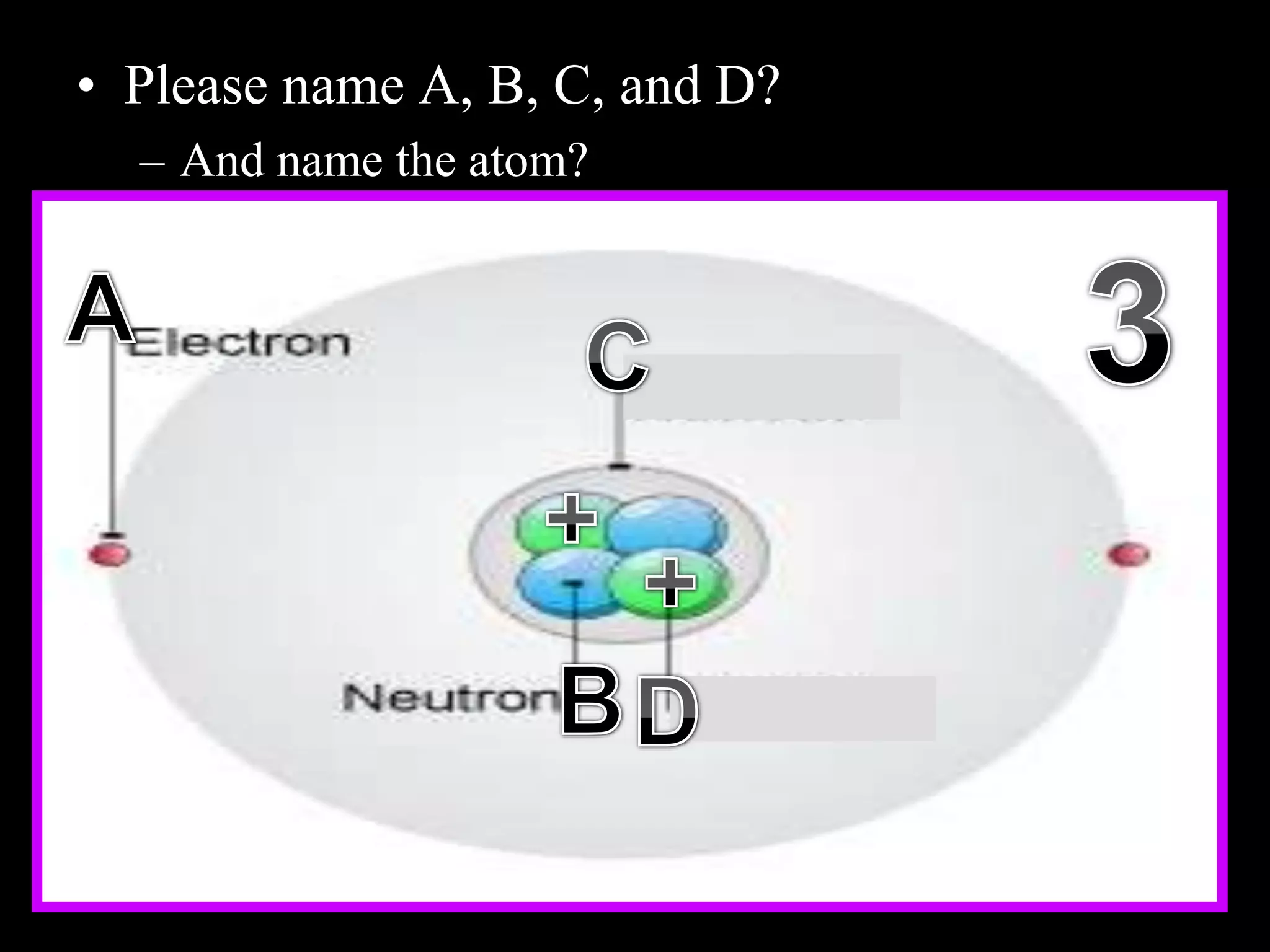
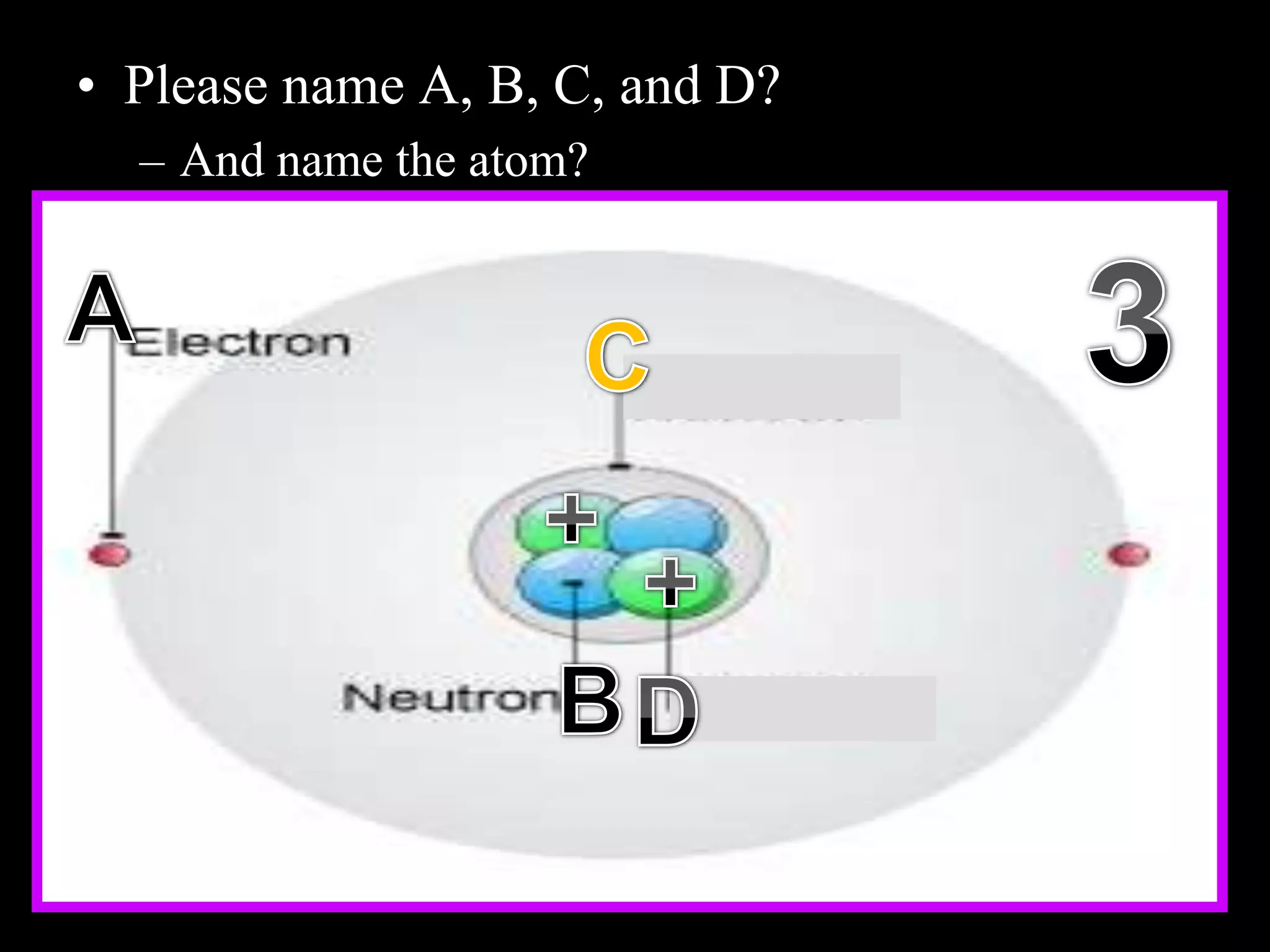
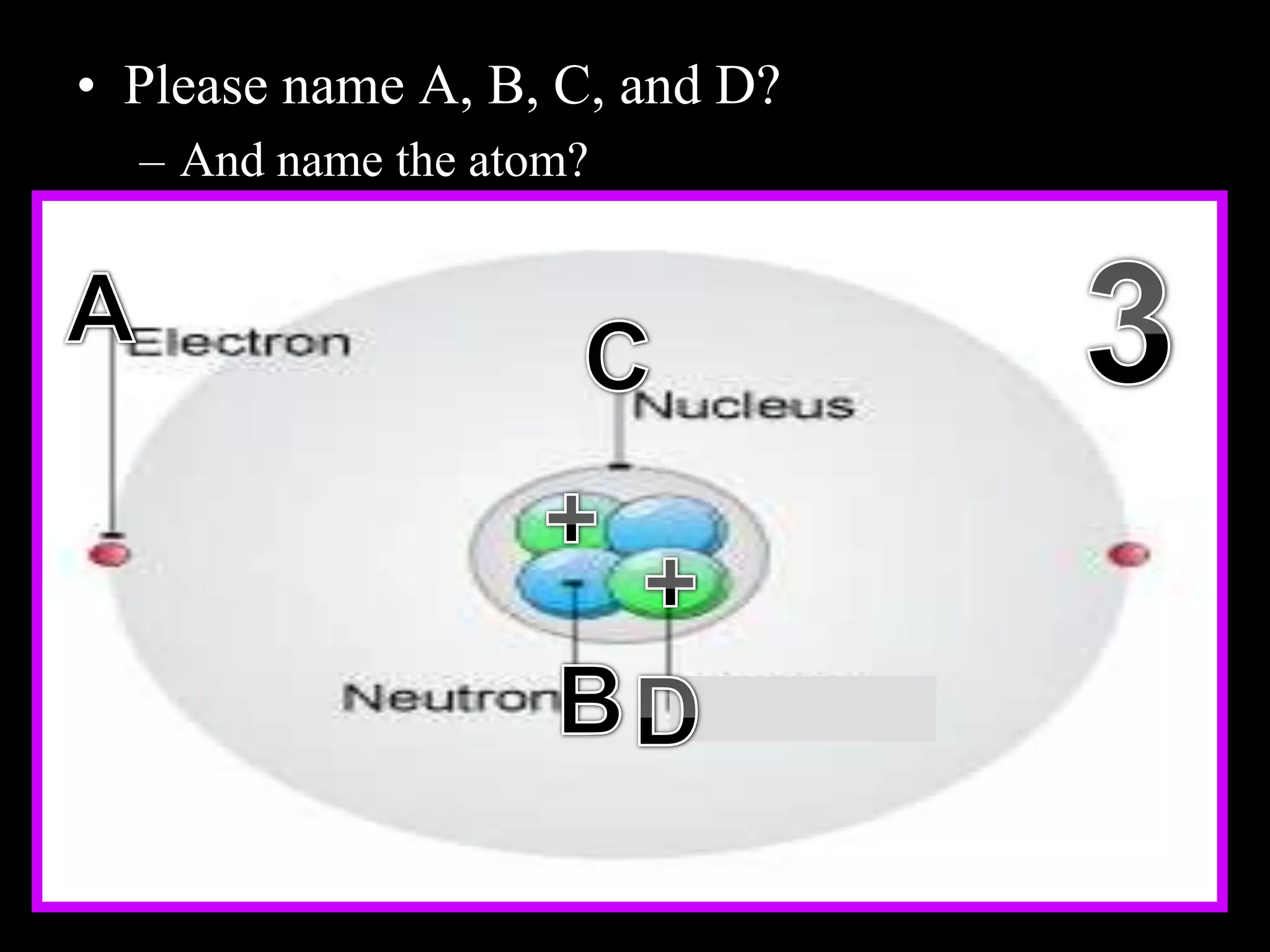
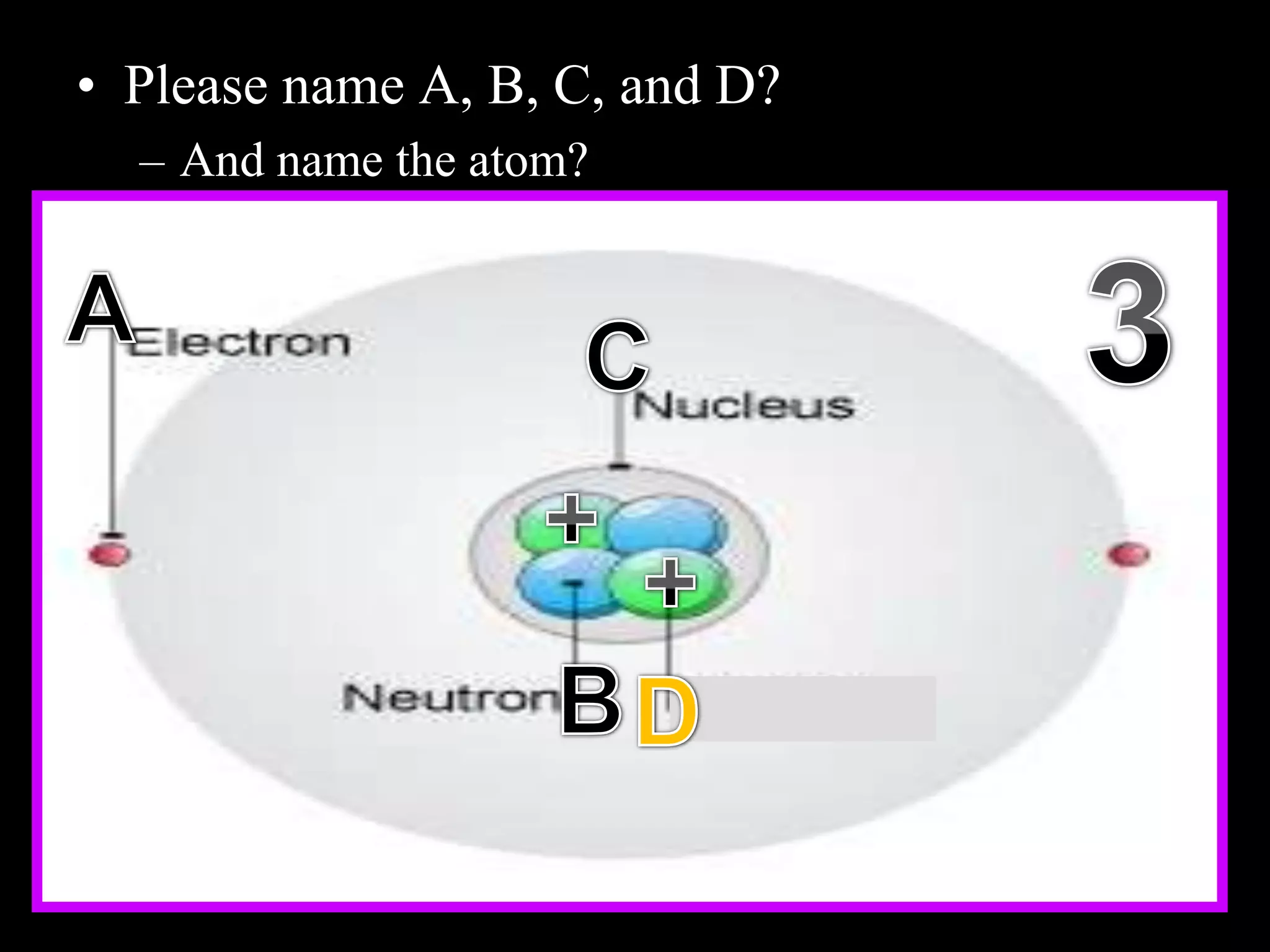
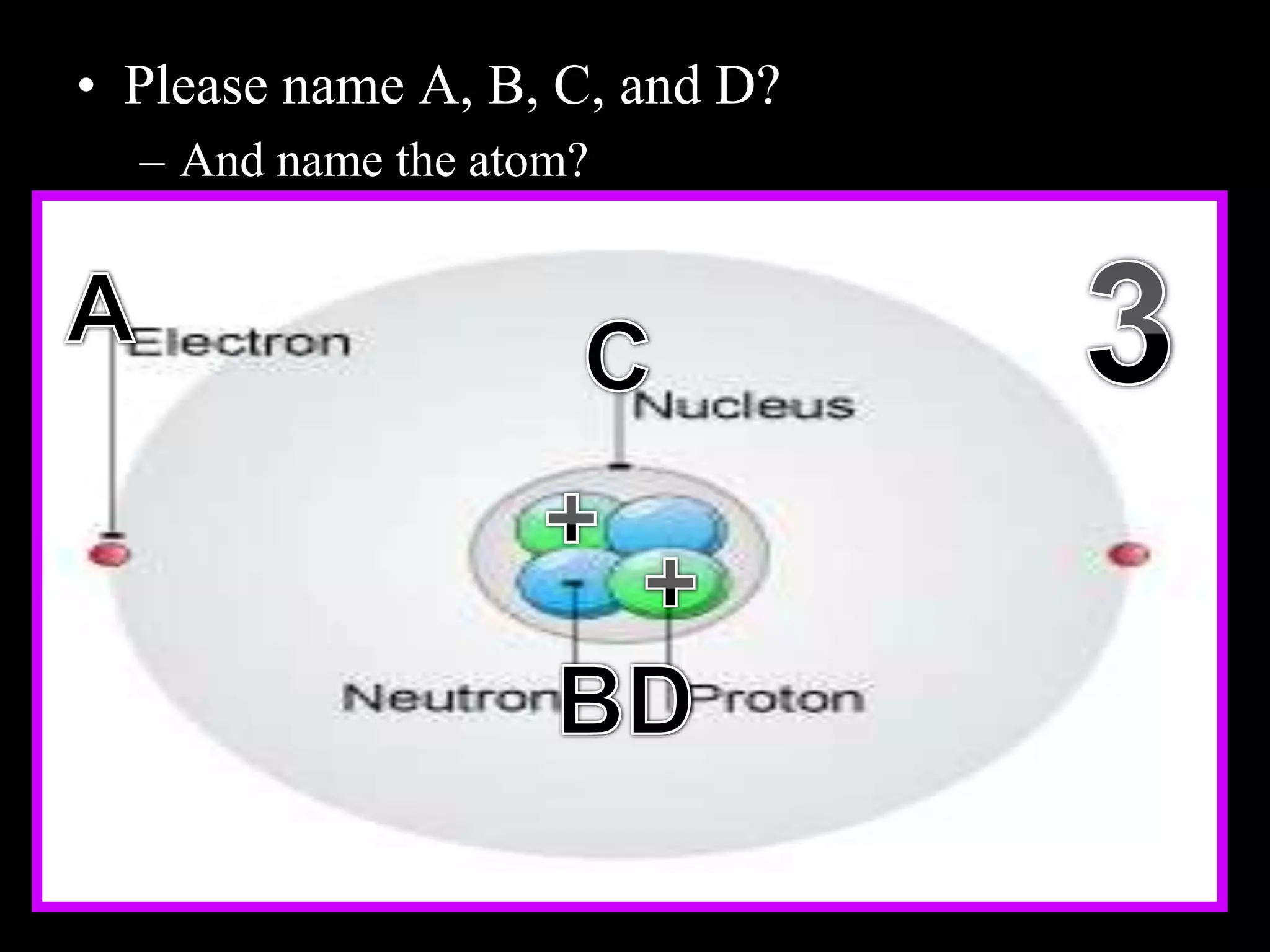
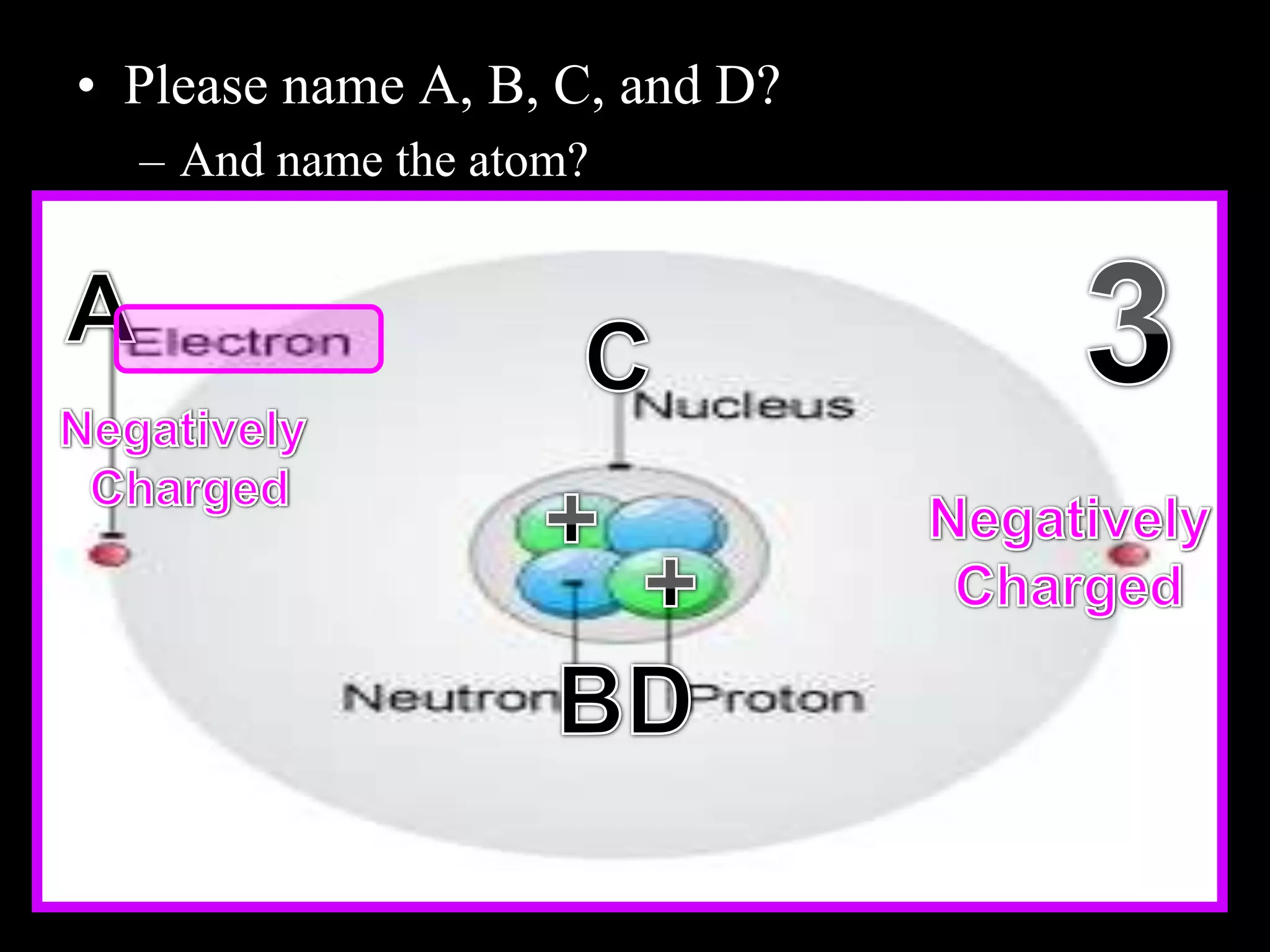
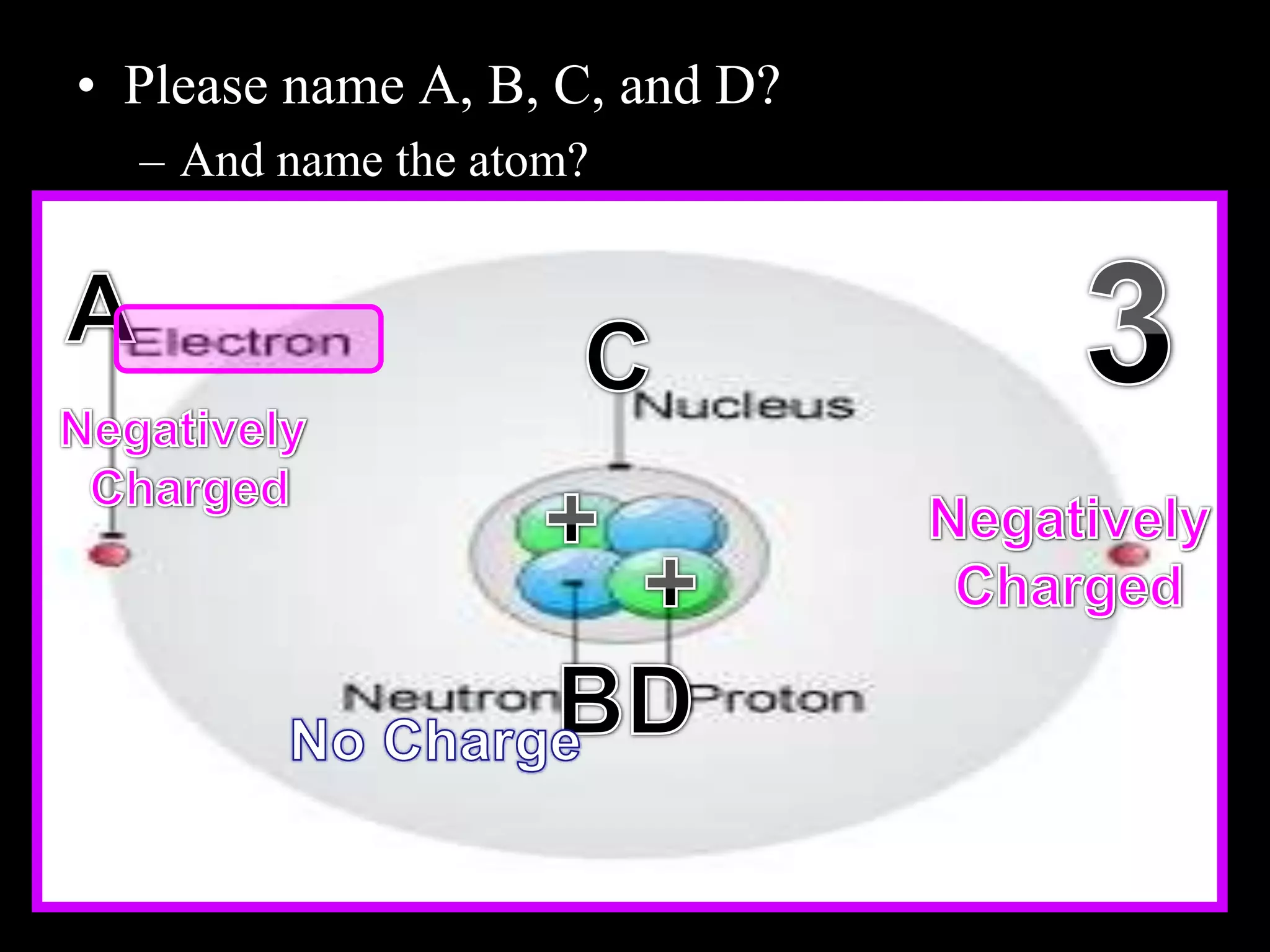
• Please name A, B, C, and D?
– And name the atom?
Copyright © 2010 Ryan P. Murphy
• The nucleus of the atom is…
Copyright © 2010 Ryan P. Murphy
• The nucleus of the atom is…
– A.) Very dense.
Copyright © 2010 Ryan P. Murphy
• The nucleus of the atom is…
– A.) Very dense.
– B.) Very, very, dense.
Copyright © 2010 Ryan P. Murphy
• The nucleus of the atom is…
– A.) Very dense.
– B.) Very, very, dense.
– C.) Very, very, very dense.
Copyright © 2010 Ryan P. Murphy
• The nucleus of the atom is…
– A.) Very dense.
– B.) Very, very, dense.
– C.) Very, very, very dense.
– D.) Very, very, very, very dense.
Copyright © 2010 Ryan P. Murphy
• The nucleus of the atom is…
– A.) Very dense.
– B.) Very, very, dense.
– C.) Very, very, very dense.
– D.) Very, very, very, very dense.
– E.) Very, very, very, very, very, dense.
Copyright © 2010 Ryan P. Murphy
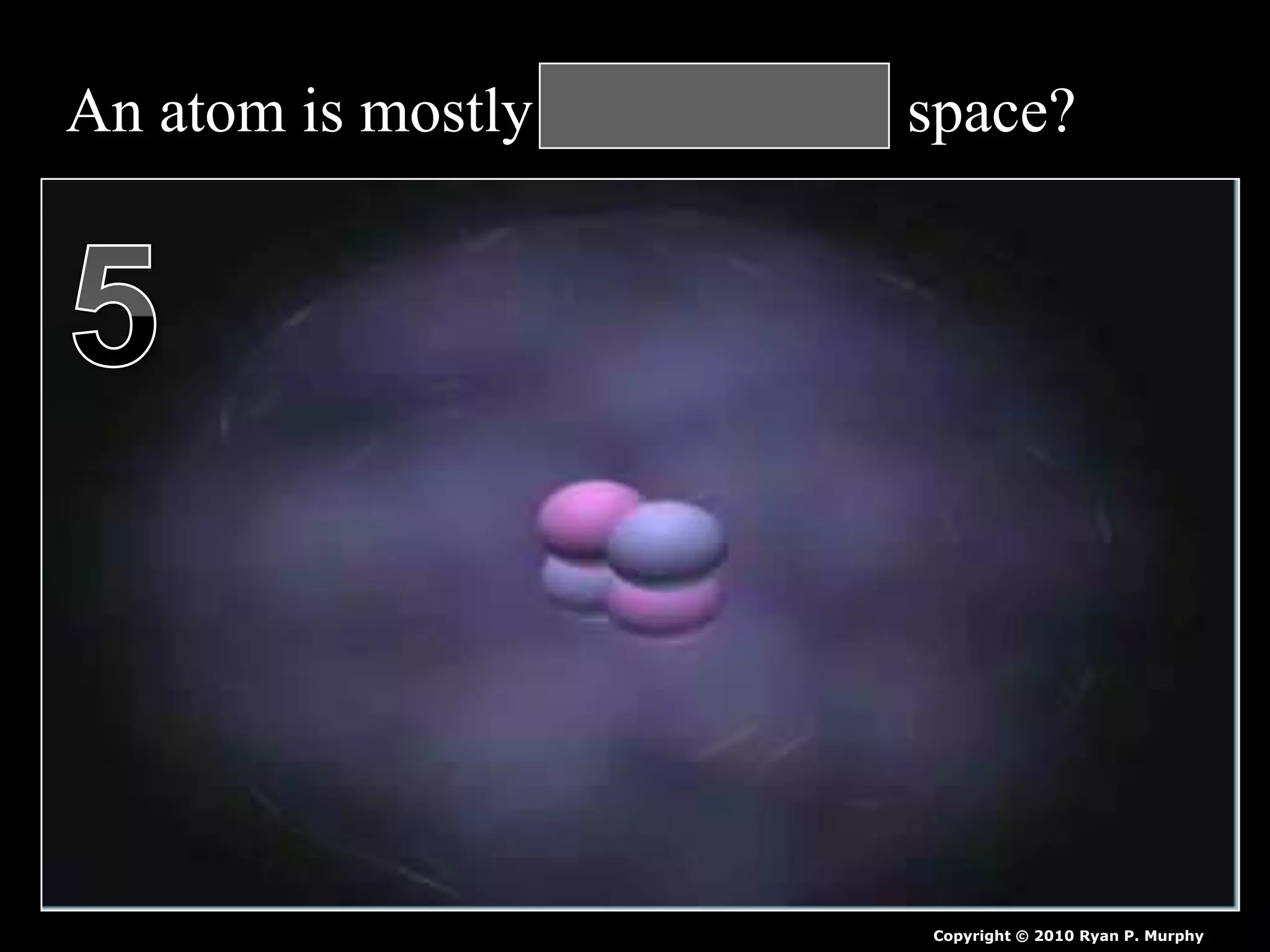
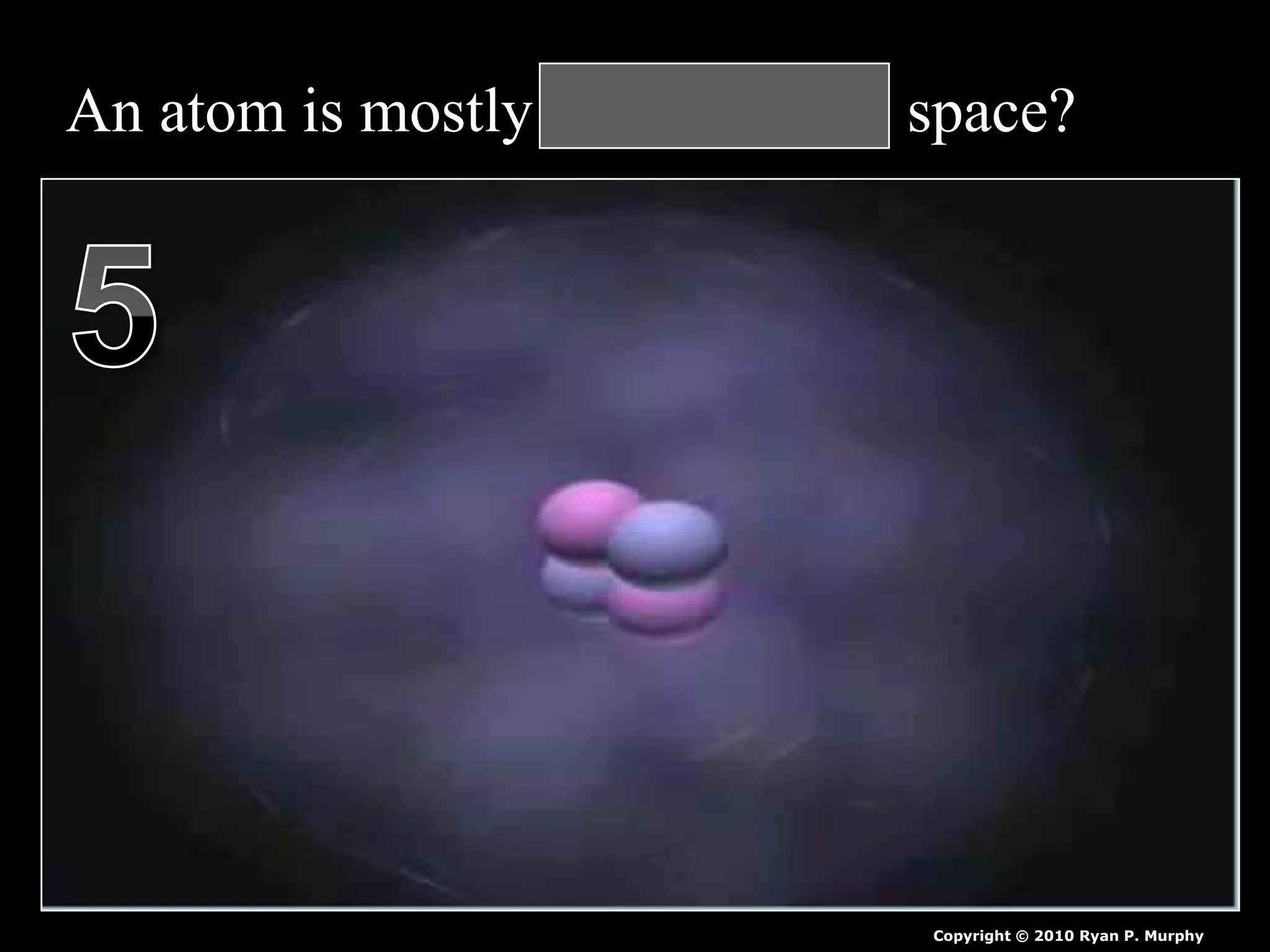
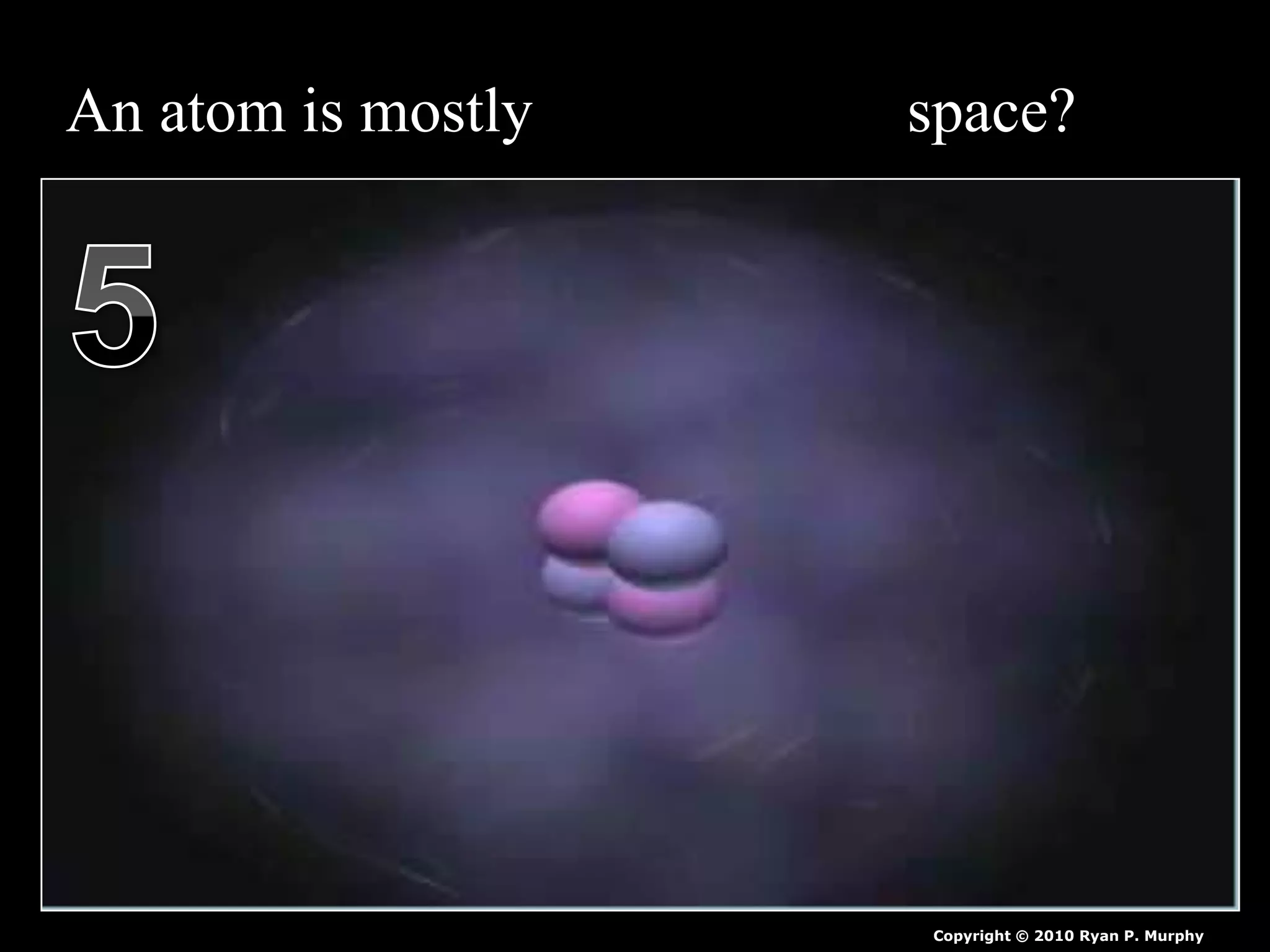
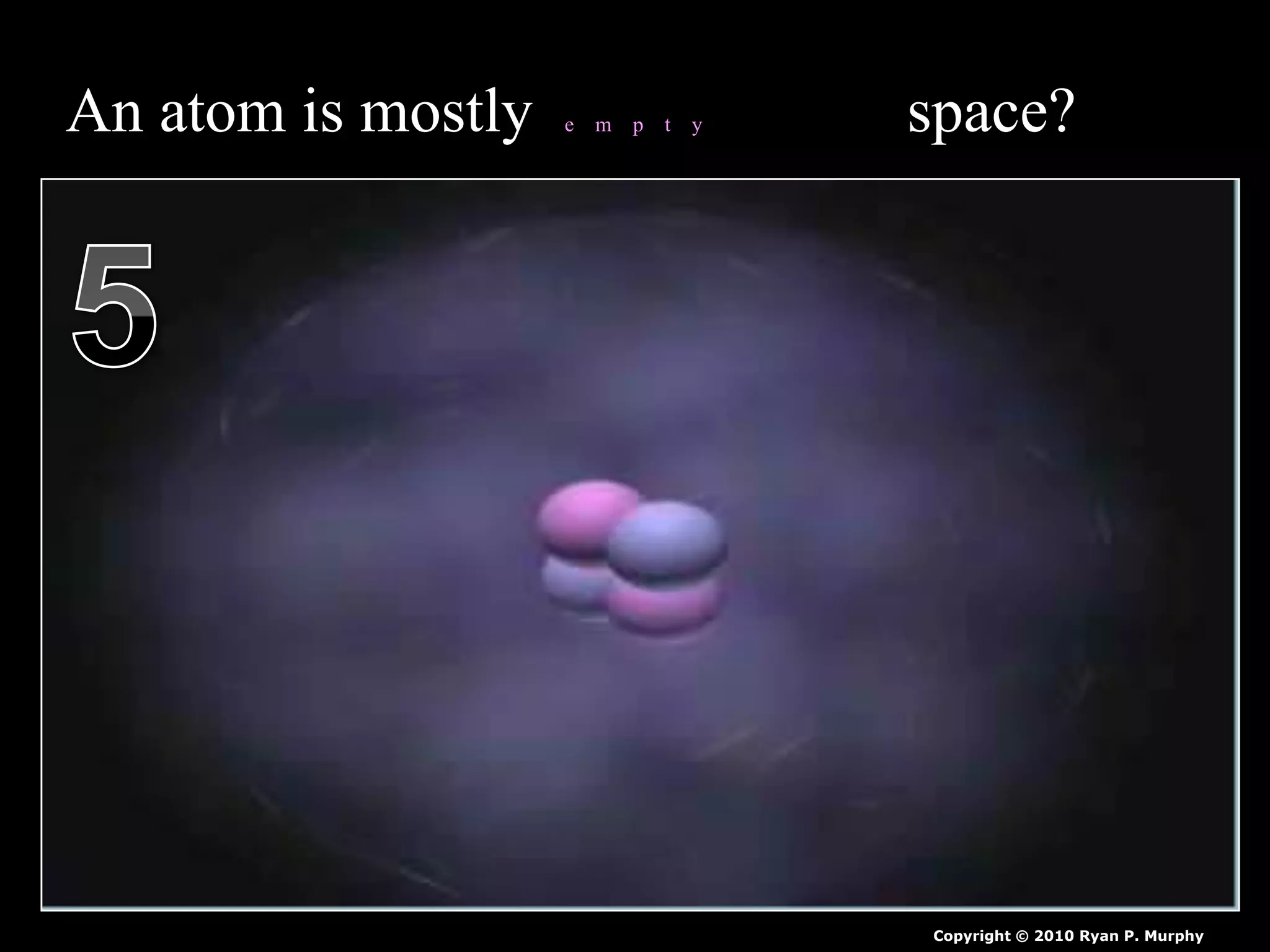
An atom is mostly empty space?
Copyright © 2010 Ryan P. Murphy
HAVE A GOOD
LOOK ATOM
ROUND
ABOUT
NUMBERIFFIC SUPER
SMALL
ATOMIC
POWER
-BONUS-
1 6 11 16 *21
2 7 12 17 *22
3 8 13 18 *23
4 9 14 19 *24
5 10 15 20 *25
Copyright © 2010 Ryan P. Murphy
Intro to Atoms Review Game
HAVE A GOOD
LOOK ATOM
ROUND
ABOUT
NUMBERIFFIC SUPER
SMALL
ATOMIC
POWER
-BONUS-
1 6 11 16 *21
2 7 12 17 *22
3 8 13 18 *23
4 9 14 19 *24
5 10 15 20 *25
Copyright © 2010 Ryan P. Murphy
Intro to Atoms Review Game
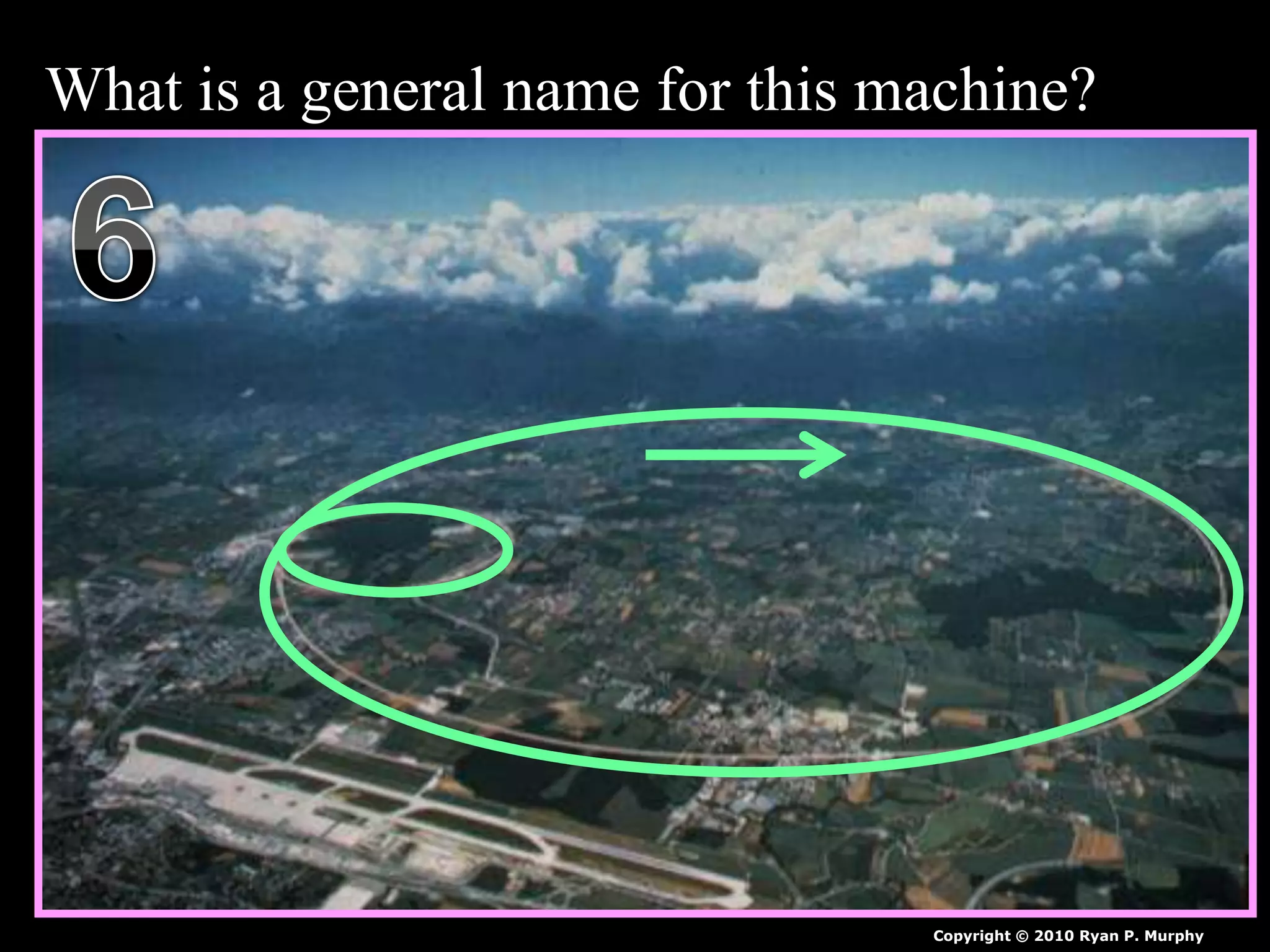
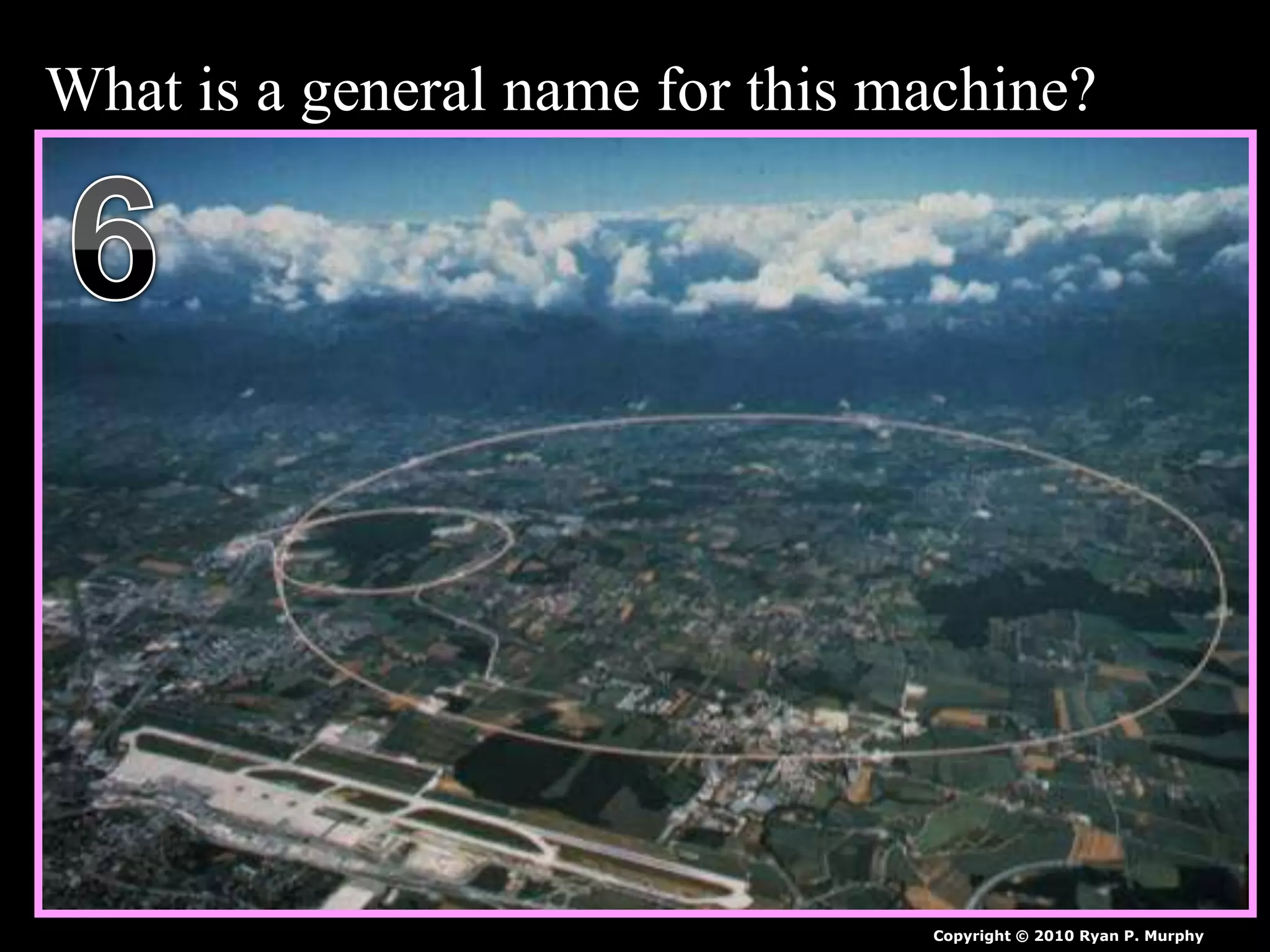
What is a general name for this machine?
Copyright © 2010 Ryan P. Murphy
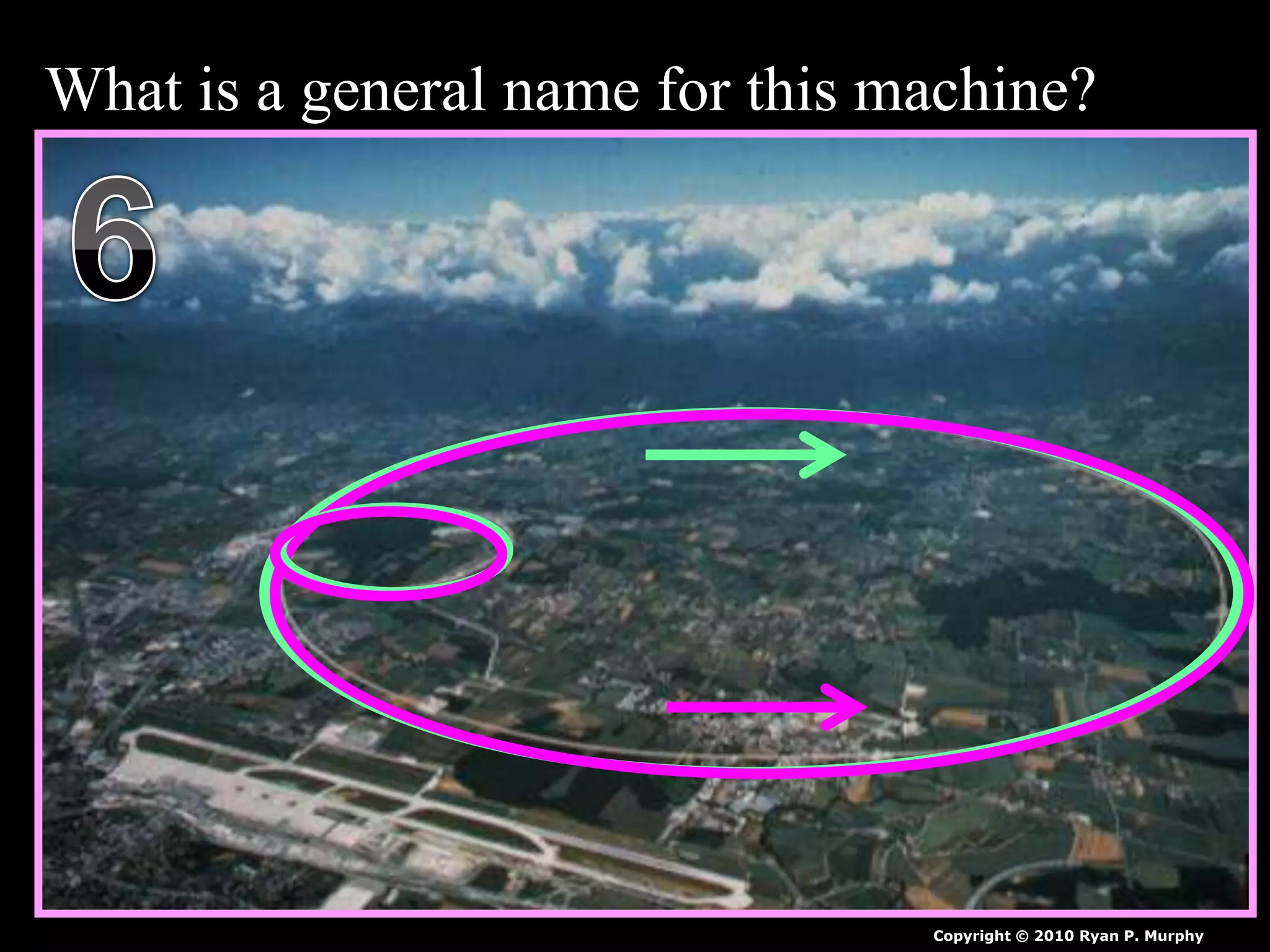
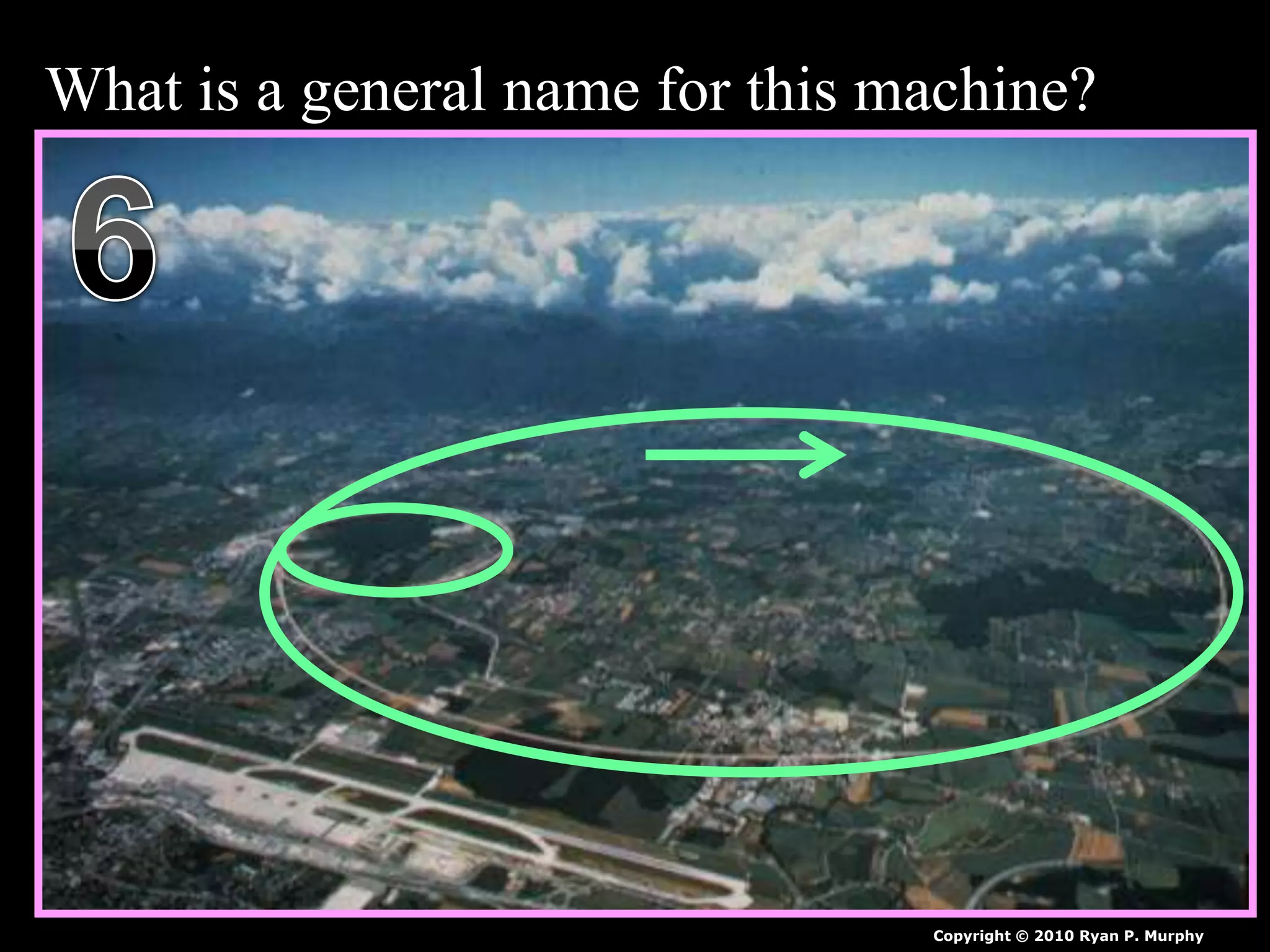
What is a general name for this machine?
Copyright © 2010 Ryan P. Murphy
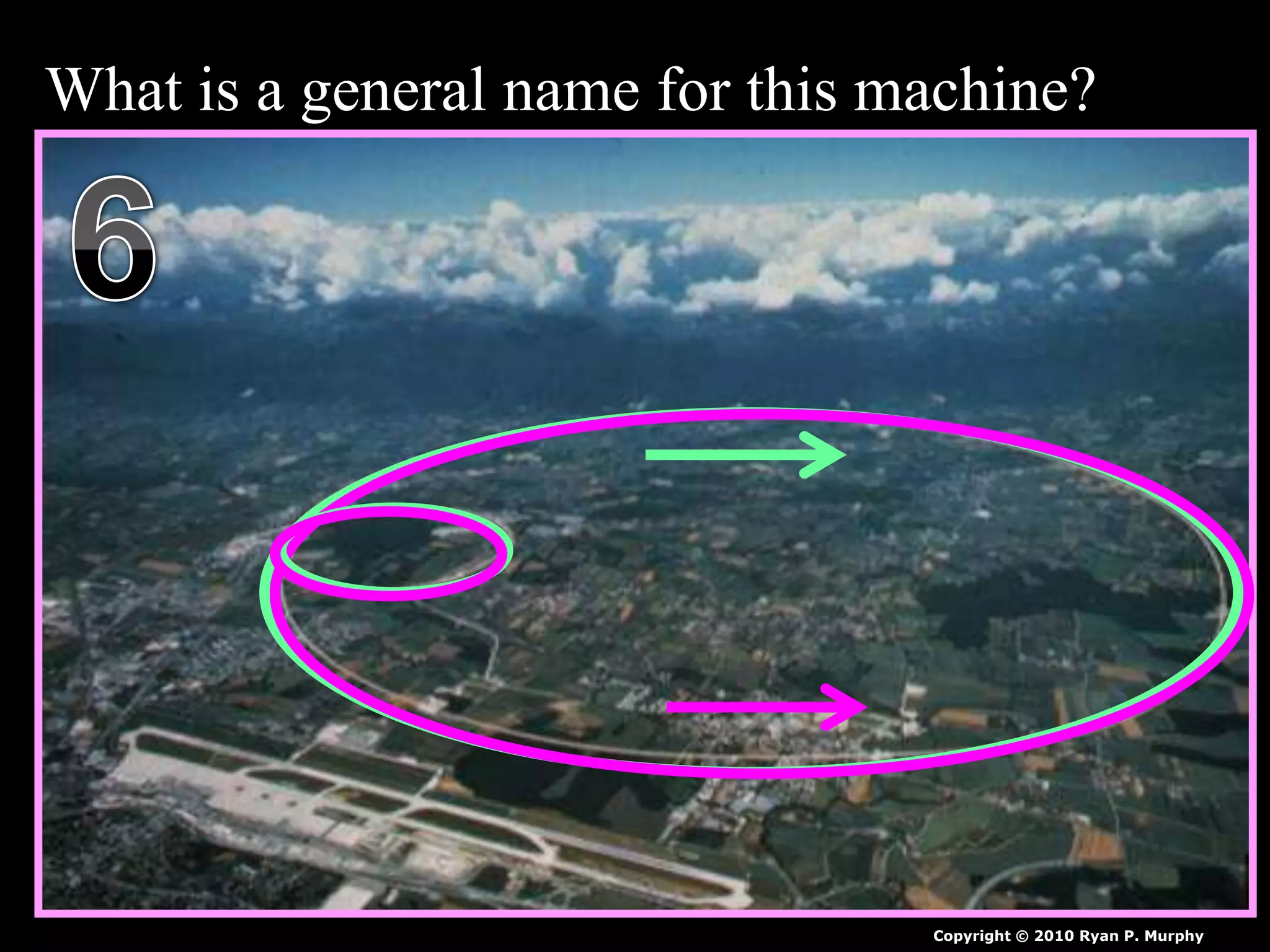
What is a general name for this machine?
Copyright © 2010 Ryan P. Murphy
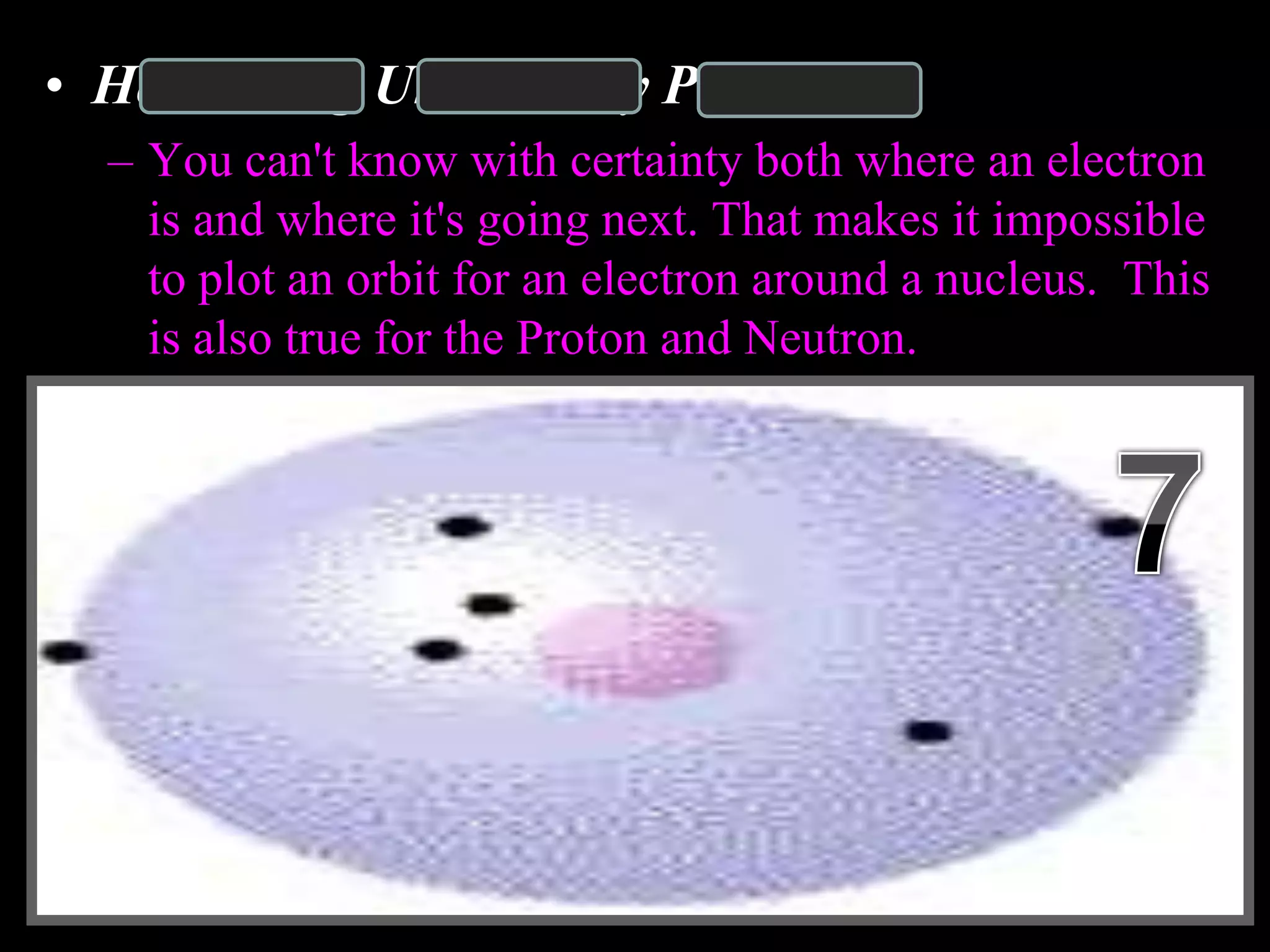
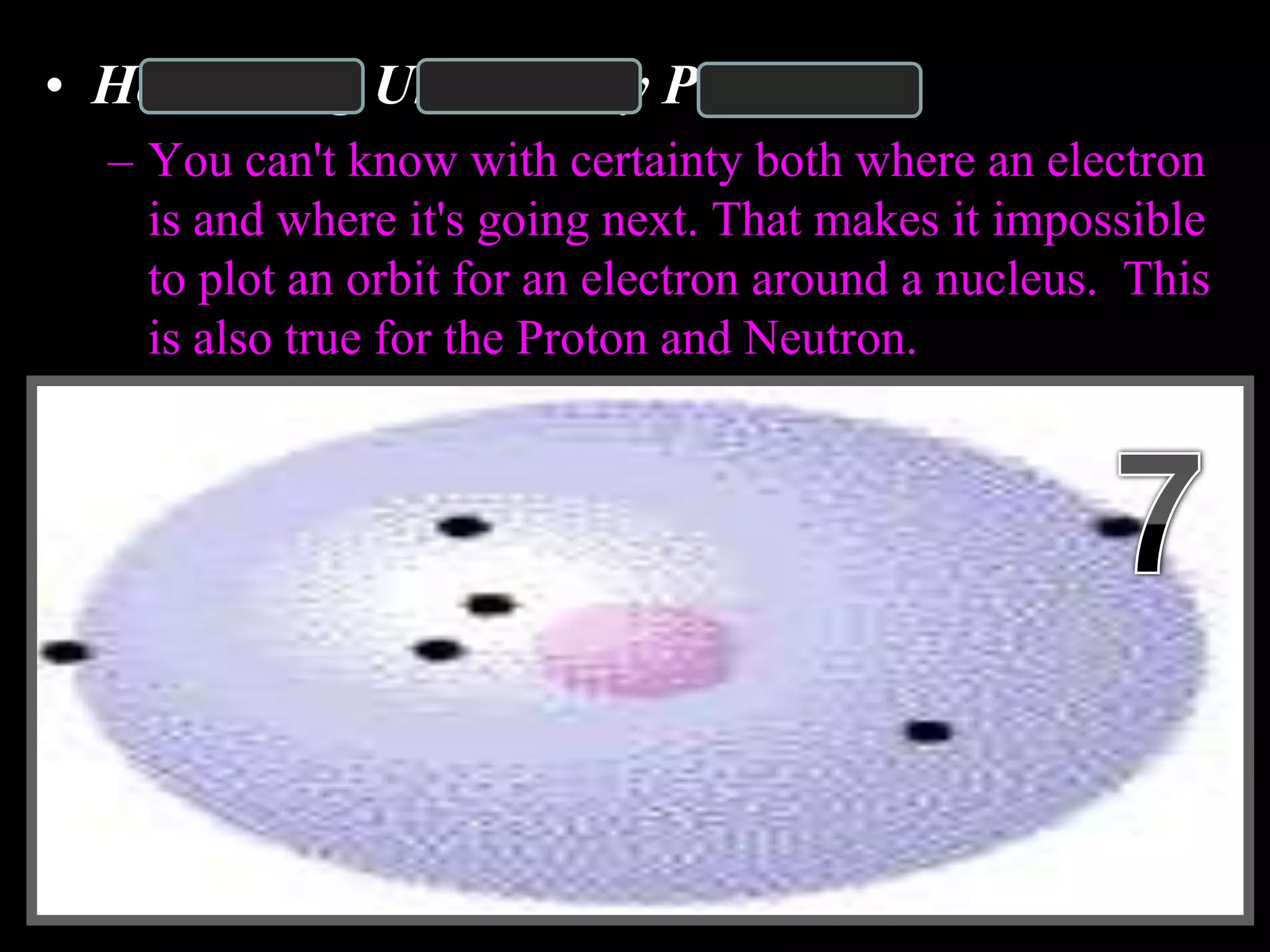
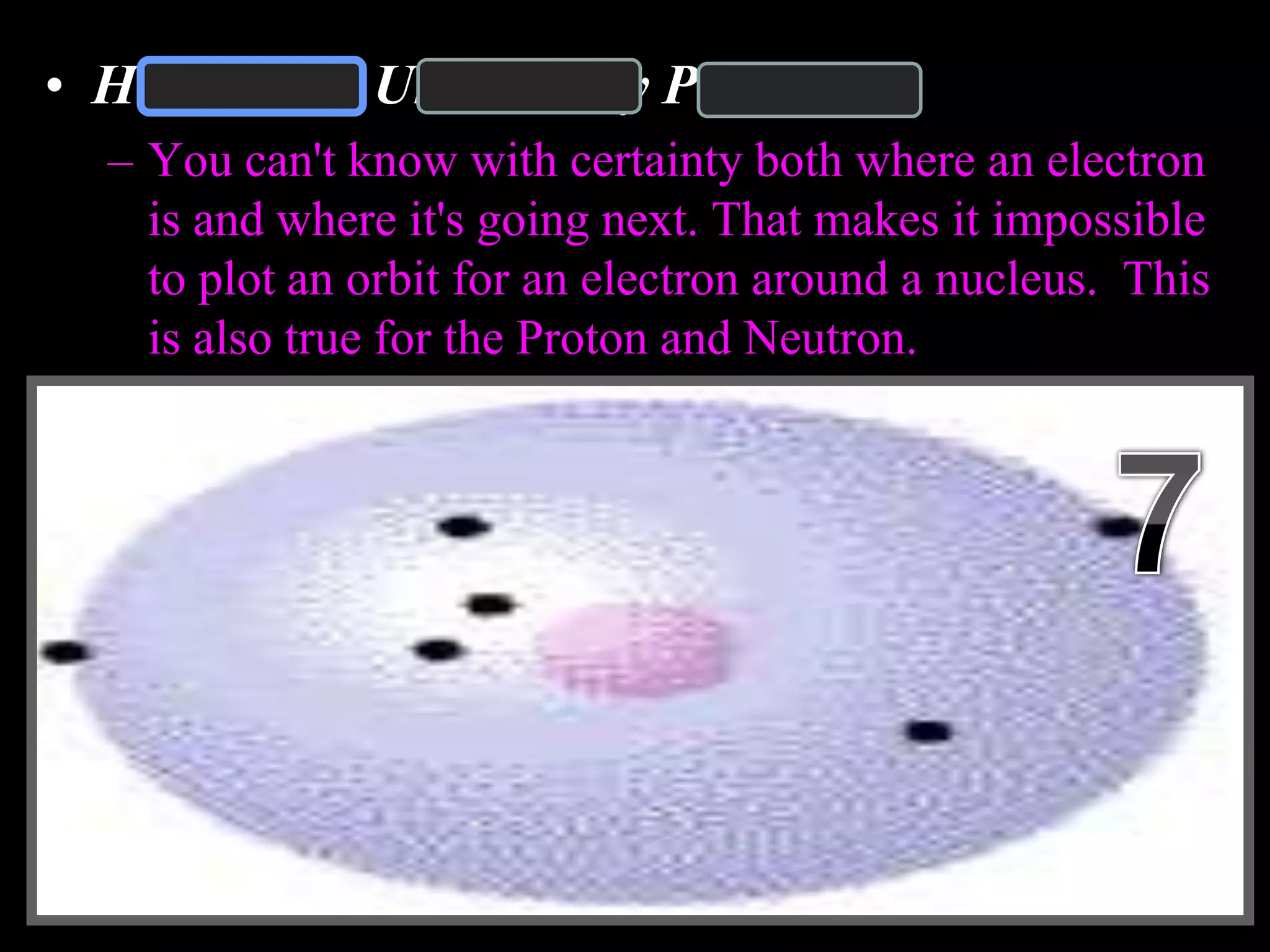
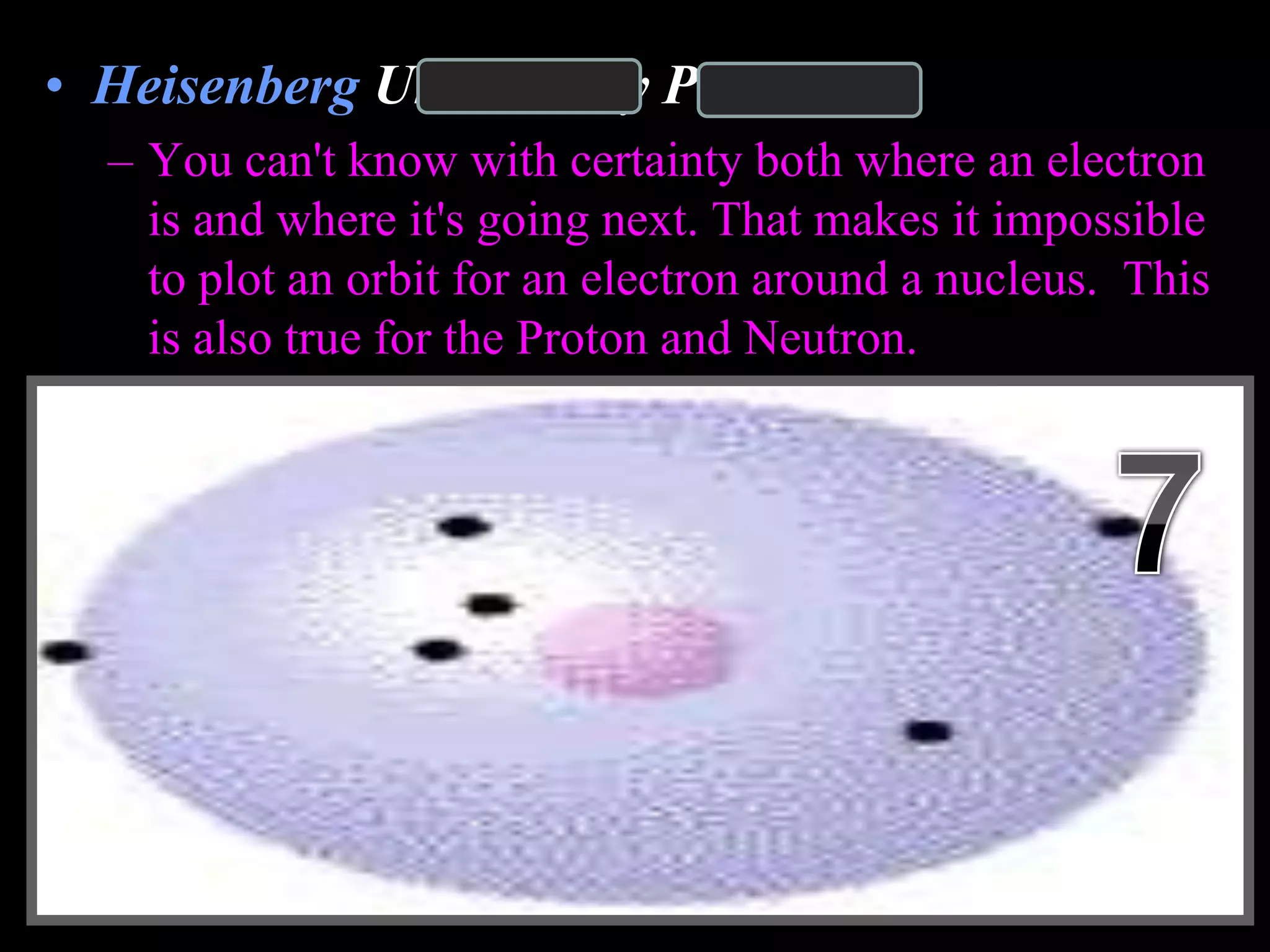
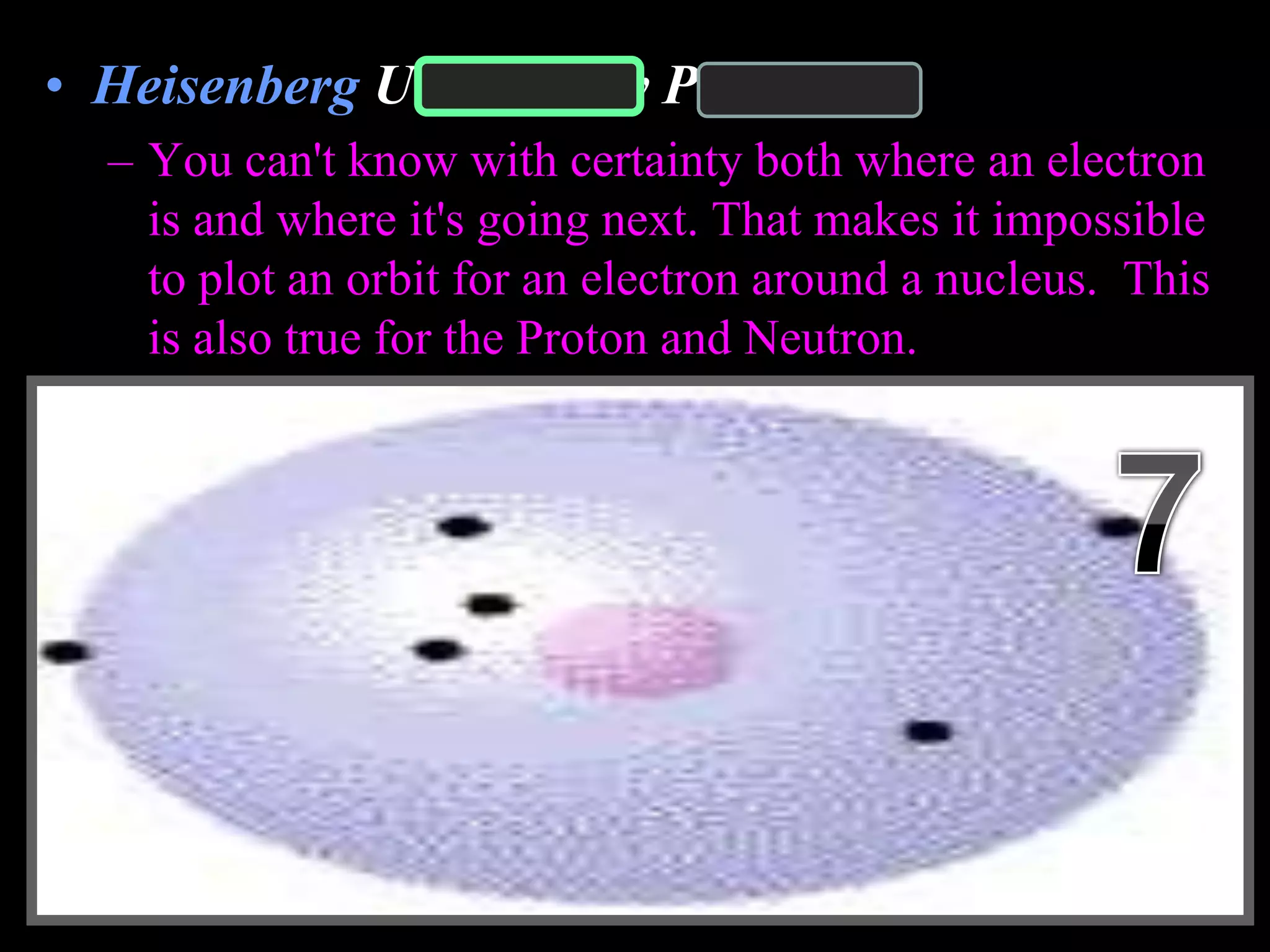
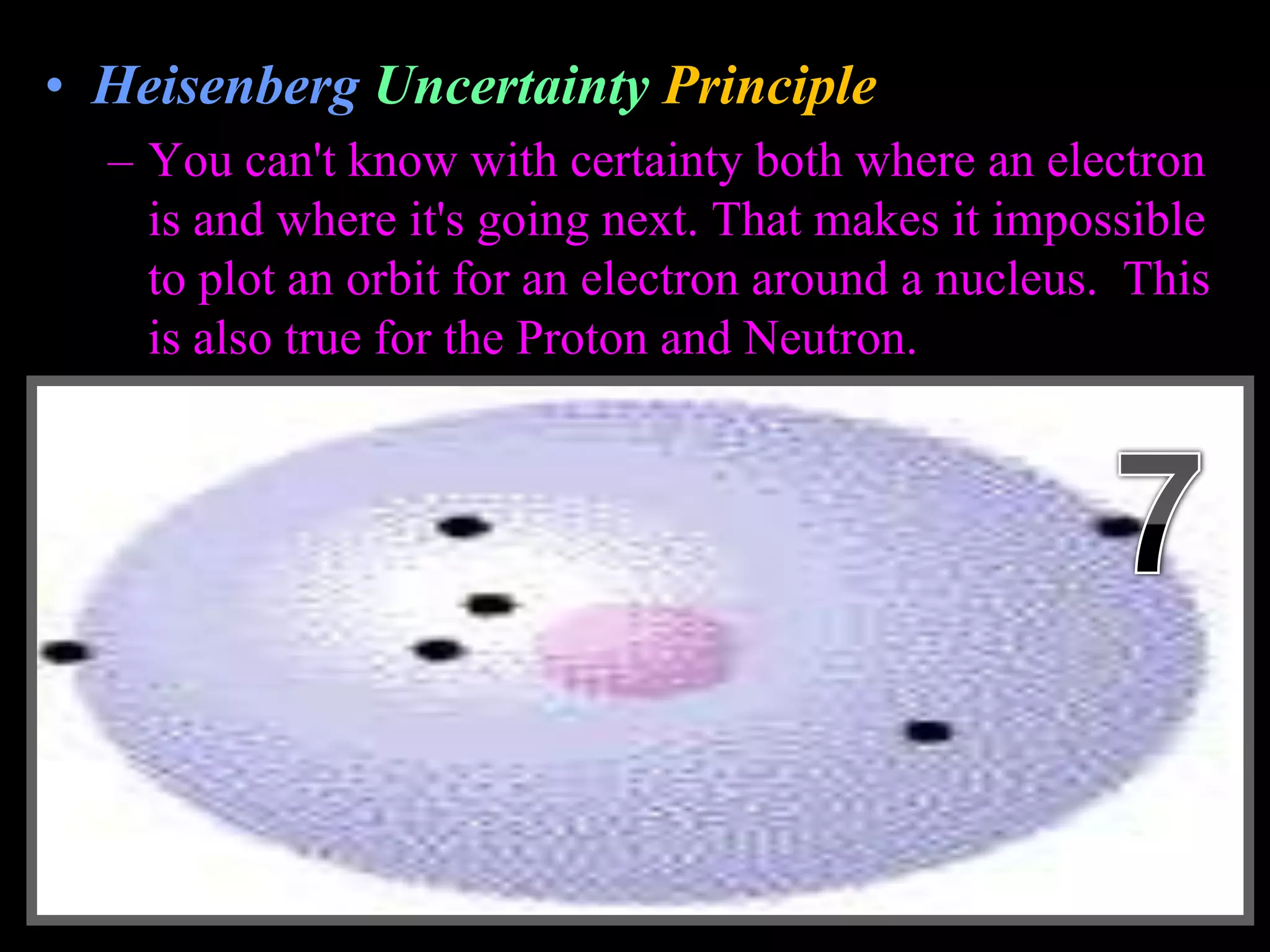
• Heisenberg Uncertainty Principle
– You can't know with certainty both where an electron
is and where it's going next. That makes it impossible
to plot an orbit for an electron around a nucleus. This
is also true for the Proton and Neutron.
Copyright © 2010 Ryan P. Murphy
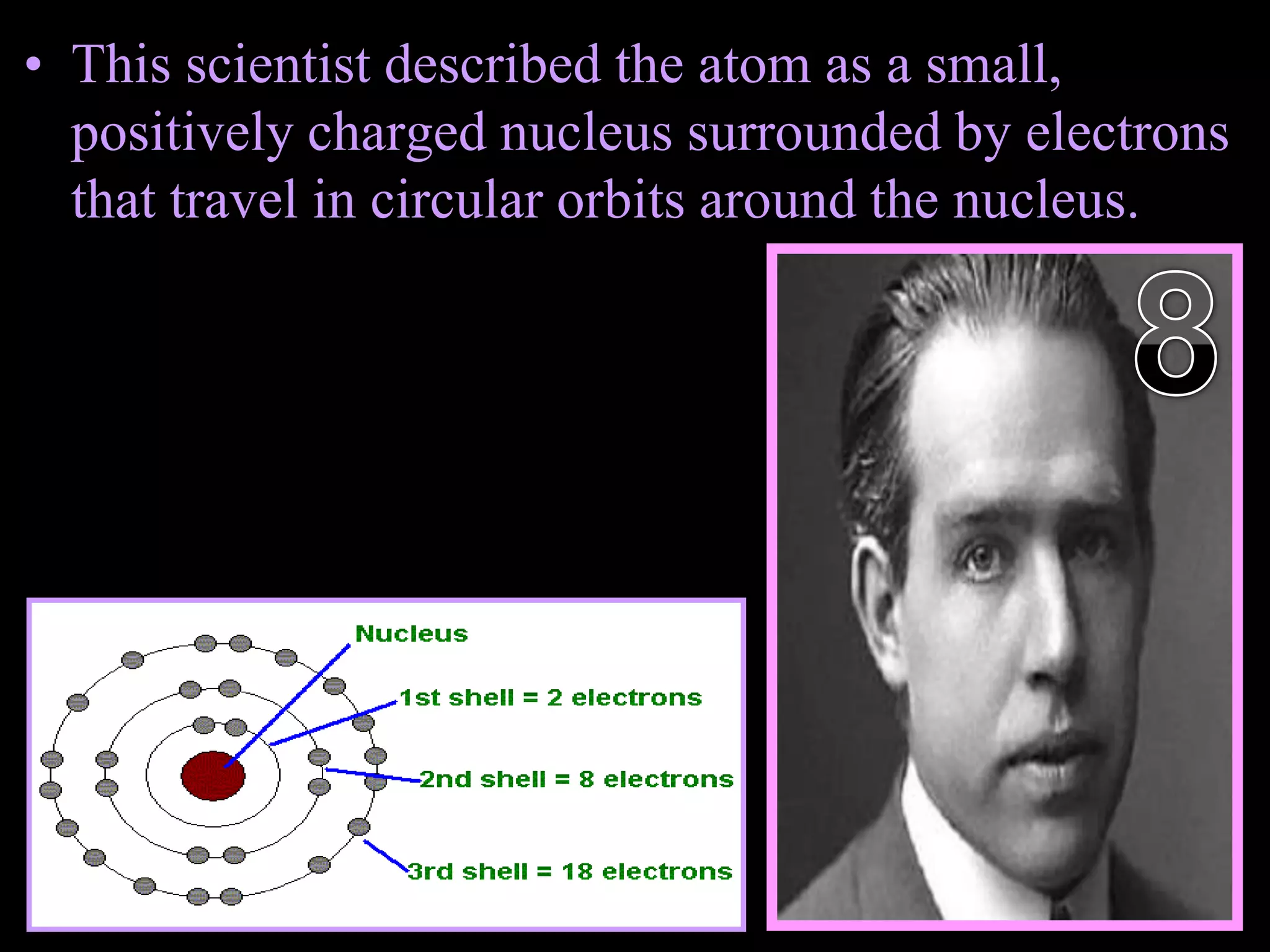
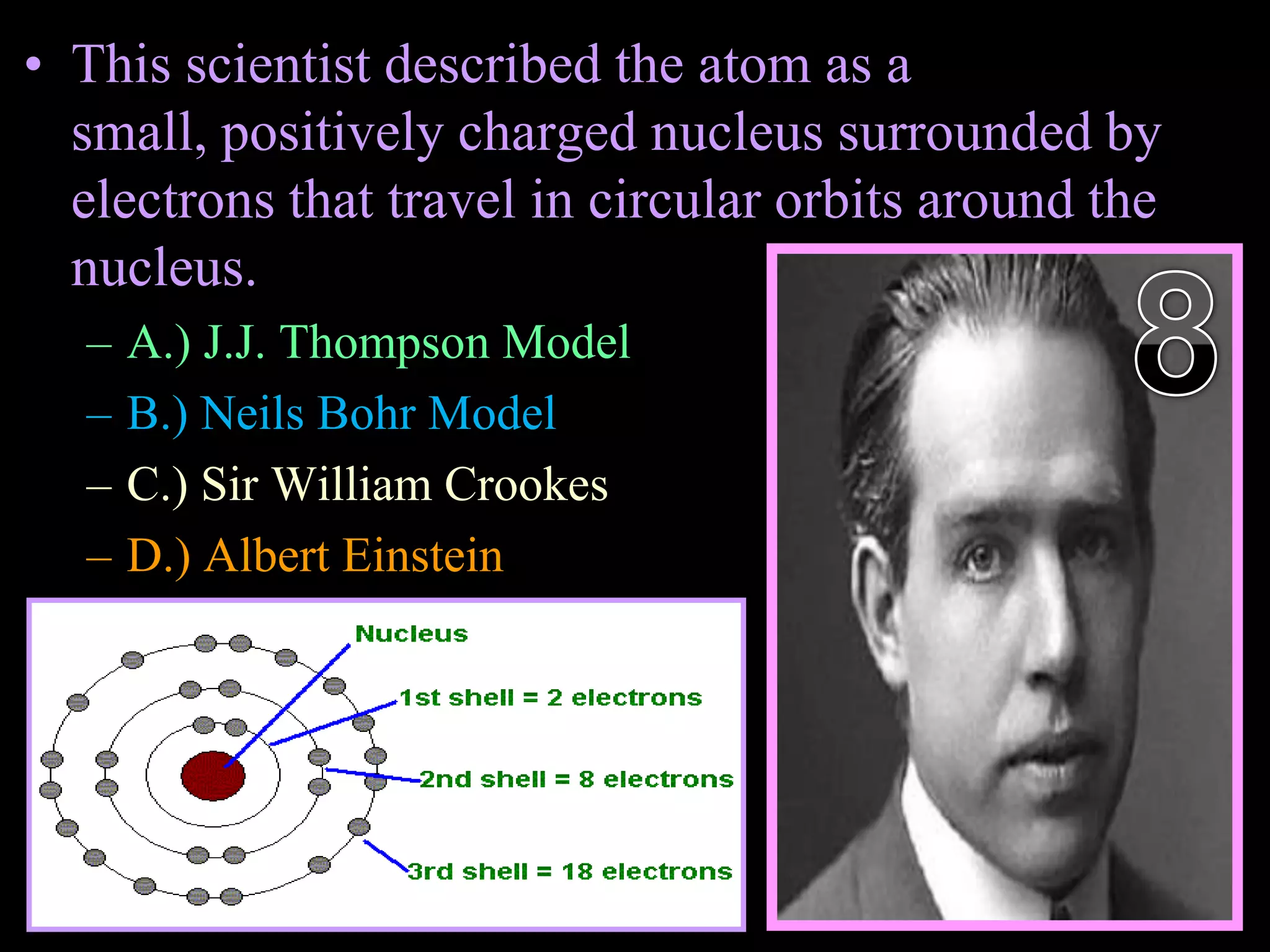
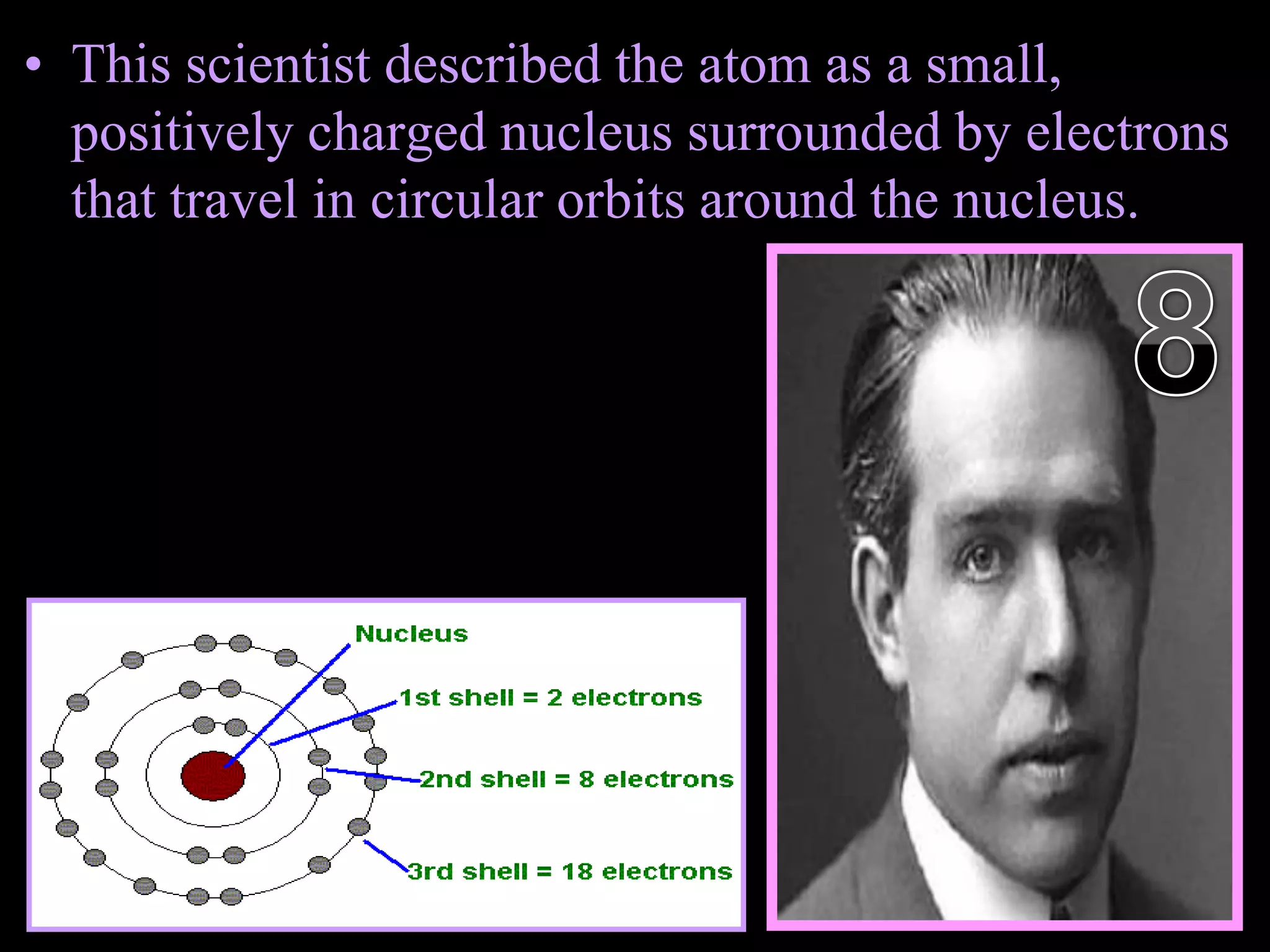
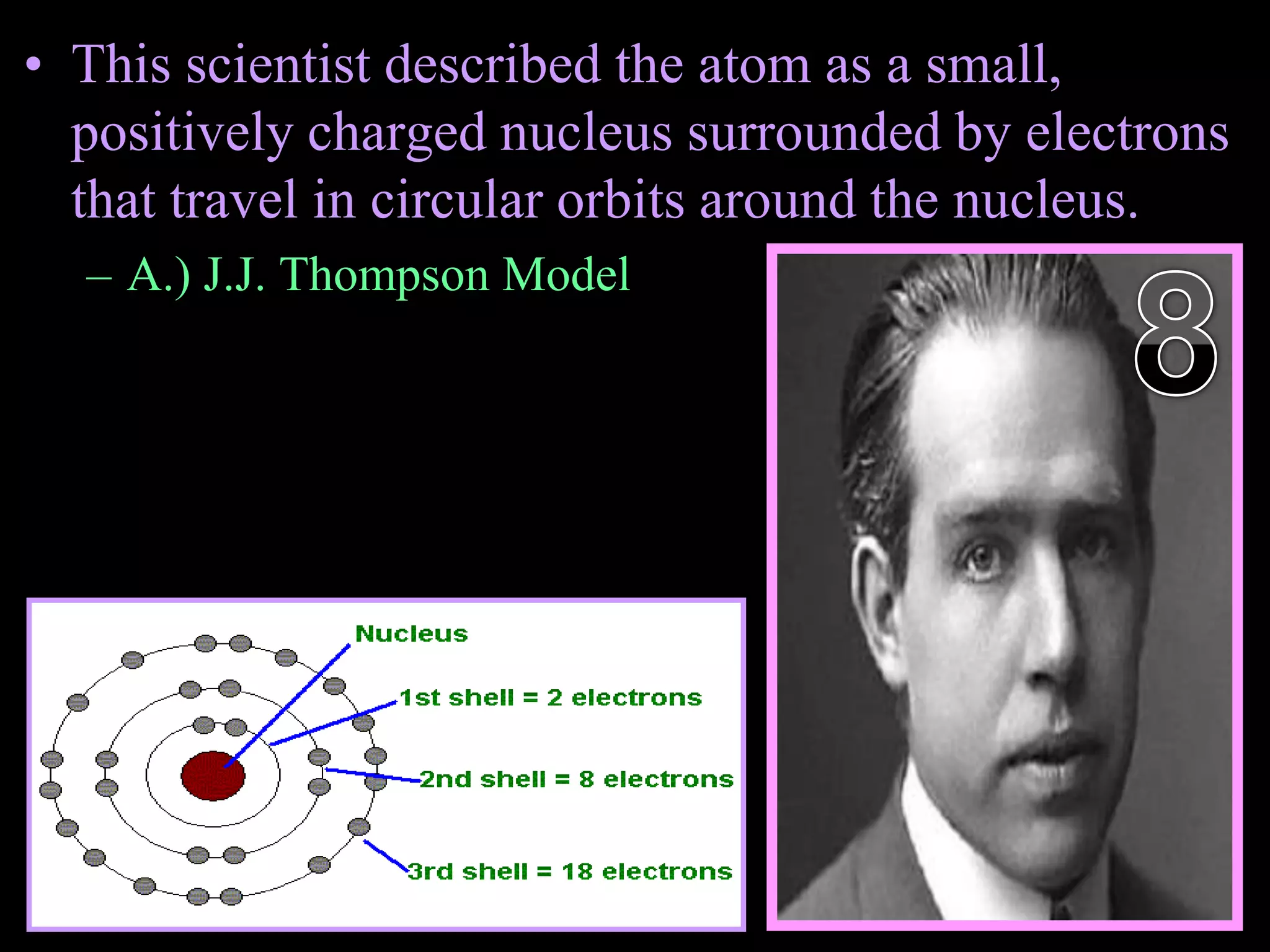
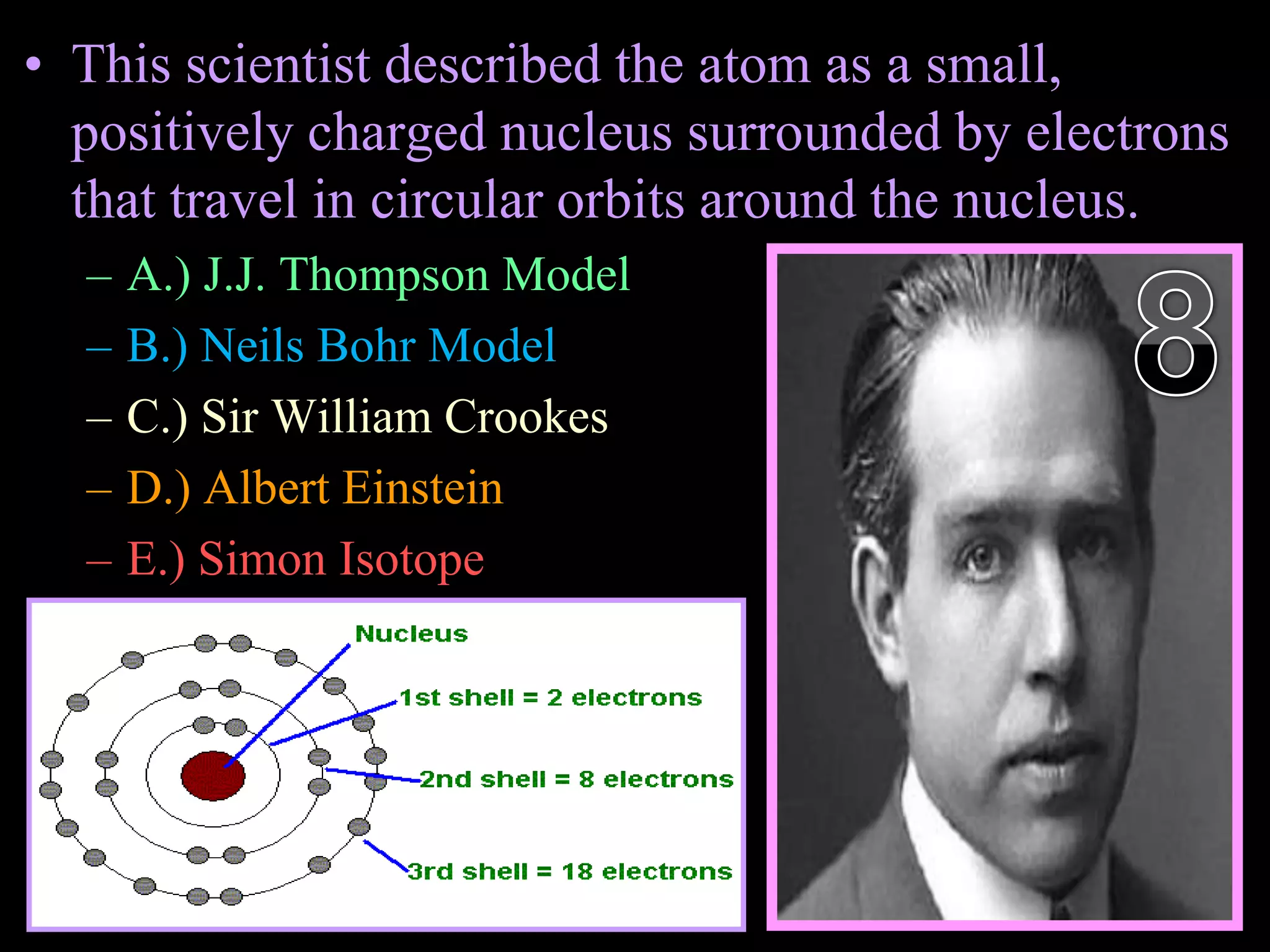
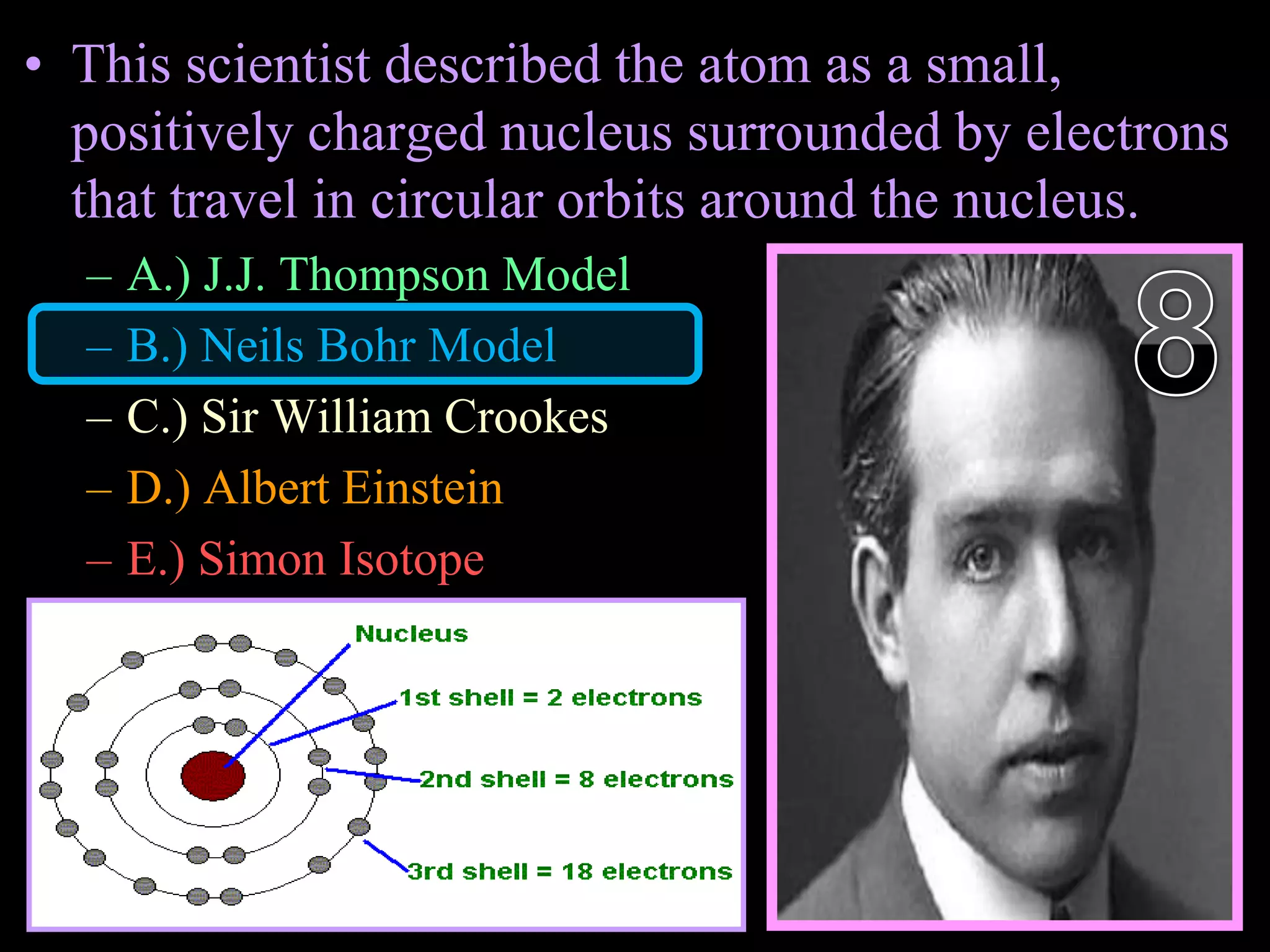
• This scientist described the atom as a small,
positively charged nucleus surrounded by electrons
that travel in circular orbits around the nucleus.
Copyright © 2010 Ryan P. Murphy
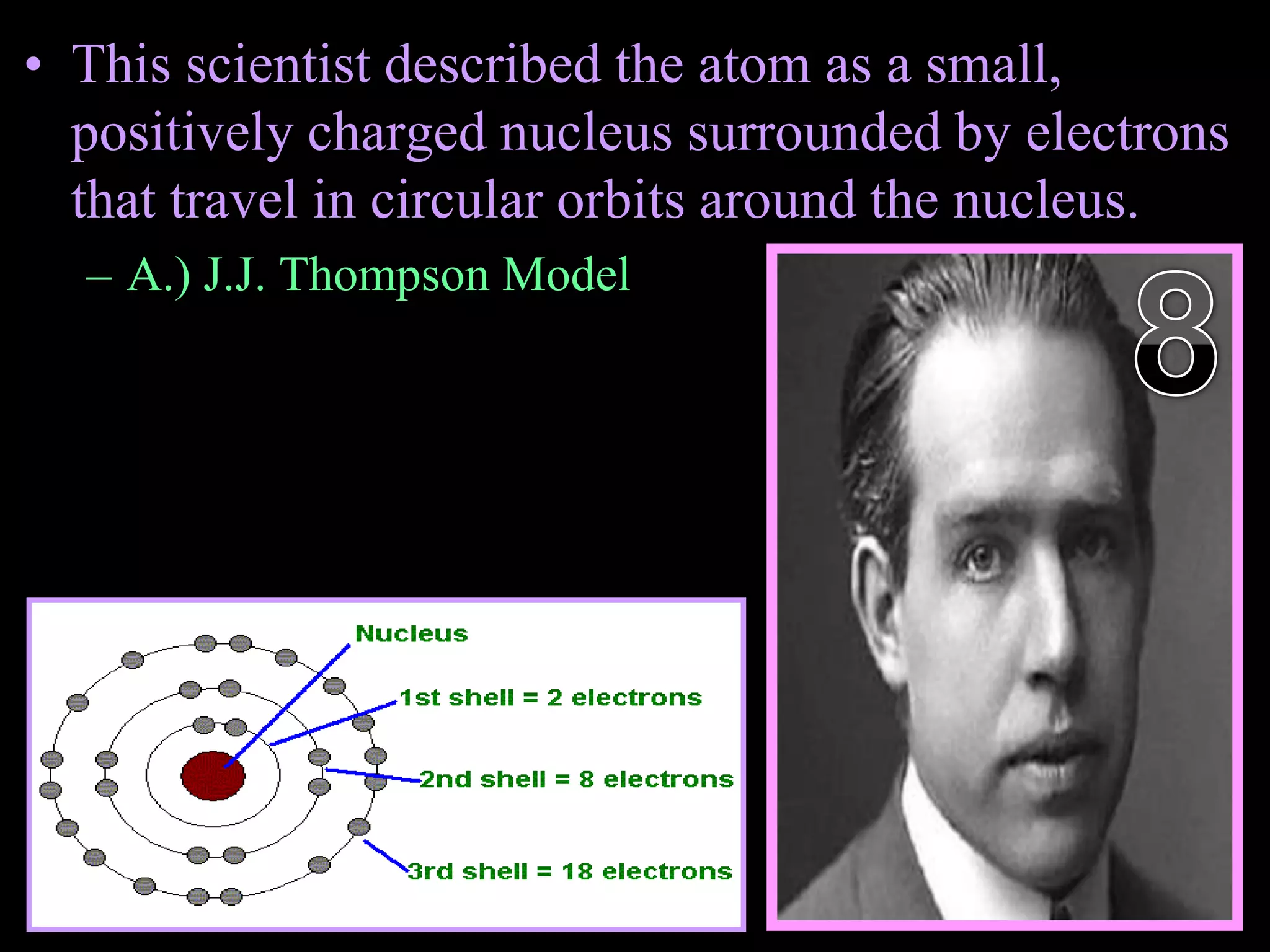
• This scientist described the atom as a small,
positively charged nucleus surrounded by electrons
that travel in circular orbits around the nucleus.
– A.) J.J. Thompson Model
Copyright © 2010 Ryan P. Murphy
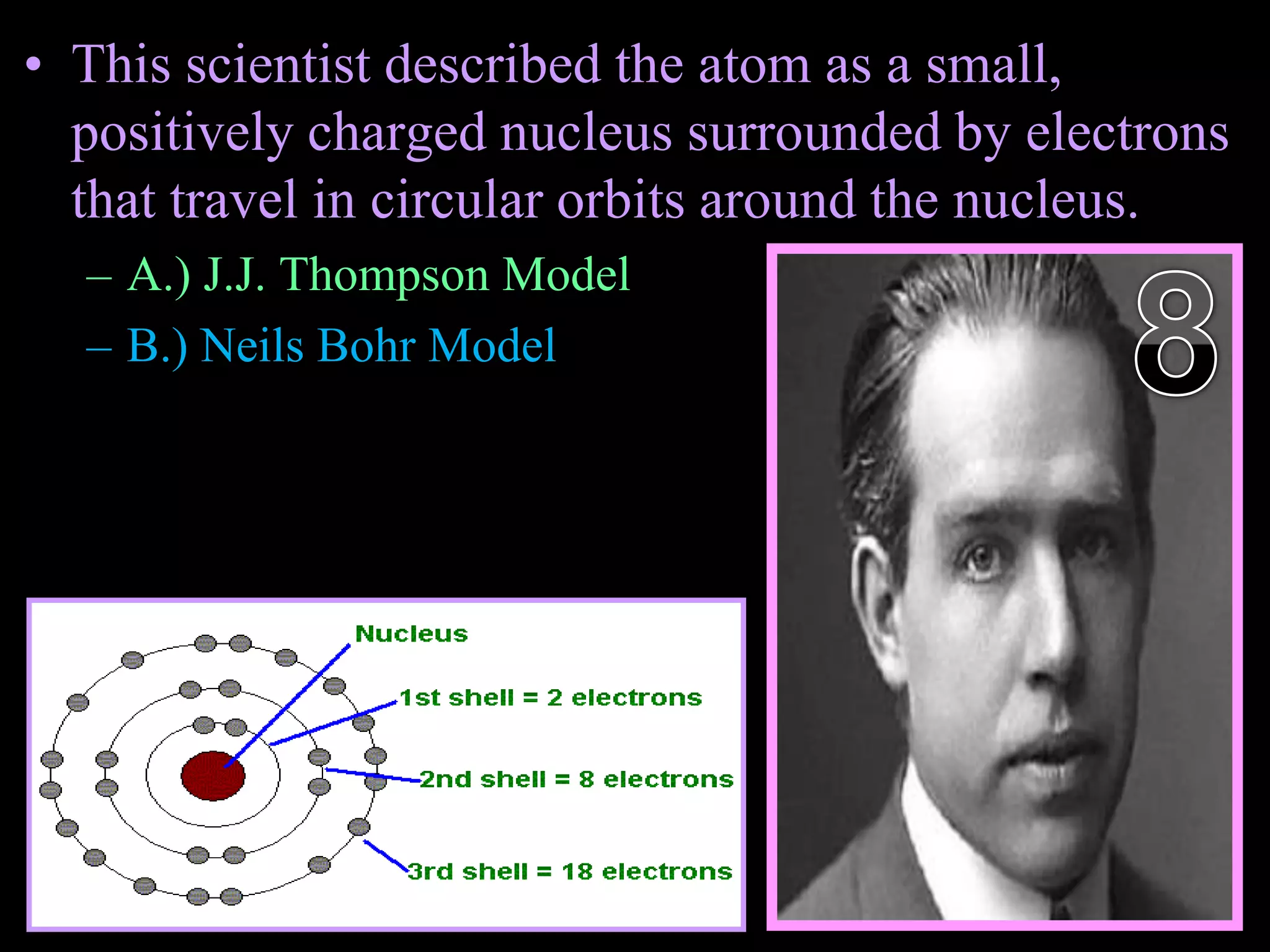
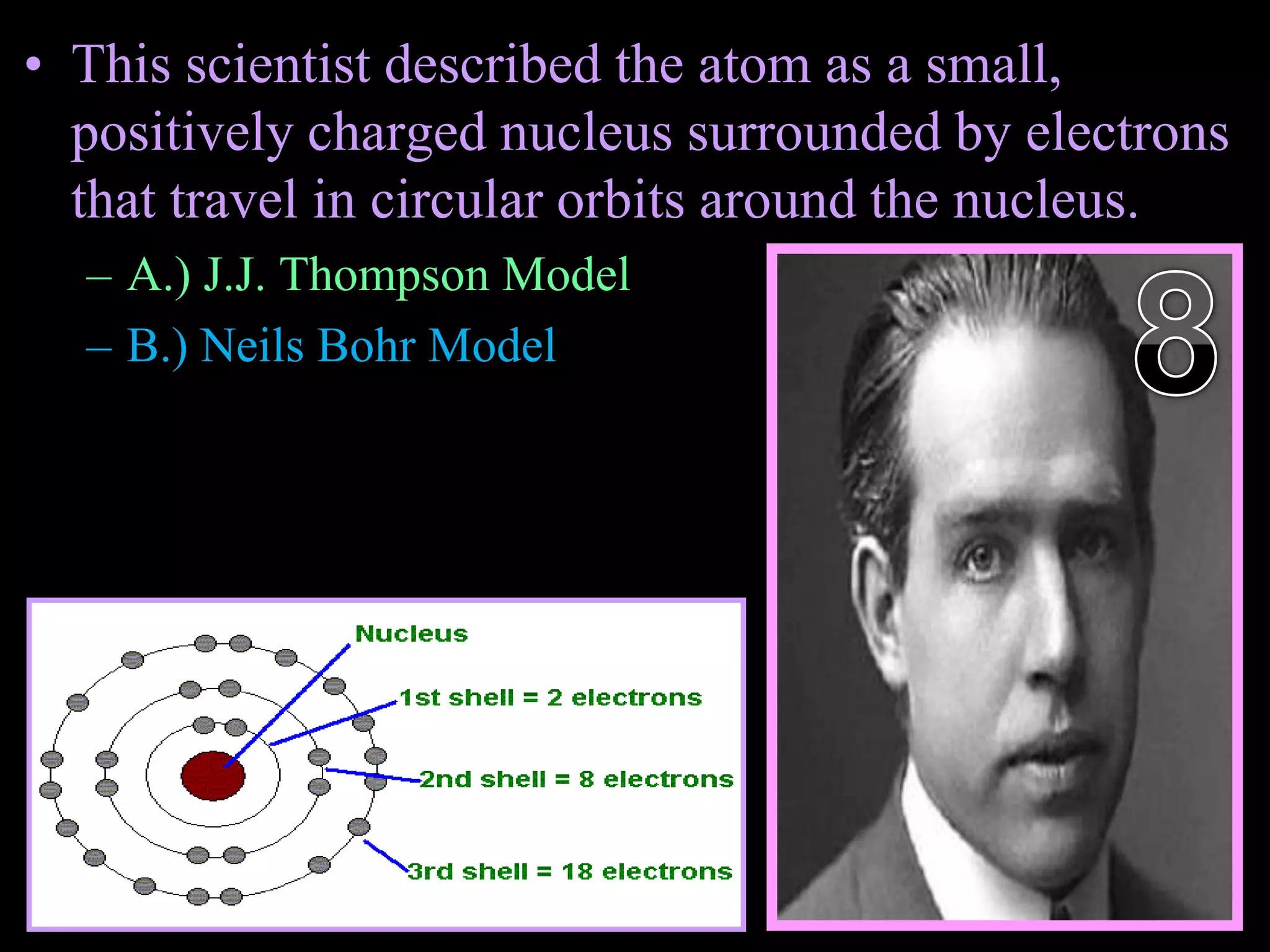
• This scientist described the atom as a small,
positively charged nucleus surrounded by electrons
that travel in circular orbits around the nucleus.
– A.) J.J. Thompson Model
– B.) Neils Bohr Model
Copyright © 2010 Ryan P. Murphy
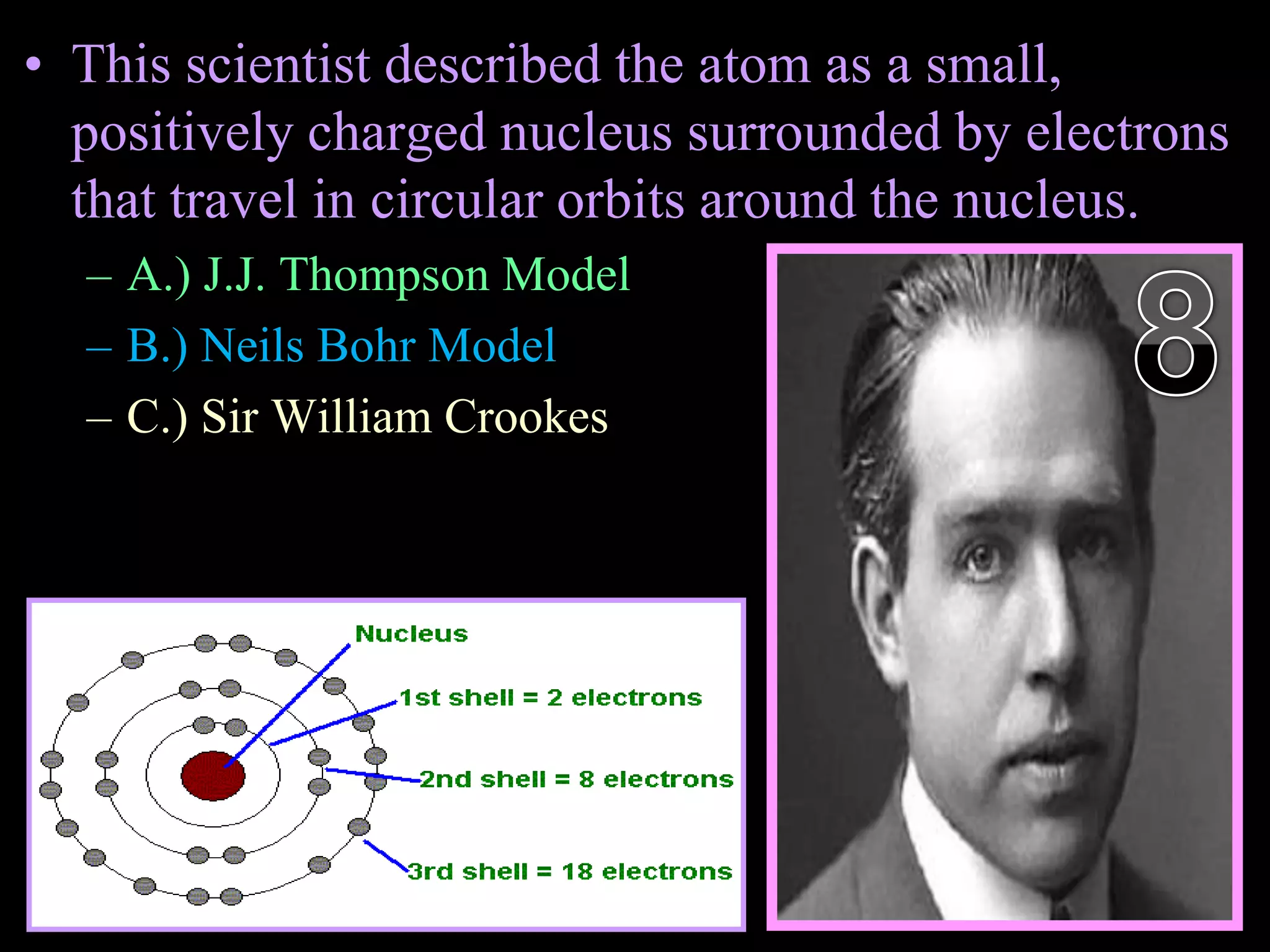
• This scientist described the atom as a small,
positively charged nucleus surrounded by electrons
that travel in circular orbits around the nucleus.
– A.) J.J. Thompson Model
– B.) Neils Bohr Model
– C.) Sir William Crookes
Copyright © 2010 Ryan P. Murphy
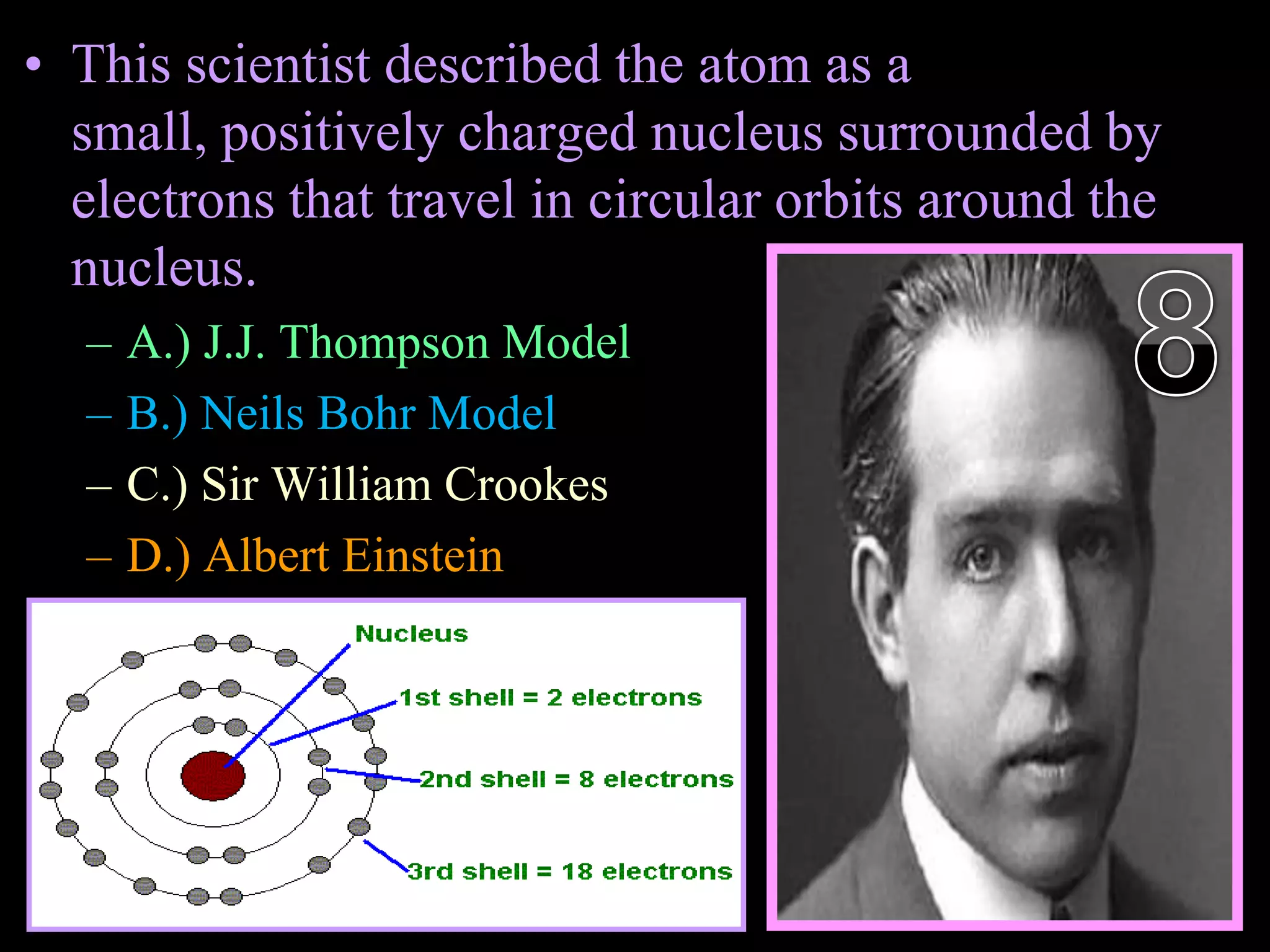
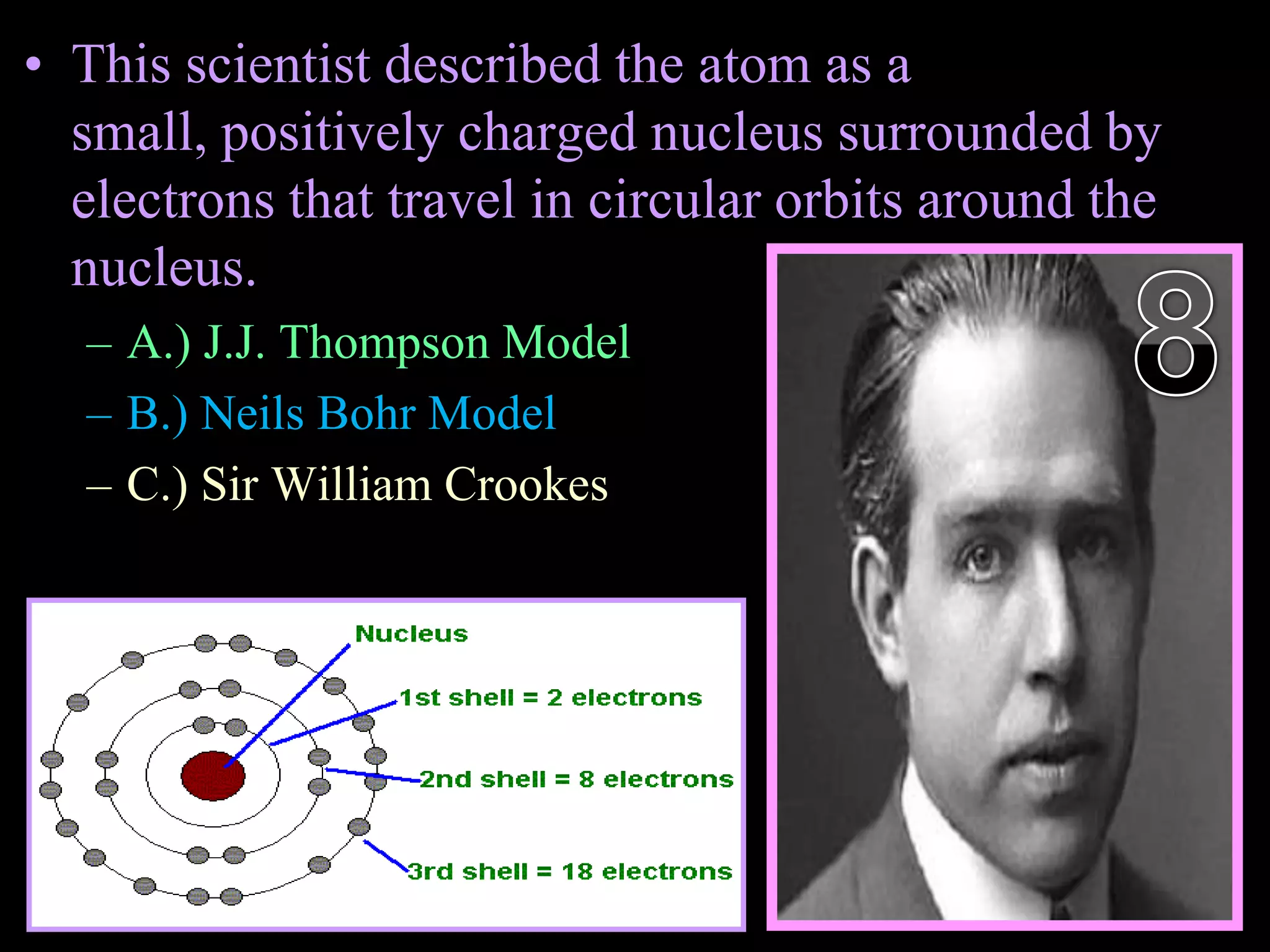
• This scientist described the atom as a
small, positively charged nucleus surrounded by
electrons that travel in circular orbits around the
nucleus.
– A.) J.J. Thompson Model
– B.) Neils Bohr Model
– C.) Sir William Crookes
– D.) Albert Einstein
Copyright © 2010 Ryan P. Murphy
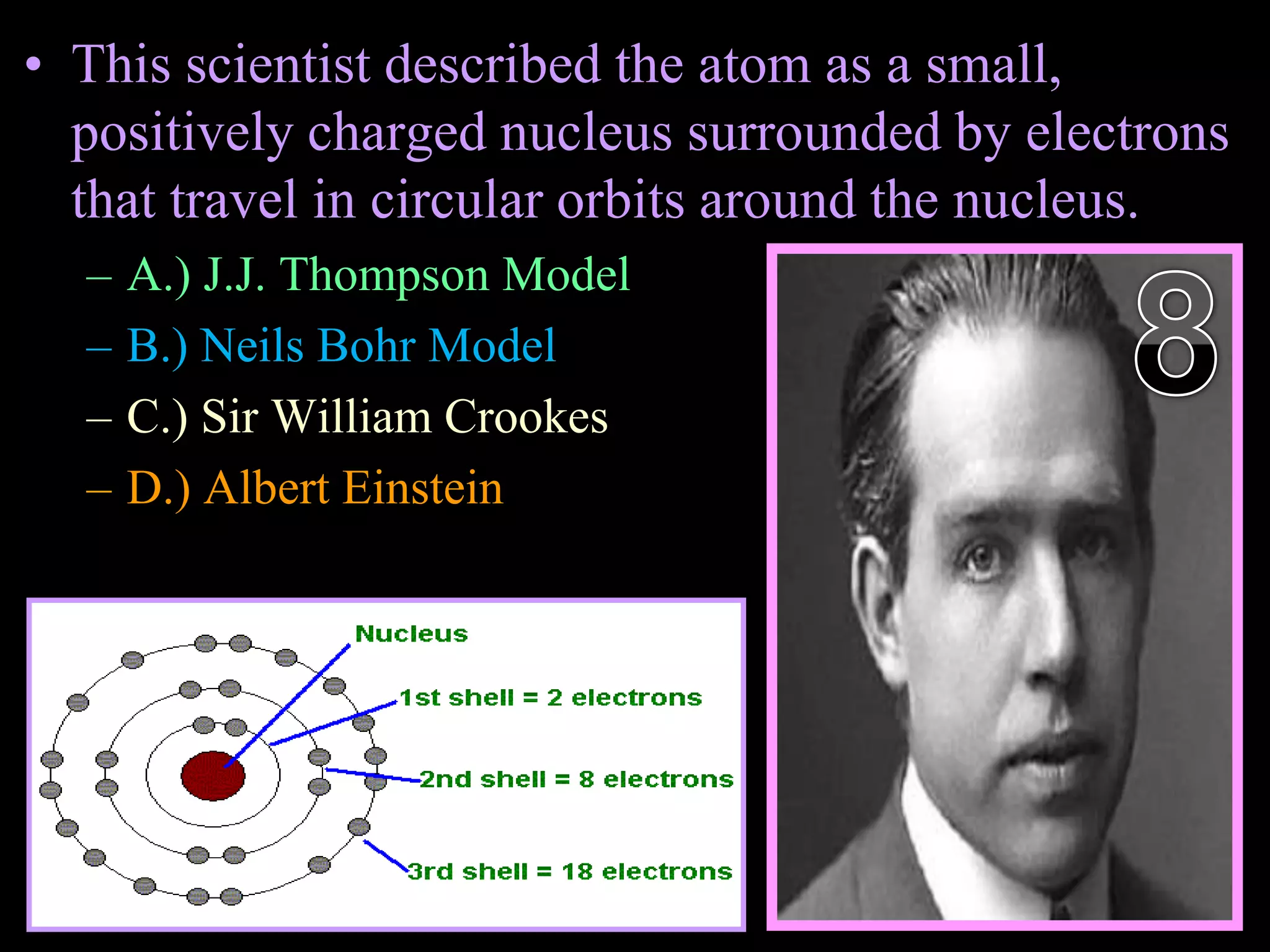
• This scientist described the atom as a
small, positively charged nucleus surrounded by
electrons that travel in circular orbits around the
nucleus.
– A.) J.J. Thompson Model
– B.) Neils Bohr Model
– C.) Sir William Crookes
– D.) Albert Einstein
– E.) Simon Isotope
Copyright © 2010 Ryan P. Murphy
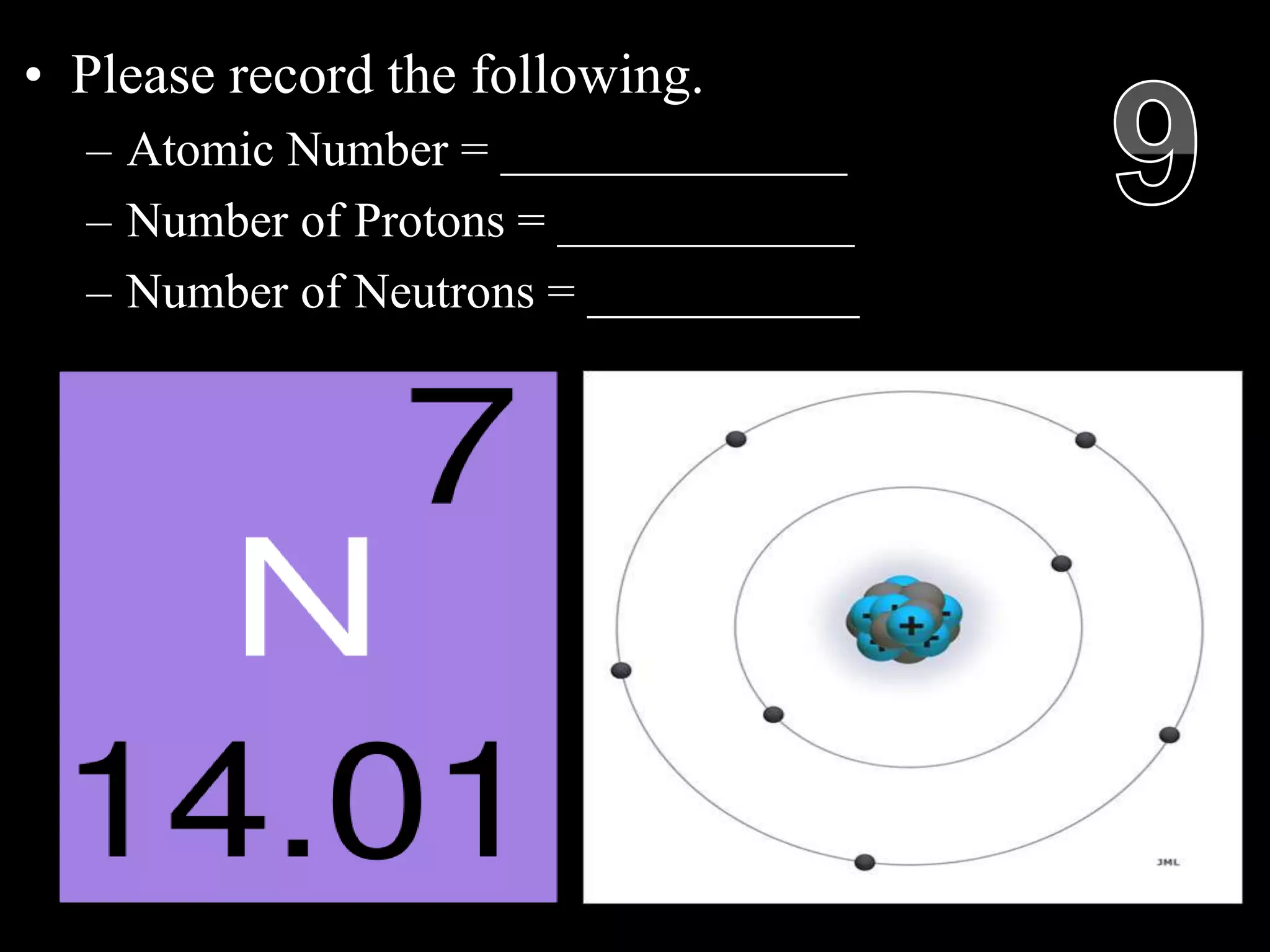
• Please record the following.
– Atomic Number = ______________
– Number of Protons = ____________
– Number of Neutrons = ___________
Copyright © 2010 Ryan P. Murphy
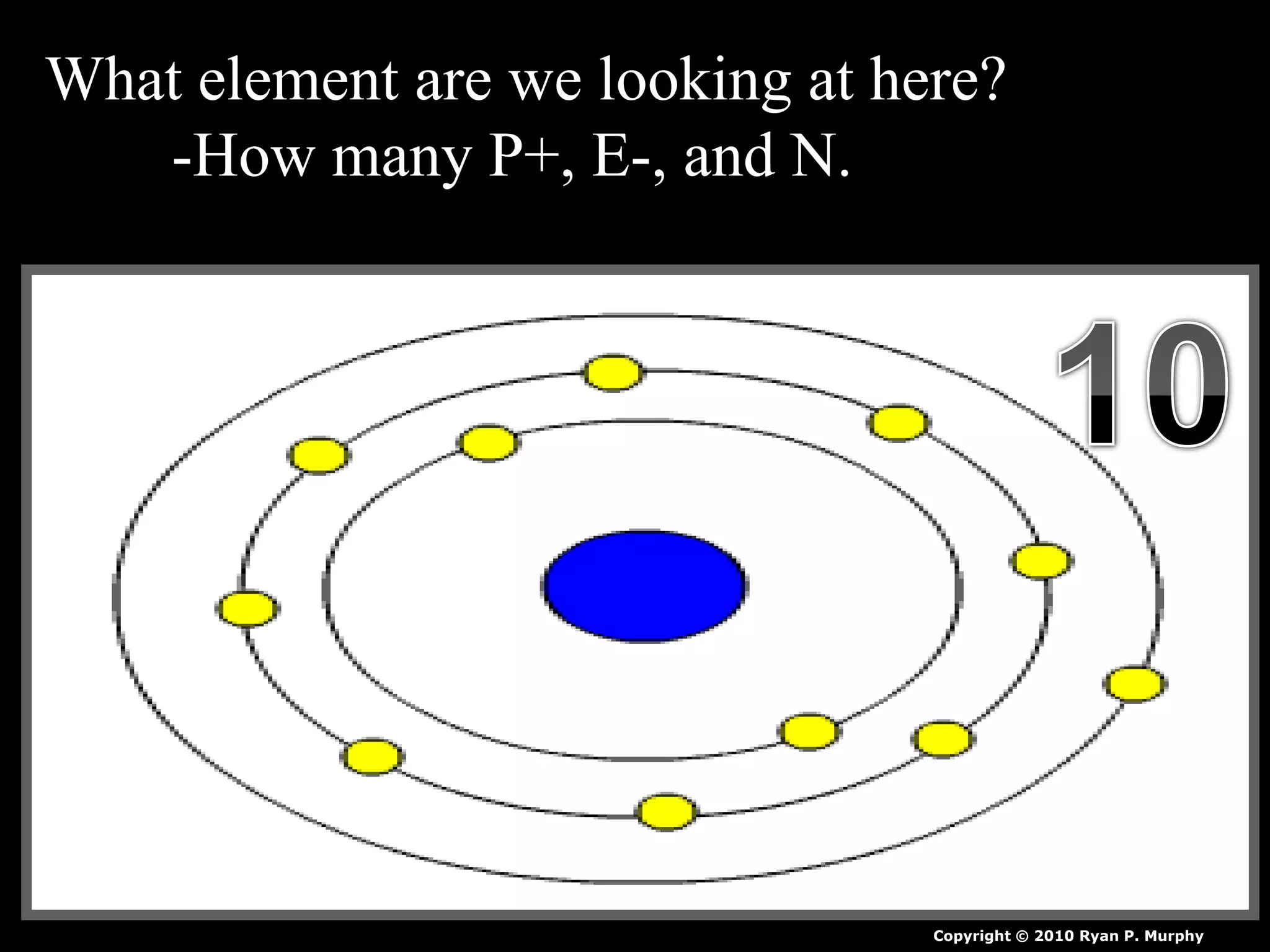
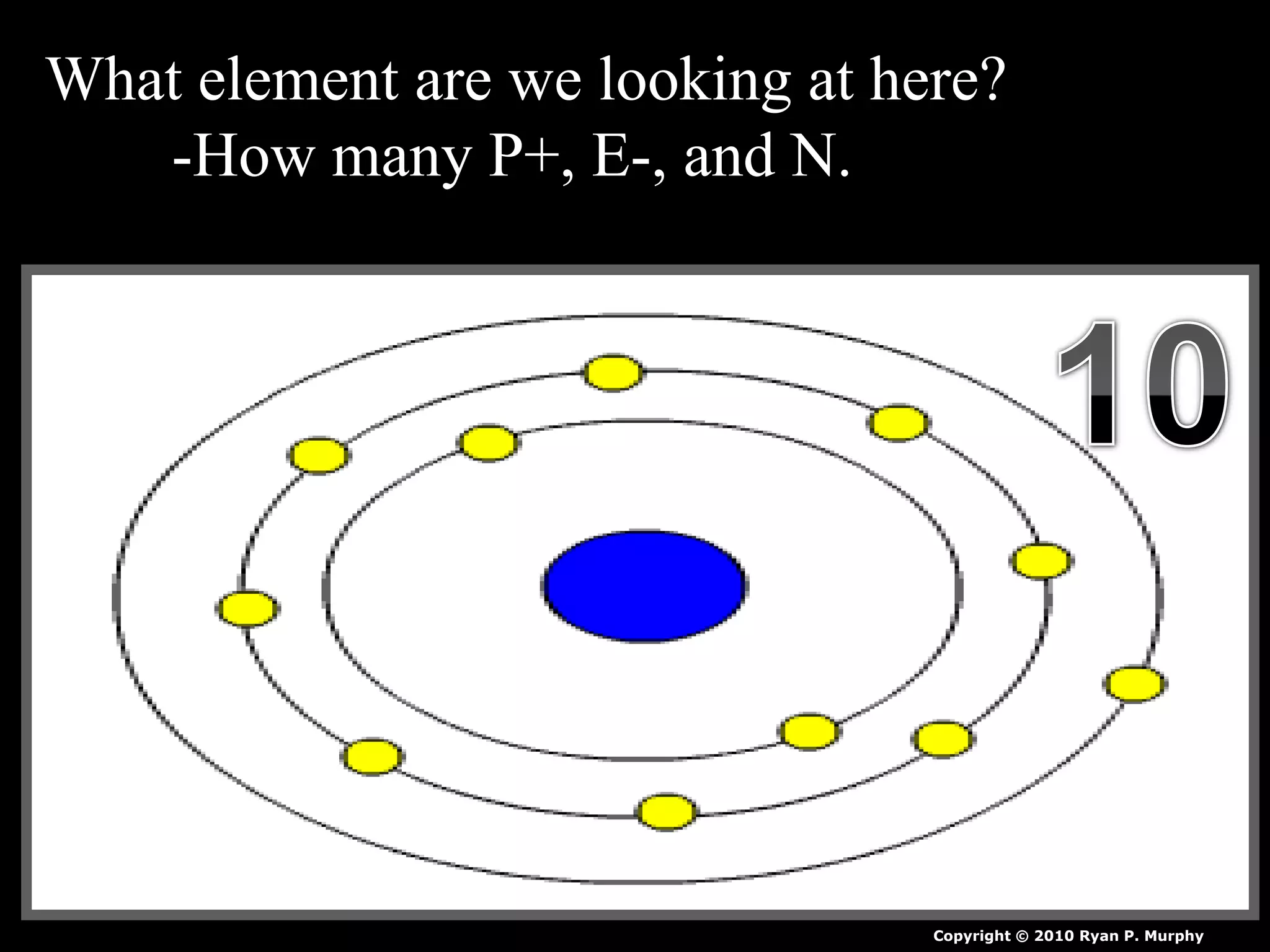
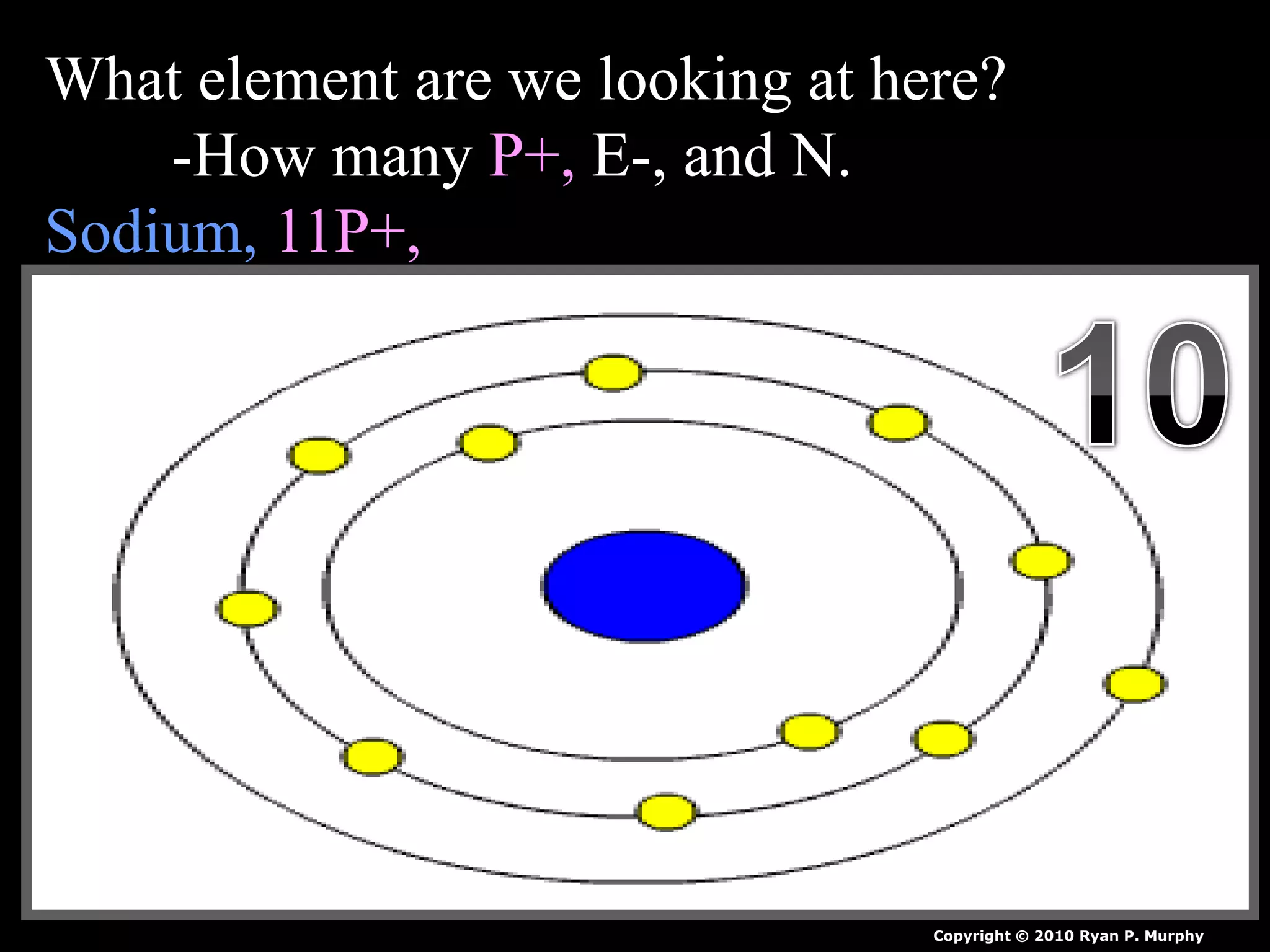
What element are we looking at here?
-How many P+, E-, and N.
Copyright © 2010 Ryan P. Murphy
HAVE A GOOD
LOOK ATOM
ROUND
ABOUT
NUMBERIFFIC SUPER
SMALL
ATOMIC
POWER
-BONUS-
1 6 11 16 *21
2 7 12 17 *22
3 8 13 18 *23
4 9 14 19 *24
5 10 15 20 *25
Copyright © 2010 Ryan P. Murphy
Intro to Atoms Review Game
HAVE A GOOD
LOOK ATOM
ROUND
ABOUT
NUMBERIFFIC SUPER
SMALL
ATOMIC
POWER
-BONUS-
1 6 11 16 *21
2 7 12 17 *22
3 8 13 18 *23
4 9 14 19 *24
5 10 15 20 *25
Copyright © 2010 Ryan P. Murphy
Intro to Atoms Review Game
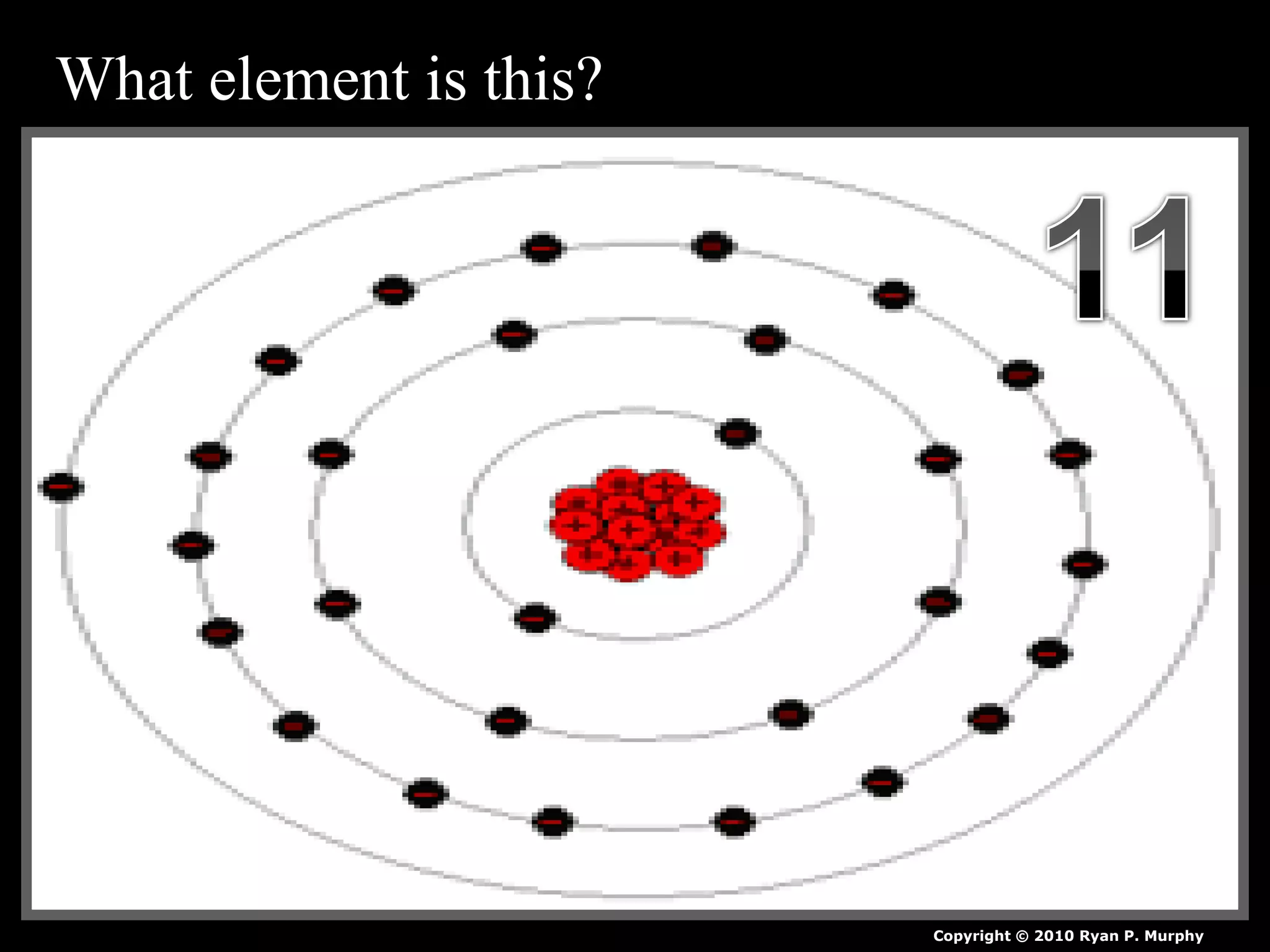
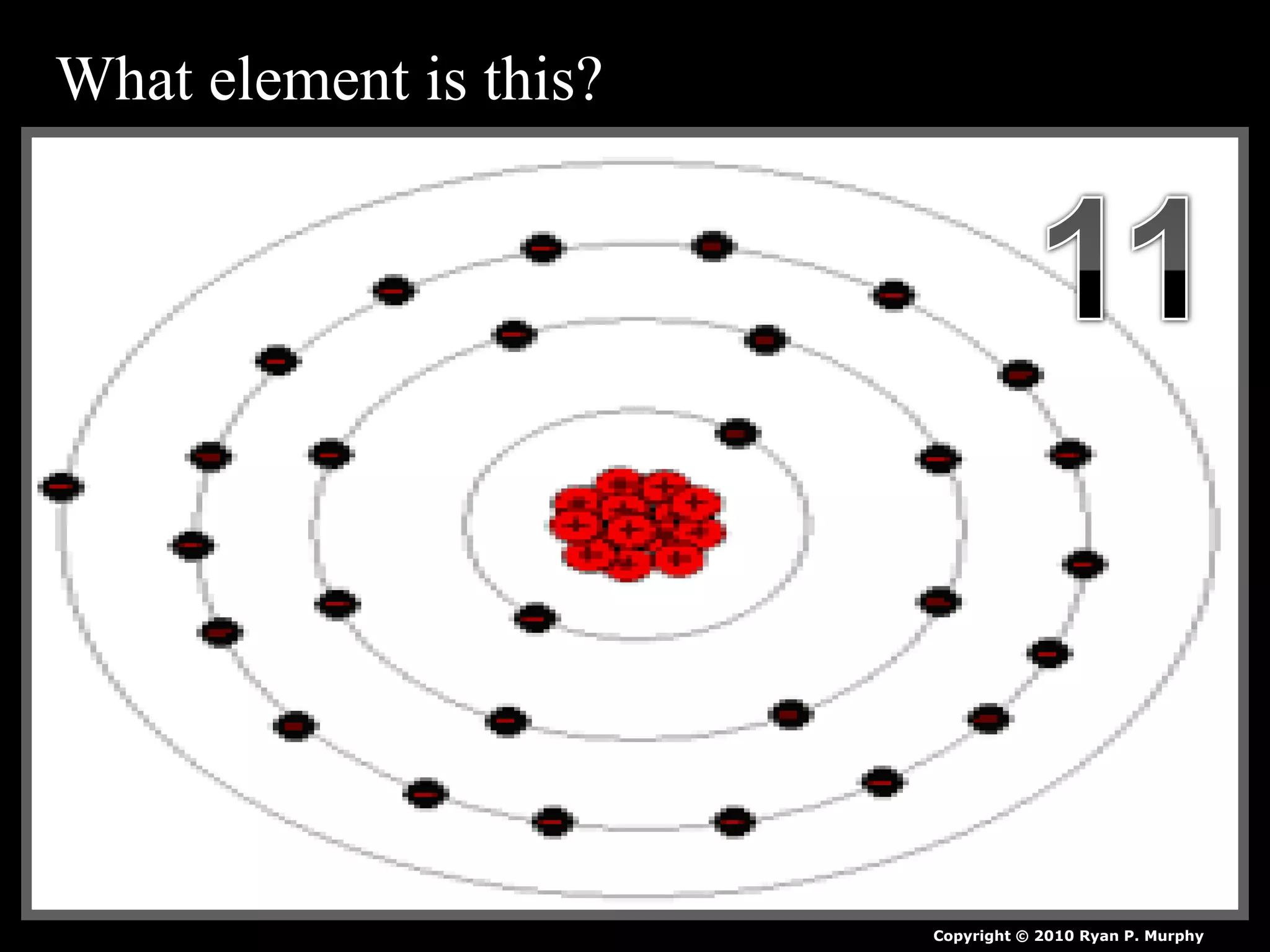
What element is this?
Copyright © 2010 Ryan P. Murphy
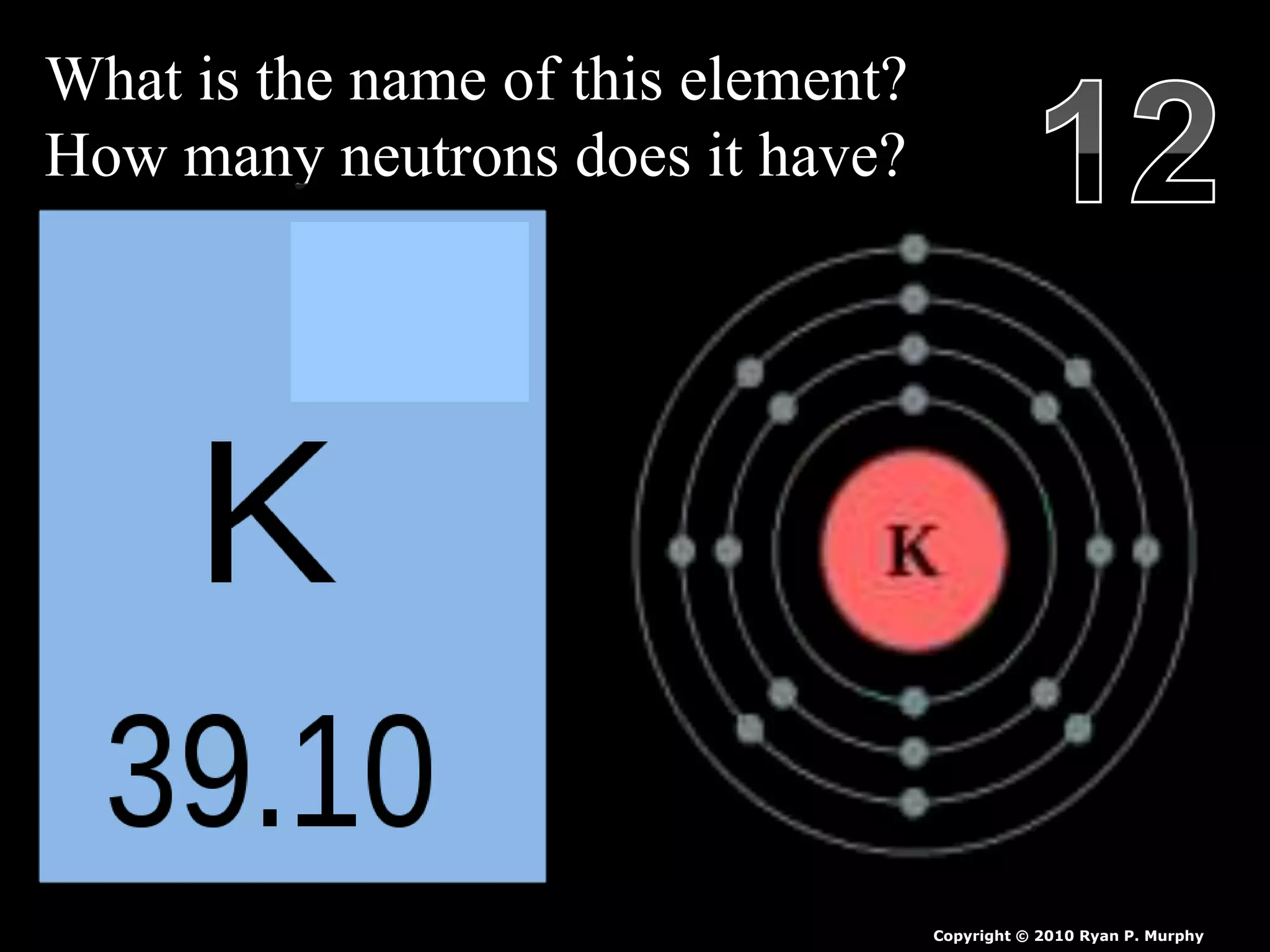
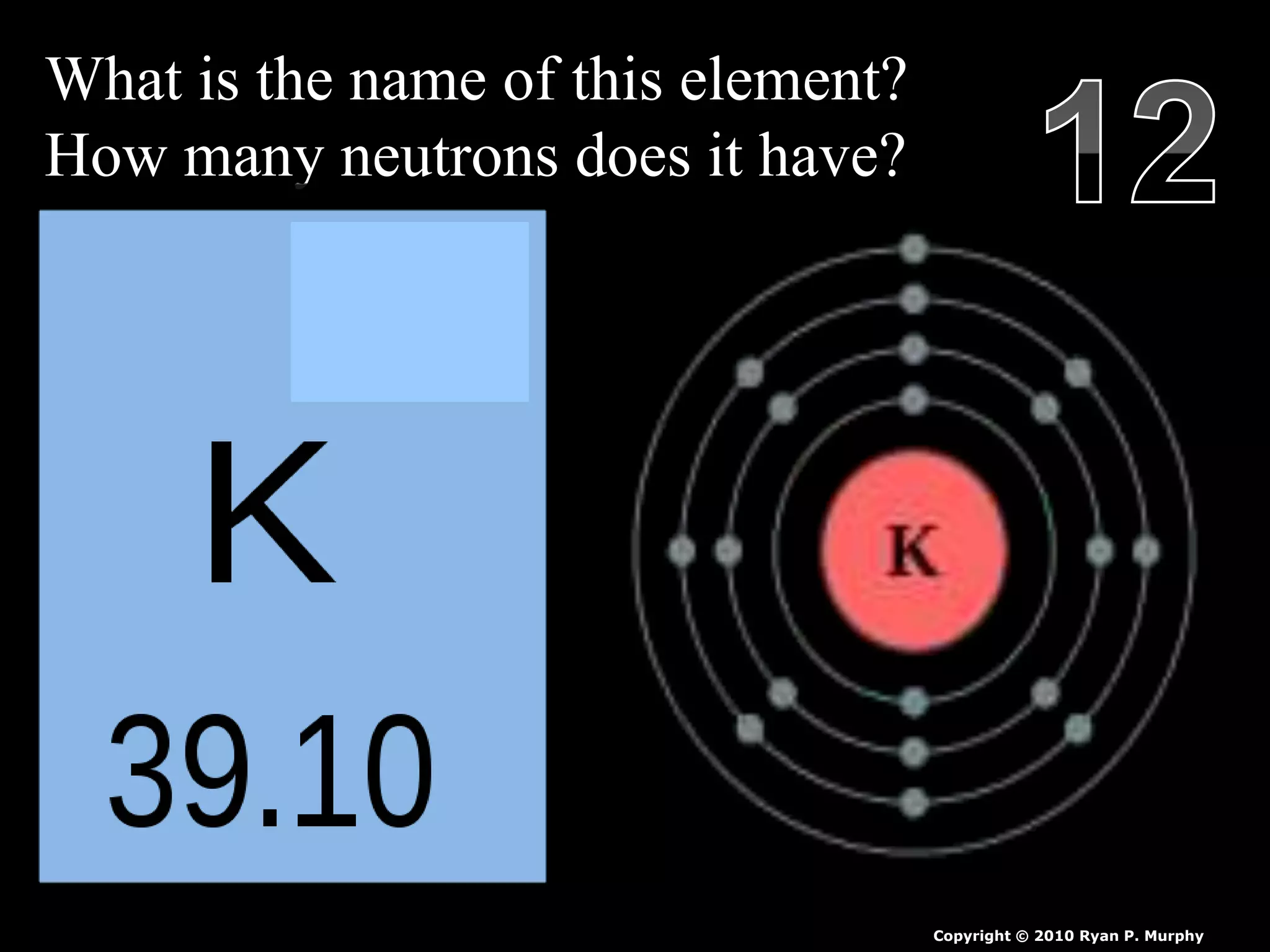
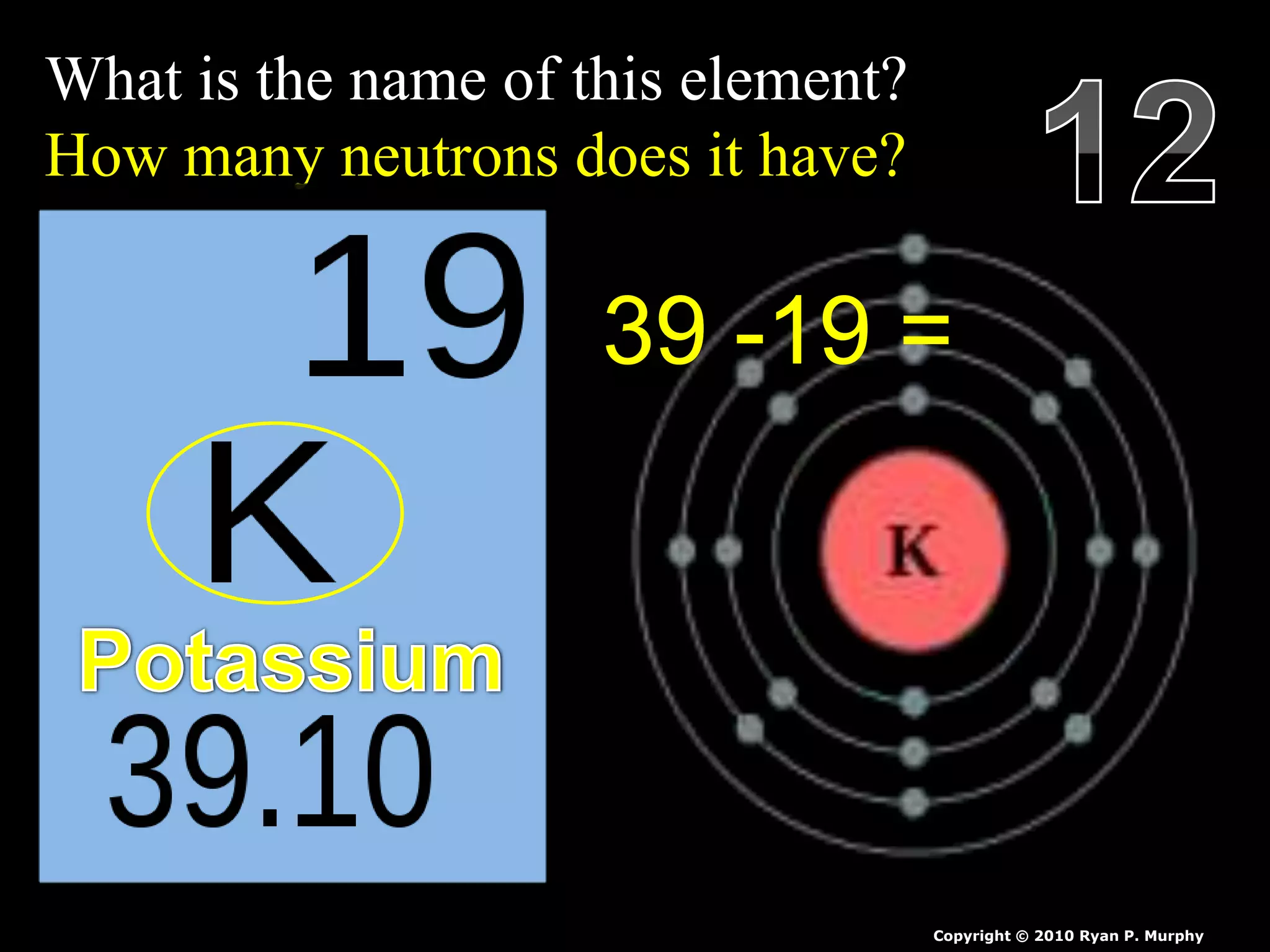
What is the name of this element?
How many neutrons does it have?
Copyright © 2010 Ryan P. Murphy
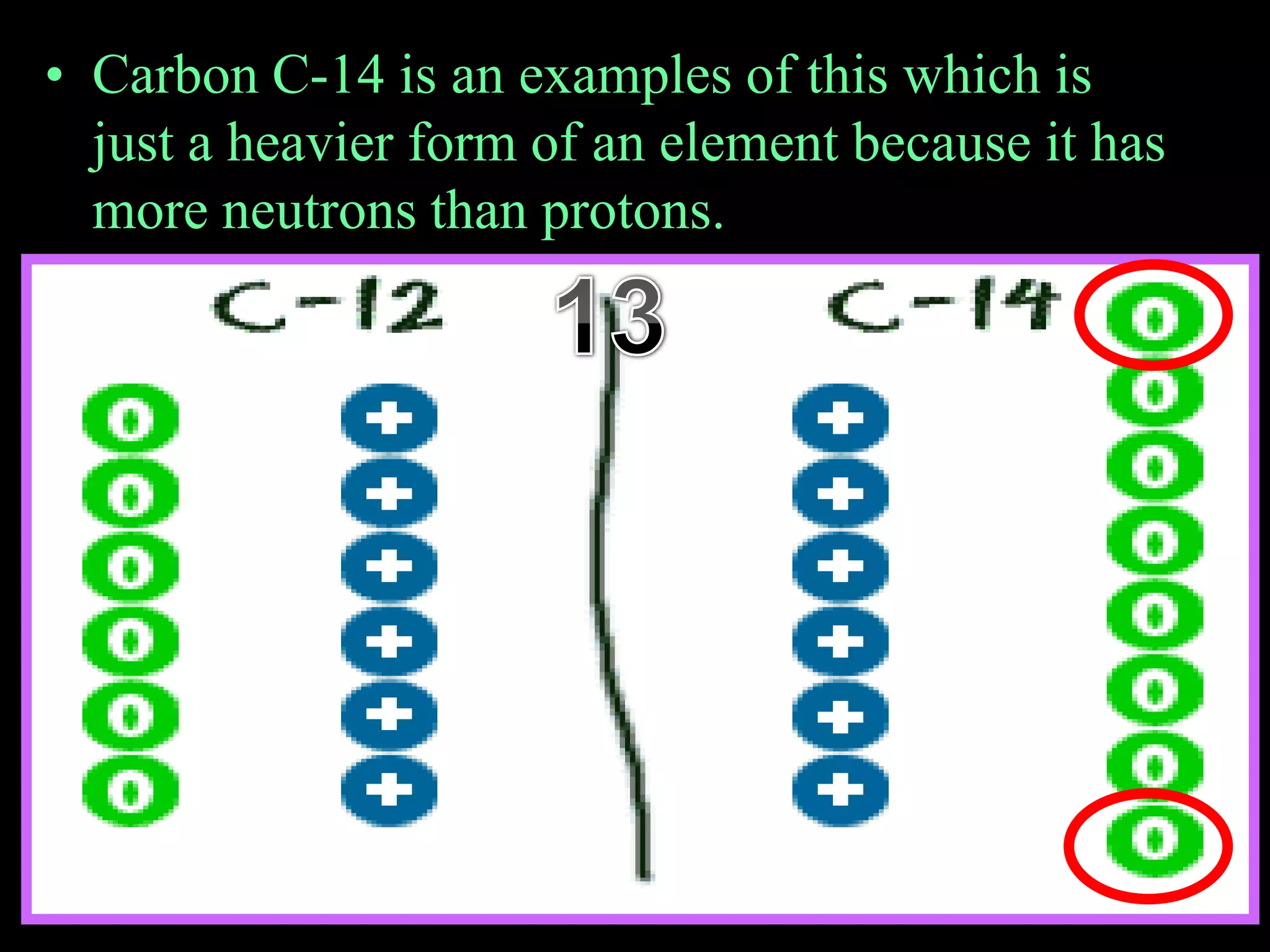
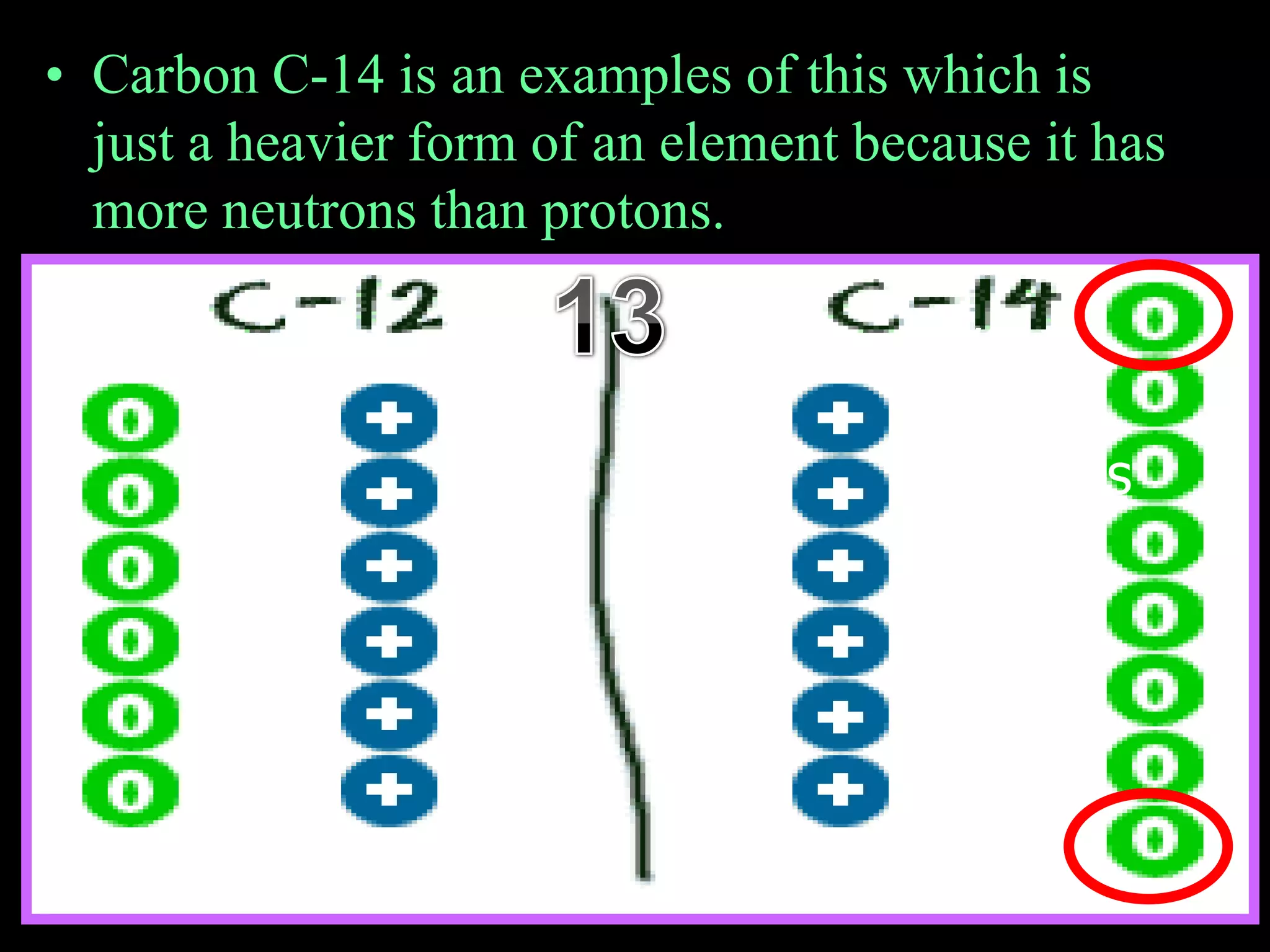
• Carbon C-14 is an examples of this which is
just a heavier form of an element because it has
more neutrons than protons.
Copyright © 2010 Ryan P. Murphy
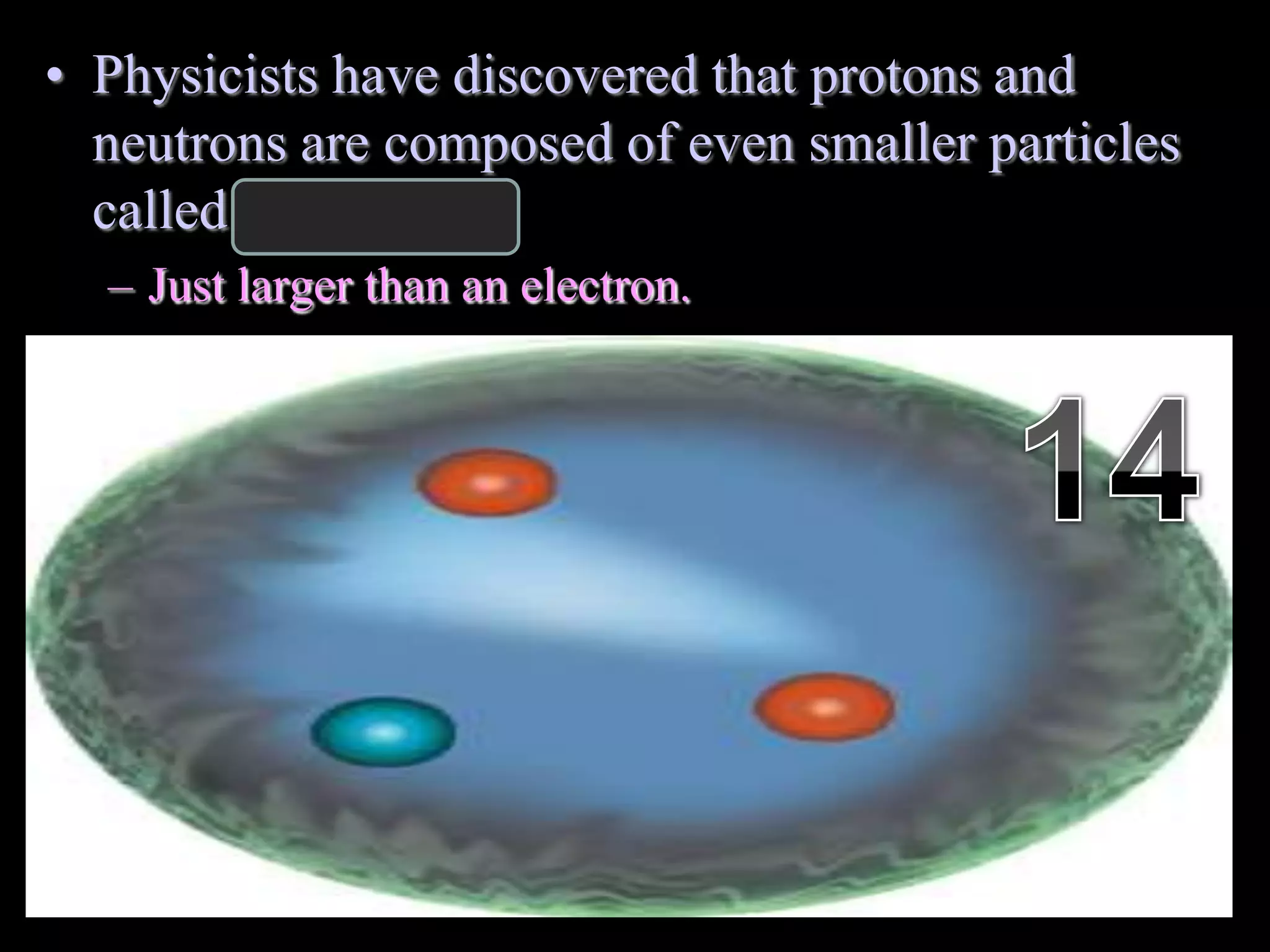
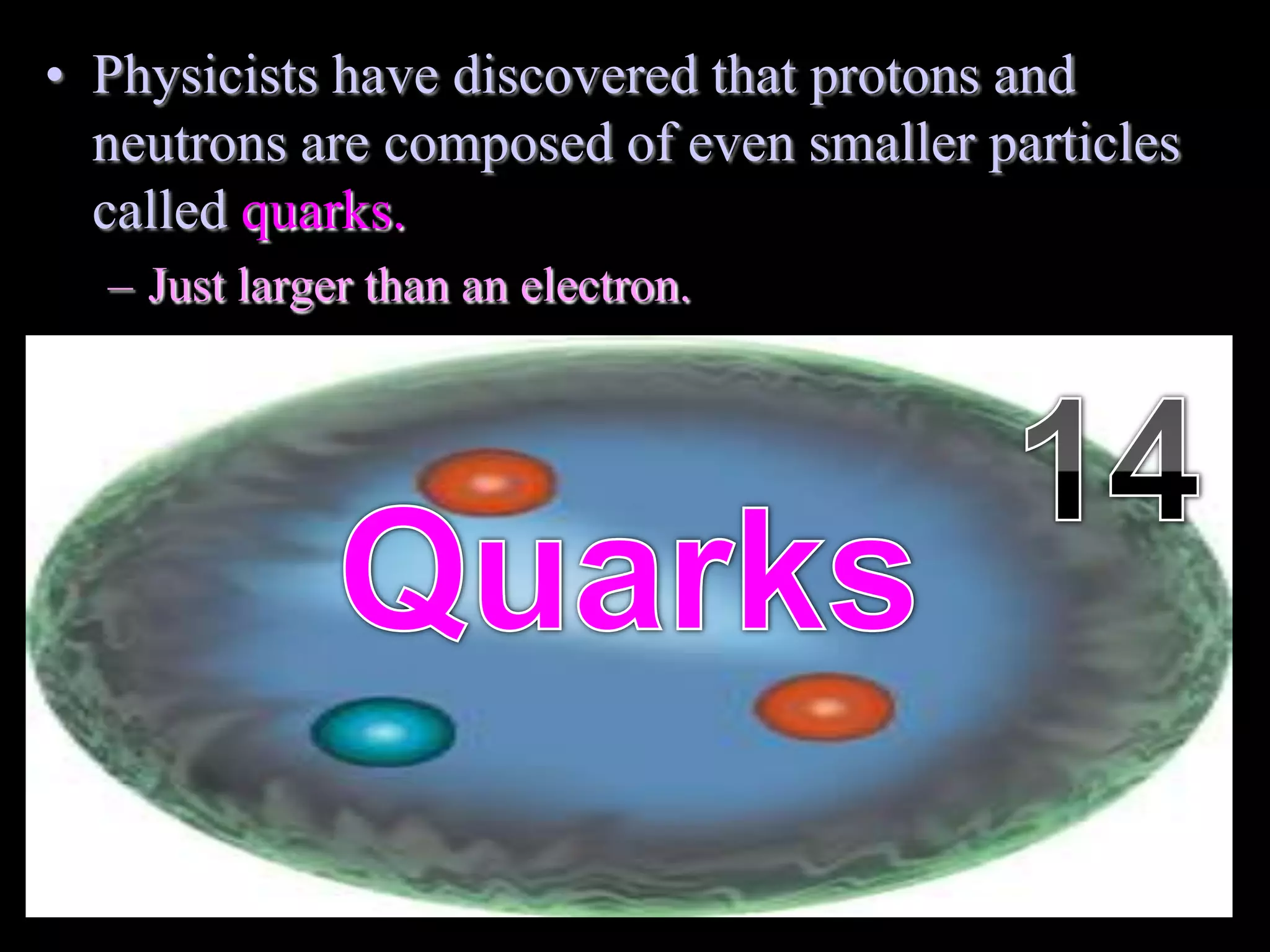
• Physicists have discovered that protons and
neutrons are composed of even smaller particles
called quarks.
– Just larger than an electron.
Copyright © 2010 Ryan P. Murphy
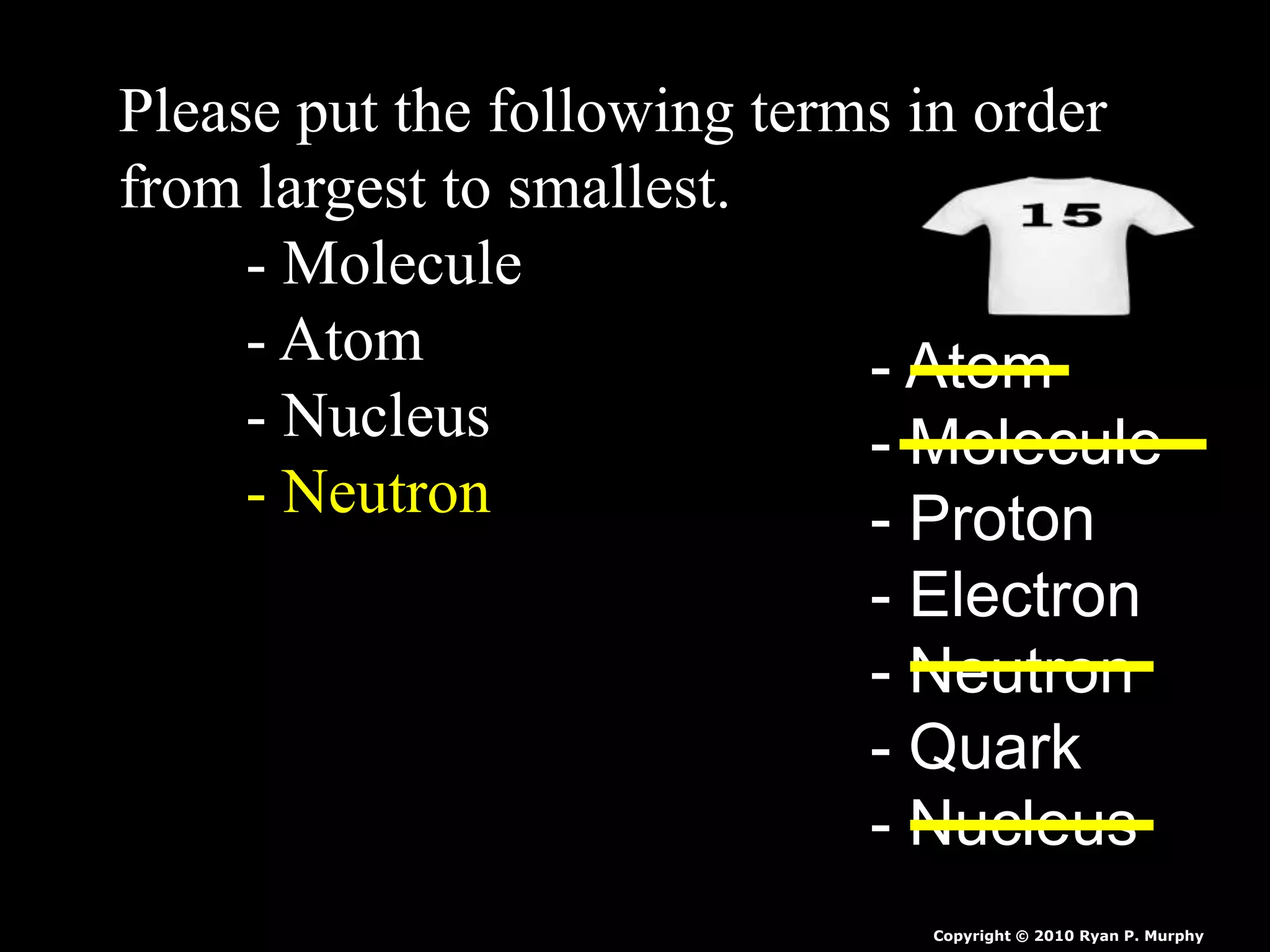
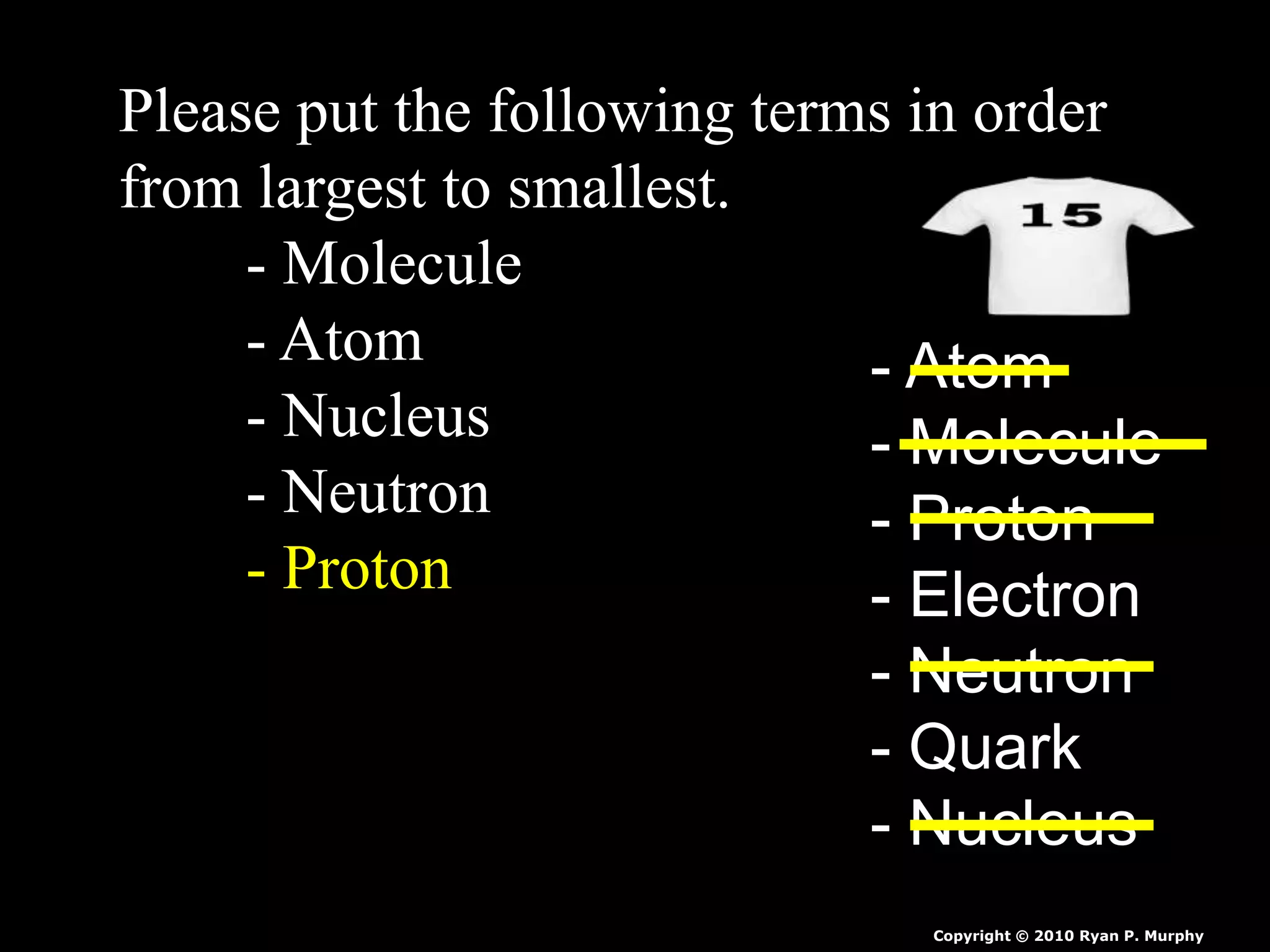
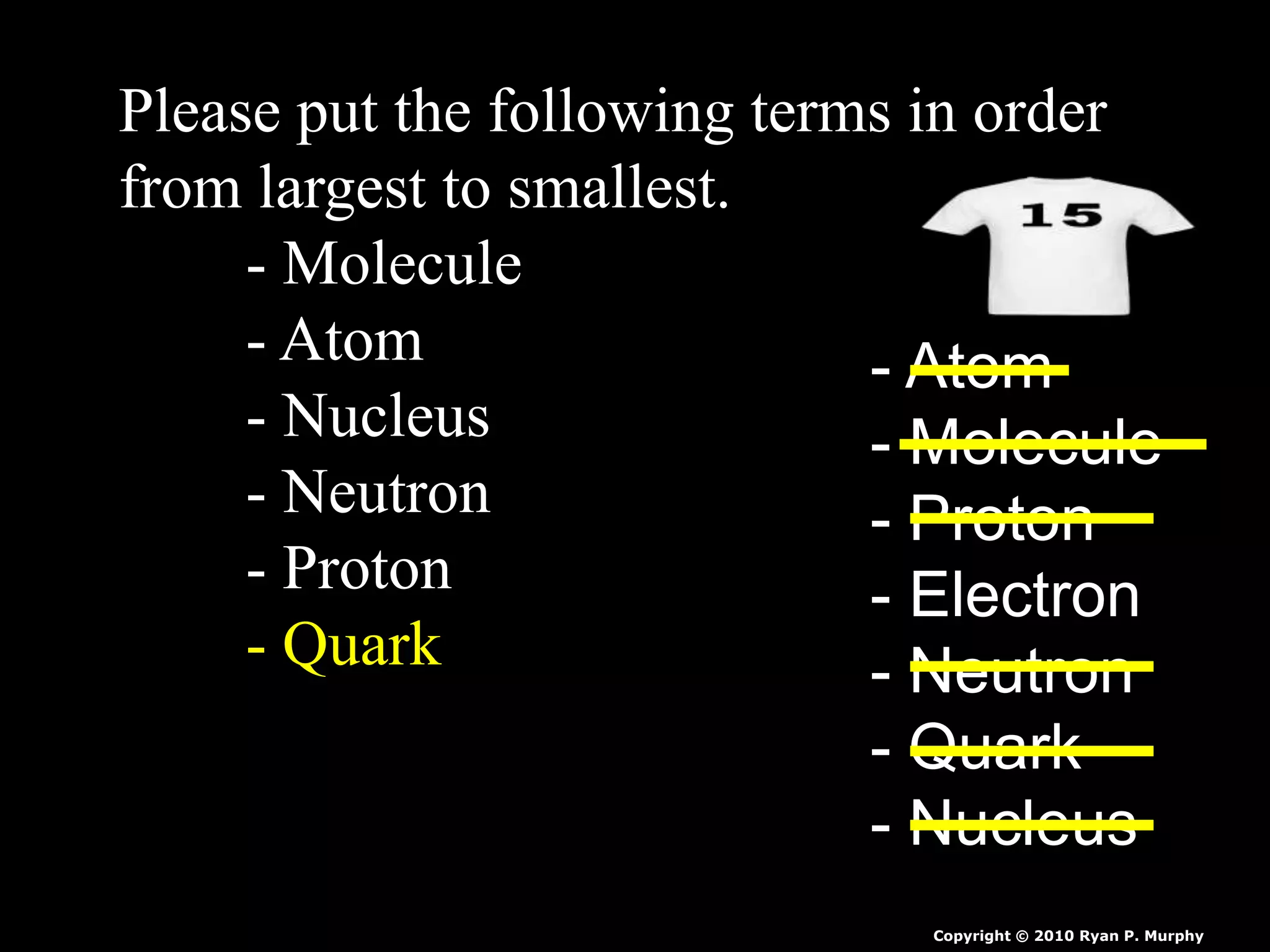
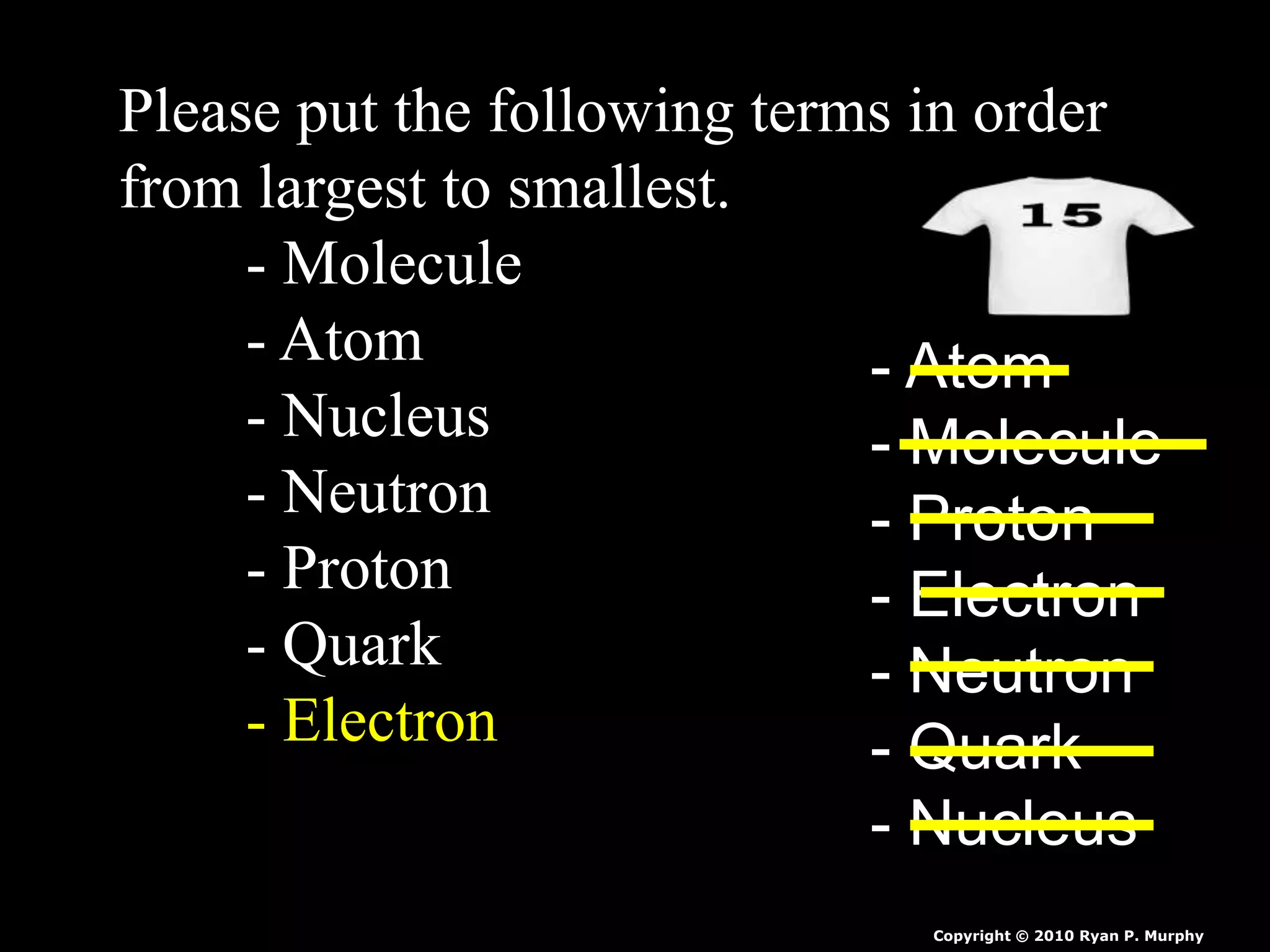
Please put the following terms in order
from largest to smallest.
- Atom
- Molecule
- Proton
- Electron
- Neutron
- Quark
- Nucleus
Copyright © 2010 Ryan P. Murphy
HAVE A GOOD
LOOK ATOM
ROUND
ABOUT
NUMBERIFFIC SUPER
SMALL
ATOMIC
POWER
-BONUS-
1 6 11 16 *21
2 7 12 17 *22
3 8 13 18 *23
4 9 14 19 *24
5 10 15 20 *25
Copyright © 2010 Ryan P. Murphy
Intro to Atoms Review Game
HAVE A GOOD
LOOK ATOM
ROUND
ABOUT
NUMBERIFFIC SUPER
SMALL
ATOMIC
POWER
-BONUS-
1 6 11 16 *21
2 7 12 17 *22
3 8 13 18 *23
4 9 14 19 *24
5 10 15 20 *25
Copyright © 2010 Ryan P. Murphy
Intro to Atoms Review Game
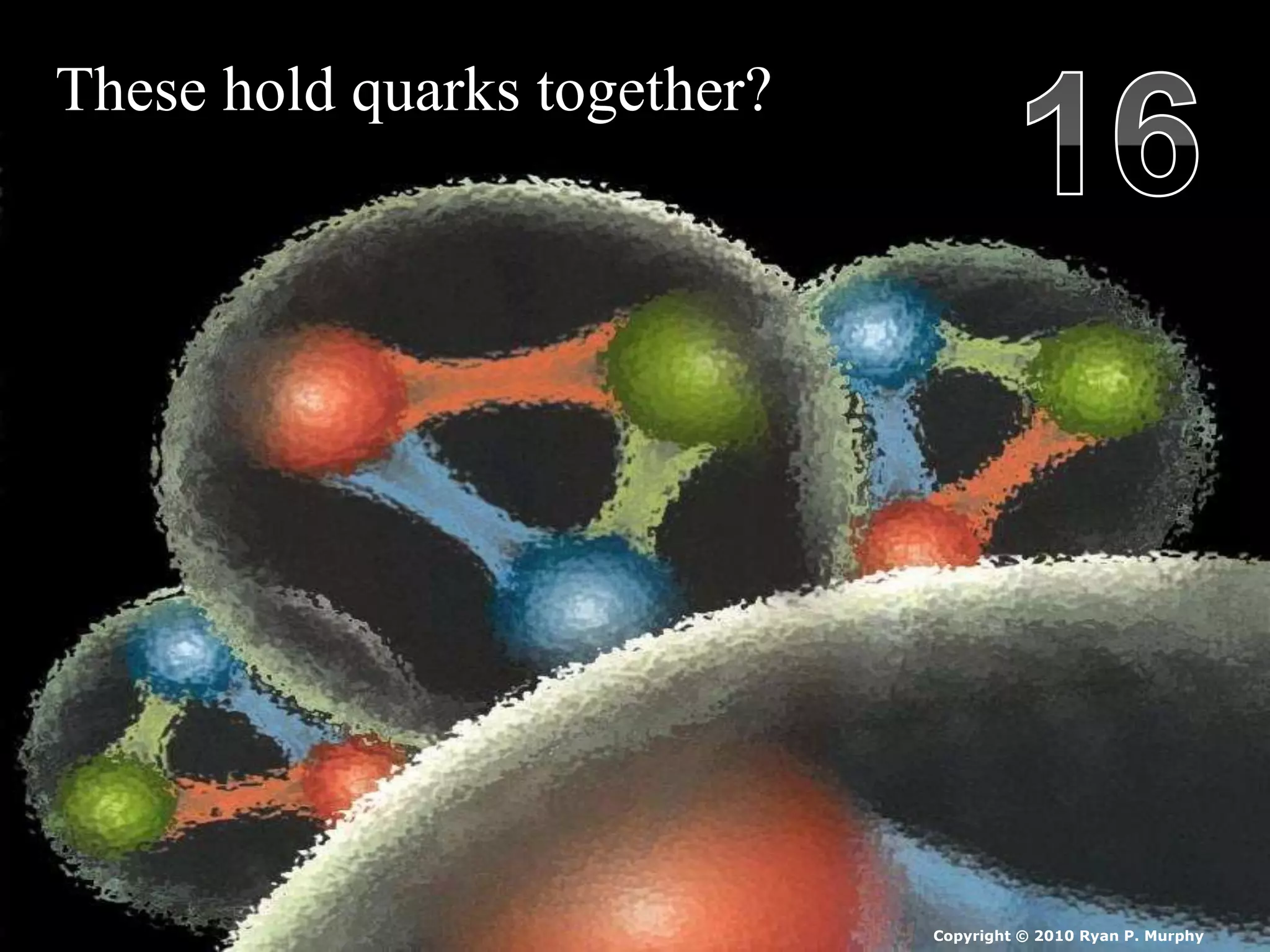
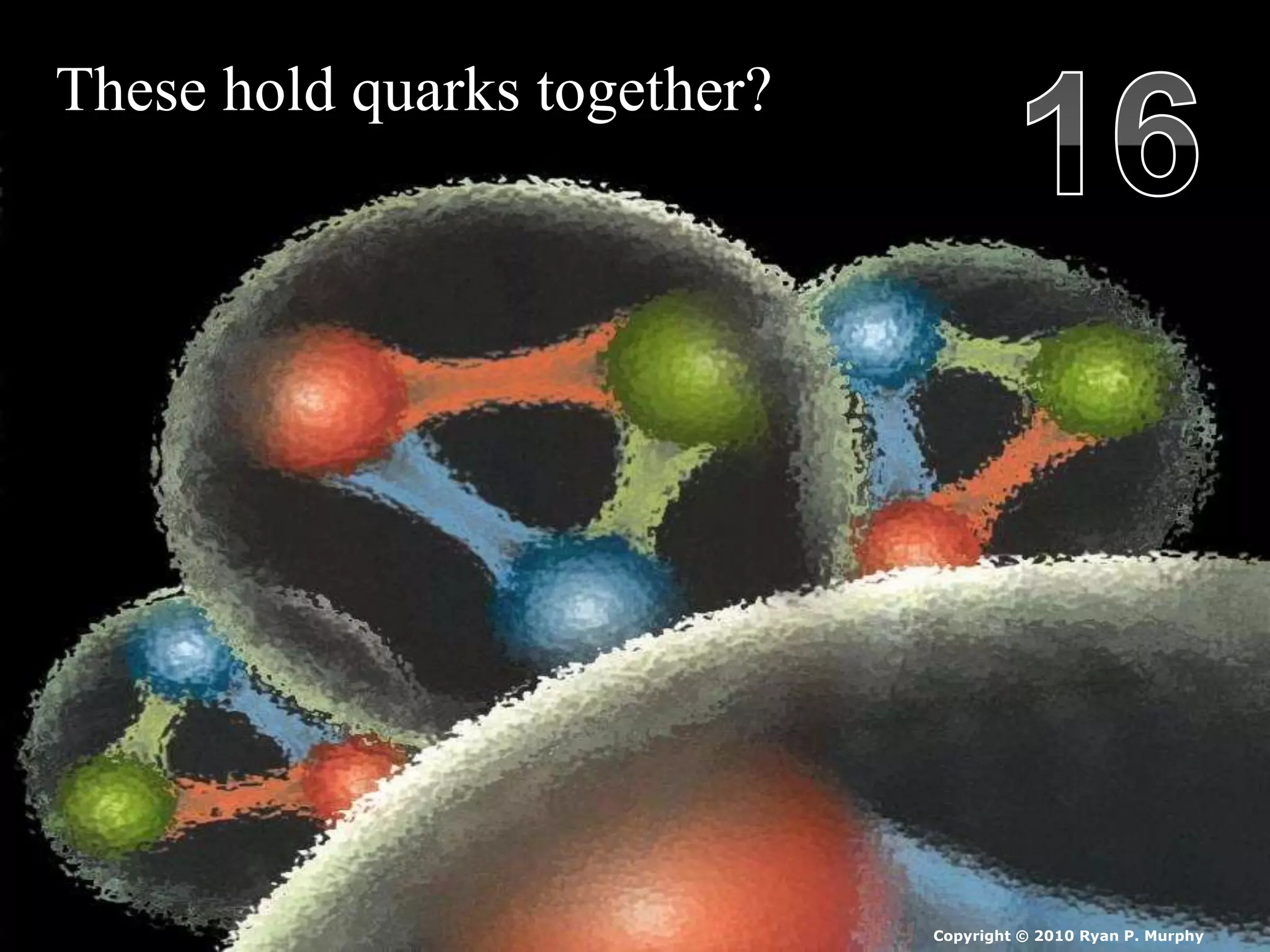
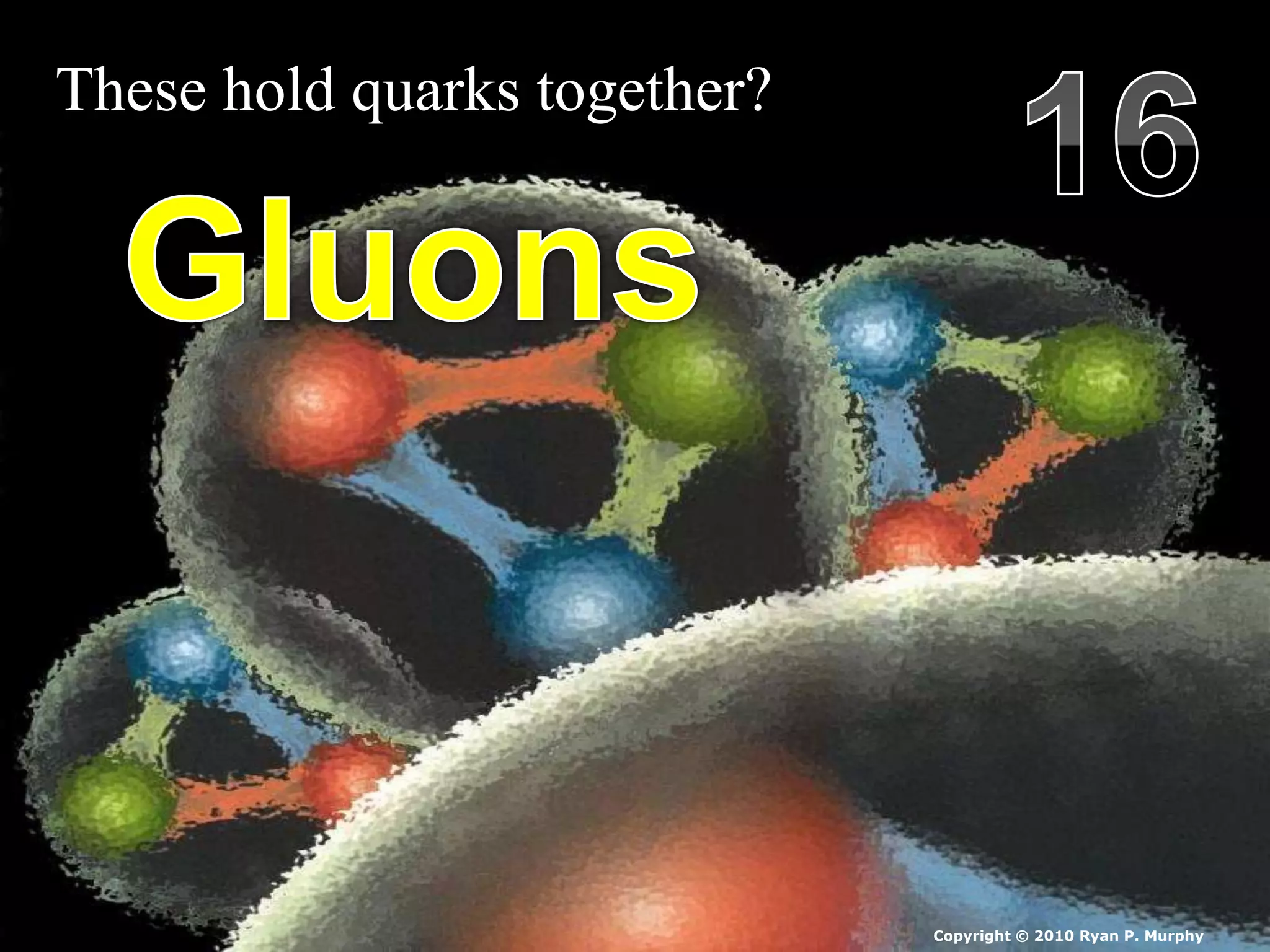
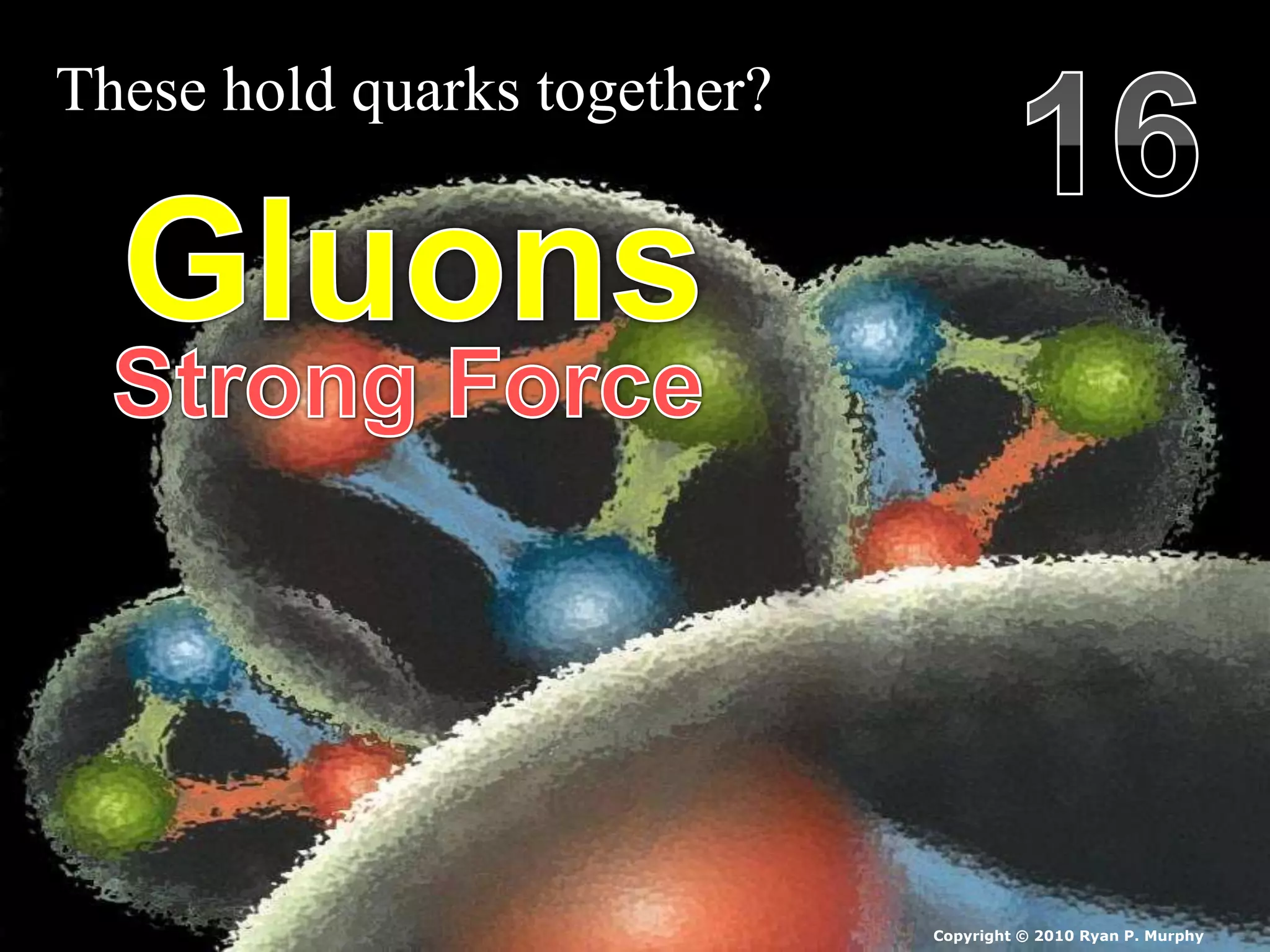
These hold quarks together?
Copyright © 2010 Ryan P. Murphy
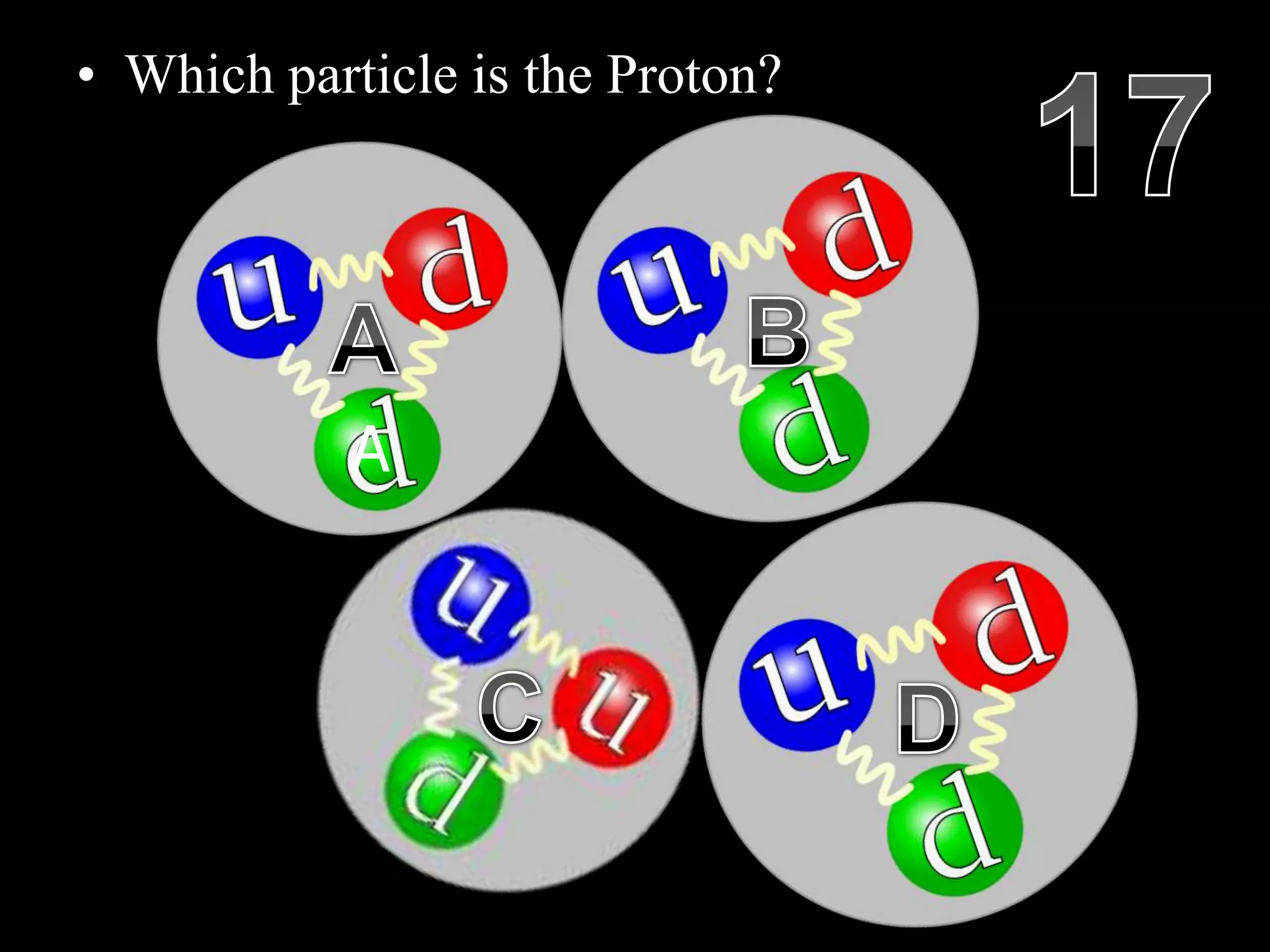
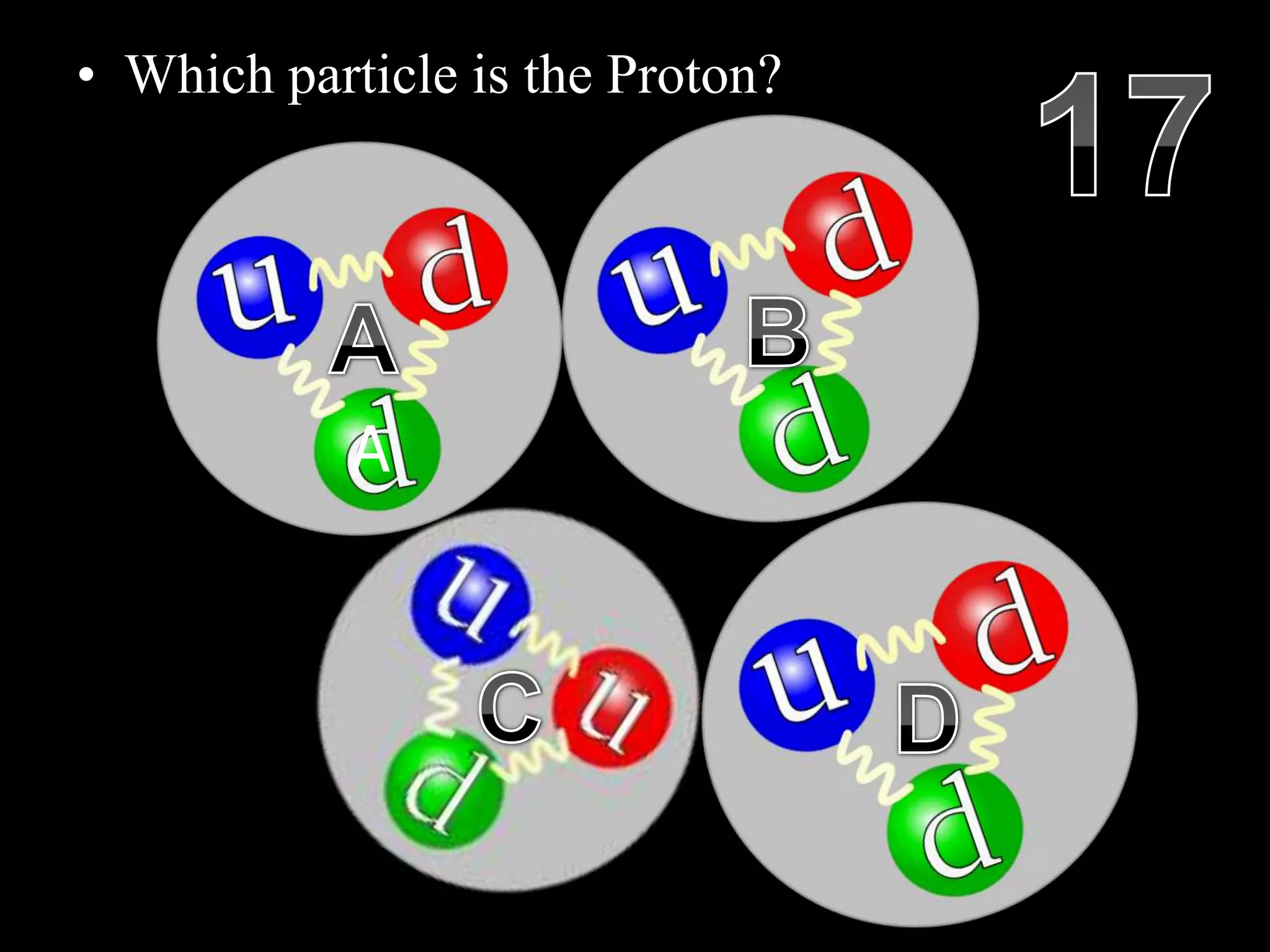
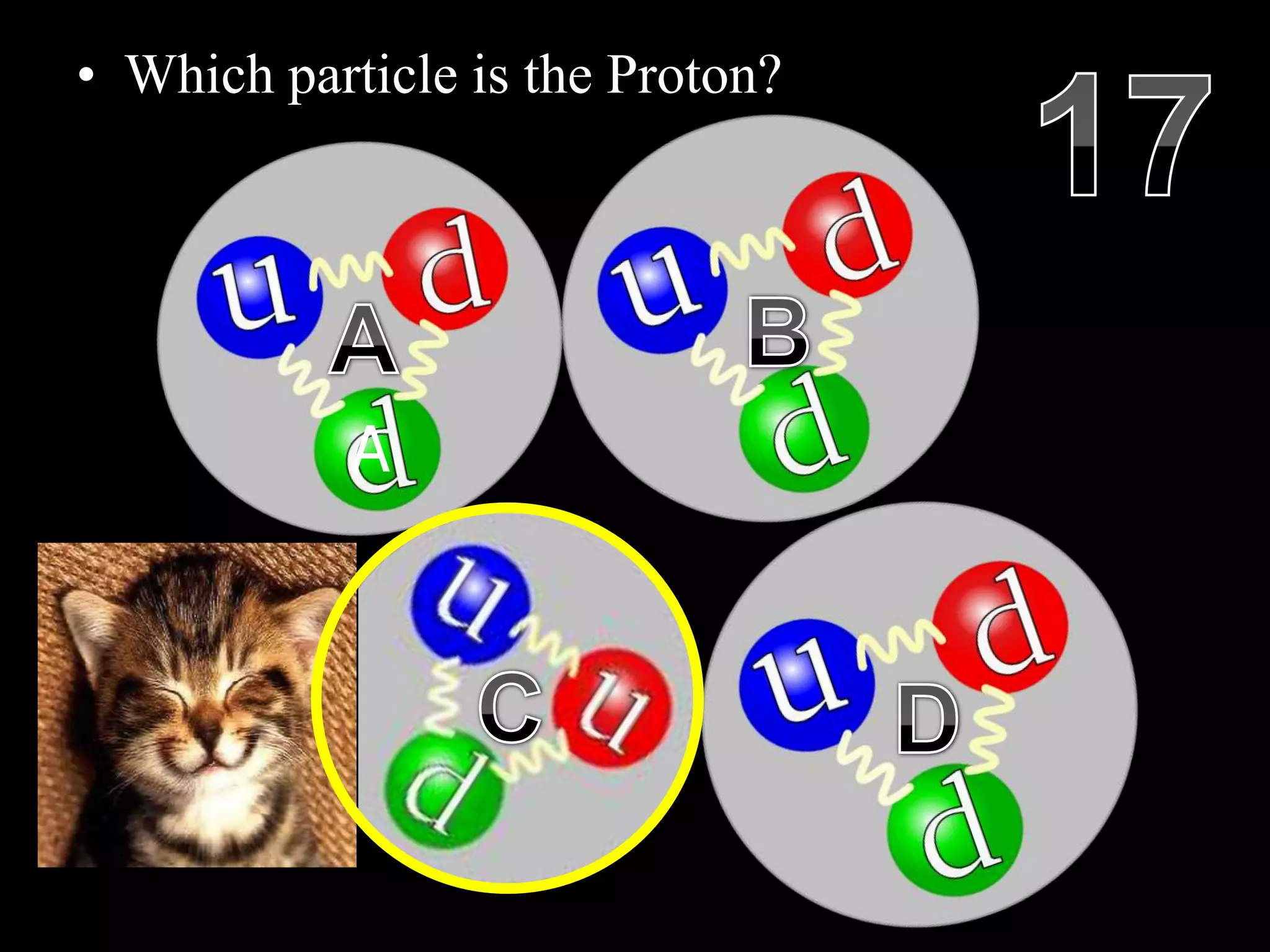
• Which particle is the Proton?
Copyright © 2010 Ryan P. Murphy
A
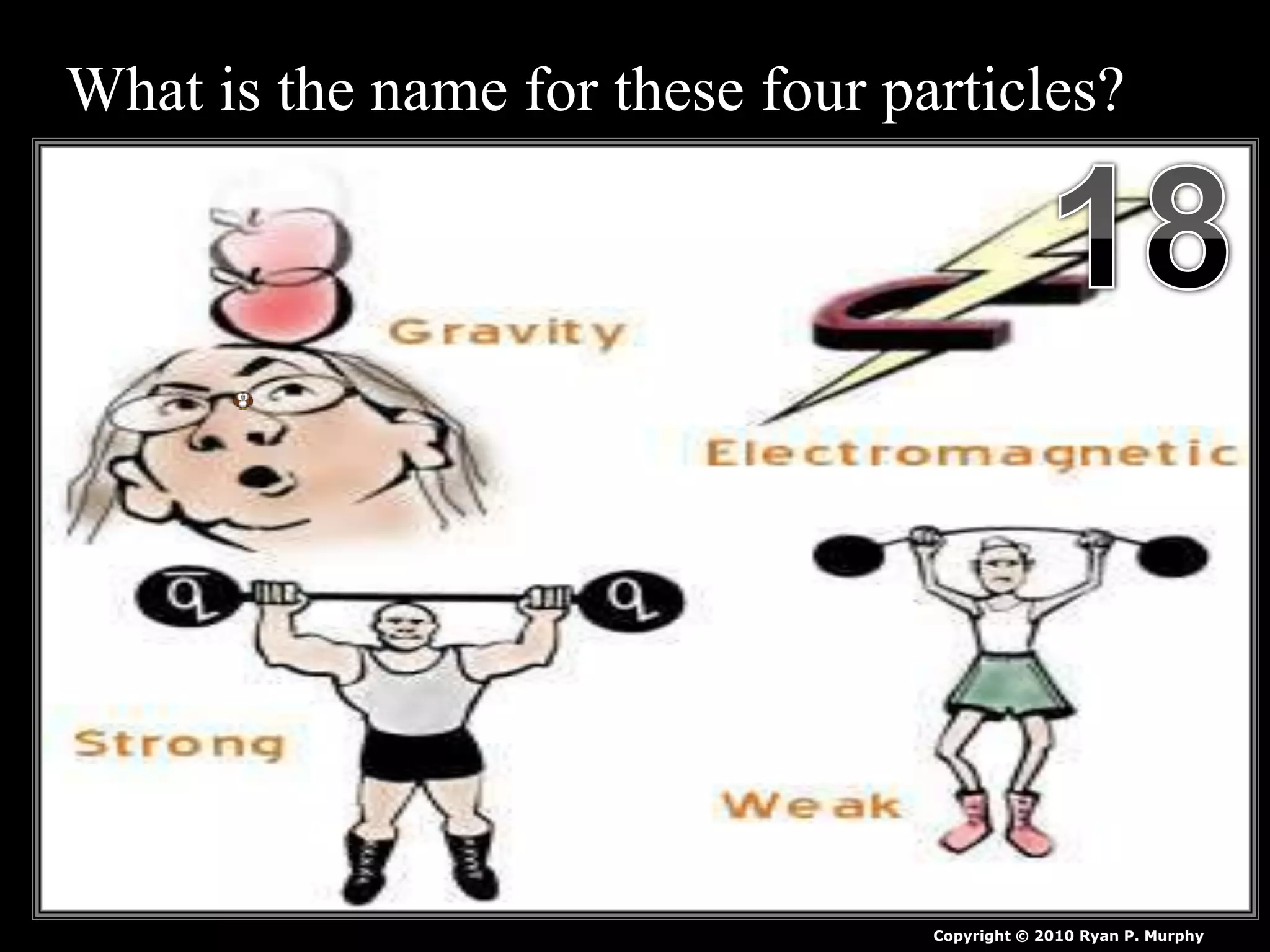
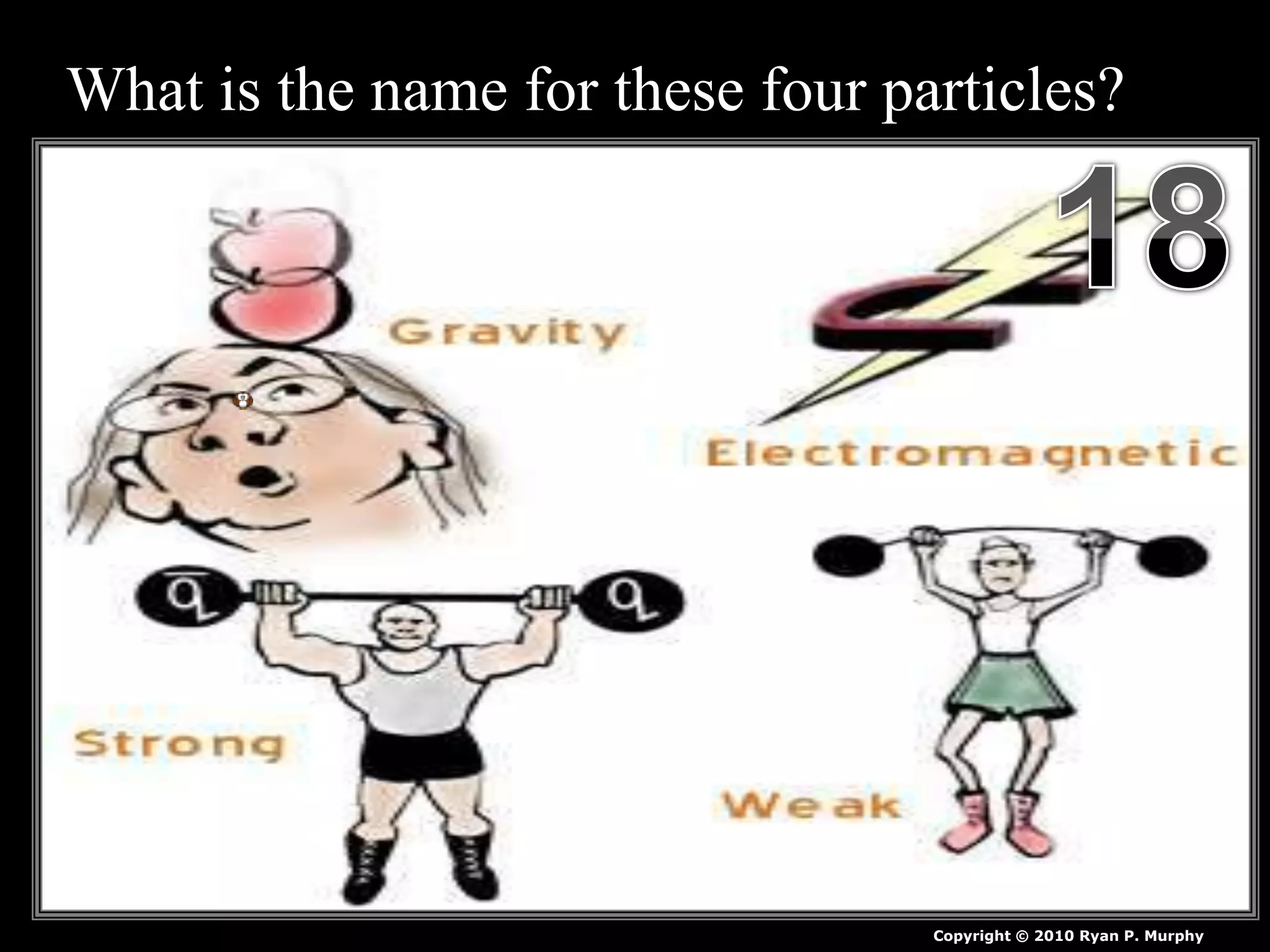
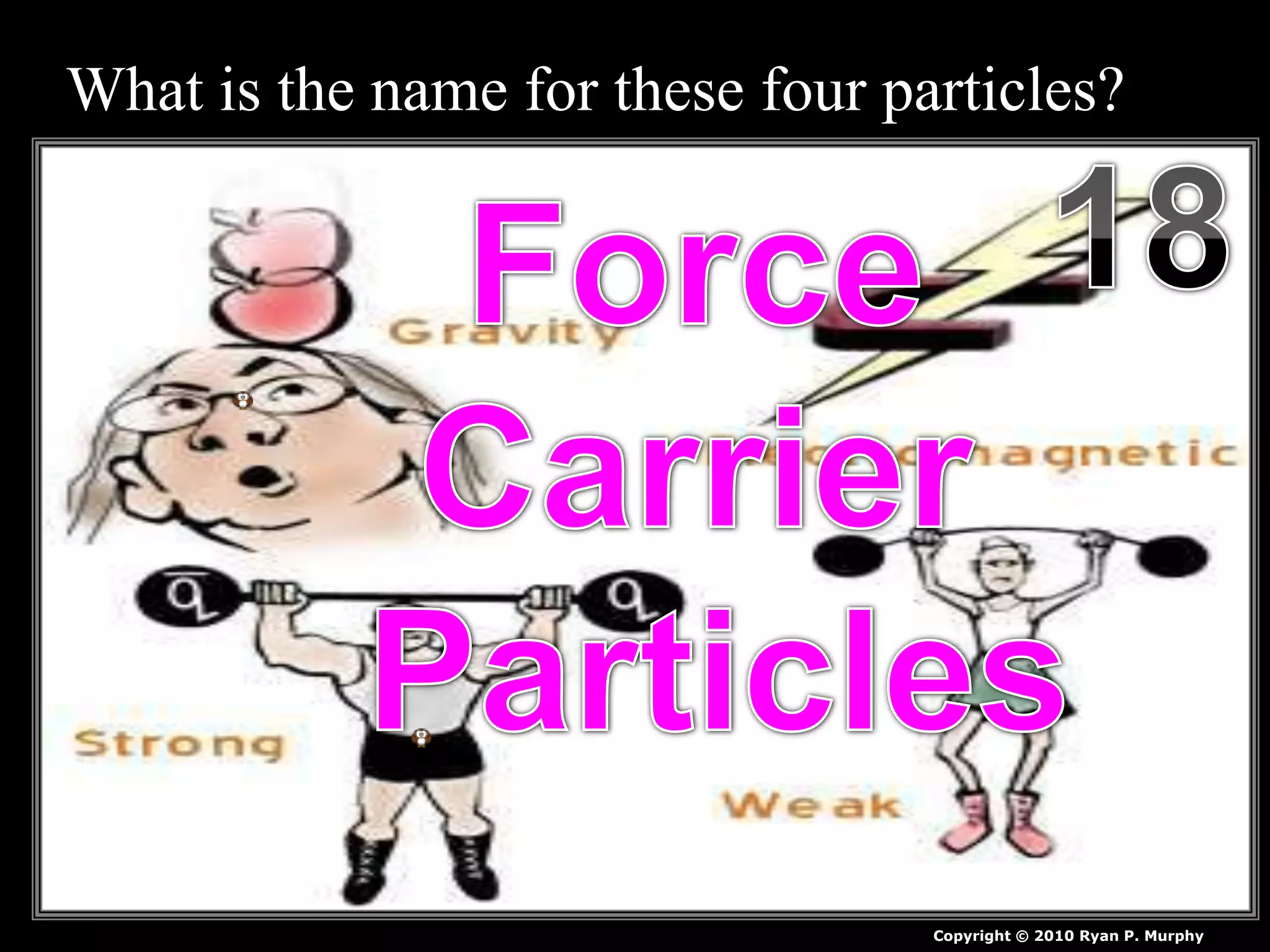
What is the name for these four particles?
Copyright © 2010 Ryan P. Murphy
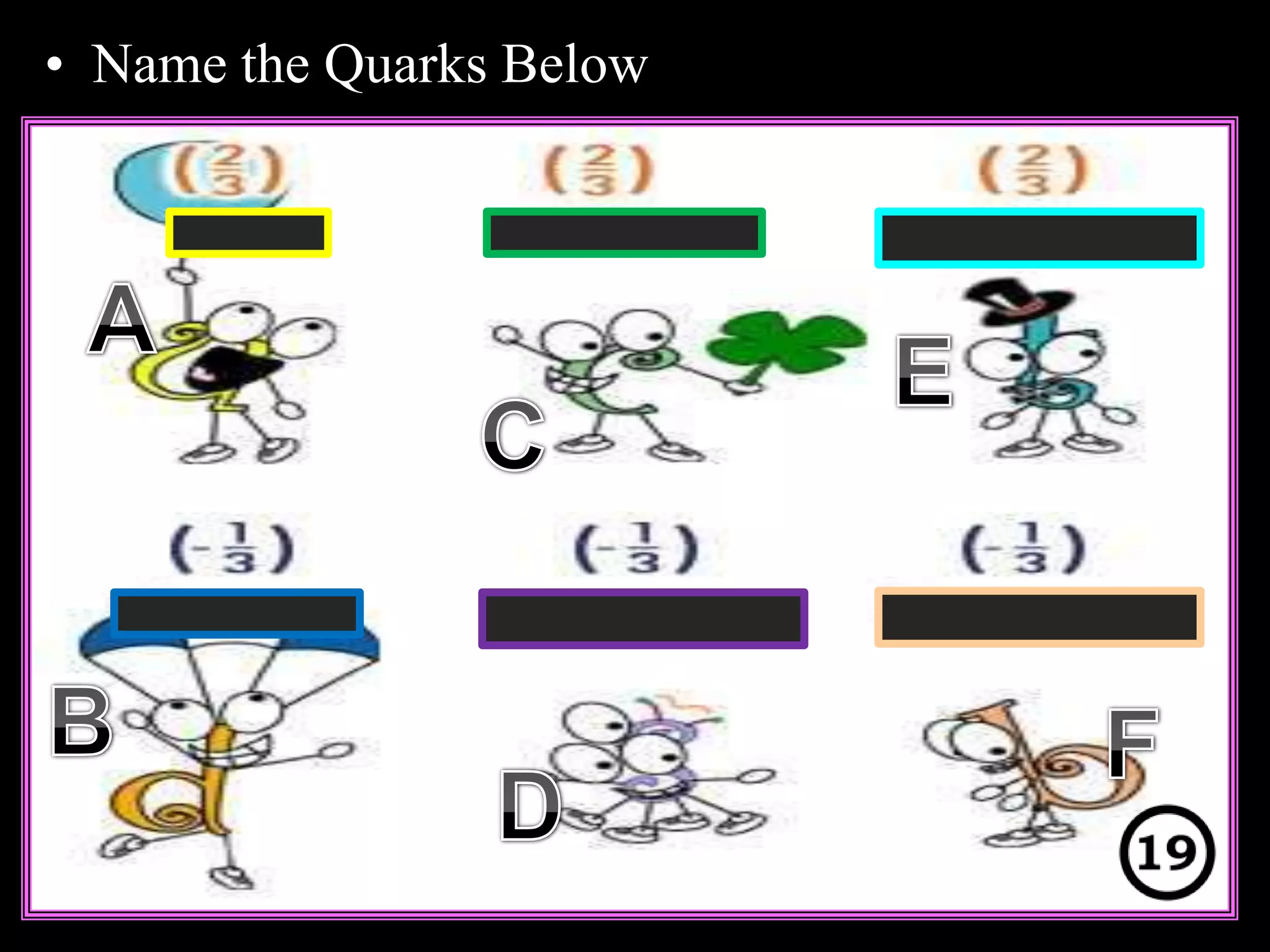
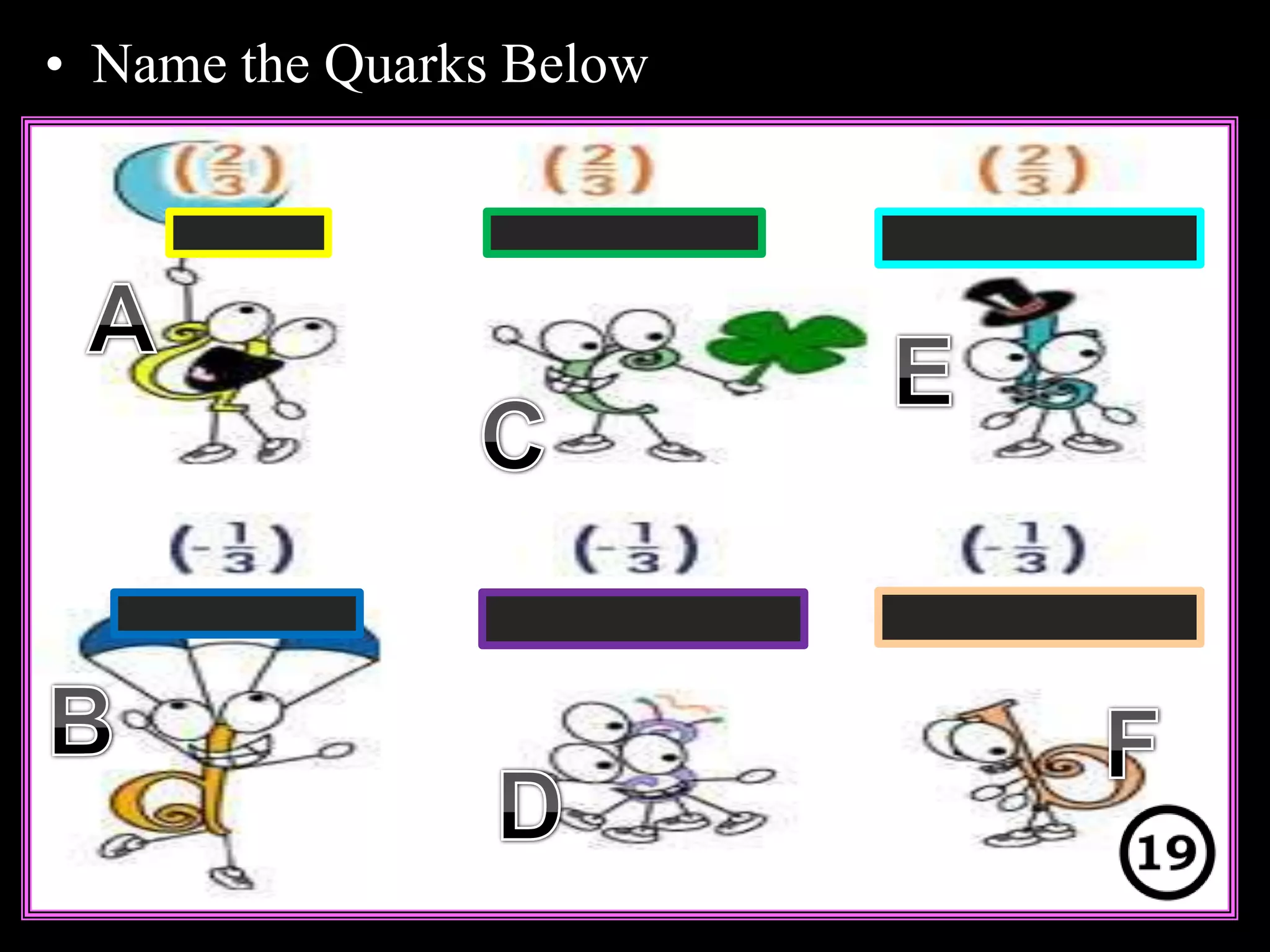
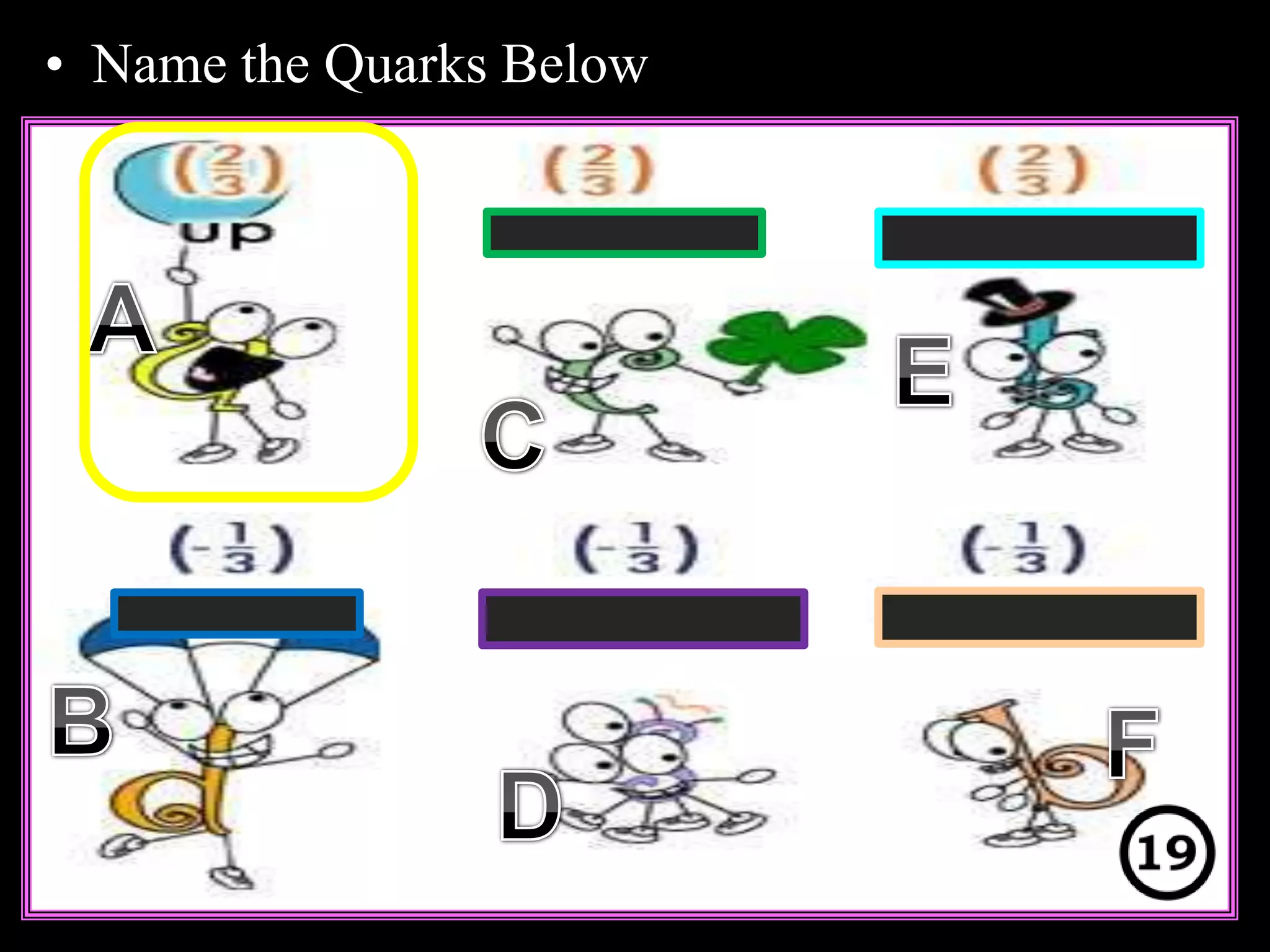
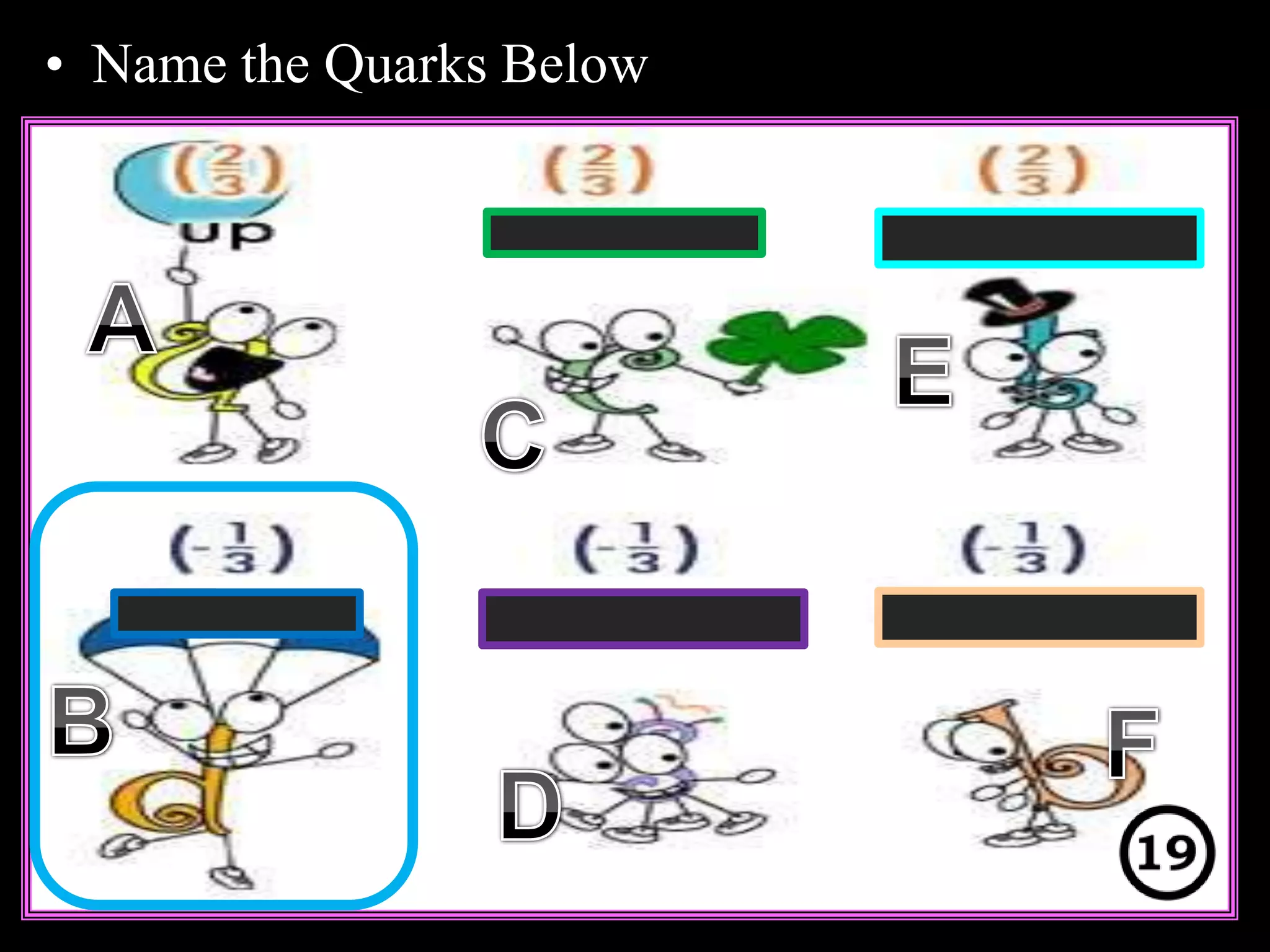
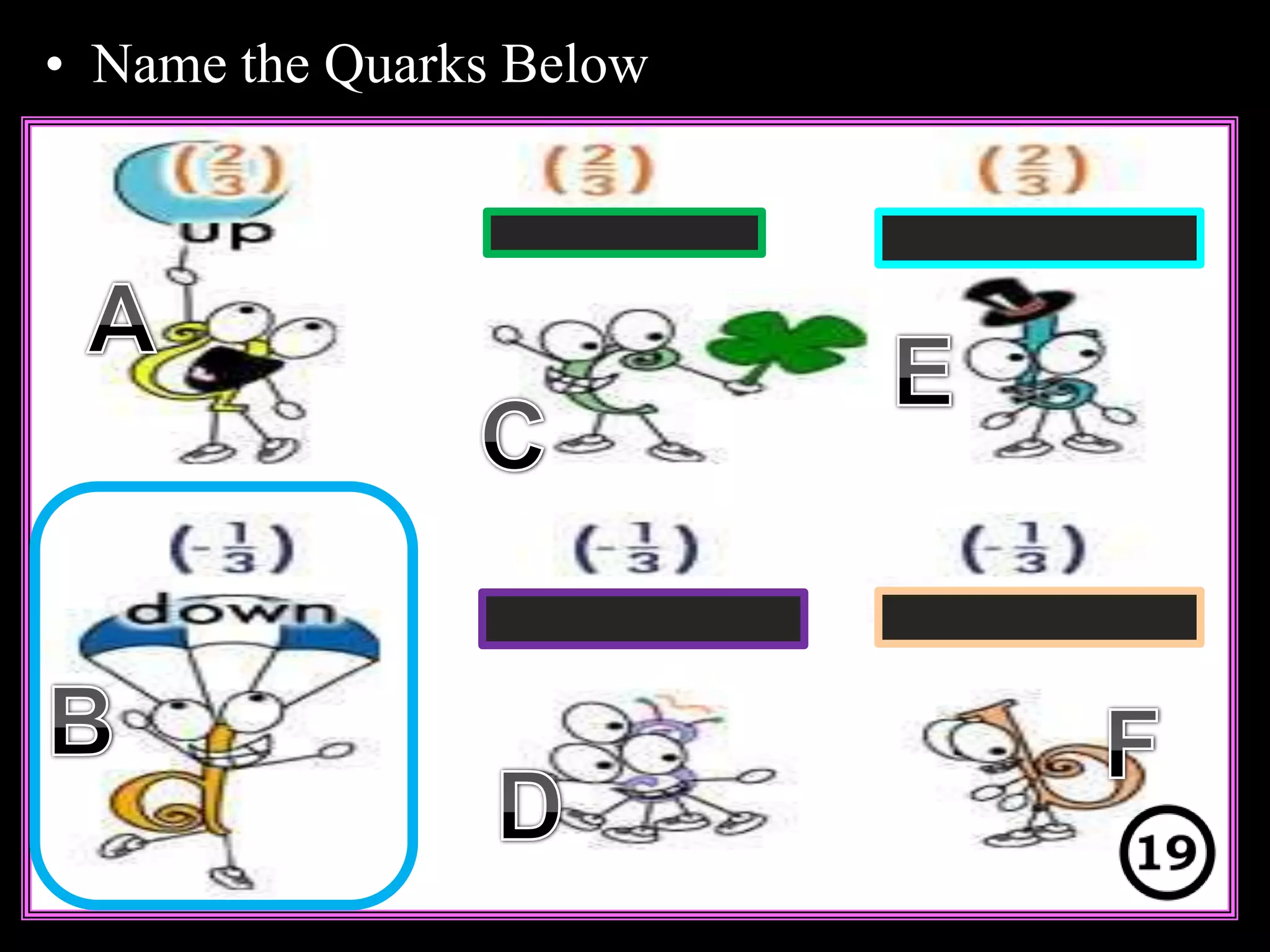
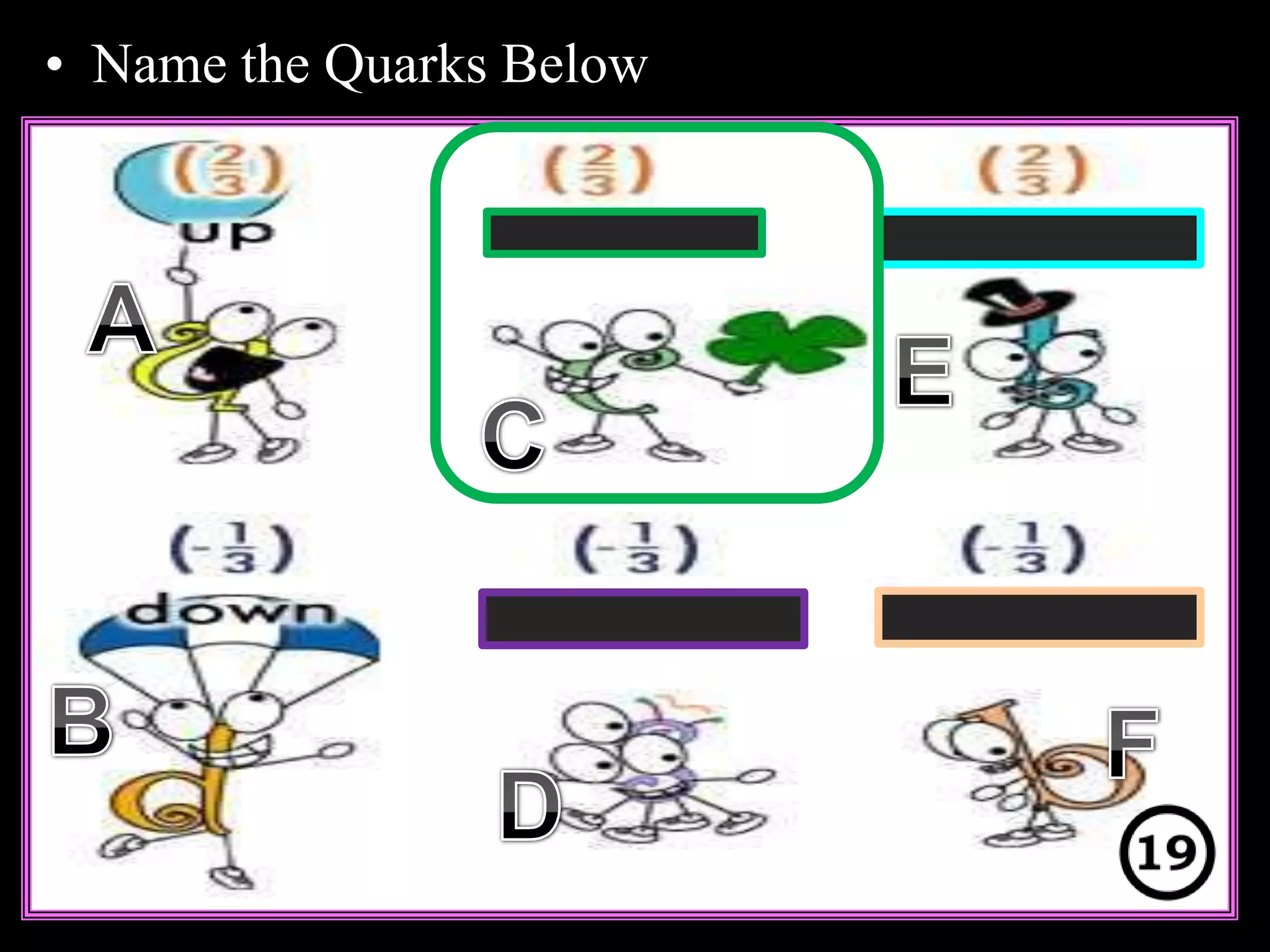
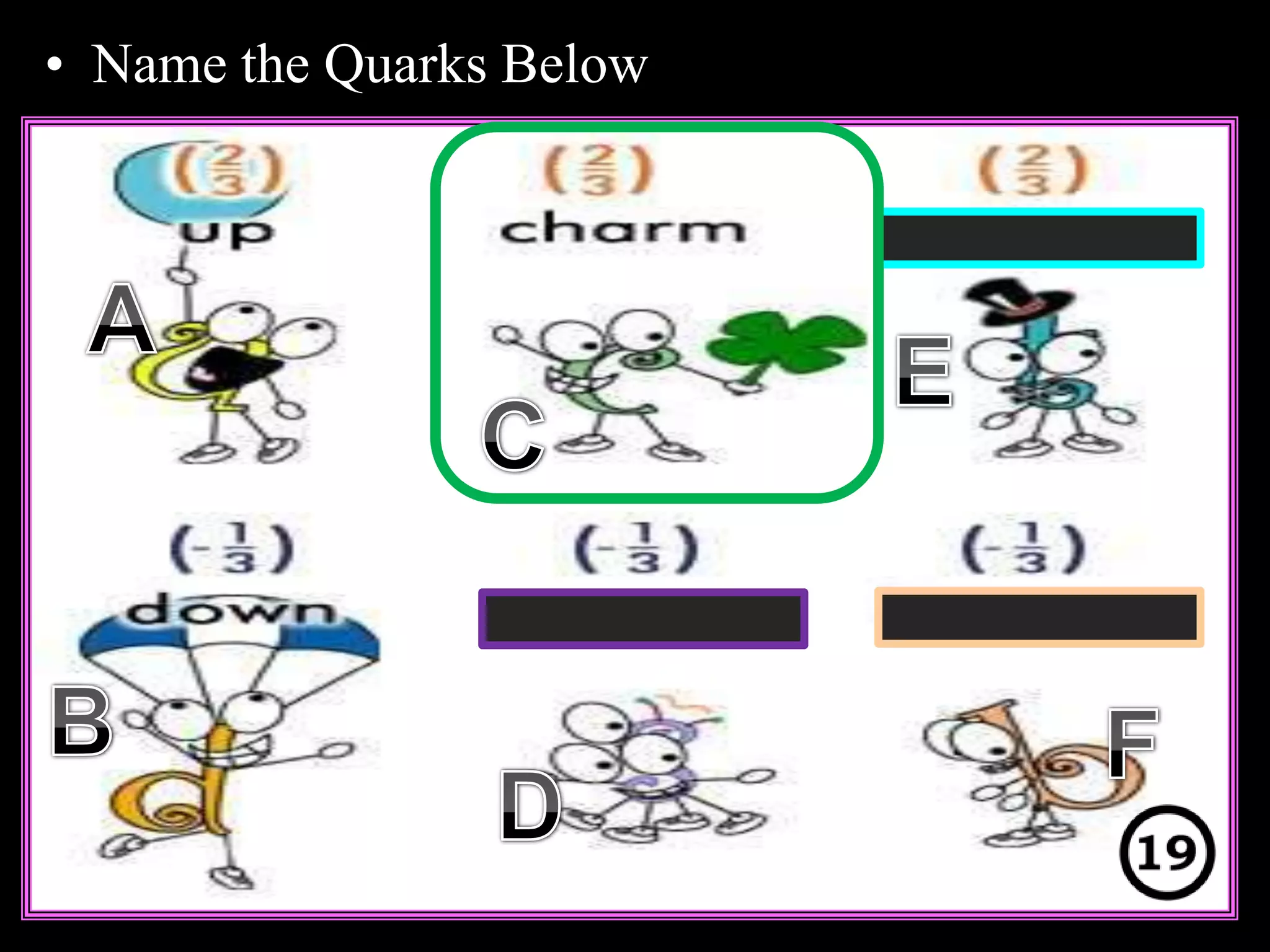
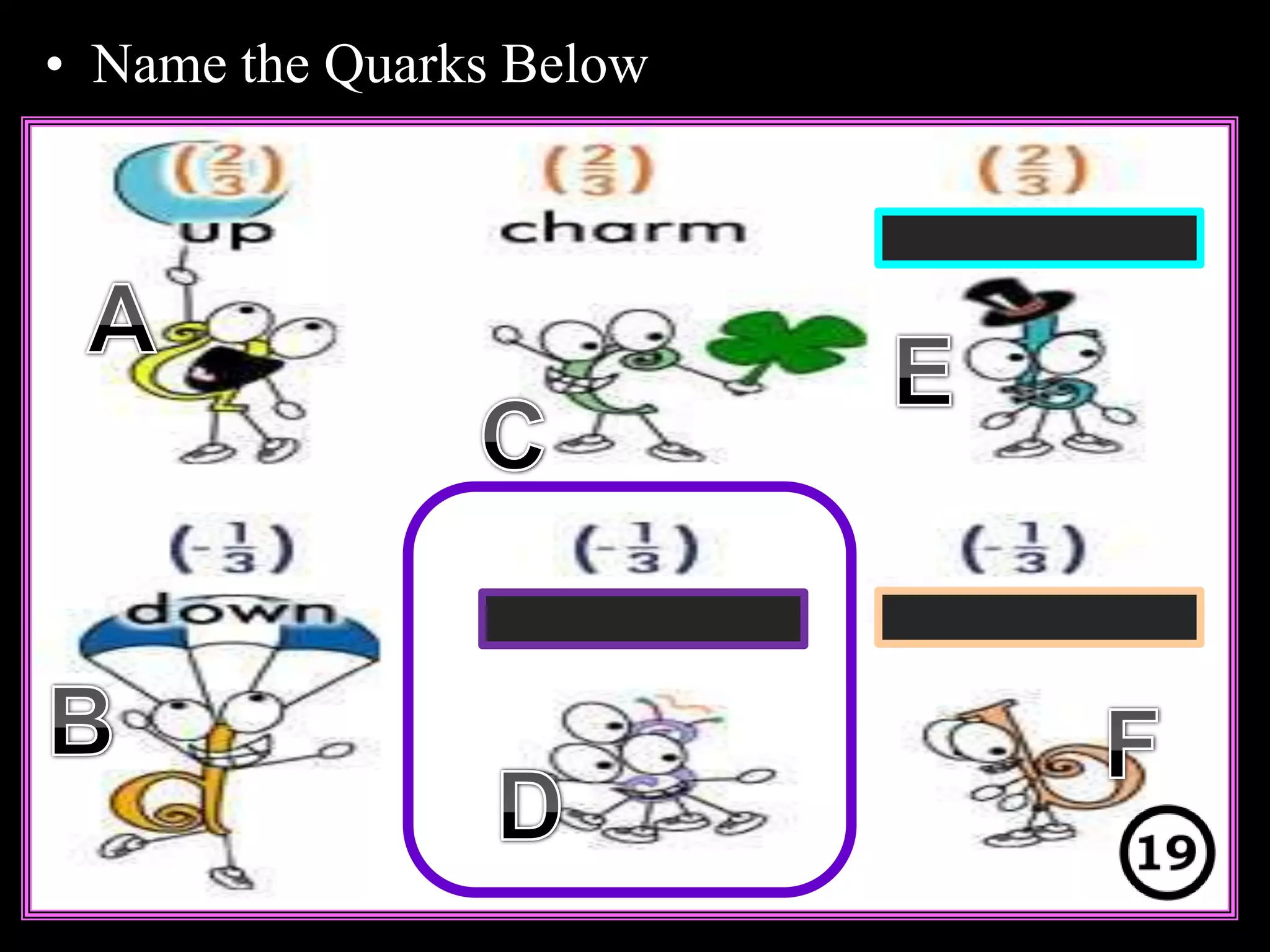
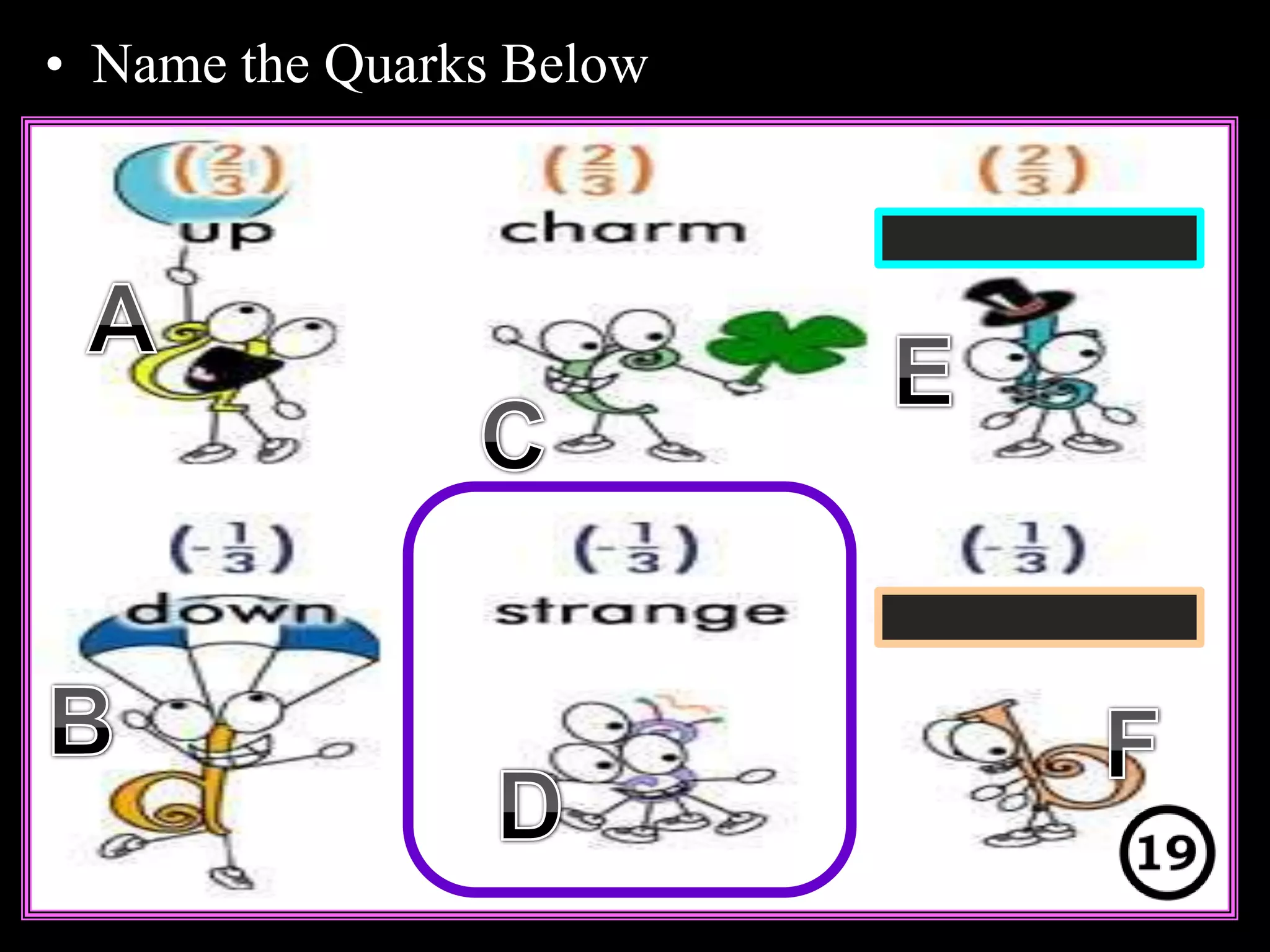
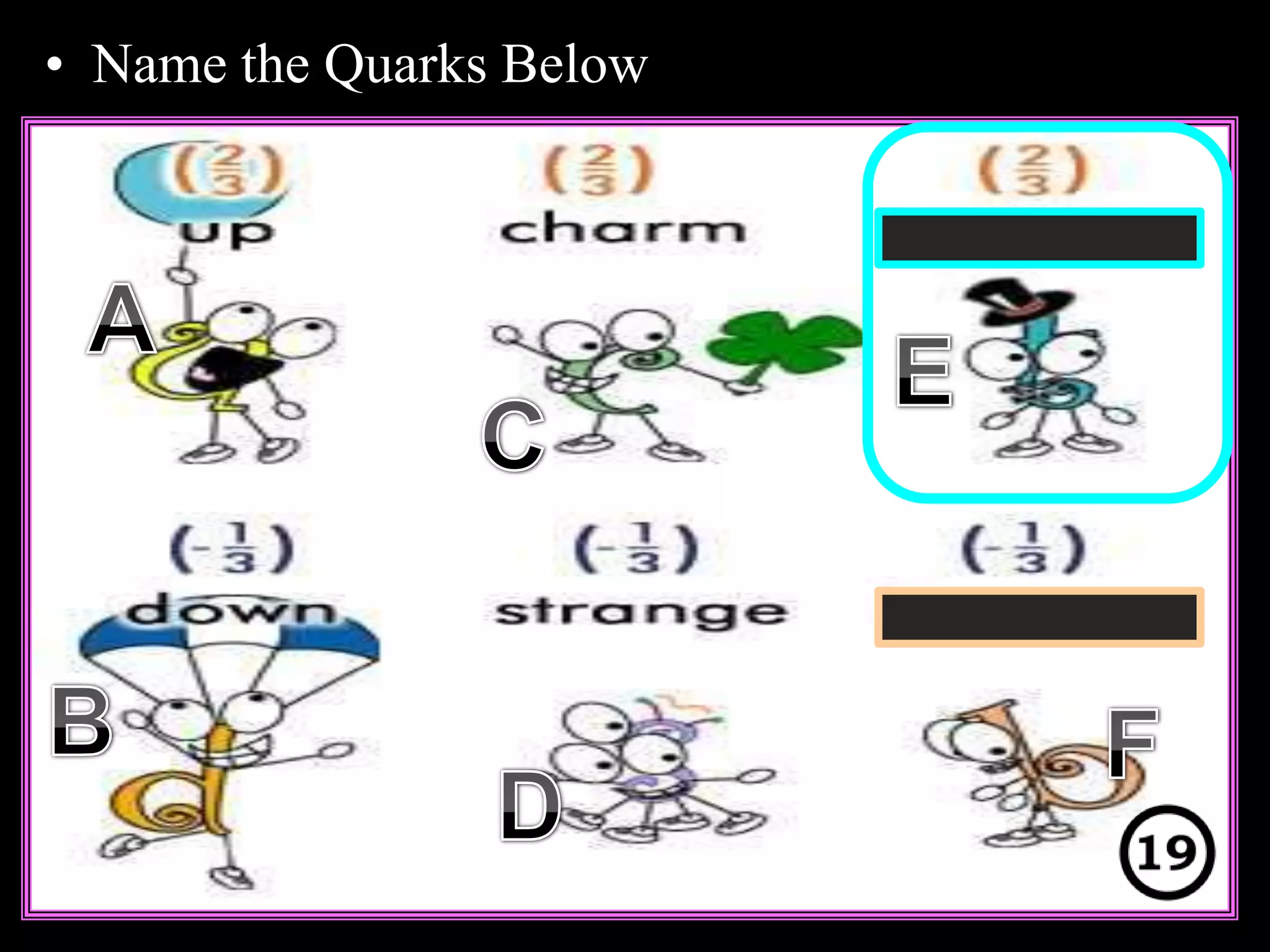
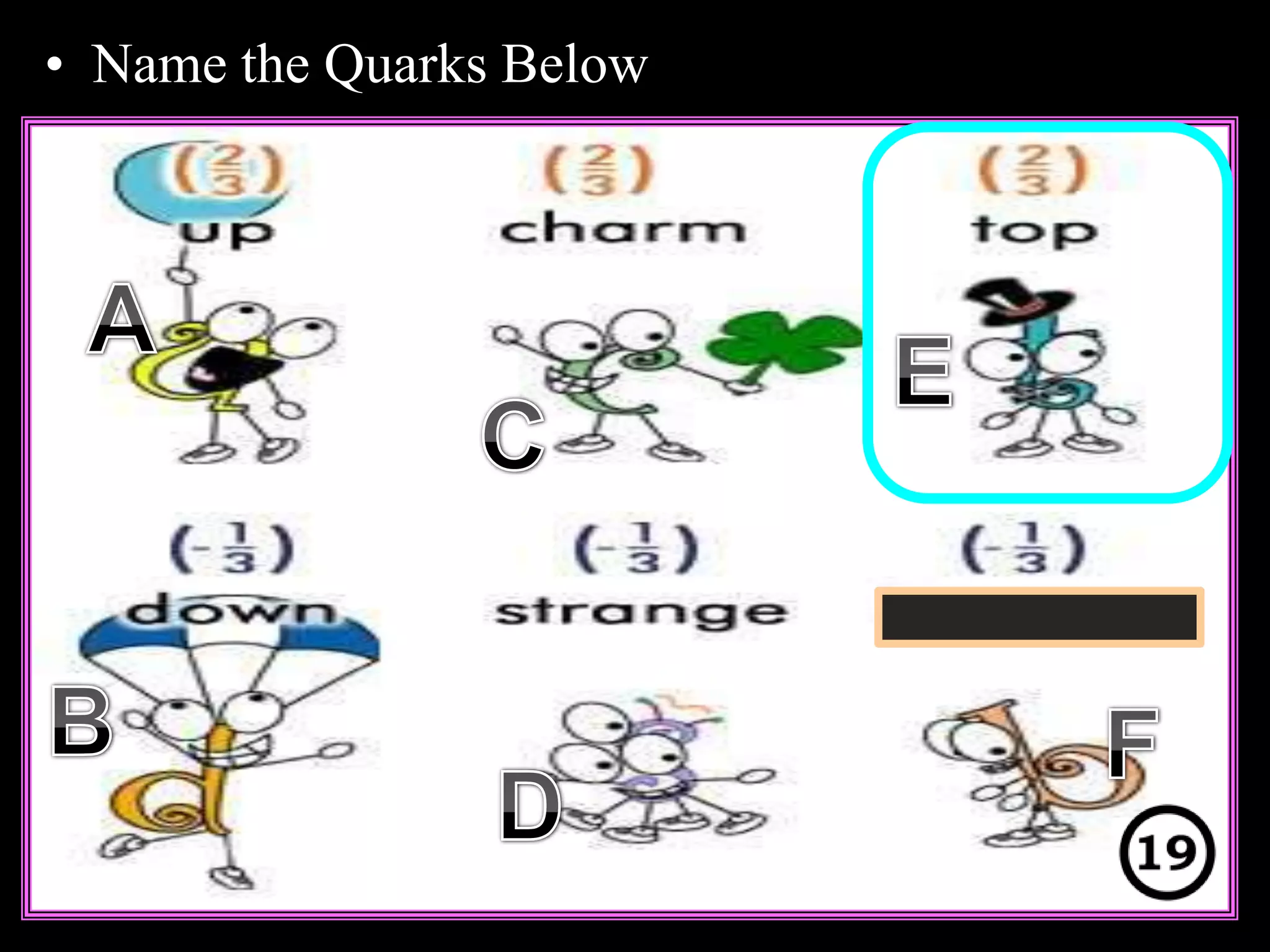
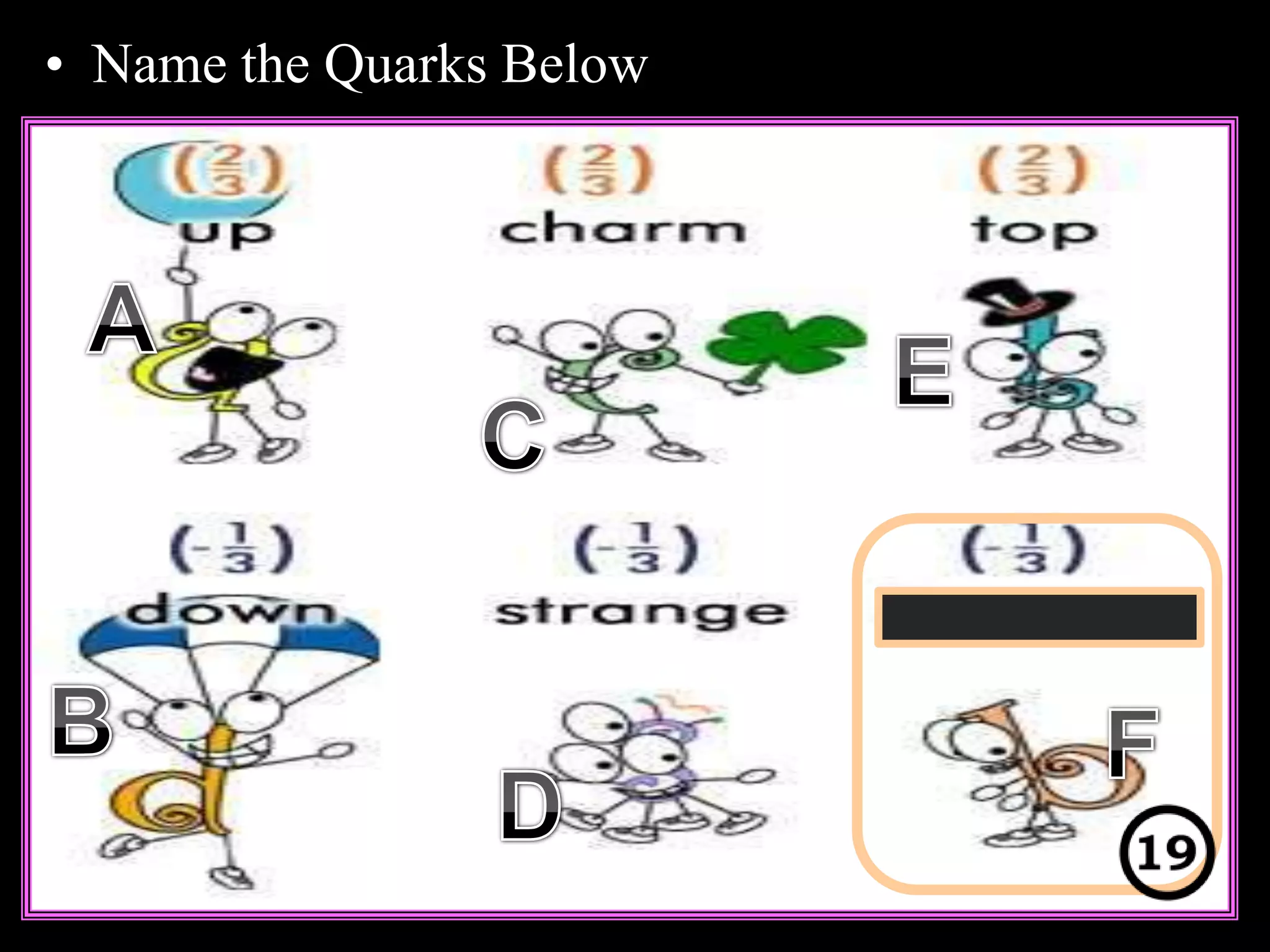
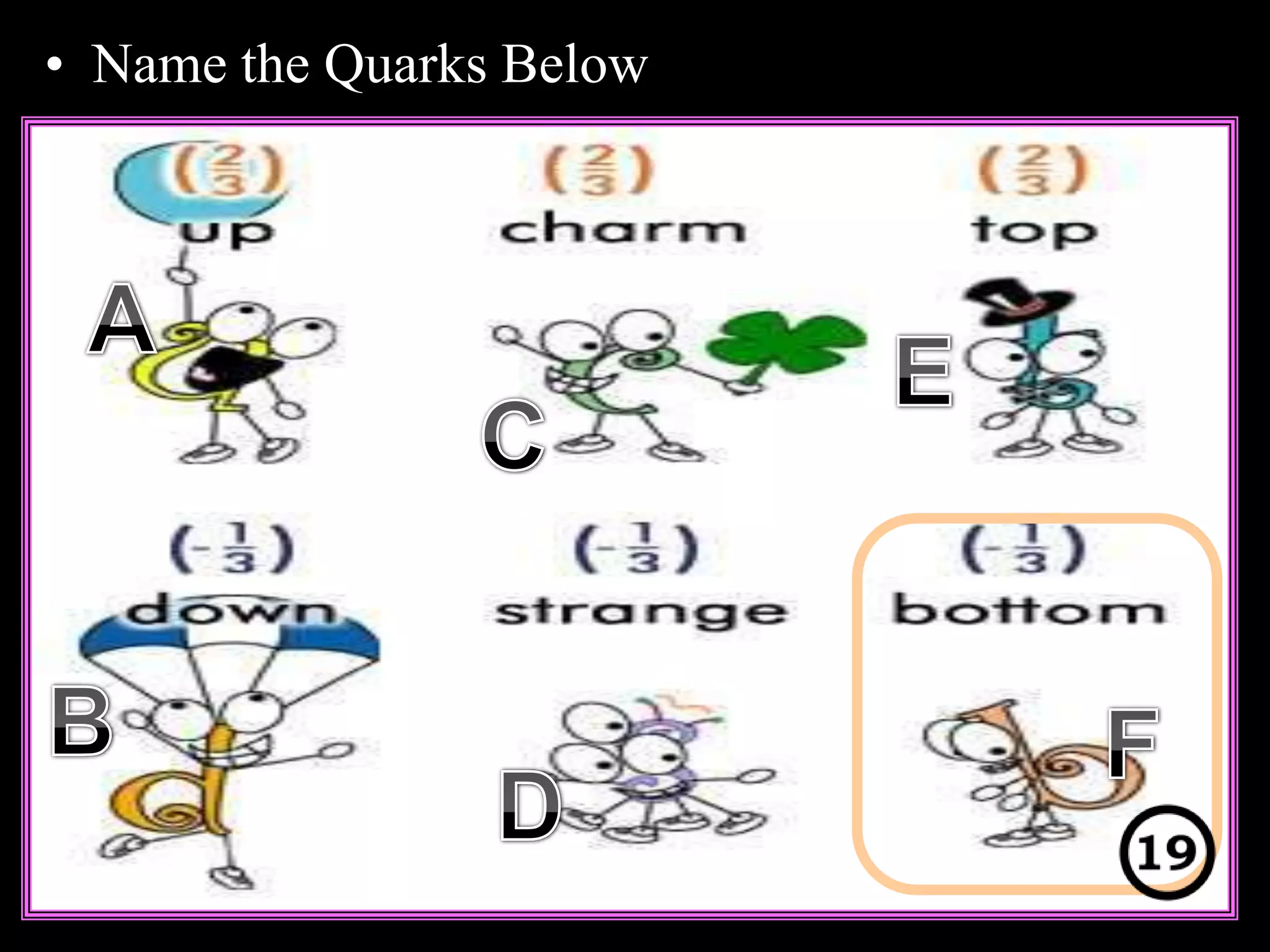
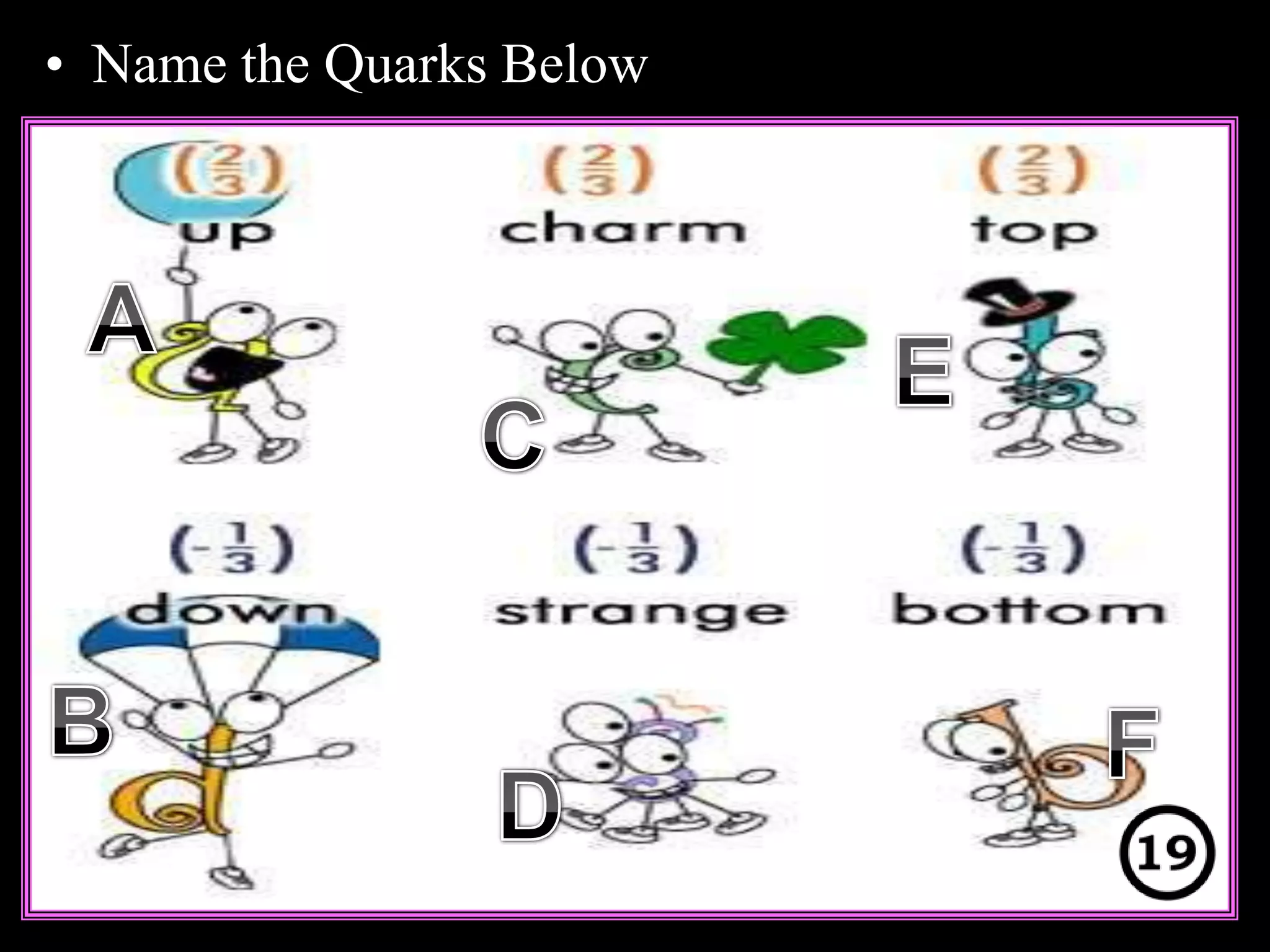
• Name the Quarks Below
Copyright © 2010 Ryan P. Murphy
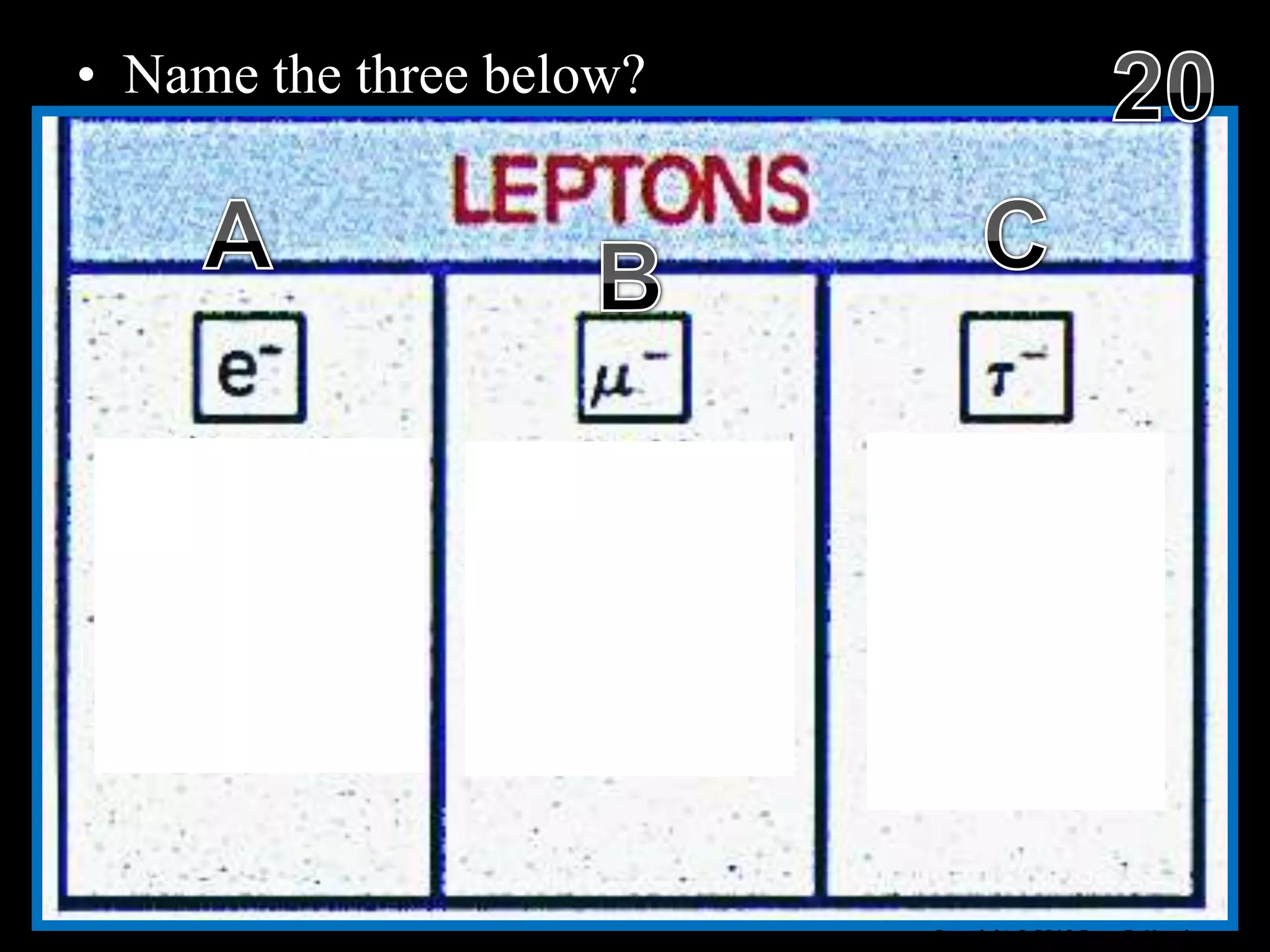
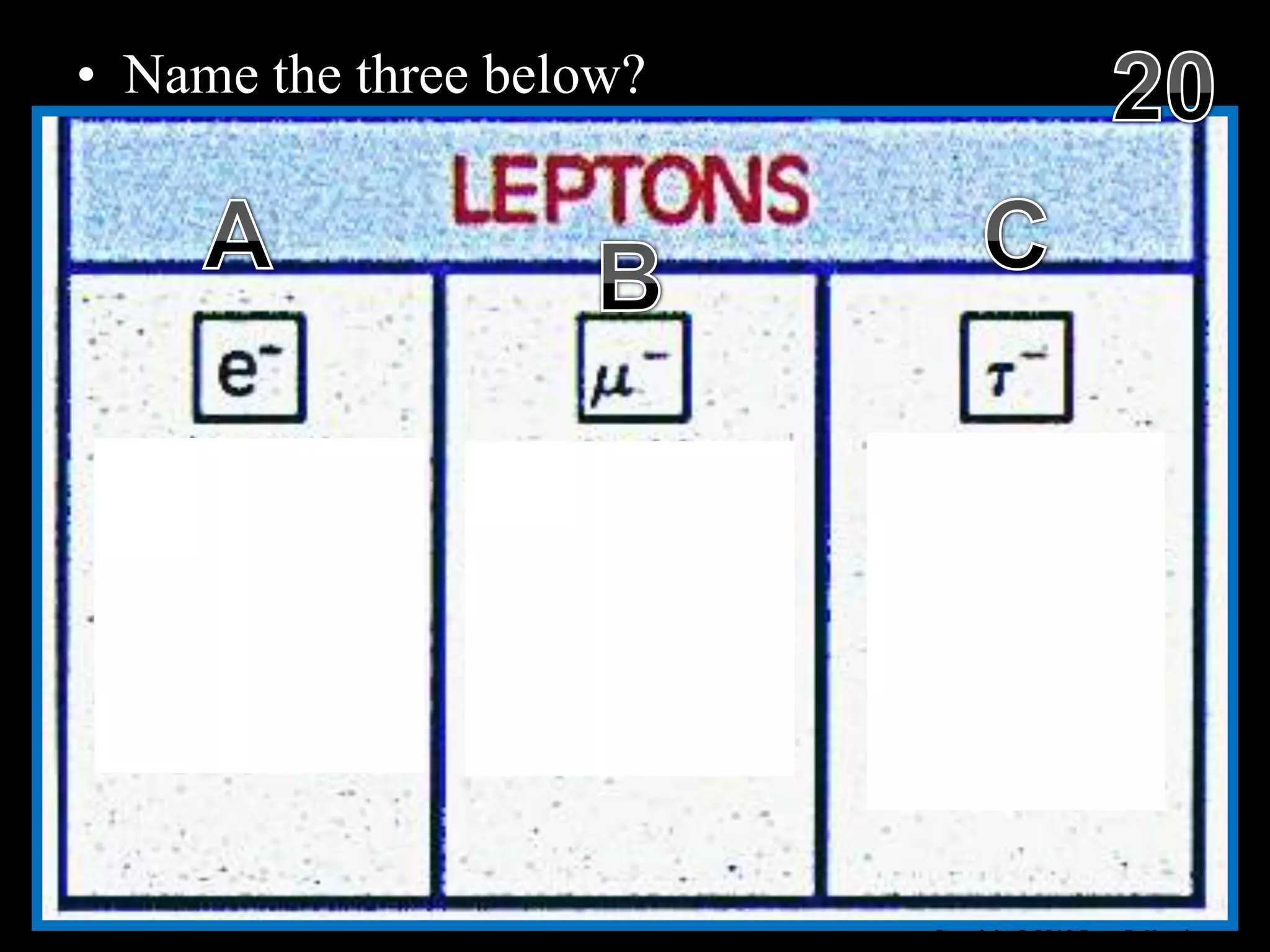
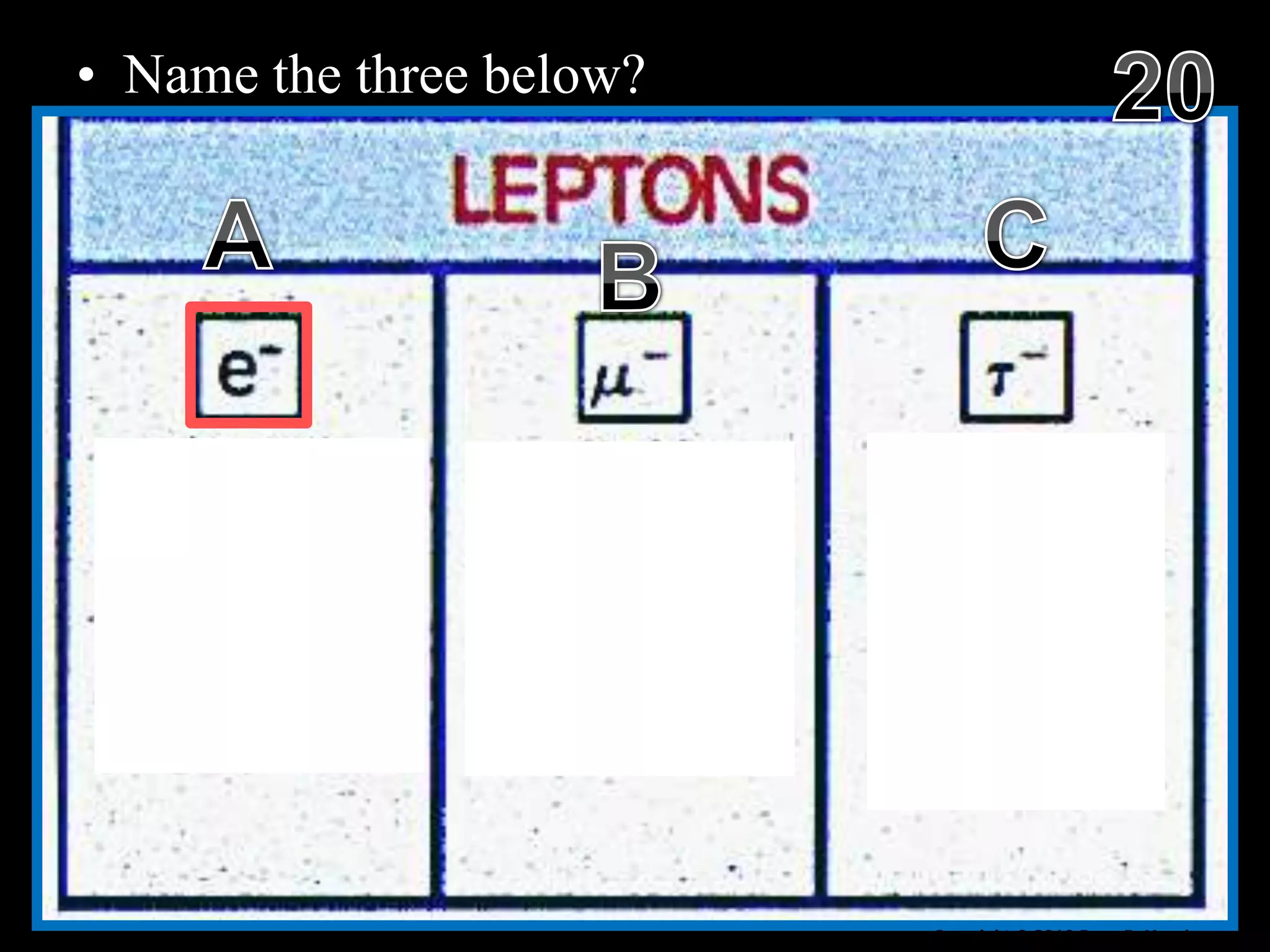
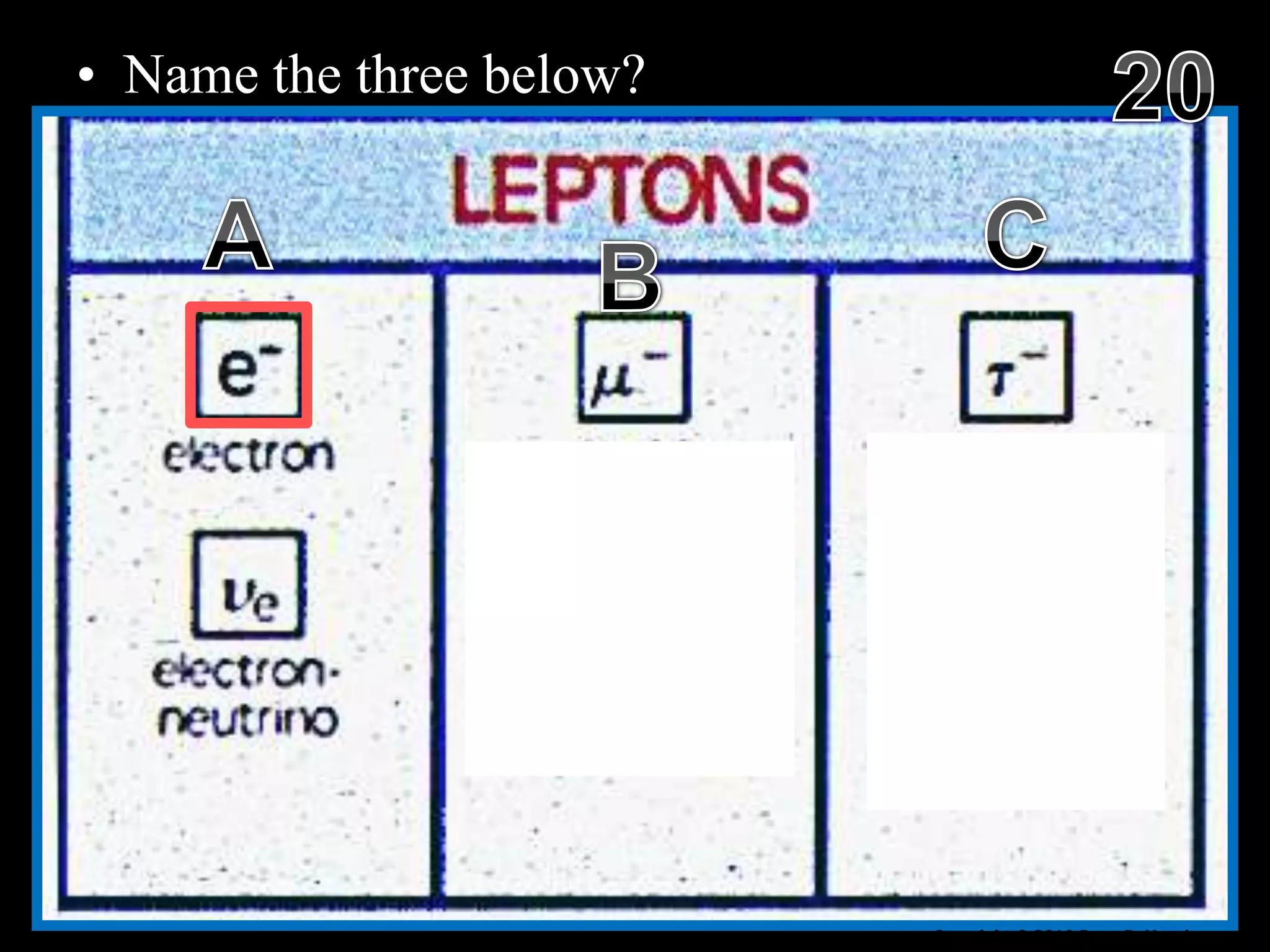
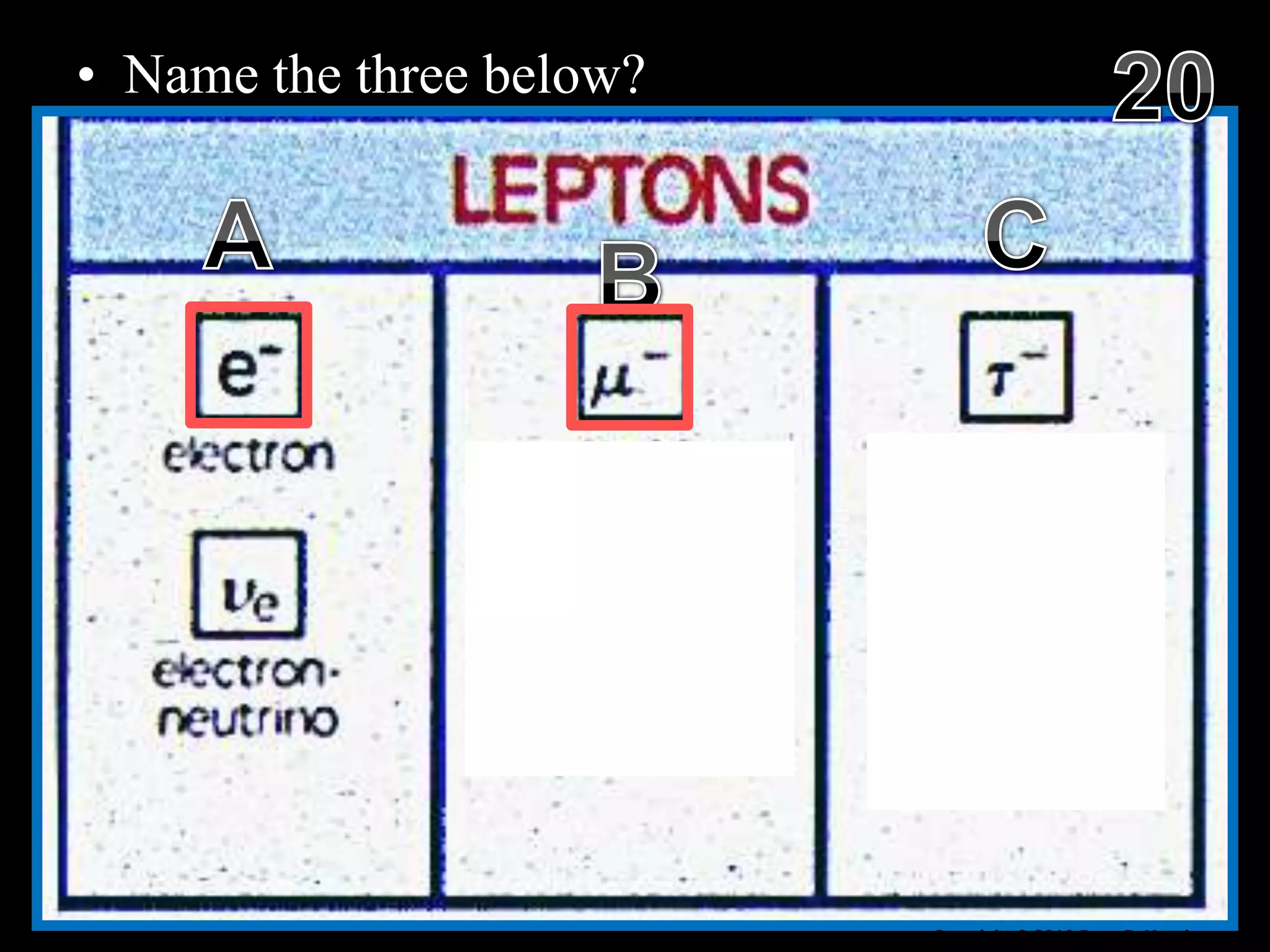
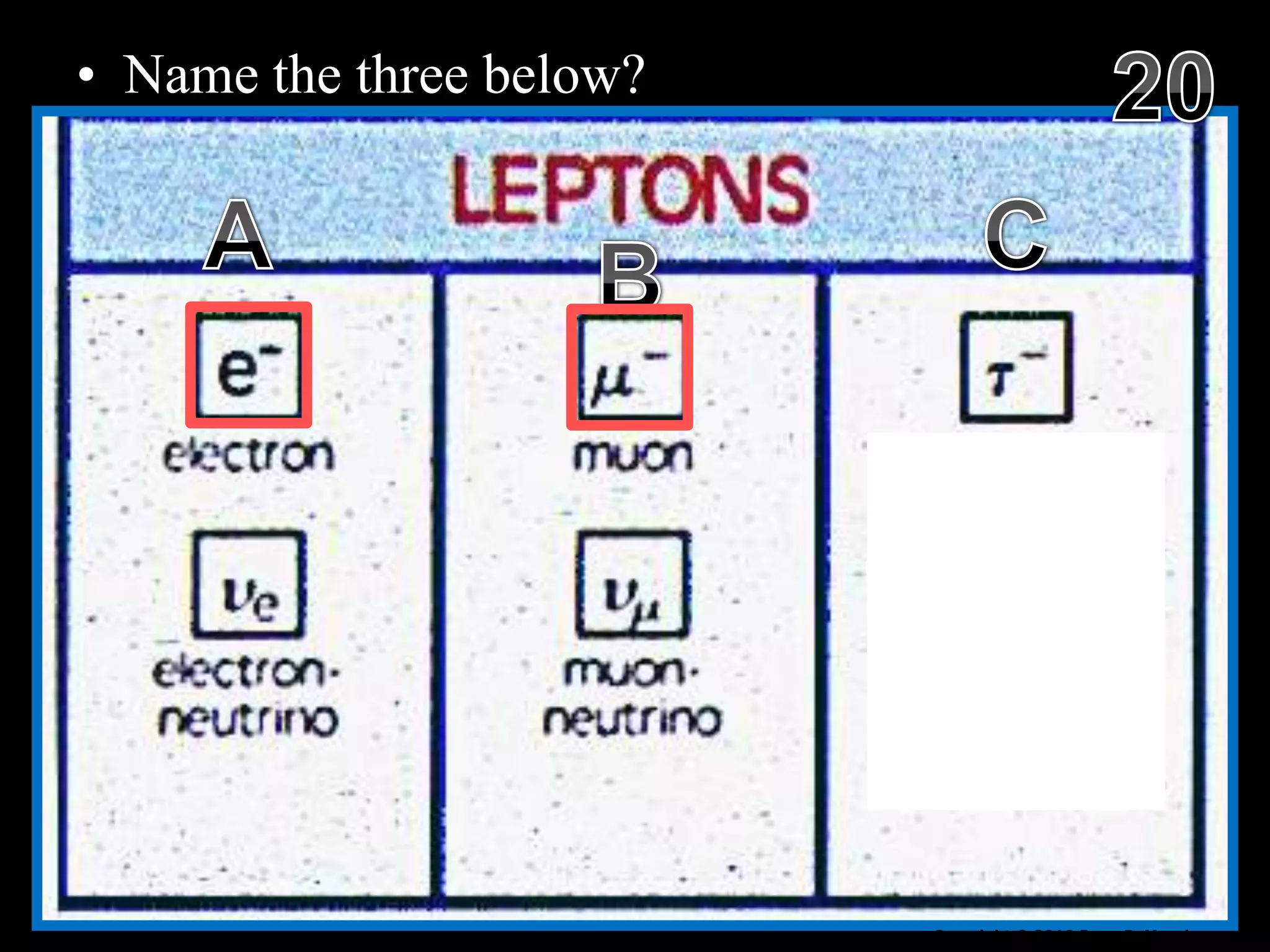
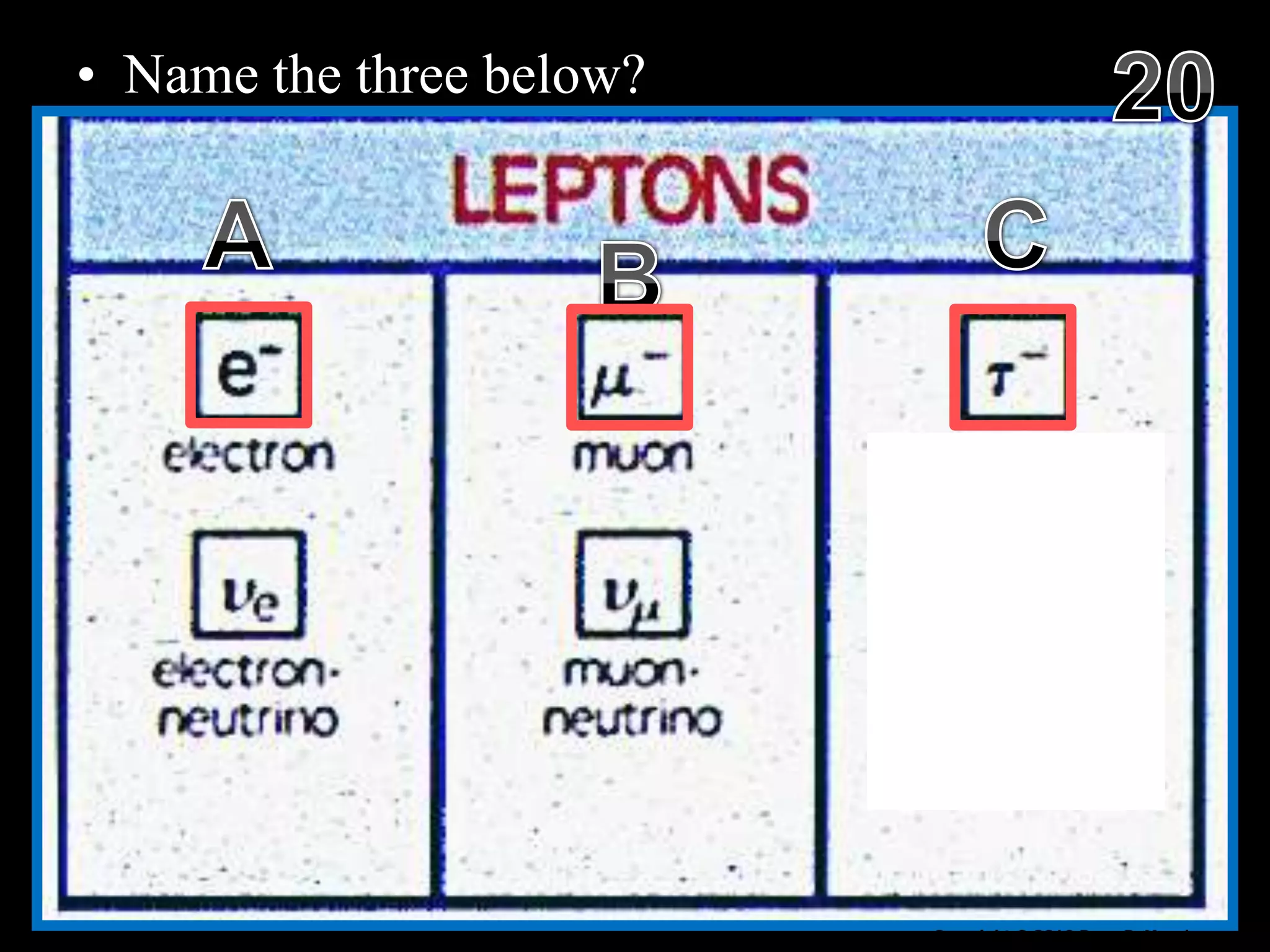
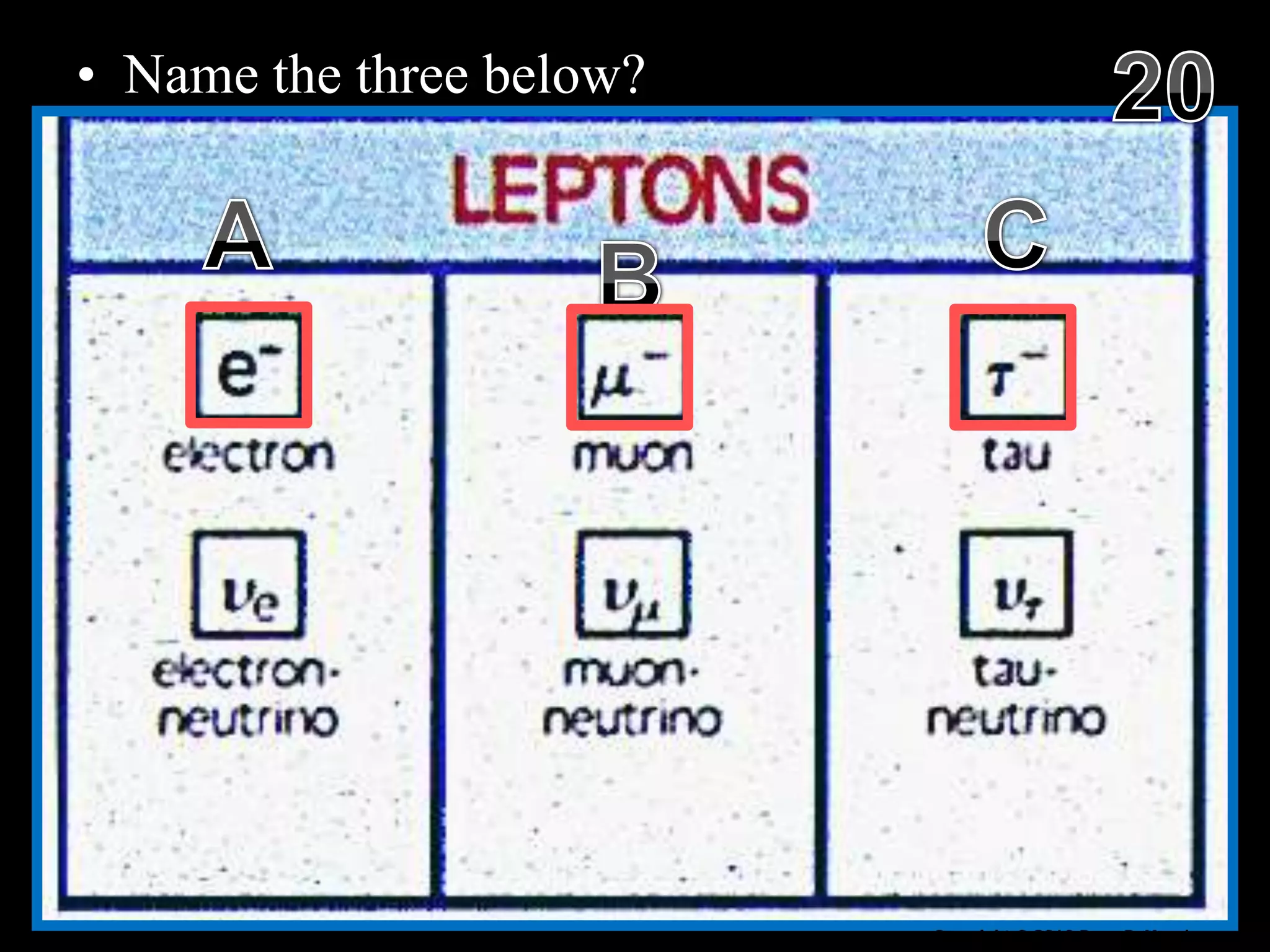
• Name the three below?
Copyright © 2010 Ryan P. Murphy
HAVE A GOOD
LOOK ATOM
ROUND
ABOUT
NUMBERIFFIC SUPER
SMALL
ATOMIC
POWER
-BONUS-
1 6 11 16 *21
2 7 12 17 *22
3 8 13 18 *23
4 9 14 19 *24
5 10 15 20 *25
Copyright © 2010 Ryan P. Murphy
Intro to Atoms Review Game
HAVE A GOOD
LOOK ATOM
ROUND
ABOUT
NUMBERIFFIC SUPER
SMALL
ATOMIC
POWER
-BONUS-
1 6 11 16 *21
2 7 12 17 *22
3 8 13 18 *23
4 9 14 19 *24
5 10 15 20 *25
Copyright © 2010 Ryan P. Murphy
Intro to Atoms Review Game
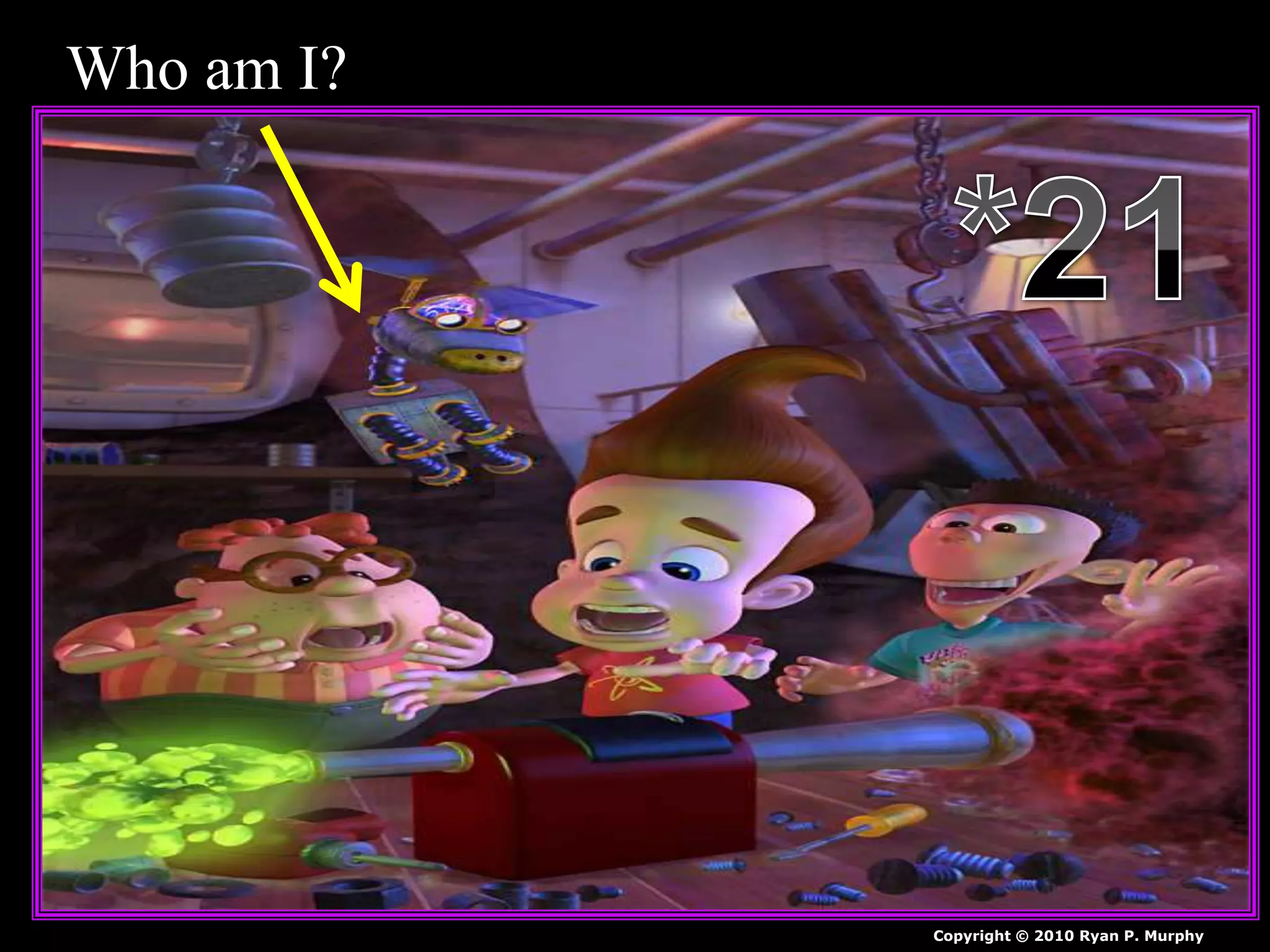
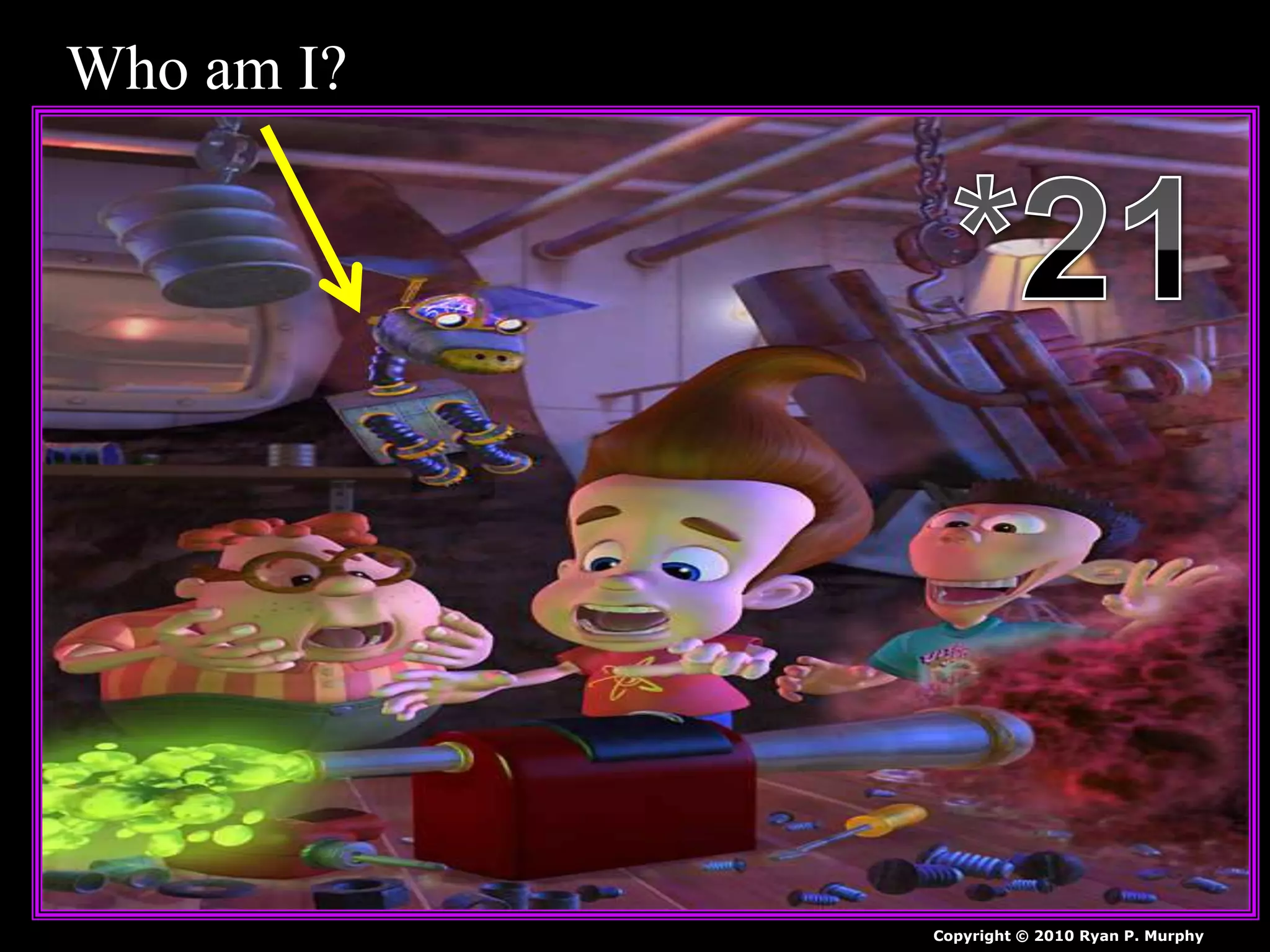
Who am I?
Copyright © 2010 Ryan P. Murphy
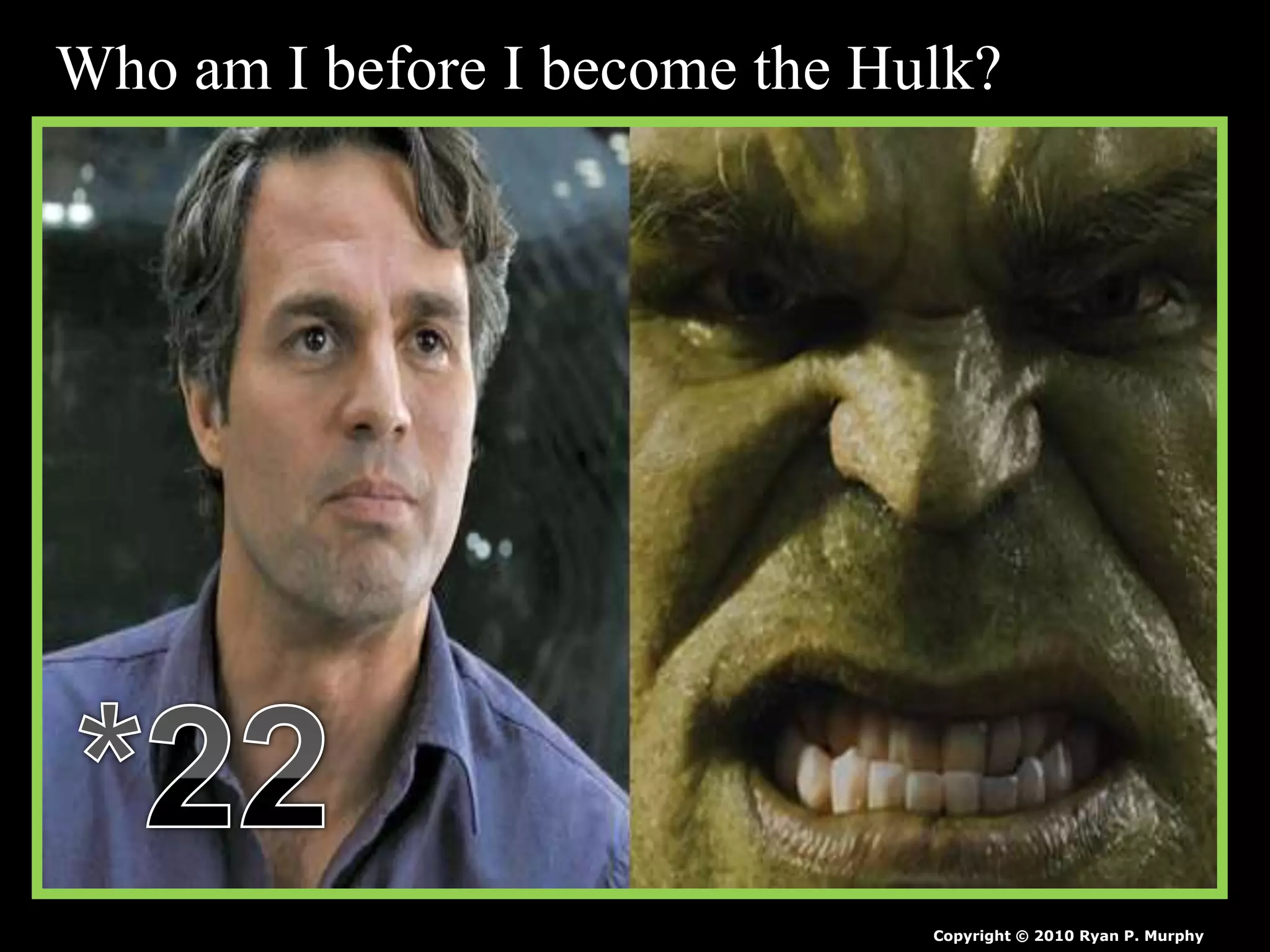
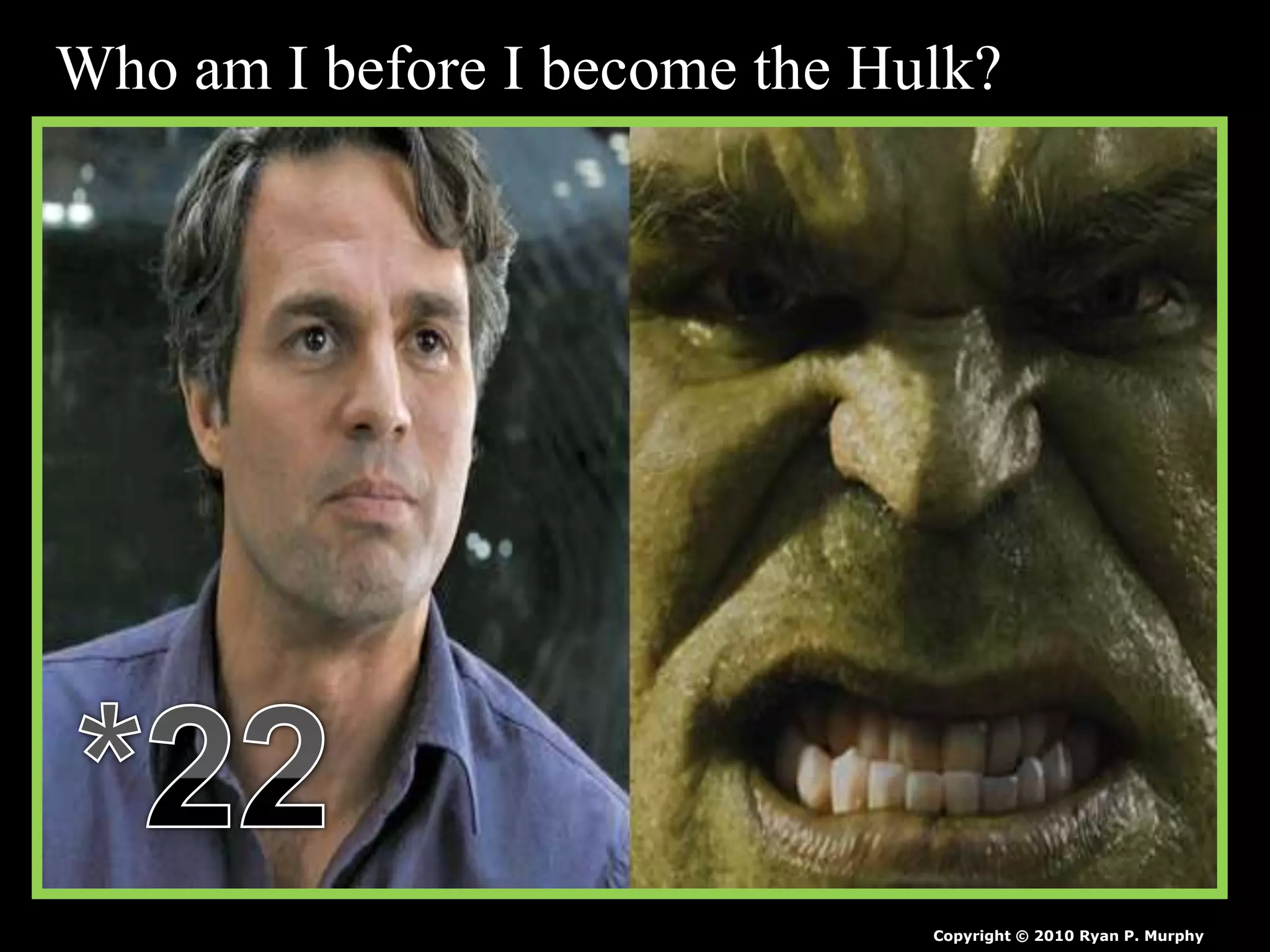
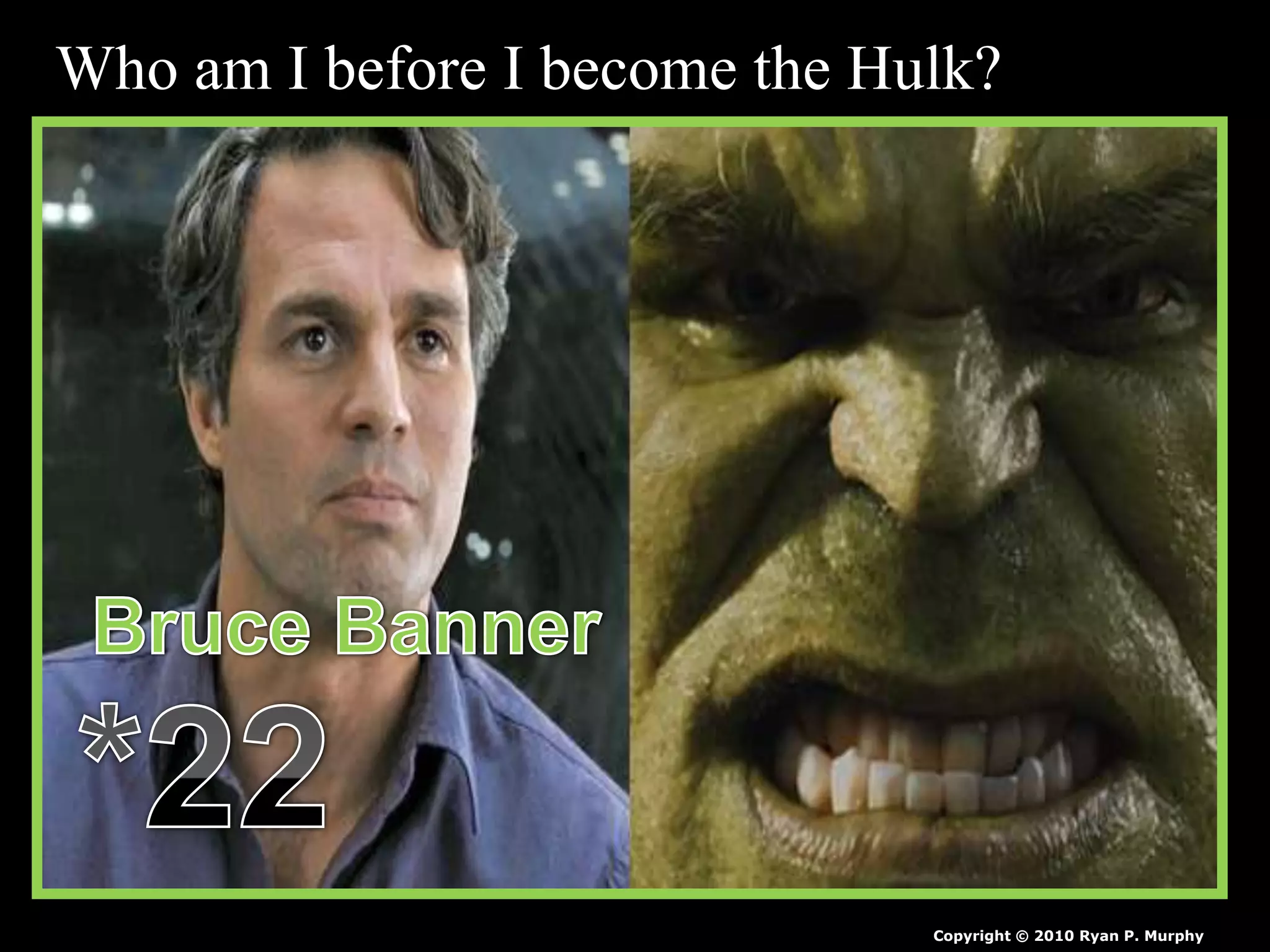
Who am I before I become the Hulk?
Copyright © 2010 Ryan P. Murphy
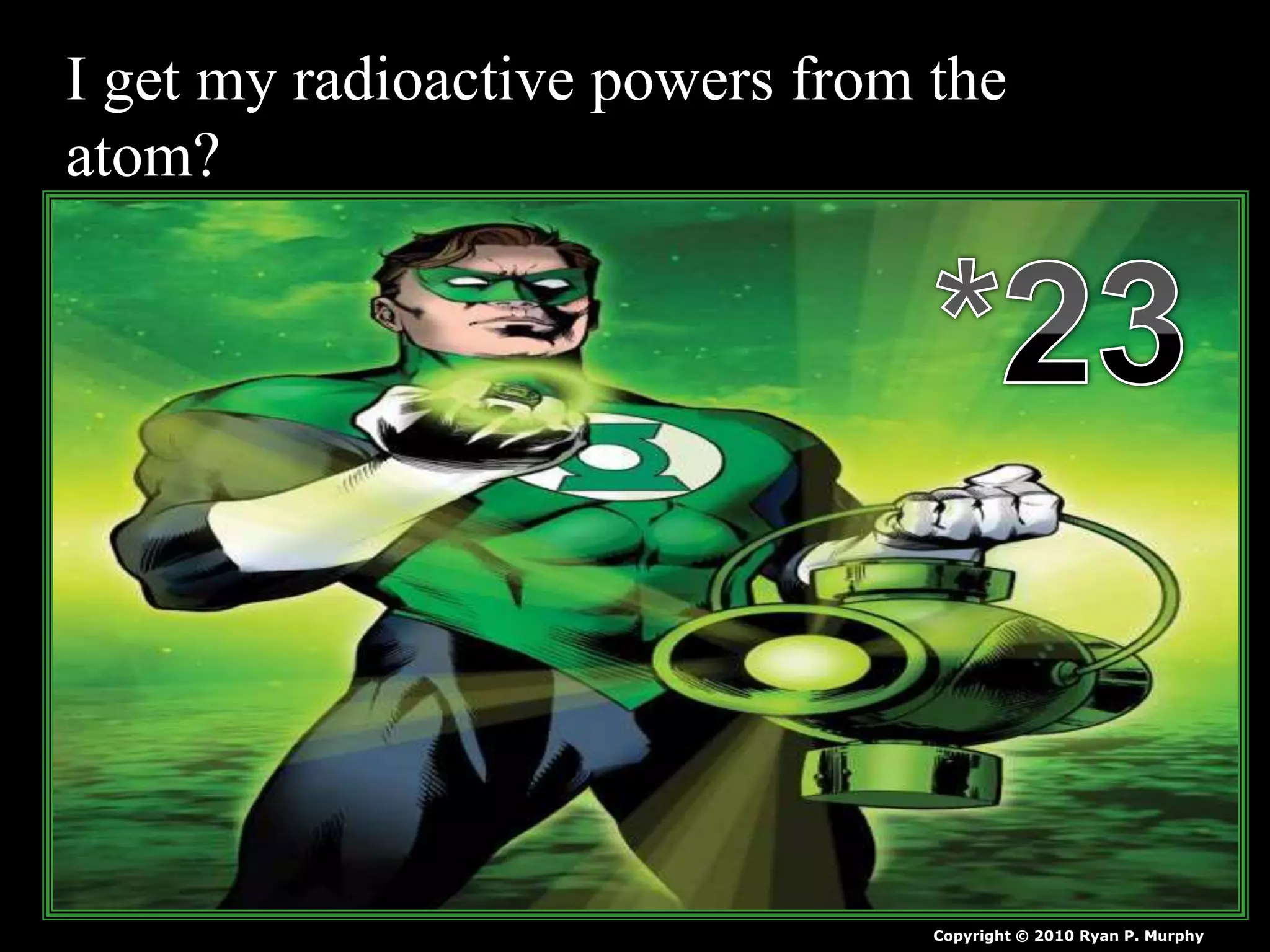
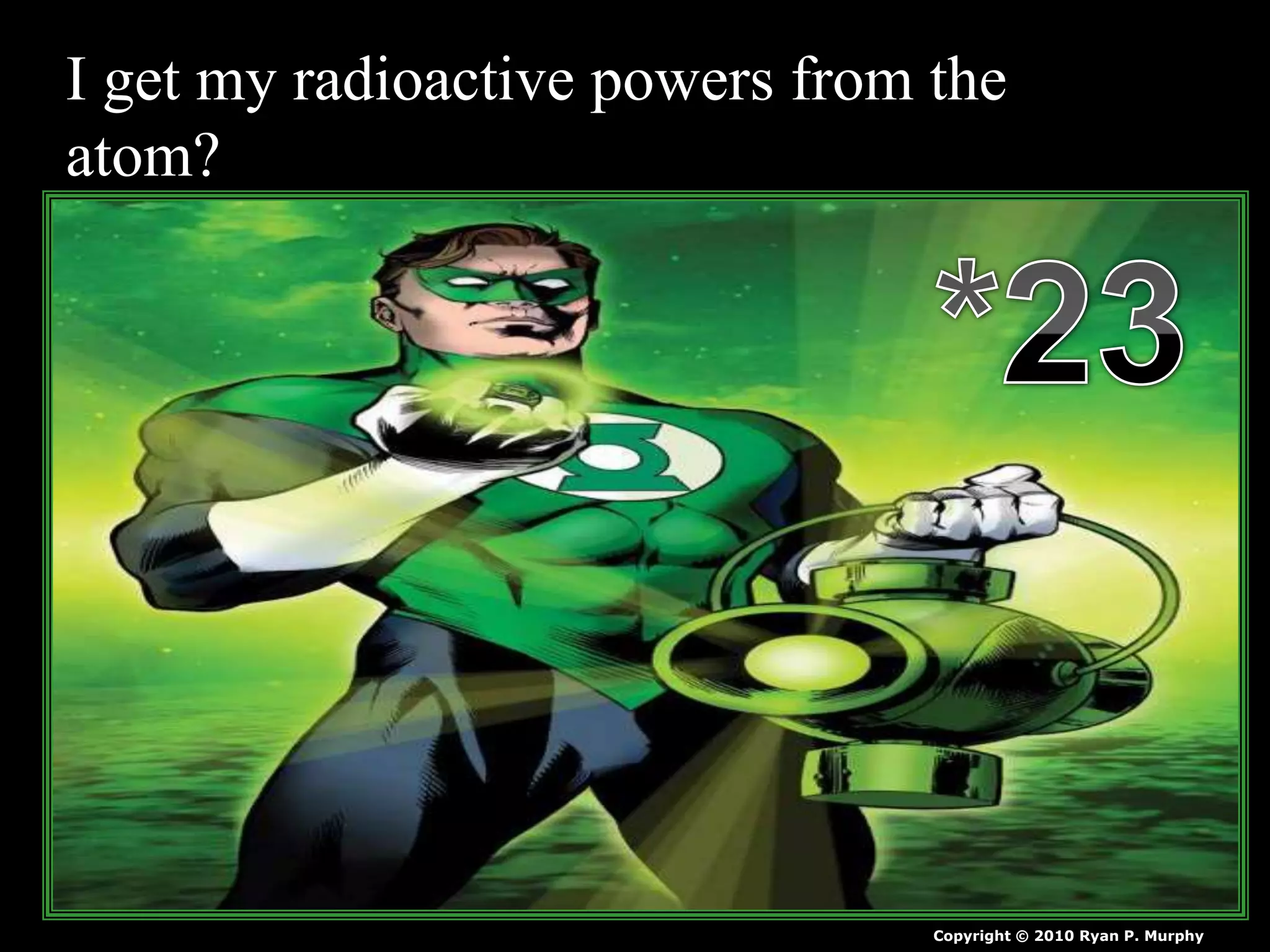
I get my radioactive powers from the
atom?
Copyright © 2010 Ryan P. Murphy
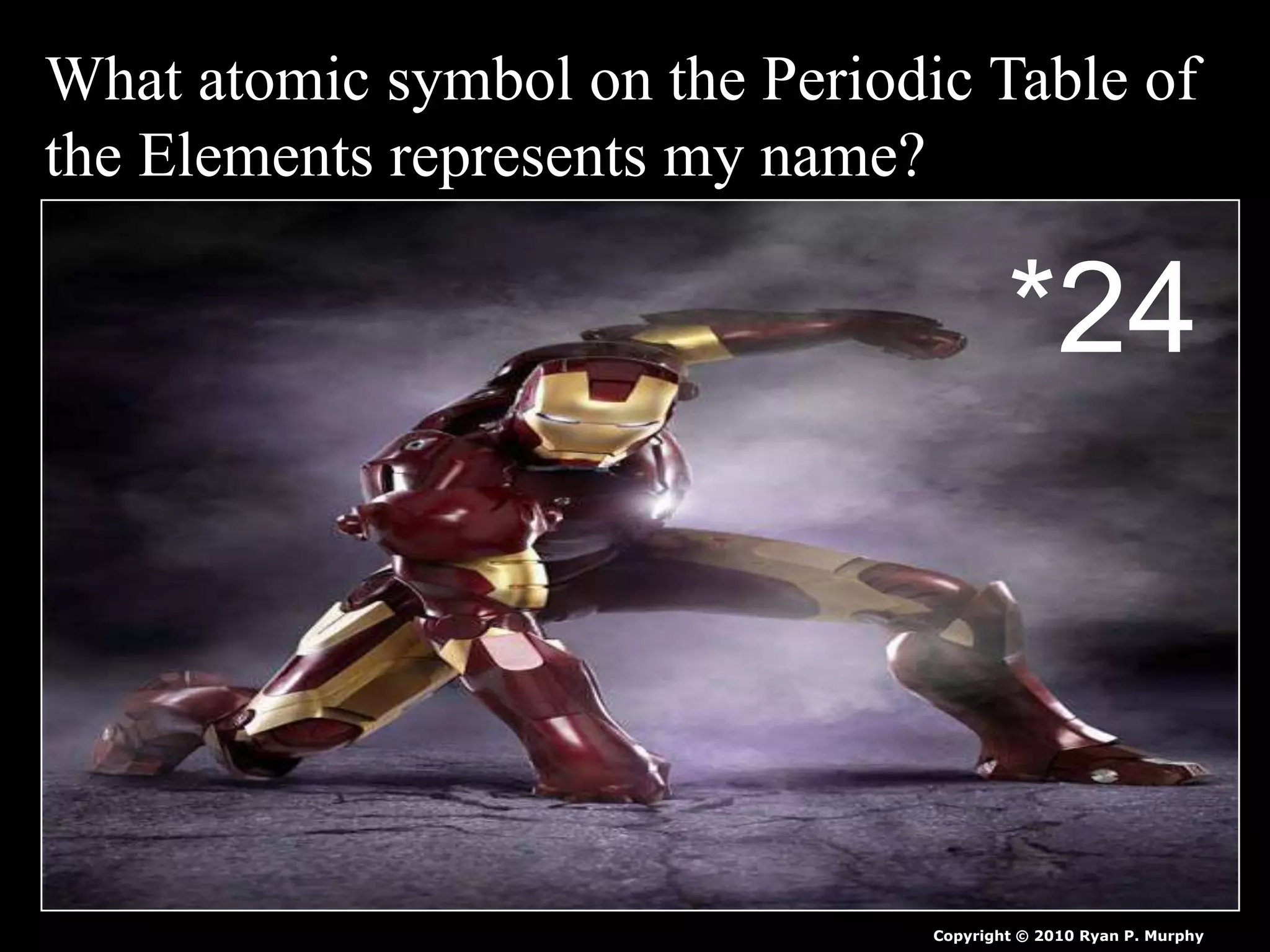
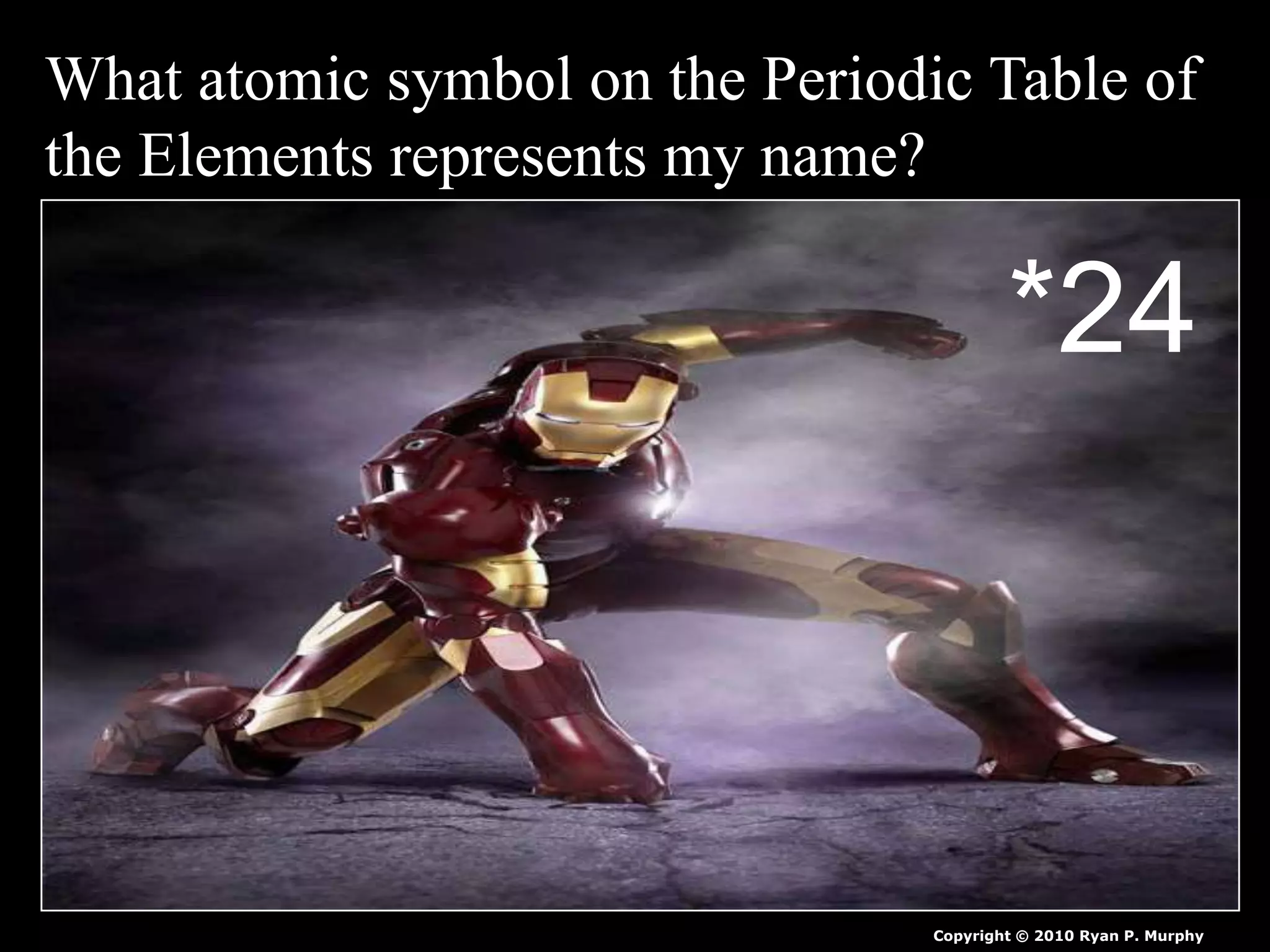
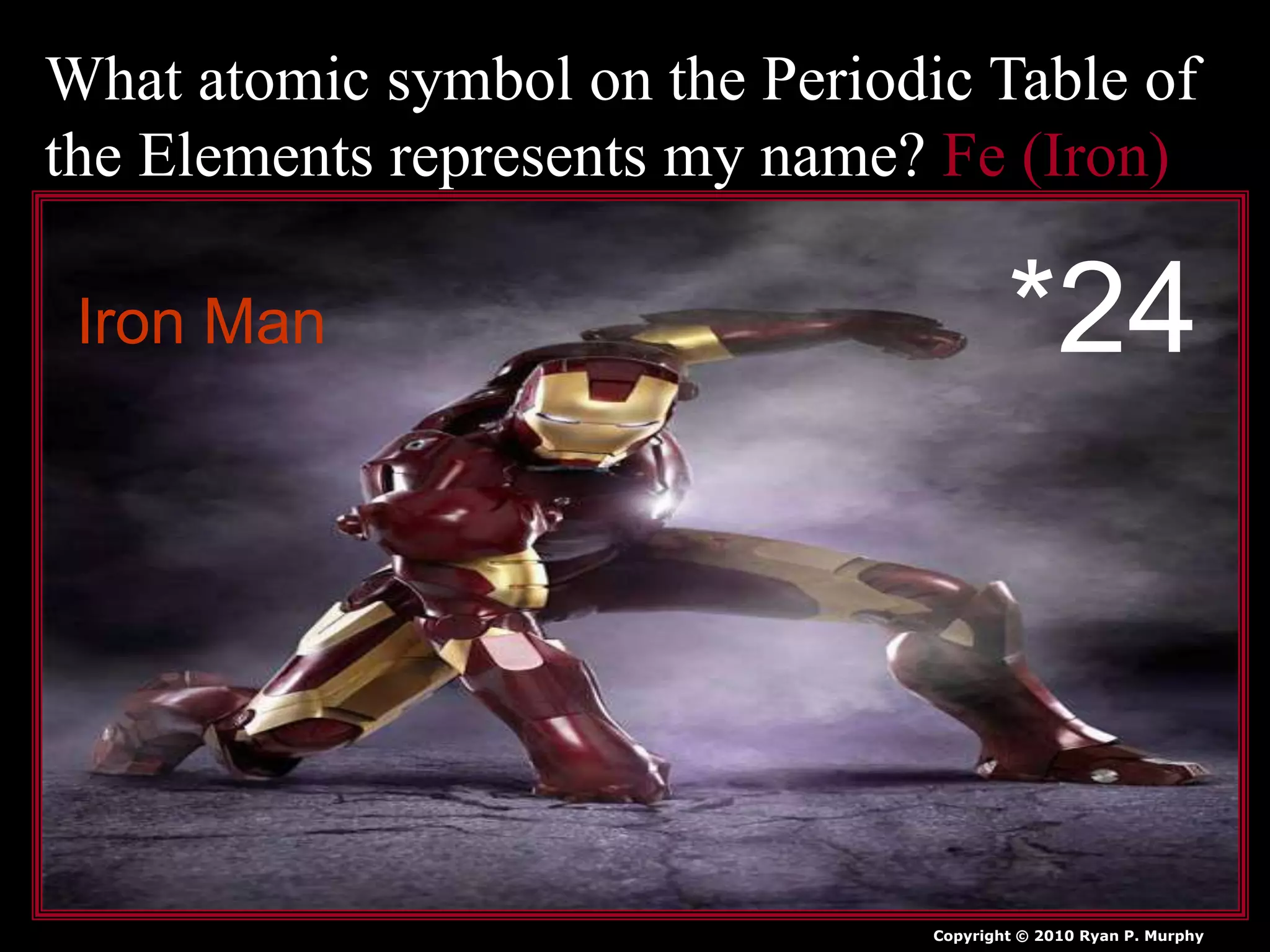
What atomic symbol on the Periodic Table of
the Elements represents my name?
Copyright © 2010 Ryan P. Murphy
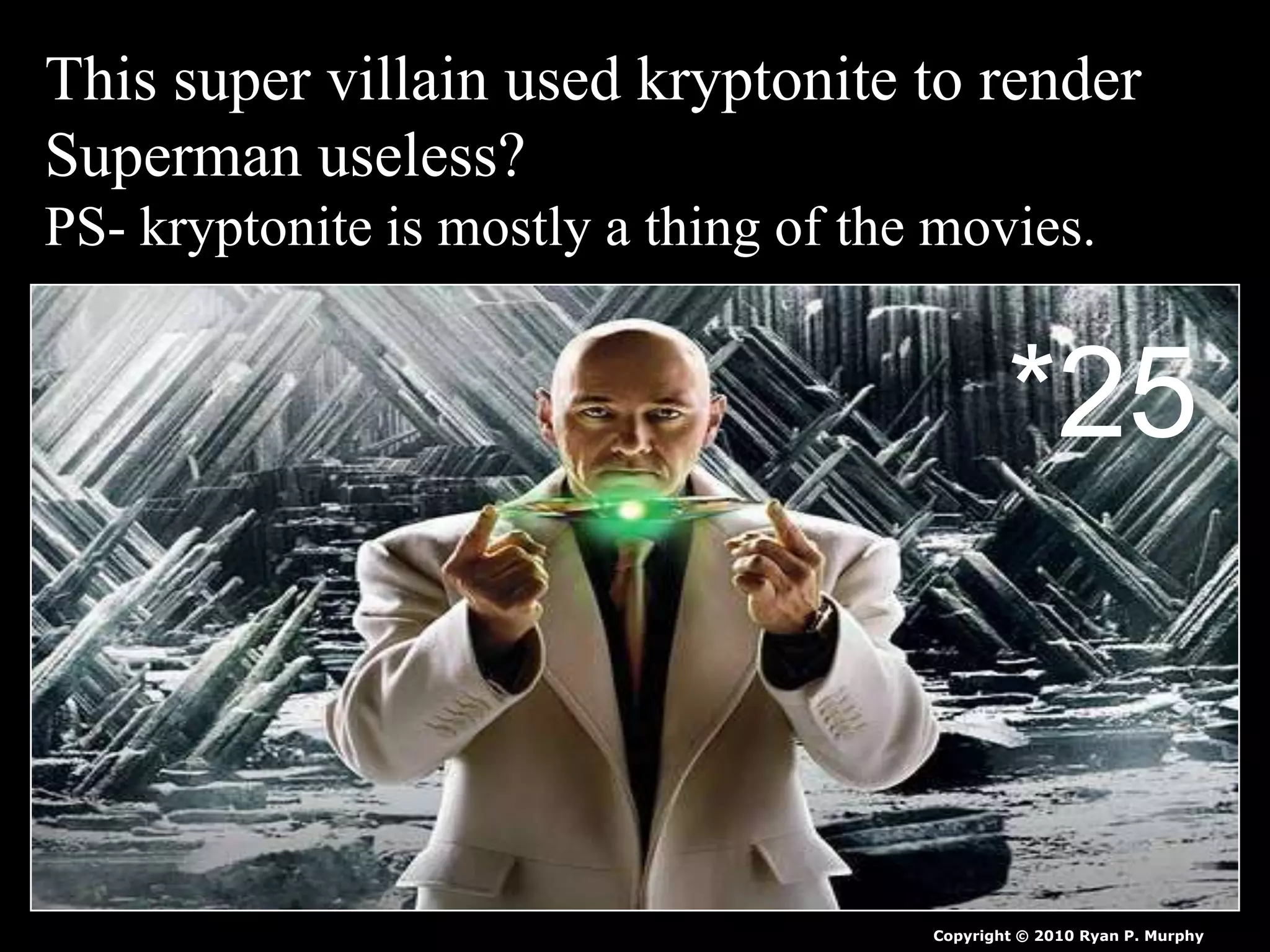
*24
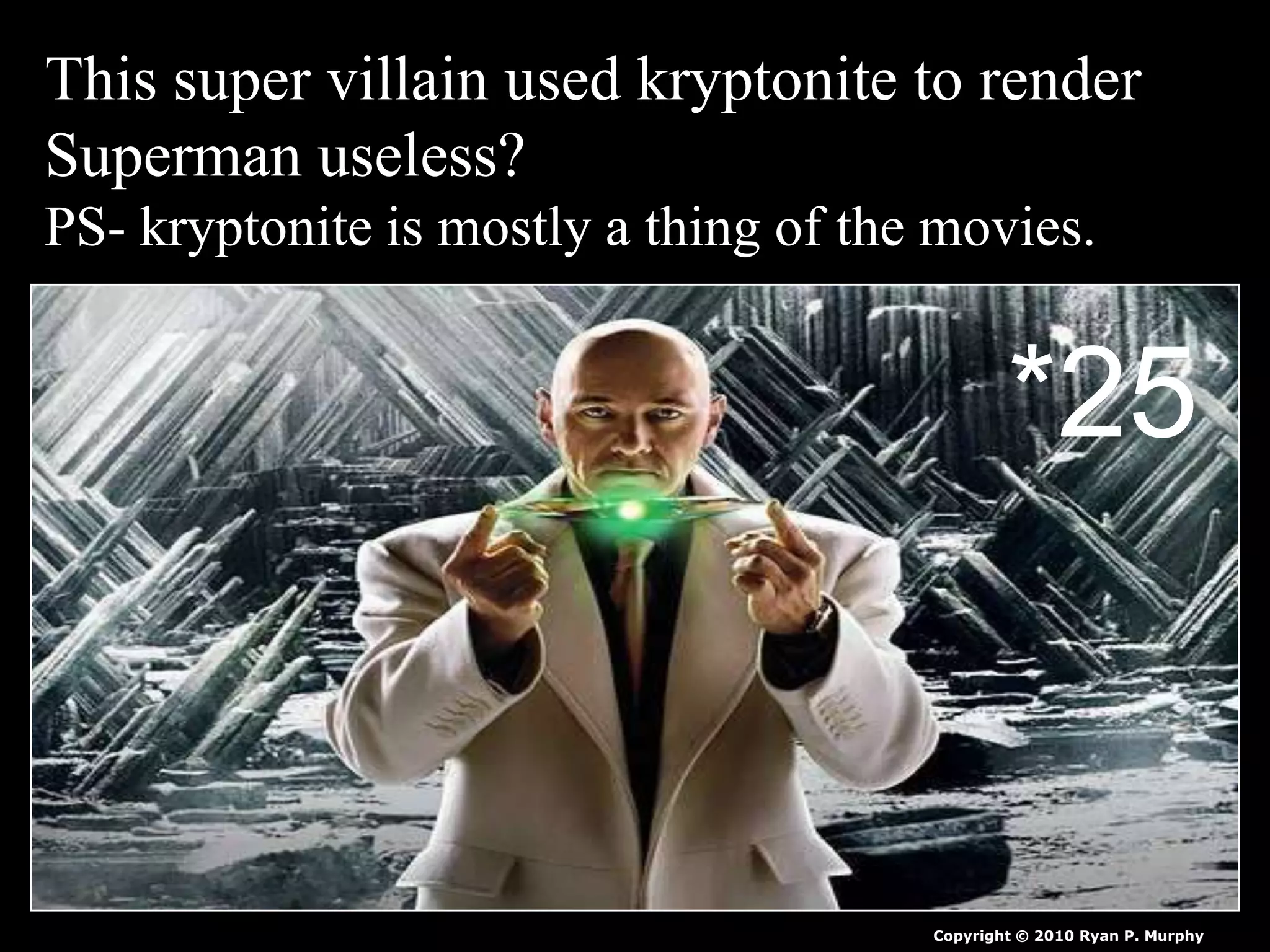
This super villain used kryptonite to render
Superman useless?
PS- kryptonite is mostly a thing of the movies.
Copyright © 2010 Ryan P. Murphy
*25
HAVE A GOOD
LOOK ATOM
ROUND
ABOUT
NUMBERIFFIC SUPER
SMALL
ATOMIC
POWER
-BONUS-
1 6 11 16 *21
2 7 12 17 *22
3 8 13 18 *23
4 9 14 19 *24
5 10 15 20 *25
Copyright © 2010 Ryan P. Murphy
Intro to Atoms Review Game
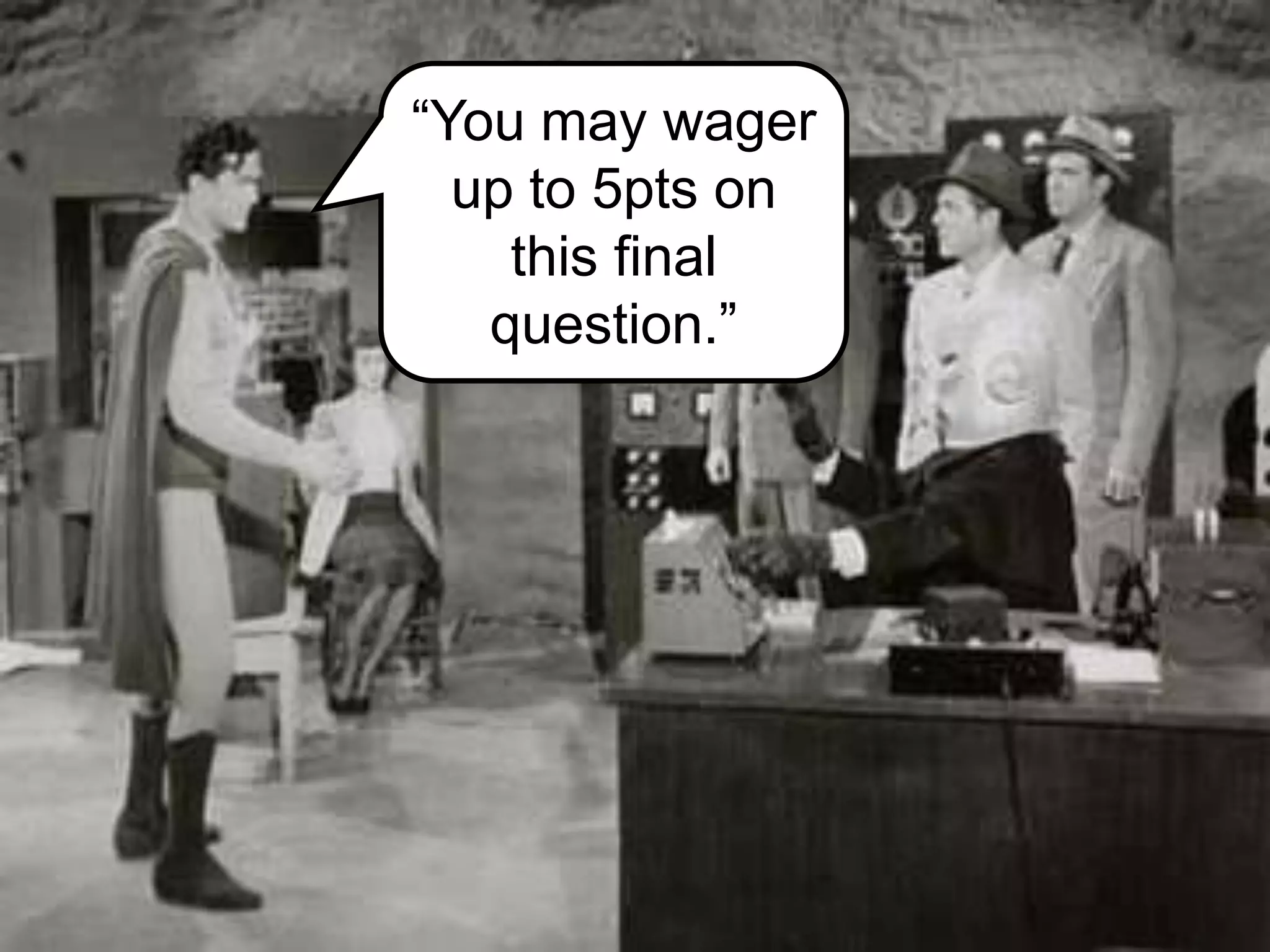
“You may wager
up to 5pts on
this final
question.”
“Please make
your wager now.”
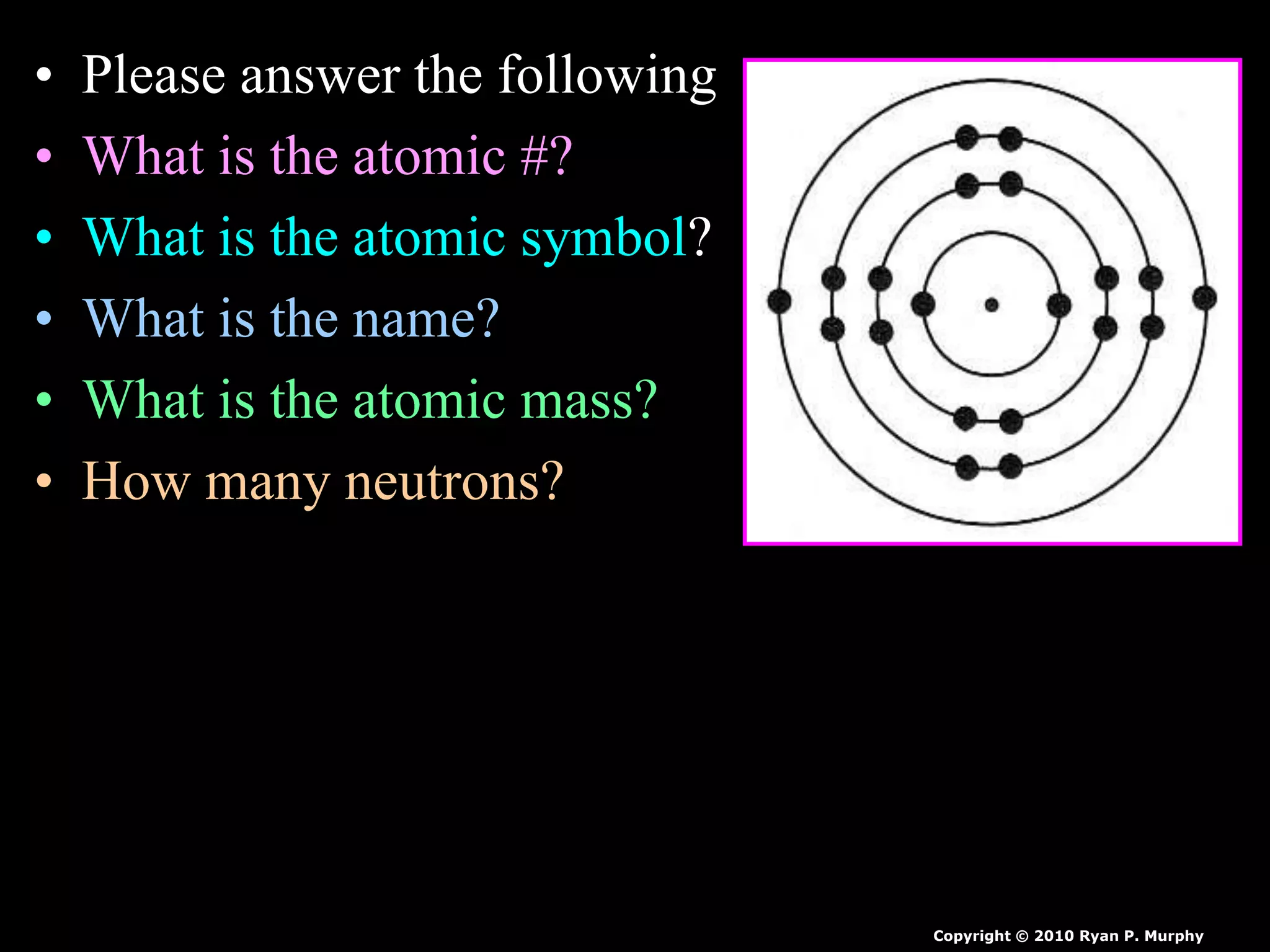
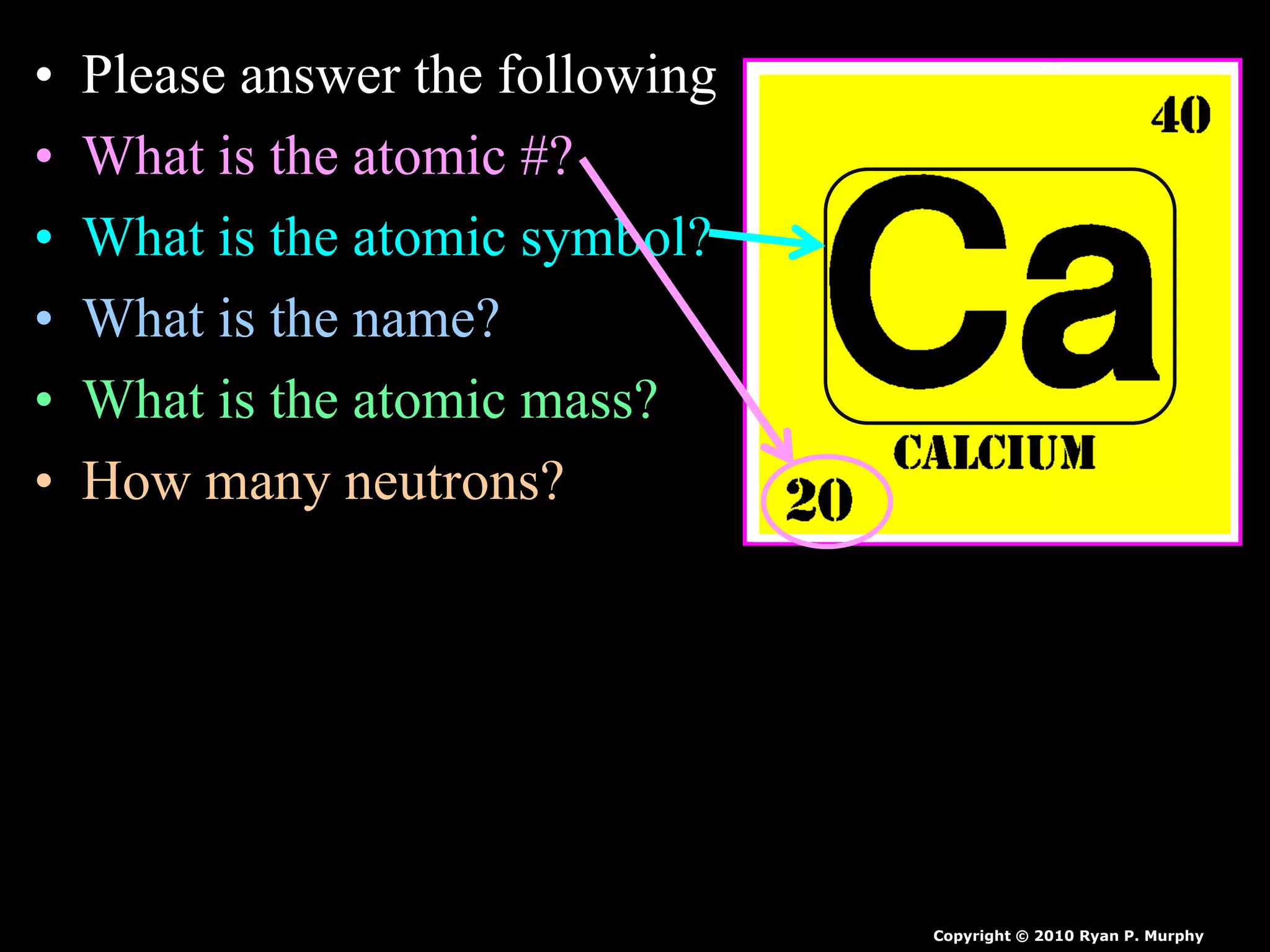
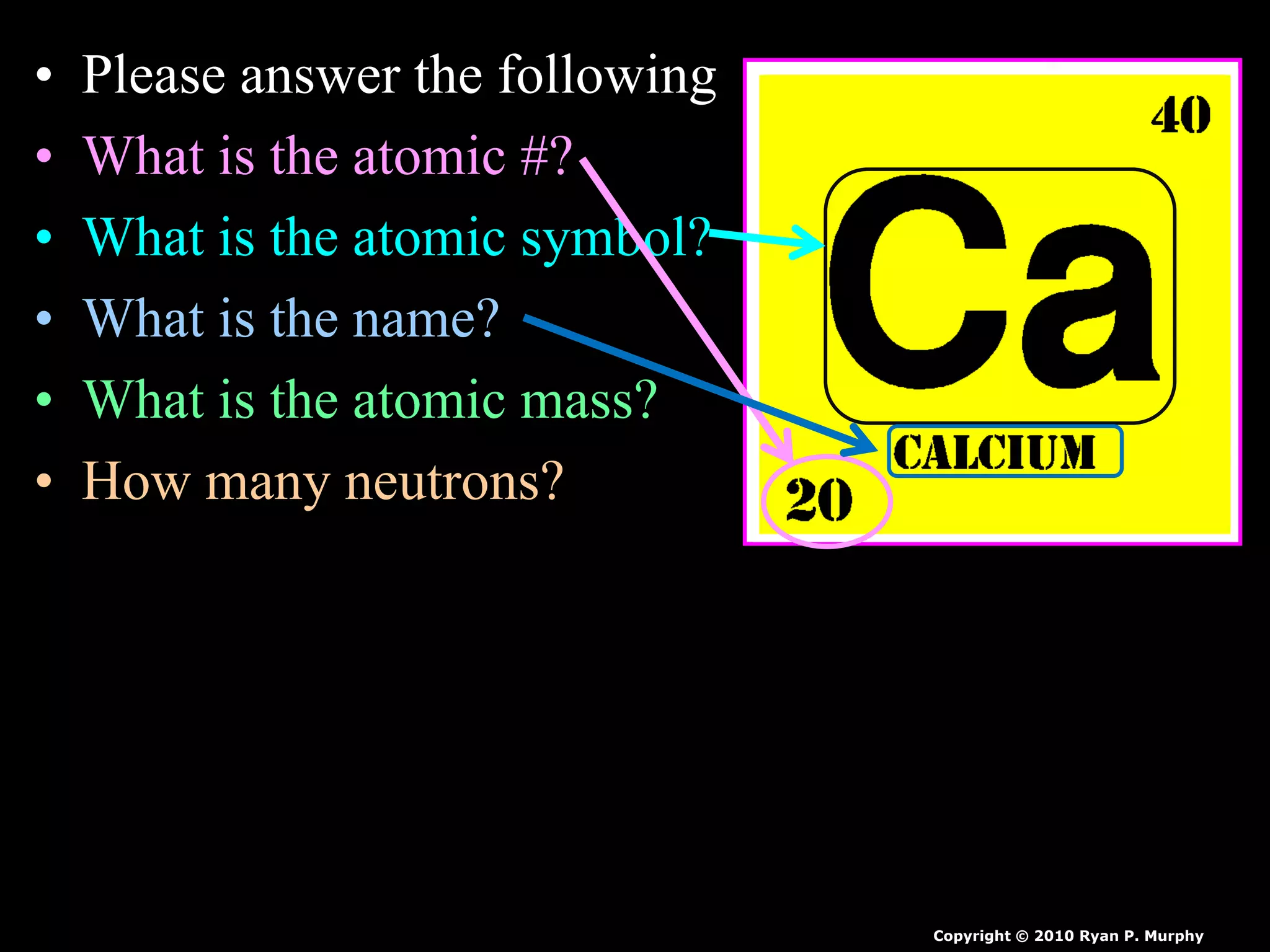
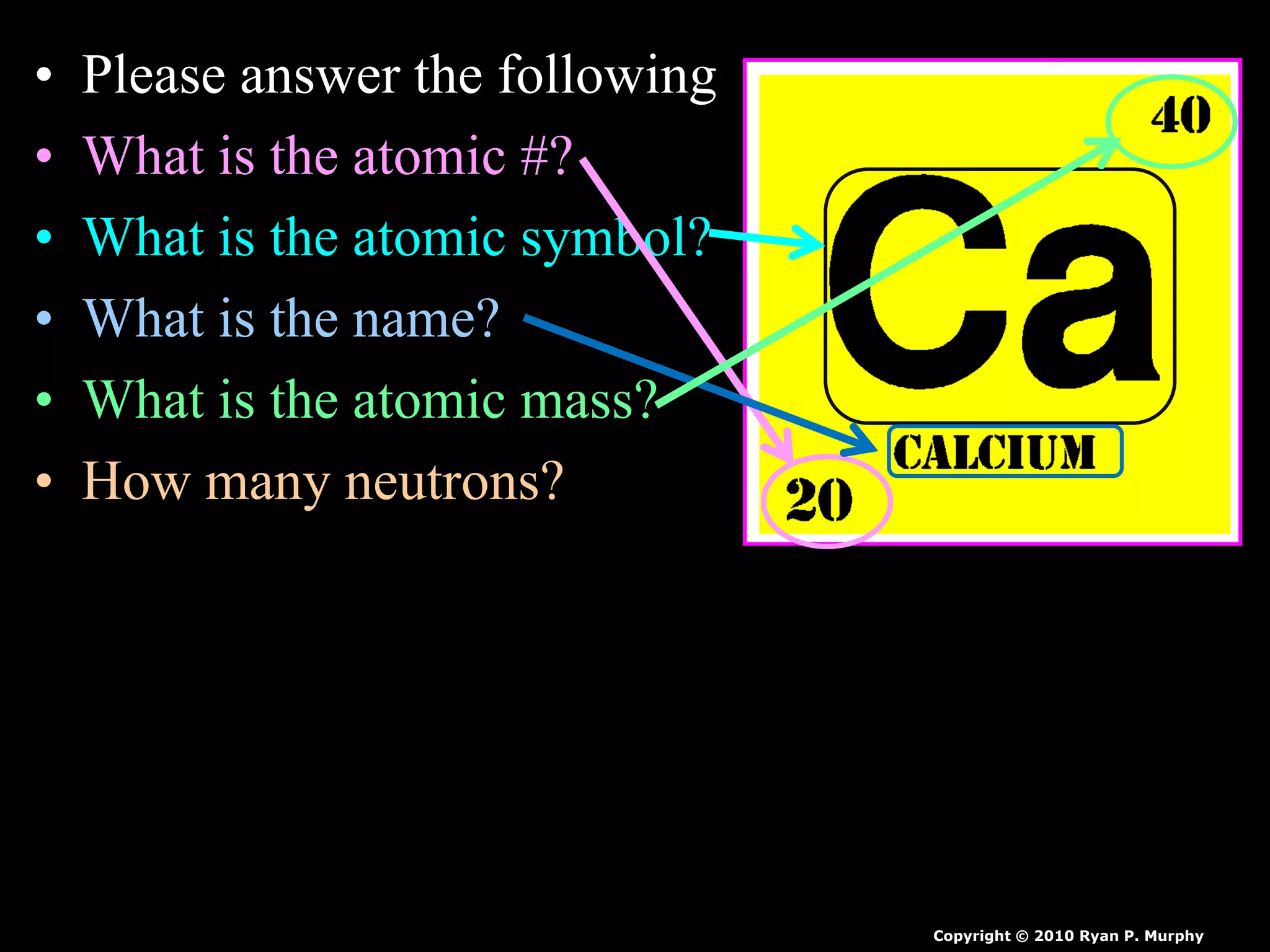
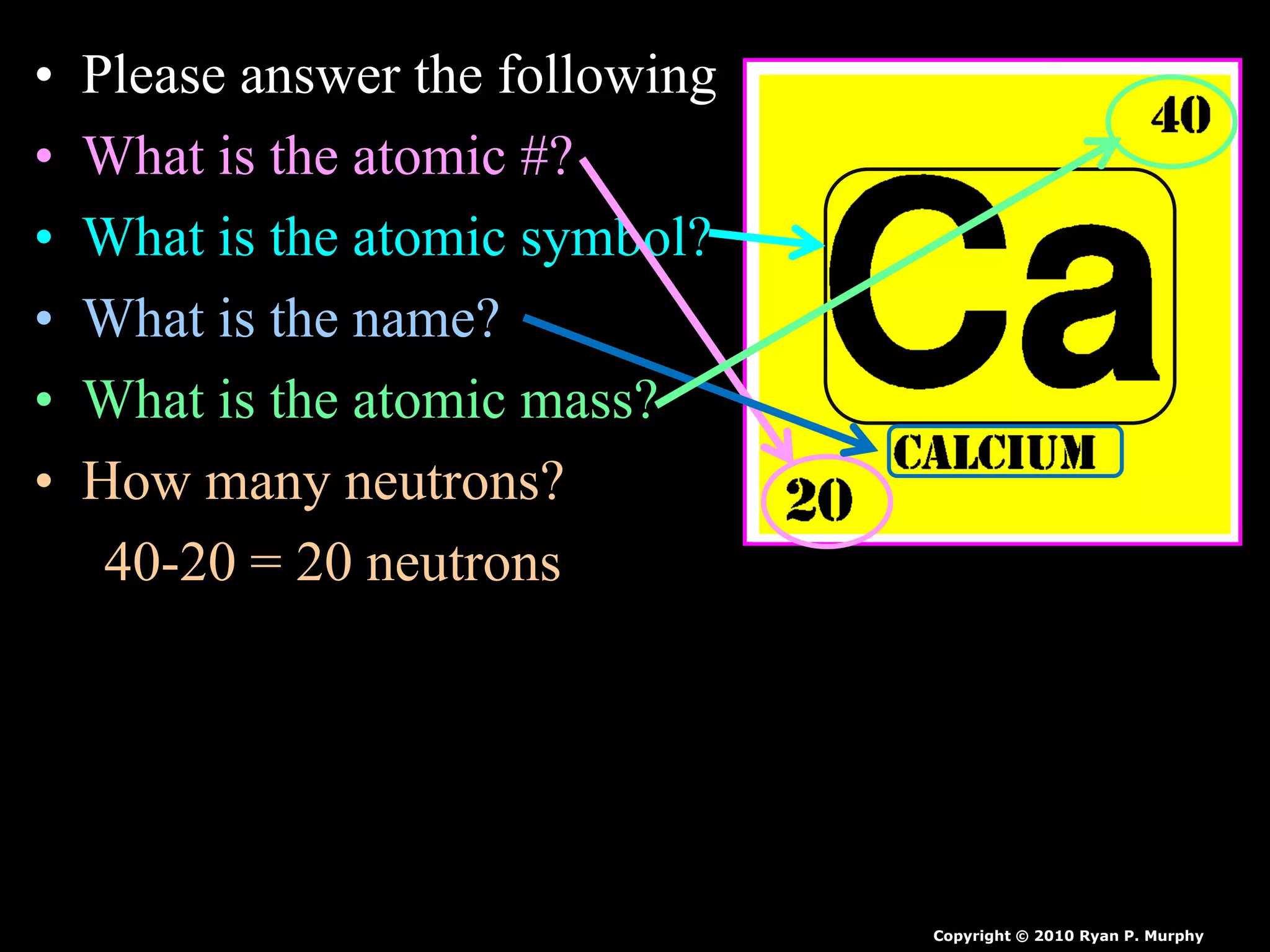
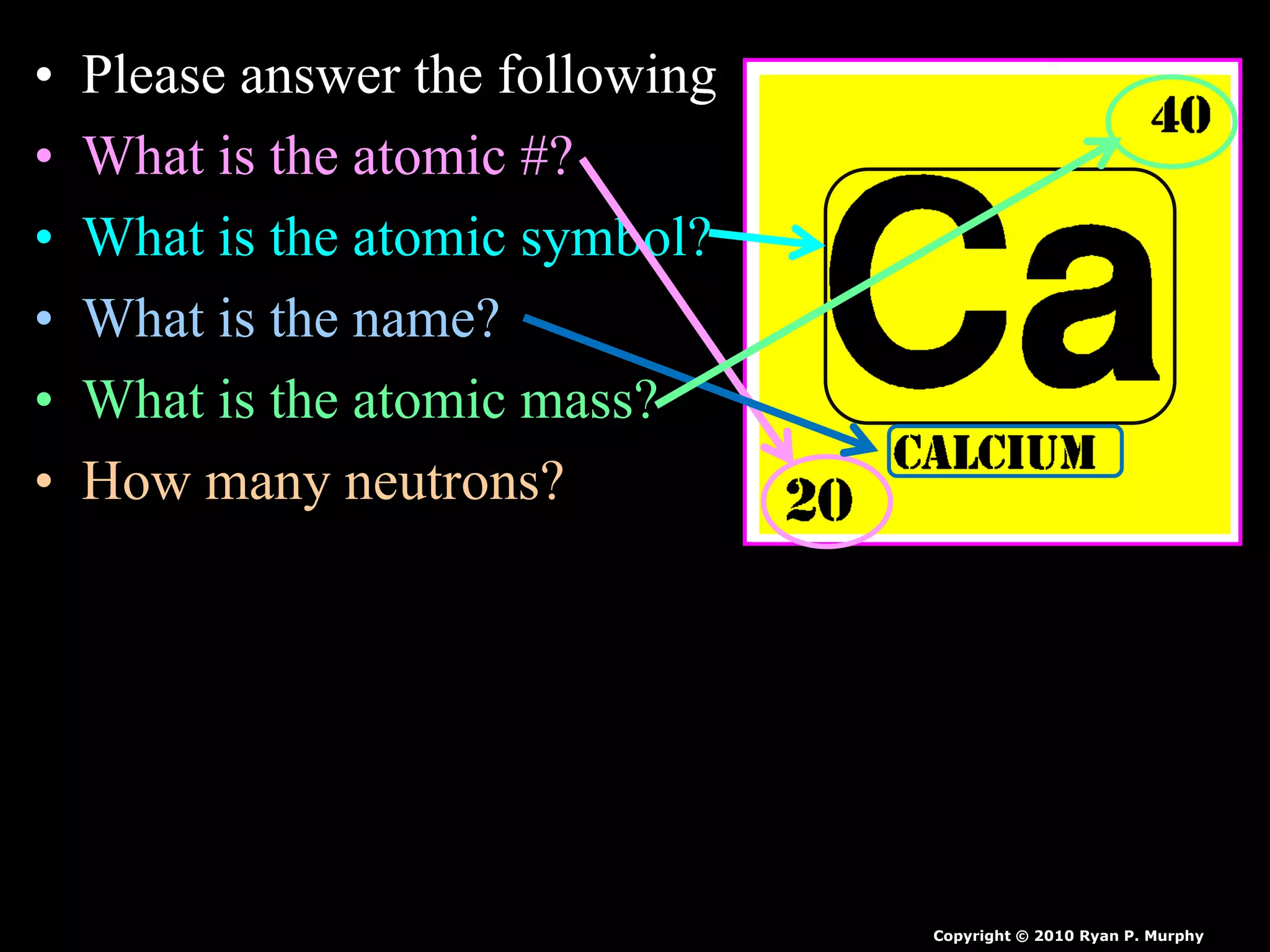
• Please answer the following
• What is the atomic #?
• What is the atomic symbol?
• What is the name?
• What is the atomic mass?
• How many neutrons?
Copyright © 2010 Ryan P. Murphy
HAVE A GOOD
LOOK ATOM
ROUND
ABOUT
NUMBERIFFIC SUPER
SMALL
ATOMIC
POWER
-BONUS-
1 6 11 16 *21
2 7 12 17 *22
3 8 13 18 *23
4 9 14 19 *24
5 10 15 20 *25
Copyright © 2010 Ryan P. Murphy
Intro to Atoms Review Game
HAVE A GOOD
LOOK ATOM
ROUND
ABOUT
NUMBERIFFIC SUPER
SMALL
ATOMIC
POWER
-BONUS-
1 6 11 16 *21
2 7 12 17 *22
3 8 13 18 *23
4 9 14 19 *24
5 10 15 20 *25
Copyright © 2010 Ryan P. Murphy
Intro to Atoms Review Game
• The Crookes Tube / Cathode Ray Tube helped
scientists learn that…
– A) Cathode rays were negatively charged
particles, which were later named electrons.
– B.) Opposite charges tend to repel in the tube.
– C.) Protons make up the center of the nucleus.
– D.) The neutron is slightly smaller than the proton.
Copyright © 2010 Ryan P. Murphy
• The Crookes Tube / Cathode Ray Tube helped
scientists learn that…
– A) Cathode rays were negatively charged particles,
which were later named electrons.
– B.) Opposite charges tend to repel in the tube.
– C.) Protons make up the center of the nucleus.
– D.) The neutron is slightly smaller than the proton.
Copyright © 2010 Ryan P. Murphy
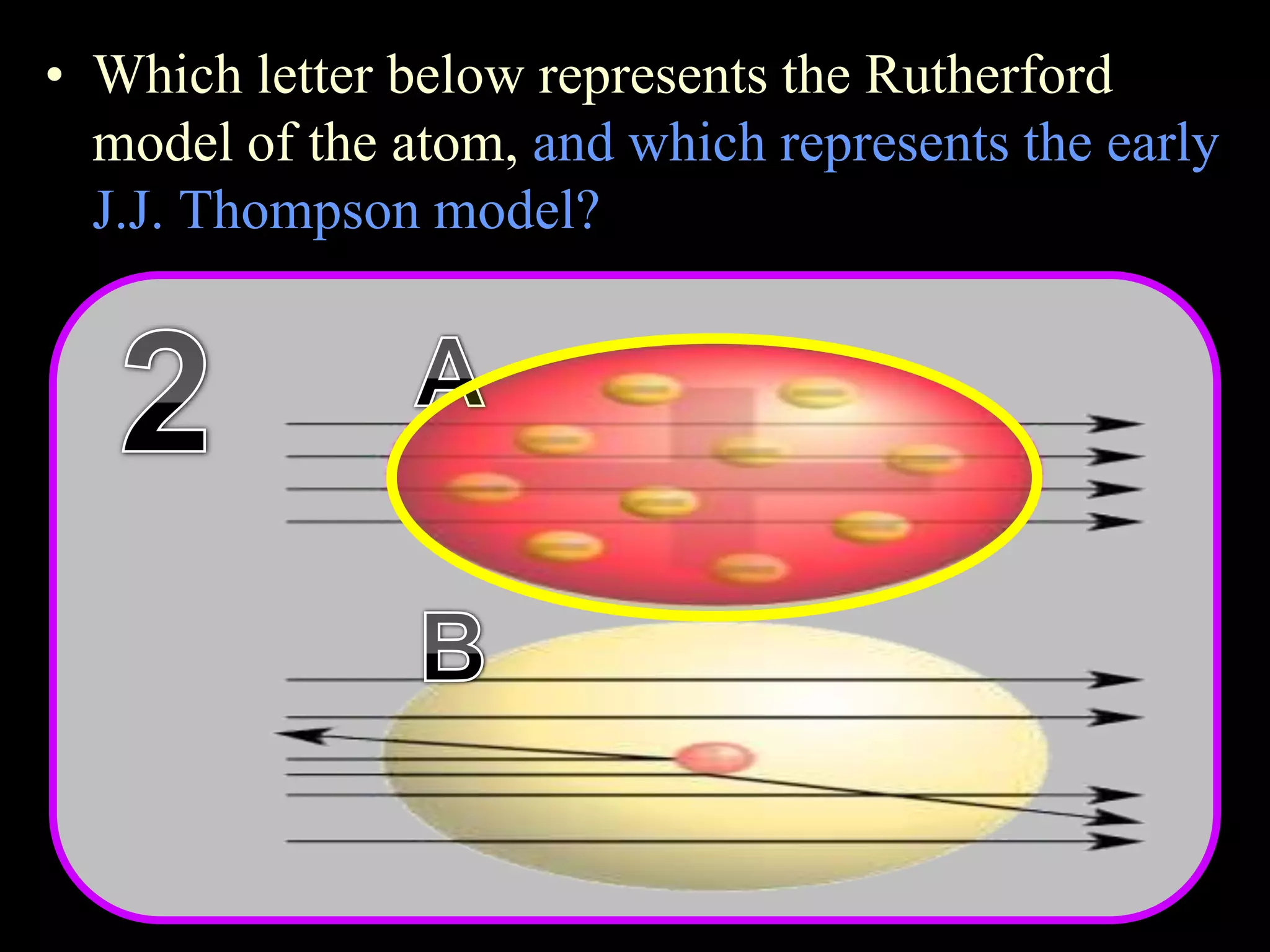
• Which letter below represents the Rutherford
model of the atom, and which represents the early
J.J. Thompson model?
Copyright © 2010 Ryan P. Murphy
• Which letter below represents the Rutherford
model of the atom, and which represents the early
J.J. Thompson model?
Copyright © 2010 Ryan P. Murphy
• Which letter below represents the Rutherford
model of the atom, and which represents the early
J.J. Thompson model?
Copyright © 2010 Ryan P. Murphy
• Which letter below represents the Rutherford
model of the atom, and which represents the early
J.J. Thompson model?
Copyright © 2010 Ryan P. Murphy
• Which letter below represents the Rutherford
model of the atom, and which represents the early
J.J. Thompson model?
Copyright © 2010 Ryan P. Murphy
• Which letter below represents the Rutherford
model of the atom, and which represents the early
J.J. Thompson model?
Copyright © 2010 Ryan P. Murphy
Atoms have a positively charged center
that contains most of its mass
• Please name A, B, C, and D?
– And name the atom?
Copyright © 2010 Ryan P. Murphy
• Please name A, B, C, and D?
– And name the atom?
Copyright © 2010 Ryan P. Murphy
• Please name A, B, C, and D?
– And name the atom?
Copyright © 2010 Ryan P. Murphy
• Please name A, B, C, and D?
– And name the atom?
Copyright © 2010 Ryan P. Murphy
• Please name A, B, C, and D?
– And name the atom?
Copyright © 2010 Ryan P. Murphy
• Please name A, B, C, and D?
– And name the atom?
Copyright © 2010 Ryan P. Murphy
• Please name A, B, C, and D?
– And name the atom?
Copyright © 2010 Ryan P. Murphy
• Please name A, B, C, and D?
– And name the atom?
Copyright © 2010 Ryan P. Murphy
• Please name A, B, C, and D?
– And name the atom?
Copyright © 2010 Ryan P. Murphy
• Please name A, B, C, and D?
– And name the atom?
Copyright © 2010 Ryan P. Murphy
• Please name A, B, C, and D?
– And name the atom?
Copyright © 2010 Ryan P. Murphy
• Please name A, B, C, and D?
– And name the atom?
Copyright © 2010 Ryan P. Murphy
• Please name A, B, C, and D?
– And name the atom?
Copyright © 2010 Ryan P. Murphy
• The nucleus of the atom is…
Copyright © 2010 Ryan P. Murphy
• The nucleus of the atom is…
– A.) Very dense.
Copyright © 2010 Ryan P. Murphy
• The nucleus of the atom is…
– A.) Very dense.
– B.) Very, very, dense.
Copyright © 2010 Ryan P. Murphy
• The nucleus of the atom is…
– A.) Very dense.
– B.) Very, very, dense.
– C.) Very, very, very dense.
Copyright © 2010 Ryan P. Murphy
• The nucleus of the atom is…
– A.) Very dense.
– B.) Very, very, dense.
– C.) Very, very, very dense.
– D.) Very, very, very, very dense.
Copyright © 2010 Ryan P. Murphy
• The nucleus of the atom is…
– A.) Very dense.
– B.) Very, very, dense.
– C.) Very, very, very dense.
– D.) Very, very, very, very dense.
– E.) Very, very, very, very, very, dense.
Copyright © 2010 Ryan P. Murphy
• The nucleus of the atom is…
– A.) Very dense.
– B.) Very, very, dense.
– C.) Very, very, very dense.
– D.) Very, very, very, very dense.
– E.) Very, very, very, very, very, dense.
Copyright © 2010 Ryan P. Murphy
Equal to a million million million kg m-3
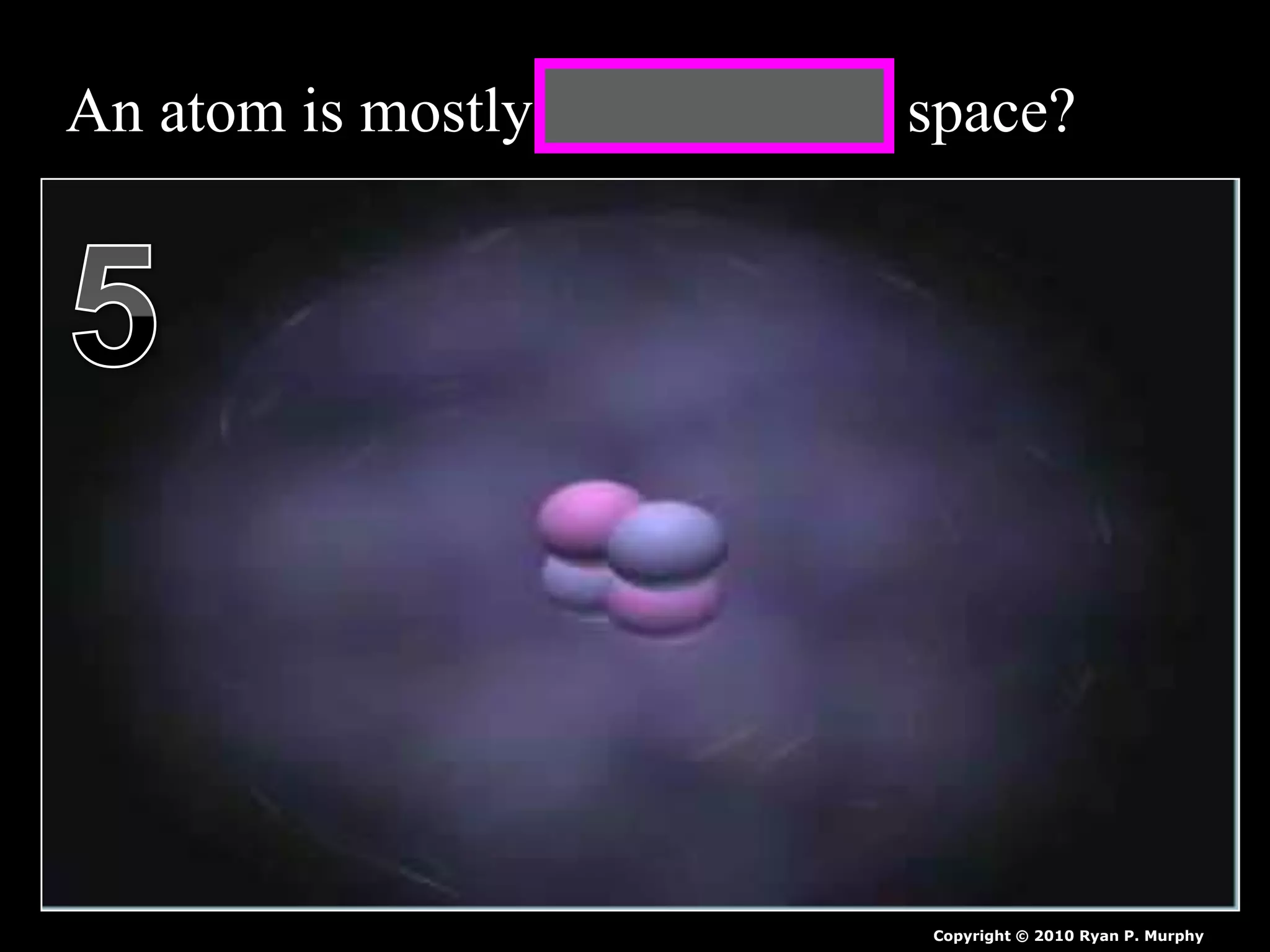
An atom is mostly empty space?
Copyright © 2010 Ryan P. Murphy
An atom is mostly empty space?
Copyright © 2010 Ryan P. Murphy
An atom is mostly empty space?
Copyright © 2010 Ryan P. Murphy
An atom is mostly e m p t y space?
Copyright © 2010 Ryan P. Murphy
HAVE A GOOD
LOOK ATOM
ROUND
ABOUT
NUMBERIFFIC SUPER
SMALL
ATOMIC
POWER
-BONUS-
1 6 11 16 *21
2 7 12 17 *22
3 8 13 18 *23
4 9 14 19 *24
5 10 15 20 *25
Copyright © 2010 Ryan P. Murphy
Intro to Atoms Review Game
HAVE A GOOD
LOOK ATOM
ROUND
ABOUT
NUMBERIFFIC SUPER
SMALL
ATOMIC
POWER
-BONUS-
1 6 11 16 *21
2 7 12 17 *22
3 8 13 18 *23
4 9 14 19 *24
5 10 15 20 *25
Copyright © 2010 Ryan P. Murphy
Intro to Atoms Review Game
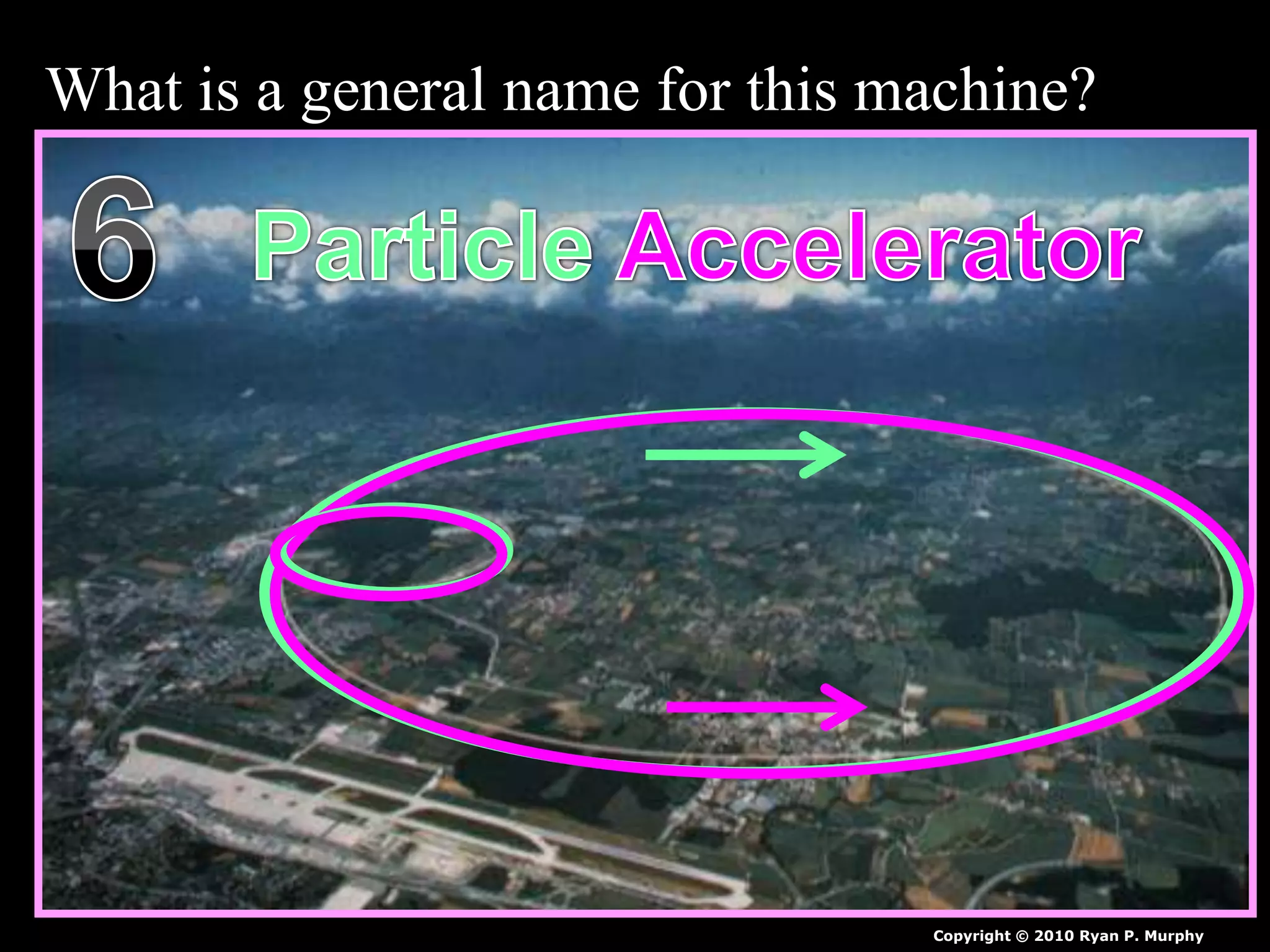
What is a general name for this machine?
Copyright © 2010 Ryan P. Murphy
What is a general name for this machine?
Copyright © 2010 Ryan P. Murphy
What is a general name for this machine?
Copyright © 2010 Ryan P. Murphy
What is a general name for this machine?
Copyright © 2010 Ryan P. Murphy
• Heisenberg Uncertainty Principle
– You can't know with certainty both where an electron
is and where it's going next. That makes it impossible
to plot an orbit for an electron around a nucleus. This
is also true for the Proton and Neutron.
Copyright © 2010 Ryan P. Murphy
• Heisenberg Uncertainty Principle
– You can't know with certainty both where an electron
is and where it's going next. That makes it impossible
to plot an orbit for an electron around a nucleus. This
is also true for the Proton and Neutron.
Copyright © 2010 Ryan P. Murphy
• Heisenberg Uncertainty Principle
– You can't know with certainty both where an electron
is and where it's going next. That makes it impossible
to plot an orbit for an electron around a nucleus. This
is also true for the Proton and Neutron.
Copyright © 2010 Ryan P. Murphy
• Heisenberg Uncertainty Principle
– You can't know with certainty both where an electron
is and where it's going next. That makes it impossible
to plot an orbit for an electron around a nucleus. This
is also true for the Proton and Neutron.
Copyright © 2010 Ryan P. Murphy
• Heisenberg Uncertainty Principle
– You can't know with certainty both where an electron
is and where it's going next. That makes it impossible
to plot an orbit for an electron around a nucleus. This
is also true for the Proton and Neutron.
Copyright © 2010 Ryan P. Murphy
• Heisenberg Uncertainty Principle
– You can't know with certainty both where an electron
is and where it's going next. That makes it impossible
to plot an orbit for an electron around a nucleus. This
is also true for the Proton and Neutron.
Copyright © 2010 Ryan P. Murphy
• Heisenberg Uncertainty Principle
– You can't know with certainty both where an electron
is and where it's going next. That makes it impossible
to plot an orbit for an electron around a nucleus. This
is also true for the Proton and Neutron.
Copyright © 2010 Ryan P. Murphy
• This scientist described the atom as a small,
positively charged nucleus surrounded by electrons
that travel in circular orbits around the nucleus.
Copyright © 2010 Ryan P. Murphy
• This scientist described the atom as a small,
positively charged nucleus surrounded by electrons
that travel in circular orbits around the nucleus.
– A.) J.J. Thompson Model
Copyright © 2010 Ryan P. Murphy
• This scientist described the atom as a small,
positively charged nucleus surrounded by electrons
that travel in circular orbits around the nucleus.
– A.) J.J. Thompson Model
– B.) Neils Bohr Model
Copyright © 2010 Ryan P. Murphy
• This scientist described the atom as a
small, positively charged nucleus surrounded by
electrons that travel in circular orbits around the
nucleus.
– A.) J.J. Thompson Model
– B.) Neils Bohr Model
– C.) Sir William Crookes
Copyright © 2010 Ryan P. Murphy
• This scientist described the atom as a small,
positively charged nucleus surrounded by electrons
that travel in circular orbits around the nucleus.
– A.) J.J. Thompson Model
– B.) Neils Bohr Model
– C.) Sir William Crookes
– D.) Albert Einstein
Copyright © 2010 Ryan P. Murphy
• This scientist described the atom as a small,
positively charged nucleus surrounded by electrons
that travel in circular orbits around the nucleus.
– A.) J.J. Thompson Model
– B.) Neils Bohr Model
– C.) Sir William Crookes
– D.) Albert Einstein
– E.) Simon Isotope
Copyright © 2010 Ryan P. Murphy
• This scientist described the atom as a small,
positively charged nucleus surrounded by electrons
that travel in circular orbits around the nucleus.
– A.) J.J. Thompson Model
– B.) Neils Bohr Model
– C.) Sir William Crookes
– D.) Albert Einstein
– E.) Simon Isotope
Copyright © 2010 Ryan P. Murphy
• Please record the following.
– Atomic Number = ______________
– Number of Protons = ____________
– Number of Neutrons = ___________
Copyright © 2010 Ryan P. Murphy
• Please record the following.
– Atomic Number = ______________
– Number of Protons = ____________
– Number of Neutrons = ___________
Copyright © 2010 Ryan P. Murphy
• Please record the following.
– Atomic Number = 7
– Number of Protons = ____________
– Number of Neutrons = ___________
Copyright © 2010 Ryan P. Murphy
• Please record the following.
– Atomic Number = 7
– Number of Protons = ____________
– Number of Neutrons = ___________
Copyright © 2010 Ryan P. Murphy
• Please record the following.
– Atomic Number = 7
– Number of Protons = 7
– Number of Neutrons = ___________
Copyright © 2010 Ryan P. Murphy
• Please record the following.
– Atomic Number = 7
– Number of Protons = 7
– Number of Neutrons = ___________
Copyright © 2010 Ryan P. Murphy
• Please record the following.
– Atomic Number = 7
– Number of Protons = 7
– Number of Neutrons = 14.01 – 7 =
Copyright © 2010 Ryan P. Murphy
• Please record the following.
– Atomic Number = 7
– Number of Protons = 7
– Number of Neutrons = 14.01 – 7 = 7.01 0r 7
Copyright © 2010 Ryan P. Murphy
What element are we looking at here?
-How many P+, E-, and N.
Copyright © 2010 Ryan P. Murphy
What element are we looking at here?
-How many P+, E-, and N.
Sodium,
Copyright © 2010 Ryan P. Murphy
What element are we looking at here?
-How many P+, E-, and N.
Sodium, 11P+,
Copyright © 2010 Ryan P. Murphy
What element are we looking at here?
-How many P+, E-, and N.
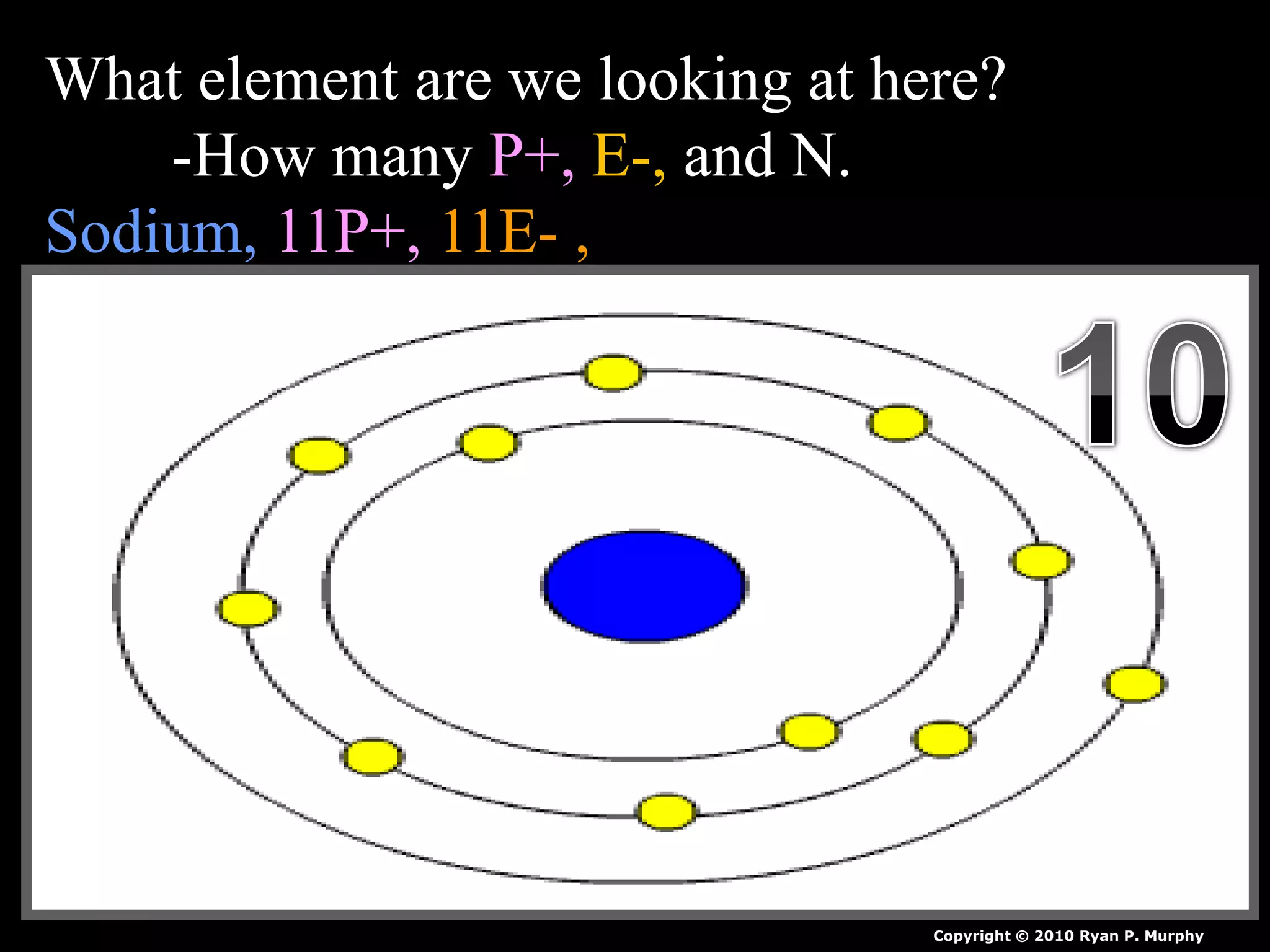
Sodium, 11P+, 11E- ,
Copyright © 2010 Ryan P. Murphy
What element are we looking at here?
-How many P+, E-, and N.
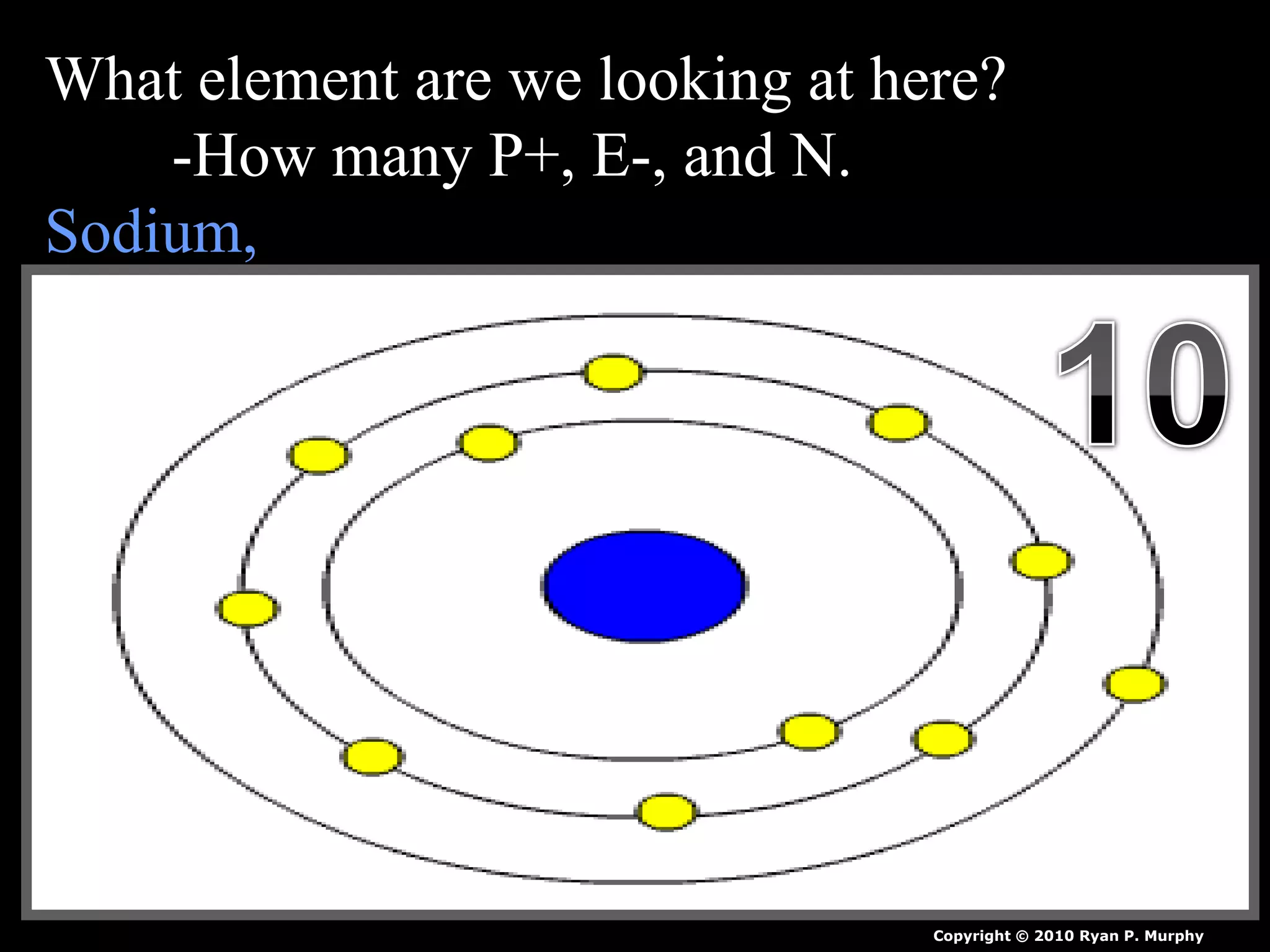
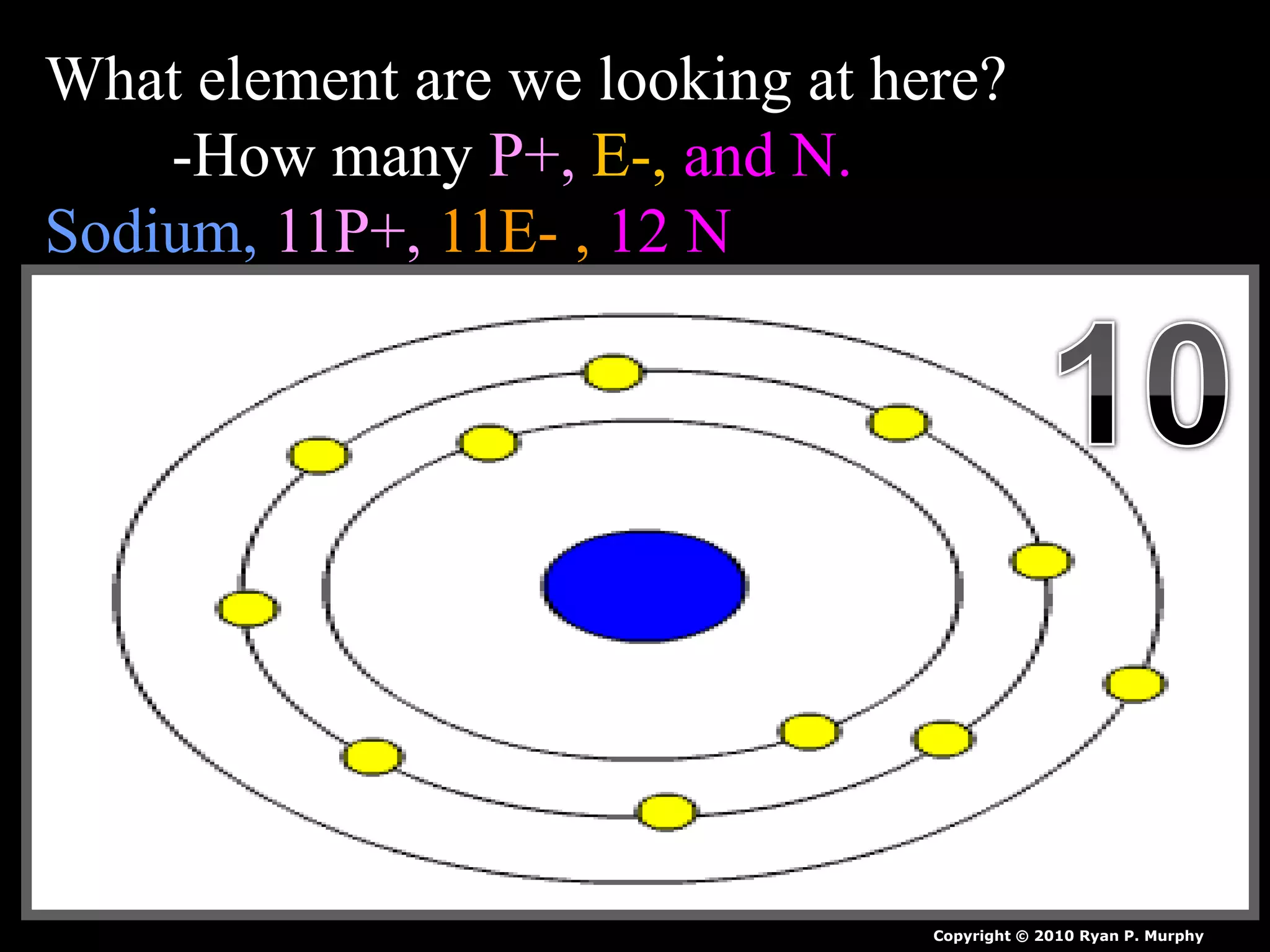
Sodium, 11P+, 11E- , 12 N
Copyright © 2010 Ryan P. Murphy
HAVE A GOOD
LOOK ATOM
ROUND
ABOUT
NUMBERIFFIC SUPER
SMALL
ATOMIC
POWER
-BONUS-
1 6 11 16 *21
2 7 12 17 *22
3 8 13 18 *23
4 9 14 19 *24
5 10 15 20 *25
Copyright © 2010 Ryan P. Murphy
Intro to Atoms Review Game
HAVE A GOOD
LOOK ATOM
ROUND
ABOUT
NUMBERIFFIC SUPER
SMALL
ATOMIC
POWER
-BONUS-
1 6 11 16 *21
2 7 12 17 *22
3 8 13 18 *23
4 9 14 19 *24
5 10 15 20 *25
Copyright © 2010 Ryan P. Murphy
Intro to Atoms Review Game
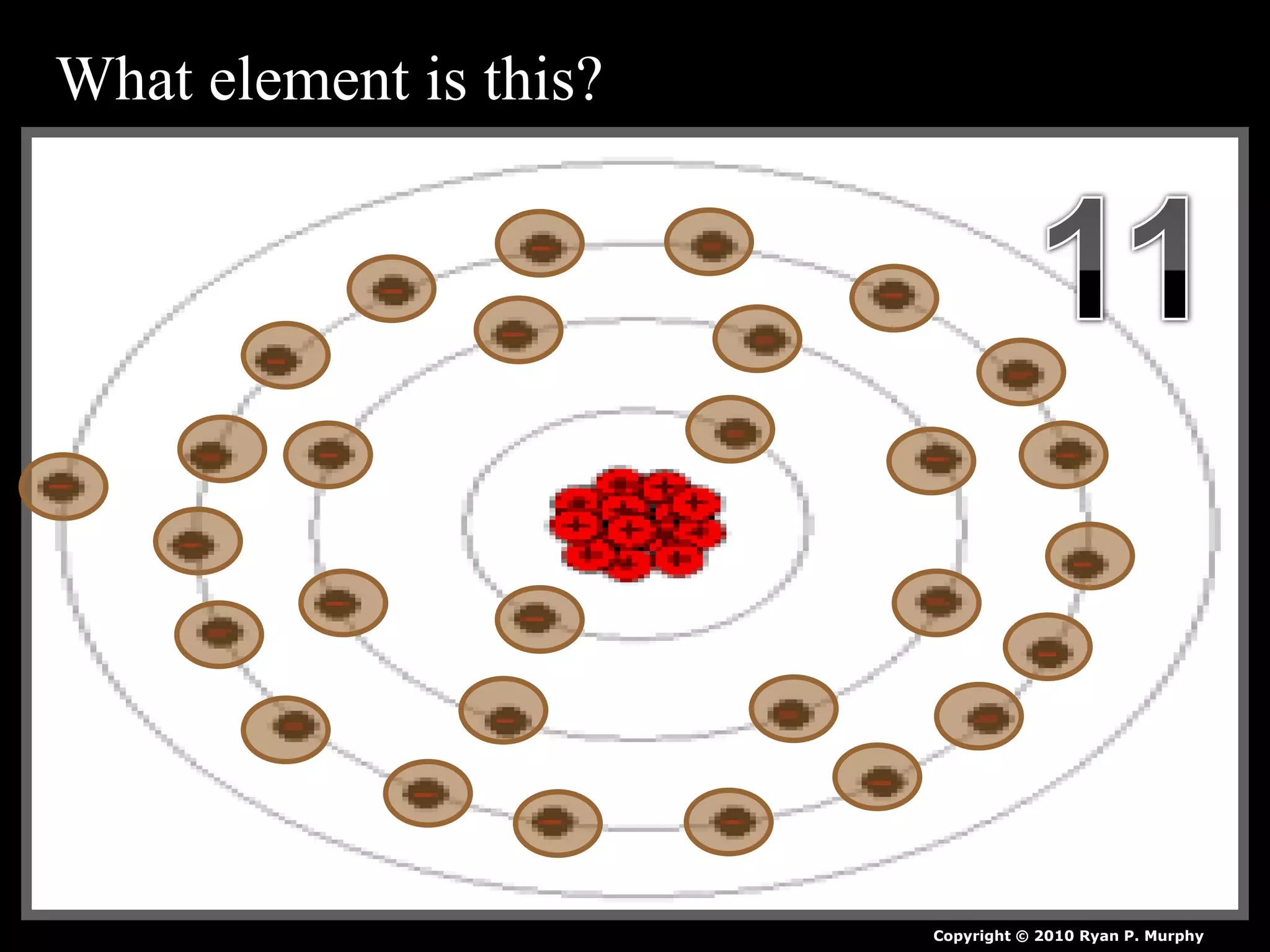
What element is this?
Copyright © 2010 Ryan P. Murphy
What element is this?
Copyright © 2010 Ryan P. Murphy
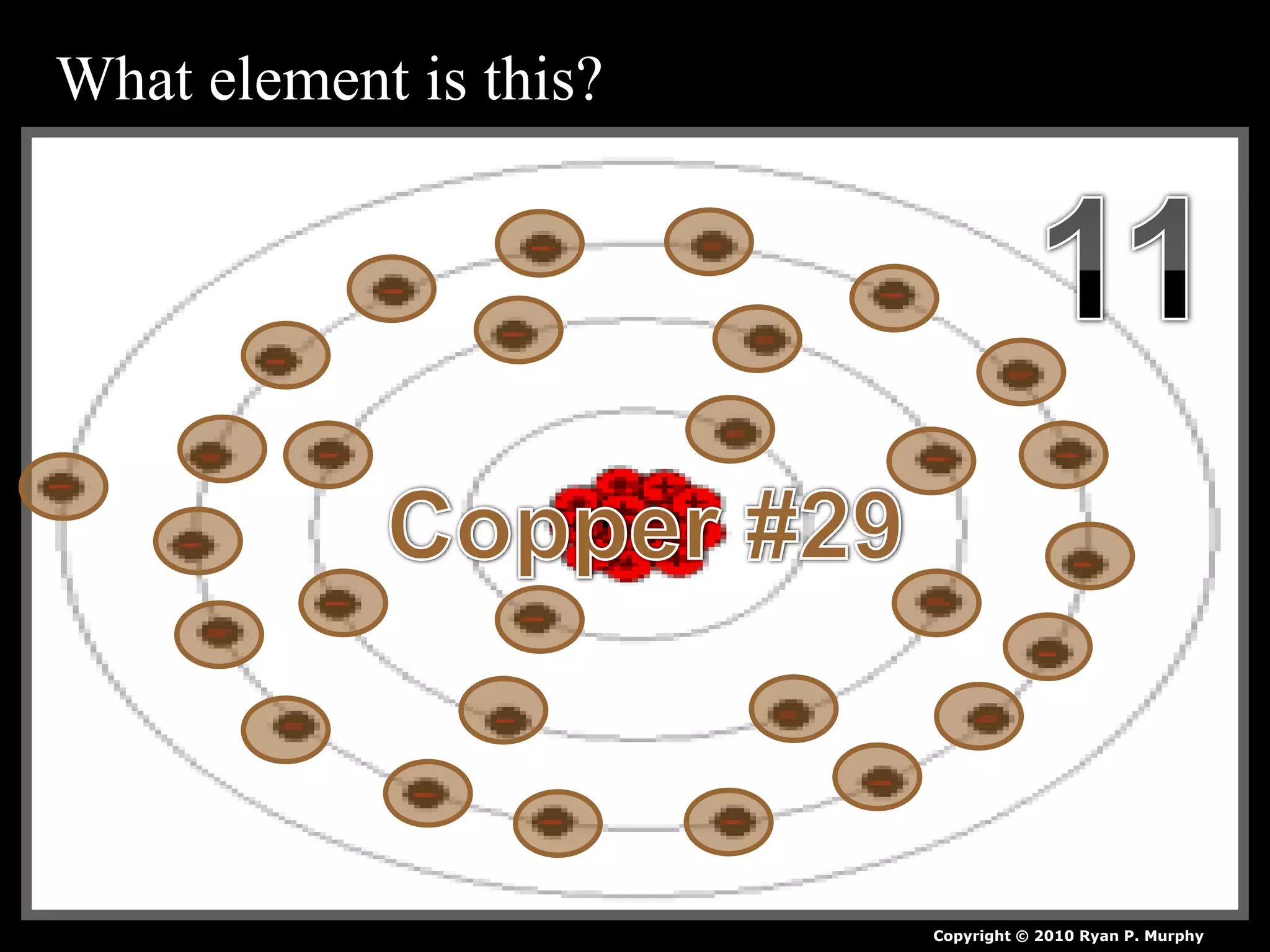
What element is this?
Copyright © 2010 Ryan P. Murphy
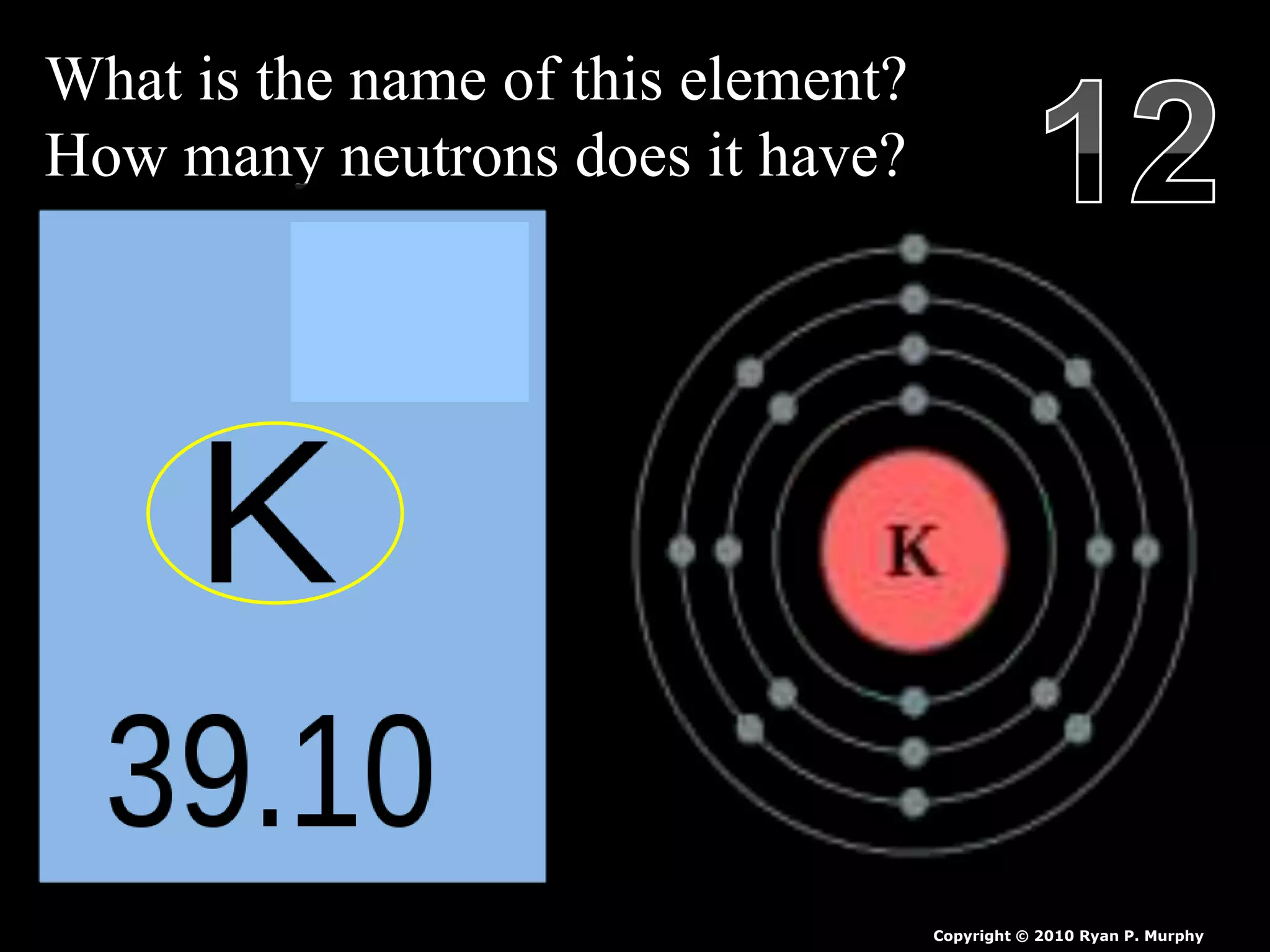
What is the name of this element?
How many neutrons does it have?
Copyright © 2010 Ryan P. Murphy
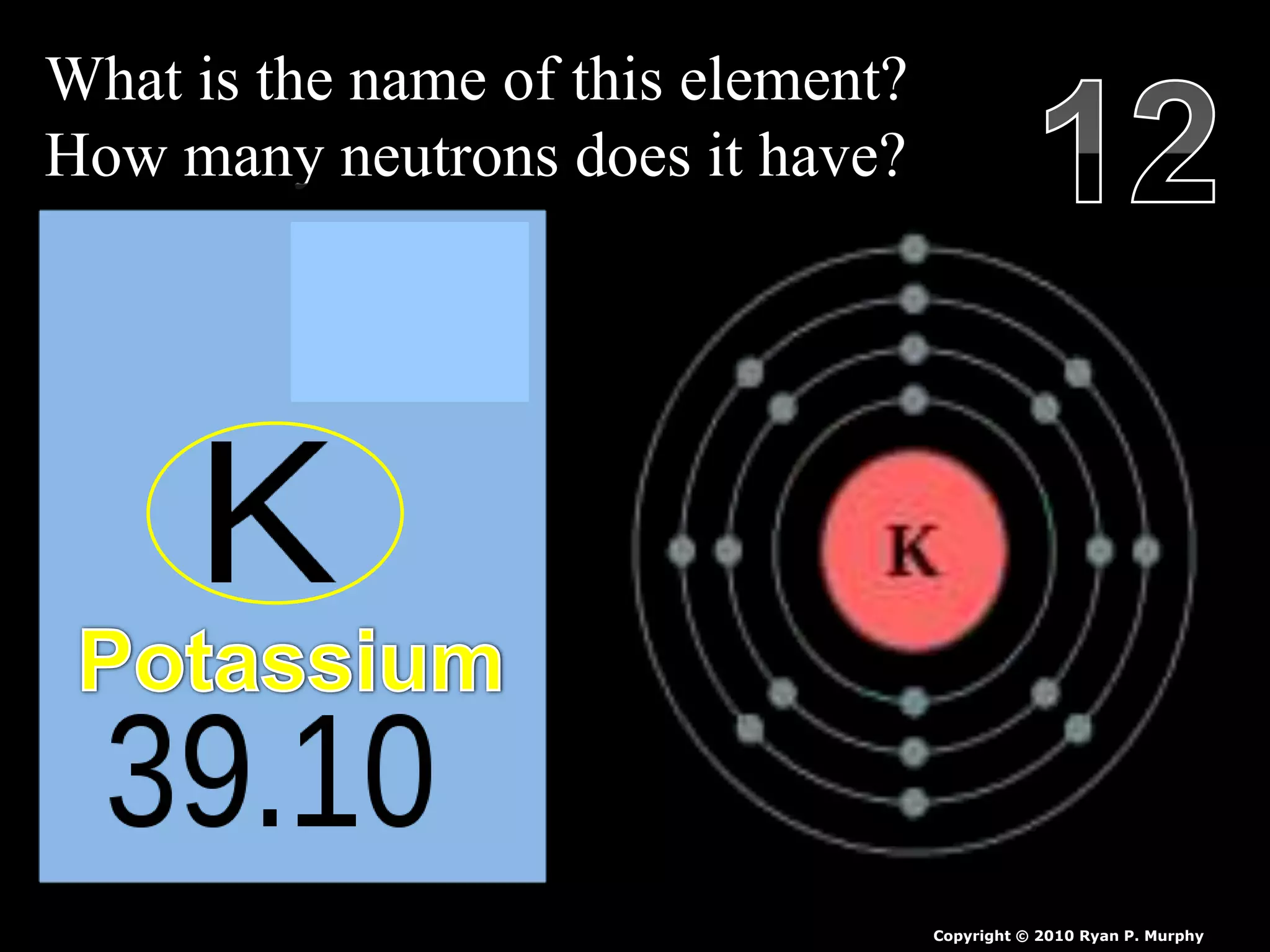
What is the name of this element?
How many neutrons does it have?
Copyright © 2010 Ryan P. Murphy
What is the name of this element?
How many neutrons does it have?
Copyright © 2010 Ryan P. Murphy
What is the name of this element?
How many neutrons does it have?
Copyright © 2010 Ryan P. Murphy
What is the name of this element?
How many neutrons does it have?
Copyright © 2010 Ryan P. Murphy
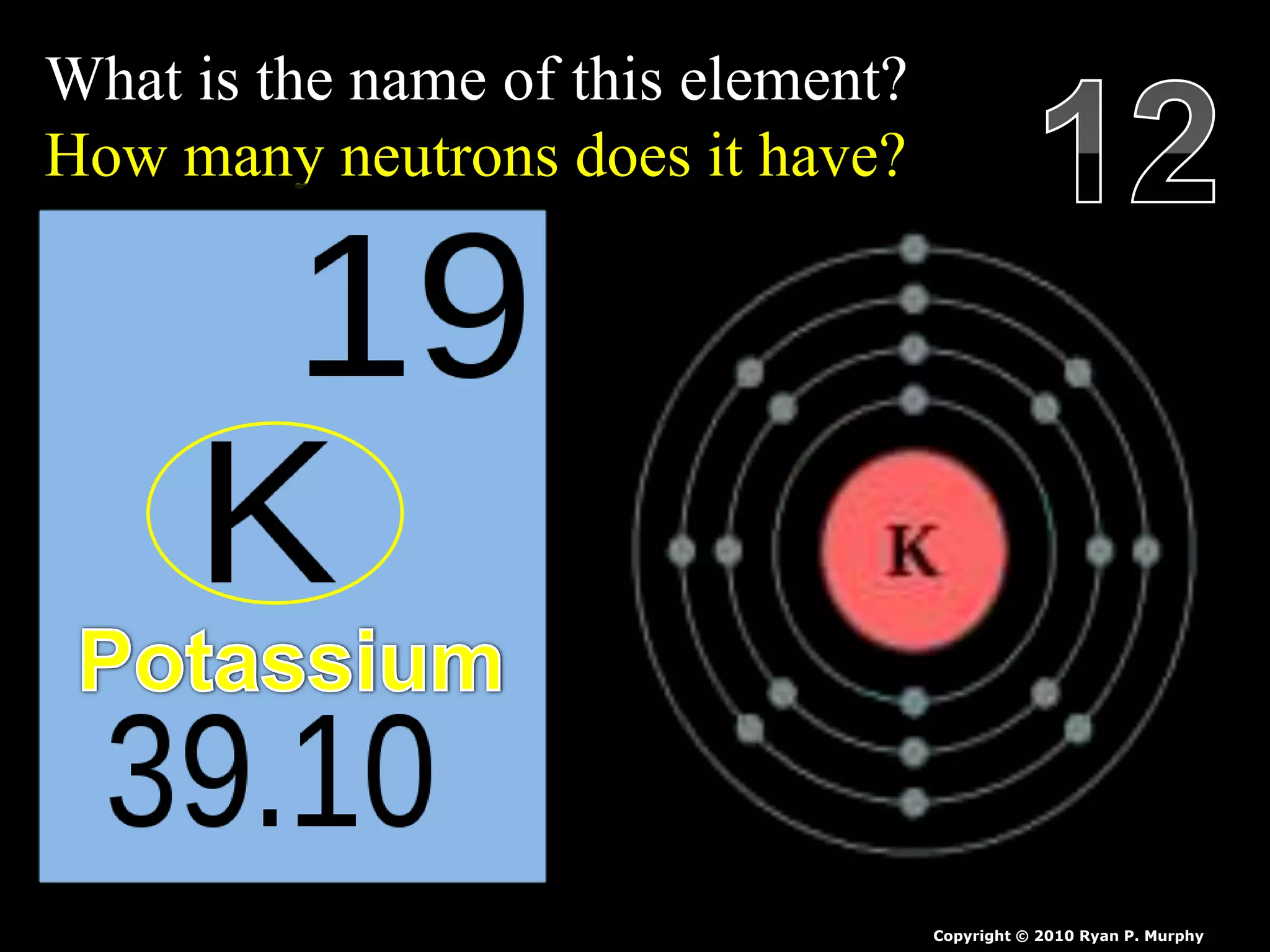
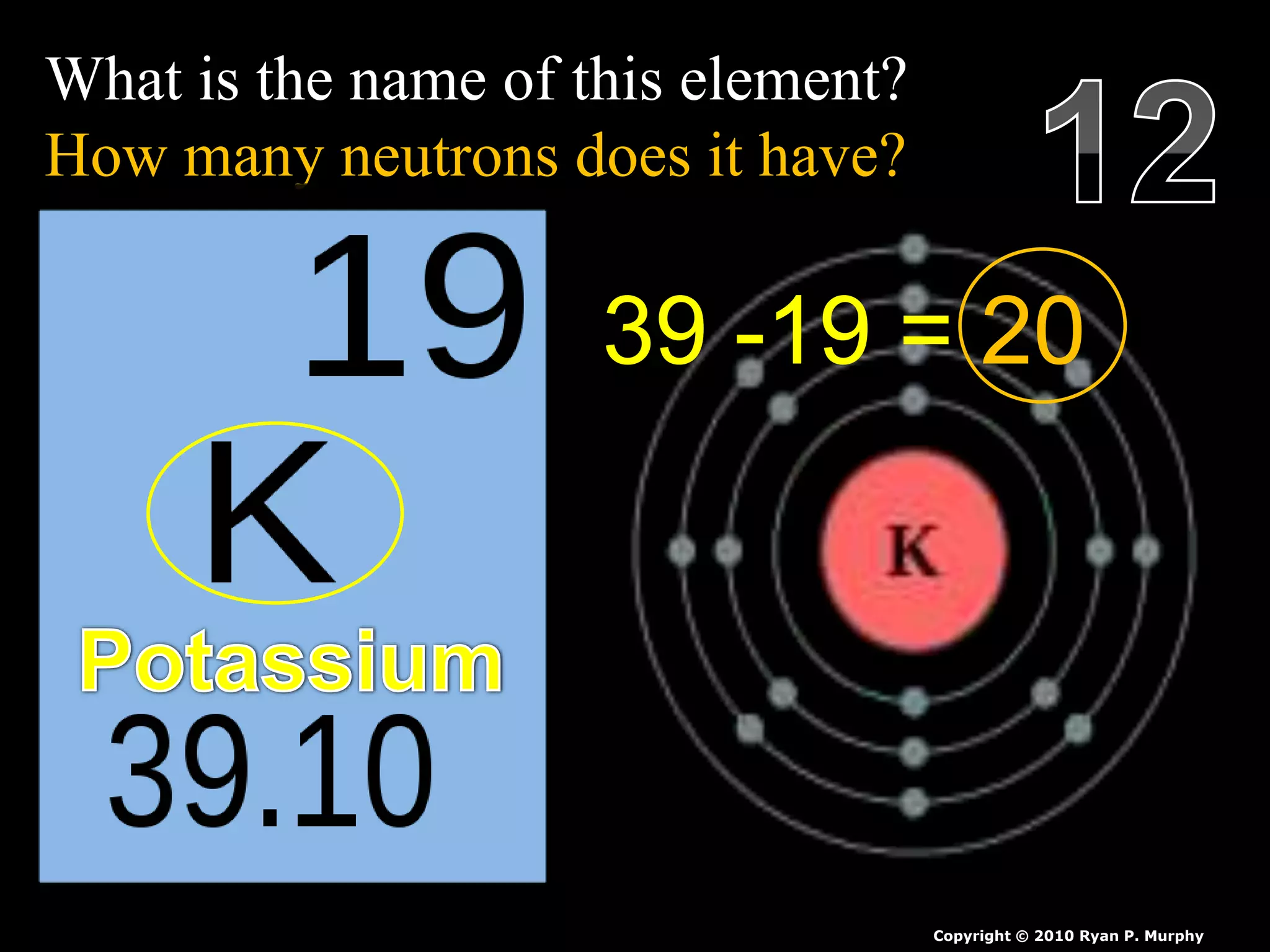
39 -19 =
What is the name of this element?
How many neutrons does it have?
Copyright © 2010 Ryan P. Murphy
39 -19 = 20
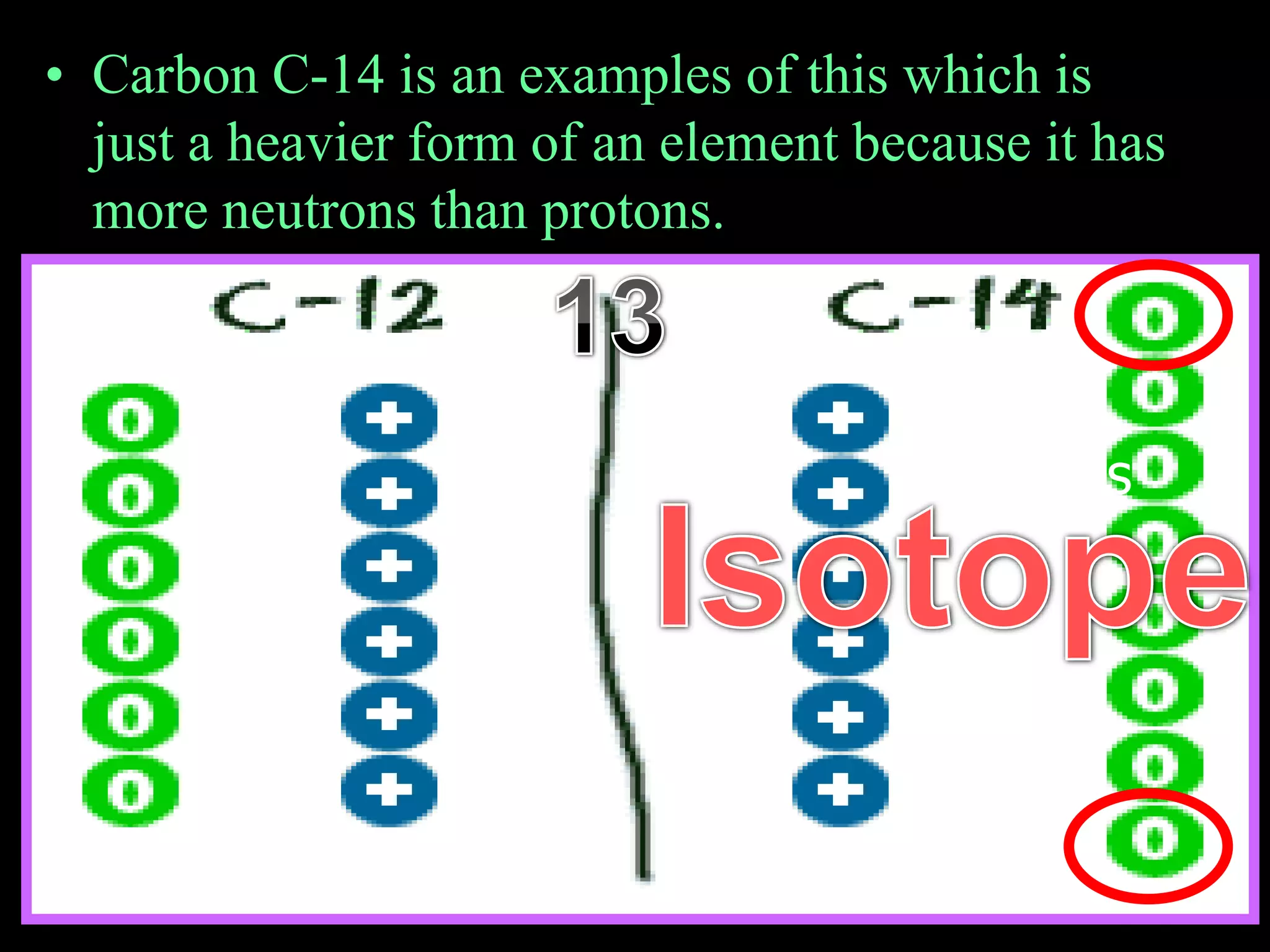
• Carbon C-14 is an examples of this which is
just a heavier form of an element because it has
more neutrons than protons.
Copyright © 2010 Ryan P. Murphy
Two
extra
neutrons
• Carbon C-14 is an examples of this which is
just a heavier form of an element because it has
more neutrons than protons.
Copyright © 2010 Ryan P. Murphy
Two
extra
neutrons
• Physicists have discovered that protons and
neutrons are composed of even smaller particles
called quarks.
– Just larger than an electron.
Copyright © 2010 Ryan P. Murphy
• Physicists have discovered that protons and
neutrons are composed of even smaller particles
called quarks.
– Just larger than an electron.
Copyright © 2010 Ryan P. Murphy
• Physicists have discovered that protons and
neutrons are composed of even smaller particles
called quarks.
– Just larger than an electron.
Copyright © 2010 Ryan P. Murphy
Please put the following terms in order
from largest to smallest.
- Atom
- Molecule
- Proton
- Electron
- Neutron
- Quark
- Nucleus
Copyright © 2010 Ryan P. Murphy
Please put the following terms in order
from largest to smallest.
-
- Atom
- Molecule
- Proton
- Electron
- Neutron
- Quark
- Nucleus
Copyright © 2010 Ryan P. Murphy
Please put the following terms in order
from largest to smallest.
- Molecule
- - Atom
- Molecule
- Proton
- Electron
- Neutron
- Quark
- Nucleus
Copyright © 2010 Ryan P. Murphy
Please put the following terms in order
from largest to smallest.
- Molecule
- Atom - Atom
- Molecule
- Proton
- Electron
- Neutron
- Quark
- Nucleus
Copyright © 2010 Ryan P. Murphy
Please put the following terms in order
from largest to smallest.
- Molecule
- Atom
- Nucleus
- Atom
- Molecule
- Proton
- Electron
- Neutron
- Quark
- Nucleus
Copyright © 2010 Ryan P. Murphy
Please put the following terms in order
from largest to smallest.
- Molecule
- Atom
- Nucleus
- Neutron
- Atom
- Molecule
- Proton
- Electron
- Neutron
- Quark
- Nucleus
Copyright © 2010 Ryan P. Murphy
Please put the following terms in order
from largest to smallest.
- Molecule
- Atom
- Nucleus
- Neutron
- Proton
- Atom
- Molecule
- Proton
- Electron
- Neutron
- Quark
- Nucleus
Copyright © 2010 Ryan P. Murphy
Please put the following terms in order
from largest to smallest.
- Molecule
- Atom
- Nucleus
- Neutron
- Proton
- Quark
- Atom
- Molecule
- Proton
- Electron
- Neutron
- Quark
- Nucleus
Copyright © 2010 Ryan P. Murphy
Please put the following terms in order
from largest to smallest.
- Molecule
- Atom
- Nucleus
- Neutron
- Proton
- Quark
- Electron
- Atom
- Molecule
- Proton
- Electron
- Neutron
- Quark
- Nucleus
Copyright © 2010 Ryan P. Murphy
Please put the following terms in order
from largest to smallest.
- Molecule
- Atom
- Nucleus
- Neutron
- Proton
- Quark
- Electron
Copyright © 2010 Ryan P. Murphy
HAVE A GOOD
LOOK ATOM
ROUND
ABOUT
NUMBERIFFIC SUPER
SMALL
ATOMIC
POWER
-BONUS-
1 6 11 16 *21
2 7 12 17 *22
3 8 13 18 *23
4 9 14 19 *24
5 10 15 20 *25
Copyright © 2010 Ryan P. Murphy
Intro to Atoms Review Game
HAVE A GOOD
LOOK ATOM
ROUND
ABOUT
NUMBERIFFIC SUPER
SMALL
ATOMIC
POWER
-BONUS-
1 6 11 16 *21
2 7 12 17 *22
3 8 13 18 *23
4 9 14 19 *24
5 10 15 20 *25
Copyright © 2010 Ryan P. Murphy
Intro to Atoms Review Game
These hold quarks together?
Copyright © 2010 Ryan P. Murphy
These hold quarks together?
Copyright © 2010 Ryan P. Murphy
These hold quarks together?
Copyright © 2010 Ryan P. Murphy
• Which particle is the Proton?
Copyright © 2010 Ryan P. Murphy
A
• Which particle is the Proton?
Copyright © 2010 Ryan P. Murphy
A
What is the name for these four particles?
Copyright © 2010 Ryan P. Murphy
What is the name for these four particles?
Copyright © 2010 Ryan P. Murphy
What is the name for these four particles?
Copyright © 2010 Ryan P. Murphy
What is the name for these four particles?
Copyright © 2010 Ryan P. Murphy
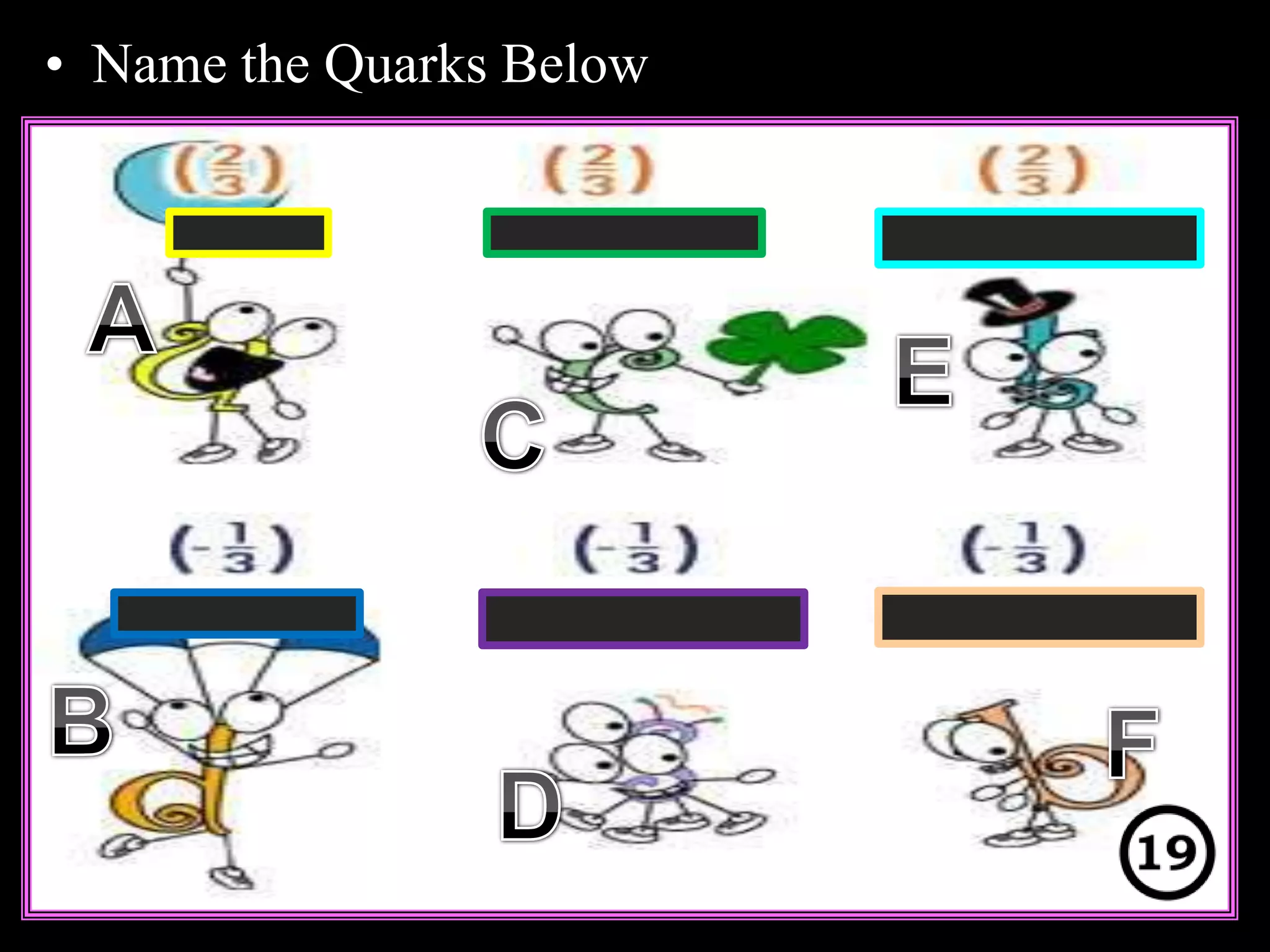
• Name the Quarks Below
Copyright © 2010 Ryan P. Murphy
• Name the Quarks Below
Copyright © 2010 Ryan P. Murphy
• Name the Quarks Below
Copyright © 2010 Ryan P. Murphy
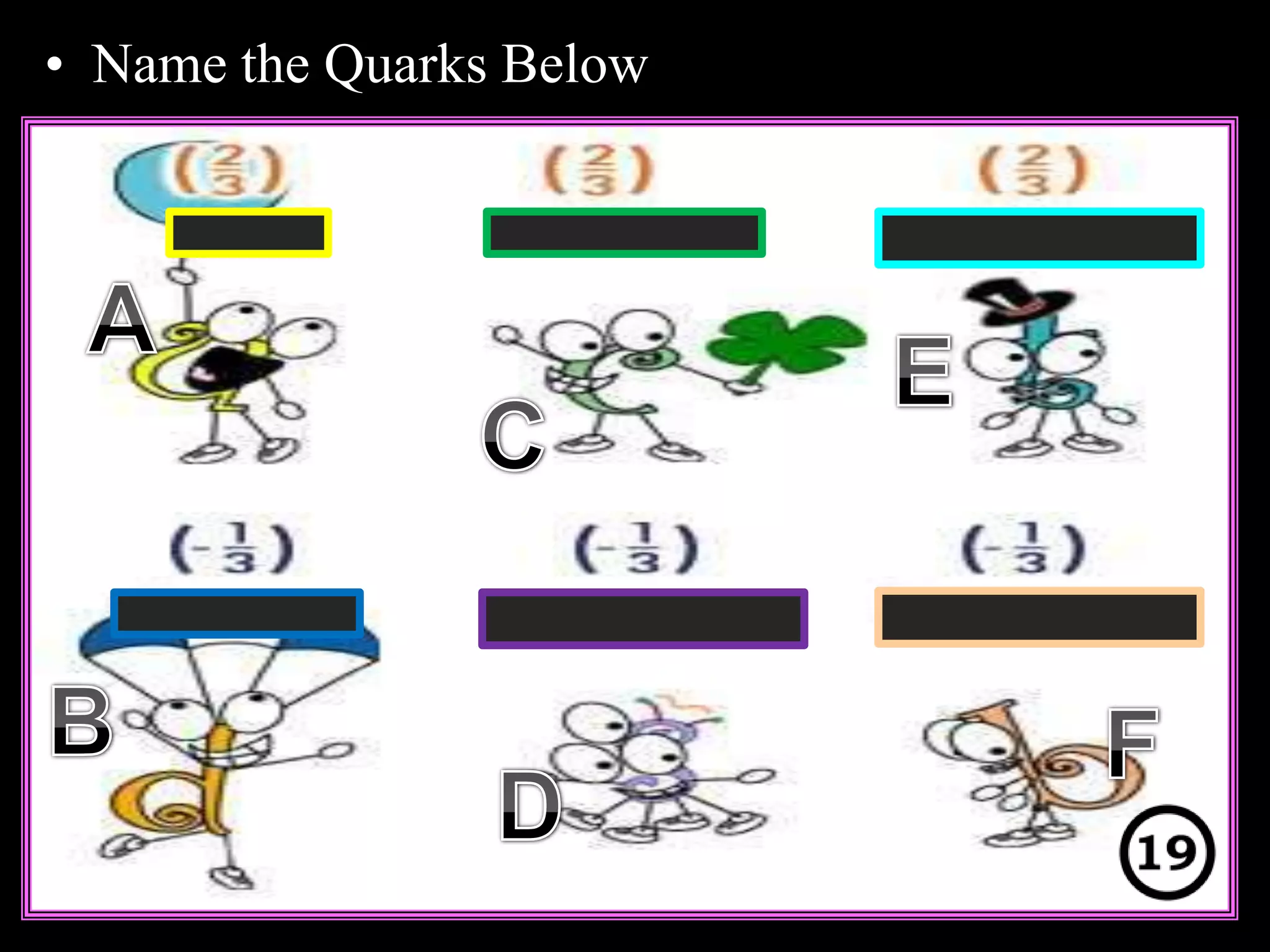
• Name the Quarks Below
Copyright © 2010 Ryan P. Murphy
• Name the Quarks Below
Copyright © 2010 Ryan P. Murphy
• Name the Quarks Below
Copyright © 2010 Ryan P. Murphy
• Name the Quarks Below
Copyright © 2010 Ryan P. Murphy
• Name the Quarks Below
Copyright © 2010 Ryan P. Murphy
• Name the Quarks Below
Copyright © 2010 Ryan P. Murphy
• Name the Quarks Below
Copyright © 2010 Ryan P. Murphy
• Name the Quarks Below
Copyright © 2010 Ryan P. Murphy
• Name the Quarks Below
Copyright © 2010 Ryan P. Murphy
• Name the Quarks Below
Copyright © 2010 Ryan P. Murphy
• Name the Quarks Below
Copyright © 2010 Ryan P. Murphy
• Name the Quarks Below
Copyright © 2010 Ryan P. Murphy
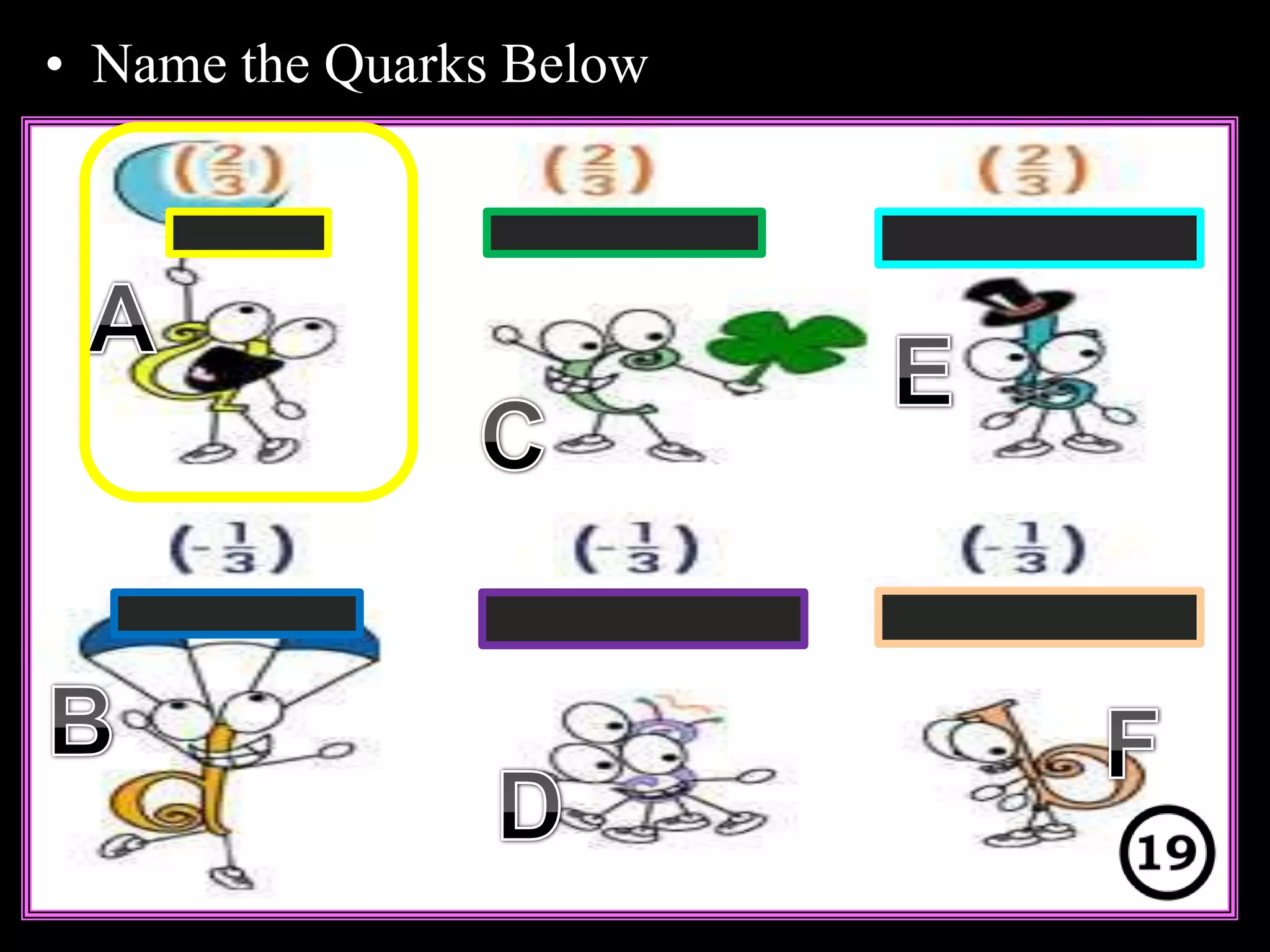
• Name the Quarks Below
Copyright © 2010 Ryan P. Murphy
• Name the three below?
Copyright © 2010 Ryan P. Murphy
• Name the three below?
Copyright © 2010 Ryan P. Murphy
• Name the three below?
Copyright © 2010 Ryan P. Murphy
• Name the three below?
Copyright © 2010 Ryan P. Murphy
• Name the three below?
Copyright © 2010 Ryan P. Murphy
• Name the three below?
Copyright © 2010 Ryan P. Murphy
• Name the three below?
Copyright © 2010 Ryan P. Murphy
HAVE A GOOD
LOOK ATOM
ROUND
ABOUT
NUMBERIFFIC SUPER
SMALL
ATOMIC
POWER
-BONUS-
1 6 11 16 *21
2 7 12 17 *22
3 8 13 18 *23
4 9 14 19 *24
5 10 15 20 *25
Copyright © 2010 Ryan P. Murphy
Intro to Atoms Review Game
HAVE A GOOD
LOOK ATOM
ROUND
ABOUT
NUMBERIFFIC SUPER
SMALL
ATOMIC
POWER
-BONUS-
1 6 11 16 *21
2 7 12 17 *22
3 8 13 18 *23
4 9 14 19 *24
5 10 15 20 *25
Copyright © 2010 Ryan P. Murphy
Intro to Atoms Review Game
Who am I?
Copyright © 2010 Ryan P. Murphy
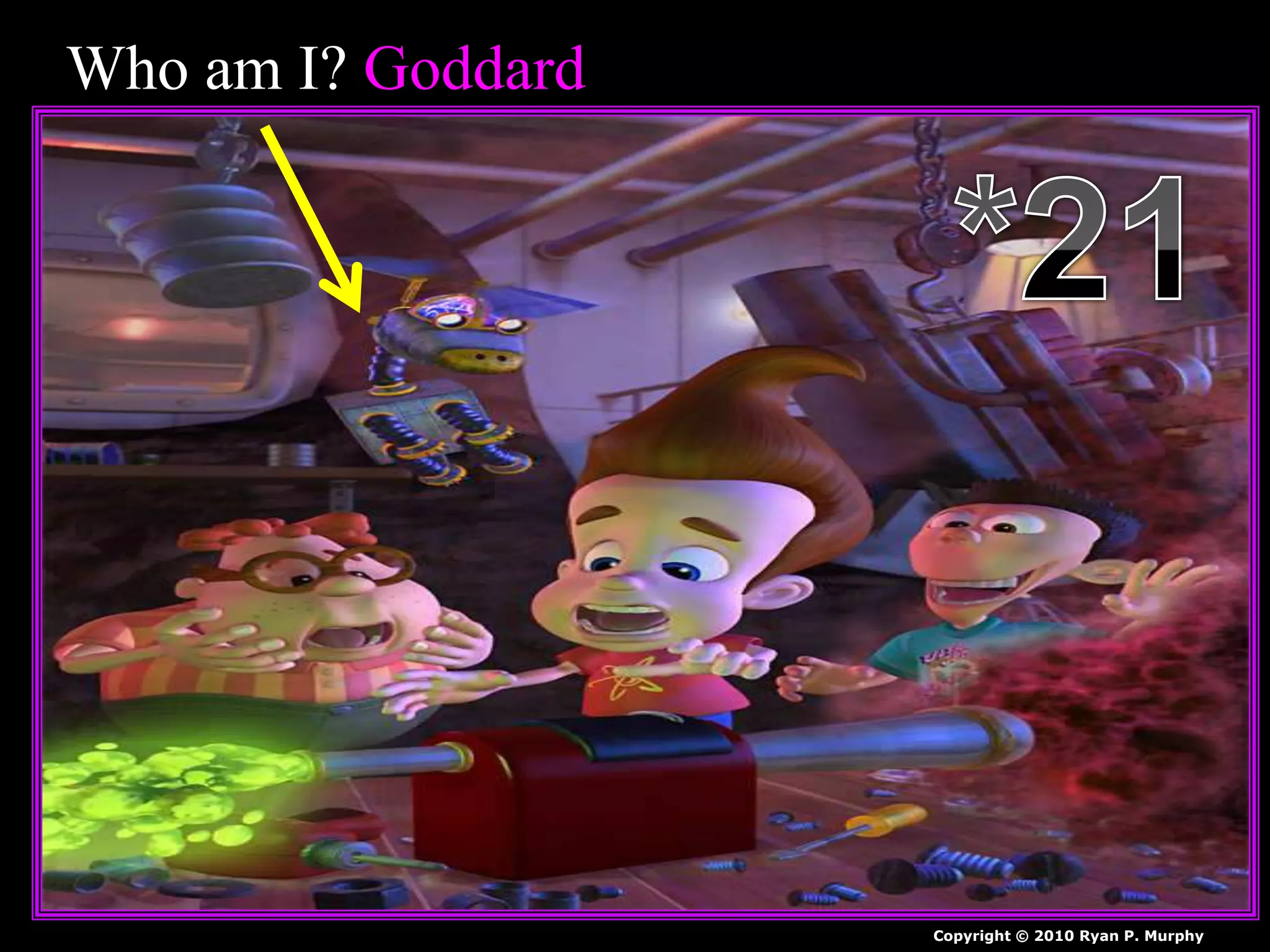
Who am I? Goddard
Copyright © 2010 Ryan P. Murphy
Who am I before I become the Hulk?
Copyright © 2010 Ryan P. Murphy
Who am I before I become the Hulk?
Copyright © 2010 Ryan P. Murphy
I get my radioactive powers from the
atom?
Copyright © 2010 Ryan P. Murphy
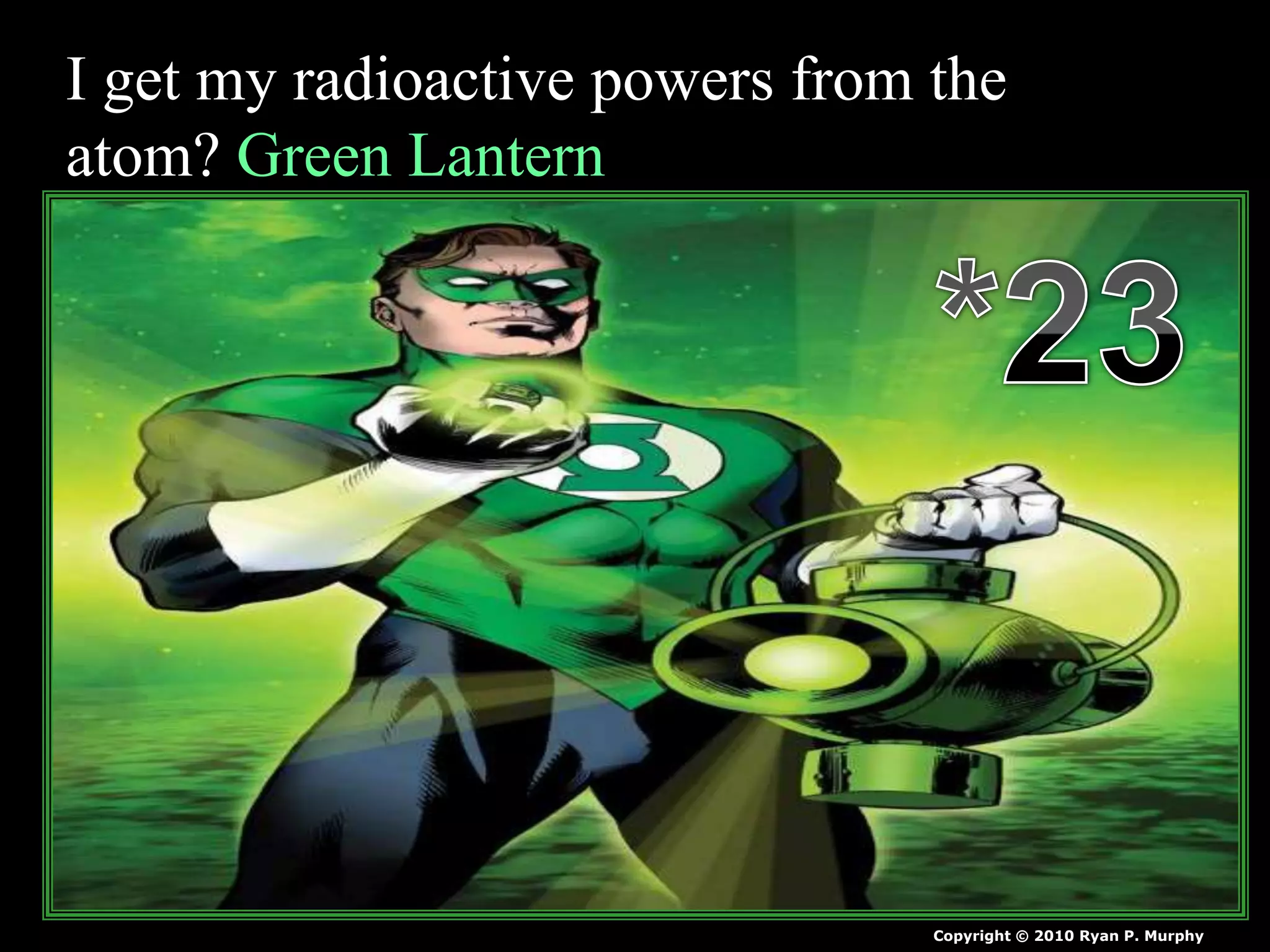
I get my radioactive powers from the
atom? Green Lantern
Copyright © 2010 Ryan P. Murphy
What atomic symbol on the Periodic Table of
the Elements represents my name?
Copyright © 2010 Ryan P. Murphy
*24
What atomic symbol on the Periodic Table of
the Elements represents my name? Fe (Iron)
Copyright © 2010 Ryan P. Murphy
*24Iron Man
This super villain used kryptonite to render
Superman useless?
PS- kryptonite is mostly a thing of the movies.
Copyright © 2010 Ryan P. Murphy
*25
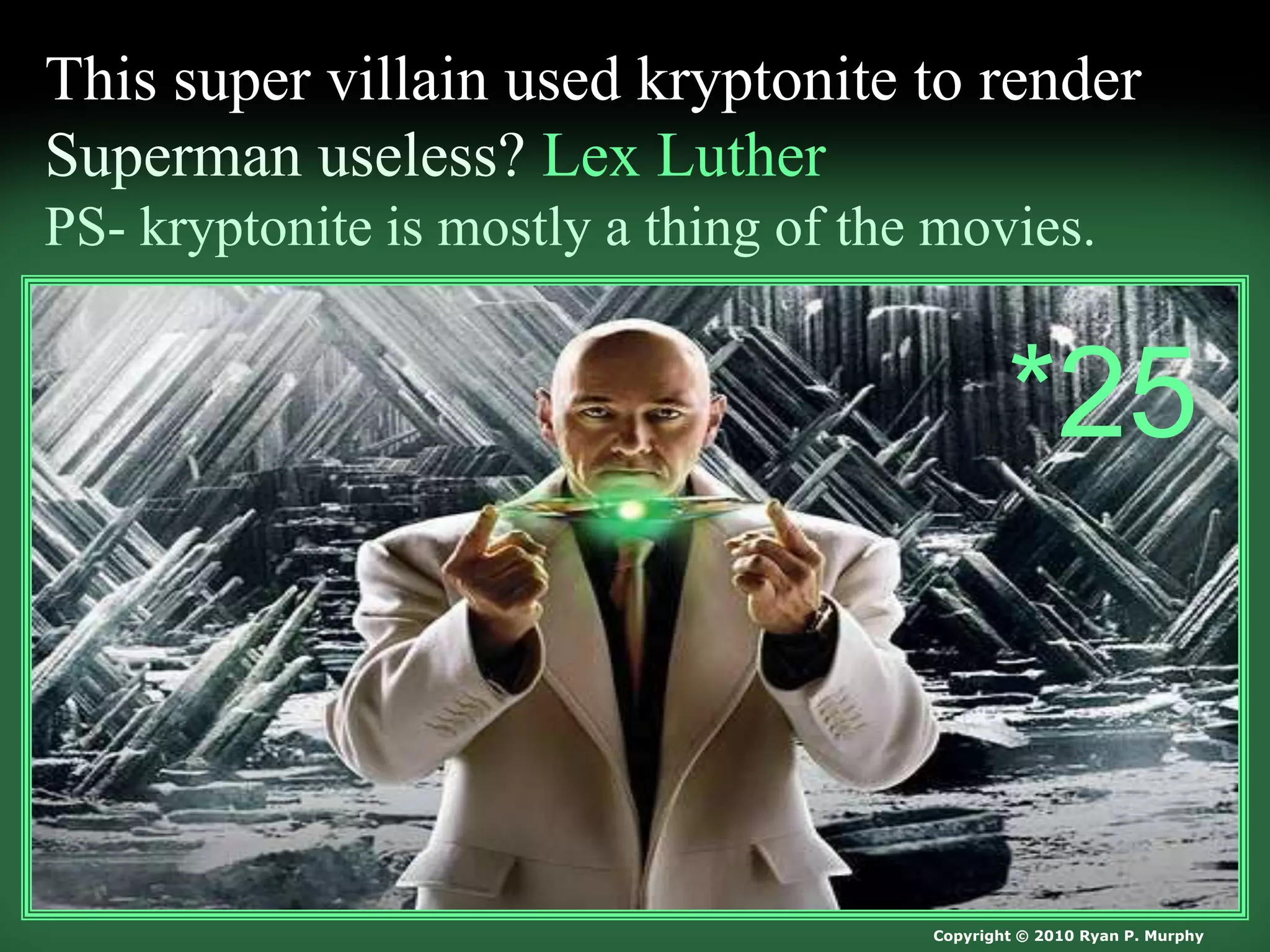
This super villain used kryptonite to render
Superman useless? Lex Luther
PS- kryptonite is mostly a thing of the movies.
Copyright © 2010 Ryan P. Murphy
*25
HAVE A GOOD
LOOK ATOM
ROUND
ABOUT
NUMBERIFFIC SUPER
SMALL
ATOMIC
POWER
-BONUS-
1 6 11 16 *21
2 7 12 17 *22
3 8 13 18 *23
4 9 14 19 *24
5 10 15 20 *25
Copyright © 2010 Ryan P. Murphy
Intro to Atoms Review Game
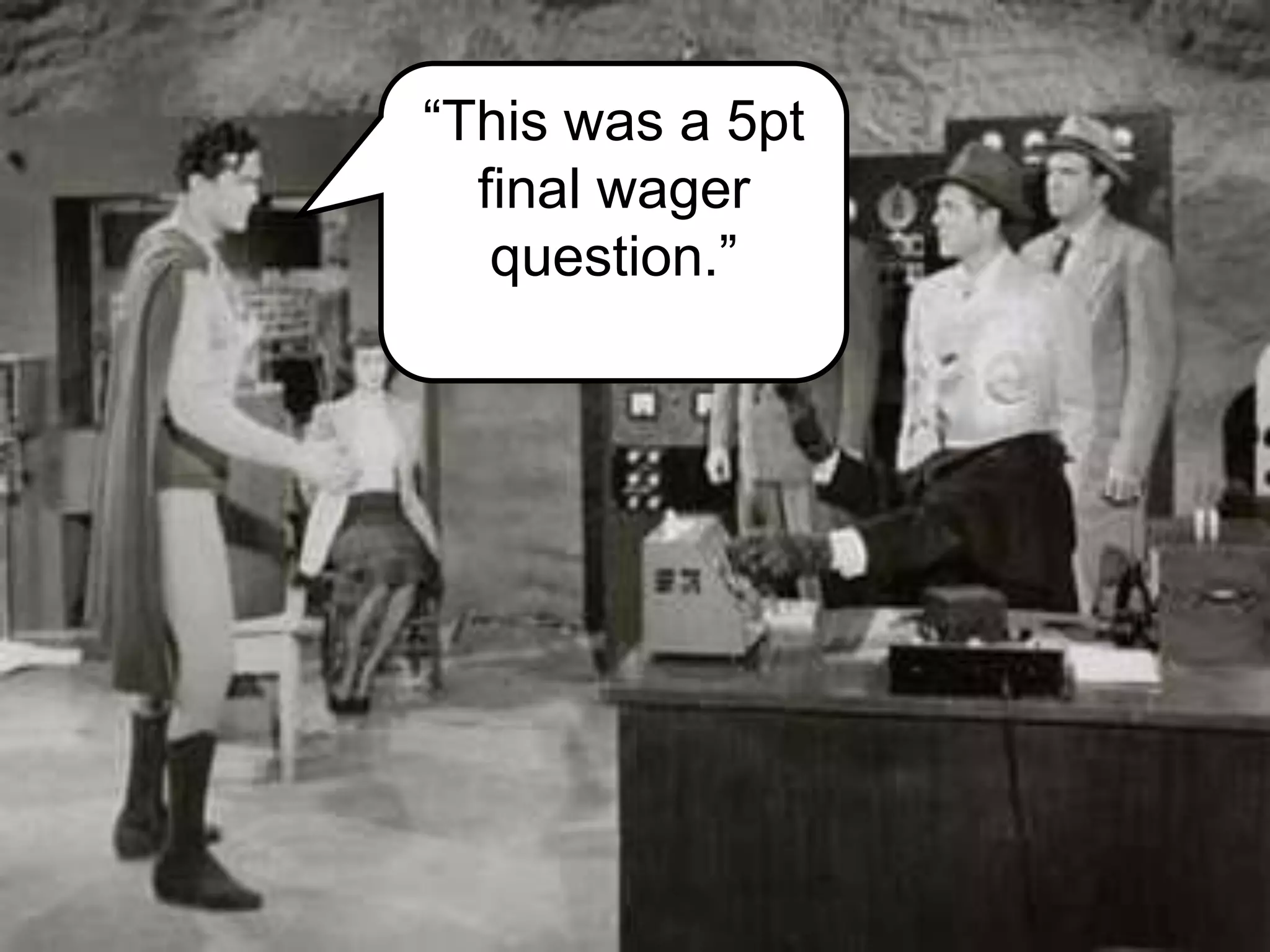
“This was a 5pt
final wager
question.”
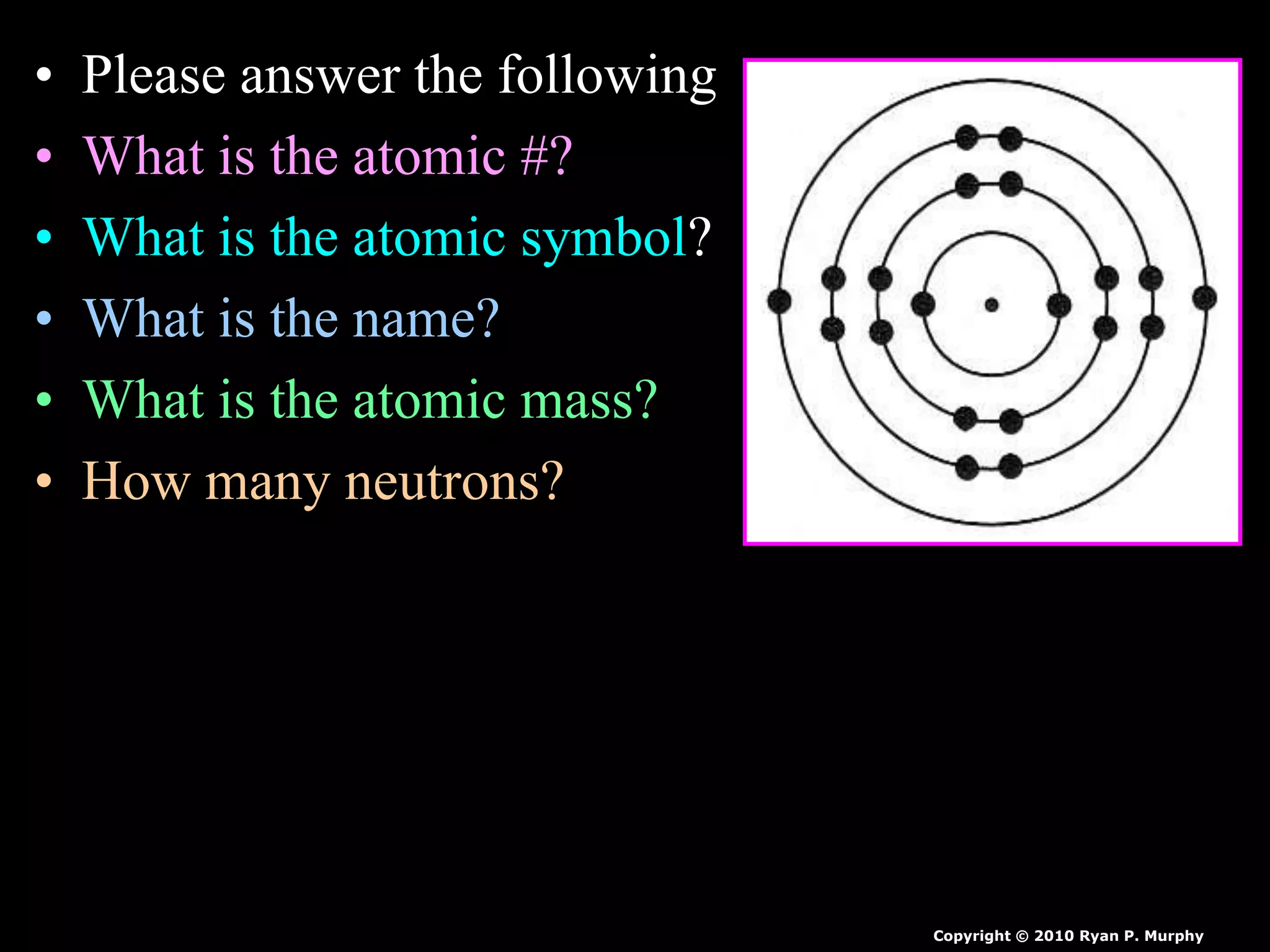
• Please answer the following
• What is the atomic #?
• What is the atomic symbol?
• What is the name?
• What is the atomic mass?
• How many neutrons?
Copyright © 2010 Ryan P. Murphy
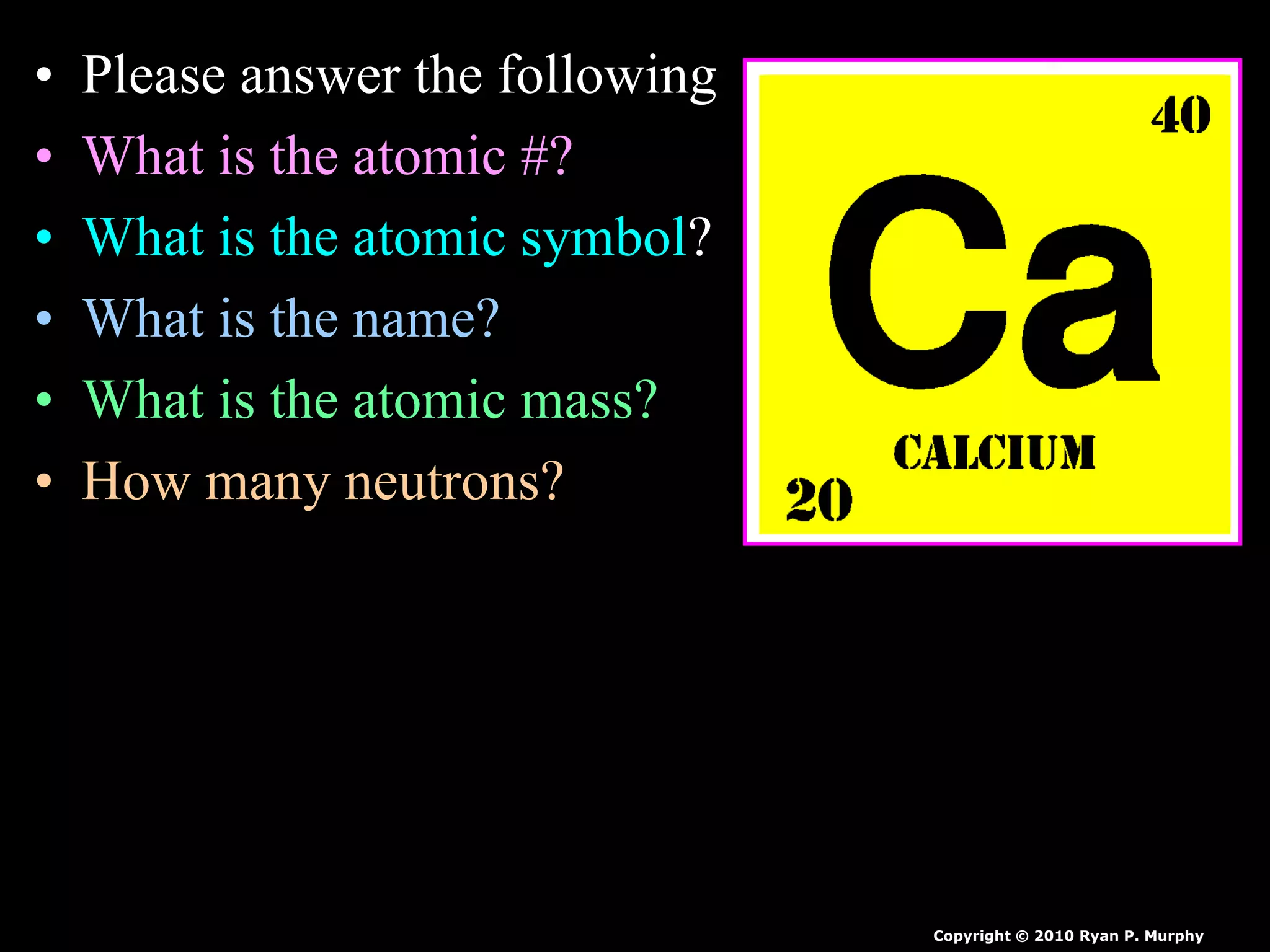
• Please answer the following
• What is the atomic #?
• What is the atomic symbol?
• What is the name?
• What is the atomic mass?
• How many neutrons?
Copyright © 2010 Ryan P. Murphy
• Please answer the following
• What is the atomic #?
• What is the atomic symbol?
• What is the name?
• What is the atomic mass?
• How many neutrons?
Copyright © 2010 Ryan P. Murphy
• Please answer the following
• What is the atomic #?
• What is the atomic symbol?
• What is the name?
• What is the atomic mass?
• How many neutrons?
Copyright © 2010 Ryan P. Murphy
• Please answer the following
• What is the atomic #?
• What is the atomic symbol?
• What is the name?
• What is the atomic mass?
• How many neutrons?
Copyright © 2010 Ryan P. Murphy
• Please answer the following
• What is the atomic #?
• What is the atomic symbol?
• What is the name?
• What is the atomic mass?
• How many neutrons?
Copyright © 2010 Ryan P. Murphy
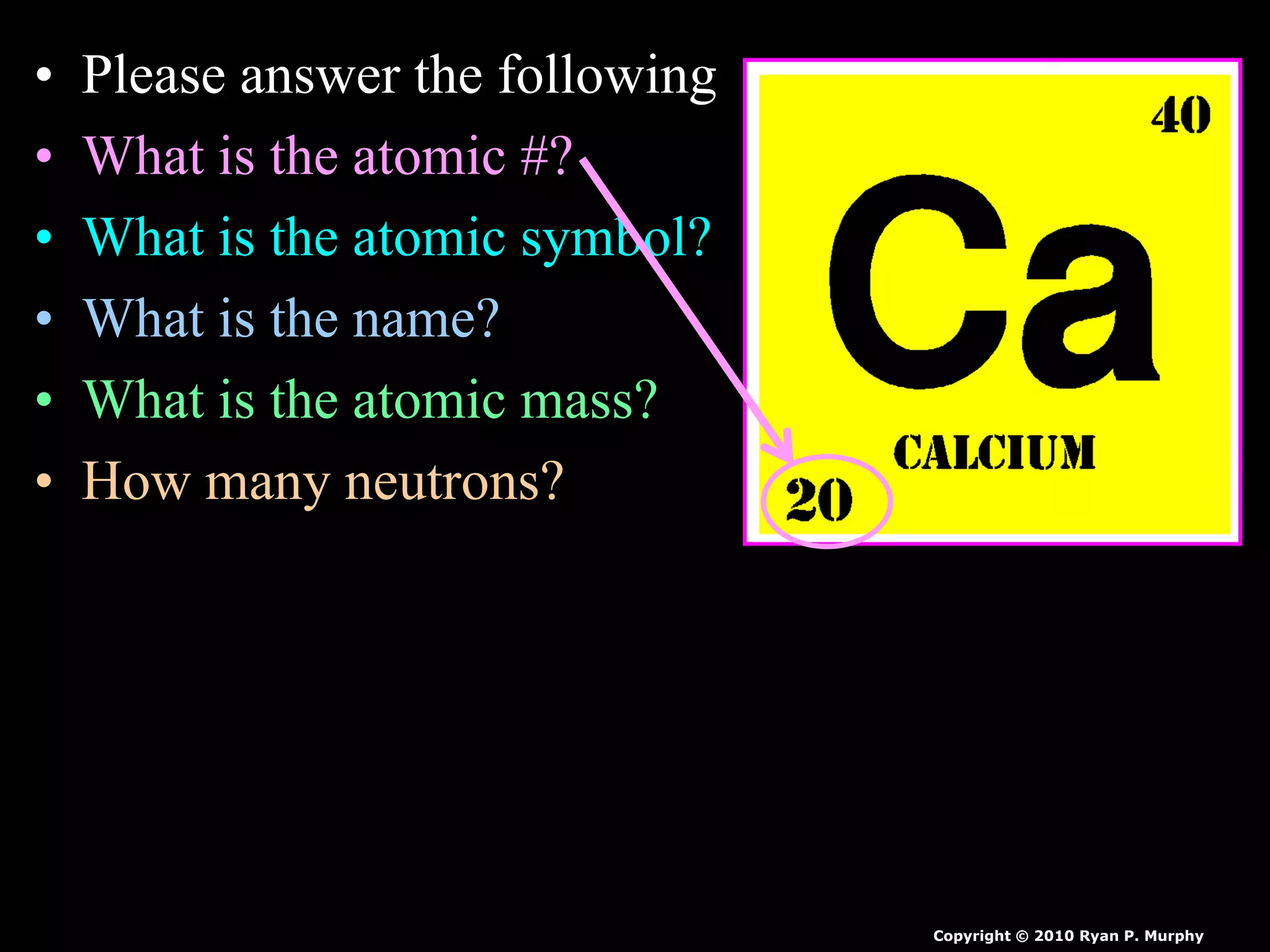
• Please answer the following
• What is the atomic #?
• What is the atomic symbol?
• What is the name?
• What is the atomic mass?
• How many neutrons?
40-20 = 20 neutrons
Copyright © 2010 Ryan P. Murphy
• Please answer the following
• What is the atomic #?
• What is the atomic symbol?
• What is the name?
• What is the atomic mass?
• How many neutrons?
Copyright © 2010 Ryan P. Murphy
Questions 1-20 = 5pts Each
Final Category (Bonus) = 1pt Each
Final Questions = 5 pt wager
Find the Owl =
Secretly write “Owl” in the correct box
worth 1pt.
• http://sciencepowerpoint.com
http://sciencepowerpoint.com/Atoms_Periodic_Table_of_Elements_Unit.html
Areas of Focus within The Atoms and Periodic Table Unit:
Atoms (Atomic Force Microscopes), Rutherford’s Gold Foil Experiment, Cathode
Tube, Atoms, Fundamental Particles, The Nucleus, Isotopes, AMU, Size of
Atoms and Particles, Quarks, Recipe of the Universe, Atomic Theory, Atomic
Symbols, #’;s, Valence Electrons, Octet Rule, SPONCH Atoms, Molecules,
Hydrocarbons (Structure), Alcohols (Structure), Proteins (Structure), Atomic
Bonds, Ionic Bonds, Covalent Bonds, Metallic Bonds, , Precipitation Reactions,
Acids and Bases, Electron Negativity, Polar Bonds, Chemical Change,
Exothermic Reactions, Endothermic Reactions, Laws Conservation of Matter,
Balancing Chemical Equations, Oxidation and Reduction, Periodic Table of the
Elements, Organization of Periodic Table, Transition Metals, Acids and Bases,
Non-Metals, Metals, Metalloids, Ionization.
• This PowerPoint roadmap is one small part of my
Atoms and Periodic Table Unit.
• This unit includes a four part 2000+ slide PowerPoint
roadmap.
• 13 page bundled homework that chronologically
follows slideshow
• 14 pages of unit notes with visuals.
• 3 PowerPoint review games.
• Activity sheets, rubrics, advice page, curriculum
guide, materials list, and much more.
• http://sciencepowerpoint.com
• Please visit the links below to learn more about
each of the units in this curriculum
– These units take me about four years to complete with
my students in grades 5-10.
Earth Science Units Extended Tour Link and Curriculum Guide
Geology Topics Unit http://sciencepowerpoint.com/Geology_Unit.html
Astronomy Topics Unit http://sciencepowerpoint.com/Astronomy_Unit.html
Weather and Climate Unit http://sciencepowerpoint.com/Weather_Climate_Unit.html
Soil Science, Weathering, More http://sciencepowerpoint.com/Soil_and_Glaciers_Unit.html
Water Unit http://sciencepowerpoint.com/Water_Molecule_Unit.html
Rivers Unit http://sciencepowerpoint.com/River_and_Water_Quality_Unit.html
= Easier = More Difficult = Most Difficult
5th – 7th grade 6th – 8th grade 8th – 10th grade
Physical Science Units Extended Tour Link and Curriculum Guide
Science Skills Unit http://sciencepowerpoint.com/Science_Introduction_Lab_Safety_Metric_Methods.html
Motion and Machines Unit http://sciencepowerpoint.com/Newtons_Laws_Motion_Machines_Unit.html
Matter, Energy, Envs. Unit http://sciencepowerpoint.com/Energy_Topics_Unit.html
Atoms and Periodic Table Unit http://sciencepowerpoint.com/Atoms_Periodic_Table_of_Elements_Unit.html
Life Science Units Extended Tour Link and Curriculum Guide
Human Body / Health Topics
http://sciencepowerpoint.com/Human_Body_Systems_and_Health_Topics_Unit.html
DNA and Genetics Unit http://sciencepowerpoint.com/DNA_Genetics_Unit.html
Cell Biology Unit http://sciencepowerpoint.com/Cellular_Biology_Unit.html
Infectious Diseases Unit http://sciencepowerpoint.com/Infectious_Diseases_Unit.html
Taxonomy and Classification Unit http://sciencepowerpoint.com/Taxonomy_Classification_Unit.html
Evolution / Natural Selection Unit http://sciencepowerpoint.com/Evolution_Natural_Selection_Unit.html
Botany Topics Unit http://sciencepowerpoint.com/Plant_Botany_Unit.html
Ecology Feeding Levels Unit http://sciencepowerpoint.com/Ecology_Feeding_Levels_Unit.htm
Ecology Interactions Unit http://sciencepowerpoint.com/Ecology_Interactions_Unit.html
Ecology Abiotic Factors Unit http://sciencepowerpoint.com/Ecology_Abiotic_Factors_Unit.html
• http://sciencepowerpoint.com
• The entire four year curriculum can be found at...
http://sciencepowerpoint.com/ Please feel free to
contact me with any questions you may have. Thank
you for your interest in this curriculum.
Sincerely,
Ryan Murphy M.Ed
www.sciencepowerpoint@gmail.com

Introduction to the Atom, Protons, Neutrons, Electron, Nucleus, Atomic Mass, Quiz Game

  • 1.
    • Please recordthe following. – Atomic Number = 7 – Number of Protons = 7 – Number of Neutrons = 14.01 – 7 = 7.01 0r 7 Copyright © 2010 Ryan P. Murphy
  • 2.
    HAVE A GOOD LOOKATOM ROUND ABOUT NUMBERIFFIC SUPER SMALL ATOMIC POWER -BONUS- 1 6 11 16 *21 2 7 12 17 *22 3 8 13 18 *23 4 9 14 19 *24 5 10 15 20 *25 Copyright © 2010 Ryan P. Murphy Intro to Atoms Review Game
  • 3.
    • How toplay… – Don’t play like Jeo_ _ _ _ y. – Class should be divided into several small groups. – Groups should use science journal (red slide notes), homework, and other available materials to assist you. – Groups can communicate quietly with each other but no sharing answers between groups. • Practice quietly communicating right now? • Practice Communication Question: • Your group gets to order one pizza and you can have two toppings. What does your group want?
  • 4.
    Questions 1-20 =5pts Each Final Category (Bonus) = 1pt Each Final Questions = 5 pt wager If you wager 5 on the last question and get it wrong you lose 5 pts. Wager 5 and get it right you get 5 pts. Find the Owl = Secretly write “Owl” in the correct box worth 1pt. “I’ll be about this big.”
  • 5.
    • Is yourname on the review sheet?
  • 6.
    • Is yourname on the review sheet?
  • 7.
  • 9.
    http://sciencepowerpoint.com/Atoms_Periodic_Table_of_Elements_Unit.html Areas of Focuswithin The Atoms and Periodic Table Unit: Atoms (Atomic Force Microscopes), Rutherford’s Gold Foil Experiment, Cathode Tube, Atoms, Fundamental Particles, The Nucleus, Isotopes, AMU, Size of Atoms and Particles, Quarks, Recipe of the Universe, Atomic Theory, Atomic Symbols, #’;s, Valence Electrons, Octet Rule, SPONCH Atoms, Molecules, Hydrocarbons (Structure), Alcohols (Structure), Proteins (Structure), Atomic Bonds, Ionic Bonds, Covalent Bonds, Metallic Bonds, , Precipitation Reactions, Acids and Bases, Electron Negativity, Polar Bonds, Chemical Change, Exothermic Reactions, Endothermic Reactions, Laws Conservation of Matter, Balancing Chemical Equations, Oxidation and Reduction, Periodic Table of the Elements, Organization of Periodic Table, Transition Metals, Acids and Bases, Non-Metals, Metals, Metalloids, Ionization.
  • 15.
    • This PowerPointroadmap is one small part of my Atoms and Periodic Table Unit. • This unit includes a four part 2000+ slide PowerPoint roadmap. • 13 page bundled homework that chronologically follows slideshow • 14 pages of unit notes with visuals. • 3 PowerPoint review games. • Activity sheets, rubrics, advice page, curriculum guide, materials list, and much more. • http://sciencepowerpoint.com
  • 17.
    • Please visitthe links below to learn more about each of the units in this curriculum – These units take me about four years to complete with my students in grades 5-10. Earth Science Units Extended Tour Link and Curriculum Guide Geology Topics Unit http://sciencepowerpoint.com/Geology_Unit.html Astronomy Topics Unit http://sciencepowerpoint.com/Astronomy_Unit.html Weather and Climate Unit http://sciencepowerpoint.com/Weather_Climate_Unit.html Soil Science, Weathering, More http://sciencepowerpoint.com/Soil_and_Glaciers_Unit.html Water Unit http://sciencepowerpoint.com/Water_Molecule_Unit.html Rivers Unit http://sciencepowerpoint.com/River_and_Water_Quality_Unit.html = Easier = More Difficult = Most Difficult 5th – 7th grade 6th – 8th grade 8th – 10th grade
  • 18.
    Physical Science UnitsExtended Tour Link and Curriculum Guide Science Skills Unit http://sciencepowerpoint.com/Science_Introduction_Lab_Safety_Metric_Methods.html Motion and Machines Unit http://sciencepowerpoint.com/Newtons_Laws_Motion_Machines_Unit.html Matter, Energy, Envs. Unit http://sciencepowerpoint.com/Energy_Topics_Unit.html Atoms and Periodic Table Unit http://sciencepowerpoint.com/Atoms_Periodic_Table_of_Elements_Unit.html Life Science Units Extended Tour Link and Curriculum Guide Human Body / Health Topics http://sciencepowerpoint.com/Human_Body_Systems_and_Health_Topics_Unit.html DNA and Genetics Unit http://sciencepowerpoint.com/DNA_Genetics_Unit.html Cell Biology Unit http://sciencepowerpoint.com/Cellular_Biology_Unit.html Infectious Diseases Unit http://sciencepowerpoint.com/Infectious_Diseases_Unit.html Taxonomy and Classification Unit http://sciencepowerpoint.com/Taxonomy_Classification_Unit.html Evolution / Natural Selection Unit http://sciencepowerpoint.com/Evolution_Natural_Selection_Unit.html Botany Topics Unit http://sciencepowerpoint.com/Plant_Botany_Unit.html Ecology Feeding Levels Unit http://sciencepowerpoint.com/Ecology_Feeding_Levels_Unit.htm Ecology Interactions Unit http://sciencepowerpoint.com/Ecology_Interactions_Unit.html Ecology Abiotic Factors Unit http://sciencepowerpoint.com/Ecology_Abiotic_Factors_Unit.html
  • 19.
  • 20.
    • The entirefour year curriculum can be found at... http://sciencepowerpoint.com/ Please feel free to contact me with any questions you may have. Thank you for your interest in this curriculum. Sincerely, Ryan Murphy M.Ed www.sciencepowerpoint@gmail.com
  • 21.
    HAVE A GOOD LOOKATOM ROUND ABOUT NUMBERIFFIC SUPER SMALL ATOMIC POWER -BONUS- 1 6 11 16 *21 2 7 12 17 *22 3 8 13 18 *23 4 9 14 19 *24 5 10 15 20 *25 Copyright © 2010 Ryan P. Murphy Intro to Atoms Review Game
  • 22.
    HAVE A GOOD LOOKATOM ROUND ABOUT NUMBERIFFIC SUPER SMALL ATOMIC POWER -BONUS- 1 6 11 16 *21 2 7 12 17 *22 3 8 13 18 *23 4 9 14 19 *24 5 10 15 20 *25 Copyright © 2010 Ryan P. Murphy Intro to Atoms Review Game
  • 23.
    • The CrookesTube / Cathode Ray Tube helped scientists learn that… Copyright © 2010 Ryan P. Murphy
  • 24.
    • The CrookesTube / Cathode Ray Tube helped scientists learn that… – A) Cathode rays were negatively charged particles, which were later named electrons. Copyright © 2010 Ryan P. Murphy
  • 25.
    • The CrookesTube / Cathode Ray Tube helped scientists learn that… – A) Cathode rays were negatively charged particles, which were later named electrons. – B.) Opposite charges tend to repel in the tube. Copyright © 2010 Ryan P. Murphy
  • 26.
    • The CrookesTube / Cathode Ray Tube helped scientists learn that… – A) Cathode rays were negatively charged particles, which were later named electrons. – B.) Opposite charges tend to repel in the tube. – C.) Protons make up the center of the nucleus. Copyright © 2010 Ryan P. Murphy
  • 27.
    • The CrookesTube / Cathode Ray Tube helped scientists learn that… – A) Cathode rays were negatively charged particles, which were later named electrons. – B.) Opposite charges tend to repel in the tube. – C.) Protons make up the center of the nucleus. – D.) The neutron is slightly smaller than the proton. Copyright © 2010 Ryan P. Murphy
  • 28.
    • Which letterbelow represents the Rutherford model of the atom, and which represents the early J.J. Thompson model? Copyright © 2010 Ryan P. Murphy
  • 29.
    • Please nameA, B, C, and D? – And name the atom? Copyright © 2010 Ryan P. Murphy
  • 30.
    • The nucleusof the atom is… Copyright © 2010 Ryan P. Murphy
  • 31.
    • The nucleusof the atom is… – A.) Very dense. Copyright © 2010 Ryan P. Murphy
  • 32.
    • The nucleusof the atom is… – A.) Very dense. – B.) Very, very, dense. Copyright © 2010 Ryan P. Murphy
  • 33.
    • The nucleusof the atom is… – A.) Very dense. – B.) Very, very, dense. – C.) Very, very, very dense. Copyright © 2010 Ryan P. Murphy
  • 34.
    • The nucleusof the atom is… – A.) Very dense. – B.) Very, very, dense. – C.) Very, very, very dense. – D.) Very, very, very, very dense. Copyright © 2010 Ryan P. Murphy
  • 35.
    • The nucleusof the atom is… – A.) Very dense. – B.) Very, very, dense. – C.) Very, very, very dense. – D.) Very, very, very, very dense. – E.) Very, very, very, very, very, dense. Copyright © 2010 Ryan P. Murphy
  • 36.
    An atom ismostly empty space? Copyright © 2010 Ryan P. Murphy
  • 37.
    HAVE A GOOD LOOKATOM ROUND ABOUT NUMBERIFFIC SUPER SMALL ATOMIC POWER -BONUS- 1 6 11 16 *21 2 7 12 17 *22 3 8 13 18 *23 4 9 14 19 *24 5 10 15 20 *25 Copyright © 2010 Ryan P. Murphy Intro to Atoms Review Game
  • 38.
    HAVE A GOOD LOOKATOM ROUND ABOUT NUMBERIFFIC SUPER SMALL ATOMIC POWER -BONUS- 1 6 11 16 *21 2 7 12 17 *22 3 8 13 18 *23 4 9 14 19 *24 5 10 15 20 *25 Copyright © 2010 Ryan P. Murphy Intro to Atoms Review Game
  • 39.
    What is ageneral name for this machine? Copyright © 2010 Ryan P. Murphy
  • 40.
    What is ageneral name for this machine? Copyright © 2010 Ryan P. Murphy
  • 41.
    What is ageneral name for this machine? Copyright © 2010 Ryan P. Murphy
  • 42.
    • Heisenberg UncertaintyPrinciple – You can't know with certainty both where an electron is and where it's going next. That makes it impossible to plot an orbit for an electron around a nucleus. This is also true for the Proton and Neutron. Copyright © 2010 Ryan P. Murphy
  • 43.
    • This scientistdescribed the atom as a small, positively charged nucleus surrounded by electrons that travel in circular orbits around the nucleus. Copyright © 2010 Ryan P. Murphy
  • 44.
    • This scientistdescribed the atom as a small, positively charged nucleus surrounded by electrons that travel in circular orbits around the nucleus. – A.) J.J. Thompson Model Copyright © 2010 Ryan P. Murphy
  • 45.
    • This scientistdescribed the atom as a small, positively charged nucleus surrounded by electrons that travel in circular orbits around the nucleus. – A.) J.J. Thompson Model – B.) Neils Bohr Model Copyright © 2010 Ryan P. Murphy
  • 46.
    • This scientistdescribed the atom as a small, positively charged nucleus surrounded by electrons that travel in circular orbits around the nucleus. – A.) J.J. Thompson Model – B.) Neils Bohr Model – C.) Sir William Crookes Copyright © 2010 Ryan P. Murphy
  • 47.
    • This scientistdescribed the atom as a small, positively charged nucleus surrounded by electrons that travel in circular orbits around the nucleus. – A.) J.J. Thompson Model – B.) Neils Bohr Model – C.) Sir William Crookes – D.) Albert Einstein Copyright © 2010 Ryan P. Murphy
  • 48.
    • This scientistdescribed the atom as a small, positively charged nucleus surrounded by electrons that travel in circular orbits around the nucleus. – A.) J.J. Thompson Model – B.) Neils Bohr Model – C.) Sir William Crookes – D.) Albert Einstein – E.) Simon Isotope Copyright © 2010 Ryan P. Murphy
  • 49.
    • Please recordthe following. – Atomic Number = ______________ – Number of Protons = ____________ – Number of Neutrons = ___________ Copyright © 2010 Ryan P. Murphy
  • 50.
    What element arewe looking at here? -How many P+, E-, and N. Copyright © 2010 Ryan P. Murphy
  • 51.
    HAVE A GOOD LOOKATOM ROUND ABOUT NUMBERIFFIC SUPER SMALL ATOMIC POWER -BONUS- 1 6 11 16 *21 2 7 12 17 *22 3 8 13 18 *23 4 9 14 19 *24 5 10 15 20 *25 Copyright © 2010 Ryan P. Murphy Intro to Atoms Review Game
  • 52.
    HAVE A GOOD LOOKATOM ROUND ABOUT NUMBERIFFIC SUPER SMALL ATOMIC POWER -BONUS- 1 6 11 16 *21 2 7 12 17 *22 3 8 13 18 *23 4 9 14 19 *24 5 10 15 20 *25 Copyright © 2010 Ryan P. Murphy Intro to Atoms Review Game
  • 53.
    What element isthis? Copyright © 2010 Ryan P. Murphy
  • 54.
    What is thename of this element? How many neutrons does it have? Copyright © 2010 Ryan P. Murphy
  • 55.
    • Carbon C-14is an examples of this which is just a heavier form of an element because it has more neutrons than protons. Copyright © 2010 Ryan P. Murphy
  • 56.
    • Physicists havediscovered that protons and neutrons are composed of even smaller particles called quarks. – Just larger than an electron. Copyright © 2010 Ryan P. Murphy
  • 57.
    Please put thefollowing terms in order from largest to smallest. - Atom - Molecule - Proton - Electron - Neutron - Quark - Nucleus Copyright © 2010 Ryan P. Murphy
  • 58.
    HAVE A GOOD LOOKATOM ROUND ABOUT NUMBERIFFIC SUPER SMALL ATOMIC POWER -BONUS- 1 6 11 16 *21 2 7 12 17 *22 3 8 13 18 *23 4 9 14 19 *24 5 10 15 20 *25 Copyright © 2010 Ryan P. Murphy Intro to Atoms Review Game
  • 59.
    HAVE A GOOD LOOKATOM ROUND ABOUT NUMBERIFFIC SUPER SMALL ATOMIC POWER -BONUS- 1 6 11 16 *21 2 7 12 17 *22 3 8 13 18 *23 4 9 14 19 *24 5 10 15 20 *25 Copyright © 2010 Ryan P. Murphy Intro to Atoms Review Game
  • 60.
    These hold quarkstogether? Copyright © 2010 Ryan P. Murphy
  • 61.
    • Which particleis the Proton? Copyright © 2010 Ryan P. Murphy A
  • 62.
    What is thename for these four particles? Copyright © 2010 Ryan P. Murphy
  • 63.
    • Name theQuarks Below Copyright © 2010 Ryan P. Murphy
  • 64.
    • Name thethree below? Copyright © 2010 Ryan P. Murphy
  • 65.
    HAVE A GOOD LOOKATOM ROUND ABOUT NUMBERIFFIC SUPER SMALL ATOMIC POWER -BONUS- 1 6 11 16 *21 2 7 12 17 *22 3 8 13 18 *23 4 9 14 19 *24 5 10 15 20 *25 Copyright © 2010 Ryan P. Murphy Intro to Atoms Review Game
  • 66.
    HAVE A GOOD LOOKATOM ROUND ABOUT NUMBERIFFIC SUPER SMALL ATOMIC POWER -BONUS- 1 6 11 16 *21 2 7 12 17 *22 3 8 13 18 *23 4 9 14 19 *24 5 10 15 20 *25 Copyright © 2010 Ryan P. Murphy Intro to Atoms Review Game
  • 67.
    Who am I? Copyright© 2010 Ryan P. Murphy
  • 68.
    Who am Ibefore I become the Hulk? Copyright © 2010 Ryan P. Murphy
  • 69.
    I get myradioactive powers from the atom? Copyright © 2010 Ryan P. Murphy
  • 70.
    What atomic symbolon the Periodic Table of the Elements represents my name? Copyright © 2010 Ryan P. Murphy *24
  • 71.
    This super villainused kryptonite to render Superman useless? PS- kryptonite is mostly a thing of the movies. Copyright © 2010 Ryan P. Murphy *25
  • 72.
    HAVE A GOOD LOOKATOM ROUND ABOUT NUMBERIFFIC SUPER SMALL ATOMIC POWER -BONUS- 1 6 11 16 *21 2 7 12 17 *22 3 8 13 18 *23 4 9 14 19 *24 5 10 15 20 *25 Copyright © 2010 Ryan P. Murphy Intro to Atoms Review Game
  • 73.
    “You may wager upto 5pts on this final question.”
  • 74.
  • 75.
    • Please answerthe following • What is the atomic #? • What is the atomic symbol? • What is the name? • What is the atomic mass? • How many neutrons? Copyright © 2010 Ryan P. Murphy
  • 77.
    HAVE A GOOD LOOKATOM ROUND ABOUT NUMBERIFFIC SUPER SMALL ATOMIC POWER -BONUS- 1 6 11 16 *21 2 7 12 17 *22 3 8 13 18 *23 4 9 14 19 *24 5 10 15 20 *25 Copyright © 2010 Ryan P. Murphy Intro to Atoms Review Game
  • 78.
    HAVE A GOOD LOOKATOM ROUND ABOUT NUMBERIFFIC SUPER SMALL ATOMIC POWER -BONUS- 1 6 11 16 *21 2 7 12 17 *22 3 8 13 18 *23 4 9 14 19 *24 5 10 15 20 *25 Copyright © 2010 Ryan P. Murphy Intro to Atoms Review Game
  • 79.
    • The CrookesTube / Cathode Ray Tube helped scientists learn that… – A) Cathode rays were negatively charged particles, which were later named electrons. – B.) Opposite charges tend to repel in the tube. – C.) Protons make up the center of the nucleus. – D.) The neutron is slightly smaller than the proton. Copyright © 2010 Ryan P. Murphy
  • 80.
    • The CrookesTube / Cathode Ray Tube helped scientists learn that… – A) Cathode rays were negatively charged particles, which were later named electrons. – B.) Opposite charges tend to repel in the tube. – C.) Protons make up the center of the nucleus. – D.) The neutron is slightly smaller than the proton. Copyright © 2010 Ryan P. Murphy
  • 81.
    • Which letterbelow represents the Rutherford model of the atom, and which represents the early J.J. Thompson model? Copyright © 2010 Ryan P. Murphy
  • 82.
    • Which letterbelow represents the Rutherford model of the atom, and which represents the early J.J. Thompson model? Copyright © 2010 Ryan P. Murphy
  • 83.
    • Which letterbelow represents the Rutherford model of the atom, and which represents the early J.J. Thompson model? Copyright © 2010 Ryan P. Murphy
  • 84.
    • Which letterbelow represents the Rutherford model of the atom, and which represents the early J.J. Thompson model? Copyright © 2010 Ryan P. Murphy
  • 85.
    • Which letterbelow represents the Rutherford model of the atom, and which represents the early J.J. Thompson model? Copyright © 2010 Ryan P. Murphy
  • 86.
    • Which letterbelow represents the Rutherford model of the atom, and which represents the early J.J. Thompson model? Copyright © 2010 Ryan P. Murphy Atoms have a positively charged center that contains most of its mass
  • 87.
    • Please nameA, B, C, and D? – And name the atom? Copyright © 2010 Ryan P. Murphy
  • 88.
    • Please nameA, B, C, and D? – And name the atom? Copyright © 2010 Ryan P. Murphy
  • 89.
    • Please nameA, B, C, and D? – And name the atom? Copyright © 2010 Ryan P. Murphy
  • 90.
    • Please nameA, B, C, and D? – And name the atom? Copyright © 2010 Ryan P. Murphy
  • 91.
    • Please nameA, B, C, and D? – And name the atom? Copyright © 2010 Ryan P. Murphy
  • 92.
    • Please nameA, B, C, and D? – And name the atom? Copyright © 2010 Ryan P. Murphy
  • 93.
    • Please nameA, B, C, and D? – And name the atom? Copyright © 2010 Ryan P. Murphy
  • 94.
    • Please nameA, B, C, and D? – And name the atom? Copyright © 2010 Ryan P. Murphy
  • 95.
    • Please nameA, B, C, and D? – And name the atom? Copyright © 2010 Ryan P. Murphy
  • 96.
    • Please nameA, B, C, and D? – And name the atom? Copyright © 2010 Ryan P. Murphy
  • 97.
    • Please nameA, B, C, and D? – And name the atom? Copyright © 2010 Ryan P. Murphy
  • 98.
    • Please nameA, B, C, and D? – And name the atom? Copyright © 2010 Ryan P. Murphy
  • 99.
    • Please nameA, B, C, and D? – And name the atom? Copyright © 2010 Ryan P. Murphy
  • 100.
    • The nucleusof the atom is… Copyright © 2010 Ryan P. Murphy
  • 101.
    • The nucleusof the atom is… – A.) Very dense. Copyright © 2010 Ryan P. Murphy
  • 102.
    • The nucleusof the atom is… – A.) Very dense. – B.) Very, very, dense. Copyright © 2010 Ryan P. Murphy
  • 103.
    • The nucleusof the atom is… – A.) Very dense. – B.) Very, very, dense. – C.) Very, very, very dense. Copyright © 2010 Ryan P. Murphy
  • 104.
    • The nucleusof the atom is… – A.) Very dense. – B.) Very, very, dense. – C.) Very, very, very dense. – D.) Very, very, very, very dense. Copyright © 2010 Ryan P. Murphy
  • 105.
    • The nucleusof the atom is… – A.) Very dense. – B.) Very, very, dense. – C.) Very, very, very dense. – D.) Very, very, very, very dense. – E.) Very, very, very, very, very, dense. Copyright © 2010 Ryan P. Murphy
  • 106.
    • The nucleusof the atom is… – A.) Very dense. – B.) Very, very, dense. – C.) Very, very, very dense. – D.) Very, very, very, very dense. – E.) Very, very, very, very, very, dense. Copyright © 2010 Ryan P. Murphy Equal to a million million million kg m-3
  • 107.
    An atom ismostly empty space? Copyright © 2010 Ryan P. Murphy
  • 108.
    An atom ismostly empty space? Copyright © 2010 Ryan P. Murphy
  • 109.
    An atom ismostly empty space? Copyright © 2010 Ryan P. Murphy
  • 110.
    An atom ismostly e m p t y space? Copyright © 2010 Ryan P. Murphy
  • 111.
    HAVE A GOOD LOOKATOM ROUND ABOUT NUMBERIFFIC SUPER SMALL ATOMIC POWER -BONUS- 1 6 11 16 *21 2 7 12 17 *22 3 8 13 18 *23 4 9 14 19 *24 5 10 15 20 *25 Copyright © 2010 Ryan P. Murphy Intro to Atoms Review Game
  • 112.
    HAVE A GOOD LOOKATOM ROUND ABOUT NUMBERIFFIC SUPER SMALL ATOMIC POWER -BONUS- 1 6 11 16 *21 2 7 12 17 *22 3 8 13 18 *23 4 9 14 19 *24 5 10 15 20 *25 Copyright © 2010 Ryan P. Murphy Intro to Atoms Review Game
  • 113.
    What is ageneral name for this machine? Copyright © 2010 Ryan P. Murphy
  • 114.
    What is ageneral name for this machine? Copyright © 2010 Ryan P. Murphy
  • 115.
    What is ageneral name for this machine? Copyright © 2010 Ryan P. Murphy
  • 116.
    What is ageneral name for this machine? Copyright © 2010 Ryan P. Murphy
  • 117.
    • Heisenberg UncertaintyPrinciple – You can't know with certainty both where an electron is and where it's going next. That makes it impossible to plot an orbit for an electron around a nucleus. This is also true for the Proton and Neutron. Copyright © 2010 Ryan P. Murphy
  • 118.
    • Heisenberg UncertaintyPrinciple – You can't know with certainty both where an electron is and where it's going next. That makes it impossible to plot an orbit for an electron around a nucleus. This is also true for the Proton and Neutron. Copyright © 2010 Ryan P. Murphy
  • 119.
    • Heisenberg UncertaintyPrinciple – You can't know with certainty both where an electron is and where it's going next. That makes it impossible to plot an orbit for an electron around a nucleus. This is also true for the Proton and Neutron. Copyright © 2010 Ryan P. Murphy
  • 120.
    • Heisenberg UncertaintyPrinciple – You can't know with certainty both where an electron is and where it's going next. That makes it impossible to plot an orbit for an electron around a nucleus. This is also true for the Proton and Neutron. Copyright © 2010 Ryan P. Murphy
  • 121.
    • Heisenberg UncertaintyPrinciple – You can't know with certainty both where an electron is and where it's going next. That makes it impossible to plot an orbit for an electron around a nucleus. This is also true for the Proton and Neutron. Copyright © 2010 Ryan P. Murphy
  • 122.
    • Heisenberg UncertaintyPrinciple – You can't know with certainty both where an electron is and where it's going next. That makes it impossible to plot an orbit for an electron around a nucleus. This is also true for the Proton and Neutron. Copyright © 2010 Ryan P. Murphy
  • 123.
    • Heisenberg UncertaintyPrinciple – You can't know with certainty both where an electron is and where it's going next. That makes it impossible to plot an orbit for an electron around a nucleus. This is also true for the Proton and Neutron. Copyright © 2010 Ryan P. Murphy
  • 124.
    • This scientistdescribed the atom as a small, positively charged nucleus surrounded by electrons that travel in circular orbits around the nucleus. Copyright © 2010 Ryan P. Murphy
  • 125.
    • This scientistdescribed the atom as a small, positively charged nucleus surrounded by electrons that travel in circular orbits around the nucleus. – A.) J.J. Thompson Model Copyright © 2010 Ryan P. Murphy
  • 126.
    • This scientistdescribed the atom as a small, positively charged nucleus surrounded by electrons that travel in circular orbits around the nucleus. – A.) J.J. Thompson Model – B.) Neils Bohr Model Copyright © 2010 Ryan P. Murphy
  • 127.
    • This scientistdescribed the atom as a small, positively charged nucleus surrounded by electrons that travel in circular orbits around the nucleus. – A.) J.J. Thompson Model – B.) Neils Bohr Model – C.) Sir William Crookes Copyright © 2010 Ryan P. Murphy
  • 128.
    • This scientistdescribed the atom as a small, positively charged nucleus surrounded by electrons that travel in circular orbits around the nucleus. – A.) J.J. Thompson Model – B.) Neils Bohr Model – C.) Sir William Crookes – D.) Albert Einstein Copyright © 2010 Ryan P. Murphy
  • 129.
    • This scientistdescribed the atom as a small, positively charged nucleus surrounded by electrons that travel in circular orbits around the nucleus. – A.) J.J. Thompson Model – B.) Neils Bohr Model – C.) Sir William Crookes – D.) Albert Einstein – E.) Simon Isotope Copyright © 2010 Ryan P. Murphy
  • 130.
    • This scientistdescribed the atom as a small, positively charged nucleus surrounded by electrons that travel in circular orbits around the nucleus. – A.) J.J. Thompson Model – B.) Neils Bohr Model – C.) Sir William Crookes – D.) Albert Einstein – E.) Simon Isotope Copyright © 2010 Ryan P. Murphy
  • 131.
    • Please recordthe following. – Atomic Number = ______________ – Number of Protons = ____________ – Number of Neutrons = ___________ Copyright © 2010 Ryan P. Murphy
  • 132.
    • Please recordthe following. – Atomic Number = ______________ – Number of Protons = ____________ – Number of Neutrons = ___________ Copyright © 2010 Ryan P. Murphy
  • 133.
    • Please recordthe following. – Atomic Number = 7 – Number of Protons = ____________ – Number of Neutrons = ___________ Copyright © 2010 Ryan P. Murphy
  • 134.
    • Please recordthe following. – Atomic Number = 7 – Number of Protons = ____________ – Number of Neutrons = ___________ Copyright © 2010 Ryan P. Murphy
  • 135.
    • Please recordthe following. – Atomic Number = 7 – Number of Protons = 7 – Number of Neutrons = ___________ Copyright © 2010 Ryan P. Murphy
  • 136.
    • Please recordthe following. – Atomic Number = 7 – Number of Protons = 7 – Number of Neutrons = ___________ Copyright © 2010 Ryan P. Murphy
  • 137.
    • Please recordthe following. – Atomic Number = 7 – Number of Protons = 7 – Number of Neutrons = 14.01 – 7 = Copyright © 2010 Ryan P. Murphy
  • 138.
    • Please recordthe following. – Atomic Number = 7 – Number of Protons = 7 – Number of Neutrons = 14.01 – 7 = 7.01 0r 7 Copyright © 2010 Ryan P. Murphy
  • 139.
    What element arewe looking at here? -How many P+, E-, and N. Copyright © 2010 Ryan P. Murphy
  • 140.
    What element arewe looking at here? -How many P+, E-, and N. Sodium, Copyright © 2010 Ryan P. Murphy
  • 141.
    What element arewe looking at here? -How many P+, E-, and N. Sodium, 11P+, Copyright © 2010 Ryan P. Murphy
  • 142.
    What element arewe looking at here? -How many P+, E-, and N. Sodium, 11P+, 11E- , Copyright © 2010 Ryan P. Murphy
  • 143.
    What element arewe looking at here? -How many P+, E-, and N. Sodium, 11P+, 11E- , 12 N Copyright © 2010 Ryan P. Murphy
  • 144.
    HAVE A GOOD LOOKATOM ROUND ABOUT NUMBERIFFIC SUPER SMALL ATOMIC POWER -BONUS- 1 6 11 16 *21 2 7 12 17 *22 3 8 13 18 *23 4 9 14 19 *24 5 10 15 20 *25 Copyright © 2010 Ryan P. Murphy Intro to Atoms Review Game
  • 145.
    HAVE A GOOD LOOKATOM ROUND ABOUT NUMBERIFFIC SUPER SMALL ATOMIC POWER -BONUS- 1 6 11 16 *21 2 7 12 17 *22 3 8 13 18 *23 4 9 14 19 *24 5 10 15 20 *25 Copyright © 2010 Ryan P. Murphy Intro to Atoms Review Game
  • 146.
    What element isthis? Copyright © 2010 Ryan P. Murphy
  • 147.
    What element isthis? Copyright © 2010 Ryan P. Murphy
  • 148.
    What element isthis? Copyright © 2010 Ryan P. Murphy
  • 149.
    What is thename of this element? How many neutrons does it have? Copyright © 2010 Ryan P. Murphy
  • 150.
    What is thename of this element? How many neutrons does it have? Copyright © 2010 Ryan P. Murphy
  • 151.
    What is thename of this element? How many neutrons does it have? Copyright © 2010 Ryan P. Murphy
  • 152.
    What is thename of this element? How many neutrons does it have? Copyright © 2010 Ryan P. Murphy
  • 153.
    What is thename of this element? How many neutrons does it have? Copyright © 2010 Ryan P. Murphy 39 -19 =
  • 154.
    What is thename of this element? How many neutrons does it have? Copyright © 2010 Ryan P. Murphy 39 -19 = 20
  • 155.
    • Carbon C-14is an examples of this which is just a heavier form of an element because it has more neutrons than protons. Copyright © 2010 Ryan P. Murphy Two extra neutrons
  • 156.
    • Carbon C-14is an examples of this which is just a heavier form of an element because it has more neutrons than protons. Copyright © 2010 Ryan P. Murphy Two extra neutrons
  • 157.
    • Physicists havediscovered that protons and neutrons are composed of even smaller particles called quarks. – Just larger than an electron. Copyright © 2010 Ryan P. Murphy
  • 158.
    • Physicists havediscovered that protons and neutrons are composed of even smaller particles called quarks. – Just larger than an electron. Copyright © 2010 Ryan P. Murphy
  • 159.
    • Physicists havediscovered that protons and neutrons are composed of even smaller particles called quarks. – Just larger than an electron. Copyright © 2010 Ryan P. Murphy
  • 160.
    Please put thefollowing terms in order from largest to smallest. - Atom - Molecule - Proton - Electron - Neutron - Quark - Nucleus Copyright © 2010 Ryan P. Murphy
  • 161.
    Please put thefollowing terms in order from largest to smallest. - - Atom - Molecule - Proton - Electron - Neutron - Quark - Nucleus Copyright © 2010 Ryan P. Murphy
  • 162.
    Please put thefollowing terms in order from largest to smallest. - Molecule - - Atom - Molecule - Proton - Electron - Neutron - Quark - Nucleus Copyright © 2010 Ryan P. Murphy
  • 163.
    Please put thefollowing terms in order from largest to smallest. - Molecule - Atom - Atom - Molecule - Proton - Electron - Neutron - Quark - Nucleus Copyright © 2010 Ryan P. Murphy
  • 164.
    Please put thefollowing terms in order from largest to smallest. - Molecule - Atom - Nucleus - Atom - Molecule - Proton - Electron - Neutron - Quark - Nucleus Copyright © 2010 Ryan P. Murphy
  • 165.
    Please put thefollowing terms in order from largest to smallest. - Molecule - Atom - Nucleus - Neutron - Atom - Molecule - Proton - Electron - Neutron - Quark - Nucleus Copyright © 2010 Ryan P. Murphy
  • 166.
    Please put thefollowing terms in order from largest to smallest. - Molecule - Atom - Nucleus - Neutron - Proton - Atom - Molecule - Proton - Electron - Neutron - Quark - Nucleus Copyright © 2010 Ryan P. Murphy
  • 167.
    Please put thefollowing terms in order from largest to smallest. - Molecule - Atom - Nucleus - Neutron - Proton - Quark - Atom - Molecule - Proton - Electron - Neutron - Quark - Nucleus Copyright © 2010 Ryan P. Murphy
  • 168.
    Please put thefollowing terms in order from largest to smallest. - Molecule - Atom - Nucleus - Neutron - Proton - Quark - Electron - Atom - Molecule - Proton - Electron - Neutron - Quark - Nucleus Copyright © 2010 Ryan P. Murphy
  • 169.
    Please put thefollowing terms in order from largest to smallest. - Molecule - Atom - Nucleus - Neutron - Proton - Quark - Electron Copyright © 2010 Ryan P. Murphy
  • 170.
    HAVE A GOOD LOOKATOM ROUND ABOUT NUMBERIFFIC SUPER SMALL ATOMIC POWER -BONUS- 1 6 11 16 *21 2 7 12 17 *22 3 8 13 18 *23 4 9 14 19 *24 5 10 15 20 *25 Copyright © 2010 Ryan P. Murphy Intro to Atoms Review Game
  • 171.
    HAVE A GOOD LOOKATOM ROUND ABOUT NUMBERIFFIC SUPER SMALL ATOMIC POWER -BONUS- 1 6 11 16 *21 2 7 12 17 *22 3 8 13 18 *23 4 9 14 19 *24 5 10 15 20 *25 Copyright © 2010 Ryan P. Murphy Intro to Atoms Review Game
  • 172.
    These hold quarkstogether? Copyright © 2010 Ryan P. Murphy
  • 173.
    These hold quarkstogether? Copyright © 2010 Ryan P. Murphy
  • 174.
    These hold quarkstogether? Copyright © 2010 Ryan P. Murphy
  • 175.
    • Which particleis the Proton? Copyright © 2010 Ryan P. Murphy A
  • 176.
    • Which particleis the Proton? Copyright © 2010 Ryan P. Murphy A
  • 177.
    What is thename for these four particles? Copyright © 2010 Ryan P. Murphy
  • 178.
    What is thename for these four particles? Copyright © 2010 Ryan P. Murphy
  • 179.
    What is thename for these four particles? Copyright © 2010 Ryan P. Murphy
  • 180.
    What is thename for these four particles? Copyright © 2010 Ryan P. Murphy
  • 181.
    • Name theQuarks Below Copyright © 2010 Ryan P. Murphy
  • 182.
    • Name theQuarks Below Copyright © 2010 Ryan P. Murphy
  • 183.
    • Name theQuarks Below Copyright © 2010 Ryan P. Murphy
  • 184.
    • Name theQuarks Below Copyright © 2010 Ryan P. Murphy
  • 185.
    • Name theQuarks Below Copyright © 2010 Ryan P. Murphy
  • 186.
    • Name theQuarks Below Copyright © 2010 Ryan P. Murphy
  • 187.
    • Name theQuarks Below Copyright © 2010 Ryan P. Murphy
  • 188.
    • Name theQuarks Below Copyright © 2010 Ryan P. Murphy
  • 189.
    • Name theQuarks Below Copyright © 2010 Ryan P. Murphy
  • 190.
    • Name theQuarks Below Copyright © 2010 Ryan P. Murphy
  • 191.
    • Name theQuarks Below Copyright © 2010 Ryan P. Murphy
  • 192.
    • Name theQuarks Below Copyright © 2010 Ryan P. Murphy
  • 193.
    • Name theQuarks Below Copyright © 2010 Ryan P. Murphy
  • 194.
    • Name theQuarks Below Copyright © 2010 Ryan P. Murphy
  • 195.
    • Name theQuarks Below Copyright © 2010 Ryan P. Murphy
  • 196.
    • Name theQuarks Below Copyright © 2010 Ryan P. Murphy
  • 197.
    • Name thethree below? Copyright © 2010 Ryan P. Murphy
  • 198.
    • Name thethree below? Copyright © 2010 Ryan P. Murphy
  • 199.
    • Name thethree below? Copyright © 2010 Ryan P. Murphy
  • 200.
    • Name thethree below? Copyright © 2010 Ryan P. Murphy
  • 201.
    • Name thethree below? Copyright © 2010 Ryan P. Murphy
  • 202.
    • Name thethree below? Copyright © 2010 Ryan P. Murphy
  • 203.
    • Name thethree below? Copyright © 2010 Ryan P. Murphy
  • 204.
    HAVE A GOOD LOOKATOM ROUND ABOUT NUMBERIFFIC SUPER SMALL ATOMIC POWER -BONUS- 1 6 11 16 *21 2 7 12 17 *22 3 8 13 18 *23 4 9 14 19 *24 5 10 15 20 *25 Copyright © 2010 Ryan P. Murphy Intro to Atoms Review Game
  • 205.
    HAVE A GOOD LOOKATOM ROUND ABOUT NUMBERIFFIC SUPER SMALL ATOMIC POWER -BONUS- 1 6 11 16 *21 2 7 12 17 *22 3 8 13 18 *23 4 9 14 19 *24 5 10 15 20 *25 Copyright © 2010 Ryan P. Murphy Intro to Atoms Review Game
  • 206.
    Who am I? Copyright© 2010 Ryan P. Murphy
  • 207.
    Who am I?Goddard Copyright © 2010 Ryan P. Murphy
  • 208.
    Who am Ibefore I become the Hulk? Copyright © 2010 Ryan P. Murphy
  • 209.
    Who am Ibefore I become the Hulk? Copyright © 2010 Ryan P. Murphy
  • 210.
    I get myradioactive powers from the atom? Copyright © 2010 Ryan P. Murphy
  • 211.
    I get myradioactive powers from the atom? Green Lantern Copyright © 2010 Ryan P. Murphy
  • 212.
    What atomic symbolon the Periodic Table of the Elements represents my name? Copyright © 2010 Ryan P. Murphy *24
  • 213.
    What atomic symbolon the Periodic Table of the Elements represents my name? Fe (Iron) Copyright © 2010 Ryan P. Murphy *24Iron Man
  • 214.
    This super villainused kryptonite to render Superman useless? PS- kryptonite is mostly a thing of the movies. Copyright © 2010 Ryan P. Murphy *25
  • 215.
    This super villainused kryptonite to render Superman useless? Lex Luther PS- kryptonite is mostly a thing of the movies. Copyright © 2010 Ryan P. Murphy *25
  • 216.
    HAVE A GOOD LOOKATOM ROUND ABOUT NUMBERIFFIC SUPER SMALL ATOMIC POWER -BONUS- 1 6 11 16 *21 2 7 12 17 *22 3 8 13 18 *23 4 9 14 19 *24 5 10 15 20 *25 Copyright © 2010 Ryan P. Murphy Intro to Atoms Review Game
  • 217.
    “This was a5pt final wager question.”
  • 218.
    • Please answerthe following • What is the atomic #? • What is the atomic symbol? • What is the name? • What is the atomic mass? • How many neutrons? Copyright © 2010 Ryan P. Murphy
  • 219.
    • Please answerthe following • What is the atomic #? • What is the atomic symbol? • What is the name? • What is the atomic mass? • How many neutrons? Copyright © 2010 Ryan P. Murphy
  • 220.
    • Please answerthe following • What is the atomic #? • What is the atomic symbol? • What is the name? • What is the atomic mass? • How many neutrons? Copyright © 2010 Ryan P. Murphy
  • 221.
    • Please answerthe following • What is the atomic #? • What is the atomic symbol? • What is the name? • What is the atomic mass? • How many neutrons? Copyright © 2010 Ryan P. Murphy
  • 222.
    • Please answerthe following • What is the atomic #? • What is the atomic symbol? • What is the name? • What is the atomic mass? • How many neutrons? Copyright © 2010 Ryan P. Murphy
  • 223.
    • Please answerthe following • What is the atomic #? • What is the atomic symbol? • What is the name? • What is the atomic mass? • How many neutrons? Copyright © 2010 Ryan P. Murphy
  • 224.
    • Please answerthe following • What is the atomic #? • What is the atomic symbol? • What is the name? • What is the atomic mass? • How many neutrons? 40-20 = 20 neutrons Copyright © 2010 Ryan P. Murphy
  • 225.
    • Please answerthe following • What is the atomic #? • What is the atomic symbol? • What is the name? • What is the atomic mass? • How many neutrons? Copyright © 2010 Ryan P. Murphy
  • 226.
    Questions 1-20 =5pts Each Final Category (Bonus) = 1pt Each Final Questions = 5 pt wager Find the Owl = Secretly write “Owl” in the correct box worth 1pt.
  • 227.
  • 229.
    http://sciencepowerpoint.com/Atoms_Periodic_Table_of_Elements_Unit.html Areas of Focuswithin The Atoms and Periodic Table Unit: Atoms (Atomic Force Microscopes), Rutherford’s Gold Foil Experiment, Cathode Tube, Atoms, Fundamental Particles, The Nucleus, Isotopes, AMU, Size of Atoms and Particles, Quarks, Recipe of the Universe, Atomic Theory, Atomic Symbols, #’;s, Valence Electrons, Octet Rule, SPONCH Atoms, Molecules, Hydrocarbons (Structure), Alcohols (Structure), Proteins (Structure), Atomic Bonds, Ionic Bonds, Covalent Bonds, Metallic Bonds, , Precipitation Reactions, Acids and Bases, Electron Negativity, Polar Bonds, Chemical Change, Exothermic Reactions, Endothermic Reactions, Laws Conservation of Matter, Balancing Chemical Equations, Oxidation and Reduction, Periodic Table of the Elements, Organization of Periodic Table, Transition Metals, Acids and Bases, Non-Metals, Metals, Metalloids, Ionization.
  • 235.
    • This PowerPointroadmap is one small part of my Atoms and Periodic Table Unit. • This unit includes a four part 2000+ slide PowerPoint roadmap. • 13 page bundled homework that chronologically follows slideshow • 14 pages of unit notes with visuals. • 3 PowerPoint review games. • Activity sheets, rubrics, advice page, curriculum guide, materials list, and much more. • http://sciencepowerpoint.com
  • 237.
    • Please visitthe links below to learn more about each of the units in this curriculum – These units take me about four years to complete with my students in grades 5-10. Earth Science Units Extended Tour Link and Curriculum Guide Geology Topics Unit http://sciencepowerpoint.com/Geology_Unit.html Astronomy Topics Unit http://sciencepowerpoint.com/Astronomy_Unit.html Weather and Climate Unit http://sciencepowerpoint.com/Weather_Climate_Unit.html Soil Science, Weathering, More http://sciencepowerpoint.com/Soil_and_Glaciers_Unit.html Water Unit http://sciencepowerpoint.com/Water_Molecule_Unit.html Rivers Unit http://sciencepowerpoint.com/River_and_Water_Quality_Unit.html = Easier = More Difficult = Most Difficult 5th – 7th grade 6th – 8th grade 8th – 10th grade
  • 238.
    Physical Science UnitsExtended Tour Link and Curriculum Guide Science Skills Unit http://sciencepowerpoint.com/Science_Introduction_Lab_Safety_Metric_Methods.html Motion and Machines Unit http://sciencepowerpoint.com/Newtons_Laws_Motion_Machines_Unit.html Matter, Energy, Envs. Unit http://sciencepowerpoint.com/Energy_Topics_Unit.html Atoms and Periodic Table Unit http://sciencepowerpoint.com/Atoms_Periodic_Table_of_Elements_Unit.html Life Science Units Extended Tour Link and Curriculum Guide Human Body / Health Topics http://sciencepowerpoint.com/Human_Body_Systems_and_Health_Topics_Unit.html DNA and Genetics Unit http://sciencepowerpoint.com/DNA_Genetics_Unit.html Cell Biology Unit http://sciencepowerpoint.com/Cellular_Biology_Unit.html Infectious Diseases Unit http://sciencepowerpoint.com/Infectious_Diseases_Unit.html Taxonomy and Classification Unit http://sciencepowerpoint.com/Taxonomy_Classification_Unit.html Evolution / Natural Selection Unit http://sciencepowerpoint.com/Evolution_Natural_Selection_Unit.html Botany Topics Unit http://sciencepowerpoint.com/Plant_Botany_Unit.html Ecology Feeding Levels Unit http://sciencepowerpoint.com/Ecology_Feeding_Levels_Unit.htm Ecology Interactions Unit http://sciencepowerpoint.com/Ecology_Interactions_Unit.html Ecology Abiotic Factors Unit http://sciencepowerpoint.com/Ecology_Abiotic_Factors_Unit.html
  • 239.
  • 240.
    • The entirefour year curriculum can be found at... http://sciencepowerpoint.com/ Please feel free to contact me with any questions you may have. Thank you for your interest in this curriculum. Sincerely, Ryan Murphy M.Ed www.sciencepowerpoint@gmail.com