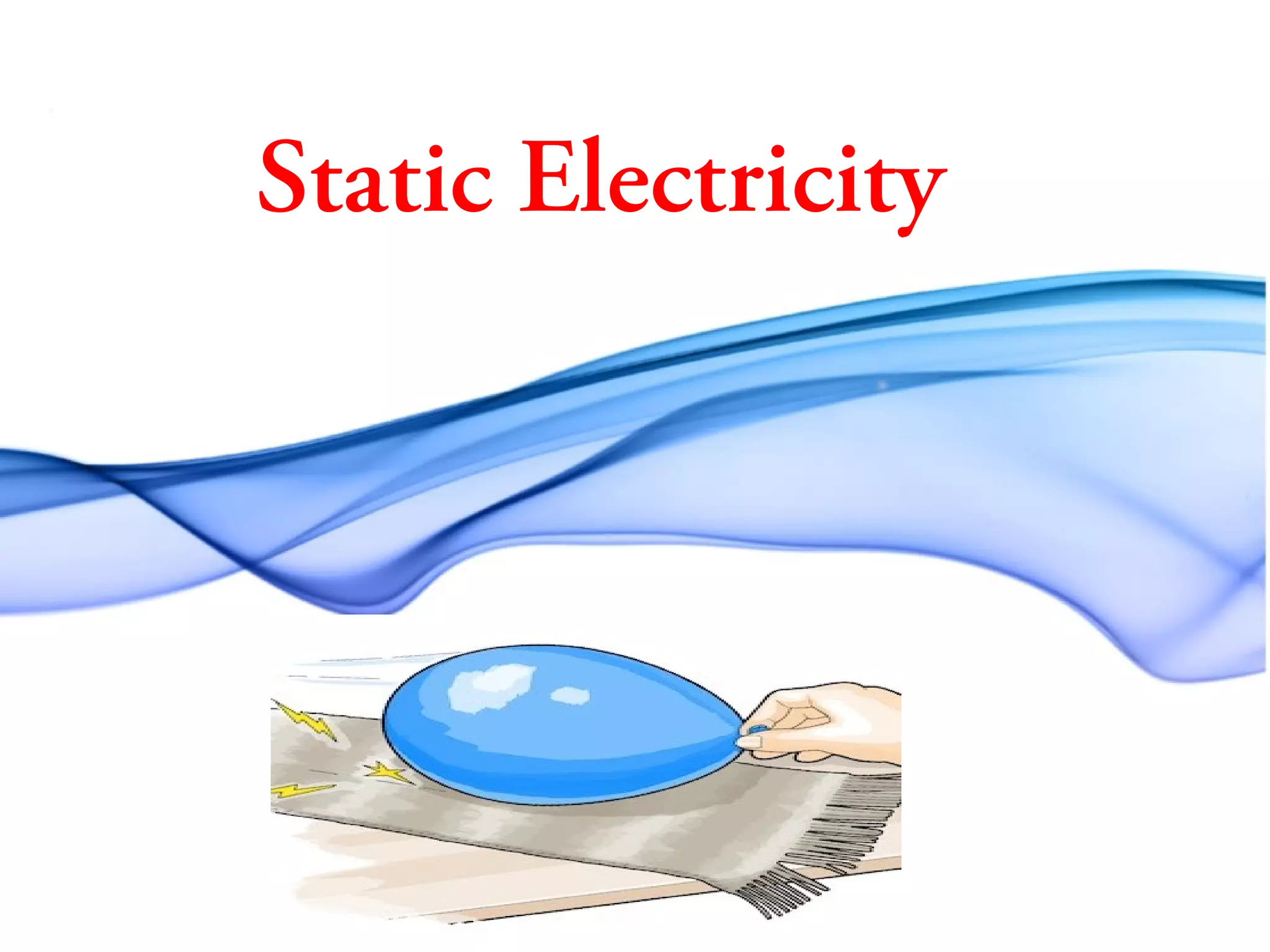
Static Electricity
Static Electricity
• What is Electricity ?
• What is Static Electricity
?
• difference between them ?
Static Electricity
• What is Electricity
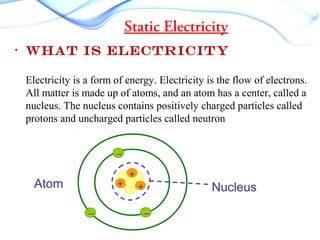
Electricity is a form of energy. Electricity is the flow of electrons.
All matter is made up of atoms, and an atom has a center, called a
nucleus. The nucleus contains positively charged particles called
protons and uncharged particles called neutron
+
+
+
–
––
Atom Nucleus
Static Electricity
• What is Static Electricity
Static electricity occurs when there is a build up of electric
charge on the surface of a material.
It is called static electricity because the charges don’t move.
The electricity we use everyday involves moving charges.
Static = Charge does not move or flow
Two kinds of charges
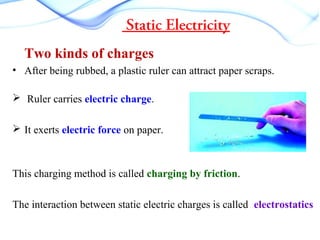
• After being rubbed, a plastic ruler can attract paper scraps.
 Ruler carries electric charge.
 It exerts electric force on paper.
This charging method is called charging by friction.
The interaction between static electric charges is called electrostatics
Static Electricity
Static Electricity
Where do charges come from?.
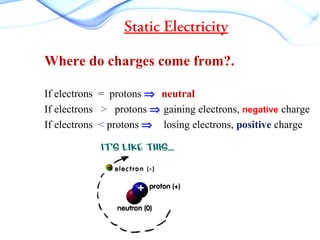
If electrons = protons ⇒ neutral
If electrons > protons ⇒ gaining electrons, negative charge
If electrons < protons ⇒ losing electrons, positive charge
Static Electricity
Where do charges come from?
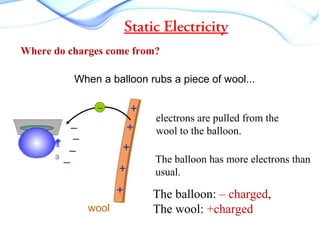
When a balloon rubs a piece of wool...
electrons are pulled from the
wool to the balloon.
The balloon has more electrons than
usual.
The balloon: – charged,
The wool: +chargedwool
– +
+
+
+
+
–
–
–
–
–
Static Electricity
Where do charges come from?
Rubbing materials does NOT create
electric charges.
It just transfers electrons from one
material to the other.
Static Electricity
Examples of static electricity:
Rubbing a balloon on your hair
Walking across carpet
Clothes tumbling in dryer
What do these have in common?
Friction!!!!
Static Electricity
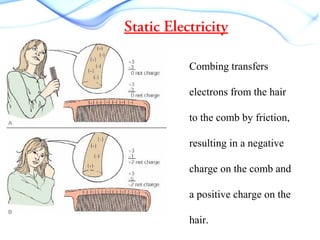
Combing transfers
electrons from the hair
to the comb by friction,
resulting in a negative
charge on the comb and
a positive charge on the
hair.
Static Electricity
Induced charge
• Charged and neutral objects (not touching) are attracted because
electrons move in the neutral object.
• Electrons move toward a +ve charged object and away from a –ve
charged one.
This is called “induced charge”
Static Electricity
Conduction
Conduction = direct transfer of charge
Example : walk across carpet and touch a doorknob shocking!
Electrons are stripped from the carpet and we gain a –ve charge
When you touch the doorknob, electrons jump onto it :
electrical discharge
Static Electricity
Rules of static electricity
 Objects with like (same) charges repel, but
objects with unlike charges attract.
 Charged objects attract neutral objects
Static Electricity
Does friction always create static charge?
 Different materials have different strength of attraction for
electrons
 If two objects of the same material are rubbed, no static charge
forms (equal number of electrons transfer each way)
 If two different objects are rubbed, they will have different
attraction to the electrons. The stronger one will take electrons
away from weaker one and static charges build up
Static Electricity
Uses of static electricity
 Dust removal (Pollution Control)
 Photocopy (Xerography)
 Car Painting
Static Electricity
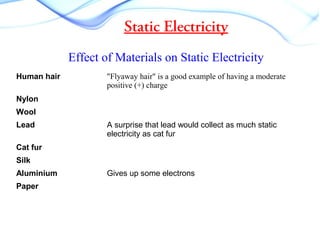
Effect of Materials on Static Electricity
 Materials are listed below according how well they create static electricity
when rubbed with another material, as well as what charge the material
will possess.
Become positive in charge
Materials that gain a positive (+) electrical charge ( or tend to give up
electrons)
Dry human skin Greatest tendency to giving up electrons and
becoming highly positive (+) in charge
Leather
Glass The glass on your TV screen gets charged and
collects dust
Static Electricity
Effect of Materials on Static Electricity
Human hair "Flyaway hair" is a good example of having a moderate
positive (+) charge
Nylon
Wool
Lead A surprise that lead would collect as much static
electricity as cat fur
Cat fur
Silk
Aluminium Gives up some electrons
Paper
Static Electricity
Effect of Materials on Static Electricity
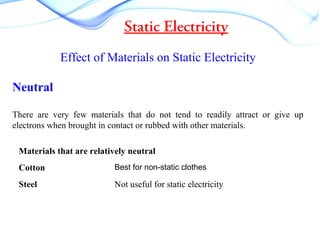
Neutral
There are very few materials that do not tend to readily attract or give up
electrons when brought in contact or rubbed with other materials.
Materials that are relatively neutral
Cotton Best for non-static clothes
Steel Not useful for static electricity
Static Electricity
Effect of Materials on Static Electricity
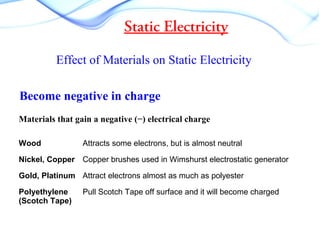
Become negative in charge
Materials that gain a negative (−) electrical charge
Wood Attracts some electrons, but is almost neutral
Nickel, Copper Copper brushes used in Wimshurst electrostatic generator
Gold, Platinum Attract electrons almost as much as polyester
Polyethylene
(Scotch Tape)
Pull Scotch Tape off surface and it will become charged
Thank You

Static electricity

  • 1.
  • 2.
    Static Electricity • Whatis Electricity ? • What is Static Electricity ? • difference between them ?
  • 3.
    Static Electricity • Whatis Electricity Electricity is a form of energy. Electricity is the flow of electrons. All matter is made up of atoms, and an atom has a center, called a nucleus. The nucleus contains positively charged particles called protons and uncharged particles called neutron + + + – –– Atom Nucleus
  • 4.
    Static Electricity • Whatis Static Electricity Static electricity occurs when there is a build up of electric charge on the surface of a material. It is called static electricity because the charges don’t move. The electricity we use everyday involves moving charges. Static = Charge does not move or flow
  • 5.
    Two kinds ofcharges • After being rubbed, a plastic ruler can attract paper scraps.  Ruler carries electric charge.  It exerts electric force on paper. This charging method is called charging by friction. The interaction between static electric charges is called electrostatics Static Electricity
  • 6.
    Static Electricity Where docharges come from?. If electrons = protons ⇒ neutral If electrons > protons ⇒ gaining electrons, negative charge If electrons < protons ⇒ losing electrons, positive charge
  • 7.
    Static Electricity Where docharges come from? When a balloon rubs a piece of wool... electrons are pulled from the wool to the balloon. The balloon has more electrons than usual. The balloon: – charged, The wool: +chargedwool – + + + + + – – – – –
  • 8.
    Static Electricity Where docharges come from? Rubbing materials does NOT create electric charges. It just transfers electrons from one material to the other.
  • 9.
    Static Electricity Examples ofstatic electricity: Rubbing a balloon on your hair Walking across carpet Clothes tumbling in dryer What do these have in common? Friction!!!!
  • 10.
    Static Electricity Combing transfers electronsfrom the hair to the comb by friction, resulting in a negative charge on the comb and a positive charge on the hair.
  • 11.
    Static Electricity Induced charge •Charged and neutral objects (not touching) are attracted because electrons move in the neutral object. • Electrons move toward a +ve charged object and away from a –ve charged one. This is called “induced charge”
  • 12.
    Static Electricity Conduction Conduction =direct transfer of charge Example : walk across carpet and touch a doorknob shocking! Electrons are stripped from the carpet and we gain a –ve charge When you touch the doorknob, electrons jump onto it : electrical discharge
  • 13.
    Static Electricity Rules ofstatic electricity  Objects with like (same) charges repel, but objects with unlike charges attract.  Charged objects attract neutral objects
  • 14.
    Static Electricity Does frictionalways create static charge?  Different materials have different strength of attraction for electrons  If two objects of the same material are rubbed, no static charge forms (equal number of electrons transfer each way)  If two different objects are rubbed, they will have different attraction to the electrons. The stronger one will take electrons away from weaker one and static charges build up
  • 15.
    Static Electricity Uses ofstatic electricity  Dust removal (Pollution Control)  Photocopy (Xerography)  Car Painting
  • 16.
    Static Electricity Effect ofMaterials on Static Electricity  Materials are listed below according how well they create static electricity when rubbed with another material, as well as what charge the material will possess. Become positive in charge Materials that gain a positive (+) electrical charge ( or tend to give up electrons) Dry human skin Greatest tendency to giving up electrons and becoming highly positive (+) in charge Leather Glass The glass on your TV screen gets charged and collects dust
  • 17.
    Static Electricity Effect ofMaterials on Static Electricity Human hair "Flyaway hair" is a good example of having a moderate positive (+) charge Nylon Wool Lead A surprise that lead would collect as much static electricity as cat fur Cat fur Silk Aluminium Gives up some electrons Paper
  • 18.
    Static Electricity Effect ofMaterials on Static Electricity Neutral There are very few materials that do not tend to readily attract or give up electrons when brought in contact or rubbed with other materials. Materials that are relatively neutral Cotton Best for non-static clothes Steel Not useful for static electricity
  • 19.
    Static Electricity Effect ofMaterials on Static Electricity Become negative in charge Materials that gain a negative (−) electrical charge Wood Attracts some electrons, but is almost neutral Nickel, Copper Copper brushes used in Wimshurst electrostatic generator Gold, Platinum Attract electrons almost as much as polyester Polyethylene (Scotch Tape) Pull Scotch Tape off surface and it will become charged
  • 20.