Static Electricity
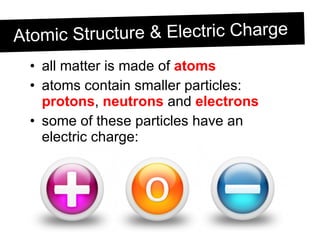
all matter is made of  atoms atoms contain smaller particles:  protons ,  neutrons  and  electrons some of these particles have an  electric charge: Atomic Structure & Electric Charge
orbiting the nucleus negative (-) electron nucleus no charge (0) neutron nucleus positive (+) proton Location Electric Charge Particle
If an object has  more electrons  than protons,  it is  negatively  charged. Electric Charge # protons:  8 # electrons:  12 # protons < # electrons therefore, overall charge =  negative
if an object has  more   protons  than electrons, it is  positively  charged Electric Charge # protons:  8 # electrons:  5 # protons > # electrons therefore, overall charge =  positive
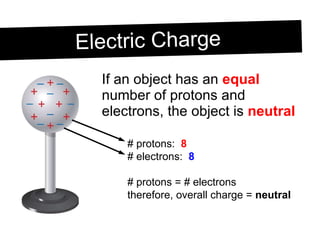
If an object has an  equal  number of protons and electrons, the object is  neutral Electric Charge # protons:  8 # electrons:  8 # protons = # electrons therefore, overall charge =  neutral
Electric Charge + — Law of attraction:  opposite charges attract
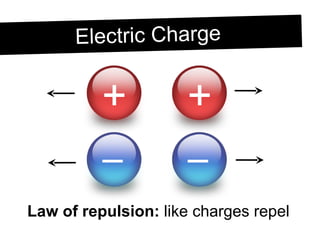
Electric Charge Law of repulsion:  like charges repel + — + —
Electric Charge A  charged  object and a  neutral  object will  attract  each other 0 0 + —
Electrons can be  transferred  from one object to another. For example, a neutral or positively charged object will become  negatively  charged if it  gains  electrons. Electric Charge
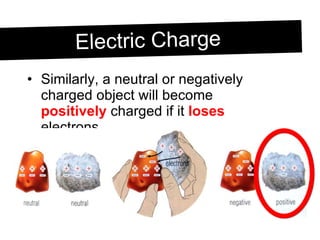
Similarly, a neutral or negatively charged object will become  positively  charged if it  loses  electrons. Electric Charge
Only  electrons  (negative charges) are capable of  moving  from one object to another!  Protons ( positive  charges)  stay  in place. Electric Charge
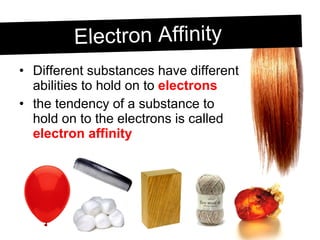
Different substances have different abilities to hold on to  electrons the tendency of a substance to hold on to the electrons is called  electron affinity Electron Affinity
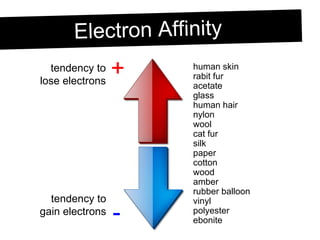
Electron Affinity human skin rabit fur acetate glass human hair nylon wool cat fur silk paper cotton wood amber rubber balloon vinyl polyester ebonite + - tendency to lose electrons tendency to gain electrons
Conductivity  is the ability of materials to allow electrons to move freely Materials that hold on to their electrons and do not allow them to move easily are called electrical  insulators Materials that allow electrons to change positions are called  conductors Conductors & Insulators
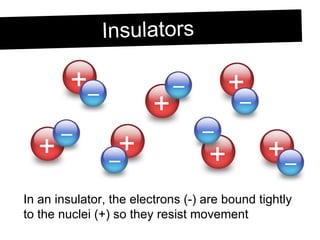
Insulators In an insulator, the electrons (-) are bound tightly to the nuclei (+) so they resist movement + — + — + — + — + — + — + —
Common Insulators
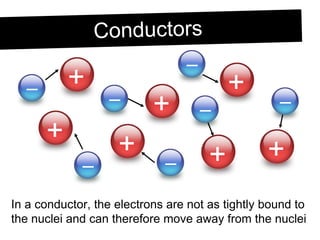
Conductors In a conductor, the electrons are not as tightly bound to the nuclei and can therefore move away from the nuclei + — + — + — + — + — + — + —
Common Conductors
The electric charge that builds up on the  surface  of an object is called a  static charge The charges are “static” because they remain in  one   location  on the surface of the object until they are given a  path  to escape Static Electricity
Static Electricity and Friction All solid materials are  charged  by the  transfer  of  electrons When two objects rub together, the force of  friction  can remove electrons from one object and transfer them to the other object
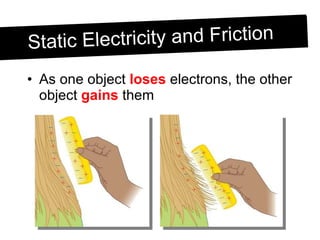
As one object  loses  electrons, the other object  gains  them Static Electricity and Friction
New electrons are not being  created , they are just being  rearranged Static Electricity and Friction
Static Electricity

Static Electricity

  • 1.
  • 2.
    all matter ismade of atoms atoms contain smaller particles: protons , neutrons and electrons some of these particles have an electric charge: Atomic Structure & Electric Charge
  • 3.
    orbiting the nucleusnegative (-) electron nucleus no charge (0) neutron nucleus positive (+) proton Location Electric Charge Particle
  • 4.
    If an objecthas more electrons than protons, it is negatively charged. Electric Charge # protons: 8 # electrons: 12 # protons < # electrons therefore, overall charge = negative
  • 5.
    if an objecthas more protons than electrons, it is positively charged Electric Charge # protons: 8 # electrons: 5 # protons > # electrons therefore, overall charge = positive
  • 6.
    If an objecthas an equal number of protons and electrons, the object is neutral Electric Charge # protons: 8 # electrons: 8 # protons = # electrons therefore, overall charge = neutral
  • 7.
    Electric Charge +— Law of attraction: opposite charges attract
  • 8.
    Electric Charge Lawof repulsion: like charges repel + — + —
  • 9.
    Electric Charge A charged object and a neutral object will attract each other 0 0 + —
  • 10.
    Electrons can be transferred from one object to another. For example, a neutral or positively charged object will become negatively charged if it gains electrons. Electric Charge
  • 11.
    Similarly, a neutralor negatively charged object will become positively charged if it loses electrons. Electric Charge
  • 12.
    Only electrons (negative charges) are capable of moving from one object to another! Protons ( positive charges) stay in place. Electric Charge
  • 13.
    Different substances havedifferent abilities to hold on to electrons the tendency of a substance to hold on to the electrons is called electron affinity Electron Affinity
  • 14.
    Electron Affinity humanskin rabit fur acetate glass human hair nylon wool cat fur silk paper cotton wood amber rubber balloon vinyl polyester ebonite + - tendency to lose electrons tendency to gain electrons
  • 15.
    Conductivity isthe ability of materials to allow electrons to move freely Materials that hold on to their electrons and do not allow them to move easily are called electrical insulators Materials that allow electrons to change positions are called conductors Conductors & Insulators
  • 16.
    Insulators In aninsulator, the electrons (-) are bound tightly to the nuclei (+) so they resist movement + — + — + — + — + — + — + —
  • 17.
  • 18.
    Conductors In aconductor, the electrons are not as tightly bound to the nuclei and can therefore move away from the nuclei + — + — + — + — + — + — + —
  • 19.
  • 20.
    The electric chargethat builds up on the surface of an object is called a static charge The charges are “static” because they remain in one location on the surface of the object until they are given a path to escape Static Electricity
  • 21.
    Static Electricity andFriction All solid materials are charged by the transfer of electrons When two objects rub together, the force of friction can remove electrons from one object and transfer them to the other object
  • 22.
    As one object loses electrons, the other object gains them Static Electricity and Friction
  • 23.
    New electrons arenot being created , they are just being rearranged Static Electricity and Friction
  • 24.