ATOMIC STRUCTURE
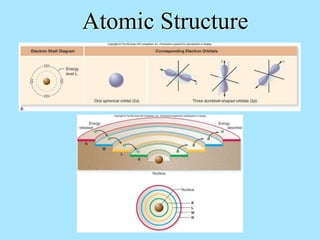
Atomic Structure
All matter is composed of atoms.
Understanding the structure of atoms is
critical to understanding the properties
of matter
HISTORY OF THE ATOM
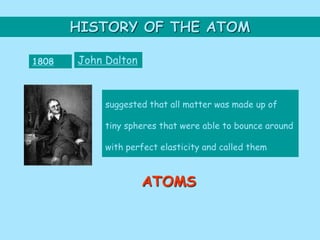
1808 John Dalton
suggested that all matter was made up of
tiny spheres that were able to bounce around
with perfect elasticity and called them
ATOMS
8 X2Y16 X 8 Y+
DALTONS ATOMIC THEORY
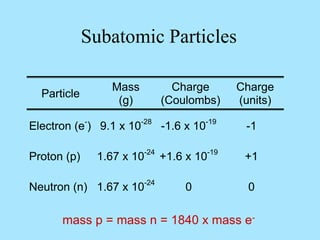
Subatomic Particles
Particle
Mass
(g)
Charge
(Coulombs)
Charge
(units)
Electron (e-
) 9.1 x 10⁻²⁸
-1.6 x 10⁻¹⁹
-1
Proton (p) 1.67 x 10⁻²⁴
+1.6 x 10⁻¹⁹
+1
Neutron (n) 1.67 x 10⁻²⁴
0 0
mass p = mass n = 1840 x mass e-
HISTORY OF THE ATOM
1898 Joseph John Thompson
found that atoms could sometimes eject a far
smaller negative particle which he called an
ELECTRON
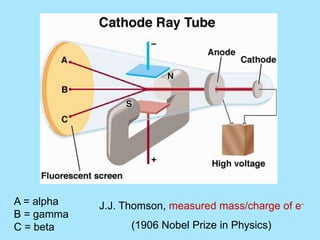
J.J. Thomson, measured mass/charge of e-
(1906 Nobel Prize in Physics)
A = alpha
B = gamma
C = beta
gold foil
helium nuclei
CHARGE OF AN ELECTRON
Millikan oil drop
experiment
HISTORY OF THE ATOM
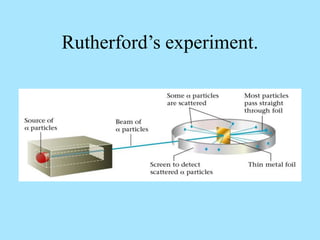
1910 Ernest Rutherford
oversaw Geiger and Marsden carrying out his
famous experiment.
they fired Helium nuclei at a piece of gold foil
which was only a few atoms thick.
they found that although most of them
passed through. About 1 in 10,000 hit
Rutherford’s experiment.
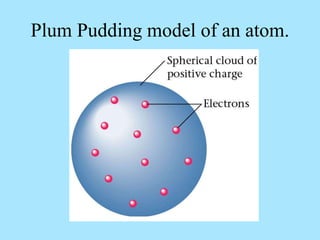
Plum Pudding model of an atom.
Results of foil experiment if Plum
Pudding model had been correct.
Actual Results.
A nuclear atom viewed in cross
section.
atomic radius ~ 100 pm = 1 x 10⁻¹⁰ m
nuclear radius ~ 5 x 10⁻³ pm = 5 x 10-15 m
Rutherford’s Model of the Atom
Atomic Structure
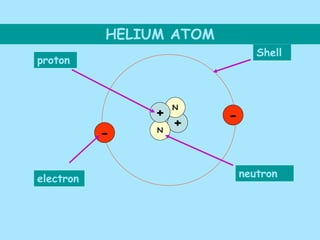
Atoms are composed of
-protons – positively charged particles
-neutrons – neutral particles
-electrons – negatively charged particles
Protons and neutrons are located in the
nucleus. Electrons are found in orbitals
surrounding the nucleus.
HELIUM ATOM
+
N
N
+
-
-
proton
electron neutron
Shell
Atomic Structure
Every different atom has a characteristic
number of protons in the nucleus.
atomic number = number of protons
Atoms with the same atomic number
have the same chemical properties and
belong to the same element.
Atomic Structure
Each proton and neutron has a mass of
approximately 1 dalton.
The sum of protons and neutrons is the atom’s
atomic mass.
Isotopes – atoms of the same element that
have different atomic mass numbers due to
different numbers of neutrons.
ATOMIC STRUCTURE
the number of protons in an atom
the number of protons and
neutrons in an atom
He
2
4Atomic mass
Atomic number
number of electrons = number of protons
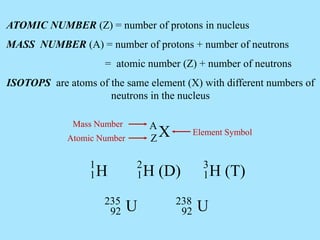
ATOMIC NUMBER (Z) = number of protons in nucleus
MASS NUMBER (A) = number of protons + number of neutrons
= atomic number (Z) + number of neutrons
ISOTOPS are atoms of the same element (X) with different numbers of
neutrons in the nucleus
XA
Z
H1
1 H (D)2
1 H (T)3
1
U235
92 U238
92
Mass Number
Atomic Number
Element Symbol
Atomic Structure
Atomic Structure
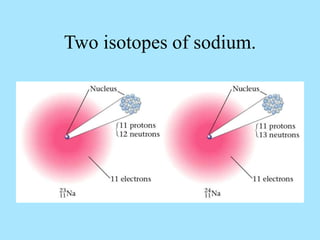
Two isotopes of sodium.
HISTORY OF THE ATOM
1913 Niels Bohr
studied under Rutherford at the Victoria
University in Manchester.
Bohr refined Rutherford's idea by adding
that the electrons were in orbits. Rather
like planets orbiting the sun. With each
orbit only able to contain a set number of
electrons.
MULTIELECTRON ATOMS
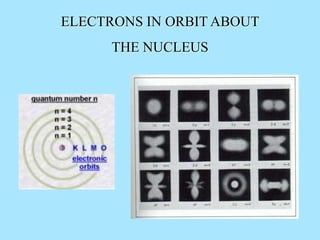
ELECTRONS IN ORBIT ABOUT
THE NUCLEUS
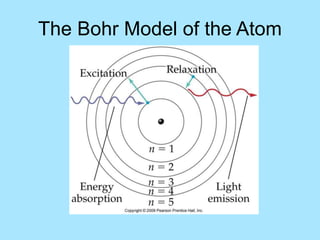
1. e- can have only specific
(quantized) energy values
2. light is emitted as e- moves
from one energy level to a
lower energy level
Bohr’s Model of
the Atom (1913)
En = -RH ( )
1
n2
n (principal quantum number) = 1,2,3,…
RH (Rydberg constant) = 2.18 x 10⁻¹⁸J
The Bohr Model of the Atom
Atomic Structure
The Bohr Model of the Atom:
Ground and Excited States
• In the Bohr model of hydrogen, the lowest amount
of energy hydrogen’s one electron can have
corresponds to being in the n = 1 orbit. We call this
its ground state.
• When the atom gains energy, the electron leaps to a
higher energy orbit. We call this an excited state.
• The atom is less stable in an excited state and so it
will release the extra energy to return to the ground
state.
– Either all at once or in several steps.
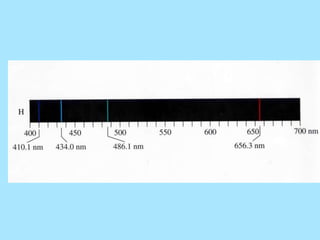
Line Emission Spectrum of Hydrogen Atoms
Every element has a unique emission spectrum
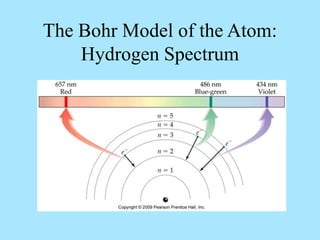
The Bohr Model of the Atom:
Hydrogen Spectrum
• Every hydrogen atom has identical orbits, so every
hydrogen atom can undergo the same energy
transitions.
• However, since the distances between the orbits in
an atom are not all the same, no two leaps in an
atom will have the same energy.
– The closer the orbits are in energy, the lower
the energy of the photon emitted.
– Lower energy photon = longer wavelength.
• Therefore, we get an emission spectrum that has a
lot of lines that are unique to hydrogen.
The Bohr Model of the Atom:
Hydrogen Spectrum
Ephoton = DE = Ef - Ei
Ef = -RH ( )
1
n2
f
Ei = -RH ( )
1
n2
i
i f
DE = RH( )
1
n2
1
n2
RH is the Rydberg constant
n is the principal quantum number
En = -RH ( )
1
n2
Bohr showed the energy a H
atom can have is equal to:
Line spectrum of
some elements
LIGHT EMISSION OF SODIUM ATOM
Line spectrum
Atomic Structure
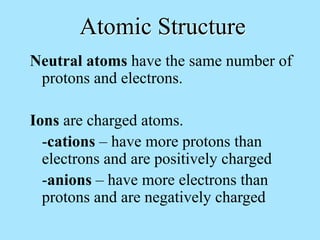
Neutral atoms have the same number of
protons and electrons.
Ions are charged atoms.
-cations – have more protons than
electrons and are positively charged
-anions – have more electrons than
protons and are negatively charged
An ion is formed when an atom, or group of atoms, has a
net positive or negative charge (why?).
If a neutral atom looses one or more electrons
it becomes a cation.
If a neutral atom gains one or more electrons
it becomes an anion.
Na
11 protons
11 electrons Na+ 11 protons
10 electrons
Cl
17 protons
17 electrons Cl-
17 protons
18 electrons

2. atomic structure

  • 1.
  • 2.
    Atomic Structure All matteris composed of atoms. Understanding the structure of atoms is critical to understanding the properties of matter
  • 3.
    HISTORY OF THEATOM 1808 John Dalton suggested that all matter was made up of tiny spheres that were able to bounce around with perfect elasticity and called them ATOMS
  • 4.
    8 X2Y16 X8 Y+ DALTONS ATOMIC THEORY
  • 5.
    Subatomic Particles Particle Mass (g) Charge (Coulombs) Charge (units) Electron (e- )9.1 x 10⁻²⁸ -1.6 x 10⁻¹⁹ -1 Proton (p) 1.67 x 10⁻²⁴ +1.6 x 10⁻¹⁹ +1 Neutron (n) 1.67 x 10⁻²⁴ 0 0 mass p = mass n = 1840 x mass e-
  • 6.
    HISTORY OF THEATOM 1898 Joseph John Thompson found that atoms could sometimes eject a far smaller negative particle which he called an ELECTRON
  • 7.
    J.J. Thomson, measuredmass/charge of e- (1906 Nobel Prize in Physics) A = alpha B = gamma C = beta
  • 8.
    gold foil helium nuclei CHARGEOF AN ELECTRON Millikan oil drop experiment
  • 9.
    HISTORY OF THEATOM 1910 Ernest Rutherford oversaw Geiger and Marsden carrying out his famous experiment. they fired Helium nuclei at a piece of gold foil which was only a few atoms thick. they found that although most of them passed through. About 1 in 10,000 hit
  • 10.
  • 11.
    Plum Pudding modelof an atom.
  • 12.
    Results of foilexperiment if Plum Pudding model had been correct.
  • 13.
  • 14.
    A nuclear atomviewed in cross section.
  • 15.
    atomic radius ~100 pm = 1 x 10⁻¹⁰ m nuclear radius ~ 5 x 10⁻³ pm = 5 x 10-15 m Rutherford’s Model of the Atom
  • 16.
    Atomic Structure Atoms arecomposed of -protons – positively charged particles -neutrons – neutral particles -electrons – negatively charged particles Protons and neutrons are located in the nucleus. Electrons are found in orbitals surrounding the nucleus.
  • 17.
  • 18.
    Atomic Structure Every differentatom has a characteristic number of protons in the nucleus. atomic number = number of protons Atoms with the same atomic number have the same chemical properties and belong to the same element.
  • 19.
    Atomic Structure Each protonand neutron has a mass of approximately 1 dalton. The sum of protons and neutrons is the atom’s atomic mass. Isotopes – atoms of the same element that have different atomic mass numbers due to different numbers of neutrons.
  • 20.
    ATOMIC STRUCTURE the numberof protons in an atom the number of protons and neutrons in an atom He 2 4Atomic mass Atomic number number of electrons = number of protons
  • 21.
    ATOMIC NUMBER (Z)= number of protons in nucleus MASS NUMBER (A) = number of protons + number of neutrons = atomic number (Z) + number of neutrons ISOTOPS are atoms of the same element (X) with different numbers of neutrons in the nucleus XA Z H1 1 H (D)2 1 H (T)3 1 U235 92 U238 92 Mass Number Atomic Number Element Symbol
  • 22.
  • 23.
  • 24.
  • 25.
    HISTORY OF THEATOM 1913 Niels Bohr studied under Rutherford at the Victoria University in Manchester. Bohr refined Rutherford's idea by adding that the electrons were in orbits. Rather like planets orbiting the sun. With each orbit only able to contain a set number of electrons.
  • 26.
  • 28.
    ELECTRONS IN ORBITABOUT THE NUCLEUS
  • 29.
    1. e- canhave only specific (quantized) energy values 2. light is emitted as e- moves from one energy level to a lower energy level Bohr’s Model of the Atom (1913) En = -RH ( ) 1 n2 n (principal quantum number) = 1,2,3,… RH (Rydberg constant) = 2.18 x 10⁻¹⁸J
  • 30.
    The Bohr Modelof the Atom
  • 31.
  • 32.
    The Bohr Modelof the Atom: Ground and Excited States • In the Bohr model of hydrogen, the lowest amount of energy hydrogen’s one electron can have corresponds to being in the n = 1 orbit. We call this its ground state. • When the atom gains energy, the electron leaps to a higher energy orbit. We call this an excited state. • The atom is less stable in an excited state and so it will release the extra energy to return to the ground state. – Either all at once or in several steps.
  • 35.
    Line Emission Spectrumof Hydrogen Atoms Every element has a unique emission spectrum
  • 36.
    The Bohr Modelof the Atom: Hydrogen Spectrum • Every hydrogen atom has identical orbits, so every hydrogen atom can undergo the same energy transitions. • However, since the distances between the orbits in an atom are not all the same, no two leaps in an atom will have the same energy. – The closer the orbits are in energy, the lower the energy of the photon emitted. – Lower energy photon = longer wavelength. • Therefore, we get an emission spectrum that has a lot of lines that are unique to hydrogen.
  • 38.
    The Bohr Modelof the Atom: Hydrogen Spectrum
  • 39.
    Ephoton = DE= Ef - Ei Ef = -RH ( ) 1 n2 f Ei = -RH ( ) 1 n2 i i f DE = RH( ) 1 n2 1 n2 RH is the Rydberg constant n is the principal quantum number En = -RH ( ) 1 n2 Bohr showed the energy a H atom can have is equal to:
  • 40.
  • 41.
    LIGHT EMISSION OFSODIUM ATOM Line spectrum
  • 42.
    Atomic Structure Neutral atomshave the same number of protons and electrons. Ions are charged atoms. -cations – have more protons than electrons and are positively charged -anions – have more electrons than protons and are negatively charged
  • 43.
    An ion isformed when an atom, or group of atoms, has a net positive or negative charge (why?). If a neutral atom looses one or more electrons it becomes a cation. If a neutral atom gains one or more electrons it becomes an anion. Na 11 protons 11 electrons Na+ 11 protons 10 electrons Cl 17 protons 17 electrons Cl- 17 protons 18 electrons