Structure of Atoms 3.2
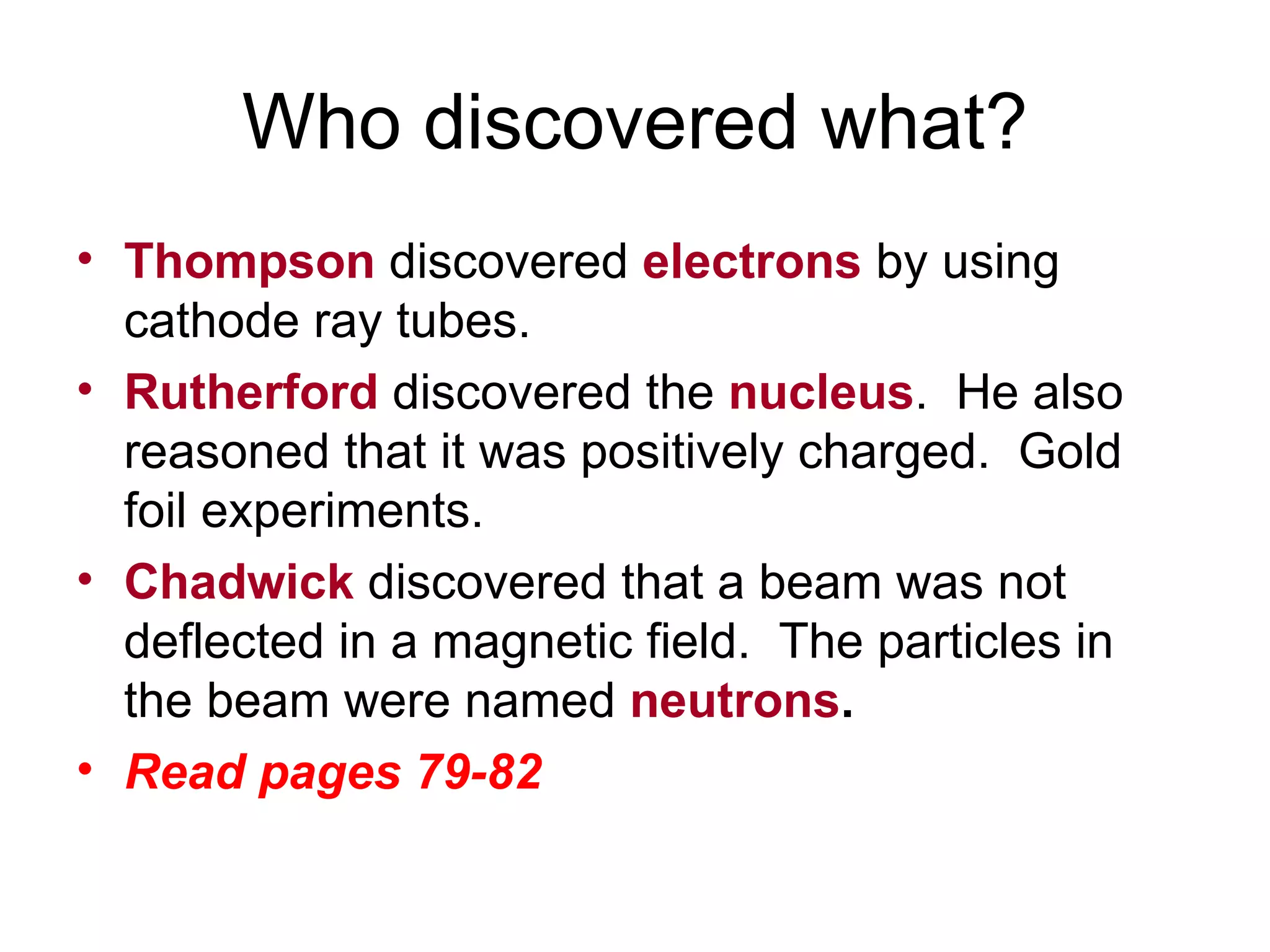
Who discovered what? Thompson  discovered  electrons  by using cathode ray tubes. Rutherford  discovered the  nucleus .  He also reasoned that it was positively charged.  Gold foil experiments. Chadwick  discovered that a beam was not deflected in a magnetic field.  The particles in the beam were named  neutrons .   Read pages 79-82
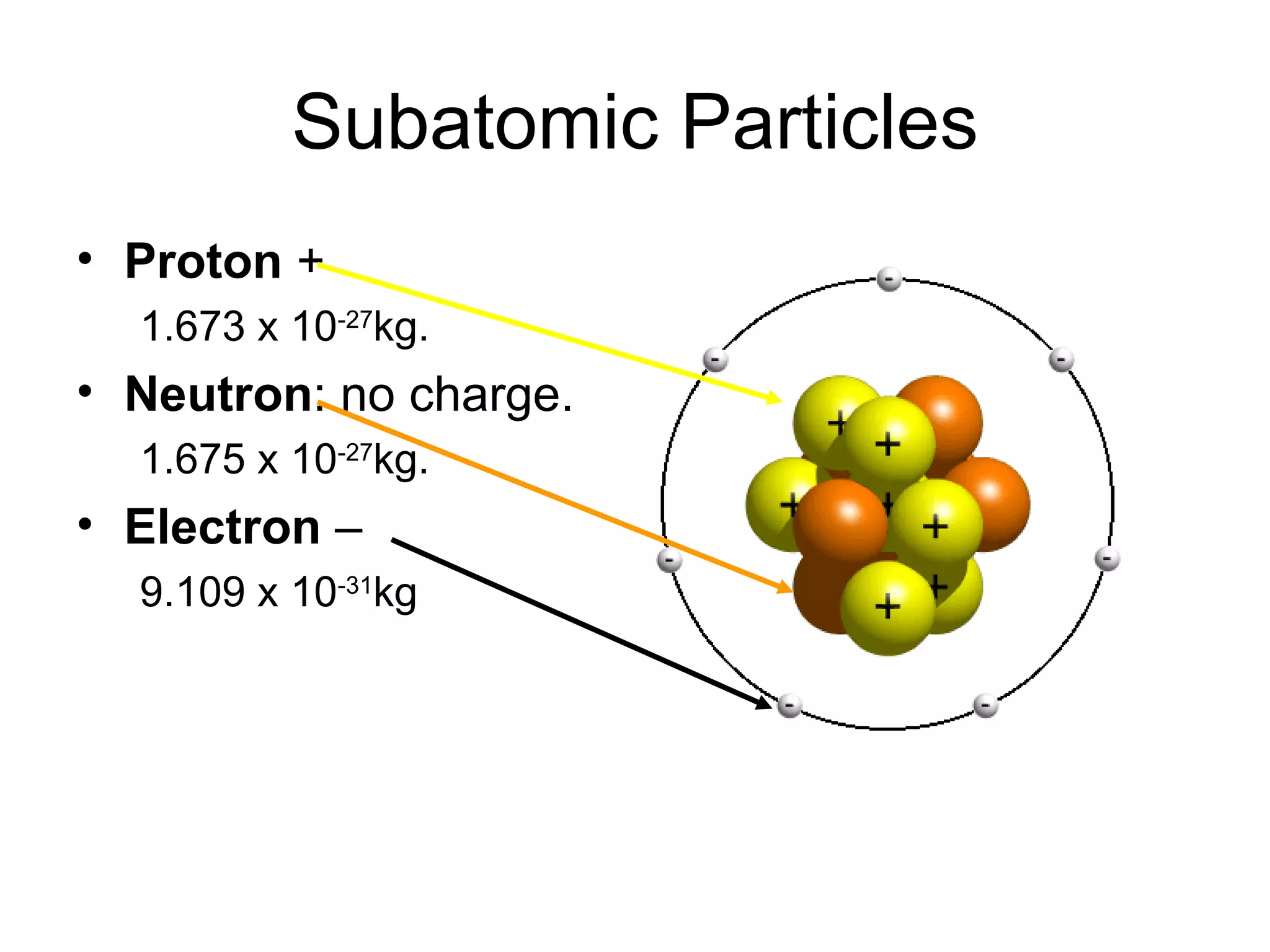
Subatomic Particles Proton  +  1.673 x 10 -27 kg. Neutron : no charge. 1.675 x 10 -27 kg. Electron  –  9.109 x 10 -31 kg
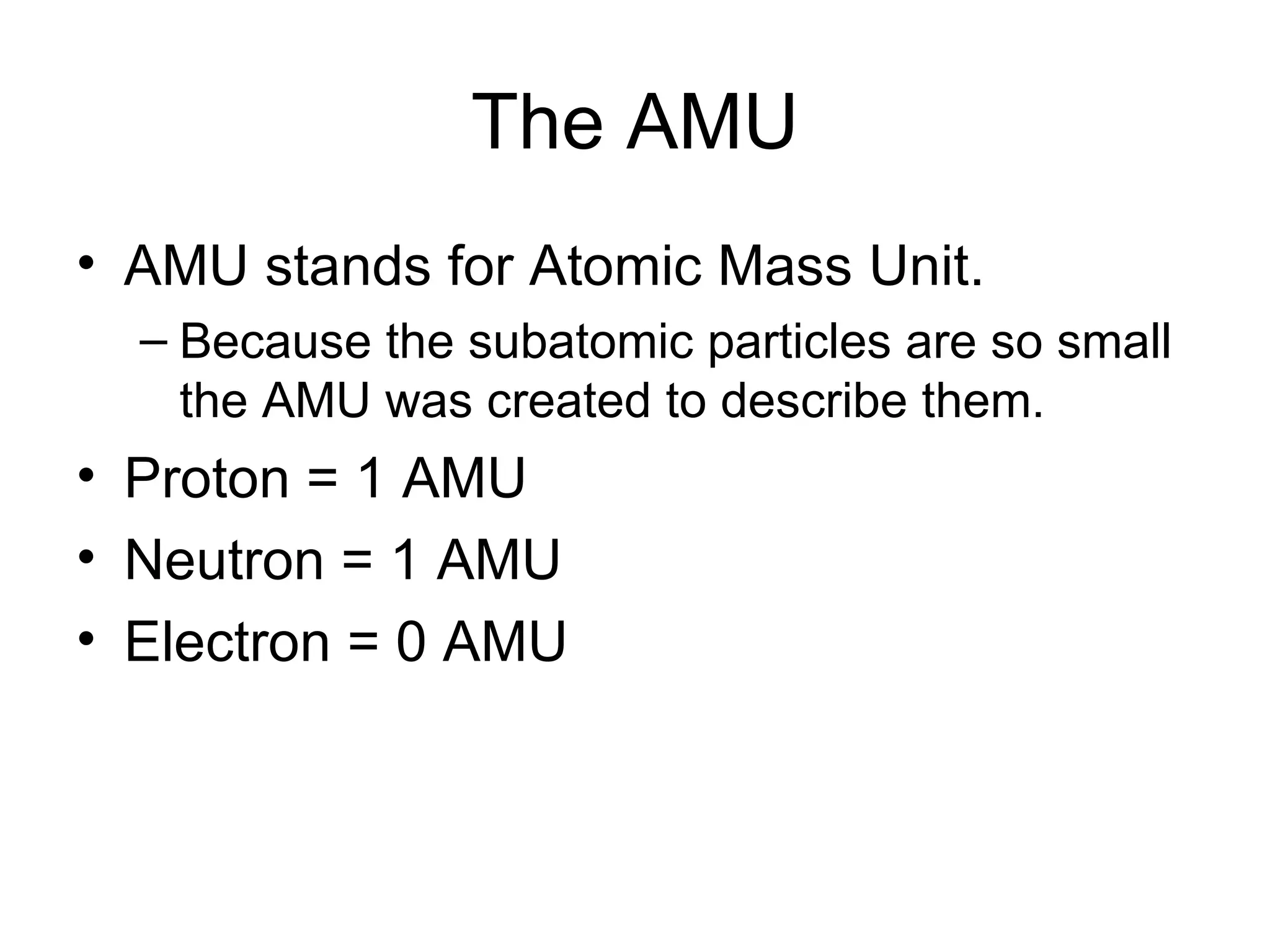
The AMU AMU stands for Atomic Mass Unit. Because the subatomic particles are so small the AMU was created to describe them. Proton = 1 AMU Neutron = 1 AMU Electron = 0 AMU
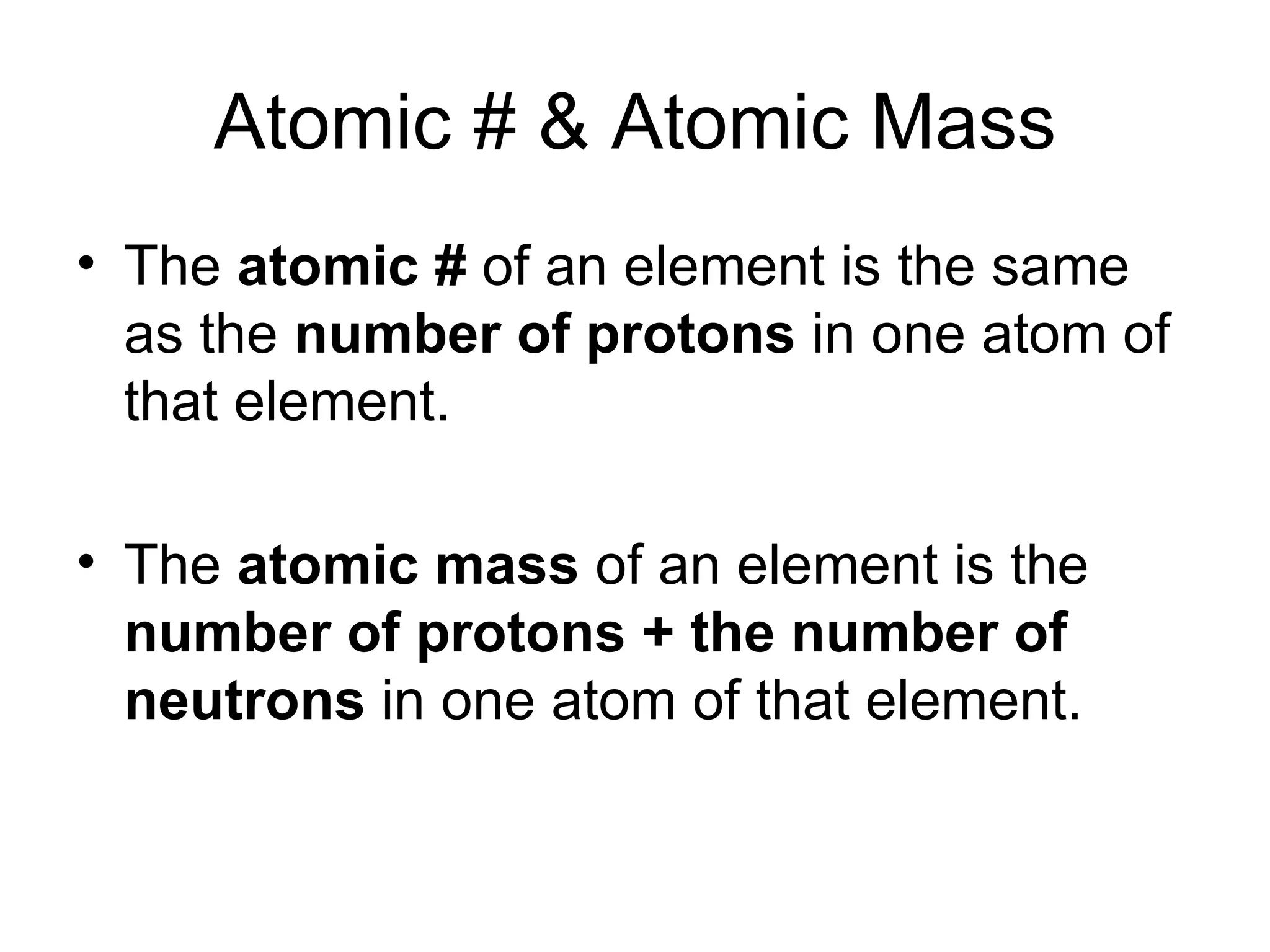
Atomic # & Atomic Mass The  atomic #  of an element is the same as the  number of protons  in one atom of that element. The  atomic mass  of an element is the  number of protons + the number of neutrons  in one atom of that element.
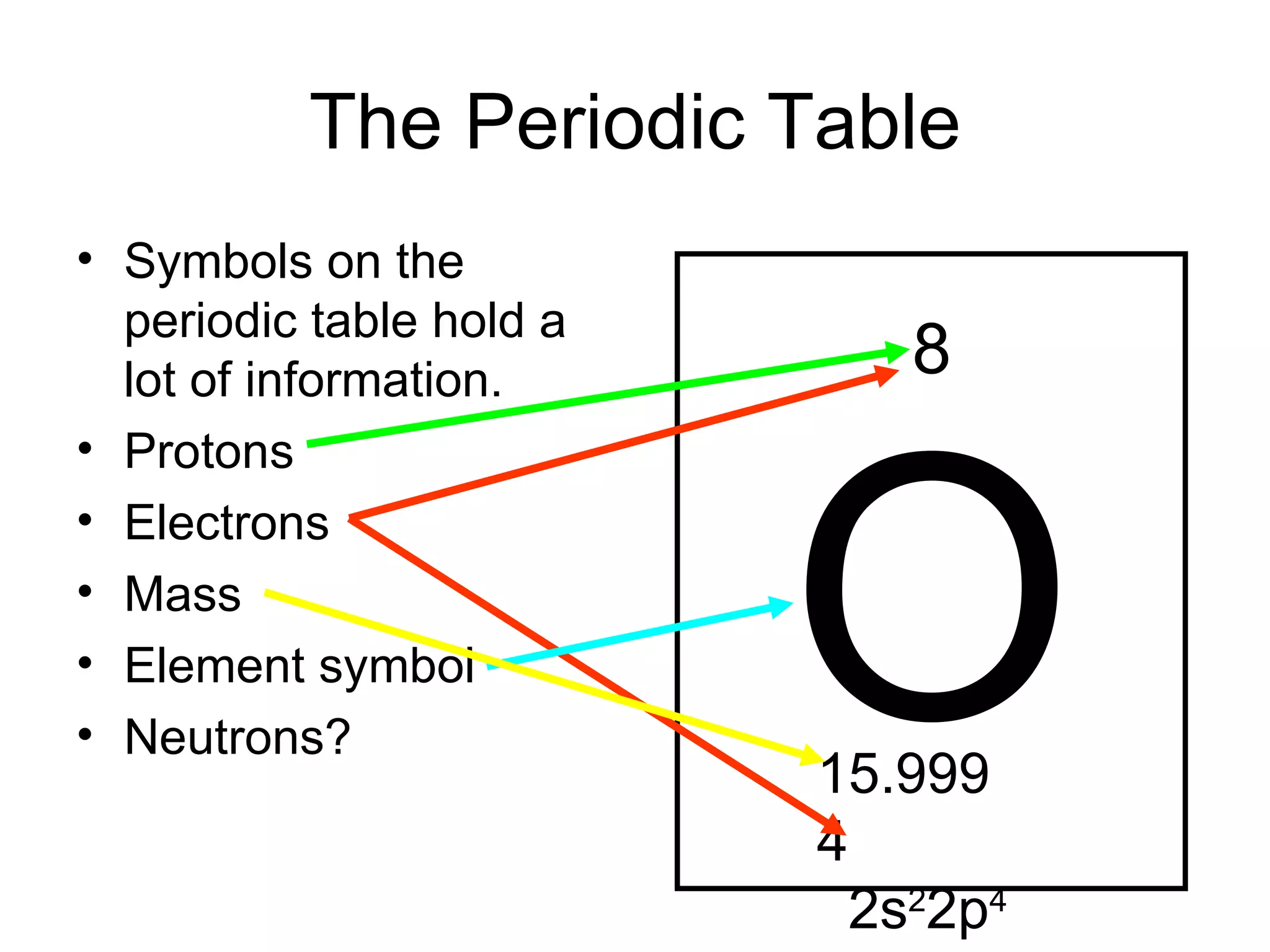
The Periodic Table Symbols on the periodic table hold a lot of information. Protons Electrons Mass Element symbol Neutrons? O 8 15.9994 2s 2 2p 4
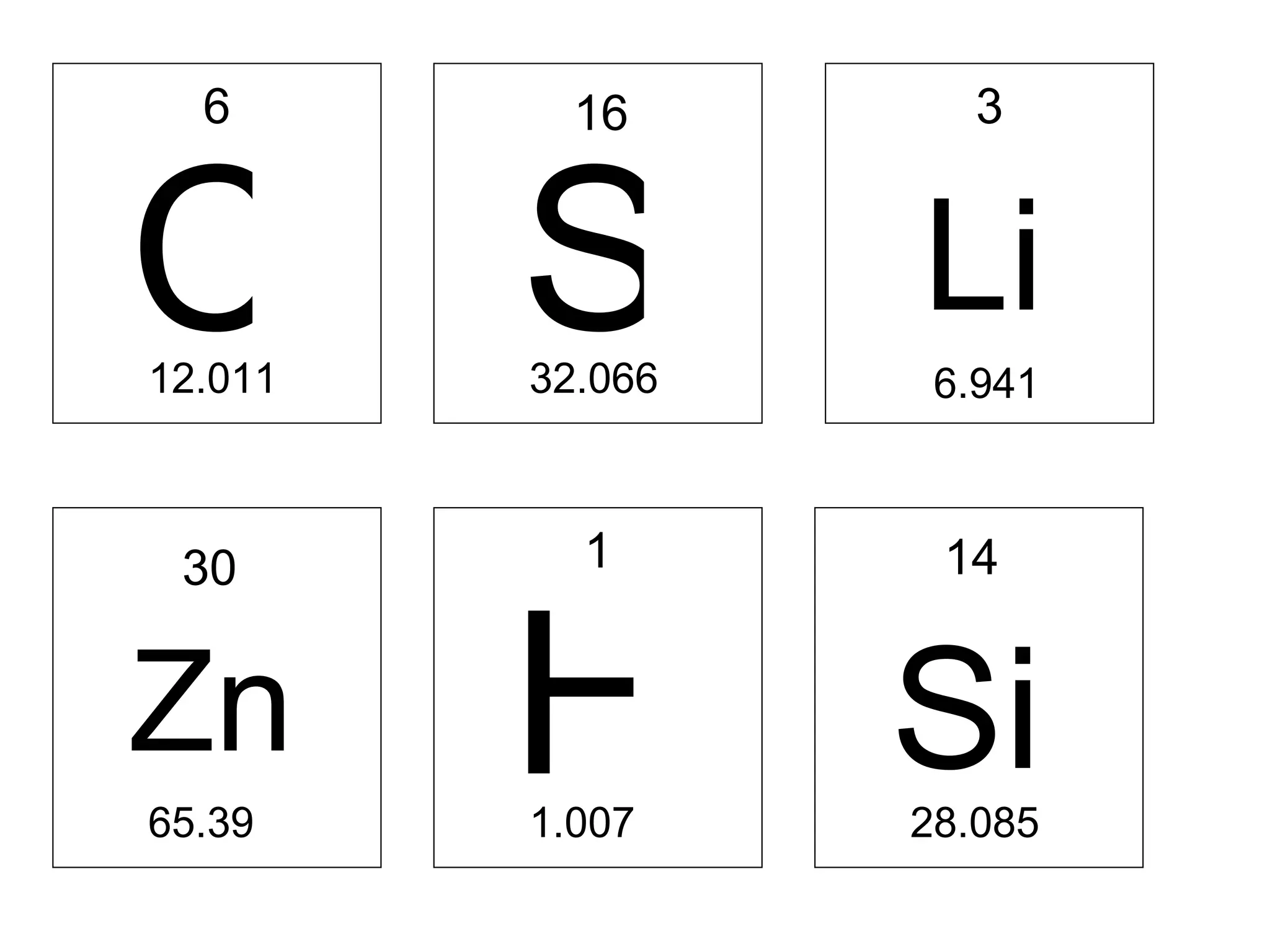
C 6 12.011 S 16 32.066 Zn 30 65.39 H 1 1.007 Si 14 28.085 Li 3 6.941
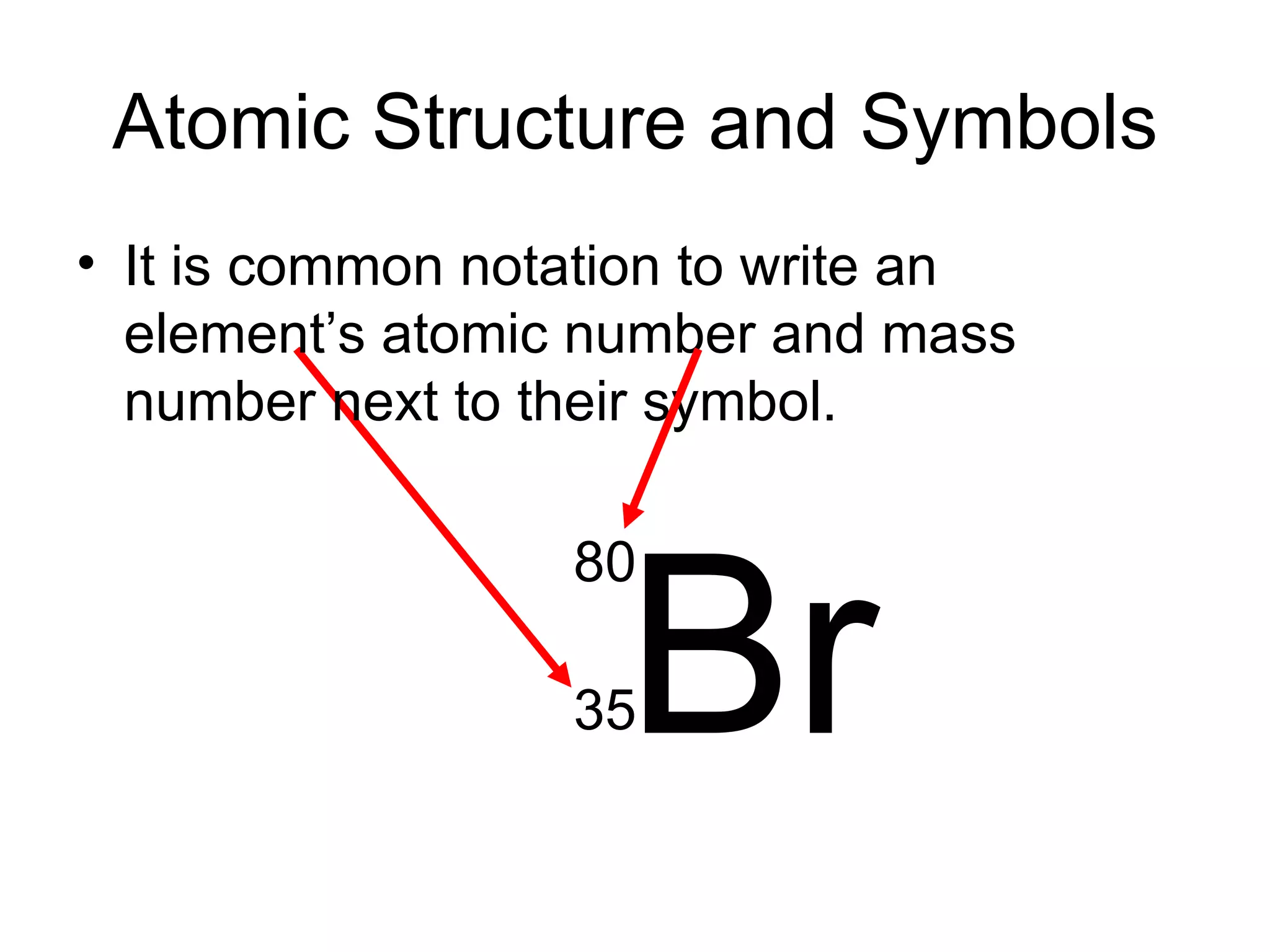
Atomic Structure and Symbols It is common notation to write an element’s atomic number and mass number next to their symbol. Br 80 35
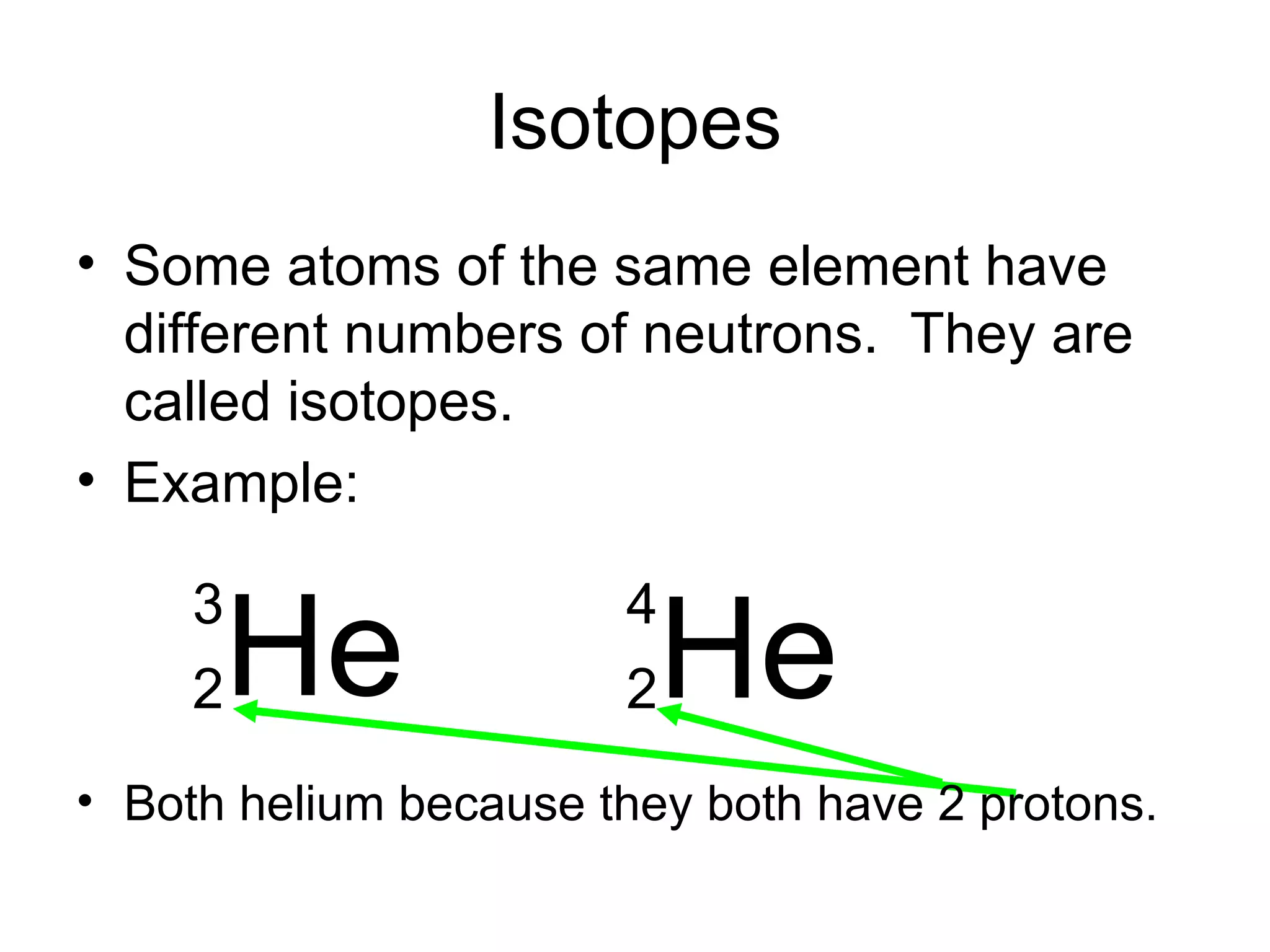
Isotopes Some atoms of the same element have different numbers of neutrons.  They are called isotopes. Example: Both helium because they both have 2 protons. He He 4 3 2 2
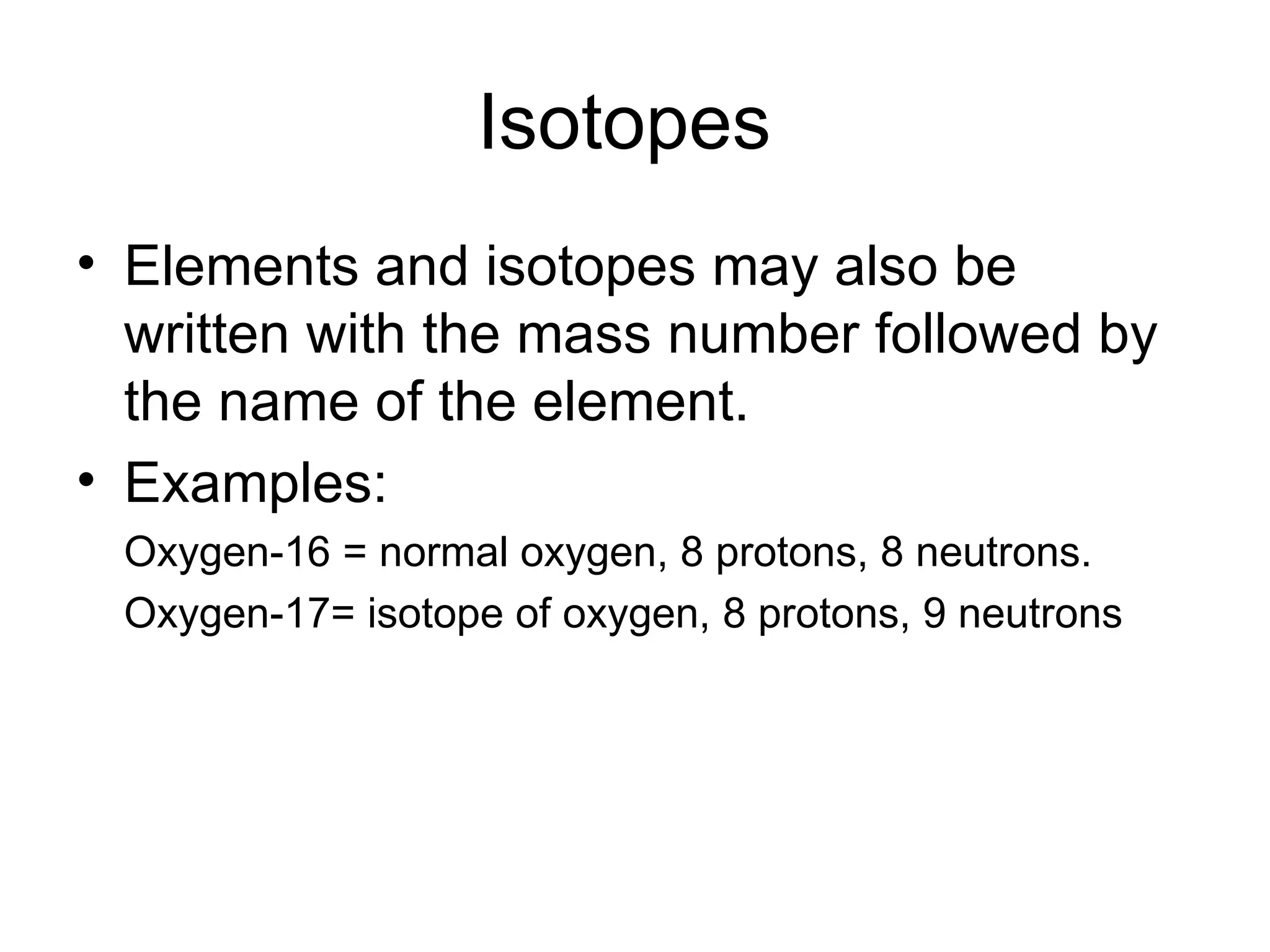
Isotopes  Elements and isotopes may also be written with the mass number followed by the name of the element. Examples: Oxygen-16 = normal oxygen, 8 protons, 8 neutrons. Oxygen-17= isotope of oxygen, 8 protons, 9 neutrons

3.2 structure of atoms

  • 1.
  • 2.
    Who discovered what?Thompson discovered electrons by using cathode ray tubes. Rutherford discovered the nucleus . He also reasoned that it was positively charged. Gold foil experiments. Chadwick discovered that a beam was not deflected in a magnetic field. The particles in the beam were named neutrons . Read pages 79-82
  • 3.
    Subatomic Particles Proton + 1.673 x 10 -27 kg. Neutron : no charge. 1.675 x 10 -27 kg. Electron – 9.109 x 10 -31 kg
  • 4.
    The AMU AMUstands for Atomic Mass Unit. Because the subatomic particles are so small the AMU was created to describe them. Proton = 1 AMU Neutron = 1 AMU Electron = 0 AMU
  • 5.
    Atomic # &Atomic Mass The atomic # of an element is the same as the number of protons in one atom of that element. The atomic mass of an element is the number of protons + the number of neutrons in one atom of that element.
  • 6.
    The Periodic TableSymbols on the periodic table hold a lot of information. Protons Electrons Mass Element symbol Neutrons? O 8 15.9994 2s 2 2p 4
  • 7.
    C 6 12.011S 16 32.066 Zn 30 65.39 H 1 1.007 Si 14 28.085 Li 3 6.941
  • 8.
    Atomic Structure andSymbols It is common notation to write an element’s atomic number and mass number next to their symbol. Br 80 35
  • 9.
    Isotopes Some atomsof the same element have different numbers of neutrons. They are called isotopes. Example: Both helium because they both have 2 protons. He He 4 3 2 2
  • 10.
    Isotopes Elementsand isotopes may also be written with the mass number followed by the name of the element. Examples: Oxygen-16 = normal oxygen, 8 protons, 8 neutrons. Oxygen-17= isotope of oxygen, 8 protons, 9 neutrons