Atomic Structure & the Periodic Table
Objectives Identify important developments in the history of atomic theory. Summarize Dalton’s atomic theory. Describe the size of an atom. Distinguish among protons, electrons, and neutrons in terms of relative mass and change. Describe the structure of an atom, including the location of the protons, electrons, and neutrons with respect to the nucleus. Explain how the atomic number identifies an element. Use the atomic number and mass number of an element to find the number of protons, electrons, and neutrons. Explain how isotopes differ and why the atomic masses of elements are not whole numbers. Calculate the average atomic mass of an element from isotope data. TEKS: 2A, 2B, 2C, 2D, 2E, 3A, 3C, 3E, 4A, 4C,4D, 5A, 6A, 6B, 6C,  8A, 9B, 10A, 11A
Early Models of the Atom 400 B.C. – Democritus proposed the existence of fundamental particles of matter that were indivisible and indestructible - “atomos”. Aristotle thought all matter was continuous; he did not believe in atoms. Neither idea was supported by any experimental evidence – speculation only.
Foundations of Atomic Theory The late 1700’s –definitions and basic laws had been discovered and accepted by chemists. Element – substance that cannot be broken down by ordinary chemical means. Chemical Reaction – transformation of substance or substances into one or more new substances.
Law of Conservation of Mass  – mass cannot be created or destroyed just changed from one form to another.  ( Antoine Lavosier) Law of Definite Proportions  – a chemical compound contains exactly the same elements in the same proportion regardless of sample size.  (Joseph Proust from work of Gay-Lussac & Amadeo Avogadro – 1802/1804) Law of Multiple Proportions  – If two or more different compounds are composed of the same two elements, then the ratio of the masses of those elements will always exist as a ratio of small whole numbers.  (John Dalton - 1808)
Dalton’s Atomic Theory All elements are composed of tiny indivisible particles called atoms. Atoms of the same element are identical.  The atoms of one element are different from the atoms of another element. Atoms combine in simple whole-number ratios. Atoms are separated, joined or rearranged in chemical reactions.  Atoms of one element are never changed into atoms of another element as a result of a chemical reaction.
Discovery of Electrons 1897 – J.J. Thomson – “Cathode Ray Tube Experiment” Showed existence of first know sub-atomic particle Determined charge to mass ratio of the electron 1909 – Robert Millikan found the charge of the electron –  “Millikan’s Oil Drop Experiment”
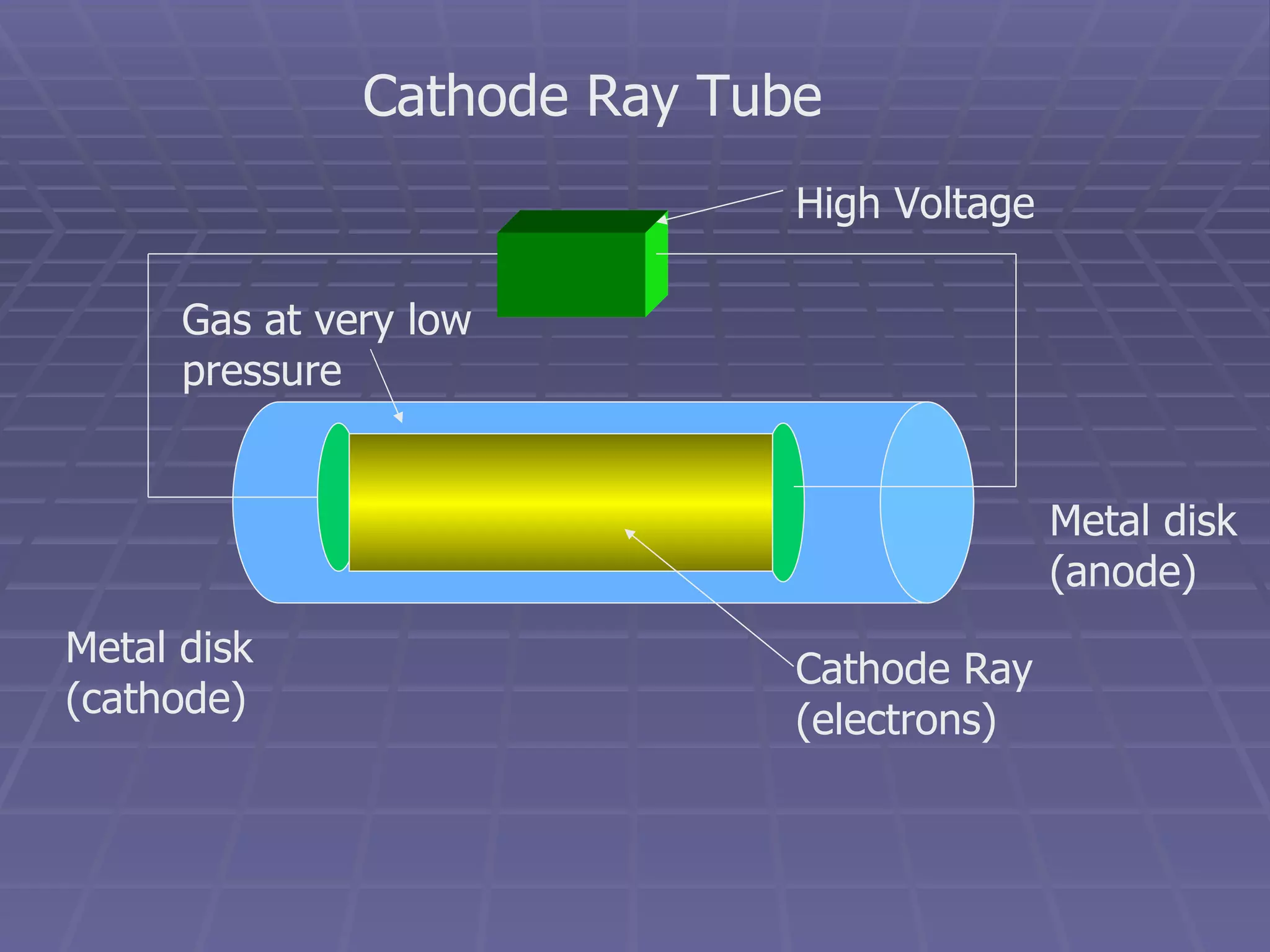
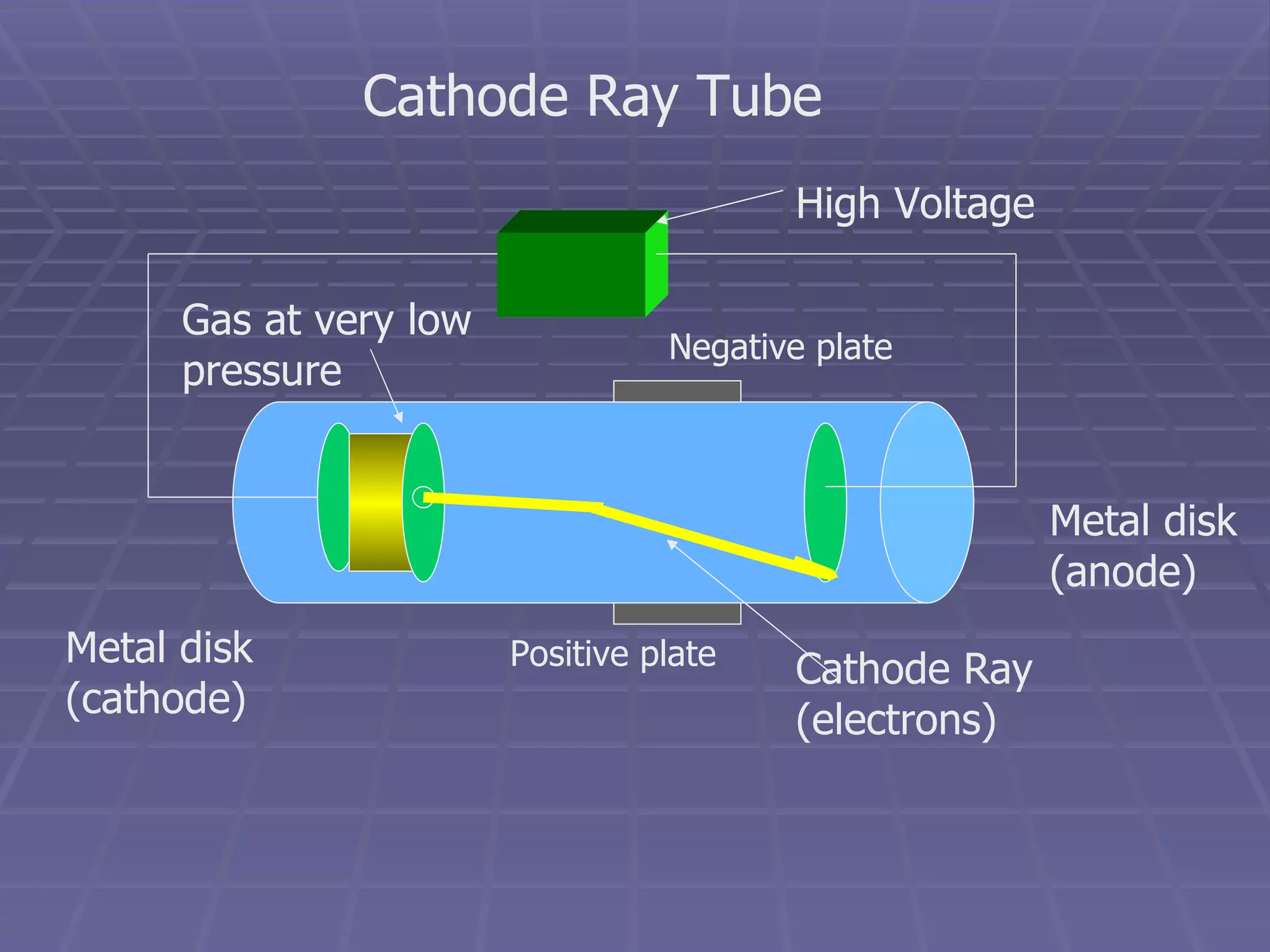
Cathode Ray Tube High Voltage Cathode Ray (electrons) Metal disk (cathode) Metal disk (anode) Gas at very low pressure
Cathode Ray Tube High Voltage Cathode Ray (electrons) Metal disk (cathode) Metal disk (anode) Gas at very low pressure Negative plate Positive plate
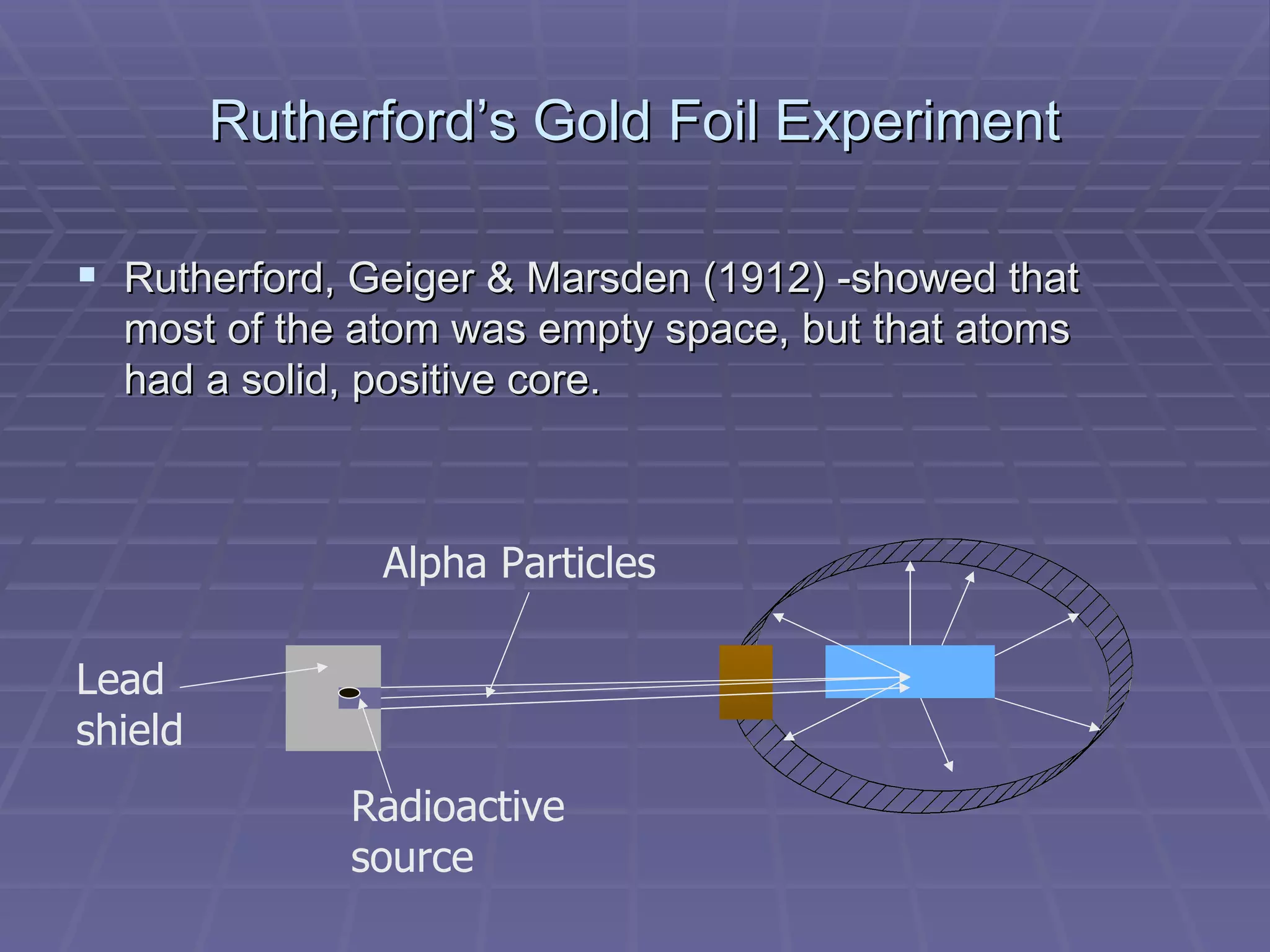
Rutherford’s Gold Foil Experiment Rutherford, Geiger & Marsden (1912) -showed that most of the atom was empty space, but that atoms had a solid, positive core. Alpha Particles Radioactive source Lead shield
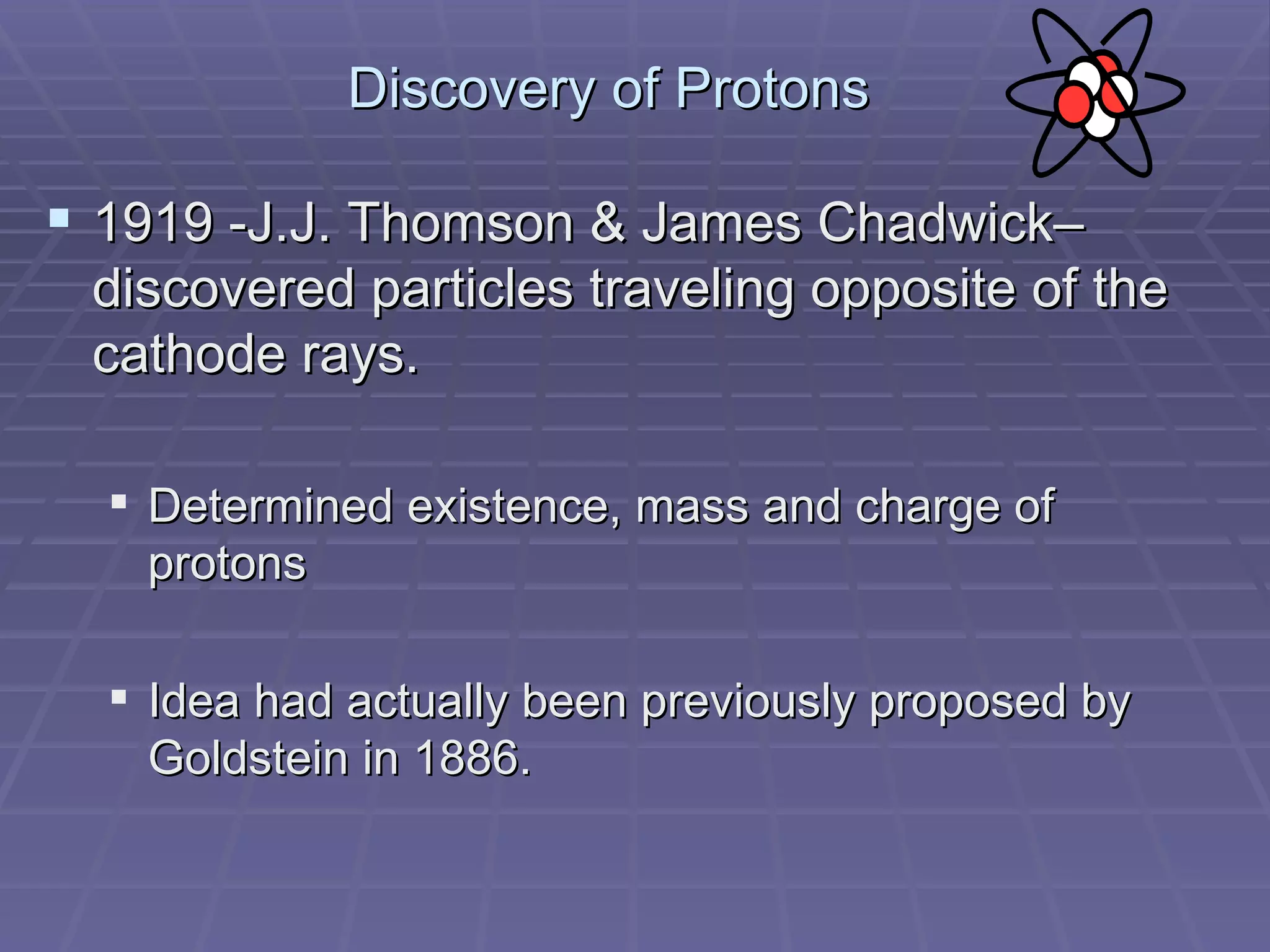
Discovery of Protons 1919 -J.J. Thomson & James Chadwick– discovered particles traveling opposite of the cathode rays. Determined existence, mass and charge of protons Idea had actually been previously proposed by Goldstein in 1886.
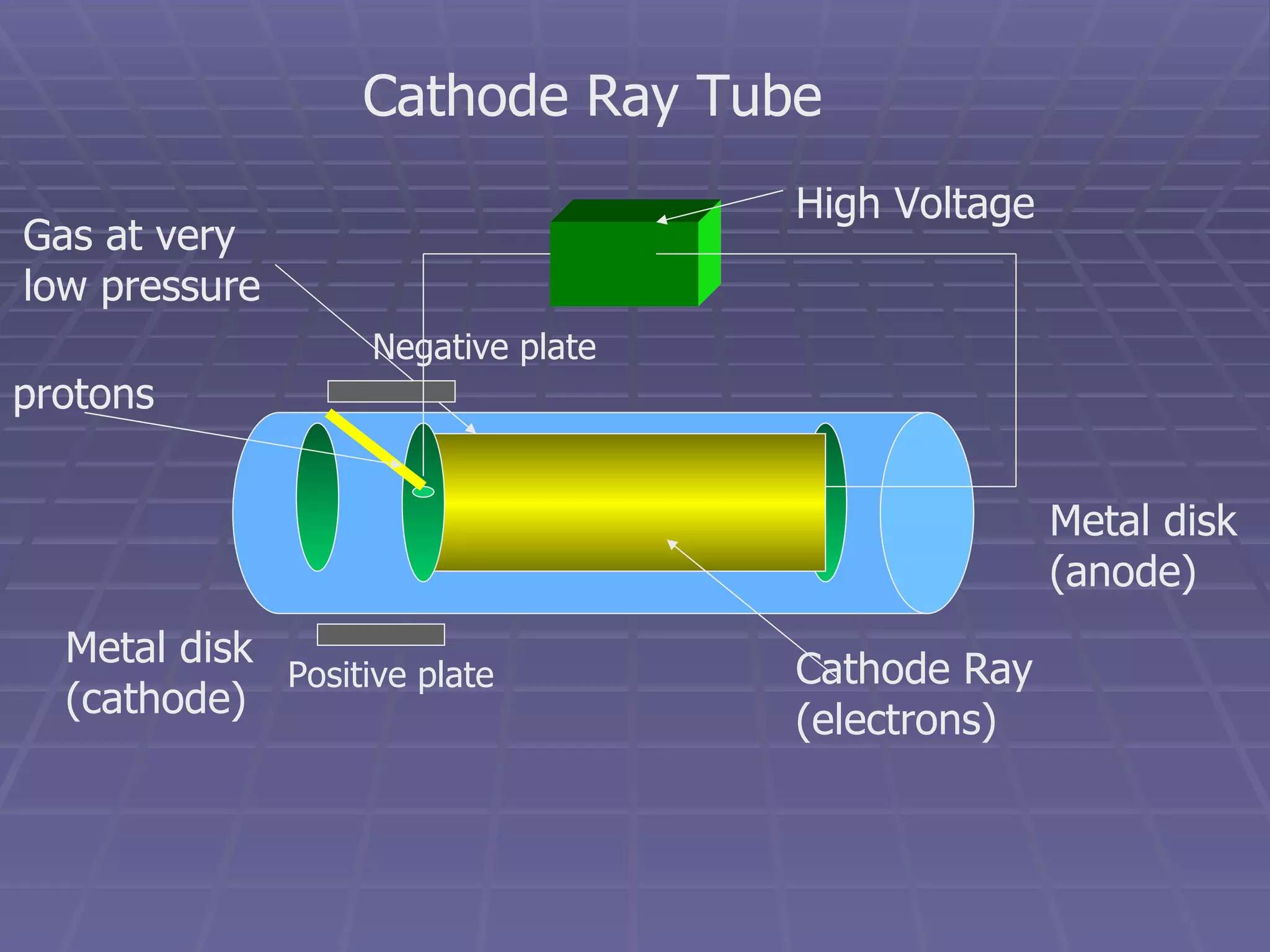
Cathode Ray Tube High Voltage Cathode Ray (electrons) Metal disk (cathode) Metal disk (anode) Gas at very low pressure Negative plate Positive plate  protons
Neutrons James Chadwick 1932 - confirmed the existence of the neutron.  Neutrons are subatomic particles with no charge but with a mass nearly equal to that of a proton. Walter Bothe had first reasoned the existence of a third subatomic particle in 1930. Bothe’s work was based in part on that of Henry Mosely who showed by X-ray analysis that not all atoms of the same element were identical. (Isotopes – 1907)
Counting Particles Atomic Number = number of protons Mass Number = number of protons and neutrons Atomic Mass  =  average mass of the isotopes (also known as atomic weight)
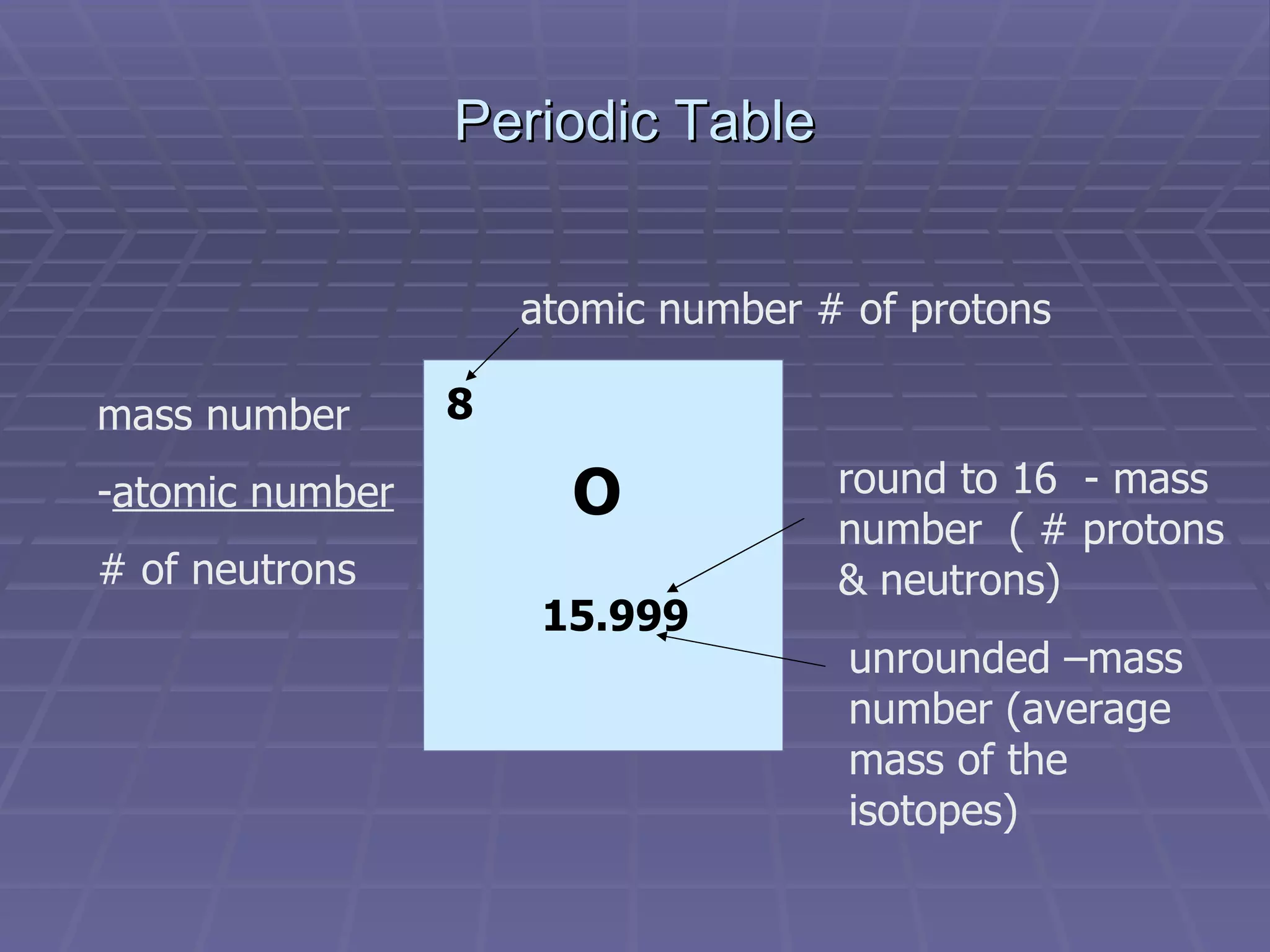
Periodic Table 8 15.999 atomic number # of protons round to 16  - mass number  ( # protons & neutrons) unrounded –mass number (average mass of the isotopes) mass number  atomic number # of neutrons O
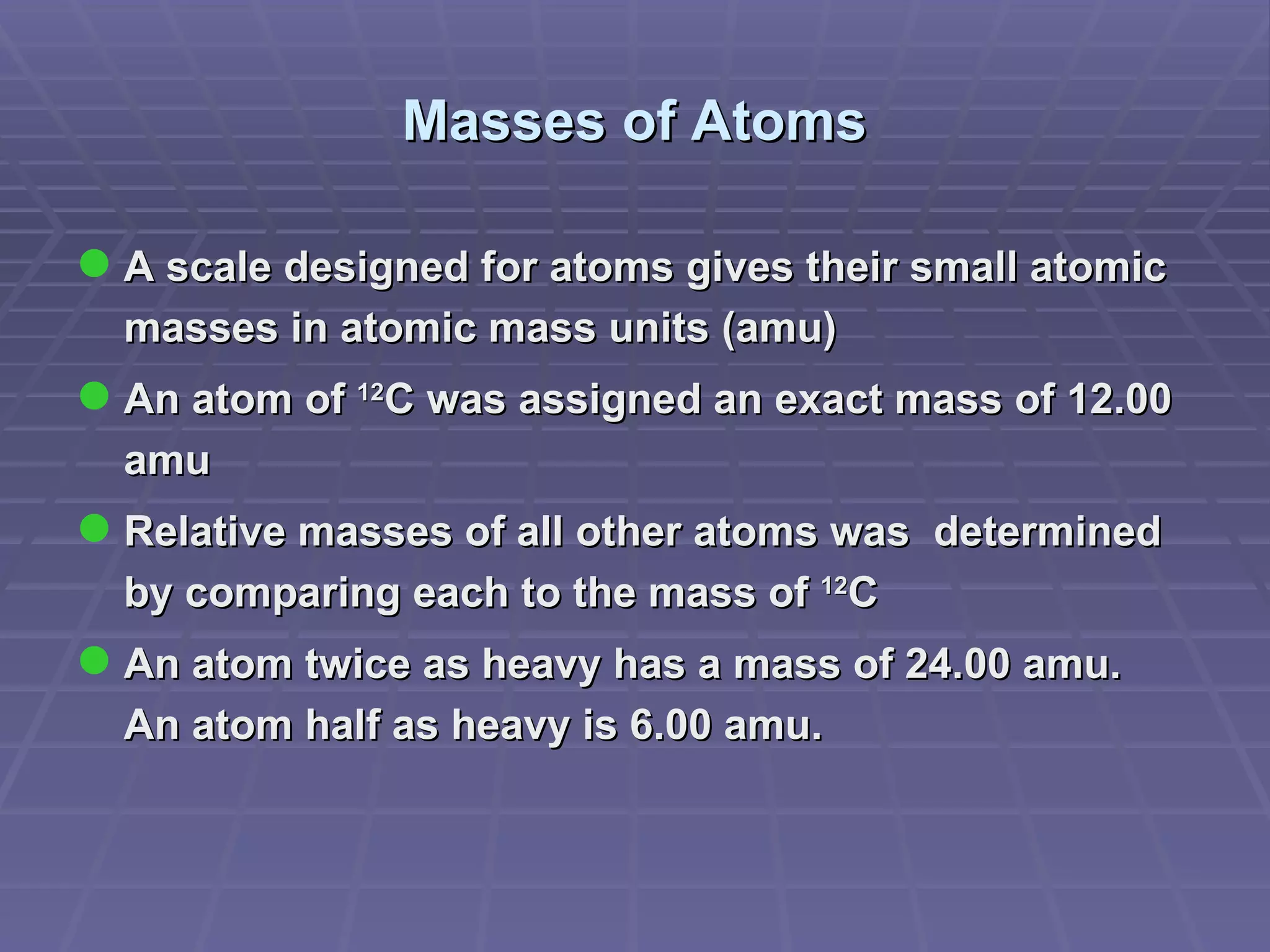
Masses of Atoms A scale designed for atoms gives their small atomic masses in atomic mass units (amu) An atom of  12 C was assigned an exact mass of 12.00 amu Relative masses of all other atoms was  determined by comparing each to the mass of  12 C  An atom twice as heavy has a mass of 24.00 amu.  An atom half as heavy is 6.00 amu.
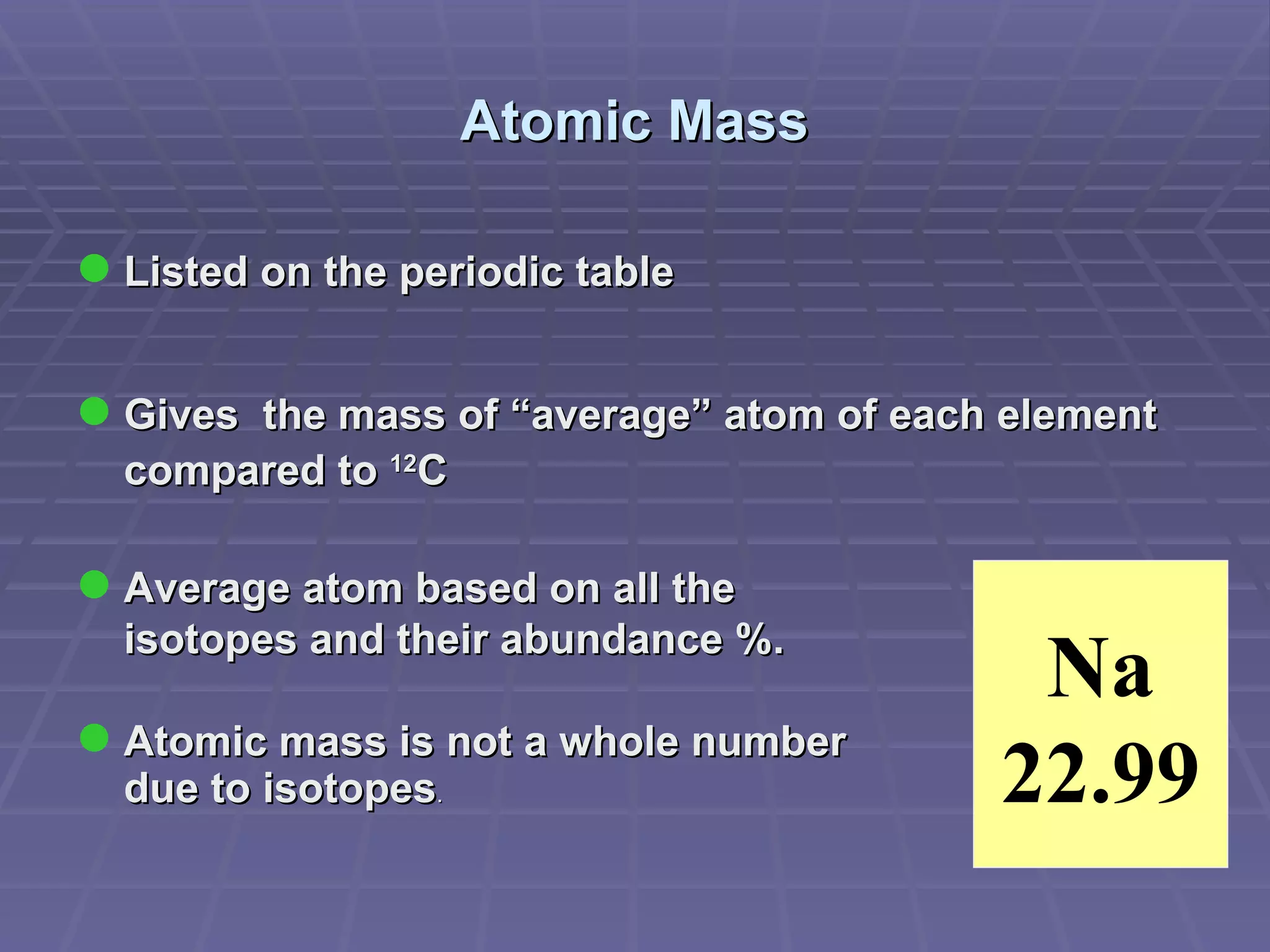
Atomic Mass Listed on the periodic table Gives  the mass of “average” atom of each element compared to  12 C  Average atom based on all the  isotopes and their abundance %. Atomic mass is not a whole number  due   to   isotopes . Na 22.99
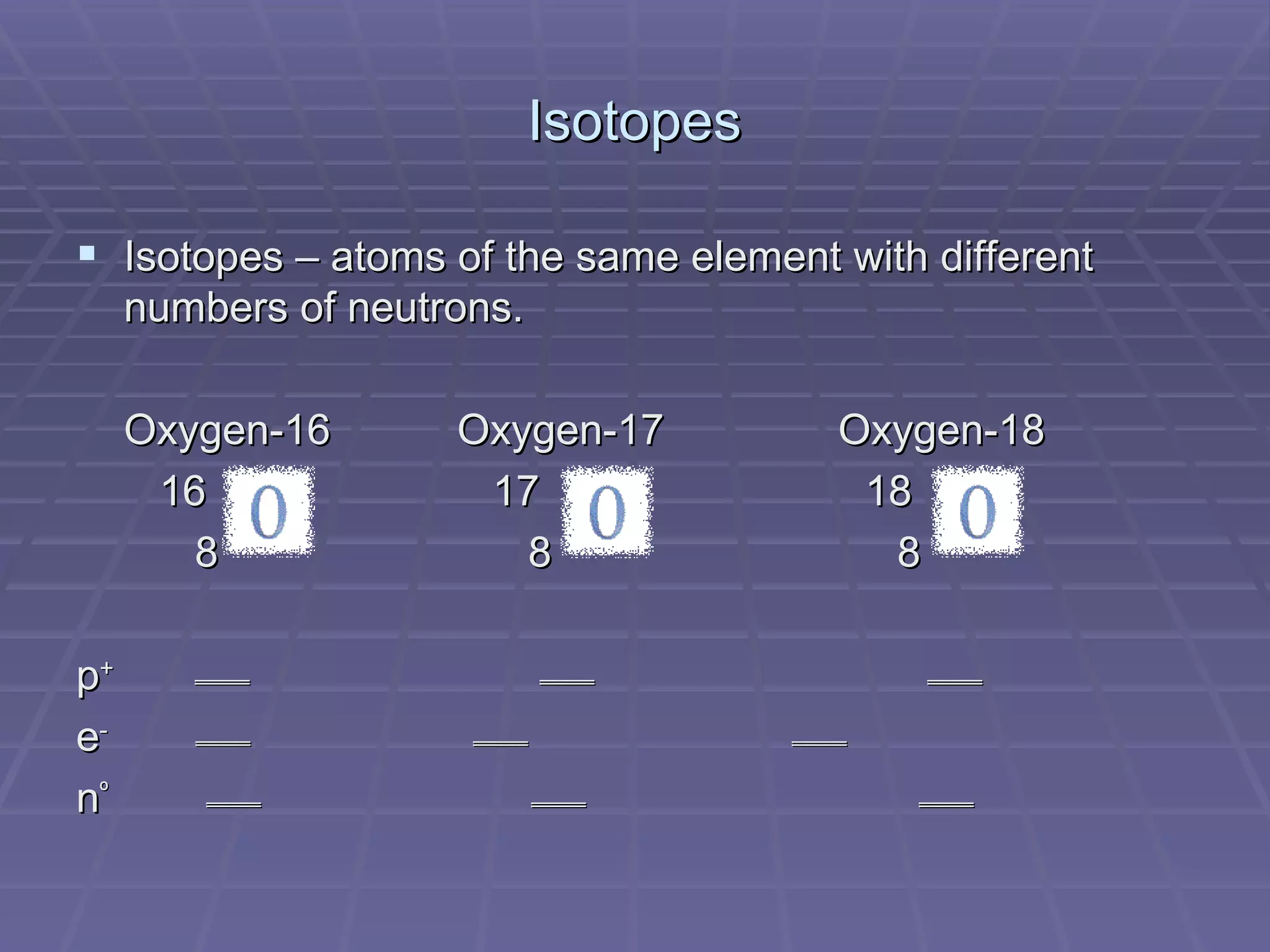
Isotopes Isotopes – atoms of the same element with different numbers of neutrons. Oxygen-16 Oxygen-17 Oxygen-18   16   17    18    8   8   8 p +  ‗‗‗‗   ‗‗‗‗    ‗‗‗‗ e -  ‗‗‗‗  ‗‗‗‗   ‗‗‗‗ n º   ‗‗‗‗     ‗‗‗‗    ‗‗‗‗
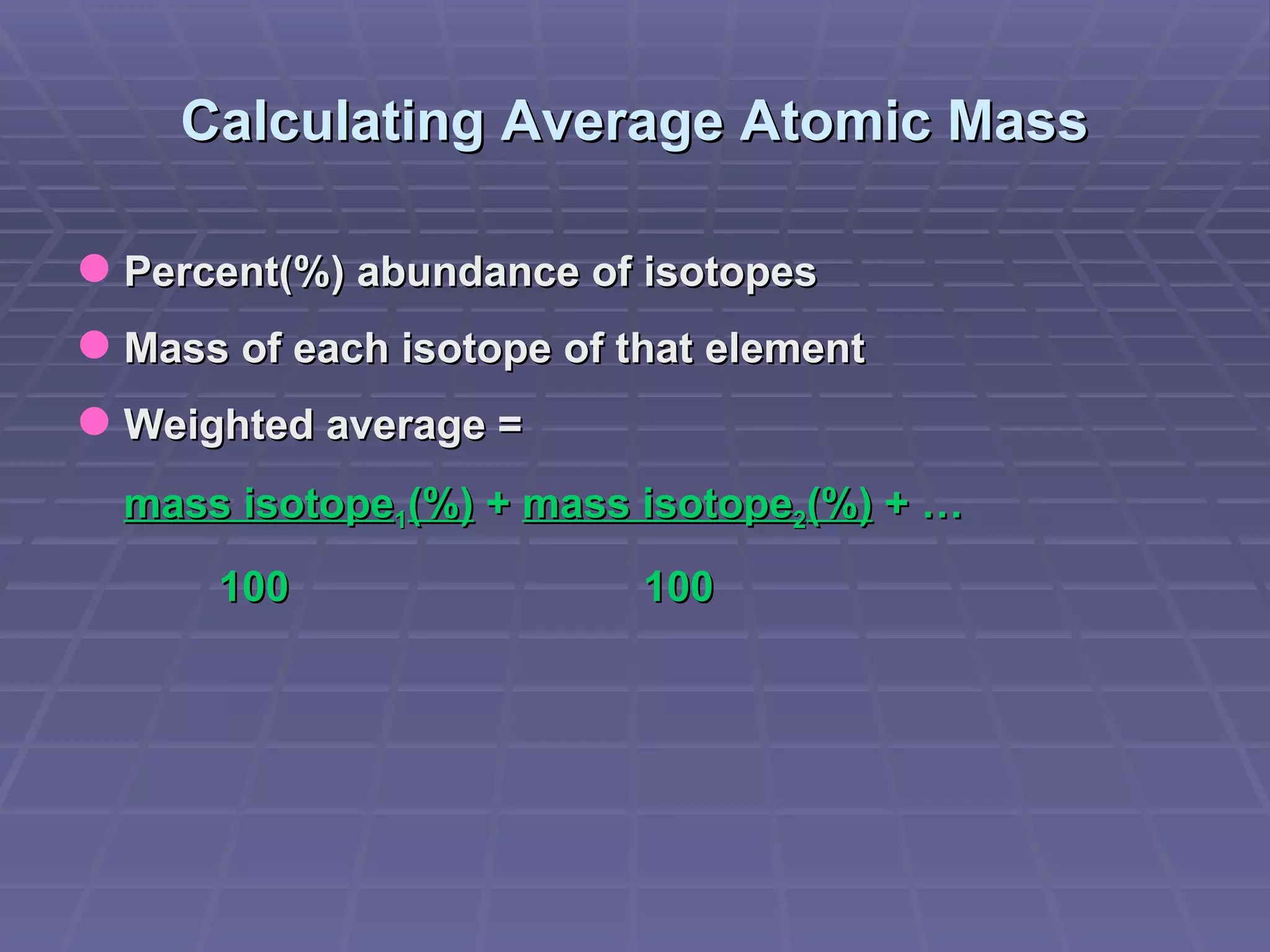
Calculating Average Atomic Mass Percent(%) abundance of isotopes Mass of each isotope of that element Weighted average = mass isotope 1 (%)  +  mass isotope 2 (%)  + …   100    100
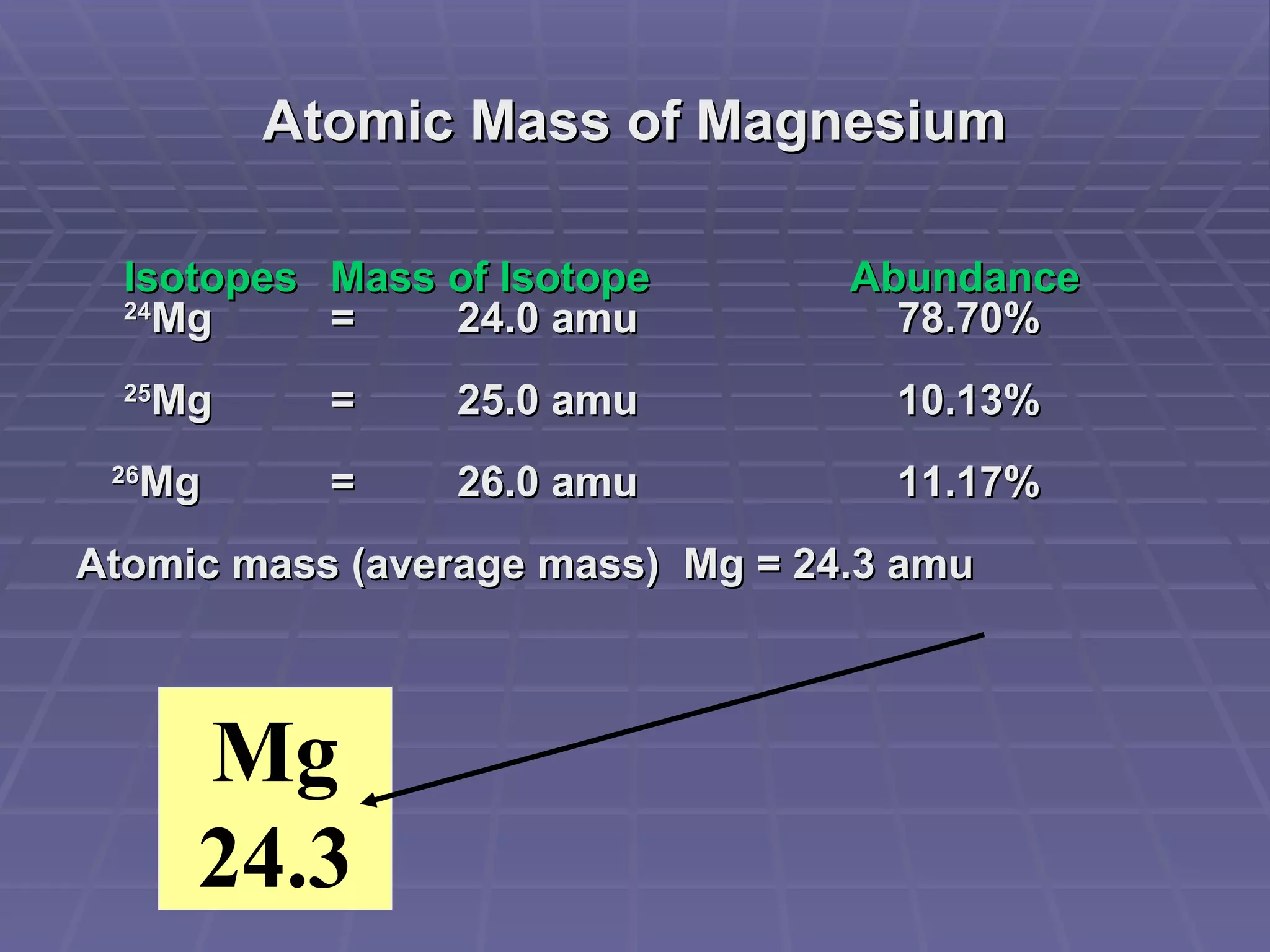
Atomic Mass of Magnesium Isotopes  Mass of Isotope   Abundance   24 Mg  = 24.0 amu    78.70% 25 Mg  =  25.0 amu      10.13% 26 Mg  =  26.0 amu   11.17% Atomic mass (average mass)  Mg = 24.3 amu Mg 24.3
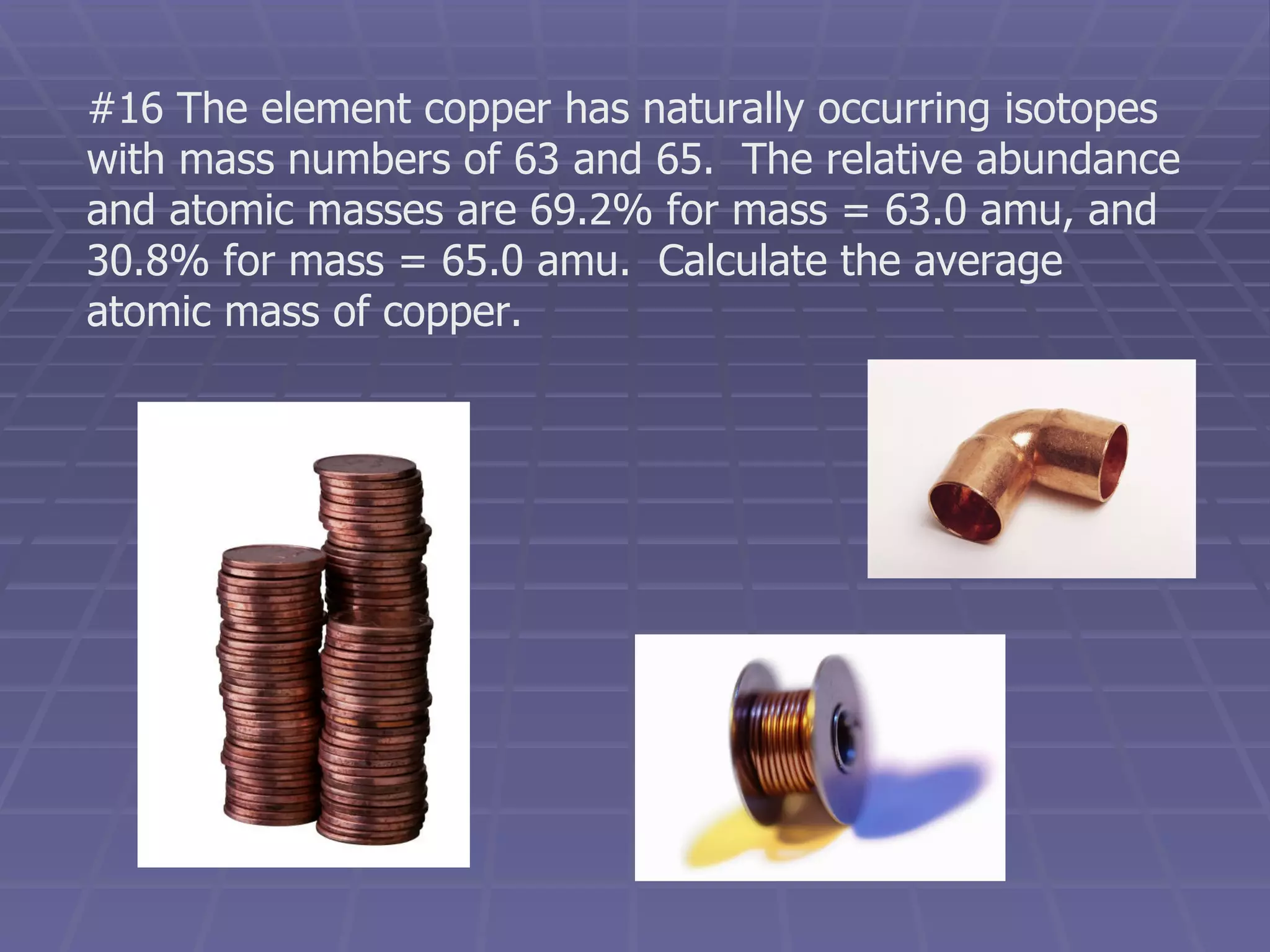
#16 The element copper has naturally occurring isotopes with mass numbers of 63 and 65.  The relative abundance and atomic masses are 69.2% for mass = 63.0 amu, and 30.8% for mass = 65.0 amu.  Calculate the average atomic mass of copper.
Finding An Isotopic Mass Naturally occurring boron is 80.20% boron-11 (atomic mass 11.0 amu) and 19.80% of a different isotope of boron.  What must the mass of this isotope be if the average atomic mass of boron is 10.81 amu?
Radioactivity Mosely’s X-ray analysis of atoms was an attempt to explain radioactivity. 1896 – Henri Becquerel – Uranium spontaneously emits energy. 1898 – Marie & Pierre Curie – first isolated a radioactive element - Radium
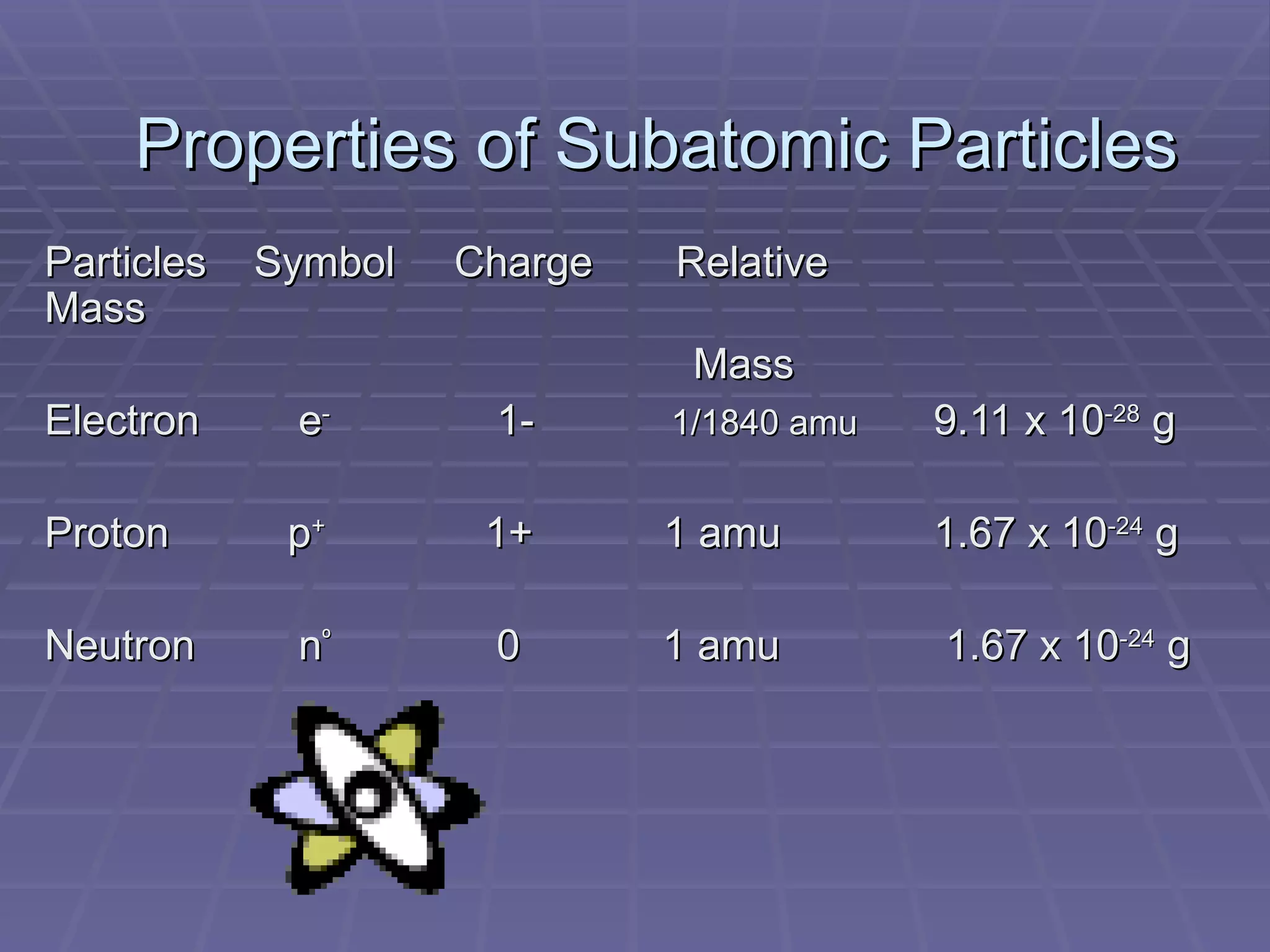
Properties of Subatomic Particles Particles  Symbol  Charge  Relative    Mass    Mass Electron e -   1-   1/1840 amu   9.11 x 10 -28  g Proton  p +   1+  1 amu  1.67 x 10 -24  g Neutron n º   0  1 amu   1.67 x 10 -24  g
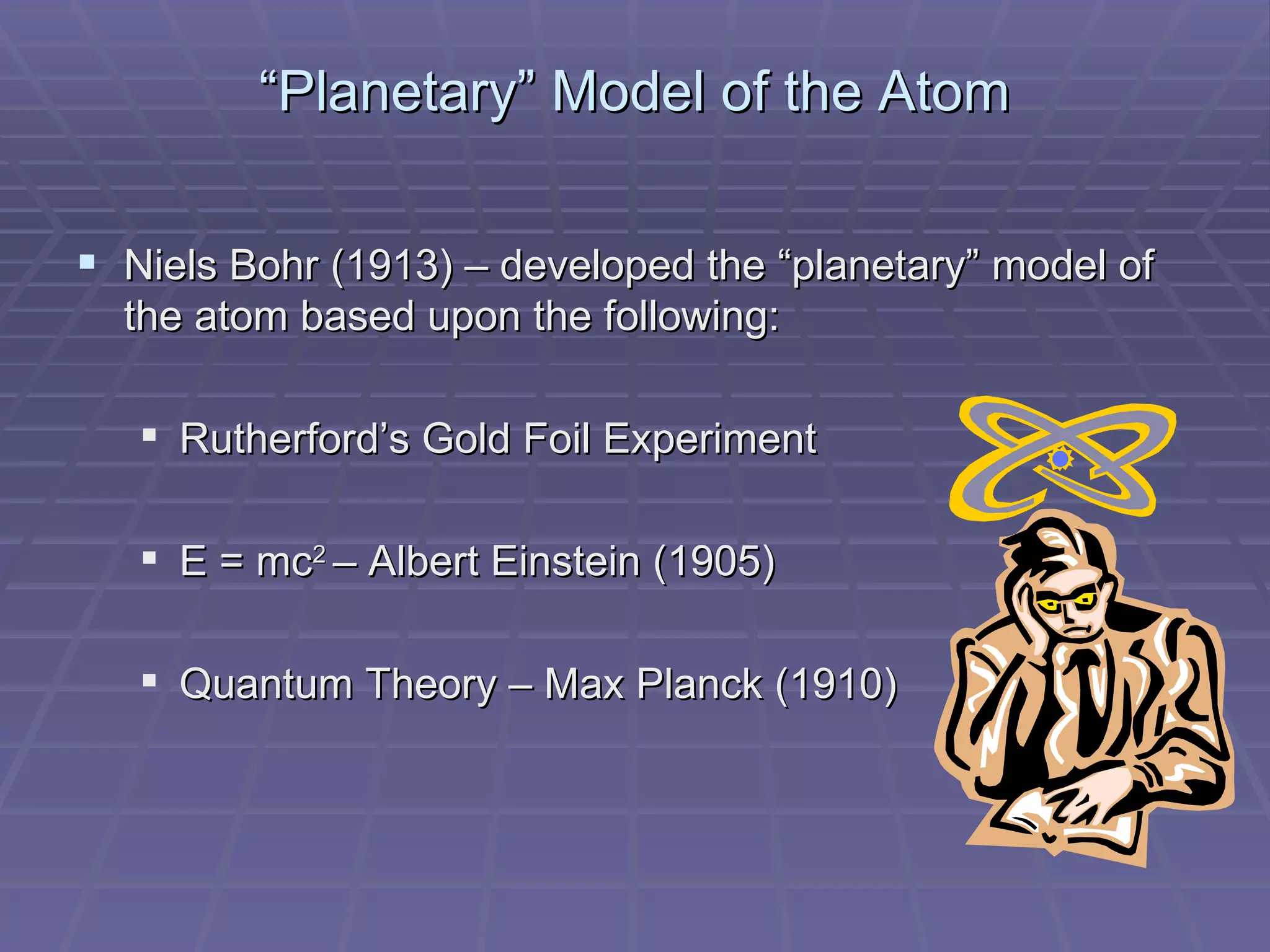
“ Planetary” Model of the Atom Niels Bohr (1913) – developed the “planetary” model of the atom based upon the following:  Rutherford’s Gold Foil Experiment E = mc 2  – Albert Einstein (1905) Quantum Theory – Max Planck (1910)
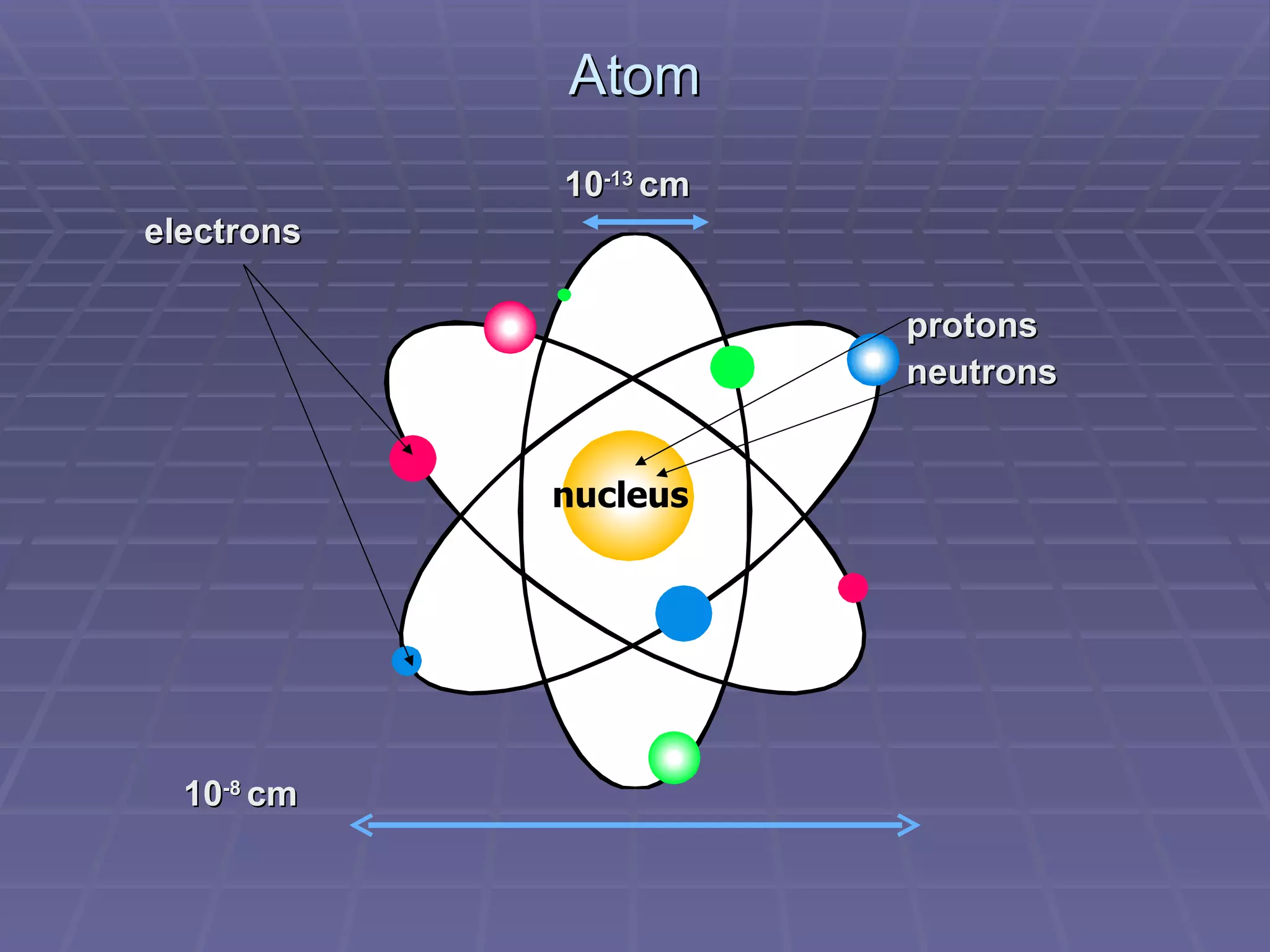
Atom   10 -13  cm electrons   protons     neutrons 10 -8  cm nucleus
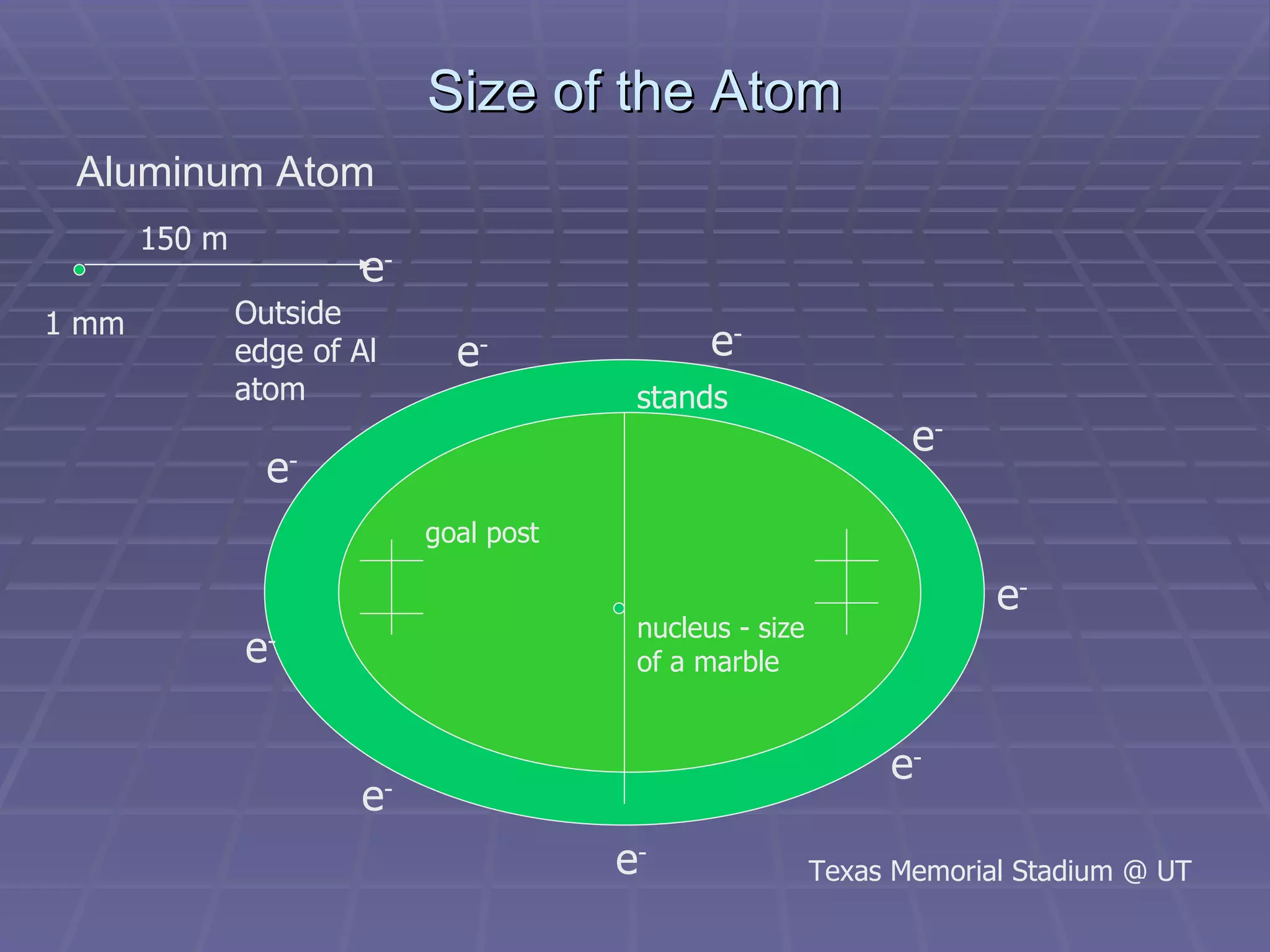
Size of the Atom Aluminum Atom Texas Memorial Stadium @ UT e - e - e - e - e - e - e - e - e - nucleus - size of a marble 1 mm Outside edge of Al atom 150 m e - goal post stands

Atomic Structure and the Periodic Table

  • 1.
    Atomic Structure &the Periodic Table
  • 2.
    Objectives Identify importantdevelopments in the history of atomic theory. Summarize Dalton’s atomic theory. Describe the size of an atom. Distinguish among protons, electrons, and neutrons in terms of relative mass and change. Describe the structure of an atom, including the location of the protons, electrons, and neutrons with respect to the nucleus. Explain how the atomic number identifies an element. Use the atomic number and mass number of an element to find the number of protons, electrons, and neutrons. Explain how isotopes differ and why the atomic masses of elements are not whole numbers. Calculate the average atomic mass of an element from isotope data. TEKS: 2A, 2B, 2C, 2D, 2E, 3A, 3C, 3E, 4A, 4C,4D, 5A, 6A, 6B, 6C, 8A, 9B, 10A, 11A
  • 3.
    Early Models ofthe Atom 400 B.C. – Democritus proposed the existence of fundamental particles of matter that were indivisible and indestructible - “atomos”. Aristotle thought all matter was continuous; he did not believe in atoms. Neither idea was supported by any experimental evidence – speculation only.
  • 4.
    Foundations of AtomicTheory The late 1700’s –definitions and basic laws had been discovered and accepted by chemists. Element – substance that cannot be broken down by ordinary chemical means. Chemical Reaction – transformation of substance or substances into one or more new substances.
  • 5.
    Law of Conservationof Mass – mass cannot be created or destroyed just changed from one form to another. ( Antoine Lavosier) Law of Definite Proportions – a chemical compound contains exactly the same elements in the same proportion regardless of sample size. (Joseph Proust from work of Gay-Lussac & Amadeo Avogadro – 1802/1804) Law of Multiple Proportions – If two or more different compounds are composed of the same two elements, then the ratio of the masses of those elements will always exist as a ratio of small whole numbers. (John Dalton - 1808)
  • 6.
    Dalton’s Atomic TheoryAll elements are composed of tiny indivisible particles called atoms. Atoms of the same element are identical. The atoms of one element are different from the atoms of another element. Atoms combine in simple whole-number ratios. Atoms are separated, joined or rearranged in chemical reactions. Atoms of one element are never changed into atoms of another element as a result of a chemical reaction.
  • 7.
    Discovery of Electrons1897 – J.J. Thomson – “Cathode Ray Tube Experiment” Showed existence of first know sub-atomic particle Determined charge to mass ratio of the electron 1909 – Robert Millikan found the charge of the electron – “Millikan’s Oil Drop Experiment”
  • 8.
    Cathode Ray TubeHigh Voltage Cathode Ray (electrons) Metal disk (cathode) Metal disk (anode) Gas at very low pressure
  • 9.
    Cathode Ray TubeHigh Voltage Cathode Ray (electrons) Metal disk (cathode) Metal disk (anode) Gas at very low pressure Negative plate Positive plate
  • 10.
    Rutherford’s Gold FoilExperiment Rutherford, Geiger & Marsden (1912) -showed that most of the atom was empty space, but that atoms had a solid, positive core. Alpha Particles Radioactive source Lead shield
  • 11.
    Discovery of Protons1919 -J.J. Thomson & James Chadwick– discovered particles traveling opposite of the cathode rays. Determined existence, mass and charge of protons Idea had actually been previously proposed by Goldstein in 1886.
  • 12.
    Cathode Ray TubeHigh Voltage Cathode Ray (electrons) Metal disk (cathode) Metal disk (anode) Gas at very low pressure Negative plate Positive plate protons
  • 13.
    Neutrons James Chadwick1932 - confirmed the existence of the neutron. Neutrons are subatomic particles with no charge but with a mass nearly equal to that of a proton. Walter Bothe had first reasoned the existence of a third subatomic particle in 1930. Bothe’s work was based in part on that of Henry Mosely who showed by X-ray analysis that not all atoms of the same element were identical. (Isotopes – 1907)
  • 14.
    Counting Particles AtomicNumber = number of protons Mass Number = number of protons and neutrons Atomic Mass = average mass of the isotopes (also known as atomic weight)
  • 15.
    Periodic Table 815.999 atomic number # of protons round to 16 - mass number ( # protons & neutrons) unrounded –mass number (average mass of the isotopes) mass number atomic number # of neutrons O
  • 16.
    Masses of AtomsA scale designed for atoms gives their small atomic masses in atomic mass units (amu) An atom of 12 C was assigned an exact mass of 12.00 amu Relative masses of all other atoms was determined by comparing each to the mass of 12 C An atom twice as heavy has a mass of 24.00 amu. An atom half as heavy is 6.00 amu.
  • 17.
    Atomic Mass Listedon the periodic table Gives the mass of “average” atom of each element compared to 12 C Average atom based on all the isotopes and their abundance %. Atomic mass is not a whole number due to isotopes . Na 22.99
  • 18.
    Isotopes Isotopes –atoms of the same element with different numbers of neutrons. Oxygen-16 Oxygen-17 Oxygen-18 16 17 18 8 8 8 p + ‗‗‗‗ ‗‗‗‗ ‗‗‗‗ e - ‗‗‗‗ ‗‗‗‗ ‗‗‗‗ n º ‗‗‗‗ ‗‗‗‗ ‗‗‗‗
  • 19.
    Calculating Average AtomicMass Percent(%) abundance of isotopes Mass of each isotope of that element Weighted average = mass isotope 1 (%) + mass isotope 2 (%) + … 100 100
  • 20.
    Atomic Mass ofMagnesium Isotopes Mass of Isotope Abundance 24 Mg = 24.0 amu 78.70% 25 Mg = 25.0 amu 10.13% 26 Mg = 26.0 amu 11.17% Atomic mass (average mass) Mg = 24.3 amu Mg 24.3
  • 21.
    #16 The elementcopper has naturally occurring isotopes with mass numbers of 63 and 65. The relative abundance and atomic masses are 69.2% for mass = 63.0 amu, and 30.8% for mass = 65.0 amu. Calculate the average atomic mass of copper.
  • 22.
    Finding An IsotopicMass Naturally occurring boron is 80.20% boron-11 (atomic mass 11.0 amu) and 19.80% of a different isotope of boron. What must the mass of this isotope be if the average atomic mass of boron is 10.81 amu?
  • 23.
    Radioactivity Mosely’s X-rayanalysis of atoms was an attempt to explain radioactivity. 1896 – Henri Becquerel – Uranium spontaneously emits energy. 1898 – Marie & Pierre Curie – first isolated a radioactive element - Radium
  • 24.
    Properties of SubatomicParticles Particles Symbol Charge Relative Mass Mass Electron e - 1- 1/1840 amu 9.11 x 10 -28 g Proton p + 1+ 1 amu 1.67 x 10 -24 g Neutron n º 0 1 amu 1.67 x 10 -24 g
  • 25.
    “ Planetary” Modelof the Atom Niels Bohr (1913) – developed the “planetary” model of the atom based upon the following: Rutherford’s Gold Foil Experiment E = mc 2 – Albert Einstein (1905) Quantum Theory – Max Planck (1910)
  • 26.
    Atom 10 -13 cm electrons protons neutrons 10 -8 cm nucleus
  • 27.
    Size of theAtom Aluminum Atom Texas Memorial Stadium @ UT e - e - e - e - e - e - e - e - e - nucleus - size of a marble 1 mm Outside edge of Al atom 150 m e - goal post stands

Editor's Notes

  • #8 Electrons were discovered by Thomson using a cathode ray tube in 1897. Thomson performed experiments that involved passing electric current through gases at low pressure. He sealed the gases in glass tubes fitted at both ends with metal disks called electrodes. The electrodes were connected to a source of high-voltage electricity. One electrode, the anode, became positively charged. The other electrode, the cathode, became negatively charged. The glowing beam formed between the electrodes. This beam, which traveled from the cathode to the anode, is called a cathode ray. Thomson found that cathode rays are attracted to metal plates that have a positive electrical charge. He determined the particle (electron) was negatively charged.
  • #11 A narrow beam of alpha particles (2 protons and 2 neutrons) was directed at a piece of gold foil. It was found that while most of the particles passed straight through, some bounced straight back or were deflected at angles. This experiment showed that most of the atom was empty space, but that atoms had a sold, positive core.
  • #12 If cathode rays are electrons given off by atoms, what remains of the atoms that has lost the electrons? First, atoms have no net electric charge; they are electrically neutral. Second, electric charges are carried by particles of matter. Third, electric charges always exist in whole-number multiples of a single basic unit; that is, there are no fractions of charges. Fourth, when a number of negatively charged particles combines with an equal number of positively charged particles, an electrically neutral particle is formed. Evidence for such a positively charged particle was found in 1886. when E. Goldstein observed a cathode-ray tube and found rays traveling in the direction opposite to that of the cathode rays. He called these rays canal rays and concluded that they were composed of positive particles called protons.
  • #14 Bothe & Chadwick were both members of Rutherford’s lab, therefore, he is sometimes credited with the discovery of the neutron.