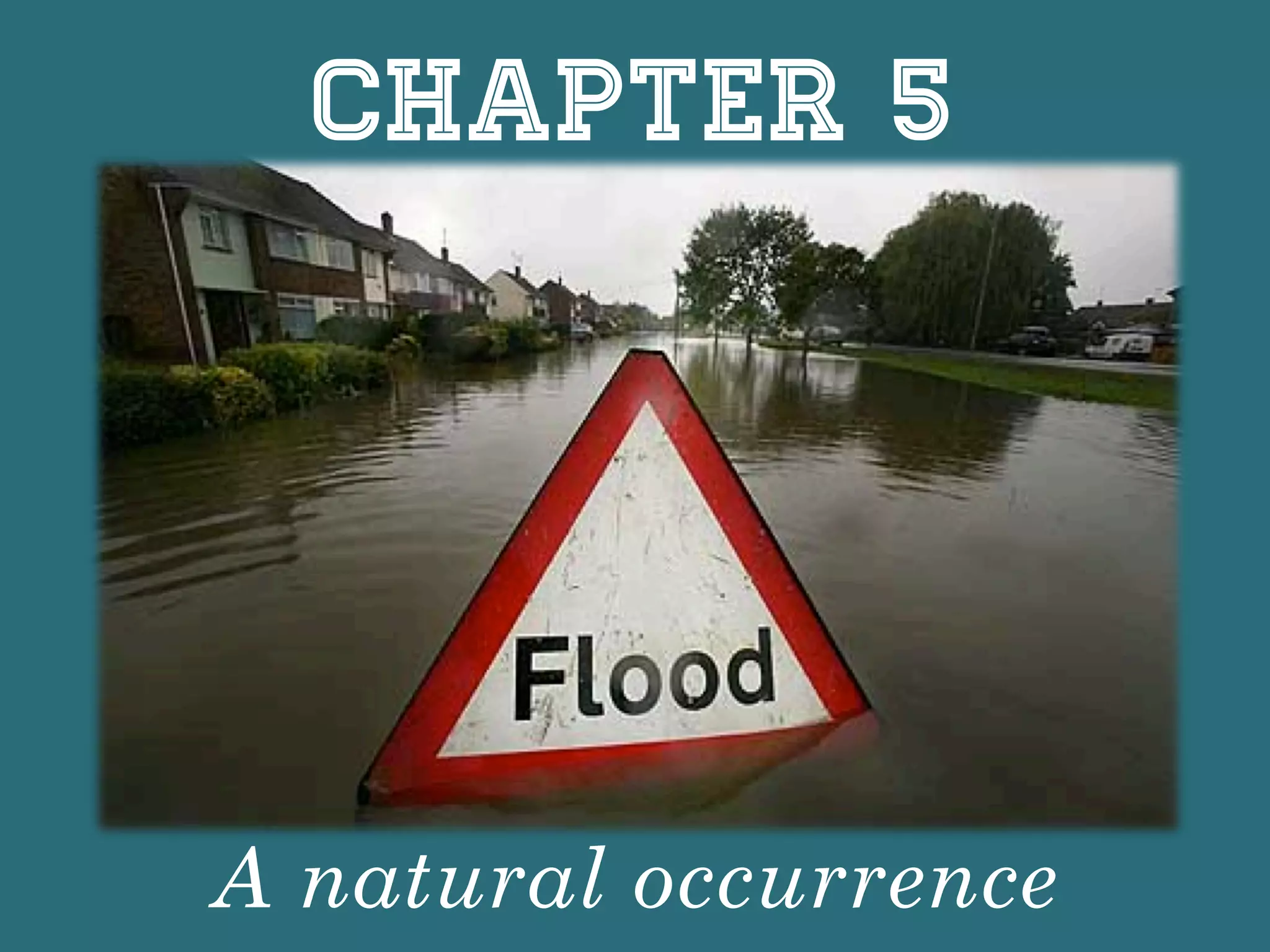
Chapter 5
A natural occurrence
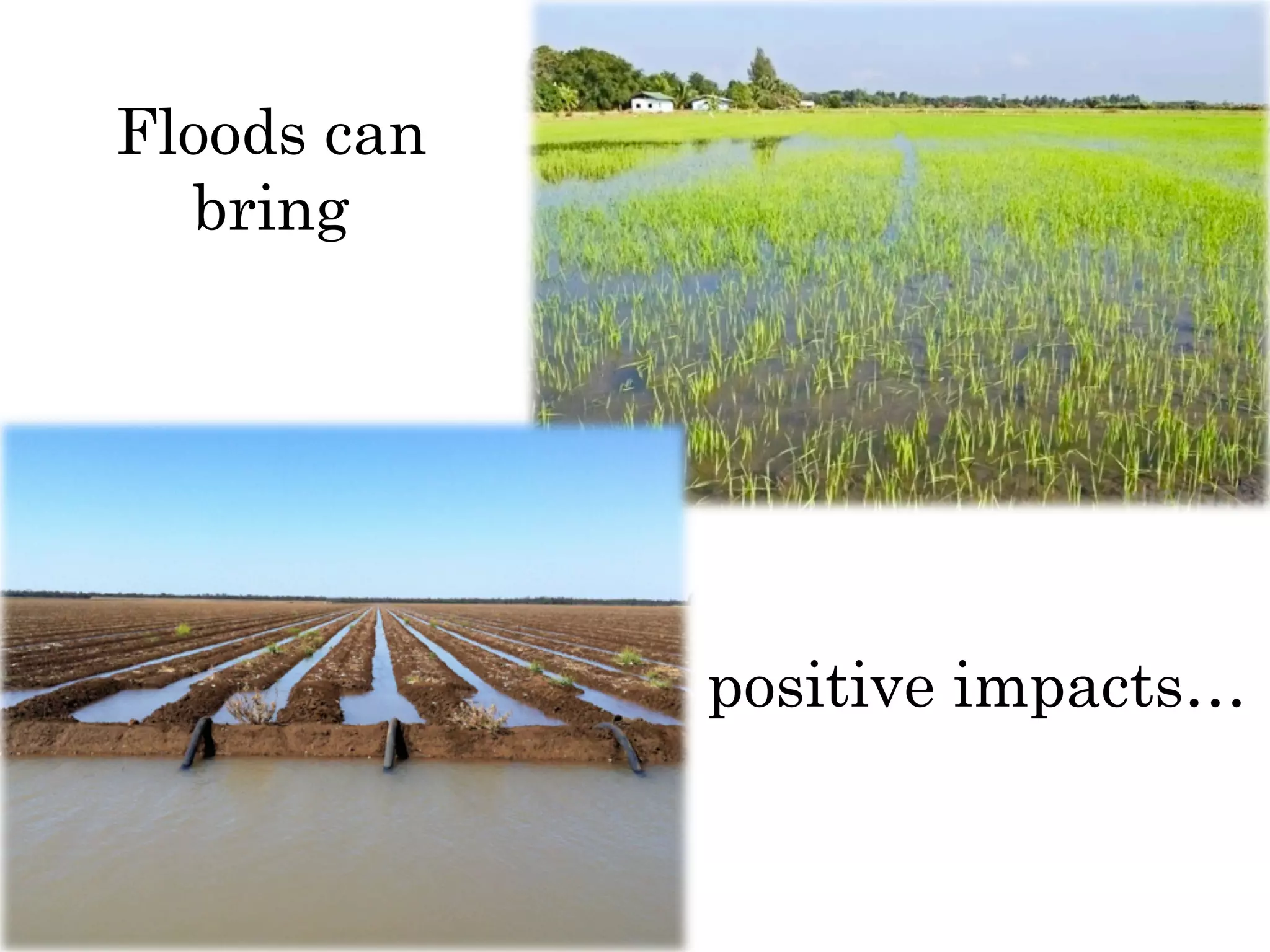
Floods can
bring
positive impacts…
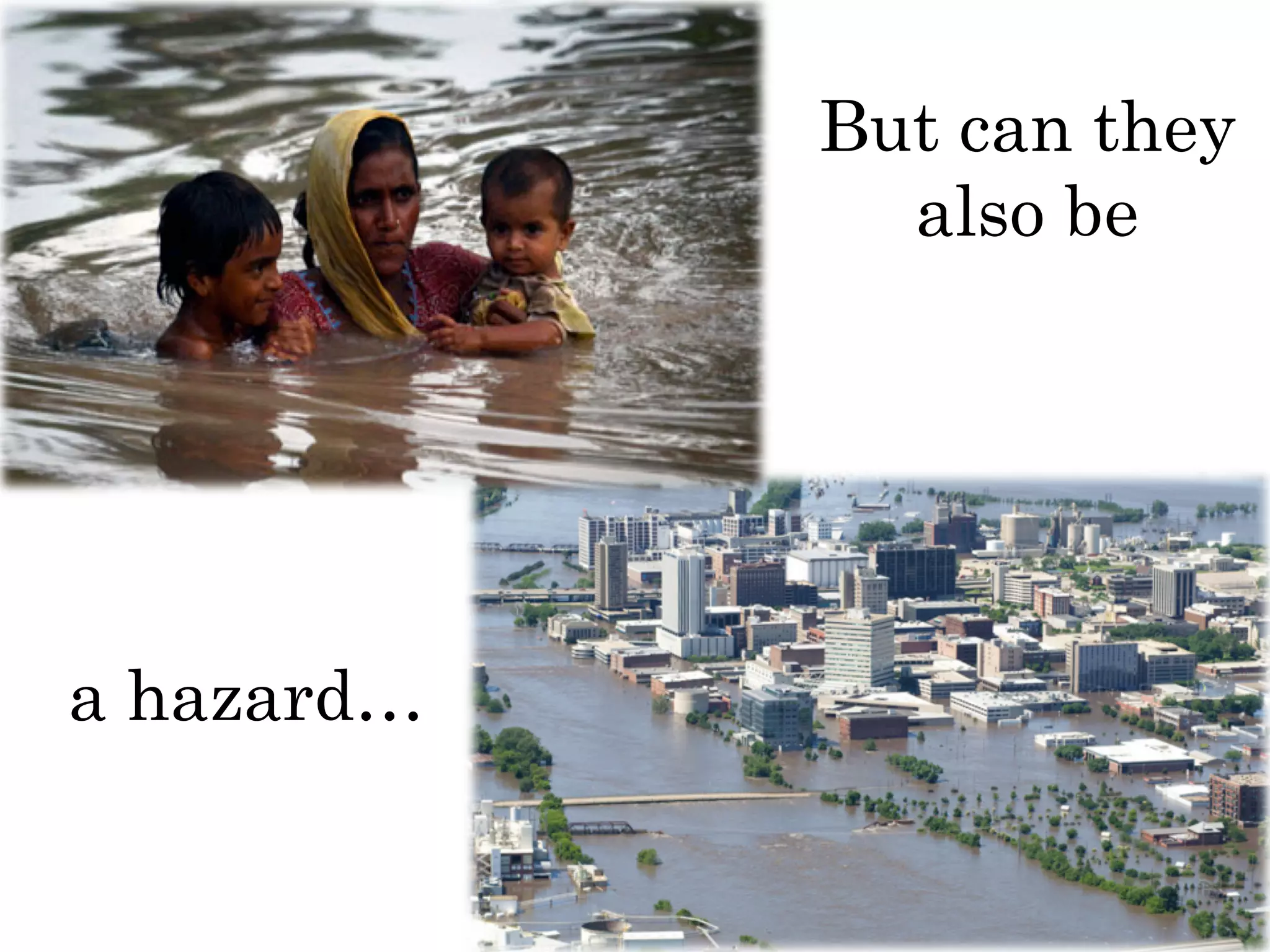
a hazard…
But can they
also be
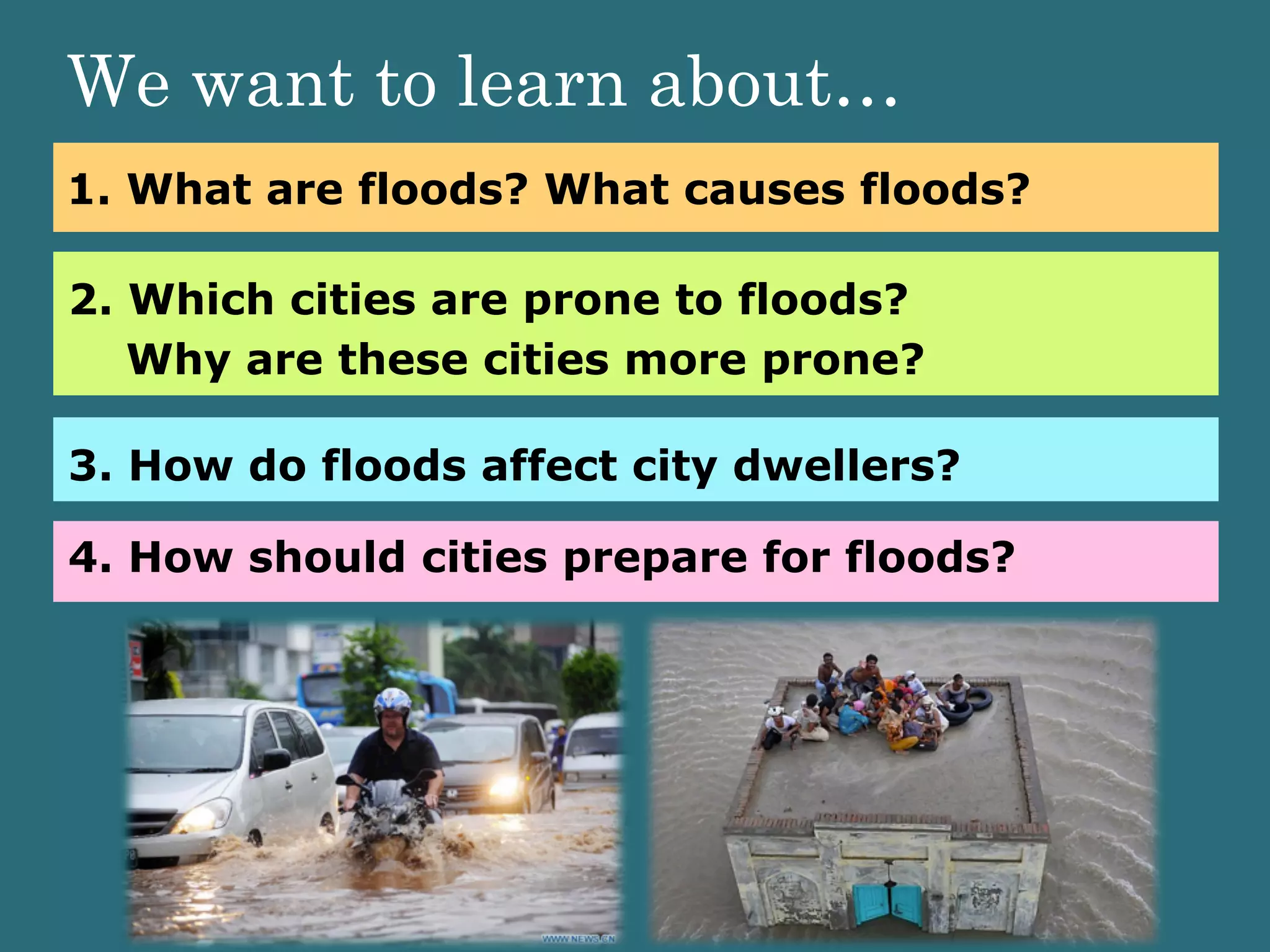
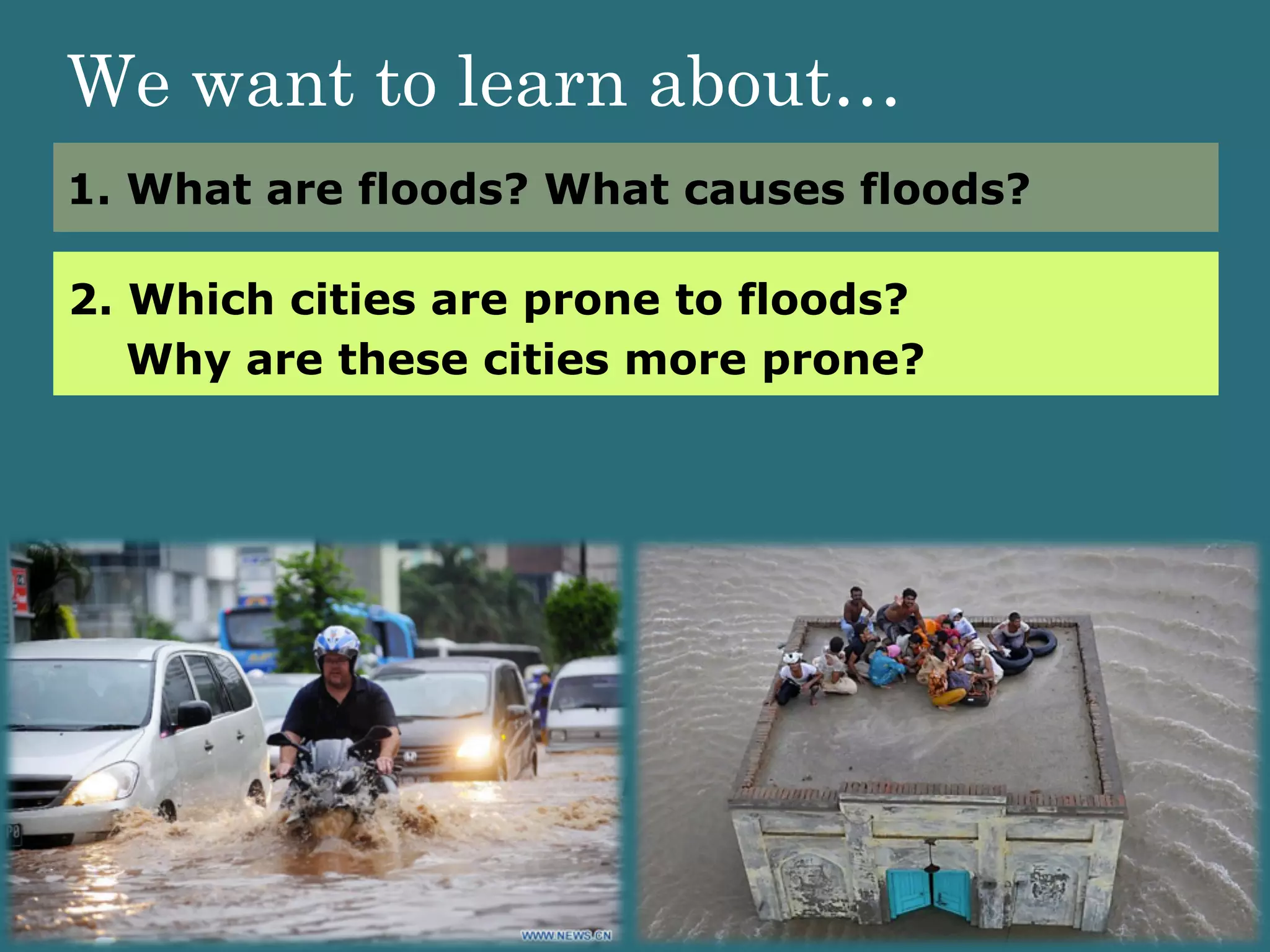
1. What are floods? What causes floods?
2. Which cities are prone to floods?
Why are these cities more prone?
3. How do floods affect city dwellers?
4. How should cities prepare for floods?
We want to learn about…
1. What are floods?
Definition:
Floods are large amounts of
water that overflows onto
land that is usually dry.
Geographical concept:
Scale
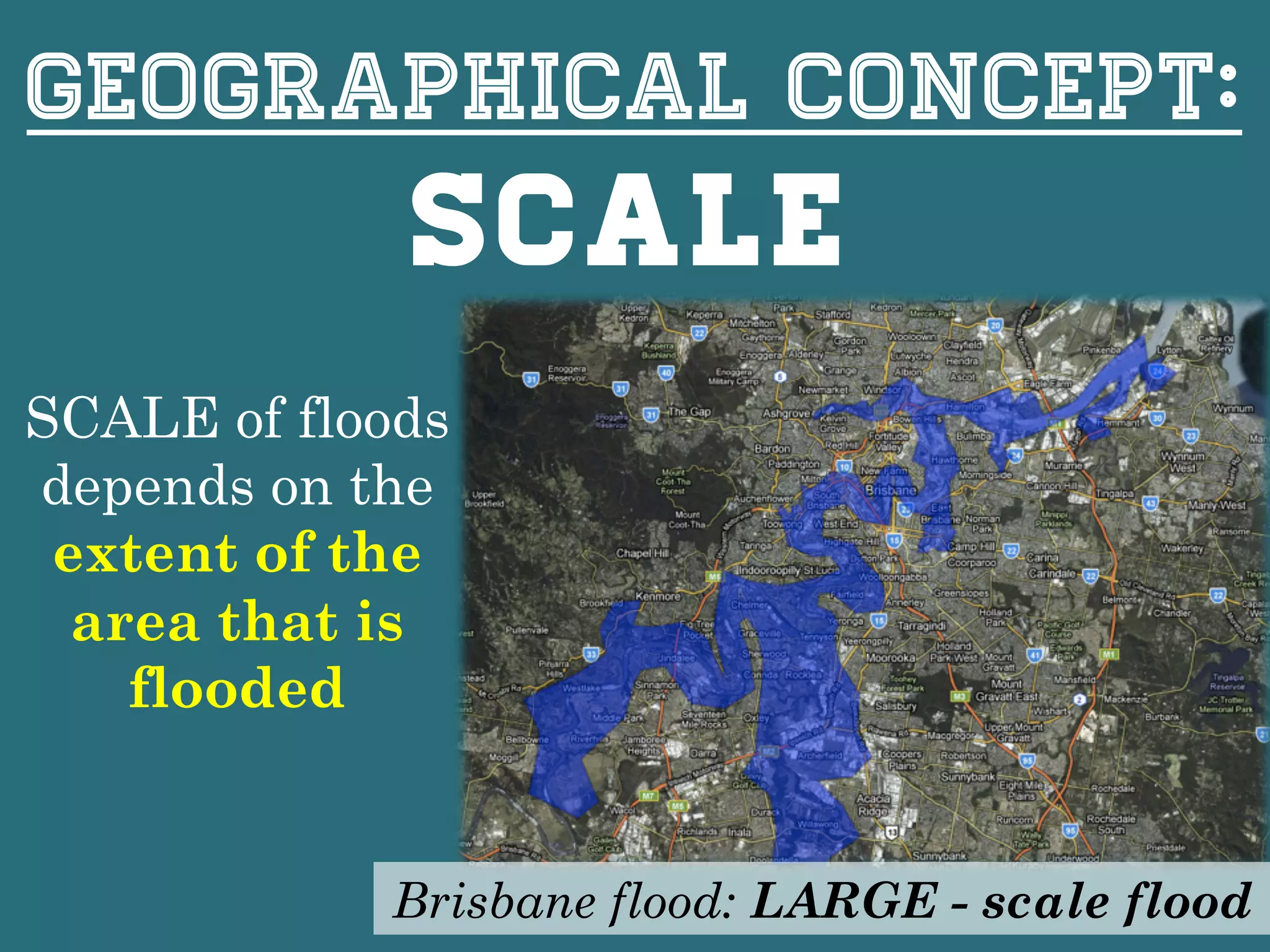
SCALE of floods
depends on the
extent of the
area that is
flooded
Brisbane flood: LARGE - scale flood
Geographical concept:
Scale
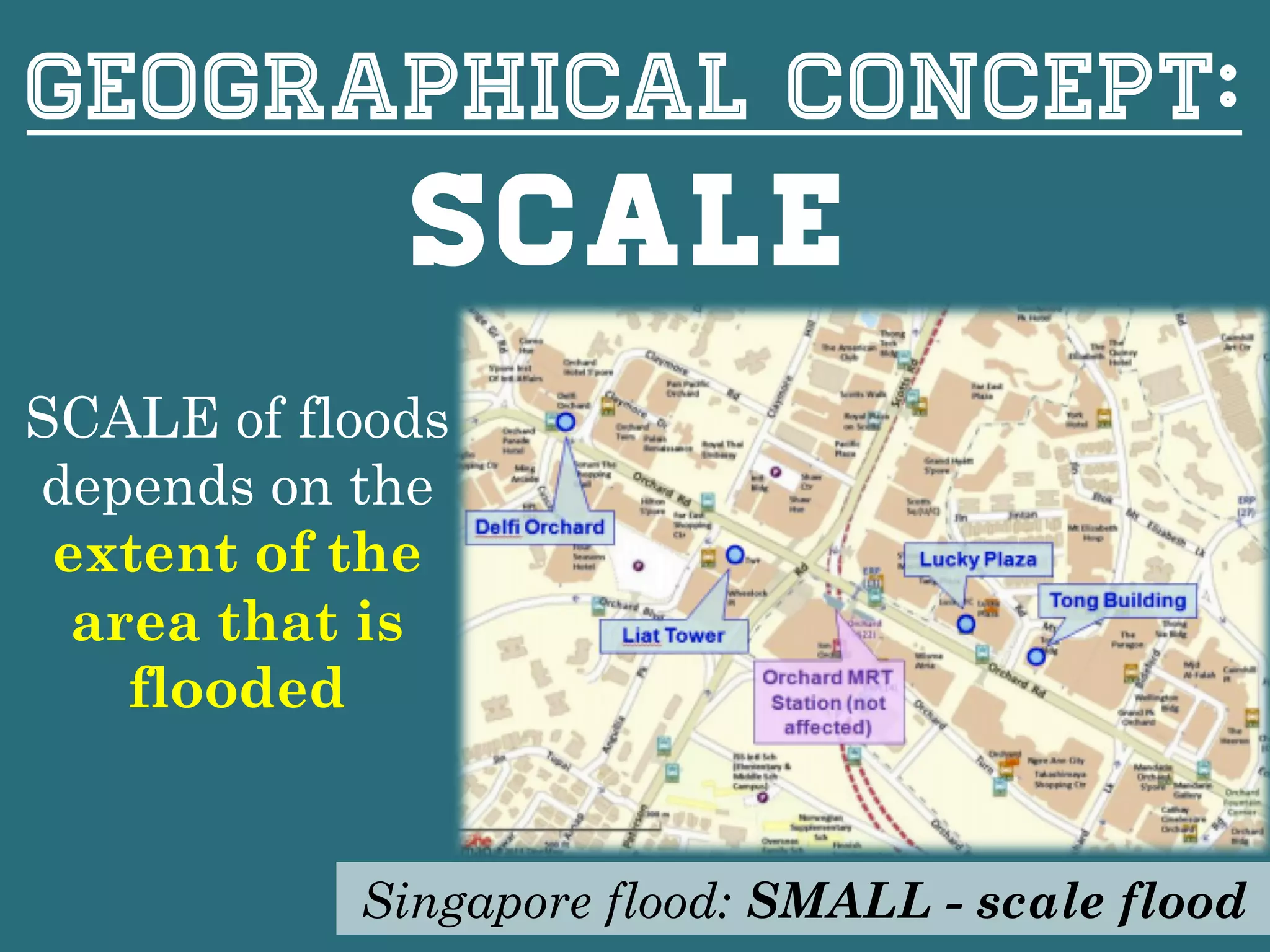
SCALE of floods
depends on the
extent of the
area that is
flooded
Singapore flood: SMALL - scale flood
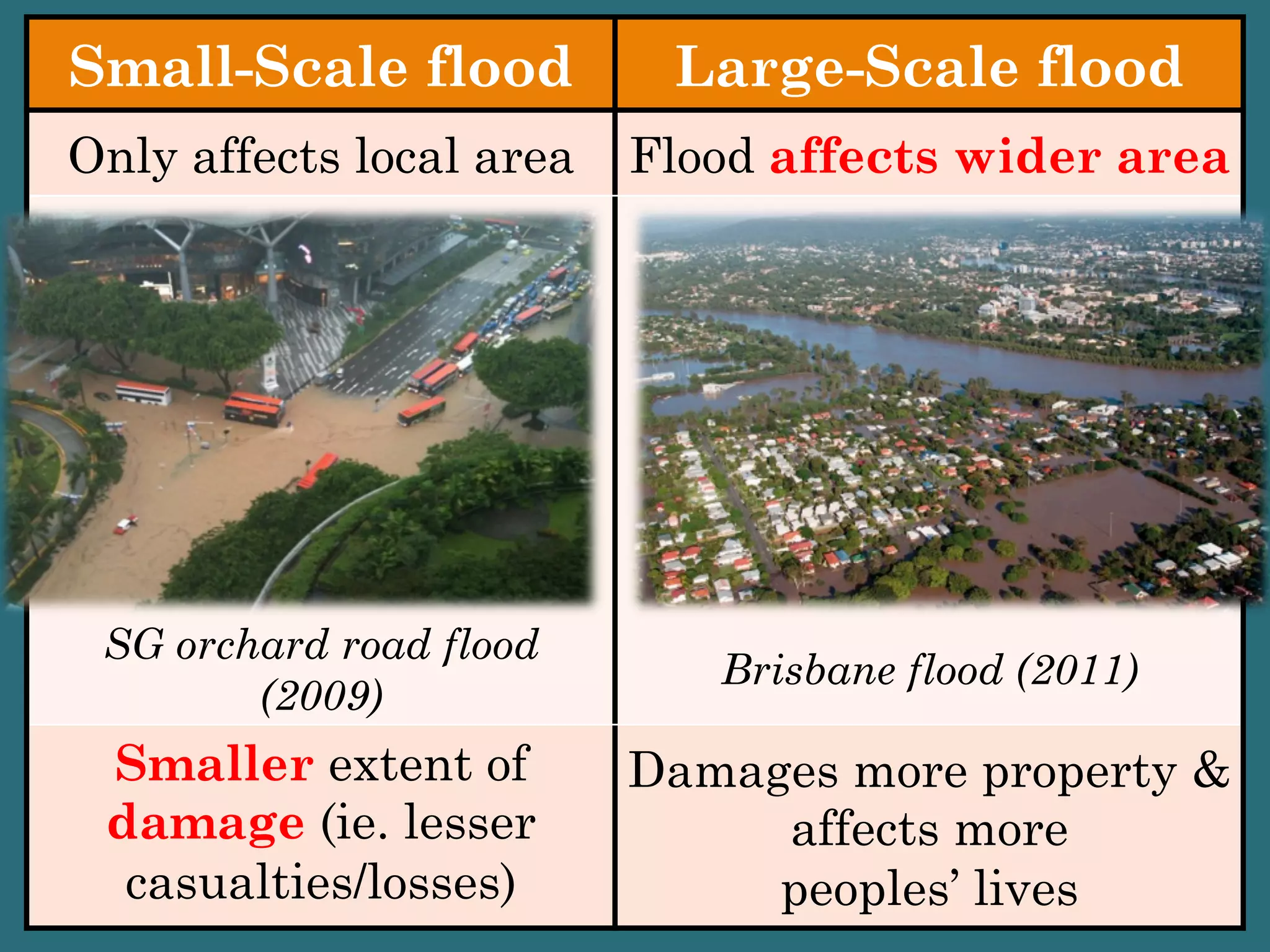
Small-Scale flood Large-Scale flood
Only affects local area Flood affects wider area
SG orchard road flood
(2009)
Brisbane flood (2011)
Smaller extent of
damage (ie. lesser
casualties/losses)
Damages more property &
affects more
peoples’ lives
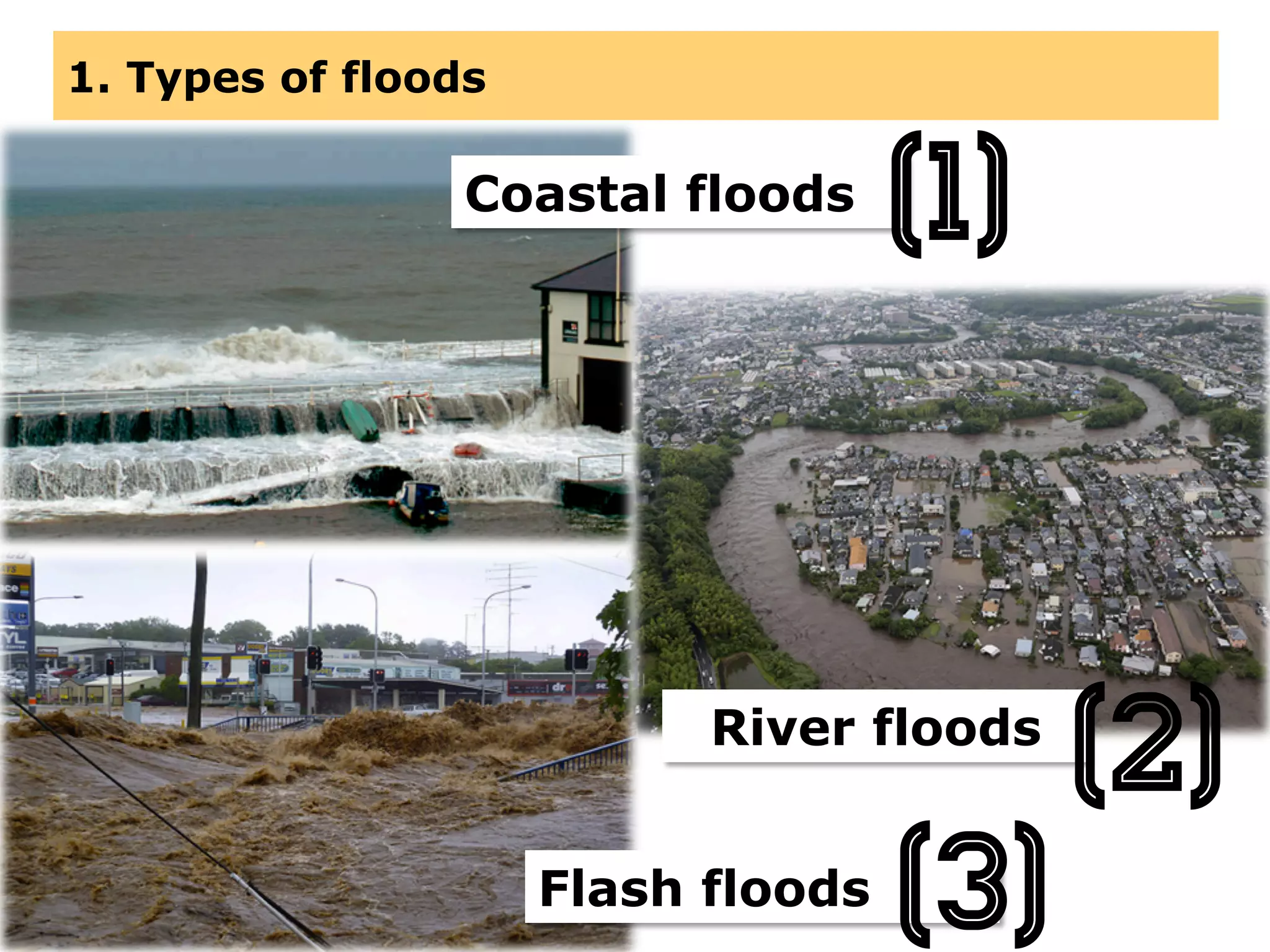
1. Types of floods
Flash floods
Coastal floods
(1)
River floods
(2)
(3)
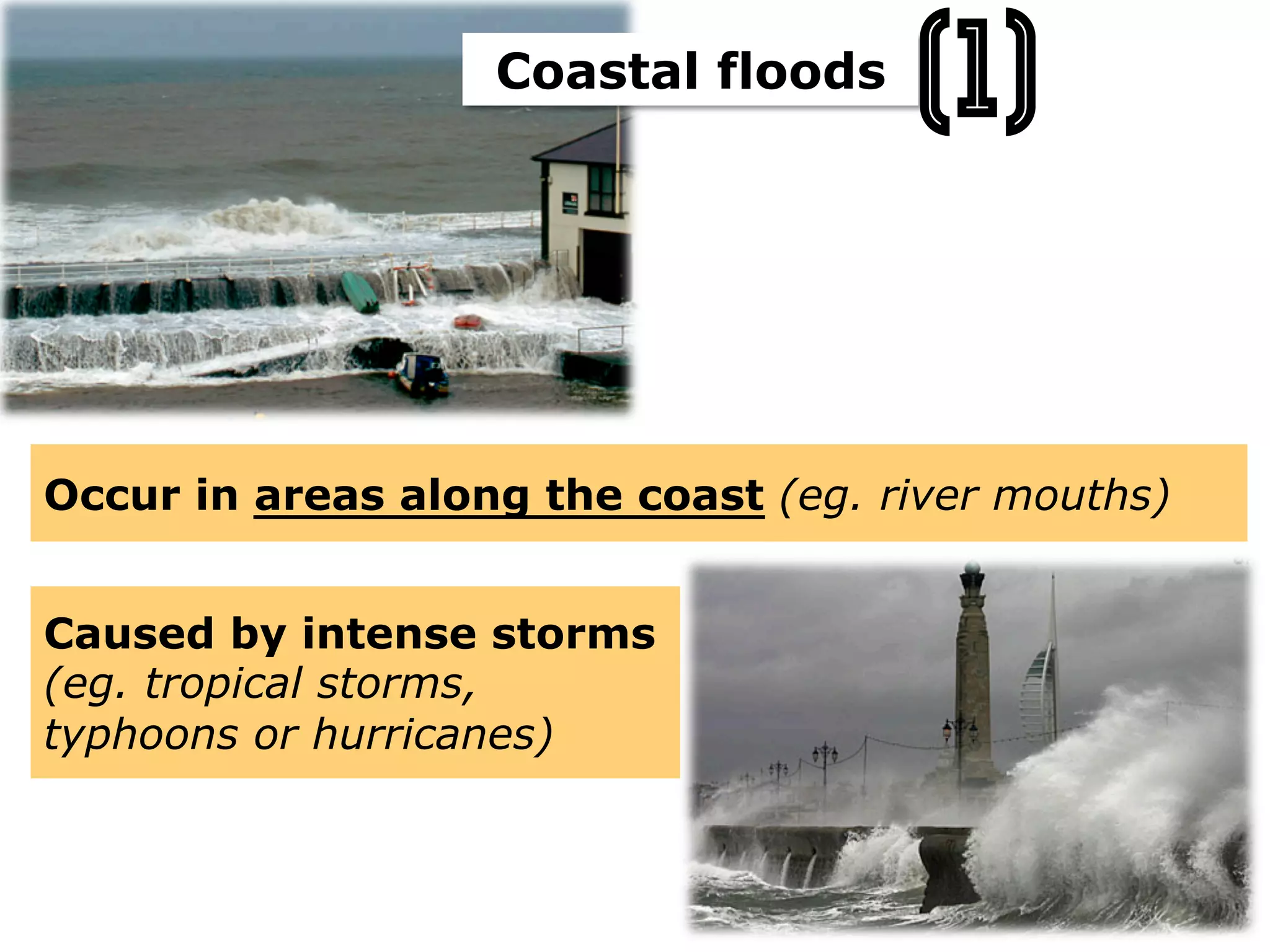
Occur in areas along the coast (eg. river mouths)
Caused by intense storms
(eg. tropical storms,
typhoons or hurricanes)
Coastal floods
(1)
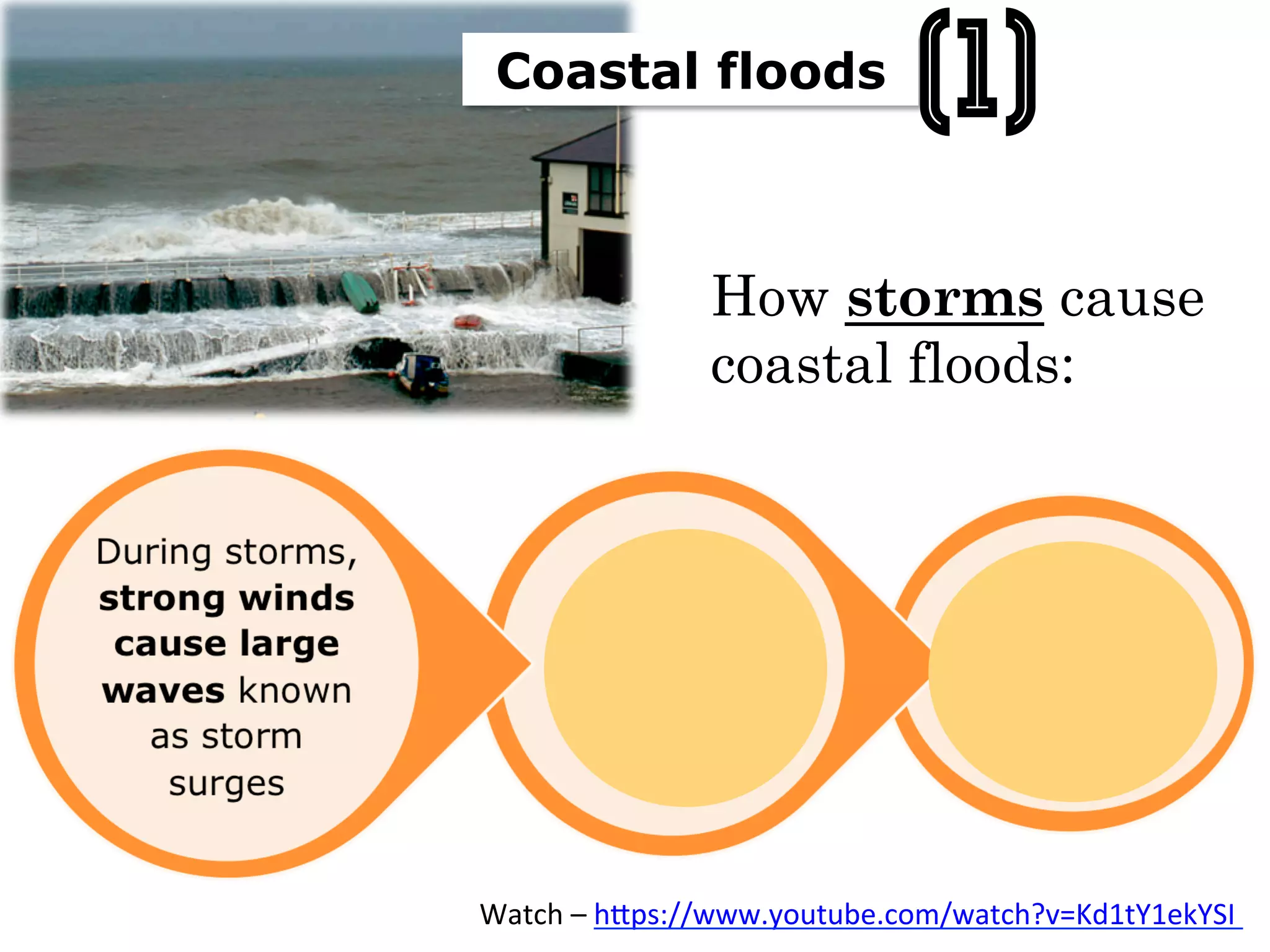
How storms cause
coastal floods:
Watch	
  –	
  h(ps://www.youtube.com/watch?v=Kd1tY1ekYSI	
  	
  
Coastal floods
(1)
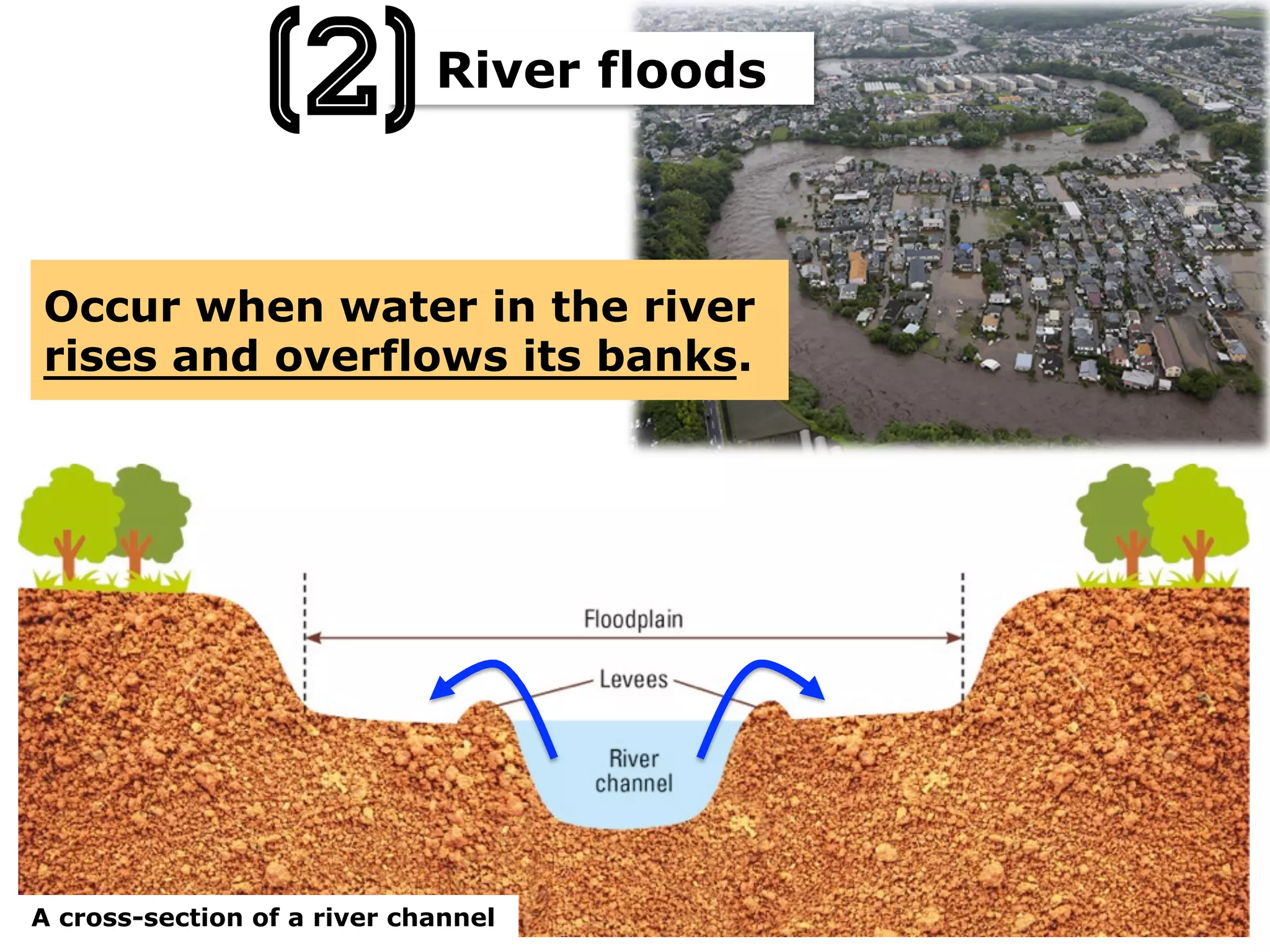
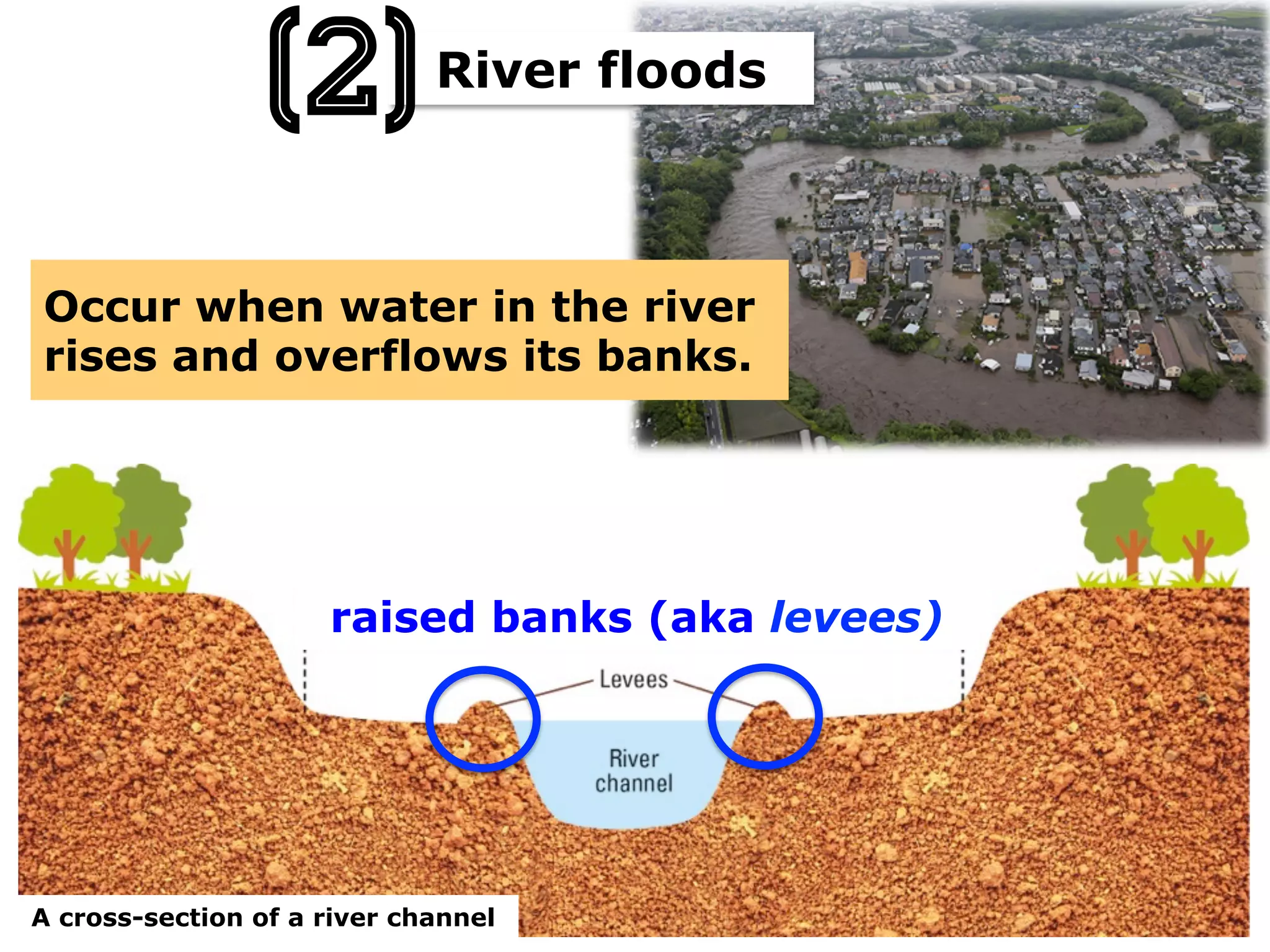
Occur when water in the river
rises and overflows its banks.
A cross-section of a river channel
River floods
(2)
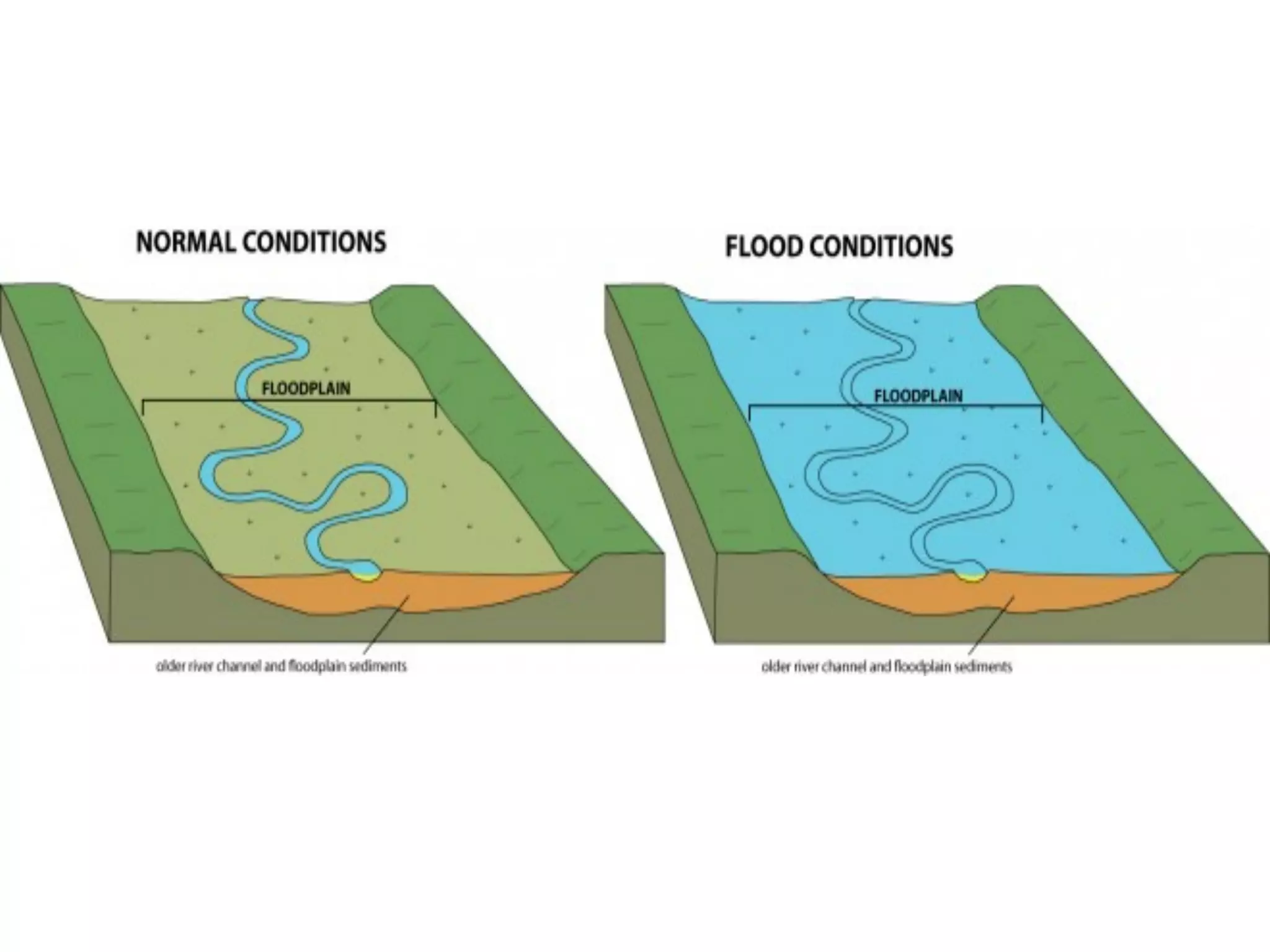
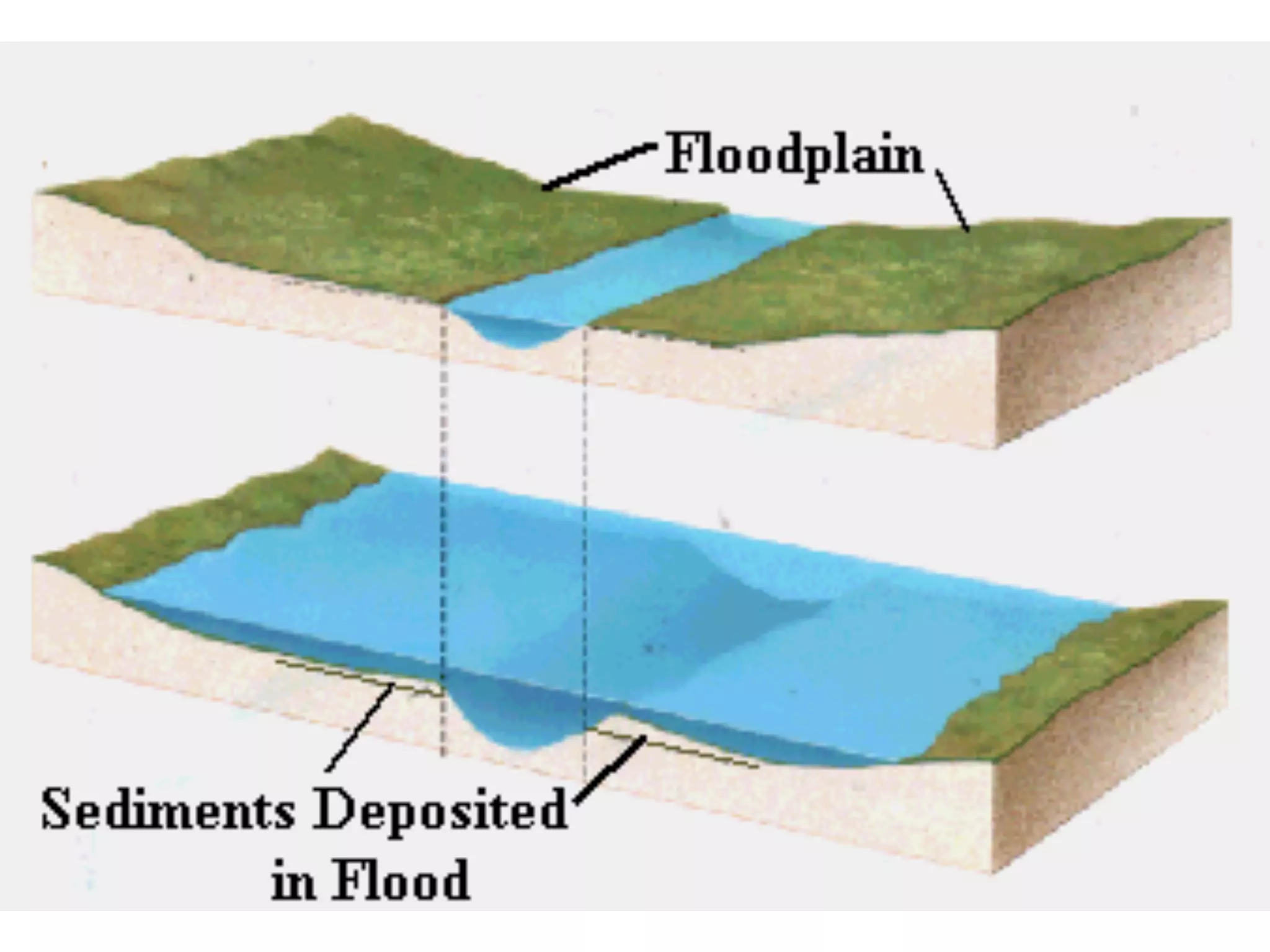
Occur when water in the river
rises and overflows its banks.
A cross-section of a river channel
raised banks (aka levees)
River floods
(2)
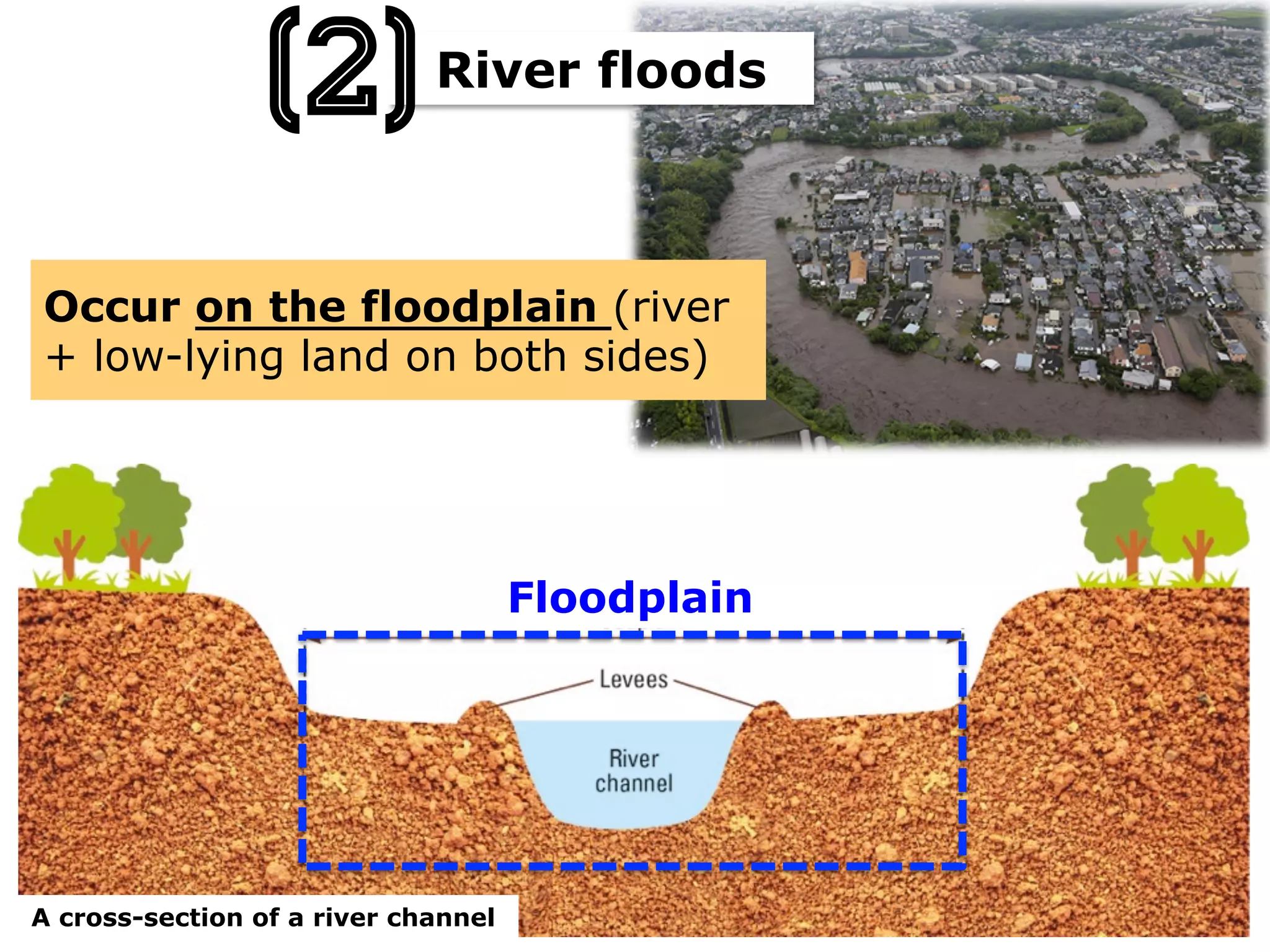
Occur on the floodplain (river
+ low-lying land on both sides)
A cross-section of a river channel
Floodplain
River floods
(2)
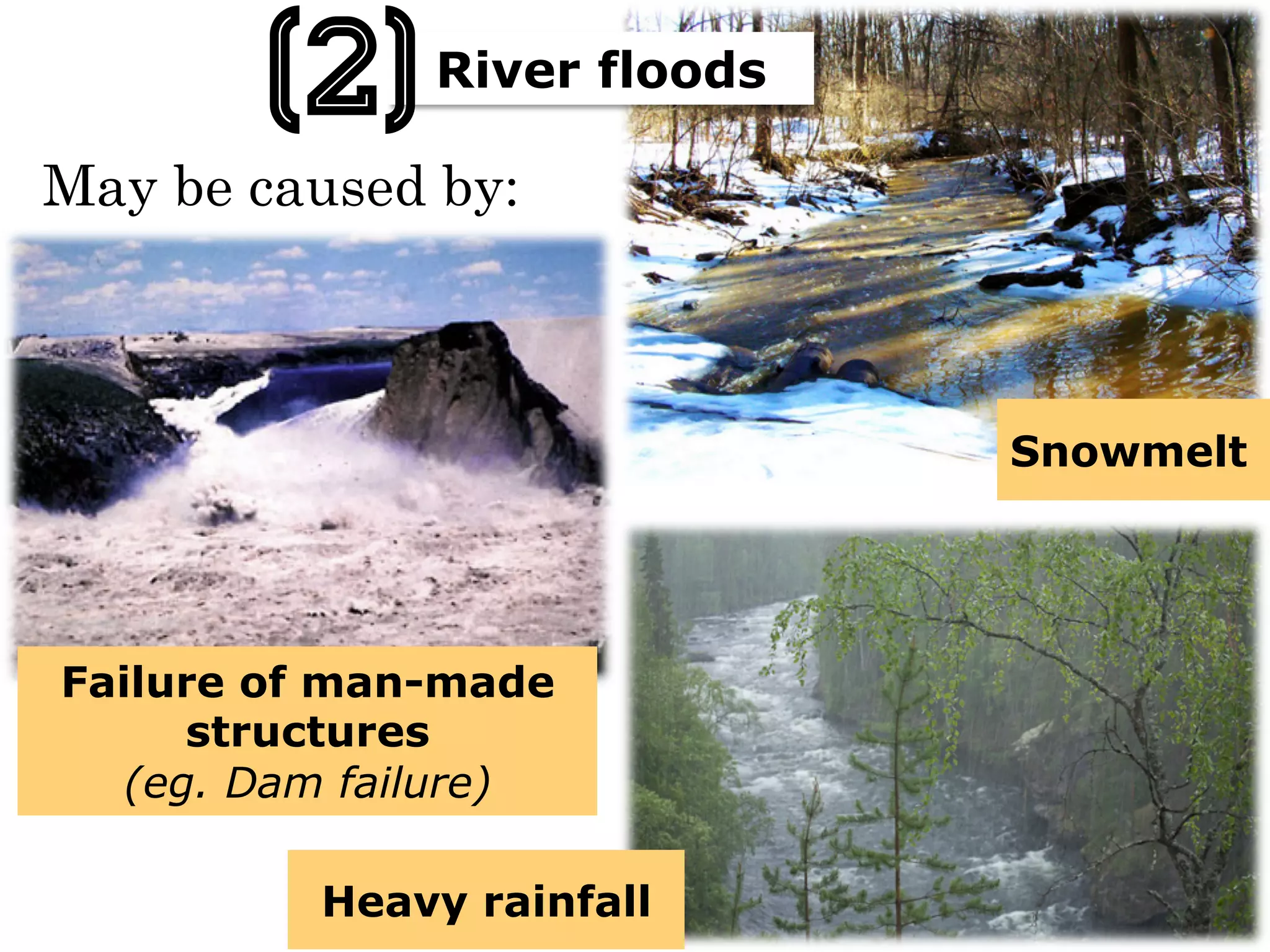
May be caused by:
Snowmelt
Failure of man-made
structures
(eg. Dam failure)
Heavy rainfall
River floods
(2)
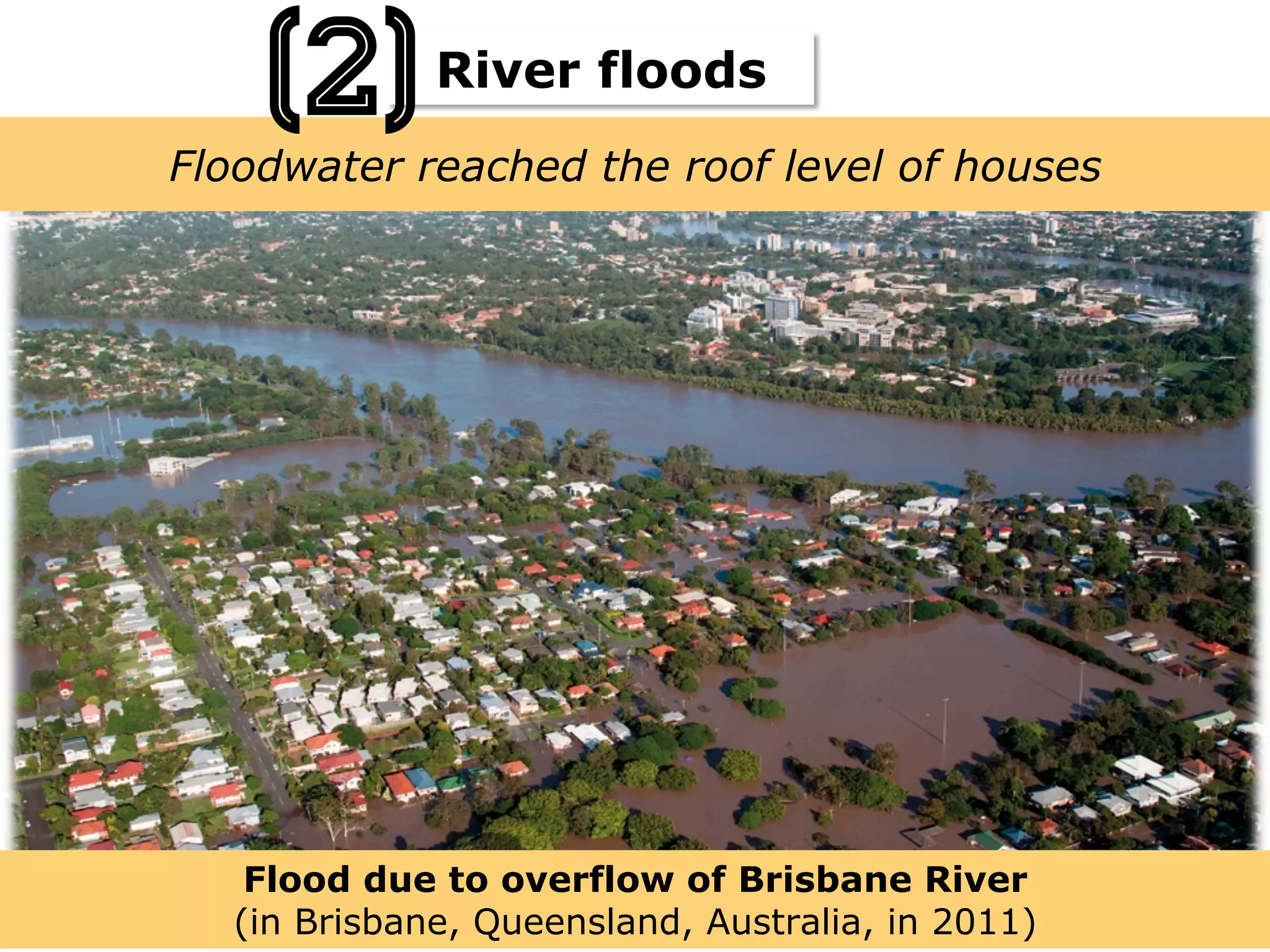
Floodwater reached the roof level of houses
Flood due to overflow of Brisbane River
(in Brisbane, Queensland, Australia, in 2011)
River floods
(2)
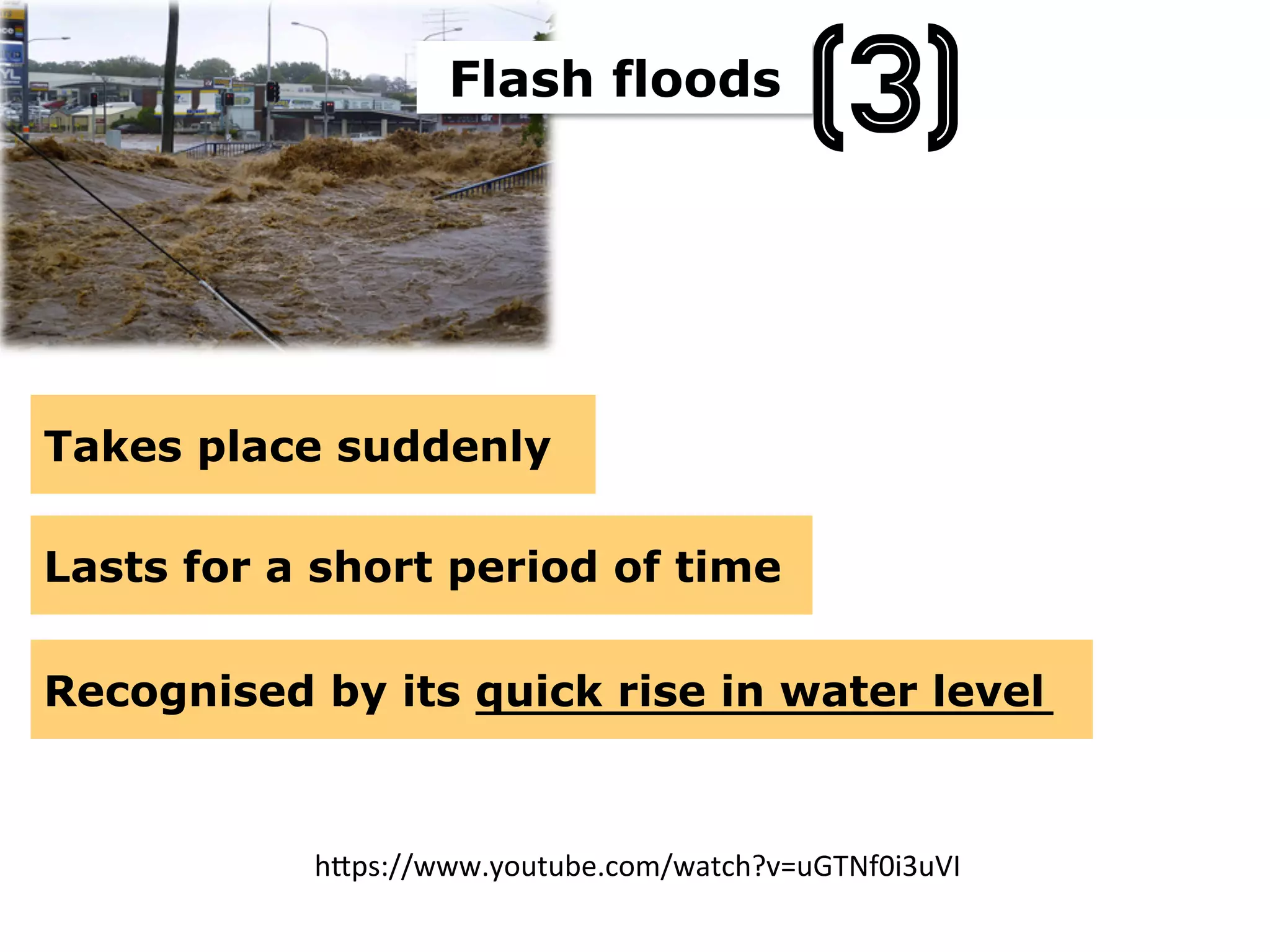
Flash floods
Takes place suddenly
Lasts for a short period of time
Recognised by its quick rise in water level
(3)
h(ps://www.youtube.com/watch?v=uGTNf0i3uVI	
  
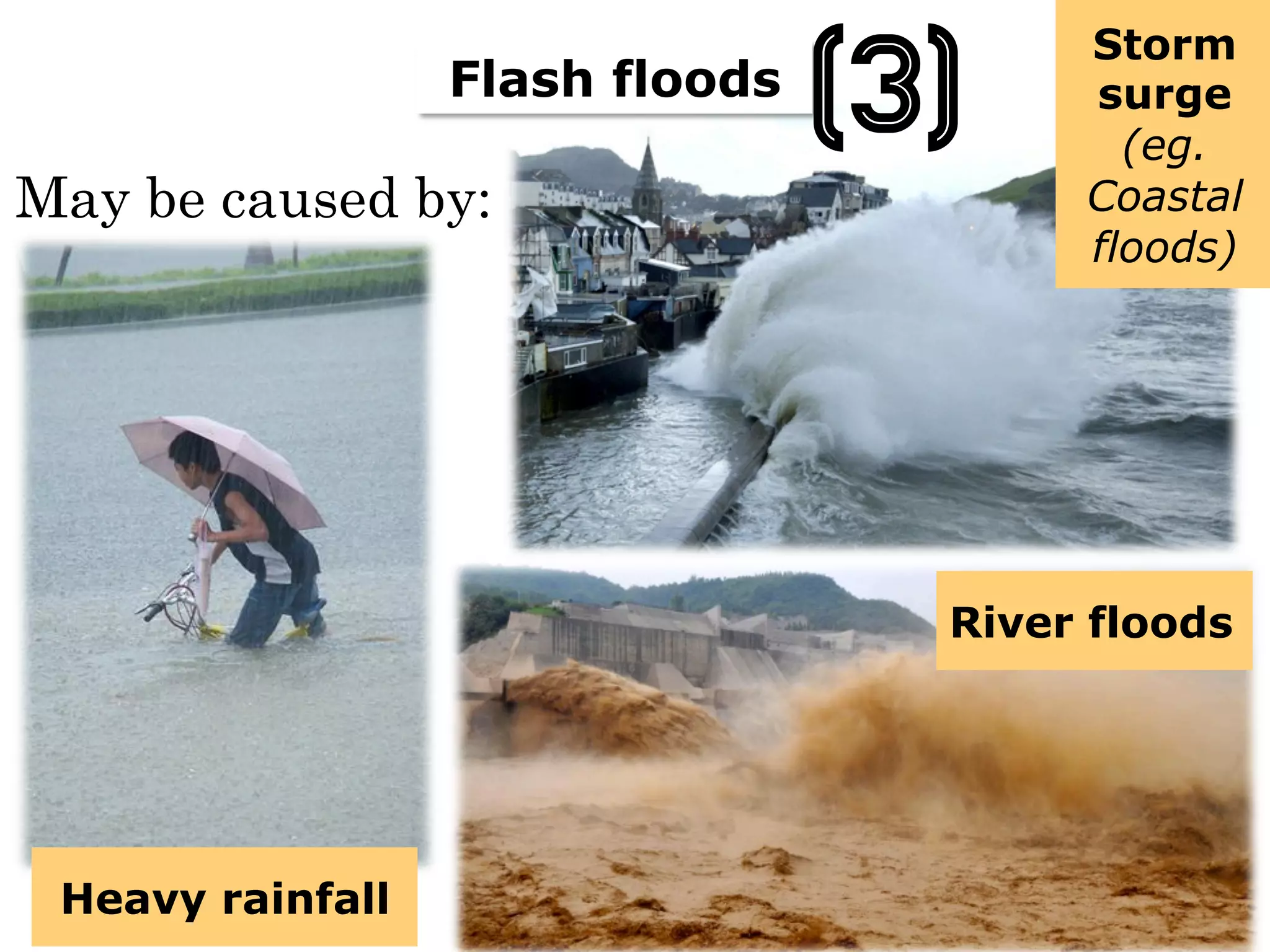
Flash floods
River floods
(3)
May be caused by:
Heavy rainfall
Storm
surge
(eg.
Coastal
floods)
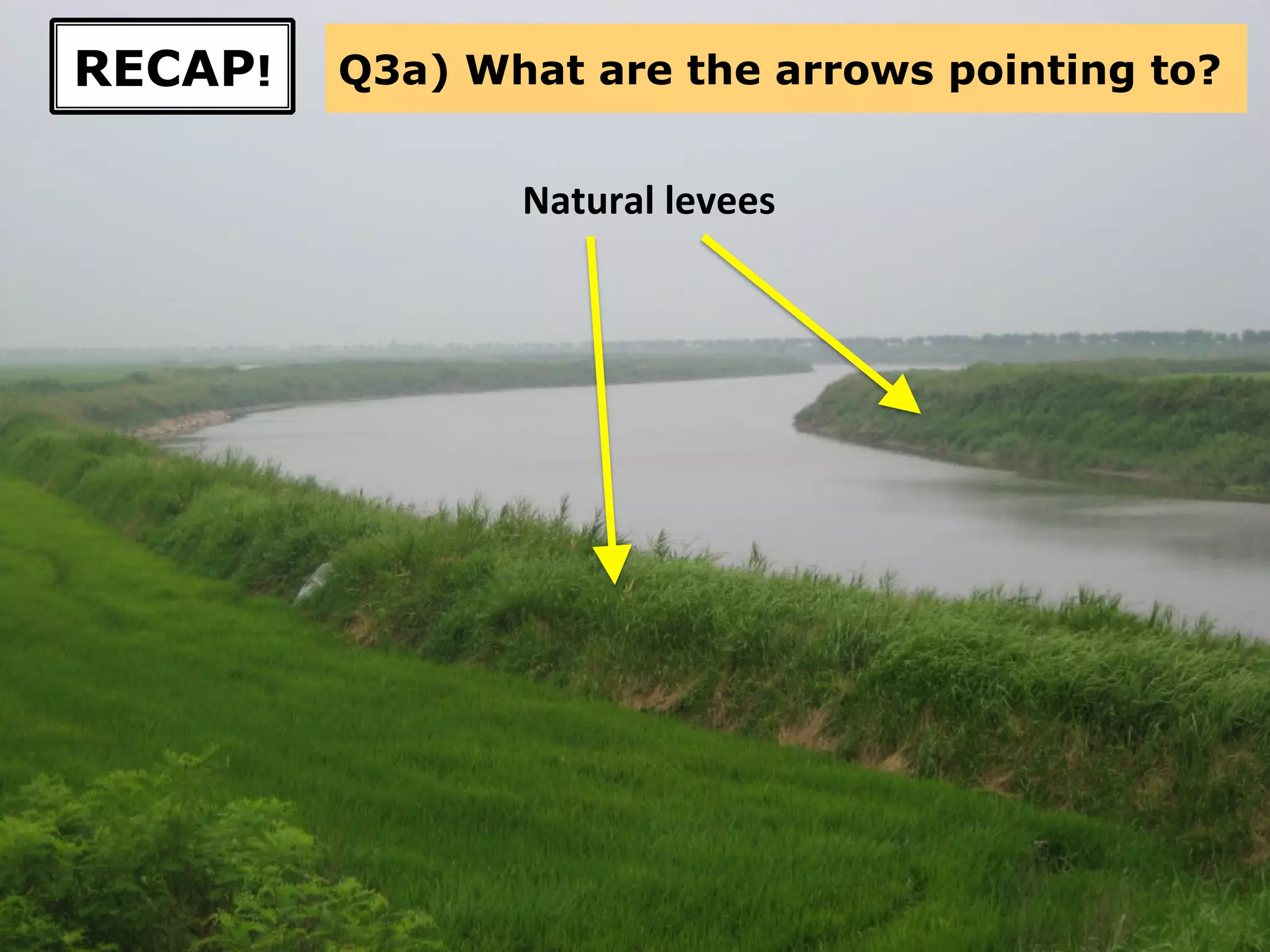
Q3a) What are the arrows pointing to?RECAP!
Natural	
  levees	
  
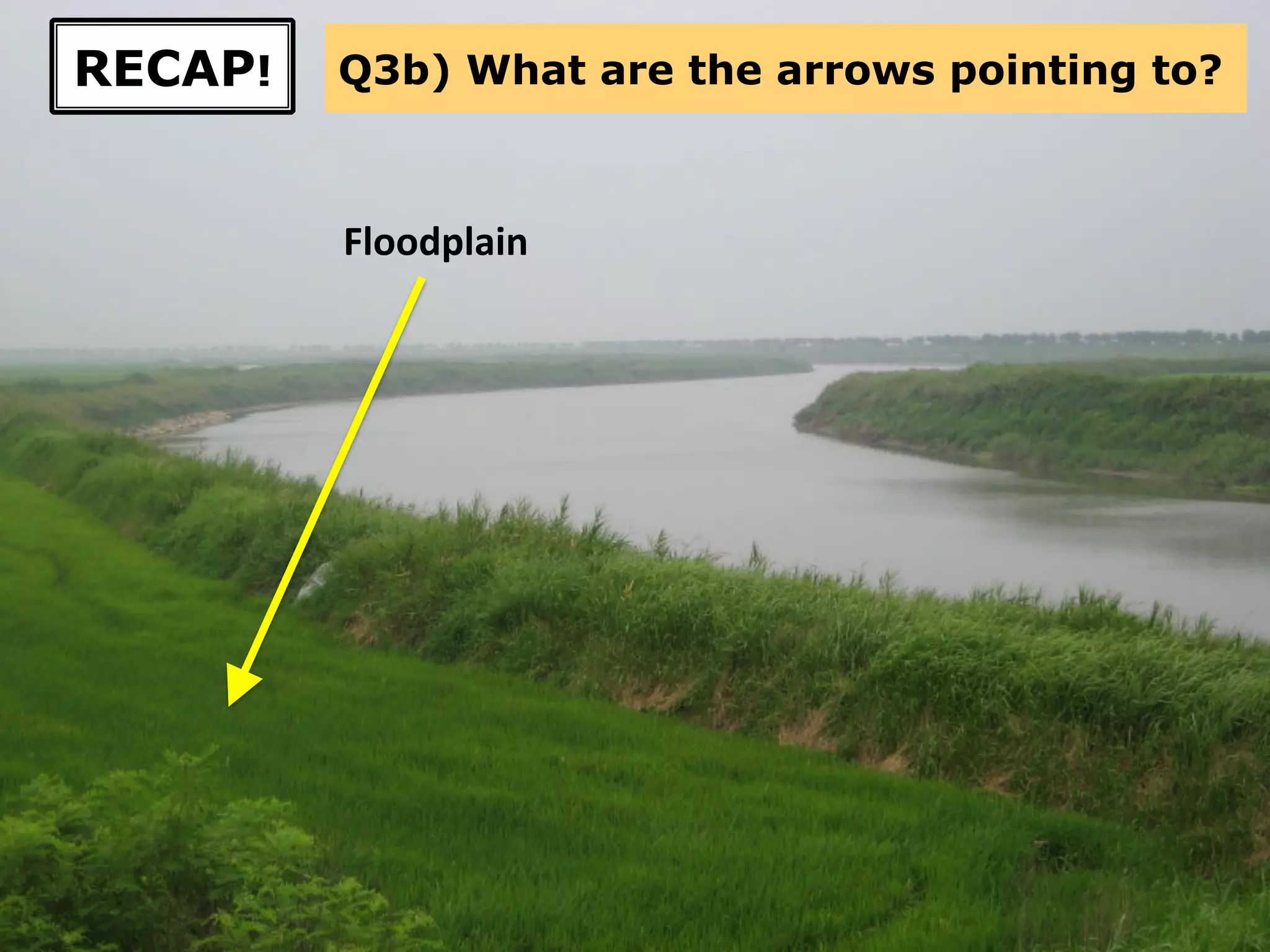
Q3b) What are the arrows pointing to?RECAP!
Floodplain	
  
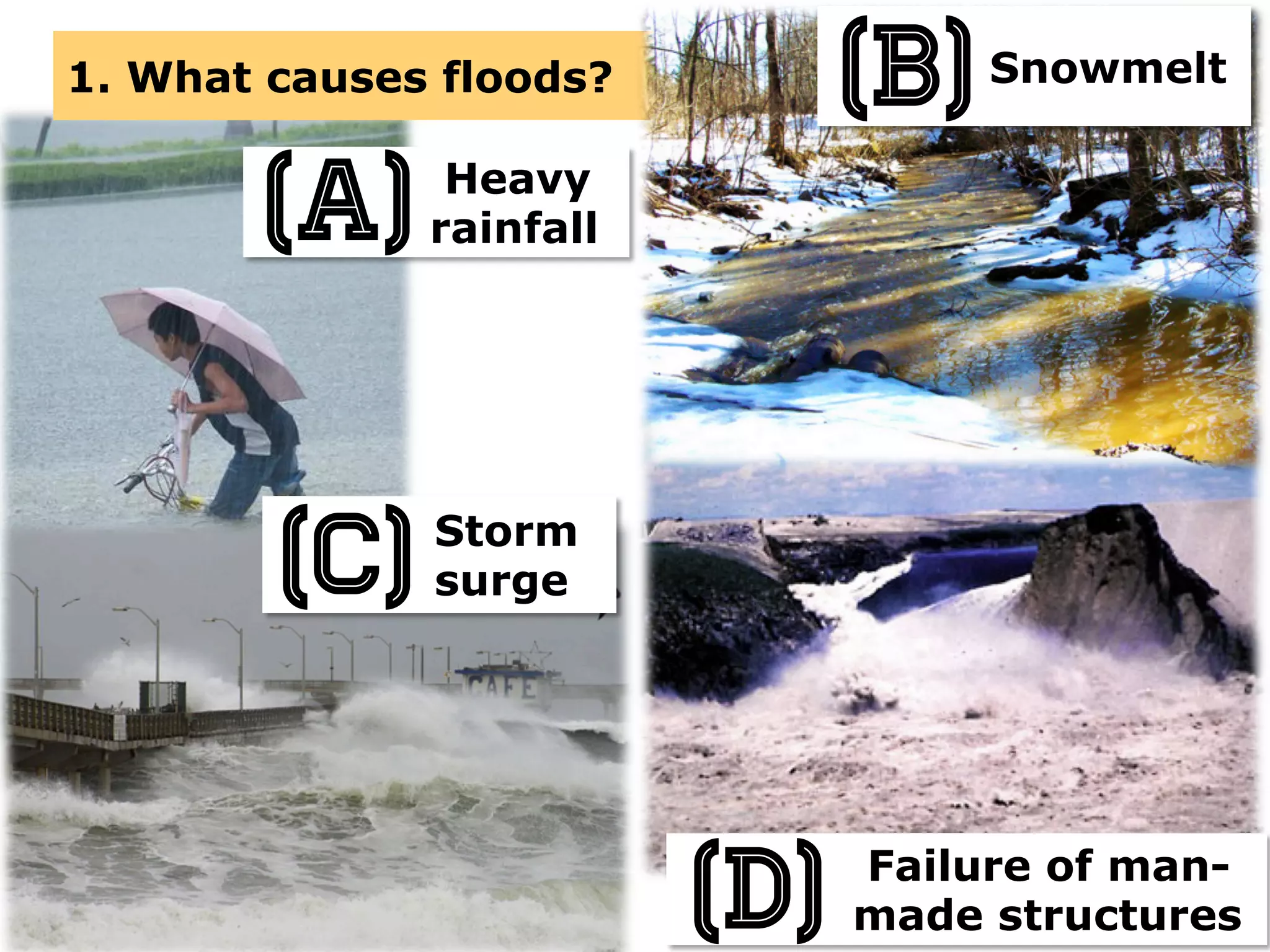
Failure of man-
made structures
Heavy
rainfall
Storm
surge
1. What causes floods? Snowmelt
(a)
(B)
(C)
(D)
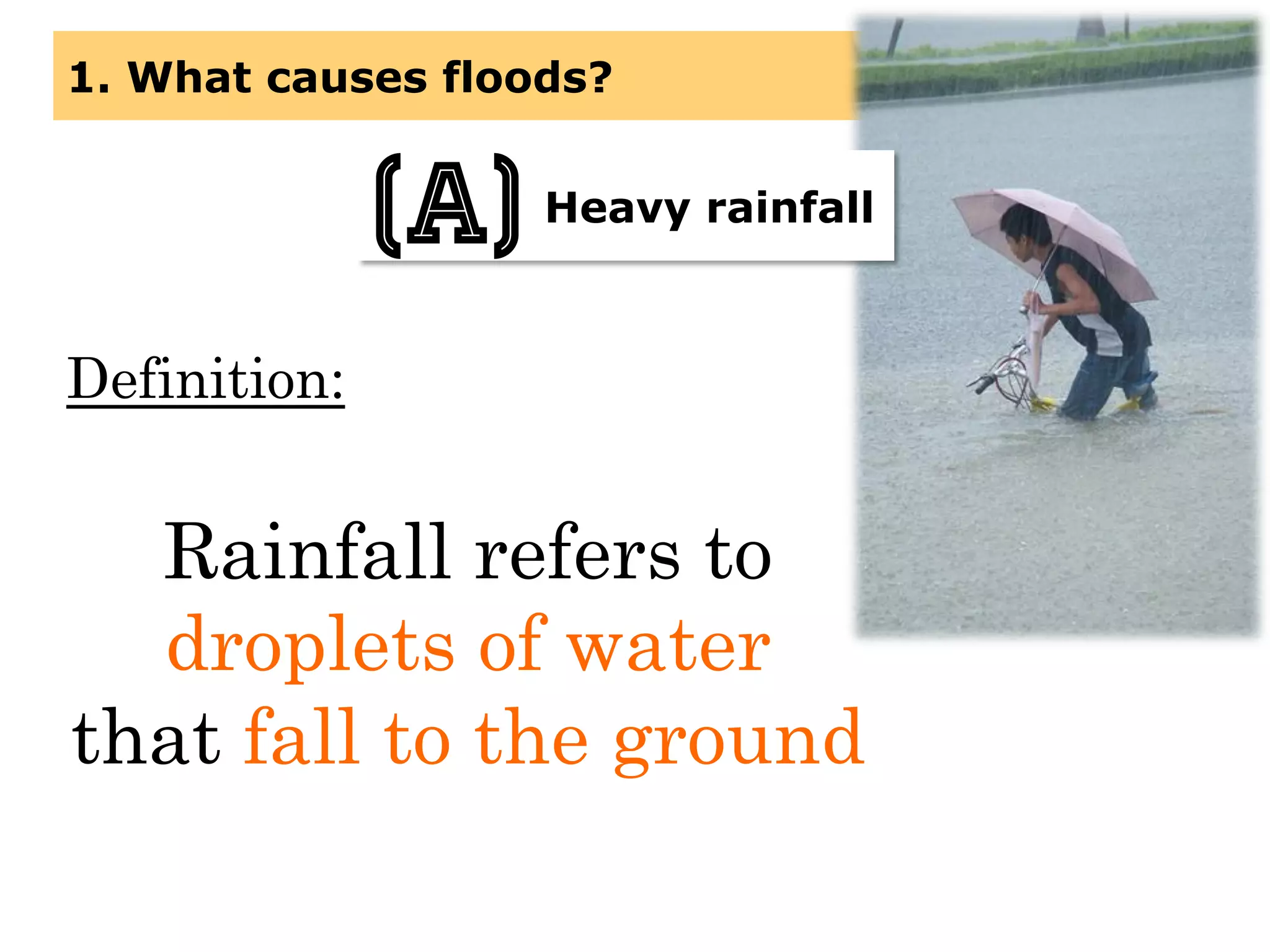
Definition:
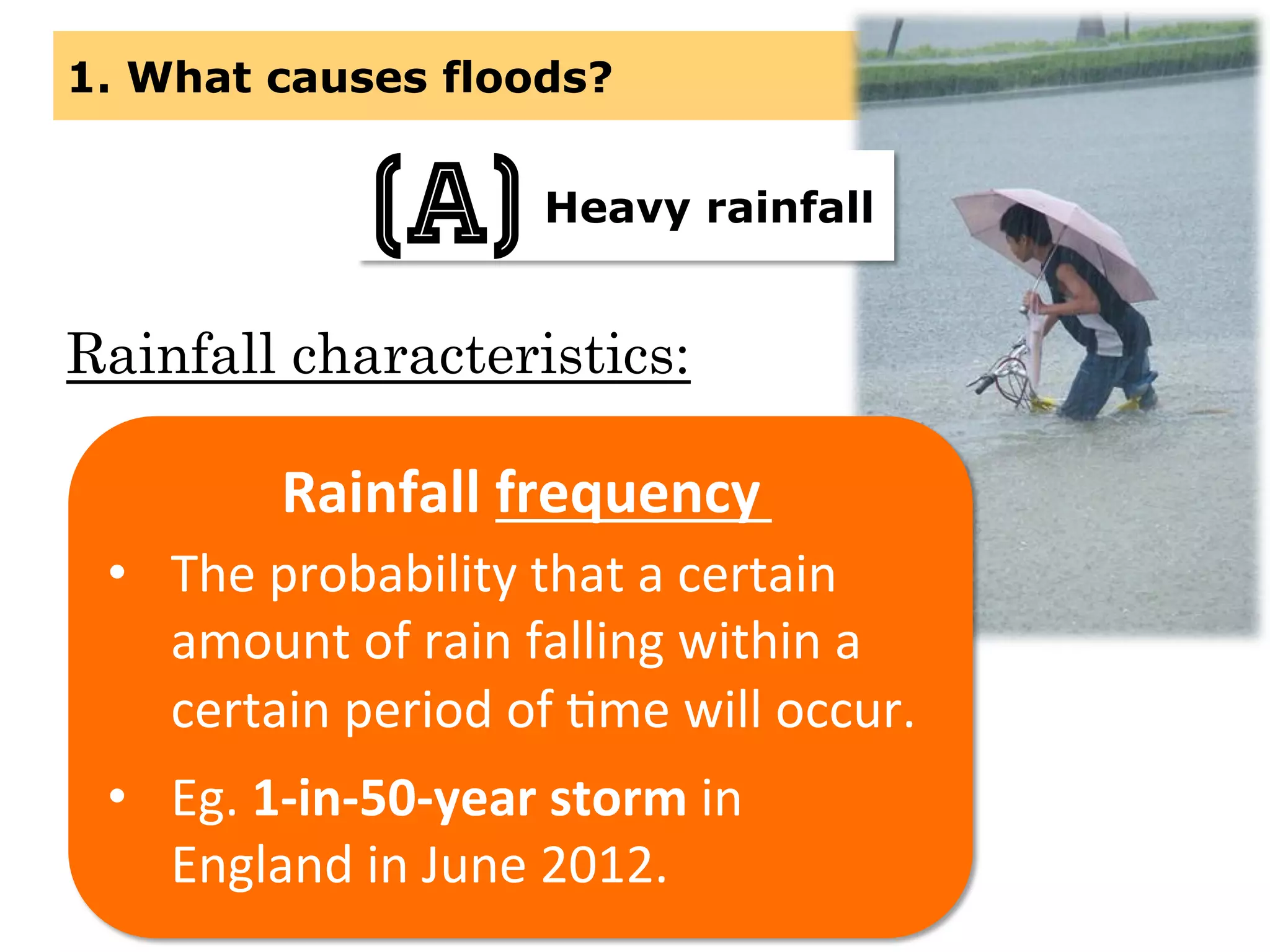
Rainfall refers to
droplets of water
that fall to the ground
1. What causes floods?
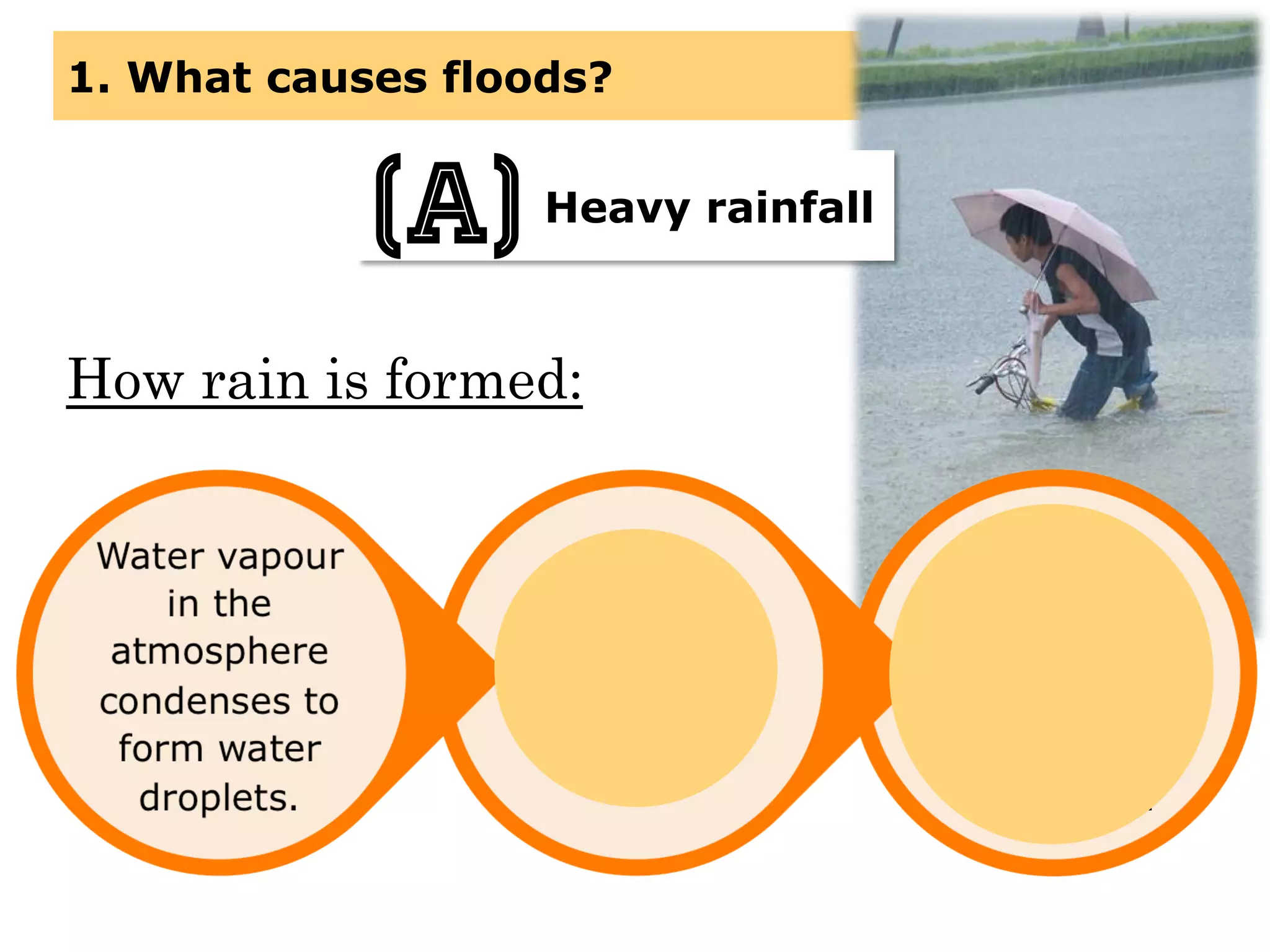
Heavy rainfall(a)
How rain is formed:
1. What causes floods?
Heavy rainfall(a)
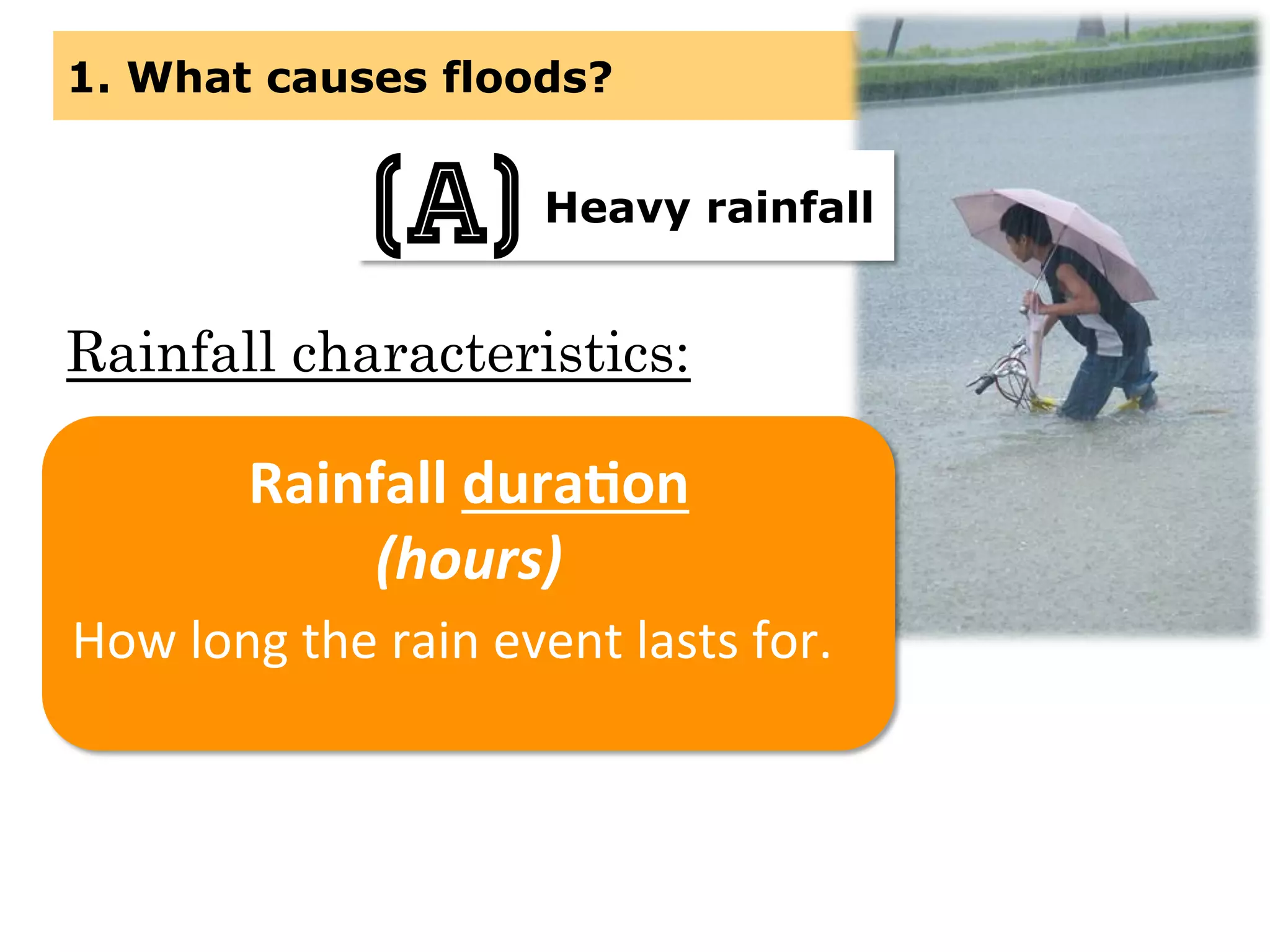
Rainfall characteristics:
1. What causes floods?
Heavy rainfall(a)
Rainfall	
  dura3on	
  	
  
(hours)	
  
How	
  long	
  the	
  rain	
  event	
  lasts	
  for.	
  
Rainfall characteristics:
1. What causes floods?
Heavy rainfall(a)
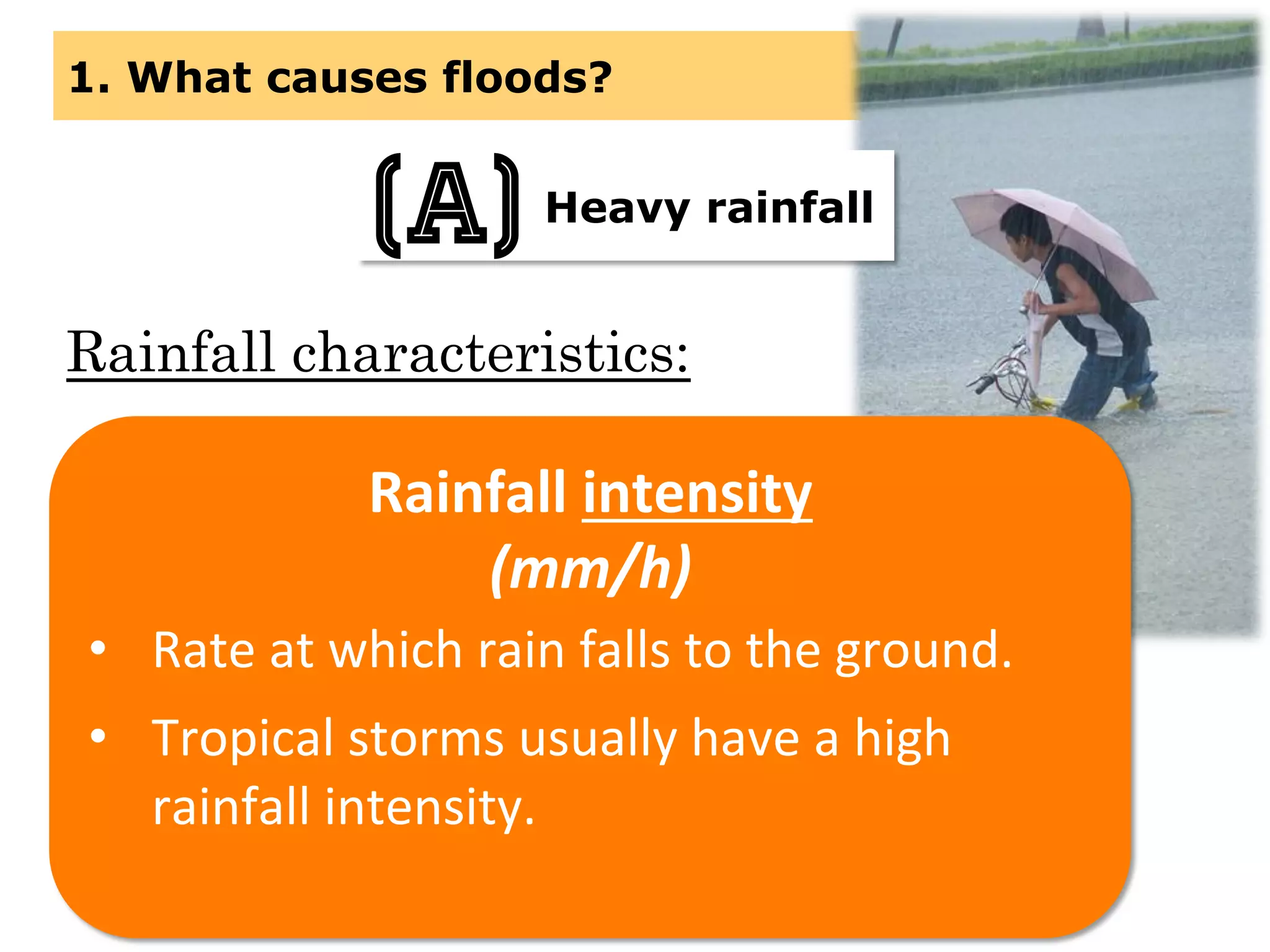
Rainfall	
  intensity	
  	
  
(mm/h)	
  
•  Rate	
  at	
  which	
  rain	
  falls	
  to	
  the	
  ground.	
  	
  
•  Tropical	
  storms	
  usually	
  have	
  a	
  high	
  
rainfall	
  intensity.	
  
Rainfall characteristics:
1. What causes floods?
Heavy rainfall(a)
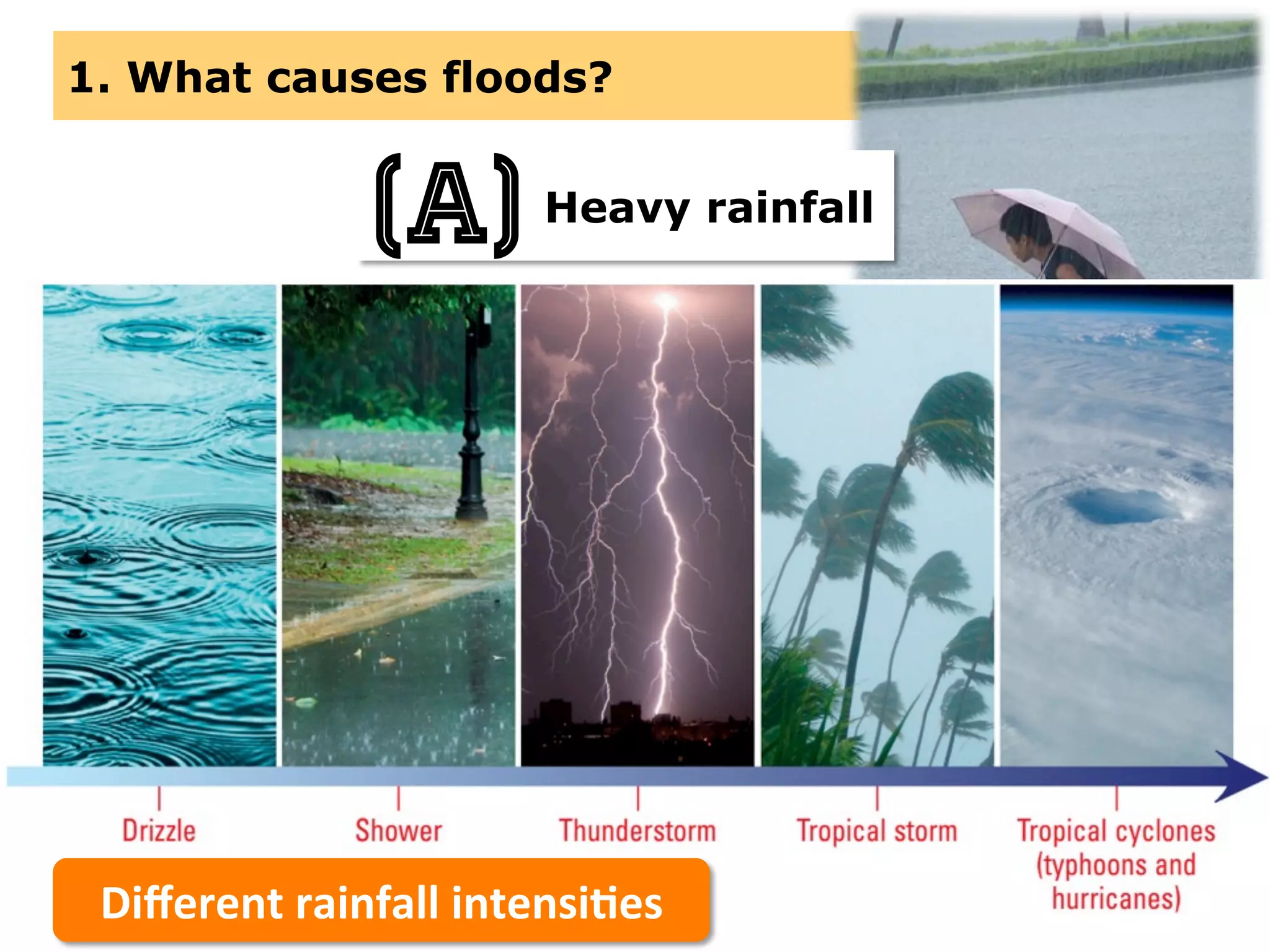
Different	
  rainfall	
  intensi3es	
  
1. What causes floods?
Heavy rainfall(a)
Rainfall characteristics:
Rainfall	
  frequency	
  
•  The	
  probability	
  that	
  a	
  certain	
  
amount	
  of	
  rain	
  falling	
  within	
  a	
  
certain	
  period	
  of	
  Mme	
  will	
  occur.	
  
•  Eg.	
  1-­‐in-­‐50-­‐year	
  storm	
  in	
  
England	
  in	
  June	
  2012.	
  	
  
1. What causes floods?
Heavy rainfall(a)
Rainfall characteristics:
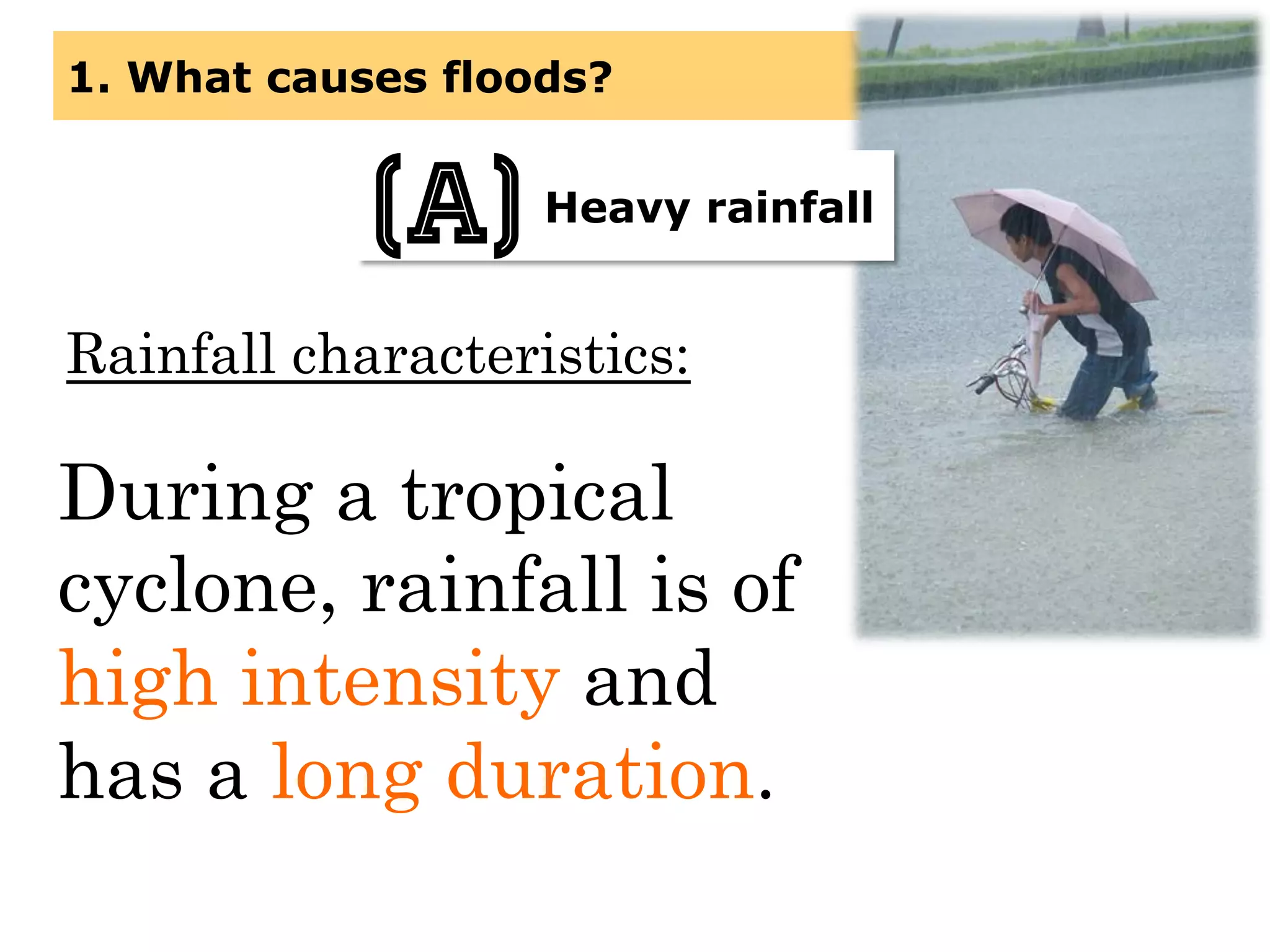
During a tropical
cyclone, rainfall is of
high intensity and
has a long duration.
Definition:
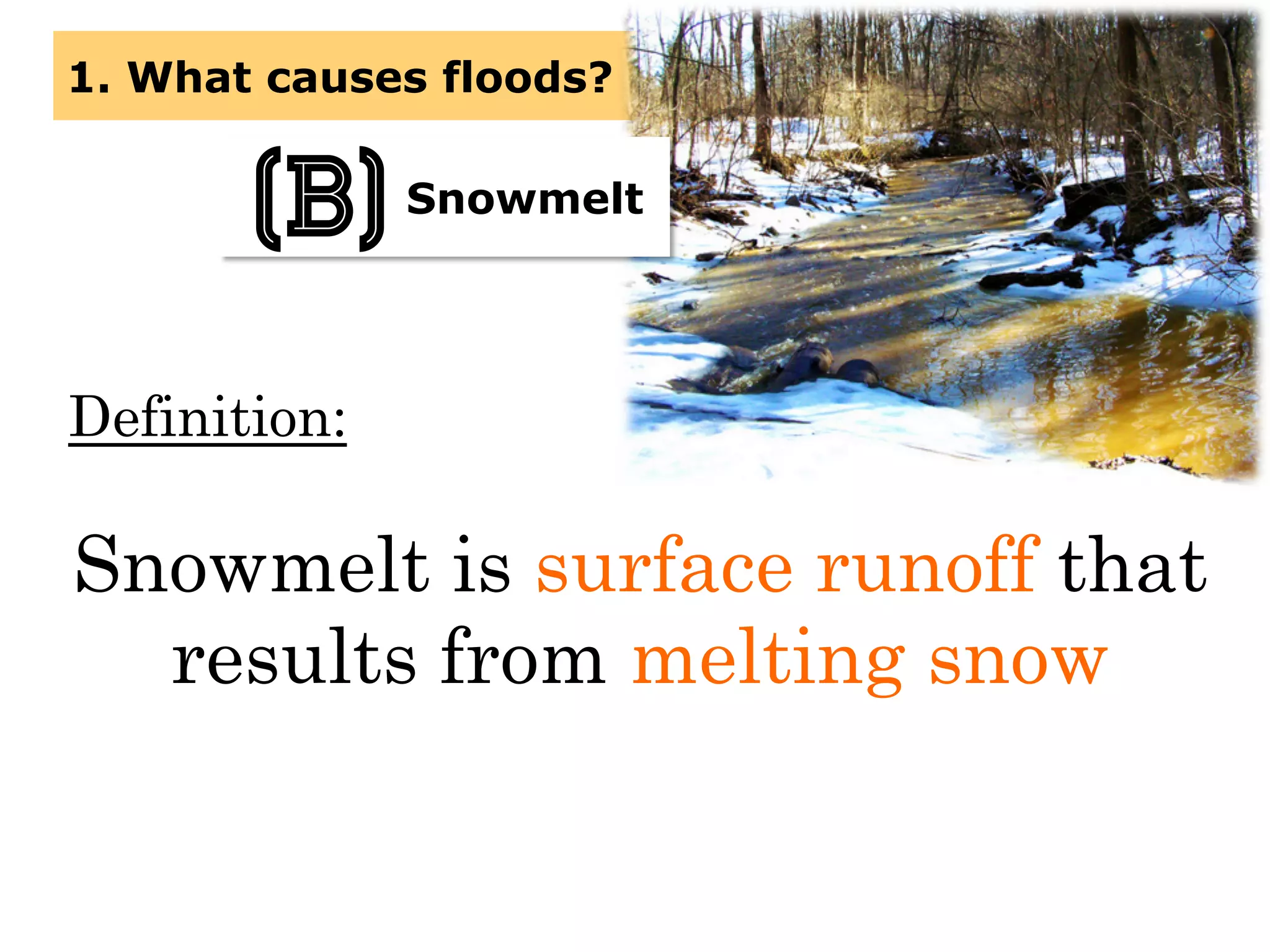
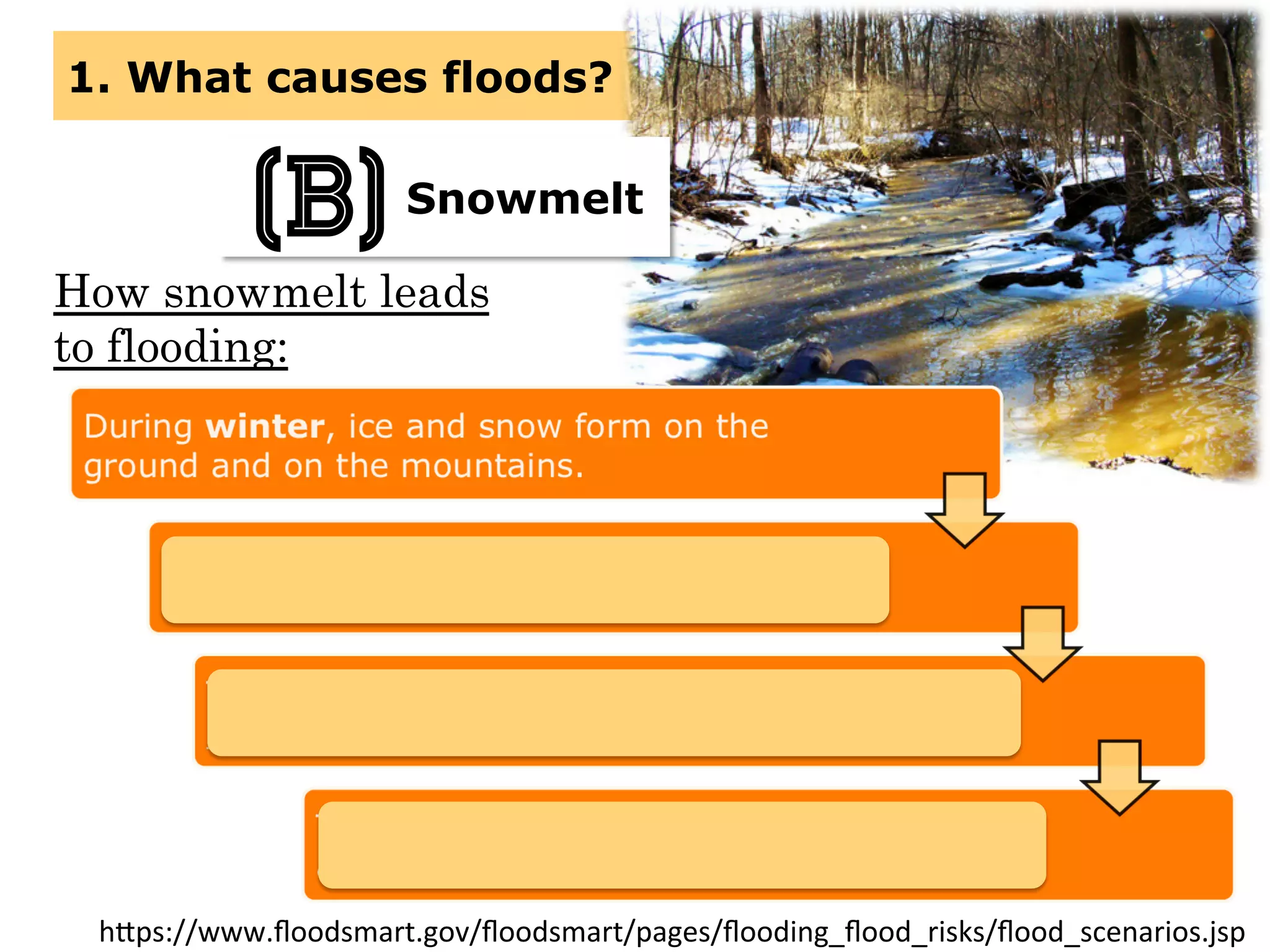
Snowmelt is surface runoff that
results from melting snow
1. What causes floods?
Snowmelt
(B)
How snowmelt leads
to flooding:
1. What causes floods?
Snowmelt
(B)
h(ps://www.floodsmart.gov/floodsmart/pages/flooding_flood_risks/flood_scenarios.jsp	
  
Definition:
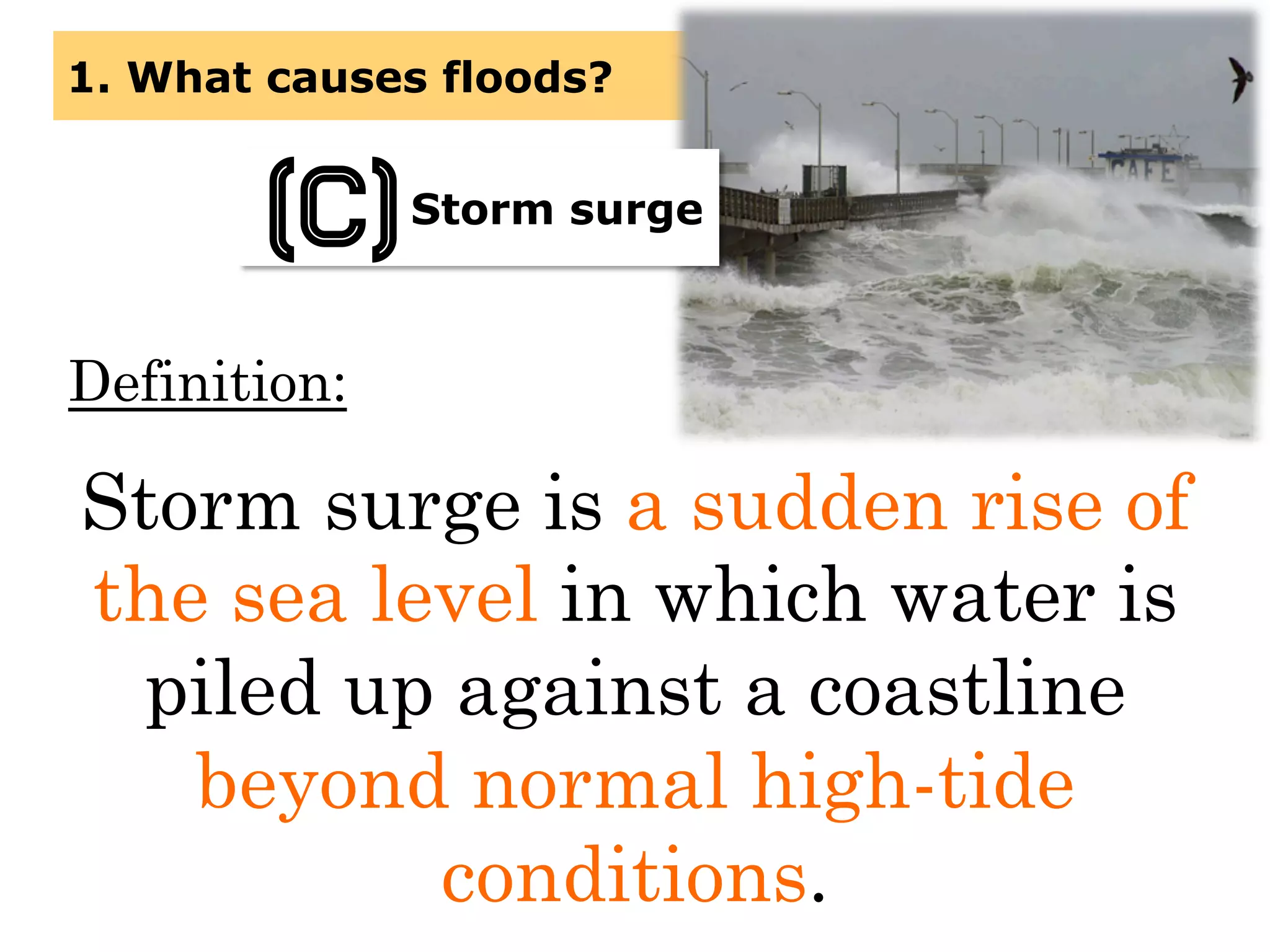
Storm surge is a sudden rise of
the sea level in which water is
piled up against a coastline
beyond normal high-tide
conditions.
1. What causes floods?
Storm surge
(C)
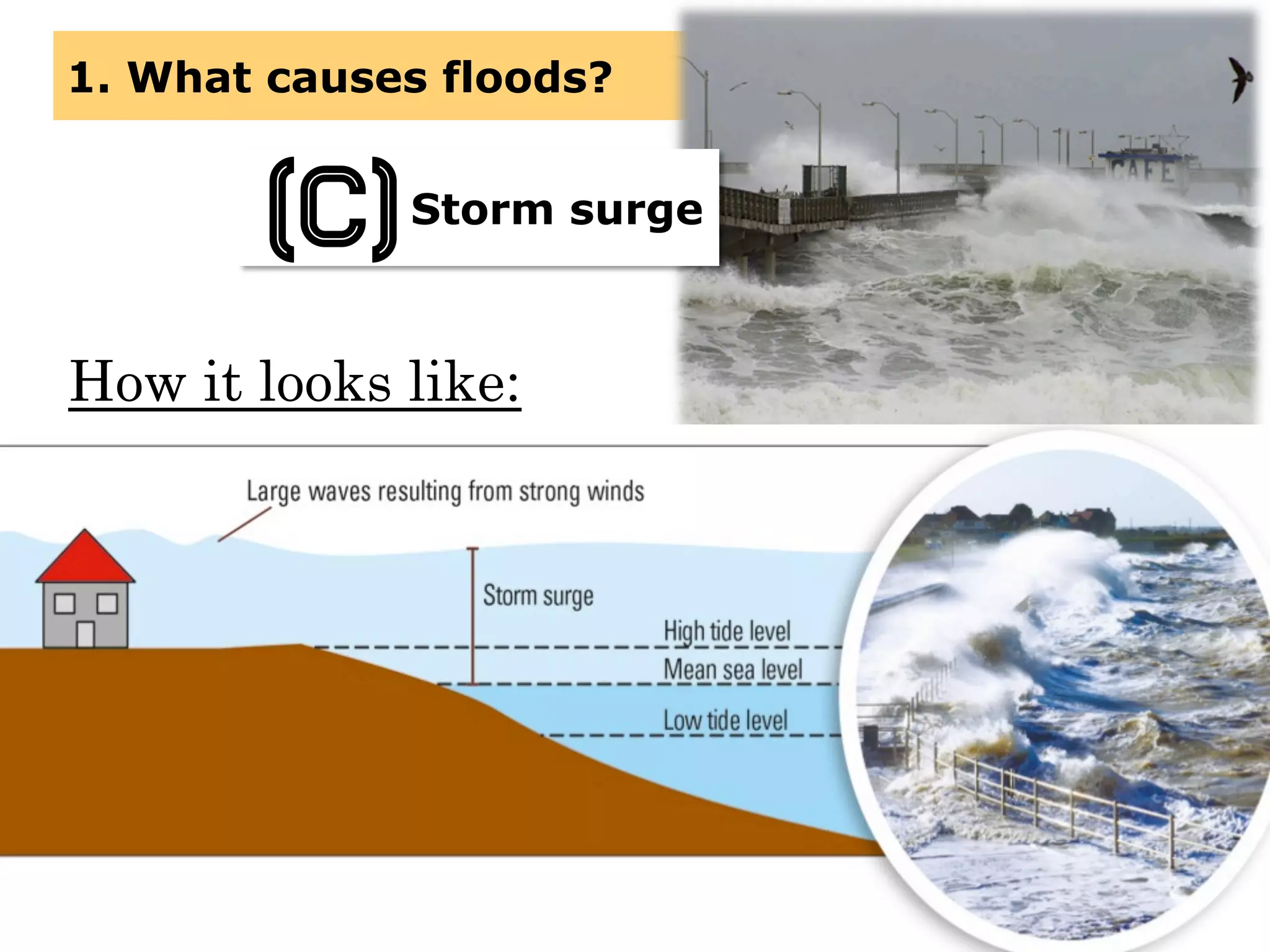
How it looks like:
1. What causes floods?
Storm surge
(C)
How it is formed:
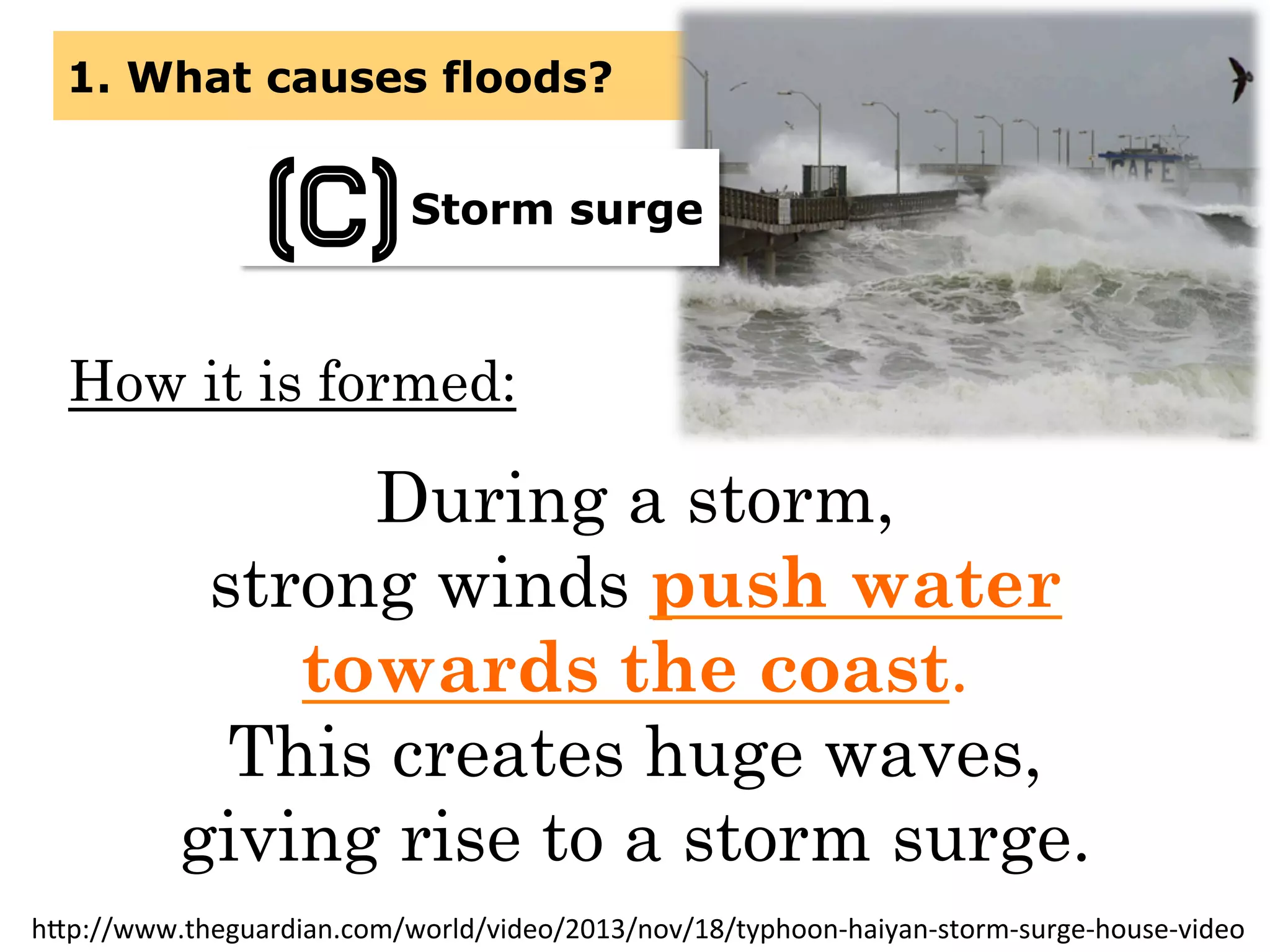
During a storm,
strong winds push water
towards the coast.
This creates huge waves,
giving rise to a storm surge.
1. What causes floods?
Storm surge
(C)
h(p://www.theguardian.com/world/video/2013/nov/18/typhoon-­‐haiyan-­‐storm-­‐surge-­‐house-­‐video	
  
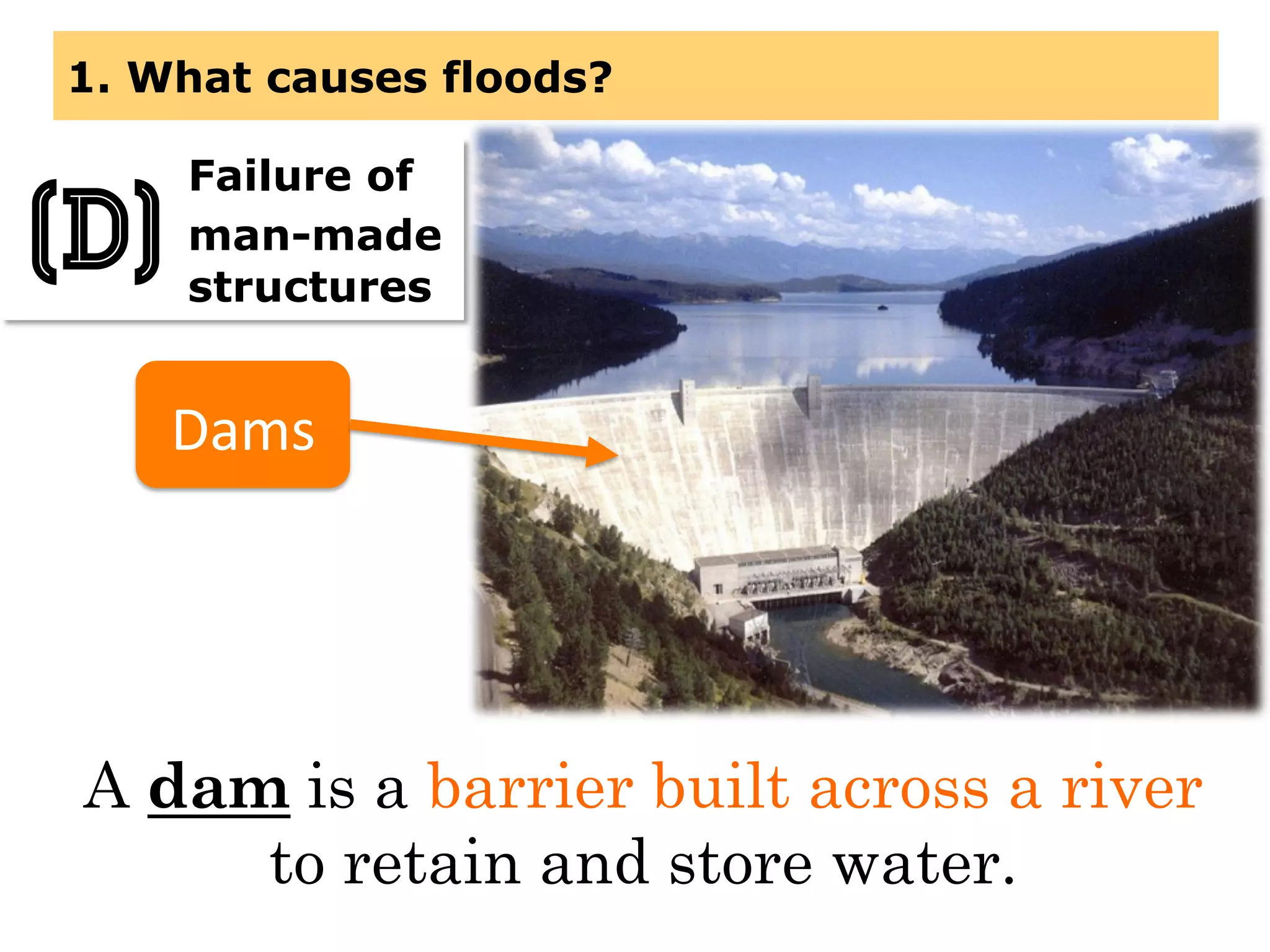
1. What causes floods?
Dams	
  
A dam is a barrier built across a river
to retain and store water.
Failure of
man-made
structures
(D)
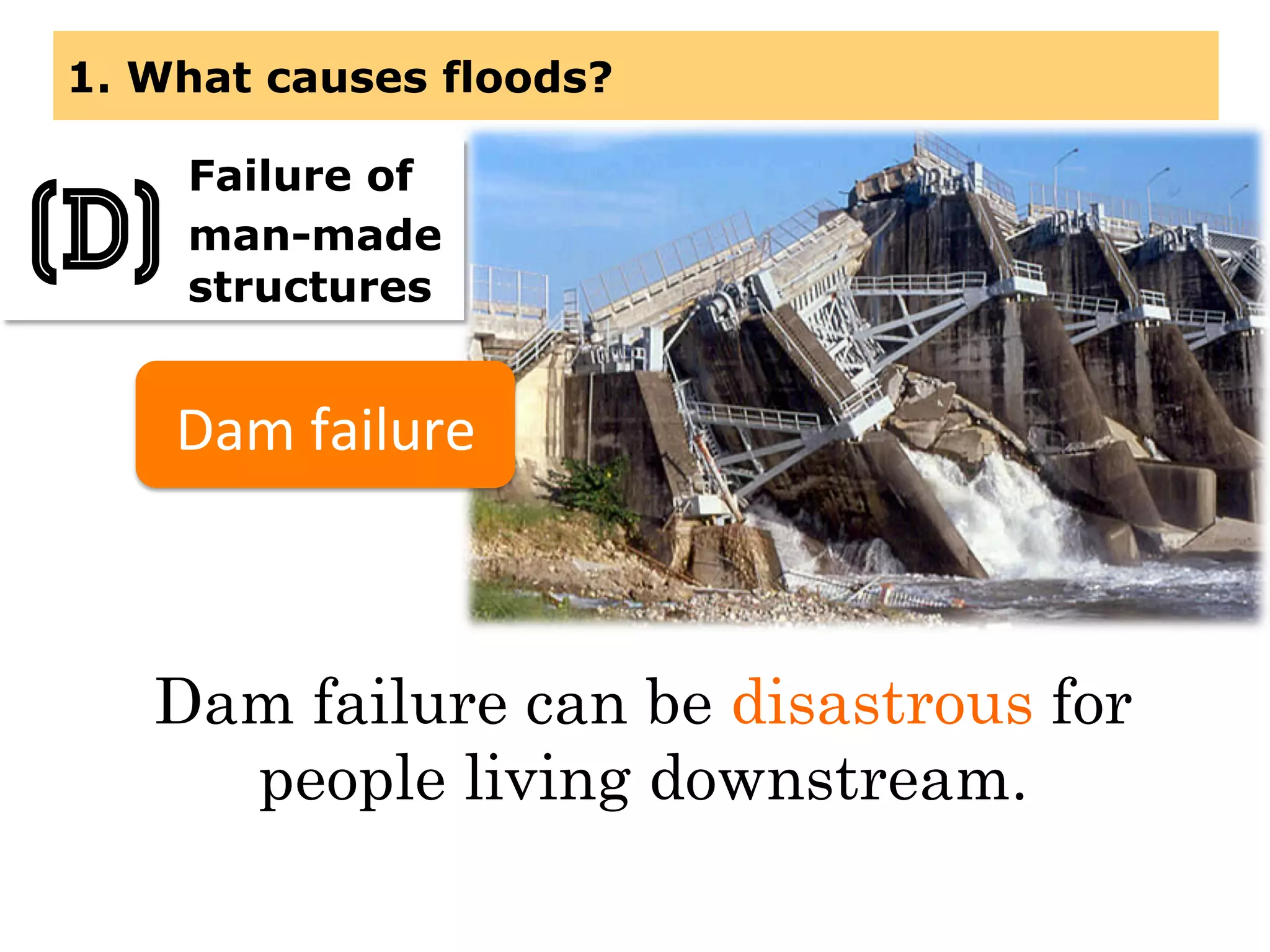
1. What causes floods?
Dam failure can be disastrous for
people living downstream.
Failure of
man-made
structures
(D)
Dam	
  failure	
  
1. What causes floods?
Levees	
  
Failure of
man-made
structures
(D)
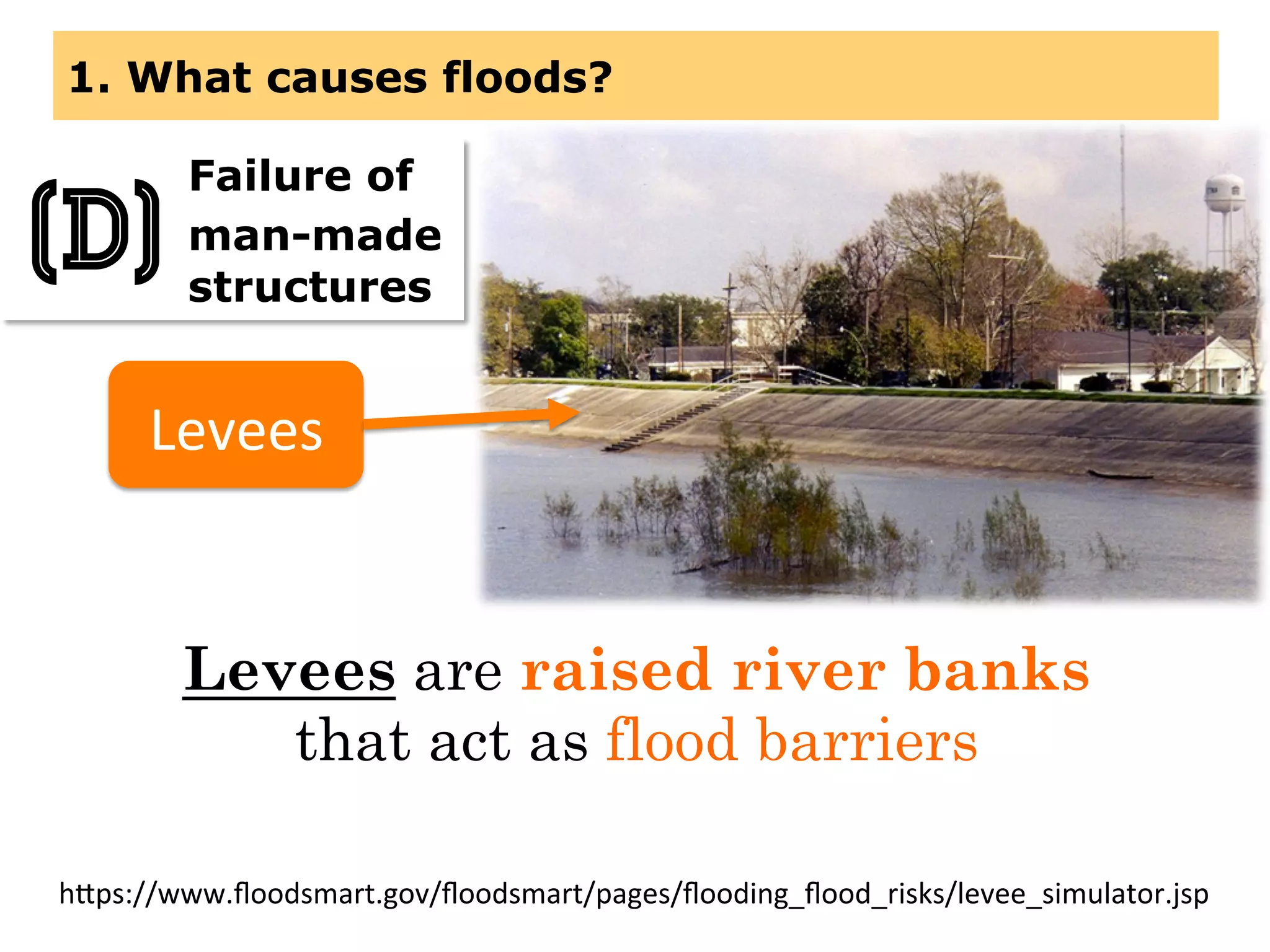
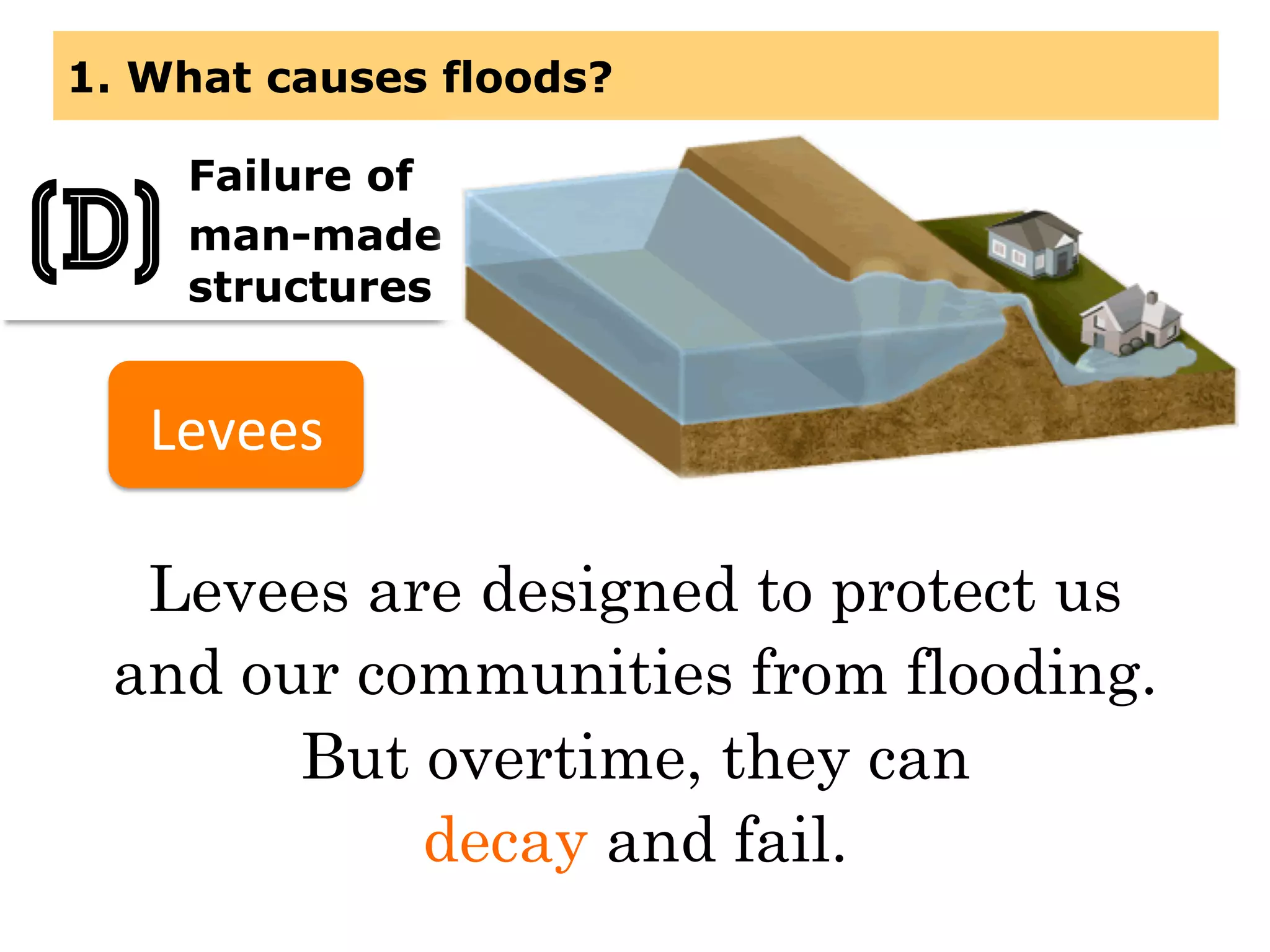
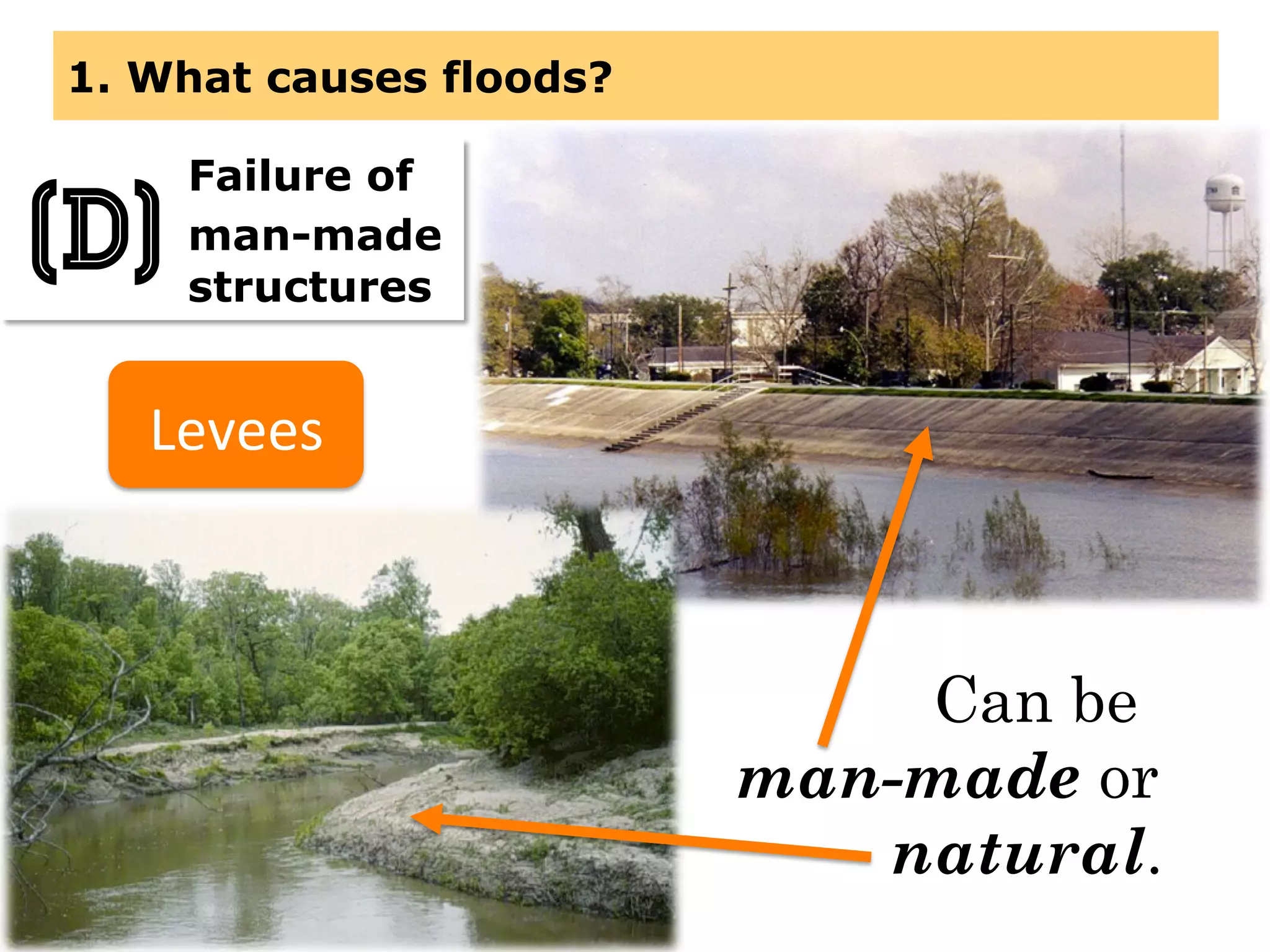
Levees are raised river banks
that act as flood barriers
h(ps://www.floodsmart.gov/floodsmart/pages/flooding_flood_risks/levee_simulator.jsp	
  
1. What causes floods?
Failure of
man-made
structures
(D)
Can be
man-made or
natural.
Levees	
  
1. What causes floods?
Levees	
  
Failure of
man-made
structures
(D)
Levees are designed to protect us
and our communities from flooding.
But overtime, they can
decay and fail.
1. What causes floods?
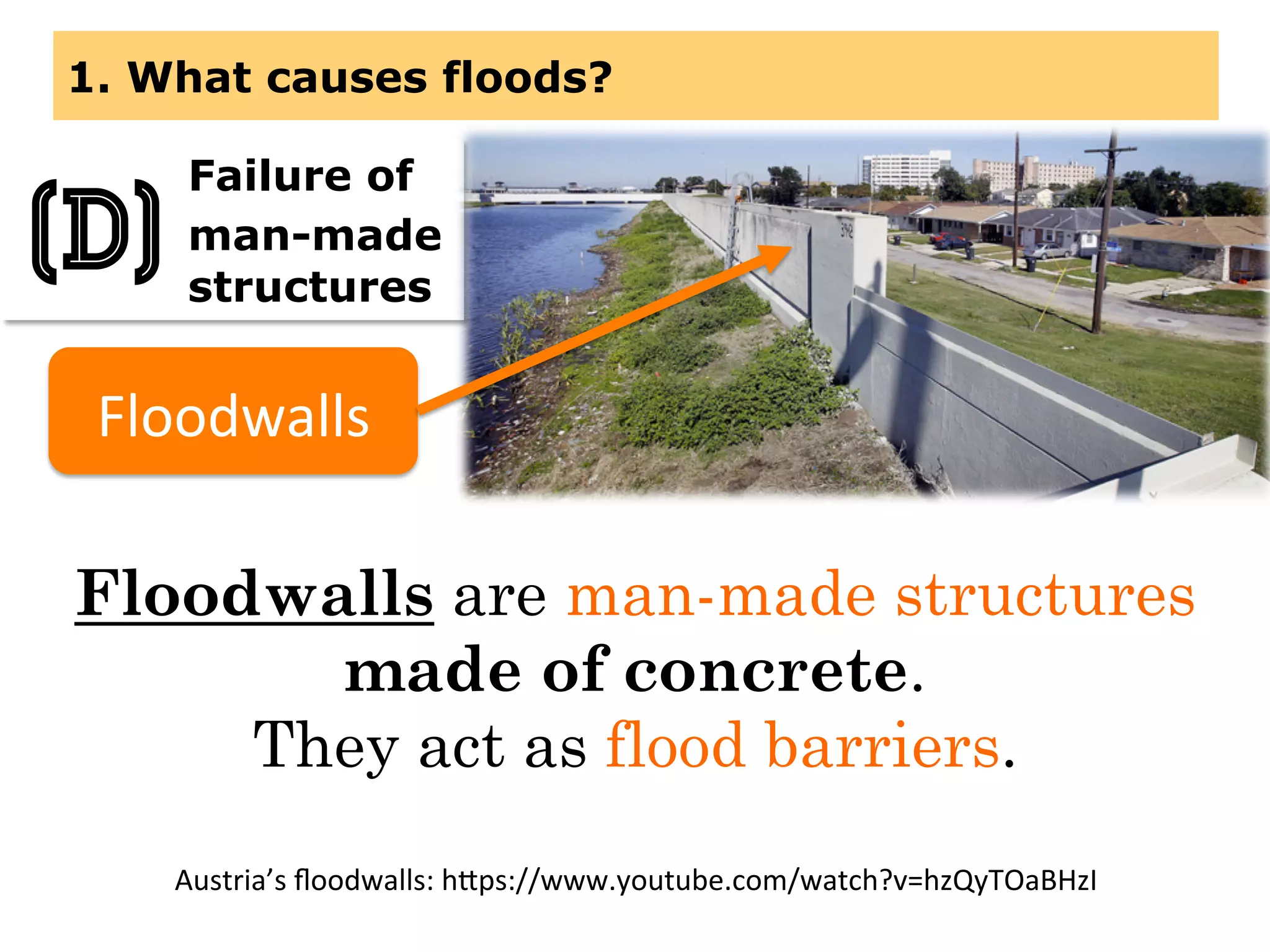
Floodwalls are man-made structures
made of concrete.
They act as flood barriers.
Failure of
man-made
structures
(D)
Floodwalls	
  
Austria’s	
  floodwalls:	
  h(ps://www.youtube.com/watch?v=hzQyTOaBHzI	
  
1. What causes floods?
Failure of
man-made
structures
(D)
Floodwalls	
  
1. What causes floods?
Failure of
man-made
structures
(D)
Levees	
  &	
  
Floodwalls	
  
Failure	
  
1. What are floods? What causes floods?
2. Which cities are prone to floods?
Why are these cities more prone?
We want to learn about…
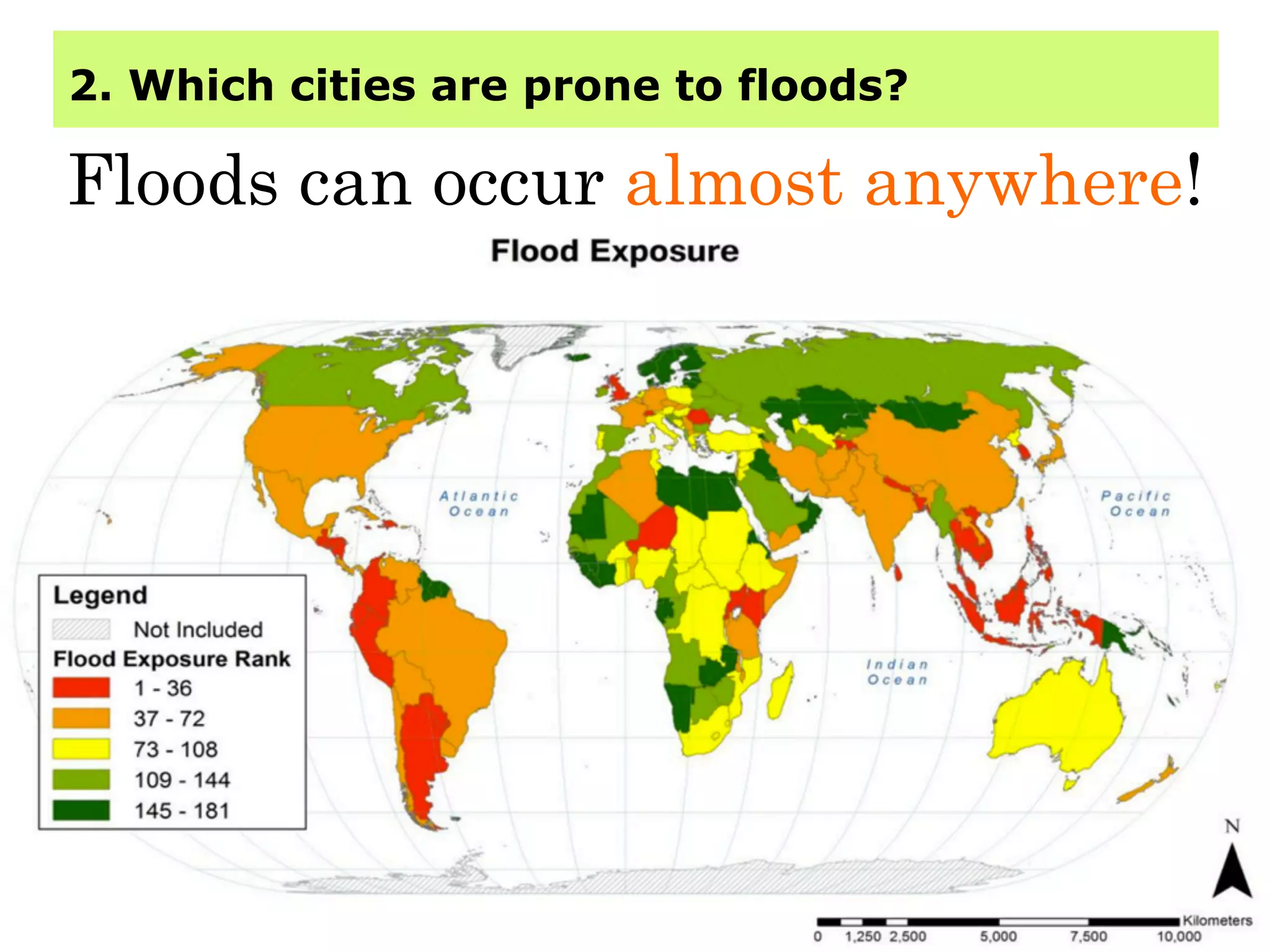
Floods can occur almost anywhere!
2. Which cities are prone to floods?
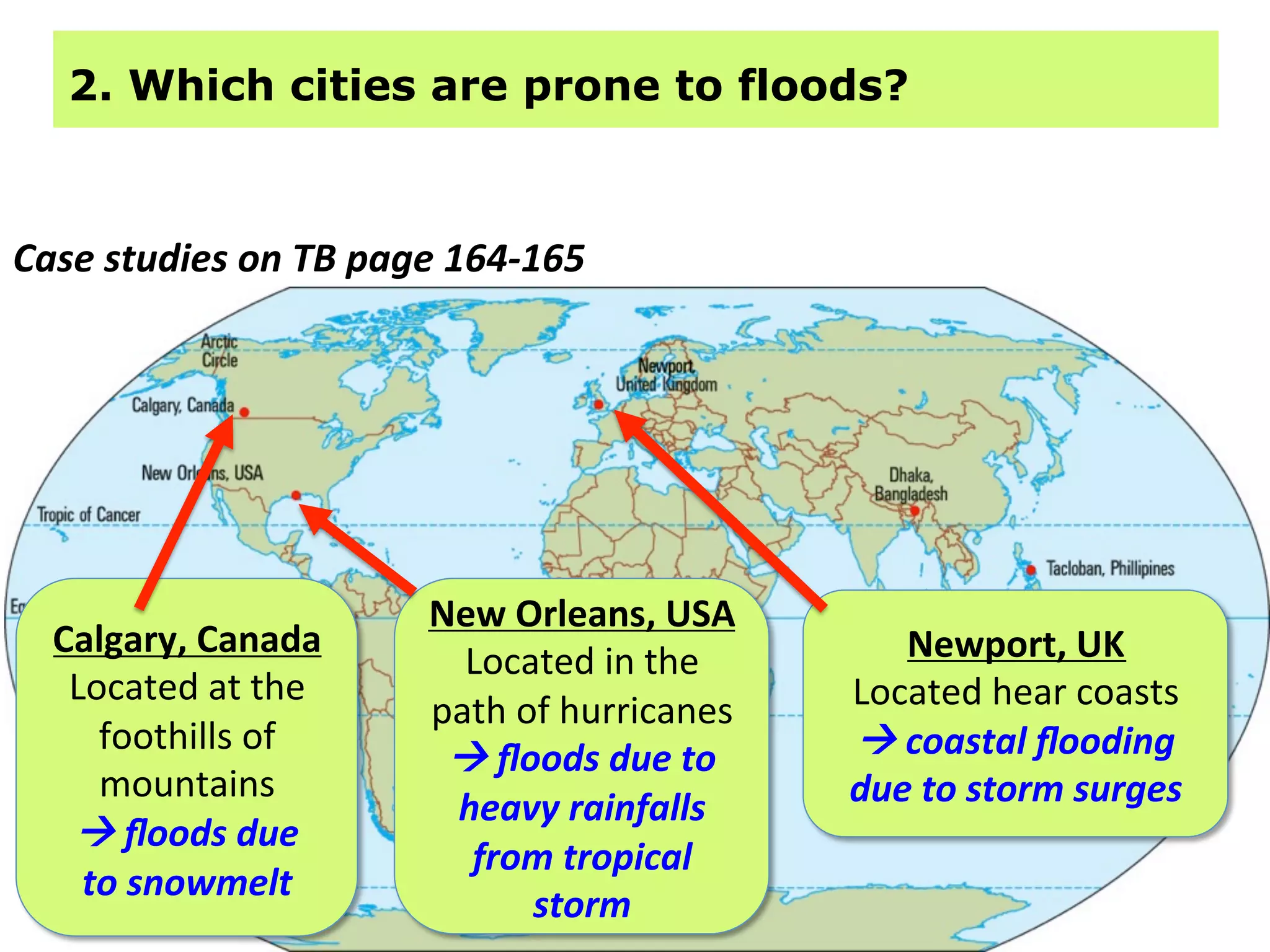
Case	
  studies	
  on	
  TB	
  page	
  164-­‐165	
  
Newport,	
  UK	
  
Located	
  hear	
  coasts	
  
	
  coastal	
  flooding	
  
due	
  to	
  storm	
  surges	
  
New	
  Orleans,	
  USA	
  
Located	
  in	
  the	
  
path	
  of	
  hurricanes	
  	
  
	
  floods	
  due	
  to	
  
heavy	
  rainfalls	
  
from	
  tropical	
  
storm	
  
Calgary,	
  Canada	
  
Located	
  at	
  the	
  
foothills	
  of	
  	
  
mountains	
  
	
  floods	
  due	
  	
  
to	
  snowmelt	
  
2. Which cities are prone to floods?
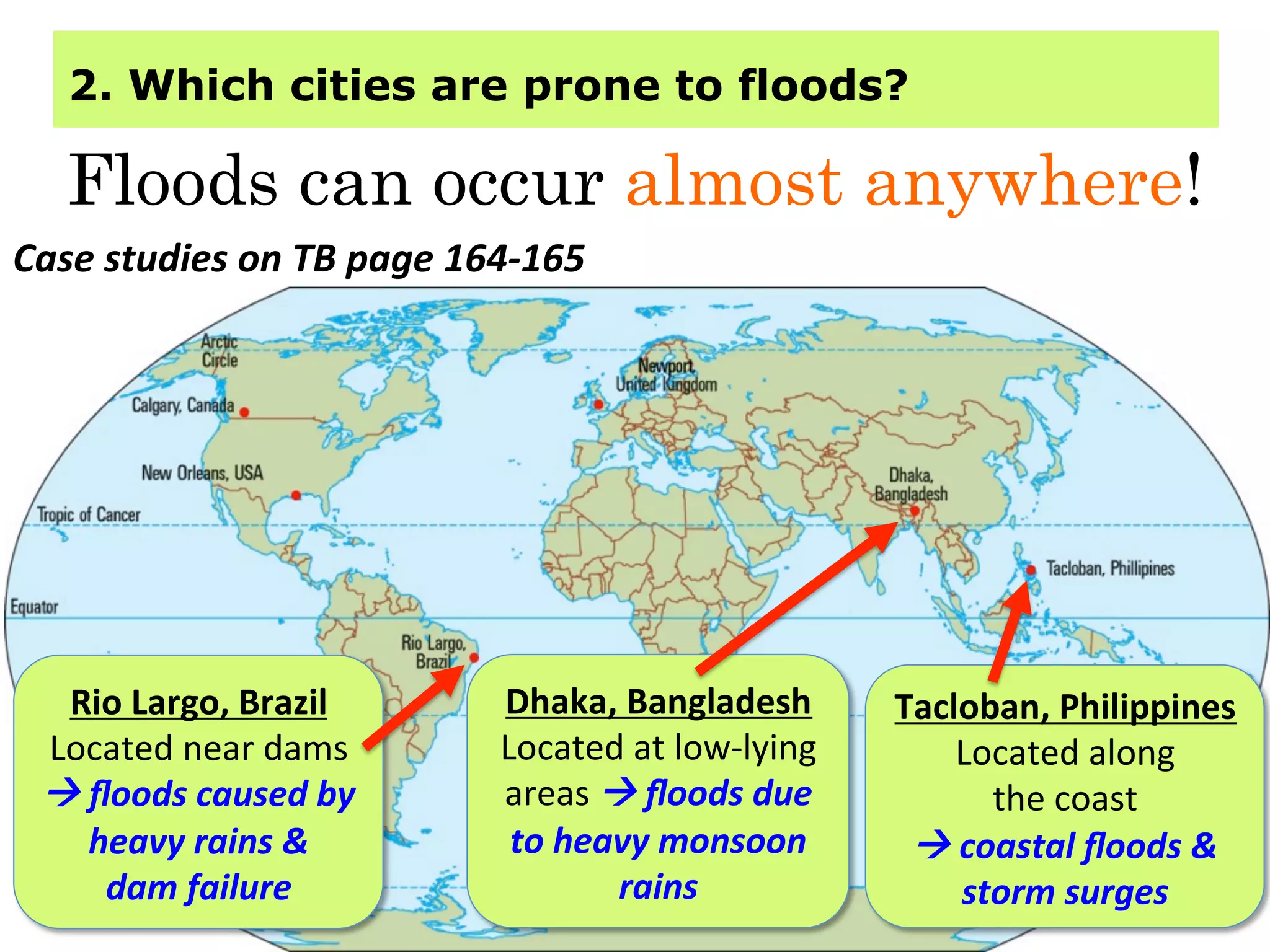
Floods can occur almost anywhere!
Case	
  studies	
  on	
  TB	
  page	
  164-­‐165	
  
Tacloban,	
  Philippines	
  
Located	
  along	
  	
  
the	
  coast	
  	
  
	
  coastal	
  floods	
  &	
  	
  
storm	
  surges	
  
2. Which cities are prone to floods?
Rio	
  Largo,	
  Brazil	
  
Located	
  near	
  dams	
  	
  
	
  floods	
  caused	
  by	
  
heavy	
  rains	
  &	
  	
  
dam	
  failure	
  
Dhaka,	
  Bangladesh	
  
Located	
  at	
  low-­‐lying	
  
areas	
  	
  floods	
  due	
  
to	
  heavy	
  monsoon	
  
rains	
  
2. Why are these cities more prone to floods?
Height of land
above sea level(i)
Proximity to
water bodies(iI)
Permeability of
surface cover(iII)
Channel
Capacity(iv)
2. Why are these cities more prone to floods?
Height of land above sea level
(i)
Mean sea level is the average height of the
sea surface over a long period of time.
2. Why are these cities more prone to floods?
Height of land above sea level
(i)
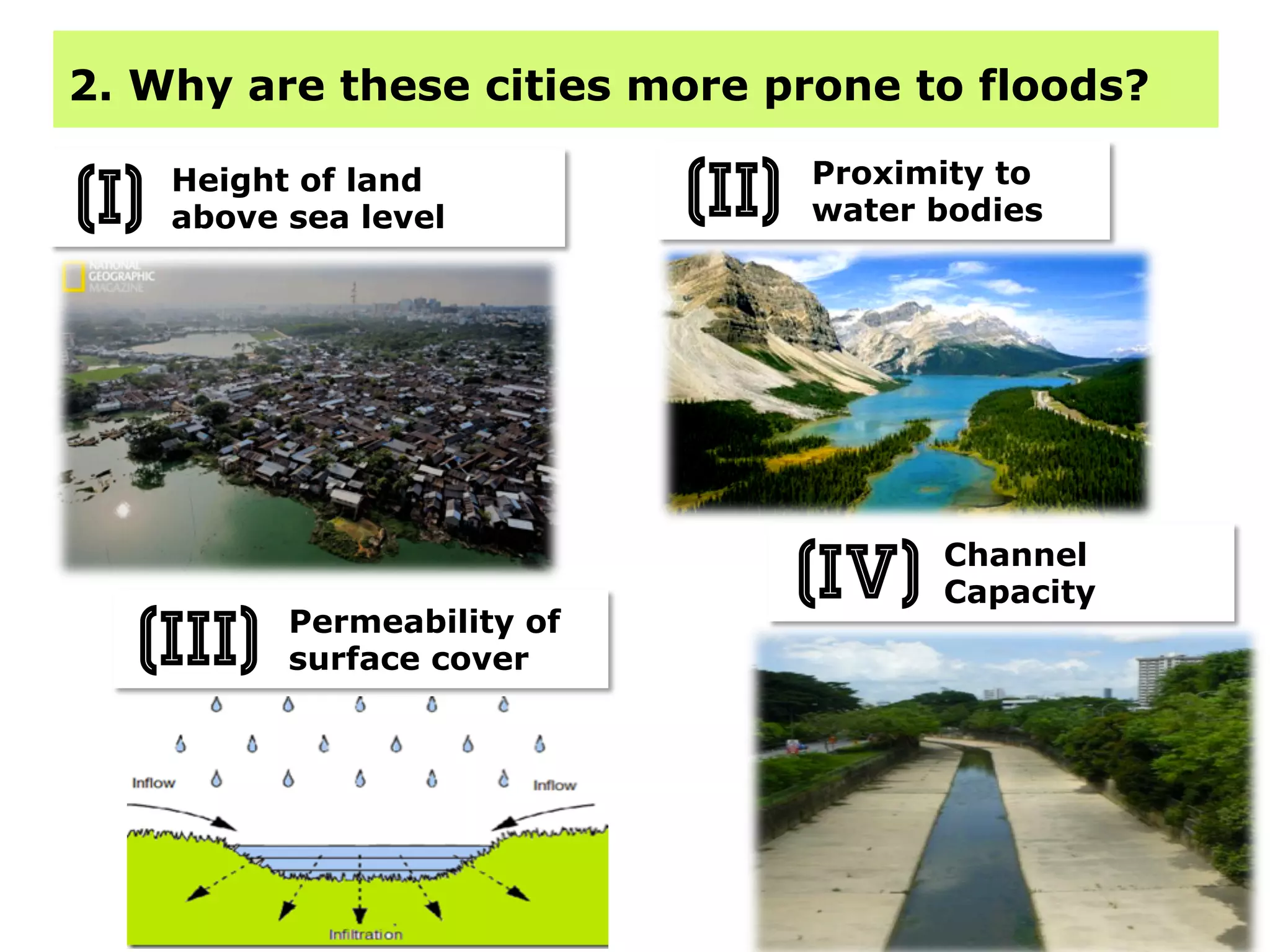
Cities that are
located on
low-lying
lands
are more prone
to floods
Low-lying areas à prone to flooding
2. Why are these cities more prone to floods?
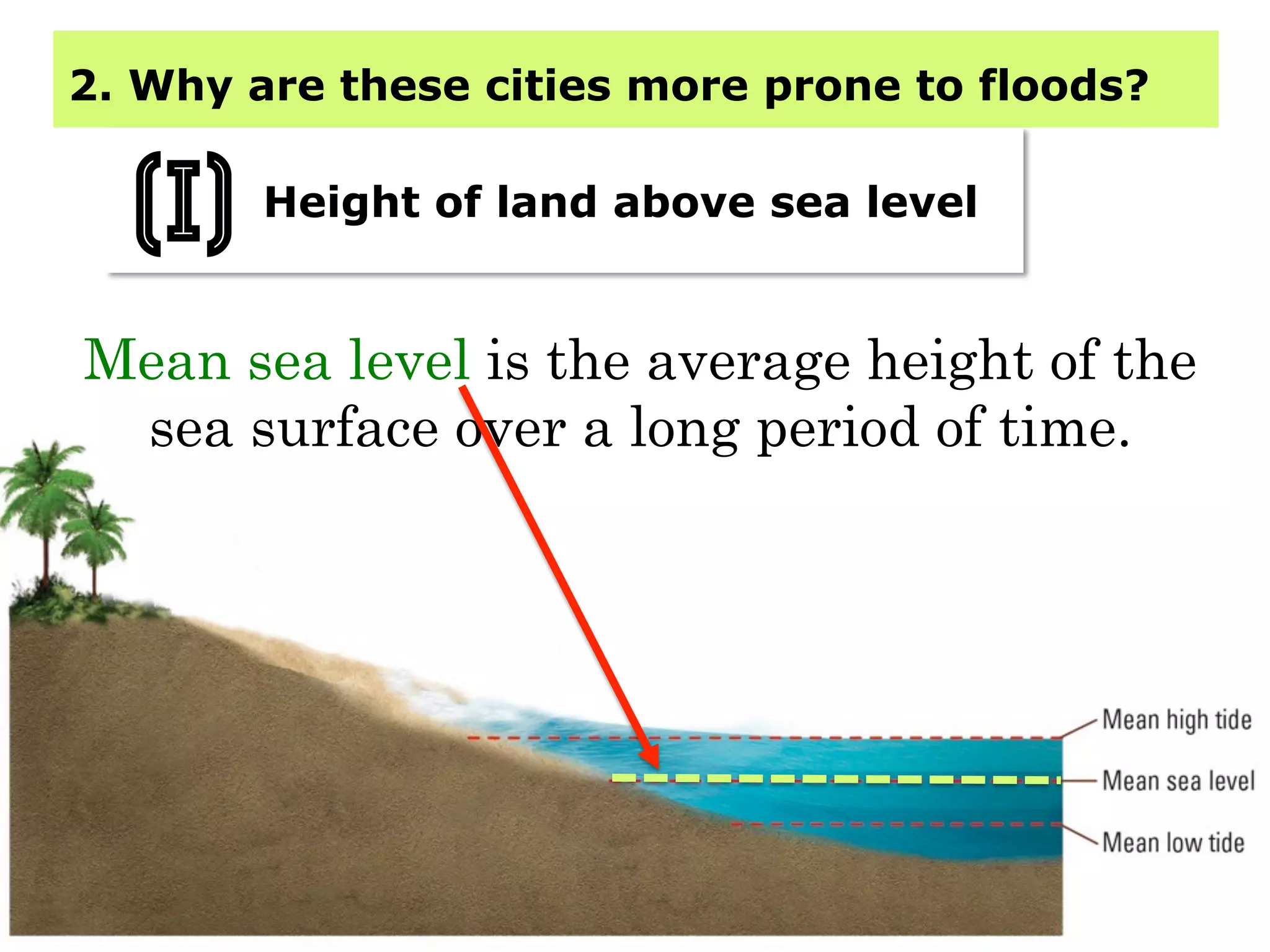
Proximity to water bodies
(iI)
Water bodies are significant accumulations
of water:
•  Oceans
•  Seas
•  Lakes
•  Rivers
•  Reservoirs
2. Why are these cities more prone to floods?
Proximity to water bodies
(iI)
Cities that are
located near water
bodies are more
prone to floods
Near to oceans / seas /
lakes / river mouths /
reservoirs à more prone
to flooding
2. Why are these cities more prone to floods?
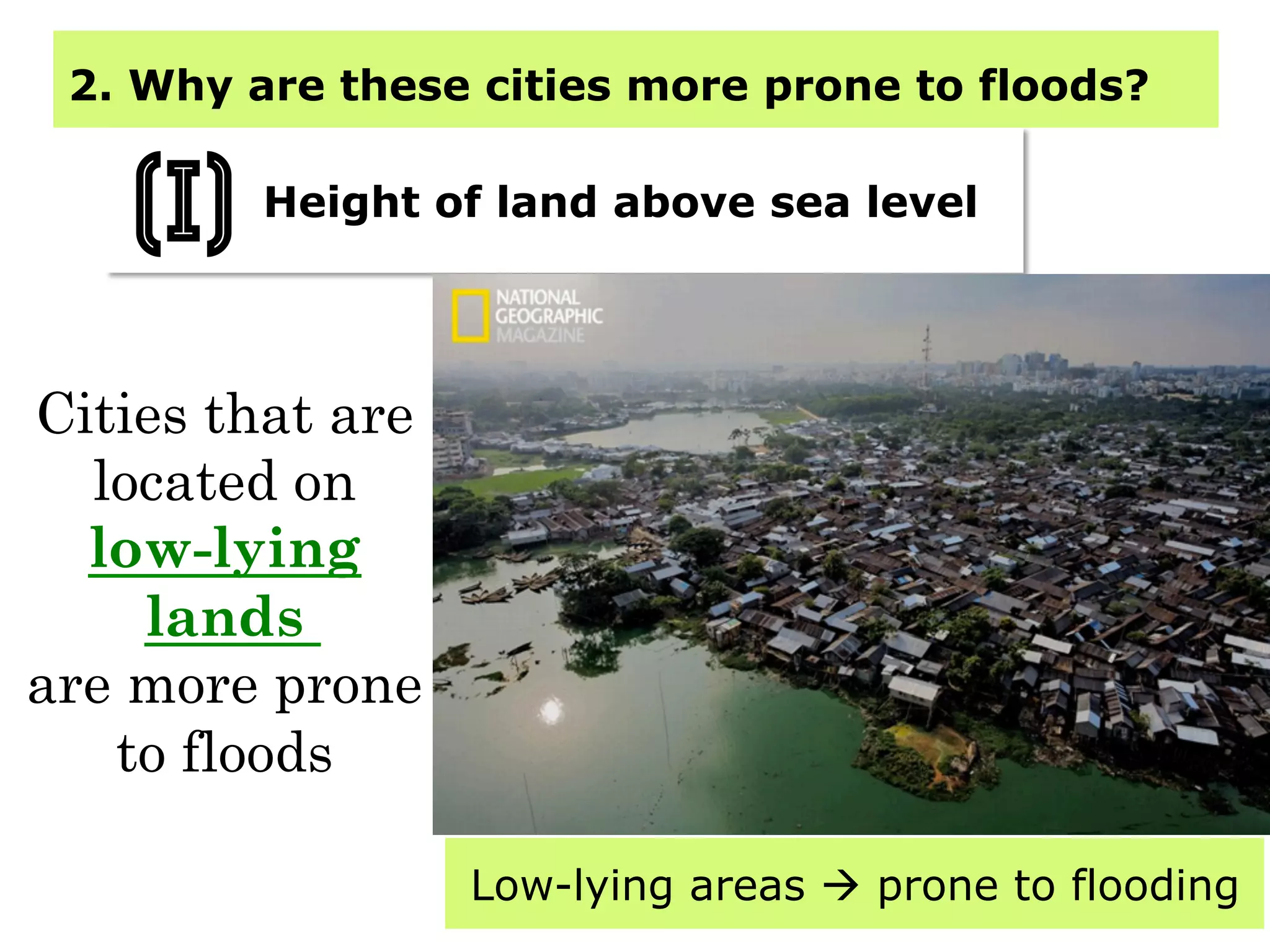
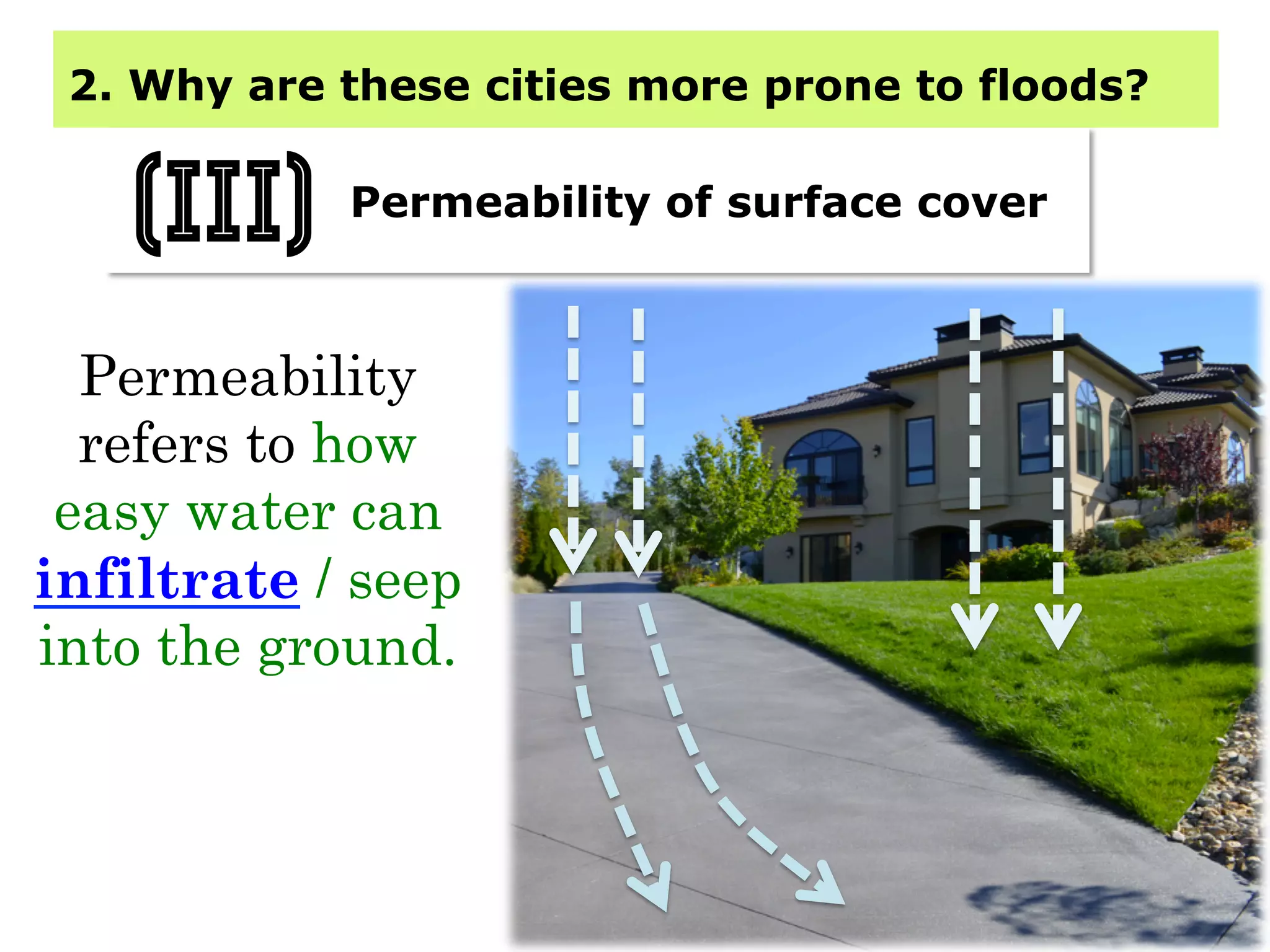
Permeability of surface cover
(iII)
Permeability
refers to how
easy water can
infiltrate / seep
into the ground.
2. Why are these cities more prone to floods?
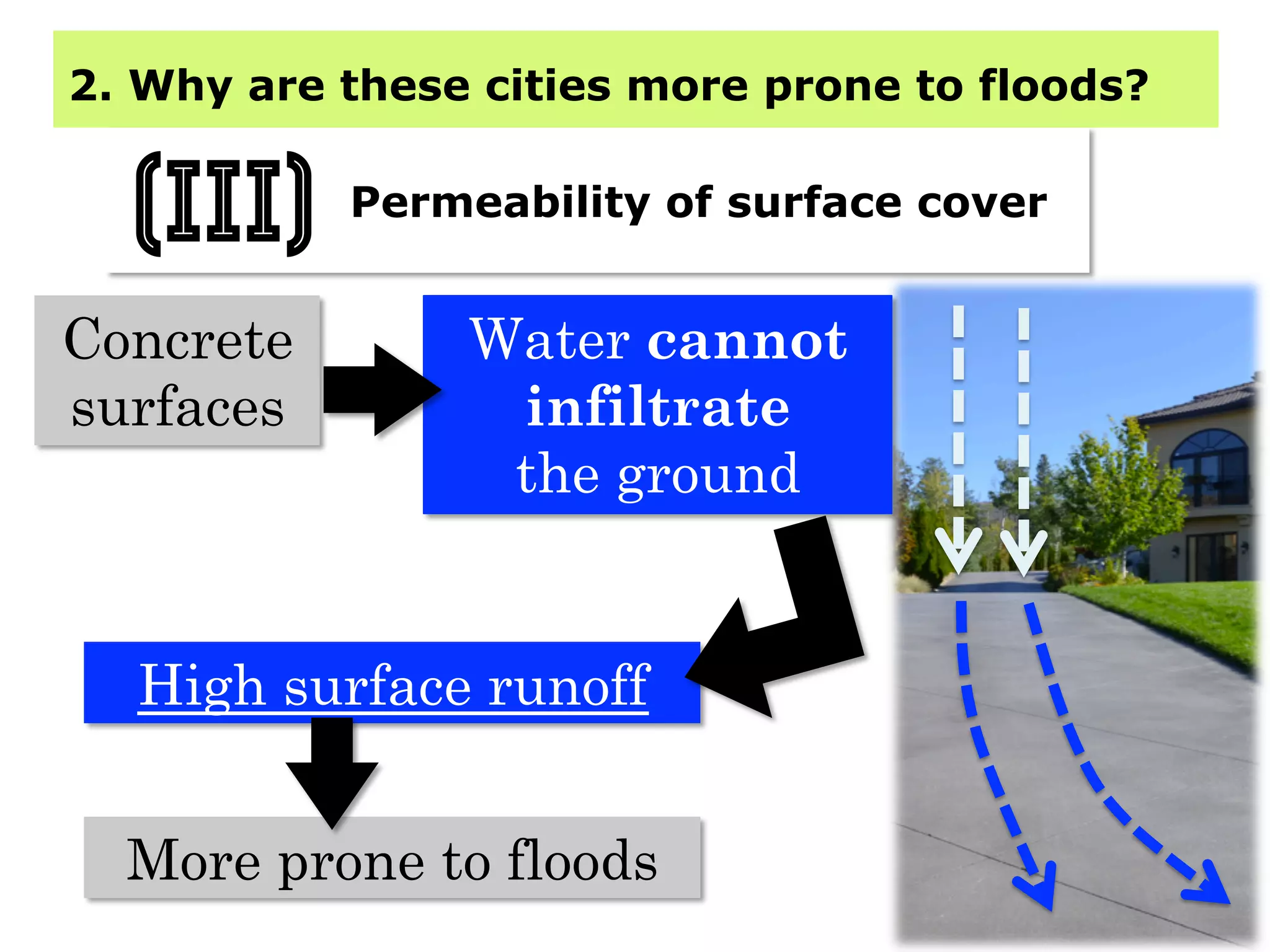
Permeability of surface cover
(iII)
Concrete
surfaces
Water cannot
infiltrate
the ground
High surface runoff
More prone to floods
2. Why are these cities more prone to floods?
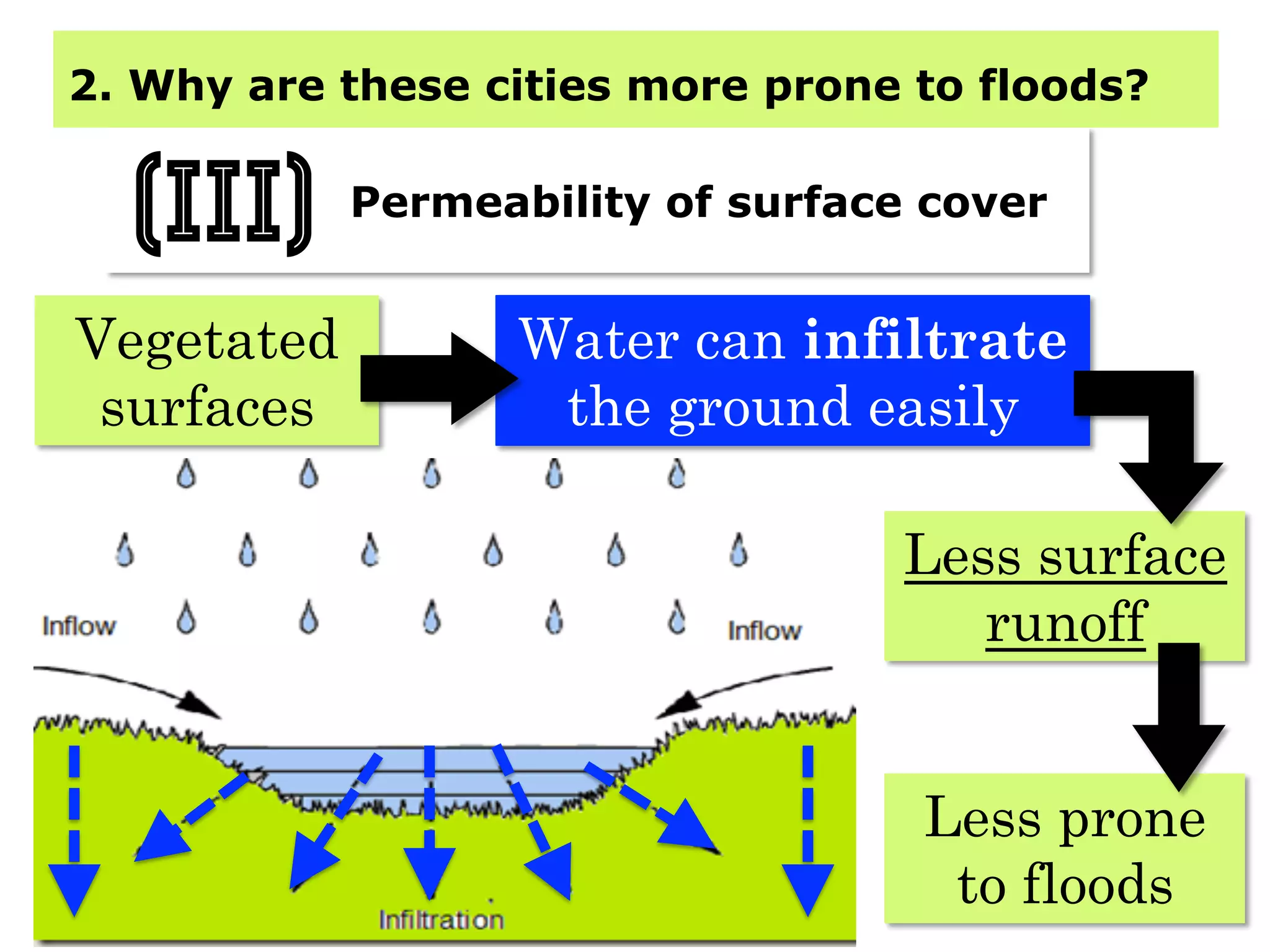
Permeability of surface cover
(iII)
Vegetated
surfaces
Water can infiltrate
the ground easily
Less surface
runoff
Less prone
to floods
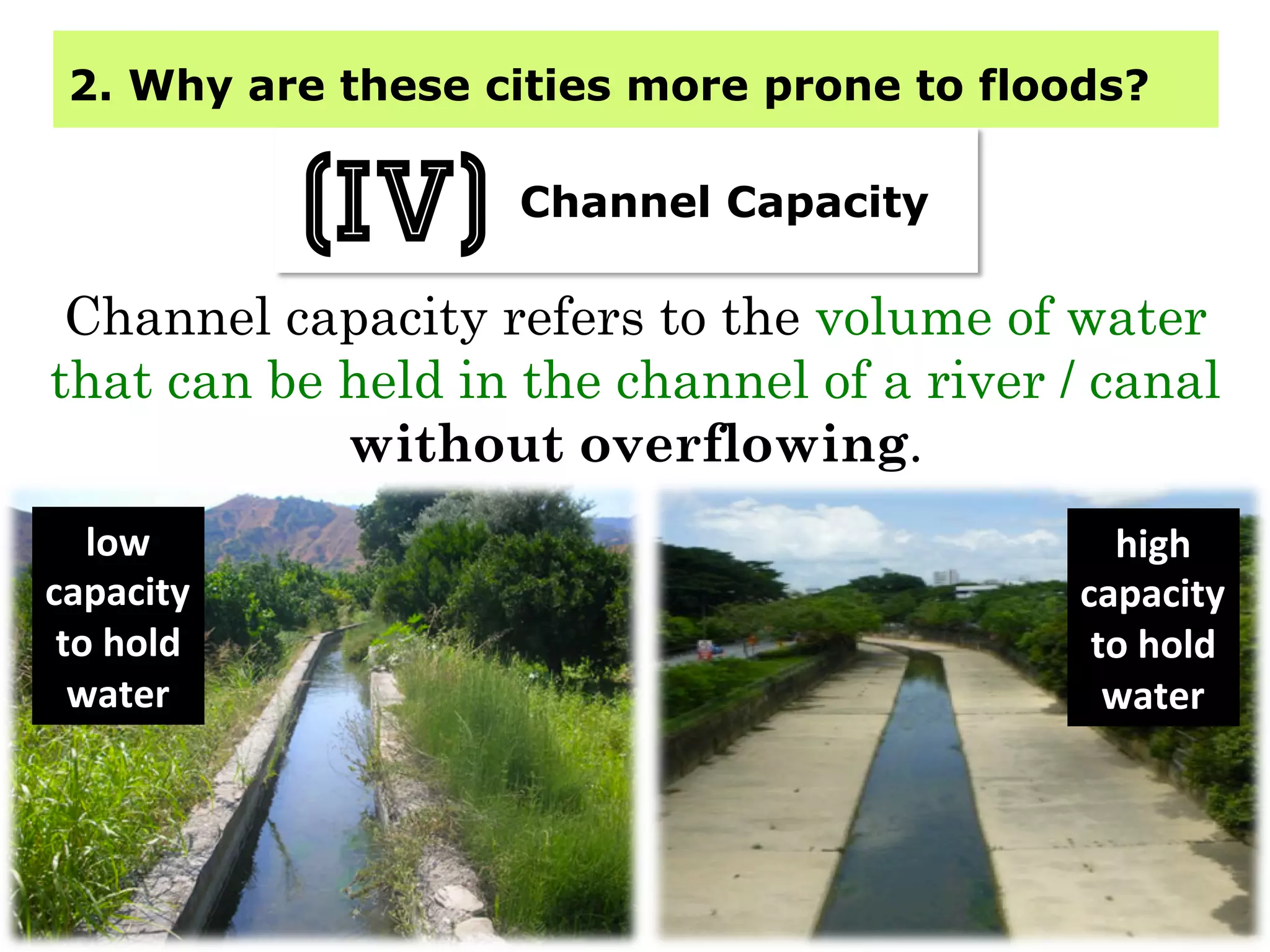
2. Why are these cities more prone to floods?
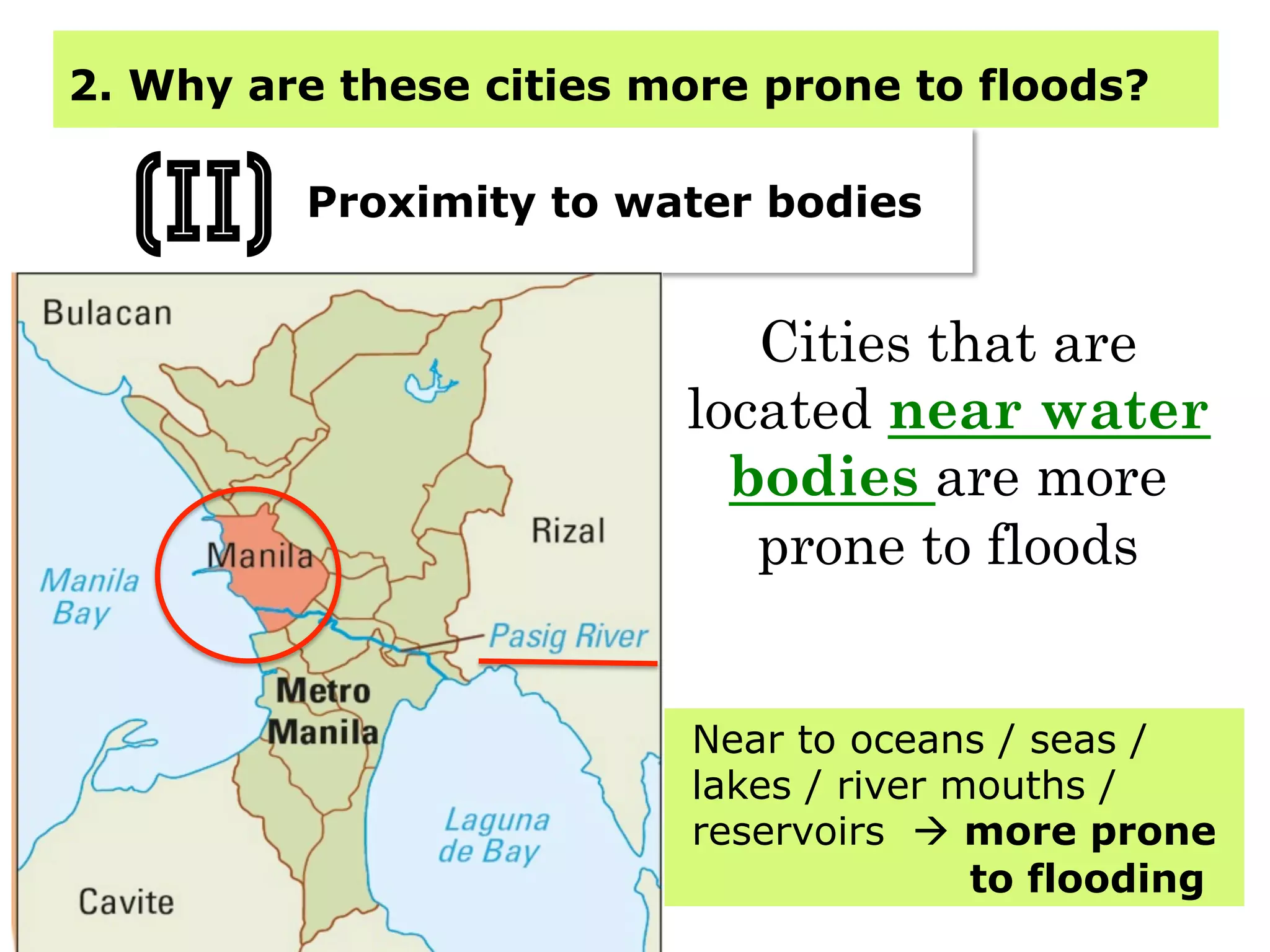
Channel Capacity
(iv)
Channel capacity refers to the volume of water
that can be held in the channel of a river / canal
without overflowing.
low	
  
capacity	
  
to	
  hold	
  	
  
water	
  
high	
  
capacity	
  	
  
to	
  hold	
  	
  
water	
  
2. Why are these cities more prone to floods?
Channel Capacity
(iv)
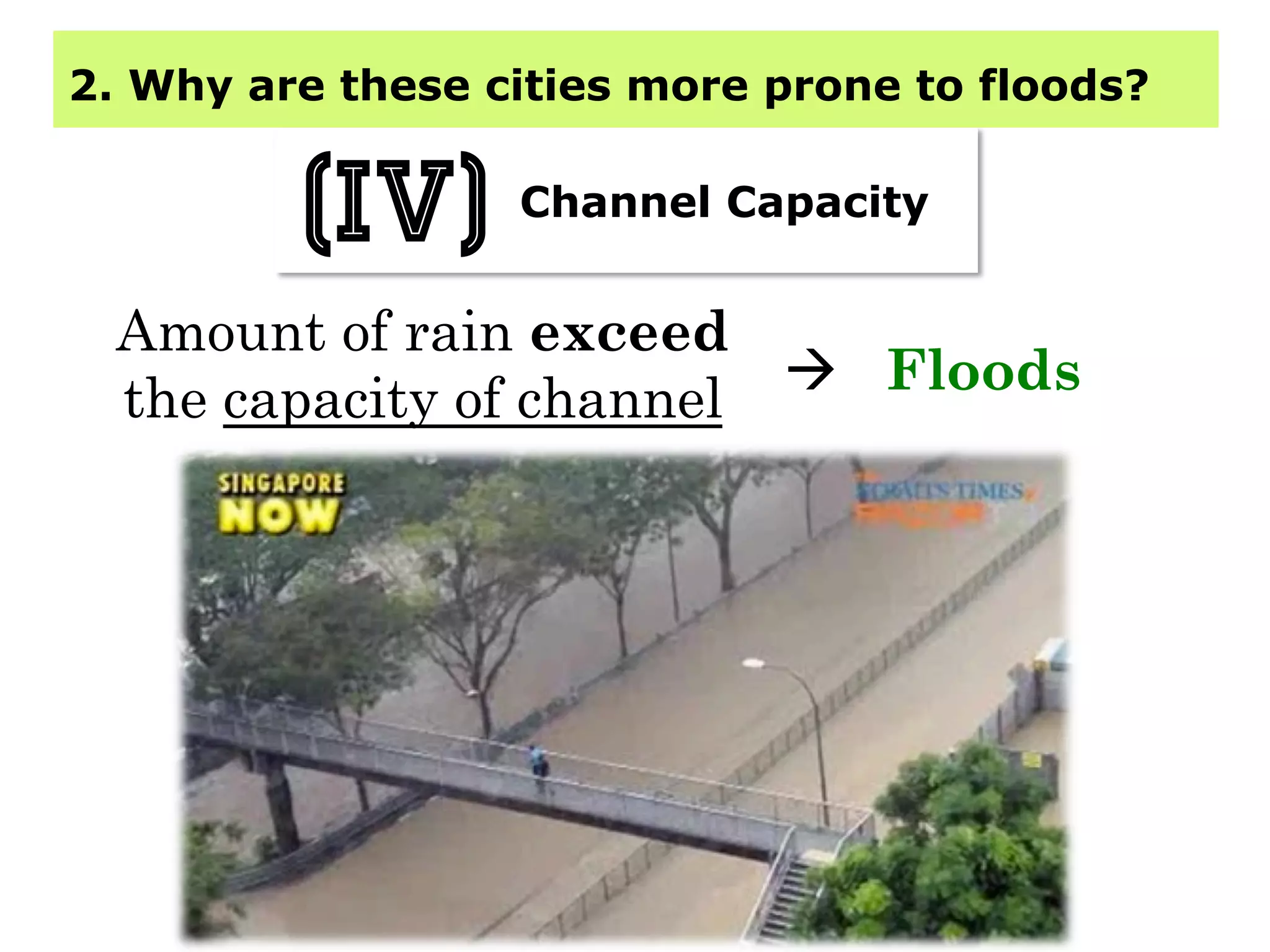
Amount of rain exceed
the capacity of channel à Floods
2. Why are these cities more prone to floods?
Channel Capacity
(iv)
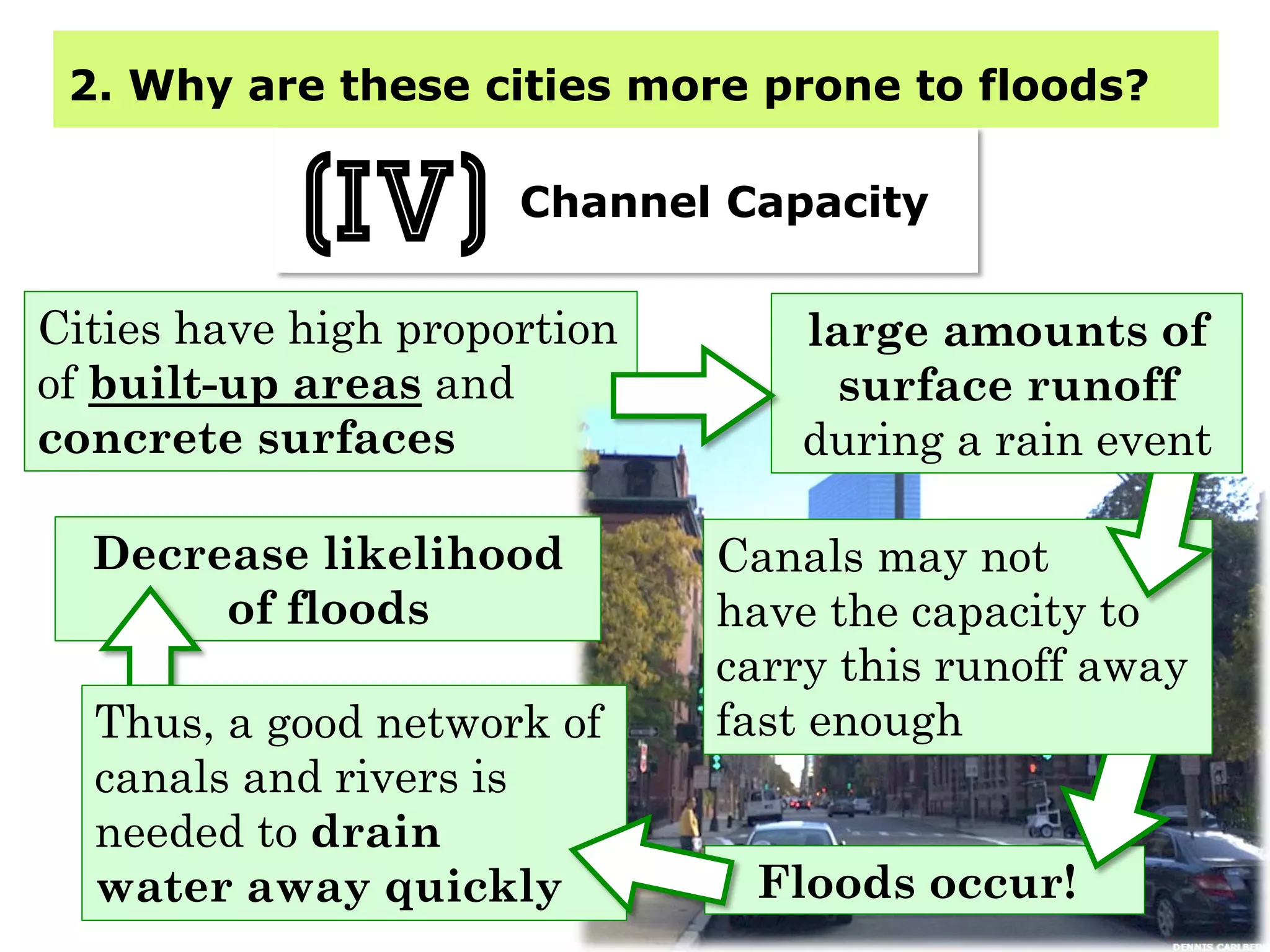
Cities have high proportion
of built-up areas and
concrete surfaces
Floods occur!
Canals may not
have the capacity to
carry this runoff away
fast enough
large amounts of
surface runoff
during a rain event
Decrease likelihood
of floods
Thus, a good network of
canals and rivers is
needed to drain
water away quickly
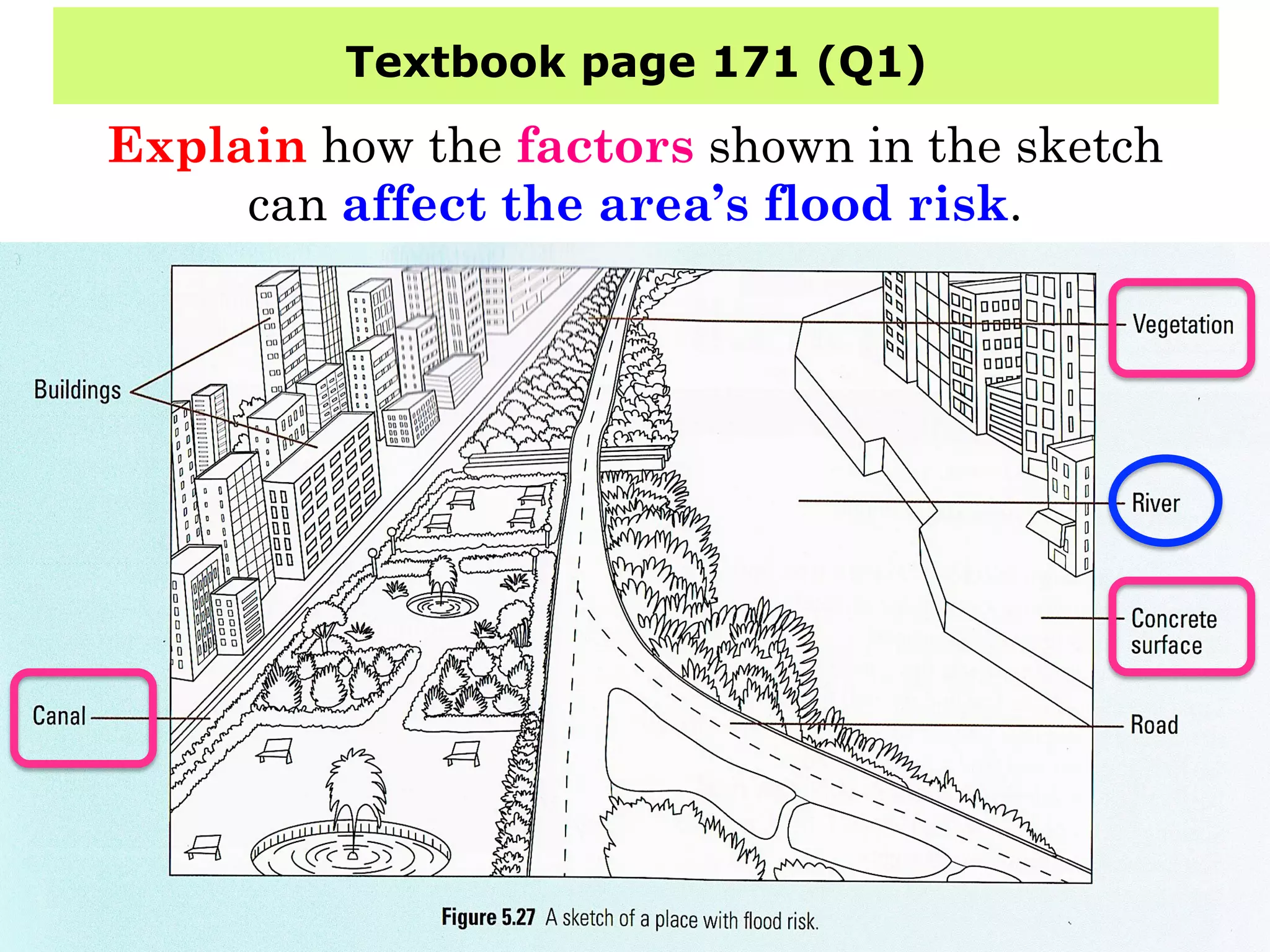
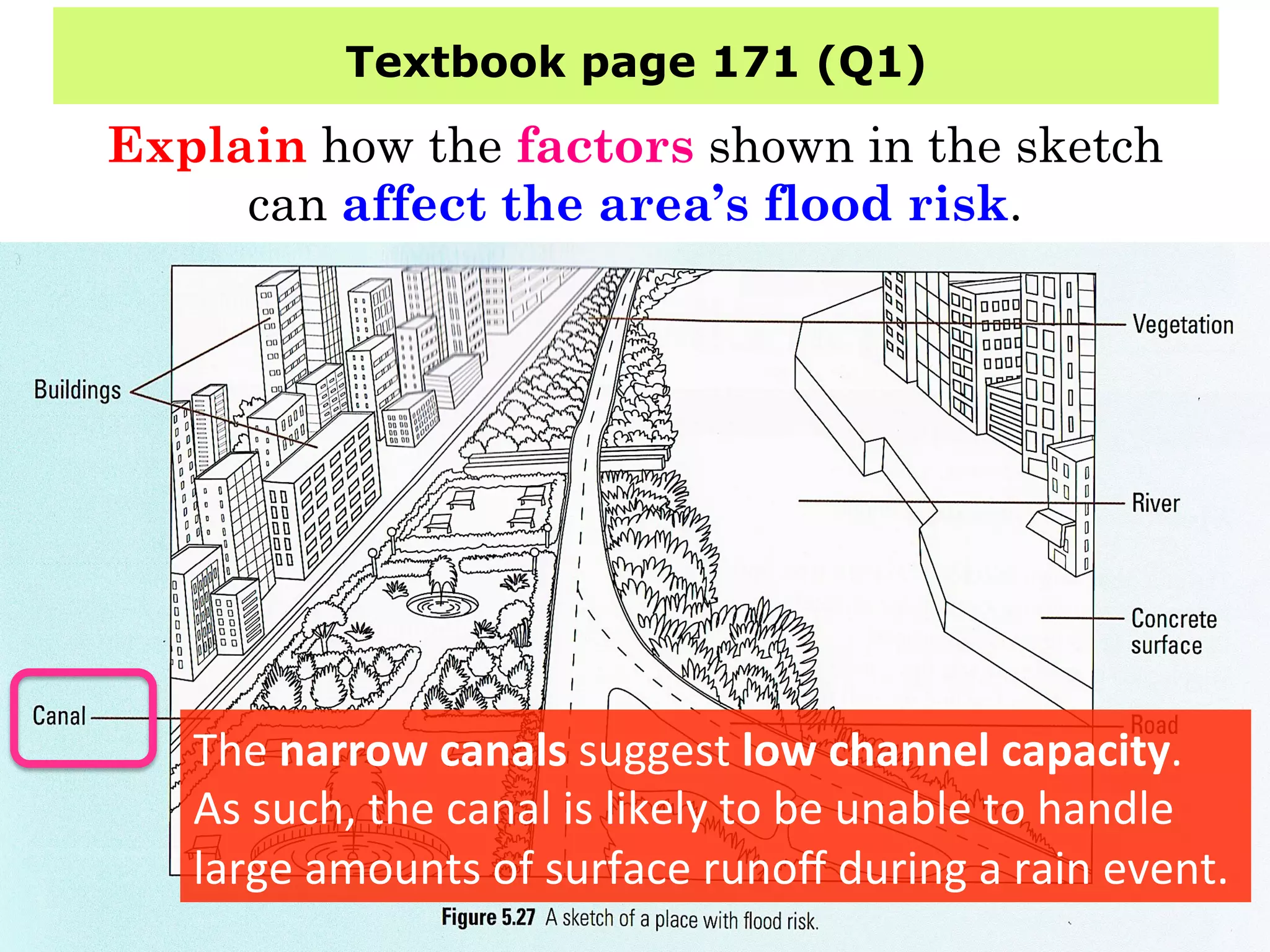
Textbook page 171 (Q1)
Explain how the factors shown in the sketch
can affect the area’s flood risk.
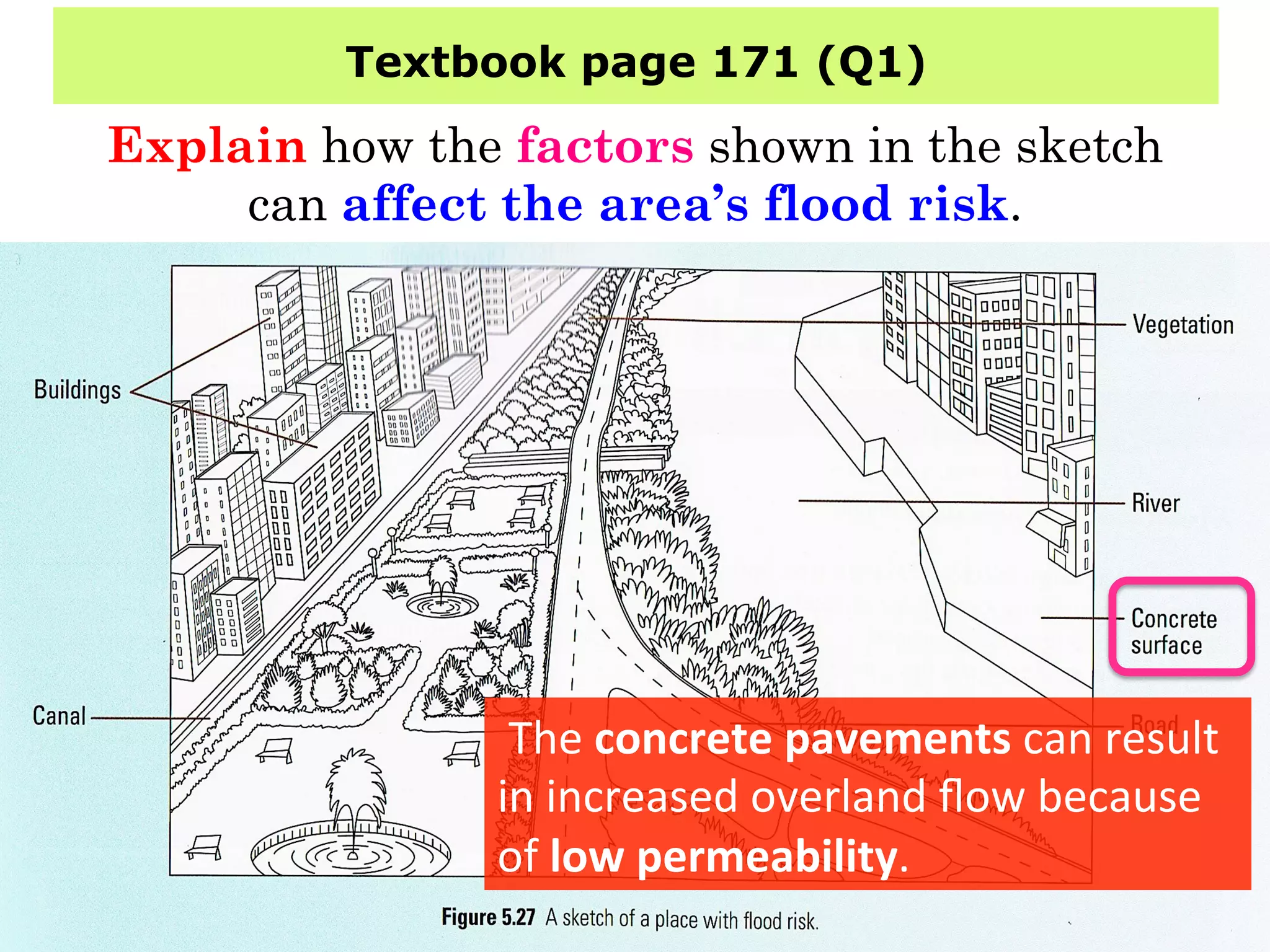
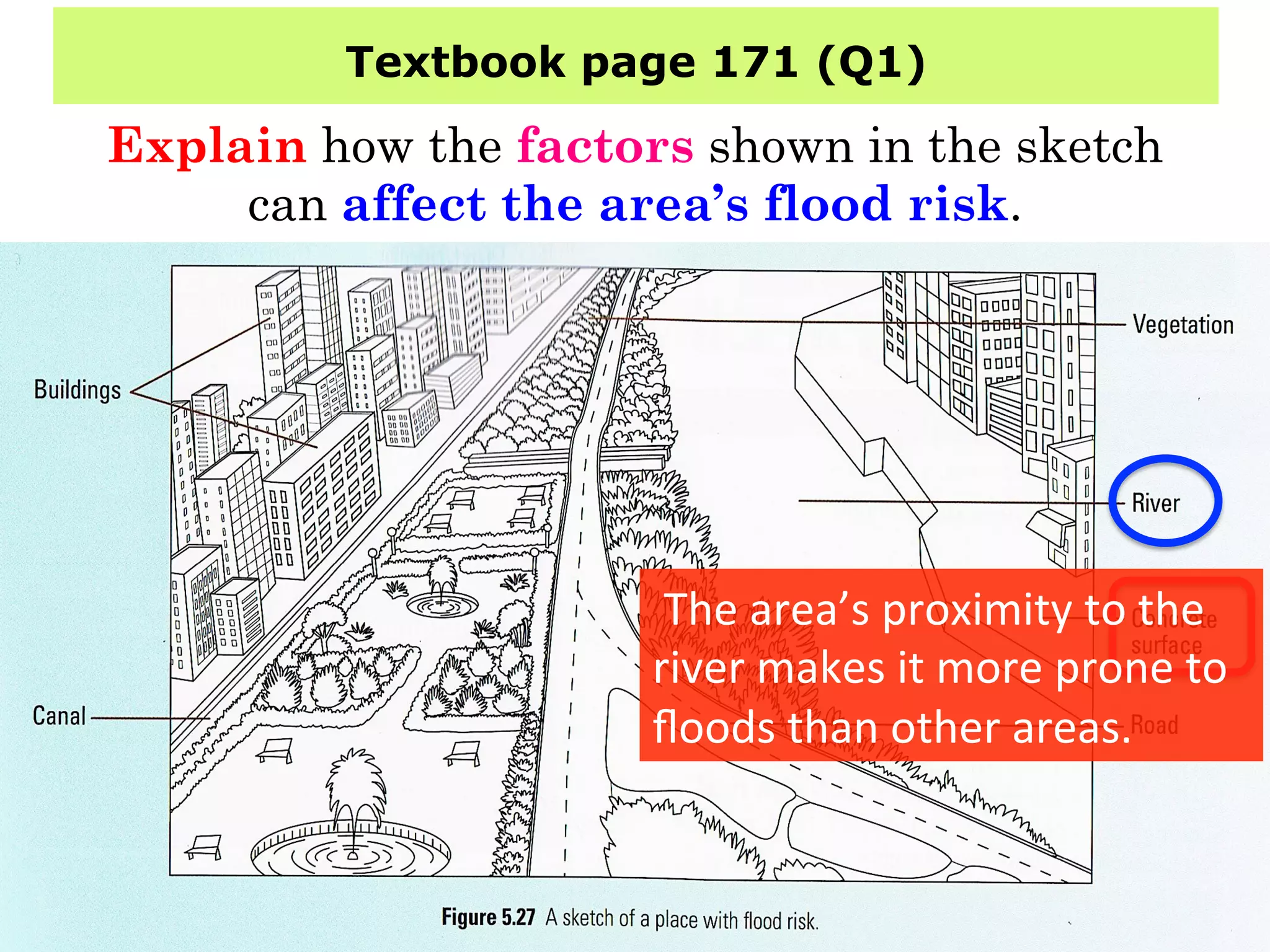
Textbook page 171 (Q1)
Explain how the factors shown in the sketch
can affect the area’s flood risk.
	
  The	
  concrete	
  pavements	
  can	
  result	
  
in	
  increased	
  overland	
  flow	
  because	
  
of	
  low	
  permeability.	
  
Textbook page 171 (Q1)
Explain how the factors shown in the sketch
can affect the area’s flood risk.
The	
  narrow	
  canals	
  suggest	
  low	
  channel	
  capacity.	
  	
  
As	
  such,	
  the	
  canal	
  is	
  likely	
  to	
  be	
  unable	
  to	
  handle	
  
large	
  amounts	
  of	
  surface	
  runoff	
  during	
  a	
  rain	
  event.	
  
Textbook page 171 (Q1)
Explain how the factors shown in the sketch
can affect the area’s flood risk.
	
  The	
  area’s	
  proximity	
  to	
  the	
  
river	
  makes	
  it	
  more	
  prone	
  to	
  
floods	
  than	
  other	
  areas.	
  

S2 GE Slides - Floods (Part 1)

  • 1.
  • 2.
  • 3.
    a hazard… But canthey also be
  • 4.
    1. What arefloods? What causes floods? 2. Which cities are prone to floods? Why are these cities more prone? 3. How do floods affect city dwellers? 4. How should cities prepare for floods? We want to learn about…
  • 5.
    1. What arefloods? Definition: Floods are large amounts of water that overflows onto land that is usually dry.
  • 6.
    Geographical concept: Scale SCALE offloods depends on the extent of the area that is flooded Brisbane flood: LARGE - scale flood
  • 7.
    Geographical concept: Scale SCALE offloods depends on the extent of the area that is flooded Singapore flood: SMALL - scale flood
  • 8.
    Small-Scale flood Large-Scaleflood Only affects local area Flood affects wider area SG orchard road flood (2009) Brisbane flood (2011) Smaller extent of damage (ie. lesser casualties/losses) Damages more property & affects more peoples’ lives
  • 9.
    1. Types offloods Flash floods Coastal floods (1) River floods (2) (3)
  • 10.
    Occur in areasalong the coast (eg. river mouths) Caused by intense storms (eg. tropical storms, typhoons or hurricanes) Coastal floods (1)
  • 11.
    How storms cause coastalfloods: Watch  –  h(ps://www.youtube.com/watch?v=Kd1tY1ekYSI     Coastal floods (1)
  • 12.
    Occur when waterin the river rises and overflows its banks. A cross-section of a river channel River floods (2)
  • 13.
    Occur when waterin the river rises and overflows its banks. A cross-section of a river channel raised banks (aka levees) River floods (2)
  • 14.
    Occur on thefloodplain (river + low-lying land on both sides) A cross-section of a river channel Floodplain River floods (2)
  • 15.
    May be causedby: Snowmelt Failure of man-made structures (eg. Dam failure) Heavy rainfall River floods (2)
  • 16.
    Floodwater reached theroof level of houses Flood due to overflow of Brisbane River (in Brisbane, Queensland, Australia, in 2011) River floods (2)
  • 17.
    Flash floods Takes placesuddenly Lasts for a short period of time Recognised by its quick rise in water level (3) h(ps://www.youtube.com/watch?v=uGTNf0i3uVI  
  • 18.
    Flash floods River floods (3) Maybe caused by: Heavy rainfall Storm surge (eg. Coastal floods)
  • 19.
    Q3a) What arethe arrows pointing to?RECAP! Natural  levees  
  • 20.
    Q3b) What arethe arrows pointing to?RECAP! Floodplain  
  • 23.
    Failure of man- madestructures Heavy rainfall Storm surge 1. What causes floods? Snowmelt (a) (B) (C) (D)
  • 24.
    Definition: Rainfall refers to dropletsof water that fall to the ground 1. What causes floods? Heavy rainfall(a)
  • 25.
    How rain isformed: 1. What causes floods? Heavy rainfall(a)
  • 26.
    Rainfall characteristics: 1. Whatcauses floods? Heavy rainfall(a) Rainfall  dura3on     (hours)   How  long  the  rain  event  lasts  for.  
  • 27.
    Rainfall characteristics: 1. Whatcauses floods? Heavy rainfall(a) Rainfall  intensity     (mm/h)   •  Rate  at  which  rain  falls  to  the  ground.     •  Tropical  storms  usually  have  a  high   rainfall  intensity.  
  • 28.
    Rainfall characteristics: 1. Whatcauses floods? Heavy rainfall(a) Different  rainfall  intensi3es  
  • 29.
    1. What causesfloods? Heavy rainfall(a) Rainfall characteristics: Rainfall  frequency   •  The  probability  that  a  certain   amount  of  rain  falling  within  a   certain  period  of  Mme  will  occur.   •  Eg.  1-­‐in-­‐50-­‐year  storm  in   England  in  June  2012.    
  • 30.
    1. What causesfloods? Heavy rainfall(a) Rainfall characteristics: During a tropical cyclone, rainfall is of high intensity and has a long duration.
  • 31.
    Definition: Snowmelt is surfacerunoff that results from melting snow 1. What causes floods? Snowmelt (B)
  • 32.
    How snowmelt leads toflooding: 1. What causes floods? Snowmelt (B) h(ps://www.floodsmart.gov/floodsmart/pages/flooding_flood_risks/flood_scenarios.jsp  
  • 33.
    Definition: Storm surge isa sudden rise of the sea level in which water is piled up against a coastline beyond normal high-tide conditions. 1. What causes floods? Storm surge (C)
  • 34.
    How it lookslike: 1. What causes floods? Storm surge (C)
  • 35.
    How it isformed: During a storm, strong winds push water towards the coast. This creates huge waves, giving rise to a storm surge. 1. What causes floods? Storm surge (C) h(p://www.theguardian.com/world/video/2013/nov/18/typhoon-­‐haiyan-­‐storm-­‐surge-­‐house-­‐video  
  • 36.
    1. What causesfloods? Dams   A dam is a barrier built across a river to retain and store water. Failure of man-made structures (D)
  • 37.
    1. What causesfloods? Dam failure can be disastrous for people living downstream. Failure of man-made structures (D) Dam  failure  
  • 38.
    1. What causesfloods? Levees   Failure of man-made structures (D) Levees are raised river banks that act as flood barriers h(ps://www.floodsmart.gov/floodsmart/pages/flooding_flood_risks/levee_simulator.jsp  
  • 39.
    1. What causesfloods? Failure of man-made structures (D) Can be man-made or natural. Levees  
  • 40.
    1. What causesfloods? Levees   Failure of man-made structures (D) Levees are designed to protect us and our communities from flooding. But overtime, they can decay and fail.
  • 41.
    1. What causesfloods? Floodwalls are man-made structures made of concrete. They act as flood barriers. Failure of man-made structures (D) Floodwalls   Austria’s  floodwalls:  h(ps://www.youtube.com/watch?v=hzQyTOaBHzI  
  • 42.
    1. What causesfloods? Failure of man-made structures (D) Floodwalls  
  • 43.
    1. What causesfloods? Failure of man-made structures (D) Levees  &   Floodwalls   Failure  
  • 44.
    1. What arefloods? What causes floods? 2. Which cities are prone to floods? Why are these cities more prone? We want to learn about…
  • 45.
    Floods can occuralmost anywhere! 2. Which cities are prone to floods?
  • 46.
    Case  studies  on  TB  page  164-­‐165   Newport,  UK   Located  hear  coasts     coastal  flooding   due  to  storm  surges   New  Orleans,  USA   Located  in  the   path  of  hurricanes       floods  due  to   heavy  rainfalls   from  tropical   storm   Calgary,  Canada   Located  at  the   foothills  of     mountains     floods  due     to  snowmelt   2. Which cities are prone to floods?
  • 47.
    Floods can occuralmost anywhere! Case  studies  on  TB  page  164-­‐165   Tacloban,  Philippines   Located  along     the  coast       coastal  floods  &     storm  surges   2. Which cities are prone to floods? Rio  Largo,  Brazil   Located  near  dams       floods  caused  by   heavy  rains  &     dam  failure   Dhaka,  Bangladesh   Located  at  low-­‐lying   areas    floods  due   to  heavy  monsoon   rains  
  • 48.
    2. Why arethese cities more prone to floods? Height of land above sea level(i) Proximity to water bodies(iI) Permeability of surface cover(iII) Channel Capacity(iv)
  • 49.
    2. Why arethese cities more prone to floods? Height of land above sea level (i) Mean sea level is the average height of the sea surface over a long period of time.
  • 50.
    2. Why arethese cities more prone to floods? Height of land above sea level (i) Cities that are located on low-lying lands are more prone to floods Low-lying areas à prone to flooding
  • 51.
    2. Why arethese cities more prone to floods? Proximity to water bodies (iI) Water bodies are significant accumulations of water: •  Oceans •  Seas •  Lakes •  Rivers •  Reservoirs
  • 52.
    2. Why arethese cities more prone to floods? Proximity to water bodies (iI) Cities that are located near water bodies are more prone to floods Near to oceans / seas / lakes / river mouths / reservoirs à more prone to flooding
  • 53.
    2. Why arethese cities more prone to floods? Permeability of surface cover (iII) Permeability refers to how easy water can infiltrate / seep into the ground.
  • 54.
    2. Why arethese cities more prone to floods? Permeability of surface cover (iII) Concrete surfaces Water cannot infiltrate the ground High surface runoff More prone to floods
  • 55.
    2. Why arethese cities more prone to floods? Permeability of surface cover (iII) Vegetated surfaces Water can infiltrate the ground easily Less surface runoff Less prone to floods
  • 56.
    2. Why arethese cities more prone to floods? Channel Capacity (iv) Channel capacity refers to the volume of water that can be held in the channel of a river / canal without overflowing. low   capacity   to  hold     water   high   capacity     to  hold     water  
  • 57.
    2. Why arethese cities more prone to floods? Channel Capacity (iv) Amount of rain exceed the capacity of channel à Floods
  • 58.
    2. Why arethese cities more prone to floods? Channel Capacity (iv) Cities have high proportion of built-up areas and concrete surfaces Floods occur! Canals may not have the capacity to carry this runoff away fast enough large amounts of surface runoff during a rain event Decrease likelihood of floods Thus, a good network of canals and rivers is needed to drain water away quickly
  • 59.
    Textbook page 171(Q1) Explain how the factors shown in the sketch can affect the area’s flood risk.
  • 60.
    Textbook page 171(Q1) Explain how the factors shown in the sketch can affect the area’s flood risk.  The  concrete  pavements  can  result   in  increased  overland  flow  because   of  low  permeability.  
  • 61.
    Textbook page 171(Q1) Explain how the factors shown in the sketch can affect the area’s flood risk. The  narrow  canals  suggest  low  channel  capacity.     As  such,  the  canal  is  likely  to  be  unable  to  handle   large  amounts  of  surface  runoff  during  a  rain  event.  
  • 62.
    Textbook page 171(Q1) Explain how the factors shown in the sketch can affect the area’s flood risk.  The  area’s  proximity  to  the   river  makes  it  more  prone  to   floods  than  other  areas.