A flood is an overflow of an expanse of water
that submerges land. Flood as a temporary
covering by water of land not normally
covered by water. Flooding may result from
the volume of water within a body of water,
such as a river or lake, which overflows or
breaks levees, with the result that some of the
water escapes its usual boundaries. While the
size of a lake or other body of water will vary
with seasonal changes in precipitation and
snow melt, it is not a significant flood unless
such escapes of water endanger land areas
used by man like a village, city or other
inhabited area.
The flood of 1931 in the HWANG HO ,
flooded China’s great plain , killing 2 million
people that’s why it’s called sorrow of china.
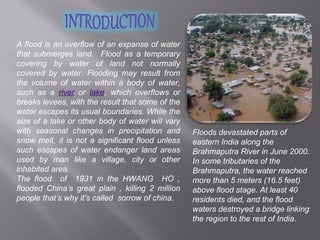
Floods devastated parts of
eastern India along the
Brahmaputra River in June 2000.
In some tributaries of the
Brahmaputra, the water reached
more than 5 meters (16.5 feet)
above flood stage. At least 40
residents died, and the flood
waters destroyed a bridge linking
the region to the rest of India.
TYPES OF FLOOD:TYPES OF FLOOD:
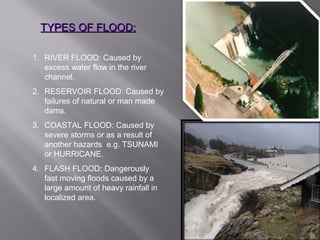
1. RIVER FLOOD: Caused by
excess water flow in the river
channel.
2. RESERVOIR FLOOD: Caused by
failures of natural or man made
dams.
3. COASTAL FLOOD: Caused by
severe storms or as a result of
another hazards e.g. TSUNAMI
or HURRICANE.
4. FLASH FLOOD: Dangerously
fast moving floods caused by a
large amount of heavy rainfall in
localized area.
CAUSES OF FLOODSCAUSES OF FLOODS
:
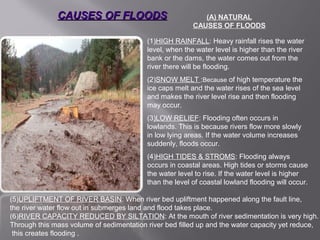
(1)HIGH RAINFALL: Heavy rainfall rises the water
level, when the water level is higher than the river
bank or the dams, the water comes out from the
river there will be flooding.
(2)SNOW MELT :Because of high temperature the
ice caps melt and the water rises of the sea level
and makes the river level rise and then flooding
may occur.
(3)LOW RELIEF: Flooding often occurs in
lowlands. This is because rivers flow more slowly
in low lying areas. If the water volume increases
suddenly, floods occur.
(4)HIGH TIDES & STROMS: Flooding always
occurs in coastal areas. High tides or storms cause
the water level to rise. If the water level is higher
than the level of coastal lowland flooding will occur.
(5)UPLIFTMENT OF RIVER BASIN: When river bed upliftment happened along the fault line,
the river water flow out in submerges land and flood takes place.
(6)RIVER CAPACITY REDUCED BY SILTATION: At the mouth of river sedimentation is very high.
Through this mass volume of sedimentation river bed filled up and the water capacity yet reduce,
this creates flooding .
(A) NATURAL
CAUSES OF FLOODS
(B) HUMAN CAUSES OF FLOOD:(B) HUMAN CAUSES OF FLOOD:
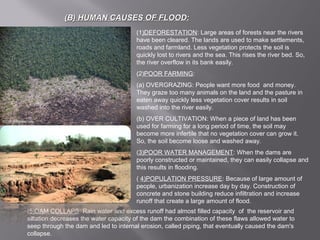
(1)DEFORESTATION: Large areas of forests near the rivers
have been cleared. The lands are used to make settlements,
roads and farmland. Less vegetation protects the soil is
quickly lost to rivers and the sea. This rises the river bed. So,
the river overflow in its bank easily.
(2)POOR FARMING:
(a) OVERGRAZING: People want more food and money.
They graze too many animals on the land and the pasture in
eaten away quickly less vegetation cover results in soil
washed into the river easily.
(b) OVER CULTIVATION: When a piece of land has been
used for farming for a long period of time, the soil may
become more infertile that no vegetation cover can grow it.
So, the soil become loose and washed away.
(3)POOR WATER MANAGEMENT: When the dams are
poorly constructed or maintained, they can easily collapse and
this results in flooding.
( 4)POPULATION PRESSURE: Because of large amount of
people, urbanization increase day by day. Construction of
concrete and stone building reduce infiltration and increase
runoff that create a large amount of flood.
(5)DAM COLLAPS: Rain water and excess runoff had almost filled capacity of the reservoir and
siltation decreases the water capacity of the dam the combination of these flaws allowed water to
seep through the dam and led to internal erosion, called piping, that eventually caused the dam's
collapse.
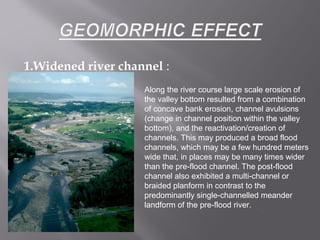
1.Widened river channel :
Along the river course large scale erosion of
the valley bottom resulted from a combination
of concave bank erosion, channel avulsions
(change in channel position within the valley
bottom), and the reactivation/creation of
channels. This may produced a broad flood
channels, which may be a few hundred meters
wide that, in places may be many times wider
than the pre-flood channel. The post-flood
channel also exhibited a multi-channel or
braided planform in contrast to the
predominantly single-channelled meander
landform of the pre-flood river.
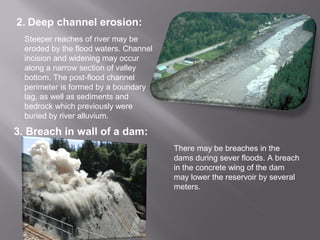
2. Deep channel erosion:
Steeper reaches of river may be
eroded by the flood waters. Channel
incision and widening may occur
along a narrow section of valley
bottom. The post-flood channel
perimeter is formed by a boundary
lag, as well as sediments and
bedrock which previously were
buried by river alluvium.
3. Breach in wall of a dam:
There may be breaches in the
dams during sever floods. A breach
in the concrete wing of the dam
may lower the reservoir by several
meters.
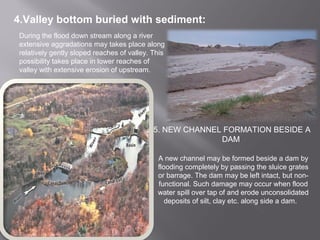
4.Valley bottom buried with sediment:
During the flood down stream along a river
extensive aggradations may takes place along
relatively gently sloped reaches of valley. This
possibility takes place in lower reaches of
valley with extensive erosion of upstream.
5. NEW CHANNEL FORMATION BESIDE A
DAM
A new channel may be formed beside a dam by
flooding completely by passing the sluice grates
or barrage. The dam may be left intact, but non-
functional. Such damage may occur when flood
water spill over tap of and erode unconsolidated
deposits of silt, clay etc. along side a dam.
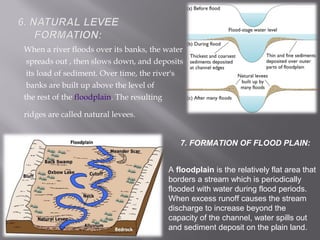
When a river floods over its banks, the water
spreads out , then slows down, and deposits
its load of sediment. Over time, the river's
banks are built up above the level of
the rest of the floodplain. The resulting
ridges are called natural levees.
A floodplain is the relatively flat area that
borders a stream which is periodically
flooded with water during flood periods.
When excess runoff causes the stream
discharge to increase beyond the
capacity of the channel, water spills out
and sediment deposit on the plain land.
7. FORMATION OF FLOOD PLAIN:
8. Landslide caused by flood
Flood is also the cause of many
natural hazards landslide is one
of them, heavy flooding erodes
the soil and geological structure
loses it’s stability. The worst
recent landslide disaster
occurred in Italy’s voiont
reservoir which drowned 2000
people in flood wave.
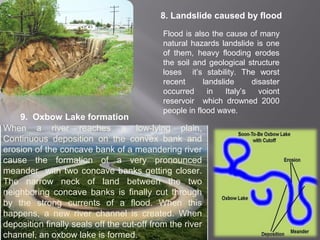
9. Oxbow Lake formation
When a river reaches a low-lying plain,
Continuous deposition on the convex bank and
erosion of the concave bank of a meandering river
cause the formation of a very pronounced
meander with two concave banks getting closer.
The narrow neck of land between the two
neighboring concave banks is finally cut through
by the strong currents of a flood. When this
happens, a new river channel is created. When
deposition finally seals off the cut-off from the river
channel, an oxbow lake is formed.
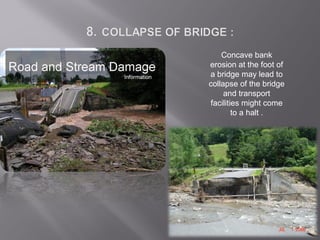
Concave bank
erosion at the foot of
a bridge may lead to
collapse of the bridge
and transport
facilities might come
to a halt .
 STRUCTURAL MANAGEMENT:
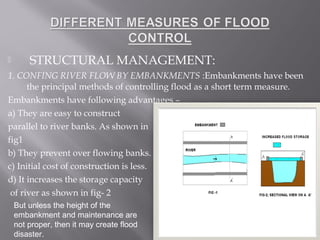
1. CONFING RIVER FLOW BY EMBANKMENTS :Embankments have been
the principal methods of controlling flood as a short term measure.
Embankments have following advantages –
a) They are easy to construct
parallel to river banks. As shown in
fig1
b) They prevent over flowing banks.
c) Initial cost of construction is less.
d) It increases the storage capacity
of river as shown in fig- 2
But unless the height of the
embankment and maintenance are
not proper, then it may create flood
disaster.
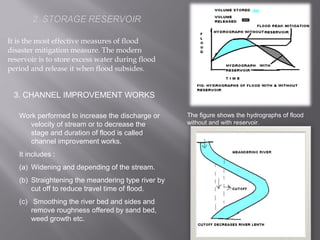
It is the most effective measures of flood
disaster mitigation measure. The modern
reservoir is to store excess water during flood
period and release it when flood subsides.
The figure shows the hydrographs of flood
without and with reservoir.
3. CHANNEL IMPROVEMENT WORKS
Work performed to increase the discharge or
velocity of stream or to decrease the
stage and duration of flood is called
channel improvement works.
It includes :
(a) Widening and depending of the stream.
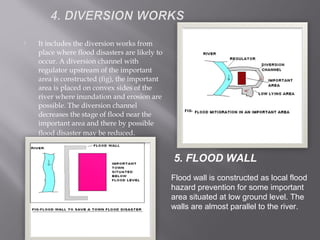
(b) Straightening the meandering type river by
cut off to reduce travel time of flood.
(c) Smoothing the river bed and sides and
remove roughness offered by sand bed,
weed growth etc.
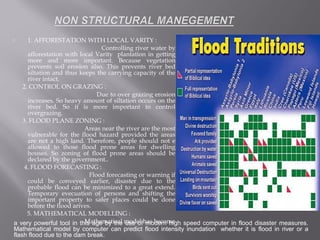
 It includes the diversion works from
place where flood disasters are likely to
occur. A diversion channel with
regulator upstream of the important
area is constructed (fig), the important
area is placed on convex sides of the
river where inundation and erosion are
possible. The diversion channel
decreases the stage of flood near the
important area and there by possible
flood disaster may be reduced.
5. FLOOD WALL
Flood wall is constructed as local flood
hazard prevention for some important
area situated at low ground level. The
walls are almost parallel to the river.
 1. AFFORESTATION WITH LOCAL VARITY :
Controlling river water by
afforestation with local Varity plantation in getting
more and more important. Because vegetation
prevents soil erosion also. This prevents river bed
siltation and thus keeps the carrying capacity of the
river intact.
2. CONTROL ON GRAZING :
Due to over grazing erosion
increases. So heavy amount of siltation occurs on the
river bed. So it is more important to control
overgrazing.
3. FLOOD PLANE ZONING :
Areas near the river are the most
vulnerable for the flood hazard provided the areas
are not a high land. Therefore, people should not e
allowed to those flood prone areas for dwelling
houses. So zoning of flood prone areas should be
declared by the government..
4. FLOOD FORECASTING :
Flood forecasting or warning if
could be conveyed earlier, disaster due to the
probable flood can be minimized to a great extend.
Temporary evecuation of persons and shifting the
important property to safer places could be done
before the flood arives.
5. MATHEMATICAL MODELLING :
Mathematical model has becomea very powerful tool in this age by the use of modern high speed computer in flood disaster measures.
Mathematical model by computer can predict flood intensity inundation whether it is flood in river or a
flash flood due to the dam break.
Geomorphologic apply science techniques, such as:
•Geomorphic and geologic watershed mapping and
interpretation
•Sediment source inventories and sediment budget
determinations
•Historical records analyses and land use change impact
assessments
•Stream flow and sediment entrainment and transport
monitoring
•High-resolution flow velocity profiling
•Channel geometry and bed profile surveys
•Channel bed and subsurface sediment characterization
including mapping
•Numerical modeling of sediment transport dynamics in sand-
and gravel-bed rivers
•Numerical modeling of reservoir sediment deposition and
stratification
•Physical modeling (flume) experiments
•Aquatic and estuarine habitat characterization and modeling
•Large wood assessments and budgets,
•Planning and designs for river restoration, gravel augmentation,
instream habitat structure placement
•Strategic planning for dam removal
•Prescriptions for ecological high flow releases
•Designs for ecological high flow implementation
Baseline and post-project monitoring and evaluation
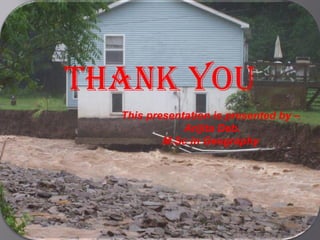
Thank You
This presentation is presented by –
Arijita Deb.
M.Sc in Geography

Flood

  • 2.
    A flood isan overflow of an expanse of water that submerges land. Flood as a temporary covering by water of land not normally covered by water. Flooding may result from the volume of water within a body of water, such as a river or lake, which overflows or breaks levees, with the result that some of the water escapes its usual boundaries. While the size of a lake or other body of water will vary with seasonal changes in precipitation and snow melt, it is not a significant flood unless such escapes of water endanger land areas used by man like a village, city or other inhabited area. The flood of 1931 in the HWANG HO , flooded China’s great plain , killing 2 million people that’s why it’s called sorrow of china. Floods devastated parts of eastern India along the Brahmaputra River in June 2000. In some tributaries of the Brahmaputra, the water reached more than 5 meters (16.5 feet) above flood stage. At least 40 residents died, and the flood waters destroyed a bridge linking the region to the rest of India.
  • 3.
    TYPES OF FLOOD:TYPESOF FLOOD: 1. RIVER FLOOD: Caused by excess water flow in the river channel. 2. RESERVOIR FLOOD: Caused by failures of natural or man made dams. 3. COASTAL FLOOD: Caused by severe storms or as a result of another hazards e.g. TSUNAMI or HURRICANE. 4. FLASH FLOOD: Dangerously fast moving floods caused by a large amount of heavy rainfall in localized area.
  • 4.
    CAUSES OF FLOODSCAUSESOF FLOODS : (1)HIGH RAINFALL: Heavy rainfall rises the water level, when the water level is higher than the river bank or the dams, the water comes out from the river there will be flooding. (2)SNOW MELT :Because of high temperature the ice caps melt and the water rises of the sea level and makes the river level rise and then flooding may occur. (3)LOW RELIEF: Flooding often occurs in lowlands. This is because rivers flow more slowly in low lying areas. If the water volume increases suddenly, floods occur. (4)HIGH TIDES & STROMS: Flooding always occurs in coastal areas. High tides or storms cause the water level to rise. If the water level is higher than the level of coastal lowland flooding will occur. (5)UPLIFTMENT OF RIVER BASIN: When river bed upliftment happened along the fault line, the river water flow out in submerges land and flood takes place. (6)RIVER CAPACITY REDUCED BY SILTATION: At the mouth of river sedimentation is very high. Through this mass volume of sedimentation river bed filled up and the water capacity yet reduce, this creates flooding . (A) NATURAL CAUSES OF FLOODS
  • 5.
    (B) HUMAN CAUSESOF FLOOD:(B) HUMAN CAUSES OF FLOOD: (1)DEFORESTATION: Large areas of forests near the rivers have been cleared. The lands are used to make settlements, roads and farmland. Less vegetation protects the soil is quickly lost to rivers and the sea. This rises the river bed. So, the river overflow in its bank easily. (2)POOR FARMING: (a) OVERGRAZING: People want more food and money. They graze too many animals on the land and the pasture in eaten away quickly less vegetation cover results in soil washed into the river easily. (b) OVER CULTIVATION: When a piece of land has been used for farming for a long period of time, the soil may become more infertile that no vegetation cover can grow it. So, the soil become loose and washed away. (3)POOR WATER MANAGEMENT: When the dams are poorly constructed or maintained, they can easily collapse and this results in flooding. ( 4)POPULATION PRESSURE: Because of large amount of people, urbanization increase day by day. Construction of concrete and stone building reduce infiltration and increase runoff that create a large amount of flood. (5)DAM COLLAPS: Rain water and excess runoff had almost filled capacity of the reservoir and siltation decreases the water capacity of the dam the combination of these flaws allowed water to seep through the dam and led to internal erosion, called piping, that eventually caused the dam's collapse.
  • 6.
    1.Widened river channel: Along the river course large scale erosion of the valley bottom resulted from a combination of concave bank erosion, channel avulsions (change in channel position within the valley bottom), and the reactivation/creation of channels. This may produced a broad flood channels, which may be a few hundred meters wide that, in places may be many times wider than the pre-flood channel. The post-flood channel also exhibited a multi-channel or braided planform in contrast to the predominantly single-channelled meander landform of the pre-flood river.
  • 7.
    2. Deep channelerosion: Steeper reaches of river may be eroded by the flood waters. Channel incision and widening may occur along a narrow section of valley bottom. The post-flood channel perimeter is formed by a boundary lag, as well as sediments and bedrock which previously were buried by river alluvium. 3. Breach in wall of a dam: There may be breaches in the dams during sever floods. A breach in the concrete wing of the dam may lower the reservoir by several meters.
  • 8.
    4.Valley bottom buriedwith sediment: During the flood down stream along a river extensive aggradations may takes place along relatively gently sloped reaches of valley. This possibility takes place in lower reaches of valley with extensive erosion of upstream. 5. NEW CHANNEL FORMATION BESIDE A DAM A new channel may be formed beside a dam by flooding completely by passing the sluice grates or barrage. The dam may be left intact, but non- functional. Such damage may occur when flood water spill over tap of and erode unconsolidated deposits of silt, clay etc. along side a dam.
  • 9.
    When a riverfloods over its banks, the water spreads out , then slows down, and deposits its load of sediment. Over time, the river's banks are built up above the level of the rest of the floodplain. The resulting ridges are called natural levees. A floodplain is the relatively flat area that borders a stream which is periodically flooded with water during flood periods. When excess runoff causes the stream discharge to increase beyond the capacity of the channel, water spills out and sediment deposit on the plain land. 7. FORMATION OF FLOOD PLAIN:
  • 10.
    8. Landslide causedby flood Flood is also the cause of many natural hazards landslide is one of them, heavy flooding erodes the soil and geological structure loses it’s stability. The worst recent landslide disaster occurred in Italy’s voiont reservoir which drowned 2000 people in flood wave. 9. Oxbow Lake formation When a river reaches a low-lying plain, Continuous deposition on the convex bank and erosion of the concave bank of a meandering river cause the formation of a very pronounced meander with two concave banks getting closer. The narrow neck of land between the two neighboring concave banks is finally cut through by the strong currents of a flood. When this happens, a new river channel is created. When deposition finally seals off the cut-off from the river channel, an oxbow lake is formed.
  • 11.
    Concave bank erosion atthe foot of a bridge may lead to collapse of the bridge and transport facilities might come to a halt .
  • 12.
     STRUCTURAL MANAGEMENT: 1.CONFING RIVER FLOW BY EMBANKMENTS :Embankments have been the principal methods of controlling flood as a short term measure. Embankments have following advantages – a) They are easy to construct parallel to river banks. As shown in fig1 b) They prevent over flowing banks. c) Initial cost of construction is less. d) It increases the storage capacity of river as shown in fig- 2 But unless the height of the embankment and maintenance are not proper, then it may create flood disaster.
  • 13.
    It is themost effective measures of flood disaster mitigation measure. The modern reservoir is to store excess water during flood period and release it when flood subsides. The figure shows the hydrographs of flood without and with reservoir. 3. CHANNEL IMPROVEMENT WORKS Work performed to increase the discharge or velocity of stream or to decrease the stage and duration of flood is called channel improvement works. It includes : (a) Widening and depending of the stream. (b) Straightening the meandering type river by cut off to reduce travel time of flood. (c) Smoothing the river bed and sides and remove roughness offered by sand bed, weed growth etc.
  • 14.
     It includesthe diversion works from place where flood disasters are likely to occur. A diversion channel with regulator upstream of the important area is constructed (fig), the important area is placed on convex sides of the river where inundation and erosion are possible. The diversion channel decreases the stage of flood near the important area and there by possible flood disaster may be reduced. 5. FLOOD WALL Flood wall is constructed as local flood hazard prevention for some important area situated at low ground level. The walls are almost parallel to the river.
  • 15.
     1. AFFORESTATIONWITH LOCAL VARITY : Controlling river water by afforestation with local Varity plantation in getting more and more important. Because vegetation prevents soil erosion also. This prevents river bed siltation and thus keeps the carrying capacity of the river intact. 2. CONTROL ON GRAZING : Due to over grazing erosion increases. So heavy amount of siltation occurs on the river bed. So it is more important to control overgrazing. 3. FLOOD PLANE ZONING : Areas near the river are the most vulnerable for the flood hazard provided the areas are not a high land. Therefore, people should not e allowed to those flood prone areas for dwelling houses. So zoning of flood prone areas should be declared by the government.. 4. FLOOD FORECASTING : Flood forecasting or warning if could be conveyed earlier, disaster due to the probable flood can be minimized to a great extend. Temporary evecuation of persons and shifting the important property to safer places could be done before the flood arives. 5. MATHEMATICAL MODELLING : Mathematical model has becomea very powerful tool in this age by the use of modern high speed computer in flood disaster measures. Mathematical model by computer can predict flood intensity inundation whether it is flood in river or a flash flood due to the dam break.
  • 16.
    Geomorphologic apply sciencetechniques, such as: •Geomorphic and geologic watershed mapping and interpretation •Sediment source inventories and sediment budget determinations •Historical records analyses and land use change impact assessments •Stream flow and sediment entrainment and transport monitoring •High-resolution flow velocity profiling •Channel geometry and bed profile surveys •Channel bed and subsurface sediment characterization including mapping •Numerical modeling of sediment transport dynamics in sand- and gravel-bed rivers •Numerical modeling of reservoir sediment deposition and stratification •Physical modeling (flume) experiments •Aquatic and estuarine habitat characterization and modeling •Large wood assessments and budgets, •Planning and designs for river restoration, gravel augmentation, instream habitat structure placement •Strategic planning for dam removal •Prescriptions for ecological high flow releases •Designs for ecological high flow implementation Baseline and post-project monitoring and evaluation
  • 17.
    Thank You This presentationis presented by – Arijita Deb. M.Sc in Geography