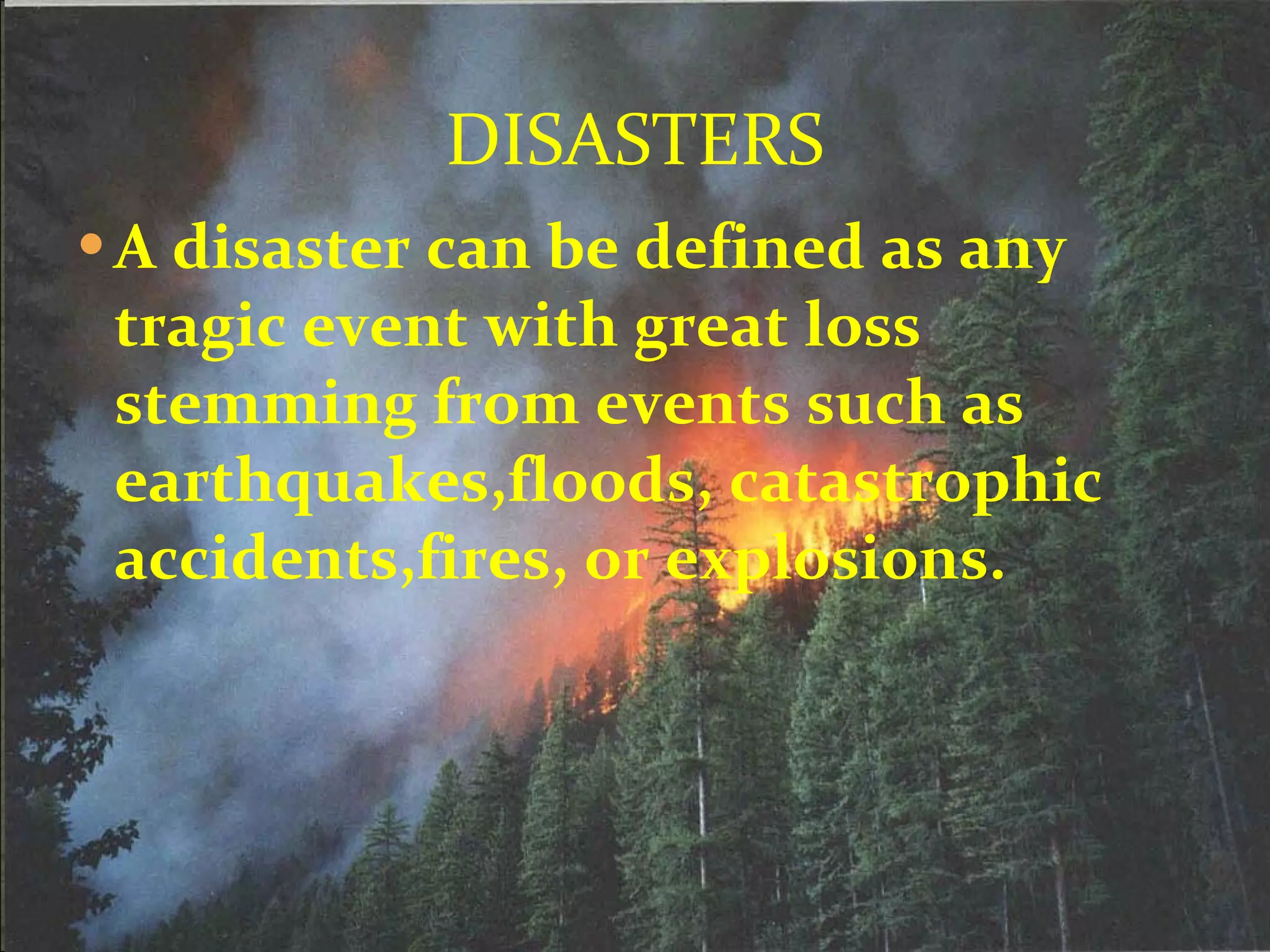
DISASTERS A disaster can be defined as any tragic event with great loss stemming from events such as earthquakes,floods, catastrophic accidents,fires, or explosions.
Disasters:   TYPES OF DISASTERS Natural disaster   Man-made catastrophe
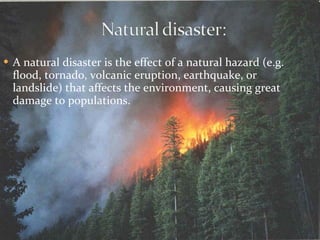
A natural disaster is the effect of a natural hazard (e.g. flood, tornado, volcanic eruption, earthquake, or landslide) that affects the environment, causing great damage to populations.
                                                                                                                                                                                                                              
TORNADOES
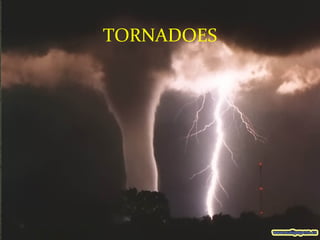
They are also called twisters or cyclones Most people recognize them as a towering black funnel extending downward from the base of a large cumulonimbus cloud.  Tornadoes are characterized by violent winds. The speed of the wind is the primary cause of deaths and destruction of property. Many people are killed by flying objects  (missiles).
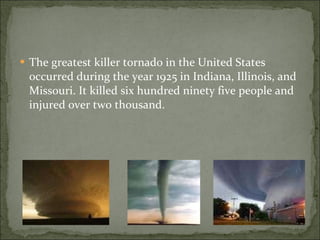
The greatest killer tornado in the United States occurred during the year 1925 in Indiana, Illinois, and Missouri. It killed six hundred ninety five people and injured over two thousand.
The best thing to do is to get into a shelter that is equipped with a storm cellar. If you don't have a shelter designed to withstand tornadoes, then go into your basement. Do not stand near any windows. If you cannot reach the basement in time, find a closet or bathroom on the lowest floor possible. (Toilets and bathtubs are usually anchored into the ground, and those are usually the only things left intact after a tornado hits).
EARTHQUAKES
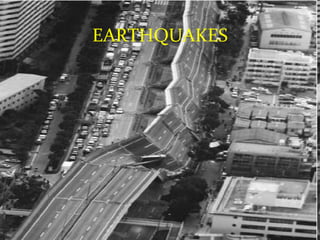
An earthquake is a shaking of the ground caused by the sudden dislocation of material within the earth's outer layer, or crust. Some earthquakes are  slight and  others are so violent that they cause extensive damage. Each year in the world occur, an estimated 800 quakes of magnitudes 5 to 6 . About 50,000 quakes of magnitudes 3 to 4 and only about one of magnitude 8 to 9 . The amount of destruction depends not only on the magnitude but also on the kind of ground and types of buildings, and on the location of the focus in relation to heavily populated areas. Large earthquakes are preceded by many aftershocks, which may persist for days or weeks. The first shock is the most damaging. However, sometimes an aftershock may be even more powerful than the original shock.
If you are outdoors, stay as far away from buildings as possible.  Stay away from glass or anything that could fall.  Be prepared for aftershocks after the initial earthquake has ended. Aftershocks are  follow-up earthquakes. They are smaller than the first one, but still are very dangerous.  Stay away from bookcases or furniture that can fall on you.
TSUNAMI
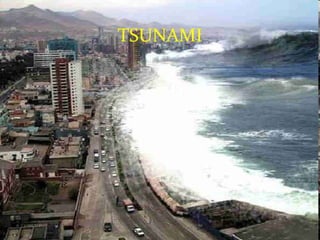
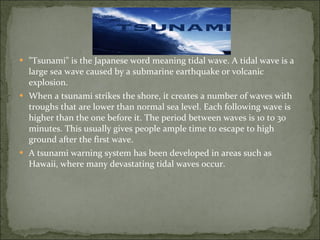
"Tsunami" is the Japanese word meaning tidal wave. A tidal wave is a large sea wave caused by a submarine earthquake or volcanic explosion. When a tsunami strikes the shore, it creates a number of waves with troughs that are lower than normal sea level. Each following wave is higher than the one before it. The period between waves is 10 to 30 minutes. This usually gives people ample time to escape to high ground after the first wave. A tsunami warning system has been developed in areas such as Hawaii, where many devastating tidal waves occur.
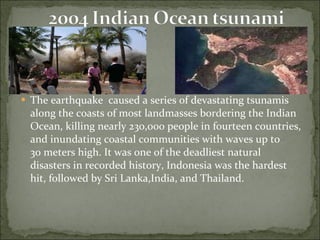
The earthquake  caused a series of devastating tsunamis   along the coasts of most landmasses bordering the Indian Ocean, killing nearly 230,000 people in fourteen countries, and inundating coastal communities with waves up to 30 meters high. It was one of the deadliest natural disasters in recorded history, Indonesia was the hardest hit, followed by Sri Lanka,India, and Thailand.
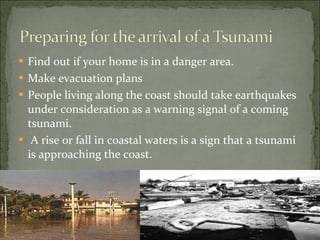
Find out if your home is in a danger area. Make evacuation plans People living along the coast should take earthquakes under consideration as a warning signal of a coming tsunami. A rise or fall in coastal waters is a sign that a tsunami is approaching the coast.
VOLCANOES
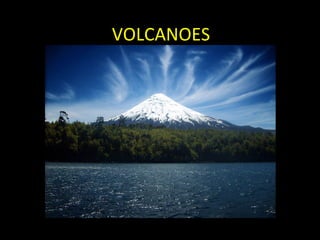
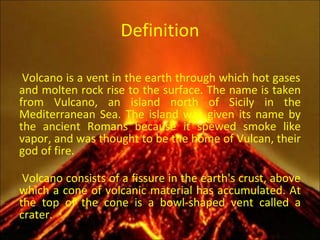
Definition A Volcano is a vent in the earth through which hot gases and molten rock rise to the surface. The name is taken from Vulcano, an island north of Sicily in the Mediterranean Sea. The island was given its name by the ancient Romans because it spewed smoke like vapor, and was thought to be the home of Vulcan, their god of fire. A Volcano consists of a fissure in the earth's crust, above which a cone of volcanic material has accumulated. At the top of the cone is a bowl-shaped vent called a crater.  
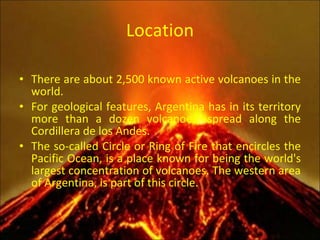
Location There are about 2,500 known active volcanoes in the world. For geological features, Argentina has in its territory more than a dozen volcanoes, spread along the Cordillera de los Andes. The so-called Circle or Ring of Fire that encircles the Pacific Ocean, is a place known for being the world's largest concentration of volcanoes. The western area of Argentina, is part of this circle.
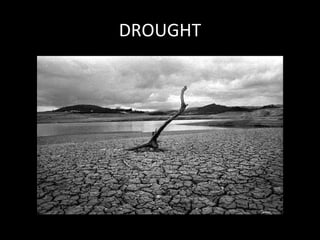
DROUGHT
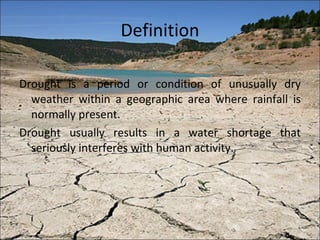
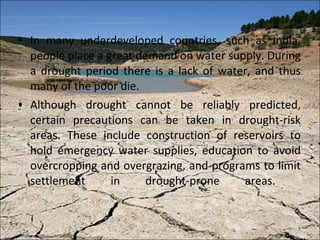
Definition Drought is a period or condition of unusually dry weather within a geographic area where rainfall is normally present. Drought usually results in a water shortage that seriously interferes with human activity.
In many underdeveloped countries, such as India, people place a great demand on water supply. During a drought period there is a lack of water, and thus many of the poor die. Although drought cannot be reliably predicted, certain precautions can be taken in drought-risk areas. These include construction of reservoirs to hold emergency water supplies, education to avoid overcropping and overgrazing, and programs to limit settlement in drought-prone areas.
HURRICANES
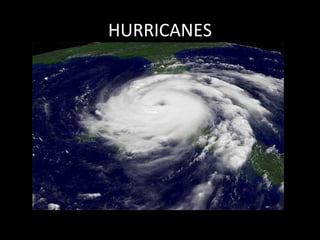
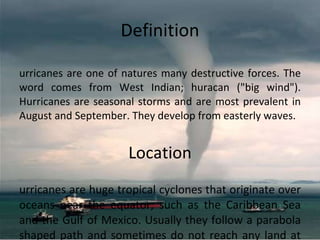
Definition Hurricanes are one of natures many destructive forces. The word comes from West Indian; huracan ("big wind"). Hurricanes are seasonal storms and are most prevalent in August and September. They develop from easterly waves. Location Hurricanes are huge tropical cyclones that originate over oceans near the equator, such as the Caribbean Sea and the Gulf of Mexico. Usually they follow a parabola shaped path and sometimes do not reach any land at all.
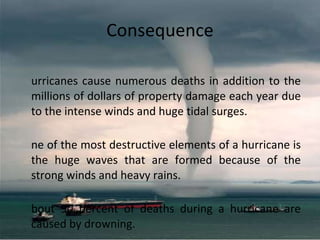
Consequence Hurricanes cause numerous deaths in addition to the millions of dollars of property damage each year due to the intense winds and huge tidal surges.  One of the most destructive elements of a hurricane is the huge waves that are formed because of the strong winds and heavy rains. About 90 percent of deaths during a hurricane are caused by drowning.
MAN-MADE CATASTROPHE Disastrous event caused directly and principally by one or more identifiable deliberate or negligent  human actions. Also called human-made disaster.
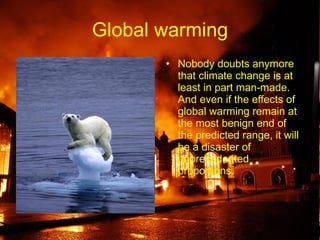
Global warming Nobody doubts anymore that climate change is at least in part man-made. And even if the effects of global warming remain at the most benign end of the predicted range, it will be a disaster of unprecedented proportions.
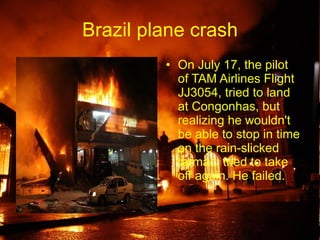
Brazil plane crash On July 17, the pilot of TAM Airlines Flight JJ3054, tried to land at Congonhas, but realizing he wouldn't be able to stop in time on the rain-slicked tarmac, tried to take off again. He failed.
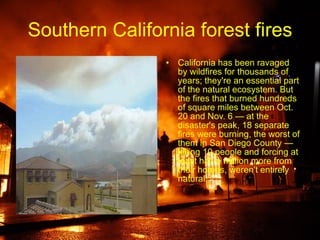
Southern California forest fires California has been ravaged by wildfires for thousands of years; they're an essential part of the natural ecosystem. But the fires that burned hundreds of square miles between Oct. 20 and Nov. 6 — at the disaster's peak, 18 separate fires were burning, the worst of them in San Diego County — killing 10 people and forcing at least half a million more from their homes, weren't entirely natural
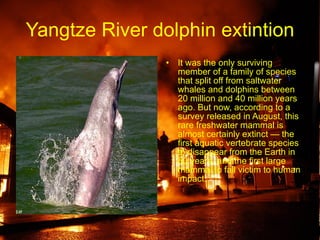
Yangtze River dolphin extintion It was the only surviving member of a family of species that split off from saltwater whales and dolphins between 20 million and 40 million years ago. But now, according to a survey released in August, this rare freshwater mammal is almost certainly extinct — the first aquatic vertebrate species to disappear from the Earth in 50 years, and the first large mammal to fall victim to human impact.
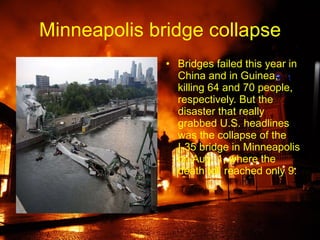
Minneapolis bridge collapse Bridges failed this year in China and in Guinea, killing 64 and 70 people, respectively. But the disaster that really grabbed U.S. headlines was the collapse of the I-35 bridge in Minneapolis on Aug. 1, where the death toll reached only 9.
Natural Disasters That Were  Caused by Human Stupidity
The Draining of Lake Peigneur   In 1980, a Texaco oil rig was drilling for petroleum at Lake Peigneur, a Louisiana lake that sits directly on top of a salt mine, and has an average depth of six feet. Were it a swimming pool, it wouldn't have been safe for diving, so it probably wasn't surprising to anyone but the drillers when they punched a hole through the top of the mine. At first the water simply trickled down below. But as the salt dissolved the hole expanded, and by lunch time they'd  created a whirlpool  that managed to suck the drilling platform, several barges and 65 or so acres of land into the lake. Because the water was going into the mine faster than the air could get out, spectators were treated to a geyser of water and debris that shot 400 feet into the air.
Fortunately no workers were killed by the whirlpool. Those on the platform, while unable to do their job properly, were smart enough to haul ass when things started getting a little too real, as were the salt miners below. Though all the evidence was literally flushed down the drain, it was a bit difficult for Texaco to sidestep the mystery of the suddenly salty lake and giant-ass waterfall that wasn't there before, and were forced to pay out over $40 million dollars, an amount of money that ensured the oil industry would never again cause an environmental disaster.
The Boston Molassacre   The life of a construction worker at a molasses factory is a difficult one. Or at least we assume it is, because one named Aurthur Jell decided to half-ass it when he built a molasses storage tank in the North End of Boston. He never bothered to check his tank for leaks of any kind before calling it a day, leaving the locals to try and plug up its many cracks (presumably while joking about construction being slower than molasses). As more leaks appeared, they knew the sight of molasses oozing from the cracks served as a warning of the disaster that could follow. So they hid them by painting the tank a molasses shade of brown
THE DISASTER: January of 1919 was unseasonably warm. As the fermentation process in the tank continued to produce carbon monoxide, the pressure inside continued to build, causing the cracks within the tank to expand like a trucker's waistline. Eventually the rivets shot out of the tank, unleashing a 15-foot tall tidal wave that covered Boston, providing residents with a valuable look at what a melted Stay-Puft would have  really  done to New York at the end of  Ghostbusters. The wave traveled through the city at 35 miles an hour, lifting a train off the tracks and crushing buildings in its sweet, sticky fury. The hot air released from the tanks also created a blast wave that reportedly threw vehicles off the road, though considering this took place in Gatsby's America we can only assume this meant a maelstrom of horses and Model Ts.
The military, police and the Red Cross joined in on the rescue effort, and the final toll would be 21 deaths, countless injuries and 87,000 man hours of the nastiest cleanup outside of an oil tanker spill. The owners of the tank tried to pin the explosion on anarchists (presumably after first blaming hooch parlors and the women's suffrage movement) but in the end they were found liable and were forced to pay damages. The tank was never rebuilt, but to this day some Boston residents claim you can still smell the molasses on hot summer days
Vajont Dam   During the 1920s, the Italian energy company, SADE, had a dream: to build a big-ass dam in the valley of the Vajont River. It would take decades, and during that time SADE assured everyone they had studied the terrain--including past landslides--and told those in the Vajont valley that everything was peachy. Experts came out of the woodwork to call bullshit, saying that the side of neighboring Monte Toc would collapse into the basin if they dammed it up. SADE decided to call their bluff, wrapping up construction in 1959 and starting filling in 1960.
THE DISASTER: After a series of minor landslides, SADE knew what they had to do: sue the media outlets who reported on the story. A year later, five major earthquakes were reported, but SADE shrugged it off, citing the accepted scientific fact that earthquakes never strike the same place twice. They then proceeded to fill the basin to maximum level. Meanwhile, the mountain itself was moving downward a meter a day in an attempt to flee its own horrible tragedy.
In 1963, SADE pushed their luck too far and after many attempts to fill and drain the reservoir, rain joined forces with a massive landslide into the reservoir itself and created a 750-foot tall wave that wiped out the villages of Erto and Casso, who had never been told a mega-tsunami was imminent. The Italian government (which owned the dam by this point) immediately tried to pass the disaster off, blaming it on "God's mysterious designs of love," which is an excellent name for a J-Pop band but is a pretty weak excuse for ending 2,000 lives. After a lengthy trial, SADE was held responsible but never forced to pay damages, proving once and for all that crime (or at least negligence) doesn't pay, but it also doesn't necessarily cost you anything.
Centralia  In May 1962, the citizens of Centralia, Pennsylvania hired a group of volunteer firefighters to clean up the town's landfill. By "landfill" we mean "the abandoned mine where they stuffed their trash" and by "clean up" we mean "set on fucking fire.“ After burning the trash the firefighters made the bold decision to not actually put the fire out
THE DISASTER:   Naturally, the fire spread, growing throughout the mine and gaining intensity as it did so. Signs of distress began popping-up as the inferno caused damage to the terrain and began destroying sections of road across the borough, causing smoke to billow from below. People started getting sick from both the toxic smoke rolling up from the ground and the lowering of oxygen levels as the underground hellfire consumed it from the air. Despite the illness, ruined roads and sudden pillars of Satanic smoke, serious attention wasn't paid until 1979 when a gas station owner noticed his tanks had reached a temperature of 175 degrees Fahrenheit
The state of Pennsylvania finally conceded that Centralia was burning from the inside out when in 1981, a 12-year-old boy was almost  swallowed alive  by his grandmother's back yard. After hearing of this story, the firefighters responsible offered no comment, presumably because they were busy not putting out any fires. Once national attention was brought to the incident, Congress spent $42 million dollars in a massive relocation effort. Most residents, fearing everything from a large-scale collapse to consumption at the hands of a vengeful Earth, accepted the offer and moved to near by cities. Still, some of the 1,000 or so residents stayed behind. In fact, up until recently, there were still a handful of residents (nine in 2007) who felt that standing your ground was more valuable than not living in a place that is constantly on fire
Few buildings still stand, having been destroyed by the state or nature itself. The fire continues to burn today and is predicted to continue burning for 250 years. Centralia is now reported to be empty, seeing only the occasional visitors in wayward adventurers and people who never played a  Silent Hill  game.

Natural disasters

  • 1.
    DISASTERS A disastercan be defined as any tragic event with great loss stemming from events such as earthquakes,floods, catastrophic accidents,fires, or explosions.
  • 2.
    Disasters: TYPES OF DISASTERS Natural disaster Man-made catastrophe
  • 3.
    A natural disasteris the effect of a natural hazard (e.g. flood, tornado, volcanic eruption, earthquake, or landslide) that affects the environment, causing great damage to populations.
  • 4.
                                                                                                                                                                                                               
  • 5.
  • 6.
    They are alsocalled twisters or cyclones Most people recognize them as a towering black funnel extending downward from the base of a large cumulonimbus cloud. Tornadoes are characterized by violent winds. The speed of the wind is the primary cause of deaths and destruction of property. Many people are killed by flying objects (missiles).
  • 7.
    The greatest killertornado in the United States occurred during the year 1925 in Indiana, Illinois, and Missouri. It killed six hundred ninety five people and injured over two thousand.
  • 8.
    The best thingto do is to get into a shelter that is equipped with a storm cellar. If you don't have a shelter designed to withstand tornadoes, then go into your basement. Do not stand near any windows. If you cannot reach the basement in time, find a closet or bathroom on the lowest floor possible. (Toilets and bathtubs are usually anchored into the ground, and those are usually the only things left intact after a tornado hits).
  • 9.
  • 10.
    An earthquake isa shaking of the ground caused by the sudden dislocation of material within the earth's outer layer, or crust. Some earthquakes are slight and others are so violent that they cause extensive damage. Each year in the world occur, an estimated 800 quakes of magnitudes 5 to 6 . About 50,000 quakes of magnitudes 3 to 4 and only about one of magnitude 8 to 9 . The amount of destruction depends not only on the magnitude but also on the kind of ground and types of buildings, and on the location of the focus in relation to heavily populated areas. Large earthquakes are preceded by many aftershocks, which may persist for days or weeks. The first shock is the most damaging. However, sometimes an aftershock may be even more powerful than the original shock.
  • 11.
    If you areoutdoors, stay as far away from buildings as possible. Stay away from glass or anything that could fall. Be prepared for aftershocks after the initial earthquake has ended. Aftershocks are follow-up earthquakes. They are smaller than the first one, but still are very dangerous. Stay away from bookcases or furniture that can fall on you.
  • 12.
  • 13.
    "Tsunami" is theJapanese word meaning tidal wave. A tidal wave is a large sea wave caused by a submarine earthquake or volcanic explosion. When a tsunami strikes the shore, it creates a number of waves with troughs that are lower than normal sea level. Each following wave is higher than the one before it. The period between waves is 10 to 30 minutes. This usually gives people ample time to escape to high ground after the first wave. A tsunami warning system has been developed in areas such as Hawaii, where many devastating tidal waves occur.
  • 14.
    The earthquake caused a series of devastating tsunamis along the coasts of most landmasses bordering the Indian Ocean, killing nearly 230,000 people in fourteen countries, and inundating coastal communities with waves up to 30 meters high. It was one of the deadliest natural disasters in recorded history, Indonesia was the hardest hit, followed by Sri Lanka,India, and Thailand.
  • 15.
    Find out ifyour home is in a danger area. Make evacuation plans People living along the coast should take earthquakes under consideration as a warning signal of a coming tsunami. A rise or fall in coastal waters is a sign that a tsunami is approaching the coast.
  • 16.
  • 17.
    Definition A Volcanois a vent in the earth through which hot gases and molten rock rise to the surface. The name is taken from Vulcano, an island north of Sicily in the Mediterranean Sea. The island was given its name by the ancient Romans because it spewed smoke like vapor, and was thought to be the home of Vulcan, their god of fire. A Volcano consists of a fissure in the earth's crust, above which a cone of volcanic material has accumulated. At the top of the cone is a bowl-shaped vent called a crater.  
  • 18.
    Location There areabout 2,500 known active volcanoes in the world. For geological features, Argentina has in its territory more than a dozen volcanoes, spread along the Cordillera de los Andes. The so-called Circle or Ring of Fire that encircles the Pacific Ocean, is a place known for being the world's largest concentration of volcanoes. The western area of Argentina, is part of this circle.
  • 19.
  • 20.
    Definition Drought isa period or condition of unusually dry weather within a geographic area where rainfall is normally present. Drought usually results in a water shortage that seriously interferes with human activity.
  • 21.
    In many underdevelopedcountries, such as India, people place a great demand on water supply. During a drought period there is a lack of water, and thus many of the poor die. Although drought cannot be reliably predicted, certain precautions can be taken in drought-risk areas. These include construction of reservoirs to hold emergency water supplies, education to avoid overcropping and overgrazing, and programs to limit settlement in drought-prone areas.
  • 22.
  • 23.
    Definition Hurricanes areone of natures many destructive forces. The word comes from West Indian; huracan ("big wind"). Hurricanes are seasonal storms and are most prevalent in August and September. They develop from easterly waves. Location Hurricanes are huge tropical cyclones that originate over oceans near the equator, such as the Caribbean Sea and the Gulf of Mexico. Usually they follow a parabola shaped path and sometimes do not reach any land at all.
  • 24.
    Consequence Hurricanes causenumerous deaths in addition to the millions of dollars of property damage each year due to the intense winds and huge tidal surges. One of the most destructive elements of a hurricane is the huge waves that are formed because of the strong winds and heavy rains. About 90 percent of deaths during a hurricane are caused by drowning.
  • 25.
    MAN-MADE CATASTROPHE Disastrousevent caused directly and principally by one or more identifiable deliberate or negligent human actions. Also called human-made disaster.
  • 26.
    Global warming Nobodydoubts anymore that climate change is at least in part man-made. And even if the effects of global warming remain at the most benign end of the predicted range, it will be a disaster of unprecedented proportions.
  • 27.
    Brazil plane crashOn July 17, the pilot of TAM Airlines Flight JJ3054, tried to land at Congonhas, but realizing he wouldn't be able to stop in time on the rain-slicked tarmac, tried to take off again. He failed.
  • 28.
    Southern California forestfires California has been ravaged by wildfires for thousands of years; they're an essential part of the natural ecosystem. But the fires that burned hundreds of square miles between Oct. 20 and Nov. 6 — at the disaster's peak, 18 separate fires were burning, the worst of them in San Diego County — killing 10 people and forcing at least half a million more from their homes, weren't entirely natural
  • 29.
    Yangtze River dolphinextintion It was the only surviving member of a family of species that split off from saltwater whales and dolphins between 20 million and 40 million years ago. But now, according to a survey released in August, this rare freshwater mammal is almost certainly extinct — the first aquatic vertebrate species to disappear from the Earth in 50 years, and the first large mammal to fall victim to human impact.
  • 30.
    Minneapolis bridge collapseBridges failed this year in China and in Guinea, killing 64 and 70 people, respectively. But the disaster that really grabbed U.S. headlines was the collapse of the I-35 bridge in Minneapolis on Aug. 1, where the death toll reached only 9.
  • 31.
    Natural Disasters ThatWere Caused by Human Stupidity
  • 32.
    The Draining ofLake Peigneur In 1980, a Texaco oil rig was drilling for petroleum at Lake Peigneur, a Louisiana lake that sits directly on top of a salt mine, and has an average depth of six feet. Were it a swimming pool, it wouldn't have been safe for diving, so it probably wasn't surprising to anyone but the drillers when they punched a hole through the top of the mine. At first the water simply trickled down below. But as the salt dissolved the hole expanded, and by lunch time they'd created a whirlpool that managed to suck the drilling platform, several barges and 65 or so acres of land into the lake. Because the water was going into the mine faster than the air could get out, spectators were treated to a geyser of water and debris that shot 400 feet into the air.
  • 33.
    Fortunately no workerswere killed by the whirlpool. Those on the platform, while unable to do their job properly, were smart enough to haul ass when things started getting a little too real, as were the salt miners below. Though all the evidence was literally flushed down the drain, it was a bit difficult for Texaco to sidestep the mystery of the suddenly salty lake and giant-ass waterfall that wasn't there before, and were forced to pay out over $40 million dollars, an amount of money that ensured the oil industry would never again cause an environmental disaster.
  • 34.
    The Boston Molassacre The life of a construction worker at a molasses factory is a difficult one. Or at least we assume it is, because one named Aurthur Jell decided to half-ass it when he built a molasses storage tank in the North End of Boston. He never bothered to check his tank for leaks of any kind before calling it a day, leaving the locals to try and plug up its many cracks (presumably while joking about construction being slower than molasses). As more leaks appeared, they knew the sight of molasses oozing from the cracks served as a warning of the disaster that could follow. So they hid them by painting the tank a molasses shade of brown
  • 35.
    THE DISASTER: Januaryof 1919 was unseasonably warm. As the fermentation process in the tank continued to produce carbon monoxide, the pressure inside continued to build, causing the cracks within the tank to expand like a trucker's waistline. Eventually the rivets shot out of the tank, unleashing a 15-foot tall tidal wave that covered Boston, providing residents with a valuable look at what a melted Stay-Puft would have really done to New York at the end of Ghostbusters. The wave traveled through the city at 35 miles an hour, lifting a train off the tracks and crushing buildings in its sweet, sticky fury. The hot air released from the tanks also created a blast wave that reportedly threw vehicles off the road, though considering this took place in Gatsby's America we can only assume this meant a maelstrom of horses and Model Ts.
  • 36.
    The military, policeand the Red Cross joined in on the rescue effort, and the final toll would be 21 deaths, countless injuries and 87,000 man hours of the nastiest cleanup outside of an oil tanker spill. The owners of the tank tried to pin the explosion on anarchists (presumably after first blaming hooch parlors and the women's suffrage movement) but in the end they were found liable and were forced to pay damages. The tank was never rebuilt, but to this day some Boston residents claim you can still smell the molasses on hot summer days
  • 37.
    Vajont Dam During the 1920s, the Italian energy company, SADE, had a dream: to build a big-ass dam in the valley of the Vajont River. It would take decades, and during that time SADE assured everyone they had studied the terrain--including past landslides--and told those in the Vajont valley that everything was peachy. Experts came out of the woodwork to call bullshit, saying that the side of neighboring Monte Toc would collapse into the basin if they dammed it up. SADE decided to call their bluff, wrapping up construction in 1959 and starting filling in 1960.
  • 38.
    THE DISASTER: Aftera series of minor landslides, SADE knew what they had to do: sue the media outlets who reported on the story. A year later, five major earthquakes were reported, but SADE shrugged it off, citing the accepted scientific fact that earthquakes never strike the same place twice. They then proceeded to fill the basin to maximum level. Meanwhile, the mountain itself was moving downward a meter a day in an attempt to flee its own horrible tragedy.
  • 39.
    In 1963, SADEpushed their luck too far and after many attempts to fill and drain the reservoir, rain joined forces with a massive landslide into the reservoir itself and created a 750-foot tall wave that wiped out the villages of Erto and Casso, who had never been told a mega-tsunami was imminent. The Italian government (which owned the dam by this point) immediately tried to pass the disaster off, blaming it on "God's mysterious designs of love," which is an excellent name for a J-Pop band but is a pretty weak excuse for ending 2,000 lives. After a lengthy trial, SADE was held responsible but never forced to pay damages, proving once and for all that crime (or at least negligence) doesn't pay, but it also doesn't necessarily cost you anything.
  • 40.
    Centralia InMay 1962, the citizens of Centralia, Pennsylvania hired a group of volunteer firefighters to clean up the town's landfill. By "landfill" we mean "the abandoned mine where they stuffed their trash" and by "clean up" we mean "set on fucking fire.“ After burning the trash the firefighters made the bold decision to not actually put the fire out
  • 41.
    THE DISASTER: Naturally, the fire spread, growing throughout the mine and gaining intensity as it did so. Signs of distress began popping-up as the inferno caused damage to the terrain and began destroying sections of road across the borough, causing smoke to billow from below. People started getting sick from both the toxic smoke rolling up from the ground and the lowering of oxygen levels as the underground hellfire consumed it from the air. Despite the illness, ruined roads and sudden pillars of Satanic smoke, serious attention wasn't paid until 1979 when a gas station owner noticed his tanks had reached a temperature of 175 degrees Fahrenheit
  • 42.
    The state ofPennsylvania finally conceded that Centralia was burning from the inside out when in 1981, a 12-year-old boy was almost swallowed alive by his grandmother's back yard. After hearing of this story, the firefighters responsible offered no comment, presumably because they were busy not putting out any fires. Once national attention was brought to the incident, Congress spent $42 million dollars in a massive relocation effort. Most residents, fearing everything from a large-scale collapse to consumption at the hands of a vengeful Earth, accepted the offer and moved to near by cities. Still, some of the 1,000 or so residents stayed behind. In fact, up until recently, there were still a handful of residents (nine in 2007) who felt that standing your ground was more valuable than not living in a place that is constantly on fire
  • 43.
    Few buildings stillstand, having been destroyed by the state or nature itself. The fire continues to burn today and is predicted to continue burning for 250 years. Centralia is now reported to be empty, seeing only the occasional visitors in wayward adventurers and people who never played a Silent Hill game.