CHAPTER IV:

GROUNDWATER


        BAUTISTA, GLADYS JOY B.
        CE-5B
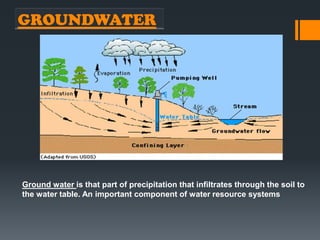
GROUNDWATER


Ground water is that part of precipitation that infiltrates through the soil to
the water table. An important component of water resource systems
SOURCES OF GROUNDWATER

Precipitation
Interception
Subsurface flow
Soil moisture
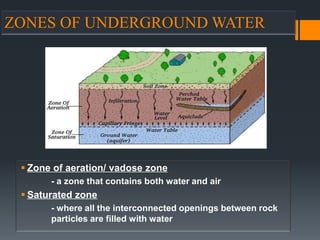
ZONES OF UNDERGROUND WATER


  Zone of aeration/ vadose zone
       - a zone that contains both water and air
  Saturated zone
       - where all the interconnected openings between rock
       particles are filled with water
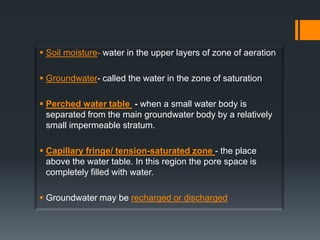
 Soil moisture- water in the upper layers of zone of aeration

 Groundwater- called the water in the zone of saturation

 Perched water table - when a small water body is
  separated from the main groundwater body by a relatively
  small impermeable stratum.

 Capillary fringe/ tension-saturated zone - the place
  above the water table. In this region the pore space is
  completely filled with water.

 Groundwater may be recharged or discharged
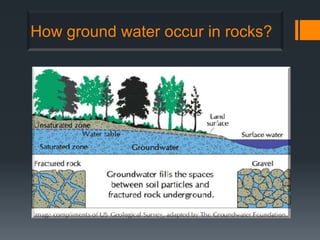
How ground water occur in rocks?
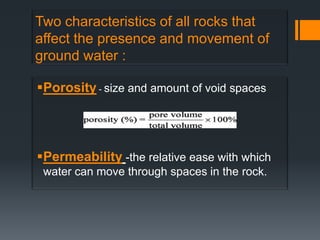
Two characteristics of all rocks that
affect the presence and movement of
ground water :

Porosity - size and amount of void spaces


Permeability -the relative ease with which
 water can move through spaces in the rock.
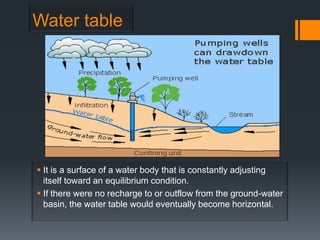
Water table


 It is a surface of a water body that is constantly adjusting
  itself toward an equilibrium condition.
 If there were no recharge to or outflow from the ground-water
  basin, the water table would eventually become horizontal.
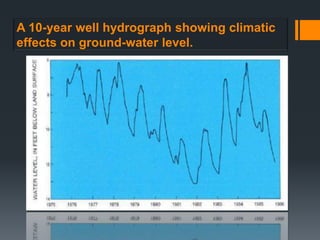
A 10-year well hydrograph showing climatic
effects on ground-water level.
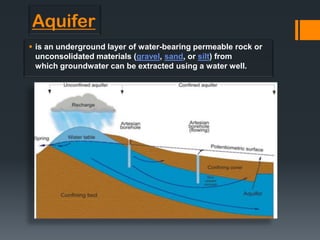
Aquifer
 is an underground layer of water-bearing permeable rock or
  unconsolidated materials (gravel, sand, or silt) from
  which groundwater can be extracted using a water well.
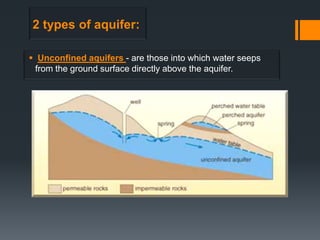
2 types of aquifer:

 Unconfined aquifers - are those into which water seeps
 from the ground surface directly above the aquifer.
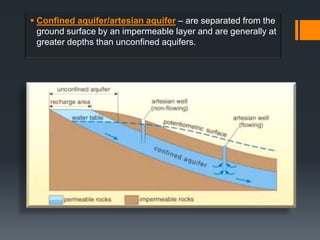
 Confined aquifer/artesian aquifer – are separated from the
  ground surface by an impermeable layer and are generally at
  greater depths than unconfined aquifers.
DISCHARGE OF GROUNDWATER


 DISCHARGED BY:

 TRANSPIRATION AND EVAPORATION
 SPRINGS
 SUBSURFACE FLOW
 WELLS
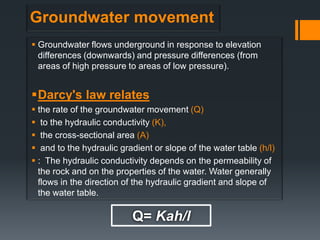
Groundwater movement
 Groundwater flows underground in response to elevation
  differences (downwards) and pressure differences (from
  areas of high pressure to areas of low pressure).


Darcy's law relates
 the rate of the groundwater movement (Q)
 to the hydraulic conductivity (K),
 the cross-sectional area (A)
 and to the hydraulic gradient or slope of the water table (h/l)
 : The hydraulic conductivity depends on the permeability of
  the rock and on the properties of the water. Water generally
  flows in the direction of the hydraulic gradient and slope of
  the water table.

                          Q= Kah/l
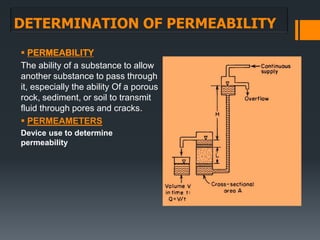
DETERMINATION OF PERMEABILITY
 PERMEABILITY
The ability of a substance to allow
another substance to pass through
it, especially the ability Of a porous
rock, sediment, or soil to transmit
fluid through pores and cracks.
 PERMEAMETERS
Device use to determine
permeability
Wells and Pump

 Well is an excavated hole, usually a
  vertical shaft, in the earth allowing
  access to groundwater
 Pumping a well lowers the water level
  around the well to form a cone of
  depression in the water table. If the
  cone of depression extends to other
  nearby wells, the water level in those
  wells will be lowered.
HYDRAULICS OF WELLS
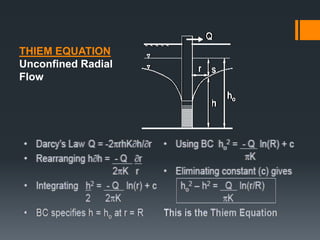
         Static Water Level [SWL] (ho) is the
         equilibrium water level before pumping
         Commences

         • Pumping Water Level [PWL] (h)
          is the water level during pumping

         • Drawdown (s = ho - h) is the
         difference between SWL and PWL

         • Well Yield (Q) is the volume of water
         pumped per unit Time

         • Specific Capacity (Q/s) is the yield per
         unit drawdown
THIEM EQUATION
Unconfined Radial
Flow
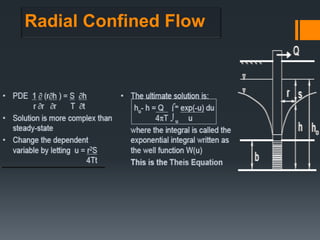
Radial Confined Flow
OTHER WELL TESTS:

RECOVERY TESTS

SLUG TESTS

LEAKY AQUIFER TESTS

STEP DRAWDOWN TESTS
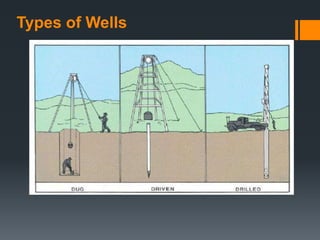
Types of Wells
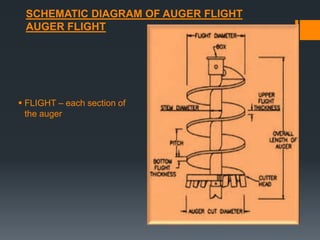
SCHEMATIC DIAGRAM OF AUGER FLIGHT
 AUGER FLIGHT


 FLIGHT – each section of
  the auger
Sources of contamination in
groundwater

Salt contamination
Leakage and spills
Pesticides and fertilizers
Waste disposals
 Advection- describes movement of contaminant with and at the
  speed of the moving water

 Dispersion- it leads to a spreading of concentration fronts as
  they evolve over time and enhanced mixing of contaminated
  water with surrounding uncontaminated water.

 Molecular diffusion- spreading of contaminants from the pore
  space from regions of high concentration to low cow
  concentration in response to concentration gradients

 Radioactive decay- results in the transformation of a
  radioisotopes into one or more daughter products.

 Volatilization- phase transfer into soil gas in the unsaturated
  zone.
 Sorption-absorption- transfer into soil and rock particles
MITIGATION

 Cleanup of contaminated groundwater tends to be very
  costly. Effective remediation of groundwater is generally very
  difficult.
 . Most of these treatment methods involve the filtration of the
  contaminants of concern, and additional protection may be
  garnered by installing well-casing screens only at depths
  where contamination is not present.
 Well water for personal use is often filtered with reverse
  osmosis water processors; this process can remove very
  small particles. A simple, effective way of killing
  microorganisms is to bring the water to a full boil for one to
  three minutes, depending on location.
SHOCK CHLORINATION

Shock chlorination/well sanitation is
simply the process of adding a sanitizer to
the well in high concentrations to destroy
any bacterial growth. Shock chlorination is
effective in reducing an iron bacteria,
hydrogen sulfur, or coliform bacteria
problem

groundwater

  • 1.
    CHAPTER IV: GROUNDWATER BAUTISTA, GLADYS JOY B. CE-5B
  • 2.
    GROUNDWATER Ground water isthat part of precipitation that infiltrates through the soil to the water table. An important component of water resource systems
  • 3.
  • 4.
    ZONES OF UNDERGROUNDWATER  Zone of aeration/ vadose zone - a zone that contains both water and air  Saturated zone - where all the interconnected openings between rock particles are filled with water
  • 5.
     Soil moisture-water in the upper layers of zone of aeration  Groundwater- called the water in the zone of saturation  Perched water table - when a small water body is separated from the main groundwater body by a relatively small impermeable stratum.  Capillary fringe/ tension-saturated zone - the place above the water table. In this region the pore space is completely filled with water.  Groundwater may be recharged or discharged
  • 6.
    How ground wateroccur in rocks?
  • 7.
    Two characteristics ofall rocks that affect the presence and movement of ground water : Porosity - size and amount of void spaces Permeability -the relative ease with which water can move through spaces in the rock.
  • 8.
    Water table  Itis a surface of a water body that is constantly adjusting itself toward an equilibrium condition.  If there were no recharge to or outflow from the ground-water basin, the water table would eventually become horizontal.
  • 9.
    A 10-year wellhydrograph showing climatic effects on ground-water level.
  • 10.
    Aquifer  is anunderground layer of water-bearing permeable rock or unconsolidated materials (gravel, sand, or silt) from which groundwater can be extracted using a water well.
  • 11.
    2 types ofaquifer:  Unconfined aquifers - are those into which water seeps from the ground surface directly above the aquifer.
  • 12.
     Confined aquifer/artesianaquifer – are separated from the ground surface by an impermeable layer and are generally at greater depths than unconfined aquifers.
  • 13.
    DISCHARGE OF GROUNDWATER DISCHARGED BY: TRANSPIRATION AND EVAPORATION SPRINGS SUBSURFACE FLOW WELLS
  • 14.
    Groundwater movement  Groundwaterflows underground in response to elevation differences (downwards) and pressure differences (from areas of high pressure to areas of low pressure). Darcy's law relates  the rate of the groundwater movement (Q)  to the hydraulic conductivity (K),  the cross-sectional area (A)  and to the hydraulic gradient or slope of the water table (h/l)  : The hydraulic conductivity depends on the permeability of the rock and on the properties of the water. Water generally flows in the direction of the hydraulic gradient and slope of the water table. Q= Kah/l
  • 15.
    DETERMINATION OF PERMEABILITY PERMEABILITY The ability of a substance to allow another substance to pass through it, especially the ability Of a porous rock, sediment, or soil to transmit fluid through pores and cracks.  PERMEAMETERS Device use to determine permeability
  • 16.
    Wells and Pump Well is an excavated hole, usually a vertical shaft, in the earth allowing access to groundwater Pumping a well lowers the water level around the well to form a cone of depression in the water table. If the cone of depression extends to other nearby wells, the water level in those wells will be lowered.
  • 17.
    HYDRAULICS OF WELLS Static Water Level [SWL] (ho) is the equilibrium water level before pumping Commences • Pumping Water Level [PWL] (h) is the water level during pumping • Drawdown (s = ho - h) is the difference between SWL and PWL • Well Yield (Q) is the volume of water pumped per unit Time • Specific Capacity (Q/s) is the yield per unit drawdown
  • 18.
  • 19.
  • 20.
    OTHER WELL TESTS: RECOVERYTESTS SLUG TESTS LEAKY AQUIFER TESTS STEP DRAWDOWN TESTS
  • 21.
  • 22.
    SCHEMATIC DIAGRAM OFAUGER FLIGHT AUGER FLIGHT  FLIGHT – each section of the auger
  • 23.
    Sources of contaminationin groundwater Salt contamination Leakage and spills Pesticides and fertilizers Waste disposals
  • 24.
     Advection- describesmovement of contaminant with and at the speed of the moving water  Dispersion- it leads to a spreading of concentration fronts as they evolve over time and enhanced mixing of contaminated water with surrounding uncontaminated water.  Molecular diffusion- spreading of contaminants from the pore space from regions of high concentration to low cow concentration in response to concentration gradients  Radioactive decay- results in the transformation of a radioisotopes into one or more daughter products.  Volatilization- phase transfer into soil gas in the unsaturated zone.  Sorption-absorption- transfer into soil and rock particles
  • 25.
    MITIGATION  Cleanup ofcontaminated groundwater tends to be very costly. Effective remediation of groundwater is generally very difficult.  . Most of these treatment methods involve the filtration of the contaminants of concern, and additional protection may be garnered by installing well-casing screens only at depths where contamination is not present.  Well water for personal use is often filtered with reverse osmosis water processors; this process can remove very small particles. A simple, effective way of killing microorganisms is to bring the water to a full boil for one to three minutes, depending on location.
  • 26.
    SHOCK CHLORINATION Shock chlorination/wellsanitation is simply the process of adding a sanitizer to the well in high concentrations to destroy any bacterial growth. Shock chlorination is effective in reducing an iron bacteria, hydrogen sulfur, or coliform bacteria problem