Landforms Produced by
Coastal Processes
CHAPTER 7: COASTS
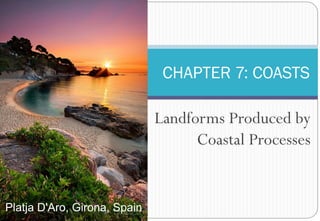
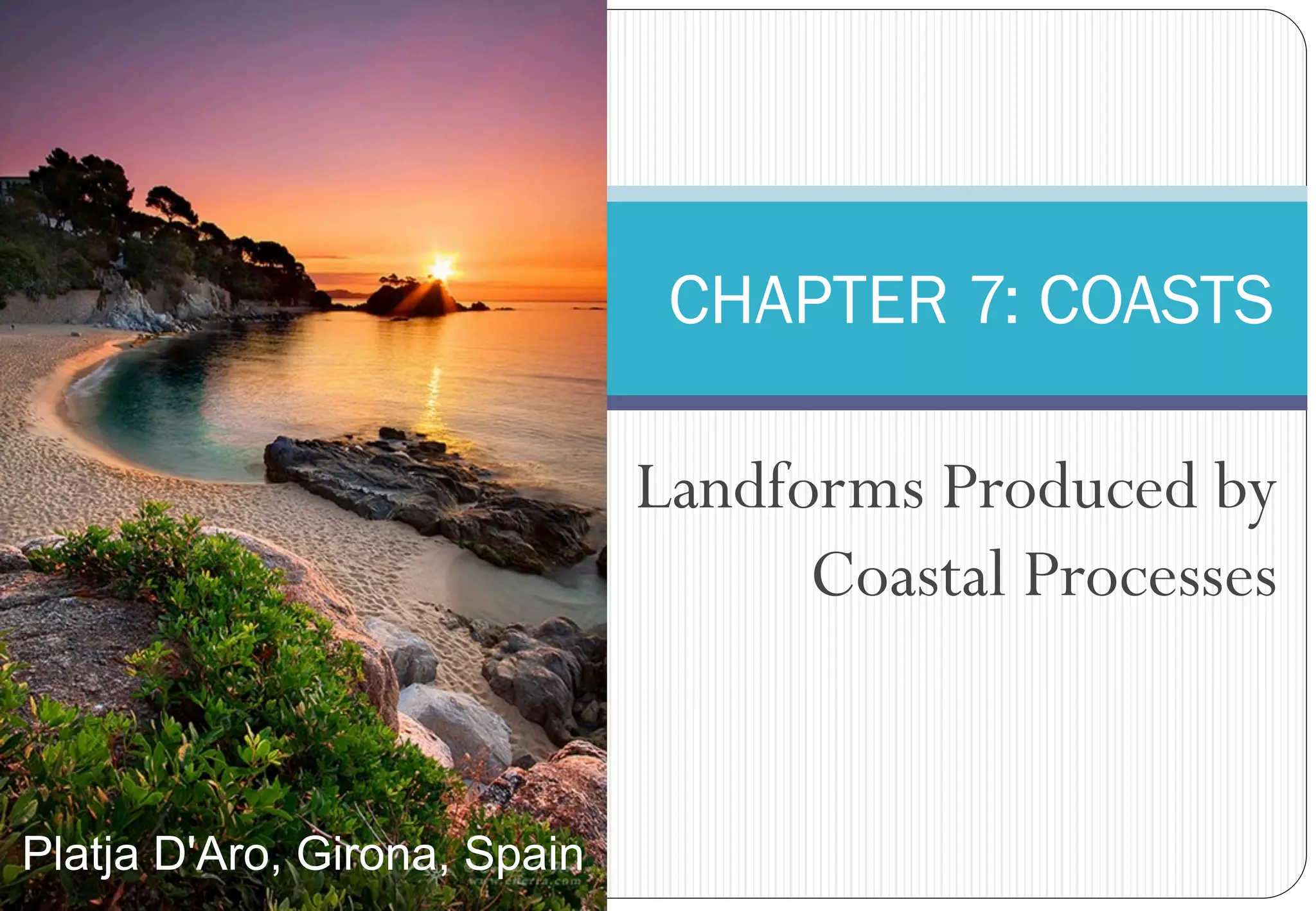
Platja D'Aro, Girona, Spain
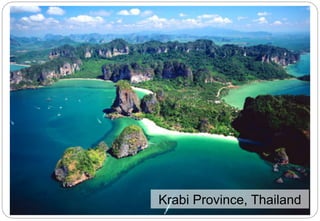
Krabi Province, Thailand
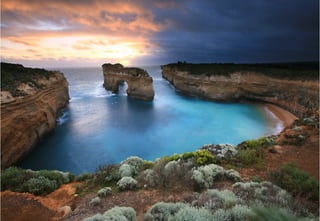
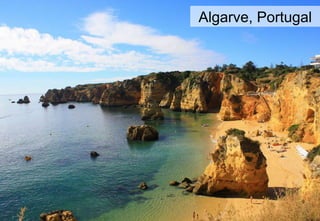
Algarve, Portugal
Different Coastal Landforms
— (A) Cliffed coasts (Erosion):
— (i) Cliff & shore platforms
— (ii) Headlands and bays
— (iii) Caves, arches and stacks (linked to refraction)
— (B) Depositional coasts:
— (i) Beaches
— (ii) Spits & tombolos (linked to Longshore Drift)
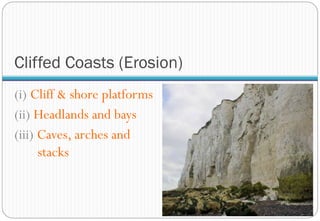
Cliffed Coasts (Erosion)
(i) Cliff & shore platforms
(ii) Headlands and bays
(iii) Caves, arches and
stacks
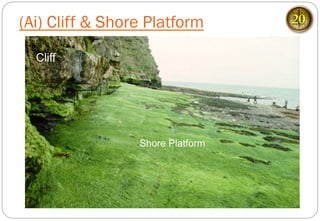
Shore Platform
Cliff
(Ai) Cliff & Shore Platform 20
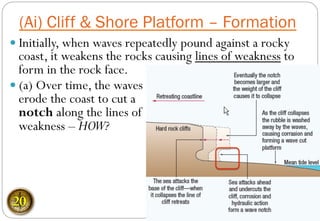
(Ai) Cliff & Shore Platform – Formation
— Initially, when waves repeatedly pound against a rocky
coast, it weakens the rocks causing lines of weakness to
form in the rock face.
— (a) Over time, the waves
erode the coast to cut a
notch along the lines of
weakness – HOW?
20
Recall: coastal erosional processes
— Corrasion /Abrasion*
— The waves throw rock particles at the coast,
eroding the cliff face away.
— Attrition
— Rocks and pebbles collide with each other.
— Solution / Corrosion
— Acids contained in sea water will slowly dissolve rock
minerals.
— Hydraulic action*
— The force of the waves forces rocks apart.
15
(Ai) Cliff & Shore Platform – Formation
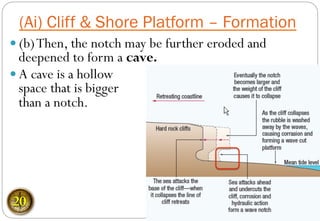
— (b)Then, the notch may be further eroded and
deepened to form a cave.
— A cave is a hollow
space that is bigger
than a notch.
20
(Ai) Cliff & Shore Platform – Formation
20
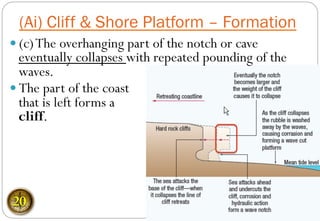
— (c)The overhanging part of the notch or cave
eventually collapses with repeated pounding of the
waves.
— The part of the coast
that is left forms a
cliff.
(Ai) Cliff & Shore Platform – Formation
— (d)As the cliff continues to be eroded by waves, it
retreats inland.
— Over time, a gently
sloping or flat surface
known as a
shore platform
forms at the base of
the cliff.
20
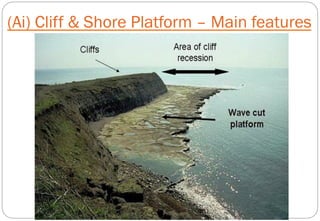
(Ai) Cliff & Shore Platform – Main features
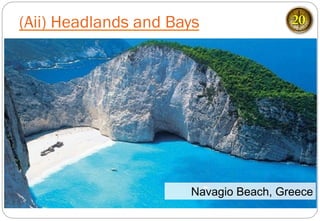
(Aii) Headlands and Bays
Navagio Beach, Greece
20
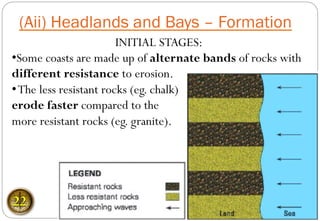
INITIAL STAGES:
• Some coasts are made up of alternate bands of rocks with
different resistance to erosion.
• The less resistant rocks (eg. chalk)
erode faster compared to the
more resistant rocks (eg. granite).
(Aii) Headlands and Bays – Formation
22
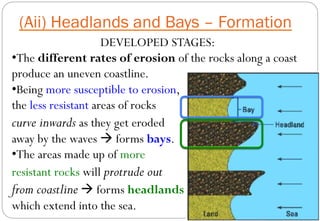
DEVELOPED STAGES:
• The different rates of erosion of the rocks along a coast
produce an uneven coastline.
• Being more susceptible to erosion,
the less resistant areas of rocks
curve inwards as they get eroded
away by the waves à forms bays.
• The areas made up of more
resistant rocks will protrude out
from coastline à forms headlands
which extend into the sea.
(Aii) Headlands and Bays – Formation
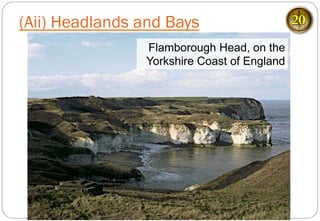
(Aii) Headlands and Bays
Flamborough Head, on the
Yorkshire Coast of England
20
DEVELOPED STAGES:
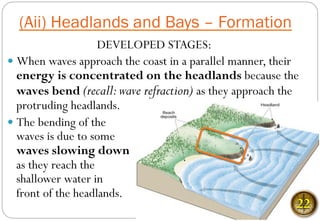
— When waves approach the coast in a parallel manner, their
energy is concentrated on the headlands because the
waves bend (recall:wave refraction) as they approach the
protruding headlands.
— The bending of the
waves is due to some
waves slowing down
as they reach the
shallower water in
front of the headlands.
(Aii) Headlands and Bays – Formation
22
LATER STAGES:
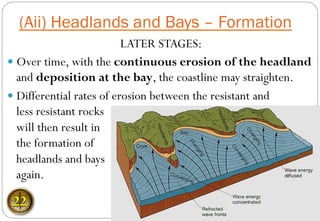
— Over time, with the continuous erosion of the headland
and deposition at the bay, the coastline may straighten.
— Differential rates of erosion between the resistant and
less resistant rocks
will then result in
the formation of
headlands and bays
again.
(Aii) Headlands and Bays – Formation
22
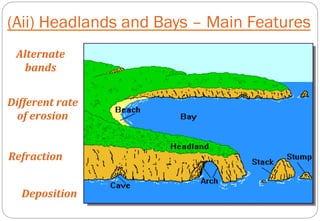
(Aii) Headlands and Bays – Main Features
Alternate	
  
bands	
  
Different	
  rate	
  
of	
  erosion	
  
Deposition	
  	
  
Refraction	
  
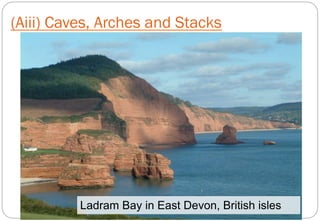
Ladram Bay in East Devon, British isles
(Aiii) Caves, Arches and Stacks
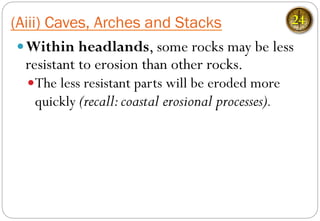
— Within headlands, some rocks may be less
resistant to erosion than other rocks.
— The less resistant parts will be eroded more
quickly (recall:coastal erosional processes).
(Aiii) Caves, Arches and Stacks 24
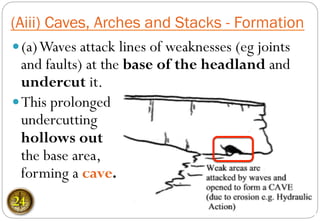
— (a)Waves attack lines of weaknesses (eg joints
and faults) at the base of the headland and
undercut it.
— This prolonged
undercutting
hollows out
the base area,
forming a cave.
(Aiii) Caves, Arches and Stacks - Formation
24
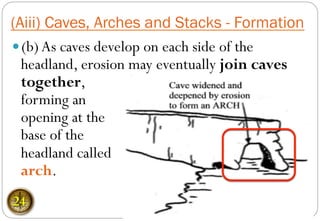
— (b)As caves develop on each side of the
headland, erosion may eventually join caves
together,
forming an
opening at the
base of the
headland called
arch.
(Aiii) Caves, Arches and Stacks - Formation
24
(Aiii) Caves, Arches and Stacks - Formation
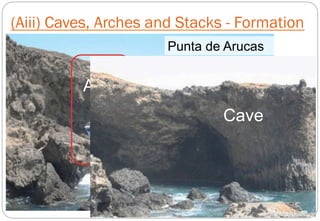
Punta de Arucas
Arch Cave
Cave
— (c) Over time, the roof of the arch may
collapse to form a stack (a pillar of rock in
the sea after the arch collapses).
(Aiii) Caves, Arches and Stacks - Formation
24
Krabi, Thailand
(Aiii) Caves, Arches and Stacks
(Aiii) Caves, Arches and Stacks - Formation
24
— (d)The stack may be further eroded by waves,
causing some portions of it to collapse,
forming stumps.
(A) Cliffed Coasts – Recap
Putting all the features and landforms caused by erosion:
(Arch)	
  
(Shore	
  pla.orm)	
  
Undercut	
  
Collapse	
  	
  
Hollow	
  
out	
  
Wave	
  
erosion	
  Lines	
  of	
  
weakness	
  
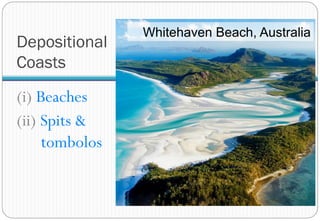
Depositional
Coasts
(i) Beaches
(ii) Spits &
tombolos
Whitehaven Beach, Australia
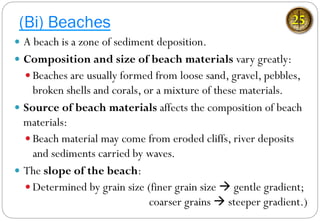
—  A beach is a zone of sediment deposition.
—  Composition and size of beach materials vary greatly:
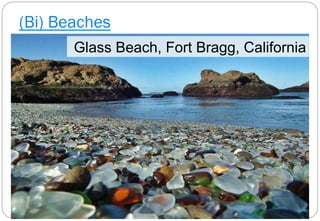
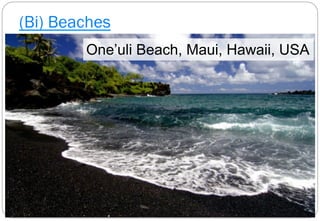
— Beaches are usually formed from loose sand, gravel, pebbles,
broken shells and corals, or a mixture of these materials.
—  Source of beach materials affects the composition of beach
materials:
— Beach material may come from eroded cliffs, river deposits
and sediments carried by waves.
—  The slope of the beach:
— Determined by grain size (finer grain size à gentle gradient;
coarser grains à steeper gradient.)
(Bi) Beaches 25
(Bi) Beaches
Horseshoe Bay, Bermuda
(Bi) Beaches
Glass Beach, Fort Bragg, California
(Bi) Beaches
One’uli Beach, Maui, Hawaii, USA
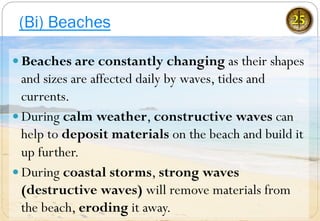
— Beaches are constantly changing as their shapes
and sizes are affected daily by waves, tides and
currents.
— During calm weather, constructive waves can
help to deposit materials on the beach and build it
up further.
— During coastal storms, strong waves
(destructive waves) will remove materials from
the beach, eroding it away.
25(Bi) Beaches
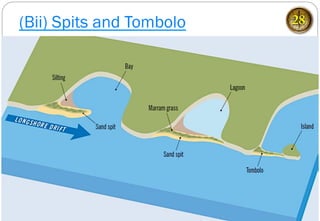
(Bii) Spits and Tombolo 28
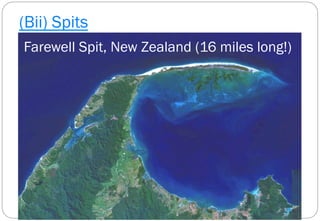
(Bii) Spits
Farewell Spit, New Zealand (16 miles long!)
(Bii) Spits 28
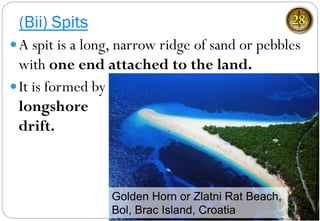
— A spit is a long, narrow ridge of sand or pebbles
with one end attached to the land.
— It is formed by
longshore
drift.
Golden Horn or Zlatni Rat Beach,
Bol, Brac Island, Croatia
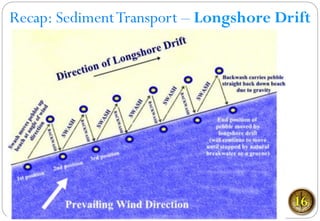
Recap: SedimentTransport – Longshore Drift
16
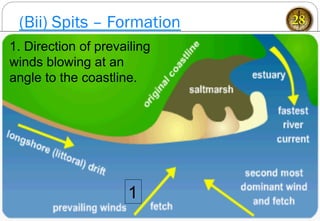
(Bii) Spits – Formation 28
1
1. Direction of prevailing
winds blowing at an
angle to the coastline.
(Bii) Spits – Formation 28
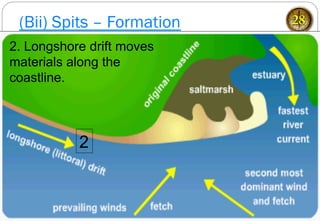
2
2. Longshore drift moves
materials along the
coastline.
(Bii) Spits – Formation 28
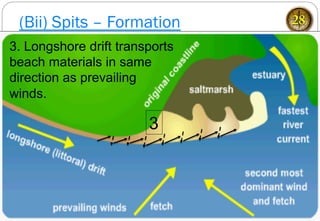
3
3. Longshore drift transports
beach materials in same
direction as prevailing
winds.
(Bii) Spits – Formation 28
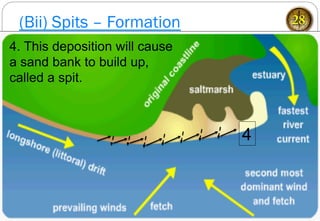
4
4. This deposition will cause
a sand bank to build up,
called a spit.
(Bii) Spits – Formation 28
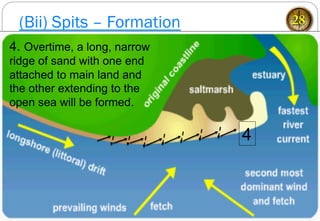
4
4. Overtime, a long, narrow
ridge of sand with one end
attached to main land and
the other extending to the
open sea will be formed.
(Bii) Spits – Formation 28
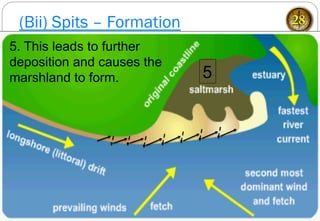
5
5. This leads to further
deposition and causes the
marshland to form.
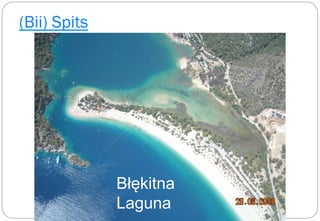
(Bii) Spits
Błękitna
Laguna
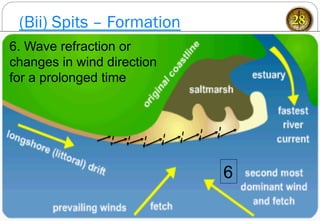
(Bii) Spits – Formation 28
6
6. Wave refraction or
changes in wind direction
for a prolonged time
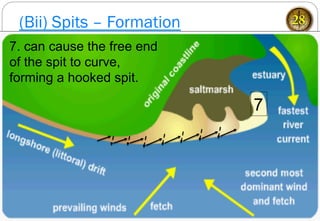
(Bii) Spits – Formation 28
7
7. can cause the free end
of the spit to curve,
forming a hooked spit.
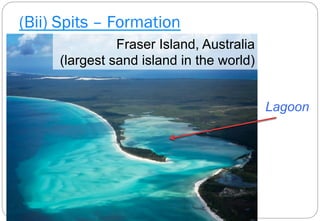
(Bii) Spits – Formation
Fraser Island, Australia
(largest sand island in the world)
Lagoon
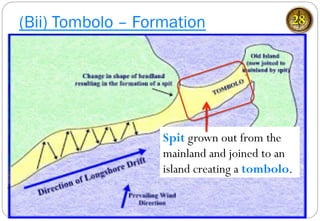
(Bii) Tombolo – Formation 28
Spit grown out from the
mainland and joined to an
island creating a tombolo.
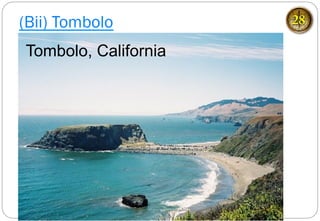
(Bii) Tombolo 28
Tombolo, California
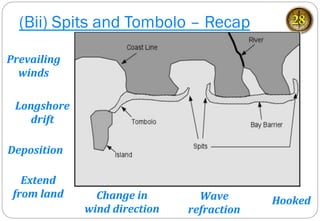
(Bii) Spits and Tombolo – Recap 28
Wave	
  
refraction	
  
Hooked	
  	
  Change	
  in	
  
wind	
  direction	
  
Deposition	
  
Longshore	
  
drift	
  
Prevailing	
  
winds	
  
Extend	
  
from	
  land	
  
Krabi Island, Thailand
Algarve, Portugal
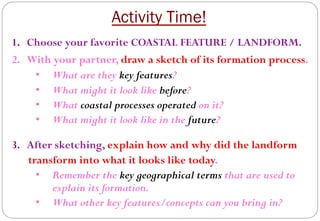
Activity Time!
1.  Choose your favorite COASTAL FEATURE / LANDFORM.
2.  With your partner, draw a sketch of its formation process.
•  What are they key features?
•  What might it look like before?
•  What coastal processes operated on it?
•  What might it look like in the future?
3.  After sketching, explain how and why did the landform
transform into what it looks like today.
•  Remember the key geographical terms that are used to
explain its formation.
•  What other key features/concepts can you bring in?

S3 GE Slides 1.2 - Coasts GW1

  • 1.
    Landforms Produced by CoastalProcesses CHAPTER 7: COASTS Platja D'Aro, Girona, Spain
  • 2.
  • 3.
  • 4.
    Different Coastal Landforms — (A)Cliffed coasts (Erosion): — (i) Cliff & shore platforms — (ii) Headlands and bays — (iii) Caves, arches and stacks (linked to refraction) — (B) Depositional coasts: — (i) Beaches — (ii) Spits & tombolos (linked to Longshore Drift)
  • 5.
    Cliffed Coasts (Erosion) (i)Cliff & shore platforms (ii) Headlands and bays (iii) Caves, arches and stacks
  • 6.
  • 7.
    (Ai) Cliff &Shore Platform – Formation — Initially, when waves repeatedly pound against a rocky coast, it weakens the rocks causing lines of weakness to form in the rock face. — (a) Over time, the waves erode the coast to cut a notch along the lines of weakness – HOW? 20
  • 8.
    Recall: coastal erosionalprocesses — Corrasion /Abrasion* — The waves throw rock particles at the coast, eroding the cliff face away. — Attrition — Rocks and pebbles collide with each other. — Solution / Corrosion — Acids contained in sea water will slowly dissolve rock minerals. — Hydraulic action* — The force of the waves forces rocks apart. 15
  • 9.
    (Ai) Cliff &Shore Platform – Formation — (b)Then, the notch may be further eroded and deepened to form a cave. — A cave is a hollow space that is bigger than a notch. 20
  • 10.
    (Ai) Cliff &Shore Platform – Formation 20 — (c)The overhanging part of the notch or cave eventually collapses with repeated pounding of the waves. — The part of the coast that is left forms a cliff.
  • 11.
    (Ai) Cliff &Shore Platform – Formation — (d)As the cliff continues to be eroded by waves, it retreats inland. — Over time, a gently sloping or flat surface known as a shore platform forms at the base of the cliff. 20
  • 12.
    (Ai) Cliff &Shore Platform – Main features
  • 13.
    (Aii) Headlands andBays Navagio Beach, Greece 20
  • 14.
    INITIAL STAGES: • Some coastsare made up of alternate bands of rocks with different resistance to erosion. • The less resistant rocks (eg. chalk) erode faster compared to the more resistant rocks (eg. granite). (Aii) Headlands and Bays – Formation 22
  • 15.
    DEVELOPED STAGES: • The differentrates of erosion of the rocks along a coast produce an uneven coastline. • Being more susceptible to erosion, the less resistant areas of rocks curve inwards as they get eroded away by the waves à forms bays. • The areas made up of more resistant rocks will protrude out from coastline à forms headlands which extend into the sea. (Aii) Headlands and Bays – Formation
  • 16.
    (Aii) Headlands andBays Flamborough Head, on the Yorkshire Coast of England 20
  • 17.
    DEVELOPED STAGES: — When wavesapproach the coast in a parallel manner, their energy is concentrated on the headlands because the waves bend (recall:wave refraction) as they approach the protruding headlands. — The bending of the waves is due to some waves slowing down as they reach the shallower water in front of the headlands. (Aii) Headlands and Bays – Formation 22
  • 18.
    LATER STAGES: — Over time,with the continuous erosion of the headland and deposition at the bay, the coastline may straighten. — Differential rates of erosion between the resistant and less resistant rocks will then result in the formation of headlands and bays again. (Aii) Headlands and Bays – Formation 22
  • 19.
    (Aii) Headlands andBays – Main Features Alternate   bands   Different  rate   of  erosion   Deposition     Refraction  
  • 20.
    Ladram Bay inEast Devon, British isles (Aiii) Caves, Arches and Stacks
  • 21.
    — Within headlands, somerocks may be less resistant to erosion than other rocks. — The less resistant parts will be eroded more quickly (recall:coastal erosional processes). (Aiii) Caves, Arches and Stacks 24
  • 22.
    — (a)Waves attack linesof weaknesses (eg joints and faults) at the base of the headland and undercut it. — This prolonged undercutting hollows out the base area, forming a cave. (Aiii) Caves, Arches and Stacks - Formation 24
  • 23.
    — (b)As caves developon each side of the headland, erosion may eventually join caves together, forming an opening at the base of the headland called arch. (Aiii) Caves, Arches and Stacks - Formation 24
  • 24.
    (Aiii) Caves, Archesand Stacks - Formation Punta de Arucas Arch Cave Cave
  • 25.
    — (c) Over time,the roof of the arch may collapse to form a stack (a pillar of rock in the sea after the arch collapses). (Aiii) Caves, Arches and Stacks - Formation 24
  • 26.
  • 27.
    (Aiii) Caves, Archesand Stacks - Formation 24 — (d)The stack may be further eroded by waves, causing some portions of it to collapse, forming stumps.
  • 28.
    (A) Cliffed Coasts– Recap Putting all the features and landforms caused by erosion: (Arch)   (Shore  pla.orm)   Undercut   Collapse     Hollow   out   Wave   erosion  Lines  of   weakness  
  • 29.
    Depositional Coasts (i) Beaches (ii) Spits& tombolos Whitehaven Beach, Australia
  • 30.
    —  A beachis a zone of sediment deposition. —  Composition and size of beach materials vary greatly: — Beaches are usually formed from loose sand, gravel, pebbles, broken shells and corals, or a mixture of these materials. —  Source of beach materials affects the composition of beach materials: — Beach material may come from eroded cliffs, river deposits and sediments carried by waves. —  The slope of the beach: — Determined by grain size (finer grain size à gentle gradient; coarser grains à steeper gradient.) (Bi) Beaches 25
  • 31.
  • 32.
    (Bi) Beaches Glass Beach,Fort Bragg, California
  • 33.
  • 34.
    — Beaches are constantlychanging as their shapes and sizes are affected daily by waves, tides and currents. — During calm weather, constructive waves can help to deposit materials on the beach and build it up further. — During coastal storms, strong waves (destructive waves) will remove materials from the beach, eroding it away. 25(Bi) Beaches
  • 35.
    (Bii) Spits andTombolo 28
  • 36.
    (Bii) Spits Farewell Spit,New Zealand (16 miles long!)
  • 37.
    (Bii) Spits 28 — Aspit is a long, narrow ridge of sand or pebbles with one end attached to the land. — It is formed by longshore drift. Golden Horn or Zlatni Rat Beach, Bol, Brac Island, Croatia
  • 38.
    Recap: SedimentTransport –Longshore Drift 16
  • 39.
    (Bii) Spits –Formation 28 1 1. Direction of prevailing winds blowing at an angle to the coastline.
  • 40.
    (Bii) Spits –Formation 28 2 2. Longshore drift moves materials along the coastline.
  • 41.
    (Bii) Spits –Formation 28 3 3. Longshore drift transports beach materials in same direction as prevailing winds.
  • 42.
    (Bii) Spits –Formation 28 4 4. This deposition will cause a sand bank to build up, called a spit.
  • 43.
    (Bii) Spits –Formation 28 4 4. Overtime, a long, narrow ridge of sand with one end attached to main land and the other extending to the open sea will be formed.
  • 44.
    (Bii) Spits –Formation 28 5 5. This leads to further deposition and causes the marshland to form.
  • 45.
  • 46.
    (Bii) Spits –Formation 28 6 6. Wave refraction or changes in wind direction for a prolonged time
  • 47.
    (Bii) Spits –Formation 28 7 7. can cause the free end of the spit to curve, forming a hooked spit.
  • 48.
    (Bii) Spits –Formation Fraser Island, Australia (largest sand island in the world) Lagoon
  • 49.
    (Bii) Tombolo –Formation 28 Spit grown out from the mainland and joined to an island creating a tombolo.
  • 50.
  • 51.
    (Bii) Spits andTombolo – Recap 28 Wave   refraction   Hooked    Change  in   wind  direction   Deposition   Longshore   drift   Prevailing   winds   Extend   from  land  
  • 52.
  • 53.
  • 54.
    Activity Time! 1.  Chooseyour favorite COASTAL FEATURE / LANDFORM. 2.  With your partner, draw a sketch of its formation process. •  What are they key features? •  What might it look like before? •  What coastal processes operated on it? •  What might it look like in the future? 3.  After sketching, explain how and why did the landform transform into what it looks like today. •  Remember the key geographical terms that are used to explain its formation. •  What other key features/concepts can you bring in?