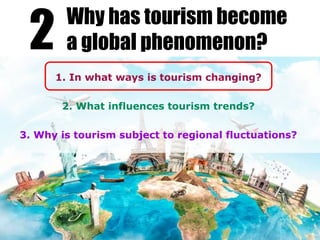
2 Why has tourism become
a global phenomenon?
• As the number of people who
travel increases, previously
unexplored tourist
attractions become more
popular
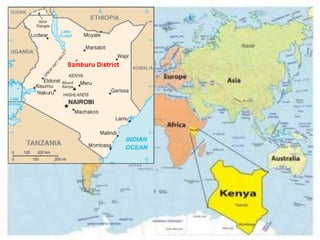
• Between 1995 and 2010, the
number of tourists to Kenya has
increased almost 10 times
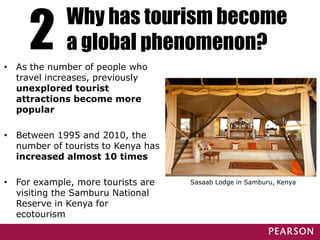
• For example, more tourists are
visiting the Samburu National
Reserve in Kenya for
ecotourism
Sasaab Lodge in Samburu, Kenya
2 Why has tourism become
a global phenomenon?
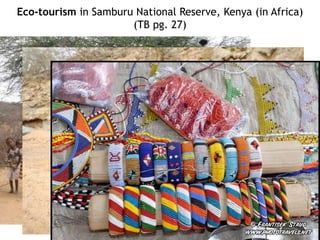
Eco-tourism in Samburu National Reserve, Kenya (in Africa)

(TB pg. 27)
1. In what ways is tourism changing?
2. What influences tourism trends?
3. Why is tourism subject to regional fluctuations?
2 Why has tourism become
a global phenomenon?
1. In what ways is tourism changing?
Trends in the global tourism industry
– Developments in International tourism
o Tourist origins and destinations
– Growth of Domestic tourism
o Tourism dollars
– Evolution of mass tourism to niche tourism
o Mass tourism
o Package holidays
o Niche tourism (e.g. Eco-tourism)
o Short-haul and long-haul destinations
Data literacy
skills
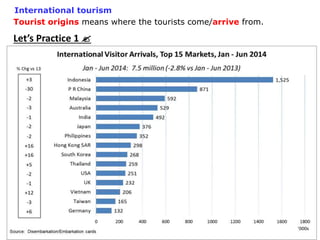
International tourism
Tourist origins means where the tourists come/arrive from.
Let’s Practice 1 
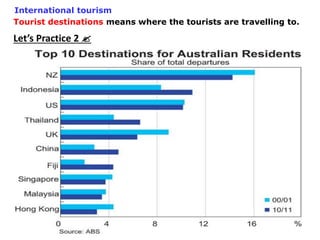
International tourism
Tourist destinations means where the tourists are travelling to.
Let’s Practice 2 
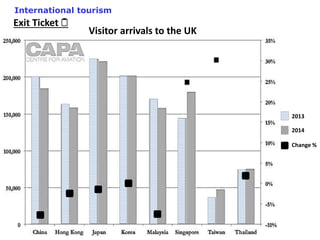
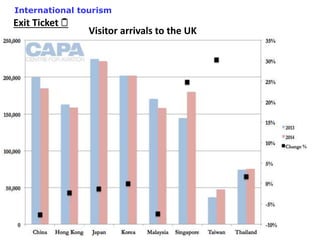
2013
2014
Change %
Visitor arrivals to the UK
Exit Ticket 
International tourism
Exit Ticket 
International tourism
Visitor arrivals to the UK
1. In what ways is tourism changing?
Trends in the global tourism industry
– Developments in International tourism
o Tourist origins and destinations
– Growth of Domestic tourism
o Tourism dollars
– Evolution of mass tourism to niche tourism
o Mass tourism
o Package holidays
o Niche tourism (e.g. Eco-tourism)
o Short-haul and long-haul destinations
TB pg. 28
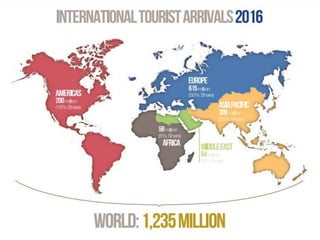
International tourist arrivals from 1950 to 2010.
Describe the trends in
international tourist arrivals
from 1950 to 2010. [4]
Trends in the global tourism industry
International tourism (TB pg. 28)
1. In what ways is tourism changing?
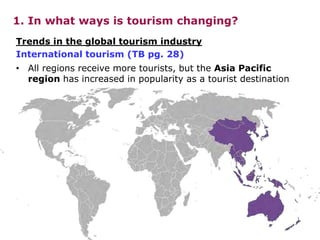
• All regions receive more tourists, but the Asia Pacific
region has increased in popularity as a tourist destination
1. In what ways is tourism changing?
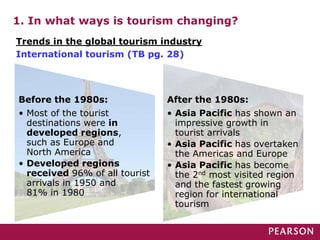
Before the 1980s:
• Most of the tourist
destinations were in
developed regions,
such as Europe and
North America
• Developed regions
received 96% of all tourist
arrivals in 1950 and
81% in 1980
After the 1980s:
• Asia Pacific has shown an
impressive growth in
tourist arrivals
• Asia Pacific has overtaken
the Americas and Europe
• Asia Pacific has become
the 2nd most visited region
and the fastest growing
region for international
tourism
Trends in the global tourism industry
International tourism (TB pg. 28)
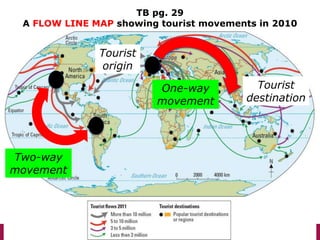
TB pg. 29
A FLOW LINE MAP showing tourist movements in 2010
Two-way
movement
Tourist
origin
Tourist
destination
One-way
movement
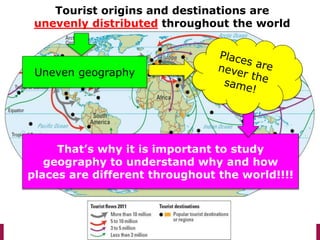
Tourist origins and destinations are
unevenly distributed throughout the world
Uneven geography
That’s why it is important to study
geography to understand why and how
places are different throughout the world!!!!
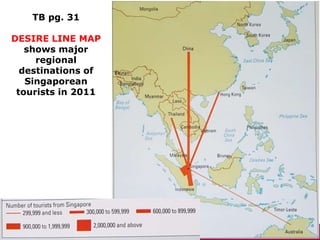
TB pg. 31
DESIRE LINE MAP
shows major
regional
destinations of
Singaporean
tourists in 2011
All About History18
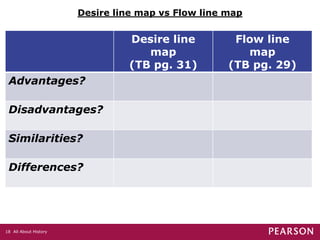
Desire line map vs Flow line map
Desire line
map
(TB pg. 31)
Flow line
map
(TB pg. 29)
Advantages?
Disadvantages?
Similarities?
Differences?
Trends in the global tourism industry
International tourism (TB pg. 29)
1. In what ways is tourism changing?
• Tourist origins means where the tourists come/arrive from.
• Tourist destinations means where the tourists are travelling
to/visiting.
1. In what ways is tourism changing?
Tourist origins and destinations (TB pg. 29)
• Large-scale tourist movements can be found:
– In North America to and from Central America, South
America and Europe (10 million+)
– In Europe to and from North America and the Middle East
(10 million)
– In Japan to and from North America, Southeast Asia and
Europe (5-10 million)
– Within Asia (5 million)
– From Asia to and from North America, Australia and
Europe (5 million)
Trends in the global tourism industry
International tourism
1. In what ways is tourism changing?
Trends in the global tourism industry
International tourism
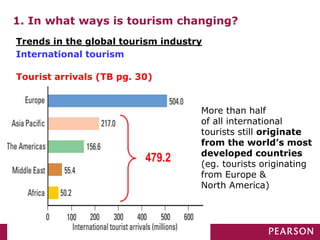
Tourist arrivals (TB pg. 30)
479.2
More than half
of all international
tourists still originate
from the world’s most
developed countries
(eg. tourists originating
from Europe &
North America)
1. In what ways is tourism changing?
Trends in the global tourism industry
International tourism
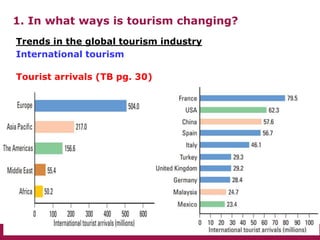
Tourist arrivals (TB pg. 30)
1. In what ways is tourism changing?
Trends in the global tourism industry
International tourism
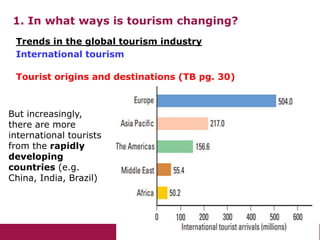
Tourist origins and destinations (TB pg. 30)
But increasingly,
there are more
international tourists
from the rapidly
developing
countries (e.g.
China, India, Brazil)
1. In what ways is tourism changing?
Trends in the global tourism industry
– Developments in International tourism
o Tourist origins and destinations
– Growth of Domestic tourism
o Tourism dollars
– Evolution of mass tourism to niche tourism
o Mass tourism
o Package holidays
o Niche tourism (e.g. Eco-tourism)
o Short-haul and long-haul destinations
1. In what ways is tourism changing?
Trends in the global tourism industry
Domestic tourism (TB pg. 32)
RECAP:
Domestic
tourism refers
to tourism
within a
tourist’s own
country.
What are the advantages that
tourists have in travelling
within their own country
(i.e. domestic tourism),
rather than outside it?
1. In what ways is tourism changing?
Trends in domestic tourism worldwide:
• Has grown along with international tourism
• Continues to be the most popular form of tourism
• Worldwide in 2010:
– 83% of all tourist arrivals were domestic tourism
– 69% of all overnight stays in hotels represented by
domestic tourism
Trends in the global tourism industry
Domestic tourism (TB pg. 32)
1. In what ways is tourism changing?
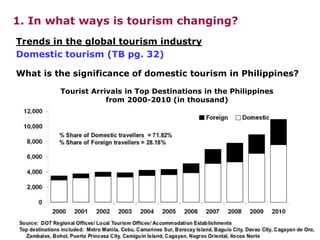
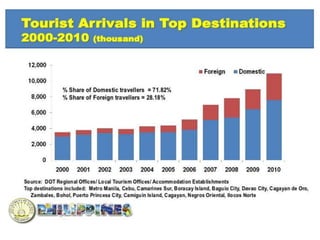
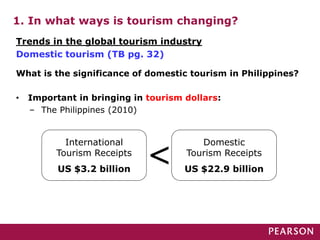
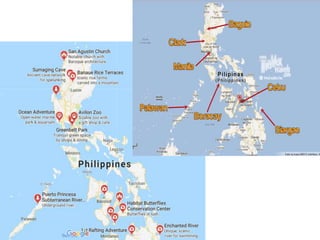
What is the significance of domestic tourism in Philippines?
Trends in the global tourism industry
Domestic tourism (TB pg. 32)
Tourist Arrivals in Top Destinations in the Philippines
from 2000-2010 (in thousand)
1. In what ways is tourism changing?
What is the significance of domestic tourism in Philippines?
• Important in bringing in tourism dollars:
– The Philippines (2010)
Trends in the global tourism industry
Domestic tourism (TB pg. 32)
International
Tourism Receipts
US $3.2 billion
Domestic
Tourism Receipts
US $22.9 billion
<
1. In what ways is tourism changing?
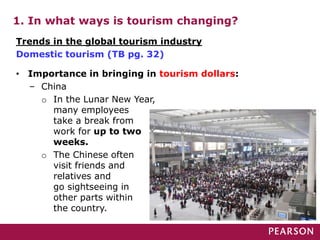
• Importance in bringing in tourism dollars:
– China
o In the Lunar New Year,
many employees
take a break from
work for up to two
weeks.
o The Chinese often
visit friends and
relatives and
go sightseeing in
other parts within
the country.
Trends in the global tourism industry
Domestic tourism (TB pg. 32)
1. In what ways is tourism changing?
• Importance in bringing in tourism dollars:
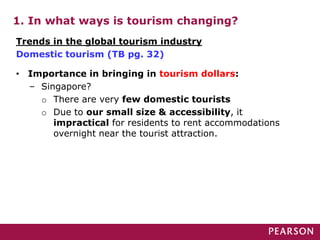
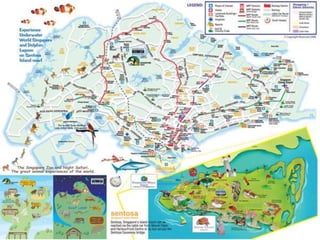
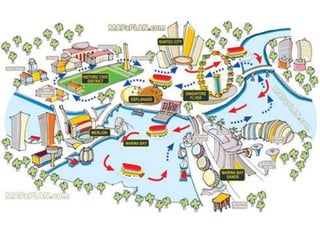
– Singapore?
o There are very few domestic tourists
o Due to our small size & accessibility, it
impractical for residents to rent accommodations
overnight near the tourist attraction.
Trends in the global tourism industry
Domestic tourism (TB pg. 32)
1. In what ways is tourism changing?
Trends in the global tourism industry
– Developments in International tourism
o Tourist origins and destinations
– Growth of Domestic tourism
o Tourism dollars
– Evolution of mass tourism to niche tourism
o Mass tourism
o Package holidays
o Niche tourism (e.g. Eco-tourism)
o Short-haul and long-haul destinations
1. In what ways is tourism changing?
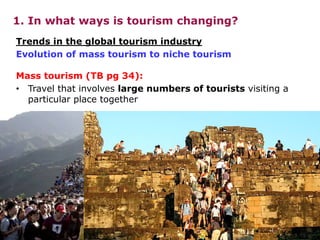
Mass tourism (TB pg 34):
• Travel that involves large numbers of tourists visiting a
particular place together
Trends in the global tourism industry
Evolution of mass tourism to niche tourism
1. In what ways is tourism changing?
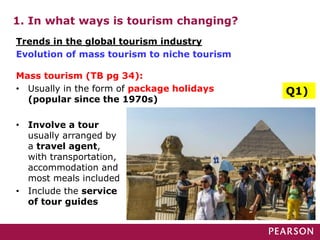
Mass tourism (TB pg 34):
• Usually in the form of package holidays
(popular since the 1970s)
• Involve a tour
usually arranged by
a travel agent,
with transportation,
accommodation and
most meals included
• Include the service
of tour guides
Trends in the global tourism industry
Evolution of mass tourism to niche tourism
Q1)
1. In what ways is tourism changing?
Trends in the global tourism industry
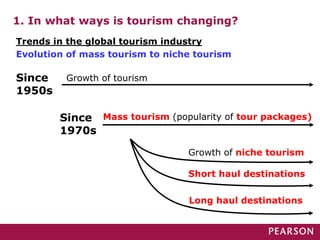
Evolution of mass tourism to niche tourism
Since
1950s
Mass tourism (popularity of tour packages)
Growth of niche tourism
Short haul destinations
Long haul destinations
Growth of tourism
Since
1970s
1. In what ways is tourism changing?
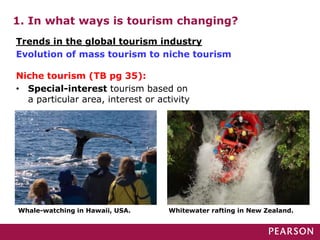
Whale-watching in Hawaii, USA. Whitewater rafting in New Zealand.
Trends in the global tourism industry
Evolution of mass tourism to niche tourism
Niche tourism (TB pg 35):
• Special-interest tourism based on
a particular area, interest or activity
1. In what ways is tourism changing?
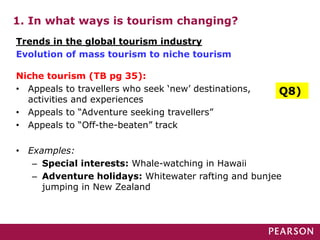
Whale-watching in Hawaii, USA.
Trends in the global tourism industry
Evolution of mass tourism to niche tourism
Niche tourism (TB pg 35):
• Special-interest tourism based on
a particular area, interest or activity
Q7)
Why is whale-watching considered
niche tourism?
• It is a special-interest tourism based on
a particular interest or activity.
• In the case whale-watching, it appeals to
travellers who seek ‘new’ destinations,
activities and experiences
• These activities are unlikely to appeal
to a broad group of travellers, but
rather only to those who specifically seek
out these activities.
1. In what ways is tourism changing?
Niche tourism (TB pg 35):
• Appeals to travellers who seek ‘new’ destinations,
activities and experiences
• Appeals to “Adventure seeking travellers”
• Appeals to “Off-the-beaten” track
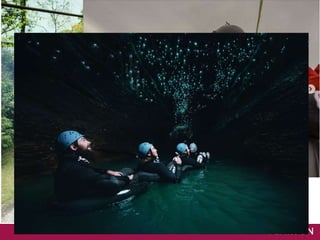
• Examples:
– Special interests: Whale-watching in Hawaii
– Adventure holidays: Whitewater rafting and bunjee
jumping in New Zealand
Trends in the global tourism industry
Evolution of mass tourism to niche tourism
Q8)
1. In what ways is tourism changing?
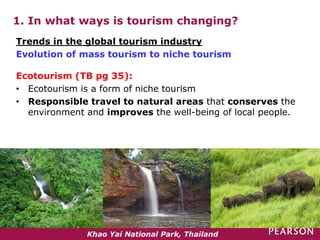
Ecotourism (TB pg 35):
• Ecotourism is a form of niche tourism
• Responsible travel to natural areas that conserves the
environment and improves the well-being of local people.
Trends in the global tourism industry
Evolution of mass tourism to niche tourism
Khao Yai National Park, Thailand
1. In what ways is tourism changing?
Ecotourism (TB pg 35):
• Six principles of ecotourism according to TIES:
Minimise
impact
Build
environmental
and cultural
awareness and
respect.
Provide positive
experiences for
both visitors and
hosts.
Provide direct
financial
benefits for
conservation.
Provide financial
benefits and
empowerment of
local people.
Raise sensitivity to
host countries’
political,
environmental and
social climate.
Trends in the global tourism industry
Evolution of mass tourism to niche tourism
Q10)
1. In what ways is tourism changing?
Ecotourism (TB pg 35):
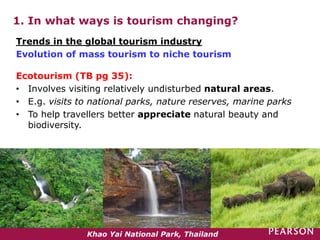
• Involves visiting relatively undisturbed natural areas.
• E.g. visits to national parks, nature reserves, marine parks
• To help travellers better appreciate natural beauty and
biodiversity.
Trends in the global tourism industry
Evolution of mass tourism to niche tourism
Khao Yai National Park, Thailand
1. In what ways is tourism changing?
Ecotourism (TB pg 35):
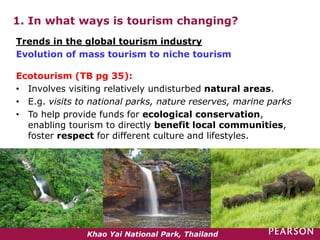
• Involves visiting relatively undisturbed natural areas.
• E.g. visits to national parks, nature reserves, marine parks
• To help provide funds for ecological conservation,
enabling tourism to directly benefit local communities,
foster respect for different culture and lifestyles.
Trends in the global tourism industry
Evolution of mass tourism to niche tourism
Khao Yai National Park, Thailand
1. In what ways is tourism changing?
Ecotourism (TB pg 35):
• Regulations to limit camping, walking, waste disposal and
disturbance of vegetation and wildlife
– Regulations help conserve natural environments for future
generations
Trends in the global tourism industry
Evolution of mass tourism to niche tourism
1. In what ways is tourism changing?
Ecotourism (TB pg 36):
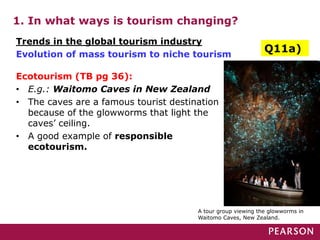
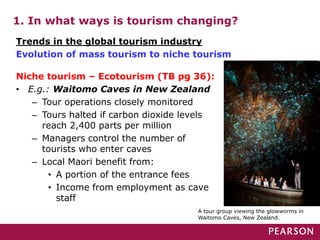
• E.g.: Waitomo Caves in New Zealand
• The caves are a famous tourist destination
because of the glowworms that light the
caves’ ceiling.
• A good example of responsible
ecotourism.
A tour group viewing the glowworms in
Waitomo Caves, New Zealand.
Trends in the global tourism industry
Evolution of mass tourism to niche tourism
Q11a)
1. In what ways is tourism changing?
Ecotourism (TB pg 36):
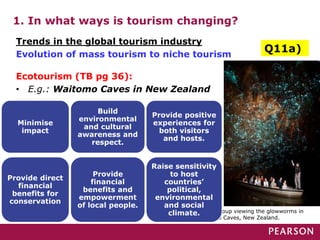
• E.g.: Waitomo Caves in New Zealand
A tour group viewing the glowworms in
Waitomo Caves, New Zealand.
Trends in the global tourism industry
Evolution of mass tourism to niche tourism
Minimise
impact
Build
environmental
and cultural
awareness and
respect.
Provide positive
experiences for
both visitors
and hosts.
Provide direct
financial
benefits for
conservation
Provide
financial
benefits and
empowerment
of local people.
Raise sensitivity
to host
countries’
political,
environmental
and social
climate.
Q11a)
1. In what ways is tourism changing?
Ecotourism (TB pg 36):
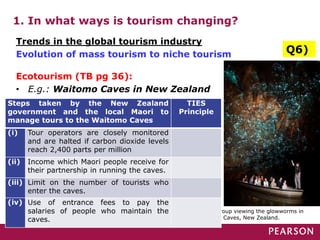
• E.g.: Waitomo Caves in New Zealand
A tour group viewing the glowworms in
Waitomo Caves, New Zealand.
Trends in the global tourism industry
Evolution of mass tourism to niche tourism Q6)
Steps taken by the New Zealand
government and the local Maori to
manage tours to the Waitomo Caves
TIES
Principle
(i) Tour operators are closely monitored
and are halted if carbon dioxide levels
reach 2,400 parts per million
(ii) Income which Maori people receive for
their partnership in running the caves.
(iii) Limit on the number of tourists who
enter the caves.
(iv) Use of entrance fees to pay the
salaries of people who maintain the
caves.
1. In what ways is tourism changing?
Ecotourism (TB pg 36):
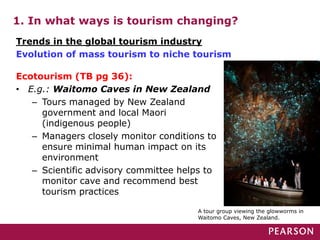
• E.g.: Waitomo Caves in New Zealand
– Tours managed by New Zealand
government and local Maori
(indigenous people)
– Managers closely monitor conditions to
ensure minimal human impact on its
environment
– Scientific advisory committee helps to
monitor cave and recommend best
tourism practices
A tour group viewing the glowworms in
Waitomo Caves, New Zealand.
Trends in the global tourism industry
Evolution of mass tourism to niche tourism
1. In what ways is tourism changing?
Niche tourism – Ecotourism (TB pg 36):
• E.g.: Waitomo Caves in New Zealand
– Tour operations closely monitored
– Tours halted if carbon dioxide levels
reach 2,400 parts per million
– Managers control the number of
tourists who enter caves
– Local Maori benefit from:
• A portion of the entrance fees
• Income from employment as cave
staff
Trends in the global tourism industry
Evolution of mass tourism to niche tourism
A tour group viewing the glowworms in
Waitomo Caves, New Zealand.
1. In what ways is tourism changing?
Ecotourism (TB pg 35):
• Responsible travels to natural areas
• Sustainability / sustainable tourism
– Natural environments preserved for future generations
– Mutual benefits are created for both tourists and hosts
– Direct financial benefits are provided for conservation
Trends in the global tourism industry
Evolution of mass tourism to niche tourism
Q12)
1. In what ways is tourism changing?
Trends in the global tourism industry
– Developments in International tourism
o Tourist origins and destinations
– Growth of Domestic tourism
o Tourism dollars
– Evolution of mass tourism to niche tourism
o Mass tourism
o Package holidays
o Niche tourism (e.g. Eco-tourism)
o Short-haul and long-haul destinations
1. In what ways is tourism changing?
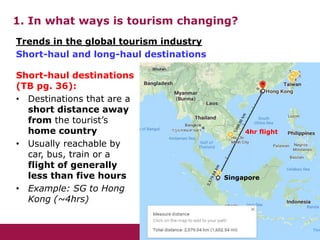
Short-haul destinations
(TB pg. 36):
• Destinations that are a
short distance away
from the tourist’s
home country
• Usually reachable by
car, bus, train or a
flight of generally
less than five hours
• Example: SG to Hong
Kong (~4hrs)
Trends in the global tourism industry
Short-haul and long-haul destinations
Singapore
4hr flight
1. In what ways is tourism changing?
Long-haul destinations (TB pg. 36):
• Destinations that are a long distance away from the
tourist’s home country
• Flight of generally five hours or more
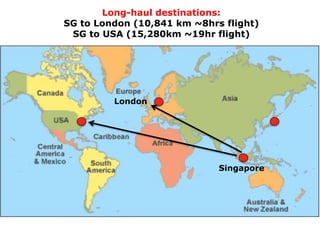
• Example: SG to London (~8hrs)
• Example: SG to the USA (~19 hours)
Trends in the global tourism industry
Short-haul and long-haul destinations
Singapore
Long-haul destinations:
SG to London (10,841 km ~8hrs flight)
SG to USA (15,280km ~19hr flight)
London
1. In what ways is tourism changing?
Trends in the global tourism industry
– Developments in International tourism
o Tourist origins and destinations
– Growth of Domestic tourism
o Tourism dollars
– Evolution of mass tourism to niche tourism
o Mass tourism
o Package holidays
o Niche tourism (e.g. Eco-tourism)
o Short-haul and long-haul destinations
1. In what ways is tourism changing?
2. What influences tourism trends?
3. Why is tourism subject to regional fluctuations?
2 Why has tourism become
a global phenomenon?
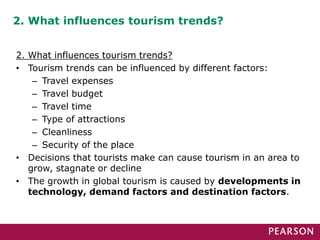
2. What influences tourism trends?
• Tourism trends can be influenced by different factors:
– Travel expenses
– Travel budget
– Travel time
– Type of attractions
– Cleanliness
– Security of the place
• Decisions that tourists make can cause tourism in an area to
grow, stagnate or decline
• The growth in global tourism is caused by developments in
technology, demand factors and destination factors.
All About History64
Natasha
Lee
Calista
Nur
Natasha
Shawali Izhar Darell
Shannon Jermine
Xavier
Whiteboard
Teacher’s
table
Notice
board
All About History65
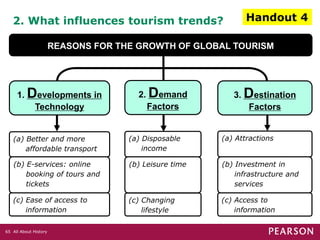
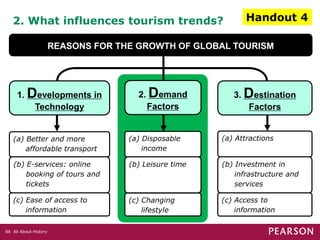
2. What influences tourism trends?
2. Demand
Factors
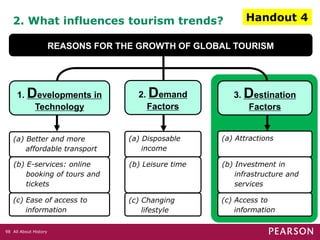
(a) Better and more
affordable transport
(a) Disposable
income
(a) Attractions
(b) E-services: online
booking of tours and
tickets
(b) Leisure time (b) Investment in
infrastructure and
services
REASONS FOR THE GROWTH OF GLOBAL TOURISM
(c) Ease of access to
information
(c) Changing
lifestyle
(c) Access to
information
1. Developments in
Technology
3. Destination
Factors
Handout 4
All About History66
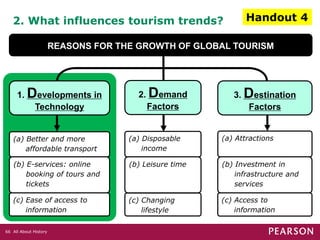
2. What influences tourism trends?
2. Demand
Factors
(a) Better and more
affordable transport
(a) Disposable
income
(a) Attractions
(b) E-services: online
booking of tours and
tickets
(b) Leisure time (b) Investment in
infrastructure and
services
REASONS FOR THE GROWTH OF GLOBAL TOURISM
(c) Ease of access to
information
(c) Changing
lifestyle
(c) Access to
information
1. Developments in
Technology
3. Destination
Factors
Handout 4
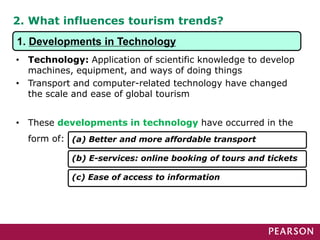
2. What influences tourism trends?
• Technology: Application of scientific knowledge to develop
machines, equipment, and ways of doing things
• Transport and computer-related technology have changed
the scale and ease of global tourism
• These developments in technology have occurred in the
form of: (a) Better and more affordable transport
(b) E-services: online booking of tours and tickets
(c) Ease of access to information
1. Developments in Technology
2. What influences tourism trends?
• Developments in Transport Technology:
- Great improvements in aircraft safety
- Shorter travelling time
- Lower travelling costs (more affordable)
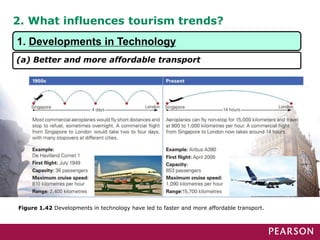
- Commercial air travel has revolutionised global tourism due
to ongoing technological developments in jet aircraft since
the 1950s
1. Developments in Technology
(a) Better and more affordable transport
2. What influences tourism trends?
Figure 1.42 Developments in technology have led to faster and more affordable transport.
1. Developments in Technology
(a) Better and more affordable transport
2. What influences tourism trends?
• Rise of budget airlines:
– Budget airlines are airlines with low fares. Such airlines
made air transport affordable, e.g. Jetstar Asia and Tiger
Airways
– Rapid expansion within Europe, North and South America,
and Southeast Asia since the 1980s
– Cheaper than major commercial airlines (smaller and
more fuel-efficient aircraft)
– Typically fly to short-haul destinations
– Costs further reduced by selling tickets online
1. Developments in Technology
(a) Better and more affordable transport
2. What influences tourism trends?
• Has helped increase the number of international
travellers by:
– Enabling more people to travel internationally and more
frequently
– Giving travellers opportunity to go on holidays further
away from home
– Enabling travellers to go to destinations not covered by
major commercial airlines, e.g. Bhutan, the Pacific
islands, Northern Thailand, and many islands in the
Mediterranean region (Corsica and Crete)
1. Developments in Technology
(a) Better and more affordable transport
2. What influences tourism trends?
1. Developments in Technology
(b) E-services: online booking of tours and tickets
• E-services help to encourage tourism because:
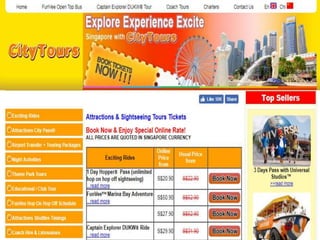
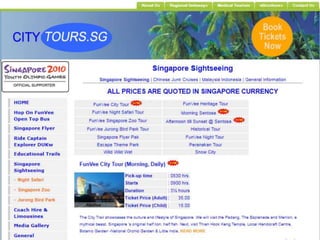
– People can easily book their holidays and plane tickets at
the click of the button.
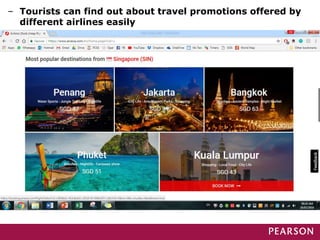
– Tourists can find out about travel promotions offered by
different airlines easily
– Convenience  tourists would be tempted to book
tickets  travels are encouraged
– People can easily book their holidays and plane tickets at
the click of the button.
– Tourists can find out about travel promotions offered by
different airlines easily
2. What influences tourism trends?
1. Developments in Technology
(b) E-services: online booking of tours and tickets
2. What influences tourism trends?
1. Developments in Technology
(b) E-services: online booking of tours and tickets
2. What influences tourism trends?
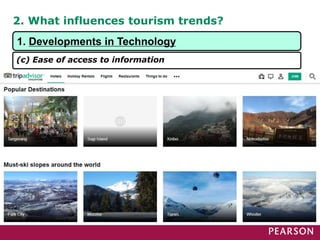
• Helped make information more readily available and
accessible
• Made available updated information
1. Developments in Technology
(c) Ease of access to information
2. What influences tourism trends?
• Helped make information more readily available and
accessible
• Made available updated information
1. Developments in Technology
(c) Ease of access to information
2. What influences tourism trends?
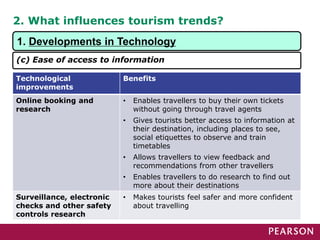
Technological
improvements
Benefits
Online booking and
research
• Enables travellers to buy their own tickets
without going through travel agents
• Gives tourists better access to information at
their destination, including places to see,
social etiquettes to observe and train
timetables
• Allows travellers to view feedback and
recommendations from other travellers
• Enables travellers to do research to find out
more about their destinations
Surveillance, electronic
checks and other safety
controls research
• Makes tourists feel safer and more confident
about travelling
1. Developments in Technology
(c) Ease of access to information
2. What influences tourism trends?
• Helped promote air travel and global tourism because:
○Tourists have access to more options, freedom and control
over their holiday plans
○Increased awareness of interesting destinations from
reading reviews  Ease in planning their trip to visit 
people are encouraged to travel
1. Developments in Technology
(c) Ease of access to information
2. What influences tourism trends?
More air routes and agreements
• Increased number of air routes and agreements have made
various parts of the world more accessible
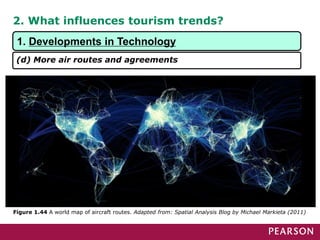
• Produced global pattern of air routes
• Countries are now better connected
• Key agreements and policies helped tourist numbers to
increase
1. Developments in Technology
(d) More air routes and agreements
2. What influences tourism trends?
Figure 1.44 A world map of aircraft routes. Adapted from: Spatial Analysis Blog by Michael Markieta (2011)
1. Developments in Technology
(d) More air routes and agreements
2. What influences tourism trends?
• There are two key factors that helped the growth of global
tourism. These are:
– Open skies agreement
– Deregulation
1. Developments in Technology
(d) More air routes and agreements
2. What influences tourism trends?
• Open skies agreement: An agreement made between
governments to remove restrictions on commercial flights
between their respective countries
– Commercial airlines can freely decide the routes, capacity
and price of their flights without interference from the
government
– Free-market environment for commercial airlines to
compete in
1. Developments in Technology
(d) More air routes and agreements
2. What influences tourism trends?
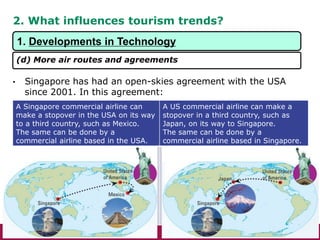
• Singapore has had an open-skies agreement with the USA
since 2001. In this agreement:
A Singapore commercial airline can
make a stopover in the USA on its way
to a third country, such as Mexico.
The same can be done by a
commercial airline based in the USA.
A US commercial airline can make a
stopover in a third country, such as
Japan, on its way to Singapore.
The same can be done by a
commercial airline based in Singapore.
1. Developments in Technology
(d) More air routes and agreements
2. What influences tourism trends?
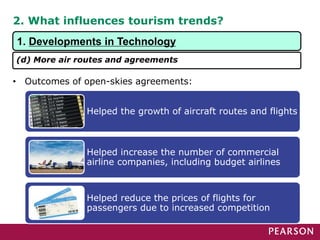
• Outcomes of open-skies agreements:
Helped the growth of aircraft routes and flights
Helped increase the number of commercial
airline companies, including budget airlines
Helped reduce the prices of flights for
passengers due to increased competition
1. Developments in Technology
(d) More air routes and agreements
2. What influences tourism trends?
• Deregulation: Allowing fares to rise and fall according to
market demand and according to competition between
various airline companies
– Before 1978, nearly all airfares between countries were
regulated by the International Air Transport Association
(IATA)
– Prices set for airfares to make airline companies profitable
– However, since 1978, both domestic and international
aviation have become deregulated
1. Developments in Technology
(d) More air routes and agreements
All About History88
2. What influences tourism trends?
2. Demand
Factors
(a) Better and more
affordable transport
(a) Disposable
income
(a) Attractions
(b) E-services: online
booking of tours and
tickets
(b) Leisure time (b) Investment in
infrastructure and
services
REASONS FOR THE GROWTH OF GLOBAL TOURISM
(c) Ease of access to
information
(c) Changing
lifestyle
(c) Access to
information
1. Developments in
Technology
3. Destination
Factors
Handout 4
2. What influences tourism trends?
• Demand factors: Affect people’s demand for goods and
services and affect their ability to travel
– Influence people’s ability to travel and people’s desire to
purchase tourism-related goods and services
– Demand factors in tourism include:
– Affected by tourist profiles, which are the lifestyle,
habits and character of tourists visiting a place)
(a) Disposable income
(b) Leisure time
(c) Changing lifestyle
2. Demand Factors
2. What influences tourism trend?
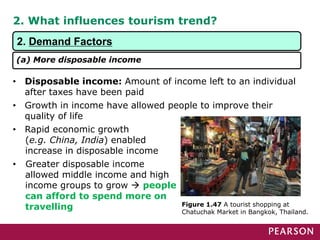
• Disposable income: Amount of income left to an individual
after taxes have been paid
• Growth in income have allowed people to improve their
quality of life
• Rapid economic growth
(e.g. China, India) enabled
increase in disposable income
• Greater disposable income
allowed middle income and high
income groups to grow  people
can afford to spend more on
travelling Figure 1.47 A tourist shopping at
Chatuchak Market in Bangkok, Thailand.
2. Demand Factors
(a) More disposable income
2. What influences tourism trend?
• Leisure time: Part of a day, week or year when people have
no work commitments (time for relaxation)
• Comes in the form of paid leave for the middle to high
income groups
• In many DCs and LDCs since the 1950s, people have enjoyed
shorter working weeks, more public holidays and more paid
annual leave
2. Demand Factors
(b) More leisure time
2. What influences tourism trend?
• Increased availability of leisure time has allowed more
people to travel
• Example: Australia
– Many employees can exchange paid overtime work for
leave which increases their chances of taking longer
weekend breaks
• Example: Canada
– Increase in additional breaks and extended weekends
• With more income and paid leave, people are more
inclined to travel
2. Demand Factors
(b) More leisure time
2. What influences tourism trend?
• Changing lifestyle: Change in the way people live
throughout their lifetime and from generation to generation
• Pace of life today is much faster
• Many find themselves spending long hours at the workplace
beyond the official working hours
• Therefore, people travel to relax and take a break from
their fast-paced lifestyles at work and at home
2. Demand Factors
(c) Changing lifestyle
2. What influences tourism trend?
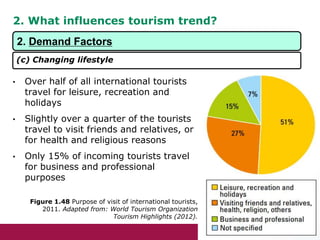
• Over half of all international tourists
travel for leisure, recreation and
holidays
• Slightly over a quarter of the tourists
travel to visit friends and relatives, or
for health and religious reasons
• Only 15% of incoming tourists travel
for business and professional
purposes
Figure 1.48 Purpose of visit of international tourists,
2011. Adapted from: World Tourism Organization
Tourism Highlights (2012).
2. Demand Factors
(c) Changing lifestyle
2. What influences tourism trend?
• With advances in medical technology and knowledge, people
are more health conscious and lead healthier lifestyles
• People live longer and are more physically fit to travel
• Retirees are major contributors to the growth of tourism
• Travelling is a way for retirees to spend their healthy
years productively
2. Demand Factors
(c) Changing lifestyle
2. What influences tourism trend?
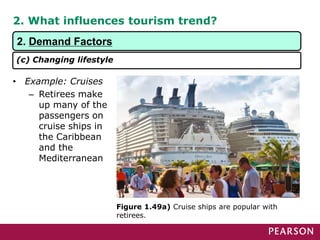
• Example: Cruises
– Retirees make
up many of the
passengers on
cruise ships in
the Caribbean
and the
Mediterranean
Figure 1.49a) Cruise ships are popular with
retirees.
2. Demand Factors
(c) Changing lifestyle
2. What influences tourism trend?
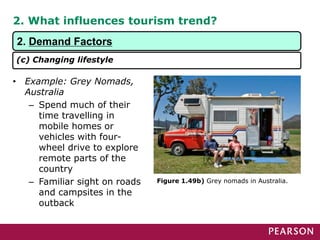
• Example: Grey Nomads,
Australia
– Spend much of their
time travelling in
mobile homes or
vehicles with four-
wheel drive to explore
remote parts of the
country
– Familiar sight on roads
and campsites in the
outback
Figure 1.49b) Grey nomads in Australia.
2. Demand Factors
(c) Changing lifestyle
All About History98
2. What influences tourism trends?
2. Demand
Factors
(a) Better and more
affordable transport
(a) Disposable
income
(a) Attractions
(b) E-services: online
booking of tours and
tickets
(b) Leisure time (b) Investment in
infrastructure and
services
REASONS FOR THE GROWTH OF GLOBAL TOURISM
(c) Ease of access to
information
(c) Changing
lifestyle
(c) Access to
information
1. Developments in
Technology
3. Destination
Factors
Handout 4
2. What influences tourism trends?
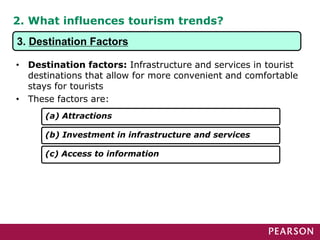
• Destination factors: Infrastructure and services in tourist
destinations that allow for more convenient and comfortable
stays for tourists
• These factors are:
3. Destination Factors
(a) Attractions
(b) Investment in infrastructure and services
(c) Access to information
2. What influences tourism trends?
• Attraction: Feature or quality that makes a place interesting
or enjoyable
• Promoted and enhanced by the tourism industry to attract
even more tourists
• Some are natural attractions (e.g. scenic beauty) while
others are built attractions (e.g. medical services,
educational facilities, theme parks)
• Without built attractions, tourists are less likely to
visit a place
3. Destination Factors
(a) Attractions
2. What influences tourism trends?
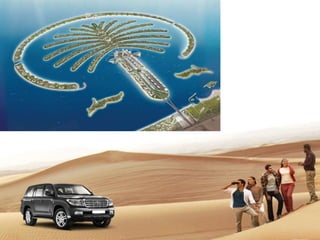
• Example: Dubai
– A city in the United Arab Emirates in the Middle East
– Major destination and stopover location between Europe
and Asia
– Received more than 9 million travellers in 2011
– Tourists visit for shopping, business and entertainment
3. Destination Factors
(a) Attractions
2. What influences tourism trends?
• Example: Dubai
– Wide range of retail and luxury outlets, world-class MICE
facilities, luxury hotels and large-scale architectural and
engineering projects, e.g. Burj Al Arab and Palm Islands
Figure 1.50 Built attractions in Dubai. [From left to right] a) The
Burj Al Arab. b) The Palm Islands
3. Destination Factors
(a) Attractions
2. What influences tourism trends?
• Governments, tourist authorities and tourism businesses
know the value of investing in attractions
• Attractions offer something spectacular, unique and
interesting for tourists
• Tourists might return repeatedly to spend their tourist
dollars
3. Destination Factors
(a) Attractions
2. What influences tourism trends?
• Infrastructure: Transport and communication networks,
electrical frameworks and systems for water and waste
disposal
– Examples:
o Airports, Roads, Railways
• Services: Particular type of help or work that is provided by
a business to customers
– Examples:
o Food outlets, Entertainment, Telecommunication
3. Destination Factors
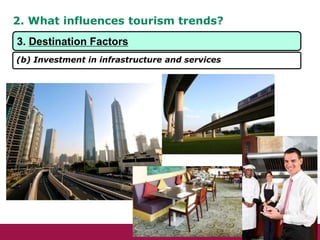
(b) Investment in infrastructure and services
2. What influences tourism trends?
3. Destination Factors
(b) Investment in infrastructure and services
2. What influences tourism trends?
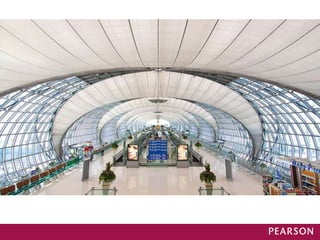
Example: Airport expansion in Southeast Asia
– Southeast Asia experienced rapid growth in international
tourist arrivals over the last three decades
– Airports have undergone considerable expansion to
facilitate increased international tourist arrivals, e.g.
Suvarnabhumi Airport (Bangkok)
– Changi Airport’s Budget Terminal was closed to make way
for the construction of a new Terminal 4
3. Destination Factors
(b) Investment in infrastructure and services
All About History109
2. What influences tourism trends?
• Accommodation
– Sufficient hotels must be built to receive rising number of
tourists
– Hotels must serve a range of tourist budgets
– Example: Hong Kong
• 49 hotels to be built from 2012 to 2016
• Plan is to accommodate 70 million visitors a year (from
previous 42 million)
3. Destination Factors
(b) Investment in infrastructure and services
2. What influences tourism trends?
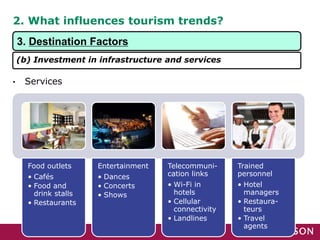
• Services
Food outlets
• Cafés
• Food and
drink stalls
• Restaurants
Entertainment
• Dances
• Concerts
• Shows
Telecommuni-
cation links
• Wi-Fi in
hotels
• Cellular
connectivity
• Landlines
Trained
personnel
• Hotel
managers
• Restaura-
teurs
• Travel
agents
3. Destination Factors
(b) Investment in infrastructure and services
2. What influences tourism trends?
• Access to information: Ease with which information can be
obtained
• Tourists are more likely to visit a destination when travel-
related information is easy to obtain, both outside and within
a destination. Examples:
– Transport routes and schedules
– Weather conditions
– Available accommodation
• Tourists to have access to information in a language that
they can understand
3. Destination Factors
(c) Access to information
2. What influences tourism trends?
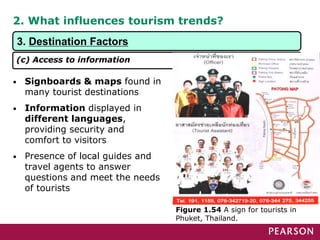
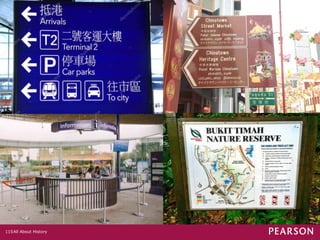
• Signboards & maps found in
many tourist destinations
• Information displayed in
different languages,
providing security and
comfort to visitors
• Presence of local guides and
travel agents to answer
questions and meet the needs
of tourists
3. Destination Factors
(c) Access to information
Figure 1.54 A sign for tourists in
Phuket, Thailand.
All About History115
2. What influences tourism trends?
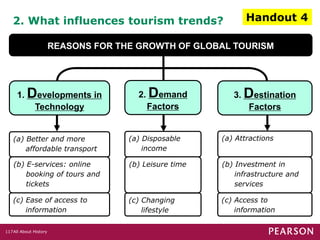
• Presence of information and access to information assures
tourists that there are people they can communicate with for
help
• Ease of travel, convenience and tourists feel safe navigating
around the place  tourists would be more willing to
visit the destination
3. Destination Factors
(c) Access to information
All About History117
2. What influences tourism trends?
2. Demand
Factors
(a) Better and more
affordable transport
(a) Disposable
income
(a) Attractions
(b) E-services: online
booking of tours and
tickets
(b) Leisure time (b) Investment in
infrastructure and
services
REASONS FOR THE GROWTH OF GLOBAL TOURISM
(c) Ease of access to
information
(c) Changing
lifestyle
(c) Access to
information
1. Developments in
Technology
3. Destination
Factors
Handout 4
1. In what ways is tourism changing?
2. What influences tourism trends?
3. Why is tourism subject to regional fluctuations?
2 Why has tourism become
a global phenomenon?
3. Why is tourism subject to regional fluctuations?
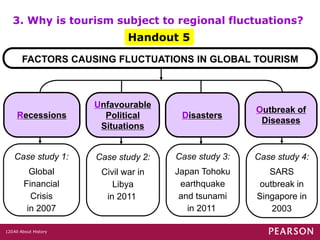
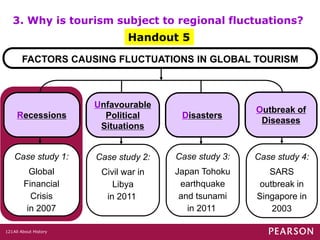
• Tourism is volatile and experiences changes in tourist
numbers and receipts according to regional fluctuations
• Regional fluctuations: Rapid changes in a region’s
situation or condition
• Caused by events that affect tourist destinations within and
outside the country they occurred in:
– Regional and global recessions
– Unfavourable political situations
– Disasters
– Outbreaks of diseases
All About History120
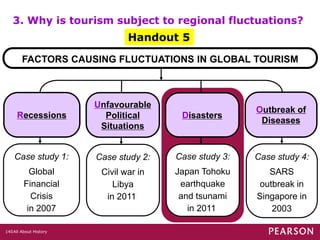
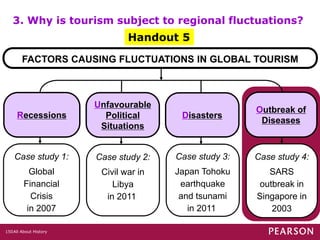
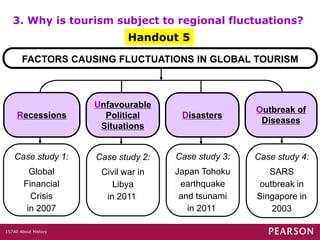
Handout 5
3. Why is tourism subject to regional fluctuations?
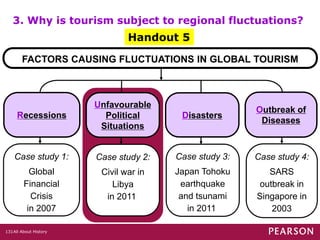
Case study 1:
Global
Financial
Crisis
in 2007
Recessions
Unfavourable
Political
Situations
Outbreak of
Diseases
Disasters
Case study 2:
Civil war in
Libya
in 2011
Case study 3:
Japan Tohoku
earthquake
and tsunami
in 2011
Case study 4:
SARS
outbreak in
Singapore in
2003
FACTORS CAUSING FLUCTUATIONS IN GLOBAL TOURISM
All About History121
Handout 5
3. Why is tourism subject to regional fluctuations?
Case study 1:
Global
Financial
Crisis
in 2007
Recessions
Unfavourable
Political
Situations
Outbreak of
Diseases
Disasters
Case study 2:
Civil war in
Libya
in 2011
Case study 3:
Japan Tohoku
earthquake
and tsunami
in 2011
Case study 4:
SARS
outbreak in
Singapore in
2003
FACTORS CAUSING FLUCTUATIONS IN GLOBAL TOURISM
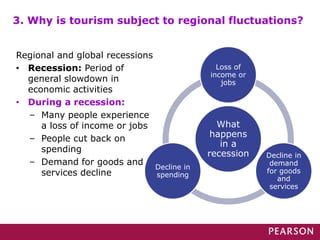
Regional and global recessions
• Recession: Period of
general slowdown in
economic activities
• During a recession:
– Many people experience
a loss of income or jobs
– People cut back on
spending
– Demand for goods and
services decline
What
happens
in a
recession
Loss of
income or
jobs
Decline in
demand
for goods
and
services
Decline in
spending
3. Why is tourism subject to regional fluctuations?
Regional and global recessions
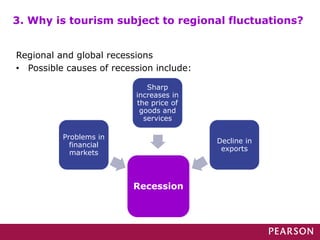
• Possible causes of recession include:
Recession
Sharp
increases in
the price of
goods and
services
Decline in
exports
Problems in
financial
markets
3. Why is tourism subject to regional fluctuations?
Regional and global recessions
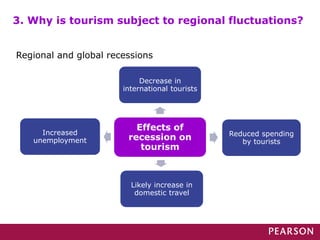
Effects of
recession on
tourism
Decrease in
international tourists
Reduced spending
by tourists
Likely increase in
domestic travel
Increased
unemployment
3. Why is tourism subject to regional fluctuations?
Regional and global recessions
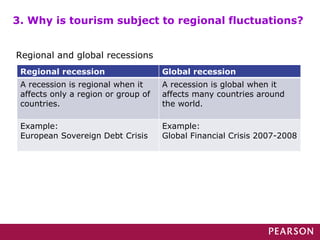
Regional recession Global recession
A recession is regional when it
affects only a region or group of
countries.
A recession is global when it
affects many countries around
the world.
Example:
European Sovereign Debt Crisis
Example:
Global Financial Crisis 2007-2008
3. Why is tourism subject to regional fluctuations?
Regional and global recessions
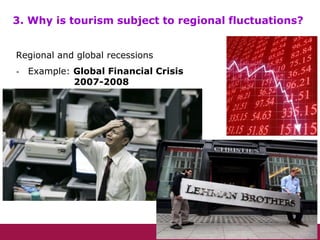
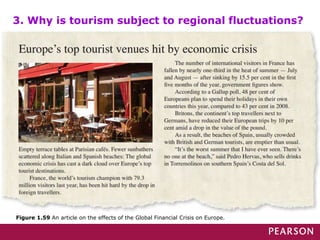
- Example: Global Financial Crisis
2007-2008
3. Why is tourism subject to regional fluctuations?
Regional and global recessions
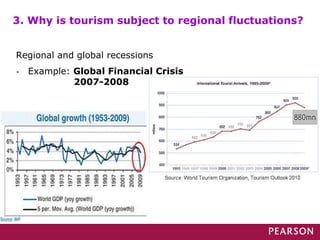
- Example: Global Financial Crisis
2007-2008
Regional and global recessions
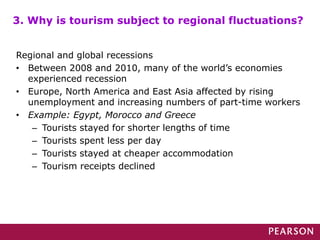
• Between 2008 and 2010, many of the world’s economies
experienced recession
• Europe, North America and East Asia affected by rising
unemployment and increasing numbers of part-time workers
• Example: Egypt, Morocco and Greece
– Tourists stayed for shorter lengths of time
– Tourists spent less per day
– Tourists stayed at cheaper accommodation
– Tourism receipts declined
3. Why is tourism subject to regional fluctuations?
Regional and global recessions
• People choose to go for holidays in their own country rather
than travel abroad during recession
– Shorter distances
– Cheaper transportation
– More affordable options
• Tourist organisations in many countries promote domestic
tourism during recession
– This encourages people to contribute to their own
country’s economy
3. Why is tourism subject to regional fluctuations?
Figure 1.59 An article on the effects of the Global Financial Crisis on Europe.
3. Why is tourism subject to regional fluctuations?
All About History131
Handout 5
3. Why is tourism subject to regional fluctuations?
Case study 1:
Global
Financial
Crisis
in 2007
Recessions
Unfavourable
Political
Situations
Outbreak of
Diseases
Disasters
Case study 2:
Civil war in
Libya
in 2011
Case study 3:
Japan Tohoku
earthquake
and tsunami
in 2011
Case study 4:
SARS
outbreak in
Singapore in
2003
FACTORS CAUSING FLUCTUATIONS IN GLOBAL TOURISM
Unfavourable political situations
• Political conflicts: State of disagreement between
different groups of people that may result in wars
• Government authorities may issue travel advisories due to
the dangers of conflicts
• Travel advisories: Official notices that discourage citizens
from travelling to a particular region or country
3. Why is tourism subject to regional fluctuations?
Unfavourable political situations
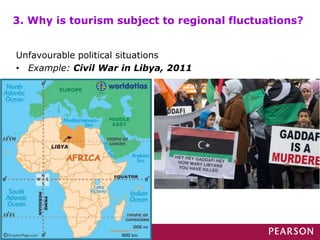
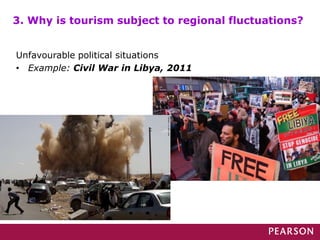
• Example: Civil War in Libya, 2011
– A civil war took place in 2011
– Governments of most countries banned citizens from
visiting Libya
– Commercial airlines reduced or stopped their flights to
Libya
3. Why is tourism subject to regional fluctuations?
Unfavourable political situations
• Example: Civil War in Libya, 2011
3. Why is tourism subject to regional fluctuations?
Unfavourable political situations
• Example: Civil War in Libya, 2011
3. Why is tourism subject to regional fluctuations?
Unfavourable political situations
• Example: Egypt
– Major tourist destination for over 100 years
– International tourist spending comprised 20% to 25% of
the country’s foreign exchange earnings
– Tourism industry employs around 2.7 million people
directly and indirectly
3. Why is tourism subject to regional fluctuations?
Unfavourable political situations
• Example: Egypt
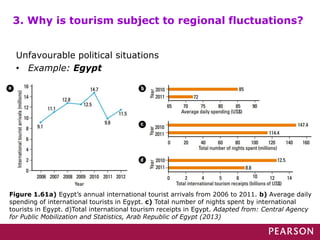
Figure 1.61a) Egypt’s annual international tourist arrivals from 2006 to 2011. b) Average daily
spending of international tourists in Egypt. c) Total number of nights spent by international
tourists in Egypt. d)Total international tourism receipts in Egypt. Adapted from: Central Agency
for Public Mobilization and Statistics, Arab Republic of Egypt (2013)
3. Why is tourism subject to regional fluctuations?
• May discourage tourists from visiting because:
○Pose dangers to tourists as well as residents
○Disrupt services and cause damage to infrastructure
○May prompt tourists to postpone or cancel their travel
plans for their safety
3. Why is tourism subject to regional fluctuations?
Unfavourable political situations
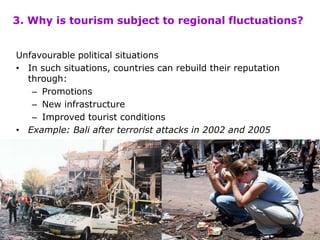
• In such situations, countries can rebuild their reputation
through:
– Promotions
– New infrastructure
– Improved tourist conditions
• Example: Bali after terrorist attacks in 2002 and 2005
3. Why is tourism subject to regional fluctuations?
All About History140
Handout 5
3. Why is tourism subject to regional fluctuations?
Case study 1:
Global
Financial
Crisis
in 2007
Recessions
Unfavourable
Political
Situations
Outbreak of
Diseases
Disasters
Case study 2:
Civil war in
Libya
in 2011
Case study 3:
Japan Tohoku
earthquake
and tsunami
in 2011
Case study 4:
SARS
outbreak in
Singapore in
2003
FACTORS CAUSING FLUCTUATIONS IN GLOBAL TOURISM
3. Why is tourism subject to regional fluctuations?
Disasters
• Disasters: Events that cause great damage to properties,
lead to injuries or cause great loss of life
3. Why is tourism subject to regional fluctuations?
Disasters
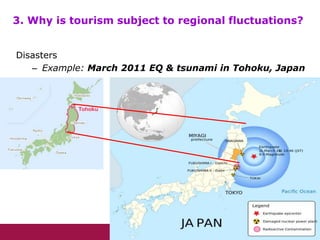
– Example: March 2011 EQ & tsunami in Tohoku, Japan
3. Why is tourism subject to regional fluctuations?
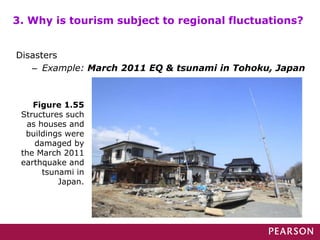
Figure 1.55
Structures such
as houses and
buildings were
damaged by
the March 2011
earthquake and
tsunami in
Japan.
Disasters
– Example: March 2011 EQ & tsunami in Tohoku, Japan
3. Why is tourism subject to regional fluctuations?
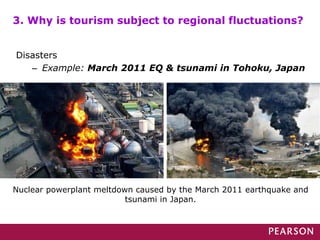
Nuclear powerplant meltdown caused by the March 2011 earthquake and
tsunami in Japan.
Disasters
– Example: March 2011 EQ & tsunami in Tohoku, Japan
3. Why is tourism subject to regional fluctuations?
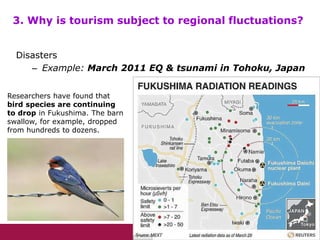
Researchers have found that
bird species are continuing
to drop in Fukushima. The barn
swallow, for example, dropped
from hundreds to dozens.
Disasters
– Example: March 2011 EQ & tsunami in Tohoku, Japan
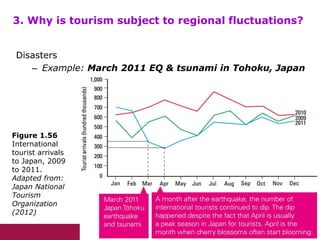
Figure 1.56
International
tourist arrivals
to Japan, 2009
to 2011.
Adapted from:
Japan National
Tourism
Organization
(2012)
3. Why is tourism subject to regional fluctuations?
Disasters
– Example: March 2011 EQ & tsunami in Tohoku, Japan
3. Why is tourism subject to regional fluctuations?
Disasters
• Disasters discourage tourists from visiting a destination
because:
– Pose risks to the safety of tourists
– Disrupt essential tourist infrastructure
– Example: March 2011 earthquake and tsunami in
Tohoku, Japan
o Earthquake, tsunami and nuclear meltdown
o Drop in international tourist numbers despite peak
season in April
o Promotion efforts by government focused on showing a
safe and beautiful Japan
Disasters
• Citizens of affected country were discouraged from
travelling overseas because:
– They themselves are recovering from the effects of the
disaster
• Affects tourism industry of nearby countries through the loss
of income
– Example: South Korea
o Receives a third of its tourists from Japan, its largest
source of tourist arrivals
o Compared to 2010, tourist arrivals from Japan in 2011
fell by 12% in March, 8% in April, and 2% in May
3. Why is tourism subject to regional fluctuations?
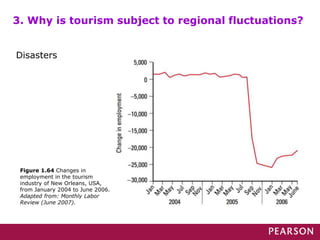
Disasters
Figure 1.64 Changes in
employment in the tourism
industry of New Orleans, USA,
from January 2004 to June 2006.
Adapted from: Monthly Labor
Review (June 2007).
3. Why is tourism subject to regional fluctuations?
All About History150
Handout 5
3. Why is tourism subject to regional fluctuations?
Case study 1:
Global
Financial
Crisis
in 2007
Recessions
Unfavourable
Political
Situations
Outbreak of
Diseases
Disasters
Case study 2:
Civil war in
Libya
in 2011
Case study 3:
Japan Tohoku
earthquake
and tsunami
in 2011
Case study 4:
SARS
outbreak in
Singapore in
2003
FACTORS CAUSING FLUCTUATIONS IN GLOBAL TOURISM
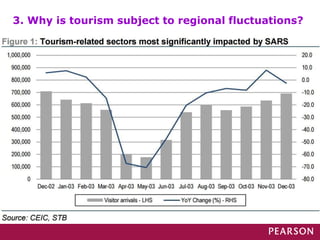
Outbreaks of diseases
• Outbreak of disease: Sudden and widespread occurrence
of disease in an area
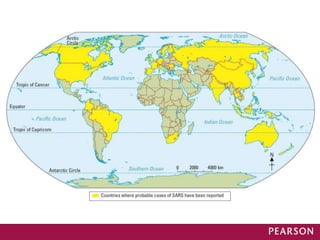
• Example: SARS (Severe Acute Respiratory Syndrome)
outbreak in Singapore in 2003 outbreak 2003
– Spread over six months
– Killed 775 people
– Infected more than 8,000 in 25 countries
3. Why is tourism subject to regional fluctuations?
Outbreaks of diseases
• Can have strong negative impacts on tourism:
– Discourage tourist travel
– Cause significant decline in tourist arrivals
– Cause businesses to postpone or cancel large-scale MICE
activities
• Can cause a huge drop in tourist arrivals because:
– Tourists do not want to risk getting infected with a
contagious disease
– Government agencies may advise travellers to avoid
areas with disease outbreaks
3. Why is tourism subject to regional fluctuations?
Outbreaks of diseases
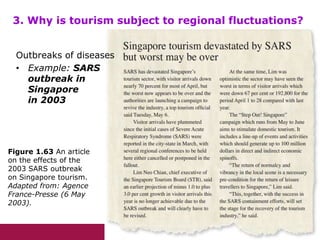
• Example: SARS
outbreak in
Singapore
in 2003
Figure 1.63 An article
on the effects of the
2003 SARS outbreak
on Singapore tourism.
Adapted from: Agence
France-Presse (6 May
2003).
3. Why is tourism subject to regional fluctuations?
Outbreaks of diseases
• Example: SARS
outbreak in
Singapore
in 2003
Outbreaks of diseases
• Example: H1N1 influenza or swine flu
– World Health Organization identified major H1N1
influenza outbreaks in USA, Mexico and Spain in 2007
– Originated from pigs
– Can be fatal
– Blamed for widespread cancellations of holiday bookings
by tourists from USA, Canada and Europe to Mexico in
2009
3. Why is tourism subject to regional fluctuations?
All About History157
Handout 5
3. Why is tourism subject to regional fluctuations?
Case study 1:
Global
Financial
Crisis
in 2007
Recessions
Unfavourable
Political
Situations
Outbreak of
Diseases
Disasters
Case study 2:
Civil war in
Libya
in 2011
Case study 3:
Japan Tohoku
earthquake
and tsunami
in 2011
Case study 4:
SARS
outbreak in
Singapore in
2003
FACTORS CAUSING FLUCTUATIONS IN GLOBAL TOURISM
All About History158
3. Why is tourism subject to regional fluctuations?
AFI:
• Answers are sometimes long-winded / simply copy from TB
 NOT meaningfully crafted to answer question / disorganised
• Time constraints
Exam Skills Practice:
Explain why and how _____________ causes fluctuations in
the tourism industry. Support your answer with a case study. [5]
• Use PEEL
• Ensure sufficient points
• Ensure relevance of statements included – include only points
that prove your argument!
1. In what ways is tourism changing?
2. What influences tourism trends?
3. Why is tourism subject to regional fluctuations?
2 Why has tourism become
a global phenomenon?

Tourism GW 2 Slides

  • 1.
    2 Why hastourism become a global phenomenon?
  • 2.
    • As thenumber of people who travel increases, previously unexplored tourist attractions become more popular • Between 1995 and 2010, the number of tourists to Kenya has increased almost 10 times • For example, more tourists are visiting the Samburu National Reserve in Kenya for ecotourism Sasaab Lodge in Samburu, Kenya 2 Why has tourism become a global phenomenon?
  • 4.
    Eco-tourism in SamburuNational Reserve, Kenya (in Africa) (TB pg. 27)
  • 5.
    1. In whatways is tourism changing? 2. What influences tourism trends? 3. Why is tourism subject to regional fluctuations? 2 Why has tourism become a global phenomenon?
  • 6.
    1. In whatways is tourism changing? Trends in the global tourism industry – Developments in International tourism o Tourist origins and destinations – Growth of Domestic tourism o Tourism dollars – Evolution of mass tourism to niche tourism o Mass tourism o Package holidays o Niche tourism (e.g. Eco-tourism) o Short-haul and long-haul destinations Data literacy skills
  • 7.
    International tourism Tourist originsmeans where the tourists come/arrive from. Let’s Practice 1 
  • 8.
    International tourism Tourist destinationsmeans where the tourists are travelling to. Let’s Practice 2 
  • 9.
    2013 2014 Change % Visitor arrivalsto the UK Exit Ticket  International tourism
  • 10.
    Exit Ticket  Internationaltourism Visitor arrivals to the UK
  • 11.
    1. In whatways is tourism changing? Trends in the global tourism industry – Developments in International tourism o Tourist origins and destinations – Growth of Domestic tourism o Tourism dollars – Evolution of mass tourism to niche tourism o Mass tourism o Package holidays o Niche tourism (e.g. Eco-tourism) o Short-haul and long-haul destinations
  • 12.
    TB pg. 28 Internationaltourist arrivals from 1950 to 2010. Describe the trends in international tourist arrivals from 1950 to 2010. [4]
  • 14.
    Trends in theglobal tourism industry International tourism (TB pg. 28) 1. In what ways is tourism changing? • All regions receive more tourists, but the Asia Pacific region has increased in popularity as a tourist destination
  • 15.
    1. In whatways is tourism changing? Before the 1980s: • Most of the tourist destinations were in developed regions, such as Europe and North America • Developed regions received 96% of all tourist arrivals in 1950 and 81% in 1980 After the 1980s: • Asia Pacific has shown an impressive growth in tourist arrivals • Asia Pacific has overtaken the Americas and Europe • Asia Pacific has become the 2nd most visited region and the fastest growing region for international tourism Trends in the global tourism industry International tourism (TB pg. 28)
  • 16.
    TB pg. 29 AFLOW LINE MAP showing tourist movements in 2010 Two-way movement Tourist origin Tourist destination One-way movement
  • 17.
    Tourist origins anddestinations are unevenly distributed throughout the world Uneven geography That’s why it is important to study geography to understand why and how places are different throughout the world!!!!
  • 18.
    TB pg. 31 DESIRELINE MAP shows major regional destinations of Singaporean tourists in 2011
  • 19.
    All About History18 Desireline map vs Flow line map Desire line map (TB pg. 31) Flow line map (TB pg. 29) Advantages? Disadvantages? Similarities? Differences?
  • 20.
    Trends in theglobal tourism industry International tourism (TB pg. 29) 1. In what ways is tourism changing? • Tourist origins means where the tourists come/arrive from. • Tourist destinations means where the tourists are travelling to/visiting.
  • 21.
    1. In whatways is tourism changing? Tourist origins and destinations (TB pg. 29) • Large-scale tourist movements can be found: – In North America to and from Central America, South America and Europe (10 million+) – In Europe to and from North America and the Middle East (10 million) – In Japan to and from North America, Southeast Asia and Europe (5-10 million) – Within Asia (5 million) – From Asia to and from North America, Australia and Europe (5 million) Trends in the global tourism industry International tourism
  • 22.
    1. In whatways is tourism changing? Trends in the global tourism industry International tourism Tourist arrivals (TB pg. 30) 479.2 More than half of all international tourists still originate from the world’s most developed countries (eg. tourists originating from Europe & North America)
  • 23.
    1. In whatways is tourism changing? Trends in the global tourism industry International tourism Tourist arrivals (TB pg. 30)
  • 24.
    1. In whatways is tourism changing? Trends in the global tourism industry International tourism Tourist origins and destinations (TB pg. 30) But increasingly, there are more international tourists from the rapidly developing countries (e.g. China, India, Brazil)
  • 26.
    1. In whatways is tourism changing? Trends in the global tourism industry – Developments in International tourism o Tourist origins and destinations – Growth of Domestic tourism o Tourism dollars – Evolution of mass tourism to niche tourism o Mass tourism o Package holidays o Niche tourism (e.g. Eco-tourism) o Short-haul and long-haul destinations
  • 27.
    1. In whatways is tourism changing? Trends in the global tourism industry Domestic tourism (TB pg. 32) RECAP: Domestic tourism refers to tourism within a tourist’s own country. What are the advantages that tourists have in travelling within their own country (i.e. domestic tourism), rather than outside it?
  • 28.
    1. In whatways is tourism changing? Trends in domestic tourism worldwide: • Has grown along with international tourism • Continues to be the most popular form of tourism • Worldwide in 2010: – 83% of all tourist arrivals were domestic tourism – 69% of all overnight stays in hotels represented by domestic tourism Trends in the global tourism industry Domestic tourism (TB pg. 32)
  • 29.
    1. In whatways is tourism changing? What is the significance of domestic tourism in Philippines? Trends in the global tourism industry Domestic tourism (TB pg. 32) Tourist Arrivals in Top Destinations in the Philippines from 2000-2010 (in thousand)
  • 31.
    1. In whatways is tourism changing? What is the significance of domestic tourism in Philippines? • Important in bringing in tourism dollars: – The Philippines (2010) Trends in the global tourism industry Domestic tourism (TB pg. 32) International Tourism Receipts US $3.2 billion Domestic Tourism Receipts US $22.9 billion <
  • 33.
    1. In whatways is tourism changing? • Importance in bringing in tourism dollars: – China o In the Lunar New Year, many employees take a break from work for up to two weeks. o The Chinese often visit friends and relatives and go sightseeing in other parts within the country. Trends in the global tourism industry Domestic tourism (TB pg. 32)
  • 34.
    1. In whatways is tourism changing? • Importance in bringing in tourism dollars: – Singapore? o There are very few domestic tourists o Due to our small size & accessibility, it impractical for residents to rent accommodations overnight near the tourist attraction. Trends in the global tourism industry Domestic tourism (TB pg. 32)
  • 37.
    1. In whatways is tourism changing? Trends in the global tourism industry – Developments in International tourism o Tourist origins and destinations – Growth of Domestic tourism o Tourism dollars – Evolution of mass tourism to niche tourism o Mass tourism o Package holidays o Niche tourism (e.g. Eco-tourism) o Short-haul and long-haul destinations
  • 38.
    1. In whatways is tourism changing? Mass tourism (TB pg 34): • Travel that involves large numbers of tourists visiting a particular place together Trends in the global tourism industry Evolution of mass tourism to niche tourism
  • 39.
    1. In whatways is tourism changing? Mass tourism (TB pg 34): • Usually in the form of package holidays (popular since the 1970s) • Involve a tour usually arranged by a travel agent, with transportation, accommodation and most meals included • Include the service of tour guides Trends in the global tourism industry Evolution of mass tourism to niche tourism Q1)
  • 40.
    1. In whatways is tourism changing? Trends in the global tourism industry Evolution of mass tourism to niche tourism Since 1950s Mass tourism (popularity of tour packages) Growth of niche tourism Short haul destinations Long haul destinations Growth of tourism Since 1970s
  • 41.
    1. In whatways is tourism changing? Whale-watching in Hawaii, USA. Whitewater rafting in New Zealand. Trends in the global tourism industry Evolution of mass tourism to niche tourism Niche tourism (TB pg 35): • Special-interest tourism based on a particular area, interest or activity
  • 42.
    1. In whatways is tourism changing? Whale-watching in Hawaii, USA. Trends in the global tourism industry Evolution of mass tourism to niche tourism Niche tourism (TB pg 35): • Special-interest tourism based on a particular area, interest or activity Q7) Why is whale-watching considered niche tourism? • It is a special-interest tourism based on a particular interest or activity. • In the case whale-watching, it appeals to travellers who seek ‘new’ destinations, activities and experiences • These activities are unlikely to appeal to a broad group of travellers, but rather only to those who specifically seek out these activities.
  • 43.
    1. In whatways is tourism changing? Niche tourism (TB pg 35): • Appeals to travellers who seek ‘new’ destinations, activities and experiences • Appeals to “Adventure seeking travellers” • Appeals to “Off-the-beaten” track • Examples: – Special interests: Whale-watching in Hawaii – Adventure holidays: Whitewater rafting and bunjee jumping in New Zealand Trends in the global tourism industry Evolution of mass tourism to niche tourism Q8)
  • 45.
    1. In whatways is tourism changing? Ecotourism (TB pg 35): • Ecotourism is a form of niche tourism • Responsible travel to natural areas that conserves the environment and improves the well-being of local people. Trends in the global tourism industry Evolution of mass tourism to niche tourism Khao Yai National Park, Thailand
  • 46.
    1. In whatways is tourism changing? Ecotourism (TB pg 35): • Six principles of ecotourism according to TIES: Minimise impact Build environmental and cultural awareness and respect. Provide positive experiences for both visitors and hosts. Provide direct financial benefits for conservation. Provide financial benefits and empowerment of local people. Raise sensitivity to host countries’ political, environmental and social climate. Trends in the global tourism industry Evolution of mass tourism to niche tourism Q10)
  • 47.
    1. In whatways is tourism changing? Ecotourism (TB pg 35): • Involves visiting relatively undisturbed natural areas. • E.g. visits to national parks, nature reserves, marine parks • To help travellers better appreciate natural beauty and biodiversity. Trends in the global tourism industry Evolution of mass tourism to niche tourism Khao Yai National Park, Thailand
  • 48.
    1. In whatways is tourism changing? Ecotourism (TB pg 35): • Involves visiting relatively undisturbed natural areas. • E.g. visits to national parks, nature reserves, marine parks • To help provide funds for ecological conservation, enabling tourism to directly benefit local communities, foster respect for different culture and lifestyles. Trends in the global tourism industry Evolution of mass tourism to niche tourism Khao Yai National Park, Thailand
  • 49.
    1. In whatways is tourism changing? Ecotourism (TB pg 35): • Regulations to limit camping, walking, waste disposal and disturbance of vegetation and wildlife – Regulations help conserve natural environments for future generations Trends in the global tourism industry Evolution of mass tourism to niche tourism
  • 50.
    1. In whatways is tourism changing? Ecotourism (TB pg 36): • E.g.: Waitomo Caves in New Zealand • The caves are a famous tourist destination because of the glowworms that light the caves’ ceiling. • A good example of responsible ecotourism. A tour group viewing the glowworms in Waitomo Caves, New Zealand. Trends in the global tourism industry Evolution of mass tourism to niche tourism Q11a)
  • 53.
    1. In whatways is tourism changing? Ecotourism (TB pg 36): • E.g.: Waitomo Caves in New Zealand A tour group viewing the glowworms in Waitomo Caves, New Zealand. Trends in the global tourism industry Evolution of mass tourism to niche tourism Minimise impact Build environmental and cultural awareness and respect. Provide positive experiences for both visitors and hosts. Provide direct financial benefits for conservation Provide financial benefits and empowerment of local people. Raise sensitivity to host countries’ political, environmental and social climate. Q11a)
  • 54.
    1. In whatways is tourism changing? Ecotourism (TB pg 36): • E.g.: Waitomo Caves in New Zealand A tour group viewing the glowworms in Waitomo Caves, New Zealand. Trends in the global tourism industry Evolution of mass tourism to niche tourism Q6) Steps taken by the New Zealand government and the local Maori to manage tours to the Waitomo Caves TIES Principle (i) Tour operators are closely monitored and are halted if carbon dioxide levels reach 2,400 parts per million (ii) Income which Maori people receive for their partnership in running the caves. (iii) Limit on the number of tourists who enter the caves. (iv) Use of entrance fees to pay the salaries of people who maintain the caves.
  • 55.
    1. In whatways is tourism changing? Ecotourism (TB pg 36): • E.g.: Waitomo Caves in New Zealand – Tours managed by New Zealand government and local Maori (indigenous people) – Managers closely monitor conditions to ensure minimal human impact on its environment – Scientific advisory committee helps to monitor cave and recommend best tourism practices A tour group viewing the glowworms in Waitomo Caves, New Zealand. Trends in the global tourism industry Evolution of mass tourism to niche tourism
  • 56.
    1. In whatways is tourism changing? Niche tourism – Ecotourism (TB pg 36): • E.g.: Waitomo Caves in New Zealand – Tour operations closely monitored – Tours halted if carbon dioxide levels reach 2,400 parts per million – Managers control the number of tourists who enter caves – Local Maori benefit from: • A portion of the entrance fees • Income from employment as cave staff Trends in the global tourism industry Evolution of mass tourism to niche tourism A tour group viewing the glowworms in Waitomo Caves, New Zealand.
  • 57.
    1. In whatways is tourism changing? Ecotourism (TB pg 35): • Responsible travels to natural areas • Sustainability / sustainable tourism – Natural environments preserved for future generations – Mutual benefits are created for both tourists and hosts – Direct financial benefits are provided for conservation Trends in the global tourism industry Evolution of mass tourism to niche tourism Q12)
  • 58.
    1. In whatways is tourism changing? Trends in the global tourism industry – Developments in International tourism o Tourist origins and destinations – Growth of Domestic tourism o Tourism dollars – Evolution of mass tourism to niche tourism o Mass tourism o Package holidays o Niche tourism (e.g. Eco-tourism) o Short-haul and long-haul destinations
  • 59.
    1. In whatways is tourism changing? Short-haul destinations (TB pg. 36): • Destinations that are a short distance away from the tourist’s home country • Usually reachable by car, bus, train or a flight of generally less than five hours • Example: SG to Hong Kong (~4hrs) Trends in the global tourism industry Short-haul and long-haul destinations Singapore 4hr flight
  • 60.
    1. In whatways is tourism changing? Long-haul destinations (TB pg. 36): • Destinations that are a long distance away from the tourist’s home country • Flight of generally five hours or more • Example: SG to London (~8hrs) • Example: SG to the USA (~19 hours) Trends in the global tourism industry Short-haul and long-haul destinations
  • 61.
    Singapore Long-haul destinations: SG toLondon (10,841 km ~8hrs flight) SG to USA (15,280km ~19hr flight) London
  • 62.
    1. In whatways is tourism changing? Trends in the global tourism industry – Developments in International tourism o Tourist origins and destinations – Growth of Domestic tourism o Tourism dollars – Evolution of mass tourism to niche tourism o Mass tourism o Package holidays o Niche tourism (e.g. Eco-tourism) o Short-haul and long-haul destinations
  • 63.
    1. In whatways is tourism changing? 2. What influences tourism trends? 3. Why is tourism subject to regional fluctuations? 2 Why has tourism become a global phenomenon?
  • 64.
    2. What influencestourism trends? 2. What influences tourism trends? • Tourism trends can be influenced by different factors: – Travel expenses – Travel budget – Travel time – Type of attractions – Cleanliness – Security of the place • Decisions that tourists make can cause tourism in an area to grow, stagnate or decline • The growth in global tourism is caused by developments in technology, demand factors and destination factors.
  • 65.
    All About History64 Natasha Lee Calista Nur Natasha ShawaliIzhar Darell Shannon Jermine Xavier Whiteboard Teacher’s table Notice board
  • 66.
    All About History65 2.What influences tourism trends? 2. Demand Factors (a) Better and more affordable transport (a) Disposable income (a) Attractions (b) E-services: online booking of tours and tickets (b) Leisure time (b) Investment in infrastructure and services REASONS FOR THE GROWTH OF GLOBAL TOURISM (c) Ease of access to information (c) Changing lifestyle (c) Access to information 1. Developments in Technology 3. Destination Factors Handout 4
  • 67.
    All About History66 2.What influences tourism trends? 2. Demand Factors (a) Better and more affordable transport (a) Disposable income (a) Attractions (b) E-services: online booking of tours and tickets (b) Leisure time (b) Investment in infrastructure and services REASONS FOR THE GROWTH OF GLOBAL TOURISM (c) Ease of access to information (c) Changing lifestyle (c) Access to information 1. Developments in Technology 3. Destination Factors Handout 4
  • 68.
    2. What influencestourism trends? • Technology: Application of scientific knowledge to develop machines, equipment, and ways of doing things • Transport and computer-related technology have changed the scale and ease of global tourism • These developments in technology have occurred in the form of: (a) Better and more affordable transport (b) E-services: online booking of tours and tickets (c) Ease of access to information 1. Developments in Technology
  • 69.
    2. What influencestourism trends? • Developments in Transport Technology: - Great improvements in aircraft safety - Shorter travelling time - Lower travelling costs (more affordable) - Commercial air travel has revolutionised global tourism due to ongoing technological developments in jet aircraft since the 1950s 1. Developments in Technology (a) Better and more affordable transport
  • 70.
    2. What influencestourism trends? Figure 1.42 Developments in technology have led to faster and more affordable transport. 1. Developments in Technology (a) Better and more affordable transport
  • 71.
    2. What influencestourism trends? • Rise of budget airlines: – Budget airlines are airlines with low fares. Such airlines made air transport affordable, e.g. Jetstar Asia and Tiger Airways – Rapid expansion within Europe, North and South America, and Southeast Asia since the 1980s – Cheaper than major commercial airlines (smaller and more fuel-efficient aircraft) – Typically fly to short-haul destinations – Costs further reduced by selling tickets online 1. Developments in Technology (a) Better and more affordable transport
  • 72.
    2. What influencestourism trends? • Has helped increase the number of international travellers by: – Enabling more people to travel internationally and more frequently – Giving travellers opportunity to go on holidays further away from home – Enabling travellers to go to destinations not covered by major commercial airlines, e.g. Bhutan, the Pacific islands, Northern Thailand, and many islands in the Mediterranean region (Corsica and Crete) 1. Developments in Technology (a) Better and more affordable transport
  • 73.
    2. What influencestourism trends? 1. Developments in Technology (b) E-services: online booking of tours and tickets • E-services help to encourage tourism because: – People can easily book their holidays and plane tickets at the click of the button. – Tourists can find out about travel promotions offered by different airlines easily – Convenience  tourists would be tempted to book tickets  travels are encouraged
  • 74.
    – People caneasily book their holidays and plane tickets at the click of the button.
  • 75.
    – Tourists canfind out about travel promotions offered by different airlines easily
  • 76.
    2. What influencestourism trends? 1. Developments in Technology (b) E-services: online booking of tours and tickets
  • 77.
    2. What influencestourism trends? 1. Developments in Technology (b) E-services: online booking of tours and tickets
  • 78.
    2. What influencestourism trends? • Helped make information more readily available and accessible • Made available updated information 1. Developments in Technology (c) Ease of access to information
  • 79.
    2. What influencestourism trends? • Helped make information more readily available and accessible • Made available updated information 1. Developments in Technology (c) Ease of access to information
  • 80.
    2. What influencestourism trends? Technological improvements Benefits Online booking and research • Enables travellers to buy their own tickets without going through travel agents • Gives tourists better access to information at their destination, including places to see, social etiquettes to observe and train timetables • Allows travellers to view feedback and recommendations from other travellers • Enables travellers to do research to find out more about their destinations Surveillance, electronic checks and other safety controls research • Makes tourists feel safer and more confident about travelling 1. Developments in Technology (c) Ease of access to information
  • 81.
    2. What influencestourism trends? • Helped promote air travel and global tourism because: ○Tourists have access to more options, freedom and control over their holiday plans ○Increased awareness of interesting destinations from reading reviews  Ease in planning their trip to visit  people are encouraged to travel 1. Developments in Technology (c) Ease of access to information
  • 82.
    2. What influencestourism trends? More air routes and agreements • Increased number of air routes and agreements have made various parts of the world more accessible • Produced global pattern of air routes • Countries are now better connected • Key agreements and policies helped tourist numbers to increase 1. Developments in Technology (d) More air routes and agreements
  • 83.
    2. What influencestourism trends? Figure 1.44 A world map of aircraft routes. Adapted from: Spatial Analysis Blog by Michael Markieta (2011) 1. Developments in Technology (d) More air routes and agreements
  • 84.
    2. What influencestourism trends? • There are two key factors that helped the growth of global tourism. These are: – Open skies agreement – Deregulation 1. Developments in Technology (d) More air routes and agreements
  • 85.
    2. What influencestourism trends? • Open skies agreement: An agreement made between governments to remove restrictions on commercial flights between their respective countries – Commercial airlines can freely decide the routes, capacity and price of their flights without interference from the government – Free-market environment for commercial airlines to compete in 1. Developments in Technology (d) More air routes and agreements
  • 86.
    2. What influencestourism trends? • Singapore has had an open-skies agreement with the USA since 2001. In this agreement: A Singapore commercial airline can make a stopover in the USA on its way to a third country, such as Mexico. The same can be done by a commercial airline based in the USA. A US commercial airline can make a stopover in a third country, such as Japan, on its way to Singapore. The same can be done by a commercial airline based in Singapore. 1. Developments in Technology (d) More air routes and agreements
  • 87.
    2. What influencestourism trends? • Outcomes of open-skies agreements: Helped the growth of aircraft routes and flights Helped increase the number of commercial airline companies, including budget airlines Helped reduce the prices of flights for passengers due to increased competition 1. Developments in Technology (d) More air routes and agreements
  • 88.
    2. What influencestourism trends? • Deregulation: Allowing fares to rise and fall according to market demand and according to competition between various airline companies – Before 1978, nearly all airfares between countries were regulated by the International Air Transport Association (IATA) – Prices set for airfares to make airline companies profitable – However, since 1978, both domestic and international aviation have become deregulated 1. Developments in Technology (d) More air routes and agreements
  • 89.
    All About History88 2.What influences tourism trends? 2. Demand Factors (a) Better and more affordable transport (a) Disposable income (a) Attractions (b) E-services: online booking of tours and tickets (b) Leisure time (b) Investment in infrastructure and services REASONS FOR THE GROWTH OF GLOBAL TOURISM (c) Ease of access to information (c) Changing lifestyle (c) Access to information 1. Developments in Technology 3. Destination Factors Handout 4
  • 90.
    2. What influencestourism trends? • Demand factors: Affect people’s demand for goods and services and affect their ability to travel – Influence people’s ability to travel and people’s desire to purchase tourism-related goods and services – Demand factors in tourism include: – Affected by tourist profiles, which are the lifestyle, habits and character of tourists visiting a place) (a) Disposable income (b) Leisure time (c) Changing lifestyle 2. Demand Factors
  • 91.
    2. What influencestourism trend? • Disposable income: Amount of income left to an individual after taxes have been paid • Growth in income have allowed people to improve their quality of life • Rapid economic growth (e.g. China, India) enabled increase in disposable income • Greater disposable income allowed middle income and high income groups to grow  people can afford to spend more on travelling Figure 1.47 A tourist shopping at Chatuchak Market in Bangkok, Thailand. 2. Demand Factors (a) More disposable income
  • 92.
    2. What influencestourism trend? • Leisure time: Part of a day, week or year when people have no work commitments (time for relaxation) • Comes in the form of paid leave for the middle to high income groups • In many DCs and LDCs since the 1950s, people have enjoyed shorter working weeks, more public holidays and more paid annual leave 2. Demand Factors (b) More leisure time
  • 93.
    2. What influencestourism trend? • Increased availability of leisure time has allowed more people to travel • Example: Australia – Many employees can exchange paid overtime work for leave which increases their chances of taking longer weekend breaks • Example: Canada – Increase in additional breaks and extended weekends • With more income and paid leave, people are more inclined to travel 2. Demand Factors (b) More leisure time
  • 94.
    2. What influencestourism trend? • Changing lifestyle: Change in the way people live throughout their lifetime and from generation to generation • Pace of life today is much faster • Many find themselves spending long hours at the workplace beyond the official working hours • Therefore, people travel to relax and take a break from their fast-paced lifestyles at work and at home 2. Demand Factors (c) Changing lifestyle
  • 95.
    2. What influencestourism trend? • Over half of all international tourists travel for leisure, recreation and holidays • Slightly over a quarter of the tourists travel to visit friends and relatives, or for health and religious reasons • Only 15% of incoming tourists travel for business and professional purposes Figure 1.48 Purpose of visit of international tourists, 2011. Adapted from: World Tourism Organization Tourism Highlights (2012). 2. Demand Factors (c) Changing lifestyle
  • 96.
    2. What influencestourism trend? • With advances in medical technology and knowledge, people are more health conscious and lead healthier lifestyles • People live longer and are more physically fit to travel • Retirees are major contributors to the growth of tourism • Travelling is a way for retirees to spend their healthy years productively 2. Demand Factors (c) Changing lifestyle
  • 97.
    2. What influencestourism trend? • Example: Cruises – Retirees make up many of the passengers on cruise ships in the Caribbean and the Mediterranean Figure 1.49a) Cruise ships are popular with retirees. 2. Demand Factors (c) Changing lifestyle
  • 98.
    2. What influencestourism trend? • Example: Grey Nomads, Australia – Spend much of their time travelling in mobile homes or vehicles with four- wheel drive to explore remote parts of the country – Familiar sight on roads and campsites in the outback Figure 1.49b) Grey nomads in Australia. 2. Demand Factors (c) Changing lifestyle
  • 99.
    All About History98 2.What influences tourism trends? 2. Demand Factors (a) Better and more affordable transport (a) Disposable income (a) Attractions (b) E-services: online booking of tours and tickets (b) Leisure time (b) Investment in infrastructure and services REASONS FOR THE GROWTH OF GLOBAL TOURISM (c) Ease of access to information (c) Changing lifestyle (c) Access to information 1. Developments in Technology 3. Destination Factors Handout 4
  • 100.
    2. What influencestourism trends? • Destination factors: Infrastructure and services in tourist destinations that allow for more convenient and comfortable stays for tourists • These factors are: 3. Destination Factors (a) Attractions (b) Investment in infrastructure and services (c) Access to information
  • 101.
    2. What influencestourism trends? • Attraction: Feature or quality that makes a place interesting or enjoyable • Promoted and enhanced by the tourism industry to attract even more tourists • Some are natural attractions (e.g. scenic beauty) while others are built attractions (e.g. medical services, educational facilities, theme parks) • Without built attractions, tourists are less likely to visit a place 3. Destination Factors (a) Attractions
  • 102.
    2. What influencestourism trends? • Example: Dubai – A city in the United Arab Emirates in the Middle East – Major destination and stopover location between Europe and Asia – Received more than 9 million travellers in 2011 – Tourists visit for shopping, business and entertainment 3. Destination Factors (a) Attractions
  • 103.
    2. What influencestourism trends? • Example: Dubai – Wide range of retail and luxury outlets, world-class MICE facilities, luxury hotels and large-scale architectural and engineering projects, e.g. Burj Al Arab and Palm Islands Figure 1.50 Built attractions in Dubai. [From left to right] a) The Burj Al Arab. b) The Palm Islands 3. Destination Factors (a) Attractions
  • 105.
    2. What influencestourism trends? • Governments, tourist authorities and tourism businesses know the value of investing in attractions • Attractions offer something spectacular, unique and interesting for tourists • Tourists might return repeatedly to spend their tourist dollars 3. Destination Factors (a) Attractions
  • 106.
    2. What influencestourism trends? • Infrastructure: Transport and communication networks, electrical frameworks and systems for water and waste disposal – Examples: o Airports, Roads, Railways • Services: Particular type of help or work that is provided by a business to customers – Examples: o Food outlets, Entertainment, Telecommunication 3. Destination Factors (b) Investment in infrastructure and services
  • 107.
    2. What influencestourism trends? 3. Destination Factors (b) Investment in infrastructure and services
  • 108.
    2. What influencestourism trends? Example: Airport expansion in Southeast Asia – Southeast Asia experienced rapid growth in international tourist arrivals over the last three decades – Airports have undergone considerable expansion to facilitate increased international tourist arrivals, e.g. Suvarnabhumi Airport (Bangkok) – Changi Airport’s Budget Terminal was closed to make way for the construction of a new Terminal 4 3. Destination Factors (b) Investment in infrastructure and services
  • 110.
  • 111.
    2. What influencestourism trends? • Accommodation – Sufficient hotels must be built to receive rising number of tourists – Hotels must serve a range of tourist budgets – Example: Hong Kong • 49 hotels to be built from 2012 to 2016 • Plan is to accommodate 70 million visitors a year (from previous 42 million) 3. Destination Factors (b) Investment in infrastructure and services
  • 112.
    2. What influencestourism trends? • Services Food outlets • Cafés • Food and drink stalls • Restaurants Entertainment • Dances • Concerts • Shows Telecommuni- cation links • Wi-Fi in hotels • Cellular connectivity • Landlines Trained personnel • Hotel managers • Restaura- teurs • Travel agents 3. Destination Factors (b) Investment in infrastructure and services
  • 114.
    2. What influencestourism trends? • Access to information: Ease with which information can be obtained • Tourists are more likely to visit a destination when travel- related information is easy to obtain, both outside and within a destination. Examples: – Transport routes and schedules – Weather conditions – Available accommodation • Tourists to have access to information in a language that they can understand 3. Destination Factors (c) Access to information
  • 115.
    2. What influencestourism trends? • Signboards & maps found in many tourist destinations • Information displayed in different languages, providing security and comfort to visitors • Presence of local guides and travel agents to answer questions and meet the needs of tourists 3. Destination Factors (c) Access to information Figure 1.54 A sign for tourists in Phuket, Thailand.
  • 116.
  • 117.
    2. What influencestourism trends? • Presence of information and access to information assures tourists that there are people they can communicate with for help • Ease of travel, convenience and tourists feel safe navigating around the place  tourists would be more willing to visit the destination 3. Destination Factors (c) Access to information
  • 118.
    All About History117 2.What influences tourism trends? 2. Demand Factors (a) Better and more affordable transport (a) Disposable income (a) Attractions (b) E-services: online booking of tours and tickets (b) Leisure time (b) Investment in infrastructure and services REASONS FOR THE GROWTH OF GLOBAL TOURISM (c) Ease of access to information (c) Changing lifestyle (c) Access to information 1. Developments in Technology 3. Destination Factors Handout 4
  • 119.
    1. In whatways is tourism changing? 2. What influences tourism trends? 3. Why is tourism subject to regional fluctuations? 2 Why has tourism become a global phenomenon?
  • 120.
    3. Why istourism subject to regional fluctuations? 3. Why is tourism subject to regional fluctuations? • Tourism is volatile and experiences changes in tourist numbers and receipts according to regional fluctuations • Regional fluctuations: Rapid changes in a region’s situation or condition • Caused by events that affect tourist destinations within and outside the country they occurred in: – Regional and global recessions – Unfavourable political situations – Disasters – Outbreaks of diseases
  • 121.
    All About History120 Handout5 3. Why is tourism subject to regional fluctuations? Case study 1: Global Financial Crisis in 2007 Recessions Unfavourable Political Situations Outbreak of Diseases Disasters Case study 2: Civil war in Libya in 2011 Case study 3: Japan Tohoku earthquake and tsunami in 2011 Case study 4: SARS outbreak in Singapore in 2003 FACTORS CAUSING FLUCTUATIONS IN GLOBAL TOURISM
  • 122.
    All About History121 Handout5 3. Why is tourism subject to regional fluctuations? Case study 1: Global Financial Crisis in 2007 Recessions Unfavourable Political Situations Outbreak of Diseases Disasters Case study 2: Civil war in Libya in 2011 Case study 3: Japan Tohoku earthquake and tsunami in 2011 Case study 4: SARS outbreak in Singapore in 2003 FACTORS CAUSING FLUCTUATIONS IN GLOBAL TOURISM
  • 123.
    Regional and globalrecessions • Recession: Period of general slowdown in economic activities • During a recession: – Many people experience a loss of income or jobs – People cut back on spending – Demand for goods and services decline What happens in a recession Loss of income or jobs Decline in demand for goods and services Decline in spending 3. Why is tourism subject to regional fluctuations?
  • 124.
    Regional and globalrecessions • Possible causes of recession include: Recession Sharp increases in the price of goods and services Decline in exports Problems in financial markets 3. Why is tourism subject to regional fluctuations?
  • 125.
    Regional and globalrecessions Effects of recession on tourism Decrease in international tourists Reduced spending by tourists Likely increase in domestic travel Increased unemployment 3. Why is tourism subject to regional fluctuations?
  • 126.
    Regional and globalrecessions Regional recession Global recession A recession is regional when it affects only a region or group of countries. A recession is global when it affects many countries around the world. Example: European Sovereign Debt Crisis Example: Global Financial Crisis 2007-2008 3. Why is tourism subject to regional fluctuations?
  • 127.
    Regional and globalrecessions - Example: Global Financial Crisis 2007-2008 3. Why is tourism subject to regional fluctuations?
  • 128.
    3. Why istourism subject to regional fluctuations? Regional and global recessions - Example: Global Financial Crisis 2007-2008
  • 129.
    Regional and globalrecessions • Between 2008 and 2010, many of the world’s economies experienced recession • Europe, North America and East Asia affected by rising unemployment and increasing numbers of part-time workers • Example: Egypt, Morocco and Greece – Tourists stayed for shorter lengths of time – Tourists spent less per day – Tourists stayed at cheaper accommodation – Tourism receipts declined 3. Why is tourism subject to regional fluctuations?
  • 130.
    Regional and globalrecessions • People choose to go for holidays in their own country rather than travel abroad during recession – Shorter distances – Cheaper transportation – More affordable options • Tourist organisations in many countries promote domestic tourism during recession – This encourages people to contribute to their own country’s economy 3. Why is tourism subject to regional fluctuations?
  • 131.
    Figure 1.59 Anarticle on the effects of the Global Financial Crisis on Europe. 3. Why is tourism subject to regional fluctuations?
  • 132.
    All About History131 Handout5 3. Why is tourism subject to regional fluctuations? Case study 1: Global Financial Crisis in 2007 Recessions Unfavourable Political Situations Outbreak of Diseases Disasters Case study 2: Civil war in Libya in 2011 Case study 3: Japan Tohoku earthquake and tsunami in 2011 Case study 4: SARS outbreak in Singapore in 2003 FACTORS CAUSING FLUCTUATIONS IN GLOBAL TOURISM
  • 133.
    Unfavourable political situations •Political conflicts: State of disagreement between different groups of people that may result in wars • Government authorities may issue travel advisories due to the dangers of conflicts • Travel advisories: Official notices that discourage citizens from travelling to a particular region or country 3. Why is tourism subject to regional fluctuations?
  • 134.
    Unfavourable political situations •Example: Civil War in Libya, 2011 – A civil war took place in 2011 – Governments of most countries banned citizens from visiting Libya – Commercial airlines reduced or stopped their flights to Libya 3. Why is tourism subject to regional fluctuations?
  • 135.
    Unfavourable political situations •Example: Civil War in Libya, 2011 3. Why is tourism subject to regional fluctuations?
  • 136.
    Unfavourable political situations •Example: Civil War in Libya, 2011 3. Why is tourism subject to regional fluctuations?
  • 137.
    Unfavourable political situations •Example: Egypt – Major tourist destination for over 100 years – International tourist spending comprised 20% to 25% of the country’s foreign exchange earnings – Tourism industry employs around 2.7 million people directly and indirectly 3. Why is tourism subject to regional fluctuations?
  • 138.
    Unfavourable political situations •Example: Egypt Figure 1.61a) Egypt’s annual international tourist arrivals from 2006 to 2011. b) Average daily spending of international tourists in Egypt. c) Total number of nights spent by international tourists in Egypt. d)Total international tourism receipts in Egypt. Adapted from: Central Agency for Public Mobilization and Statistics, Arab Republic of Egypt (2013) 3. Why is tourism subject to regional fluctuations?
  • 139.
    • May discouragetourists from visiting because: ○Pose dangers to tourists as well as residents ○Disrupt services and cause damage to infrastructure ○May prompt tourists to postpone or cancel their travel plans for their safety 3. Why is tourism subject to regional fluctuations?
  • 140.
    Unfavourable political situations •In such situations, countries can rebuild their reputation through: – Promotions – New infrastructure – Improved tourist conditions • Example: Bali after terrorist attacks in 2002 and 2005 3. Why is tourism subject to regional fluctuations?
  • 141.
    All About History140 Handout5 3. Why is tourism subject to regional fluctuations? Case study 1: Global Financial Crisis in 2007 Recessions Unfavourable Political Situations Outbreak of Diseases Disasters Case study 2: Civil war in Libya in 2011 Case study 3: Japan Tohoku earthquake and tsunami in 2011 Case study 4: SARS outbreak in Singapore in 2003 FACTORS CAUSING FLUCTUATIONS IN GLOBAL TOURISM
  • 142.
    3. Why istourism subject to regional fluctuations? Disasters • Disasters: Events that cause great damage to properties, lead to injuries or cause great loss of life
  • 143.
    3. Why istourism subject to regional fluctuations? Disasters – Example: March 2011 EQ & tsunami in Tohoku, Japan
  • 144.
    3. Why istourism subject to regional fluctuations? Figure 1.55 Structures such as houses and buildings were damaged by the March 2011 earthquake and tsunami in Japan. Disasters – Example: March 2011 EQ & tsunami in Tohoku, Japan
  • 145.
    3. Why istourism subject to regional fluctuations? Nuclear powerplant meltdown caused by the March 2011 earthquake and tsunami in Japan. Disasters – Example: March 2011 EQ & tsunami in Tohoku, Japan
  • 146.
    3. Why istourism subject to regional fluctuations? Researchers have found that bird species are continuing to drop in Fukushima. The barn swallow, for example, dropped from hundreds to dozens. Disasters – Example: March 2011 EQ & tsunami in Tohoku, Japan
  • 147.
    Figure 1.56 International tourist arrivals toJapan, 2009 to 2011. Adapted from: Japan National Tourism Organization (2012) 3. Why is tourism subject to regional fluctuations? Disasters – Example: March 2011 EQ & tsunami in Tohoku, Japan
  • 148.
    3. Why istourism subject to regional fluctuations? Disasters • Disasters discourage tourists from visiting a destination because: – Pose risks to the safety of tourists – Disrupt essential tourist infrastructure – Example: March 2011 earthquake and tsunami in Tohoku, Japan o Earthquake, tsunami and nuclear meltdown o Drop in international tourist numbers despite peak season in April o Promotion efforts by government focused on showing a safe and beautiful Japan
  • 149.
    Disasters • Citizens ofaffected country were discouraged from travelling overseas because: – They themselves are recovering from the effects of the disaster • Affects tourism industry of nearby countries through the loss of income – Example: South Korea o Receives a third of its tourists from Japan, its largest source of tourist arrivals o Compared to 2010, tourist arrivals from Japan in 2011 fell by 12% in March, 8% in April, and 2% in May 3. Why is tourism subject to regional fluctuations?
  • 150.
    Disasters Figure 1.64 Changesin employment in the tourism industry of New Orleans, USA, from January 2004 to June 2006. Adapted from: Monthly Labor Review (June 2007). 3. Why is tourism subject to regional fluctuations?
  • 151.
    All About History150 Handout5 3. Why is tourism subject to regional fluctuations? Case study 1: Global Financial Crisis in 2007 Recessions Unfavourable Political Situations Outbreak of Diseases Disasters Case study 2: Civil war in Libya in 2011 Case study 3: Japan Tohoku earthquake and tsunami in 2011 Case study 4: SARS outbreak in Singapore in 2003 FACTORS CAUSING FLUCTUATIONS IN GLOBAL TOURISM
  • 152.
    Outbreaks of diseases •Outbreak of disease: Sudden and widespread occurrence of disease in an area • Example: SARS (Severe Acute Respiratory Syndrome) outbreak in Singapore in 2003 outbreak 2003 – Spread over six months – Killed 775 people – Infected more than 8,000 in 25 countries 3. Why is tourism subject to regional fluctuations?
  • 154.
    Outbreaks of diseases •Can have strong negative impacts on tourism: – Discourage tourist travel – Cause significant decline in tourist arrivals – Cause businesses to postpone or cancel large-scale MICE activities • Can cause a huge drop in tourist arrivals because: – Tourists do not want to risk getting infected with a contagious disease – Government agencies may advise travellers to avoid areas with disease outbreaks 3. Why is tourism subject to regional fluctuations?
  • 155.
    3. Why istourism subject to regional fluctuations? Outbreaks of diseases • Example: SARS outbreak in Singapore in 2003
  • 156.
    Figure 1.63 Anarticle on the effects of the 2003 SARS outbreak on Singapore tourism. Adapted from: Agence France-Presse (6 May 2003). 3. Why is tourism subject to regional fluctuations? Outbreaks of diseases • Example: SARS outbreak in Singapore in 2003
  • 157.
    Outbreaks of diseases •Example: H1N1 influenza or swine flu – World Health Organization identified major H1N1 influenza outbreaks in USA, Mexico and Spain in 2007 – Originated from pigs – Can be fatal – Blamed for widespread cancellations of holiday bookings by tourists from USA, Canada and Europe to Mexico in 2009 3. Why is tourism subject to regional fluctuations?
  • 158.
    All About History157 Handout5 3. Why is tourism subject to regional fluctuations? Case study 1: Global Financial Crisis in 2007 Recessions Unfavourable Political Situations Outbreak of Diseases Disasters Case study 2: Civil war in Libya in 2011 Case study 3: Japan Tohoku earthquake and tsunami in 2011 Case study 4: SARS outbreak in Singapore in 2003 FACTORS CAUSING FLUCTUATIONS IN GLOBAL TOURISM
  • 159.
    All About History158 3.Why is tourism subject to regional fluctuations? AFI: • Answers are sometimes long-winded / simply copy from TB  NOT meaningfully crafted to answer question / disorganised • Time constraints Exam Skills Practice: Explain why and how _____________ causes fluctuations in the tourism industry. Support your answer with a case study. [5] • Use PEEL • Ensure sufficient points • Ensure relevance of statements included – include only points that prove your argument!
  • 160.
    1. In whatways is tourism changing? 2. What influences tourism trends? 3. Why is tourism subject to regional fluctuations? 2 Why has tourism become a global phenomenon?

Editor's Notes

  • #3 Source: (Textbook page 27)
  • #5 As the number of people who travel increases, previously unexplored tourist attractions become more popular Between 1995 and 2010, the number of tourists to Kenya has increased almost 10 times For example, more tourists are visiting the Samburu National Reserve in Kenya for ecotourism
  • #6 Source: (Textbook page 27)
  • #13 Describe the trends in international arrivals from 1950 to 2010. Overall, world tourist arrivals increased steadily from 25.3 million in 1950 to 940 million in 2010. From 1985, this increase was much more rapid, increasing by ______ within _______ years. Before the 1980s. Most of the tourist arrivals were in the developed regions, such as Europe (pink line) and the Americas (yellow line). The highest amount of the tourists arrived from Europe. But since the 1980s, tourist arrivals from Asia Pacific has grown/increased steadily (green line). In fact, in 2004, Asia Pacific has overtaken the Americas. After Europe, it was the second most visited region. Tourist arrivals from Africa and the Middle East, while gradually increasing, remains low.
  • #17 A flow line map showing tourist movements in 2010: The width of arrow line is proportional to volume of flow Shows the origins and destinations of movement Shows 1-way / 2-way movements The lines follow the actual movement route All the grey lines (flows of more than 10 million) come from developed countries (Europe and the Americas) The other areas with no lines does not mean that there are no tourists traveling to or from that country. The tourist volume is less than 3 million that’s why it is not represented by a flow line. Large-scale tourist movements can be found: In North America to and from Central America, South America and Europe (10 million+) In Europe to and from North America and the Middle East (10 million) In Japan to and from North America, Southeast Asia and Europe (5-10 million) Within Asia (5 million) From Asia to and from North America, Australia and Europe (5 million)
  • #23 In 2011: Europe received slightly more than half of all international tourist arrivals at 504 million. Q) Compare the number of international tourist arrivals in Africa and Europe. A) Africa’s tourist arrivals figure is 50.3 million while that of Europe’s is 514.0 million
  • #24 The top ten most popular tourist destinations reflect Europe’s and Asia Pacific’s status as the world’s most visited regions. Out of the top ten, six are found in Europe, with France being the most popular one. Two out of the ten, namely China and Malaysia, are found in Asia Pacific.
  • #26 https://www.statista.com/chart/7418/the-worlds-most-visited-cities-in-2016/
  • #28 Q) Suggest the advantages that tourists have in travelling within their own region, rather than outside it. A) Travelling within a region is often cheaper than travelling longer distances. Can save the hassle of changing currency It is also quicker to get to a regional destination especially if time away from home is limited. A tourist is also more likely to have better knowledge of the local language and culture of a country in the region.
  • #30 https://www.slideshare.net/janettetoral/philippines-tourism-overview-and-directions-2011-2016
  • #31 https://www.slideshare.net/janettetoral/philippines-tourism-overview-and-directions-2011-2016
  • #32 Source: (Textbook page 32)
  • #34 Source: (Textbook page 32)
  • #35 In Singapore, there are very few domestic tourists because most of Singapore’s attractions can be reached within an hour by public transport, making it impractical for residents to rent accommodations overnight near the tourist attraction.
  • #39 Great wall of China Cambodia
  • #40 Q1) Why would package holidays be attractive to international travellers? A group of tourists following a tour guide at the Great Pyramids of Giza, Egypt.
  • #41 Growth of tourism since the 1950s has allowed tourism to evolve into different forms Transportation systems can now travel much faster while carrying more people, e.g. aeroplanes, buses, ships The development in transport gave rise to mass tourism and long-haul destinations Growth in income has led to the demand for niche tourism, which offer special-interest activities rarely offered in mass tourism
  • #42 Q2) Why do you think these are considered niche tourism? These are niche tourism because they are special-interest tourism based on a particular area, interest or activities. In the case whale-watching or whitewater rafting, they appeal to travellers who seek ‘new’ destinations, activities and experiences (rather than simply visiting tourist attractions or going shopping). As such, these activities are unlikely to appeal to a broad group of travellers, but rather only to those who specifically seek out these activities.
  • #43 Q2) Why do you think these are considered niche tourism? These are niche tourism because they are special-interest tourism based on a particular area, interest or activities. In the case whale-watching or whitewater rafting, they appeal to travellers who seek ‘new’ destinations, activities and experiences (rather than simply visiting tourist attractions or going shopping). As such, these activities are unlikely to appeal to a broad group of travellers, but rather only to those who specifically seek out these activities.
  • #46 Q4) As a visitor to a Khao Yai National Park, Thailand, suggest in what ways you could be a responsible ecotourist. Do not litter. Do not touch or disturb the wildlife in the area. Do not waste water or leave the lights on. Do not remove anything from the site to keep as a souvenir.
  • #47 The International Ecotourism Society (TIES) Q5) How do you think the principle, ‘Provide positive experiences for both visitors and hosts’, can help conserve the environment? Suggested response: Visitors who have had a positive experience in a tourist site are more likely to understand the importance of conserving these sites. Hence, they will be more likely to contribute, financially or in other means, towards efforts to conserve the environment that they visited. In other words, it becomes one way in which awareness can be raised.
  • #48 Q4) As a visitor to a Khao Yai National Park, Thailand, suggest in what ways you could be a responsible ecotourist. Do not litter. Do not touch or disturb the wildlife in the area. Do not waste water or leave the lights on. Do not remove anything from the site to keep as a souvenir.
  • #49 Q4) As a visitor to a Khao Yai National Park, Thailand, suggest in what ways you could be a responsible ecotourist. Do not litter. Do not touch or disturb the wildlife in the area. Do not waste water or leave the lights on. Do not remove anything from the site to keep as a souvenir.
  • #54 Q6a) How to improve the well-being of local people? The locals who own the cave receives a portion of the entrance fees The local people are given employment opportunities to work in the cave and earn an income. Q6b) Identify a principle of tourism that is upheld by the following (an item may have more than one answer): Income which Maori people receive for their partnership in running the caves. ‘Provide financial benefits and empowerment for local people’ Limit on the number of tourists who enter the caves. ‘Minimise impact’ ‘Build environmental and cultural awareness and respect’ ‘Provide positive experiences for both visitors and hosts’ Use of entrance fees to pay the salaries of people who maintain the caves. ‘Provide direct financial benefits for conservation’ ‘Provide financial benefits and empowerment for local people’
  • #55 Q6a) How to improve the well-being of local people? The locals who own the cave receives a portion of the entrance fees The local people are given employment opportunities to work in the cave and earn an income. Q6b) Identify a principle of tourism that is upheld by the following (an item may have more than one answer): Income which Maori people receive for their partnership in running the caves. ‘Provide financial benefits and empowerment for local people’ Limit on the number of tourists who enter the caves. ‘Minimise impact’ ‘Build environmental and cultural awareness and respect’ ‘Provide positive experiences for both visitors and hosts’ Use of entrance fees to pay the salaries of people who maintain the caves. ‘Provide direct financial benefits for conservation’ ‘Provide financial benefits and empowerment for local people’
  • #56 How to conserve the environment? Regulations that limit camping, walking, waste disposal and disturbance or vegetation/wildlife When tour groups visit the national parks/natural areas like the Waitomo Caves in New Zealand, the local people/indigenous people of New Zealand will closely monitor the conditions within the cave (eg. CO2 levels) to ensure minimal human impact on its environment. They also control the number of tourists entering the caves.
  • #58 Q7) In what ways is ecotourism sustainable and responsible?
  • #64 Source: (Textbook page 27)
  • #71 Source: (Textbook page 37)
  • #81 Source: (Textbook page 40)
  • #84 Source: (Textbook page 38) Possible question for students: 1. Identify and account for three regions with the greatest concentration of air routes. North America, Europe and East Asia. These regions are the wealthiest and most densely populated. Therefore, many people in these regions can afford to travel by air. 2. Identify and account for the areas with less connectivity. Areas with less connectivity include Africa, large parts of South America, the western half of Australia and Central Asia. These areas have low population densities, are far from the main economic centres of the world, or both. For some areas such as parts of Africa, South America and Central Asia, it is because fewer people can afford to travel.
  • #87 Source: (Textbook page 39)
  • #92 Source: (Textbook page 40)
  • #96 Source: (Textbook page 41)
  • #98 Source: (Textbook page 41)
  • #99 Source: (Textbook page 41)
  • #102 Possible question for students: Why do you think a place is more likely to receive tourists if it has more built attractions? Accept all reasonable responses. Suggested response: A place with many built attractions, especially one whose range of attractions are diverse, can accommodate more types, as well as a larger number, of tourists. Tourists also often prefer places that offer many attractions and which can be viewed in a short time.
  • #104 Source: (Textbook page 42)
  • #113 Possible question for students: Why do you think people working in the tourism industry need to have formal training? Accept all reasonable answers. Possible answers include: To be able to adequately meet tourists’ needs and demands; to deliver good quality service; to converse fluently and in a polite manner.
  • #116 Source: (Textbook page 44) Possible question for students: How would the sign in help provide security and comfort for tourists? The poster is in the local Thai language as well as a language familiar to many tourists (English). The people featured in the poster can be easily identified by their uniforms. Many of the tourist assistants are non-Thais and are identified by their national flags.
  • #118 Source: (Textbook page 44) Possible question for students: How would the sign in help provide security and comfort for tourists? The poster is in the local Thai language as well as a language familiar to many tourists (English). The people featured in the poster can be easily identified by their uniforms. Many of the tourist assistants are non-Thais and are identified by their national flags.
  • #120 Source: (Textbook page 27)
  • #127 Source: (Textbook page 47)
  • #128 Source: (Textbook page 47)
  • #129 Source: (Textbook page 47)
  • #132 Source: (Textbook page 47)
  • #139 Source: (Textbook page 49) Tourist arrivals in Egypt reached a peak of 14.7 million tourists in 2010. In February 2011, the ‘Arab Spring’ uprising took place in Egypt. As a result, international tourist arrivals declined sharply. In 2011, tourists in Egypt spent less money on average and less time in the country compared to the previous year. Egypt’s overall revenue from international tourism also declined.
  • #148 Source: (Textbook page 46)
  • #150 Possible question for students: 1. Why do citizens of a disaster-affected country travel less after the event? - Accept all reasonable answers. Possible answers include: Source of income is affected by the disaster; friends, relatives or the public need assistance with search and rescue, recovery and rebuilding; replacing or rebuilding damaged property and infrastructure incurs a huge cost.
  • #151 Source: (Textbook page 53) Possible questions for students: After Hurricane Katrina hit New Orleans in the USA in August 2005, 80 per cent of the city was flooded. Before the disaster, New Orleans had 484,000 residents, of which 85,000 worked directly in the tourism industry. Describe the changes in tourism employment. Between January 2004 and July 2005, tourism employment was relatively stable, varying by around several hundred per month. There was a dramatic loss of more than 25,000 jobs by January 2006. The following four to five months show a moderate recovery, but still at a net loss of more than 20,000 jobs. Why would this disaster deter future tourists from visiting the place? It poses risks to the safety of tourists. It may disrupt essential tourist infrastructure. Potential tourists may think the area has not yet recovered from the disaster. Low employment levels could deter tourists because hotels and restaurants are not functioning fully.
  • #154 Possible questions for students: Identify five of the most popular tourist destinations that were affected by SARS. China France Germany Italy Malaysia Spain United Kingdom USA Why would tourists want to avoid places where there is an outbreak of diseases such as SARS or H1N1? Tourists do not want to get sick on holidays because it would add to the discomfort and costs. Some diseases are fatal. The fear of catching these diseases deters tourists from visiting those places. Tourists may not want to take the risk of being quarantined after they come back from their holidays because this might disrupt their work commitments.
  • #156 Source: (Textbook page 51) Possible questions for students: How did the outbreak of SARS affect the tourism industry in Singapore? SARS devastated Singapore’s tourism sector, with visitor arrivals down by nearly 70 per cent. Several regional conferences to be held were either cancelled or postponed in the fallout. 2. What step did the government take to address the drop in tourism numbers? The government tried to stimulate domestic tourism via the ‘Step Out! Singapore’ campaign, which included a line-up of events and activities. The campaign was expected to generate up to 100 million dollars in direct and indirect economic spinoffs.
  • #157 Source: (Textbook page 51) Possible questions for students: How did the outbreak of SARS affect the tourism industry in Singapore? SARS devastated Singapore’s tourism sector, with visitor arrivals down by nearly 70 per cent. Several regional conferences to be held were either cancelled or postponed in the fallout. 2. What step did the government take to address the drop in tourism numbers? The government tried to stimulate domestic tourism via the ‘Step Out! Singapore’ campaign, which included a line-up of events and activities. The campaign was expected to generate up to 100 million dollars in direct and indirect economic spinoffs.
  • #161 Source: (Textbook page 27)