Contracts signed by two or more
countries / countries around the
world to work together to deal with
climate change
Policies implemented by individual
countries to reduce the country’s
greenhouse gas emissions
(1) International Agreements (2) National Responses
Responses to Climate Change
Goal:
Reduce Greenhouse Gas Emissions
Case study: Kyoto Protocol Case study: Singapore
(a) Successes
(b) Limitations
(a) Singapore Green Plan 2012
(b) Green Mark Scheme
(c) Plant-A-Tree Programme
National Response – Singapore
(a) Singapore Green Plan 2012
Launched by the Ministry of the Environment in 2002,
the Green Plan aims to generate 60% of Singapore’s
energy needs using natural gas.
Instead of using coal, natural gas is a cleaner form of
energy and it does not produce smoke.
This would reduce the amount of CO2 released into
the atmosphere.
National Response – Singapore
(a) Singapore Green Plan 2012
For example, to achieve this goal, Singapore’s public
transportation has gradually switched to using
compressed natural gas (CNG) to power SBS buses.
CNG burns much cleaner than diesel, thus reducing
the amount of smoke and CO2 emitted by the buses.
National Response – Singapore
(a) Singapore Green Plan 2012
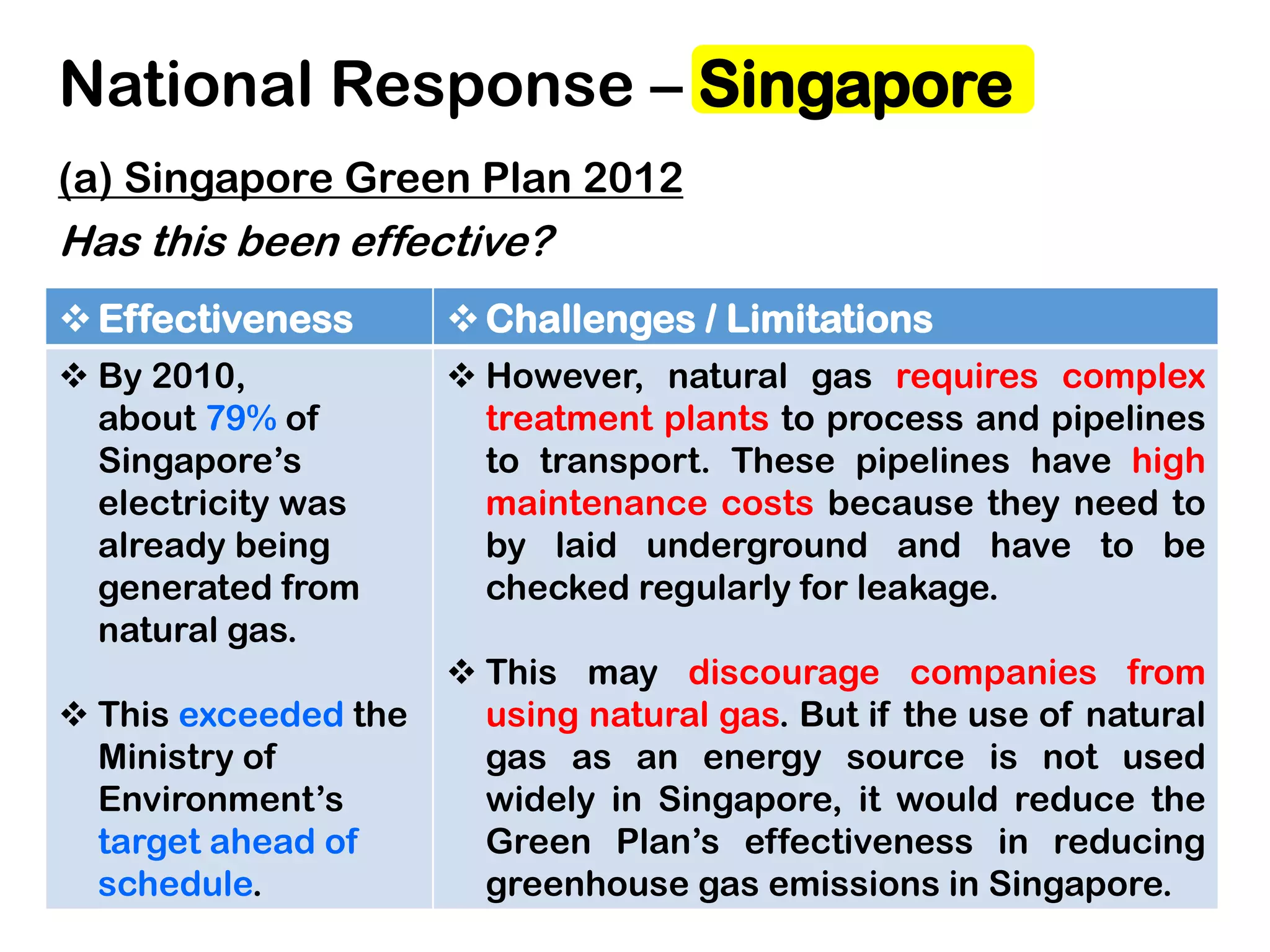
Has this been effective?
Effectiveness Challenges / Limitations
 By 2010,
about 79% of
Singapore’s
electricity was
already being
generated from
natural gas.
 This exceeded the
Ministry of
Environment’s
target ahead of
schedule.
 However, natural gas requires complex
treatment plants to process and pipelines
to transport. These pipelines have high
maintenance costs because they need to
by laid underground and have to be
checked regularly for leakage.
 This may discourage companies from
using natural gas. But if the use of natural
gas as an energy source is not used
widely in Singapore, it would reduce the
Green Plan’s effectiveness in reducing
greenhouse gas emissions in Singapore.

National Responses (Part 2)

  • 1.
    Contracts signed bytwo or more countries / countries around the world to work together to deal with climate change Policies implemented by individual countries to reduce the country’s greenhouse gas emissions (1) International Agreements (2) National Responses Responses to Climate Change Goal: Reduce Greenhouse Gas Emissions Case study: Kyoto Protocol Case study: Singapore (a) Successes (b) Limitations (a) Singapore Green Plan 2012 (b) Green Mark Scheme (c) Plant-A-Tree Programme
  • 2.
    National Response –Singapore (a) Singapore Green Plan 2012 Launched by the Ministry of the Environment in 2002, the Green Plan aims to generate 60% of Singapore’s energy needs using natural gas. Instead of using coal, natural gas is a cleaner form of energy and it does not produce smoke. This would reduce the amount of CO2 released into the atmosphere.
  • 3.
    National Response –Singapore (a) Singapore Green Plan 2012 For example, to achieve this goal, Singapore’s public transportation has gradually switched to using compressed natural gas (CNG) to power SBS buses. CNG burns much cleaner than diesel, thus reducing the amount of smoke and CO2 emitted by the buses.
  • 4.
    National Response –Singapore (a) Singapore Green Plan 2012 Has this been effective? Effectiveness Challenges / Limitations  By 2010, about 79% of Singapore’s electricity was already being generated from natural gas.  This exceeded the Ministry of Environment’s target ahead of schedule.  However, natural gas requires complex treatment plants to process and pipelines to transport. These pipelines have high maintenance costs because they need to by laid underground and have to be checked regularly for leakage.  This may discourage companies from using natural gas. But if the use of natural gas as an energy source is not used widely in Singapore, it would reduce the Green Plan’s effectiveness in reducing greenhouse gas emissions in Singapore.