Alkenes
Alkenes
• Alkenes are family of hydrocarbons
containing at least one carbon-carbon
double bond
• Alkenes are unsaturated hydrocarbons
with the presents of double bond ( ═ )
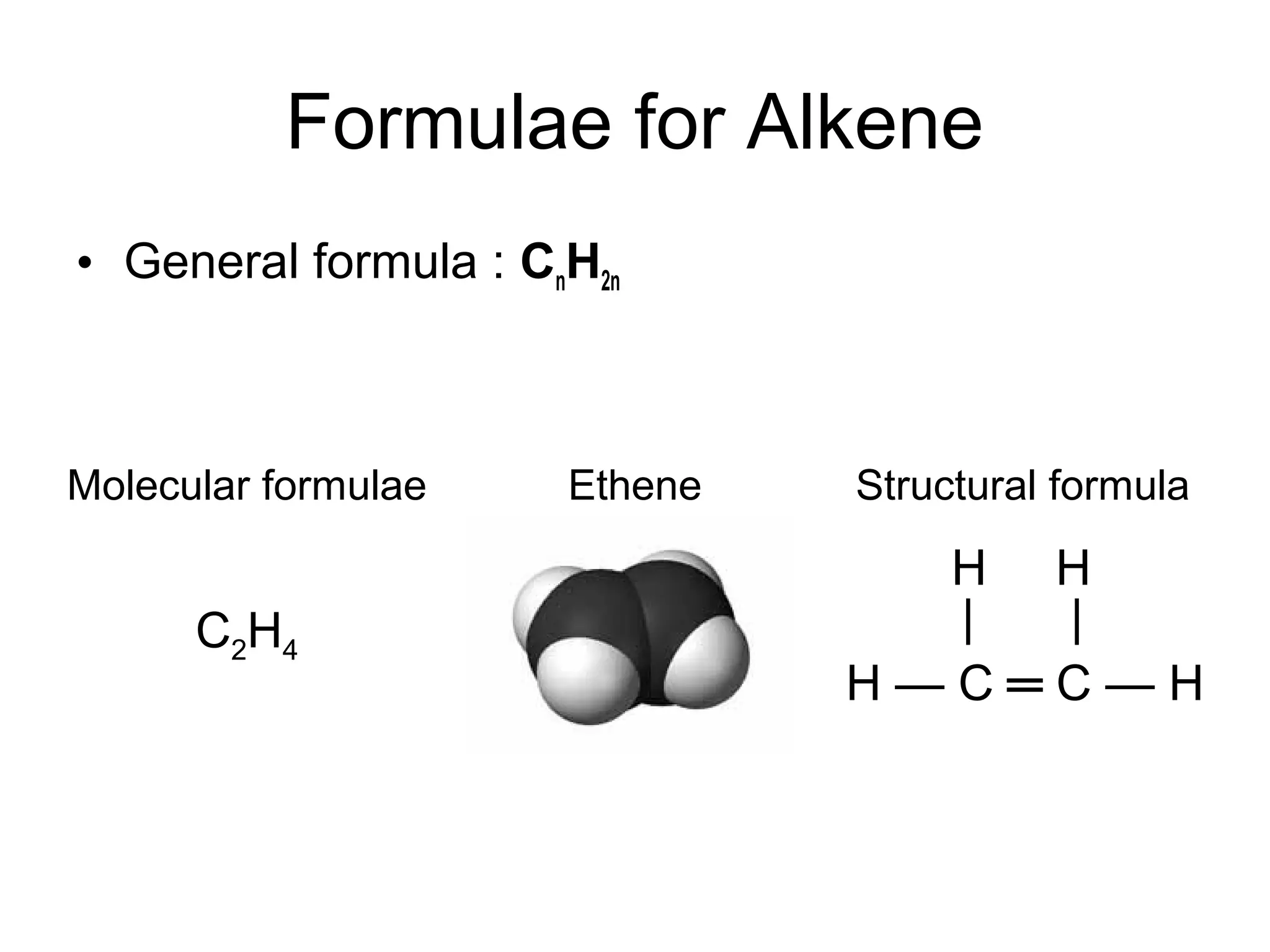
Formulae for Alkene
• General formula : CnH2n
Molecular formulae Ethene Structural formula
C2H4
H — C ═ C — H
H H
| |
Naming Alkenes
Using IUPAC nomenclature
Root
Denotes the longest
carbon chain containing
double bond
Ending
Denotes the family
name and the position
of the double bond
Tells how many carbon atoms
In the continuous carbon chain
Tells the family of the
compounds
Structural Formulae
1 2 3 1 2 3 4 5
Propene Pent-1-ene
Non-1-ene
1 2 3 4 5 6 7 8 9
n Molecular
formula
Name Structural formula
2
3
4
5
6
7
8
9
10
C2
H4
Ethene
Propene
But-1-ene
Pent-1-ene
Hex-1-ene
Hept-1-ene
Oct-1-ene
Non-1-ene
Dec-1-ene
H — C ═ C — H
H H
| |
Physical Properties
Electrical conductivity
Cannot conduct electricity
Solubility
Obeys “like dissolve like”
rule
• Dissolve in organic
solvents
• Insoluble in water
Density
Less dense than water
Melting and boiling points
• Alkanes are covalent
compounds
• They are held together
by weak intermolecular
forces
• Low melting and boiling
points
NAME Formula M.P./o
C B.P./o
C Density/g cm -3
(20o
C)
Ethene C2
H4 -169 -103 0.0011
Propene C3
H6 -185 -48 0.0018
But-1-ene C4
H18 -185 -6 0.0023
Pent-1-ene C5
H10 -165 30 0.6430
Hex-1-ene C6
H12 -140 64 0.6750
Hept-1-ene C7
H14 -119 93 0.6980
Oct-1-ene C8
H16 -104 122 0.7160
Non-1-ene C9
H18 -94 146 0.7310
Dec-1-ene C10
H20 -87 171 0.7430
When the number of carbon atoms
increases :
• The physical properties increase
• The molecules get bigger and the
molecular mass increase. So then, the
densities of the alkanes increase
• The molecules get bigger and the
intermolecular force of attraction becomes
stronger. More energy is needed to
overcome the strong forces of attraction.
The melting and boiling point increase.
Chemical Properties
Addition of Hydrogen
Addition of Halogens
Addition of Hydrogen
Halides
Addition of Water
Addition of Hydroxyl
Groups
Combustion Reaction Addition Reaction
Combustion reaction
Alkene + excess O2 → CO2 + H2O
e.g:
C2H4 + 3O2 → 2CO2 + 2H2O
• Alkenes burn with sootier flames as
compared to alkanes
• Because alkenes have a higher
percentage of carbon than alkanes
Addition Reaction
The carbon-carbon double bond is converted
into two single bonds
C ═ C + A — B
| |
— C — C —
| |
→
A B
Addition of Hydrogen
• Catalytic hydrogenation
• Temp : 180°C
• Catalyst : nickel
+ H — H
| |
H — C — C — H
| |
→
H H
H — C ═ C — H
H H
| |
H H
Addition of Halogen
• Known as Halogenation
• E.g : Ethene, C2H4 is bubbled through a solution of
bromine in tetrachloromethane, CCl4 in the dark.
Reddish-brown bromine is decolourized and a
colourless liquid 1,2-dibromoethane is formed
• Bromination is used to test the presence of a
carbon-carbon double bond
+ Br — Br
| |
H — C — C — H
| |
→
Br Br
H — C ═ C — H
H H
| |
H H
Addition of Hydrogen Halides
• Rapid reaction at room temperature
• No catalyst
• Hydrogen halides : HCl, HBr, HI
+ H — Cl
| |
H — C — C — H
| |
→
H Cl
H — C ═ C — H
H H
| |
H H
Addition of HX to propene
+ H — Br
| | |
H — C — C — C— H
| | |
→
Br H H
H — C ═ C — C — H
H H H
| | |
H H H
H
|
| | |
H — C — C — C— H
| | |
H Br H
H H H
→
1-bromopropane
2-bromopropane
Propene Hydrogen
bromide
1 2 3
1 2 3
Addition of Water
• Called hydration
• Alkene + steam → alcohol
+ H — OH CH2 — CH2
| |
H OH
CH2 ═ CH2
H3PO4
300°C, 60atm
Addition of Hydroxyl Groups
• Ethene,C2H4 reacts with dilute acidified
solution of potassium manganate(VII),
KMnO4 to produce ethane-1,2-diol
• Ethene decolourizes the purple solution of
KMnO4
• Test for a double bond
+ H — OH + [ O ] CH2 — CH2
| |
OH OH
CH2 ═ CH2
acidic KMnO4
Ethane-1,2-diol
Polymerization Reaction
Addition polymerization :
• Reaction to form a polymer from alkene
monomers.
• Hundreds or thousands of alkenes
molecules link together to form long
chains called polymers
Polymerization of ethene, C2H4
• Temp : about 200°C
• Pressure : 1200 atm
• Presence of traces of oxygen
• Product : poly(ethene) or polythene
• Uses :
• making film and plastic sheets for bag and
wrappers
• Making moulded articles (toys, bottles,
squeeze bottles
C ═ C
H H
| |
H H
| |
C ═ C
H H
| |
H H
| |
C ═ C
H H
| |
H H
| |
Polymerization of Ethene
+ +
| | | | | |
— C — C — — C — C — — C — C—
| | | | | |
| | | | | |
— C — C — C — C — C — C —
| | | | | |
H H H H H H
H H H H H H
H H H H H H
H H H H H H
| |
— C — C —
| |
n
or
Poly(ethene)
Part of double bond in C2H4
‘break open’ to produce
Two free bonds
The free bonds link with
one another to form a chain
Comparing Properties of
Alkanes and Alkenes
Chemical
Properties
Differences
Alkanes Alkenes
Reactivity • Unreactive
• Undergo substitution
reaction
• Reactive
• Undergo addition
reaction
Reaction with oxygen Burn in air, producing
yellow sooty flame
Burn in air, producing
yellow and very sooty
flame
Reaction with bromine No reaction Decolourise reddish-
brown bromine
Recation with acidified
potassium
manganate(VII)
solution
No reaction Decolourise acidified
potassium
manganate(VII)
solution
Homologous Series
Is a group or family of organic compounds that has
the following characteristics:
• Members can be represented by a general
formula
• Successive members differ from each other by
– CH2
• Members can be prepared by similar methods
• Physical properties change regularly with
increasing number of carbon atoms
• Member have similar chemical properties
because they have the same functional group
Functional group
• Is a special group of atoms attached to an
organic molecule
• This group determines the chemical properties
of the molecules because it represents the most
common site of chemical reactivity
• Chemical reactions occur at the functional group
• C ═ C is the functional group in alkenes
• It causes the chemical properties of alkenes to
differ from alkanes
Name of the
homologous series
Functional group
Alkane C — H
Alkene C ═ C
Alcohol — C — O — H
Carboxylic acid — C ═ O
|
H

2.3 alkenes

  • 1.
  • 2.
    Alkenes • Alkenes arefamily of hydrocarbons containing at least one carbon-carbon double bond • Alkenes are unsaturated hydrocarbons with the presents of double bond ( ═ )
  • 3.
    Formulae for Alkene •General formula : CnH2n Molecular formulae Ethene Structural formula C2H4 H — C ═ C — H H H | |
  • 4.
    Naming Alkenes Using IUPACnomenclature Root Denotes the longest carbon chain containing double bond Ending Denotes the family name and the position of the double bond Tells how many carbon atoms In the continuous carbon chain Tells the family of the compounds
  • 5.
    Structural Formulae 1 23 1 2 3 4 5 Propene Pent-1-ene Non-1-ene 1 2 3 4 5 6 7 8 9
  • 6.
    n Molecular formula Name Structuralformula 2 3 4 5 6 7 8 9 10 C2 H4 Ethene Propene But-1-ene Pent-1-ene Hex-1-ene Hept-1-ene Oct-1-ene Non-1-ene Dec-1-ene H — C ═ C — H H H | |
  • 7.
    Physical Properties Electrical conductivity Cannotconduct electricity Solubility Obeys “like dissolve like” rule • Dissolve in organic solvents • Insoluble in water Density Less dense than water Melting and boiling points • Alkanes are covalent compounds • They are held together by weak intermolecular forces • Low melting and boiling points
  • 8.
    NAME Formula M.P./o CB.P./o C Density/g cm -3 (20o C) Ethene C2 H4 -169 -103 0.0011 Propene C3 H6 -185 -48 0.0018 But-1-ene C4 H18 -185 -6 0.0023 Pent-1-ene C5 H10 -165 30 0.6430 Hex-1-ene C6 H12 -140 64 0.6750 Hept-1-ene C7 H14 -119 93 0.6980 Oct-1-ene C8 H16 -104 122 0.7160 Non-1-ene C9 H18 -94 146 0.7310 Dec-1-ene C10 H20 -87 171 0.7430
  • 9.
    When the numberof carbon atoms increases : • The physical properties increase • The molecules get bigger and the molecular mass increase. So then, the densities of the alkanes increase • The molecules get bigger and the intermolecular force of attraction becomes stronger. More energy is needed to overcome the strong forces of attraction. The melting and boiling point increase.
  • 10.
    Chemical Properties Addition ofHydrogen Addition of Halogens Addition of Hydrogen Halides Addition of Water Addition of Hydroxyl Groups Combustion Reaction Addition Reaction
  • 11.
    Combustion reaction Alkene +excess O2 → CO2 + H2O e.g: C2H4 + 3O2 → 2CO2 + 2H2O • Alkenes burn with sootier flames as compared to alkanes • Because alkenes have a higher percentage of carbon than alkanes
  • 12.
    Addition Reaction The carbon-carbondouble bond is converted into two single bonds C ═ C + A — B | | — C — C — | | → A B
  • 13.
    Addition of Hydrogen •Catalytic hydrogenation • Temp : 180°C • Catalyst : nickel + H — H | | H — C — C — H | | → H H H — C ═ C — H H H | | H H
  • 14.
    Addition of Halogen •Known as Halogenation • E.g : Ethene, C2H4 is bubbled through a solution of bromine in tetrachloromethane, CCl4 in the dark. Reddish-brown bromine is decolourized and a colourless liquid 1,2-dibromoethane is formed • Bromination is used to test the presence of a carbon-carbon double bond + Br — Br | | H — C — C — H | | → Br Br H — C ═ C — H H H | | H H
  • 15.
    Addition of HydrogenHalides • Rapid reaction at room temperature • No catalyst • Hydrogen halides : HCl, HBr, HI + H — Cl | | H — C — C — H | | → H Cl H — C ═ C — H H H | | H H
  • 16.
    Addition of HXto propene + H — Br | | | H — C — C — C— H | | | → Br H H H — C ═ C — C — H H H H | | | H H H H | | | | H — C — C — C— H | | | H Br H H H H → 1-bromopropane 2-bromopropane Propene Hydrogen bromide 1 2 3 1 2 3
  • 17.
    Addition of Water •Called hydration • Alkene + steam → alcohol + H — OH CH2 — CH2 | | H OH CH2 ═ CH2 H3PO4 300°C, 60atm
  • 18.
    Addition of HydroxylGroups • Ethene,C2H4 reacts with dilute acidified solution of potassium manganate(VII), KMnO4 to produce ethane-1,2-diol • Ethene decolourizes the purple solution of KMnO4 • Test for a double bond + H — OH + [ O ] CH2 — CH2 | | OH OH CH2 ═ CH2 acidic KMnO4 Ethane-1,2-diol
  • 19.
    Polymerization Reaction Addition polymerization: • Reaction to form a polymer from alkene monomers. • Hundreds or thousands of alkenes molecules link together to form long chains called polymers
  • 20.
    Polymerization of ethene,C2H4 • Temp : about 200°C • Pressure : 1200 atm • Presence of traces of oxygen • Product : poly(ethene) or polythene • Uses : • making film and plastic sheets for bag and wrappers • Making moulded articles (toys, bottles, squeeze bottles
  • 21.
    C ═ C HH | | H H | | C ═ C H H | | H H | | C ═ C H H | | H H | | Polymerization of Ethene + + | | | | | | — C — C — — C — C — — C — C— | | | | | | | | | | | | — C — C — C — C — C — C — | | | | | | H H H H H H H H H H H H H H H H H H H H H H H H | | — C — C — | | n or Poly(ethene) Part of double bond in C2H4 ‘break open’ to produce Two free bonds The free bonds link with one another to form a chain
  • 22.
    Comparing Properties of Alkanesand Alkenes Chemical Properties Differences Alkanes Alkenes Reactivity • Unreactive • Undergo substitution reaction • Reactive • Undergo addition reaction Reaction with oxygen Burn in air, producing yellow sooty flame Burn in air, producing yellow and very sooty flame Reaction with bromine No reaction Decolourise reddish- brown bromine Recation with acidified potassium manganate(VII) solution No reaction Decolourise acidified potassium manganate(VII) solution
  • 23.
    Homologous Series Is agroup or family of organic compounds that has the following characteristics: • Members can be represented by a general formula • Successive members differ from each other by – CH2 • Members can be prepared by similar methods • Physical properties change regularly with increasing number of carbon atoms • Member have similar chemical properties because they have the same functional group
  • 24.
    Functional group • Isa special group of atoms attached to an organic molecule • This group determines the chemical properties of the molecules because it represents the most common site of chemical reactivity • Chemical reactions occur at the functional group • C ═ C is the functional group in alkenes • It causes the chemical properties of alkenes to differ from alkanes
  • 25.
    Name of the homologousseries Functional group Alkane C — H Alkene C ═ C Alcohol — C — O — H Carboxylic acid — C ═ O | H