3. NaBH4
Dr. Shivendra Singh
UGC-NET-JRF, PhD-IIT Indore
…Sodium borohydride: Introduction
 It is also known as sodium tetrahydridoborate and sodium tetrahydroborate.
 The compound was discovered in the 1940s by H. I. Schlesinger.
 It is soluble in protic solvents and lower alcohols.
 It also reacts with these protic solvents to produce H2; however, these
reactions are fairly slow.
NaBH4
www.wikipedia.com
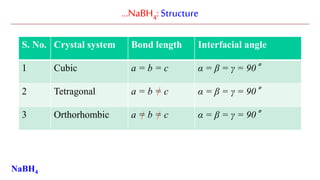
…NaBH4:Structure
 NaBH4 is a salt, consisting of the tetrahedral [BH4]− anion.
 The solid is known to exist as three polymorphs: α, β and γ.
 The stable phase at room temperature and pressure is α-NaBH4, which is
cubic and adopts an NaCl-type structure.
 At a pressure of 6.3 GPa, the structure changes to the tetragonal β-NaBH4
and at 8.9 GPa, the orthorhombic γ-NaBH4 becomes the most stable.
NaBH4
www.wikipedia.com
…NaBH4:Structure
S. No. Crystal system Bond length Interfacial angle
1 Cubic a = b = c α = β = γ = 90°
2 Tetragonal a = b = c α = β = γ = 90°
3 Orthorhombic a = b = c α = β = γ = 90°
NaBH4
…NaBH4:Synthesis
Commercial
NaBH4 production
Brown-Schlesinger
process
Bayer process
B(OCH3)3 + 4 NaH → NaBH4 + 3 NaOCH3
Industrially prepared from
sodium hydride and trimethyl
borate at 250–270 °C:
It is based on the reaction
among borax, Na, H2, and
silicon oxide (SiO2) at 700
°C.
Na2B4O7 + 16 Na + 8 H2 + 7 SiO2 → 4 NaBH4 + 7 Na2SiO3
NaBH4
www.wikipedia.com
…NaBH4:Reactivity
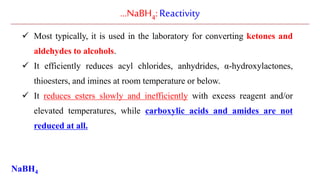
 Most typically, it is used in the laboratory for converting ketones and
aldehydes to alcohols.
 It efficiently reduces acyl chlorides, anhydrides, α-hydroxylactones,
thioesters, and imines at room temperature or below.
 It reduces esters slowly and inefficiently with excess reagent and/or
elevated temperatures, while carboxylic acids and amides are not
reduced at all.
NaBH4
…NaBH4:Reactivity
 Hydrogen-bonding activation is required, as no reduction occurs in an
aprotic solvent like diglyme.
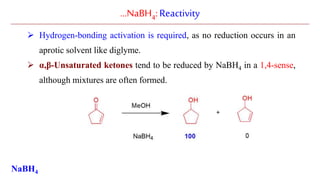
 α,β-Unsaturated ketones tend to be reduced by NaBH4 in a 1,4-sense,
although mixtures are often formed.
NaBH4
…NaBH4:Applications
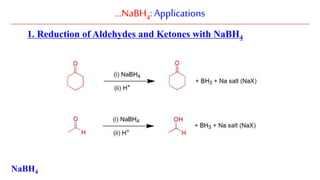
1. Reduction of Aldehydes and Ketones with NaBH4
NaBH4
…NaBH4:Mechanism(2 steps)
i. In the first step, H- detaches from the BH4
– and adds to the carbonyl carbon
([1,2]-addition). This forms the C-H bond, and breaks the C-O bond, resulting in
a new lone pair on the oxygen, which makes the oxygen negatively charged
(alkoxides, as they are deprotonated alcohols).
ii. In the second step, a proton from water (or an acid) is added to the alkoxide to
make the alcohol. This is performed at the end of the reaction, a step referred to
as the workup.
NaBH4
…NaBH4:Reactions
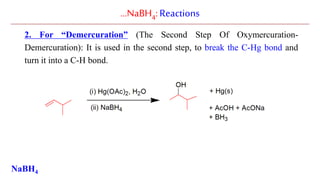
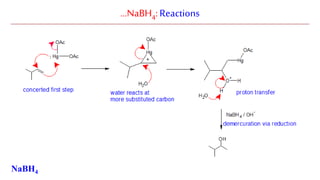
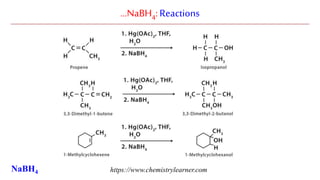
2. For “Demercuration” (The Second Step Of Oxymercuration-
Demercuration): It is used in the second step, to break the C-Hg bond and
turn it into a C-H bond.
NaBH4
…NaBH4:Reactions
NaBH4
…NaBH4:Reactions
https://www.chemistrylearner.comNaBH4
…NaBH4:Reactions
NaBH4
…NaBH4:Reactivity
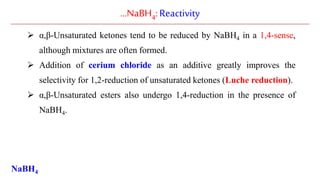
 α,β-Unsaturated ketones tend to be reduced by NaBH4 in a 1,4-sense,
although mixtures are often formed.
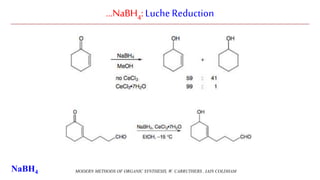
 Addition of cerium chloride as an additive greatly improves the
selectivity for 1,2-reduction of unsaturated ketones (Luche reduction).
 α,β-Unsaturated esters also undergo 1,4-reduction in the presence of
NaBH4.
NaBH4
…NaBH4:Luchereduction
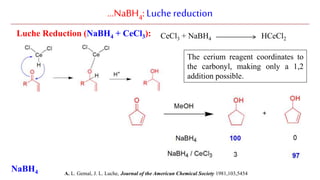
Luche Reduction (NaBH4 + CeCl3):
A. L. Gemal, J. L. Luche, Journal of the American Chemical Society 1981,103,5454
CeCl3 + NaBH4 HCeCl2
The cerium reagent coordinates to
the carbonyl, making only a 1,2
addition possible.
NaBH4
…NaBH4:LucheReduction
MODERN METHODS OF ORGANIC SYNTHESIS, W. CARRUTHERS , IAIN COLDHAMNaBH4
LAH vs NaBH4
S.
No.
Property LAH NaBH4
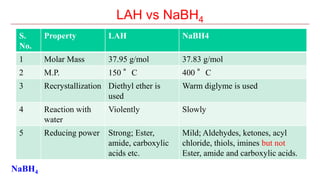
1 Molar Mass 37.95 g/mol 37.83 g/mol
2 M.P. 150 °C 400 °C
3 Recrystallization Diethyl ether is
used
Warm diglyme is used
4 Reaction with
water
Violently Slowly
5 Reducing power Strong; Ester,
amide, carboxylic
acids etc.
Mild; Aldehydes, ketones, acyl
chloride, thiols, imines but not
Ester, amide and carboxylic acids.
NaBH4
LAH vs NaBH4
Jonathan Clayden (University of Manchester), Nick Greeves (University of Liverpool), Stuart Warren (University of Cambridge); Organic Chemistry, 2nd edition.NaBH4
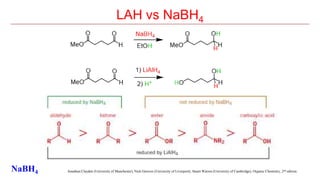
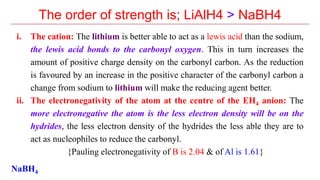
The order of strength is; LiAlH4 > NaBH4
i. The cation: The lithium is better able to act as a lewis acid than the sodium,
the lewis acid bonds to the carbonyl oxygen. This in turn increases the
amount of positive charge density on the carbonyl carbon. As the reduction
is favoured by an increase in the positive character of the carbonyl carbon a
change from sodium to lithium will make the reducing agent better.
ii. The electronegativity of the atom at the centre of the EH4 anion: The
more electronegative the atom is the less electron density will be on the
hydrides, the less electron density of the hydrides the less able they are to
act as nucleophiles to reduce the carbonyl.
{Pauling electronegativity of B is 2.04 & of Al is 1.61}
NaBH4
LAH vs NaBH4
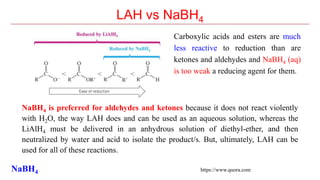
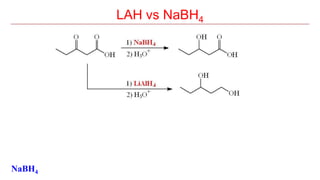
NaBH4 is preferred for aldehydes and ketones because it does not react violently
with H2O, the way LAH does and can be used as an aqueous solution, whereas the
LiAlH4 must be delivered in an anhydrous solution of diethyl-ether, and then
neutralized by water and acid to isolate the product/s. But, ultimately, LAH can be
used for all of these reactions.
https://www.quora.com
Carboxylic acids and esters are much
less reactive to reduction than are
ketones and aldehydes and NaBH4 (aq)
is too weak a reducing agent for them.
NaBH4
LAH vs NaBH4
NaBH4
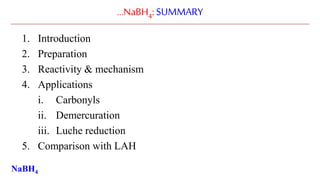
…NaBH4:SUMMARY
1. Introduction
2. Preparation
3. Reactivity & mechanism
4. Applications
i. Carbonyls
ii. Demercuration
iii. Luche reduction
5. Comparison with LAH
NaBH4
Next:Wilkinson’scatalyst
Thanks forwatching…

3. NaBH4

  • 1.
    3. NaBH4 Dr. ShivendraSingh UGC-NET-JRF, PhD-IIT Indore
  • 2.
    …Sodium borohydride: Introduction It is also known as sodium tetrahydridoborate and sodium tetrahydroborate.  The compound was discovered in the 1940s by H. I. Schlesinger.  It is soluble in protic solvents and lower alcohols.  It also reacts with these protic solvents to produce H2; however, these reactions are fairly slow. NaBH4 www.wikipedia.com
  • 3.
    …NaBH4:Structure  NaBH4 isa salt, consisting of the tetrahedral [BH4]− anion.  The solid is known to exist as three polymorphs: α, β and γ.  The stable phase at room temperature and pressure is α-NaBH4, which is cubic and adopts an NaCl-type structure.  At a pressure of 6.3 GPa, the structure changes to the tetragonal β-NaBH4 and at 8.9 GPa, the orthorhombic γ-NaBH4 becomes the most stable. NaBH4 www.wikipedia.com
  • 4.
    …NaBH4:Structure S. No. Crystalsystem Bond length Interfacial angle 1 Cubic a = b = c α = β = γ = 90° 2 Tetragonal a = b = c α = β = γ = 90° 3 Orthorhombic a = b = c α = β = γ = 90° NaBH4
  • 5.
    …NaBH4:Synthesis Commercial NaBH4 production Brown-Schlesinger process Bayer process B(OCH3)3+ 4 NaH → NaBH4 + 3 NaOCH3 Industrially prepared from sodium hydride and trimethyl borate at 250–270 °C: It is based on the reaction among borax, Na, H2, and silicon oxide (SiO2) at 700 °C. Na2B4O7 + 16 Na + 8 H2 + 7 SiO2 → 4 NaBH4 + 7 Na2SiO3 NaBH4 www.wikipedia.com
  • 6.
    …NaBH4:Reactivity  Most typically,it is used in the laboratory for converting ketones and aldehydes to alcohols.  It efficiently reduces acyl chlorides, anhydrides, α-hydroxylactones, thioesters, and imines at room temperature or below.  It reduces esters slowly and inefficiently with excess reagent and/or elevated temperatures, while carboxylic acids and amides are not reduced at all. NaBH4
  • 7.
    …NaBH4:Reactivity  Hydrogen-bonding activationis required, as no reduction occurs in an aprotic solvent like diglyme.  α,β-Unsaturated ketones tend to be reduced by NaBH4 in a 1,4-sense, although mixtures are often formed. NaBH4
  • 8.
    …NaBH4:Applications 1. Reduction ofAldehydes and Ketones with NaBH4 NaBH4
  • 9.
    …NaBH4:Mechanism(2 steps) i. Inthe first step, H- detaches from the BH4 – and adds to the carbonyl carbon ([1,2]-addition). This forms the C-H bond, and breaks the C-O bond, resulting in a new lone pair on the oxygen, which makes the oxygen negatively charged (alkoxides, as they are deprotonated alcohols). ii. In the second step, a proton from water (or an acid) is added to the alkoxide to make the alcohol. This is performed at the end of the reaction, a step referred to as the workup. NaBH4
  • 10.
    …NaBH4:Reactions 2. For “Demercuration”(The Second Step Of Oxymercuration- Demercuration): It is used in the second step, to break the C-Hg bond and turn it into a C-H bond. NaBH4
  • 11.
  • 12.
  • 13.
  • 14.
    …NaBH4:Reactivity  α,β-Unsaturated ketonestend to be reduced by NaBH4 in a 1,4-sense, although mixtures are often formed.  Addition of cerium chloride as an additive greatly improves the selectivity for 1,2-reduction of unsaturated ketones (Luche reduction).  α,β-Unsaturated esters also undergo 1,4-reduction in the presence of NaBH4. NaBH4
  • 15.
    …NaBH4:Luchereduction Luche Reduction (NaBH4+ CeCl3): A. L. Gemal, J. L. Luche, Journal of the American Chemical Society 1981,103,5454 CeCl3 + NaBH4 HCeCl2 The cerium reagent coordinates to the carbonyl, making only a 1,2 addition possible. NaBH4
  • 16.
    …NaBH4:LucheReduction MODERN METHODS OFORGANIC SYNTHESIS, W. CARRUTHERS , IAIN COLDHAMNaBH4
  • 17.
    LAH vs NaBH4 S. No. PropertyLAH NaBH4 1 Molar Mass 37.95 g/mol 37.83 g/mol 2 M.P. 150 °C 400 °C 3 Recrystallization Diethyl ether is used Warm diglyme is used 4 Reaction with water Violently Slowly 5 Reducing power Strong; Ester, amide, carboxylic acids etc. Mild; Aldehydes, ketones, acyl chloride, thiols, imines but not Ester, amide and carboxylic acids. NaBH4
  • 18.
    LAH vs NaBH4 JonathanClayden (University of Manchester), Nick Greeves (University of Liverpool), Stuart Warren (University of Cambridge); Organic Chemistry, 2nd edition.NaBH4
  • 19.
    The order ofstrength is; LiAlH4 > NaBH4 i. The cation: The lithium is better able to act as a lewis acid than the sodium, the lewis acid bonds to the carbonyl oxygen. This in turn increases the amount of positive charge density on the carbonyl carbon. As the reduction is favoured by an increase in the positive character of the carbonyl carbon a change from sodium to lithium will make the reducing agent better. ii. The electronegativity of the atom at the centre of the EH4 anion: The more electronegative the atom is the less electron density will be on the hydrides, the less electron density of the hydrides the less able they are to act as nucleophiles to reduce the carbonyl. {Pauling electronegativity of B is 2.04 & of Al is 1.61} NaBH4
  • 20.
    LAH vs NaBH4 NaBH4is preferred for aldehydes and ketones because it does not react violently with H2O, the way LAH does and can be used as an aqueous solution, whereas the LiAlH4 must be delivered in an anhydrous solution of diethyl-ether, and then neutralized by water and acid to isolate the product/s. But, ultimately, LAH can be used for all of these reactions. https://www.quora.com Carboxylic acids and esters are much less reactive to reduction than are ketones and aldehydes and NaBH4 (aq) is too weak a reducing agent for them. NaBH4
  • 21.
  • 22.
    …NaBH4:SUMMARY 1. Introduction 2. Preparation 3.Reactivity & mechanism 4. Applications i. Carbonyls ii. Demercuration iii. Luche reduction 5. Comparison with LAH NaBH4
  • 23.

Editor's Notes

  • #20 As the reduction is favoured by an increase in the positive character of the carbonyl carbon a change from sodium to lithium will make the reducing agent better.