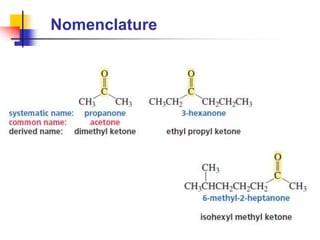
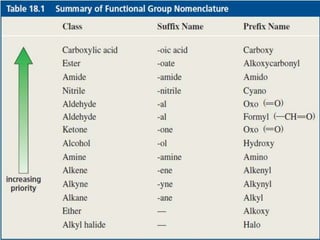
Nomenclature
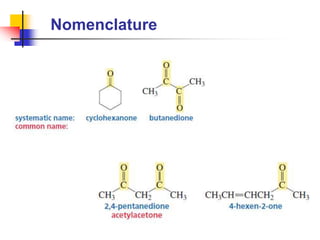
Nomenclature
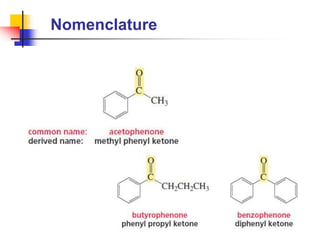
Nomenclature
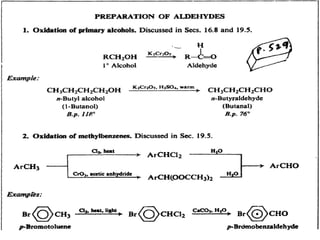
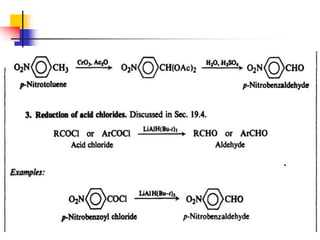
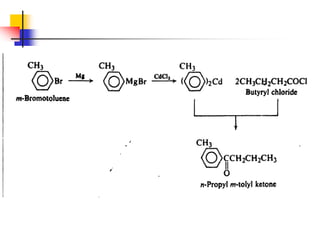
Preparation of Aldehydes
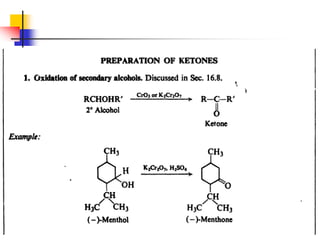
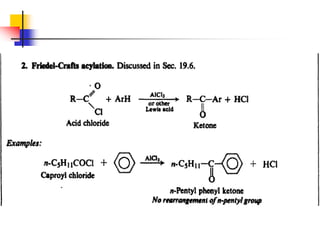
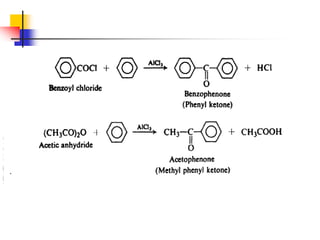
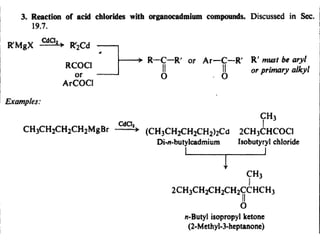
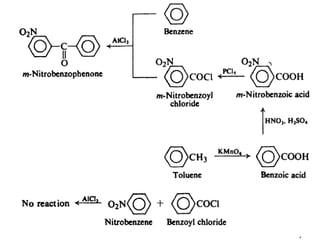
Preparation Ketones
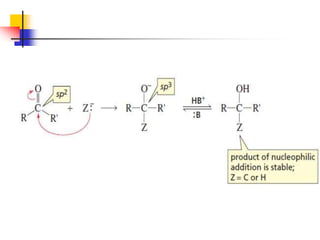
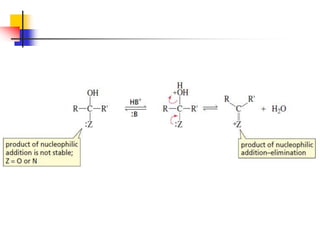
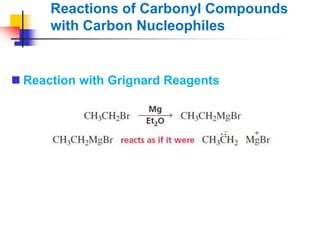
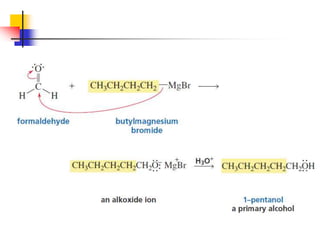
Reactions of Carbonyl Compounds
with Carbon Nucleophiles
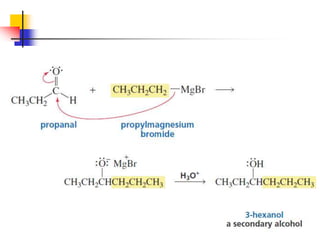
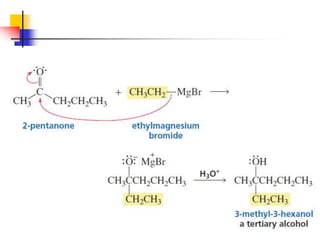
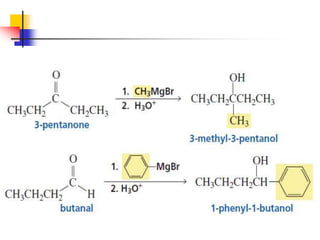
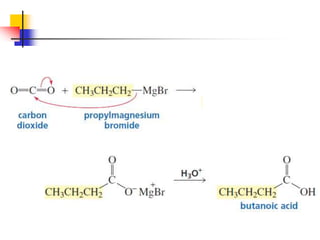
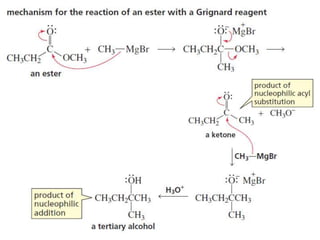
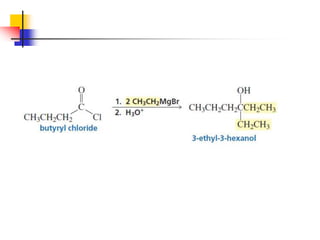
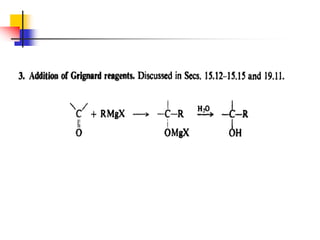
 Reaction with Grignard Reagents
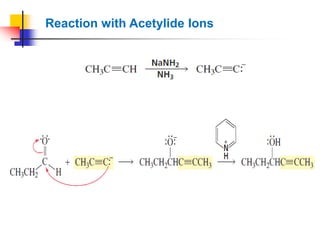
Reaction with Acetylide Ions
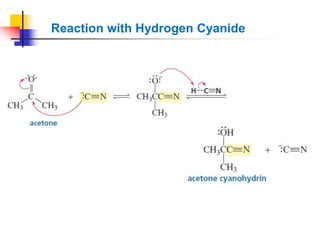
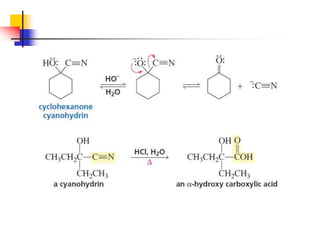
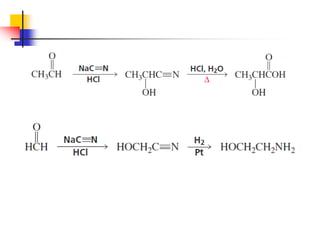
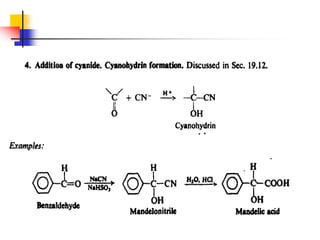
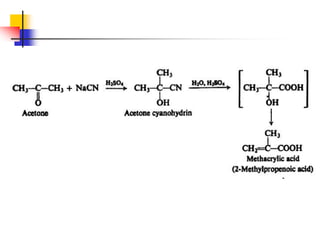
Reaction with Hydrogen Cyanide
Reactions of Carbonyl Compounds
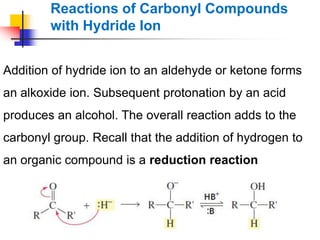
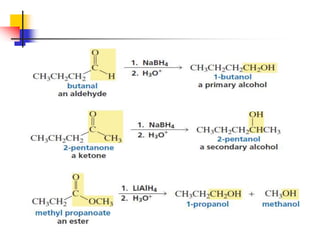
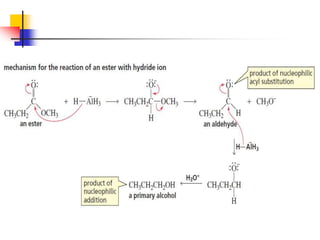
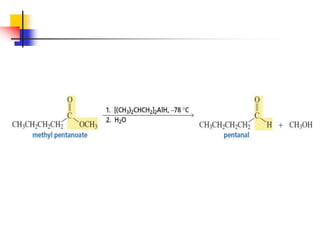
with Hydride Ion
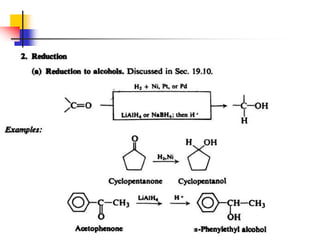
Addition of hydride ion to an aldehyde or ketone forms
an alkoxide ion. Subsequent protonation by an acid
produces an alcohol. The overall reaction adds to the
carbonyl group. Recall that the addition of hydrogen to
an organic compound is a reduction reaction
Reactions of Aldehydes and Ketones
with Nitrogen Nucleophiles
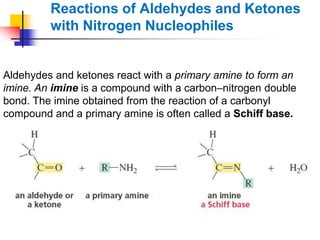
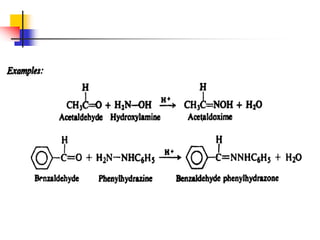
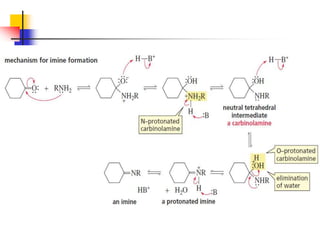
Aldehydes and ketones react with a primary amine to form an
imine. An imine is a compound with a carbon–nitrogen double
bond. The imine obtained from the reaction of a carbonyl
compound and a primary amine is often called a Schiff base.
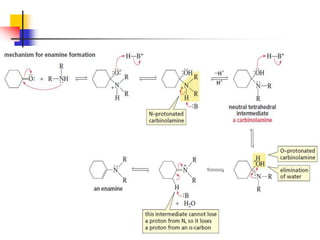
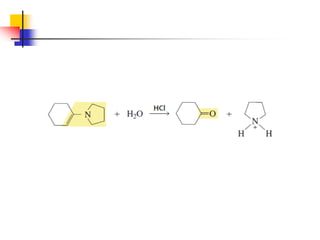
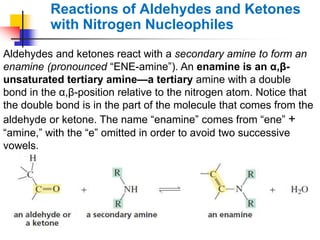
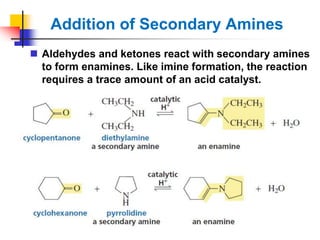
Aldehydes and ketones react with a secondary amine to form an
enamine (pronounced ―ENE-amine‖). An enamine is an α,β-
unsaturated tertiary amine—a tertiary amine with a double
bond in the α,β-position relative to the nitrogen atom. Notice that
the double bond is in the part of the molecule that comes from the
aldehyde or ketone. The name ―enamine‖ comes from ―ene‖ +
―amine,‖ with the ―e‖ omitted in order to avoid two successive
vowels.
Reactions of Aldehydes and Ketones
with Nitrogen Nucleophiles
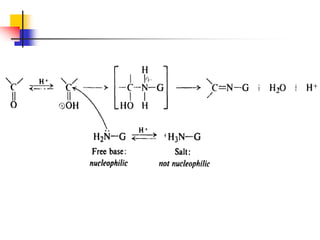
Addition of Primary Amines
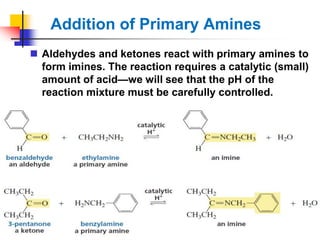
 Aldehydes and ketones react with primary amines to
form imines. The reaction requires a catalytic (small)
amount of acid—we will see that the pH of the
reaction mixture must be carefully controlled.
Addition of Secondary Amines
 Aldehydes and ketones react with secondary amines
to form enamines. Like imine formation, the reaction
requires a trace amount of an acid catalyst.
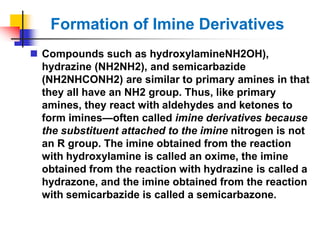
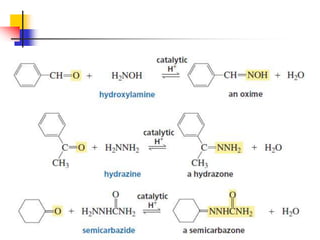
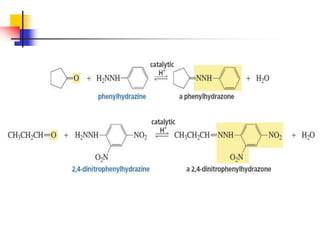
Formation of Imine Derivatives
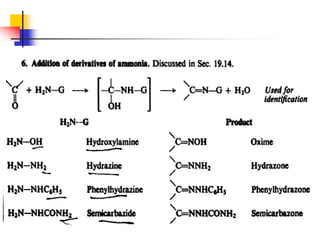
 Compounds such as hydroxylamineNH2OH),
hydrazine (NH2NH2), and semicarbazide
(NH2NHCONH2) are similar to primary amines in that
they all have an NH2 group. Thus, like primary
amines, they react with aldehydes and ketones to
form imines—often called imine derivatives because
the substituent attached to the imine nitrogen is not
an R group. The imine obtained from the reaction
with hydroxylamine is called an oxime, the imine
obtained from the reaction with hydrazine is called a
hydrazone, and the imine obtained from the reaction
with semicarbazide is called a semicarbazone.
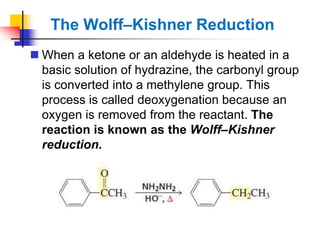
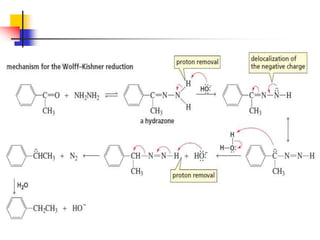
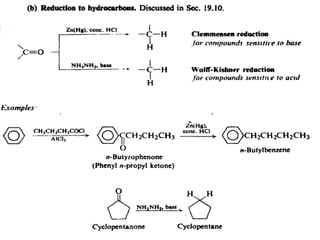
The Wolff–Kishner Reduction
 When a ketone or an aldehyde is heated in a
basic solution of hydrazine, the carbonyl group
is converted into a methylene group. This
process is called deoxygenation because an
oxygen is removed from the reactant. The
reaction is known as the Wolff–Kishner
reduction.
Reactions of Aldehydes and Ketones
with Oxygen Nucleophiles
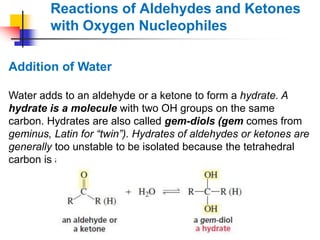
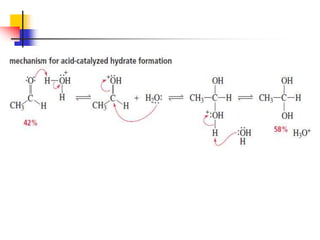
Addition of Water
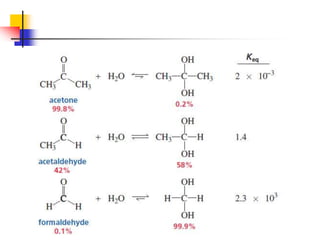
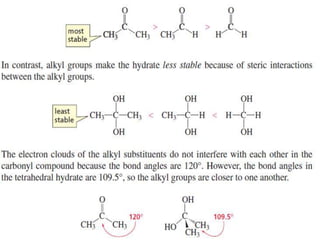
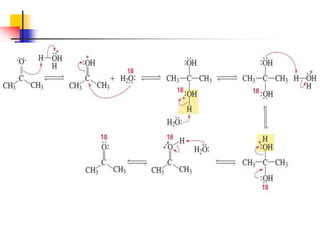
Water adds to an aldehyde or a ketone to form a hydrate. A
hydrate is a molecule with two OH groups on the same
carbon. Hydrates are also called gem-diols (gem comes from
geminus, Latin for “twin”). Hydrates of aldehydes or ketones are
generally too unstable to be isolated because the tetrahedral
carbon is attached to two oxygen atoms.
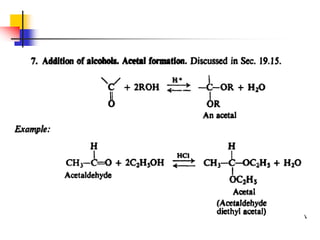
Addition of Alcohol
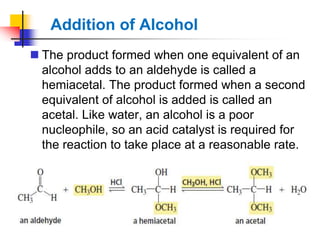
 The product formed when one equivalent of an
alcohol adds to an aldehyde is called a
hemiacetal. The product formed when a second
equivalent of alcohol is added is called an
acetal. Like water, an alcohol is a poor
nucleophile, so an acid catalyst is required for
the reaction to take place at a reasonable rate.
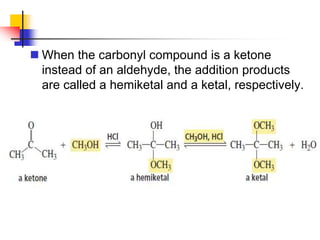
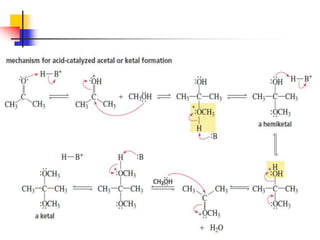
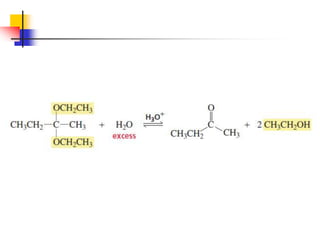
 When the carbonyl compound is a ketone
instead of an aldehyde, the addition products
are called a hemiketal and a ketal, respectively.
Protecting Groups
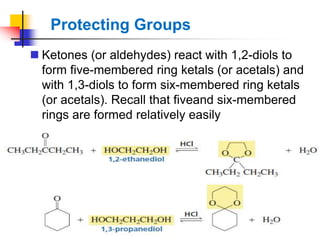
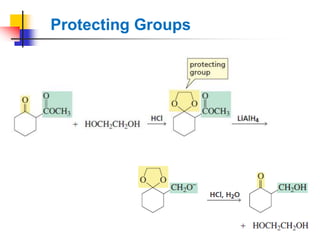
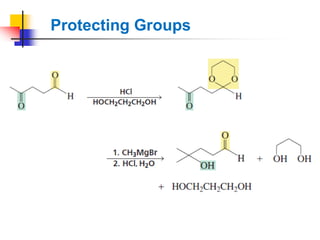
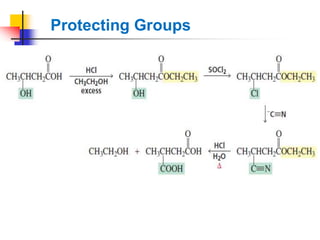
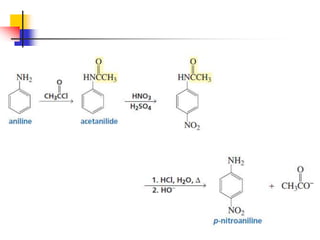
 Ketones (or aldehydes) react with 1,2-diols to
form five-membered ring ketals (or acetals) and
with 1,3-diols to form six-membered ring ketals
(or acetals). Recall that fiveand six-membered
rings are formed relatively easily
Protecting Groups
Protecting Groups
Protecting Groups
Protecting Groups
The Wittig Reaction
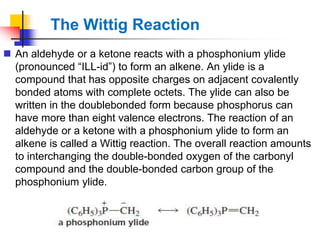
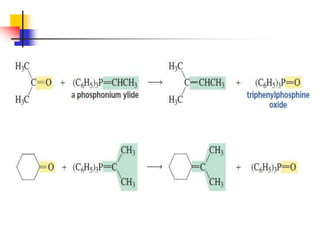
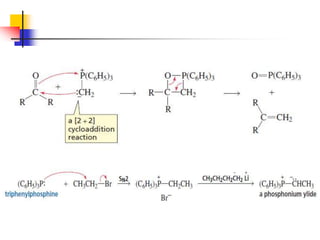
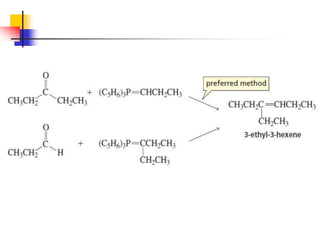
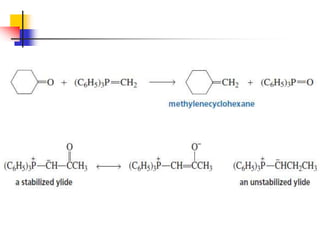
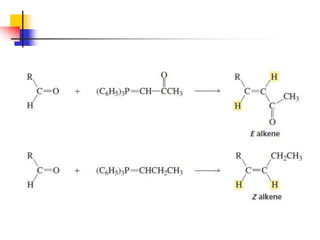
 An aldehyde or a ketone reacts with a phosphonium ylide
(pronounced ―ILL-id‖) to form an alkene. An ylide is a
compound that has opposite charges on adjacent covalently
bonded atoms with complete octets. The ylide can also be
written in the doublebonded form because phosphorus can
have more than eight valence electrons. The reaction of an
aldehyde or a ketone with a phosphonium ylide to form an
alkene is called a Wittig reaction. The overall reaction amounts
to interchanging the double-bonded oxygen of the carbonyl
compound and the double-bonded carbon group of the
phosphonium ylide.
Reactions of Aldehydes
and Ketones
Carbonyl Compounds
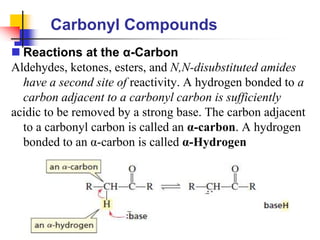
 Reactions at the α-Carbon
Aldehydes, ketones, esters, and N,N-disubstituted amides
have a second site of reactivity. A hydrogen bonded to a
carbon adjacent to a carbonyl carbon is sufficiently
acidic to be removed by a strong base. The carbon adjacent
to a carbonyl carbon is called an α-carbon. A hydrogen
bonded to an α-carbon is called α-Hydrogen
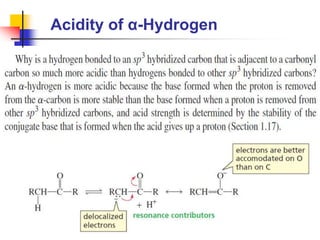
Acidity of α-Hydrogen
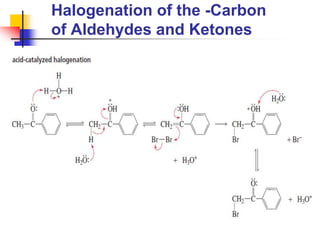
Halogenation of the -Carbon
of Aldehydes and Ketones
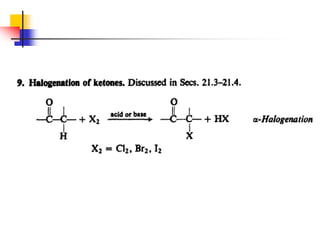
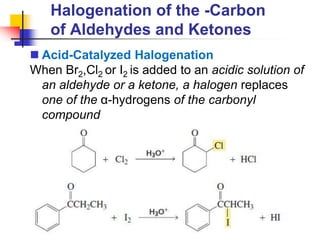
 Acid-Catalyzed Halogenation
When Br2,Cl2 or I2 is added to an acidic solution of
an aldehyde or a ketone, a halogen replaces
one of the α-hydrogens of the carbonyl
compound
Halogenation of the -Carbon
of Aldehydes and Ketones
Halogenation of the -Carbon
of Aldehydes and Ketones
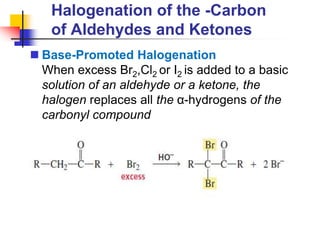
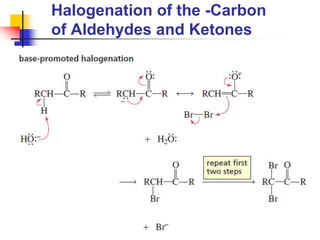
 Base-Promoted Halogenation
When excess Br2,Cl2 or I2 is added to a basic
solution of an aldehyde or a ketone, the
halogen replaces all the α-hydrogens of the
carbonyl compound
Halogenation of the -Carbon
of Aldehydes and Ketones
Halogenation of the -Carbon
of Aldehydes and Ketones
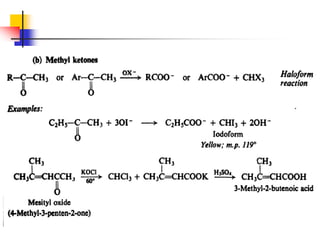
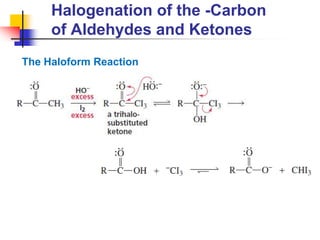
The Haloform Reaction
α-Halogenated Carbonyl
Compounds in Synthesis
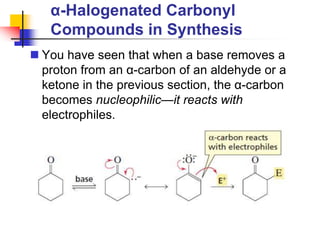
 You have seen that when a base removes a
proton from an α-carbon of an aldehyde or a
ketone in the previous section, the α-carbon
becomes nucleophilic—it reacts with
electrophiles.
α-Halogenated Carbonyl
Compounds in Synthesis
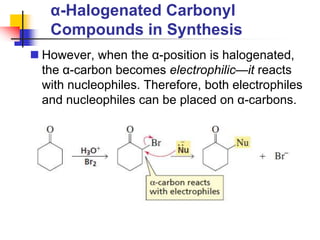
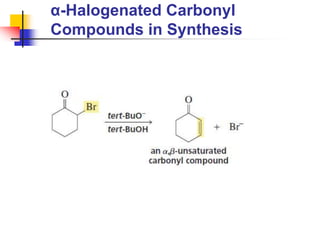
 However, when the α-position is halogenated,
the α-carbon becomes electrophilic—it reacts
with nucleophiles. Therefore, both electrophiles
and nucleophiles can be placed on α-carbons.
α-Halogenated Carbonyl
Compounds in Synthesis
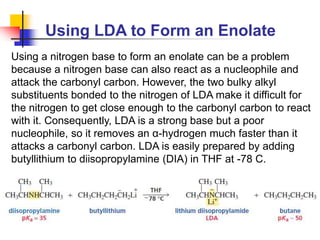
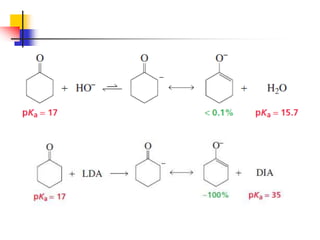
Using LDA to Form an Enolate
Using a nitrogen base to form an enolate can be a problem
because a nitrogen base can also react as a nucleophile and
attack the carbonyl carbon. However, the two bulky alkyl
substituents bonded to the nitrogen of LDA make it difficult for
the nitrogen to get close enough to the carbonyl carbon to react
with it. Consequently, LDA is a strong base but a poor
nucleophile, so it removes an α-hydrogen much faster than it
attacks a carbonyl carbon. LDA is easily prepared by adding
butyllithium to diisopropylamine (DIA) in THF at -78 C.
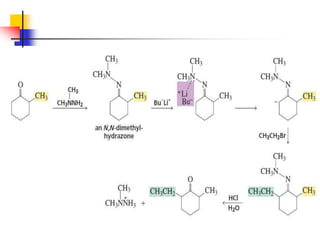
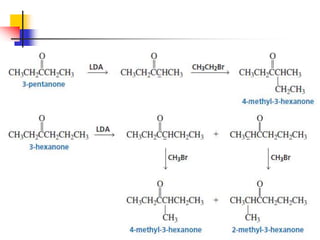
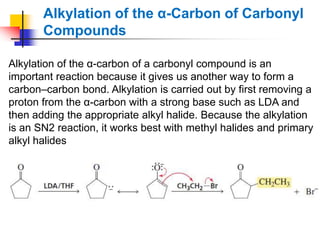
Alkylation of the α-Carbon of Carbonyl
Compounds
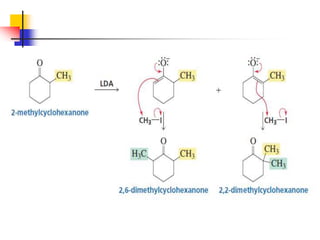
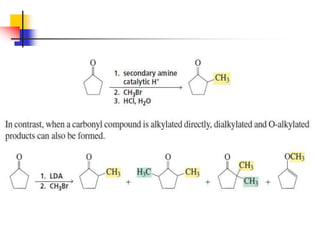
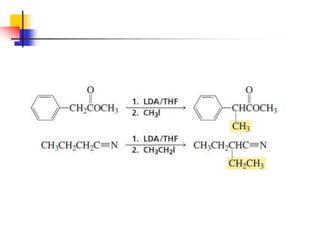
Alkylation of the α-carbon of a carbonyl compound is an
important reaction because it gives us another way to form a
carbon–carbon bond. Alkylation is carried out by first removing a
proton from the α-carbon with a strong base such as LDA and
then adding the appropriate alkyl halide. Because the alkylation
is an SN2 reaction, it works best with methyl halides and primary
alkyl halides
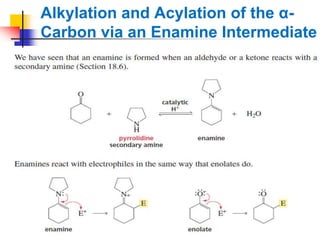
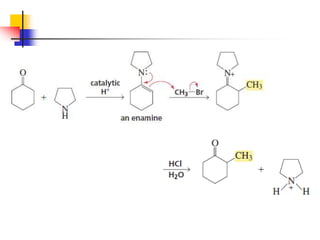
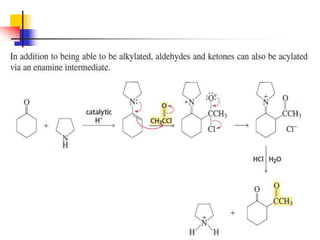
Alkylation and Acylation of the α-
Carbon via an Enamine Intermediate
The Aldol Addition
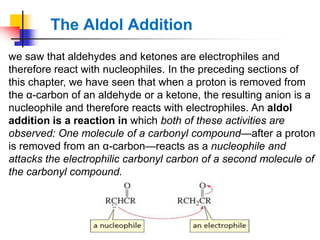
we saw that aldehydes and ketones are electrophiles and
therefore react with nucleophiles. In the preceding sections of
this chapter, we have seen that when a proton is removed from
the α-carbon of an aldehyde or a ketone, the resulting anion is a
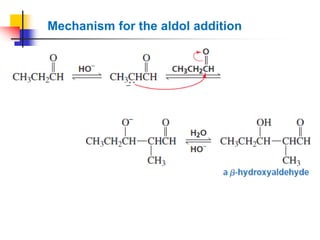
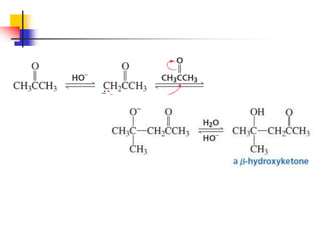
nucleophile and therefore reacts with electrophiles. An aldol
addition is a reaction in which both of these activities are
observed: One molecule of a carbonyl compound—after a proton
is removed from an α-carbon—reacts as a nucleophile and
attacks the electrophilic carbonyl carbon of a second molecule of
the carbonyl compound.
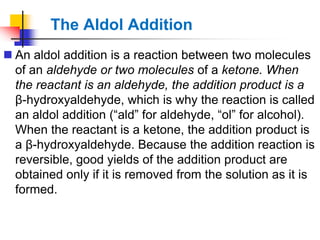
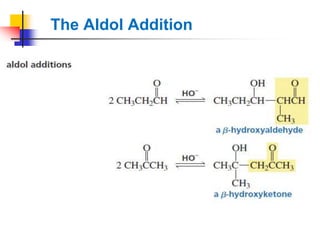
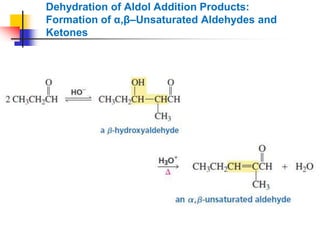
 An aldol addition is a reaction between two molecules
of an aldehyde or two molecules of a ketone. When
the reactant is an aldehyde, the addition product is a
β-hydroxyaldehyde, which is why the reaction is called
an aldol addition (―ald‖ for aldehyde, ―ol‖ for alcohol).
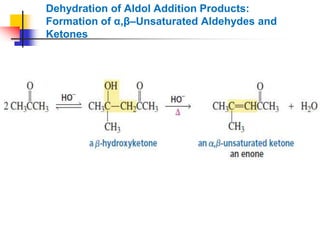
When the reactant is a ketone, the addition product is
a β-hydroxyaldehyde. Because the addition reaction is
reversible, good yields of the addition product are
obtained only if it is removed from the solution as it is
formed.
The Aldol Addition
The Aldol Addition
Mechanism for the aldol addition
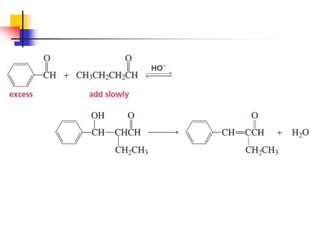
Dehydration of Aldol Addition Products:
Formation of α,β–Unsaturated Aldehydes and
Ketones
Dehydration of Aldol Addition Products:
Formation of α,β–Unsaturated Aldehydes and
Ketones
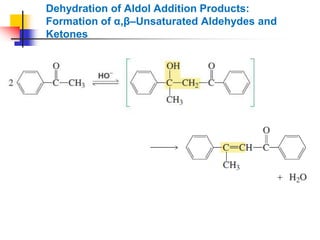
Dehydration of Aldol Addition Products:
Formation of α,β–Unsaturated Aldehydes and
Ketones
The Mixed Aldol Addition
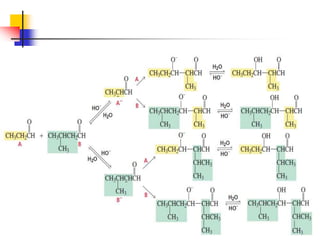
 If two different carbonyl compounds are used in an aldol
addition, four products canbe formed because each
enolate can react both with another molecule of the
carbonyl compound from which the enolate was formed
and with the other carbonyl compound. In the following
example, both carbonyl compound A and carbonyl
compound B can lose a proton from an α-carbon to form
enolates A- and B-; A- can react with either A or B, and
can react with either A or B: The preceding reaction is
called a mixed aldol addition or a crossed aldol
addition. The four products have similar physical
properties, making them difficult to separate.
Consequently, a mixed aldol addition that forms four
products is not a synthetically useful reaction.
Intramolecular Aldol Additions
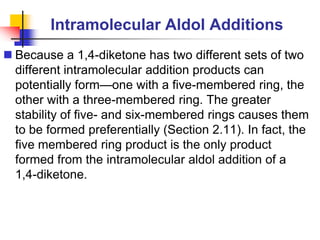
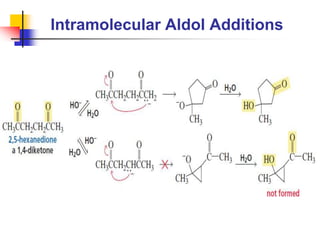
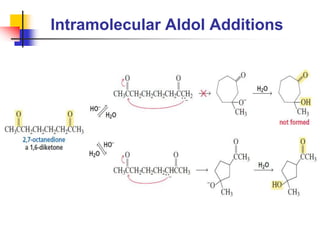
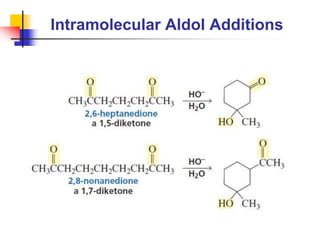
 Because a 1,4-diketone has two different sets of two
different intramolecular addition products can
potentially form—one with a five-membered ring, the
other with a three-membered ring. The greater
stability of five- and six-membered rings causes them
to be formed preferentially (Section 2.11). In fact, the
five membered ring product is the only product
formed from the intramolecular aldol addition of a
1,4-diketone.
Intramolecular Aldol Additions

Och 300 aldehyde and ketones

  • 1.
  • 2.
  • 3.
  • 4.
  • 7.
  • 18.
    Reactions of CarbonylCompounds with Carbon Nucleophiles  Reaction with Grignard Reagents
  • 26.
  • 27.
  • 30.
    Reactions of CarbonylCompounds with Hydride Ion Addition of hydride ion to an aldehyde or ketone forms an alkoxide ion. Subsequent protonation by an acid produces an alcohol. The overall reaction adds to the carbonyl group. Recall that the addition of hydrogen to an organic compound is a reduction reaction
  • 34.
    Reactions of Aldehydesand Ketones with Nitrogen Nucleophiles Aldehydes and ketones react with a primary amine to form an imine. An imine is a compound with a carbon–nitrogen double bond. The imine obtained from the reaction of a carbonyl compound and a primary amine is often called a Schiff base.
  • 35.
    Aldehydes and ketonesreact with a secondary amine to form an enamine (pronounced ―ENE-amine‖). An enamine is an α,β- unsaturated tertiary amine—a tertiary amine with a double bond in the α,β-position relative to the nitrogen atom. Notice that the double bond is in the part of the molecule that comes from the aldehyde or ketone. The name ―enamine‖ comes from ―ene‖ + ―amine,‖ with the ―e‖ omitted in order to avoid two successive vowels. Reactions of Aldehydes and Ketones with Nitrogen Nucleophiles
  • 36.
    Addition of PrimaryAmines  Aldehydes and ketones react with primary amines to form imines. The reaction requires a catalytic (small) amount of acid—we will see that the pH of the reaction mixture must be carefully controlled.
  • 38.
    Addition of SecondaryAmines  Aldehydes and ketones react with secondary amines to form enamines. Like imine formation, the reaction requires a trace amount of an acid catalyst.
  • 41.
    Formation of ImineDerivatives  Compounds such as hydroxylamineNH2OH), hydrazine (NH2NH2), and semicarbazide (NH2NHCONH2) are similar to primary amines in that they all have an NH2 group. Thus, like primary amines, they react with aldehydes and ketones to form imines—often called imine derivatives because the substituent attached to the imine nitrogen is not an R group. The imine obtained from the reaction with hydroxylamine is called an oxime, the imine obtained from the reaction with hydrazine is called a hydrazone, and the imine obtained from the reaction with semicarbazide is called a semicarbazone.
  • 44.
    The Wolff–Kishner Reduction When a ketone or an aldehyde is heated in a basic solution of hydrazine, the carbonyl group is converted into a methylene group. This process is called deoxygenation because an oxygen is removed from the reactant. The reaction is known as the Wolff–Kishner reduction.
  • 46.
    Reactions of Aldehydesand Ketones with Oxygen Nucleophiles Addition of Water Water adds to an aldehyde or a ketone to form a hydrate. A hydrate is a molecule with two OH groups on the same carbon. Hydrates are also called gem-diols (gem comes from geminus, Latin for “twin”). Hydrates of aldehydes or ketones are generally too unstable to be isolated because the tetrahedral carbon is attached to two oxygen atoms.
  • 51.
    Addition of Alcohol The product formed when one equivalent of an alcohol adds to an aldehyde is called a hemiacetal. The product formed when a second equivalent of alcohol is added is called an acetal. Like water, an alcohol is a poor nucleophile, so an acid catalyst is required for the reaction to take place at a reasonable rate.
  • 52.
     When thecarbonyl compound is a ketone instead of an aldehyde, the addition products are called a hemiketal and a ketal, respectively.
  • 56.
    Protecting Groups  Ketones(or aldehydes) react with 1,2-diols to form five-membered ring ketals (or acetals) and with 1,3-diols to form six-membered ring ketals (or acetals). Recall that fiveand six-membered rings are formed relatively easily
  • 57.
  • 58.
  • 59.
  • 60.
  • 62.
    The Wittig Reaction An aldehyde or a ketone reacts with a phosphonium ylide (pronounced ―ILL-id‖) to form an alkene. An ylide is a compound that has opposite charges on adjacent covalently bonded atoms with complete octets. The ylide can also be written in the doublebonded form because phosphorus can have more than eight valence electrons. The reaction of an aldehyde or a ketone with a phosphonium ylide to form an alkene is called a Wittig reaction. The overall reaction amounts to interchanging the double-bonded oxygen of the carbonyl compound and the double-bonded carbon group of the phosphonium ylide.
  • 68.
  • 85.
    Carbonyl Compounds  Reactionsat the α-Carbon Aldehydes, ketones, esters, and N,N-disubstituted amides have a second site of reactivity. A hydrogen bonded to a carbon adjacent to a carbonyl carbon is sufficiently acidic to be removed by a strong base. The carbon adjacent to a carbonyl carbon is called an α-carbon. A hydrogen bonded to an α-carbon is called α-Hydrogen
  • 86.
  • 87.
    Halogenation of the-Carbon of Aldehydes and Ketones  Acid-Catalyzed Halogenation When Br2,Cl2 or I2 is added to an acidic solution of an aldehyde or a ketone, a halogen replaces one of the α-hydrogens of the carbonyl compound
  • 88.
    Halogenation of the-Carbon of Aldehydes and Ketones
  • 89.
    Halogenation of the-Carbon of Aldehydes and Ketones  Base-Promoted Halogenation When excess Br2,Cl2 or I2 is added to a basic solution of an aldehyde or a ketone, the halogen replaces all the α-hydrogens of the carbonyl compound
  • 90.
    Halogenation of the-Carbon of Aldehydes and Ketones
  • 91.
    Halogenation of the-Carbon of Aldehydes and Ketones The Haloform Reaction
  • 92.
    α-Halogenated Carbonyl Compounds inSynthesis  You have seen that when a base removes a proton from an α-carbon of an aldehyde or a ketone in the previous section, the α-carbon becomes nucleophilic—it reacts with electrophiles.
  • 93.
    α-Halogenated Carbonyl Compounds inSynthesis  However, when the α-position is halogenated, the α-carbon becomes electrophilic—it reacts with nucleophiles. Therefore, both electrophiles and nucleophiles can be placed on α-carbons.
  • 94.
  • 95.
    Using LDA toForm an Enolate Using a nitrogen base to form an enolate can be a problem because a nitrogen base can also react as a nucleophile and attack the carbonyl carbon. However, the two bulky alkyl substituents bonded to the nitrogen of LDA make it difficult for the nitrogen to get close enough to the carbonyl carbon to react with it. Consequently, LDA is a strong base but a poor nucleophile, so it removes an α-hydrogen much faster than it attacks a carbonyl carbon. LDA is easily prepared by adding butyllithium to diisopropylamine (DIA) in THF at -78 C.
  • 97.
    Alkylation of theα-Carbon of Carbonyl Compounds Alkylation of the α-carbon of a carbonyl compound is an important reaction because it gives us another way to form a carbon–carbon bond. Alkylation is carried out by first removing a proton from the α-carbon with a strong base such as LDA and then adding the appropriate alkyl halide. Because the alkylation is an SN2 reaction, it works best with methyl halides and primary alkyl halides
  • 102.
    Alkylation and Acylationof the α- Carbon via an Enamine Intermediate
  • 106.
    The Aldol Addition wesaw that aldehydes and ketones are electrophiles and therefore react with nucleophiles. In the preceding sections of this chapter, we have seen that when a proton is removed from the α-carbon of an aldehyde or a ketone, the resulting anion is a nucleophile and therefore reacts with electrophiles. An aldol addition is a reaction in which both of these activities are observed: One molecule of a carbonyl compound—after a proton is removed from an α-carbon—reacts as a nucleophile and attacks the electrophilic carbonyl carbon of a second molecule of the carbonyl compound.
  • 108.
     An aldoladdition is a reaction between two molecules of an aldehyde or two molecules of a ketone. When the reactant is an aldehyde, the addition product is a β-hydroxyaldehyde, which is why the reaction is called an aldol addition (―ald‖ for aldehyde, ―ol‖ for alcohol). When the reactant is a ketone, the addition product is a β-hydroxyaldehyde. Because the addition reaction is reversible, good yields of the addition product are obtained only if it is removed from the solution as it is formed. The Aldol Addition
  • 109.
  • 110.
    Mechanism for thealdol addition
  • 112.
    Dehydration of AldolAddition Products: Formation of α,β–Unsaturated Aldehydes and Ketones
  • 113.
    Dehydration of AldolAddition Products: Formation of α,β–Unsaturated Aldehydes and Ketones
  • 114.
    Dehydration of AldolAddition Products: Formation of α,β–Unsaturated Aldehydes and Ketones
  • 115.
    The Mixed AldolAddition  If two different carbonyl compounds are used in an aldol addition, four products canbe formed because each enolate can react both with another molecule of the carbonyl compound from which the enolate was formed and with the other carbonyl compound. In the following example, both carbonyl compound A and carbonyl compound B can lose a proton from an α-carbon to form enolates A- and B-; A- can react with either A or B, and can react with either A or B: The preceding reaction is called a mixed aldol addition or a crossed aldol addition. The four products have similar physical properties, making them difficult to separate. Consequently, a mixed aldol addition that forms four products is not a synthetically useful reaction.
  • 118.
    Intramolecular Aldol Additions Because a 1,4-diketone has two different sets of two different intramolecular addition products can potentially form—one with a five-membered ring, the other with a three-membered ring. The greater stability of five- and six-membered rings causes them to be formed preferentially (Section 2.11). In fact, the five membered ring product is the only product formed from the intramolecular aldol addition of a 1,4-diketone.
  • 119.
  • 120.
  • 121.