CONFLICT,
COMMUNICATION, AND
COORDINATION
CHAPTER-9
AUTHORS:
DR. KIRAN NERKAR
DR. VILAS CHOPDE
 Conflict is the struggle between incompatible or opposing
needs, wishes, ideas, interests, or people. According to them
conflict arises when individuals or groups encounter goals
that both parties cannot attain satisfactorily. ---- Chung and
Meggison
 Conflict has been defined as the condition of objective
incompatibility between values and goals; as the behavior of
deliberately interfering with another’s goal achievement; and
as emotionally in terms of hostility. Descriptive theorists have
explained conflict behavior in terms of objective conflict of
interest, personal styles, reactions to threats, and cognitive
distortions. ---- Pondy
DEFINE CONFLICT
© 2011, Dreamtech Press :: Chapter 9 2
 Occurs when two or more individuals pursue incompatible
goals
 Refers to the behavior of individuals due to which they try to
prevent others from attaining their goals
 Arises due to a dilemma within an individual to select the
right course of action
 Occurs when there is a mismatch between the actual and
expected role
 Arises when the goals of one individual or department clashes
with the goals of the other individual or department
CHARACTERISTICS OF CONFLICT
© 2011, Dreamtech Press :: Chapter 9 3
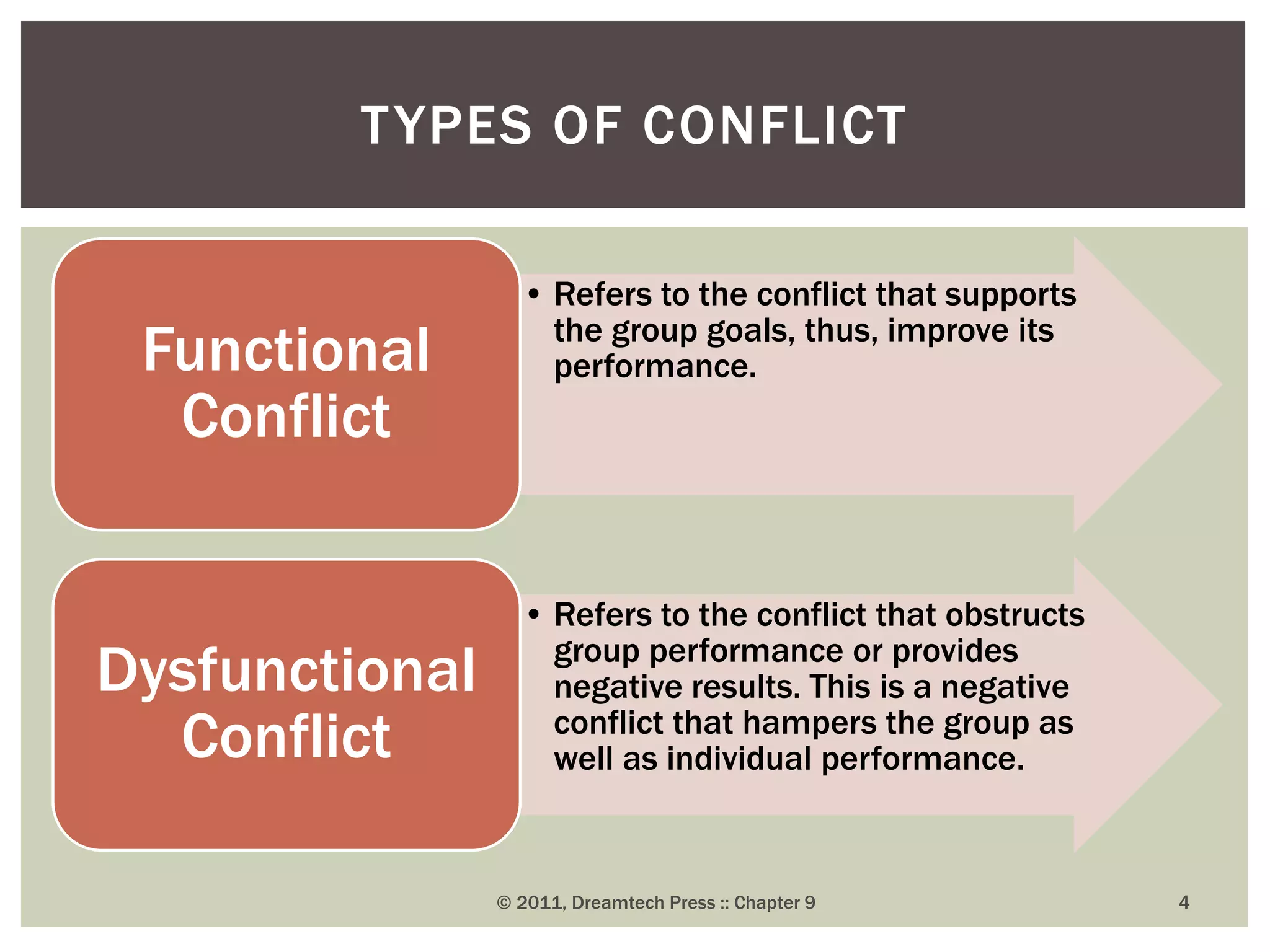
• Refers to the conflict that supports
the group goals, thus, improve its
performance.Functional
Conflict
• Refers to the conflict that obstructs
group performance or provides
negative results. This is a negative
conflict that hampers the group as
well as individual performance.
Dysfunctional
Conflict
TYPES OF CONFLICT
© 2011, Dreamtech Press :: Chapter 9 4
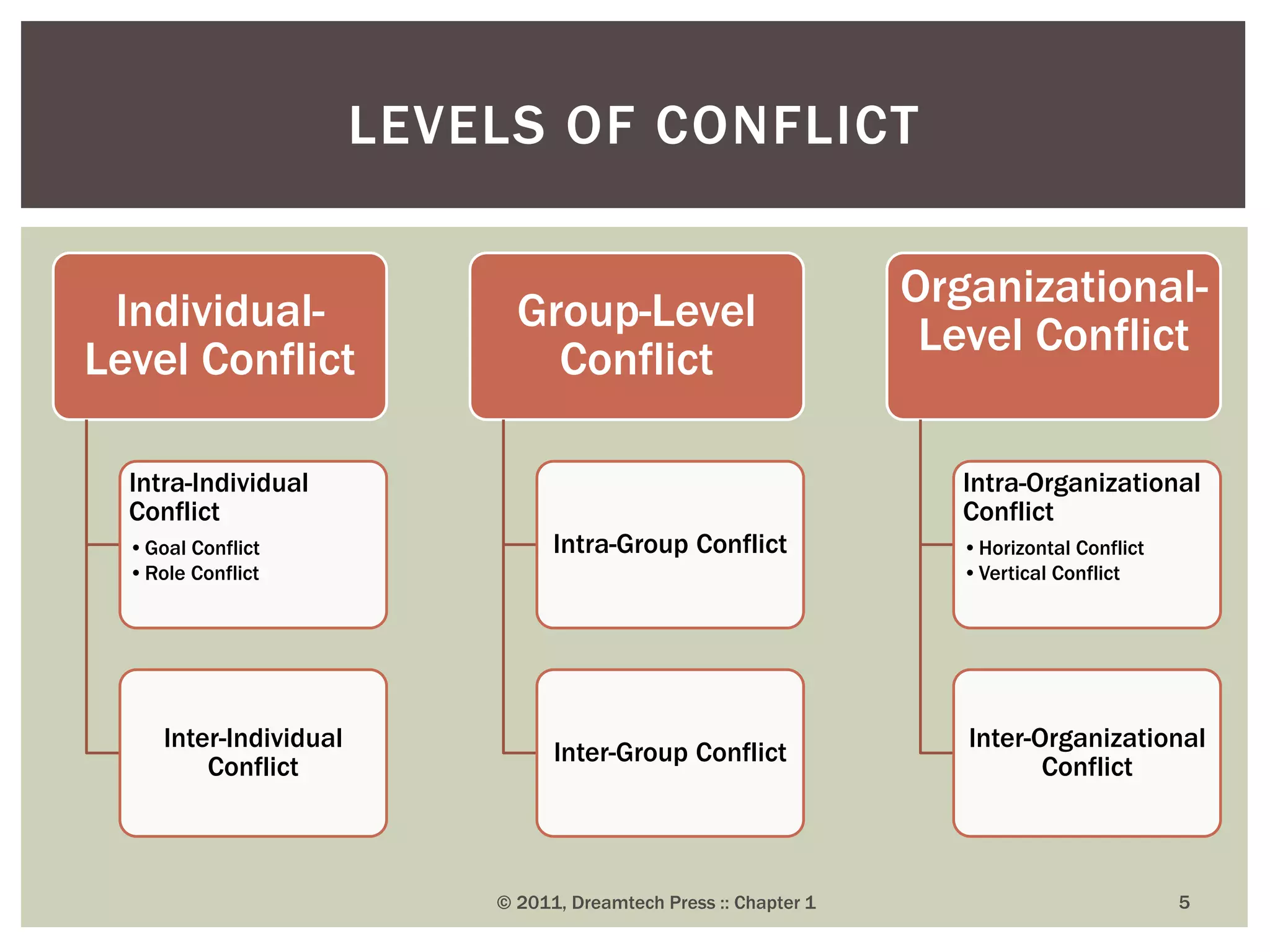
Individual-
Level Conflict
Intra-Individual
Conflict
•Goal Conflict
•Role Conflict
Inter-Individual
Conflict
Group-Level
Conflict
Intra-Group Conflict
Inter-Group Conflict
Organizational-
Level Conflict
Intra-Organizational
Conflict
•Horizontal Conflict
•Vertical Conflict
Inter-Organizational
Conflict
© 2011, Dreamtech Press :: Chapter 1 5
LEVELS OF CONFLICT
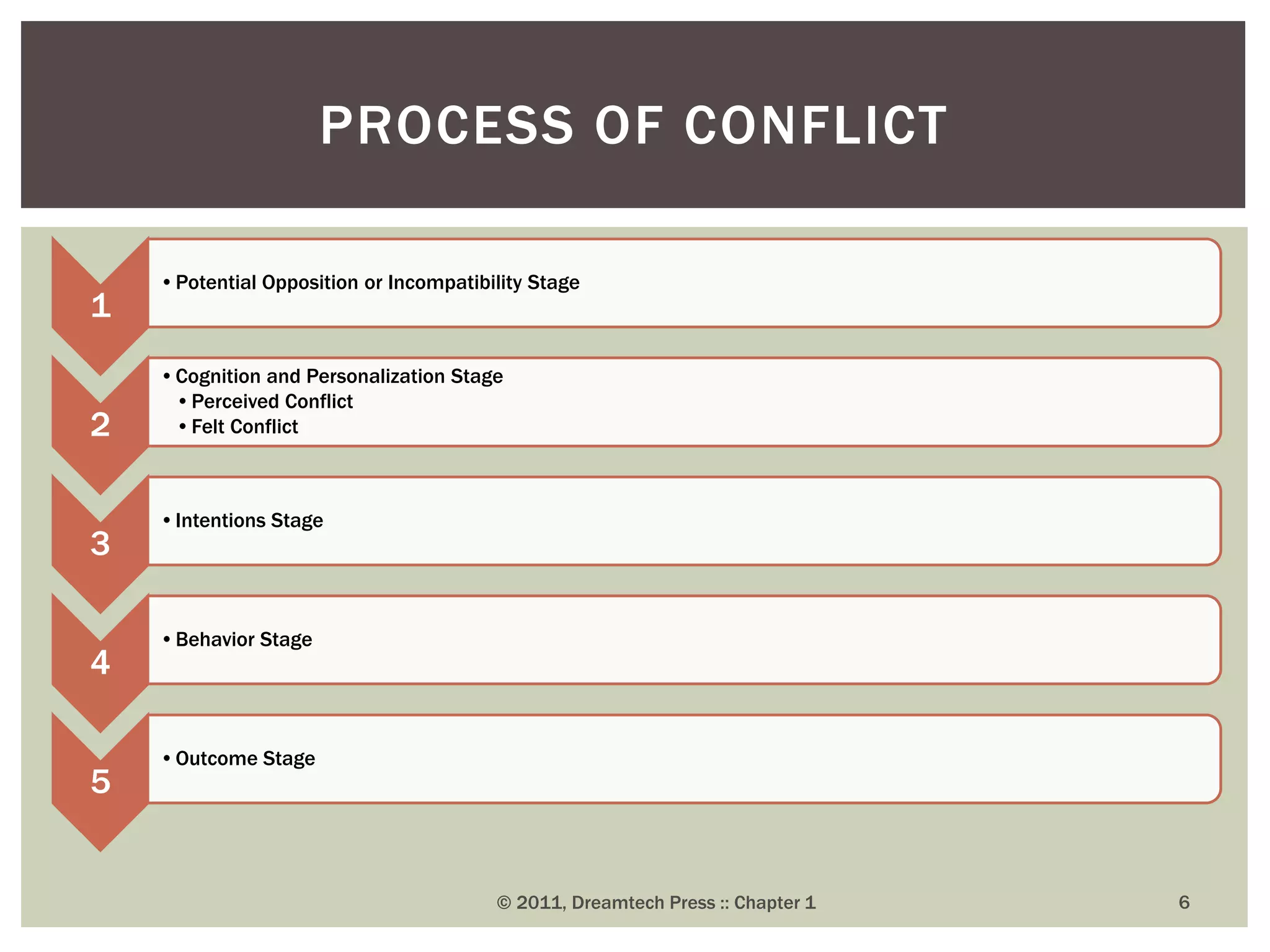
1
•Potential Opposition or Incompatibility Stage
2
•Cognition and Personalization Stage
•Perceived Conflict
•Felt Conflict
3
•Intentions Stage
4
•Behavior Stage
5
•Outcome Stage
© 2011, Dreamtech Press :: Chapter 1 6
PROCESS OF CONFLICT
© 2011, Dreamtech Press :: Chapter 1 7
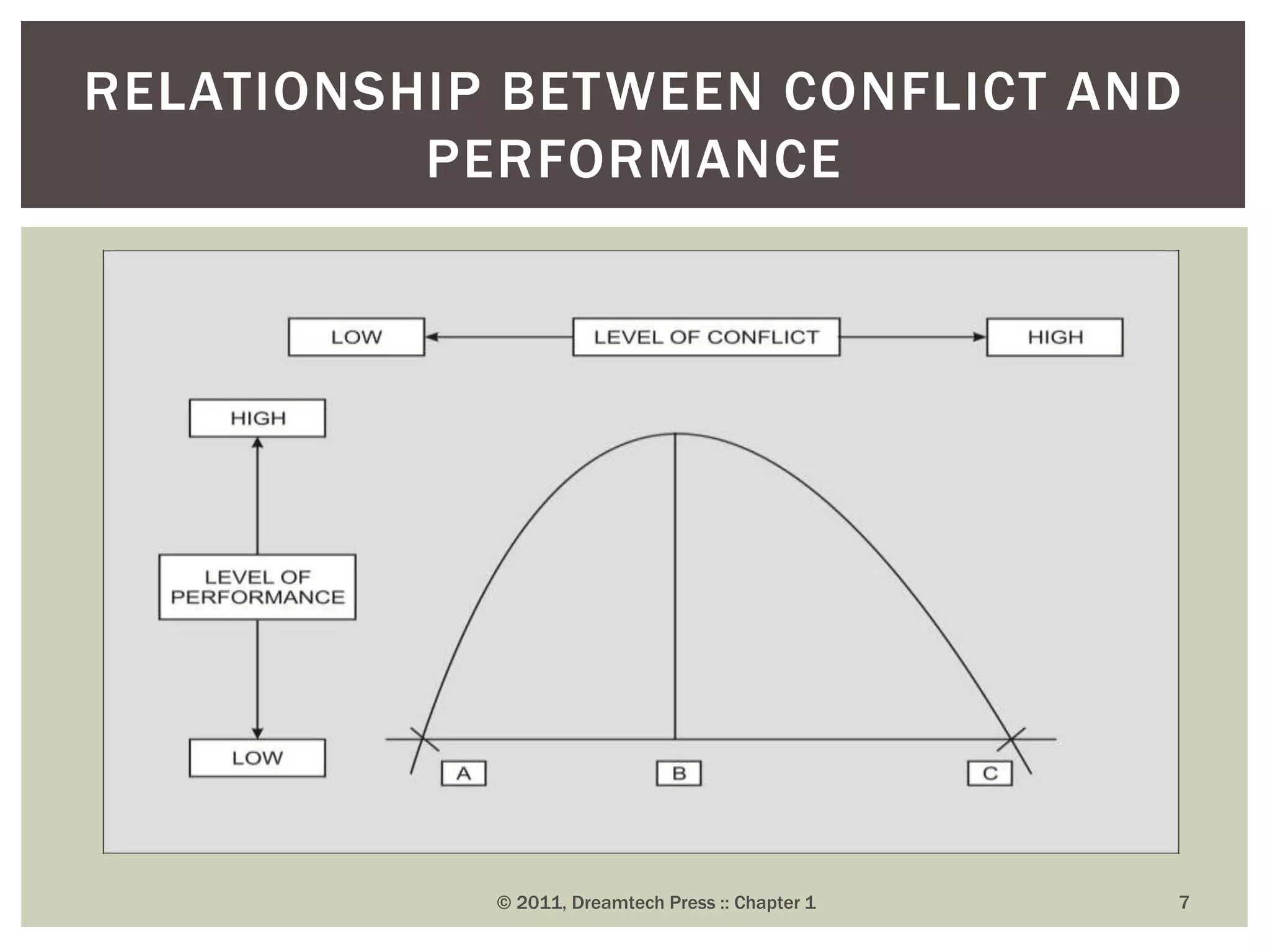
RELATIONSHIP BETWEEN CONFLICT AND
PERFORMANCE
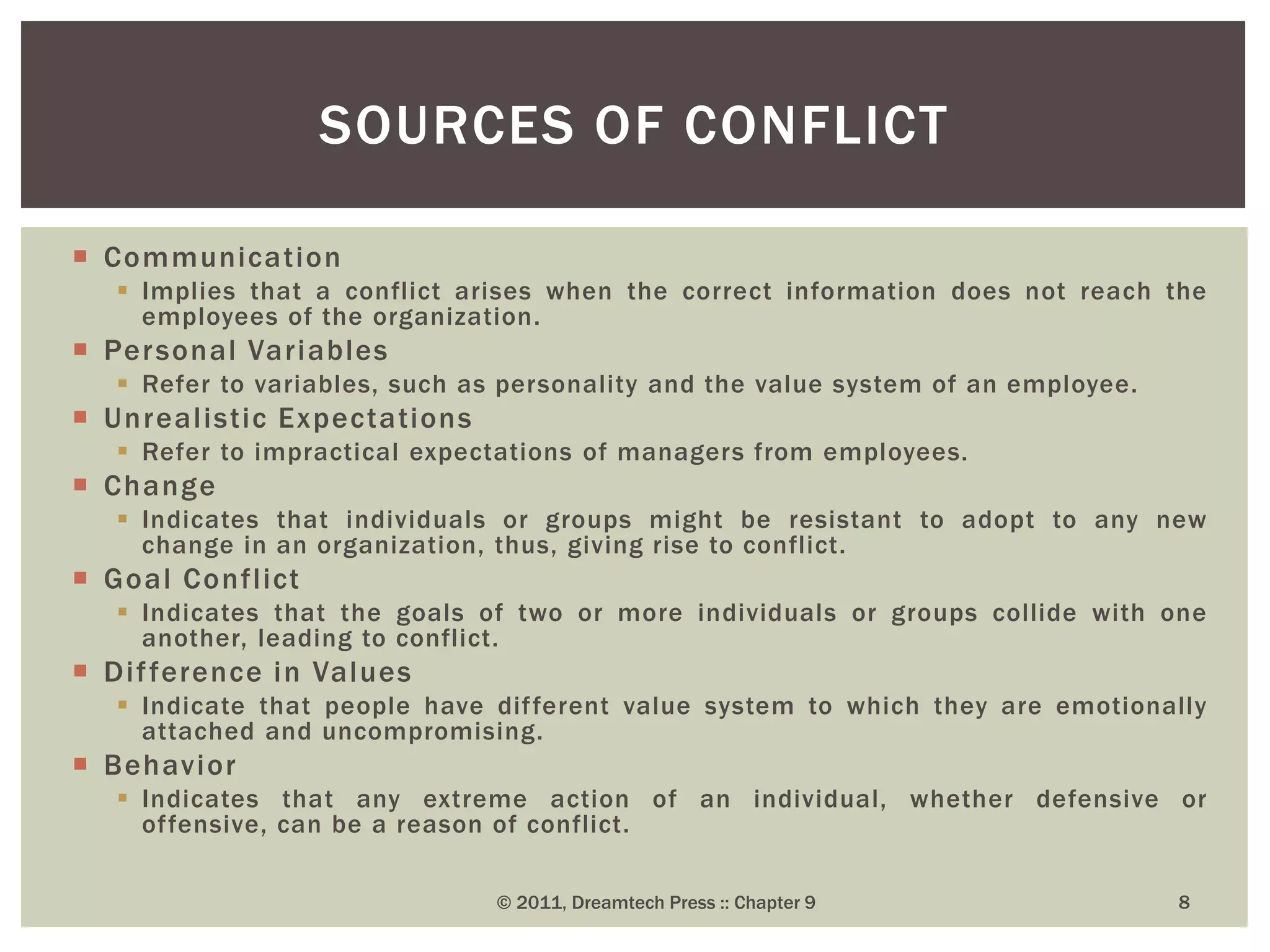
 Communication
 Implies that a conflict arises when the correct information does not reach the
employees of the organization.
 Personal Variables
 Refer to variables, such as personality and the value system of an employee.
 Unrealistic Expectations
 Refer to impractical expectations of managers from employees.
 Change
 Indicates that individuals or groups might be resistant to adopt to any new
change in an organization, thus, giving rise to conflict.
 Goal Conflict
 Indicates that the goals of two or more individuals or groups collide with one
another, leading to conflict.
 Difference in Values
 Indicate that people have different value system to which they are emotionally
attached and uncompromising.
 Behavior
 Indicates that any extreme action of an individual, whether defensive or
offensive, can be a reason of conflict.
SOURCES OF CONFLICT
© 2011, Dreamtech Press :: Chapter 9 8
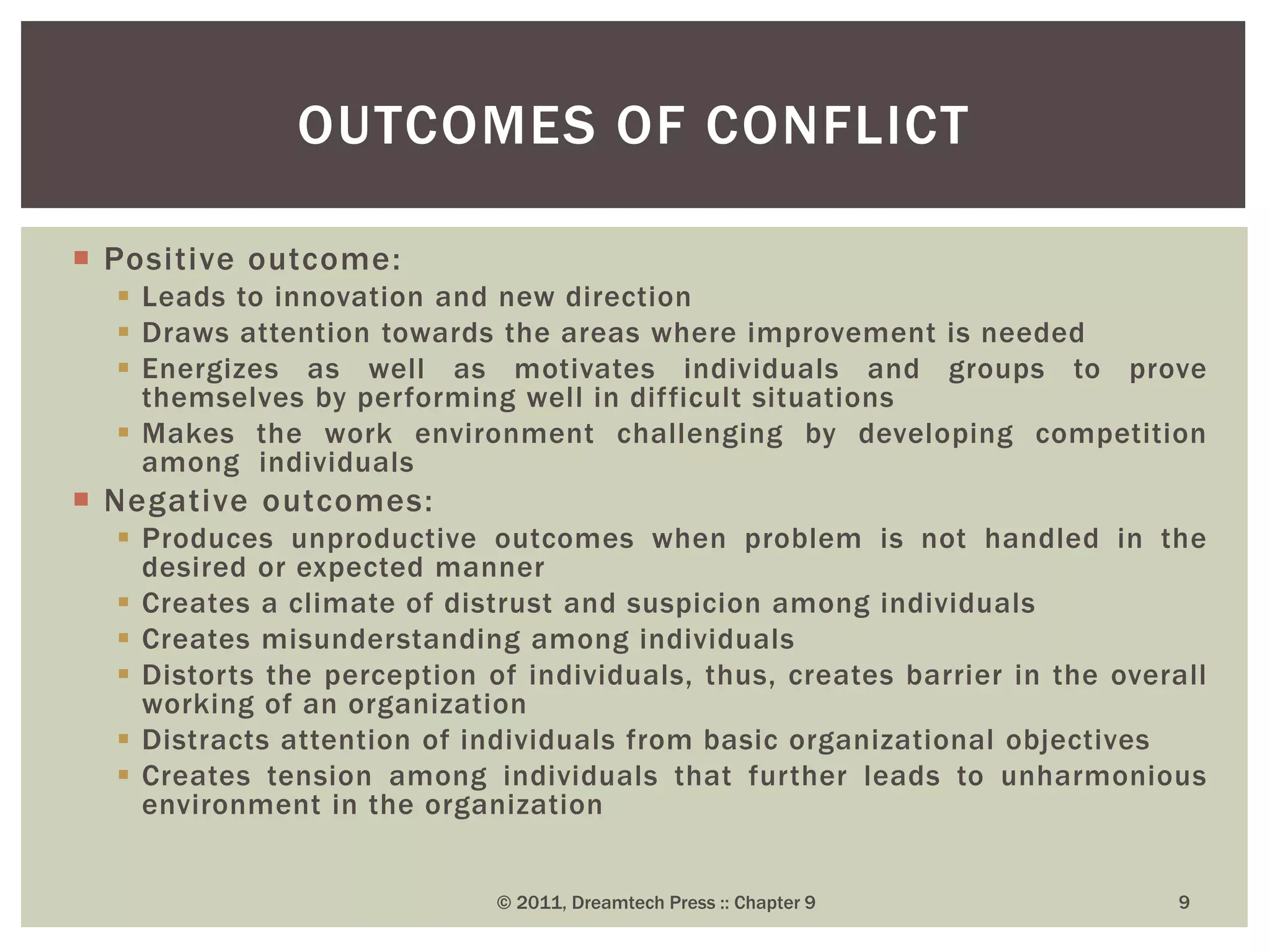
 Positive outcome:
 Leads to innovation and new direction
 Draws attention towards the areas where improvement is needed
 Energizes as well as motivates individuals and groups to prove
themselves by performing well in difficult situations
 Makes the work environment challenging by developing competition
among individuals
 Negative outcomes:
 Produces unproductive outcomes when problem is not handled in the
desired or expected manner
 Creates a climate of distrust and suspicion among individuals
 Creates misunderstanding among individuals
 Distorts the perception of individuals, thus, creates barrier in the overall
working of an organization
 Distracts attention of individuals from basic organizational objectives
 Creates tension among individuals that further leads to unharmonious
environment in the organization
OUTCOMES OF CONFLICT
© 2011, Dreamtech Press :: Chapter 9 9
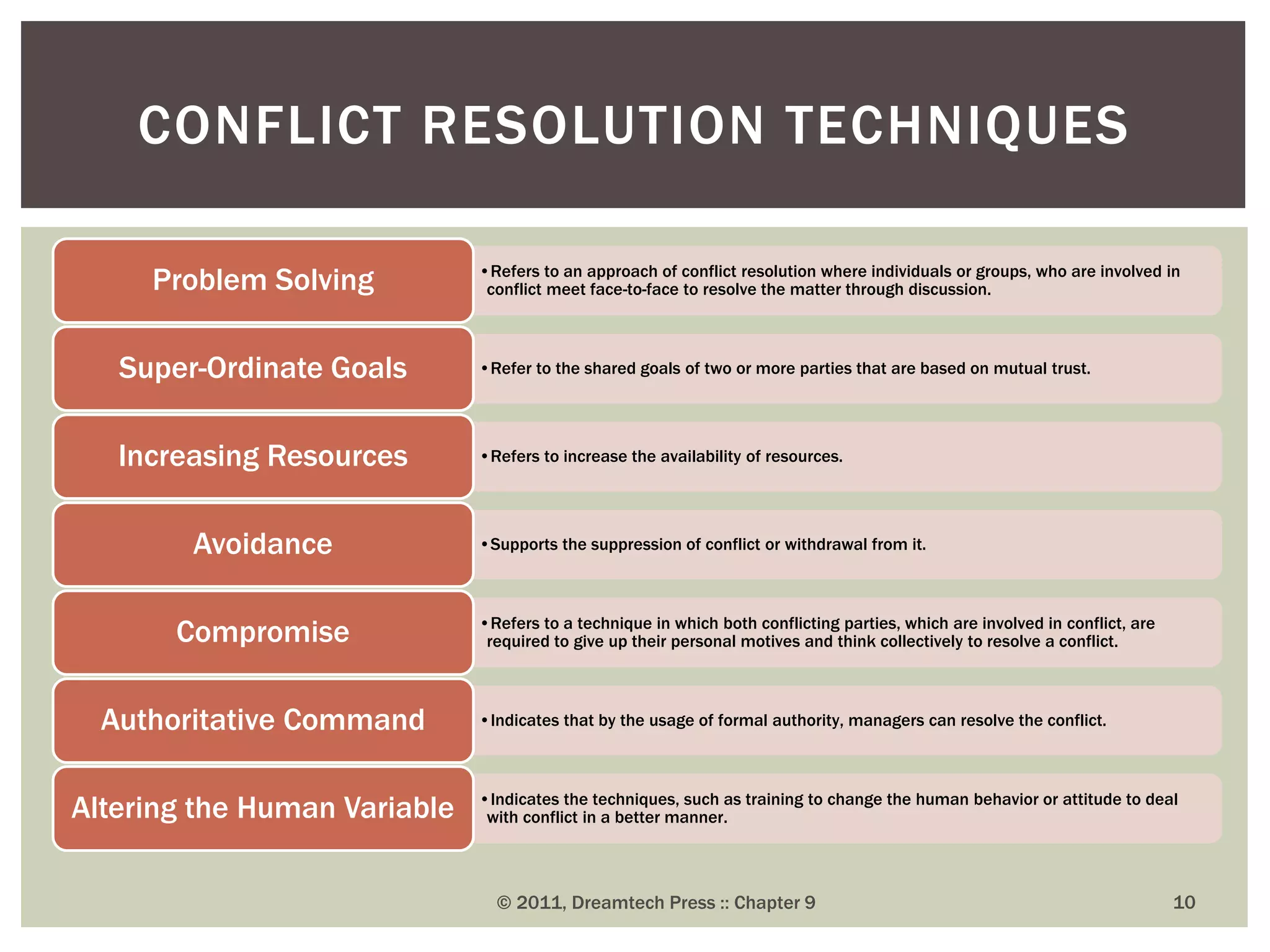
•Refers to an approach of conflict resolution where individuals or groups, who are involved in
conflict meet face-to-face to resolve the matter through discussion.Problem Solving
•Refer to the shared goals of two or more parties that are based on mutual trust.Super-Ordinate Goals
•Refers to increase the availability of resources.Increasing Resources
•Supports the suppression of conflict or withdrawal from it.Avoidance
•Refers to a technique in which both conflicting parties, which are involved in conflict, are
required to give up their personal motives and think collectively to resolve a conflict.Compromise
•Indicates that by the usage of formal authority, managers can resolve the conflict.Authoritative Command
•Indicates the techniques, such as training to change the human behavior or attitude to deal
with conflict in a better manner.Altering the Human Variable
CONFLICT RESOLUTION TECHNIQUES
© 2011, Dreamtech Press :: Chapter 9 10
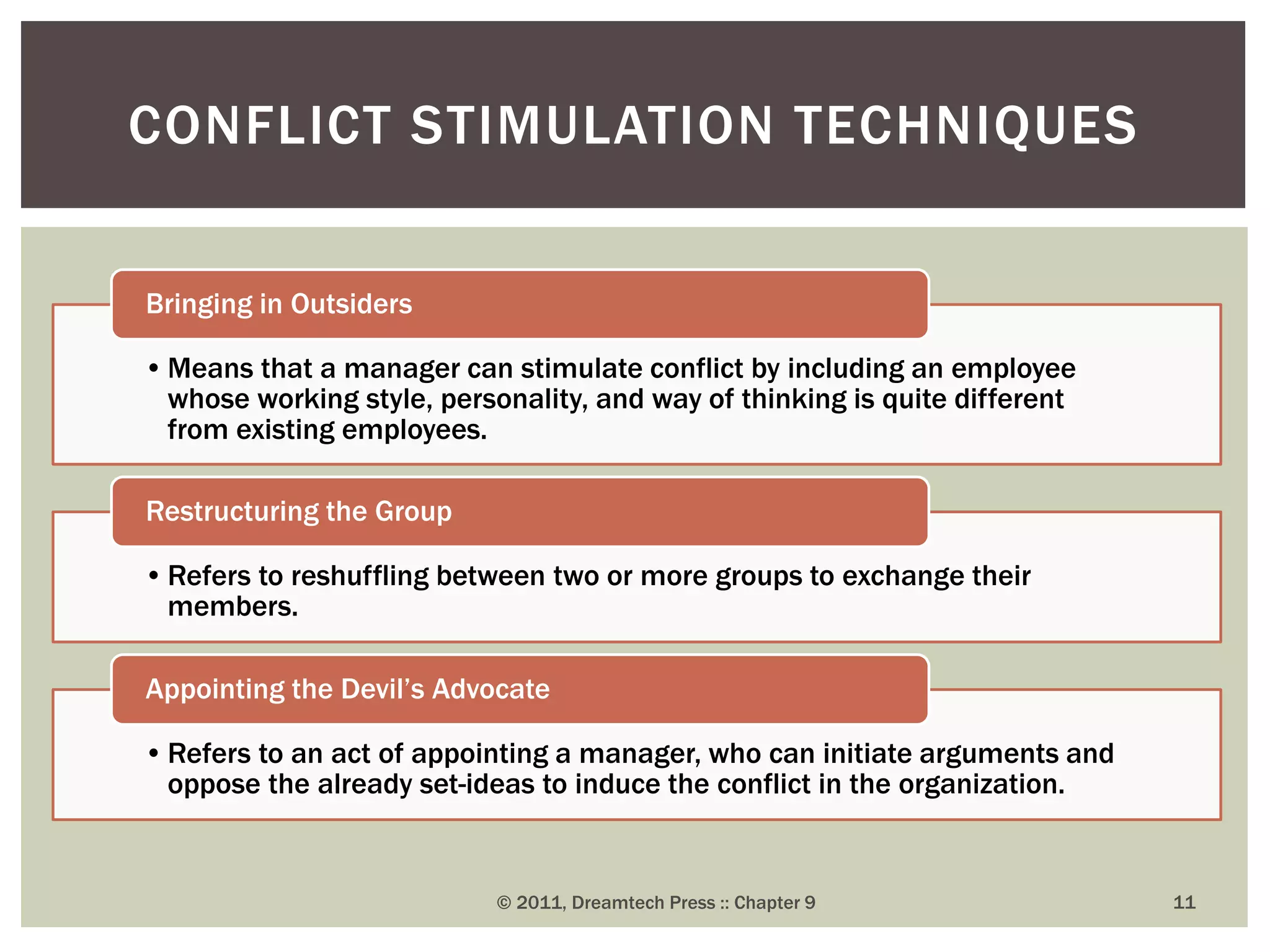
•Means that a manager can stimulate conflict by including an employee
whose working style, personality, and way of thinking is quite different
from existing employees.
Bringing in Outsiders
•Refers to reshuffling between two or more groups to exchange their
members.
Restructuring the Group
•Refers to an act of appointing a manager, who can initiate arguments and
oppose the already set-ideas to induce the conflict in the organization.
Appointing the Devil’s Advocate
CONFLICT STIMULATION TECHNIQUES
© 2011, Dreamtech Press :: Chapter 9 11
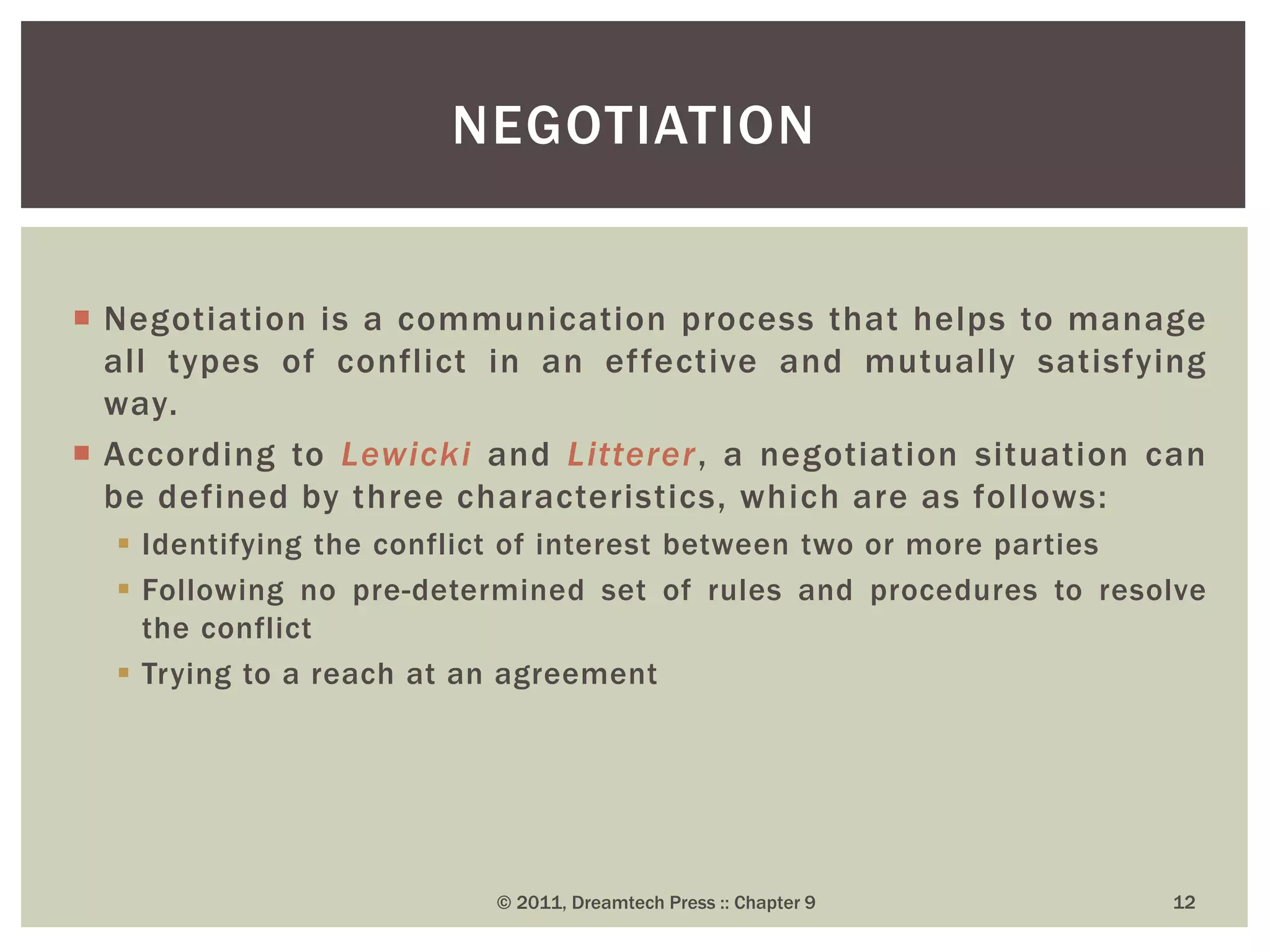
 Negotiation is a communication process that helps to manage
all types of conflict in an effective and mutually satisfying
way.
 According to Lewicki and Litterer, a negotiation situation can
be defined by three characteristics, which are as follows:
 Identifying the conflict of interest between two or more parties
 Following no pre-determined set of rules and procedures to resolve
the conflict
 Trying to a reach at an agreement
NEGOTIATION
© 2011, Dreamtech Press :: Chapter 9 12
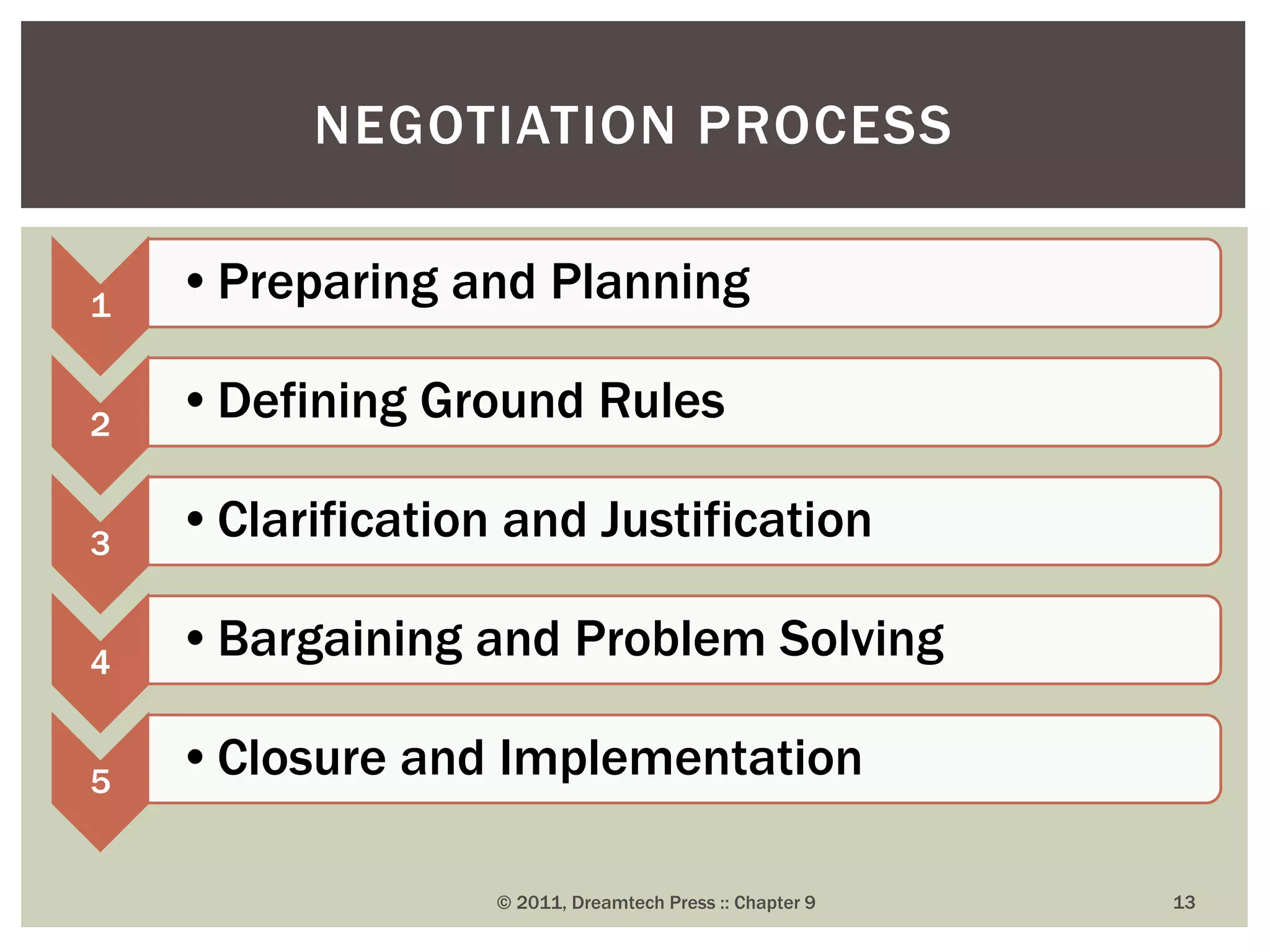
1
•Preparing and Planning
2
•Defining Ground Rules
3
•Clarification and Justification
4
•Bargaining and Problem Solving
5
•Closure and Implementation
NEGOTIATION PROCESS
© 2011, Dreamtech Press :: Chapter 9 13
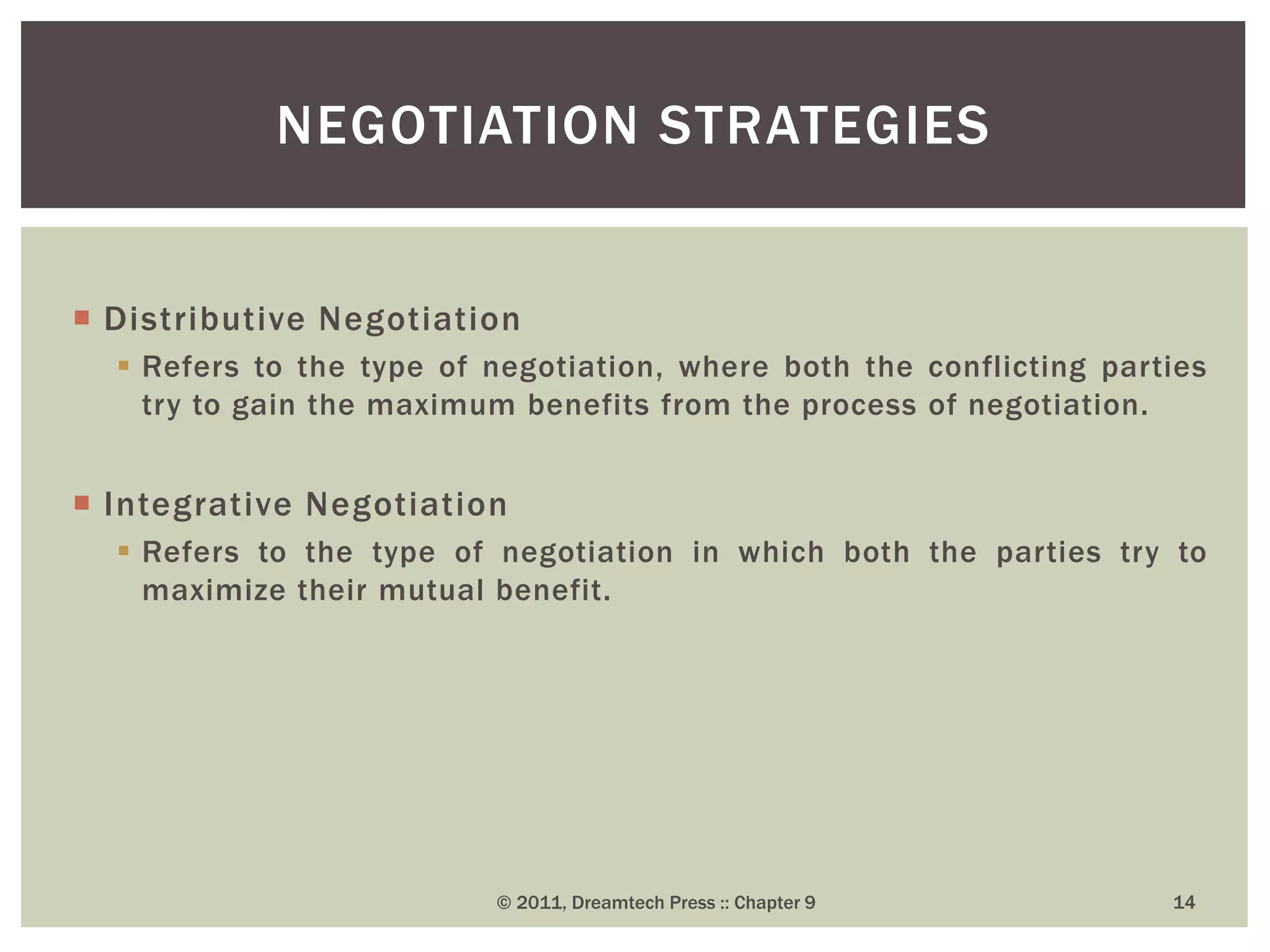
 Distributive Negotiation
 Refers to the type of negotiation, where both the conflicting parties
try to gain the maximum benefits from the process of negotiation.
 Integrative Negotiation
 Refers to the type of negotiation in which both the parties try to
maximize their mutual benefit.
NEGOTIATION STRATEGIES
© 2011, Dreamtech Press :: Chapter 9 14
 Communication is the intercourse by words, letters, or
message, intercourse of thoughts or opinions. It is the act of
making one’s ideas and opinions known to others. ---- Fred G.
Meyer
 Communication is the sum of all the things one person does
when he wants to create understanding in the mind of
another. It is a bridge of meaning. It involves a systematic and
continuous process of telling, listening, and understanding. ----
Louis A. Allen
COMMUNICATION
© 2011, Dreamtech Press :: Chapter 9 15
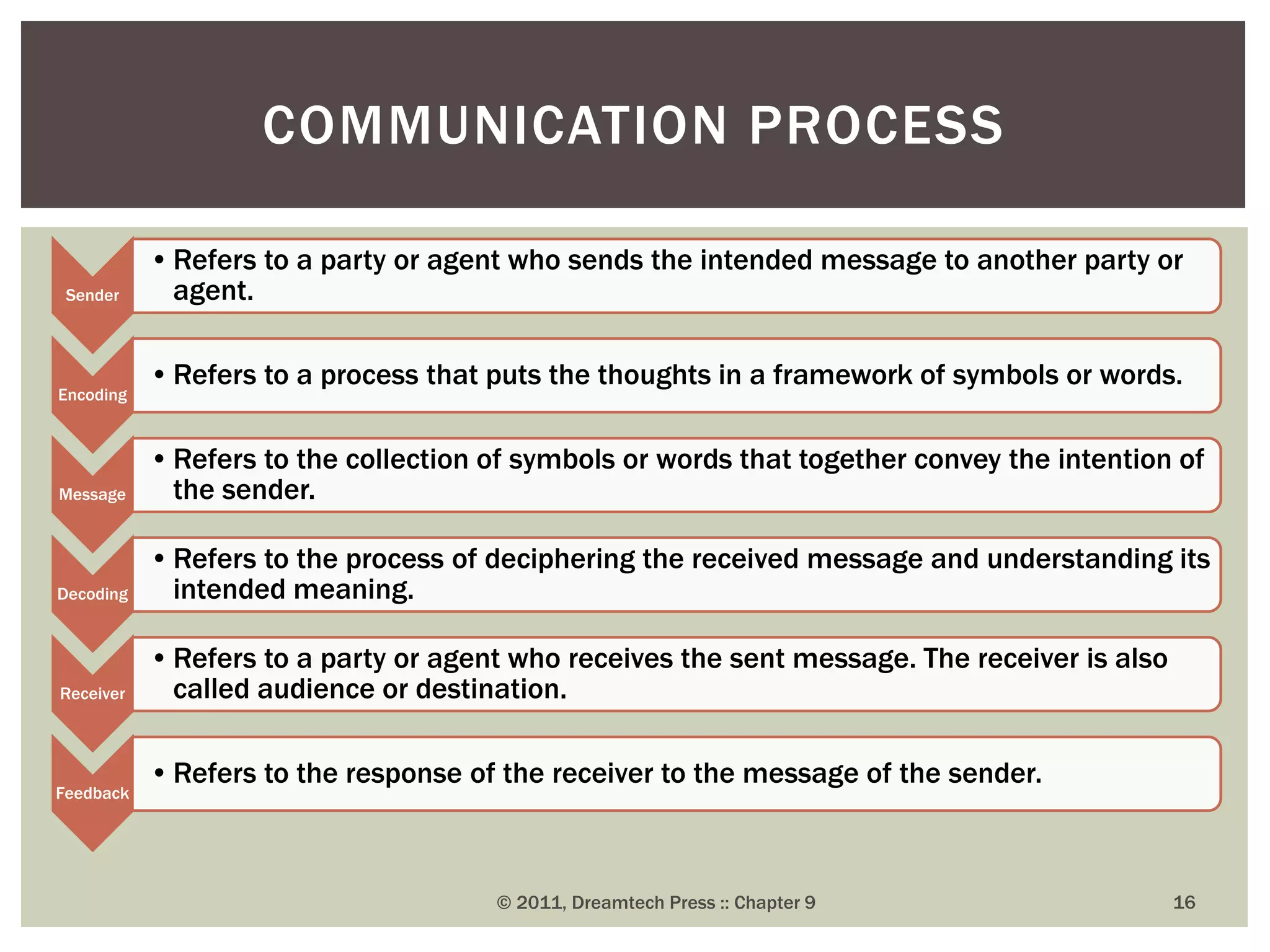
Sender
•Refers to a party or agent who sends the intended message to another party or
agent.
Encoding
•Refers to a process that puts the thoughts in a framework of symbols or words.
Message
•Refers to the collection of symbols or words that together convey the intention of
the sender.
Decoding
•Refers to the process of deciphering the received message and understanding its
intended meaning.
Receiver
•Refers to a party or agent who receives the sent message. The receiver is also
called audience or destination.
Feedback
•Refers to the response of the receiver to the message of the sender.
COMMUNICATION PROCESS
© 2011, Dreamtech Press :: Chapter 9 16
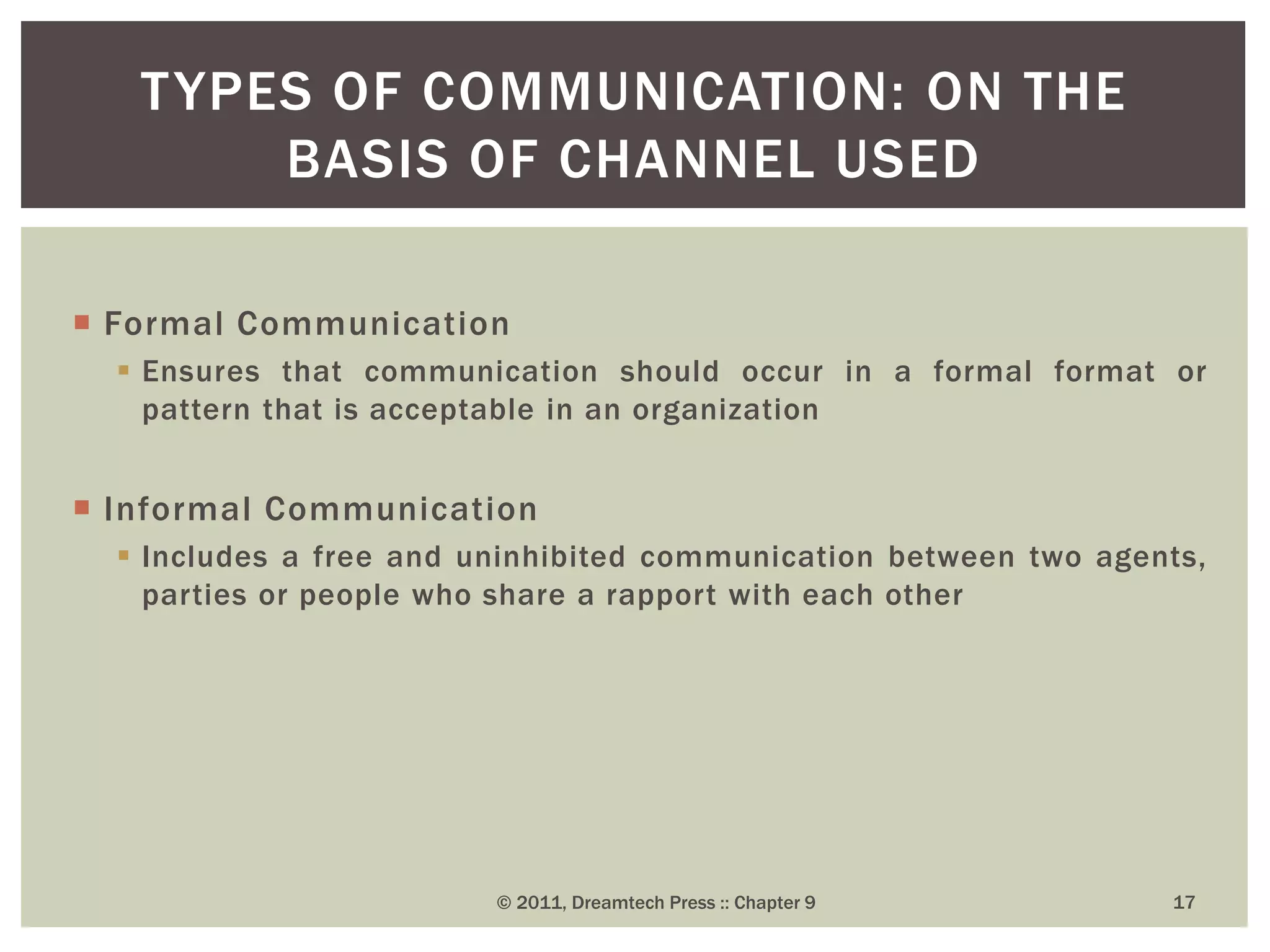
 Formal Communication
 Ensures that communication should occur in a formal format or
pattern that is acceptable in an organization
 Informal Communication
 Includes a free and uninhibited communication between two agents,
parties or people who share a rapport with each other
TYPES OF COMMUNICATION: ON THE
BASIS OF CHANNEL USED
© 2011, Dreamtech Press :: Chapter 9 17
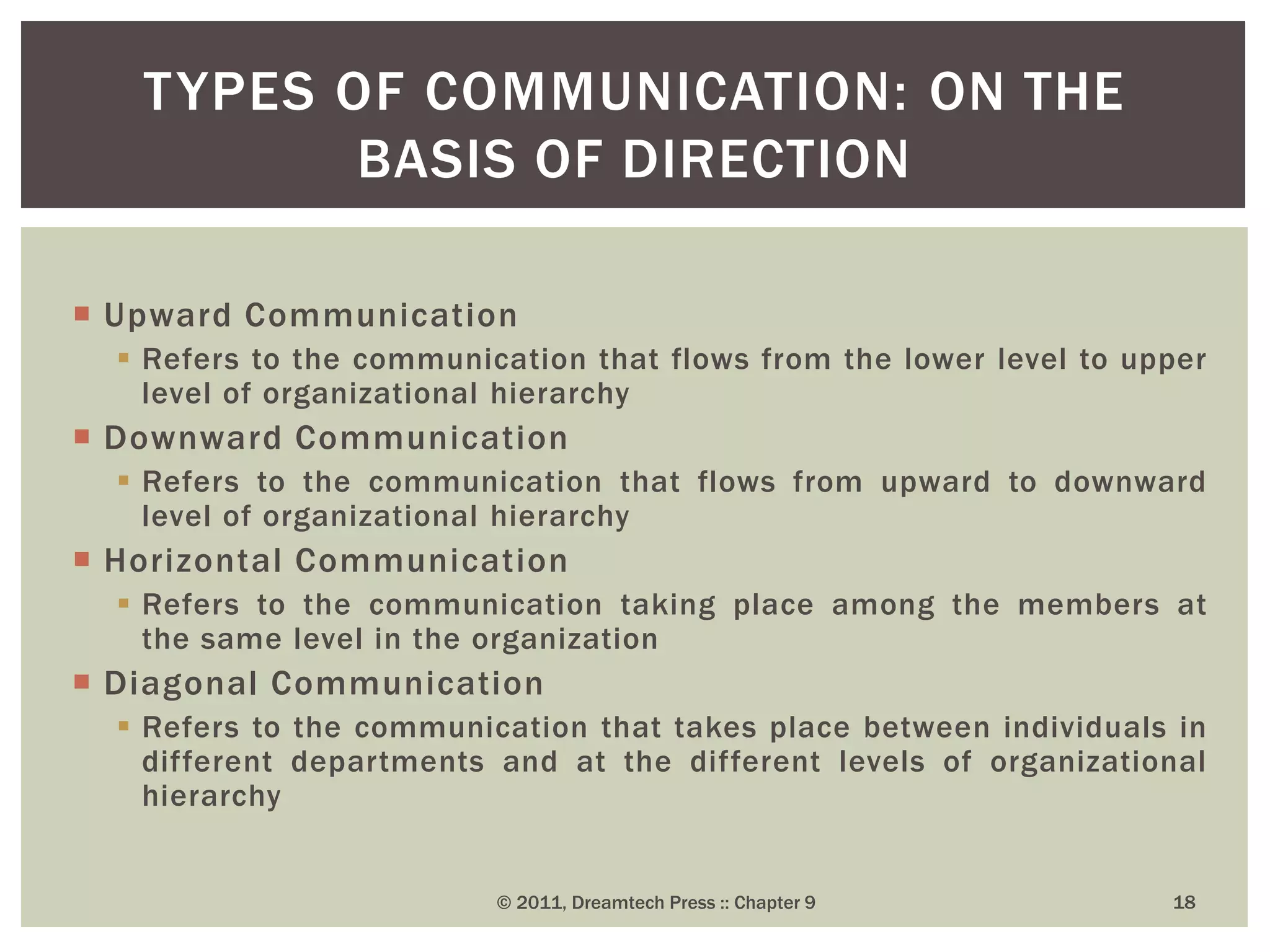
 Upward Communication
 Refers to the communication that flows from the lower level to upper
level of organizational hierarchy
 Downward Communication
 Refers to the communication that flows from upward to downward
level of organizational hierarchy
 Horizontal Communication
 Refers to the communication taking place among the members at
the same level in the organization
 Diagonal Communication
 Refers to the communication that takes place between individuals in
different departments and at the different levels of organizational
hierarchy
TYPES OF COMMUNICATION: ON THE
BASIS OF DIRECTION
© 2011, Dreamtech Press :: Chapter 9 18
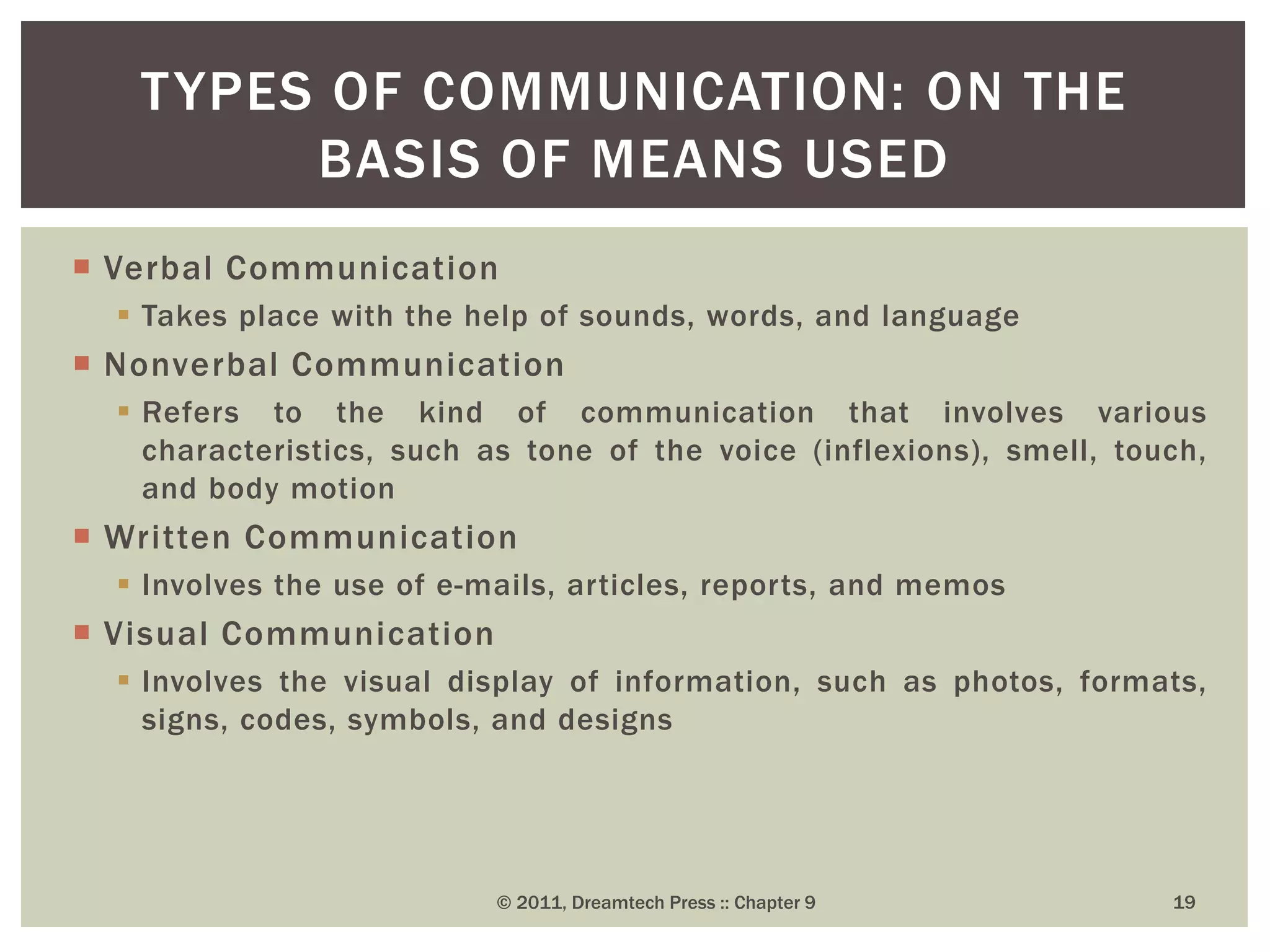
 Verbal Communication
 Takes place with the help of sounds, words, and language
 Nonverbal Communication
 Refers to the kind of communication that involves various
characteristics, such as tone of the voice (inflexions), smell, touch,
and body motion
 Written Communication
 Involves the use of e-mails, articles, reports, and memos
 Visual Communication
 Involves the visual display of information, such as photos, formats,
signs, codes, symbols, and designs
TYPES OF COMMUNICATION: ON THE
BASIS OF MEANS USED
© 2011, Dreamtech Press :: Chapter 9 19
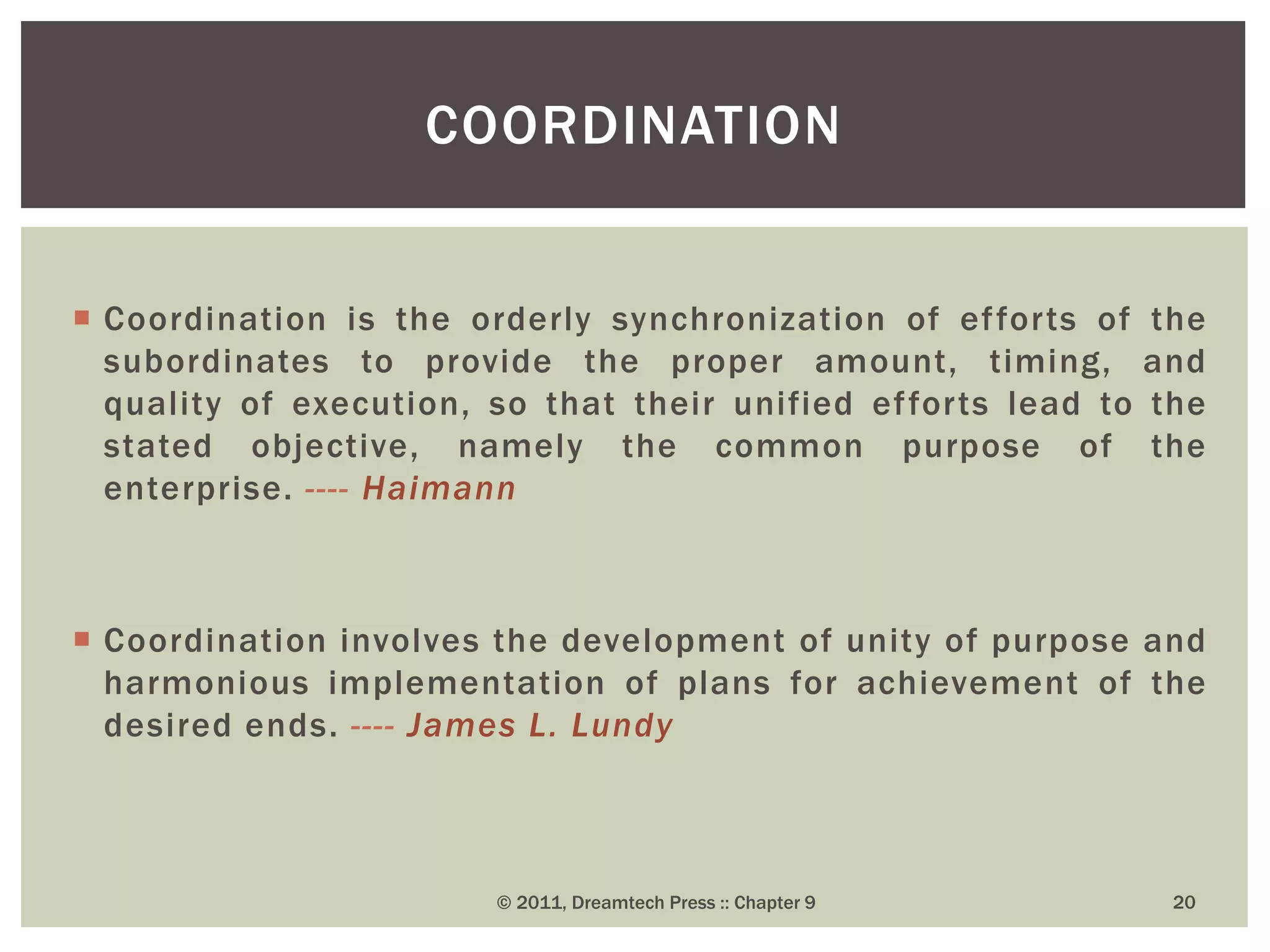
 Coordination is the orderly synchronization of efforts of the
subordinates to provide the proper amount, timing, and
quality of execution, so that their unified efforts lead to the
stated objective, namely the common purpose of the
enterprise. ---- Haimann
 Coordination involves the development of unity of purpose and
harmonious implementation of plans for achievement of the
desired ends. ---- James L. Lundy
COORDINATION
© 2011, Dreamtech Press :: Chapter 9 20
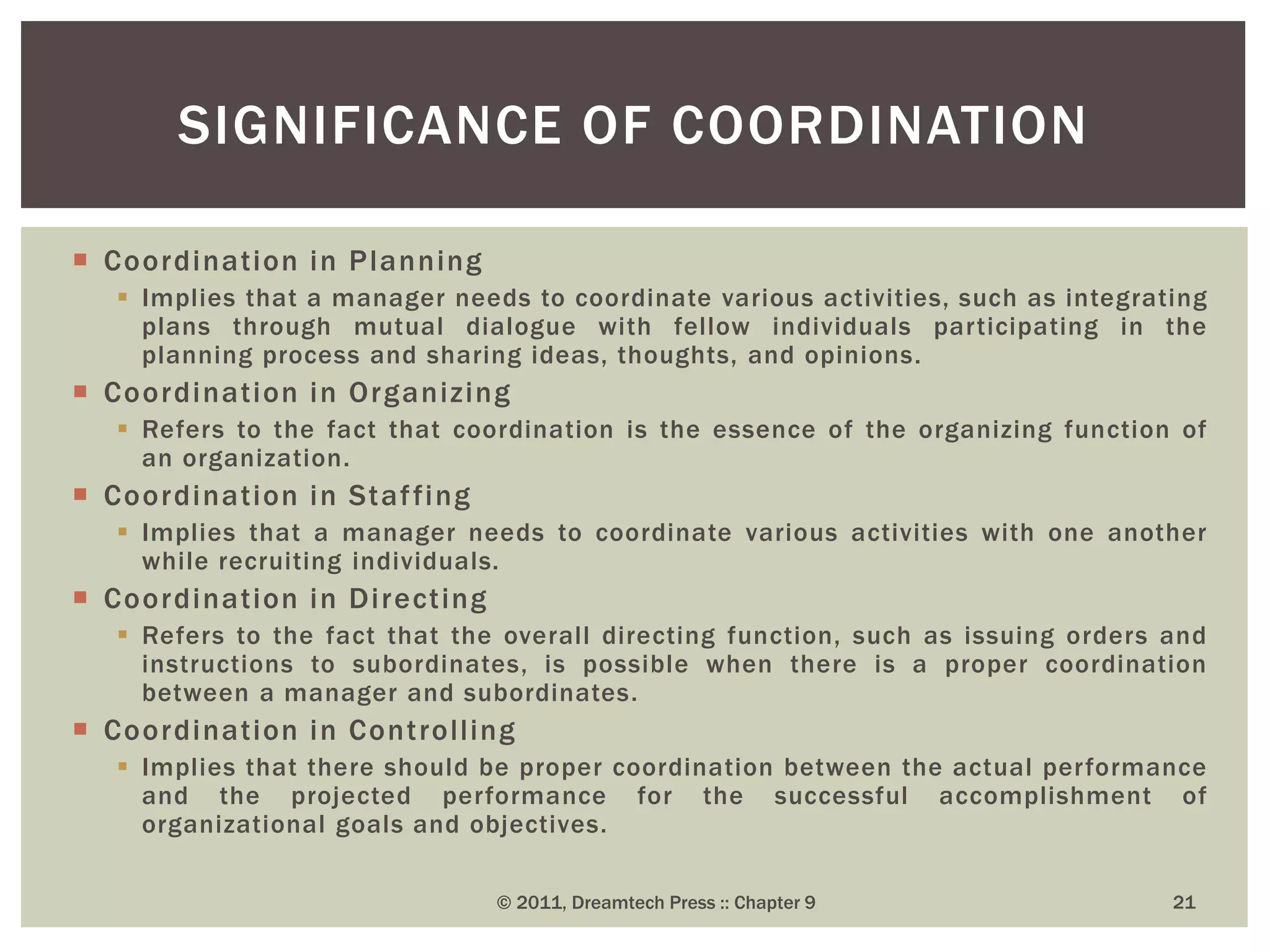
 Coordination in Planning
 Implies that a manager needs to coordinate various activities, such as integrating
plans through mutual dialogue with fellow individuals participating in the
planning process and sharing ideas, thoughts, and opinions.
 Coordination in Organizing
 Refers to the fact that coordination is the essence of the organizing function of
an organization.
 Coordination in Staffing
 Implies that a manager needs to coordinate various activities with one another
while recruiting individuals.
 Coordination in Directing
 Refers to the fact that the overall directing function, such as issuing orders and
instructions to subordinates, is possible when there is a proper coordination
between a manager and subordinates.
 Coordination in Controlling
 Implies that there should be proper coordination between the actual performance
and the projected performance for the successful accomplishment of
organizational goals and objectives.
SIGNIFICANCE OF COORDINATION
© 2011, Dreamtech Press :: Chapter 9 21
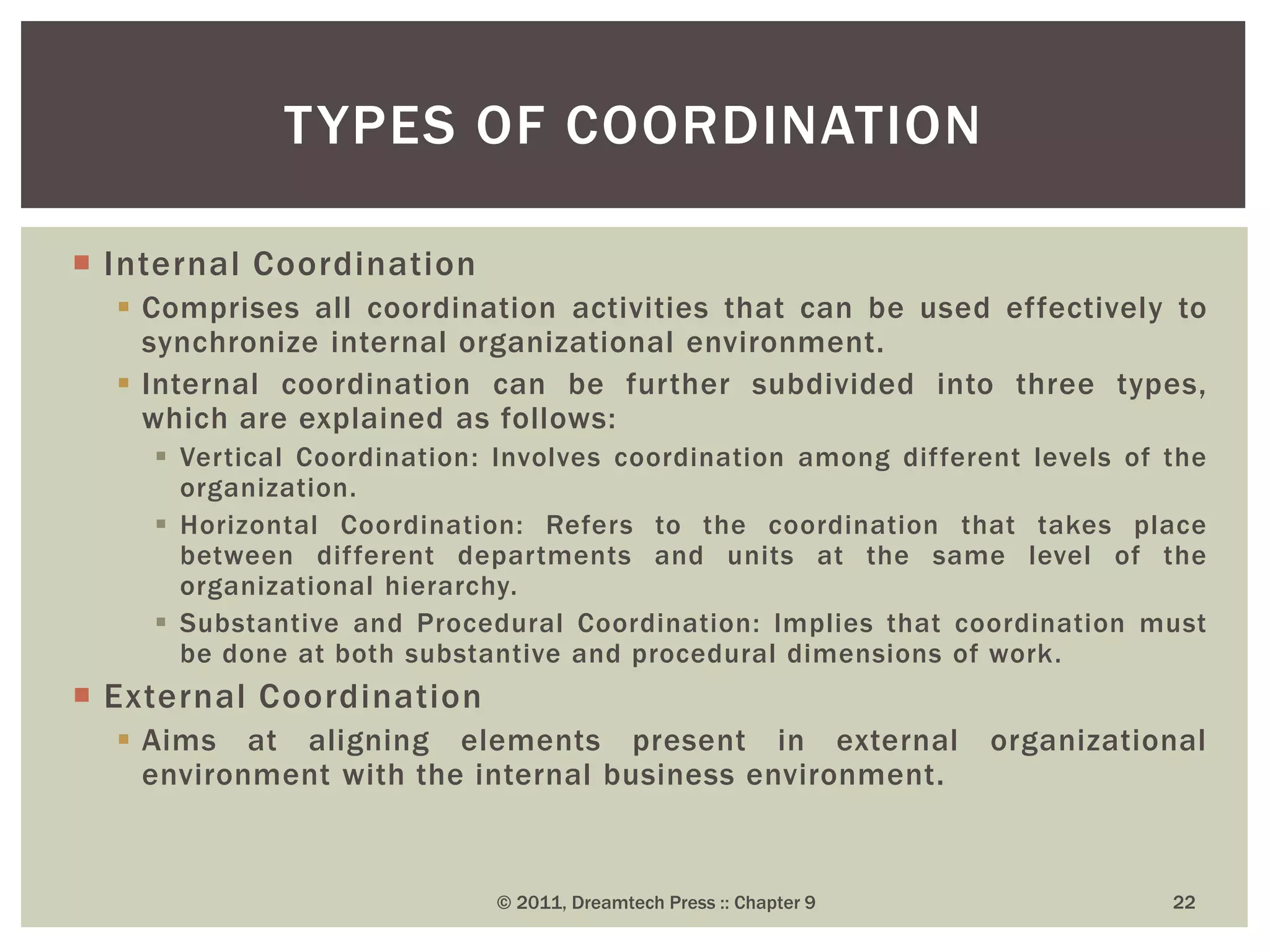
 Internal Coordination
 Comprises all coordination activities that can be used effectively to
synchronize internal organizational environment.
 Internal coordination can be further subdivided into three types,
which are explained as follows:
 Vertical Coordination: Involves coordination among different levels of the
organization.
 Horizontal Coordination: Refers to the coordination that takes place
between different departments and units at the same level of the
organizational hierarchy.
 Substantive and Procedural Coordination: Implies that coordination must
be done at both substantive and procedural dimensions of work.
 External Coordination
 Aims at aligning elements present in external organizational
environment with the internal business environment.
TYPES OF COORDINATION
© 2011, Dreamtech Press :: Chapter 9 22
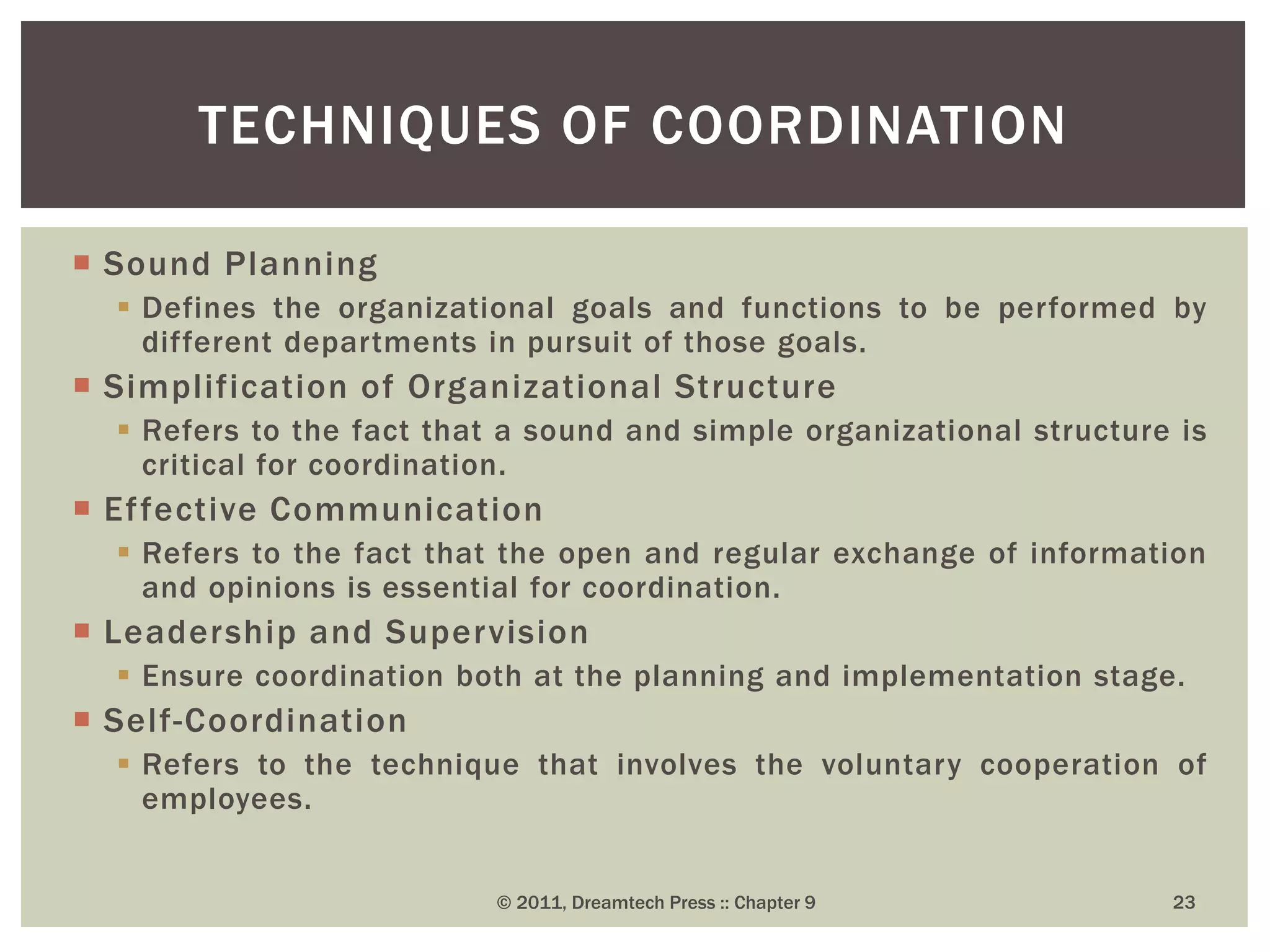
 Sound Planning
 Defines the organizational goals and functions to be performed by
different departments in pursuit of those goals.
 Simplification of Organizational Structure
 Refers to the fact that a sound and simple organizational structure is
critical for coordination.
 Effective Communication
 Refers to the fact that the open and regular exchange of information
and opinions is essential for coordination.
 Leadership and Supervision
 Ensure coordination both at the planning and implementation stage.
 Self-Coordination
 Refers to the technique that involves the voluntary cooperation of
employees.
TECHNIQUES OF COORDINATION
© 2011, Dreamtech Press :: Chapter 9 23
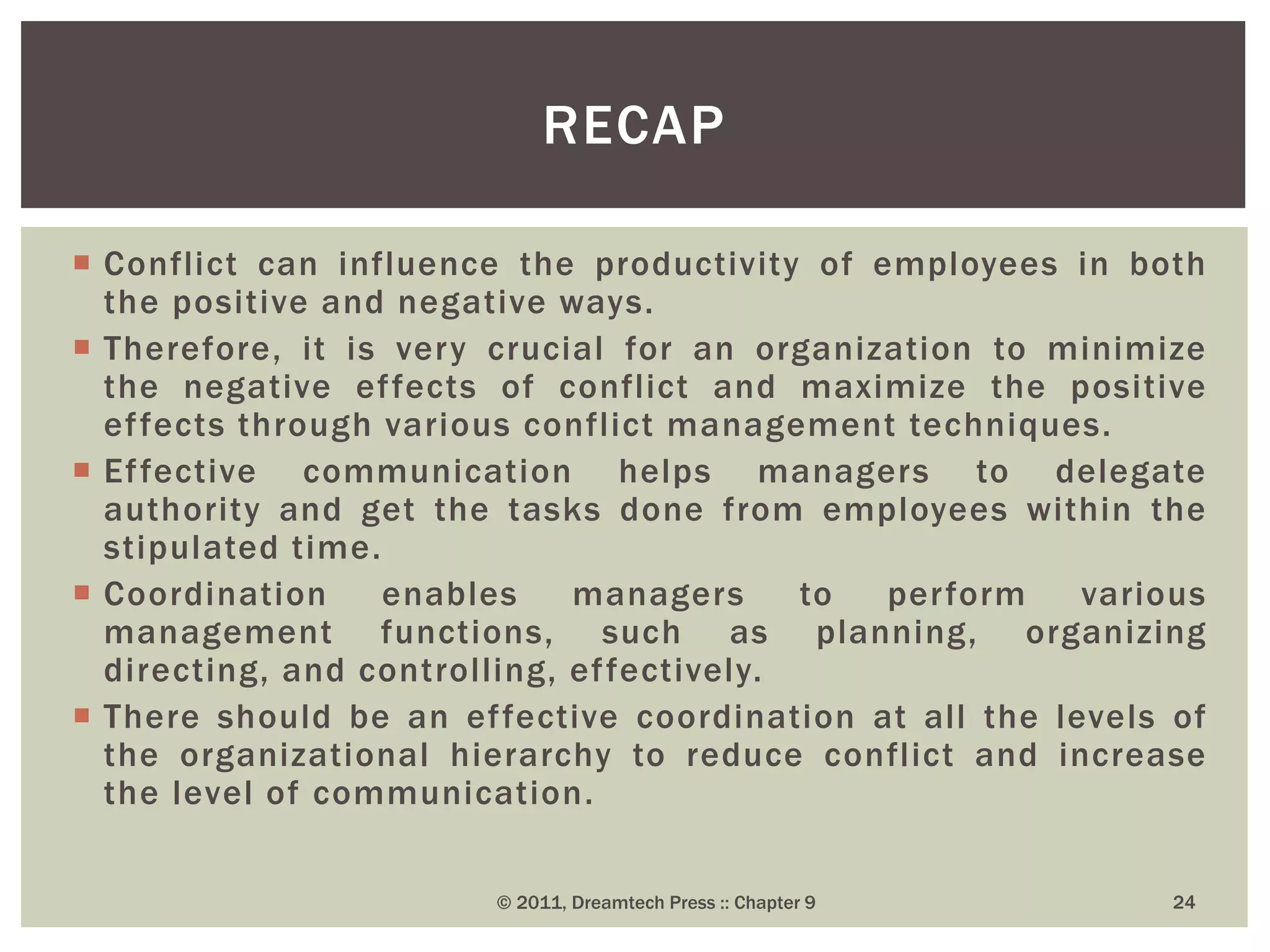
 Conflict can influence the productivity of employees in both
the positive and negative ways.
 Therefore, it is very crucial for an organization to minimize
the negative effects of conflict and maximize the positive
effects through various conflict management techniques.
 Effective communication helps managers to delegate
authority and get the tasks done from employees within the
stipulated time.
 Coordination enables managers to perform various
management functions, such as planning, organizing
directing, and controlling, effectively.
 There should be an effective coordination at all the levels of
the organizational hierarchy to reduce conflict and increase
the level of communication.
RECAP
© 2011, Dreamtech Press :: Chapter 9 24

Chapter 09 conflict,communication,and coordination

  • 1.
  • 2.
     Conflict isthe struggle between incompatible or opposing needs, wishes, ideas, interests, or people. According to them conflict arises when individuals or groups encounter goals that both parties cannot attain satisfactorily. ---- Chung and Meggison  Conflict has been defined as the condition of objective incompatibility between values and goals; as the behavior of deliberately interfering with another’s goal achievement; and as emotionally in terms of hostility. Descriptive theorists have explained conflict behavior in terms of objective conflict of interest, personal styles, reactions to threats, and cognitive distortions. ---- Pondy DEFINE CONFLICT © 2011, Dreamtech Press :: Chapter 9 2
  • 3.
     Occurs whentwo or more individuals pursue incompatible goals  Refers to the behavior of individuals due to which they try to prevent others from attaining their goals  Arises due to a dilemma within an individual to select the right course of action  Occurs when there is a mismatch between the actual and expected role  Arises when the goals of one individual or department clashes with the goals of the other individual or department CHARACTERISTICS OF CONFLICT © 2011, Dreamtech Press :: Chapter 9 3
  • 4.
    • Refers tothe conflict that supports the group goals, thus, improve its performance.Functional Conflict • Refers to the conflict that obstructs group performance or provides negative results. This is a negative conflict that hampers the group as well as individual performance. Dysfunctional Conflict TYPES OF CONFLICT © 2011, Dreamtech Press :: Chapter 9 4
  • 5.
    Individual- Level Conflict Intra-Individual Conflict •Goal Conflict •RoleConflict Inter-Individual Conflict Group-Level Conflict Intra-Group Conflict Inter-Group Conflict Organizational- Level Conflict Intra-Organizational Conflict •Horizontal Conflict •Vertical Conflict Inter-Organizational Conflict © 2011, Dreamtech Press :: Chapter 1 5 LEVELS OF CONFLICT
  • 6.
    1 •Potential Opposition orIncompatibility Stage 2 •Cognition and Personalization Stage •Perceived Conflict •Felt Conflict 3 •Intentions Stage 4 •Behavior Stage 5 •Outcome Stage © 2011, Dreamtech Press :: Chapter 1 6 PROCESS OF CONFLICT
  • 7.
    © 2011, DreamtechPress :: Chapter 1 7 RELATIONSHIP BETWEEN CONFLICT AND PERFORMANCE
  • 8.
     Communication  Impliesthat a conflict arises when the correct information does not reach the employees of the organization.  Personal Variables  Refer to variables, such as personality and the value system of an employee.  Unrealistic Expectations  Refer to impractical expectations of managers from employees.  Change  Indicates that individuals or groups might be resistant to adopt to any new change in an organization, thus, giving rise to conflict.  Goal Conflict  Indicates that the goals of two or more individuals or groups collide with one another, leading to conflict.  Difference in Values  Indicate that people have different value system to which they are emotionally attached and uncompromising.  Behavior  Indicates that any extreme action of an individual, whether defensive or offensive, can be a reason of conflict. SOURCES OF CONFLICT © 2011, Dreamtech Press :: Chapter 9 8
  • 9.
     Positive outcome: Leads to innovation and new direction  Draws attention towards the areas where improvement is needed  Energizes as well as motivates individuals and groups to prove themselves by performing well in difficult situations  Makes the work environment challenging by developing competition among individuals  Negative outcomes:  Produces unproductive outcomes when problem is not handled in the desired or expected manner  Creates a climate of distrust and suspicion among individuals  Creates misunderstanding among individuals  Distorts the perception of individuals, thus, creates barrier in the overall working of an organization  Distracts attention of individuals from basic organizational objectives  Creates tension among individuals that further leads to unharmonious environment in the organization OUTCOMES OF CONFLICT © 2011, Dreamtech Press :: Chapter 9 9
  • 10.
    •Refers to anapproach of conflict resolution where individuals or groups, who are involved in conflict meet face-to-face to resolve the matter through discussion.Problem Solving •Refer to the shared goals of two or more parties that are based on mutual trust.Super-Ordinate Goals •Refers to increase the availability of resources.Increasing Resources •Supports the suppression of conflict or withdrawal from it.Avoidance •Refers to a technique in which both conflicting parties, which are involved in conflict, are required to give up their personal motives and think collectively to resolve a conflict.Compromise •Indicates that by the usage of formal authority, managers can resolve the conflict.Authoritative Command •Indicates the techniques, such as training to change the human behavior or attitude to deal with conflict in a better manner.Altering the Human Variable CONFLICT RESOLUTION TECHNIQUES © 2011, Dreamtech Press :: Chapter 9 10
  • 11.
    •Means that amanager can stimulate conflict by including an employee whose working style, personality, and way of thinking is quite different from existing employees. Bringing in Outsiders •Refers to reshuffling between two or more groups to exchange their members. Restructuring the Group •Refers to an act of appointing a manager, who can initiate arguments and oppose the already set-ideas to induce the conflict in the organization. Appointing the Devil’s Advocate CONFLICT STIMULATION TECHNIQUES © 2011, Dreamtech Press :: Chapter 9 11
  • 12.
     Negotiation isa communication process that helps to manage all types of conflict in an effective and mutually satisfying way.  According to Lewicki and Litterer, a negotiation situation can be defined by three characteristics, which are as follows:  Identifying the conflict of interest between two or more parties  Following no pre-determined set of rules and procedures to resolve the conflict  Trying to a reach at an agreement NEGOTIATION © 2011, Dreamtech Press :: Chapter 9 12
  • 13.
    1 •Preparing and Planning 2 •DefiningGround Rules 3 •Clarification and Justification 4 •Bargaining and Problem Solving 5 •Closure and Implementation NEGOTIATION PROCESS © 2011, Dreamtech Press :: Chapter 9 13
  • 14.
     Distributive Negotiation Refers to the type of negotiation, where both the conflicting parties try to gain the maximum benefits from the process of negotiation.  Integrative Negotiation  Refers to the type of negotiation in which both the parties try to maximize their mutual benefit. NEGOTIATION STRATEGIES © 2011, Dreamtech Press :: Chapter 9 14
  • 15.
     Communication isthe intercourse by words, letters, or message, intercourse of thoughts or opinions. It is the act of making one’s ideas and opinions known to others. ---- Fred G. Meyer  Communication is the sum of all the things one person does when he wants to create understanding in the mind of another. It is a bridge of meaning. It involves a systematic and continuous process of telling, listening, and understanding. ---- Louis A. Allen COMMUNICATION © 2011, Dreamtech Press :: Chapter 9 15
  • 16.
    Sender •Refers to aparty or agent who sends the intended message to another party or agent. Encoding •Refers to a process that puts the thoughts in a framework of symbols or words. Message •Refers to the collection of symbols or words that together convey the intention of the sender. Decoding •Refers to the process of deciphering the received message and understanding its intended meaning. Receiver •Refers to a party or agent who receives the sent message. The receiver is also called audience or destination. Feedback •Refers to the response of the receiver to the message of the sender. COMMUNICATION PROCESS © 2011, Dreamtech Press :: Chapter 9 16
  • 17.
     Formal Communication Ensures that communication should occur in a formal format or pattern that is acceptable in an organization  Informal Communication  Includes a free and uninhibited communication between two agents, parties or people who share a rapport with each other TYPES OF COMMUNICATION: ON THE BASIS OF CHANNEL USED © 2011, Dreamtech Press :: Chapter 9 17
  • 18.
     Upward Communication Refers to the communication that flows from the lower level to upper level of organizational hierarchy  Downward Communication  Refers to the communication that flows from upward to downward level of organizational hierarchy  Horizontal Communication  Refers to the communication taking place among the members at the same level in the organization  Diagonal Communication  Refers to the communication that takes place between individuals in different departments and at the different levels of organizational hierarchy TYPES OF COMMUNICATION: ON THE BASIS OF DIRECTION © 2011, Dreamtech Press :: Chapter 9 18
  • 19.
     Verbal Communication Takes place with the help of sounds, words, and language  Nonverbal Communication  Refers to the kind of communication that involves various characteristics, such as tone of the voice (inflexions), smell, touch, and body motion  Written Communication  Involves the use of e-mails, articles, reports, and memos  Visual Communication  Involves the visual display of information, such as photos, formats, signs, codes, symbols, and designs TYPES OF COMMUNICATION: ON THE BASIS OF MEANS USED © 2011, Dreamtech Press :: Chapter 9 19
  • 20.
     Coordination isthe orderly synchronization of efforts of the subordinates to provide the proper amount, timing, and quality of execution, so that their unified efforts lead to the stated objective, namely the common purpose of the enterprise. ---- Haimann  Coordination involves the development of unity of purpose and harmonious implementation of plans for achievement of the desired ends. ---- James L. Lundy COORDINATION © 2011, Dreamtech Press :: Chapter 9 20
  • 21.
     Coordination inPlanning  Implies that a manager needs to coordinate various activities, such as integrating plans through mutual dialogue with fellow individuals participating in the planning process and sharing ideas, thoughts, and opinions.  Coordination in Organizing  Refers to the fact that coordination is the essence of the organizing function of an organization.  Coordination in Staffing  Implies that a manager needs to coordinate various activities with one another while recruiting individuals.  Coordination in Directing  Refers to the fact that the overall directing function, such as issuing orders and instructions to subordinates, is possible when there is a proper coordination between a manager and subordinates.  Coordination in Controlling  Implies that there should be proper coordination between the actual performance and the projected performance for the successful accomplishment of organizational goals and objectives. SIGNIFICANCE OF COORDINATION © 2011, Dreamtech Press :: Chapter 9 21
  • 22.
     Internal Coordination Comprises all coordination activities that can be used effectively to synchronize internal organizational environment.  Internal coordination can be further subdivided into three types, which are explained as follows:  Vertical Coordination: Involves coordination among different levels of the organization.  Horizontal Coordination: Refers to the coordination that takes place between different departments and units at the same level of the organizational hierarchy.  Substantive and Procedural Coordination: Implies that coordination must be done at both substantive and procedural dimensions of work.  External Coordination  Aims at aligning elements present in external organizational environment with the internal business environment. TYPES OF COORDINATION © 2011, Dreamtech Press :: Chapter 9 22
  • 23.
     Sound Planning Defines the organizational goals and functions to be performed by different departments in pursuit of those goals.  Simplification of Organizational Structure  Refers to the fact that a sound and simple organizational structure is critical for coordination.  Effective Communication  Refers to the fact that the open and regular exchange of information and opinions is essential for coordination.  Leadership and Supervision  Ensure coordination both at the planning and implementation stage.  Self-Coordination  Refers to the technique that involves the voluntary cooperation of employees. TECHNIQUES OF COORDINATION © 2011, Dreamtech Press :: Chapter 9 23
  • 24.
     Conflict caninfluence the productivity of employees in both the positive and negative ways.  Therefore, it is very crucial for an organization to minimize the negative effects of conflict and maximize the positive effects through various conflict management techniques.  Effective communication helps managers to delegate authority and get the tasks done from employees within the stipulated time.  Coordination enables managers to perform various management functions, such as planning, organizing directing, and controlling, effectively.  There should be an effective coordination at all the levels of the organizational hierarchy to reduce conflict and increase the level of communication. RECAP © 2011, Dreamtech Press :: Chapter 9 24