{
INTERPERSONAL
COMMUNICATION
By Ma’am: Syeda Tooba Saleem
introduction
 Name
 School (field)
 College (field)
 Your dream/future
goals
 Any achievement in
life
 Hobbies
 Interpersonal Communication:
is the process of exchange of information, ideas,
feelings and meaning between two or more people
through verbal and/or non-verbal methods. It often
includes face-to-face exchange of messages, which may
take form of a certain tone of voice, facial expressions,
body language and gestures.
Interpersonal Communication
Nature of Interpersonal Communication
Forms of interpersonal communication:
 Face to Face communication
 Communication mediated/facilitated by
technology
 Asynchronous (different time conversation) e.g. e-
mail & online polling.
 Synchronous (same time conversation as this
needs a clock in control lines) e.g. live videos &
instant messages in chat rooms.
Universals of Interpersonal Communication
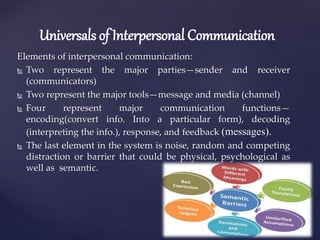
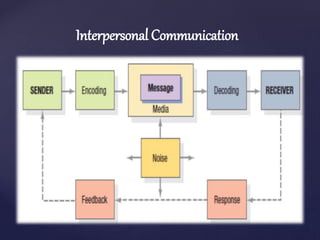
Elements of interpersonal communication:
 Two represent the major parties—sender and receiver
(communicators)
 Two represent the major tools—message and media (channel)
 Four represent major communication functions—
encoding(convert info. Into a particular form), decoding
(interpreting the info.), response, and feedback (messages).
 The last element in the system is noise, random and competing
distraction or barrier that could be physical, psychological as
well as semantic.
Interpersonal Communication
Universals of Interpersonal Communication
Common purpose of interpersonal
communication:
 To learn
 To relate (narrate or share)
 To influence
 To help
 To play
Axioms of Interpersonal Communication
Following are some sayings related to
interpersonal communication:
It is ambiguous and unclear.
It is irreversible.
It is unrepeatable.
It is unavoidable.
It is the series of punctuated events.
Thanks…

Interpersonal Communication

  • 1.
  • 2.
    introduction  Name  School(field)  College (field)  Your dream/future goals  Any achievement in life  Hobbies
  • 3.
     Interpersonal Communication: isthe process of exchange of information, ideas, feelings and meaning between two or more people through verbal and/or non-verbal methods. It often includes face-to-face exchange of messages, which may take form of a certain tone of voice, facial expressions, body language and gestures. Interpersonal Communication
  • 4.
    Nature of InterpersonalCommunication Forms of interpersonal communication:  Face to Face communication  Communication mediated/facilitated by technology  Asynchronous (different time conversation) e.g. e- mail & online polling.  Synchronous (same time conversation as this needs a clock in control lines) e.g. live videos & instant messages in chat rooms.
  • 5.
    Universals of InterpersonalCommunication Elements of interpersonal communication:  Two represent the major parties—sender and receiver (communicators)  Two represent the major tools—message and media (channel)  Four represent major communication functions— encoding(convert info. Into a particular form), decoding (interpreting the info.), response, and feedback (messages).  The last element in the system is noise, random and competing distraction or barrier that could be physical, psychological as well as semantic.
  • 6.
  • 7.
    Universals of InterpersonalCommunication Common purpose of interpersonal communication:  To learn  To relate (narrate or share)  To influence  To help  To play
  • 8.
    Axioms of InterpersonalCommunication Following are some sayings related to interpersonal communication: It is ambiguous and unclear. It is irreversible. It is unrepeatable. It is unavoidable. It is the series of punctuated events.
  • 9.

Editor's Notes

  • #5 Relate>> gossips.
  • #6 Denotation > blue is color connotation > blue is taken in meaning of sad not all color of life is “blue”
  • #8 Relate>> gossips.
  • #9 Relate>> gossips.