CONFLICT RESOLUTION
WHAT IS CONFLICT?
• Conflict is a difference of opinion or differing views between two
persons, groups of organization. (Popular view)
• Conflict is a process that begins when one party perceives that another
party has negatively affected or is about to negatively affect,
something that the first party cares about (Robbins, 1998).
• Conflict is a process in which an effort is purposely made by A to offset
the efforts of B by some form of blocking that will result in frustrating
B in attaining his or her goals or furthering his or her interests.
(Robbins & Mathew, 2009)
TRADITIONAL VS. INTERACTIONIST
VIEWS
• Traditional View:
• The early approach to conflict assumed that all conflict is bad
(harmful) & must be avoided. Conflict seen negatively.
• Conflict was seen as a dysfunctional outcome resulting from
poor communication, a lack of openness and trust between
people, and the failure of managers to be responsive to the
needs and aspirations of their employees.
• Human Relations View:
• Conflict is a natural occurrence in all groups & organizations.
Proponents rationalized its existence: it cannot be eliminated,
& there are times when it can benefit a group’s performance.
TRADITIONAL VS. INTERACTIONIST
VIEWS
• Interactionist View:
• Conflict is not only a positive force in a group but it is
absolutely necessary for a group to perform
effectively.
• A harmonious, peaceful, tranquil, and cooperative
group is prone to become static, apathetic, & non-
responsive to needs for change & innovation.
• Acc. to this view, the group leader should be
encouraged to maintain an ongoing minimum level
of conflict—enough to keep the group viable, self-
critical, and creative.
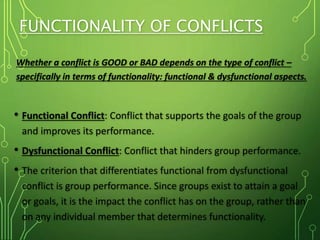
FUNCTIONALITY OF CONFLICTS
Whether a conflict is GOOD or BAD depends on the type of conflict –
specifically in terms of functionality: functional & dysfunctional aspects.
• Functional Conflict: Conflict that supports the goals of the group
and improves its performance.
• Dysfunctional Conflict: Conflict that hinders group performance.
• The criterion that differentiates functional from dysfunctional
conflict is group performance. Since groups exist to attain a goal
or goals, it is the impact the conflict has on the group, rather than
on any individual member that determines functionality.
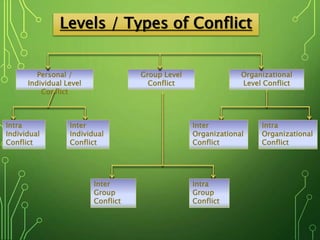
Levels / Types of Conflict
Personal /
Individual Level
Conflict
Group Level
Conflict
Organizational
Level Conflict
Intra
Individual
Conflict
Inter
Individual
Conflict
Inter
Group
Conflict
Intra
Group
Conflict
Inter
Organizational
Conflict
Intra
Organizational
Conflict
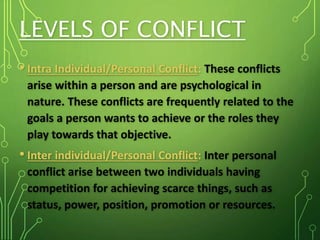
LEVELS OF CONFLICT
• Intra Individual/Personal Conflict: These conflicts
arise within a person and are psychological in
nature. These conflicts are frequently related to the
goals a person wants to achieve or the roles they
play towards that objective.
• Inter individual/Personal Conflict: Inter personal
conflict arise between two individuals having
competition for achieving scarce things, such as
status, power, position, promotion or resources.
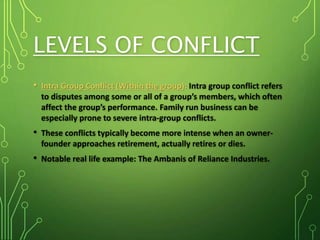
LEVELS OF CONFLICT
• Intra Group Conflict (Within the group): Intra group conflict refers
to disputes among some or all of a group’s members, which often
affect the group’s performance. Family run business can be
especially prone to severe intra-group conflicts.
• These conflicts typically become more intense when an owner-
founder approaches retirement, actually retires or dies.
• Notable real life example: The Ambanis of Reliance Industries.
LEVELS OF CONFLICT
• Inter group Conflicts (Between groups): Inter group
conflict arises out of the interaction of various groups.
• Inter group conflict may frequently happen within an
organization, thereby featuring as an organizational
conflict; here, it may refer to the conflict between
groups, departments, or sections within an organization.
• Conflict between groups is frequent and highly visible.
LEVELS OF CONFLICT
• Intra Organizational Conflict: The conflict which
arises with in various levels and departments of
organization. Various kinds are:
I. Horizontal Conflict – at the same level
(colleagues with similar designations)
II. Vertical Conflict – hierarchical levels (supervisors
& subordinates)
LEVELS OF CONFLICT
• Inter Organizational Conflict: Inter organizational conflict refers to
conflict between/among different organizations.
• Inter Organizational Conflict may include:
i. Conflict between organizations pursuing similar
objectives.
ii. Conflict between government agency and organization.
iii. Conflict between head office and a manufacturing unit.
While the last one is regularized by organizational rules
and procedures, the other types of conflicts are regulated
by State laws, administrative agencies, courts, and
regulatory commissions.
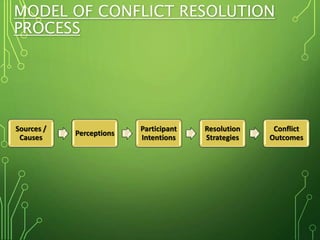
MODEL OF CONFLICT RESOLUTION
PROCESS
Sources /
Causes
Perceptions
Participant
Intentions
Resolution
Strategies
Conflict
Outcomes
SOURCES/CAUSES OF CONFLICT
• Organizational Change
• Different Sets of Values
• Threats to Status
• Contrasting Perceptions
• Lack of Trust
• Incivility
• Difficult Tasks
• Personality Clashes
Reference: Newstrom, J. W. (2011, 13th Edn.). Organizational Behavior: Human Behavior at
Work
SOURCES OF CONFLICT
• Organizational Change: People hold different views over the
direction to go, the routes to take, and their likely success, the
resources to be used, the probable outcomes. These different
views can lead to conflict.
• Different Sets of Values: People hold different beliefs and
adhere to different value systems. Their philosophies may
diverge, or their ethical value may lead them in different
directions. The resulting disputes may be difficult to resolve,
since they are less objective than disagreements over alternative
products, inventory levels, or promotional campaigns.
SOURCES OF CONFLICT
• Threats to Status: Status or the social rank of a person in a group
is very important to many individuals. When one’s status is
threatened, face-saving (the drive to protect one’s self image)
becomes a powerful driving force as a person struggles to
maintain a desired image. Conflict may arise between the
defensive person and whoever created a threat to status.
• Contrasting Perceptions: People perceive things differently as a
result of their prior experiences and expectations. Since these
perceptions are very real to the individual s/he may fail to see
that others may have contrasting perception of the same
object/event/person, thereby giving rise to conflict.
SOURCES OF CONFLICT
•Lack of Trust: Every continuing relationship
requires some degree of trust – the capacity to
voluntarily depend on each others’ word &
actions. When someone has a real or perceived
reason not to trust another, the potential for
conflict arises.
SOURCES OF CONFLICT
• Incivility: Mutual respect, empathy, and caring are the glues that hold work groups together.
Yet, lack of “common” courtesy is a problem in many organizations.
• Workplace incivility (WI) occurs when employees fail to exhibit concern and regard for others
or disrespect each other on the job. Lack of consideration may appear in many forms, including
brusque greetings, sarcasm, failure to return borrowed supplies, selfishness, showing up late
for appointments, untidiness, or noise (such as playing a radio & using cell phones in public
places). Regardless of the cause, WI can cause tensions to rise, anger to flare, & conflict to
emerge. Simple solutions to WI can be:
• Paying attention to others
• Listening to their points of view
• Inclusively welcoming others
• Showing respect for others’ time, space and opinions
• Apologizing earnestly when appropriate
• Speaking kindly with others
• Refraining from gossiping or making idle complaints
• Avoiding blaming others
• Giving constructive criticisms objectively
SOURCES OF CONFLICT
• Difficult Tasks: Occasionally, managers are charged with performing
distasteful tasks that predictably result in conflict. These tasks include
mass layoffs, personal firings for underperformance, and disciplinary
actions. Under these circumstances, some employees strike back at their
manager, either orally or physically.
• Personality Clashes: Not everyone thinks, feels, or acts alike. Some
people tend to rub us off the wrong way, and we cannot necessarily
explain why. Although personality differences can cause conflict, they are
also a rich resource for creative problem solving. Employees need to
accept, respect, and learn how to use these differences when they arise.
One popular measure for understanding Personality in the organizational
set up is MBTI (Myers Briggs Type Indicator, developed by Katherine
Myers & Isabel Briggs, based on the Type Theory perspective of Carl
Jung).
CONFLICT MANAGEMENT:
STRATEGIES / TECHNIQUES
• Confronting / Problem Solving
• Avoiding
• Smoothing
• Forcing
• Compromising
• Superordinate Goals
• Expansion of Resources
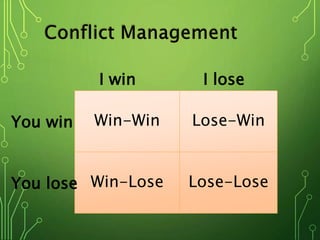
Win-Win Lose-Win
Win-Lose Lose-Lose
I win I lose
You win
You lose
CONFLICT MANAGEMENT
STRATEGIES
• Competing: A desire to satisfy one’s interests, regardless of the
impact on the other part to the conflict.
• Collaborating: A situation where the parties to a conflict each
desire to satisfy fully the concerns of all parties.
• Avoiding: The desire to withdraw from or suppress a conflict.
• Accommodating: The willingness of one party in a conflict to
place opponent’s interests above one’s own.
• Compromising: A situation in which each party to a conflict is
willing to give up something
CONFLICT MANAGEMENT:
HEALTHY OR UNHEALTHY
WAYS?
• Unhealthy Conflict Resolution
• Just as two main types of conflict occur among employees, people utilize healthy and
unhealthy ways to resolve conflict. Unhealthy ways to treat conflict include denial of the
existence of the problem, giving up rather than working toward a viable solution, getting
angry and placing blame, and manipulating others toward a certain outcome. These
behaviors lead to increased problems and tensions among employees.
• Healthy Conflict Resolution
• Healthy conflict resolution uses creative ways to involve all those affected by the conflict to
reach a fair and equitable solution. These can include a compromise, where each party gains
something and gives something up, or a win-win solution where both parties get what they
want. The win-win solution requires open-mindedness and creative thinking. The last healthy
conflict method, win-lose, involves one party "winning" the conflict and the other "losing,"
but agreeing that the next time problems arise between them, the other will give up his
position and lose, allowing a win for his counterpart.
HEALTHY CONFLICT
MANAGEMENT:
STRATEGIES / TECHNIQUES
• Identify the problem or issues. Have a discussion to understand all
sides of the problem, conflicts, needs and preferred outcomes. Clarify
to each party exactly what the conflict or problem involves. This is the
initial stage where each party can say what they want and they listen
to what the other party wants. Use of active listening skills can help, as
does a blameless approach to beginning the negotiation.
• Generate several possible solutions. This is the creative integrative

part. Drawing upon the things both parties agree on and upon the
shared goals and interests; look for several possible alternatives that
might solve the problem. Avoid evaluating and judging each idea until
it looks as though no more are going to be suggested. This is a
brainstorming approach.
HEALTHY CONFLICT MANAGEMENT:
STRATEGIES / TECHNIQUES
• Evaluate the alternative solutions. Consider each suggested solution and eliminate
those that are not acceptable to either party. Keep narrowing them down to one or
two that seem best for both.
• Decide on the best solution. Select the alternative that is mutually acceptable to
both parties. Make certain there is a mutual commitment to the decision.
• Implement the solution. It is one thing to arrive at a decision, another to carry it
out. Sometimes it is necessary to talk about how it is to be implemented. Who is
responsible to do what and by when?
• Follow-up evaluation. Not all mutually agreed upon solutions turn out to be as good
as initially expected. Make it a routine to do timely checks for accountability and
actions. Something may have been overlooked, misjudged, or something
unexpected may have occurred. Both parties should have the understanding that
decisions may need to be open for revision, but that modifications have to be
UNHEALTHY CONFLICT MANAGEMENT:
COMMON MISTAKES
• Not discussing with the other party the method used to resolve own
party’s conflicts.
• Discovering too late that more information was needed, e.g., "I should
have placed the order sooner, now they are sold out." Being too invested
in getting your way, or making extreme demands, and therefore not
being able to be flexible enough to be fair with your partner. Forgetting
that there are usually several ways of doing things and that your own
reality (or perception) is not the only reality. We humans have a
consistent tendency to believe that we are right and are being
reasonable. You will be much more effective if you are willing to see the
other party’s point of view. Focusing too much on what you could lose
and not enough on what both parties could gain. Believing the other
person must lose for you to win. Another unhealthy approach is bringing
HAPPY LEARNING

CONFLICT it's types , source, causes and management.pptx

  • 1.
  • 2.
    WHAT IS CONFLICT? •Conflict is a difference of opinion or differing views between two persons, groups of organization. (Popular view) • Conflict is a process that begins when one party perceives that another party has negatively affected or is about to negatively affect, something that the first party cares about (Robbins, 1998). • Conflict is a process in which an effort is purposely made by A to offset the efforts of B by some form of blocking that will result in frustrating B in attaining his or her goals or furthering his or her interests. (Robbins & Mathew, 2009)
  • 3.
    TRADITIONAL VS. INTERACTIONIST VIEWS •Traditional View: • The early approach to conflict assumed that all conflict is bad (harmful) & must be avoided. Conflict seen negatively. • Conflict was seen as a dysfunctional outcome resulting from poor communication, a lack of openness and trust between people, and the failure of managers to be responsive to the needs and aspirations of their employees. • Human Relations View: • Conflict is a natural occurrence in all groups & organizations. Proponents rationalized its existence: it cannot be eliminated, & there are times when it can benefit a group’s performance.
  • 4.
    TRADITIONAL VS. INTERACTIONIST VIEWS •Interactionist View: • Conflict is not only a positive force in a group but it is absolutely necessary for a group to perform effectively. • A harmonious, peaceful, tranquil, and cooperative group is prone to become static, apathetic, & non- responsive to needs for change & innovation. • Acc. to this view, the group leader should be encouraged to maintain an ongoing minimum level of conflict—enough to keep the group viable, self- critical, and creative.
  • 5.
    FUNCTIONALITY OF CONFLICTS Whethera conflict is GOOD or BAD depends on the type of conflict – specifically in terms of functionality: functional & dysfunctional aspects. • Functional Conflict: Conflict that supports the goals of the group and improves its performance. • Dysfunctional Conflict: Conflict that hinders group performance. • The criterion that differentiates functional from dysfunctional conflict is group performance. Since groups exist to attain a goal or goals, it is the impact the conflict has on the group, rather than on any individual member that determines functionality.
  • 6.
    Levels / Typesof Conflict Personal / Individual Level Conflict Group Level Conflict Organizational Level Conflict Intra Individual Conflict Inter Individual Conflict Inter Group Conflict Intra Group Conflict Inter Organizational Conflict Intra Organizational Conflict
  • 7.
    LEVELS OF CONFLICT •Intra Individual/Personal Conflict: These conflicts arise within a person and are psychological in nature. These conflicts are frequently related to the goals a person wants to achieve or the roles they play towards that objective. • Inter individual/Personal Conflict: Inter personal conflict arise between two individuals having competition for achieving scarce things, such as status, power, position, promotion or resources.
  • 8.
    LEVELS OF CONFLICT •Intra Group Conflict (Within the group): Intra group conflict refers to disputes among some or all of a group’s members, which often affect the group’s performance. Family run business can be especially prone to severe intra-group conflicts. • These conflicts typically become more intense when an owner- founder approaches retirement, actually retires or dies. • Notable real life example: The Ambanis of Reliance Industries.
  • 9.
    LEVELS OF CONFLICT •Inter group Conflicts (Between groups): Inter group conflict arises out of the interaction of various groups. • Inter group conflict may frequently happen within an organization, thereby featuring as an organizational conflict; here, it may refer to the conflict between groups, departments, or sections within an organization. • Conflict between groups is frequent and highly visible.
  • 10.
    LEVELS OF CONFLICT •Intra Organizational Conflict: The conflict which arises with in various levels and departments of organization. Various kinds are: I. Horizontal Conflict – at the same level (colleagues with similar designations) II. Vertical Conflict – hierarchical levels (supervisors & subordinates)
  • 11.
    LEVELS OF CONFLICT •Inter Organizational Conflict: Inter organizational conflict refers to conflict between/among different organizations. • Inter Organizational Conflict may include: i. Conflict between organizations pursuing similar objectives. ii. Conflict between government agency and organization. iii. Conflict between head office and a manufacturing unit. While the last one is regularized by organizational rules and procedures, the other types of conflicts are regulated by State laws, administrative agencies, courts, and regulatory commissions.
  • 12.
    MODEL OF CONFLICTRESOLUTION PROCESS Sources / Causes Perceptions Participant Intentions Resolution Strategies Conflict Outcomes
  • 13.
    SOURCES/CAUSES OF CONFLICT •Organizational Change • Different Sets of Values • Threats to Status • Contrasting Perceptions • Lack of Trust • Incivility • Difficult Tasks • Personality Clashes Reference: Newstrom, J. W. (2011, 13th Edn.). Organizational Behavior: Human Behavior at Work
  • 14.
    SOURCES OF CONFLICT •Organizational Change: People hold different views over the direction to go, the routes to take, and their likely success, the resources to be used, the probable outcomes. These different views can lead to conflict. • Different Sets of Values: People hold different beliefs and adhere to different value systems. Their philosophies may diverge, or their ethical value may lead them in different directions. The resulting disputes may be difficult to resolve, since they are less objective than disagreements over alternative products, inventory levels, or promotional campaigns.
  • 15.
    SOURCES OF CONFLICT •Threats to Status: Status or the social rank of a person in a group is very important to many individuals. When one’s status is threatened, face-saving (the drive to protect one’s self image) becomes a powerful driving force as a person struggles to maintain a desired image. Conflict may arise between the defensive person and whoever created a threat to status. • Contrasting Perceptions: People perceive things differently as a result of their prior experiences and expectations. Since these perceptions are very real to the individual s/he may fail to see that others may have contrasting perception of the same object/event/person, thereby giving rise to conflict.
  • 16.
    SOURCES OF CONFLICT •Lackof Trust: Every continuing relationship requires some degree of trust – the capacity to voluntarily depend on each others’ word & actions. When someone has a real or perceived reason not to trust another, the potential for conflict arises.
  • 17.
    SOURCES OF CONFLICT •Incivility: Mutual respect, empathy, and caring are the glues that hold work groups together. Yet, lack of “common” courtesy is a problem in many organizations. • Workplace incivility (WI) occurs when employees fail to exhibit concern and regard for others or disrespect each other on the job. Lack of consideration may appear in many forms, including brusque greetings, sarcasm, failure to return borrowed supplies, selfishness, showing up late for appointments, untidiness, or noise (such as playing a radio & using cell phones in public places). Regardless of the cause, WI can cause tensions to rise, anger to flare, & conflict to emerge. Simple solutions to WI can be: • Paying attention to others • Listening to their points of view • Inclusively welcoming others • Showing respect for others’ time, space and opinions • Apologizing earnestly when appropriate • Speaking kindly with others • Refraining from gossiping or making idle complaints • Avoiding blaming others • Giving constructive criticisms objectively
  • 18.
    SOURCES OF CONFLICT •Difficult Tasks: Occasionally, managers are charged with performing distasteful tasks that predictably result in conflict. These tasks include mass layoffs, personal firings for underperformance, and disciplinary actions. Under these circumstances, some employees strike back at their manager, either orally or physically. • Personality Clashes: Not everyone thinks, feels, or acts alike. Some people tend to rub us off the wrong way, and we cannot necessarily explain why. Although personality differences can cause conflict, they are also a rich resource for creative problem solving. Employees need to accept, respect, and learn how to use these differences when they arise. One popular measure for understanding Personality in the organizational set up is MBTI (Myers Briggs Type Indicator, developed by Katherine Myers & Isabel Briggs, based on the Type Theory perspective of Carl Jung).
  • 19.
    CONFLICT MANAGEMENT: STRATEGIES /TECHNIQUES • Confronting / Problem Solving • Avoiding • Smoothing • Forcing • Compromising • Superordinate Goals • Expansion of Resources
  • 20.
    Win-Win Lose-Win Win-Lose Lose-Lose Iwin I lose You win You lose
  • 21.
    CONFLICT MANAGEMENT STRATEGIES • Competing:A desire to satisfy one’s interests, regardless of the impact on the other part to the conflict. • Collaborating: A situation where the parties to a conflict each desire to satisfy fully the concerns of all parties. • Avoiding: The desire to withdraw from or suppress a conflict. • Accommodating: The willingness of one party in a conflict to place opponent’s interests above one’s own. • Compromising: A situation in which each party to a conflict is willing to give up something
  • 22.
    CONFLICT MANAGEMENT: HEALTHY ORUNHEALTHY WAYS? • Unhealthy Conflict Resolution • Just as two main types of conflict occur among employees, people utilize healthy and unhealthy ways to resolve conflict. Unhealthy ways to treat conflict include denial of the existence of the problem, giving up rather than working toward a viable solution, getting angry and placing blame, and manipulating others toward a certain outcome. These behaviors lead to increased problems and tensions among employees. • Healthy Conflict Resolution • Healthy conflict resolution uses creative ways to involve all those affected by the conflict to reach a fair and equitable solution. These can include a compromise, where each party gains something and gives something up, or a win-win solution where both parties get what they want. The win-win solution requires open-mindedness and creative thinking. The last healthy conflict method, win-lose, involves one party "winning" the conflict and the other "losing," but agreeing that the next time problems arise between them, the other will give up his position and lose, allowing a win for his counterpart.
  • 23.
    HEALTHY CONFLICT MANAGEMENT: STRATEGIES /TECHNIQUES • Identify the problem or issues. Have a discussion to understand all sides of the problem, conflicts, needs and preferred outcomes. Clarify to each party exactly what the conflict or problem involves. This is the initial stage where each party can say what they want and they listen to what the other party wants. Use of active listening skills can help, as does a blameless approach to beginning the negotiation. • Generate several possible solutions. This is the creative integrative part. Drawing upon the things both parties agree on and upon the shared goals and interests; look for several possible alternatives that might solve the problem. Avoid evaluating and judging each idea until it looks as though no more are going to be suggested. This is a brainstorming approach.
  • 24.
    HEALTHY CONFLICT MANAGEMENT: STRATEGIES/ TECHNIQUES • Evaluate the alternative solutions. Consider each suggested solution and eliminate those that are not acceptable to either party. Keep narrowing them down to one or two that seem best for both. • Decide on the best solution. Select the alternative that is mutually acceptable to both parties. Make certain there is a mutual commitment to the decision. • Implement the solution. It is one thing to arrive at a decision, another to carry it out. Sometimes it is necessary to talk about how it is to be implemented. Who is responsible to do what and by when? • Follow-up evaluation. Not all mutually agreed upon solutions turn out to be as good as initially expected. Make it a routine to do timely checks for accountability and actions. Something may have been overlooked, misjudged, or something unexpected may have occurred. Both parties should have the understanding that decisions may need to be open for revision, but that modifications have to be
  • 25.
    UNHEALTHY CONFLICT MANAGEMENT: COMMONMISTAKES • Not discussing with the other party the method used to resolve own party’s conflicts. • Discovering too late that more information was needed, e.g., "I should have placed the order sooner, now they are sold out." Being too invested in getting your way, or making extreme demands, and therefore not being able to be flexible enough to be fair with your partner. Forgetting that there are usually several ways of doing things and that your own reality (or perception) is not the only reality. We humans have a consistent tendency to believe that we are right and are being reasonable. You will be much more effective if you are willing to see the other party’s point of view. Focusing too much on what you could lose and not enough on what both parties could gain. Believing the other person must lose for you to win. Another unhealthy approach is bringing
  • 26.