BUSINESS COMMUNICATION
PREFACE
• Communication means transferring messages from one to another.
• It has several forms such as intrapersonal, interpersonal, group and
mass communication.
• While it comes to group communication it has a certain patterns in its
own.
• All communication patterns have certain problems of their own
when compared with each other.
INTRODUCTION
PATTERNS OF COMMUNICATION
Communication is a two-way process which involves
transferring of information or messages from one person or
group to another.
This process goes on and includes a minimum of one sender
and receiver to pass on the messages.
These messages can either be any ideas, imagination,
emotions, or thoughts.
What does communication pattern means?
What does communication
pattern mean?
1. It shows how communication flows within a group.
2. Communication patterns are structures in which
communication flows in an organization.
3. They are the communication link in working teams
according to organizational structure.
4. The patterns are related to work efficiency and who is
responsible towards whom or who talks to whom.
5. It also relates to satisfaction of group members and
decision making process.
6. This can be applied to groups but all to one and one to
all communication are also taken to be communication
pattern.
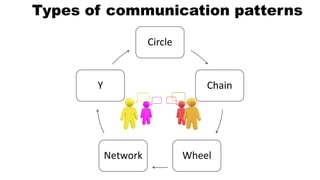
Types of communication patterns
Circle
Chain
Wheel
Network
Y
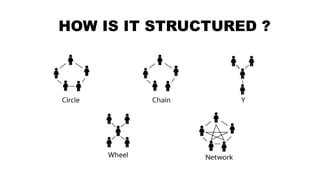
HOW IS IT STRUCTURED ?
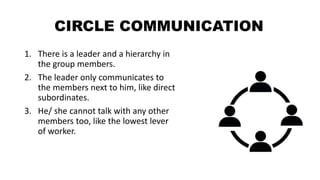
CIRCLE COMMUNICATION
1. There is a leader and a hierarchy in
the group members.
2. The leader only communicates to
the members next to him, like direct
subordinates.
3. He/ she cannot talk with any other
members too, like the lowest lever
of worker.
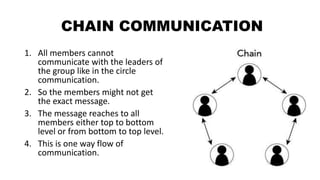
CHAIN COMMUNICATION
1. All members cannot
communicate with the leaders of
the group like in the circle
communication.
2. So the members might not get
the exact message.
3. The message reaches to all
members either top to bottom
level or from bottom to top level.
4. This is one way flow of
communication.
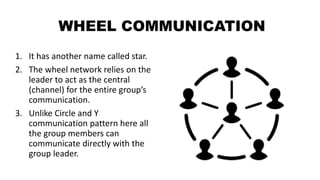
WHEEL COMMUNICATION
1. It has another name called star.
2. The wheel network relies on the
leader to act as the central
(channel) for the entire group’s
communication.
3. Unlike Circle and Y
communication pattern here all
the group members can
communicate directly with the
group leader.
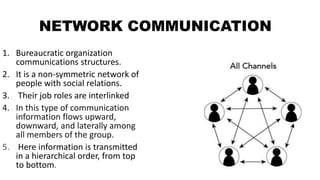
NETWORK COMMUNICATION
1. Bureaucratic organization
communications structures.
2. It is a non-symmetric network of
people with social relations.
3. Their job roles are interlinked
4. In this type of communication
information flows upward,
downward, and laterally among
all members of the group.
5. Here information is transmitted
in a hierarchical order, from top
to bottom.
Y PATTERN OF COMMUNICATION
1. The group is separated into three group.
2. Y pattern of communication is more complicated as
there are different sub-groups within a group.
3. There is a chain of command within the sub-group.
The lowest level of each sub-group communicates
with the members senior to them. They
communicate it with their seniors. Then, that
member communicates it with the leader.
4. The group members can communicate with the
other members of the group through leader only.
The sub-groups cannot communicate with each
other. They need to pass the information through
the leader to send any message to other sub-
groups.
Patterns of communication pptx

Patterns of communication pptx

  • 1.
  • 2.
    PREFACE • Communication meanstransferring messages from one to another. • It has several forms such as intrapersonal, interpersonal, group and mass communication. • While it comes to group communication it has a certain patterns in its own. • All communication patterns have certain problems of their own when compared with each other.
  • 3.
    INTRODUCTION PATTERNS OF COMMUNICATION Communicationis a two-way process which involves transferring of information or messages from one person or group to another. This process goes on and includes a minimum of one sender and receiver to pass on the messages. These messages can either be any ideas, imagination, emotions, or thoughts.
  • 4.
    What does communicationpattern means? What does communication pattern mean? 1. It shows how communication flows within a group. 2. Communication patterns are structures in which communication flows in an organization. 3. They are the communication link in working teams according to organizational structure. 4. The patterns are related to work efficiency and who is responsible towards whom or who talks to whom. 5. It also relates to satisfaction of group members and decision making process. 6. This can be applied to groups but all to one and one to all communication are also taken to be communication pattern.
  • 5.
    Types of communicationpatterns Circle Chain Wheel Network Y
  • 6.
    HOW IS ITSTRUCTURED ?
  • 7.
    CIRCLE COMMUNICATION 1. Thereis a leader and a hierarchy in the group members. 2. The leader only communicates to the members next to him, like direct subordinates. 3. He/ she cannot talk with any other members too, like the lowest lever of worker.
  • 8.
    CHAIN COMMUNICATION 1. Allmembers cannot communicate with the leaders of the group like in the circle communication. 2. So the members might not get the exact message. 3. The message reaches to all members either top to bottom level or from bottom to top level. 4. This is one way flow of communication.
  • 9.
    WHEEL COMMUNICATION 1. Ithas another name called star. 2. The wheel network relies on the leader to act as the central (channel) for the entire group’s communication. 3. Unlike Circle and Y communication pattern here all the group members can communicate directly with the group leader.
  • 10.
    NETWORK COMMUNICATION 1. Bureaucraticorganization communications structures. 2. It is a non-symmetric network of people with social relations. 3. Their job roles are interlinked 4. In this type of communication information flows upward, downward, and laterally among all members of the group. 5. Here information is transmitted in a hierarchical order, from top to bottom.
  • 11.
    Y PATTERN OFCOMMUNICATION 1. The group is separated into three group. 2. Y pattern of communication is more complicated as there are different sub-groups within a group. 3. There is a chain of command within the sub-group. The lowest level of each sub-group communicates with the members senior to them. They communicate it with their seniors. Then, that member communicates it with the leader. 4. The group members can communicate with the other members of the group through leader only. The sub-groups cannot communicate with each other. They need to pass the information through the leader to send any message to other sub- groups.