CAUSES AND STAGES OF CONFLICT


Presented To:
Dr. Naveed Akhtar



Presented By:
Ijaz Ahmed
M Yasir Iqbal
Waqar Aftab
OVERVIEW
 Definition

of Conflict
 Causes of Conflict
 Stages of Conflict
DEFINITION OF CONFLICT
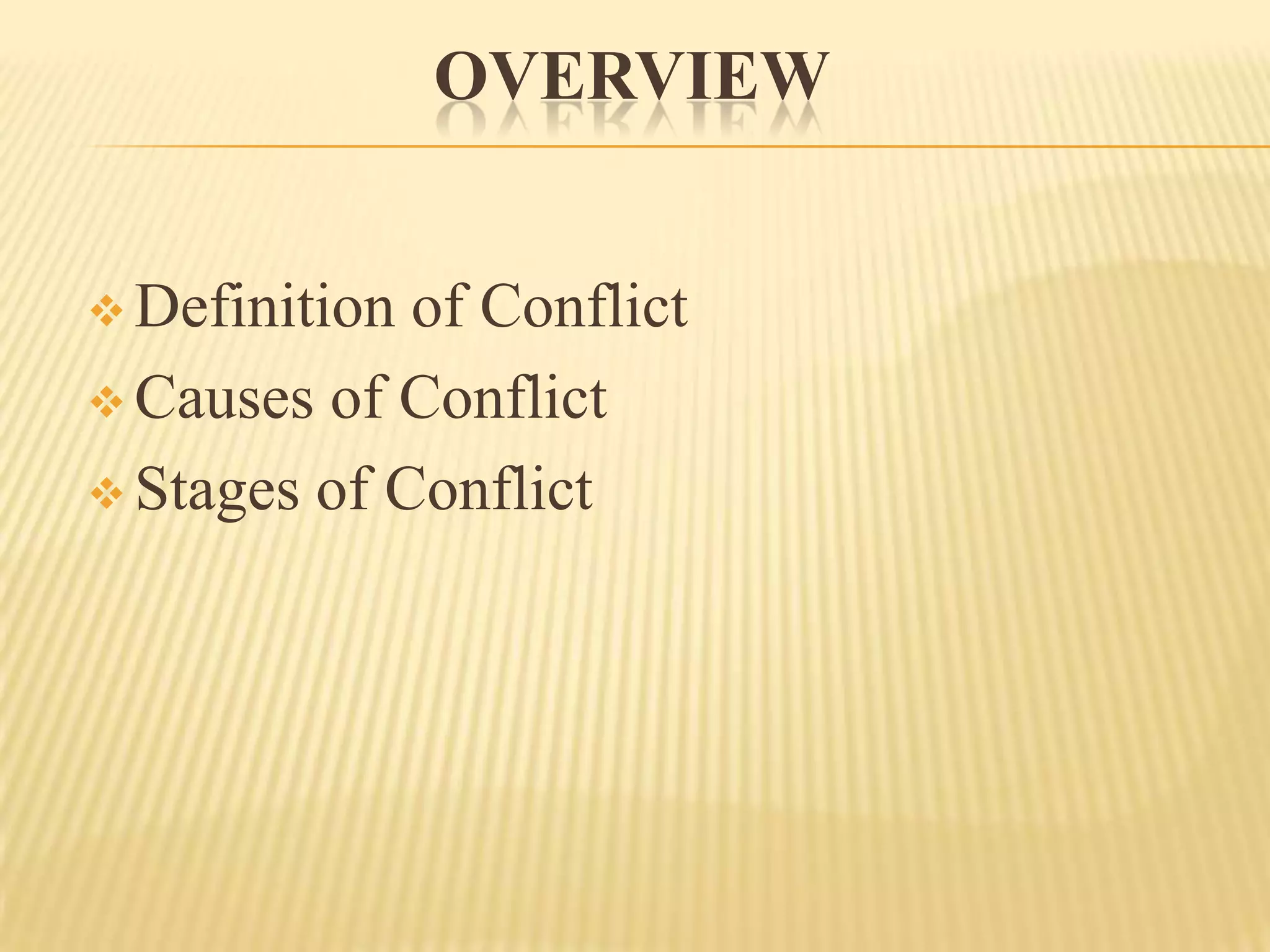
“Conflict is an expressed struggle between at
least two interdependent parties who perceive
incompatible goals, scare resources, and
interference from others in achieving their
goals.”
CAUSES OF CONFLICT
Definition
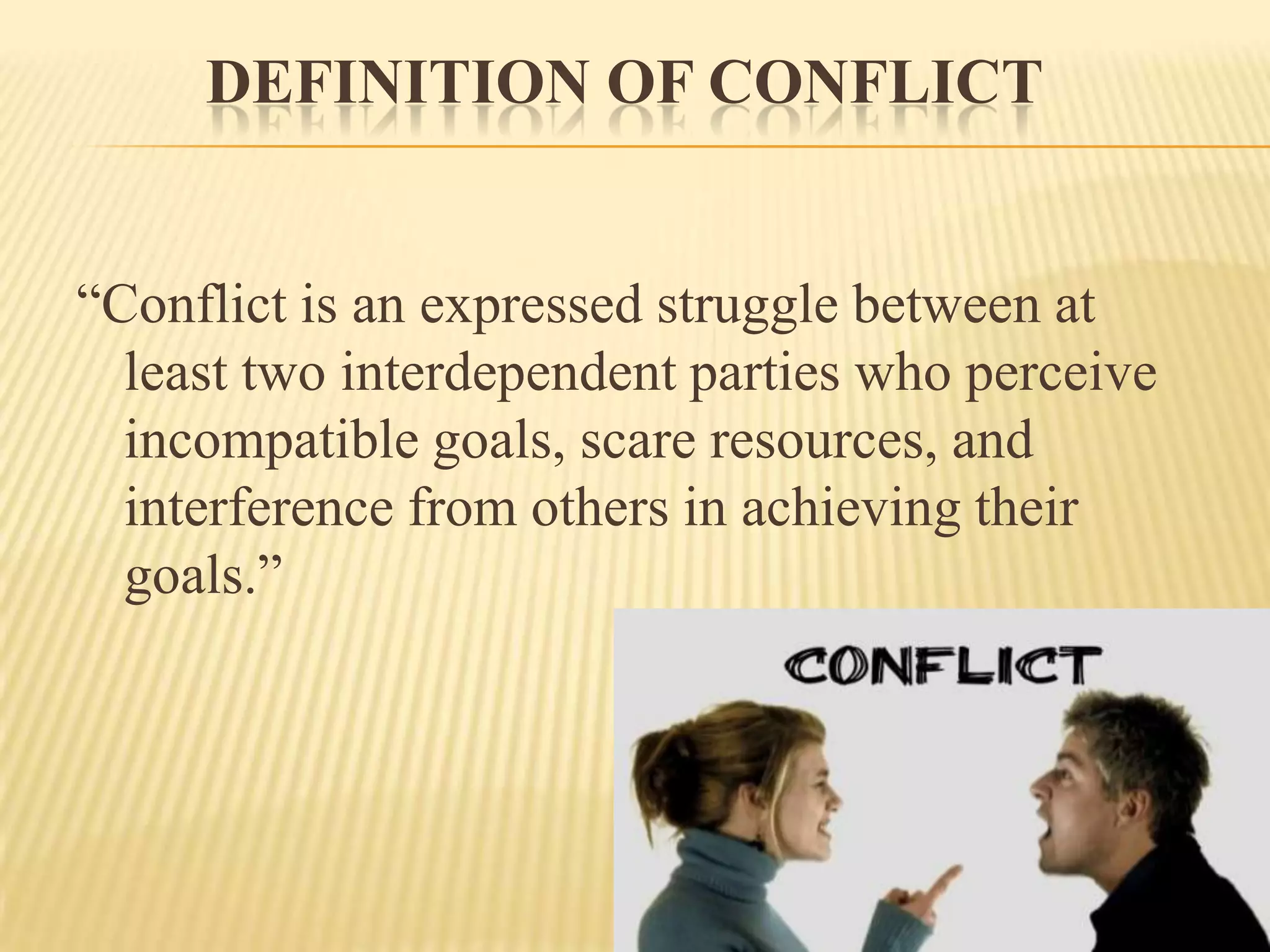
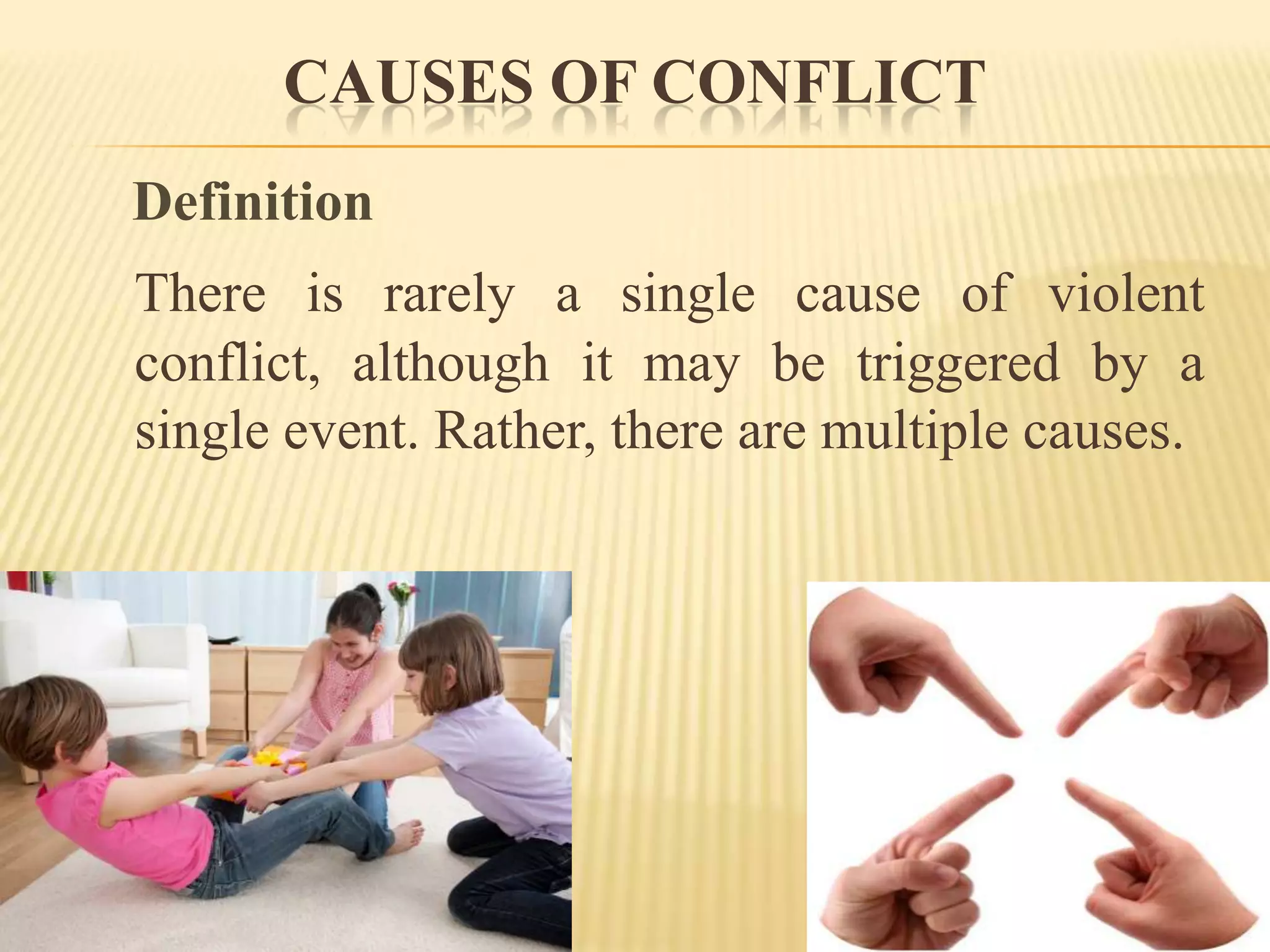
There is rarely a single cause of violent
conflict, although it may be triggered by a
single event. Rather, there are multiple causes.
CAUSES OF CONFLICT

1.

There are different types of causes of conflict
which are as follows.
Conflicting Resources
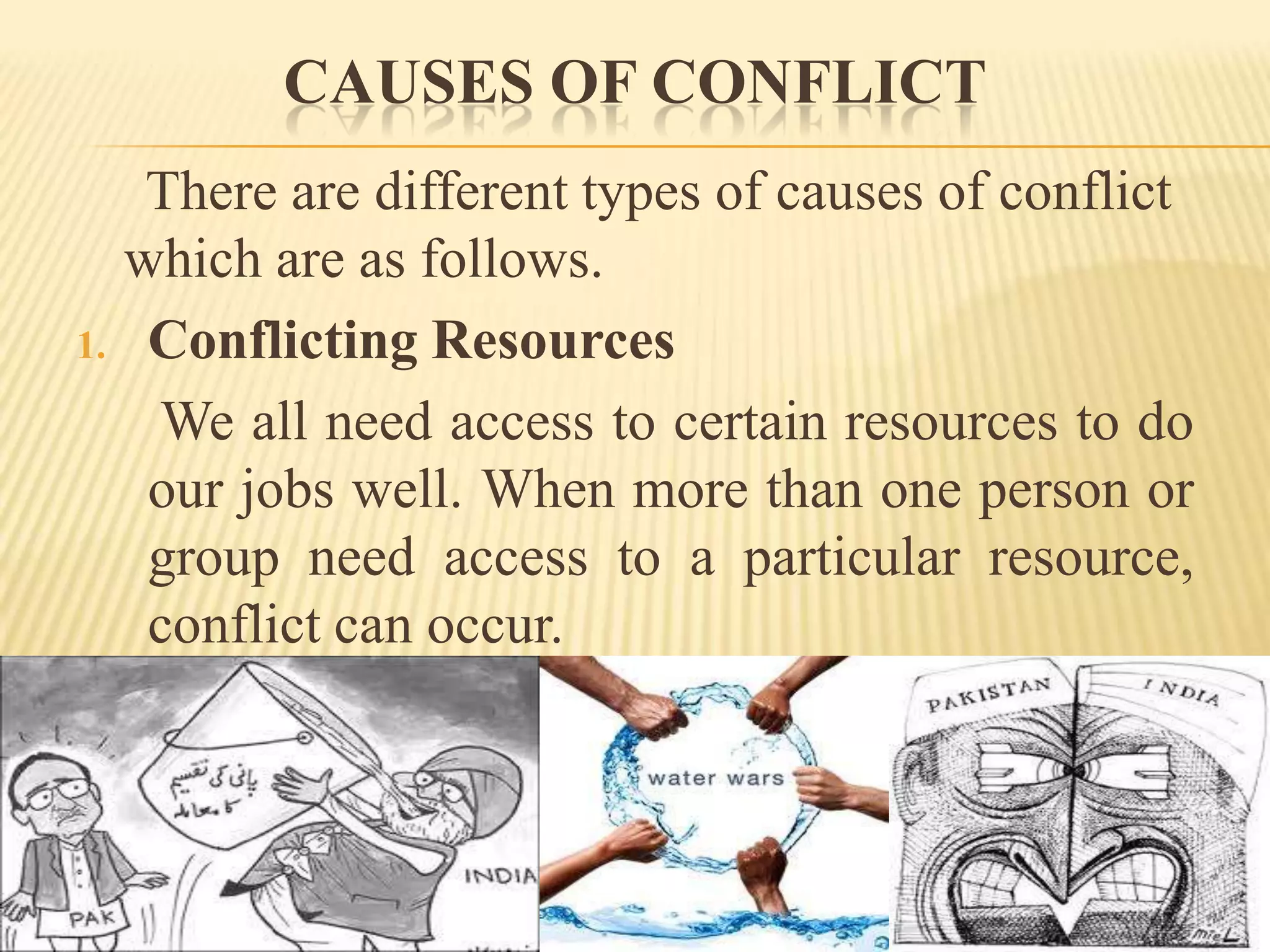
We all need access to certain resources to do
our jobs well. When more than one person or
group need access to a particular resource,
conflict can occur.
CAUSES OF CONFLICT
Tools to Over-Come Conflicting Resources
 Win-Win Negotiation
 Influence Model
CAUSES OF CONFLICT
2.

Conflicting Styles
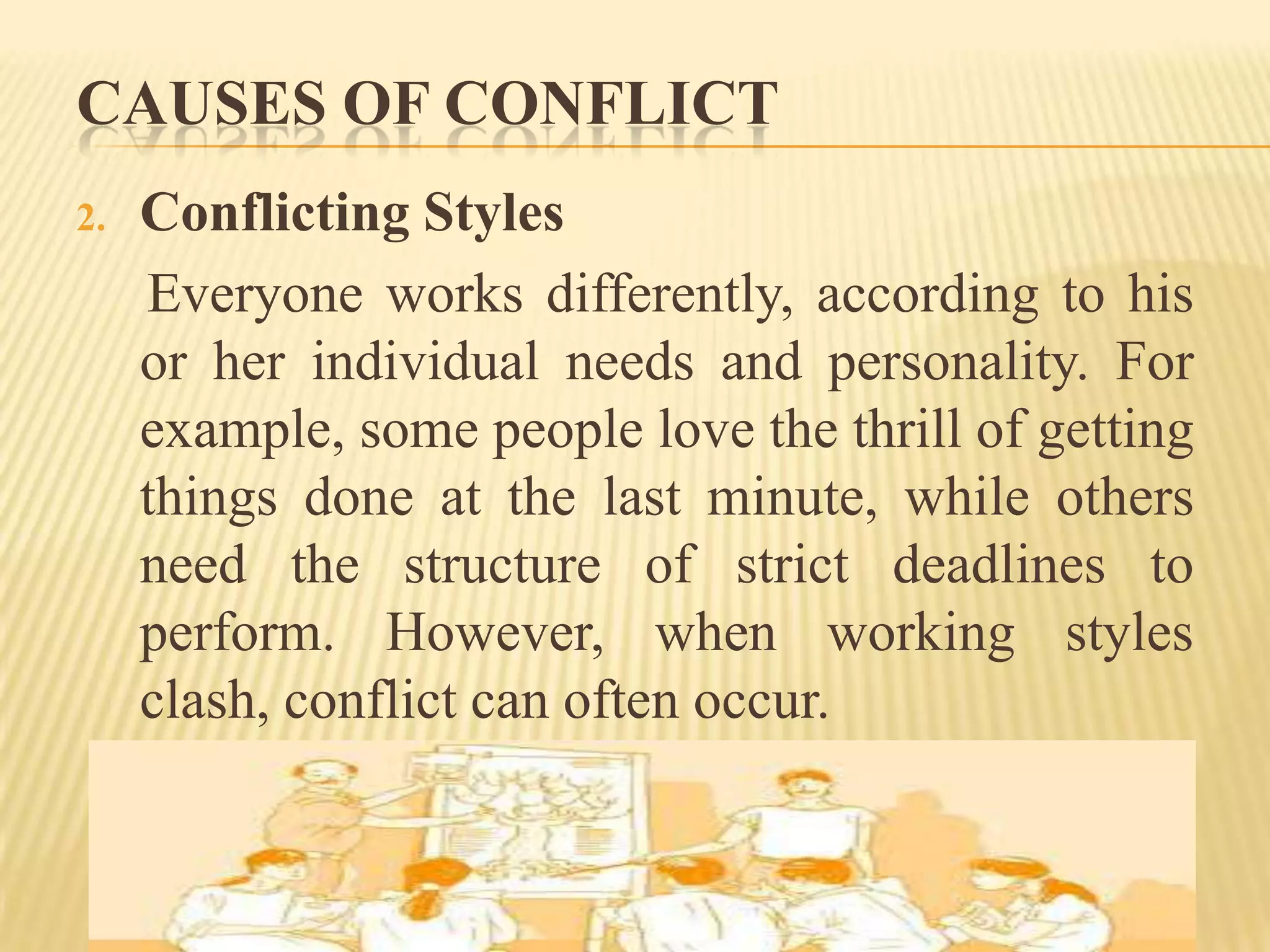
Everyone works differently, according to his
or her individual needs and personality. For
example, some people love the thrill of getting
things done at the last minute, while others
need the structure of strict deadlines to
perform. However, when working styles
clash, conflict can often occur.
CAUSES OF CONFLICT
Tools to Over-Come Conflicting Styles
 Myers-Briggs Personality Test
CAUSES OF CONFLICT
3.

Conflicting Perception
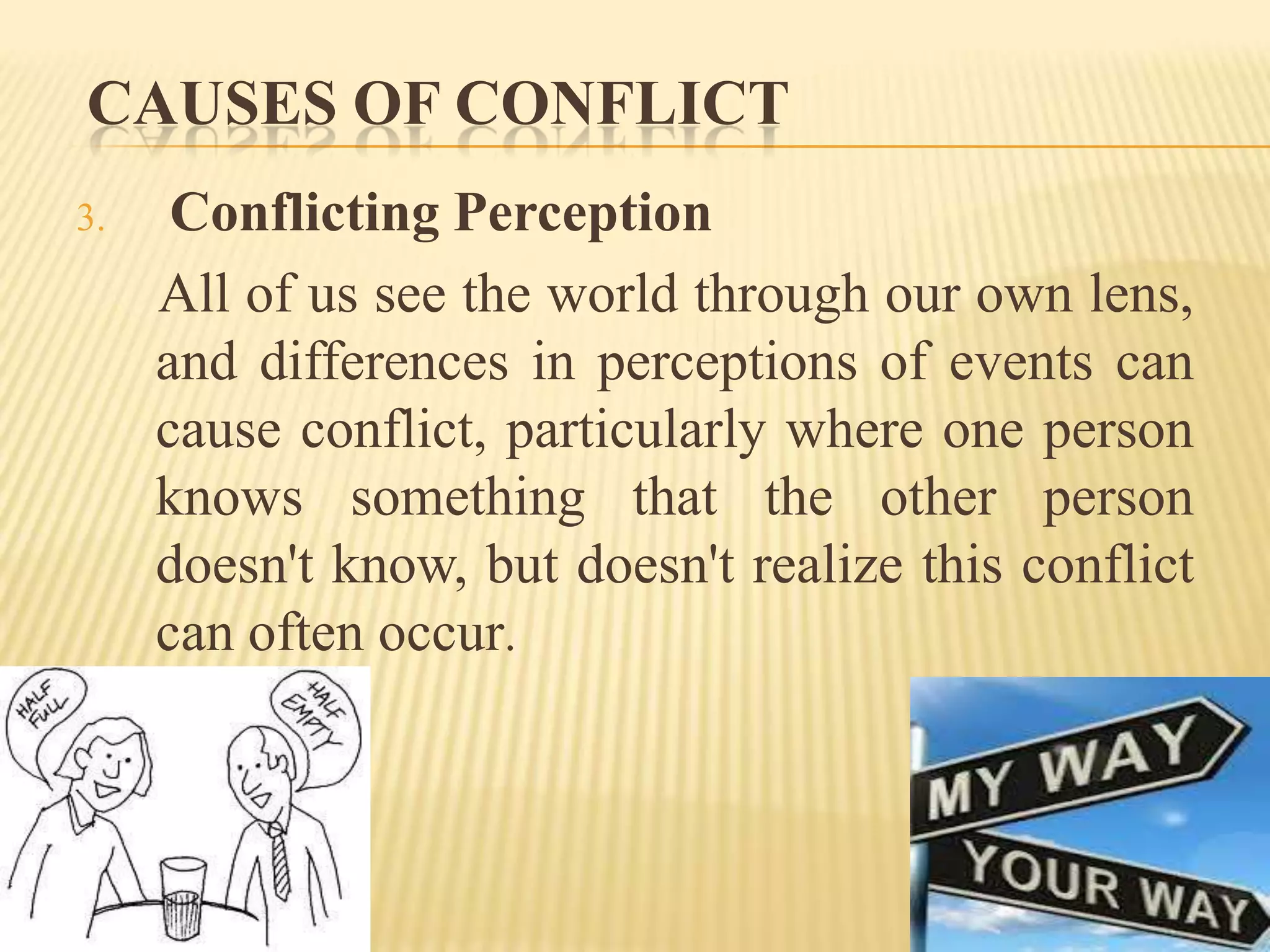
All of us see the world through our own lens,
and differences in perceptions of events can
cause conflict, particularly where one person
knows something that the other person
doesn't know, but doesn't realize this conflict
can often occur.
CAUSES OF CONFLICT
Tools to Over-Come Conflicting Perception
 Communicating openly with your team
CAUSES OF CONFLICT
4.

Conflicting Goals
Sometimes we have conflicting goals in our
work. For example, one of our managers might
tell us that speed is most important goal with
customers. Another manager might say that indepth, high-quality service is the top priority. It's
sometimes quite difficult to reconcile the two,
conflict can often occur.
CAUSES OF CONFLICT
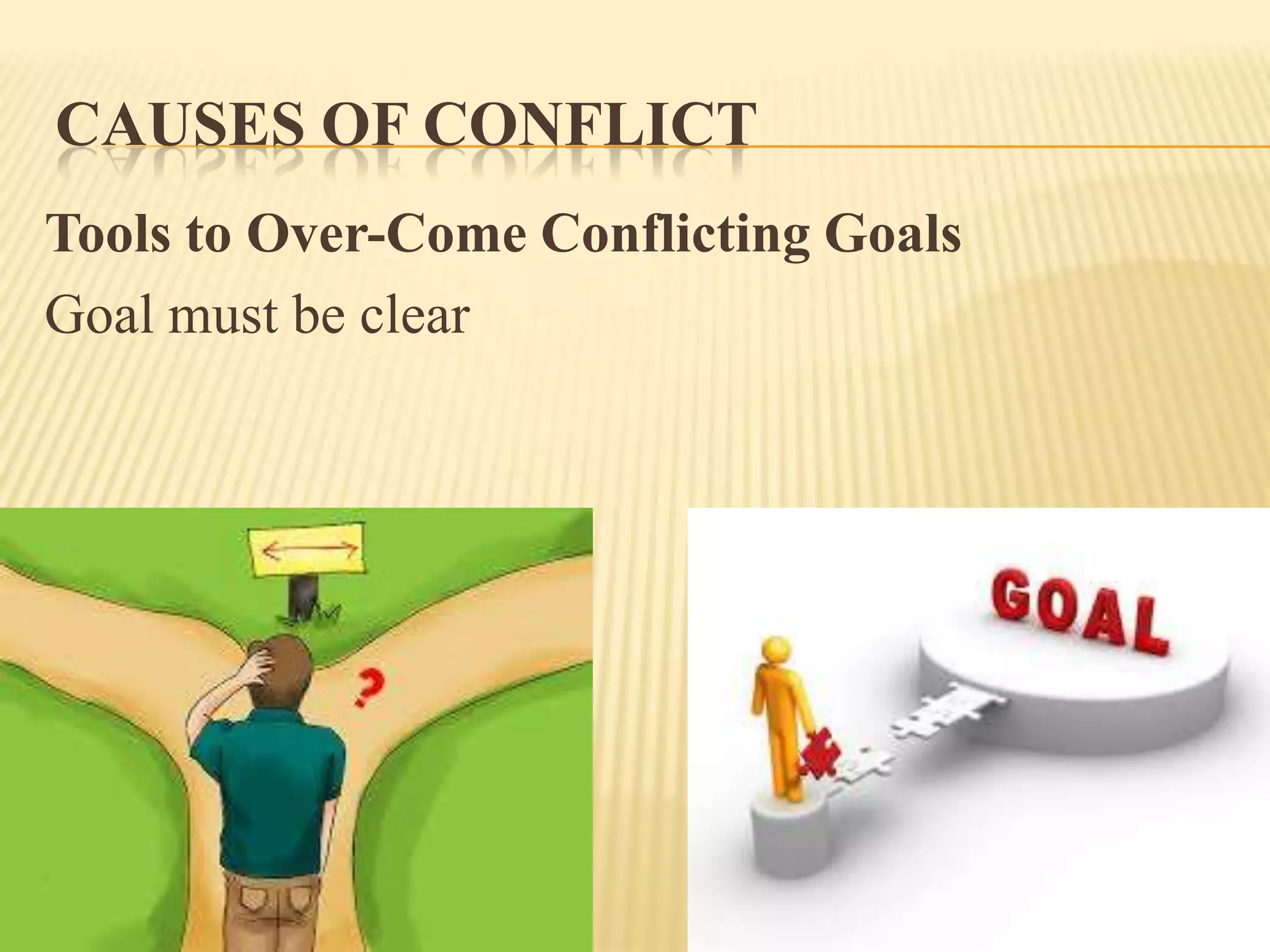
Tools to Over-Come Conflicting Goals
Goal must be clear
CAUSES OF CONFLICT
5.

Conflicting Pressures
We often have to depend on our colleagues to get
our work done. However, what happens when
you need a report from your colleague by noon,
and he's already preparing a different report for
someone else by that same deadline.
Conflicting pressures are similar to conflicting
goals, the only difference is that conflicting
pressures usually involve urgent tasks, while
conflicting goals typically involve projects with
longer timelines.
CAUSES OF CONFLICT
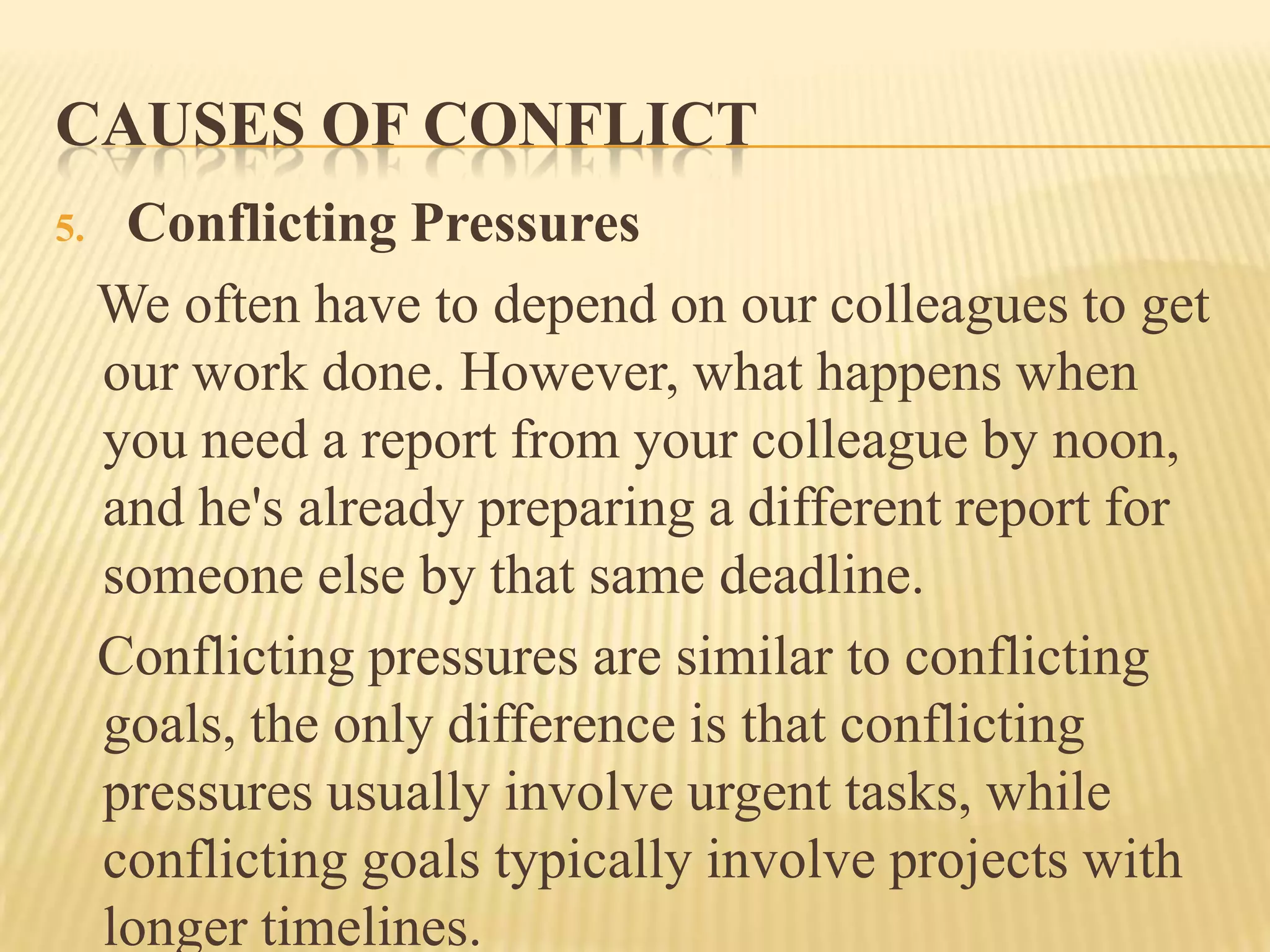
Tools to Over-Come Conflicting Pressures
 Reschedule tasks and deadlines.
CAUSES OF CONFLICT
6.

Conflicting Roles
Sometimes we have to perform a task that's outside our
normal role or responsibilities. If this causes us to step
into someone else's "territory," then conflict and power
struggles can occur. The same can happen in reverse sometimes we may feel that a particular task should be
completed by someone else.
Conflicting roles are similar to conflicting perceptions.
After all, one team member may view a task as his or
her responsibility or territory. But when someone else
comes in to take over that task, conflict occurs.
CAUSES OF CONFLICT
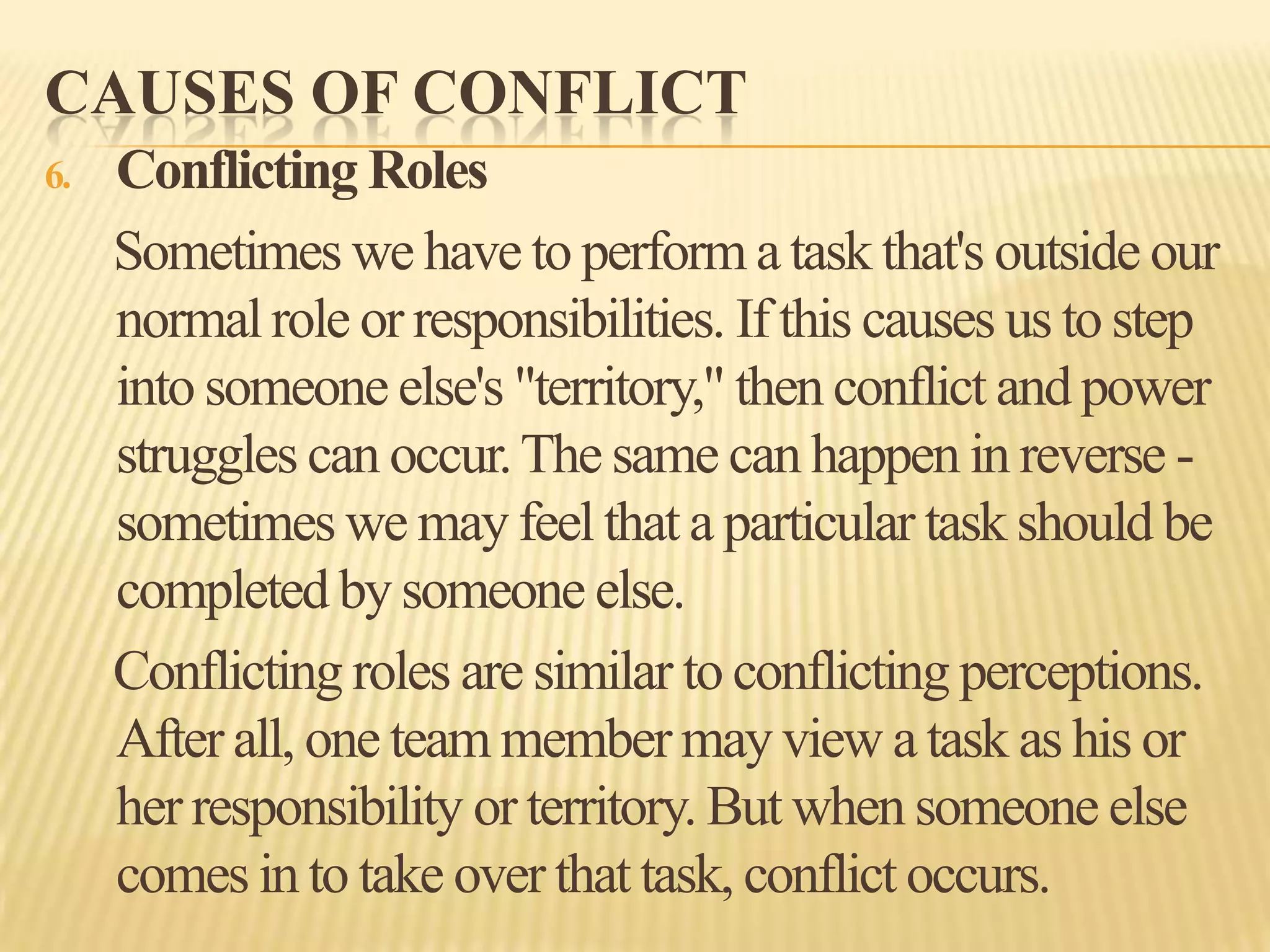
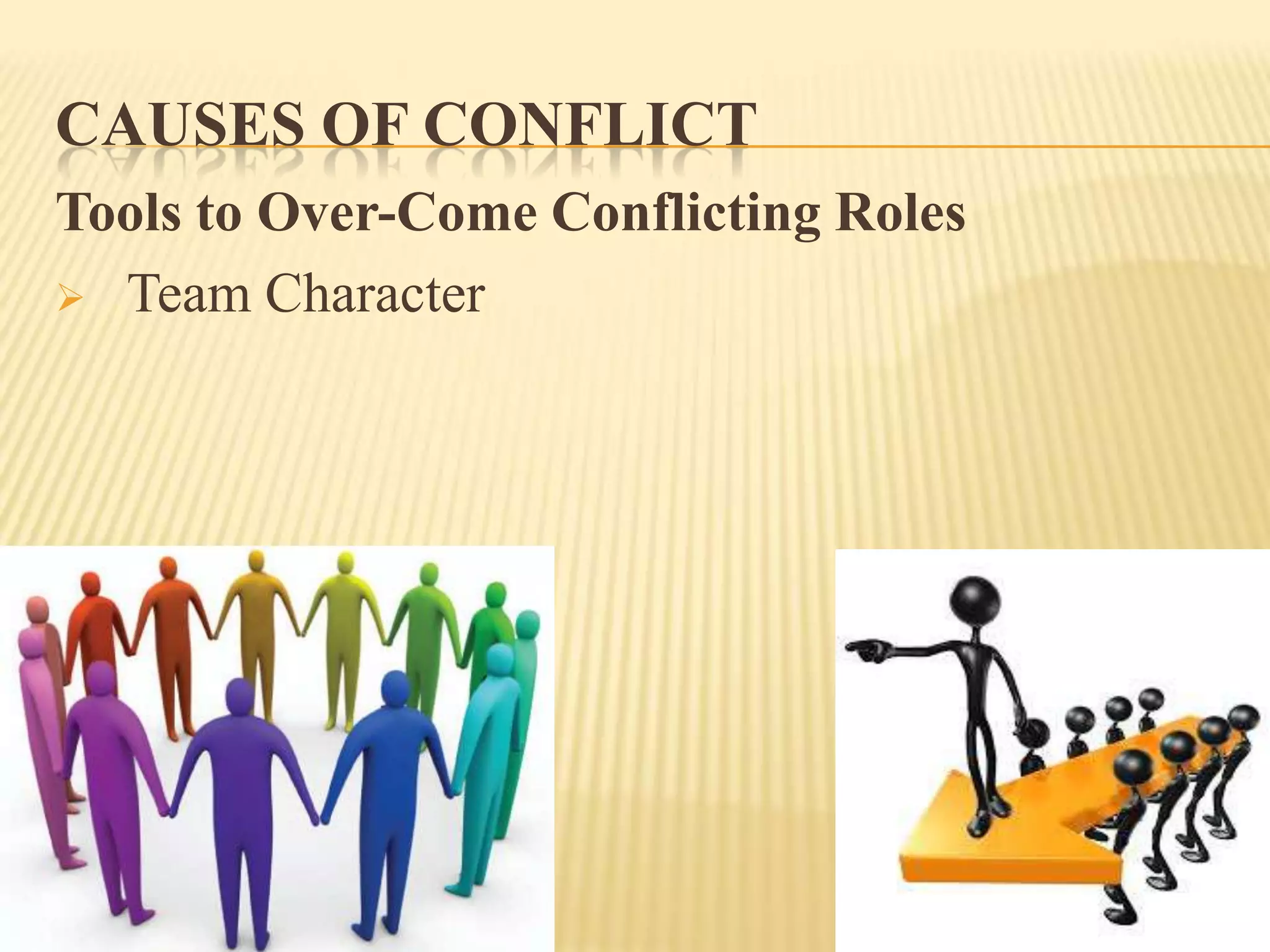
Tools to Over-Come Conflicting Roles
 Team Character
CAUSES OF CONFLICT
7.

Personality Differences
Imagine that your boss has just asked you to
perform a task that conflicts with your ethical
standards. Do you do as your boss asks, or do
you refuse? If you refuse, will you lose your
boss's trust, or even your job.
When our work conflicts with our personal
values like this, conflict can quickly arise.
CAUSES OF CONFLICT
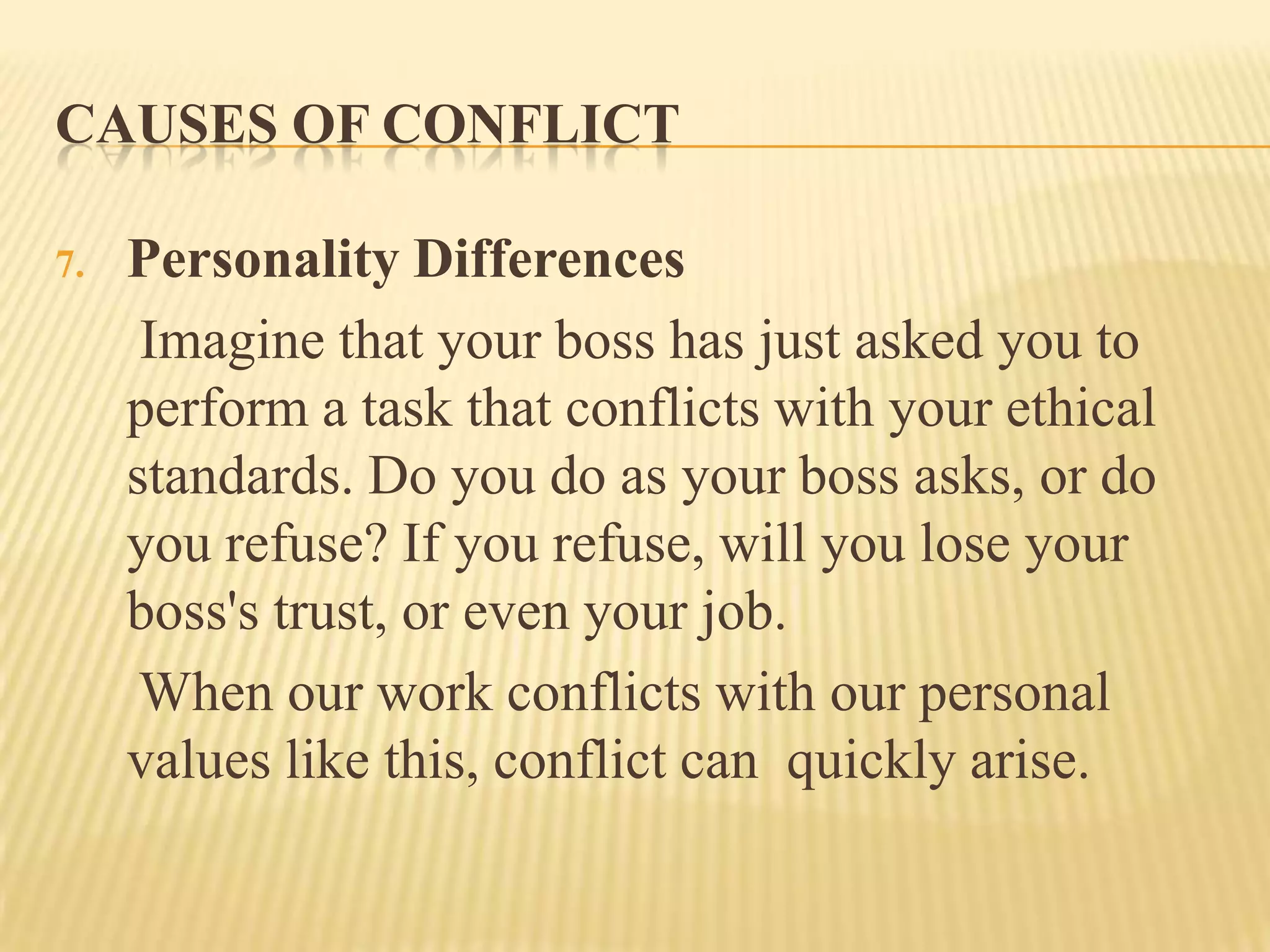
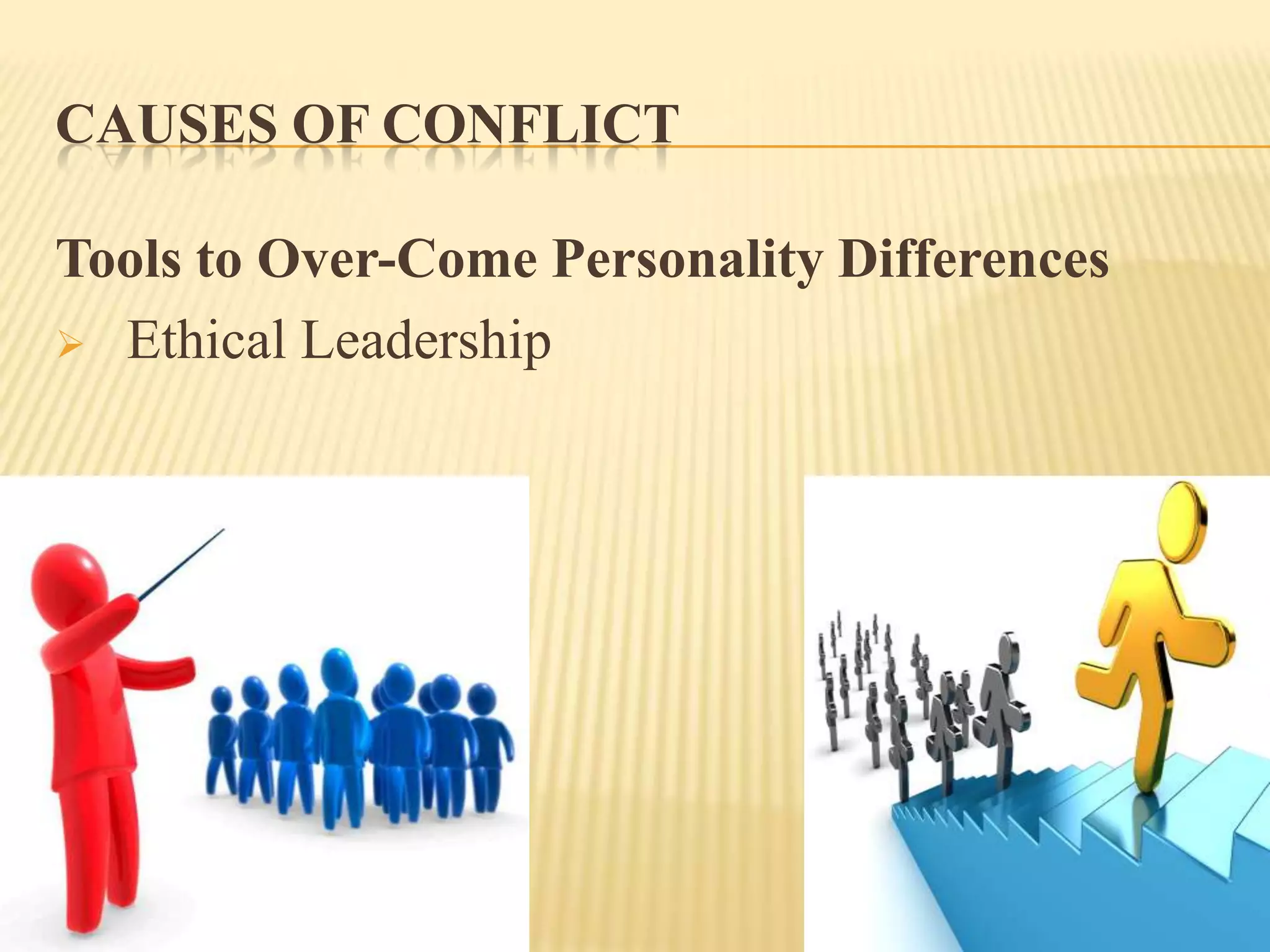
Tools to Over-Come Personality Differences
 Ethical Leadership
CAUSES OF CONFLICT
8.

Misunderstandings
Substandard communication is one of the top
reasons for conflict in and out of the office.
Incomplete or inaccurate data or information can
lead to conflict.
Often these conflicts involve disagreements over
what is best in a given situation.
CAUSES OF CONFLICT
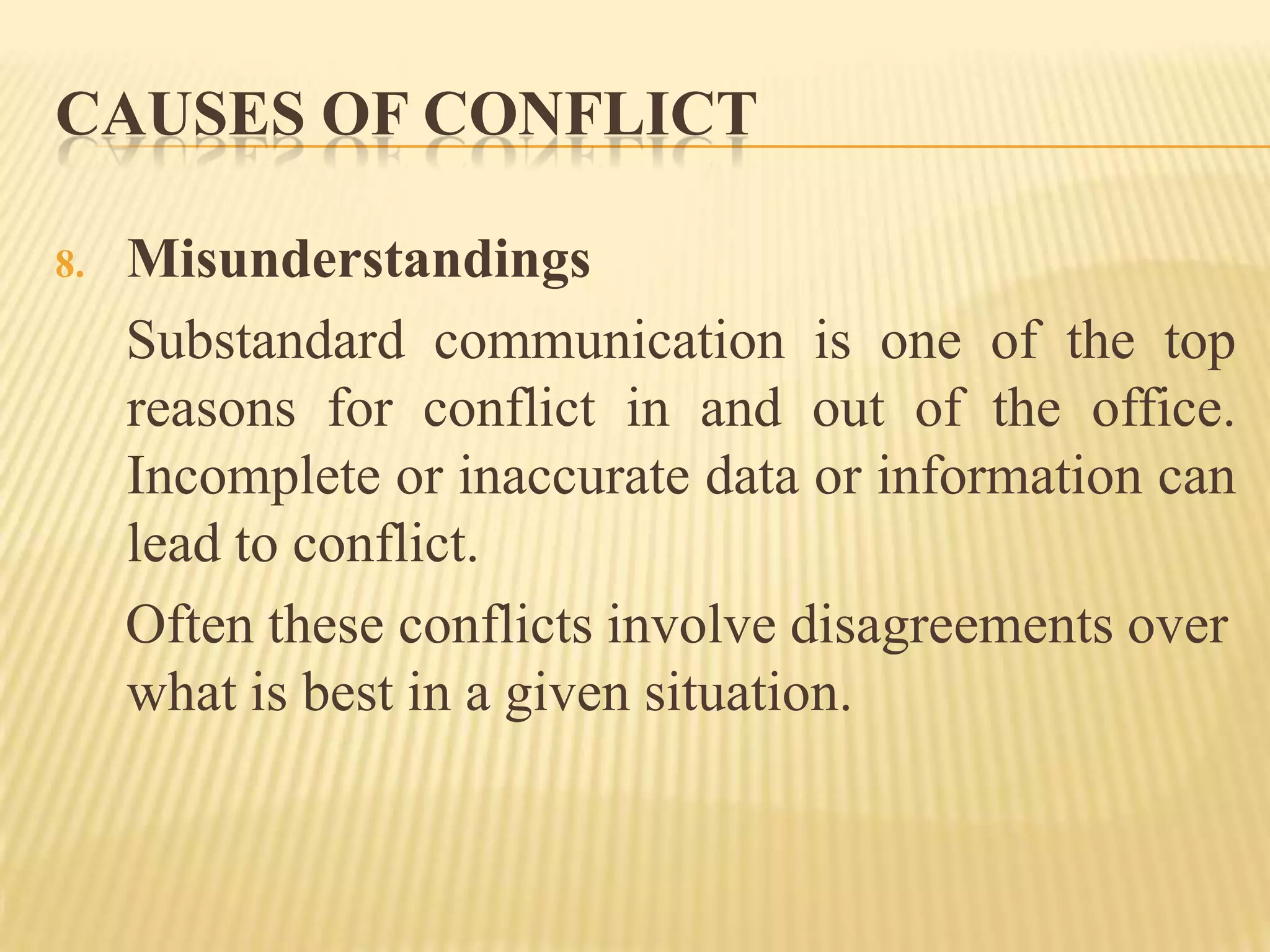
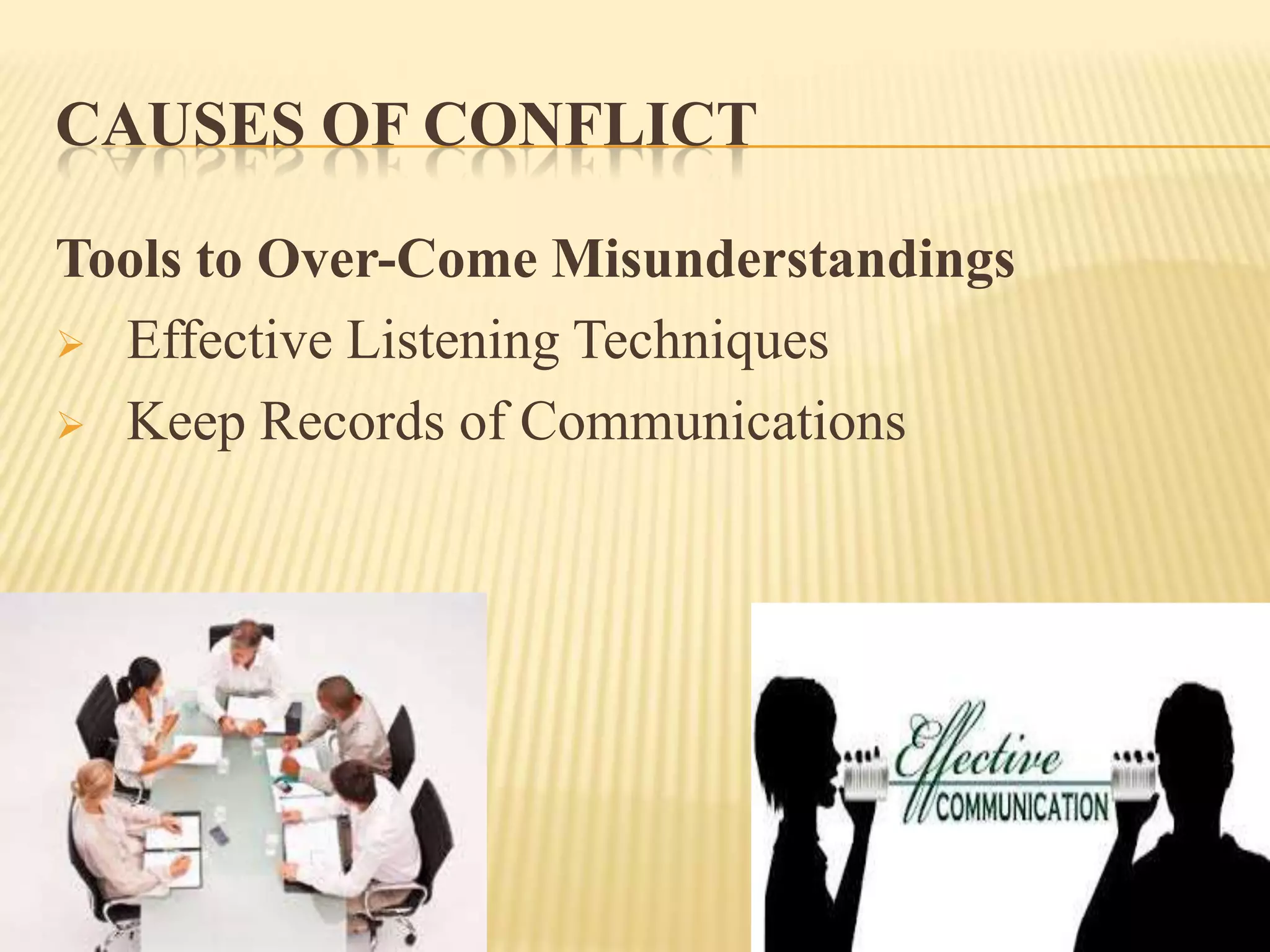
Tools to Over-Come Misunderstandings
 Effective Listening Techniques
 Keep Records of Communications
CAUSES OF CONFLICT
9.

Competition
Sometimes quotas and incentives can make it
easy to forget the big picture. We stop seeing
others as team members and start to see them as
competitors. Healthy competition is a good
motivator, but sometimes it inspires antiproductive behaviour and conflict arise.
CAUSES OF CONFLICT
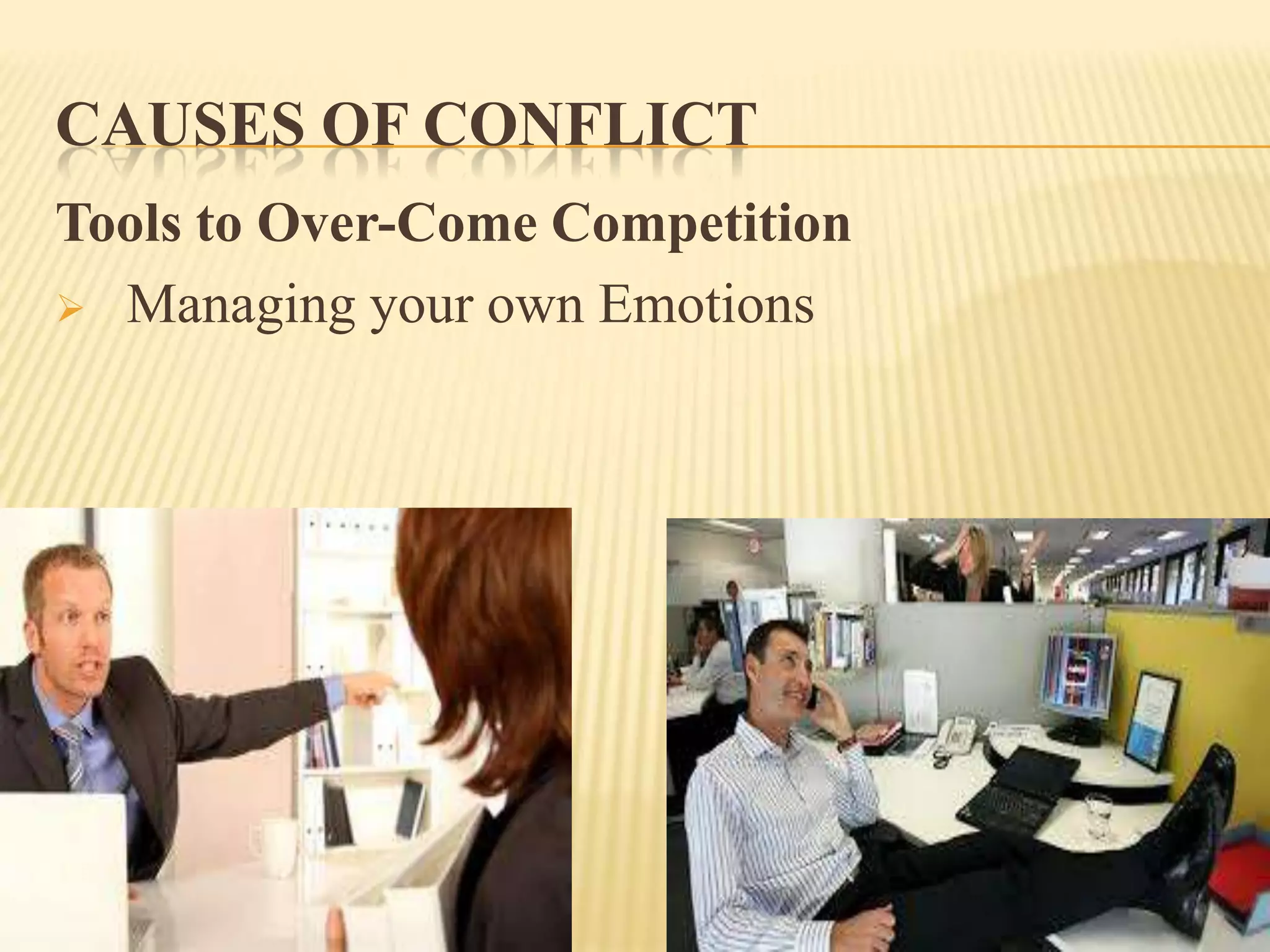
Tools to Over-Come Competition
 Managing your own Emotions
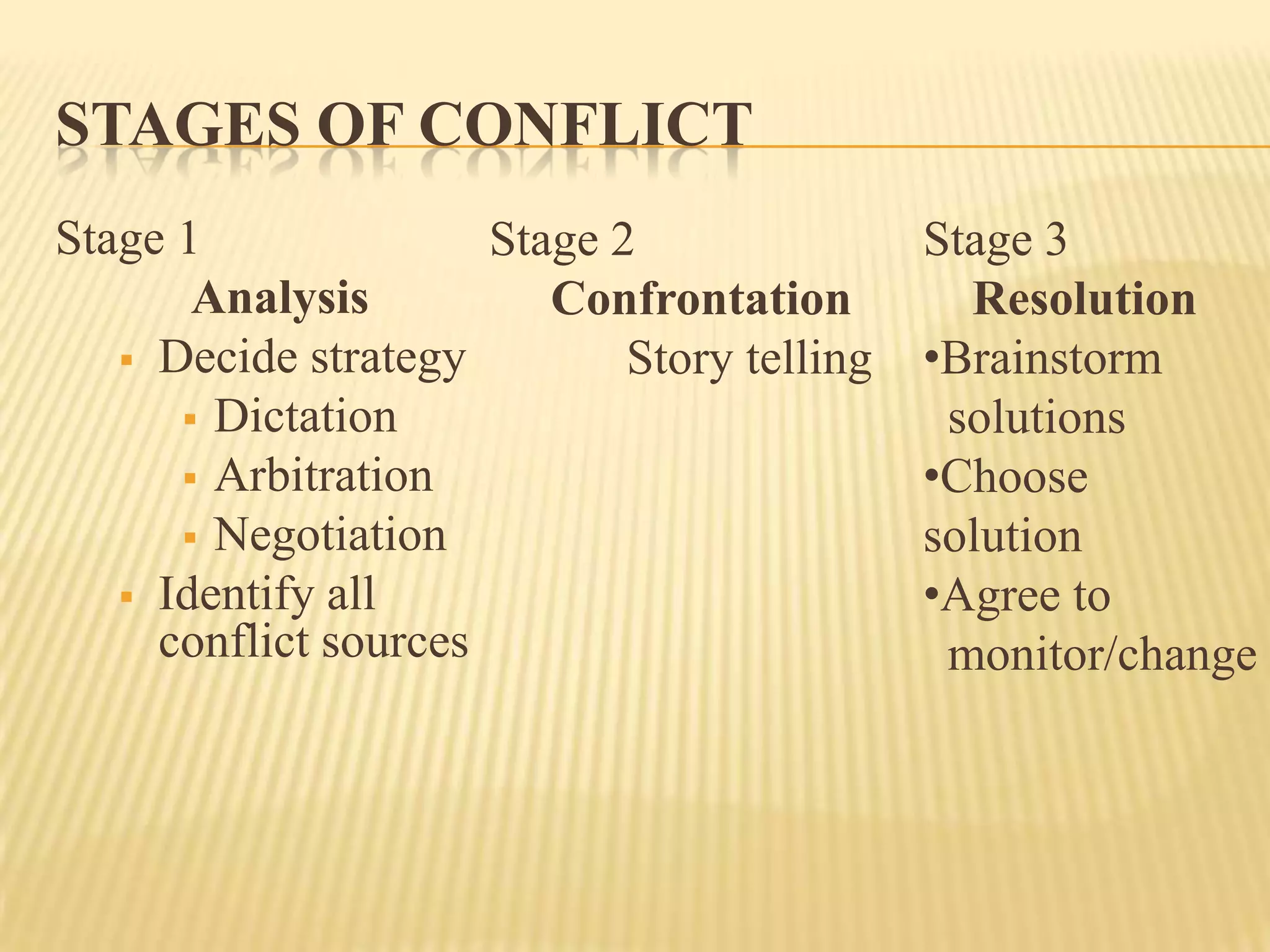
STAGES OF CONFLICT
Stage 1
Stage 2
Analysis
Confrontation
 Decide strategy
Story telling
 Dictation
 Arbitration
 Negotiation
 Identify all
conflict sources

Stage 3
Resolution
•Brainstorm
solutions
•Choose
solution
•Agree to
monitor/change
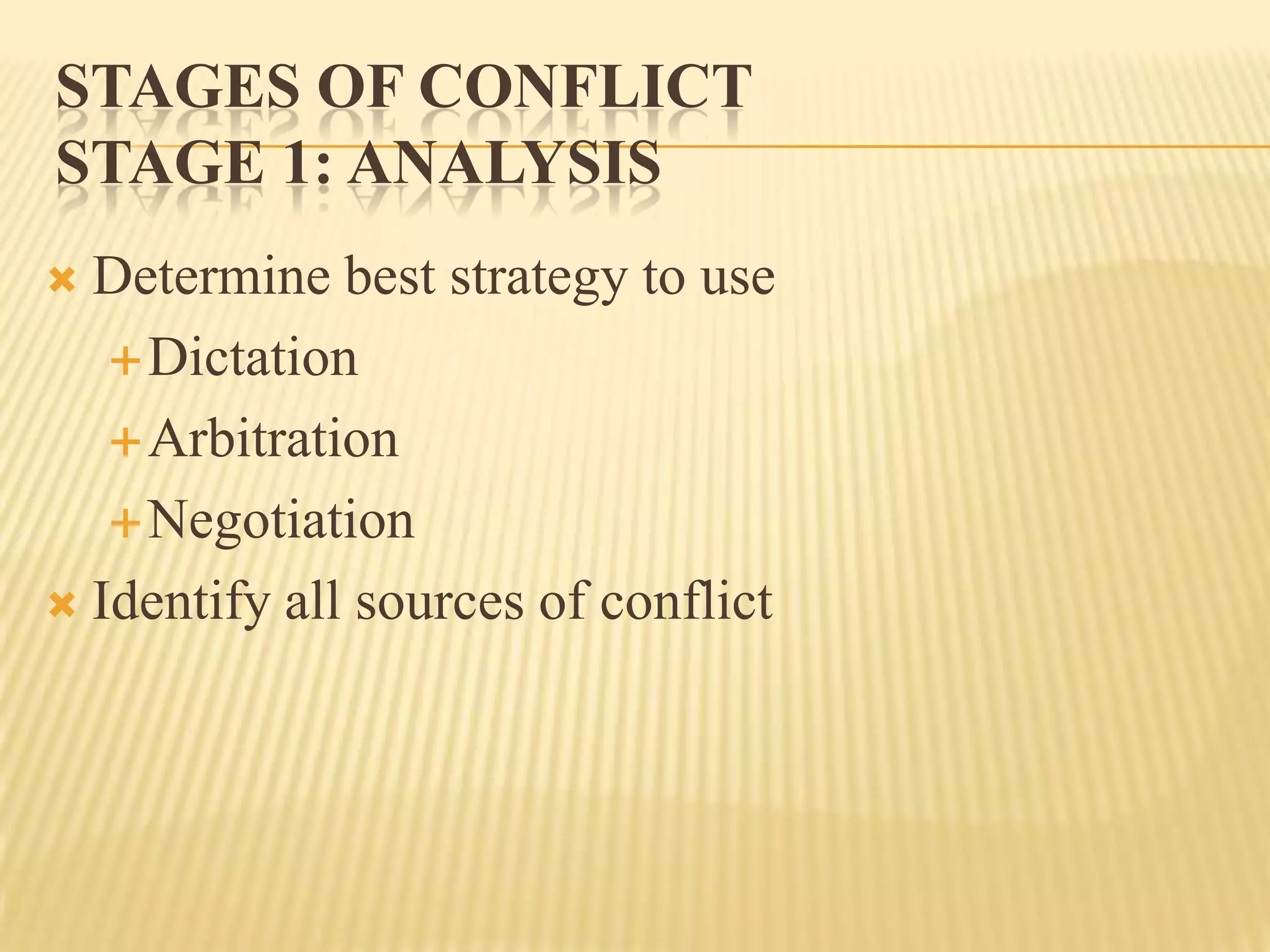
STAGES OF CONFLICT
STAGE 1: ANALYSIS
Determine best strategy to use
 Dictation
 Arbitration
 Negotiation
 Identify all sources of conflict

STAGES OF CONFLICT
STAGE 1: ANALYSIS


Dictation is best when:
 parties are irrational
 no trust exists
 too angry to be realistic
 have mental health issues
 alcohol or drugs are involved
 when violent behavior is potential
 parties have poor communication skills
 there are time constraints
STAGES OF CONFLICT
STAGE 1: ANALYSIS
Negotiation is best when:
 parties are rational
 parties want to work out a solution together
 some trust still exists
 there are no time constraints
 Arbitration
 same as mediation but use when parties get
stuck during mediation

STAGES OF CONFLICT
STAGE 1: ANALYSIS
FISHER URY’S NEGOTIATION MODEL
Don’t react
 Don’t argue
 Don’t reject
 Don’t push
 Minimize escalation

STAGES OF CONFLICT
STAGE 2: CONFRONTATION


Story Telling
Stages of conflict
Stage 3: Resolution
 Problem

and sources have been identified
 Alternative resolutions are brainstormed
 Mutually agreeable solution chosen
 Agreement to monitor changes in the future
THANK YOU

Causes and stages of conflict

  • 2.
    CAUSES AND STAGESOF CONFLICT  Presented To: Dr. Naveed Akhtar  Presented By: Ijaz Ahmed M Yasir Iqbal Waqar Aftab
  • 3.
    OVERVIEW  Definition of Conflict Causes of Conflict  Stages of Conflict
  • 4.
    DEFINITION OF CONFLICT “Conflictis an expressed struggle between at least two interdependent parties who perceive incompatible goals, scare resources, and interference from others in achieving their goals.”
  • 5.
    CAUSES OF CONFLICT Definition Thereis rarely a single cause of violent conflict, although it may be triggered by a single event. Rather, there are multiple causes.
  • 6.
    CAUSES OF CONFLICT 1. Thereare different types of causes of conflict which are as follows. Conflicting Resources We all need access to certain resources to do our jobs well. When more than one person or group need access to a particular resource, conflict can occur.
  • 7.
    CAUSES OF CONFLICT Toolsto Over-Come Conflicting Resources  Win-Win Negotiation  Influence Model
  • 8.
    CAUSES OF CONFLICT 2. ConflictingStyles Everyone works differently, according to his or her individual needs and personality. For example, some people love the thrill of getting things done at the last minute, while others need the structure of strict deadlines to perform. However, when working styles clash, conflict can often occur.
  • 9.
    CAUSES OF CONFLICT Toolsto Over-Come Conflicting Styles  Myers-Briggs Personality Test
  • 10.
    CAUSES OF CONFLICT 3. ConflictingPerception All of us see the world through our own lens, and differences in perceptions of events can cause conflict, particularly where one person knows something that the other person doesn't know, but doesn't realize this conflict can often occur.
  • 11.
    CAUSES OF CONFLICT Toolsto Over-Come Conflicting Perception  Communicating openly with your team
  • 12.
    CAUSES OF CONFLICT 4. ConflictingGoals Sometimes we have conflicting goals in our work. For example, one of our managers might tell us that speed is most important goal with customers. Another manager might say that indepth, high-quality service is the top priority. It's sometimes quite difficult to reconcile the two, conflict can often occur.
  • 13.
    CAUSES OF CONFLICT Toolsto Over-Come Conflicting Goals Goal must be clear
  • 14.
    CAUSES OF CONFLICT 5. ConflictingPressures We often have to depend on our colleagues to get our work done. However, what happens when you need a report from your colleague by noon, and he's already preparing a different report for someone else by that same deadline. Conflicting pressures are similar to conflicting goals, the only difference is that conflicting pressures usually involve urgent tasks, while conflicting goals typically involve projects with longer timelines.
  • 15.
    CAUSES OF CONFLICT Toolsto Over-Come Conflicting Pressures  Reschedule tasks and deadlines.
  • 16.
    CAUSES OF CONFLICT 6. ConflictingRoles Sometimes we have to perform a task that's outside our normal role or responsibilities. If this causes us to step into someone else's "territory," then conflict and power struggles can occur. The same can happen in reverse sometimes we may feel that a particular task should be completed by someone else. Conflicting roles are similar to conflicting perceptions. After all, one team member may view a task as his or her responsibility or territory. But when someone else comes in to take over that task, conflict occurs.
  • 17.
    CAUSES OF CONFLICT Toolsto Over-Come Conflicting Roles  Team Character
  • 18.
    CAUSES OF CONFLICT 7. PersonalityDifferences Imagine that your boss has just asked you to perform a task that conflicts with your ethical standards. Do you do as your boss asks, or do you refuse? If you refuse, will you lose your boss's trust, or even your job. When our work conflicts with our personal values like this, conflict can quickly arise.
  • 19.
    CAUSES OF CONFLICT Toolsto Over-Come Personality Differences  Ethical Leadership
  • 20.
    CAUSES OF CONFLICT 8. Misunderstandings Substandardcommunication is one of the top reasons for conflict in and out of the office. Incomplete or inaccurate data or information can lead to conflict. Often these conflicts involve disagreements over what is best in a given situation.
  • 21.
    CAUSES OF CONFLICT Toolsto Over-Come Misunderstandings  Effective Listening Techniques  Keep Records of Communications
  • 22.
    CAUSES OF CONFLICT 9. Competition Sometimesquotas and incentives can make it easy to forget the big picture. We stop seeing others as team members and start to see them as competitors. Healthy competition is a good motivator, but sometimes it inspires antiproductive behaviour and conflict arise.
  • 23.
    CAUSES OF CONFLICT Toolsto Over-Come Competition  Managing your own Emotions
  • 24.
    STAGES OF CONFLICT Stage1 Stage 2 Analysis Confrontation  Decide strategy Story telling  Dictation  Arbitration  Negotiation  Identify all conflict sources Stage 3 Resolution •Brainstorm solutions •Choose solution •Agree to monitor/change
  • 25.
    STAGES OF CONFLICT STAGE1: ANALYSIS Determine best strategy to use  Dictation  Arbitration  Negotiation  Identify all sources of conflict 
  • 26.
    STAGES OF CONFLICT STAGE1: ANALYSIS  Dictation is best when:  parties are irrational  no trust exists  too angry to be realistic  have mental health issues  alcohol or drugs are involved  when violent behavior is potential  parties have poor communication skills  there are time constraints
  • 27.
    STAGES OF CONFLICT STAGE1: ANALYSIS Negotiation is best when:  parties are rational  parties want to work out a solution together  some trust still exists  there are no time constraints  Arbitration  same as mediation but use when parties get stuck during mediation 
  • 28.
    STAGES OF CONFLICT STAGE1: ANALYSIS FISHER URY’S NEGOTIATION MODEL Don’t react  Don’t argue  Don’t reject  Don’t push  Minimize escalation 
  • 29.
    STAGES OF CONFLICT STAGE2: CONFRONTATION  Story Telling
  • 30.
    Stages of conflict Stage3: Resolution  Problem and sources have been identified  Alternative resolutions are brainstormed  Mutually agreeable solution chosen  Agreement to monitor changes in the future
  • 31.