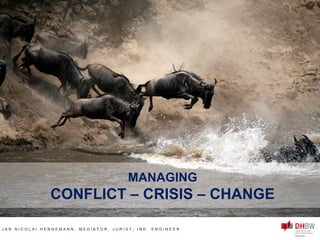
MANAGING
CONFLICT – CRISIS – CHANGE
J A N N I C O L A I H E N N E M A N N , M E D I A T O R , J U R I S T , I N D . E N G I N E E R
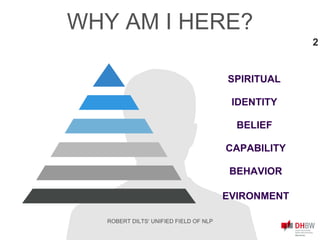
SPIRITUAL
ROBERT DILTS‘ UNIFIED FIELD OF NLP
IDENTITY
BELIEF
CAPABILITY
BEHAVIOR
EVIRONMENT
2
WHY AM I HERE?
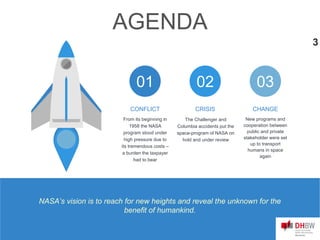
From its beginning in
1958 the NASA
program stood under
high pressure due to
its tremendous costs –
a burden the taxpayer
had to bear
CONFLICT
01
The Challenger and
Columbia accidents put the
space-program of NASA on
hold and under review
CRISIS
02
New programs and
cooperation between
public and private
stakeholder were set
up to transport
humans in space
again
CHANGE
03
NASA’s vision is to reach for new heights and reveal the unknown for the
benefit of humankind.
3
AGENDA
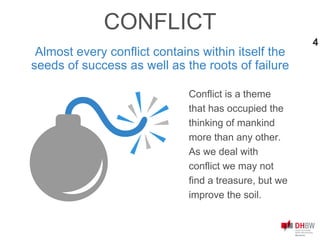
Almost every conflict contains within itself the
seeds of success as well as the roots of failure
Conflict is a theme
that has occupied the
thinking of mankind
more than any other.
As we deal with
conflict we may not
find a treasure, but we
improve the soil.
CONFLICT
4
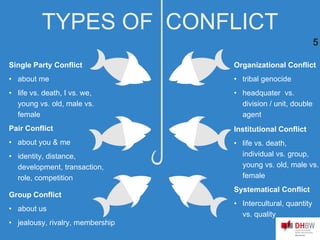
Organizational Conflict
• tribal genocide
• headquater vs.
division / unit, double
agent
Institutional Conflict
• life vs. death,
individual vs. group,
young vs. old, male vs.
female
Systematical Conflict
• Intercultural, quantity
vs. quality
Single Party Conflict
• about me
• life vs. death, I vs. we,
young vs. old, male vs.
female
Pair Conflict
• about you & me
• identity, distance,
development, transaction,
role, competition
Group Conflict
• about us
• jealousy, rivalry, membership
5
TYPES OF CONFLICT
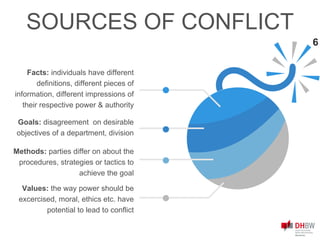
Values: the way power should be
excercised, moral, ethics etc. have
potential to lead to conflict
Goals: disagreement on desirable
objectives of a department, division
Facts: individuals have different
definitions, different pieces of
information, different impressions of
their respective power & authority
Methods: parties differ on about the
procedures, strategies or tactics to
achieve the goal
SOURCES OF CONFLICT
6
7
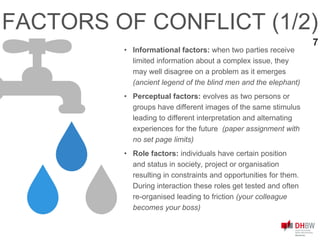
• Informational factors: when two parties receive
limited information about a complex issue, they
may well disagree on a problem as it emerges
(ancient legend of the blind men and the elephant)
• Perceptual factors: evolves as two persons or
groups have different images of the same stimulus
leading to different interpretation and alternating
experiences for the future (paper assignment with
no set page limits)
• Role factors: individuals have certain position
and status in society, project or organisation
resulting in constraints and opportunities for them.
During interaction these roles get tested and often
re-organised leading to friction (your colleague
becomes your boss)
FACTORS OF CONFLICT (1/2)
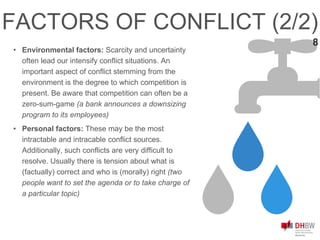
• Environmental factors: Scarcity and uncertainty
often lead our intensify conflict situations. An
important aspect of conflict stemming from the
environment is the degree to which competition is
present. Be aware that competition can often be a
zero-sum-game (a bank announces a downsizing
program to its employees)
• Personal factors: These may be the most
intractable and intracable conflict sources.
Additionally, such conflicts are very difficult to
resolve. Usually there is tension about what is
(factually) correct and who is (morally) right (two
people want to set the agenda or to take charge of
a particular topic)
8
FACTORS OF CONFLICT (2/2)
9
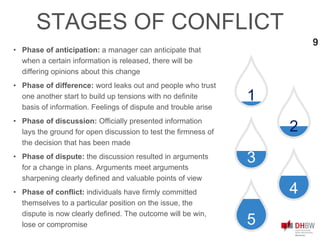
STAGES OF CONFLICT
• Phase of anticipation: a manager can anticipate that
when a certain information is released, there will be
differing opinions about this change
• Phase of difference: word leaks out and people who trust
one another start to build up tensions with no definite
basis of information. Feelings of dispute and trouble arise
• Phase of discussion: Officially presented information
lays the ground for open discussion to test the firmness of
the decision that has been made
• Phase of dispute: the discussion resulted in arguments
for a change in plans. Arguments meet arguments
sharpening clearly defined and valuable points of view
• Phase of conflict: individuals have firmly committed
themselves to a particular position on the issue, the
dispute is now clearly defined. The outcome will be win,
lose or compromise
3
2
5
4
1
R T
A S
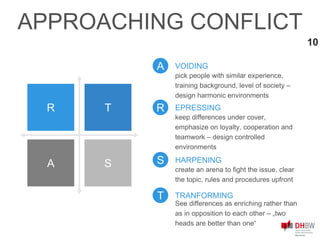
R EPRESSING
keep differences under cover,
emphasize on loyalty, cooperation and
teamwork – design controlled
environments
A VOIDING
pick people with similar experience,
training background, level of society –
design harmonic environments
S HARPENING
create an arena to fight the issue, clear
the topic, rules and procedures upfront
T TRANFORMING
APPROACHING CONFLICT
10
See differences as enriching rather than
as in opposition to each other – „two
heads are better than one“
11
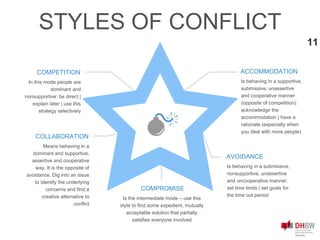
STYLES OF CONFLICT
COLLABORATION
Means behaving in a
dominant and supportive,
assertive and cooperative
way. It is the opposite of
avoidance. Dig into an issue
to identify the underlying
concerns and find a
creative alternative to
conflict
COMPETITION
In this mode people are
dominant and
nonsupportive: be direct |
explain later | use this
strategy selectively
ACCOMMODATION
Is behaving in a supportive,
submissive, unassertive
and cooperative manner
(opposite of competition):
acknowledge the
accommodation | have a
rationale (especially when
you deal with more people)
AVOIDANCE
Is behaving in a submissive,
nonsupportive, unassertive
and uncooperative manner:
set time limits | set goals for
the time out period
COMPROMISE
Is the intermediate mode – use this
style to find some expedient, mutually
acceptable solution that partially
satisfies everyone involved
12
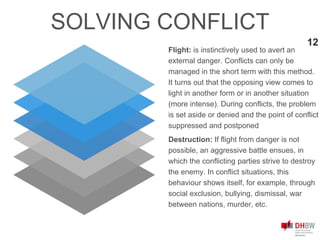
SOLVING CONFLICT
Flight: is instinctively used to avert an
external danger. Conflicts can only be
managed in the short term with this method.
It turns out that the opposing view comes to
light in another form or in another situation
(more intense). During conflicts, the problem
is set aside or denied and the point of conflict
suppressed and postponed
Destruction: If flight from danger is not
possible, an aggressive battle ensues, in
which the conflicting parties strive to destroy
the enemy. In conflict situations, this
behaviour shows itself, for example, through
social exclusion, bullying, dismissal, war
between nations, murder, etc.
13
SOLVING CONFLICT
Subordination: is selected as a method for
managing conflict if those conflicting parties with
fewer resources of power come to the
conclusion that subordination could bring
benefits. Hierarchically organized companies
are characterized by subordination.
Subordination shows itself in the form of threat,
blackmail, war, putsch, bribery, hierarchy, denial
and resignation
Delegation: The conflict is delegated to a third
party to take a decision. In order for the
conflicting parties to accept a decision by
delegation, one must ensure that this higher
authority is not directly involved in the conflict
and has no vested interests
14
SOLVING CONFLICT
Compromise: The conflicting parties must
find partial agreement in certain areas of
conflict and approach each other. One great
advantage of compromise is that the
conflicting parties retain their powers in each
phase of negotiations. Good compromises
involve the negotiations of important aspects
Consensus: All points of conflict and sub-
aspects of the search for a solution are
included in the consensus. The conflicting
parties develop a new view of their position
from the previously contrary positions, one
that is acceptable to both partners in terms of
its content, as well as on the relational level.
15
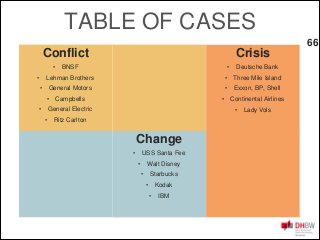
Case Logbook:
• We run a historic scheduling system for our trains that was
designed for hauling coal and grain at low costs
• For these commodities it didn’t make much difference
whether the train showed up on Monday or on Wednesday
• The new CEO set out a vision for intermodal business to
compete with truckers to transport cargo from U.S. ports
knowing that the economy will increasingly rely on imports
• If we will not succeed to become this gateway, others will
• Intermodal shippers call for JIT delivery, real-time tracking
and centralized hubs rather than siloed systems
• The “incumbents” argue with the “newbies” on how to
proceed. Create and prepare a role play from what you
have learned on conflict so far
BNSF RAILWAYS
16
Case Logbook:
• During the last two decades or so our company’s culture
was all bout me. My job. My people. My pay. And we have
been pretty successful with that
• However, the banking industry moves through times of
serious change. Just to name a few: internet & direct
banking, mobile banking, bit coins, new regulations due to
financial crisis, low interest rates, Brexit etc.
• Hence we must move to an integrated sales model and
act as ONE firm to maximize value for the (few) remaining
customers. We have to move fast and jump on the already
moving band waggon
• The “incumbents” argue with the “newbies” on how to
proceed. Create and prepare a role play from what you
have learned on conflict so far
LEHMAN BROTHERS
17
Case Logbook:
• Our purpose is to earn customers for life
• There is a controversy about our future product setup
• The sales division argues in favor of a “business as usual”
approach – the car type GM stands for will be and stay
salable on the global market. Especially the demand in
growing economies and the trend for SUVs in Europe will
guarantee sales and profits in decades to come
• The marketing division wants to build a greener fleet.
Growth in this segment is larger than in the conventional
segments and global low carbon regulation sets the pace
• The “incumbents” argue with the “newbies” on how to
proceed. Create and prepare a role play from what you
have learned on conflict so far
GENERAL MOTORS
18
Case Logbook:
• We are one of the world’s poorest-performing food
companies with little product innovation
• To slash costs we will eventually take the chicken out of the
chicken soup – similar initiatives have raised the company’s
earnings and cooled some of the heat coming from wall
street
• The CEO crafted a new mission statement to “nourish
people’s lives everywhere, every day” calling for product
innovation and new cross unit business development
• With that he also altered the company’s organizational
structure from a linear to a matrix setup
• The “incumbents” argue with the “newbies” on how to
proceed. Create and prepare a role play from what you have
learned on conflict so far
CAMPBELLS
19
Case Logbook:
• We are one of the key stakeholders in the global energy
transition providing all but nuclear power generators
• Products and services for the district heating sector are
developed, produced and marketed by our district heating
business unit autonomously
• A re-organization program foresees that all marketing
activities will be handled by a centralized marketing unit
and the former district heating unit will stay with product
development and production, only
• The successful district heating unit argues against this re-
organization. Management argues for an integrated
marketing unit for “heat” as a whole, including dh, gas,
coal, geothermal etc. Create and prepare a role play from
what you have learned on conflict so far
GENERAL ELECTRIC
20
Case Logbook:
• We are the hotel in NYC. Our credo serving our guests
has been for decades: “The Answer Is “Yes” – What Is
The Question?” or “Gentlemen serving Gentlemen”
• In recent months we experience harsh competition from
international premium hotel brands attracting our
customers through excitement, service and lower prices
• To become more competitive our CEO decided to cut our
staffs’ authority to handle complaints autonomously
(especially the eligibility to give discounts and vouchers)
• The General Manager of RC NYC argues against this cost
cutting initiative as it harms the core values and traditions
of RC. Create and prepare a role play from what you have
learned on conflict so far
THE RITZ CARLTON
21
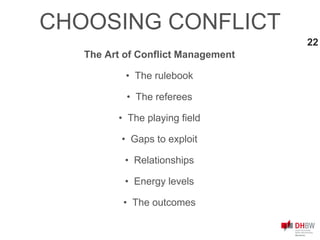
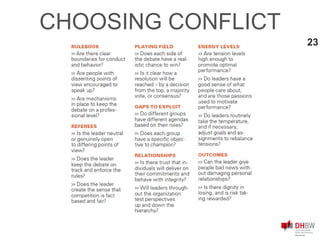
CHOOSING CONFLICT
22
The Art of Conflict Management
• The rulebook
• The referees
• The playing field
• Gaps to exploit
• Relationships
• Energy levels
• The outcomes
CHOOSING CONFLICT
23
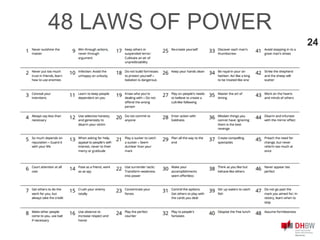
48 LAWS OF POWER
24
25
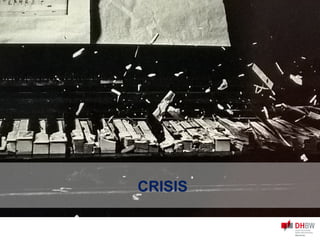
CRISIS
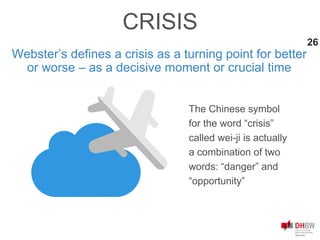
Webster’s defines a crisis as a turning point for better
or worse – as a decisive moment or crucial time
The Chinese symbol
for the word “crisis”
called wei-ji is actually
a combination of two
words: “danger” and
“opportunity”
CRISIS
26
In a confidential survey taken by
Harvard Business School,
89% of Fortune 500 CEOs see
“crisis in business as inevitable
as death or paying taxes”
50% of respondents admitted
that they do not have a prepared
crisis management plan.
42% of those companies that
reported having had a crisis in
the past still do not have any sort
of crisis management plan.
Yet 97% of the respondents
feel either confident of
somewhat confident that they
could respond well to a crisis
27
• Industrial Accidents
• Environmental Problems
• Union Problems / Strikes
• Product Recalls
• Investors
• Hostile Takeovers
• Proxy Fights
• Rumors / Media Leaks
• Government / Regulatory
• Acts of Terrorism
• Embezzlement
TYPES OF CRISIS
Most Fortune500 CEO’s see their companies at least
somewhat vulnerable to the types of crisis listed above
28
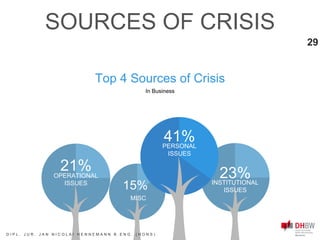
45%15%
23%INSTITUTIONAL
ISSUES
PERSONAL
ISSUES
41%
Top 4 Sources of Crisis
In Business
MISC
OPERATIONAL
ISSUES
21%
29
SOURCES OF CRISIS
D I P L . J U R . J A N N I C O L A I H E N N E M A N N B . E N G . ( H O N S )
30
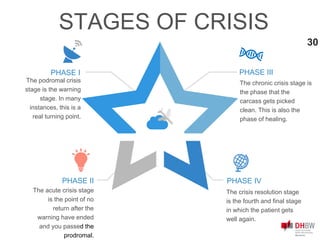
PHASE I
The podromal crisis
stage is the warning
stage. In many
instances, this is a
real turning point.
PHASE III
The chronic crisis stage is
the phase that the
carcass gets picked
clean. This is also the
phase of healing.
PHASE IV
The crisis resolution stage
is the fourth and final stage
in which the patient gets
well again.
PHASE II
The acute crisis stage
is the point of no
return after the
warning have ended
and you passed the
prodromal.
STAGES OF CRISIS
PHASE I
PHASE II
PHASE IV
PHASE III
Occasionally the prodromal crisis stage
is referred to as the precrisis stage.
The reason why prodromes are so
important to catch is that it is so much
easier to manage crisis in the prodromal
stage.
Sailors at the sea who spot the ominous
prodrome of fast gathering storm clouds
off in the horizon have no power to stop
the acute storm. But knowing what is
about to happen gives them the
opportunity to batten down the hatches,
head for shore, and just generally brace
themselves and their ship for the
inevitable acute crisis.
31
STAGES OF CRISIS
PHASE IV
PHASE III
32
PHASE II
PHASE I
STAGES OF CRISIS
The acute crisis stage is in many ways
the point of no return.
If our sailors realize that they cannot
make it back to the shore before the
storm hits, they at least have the
opportunity to pick the spot where they
feel they will be in the most
advantageous position to weather the
storm intact. If the are too close to
hidden reefs they have the opportunity
and the time to move their ship to the
open sea.
The acute crisis hurricane is often the
shortest of the four phases. But due to
its intensity, it often may feel as the
longest phase.
PHASE II
PHASE IV
33
PHASE I
PHASE III
STAGES OF CRISIS
The chronic crisis stage is sometimes
called the clean up phase.
This is also a period of recovery, of self
analysis and of healing. With good crisis
management skills, it also may become
a time for congratulations and for
plaudits and for testimonials.
Skillful managers will also use it wisely
as a good time for further crisis
management planning – analyzing what
went right and what went wrong.
In our sailing example the captain may
use the situation to hire further staff or
get better weather forecasting
equipment.
PHASE II
34
PHASE I
PHASE III
PHASE IV
STAGES OF CRISIS
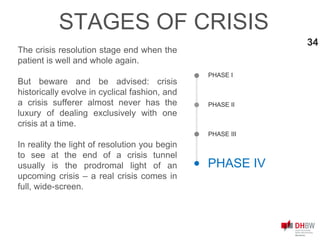
The crisis resolution stage end when the
patient is well and whole again.
But beware and be advised: crisis
historically evolve in cyclical fashion, and
a crisis sufferer almost never has the
luxury of dealing exclusively with one
crisis at a time.
In reality the light of resolution you begin
to see at the end of a crisis tunnel
usually is the prodromal light of an
upcoming crisis – a real crisis comes in
full, wide-screen.
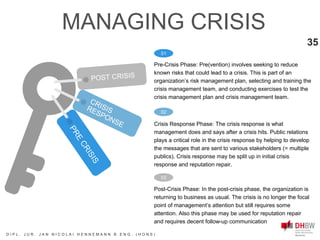
01
Pre-Crisis Phase: Pre(vention) involves seeking to reduce
known risks that could lead to a crisis. This is part of an
organization’s risk management plan, selecting and training the
crisis management team, and conducting exercises to test the
crisis management plan and crisis management team.
02
Crisis Response Phase: The crisis response is what
management does and says after a crisis hits. Public relations
plays a critical role in the crisis response by helping to develop
the messages that are sent to various stakeholders (= multiple
publics). Crisis response may be split up in initial crisis
response and reputation repair.
03
Post-Crisis Phase: In the post-crisis phase, the organization is
returning to business as usual. The crisis is no longer the focal
point of management’s attention but still requires some
attention. Also this phase may be used for reputation repair
and requires decent follow-up communication
35
MANAGING CRISIS
D I P L . J U R . J A N N I C O L A I H E N N E M A N N B . E N G . ( H O N S )
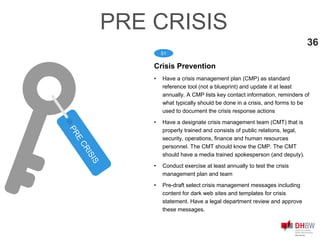
01
Crisis Prevention
• Have a crisis management plan (CMP) as standard
reference tool (not a blueprint) and update it at least
annually. A CMP lists key contact information, reminders of
what typically should be done in a crisis, and forms to be
used to document the crisis response actions
• Have a designate crisis management team (CMT) that is
properly trained and consists of public relations, legal,
security, operations, finance and human resources
personnel. The CMT should know the CMP. The CMT
should have a media trained spokesperson (and deputy).
• Conduct exercise at least annually to test the crisis
management plan and team
• Pre-draft select crisis management messages including
content for dark web sites and templates for crisis
statement. Have a legal department review and approve
these messages.
36
PRE CRISIS
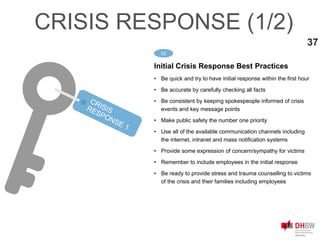
01
Initial Crisis Response Best Practices
• Be quick and try to have initial response within the first hour
• Be accurate by carefully checking all facts
• Be consistent by keeping spokespeople informed of crisis
events and key message points
• Make public safety the number one priority
• Use all of the available communication channels including
the internet, intranet and mass notification systems
• Provide some expression of concern/sympathy for victims
• Remember to include employees in the initial response
• Be ready to provide stress and trauma counselling to victims
of the crisis and their families including employees
02
37
CRISIS RESPONSE (1/2)
01
Reputation Repair Best Practices
• Attack the accuser: crisis manager confronts the person or
group claiming something is wrong with the organization
• Denial: crisis manager asserts that there is no crisis
• Scapegoat: crisis manager blames others for the crisis
• Excuse: crisis manager minimizes organizational responsibility
by denying intent to do harm and / or claiming inability to
control the events that triggered the crisis
• Justification: crisis manager minimizes the perceived damage
caused by the crisis
• Reminder: crisis manager tell stakeholders about the past
good works of the organization
• Ingratiation: crisis manager praises stakeholders for actions
• Compensation: crisis manager offers money / gifts to victims
• Apology: crisis manager indicates responsibility and asks for
forgiveness
02
38
CRISIS RESPONSE (2/2)
Return to business as usual
• Deliver all information promised to stakeholders as soon as
that information is known
• Keep stakeholders updated on the progression of recovery
efforts including any corrective measures being taken and
the progress of investigations
• Analyze the crisis management effort for lessons and
integrate those lessons in to the organization’s crisis
management system
03
39
POST CRISIS
40
Case Logbook:
• During the Mannesmann trial – that finally ended after a
retrial in late 2006 – the CEO of Deutsche Bank, Josef
Ackermann, was photographed with a two-fingered
Churchillian V for victory when making his first court
appearance
• The gesture was not related to the Mannesmann trial but
to an – in Ackermann’s eyes – “arrogant and stupid move”
Michael Jackson performed during his judicial proceedings
on sexual abuse that took place in California at the same
time
• After the photographer denied to sell you – the PR and
media team of Deutsche Bank – the picture and persisted
to sell it to the press how would you handle this situation
with our toolkit?
DEUTSCHE BANK
41
Case Logbook:
• On Wednesday, March 28 1979, shortly before 4 a.m.
something went wrong at Three Mile Island nuclear plant,
Dauphin County, Pennsylvania
• It all started with a pump that sends hot water to the steam
generator failed for reasons still unexplained
• Within seconds “bells were ringing, lights were flashing
and everybody in the reactor’s control room was garbbing
and scratching”
• At 7:02 a.m. company officials notified the Dauphin County
civil defense office that they had declared “a site
emergency”
• It was about 10 a.m. that the President of the United
States, Jimmy Carter, was informed.
• How would you handle this situation with our toolkit?
THREE MILE ISLAND
42
Case Logbook:
• Oil industry crisis are unique in terms of crisis history and
the potential for severe loss and damage
• The BP refinery explosion of Texas City in 2005 led to
fifteen people dead, 70 injured, a frightened community,
and a $1 per barrel increase in oil prices.
• The explosion occurred at 1:20 p.m. and was the third
fatal accident at the plant within 12 months.
• Keeping the crisis history of BP in mind and the fact that
BP has been listed by CorpWatch as one of the ten worst
corporations – how would you respond to this latest
refinery explosion using out toolkit?
EXXON – BP – SHELL
43
Case Logbook:
• In the early 90s of the last century Continental Airlines was
one of the most dysfunctional companies. It had been
through two bankruptcies and ten presidents in just ten
years.
• The company was burning money, there was no strategy
and the employee morale couldn’t get any worse
• Now, it is time for your team to think about the crisis at
Continental:
- What questions will you ask?
- What is the right structure to solve the crisis?
- Where will you start?
- How will you monitor your progress?
• Use the lessons learned so far!
CONTINENTAL AIRLINES
44
Case Logbook:
• After the loss against Stanford during the ‘97 season UT
Headcoach Pat Summit approached Abby, one of her
players, in a team meeting by saying: “Let’s face it. We are
handcuffed because you won’t defend or rebound.” –
• Abby then retorted, “I don’t agree” and started to haggle
with Pat about what the team should have done against
Stanford.
• After a while Pat said tightly “Abby, you are stubborn than
you are smart. And you’re gonna kill this team with it”
• How would you handle this situation with our toolkit?
• PS: When Abby graduated from UT she had played three
national championships and had won three of them
LADY VOLS
45
46
CHANGECHANGE
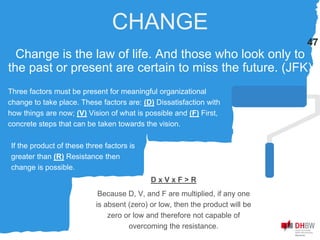
Change is the law of life. And those who look only to
the past or present are certain to miss the future. (JFK)
Three factors must be present for meaningful organizational
change to take place. These factors are: (D) Dissatisfaction with
how things are now; (V) Vision of what is possible and (F) First,
concrete steps that can be taken towards the vision.
If the product of these three factors is
greater than (R) Resistance then
change is possible.
D x V x F > R
Because D, V, and F are multiplied, if any one
is absent (zero) or low, then the product will be
zero or low and therefore not capable of
overcoming the resistance.
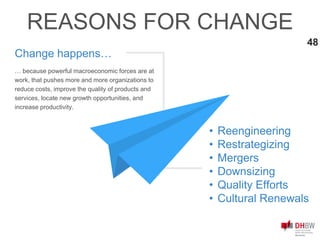
CHANGE
47
• Reengineering
• Restrategizing
• Mergers
• Downsizing
• Quality Efforts
• Cultural Renewals
… because powerful macroeconomic forces are at
work, that pushes more and more organizations to
reduce costs, improve the quality of products and
services, locate new growth opportunities, and
increase productivity.
Change happens…
REASONS FOR CHANGE
48
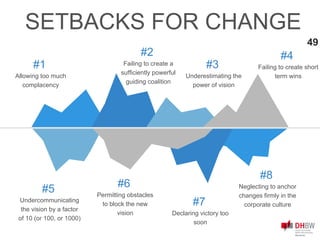
SETBACKS FOR CHANGE
Allowing too much
complacency
#1 Failing to create a
sufficiently powerful
guiding coalition
#2
Underestimating the
power of vision
#3 Failing to create short
term wins
#4
Undercommunicating
the vision by a factor
of 10 (or 100, or 1000)
#5 Permitting obstacles
to block the new
vision
#6
Declaring victory too
soon
#7
Neglecting to anchor
changes firmly in the
corporate culture
#8
49
#1 Too much complacency
High complacency levels fail transformations. Risk to overestimate ability
to force big changes. Risk to underestimate resistance to change.
50
SETBACKS FOR CHANGE
#3 Underestimate power of vision
Vision helps to direct, align and inspire actions by large
numbers of people. Without a guiding vision, each and every
choice can dissolve into an interminable, time wasting debate
#2 Failing to create guiding coalition
Without strong line leadership change teams never achieve the power
that is required to overcome sources of inertia
#4 Undercommunicate the vision
Without credible communication (and enough of it),
employees’ hearts and minds are never captured
#5 Permitting Obstacles
One well-placed blocker can stop an entire change effort. Whenever smart
and well-intentioned people avoid confronting obstacles they undermine
change
51
SETBACKS FOR CHANGE
#7 Declaring victory to soon
While celebrating a win is fine, any suggestion that the job is
mostly done is generally a terrible mistake – new approaches
are fragile and subject to regression
#6 Failing to create short term wins
There is a risk of losing momentum for change, if there are no short-
term goals to meet and celebrate.
#8 Anchor changes into culture
Change must become “the way we do things around here” –
be specific and give sufficient time
52
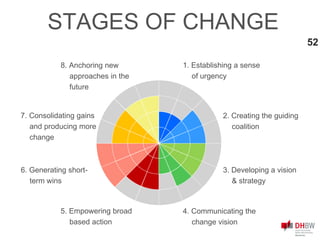
1. Establishing a sense
of urgency
2. Creating the guiding
coalition
3. Developing a vision
& strategy
4. Communicating the
change vision
5. Empowering broad
based action
6. Generating short-
term wins
7. Consolidating gains
and producing more
change
8. Anchoring new
approaches in the
future
STAGES OF CHANGE
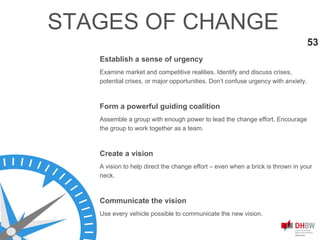
Establish a sense of urgency
Examine market and competitive realities. Identify and discuss crises,
potential crises, or major opportunities. Don’t confuse urgency with anxiety.
Form a powerful guiding coalition
Assemble a group with enough power to lead the change effort. Encourage
the group to work together as a team.
Create a vision
A vision to help direct the change effort – even when a brick is thrown in your
neck.
Communicate the vision
Use every vehicle possible to communicate the new vision.
53
STAGES OF CHANGE
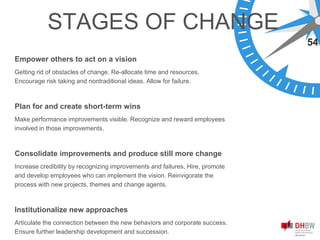
Empower others to act on a vision
Getting rid of obstacles of change. Re-allocate time and resources.
Encourage risk taking and nontraditional ideas. Allow for failure.
Plan for and create short-term wins
Make performance improvements visible. Recognize and reward employees
involved in those improvements.
Consolidate improvements and produce still more change
Increase credibility by recognizing improvements and failures. Hire, promote
and develop employees who can implement the vision. Reinvigorate the
process with new projects, themes and change agents.
Institutionalize new approaches
Articulate the connection between the new behaviors and corporate success.
Ensure further leadership development and succession.
54
STAGES OF CHANGE
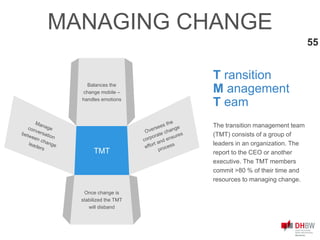
TMT
Once change is
stabilized the TMT
will disband
Balances the
change mobile –
handles emotions
The transition management team
(TMT) consists of a group of
leaders in an organization. The
report to the CEO or another
executive. The TMT members
commit >80 % of their time and
resources to managing change.
T ransition
M anagement
T eam
MANAGING CHANGE
55
56
MANAGING CHANGE
#1
Connect and balance all change efforts in
your organization
#2
…
57
MANAGING CHANGE
#3
…
#4
…
58
USS SANTA FEE
Case Logbook:
• David Marquet was Captain of the USS Santa Fee, a
nuclear submarine and a high stress environment
• The ship was dogged by poor morale, poor performance
and the worst retention in the fleet
• One day Marquet unknowingly gave an impossible order,
and his crew tried to follow it anyway. He realized he was
leading in a culture of followers. They were all in danger.
He had to fundamentally change things!
• Draw a plan, how to change things in such an
environment. Use the tools we have assembled so far and
the background described in Marquet’s Bestseller “Turn
the Ship Around!”
59
WALT DISNEY
Case Logbook:
• …
60
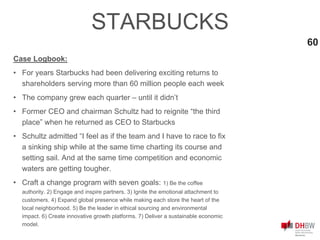
STARBUCKS
Case Logbook:
• For years Starbucks had been delivering exciting returns to
shareholders serving more than 60 million people each week
• The company grew each quarter – until it didn’t
• Former CEO and chairman Schultz had to reignite “the third
place” when he returned as CEO to Starbucks
• Schultz admitted “I feel as if the team and I have to race to fix
a sinking ship while at the same time charting its course and
setting sail. And at the same time competition and economic
waters are getting tougher.
• Craft a change program with seven goals: 1) Be the coffee
authority. 2) Engage and inspire partners. 3) Ignite the emotional attachment to
customers. 4) Expand global presence while making each store the heart of the
local neighborhood. 5) Be the leader in ethical sourcing and environmental
impact. 6) Create innovative growth platforms. 7) Deliver a sustainable economic
model.
61
APPLE
Case Logbook:
• …
62
KODAK
Case Logbook:
• …
63
IBM
Case Logbook:
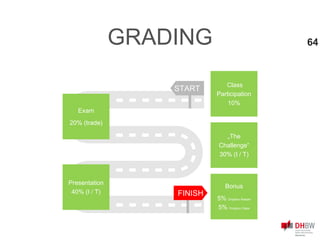
• …
Class
Participation
10%
START
FINISH
Exam
20% (trade)
GRADING
Presentation
40% (I / T)
64
„The
Challenge“
30% (I / T)
Bonus
5% Dropbox Keeper
5% Dropbox Class
CONTACT 65
Jan Nicolai Hennemann
Business Mediator, Ind. Engineer, Jurist
Senior Project Manager @ SWECO
M: +49 171 270 64 17
E: nicolai.hennemann@sweco-gmbh.de
Managing Conflict Crisis Change

Managing Conflict Crisis Change

  • 1.
    MANAGING CONFLICT – CRISIS– CHANGE J A N N I C O L A I H E N N E M A N N , M E D I A T O R , J U R I S T , I N D . E N G I N E E R
  • 2.
    SPIRITUAL ROBERT DILTS‘ UNIFIEDFIELD OF NLP IDENTITY BELIEF CAPABILITY BEHAVIOR EVIRONMENT 2 WHY AM I HERE?
  • 3.
    From its beginningin 1958 the NASA program stood under high pressure due to its tremendous costs – a burden the taxpayer had to bear CONFLICT 01 The Challenger and Columbia accidents put the space-program of NASA on hold and under review CRISIS 02 New programs and cooperation between public and private stakeholder were set up to transport humans in space again CHANGE 03 NASA’s vision is to reach for new heights and reveal the unknown for the benefit of humankind. 3 AGENDA
  • 4.
    Almost every conflictcontains within itself the seeds of success as well as the roots of failure Conflict is a theme that has occupied the thinking of mankind more than any other. As we deal with conflict we may not find a treasure, but we improve the soil. CONFLICT 4
  • 5.
    Organizational Conflict • tribalgenocide • headquater vs. division / unit, double agent Institutional Conflict • life vs. death, individual vs. group, young vs. old, male vs. female Systematical Conflict • Intercultural, quantity vs. quality Single Party Conflict • about me • life vs. death, I vs. we, young vs. old, male vs. female Pair Conflict • about you & me • identity, distance, development, transaction, role, competition Group Conflict • about us • jealousy, rivalry, membership 5 TYPES OF CONFLICT
  • 6.
    Values: the waypower should be excercised, moral, ethics etc. have potential to lead to conflict Goals: disagreement on desirable objectives of a department, division Facts: individuals have different definitions, different pieces of information, different impressions of their respective power & authority Methods: parties differ on about the procedures, strategies or tactics to achieve the goal SOURCES OF CONFLICT 6
  • 7.
    7 • Informational factors:when two parties receive limited information about a complex issue, they may well disagree on a problem as it emerges (ancient legend of the blind men and the elephant) • Perceptual factors: evolves as two persons or groups have different images of the same stimulus leading to different interpretation and alternating experiences for the future (paper assignment with no set page limits) • Role factors: individuals have certain position and status in society, project or organisation resulting in constraints and opportunities for them. During interaction these roles get tested and often re-organised leading to friction (your colleague becomes your boss) FACTORS OF CONFLICT (1/2)
  • 8.
    • Environmental factors:Scarcity and uncertainty often lead our intensify conflict situations. An important aspect of conflict stemming from the environment is the degree to which competition is present. Be aware that competition can often be a zero-sum-game (a bank announces a downsizing program to its employees) • Personal factors: These may be the most intractable and intracable conflict sources. Additionally, such conflicts are very difficult to resolve. Usually there is tension about what is (factually) correct and who is (morally) right (two people want to set the agenda or to take charge of a particular topic) 8 FACTORS OF CONFLICT (2/2)
  • 9.
    9 STAGES OF CONFLICT •Phase of anticipation: a manager can anticipate that when a certain information is released, there will be differing opinions about this change • Phase of difference: word leaks out and people who trust one another start to build up tensions with no definite basis of information. Feelings of dispute and trouble arise • Phase of discussion: Officially presented information lays the ground for open discussion to test the firmness of the decision that has been made • Phase of dispute: the discussion resulted in arguments for a change in plans. Arguments meet arguments sharpening clearly defined and valuable points of view • Phase of conflict: individuals have firmly committed themselves to a particular position on the issue, the dispute is now clearly defined. The outcome will be win, lose or compromise 3 2 5 4 1
  • 10.
    R T A S REPRESSING keep differences under cover, emphasize on loyalty, cooperation and teamwork – design controlled environments A VOIDING pick people with similar experience, training background, level of society – design harmonic environments S HARPENING create an arena to fight the issue, clear the topic, rules and procedures upfront T TRANFORMING APPROACHING CONFLICT 10 See differences as enriching rather than as in opposition to each other – „two heads are better than one“
  • 11.
    11 STYLES OF CONFLICT COLLABORATION Meansbehaving in a dominant and supportive, assertive and cooperative way. It is the opposite of avoidance. Dig into an issue to identify the underlying concerns and find a creative alternative to conflict COMPETITION In this mode people are dominant and nonsupportive: be direct | explain later | use this strategy selectively ACCOMMODATION Is behaving in a supportive, submissive, unassertive and cooperative manner (opposite of competition): acknowledge the accommodation | have a rationale (especially when you deal with more people) AVOIDANCE Is behaving in a submissive, nonsupportive, unassertive and uncooperative manner: set time limits | set goals for the time out period COMPROMISE Is the intermediate mode – use this style to find some expedient, mutually acceptable solution that partially satisfies everyone involved
  • 12.
    12 SOLVING CONFLICT Flight: isinstinctively used to avert an external danger. Conflicts can only be managed in the short term with this method. It turns out that the opposing view comes to light in another form or in another situation (more intense). During conflicts, the problem is set aside or denied and the point of conflict suppressed and postponed Destruction: If flight from danger is not possible, an aggressive battle ensues, in which the conflicting parties strive to destroy the enemy. In conflict situations, this behaviour shows itself, for example, through social exclusion, bullying, dismissal, war between nations, murder, etc.
  • 13.
    13 SOLVING CONFLICT Subordination: isselected as a method for managing conflict if those conflicting parties with fewer resources of power come to the conclusion that subordination could bring benefits. Hierarchically organized companies are characterized by subordination. Subordination shows itself in the form of threat, blackmail, war, putsch, bribery, hierarchy, denial and resignation Delegation: The conflict is delegated to a third party to take a decision. In order for the conflicting parties to accept a decision by delegation, one must ensure that this higher authority is not directly involved in the conflict and has no vested interests
  • 14.
    14 SOLVING CONFLICT Compromise: Theconflicting parties must find partial agreement in certain areas of conflict and approach each other. One great advantage of compromise is that the conflicting parties retain their powers in each phase of negotiations. Good compromises involve the negotiations of important aspects Consensus: All points of conflict and sub- aspects of the search for a solution are included in the consensus. The conflicting parties develop a new view of their position from the previously contrary positions, one that is acceptable to both partners in terms of its content, as well as on the relational level.
  • 15.
    15 Case Logbook: • Werun a historic scheduling system for our trains that was designed for hauling coal and grain at low costs • For these commodities it didn’t make much difference whether the train showed up on Monday or on Wednesday • The new CEO set out a vision for intermodal business to compete with truckers to transport cargo from U.S. ports knowing that the economy will increasingly rely on imports • If we will not succeed to become this gateway, others will • Intermodal shippers call for JIT delivery, real-time tracking and centralized hubs rather than siloed systems • The “incumbents” argue with the “newbies” on how to proceed. Create and prepare a role play from what you have learned on conflict so far BNSF RAILWAYS
  • 16.
    16 Case Logbook: • Duringthe last two decades or so our company’s culture was all bout me. My job. My people. My pay. And we have been pretty successful with that • However, the banking industry moves through times of serious change. Just to name a few: internet & direct banking, mobile banking, bit coins, new regulations due to financial crisis, low interest rates, Brexit etc. • Hence we must move to an integrated sales model and act as ONE firm to maximize value for the (few) remaining customers. We have to move fast and jump on the already moving band waggon • The “incumbents” argue with the “newbies” on how to proceed. Create and prepare a role play from what you have learned on conflict so far LEHMAN BROTHERS
  • 17.
    17 Case Logbook: • Ourpurpose is to earn customers for life • There is a controversy about our future product setup • The sales division argues in favor of a “business as usual” approach – the car type GM stands for will be and stay salable on the global market. Especially the demand in growing economies and the trend for SUVs in Europe will guarantee sales and profits in decades to come • The marketing division wants to build a greener fleet. Growth in this segment is larger than in the conventional segments and global low carbon regulation sets the pace • The “incumbents” argue with the “newbies” on how to proceed. Create and prepare a role play from what you have learned on conflict so far GENERAL MOTORS
  • 18.
    18 Case Logbook: • Weare one of the world’s poorest-performing food companies with little product innovation • To slash costs we will eventually take the chicken out of the chicken soup – similar initiatives have raised the company’s earnings and cooled some of the heat coming from wall street • The CEO crafted a new mission statement to “nourish people’s lives everywhere, every day” calling for product innovation and new cross unit business development • With that he also altered the company’s organizational structure from a linear to a matrix setup • The “incumbents” argue with the “newbies” on how to proceed. Create and prepare a role play from what you have learned on conflict so far CAMPBELLS
  • 19.
    19 Case Logbook: • Weare one of the key stakeholders in the global energy transition providing all but nuclear power generators • Products and services for the district heating sector are developed, produced and marketed by our district heating business unit autonomously • A re-organization program foresees that all marketing activities will be handled by a centralized marketing unit and the former district heating unit will stay with product development and production, only • The successful district heating unit argues against this re- organization. Management argues for an integrated marketing unit for “heat” as a whole, including dh, gas, coal, geothermal etc. Create and prepare a role play from what you have learned on conflict so far GENERAL ELECTRIC
  • 20.
    20 Case Logbook: • Weare the hotel in NYC. Our credo serving our guests has been for decades: “The Answer Is “Yes” – What Is The Question?” or “Gentlemen serving Gentlemen” • In recent months we experience harsh competition from international premium hotel brands attracting our customers through excitement, service and lower prices • To become more competitive our CEO decided to cut our staffs’ authority to handle complaints autonomously (especially the eligibility to give discounts and vouchers) • The General Manager of RC NYC argues against this cost cutting initiative as it harms the core values and traditions of RC. Create and prepare a role play from what you have learned on conflict so far THE RITZ CARLTON
  • 21.
  • 22.
    CHOOSING CONFLICT 22 The Artof Conflict Management • The rulebook • The referees • The playing field • Gaps to exploit • Relationships • Energy levels • The outcomes
  • 23.
  • 24.
    48 LAWS OFPOWER 24
  • 25.
  • 26.
    Webster’s defines acrisis as a turning point for better or worse – as a decisive moment or crucial time The Chinese symbol for the word “crisis” called wei-ji is actually a combination of two words: “danger” and “opportunity” CRISIS 26
  • 27.
    In a confidentialsurvey taken by Harvard Business School, 89% of Fortune 500 CEOs see “crisis in business as inevitable as death or paying taxes” 50% of respondents admitted that they do not have a prepared crisis management plan. 42% of those companies that reported having had a crisis in the past still do not have any sort of crisis management plan. Yet 97% of the respondents feel either confident of somewhat confident that they could respond well to a crisis 27
  • 28.
    • Industrial Accidents •Environmental Problems • Union Problems / Strikes • Product Recalls • Investors • Hostile Takeovers • Proxy Fights • Rumors / Media Leaks • Government / Regulatory • Acts of Terrorism • Embezzlement TYPES OF CRISIS Most Fortune500 CEO’s see their companies at least somewhat vulnerable to the types of crisis listed above 28
  • 29.
    45%15% 23%INSTITUTIONAL ISSUES PERSONAL ISSUES 41% Top 4 Sourcesof Crisis In Business MISC OPERATIONAL ISSUES 21% 29 SOURCES OF CRISIS D I P L . J U R . J A N N I C O L A I H E N N E M A N N B . E N G . ( H O N S )
  • 30.
    30 PHASE I The podromalcrisis stage is the warning stage. In many instances, this is a real turning point. PHASE III The chronic crisis stage is the phase that the carcass gets picked clean. This is also the phase of healing. PHASE IV The crisis resolution stage is the fourth and final stage in which the patient gets well again. PHASE II The acute crisis stage is the point of no return after the warning have ended and you passed the prodromal. STAGES OF CRISIS
  • 31.
    PHASE I PHASE II PHASEIV PHASE III Occasionally the prodromal crisis stage is referred to as the precrisis stage. The reason why prodromes are so important to catch is that it is so much easier to manage crisis in the prodromal stage. Sailors at the sea who spot the ominous prodrome of fast gathering storm clouds off in the horizon have no power to stop the acute storm. But knowing what is about to happen gives them the opportunity to batten down the hatches, head for shore, and just generally brace themselves and their ship for the inevitable acute crisis. 31 STAGES OF CRISIS
  • 32.
    PHASE IV PHASE III 32 PHASEII PHASE I STAGES OF CRISIS The acute crisis stage is in many ways the point of no return. If our sailors realize that they cannot make it back to the shore before the storm hits, they at least have the opportunity to pick the spot where they feel they will be in the most advantageous position to weather the storm intact. If the are too close to hidden reefs they have the opportunity and the time to move their ship to the open sea. The acute crisis hurricane is often the shortest of the four phases. But due to its intensity, it often may feel as the longest phase.
  • 33.
    PHASE II PHASE IV 33 PHASEI PHASE III STAGES OF CRISIS The chronic crisis stage is sometimes called the clean up phase. This is also a period of recovery, of self analysis and of healing. With good crisis management skills, it also may become a time for congratulations and for plaudits and for testimonials. Skillful managers will also use it wisely as a good time for further crisis management planning – analyzing what went right and what went wrong. In our sailing example the captain may use the situation to hire further staff or get better weather forecasting equipment.
  • 34.
    PHASE II 34 PHASE I PHASEIII PHASE IV STAGES OF CRISIS The crisis resolution stage end when the patient is well and whole again. But beware and be advised: crisis historically evolve in cyclical fashion, and a crisis sufferer almost never has the luxury of dealing exclusively with one crisis at a time. In reality the light of resolution you begin to see at the end of a crisis tunnel usually is the prodromal light of an upcoming crisis – a real crisis comes in full, wide-screen.
  • 35.
    01 Pre-Crisis Phase: Pre(vention)involves seeking to reduce known risks that could lead to a crisis. This is part of an organization’s risk management plan, selecting and training the crisis management team, and conducting exercises to test the crisis management plan and crisis management team. 02 Crisis Response Phase: The crisis response is what management does and says after a crisis hits. Public relations plays a critical role in the crisis response by helping to develop the messages that are sent to various stakeholders (= multiple publics). Crisis response may be split up in initial crisis response and reputation repair. 03 Post-Crisis Phase: In the post-crisis phase, the organization is returning to business as usual. The crisis is no longer the focal point of management’s attention but still requires some attention. Also this phase may be used for reputation repair and requires decent follow-up communication 35 MANAGING CRISIS D I P L . J U R . J A N N I C O L A I H E N N E M A N N B . E N G . ( H O N S )
  • 36.
    01 Crisis Prevention • Havea crisis management plan (CMP) as standard reference tool (not a blueprint) and update it at least annually. A CMP lists key contact information, reminders of what typically should be done in a crisis, and forms to be used to document the crisis response actions • Have a designate crisis management team (CMT) that is properly trained and consists of public relations, legal, security, operations, finance and human resources personnel. The CMT should know the CMP. The CMT should have a media trained spokesperson (and deputy). • Conduct exercise at least annually to test the crisis management plan and team • Pre-draft select crisis management messages including content for dark web sites and templates for crisis statement. Have a legal department review and approve these messages. 36 PRE CRISIS
  • 37.
    01 Initial Crisis ResponseBest Practices • Be quick and try to have initial response within the first hour • Be accurate by carefully checking all facts • Be consistent by keeping spokespeople informed of crisis events and key message points • Make public safety the number one priority • Use all of the available communication channels including the internet, intranet and mass notification systems • Provide some expression of concern/sympathy for victims • Remember to include employees in the initial response • Be ready to provide stress and trauma counselling to victims of the crisis and their families including employees 02 37 CRISIS RESPONSE (1/2)
  • 38.
    01 Reputation Repair BestPractices • Attack the accuser: crisis manager confronts the person or group claiming something is wrong with the organization • Denial: crisis manager asserts that there is no crisis • Scapegoat: crisis manager blames others for the crisis • Excuse: crisis manager minimizes organizational responsibility by denying intent to do harm and / or claiming inability to control the events that triggered the crisis • Justification: crisis manager minimizes the perceived damage caused by the crisis • Reminder: crisis manager tell stakeholders about the past good works of the organization • Ingratiation: crisis manager praises stakeholders for actions • Compensation: crisis manager offers money / gifts to victims • Apology: crisis manager indicates responsibility and asks for forgiveness 02 38 CRISIS RESPONSE (2/2)
  • 39.
    Return to businessas usual • Deliver all information promised to stakeholders as soon as that information is known • Keep stakeholders updated on the progression of recovery efforts including any corrective measures being taken and the progress of investigations • Analyze the crisis management effort for lessons and integrate those lessons in to the organization’s crisis management system 03 39 POST CRISIS
  • 40.
    40 Case Logbook: • Duringthe Mannesmann trial – that finally ended after a retrial in late 2006 – the CEO of Deutsche Bank, Josef Ackermann, was photographed with a two-fingered Churchillian V for victory when making his first court appearance • The gesture was not related to the Mannesmann trial but to an – in Ackermann’s eyes – “arrogant and stupid move” Michael Jackson performed during his judicial proceedings on sexual abuse that took place in California at the same time • After the photographer denied to sell you – the PR and media team of Deutsche Bank – the picture and persisted to sell it to the press how would you handle this situation with our toolkit? DEUTSCHE BANK
  • 41.
    41 Case Logbook: • OnWednesday, March 28 1979, shortly before 4 a.m. something went wrong at Three Mile Island nuclear plant, Dauphin County, Pennsylvania • It all started with a pump that sends hot water to the steam generator failed for reasons still unexplained • Within seconds “bells were ringing, lights were flashing and everybody in the reactor’s control room was garbbing and scratching” • At 7:02 a.m. company officials notified the Dauphin County civil defense office that they had declared “a site emergency” • It was about 10 a.m. that the President of the United States, Jimmy Carter, was informed. • How would you handle this situation with our toolkit? THREE MILE ISLAND
  • 42.
    42 Case Logbook: • Oilindustry crisis are unique in terms of crisis history and the potential for severe loss and damage • The BP refinery explosion of Texas City in 2005 led to fifteen people dead, 70 injured, a frightened community, and a $1 per barrel increase in oil prices. • The explosion occurred at 1:20 p.m. and was the third fatal accident at the plant within 12 months. • Keeping the crisis history of BP in mind and the fact that BP has been listed by CorpWatch as one of the ten worst corporations – how would you respond to this latest refinery explosion using out toolkit? EXXON – BP – SHELL
  • 43.
    43 Case Logbook: • Inthe early 90s of the last century Continental Airlines was one of the most dysfunctional companies. It had been through two bankruptcies and ten presidents in just ten years. • The company was burning money, there was no strategy and the employee morale couldn’t get any worse • Now, it is time for your team to think about the crisis at Continental: - What questions will you ask? - What is the right structure to solve the crisis? - Where will you start? - How will you monitor your progress? • Use the lessons learned so far! CONTINENTAL AIRLINES
  • 44.
    44 Case Logbook: • Afterthe loss against Stanford during the ‘97 season UT Headcoach Pat Summit approached Abby, one of her players, in a team meeting by saying: “Let’s face it. We are handcuffed because you won’t defend or rebound.” – • Abby then retorted, “I don’t agree” and started to haggle with Pat about what the team should have done against Stanford. • After a while Pat said tightly “Abby, you are stubborn than you are smart. And you’re gonna kill this team with it” • How would you handle this situation with our toolkit? • PS: When Abby graduated from UT she had played three national championships and had won three of them LADY VOLS
  • 45.
  • 46.
  • 47.
    Change is thelaw of life. And those who look only to the past or present are certain to miss the future. (JFK) Three factors must be present for meaningful organizational change to take place. These factors are: (D) Dissatisfaction with how things are now; (V) Vision of what is possible and (F) First, concrete steps that can be taken towards the vision. If the product of these three factors is greater than (R) Resistance then change is possible. D x V x F > R Because D, V, and F are multiplied, if any one is absent (zero) or low, then the product will be zero or low and therefore not capable of overcoming the resistance. CHANGE 47
  • 48.
    • Reengineering • Restrategizing •Mergers • Downsizing • Quality Efforts • Cultural Renewals … because powerful macroeconomic forces are at work, that pushes more and more organizations to reduce costs, improve the quality of products and services, locate new growth opportunities, and increase productivity. Change happens… REASONS FOR CHANGE 48
  • 49.
    SETBACKS FOR CHANGE Allowingtoo much complacency #1 Failing to create a sufficiently powerful guiding coalition #2 Underestimating the power of vision #3 Failing to create short term wins #4 Undercommunicating the vision by a factor of 10 (or 100, or 1000) #5 Permitting obstacles to block the new vision #6 Declaring victory too soon #7 Neglecting to anchor changes firmly in the corporate culture #8 49
  • 50.
    #1 Too muchcomplacency High complacency levels fail transformations. Risk to overestimate ability to force big changes. Risk to underestimate resistance to change. 50 SETBACKS FOR CHANGE #3 Underestimate power of vision Vision helps to direct, align and inspire actions by large numbers of people. Without a guiding vision, each and every choice can dissolve into an interminable, time wasting debate #2 Failing to create guiding coalition Without strong line leadership change teams never achieve the power that is required to overcome sources of inertia #4 Undercommunicate the vision Without credible communication (and enough of it), employees’ hearts and minds are never captured
  • 51.
    #5 Permitting Obstacles Onewell-placed blocker can stop an entire change effort. Whenever smart and well-intentioned people avoid confronting obstacles they undermine change 51 SETBACKS FOR CHANGE #7 Declaring victory to soon While celebrating a win is fine, any suggestion that the job is mostly done is generally a terrible mistake – new approaches are fragile and subject to regression #6 Failing to create short term wins There is a risk of losing momentum for change, if there are no short- term goals to meet and celebrate. #8 Anchor changes into culture Change must become “the way we do things around here” – be specific and give sufficient time
  • 52.
    52 1. Establishing asense of urgency 2. Creating the guiding coalition 3. Developing a vision & strategy 4. Communicating the change vision 5. Empowering broad based action 6. Generating short- term wins 7. Consolidating gains and producing more change 8. Anchoring new approaches in the future STAGES OF CHANGE
  • 53.
    Establish a senseof urgency Examine market and competitive realities. Identify and discuss crises, potential crises, or major opportunities. Don’t confuse urgency with anxiety. Form a powerful guiding coalition Assemble a group with enough power to lead the change effort. Encourage the group to work together as a team. Create a vision A vision to help direct the change effort – even when a brick is thrown in your neck. Communicate the vision Use every vehicle possible to communicate the new vision. 53 STAGES OF CHANGE
  • 54.
    Empower others toact on a vision Getting rid of obstacles of change. Re-allocate time and resources. Encourage risk taking and nontraditional ideas. Allow for failure. Plan for and create short-term wins Make performance improvements visible. Recognize and reward employees involved in those improvements. Consolidate improvements and produce still more change Increase credibility by recognizing improvements and failures. Hire, promote and develop employees who can implement the vision. Reinvigorate the process with new projects, themes and change agents. Institutionalize new approaches Articulate the connection between the new behaviors and corporate success. Ensure further leadership development and succession. 54 STAGES OF CHANGE
  • 55.
    TMT Once change is stabilizedthe TMT will disband Balances the change mobile – handles emotions The transition management team (TMT) consists of a group of leaders in an organization. The report to the CEO or another executive. The TMT members commit >80 % of their time and resources to managing change. T ransition M anagement T eam MANAGING CHANGE 55
  • 56.
    56 MANAGING CHANGE #1 Connect andbalance all change efforts in your organization #2 …
  • 57.
  • 58.
    58 USS SANTA FEE CaseLogbook: • David Marquet was Captain of the USS Santa Fee, a nuclear submarine and a high stress environment • The ship was dogged by poor morale, poor performance and the worst retention in the fleet • One day Marquet unknowingly gave an impossible order, and his crew tried to follow it anyway. He realized he was leading in a culture of followers. They were all in danger. He had to fundamentally change things! • Draw a plan, how to change things in such an environment. Use the tools we have assembled so far and the background described in Marquet’s Bestseller “Turn the Ship Around!”
  • 59.
  • 60.
    60 STARBUCKS Case Logbook: • Foryears Starbucks had been delivering exciting returns to shareholders serving more than 60 million people each week • The company grew each quarter – until it didn’t • Former CEO and chairman Schultz had to reignite “the third place” when he returned as CEO to Starbucks • Schultz admitted “I feel as if the team and I have to race to fix a sinking ship while at the same time charting its course and setting sail. And at the same time competition and economic waters are getting tougher. • Craft a change program with seven goals: 1) Be the coffee authority. 2) Engage and inspire partners. 3) Ignite the emotional attachment to customers. 4) Expand global presence while making each store the heart of the local neighborhood. 5) Be the leader in ethical sourcing and environmental impact. 6) Create innovative growth platforms. 7) Deliver a sustainable economic model.
  • 61.
  • 62.
  • 63.
  • 64.
    Class Participation 10% START FINISH Exam 20% (trade) GRADING Presentation 40% (I/ T) 64 „The Challenge“ 30% (I / T) Bonus 5% Dropbox Keeper 5% Dropbox Class
  • 65.
    CONTACT 65 Jan NicolaiHennemann Business Mediator, Ind. Engineer, Jurist Senior Project Manager @ SWECO M: +49 171 270 64 17 E: nicolai.hennemann@sweco-gmbh.de