DIRECTING FUNCTION OF
MANAGEMENT
CHAPTER-4
AUTHORS:
DR. KIRAN NERKAR
DR. VILAS CHOPDE
 Involves influencing individuals to achieve desired results. It
is concerned with influencing, guiding, supervising, and
motivating employees to perform efficiently.
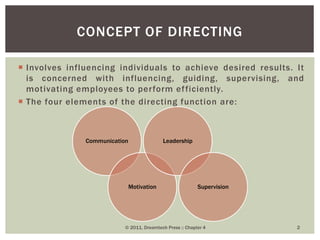
 The four elements of the directing function are:
CONCEPT OF DIRECTING
© 2011, Dreamtech Press :: Chapter 4 2
Communication
Motivation
Leadership
Supervision
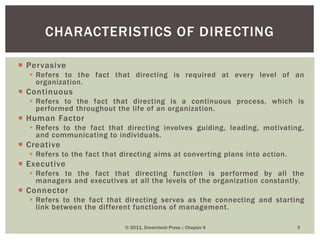
 Pervasive
 Refers to the fact that directing is required at every level of an
organization.
 Continuous
 Refers to the fact that directing is a continuous process, which is
performed throughout the life of an organization.
 Human Factor
 Refers to the fact that directing involves guiding, leading, motivating,
and communicating to individuals.
 Creative
 Refers to the fact that directing aims at converting plans into action.
 Executive
 Refers to the fact that directing function is performed by all the
managers and executives at all the levels of the organization constantly.
 Connector
 Refers to the fact that directing serves as the connecting and starting
link between the different functions of management.
CHARACTERISTICS OF DIRECTING
© 2011, Dreamtech Press :: Chapter 4 3
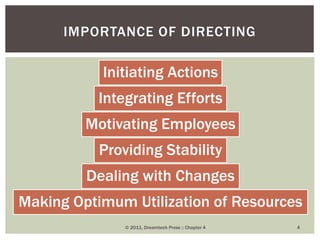
Initiating Actions
Integrating Efforts
Motivating Employees
Providing Stability
Dealing with Changes
Making Optimum Utilization of Resources
IMPORTANCE OF DIRECTING
© 2011, Dreamtech Press :: Chapter 4 4
 Personality can be defined as a combination of physical,
mental, and moral qualities of individuals reflected in their
unique behavior, which separates them from others.
 The elements of personality are:
 Behavior
 Freedom
 Peculiarity
 Physical, Mental, and Moral Qualities
 Adaptability to Environment
 Psychological Systems
 Habits
CONCEPT OF PERSONALITY
© 2011, Dreamtech Press :: Chapter 4 5
 Attitude can be defined as the tendency of an individual to
react positively or negatively in a specific set of
circumstances.
 The components of attitude are:
 Cognitive Component
 Affective Component
 Behavioral Component
CONCEPT OF ATTITUDE
© 2011, Dreamtech Press :: Chapter 4 6
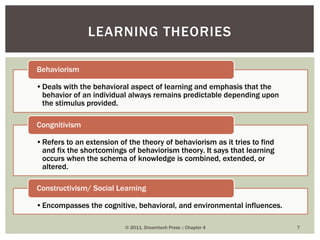
•Deals with the behavioral aspect of learning and emphasis that the
behavior of an individual always remains predictable depending upon
the stimulus provided.
Behaviorism
•Refers to an extension of the theory of behaviorism as it tries to find
and fix the shortcomings of behaviorism theory. It says that learning
occurs when the schema of knowledge is combined, extended, or
altered.
Congnitivism
•Encompasses the cognitive, behavioral, and environmental influences.
Constructivism/ Social Learning
LEARNING THEORIES
© 2011, Dreamtech Press :: Chapter 4 7
 Perception is the process of receiving, selecting, organizing,
interpreting, checking, and reaching to sensory stimulation or
data.
 The elements of perception are:
 Perceiver
 Perceptual Input
 Stimulus
 Perceptual Throughput
 Registration/Receiving
 Selection
 Organization
 Interpretation
 Perceptual Output
CONCEPT OF PERCEPTION
© 2011, Dreamtech Press :: Chapter 4 8
 Helps in better understanding of human behavior.
 Interprets the situation for each individual uniquely. The
varied perspectives of individuals help managers to have
better understanding of the situation and take right decisions.
 Helps in building the personality of employees and makes
them more confident.
 Helps in improving the behavior of employees in the
management by understanding their perceptions.
 Helps management to identify the situations under which the
behavior can be improved or molded.
 Minimizes conflicts as many times a conflict emerges out of
discrepancy between the perceptions of the parties involved.
 Signifies that the honing of perceptual skills enhances the
effectiveness of managers.
© 2011, Dreamtech Press :: Chapter 4 9
IMPORTANCE OF PERCEPTION
 Supervision involves overseeing the work of subordinates by
their superiors to ensure that they are working in accordance
with the plans.
 The various elements of supervision are explained as follows:
 Commanding
 Involves assigning work among subordinates by superiors.
 Guiding
 Refers to the second important element of supervision. Guiding involves
training the subordinates by their superiors.
 Controlling
 Refers to the fact that a supervisor has to oversee the work of his/her
subordinates.
CONCEPT OF SUPERVISION
© 2011, Dreamtech Press :: Chapter 4 10
 Ensuring quality of products
 Preventing the wastage of resources and time
 Providing guidance to employees
 Ensuring the effective implementation of plans, policies, and
programs
 Maintaining discipline in the organization
 Increasing the morale of employees
IMPORTANCE OF SUPERVISION
© 2011, Dreamtech Press :: Chapter 4 11
 An organization should strive to motivate employees from to
time to time to improve their performance, which, in turn,
increase their efficiency.
 Direction can be defined as a process in which the managers
of an organization instruct and monitor the performance of
employees to achieve the desired goals.
 The directing function of an organization enables employees
to understand their roles and responsibilities and perform
accordingly.
 There should be proper communication between the managers
and subordinates.
RECAP
© 2011, Dreamtech Press :: Chapter 4 12

Chapter 04 Directing function of management

  • 1.
  • 2.
     Involves influencingindividuals to achieve desired results. It is concerned with influencing, guiding, supervising, and motivating employees to perform efficiently.  The four elements of the directing function are: CONCEPT OF DIRECTING © 2011, Dreamtech Press :: Chapter 4 2 Communication Motivation Leadership Supervision
  • 3.
     Pervasive  Refersto the fact that directing is required at every level of an organization.  Continuous  Refers to the fact that directing is a continuous process, which is performed throughout the life of an organization.  Human Factor  Refers to the fact that directing involves guiding, leading, motivating, and communicating to individuals.  Creative  Refers to the fact that directing aims at converting plans into action.  Executive  Refers to the fact that directing function is performed by all the managers and executives at all the levels of the organization constantly.  Connector  Refers to the fact that directing serves as the connecting and starting link between the different functions of management. CHARACTERISTICS OF DIRECTING © 2011, Dreamtech Press :: Chapter 4 3
  • 4.
    Initiating Actions Integrating Efforts MotivatingEmployees Providing Stability Dealing with Changes Making Optimum Utilization of Resources IMPORTANCE OF DIRECTING © 2011, Dreamtech Press :: Chapter 4 4
  • 5.
     Personality canbe defined as a combination of physical, mental, and moral qualities of individuals reflected in their unique behavior, which separates them from others.  The elements of personality are:  Behavior  Freedom  Peculiarity  Physical, Mental, and Moral Qualities  Adaptability to Environment  Psychological Systems  Habits CONCEPT OF PERSONALITY © 2011, Dreamtech Press :: Chapter 4 5
  • 6.
     Attitude canbe defined as the tendency of an individual to react positively or negatively in a specific set of circumstances.  The components of attitude are:  Cognitive Component  Affective Component  Behavioral Component CONCEPT OF ATTITUDE © 2011, Dreamtech Press :: Chapter 4 6
  • 7.
    •Deals with thebehavioral aspect of learning and emphasis that the behavior of an individual always remains predictable depending upon the stimulus provided. Behaviorism •Refers to an extension of the theory of behaviorism as it tries to find and fix the shortcomings of behaviorism theory. It says that learning occurs when the schema of knowledge is combined, extended, or altered. Congnitivism •Encompasses the cognitive, behavioral, and environmental influences. Constructivism/ Social Learning LEARNING THEORIES © 2011, Dreamtech Press :: Chapter 4 7
  • 8.
     Perception isthe process of receiving, selecting, organizing, interpreting, checking, and reaching to sensory stimulation or data.  The elements of perception are:  Perceiver  Perceptual Input  Stimulus  Perceptual Throughput  Registration/Receiving  Selection  Organization  Interpretation  Perceptual Output CONCEPT OF PERCEPTION © 2011, Dreamtech Press :: Chapter 4 8
  • 9.
     Helps inbetter understanding of human behavior.  Interprets the situation for each individual uniquely. The varied perspectives of individuals help managers to have better understanding of the situation and take right decisions.  Helps in building the personality of employees and makes them more confident.  Helps in improving the behavior of employees in the management by understanding their perceptions.  Helps management to identify the situations under which the behavior can be improved or molded.  Minimizes conflicts as many times a conflict emerges out of discrepancy between the perceptions of the parties involved.  Signifies that the honing of perceptual skills enhances the effectiveness of managers. © 2011, Dreamtech Press :: Chapter 4 9 IMPORTANCE OF PERCEPTION
  • 10.
     Supervision involvesoverseeing the work of subordinates by their superiors to ensure that they are working in accordance with the plans.  The various elements of supervision are explained as follows:  Commanding  Involves assigning work among subordinates by superiors.  Guiding  Refers to the second important element of supervision. Guiding involves training the subordinates by their superiors.  Controlling  Refers to the fact that a supervisor has to oversee the work of his/her subordinates. CONCEPT OF SUPERVISION © 2011, Dreamtech Press :: Chapter 4 10
  • 11.
     Ensuring qualityof products  Preventing the wastage of resources and time  Providing guidance to employees  Ensuring the effective implementation of plans, policies, and programs  Maintaining discipline in the organization  Increasing the morale of employees IMPORTANCE OF SUPERVISION © 2011, Dreamtech Press :: Chapter 4 11
  • 12.
     An organizationshould strive to motivate employees from to time to time to improve their performance, which, in turn, increase their efficiency.  Direction can be defined as a process in which the managers of an organization instruct and monitor the performance of employees to achieve the desired goals.  The directing function of an organization enables employees to understand their roles and responsibilities and perform accordingly.  There should be proper communication between the managers and subordinates. RECAP © 2011, Dreamtech Press :: Chapter 4 12