1
Slides taken from:
A.R. Hambley, Electronics, © Prentice Hall, 2/e, 2000
A. Sedra and K.C. Smith, Microelectronic Circuits,
© Oxford University Press, 4/e, 1999
Operational
Amplifiers
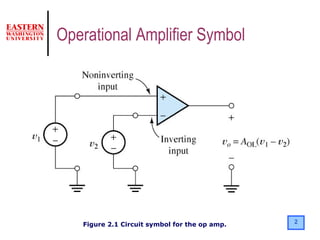
2Figure 2.1 Circuit symbol for the op amp.
Operational Amplifier Symbol
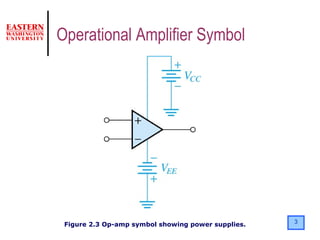
3Figure 2.3 Op-amp symbol showing power supplies.
Operational Amplifier Symbol
4
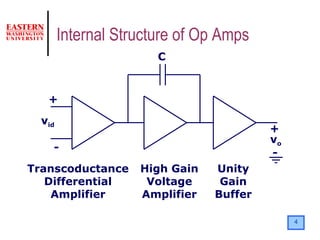
Internal Structure of Op Amps
+
-
vid
vo
+
-
Transcoductance
Differential
Amplifier
High Gain
Voltage
Amplifier
Unity
Gain
Buffer
C
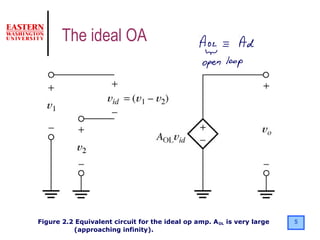
5Figure 2.2 Equivalent circuit for the ideal op amp. AOL is very large
(approaching infinity).
The ideal OA
6
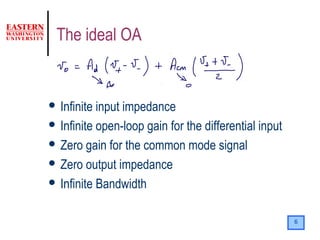
The ideal OA
 Infinite input impedance
 Infinite open-loop gain for the differential input
 Zero gain for the common mode signal
 Zero output impedance
 Infinite Bandwidth
7
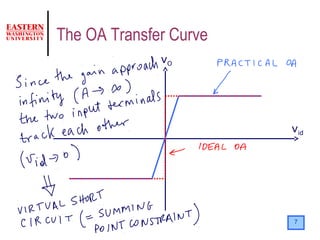
The OA Transfer Curve
vO
vid
8
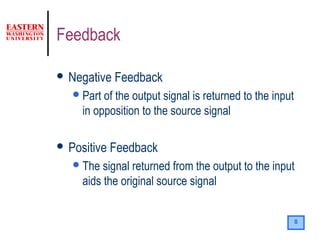
Feedback
 Negative Feedback
Part of the output signal is returned to the input
in opposition to the source signal
 Positive Feedback
The signal returned from the output to the input
aids the original source signal
9
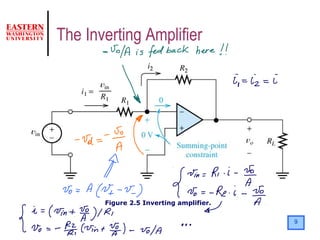
Figure 2.5 Inverting amplifier.
The Inverting Amplifier
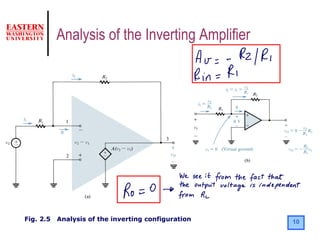
10Fig. 2.5 Analysis of the inverting configuration
Analysis of the Inverting Amplifier
11
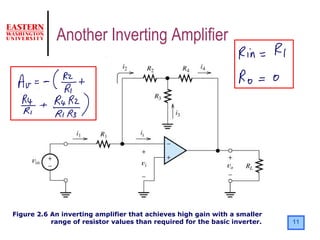
Figure 2.6 An inverting amplifier that achieves high gain with a smaller
range of resistor values than required for the basic inverter.
Another Inverting Amplifier
12
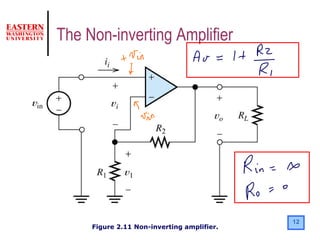
Figure 2.11 Non-inverting amplifier.
The Non-inverting Amplifier
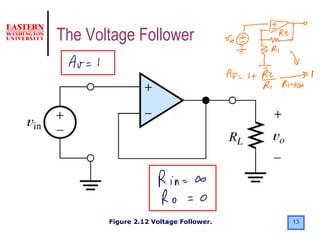
13Figure 2.12 Voltage Follower.
The Voltage Follower
14
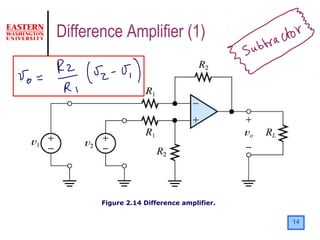
Figure 2.14 Difference amplifier.
Difference Amplifier (1)
15
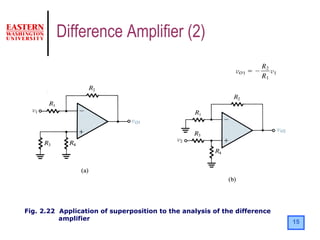
Fig. 2.22 Application of superposition to the analysis of the difference
amplifier
Difference Amplifier (2)
16
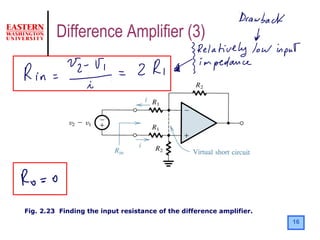
Fig. 2.23 Finding the input resistance of the difference amplifier.
Difference Amplifier (3)
17
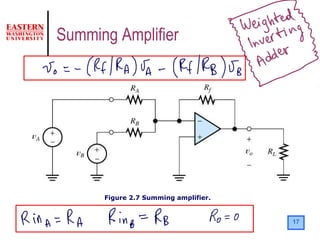
Figure 2.7 Summing amplifier.
Summing Amplifier
18
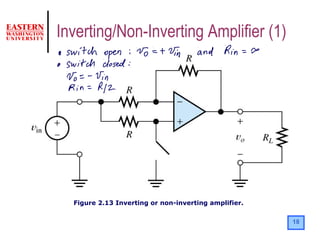
Figure 2.13 Inverting or non-inverting amplifier.
Inverting/Non-Inverting Amplifier (1)
19
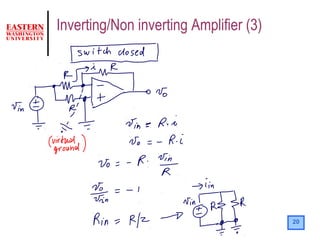
Inverting/Non Inverting Amplifier (2)
20
Inverting/Non inverting Amplifier (3)
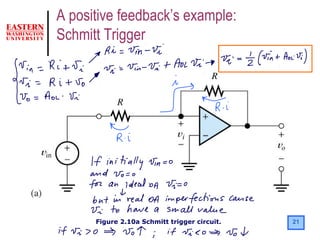
21Figure 2.10a Schmitt trigger circuit.
A positive feedback’s example:
Schmitt Trigger
22
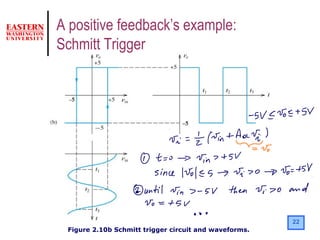
Figure 2.10b Schmitt trigger circuit and waveforms.
A positive feedback’s example:
Schmitt Trigger
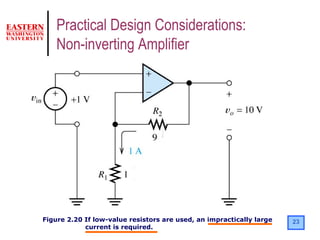
23Figure 2.20 If low-value resistors are used, an impractically large
current is required.
Practical Design Considerations:
Non-inverting Amplifier
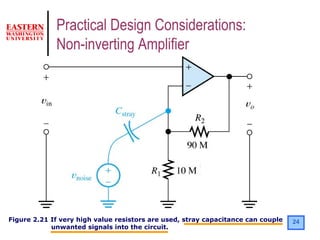
24Figure 2.21 If very high value resistors are used, stray capacitance can couple
unwanted signals into the circuit.
Practical Design Considerations:
Non-inverting Amplifier
25
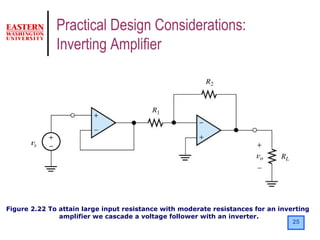
Figure 2.22 To attain large input resistance with moderate resistances for an inverting
amplifier we cascade a voltage follower with an inverter.
Practical Design Considerations:
Inverting Amplifier
26
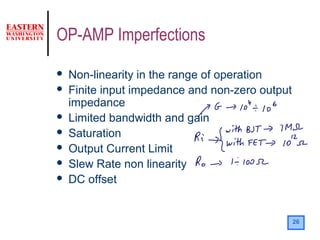
OP-AMP Imperfections
 Non-linearity in the range of operation
 Finite input impedance and non-zero output
impedance
 Limited bandwidth and gain
 Saturation
 Output Current Limit
 Slew Rate non linearity
 DC offset
27
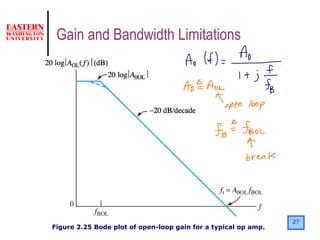
Figure 2.25 Bode plot of open-loop gain for a typical op amp.
Gain and Bandwidth Limitations
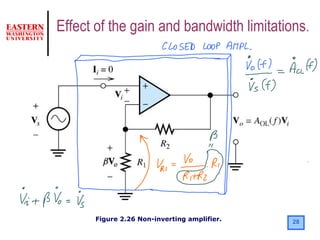
28Figure 2.26 Non-inverting amplifier.
Effect of the gain and bandwidth limitations.
29
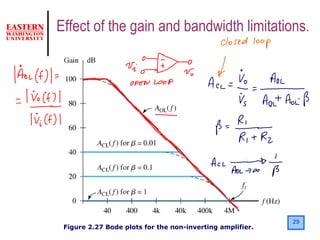
Figure 2.27 Bode plots for the non-inverting amplifier.
Effect of the gain and bandwidth limitations.
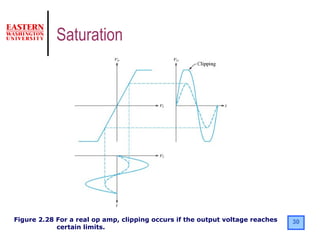
30Figure 2.28 For a real op amp, clipping occurs if the output voltage reaches
certain limits.
Saturation
31
Output Current Limit
 The current that an op amp can supply to a
load is limited (typically +/-25 mA)
 If a small-value load draw a current outside the
limit, the output waveform becomes clipped
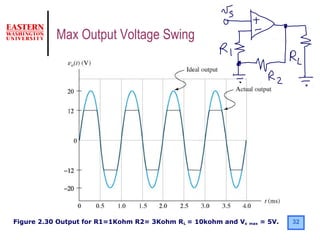
32Figure 2.30 Output for R1=1Kohm R2= 3Kohm RL = 10kohm and Vs max = 5V.
Max Output Voltage Swing
33
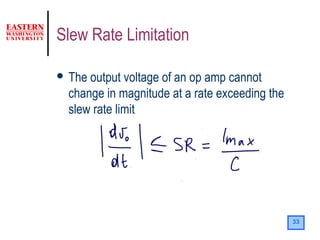
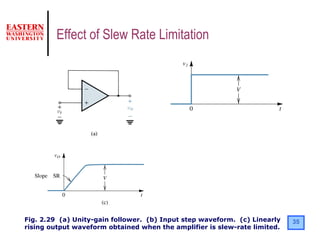
Slew Rate Limitation
 The output voltage of an op amp cannot
change in magnitude at a rate exceeding the
slew rate limit
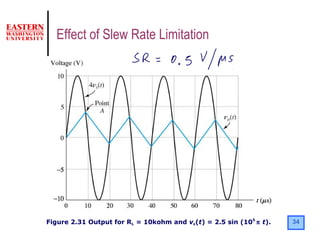
34Figure 2.31 Output for RL = 10kohm and vs(t) = 2.5 sin (105
π t).
Effect of Slew Rate Limitation
35
Effect of Slew Rate Limitation
Fig. 2.29 (a) Unity-gain follower. (b) Input step waveform. (c) Linearly
rising output waveform obtained when the amplifier is slew-rate limited.
36
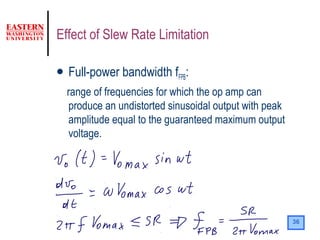
Effect of Slew Rate Limitation
 Full-power bandwidth fFPB:
range of frequencies for which the op amp can
produce an undistorted sinusoidal output with peak
amplitude equal to the guaranteed maximum output
voltage.
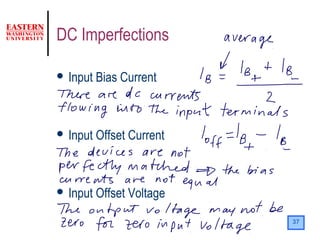
37
DC Imperfections
 Input Bias Current
 Input Offset Current
 Input Offset Voltage
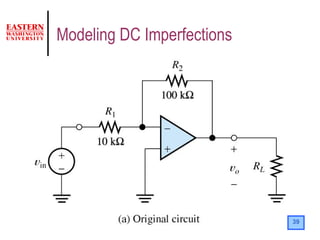
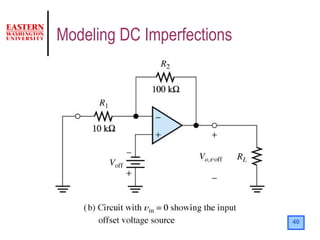
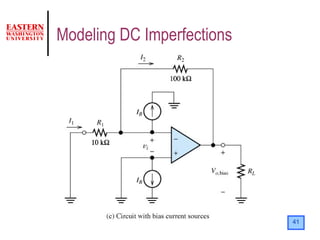
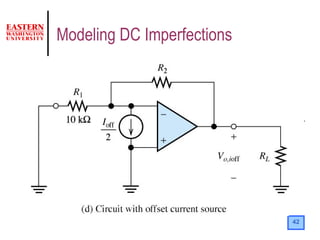
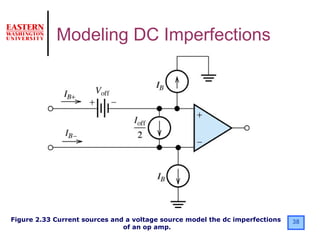
38Figure 2.33 Current sources and a voltage source model the dc imperfections
of an op amp.
Modeling DC Imperfections
39
Modeling DC Imperfections
40
Modeling DC Imperfections
41
Modeling DC Imperfections
42
Modeling DC Imperfections
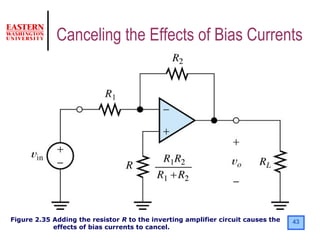
43Figure 2.35 Adding the resistor R to the inverting amplifier circuit causes the
effects of bias currents to cancel.
Canceling the Effects of Bias Currents
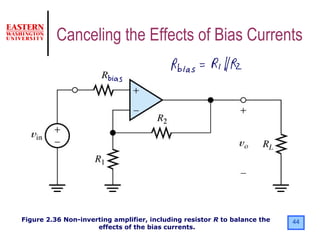
44Figure 2.36 Non-inverting amplifier, including resistor R to balance the
effects of the bias currents.
Canceling the Effects of Bias Currents
45
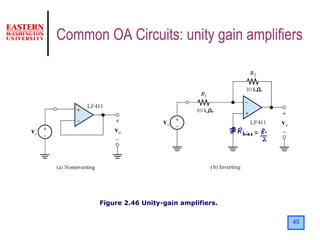
Figure 2.46 Unity-gain amplifiers.
Common OA Circuits: unity gain amplifiers
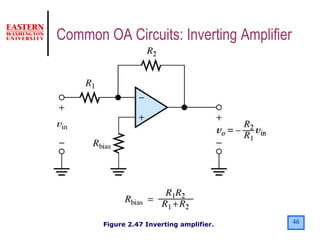
46Figure 2.47 Inverting amplifier.
Common OA Circuits: Inverting Amplifier
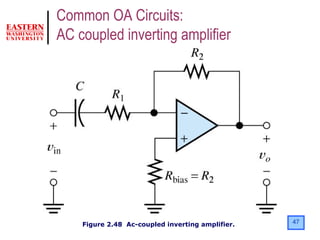
47Figure 2.48 Ac-coupled inverting amplifier.
Common OA Circuits:
AC coupled inverting amplifier
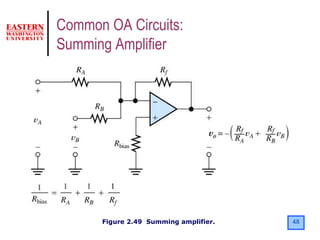
48Figure 2.49 Summing amplifier.
Common OA Circuits:
Summing Amplifier
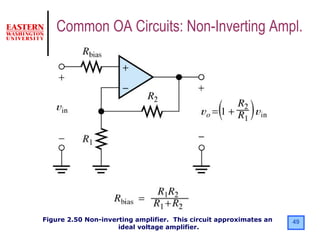
49Figure 2.50 Non-inverting amplifier. This circuit approximates an
ideal voltage amplifier.
Common OA Circuits: Non-Inverting Ampl.
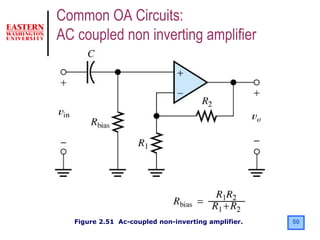
50Figure 2.51 Ac-coupled non-inverting amplifier.
Common OA Circuits:
AC coupled non inverting amplifier
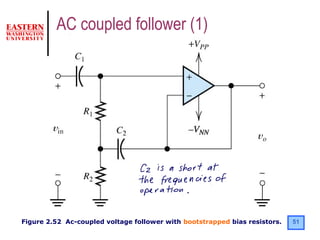
51Figure 2.52 Ac-coupled voltage follower with bootstrapped bias resistors.
AC coupled follower (1)
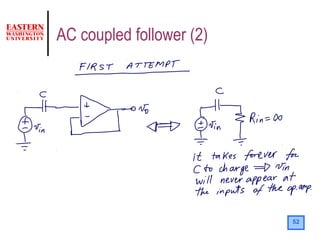
52
AC coupled follower (2)
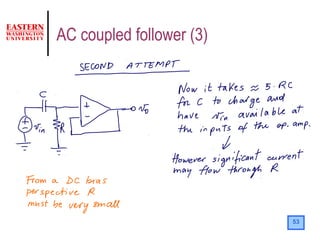
53
AC coupled follower (3)
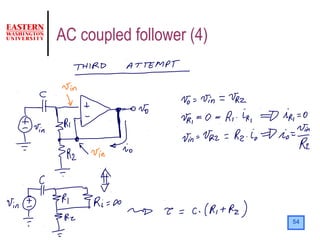
54
AC coupled follower (4)
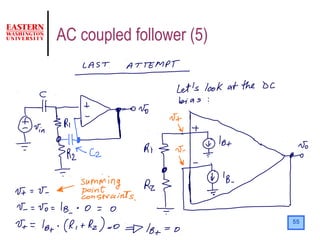
55
AC coupled follower (5)
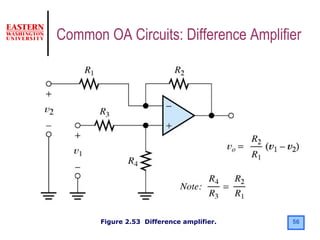
56Figure 2.53 Difference amplifier.
Common OA Circuits: Difference Amplifier
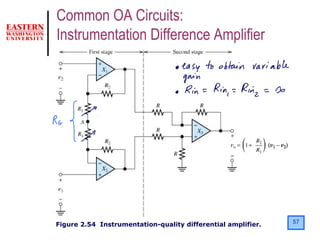
57Figure 2.54 Instrumentation-quality differential amplifier.
Common OA Circuits:
Instrumentation Difference Amplifier
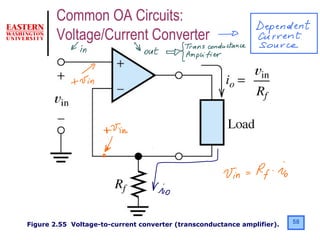
58Figure 2.55 Voltage-to-current converter (transconductance amplifier).
Common OA Circuits:
Voltage/Current Converter
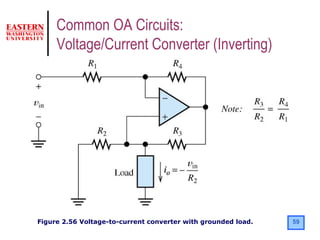
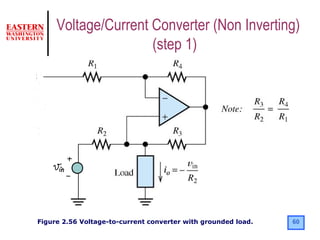
59Figure 2.56 Voltage-to-current converter with grounded load.
Common OA Circuits:
Voltage/Current Converter (Inverting)
60Figure 2.56 Voltage-to-current converter with grounded load.
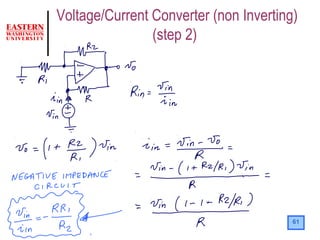
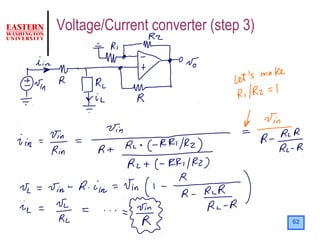
Voltage/Current Converter (Non Inverting)
(step 1)
61
Voltage/Current Converter (non Inverting)
(step 2)
62
Voltage/Current converter (step 3)
63
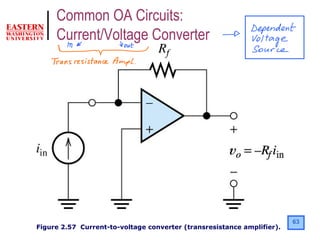
Figure 2.57 Current-to-voltage converter (transresistance amplifier).
Common OA Circuits:
Current/Voltage Converter
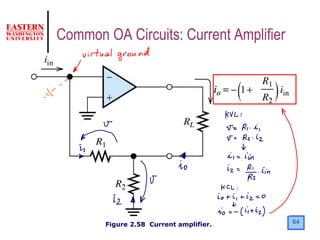
64Figure 2.58 Current amplifier.
Common OA Circuits: Current Amplifier
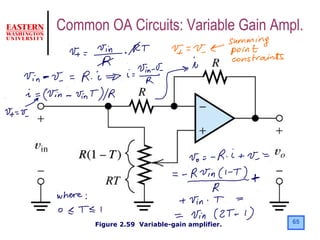
65Figure 2.59 Variable-gain amplifier.
Common OA Circuits: Variable Gain Ampl.
66
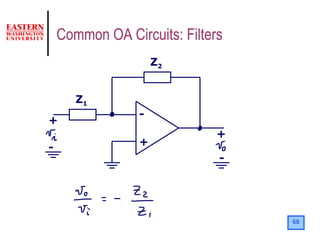
Common OA Circuits: Filters
-
+
+
-
+
-
Z2
Z1
67
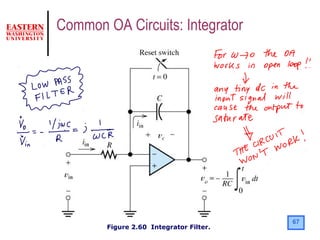
Figure 2.60 Integrator Filter.
Common OA Circuits: Integrator
68
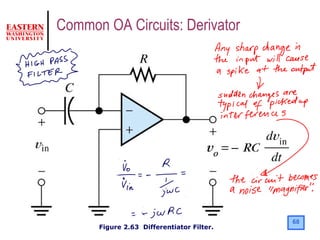
Figure 2.63 Differentiator Filter.
Common OA Circuits: Derivator
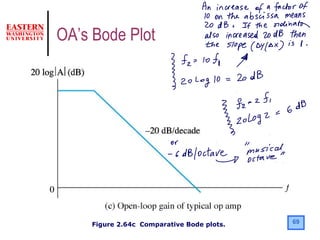
69Figure 2.64c Comparative Bode plots.
OA’s Bode Plot
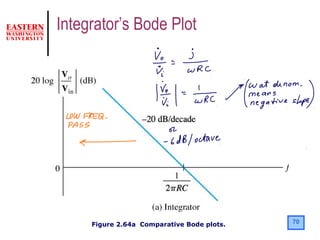
70Figure 2.64a Comparative Bode plots.
Integrator’s Bode Plot
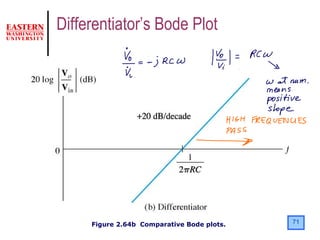
71Figure 2.64b Comparative Bode plots.
Differentiator’s Bode Plot

operational amplifiers