CHAPTER FIVE
MANAGEMENT OF
ORGANIZATIONAL CONFLICT
CONFLICT
Conflict Defined
– A process that begins when one party perceives
that another party has negatively affected, or is
about to negatively affect, something that the
first party cares about.
– The process in which one party perceives that
its interests are being opposed or negatively
affected by another party
• Is that point in an ongoing activity when an
interaction “crosses over” to become an
interparty conflict.
Cont’d
– Encompasses a wide range of conflicts that
people experience in organizations
• Incompatibility of goals
• Differences over interpretations of facts
• Disagreements based on behavioral
expectations
 Although conflict often considered harmful,
and thus something to avoid, it can also have
some benefits.
 On the other hand, moderate degree of
focused conflict can stimulate new ideas,
promote healthy competition & energize
behavior
Sources of conflict in Organization
1. Incompatible goals: it occurs when person or
work goals seem to interfere with another
person’s or department’s goals.
- people with divergent goals are more likely to
experience conflict.
2. Differentiation: Conflict is caused by different
values and beliefs due to unique backgrounds,
experiences or trainings
- cultural diversity makes it difficult to
understand or accept the beliefs and values that
other people hold toward organizational
decisions and events
Cont’d
3. Task interdependence: Conflict tends to increase
with the level of task interdependence.
- The higher the level of task interdependence, the
greater the risk of conflict, because there is a
greater chance that each side will disrupt or
interfere with the other side’s goals.
4. Scarce resources: scarcity motivates people to
compete with others who also need those
resources to achieve their objectives.
5. Ambiguous rules: Ambiguous rules or complete
lack of rules-breed conflict. This occurs b/c
uncertainty increases the risk that one party
intends to interfere with the other party’s goals.
Cont’d
6. Communication problems: Conflict occurs due
to lack of opportunity, ability, or motivation to
communicate effectively.
- without direct interaction, the two sides have less
psychological empathy for each other.
Transitions in Conflict Thought
Causes:
• Poor communication
• Lack of openness
• Failure to respond to employee needs
A. Traditional View of Conflict
The belief that all conflict is harmful and must be
avoided. It indicates a malfunctioning with the
group
Transitions in Conflict Thought (cont’d)
B. Human Relations View of Conflict
The belief that conflict is a natural and inevitable
outcome in any group.
C. Interactionist View of Conflict
The belief that conflict is not only a positive force
in a group but that it is absolutely necessary for a
group to perform effectively.
Functional versus Dysfunctional Conflict
Functional Conflict
Conflict that supports the goals of the group and
improves its performance.
Dysfunctional Conflict
Conflict that hinders group performance.
Types of Conflict
Task Conflict
Conflicts over content and goals of the work.
Relationship Conflict
Conflict based on interpersonal relationships.
Process Conflict
Conflict over how work gets done. It occurs when there
is disagreement on how to achieve the goals & actually
do the work.
Conflict management
 Interventions that alter the level of and form of conflict in
ways that maximize its benefits and minimize its
dysfunctional consequences.
 The use of resolution and stimulation techniques to achieve
the desired level of conflict.
 Interpersonal conflict management styles- how
we act toward the other person?
- Win-win Orientation: the belief that the parties will find
mutually beneficial solution to their disagreement.
- Win-lose orientation: the belief that conflicting parties are
drawing from a fixed pie, so the more one party receives,
the less the other party will receive.
Cont’d
Cont’d
Cooperativeness:
• Attempting to satisfy the other party’s concerns.
Assertiveness:
• Attempting to satisfy one’s own concerns.
 For effective conflict management, we
should learn to apply different conflict
management styles to different situations
Cont’d
A. Competing
A desire to satisfy one’s interests, regardless of the
impact on the other party to the conflict.
B. Collaborating
A situation in which the parties to a conflict each
desire to satisfy fully the concerns of all parties.
C. Avoiding
The desire to withdraw from or suppress a
conflict.
Cont’d
D. Accommodating
The willingness of one party in a conflict to place the
opponent’s interests above his or her own.
E. Compromising
A situation in which each party to a conflict
is willing to give up something.
Structural approach to conflict management
 It involves altering the underlying structural causes of
potential conflict.
A. Emphasizing super ordinate goals: a common objective
held by conflicting parties that is more important than their
conflicting departments or individual goals.
B. Reducing differentiation: is to reduce the differences
that produce the conflict.
C. Improving communication and understanding:
communication is critical to effective conflict
management. By improving the opportunity, ability and
motivation to share information, employees develop less
extreme perceptions of each other than relying on
stereotyping and emotions.
Cont’d
C. Reducing task interdependence: it includes if
possible dividing the shared resources so that each
party has exclusive use of part of it.
- sequentially or reciprocally interdependent jobs
might be combined so that they form a pooled
interdependence.
D. Increasing resources: Increase the amount of
resources available to reduce conflicts that arise
from resource scarcity.
E. Clarifying rules and procedures: clearly
established rule and regulations clarify distribution
of resources, establishes changes to the terms of
interdependence.
Cont’d
Conflict stimulation: is the creation and
constructive use of conflict by a manager
 Its purpose is to bring about situations in which
differences of opinion are exposed for
examination by all.
 A complete absence of conflict may indicate that
organization is stagnant and employees are content
with the status quo.
Conflict resolution: is a managed effort to reduce
or eliminate harmful conflict.
Positive Feelings
Negative Emotions
Conflict Definition
Perceived Conflict
Awareness by one or more
parties of the existence of
conditions that create
opportunities for conflict to
arise.
Felt Conflict
Emotional involvement in a
conflict creating anxiety,
tenseness, frustration, or
hostility.
Cont’d
Outcomes of conflict
 Functional Outcomes from Conflict
– Increased group performance
– Improved quality of decisions
– Stimulation of creativity and innovation
– Encouragement of interest and curiosity
– Provision of a medium for problem-solving
– Creation of an environment for self-evaluation and
change
Cont’d
 Dysfunctional Outcomes from Conflict
– Development of discontent
– Reduced group effectiveness
– Retarded communication
– Reduced group cohesiveness
– Infighting among group members overcomes group
goals
Conflict Management Techniques
Conflict Resolution Techniques
• Problem solving
• Superordinate goals
• Expansion of resources
• Avoidance
• Smoothing
• Compromise
• Authoritative command
• Altering the human variable
• Altering the structural variables
Conflict Management Techniques
Conflict Resolution Techniques
• Communication
• Bringing in outsiders
• Restructuring the organization
• Appointing a devil’s advocate
Negotiation
Negotiation
A process in which two or more parties exchange
goods or services and attempt to agree on the
exchange rate for them.
 Is the process in which two or more parties reach
agreement on issue even though they have different
preferences regarding the issue
Bargaining Strategies
Integrative Bargaining
Negotiation that seeks one or more settlements that
can create a win-win solution.
Distributive Bargaining
Negotiation that seeks to divide up a fixed amount
of resources; a win-lose situation.
Issues in Negotiation
 The Role of Mood & Personality Traits in
Negotiation
– Positive moods positively affect negotiations
– Traits do not appear to have a significantly direct effect
on the outcomes of either bargaining or negotiating
processes (except extraversion, which is bad for
negotiation effectiveness)
 Gender Differences in Negotiations
– Women negotiate no differently from men, although
men apparently negotiate slightly better outcomes.
– Men and women with similar power bases use the
same negotiating styles.
– Women’s attitudes toward negotiation and their
success as negotiators are less favorable than men’s.
Third-Party Negotiations
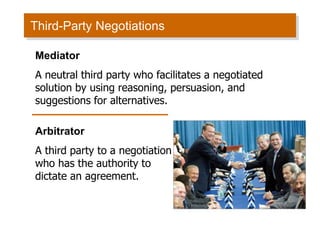
Mediator
A neutral third party who facilitates a negotiated
solution by using reasoning, persuasion, and
suggestions for alternatives.
Arbitrator
A third party to a negotiation
who has the authority to
dictate an agreement.
Third-Party Negotiations (cont’d)
Consultant
An impartial third party, skilled in
conflict management, who attempts
to facilitate creative problem
solving through communication and
analysis.
Conciliator
A trusted third party who provides an
informal communication link between
the negotiator and the opponent.

Chapter 5.ppt

  • 1.
  • 2.
    CONFLICT Conflict Defined – Aprocess that begins when one party perceives that another party has negatively affected, or is about to negatively affect, something that the first party cares about. – The process in which one party perceives that its interests are being opposed or negatively affected by another party • Is that point in an ongoing activity when an interaction “crosses over” to become an interparty conflict.
  • 3.
    Cont’d – Encompasses awide range of conflicts that people experience in organizations • Incompatibility of goals • Differences over interpretations of facts • Disagreements based on behavioral expectations  Although conflict often considered harmful, and thus something to avoid, it can also have some benefits.  On the other hand, moderate degree of focused conflict can stimulate new ideas, promote healthy competition & energize behavior
  • 4.
    Sources of conflictin Organization 1. Incompatible goals: it occurs when person or work goals seem to interfere with another person’s or department’s goals. - people with divergent goals are more likely to experience conflict. 2. Differentiation: Conflict is caused by different values and beliefs due to unique backgrounds, experiences or trainings - cultural diversity makes it difficult to understand or accept the beliefs and values that other people hold toward organizational decisions and events
  • 5.
    Cont’d 3. Task interdependence:Conflict tends to increase with the level of task interdependence. - The higher the level of task interdependence, the greater the risk of conflict, because there is a greater chance that each side will disrupt or interfere with the other side’s goals. 4. Scarce resources: scarcity motivates people to compete with others who also need those resources to achieve their objectives. 5. Ambiguous rules: Ambiguous rules or complete lack of rules-breed conflict. This occurs b/c uncertainty increases the risk that one party intends to interfere with the other party’s goals.
  • 6.
    Cont’d 6. Communication problems:Conflict occurs due to lack of opportunity, ability, or motivation to communicate effectively. - without direct interaction, the two sides have less psychological empathy for each other.
  • 7.
    Transitions in ConflictThought Causes: • Poor communication • Lack of openness • Failure to respond to employee needs A. Traditional View of Conflict The belief that all conflict is harmful and must be avoided. It indicates a malfunctioning with the group
  • 8.
    Transitions in ConflictThought (cont’d) B. Human Relations View of Conflict The belief that conflict is a natural and inevitable outcome in any group. C. Interactionist View of Conflict The belief that conflict is not only a positive force in a group but that it is absolutely necessary for a group to perform effectively.
  • 9.
    Functional versus DysfunctionalConflict Functional Conflict Conflict that supports the goals of the group and improves its performance. Dysfunctional Conflict Conflict that hinders group performance.
  • 10.
    Types of Conflict TaskConflict Conflicts over content and goals of the work. Relationship Conflict Conflict based on interpersonal relationships. Process Conflict Conflict over how work gets done. It occurs when there is disagreement on how to achieve the goals & actually do the work.
  • 11.
    Conflict management  Interventionsthat alter the level of and form of conflict in ways that maximize its benefits and minimize its dysfunctional consequences.  The use of resolution and stimulation techniques to achieve the desired level of conflict.  Interpersonal conflict management styles- how we act toward the other person? - Win-win Orientation: the belief that the parties will find mutually beneficial solution to their disagreement. - Win-lose orientation: the belief that conflicting parties are drawing from a fixed pie, so the more one party receives, the less the other party will receive.
  • 12.
  • 13.
    Cont’d Cooperativeness: • Attempting tosatisfy the other party’s concerns. Assertiveness: • Attempting to satisfy one’s own concerns.  For effective conflict management, we should learn to apply different conflict management styles to different situations
  • 14.
    Cont’d A. Competing A desireto satisfy one’s interests, regardless of the impact on the other party to the conflict. B. Collaborating A situation in which the parties to a conflict each desire to satisfy fully the concerns of all parties. C. Avoiding The desire to withdraw from or suppress a conflict.
  • 15.
    Cont’d D. Accommodating The willingnessof one party in a conflict to place the opponent’s interests above his or her own. E. Compromising A situation in which each party to a conflict is willing to give up something.
  • 16.
    Structural approach toconflict management  It involves altering the underlying structural causes of potential conflict. A. Emphasizing super ordinate goals: a common objective held by conflicting parties that is more important than their conflicting departments or individual goals. B. Reducing differentiation: is to reduce the differences that produce the conflict. C. Improving communication and understanding: communication is critical to effective conflict management. By improving the opportunity, ability and motivation to share information, employees develop less extreme perceptions of each other than relying on stereotyping and emotions.
  • 17.
    Cont’d C. Reducing taskinterdependence: it includes if possible dividing the shared resources so that each party has exclusive use of part of it. - sequentially or reciprocally interdependent jobs might be combined so that they form a pooled interdependence. D. Increasing resources: Increase the amount of resources available to reduce conflicts that arise from resource scarcity. E. Clarifying rules and procedures: clearly established rule and regulations clarify distribution of resources, establishes changes to the terms of interdependence.
  • 18.
    Cont’d Conflict stimulation: isthe creation and constructive use of conflict by a manager  Its purpose is to bring about situations in which differences of opinion are exposed for examination by all.  A complete absence of conflict may indicate that organization is stagnant and employees are content with the status quo. Conflict resolution: is a managed effort to reduce or eliminate harmful conflict.
  • 19.
    Positive Feelings Negative Emotions ConflictDefinition Perceived Conflict Awareness by one or more parties of the existence of conditions that create opportunities for conflict to arise. Felt Conflict Emotional involvement in a conflict creating anxiety, tenseness, frustration, or hostility. Cont’d
  • 20.
    Outcomes of conflict Functional Outcomes from Conflict – Increased group performance – Improved quality of decisions – Stimulation of creativity and innovation – Encouragement of interest and curiosity – Provision of a medium for problem-solving – Creation of an environment for self-evaluation and change
  • 21.
    Cont’d  Dysfunctional Outcomesfrom Conflict – Development of discontent – Reduced group effectiveness – Retarded communication – Reduced group cohesiveness – Infighting among group members overcomes group goals
  • 22.
    Conflict Management Techniques ConflictResolution Techniques • Problem solving • Superordinate goals • Expansion of resources • Avoidance • Smoothing • Compromise • Authoritative command • Altering the human variable • Altering the structural variables
  • 23.
    Conflict Management Techniques ConflictResolution Techniques • Communication • Bringing in outsiders • Restructuring the organization • Appointing a devil’s advocate
  • 24.
    Negotiation Negotiation A process inwhich two or more parties exchange goods or services and attempt to agree on the exchange rate for them.  Is the process in which two or more parties reach agreement on issue even though they have different preferences regarding the issue
  • 25.
    Bargaining Strategies Integrative Bargaining Negotiationthat seeks one or more settlements that can create a win-win solution. Distributive Bargaining Negotiation that seeks to divide up a fixed amount of resources; a win-lose situation.
  • 26.
    Issues in Negotiation The Role of Mood & Personality Traits in Negotiation – Positive moods positively affect negotiations – Traits do not appear to have a significantly direct effect on the outcomes of either bargaining or negotiating processes (except extraversion, which is bad for negotiation effectiveness)  Gender Differences in Negotiations – Women negotiate no differently from men, although men apparently negotiate slightly better outcomes. – Men and women with similar power bases use the same negotiating styles. – Women’s attitudes toward negotiation and their success as negotiators are less favorable than men’s.
  • 27.
    Third-Party Negotiations Mediator A neutralthird party who facilitates a negotiated solution by using reasoning, persuasion, and suggestions for alternatives. Arbitrator A third party to a negotiation who has the authority to dictate an agreement.
  • 28.
    Third-Party Negotiations (cont’d) Consultant Animpartial third party, skilled in conflict management, who attempts to facilitate creative problem solving through communication and analysis. Conciliator A trusted third party who provides an informal communication link between the negotiator and the opponent.