Communication Problems in Organizations Peace Team
Contents What is communication? What is organizational communication? The communication process. Importance of orgaizational communication. General types of communication. Types of organizational communication. Organizational communication problems:  causes, effects and resolving. Communication  planning:  why & process. Case studies.
What is communication? “ the lubricant of organizations…” The art of being able to structure and transmit a message in a way that another can easily understand and/or accept Using symbols (words) to attempt to create shared meaning (mutual understanding) that will result in an effect on the two of them.
What is organizational communication? A program that focuses on general communication processes and dynamics within organizations. Includes instruction in the development and maintenance of: interpersonal group relations within organizations;  decision-making and conflict management;  power and politics within organizations;  and how communications socializes and supports employees and team members.  (source: U. S. Department of Education)

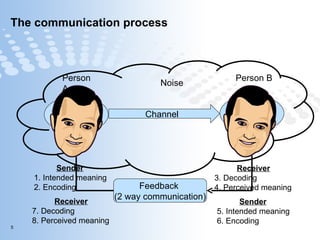
The communication process Sender Receiver Channel Feedback  (2 way communication) Sender 1. Intended meaning 2. Encoding Receiver 3. Decoding 4. Perceived meaning Sender 5. Intended meaning 6. Encoding Receiver 7. Decoding 8. Perceived meaning Noise Person A Person B
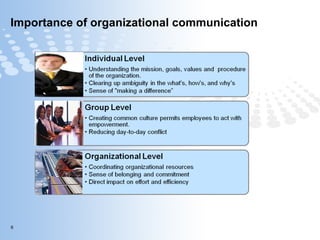
Importance of organizational communication
COMMUNICATION TYPES
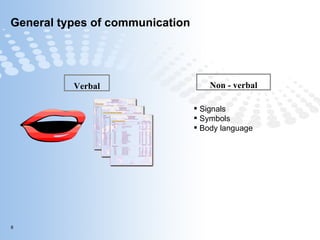
General types of communication  Verbal Non - verbal Signals Symbols Body language
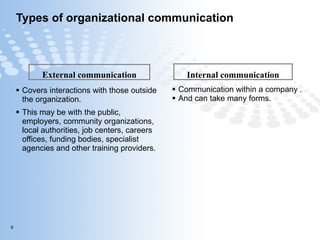
Types of organizational communication Internal communication Communication within a company . And can take many forms.  External communication Covers interactions with those outside the organization.  This may be with the public, employers, community organizations, local authorities, job centers, careers offices, funding bodies, specialist agencies and other training providers.
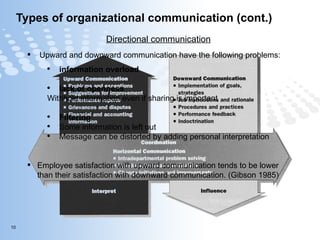
Types of organizational communication (cont.) Directional communication Upward and downward communication have the following problems: information overload  lack of openness Withhold information even if sharing is important Filtering Some information is left out Message can be distorted by adding personal interpretation Employee satisfaction with upward communication tends to be lower than their satisfaction with downward communication. (Gibson 1985)
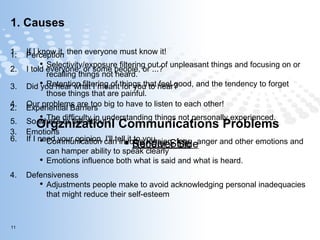
1. Causes If I know it, then everyone must know it! I told everyone, or some people, or ...? Did you hear what I meant for you to hear?  Our problems are too big to have to listen to each other!  So what's to talk about?  If I need your opinion, I'll tell it to you.    Orgznizationl Communications Problems Sender Side Receiver Side Perception Selectivity/exposure filtering out of unpleasant things and focusing on or recalling things not heard. Retention filtering of things that feel good, and the tendency to forget those things that are painful. Experiential Barriers The difficulty in understanding things not personally experienced. Emotions Communication can involve tension, fear , anger and other emotions and can hamper ability to speak clearly Emotions influence both what is said and what is heard. Defensiveness Adjustments people make to avoid acknowledging personal inadequacies that might reduce their self-esteem
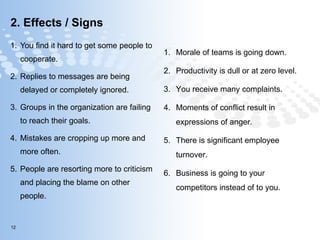
2. Effects / Signs You find it hard to get some people to cooperate. Replies to messages are being delayed or completely ignored. Groups in the organization are failing to reach their goals. Mistakes are cropping up more and more often. People are resorting more to criticism and placing the blame on other people. Morale of teams is going down. Productivity is dull or at zero level. You receive many complaints. Moments of conflict result in expressions of anger. There is significant employee turnover. Business is going to your competitors instead of to you.
3. Resolving  Listen to the people involved or who have caused the communication problem.  Secure the help of a neutral negotiator if the problems have deeply-rooted causes. Make a survey to maintain confidentiality. Initiate group counseling or training. Improve leaders communication skills. Search the history of the organization.
PLANNING OF COMMUNICATION SYSTEM
Why planning? Because internal communication strategies are developed, reactively, when there is a crisis or major event that clearly requires addressing communication issues. So, strategic planning principles are:  long-term focus   clear values, goals   comprehensive, pervasive methods   consistent messages  
Planning process Identify the common culture needed/wanted . Identify the available communication tools. Paper-based Electronic Management  behavior Determine what tools are suited to which goals.
Planning process (cont’) Develop a description of how each tool will be used. Plan for remediation. Plan For Implementation. Implement. Continuously Monitor and Revise.
CASE STUDIES GE Real Estate Case Study
GE Real Estate Multinational Company Case Study http://www.gecapitalrealestate.com/cms/servlet/ent er   Problem definition GE Real Estate is a multinational commercial real estate investor.  employees consistently say that they prefer to hear 70% of corporate information from their managers. Suggested solution developing a manager’s communication workshop that includes a face-to-face presentation covering: the fundamentals of communication; a reference booklet; assessment templates; a communication plan template; a communication scorecard; subsequent ongoing Manager’s Minute email messages.
GE Real Estate Multinational Company Case Study (cont.) Results Every other year, the company receives employee feedback through an in-depth opinion survey: The actions of senior leaders are consistent with what they say?  Communication in this business is open and honest? Senior leaders provide a clear direction for my business? My immediate manager respects people as individuals with different styles, skills and experiences? The scores have risen by approximately 10% over the past five years and now show: More than 90% of the employees understand their job responsibilities and say they want to be working with the company one year from now.  Over 80% of employees say the senior leaders provide them with a clear understanding of the business vision, mission and strategy.  Over 70% respond positively regarding their manager’s ability to listen and understand their need to know how their roles and work contributes to the business goals.
Challenger Shuttle Explosion Case Study video.flv
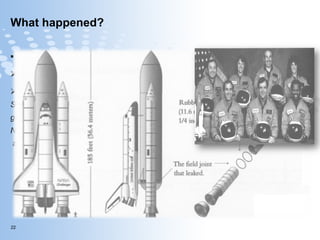
What happened? Losses: 7 lives lost In addition to: Several families sued NASA management gave up $10 million incentive fee  NASA launched on unmanned rockets and of over $2 billion in hardware
Case discussion  Unclear NASA Goals President Ronald Reagan, in an important policy speech on the national space policy on July 5, 1982 declared that the shuttle was  “fully operational”.  This speech shaped NASA goals and increased the pressure on NASA organization . This pressure was undoubtedly felt by individual decision makers and setting the stage for the Challenger explosion.  Engineers at Morton Thiokol, the contractor responsible for building the solid rocket booster, had vigorously  “ opposed the launching of Challenger”
Case discussion (cont’) NASA Policy. As NASA attempted to meet the increasing flight schedule of the space shuttle to achieve the new goals ,the agency encountered a number of constraints and operating problems. These constraints made it  increasingly difficult for NASA to reach its goals in an acceptable way-that is, with the high level of safety expected of it. The disjunction between the organizational goals of NASA and acceptable means available  (Safety Instructions ) NASA  ignored Safety Instructions
Case discussion (cont’) NASA Structure The Organization Chart of Space Shuttle Challenger project consist of IV Levels More than 30 people were in at least 25 communication situations during this period discussing the O-ring problem. None of the concerns reached levels I or II , only level III managers were given the opportunity to evaluate the concerns of the engineers.  The level I and II managers would have viewed matters differently than those at level III (“I can assure you that if we had had that information, we wouldn’t have launched “) (Kennedy Space Director )
Conclusion The Challenger accident is not individual mistake , it is organization mistake  Lack of external communication Unclear Goals and disrespect organization policy. Lack of an effective internal communication systems  The bad news seldom flows up in an organization.  Top level manages need to be aware of this fact and take steps to create a climate in which all critical information good or bad is communicated upward.
Thank You
References  http://ezinearticles.com/?6-Powerful-Ways-to-Solve-Communication-Problems-at-Work&id=652778 http://managementhelp.org/mrktng/org_cmm.htm http://performance-appraisals.org/Bacalsappraisalarticles/articles/comstrat.htm http://www.internalcommshub.com/open/news/turnover.shtml http://www.youtube.com/watch?v=j4JOjcDFtBE http://content.authorstream.com/ppt/177900_633758259289737500.pptx http://dc118.4shared.com/download/117379210/99b08e58/Organizational_Communication.ppt?tsid=20091109-204008-77bcc6f4 Work place communication text book, by Simon Thompson & Melanie Bhagat, ISBN 1-74123-305-4

Organizational Communication

  • 1.
    Communication Problems inOrganizations Peace Team
  • 2.
    Contents What iscommunication? What is organizational communication? The communication process. Importance of orgaizational communication. General types of communication. Types of organizational communication. Organizational communication problems: causes, effects and resolving. Communication planning: why & process. Case studies.
  • 3.
    What is communication?“ the lubricant of organizations…” The art of being able to structure and transmit a message in a way that another can easily understand and/or accept Using symbols (words) to attempt to create shared meaning (mutual understanding) that will result in an effect on the two of them.
  • 4.
    What is organizationalcommunication? A program that focuses on general communication processes and dynamics within organizations. Includes instruction in the development and maintenance of: interpersonal group relations within organizations; decision-making and conflict management; power and politics within organizations; and how communications socializes and supports employees and team members.  (source: U. S. Department of Education)
  • 5.
    The communication processSender Receiver Channel Feedback (2 way communication) Sender 1. Intended meaning 2. Encoding Receiver 3. Decoding 4. Perceived meaning Sender 5. Intended meaning 6. Encoding Receiver 7. Decoding 8. Perceived meaning Noise Person A Person B
  • 6.
  • 7.
  • 8.
    General types ofcommunication Verbal Non - verbal Signals Symbols Body language
  • 9.
    Types of organizationalcommunication Internal communication Communication within a company . And can take many forms. External communication Covers interactions with those outside the organization. This may be with the public, employers, community organizations, local authorities, job centers, careers offices, funding bodies, specialist agencies and other training providers.
  • 10.
    Types of organizationalcommunication (cont.) Directional communication Upward and downward communication have the following problems: information overload lack of openness Withhold information even if sharing is important Filtering Some information is left out Message can be distorted by adding personal interpretation Employee satisfaction with upward communication tends to be lower than their satisfaction with downward communication. (Gibson 1985)
  • 11.
    1. Causes IfI know it, then everyone must know it! I told everyone, or some people, or ...? Did you hear what I meant for you to hear? Our problems are too big to have to listen to each other! So what's to talk about? If I need your opinion, I'll tell it to you. Orgznizationl Communications Problems Sender Side Receiver Side Perception Selectivity/exposure filtering out of unpleasant things and focusing on or recalling things not heard. Retention filtering of things that feel good, and the tendency to forget those things that are painful. Experiential Barriers The difficulty in understanding things not personally experienced. Emotions Communication can involve tension, fear , anger and other emotions and can hamper ability to speak clearly Emotions influence both what is said and what is heard. Defensiveness Adjustments people make to avoid acknowledging personal inadequacies that might reduce their self-esteem
  • 12.
    2. Effects /Signs You find it hard to get some people to cooperate. Replies to messages are being delayed or completely ignored. Groups in the organization are failing to reach their goals. Mistakes are cropping up more and more often. People are resorting more to criticism and placing the blame on other people. Morale of teams is going down. Productivity is dull or at zero level. You receive many complaints. Moments of conflict result in expressions of anger. There is significant employee turnover. Business is going to your competitors instead of to you.
  • 13.
    3. Resolving Listen to the people involved or who have caused the communication problem. Secure the help of a neutral negotiator if the problems have deeply-rooted causes. Make a survey to maintain confidentiality. Initiate group counseling or training. Improve leaders communication skills. Search the history of the organization.
  • 14.
  • 15.
    Why planning? Becauseinternal communication strategies are developed, reactively, when there is a crisis or major event that clearly requires addressing communication issues. So, strategic planning principles are: long-term focus  clear values, goals  comprehensive, pervasive methods  consistent messages  
  • 16.
    Planning process Identifythe common culture needed/wanted . Identify the available communication tools. Paper-based Electronic Management behavior Determine what tools are suited to which goals.
  • 17.
    Planning process (cont’)Develop a description of how each tool will be used. Plan for remediation. Plan For Implementation. Implement. Continuously Monitor and Revise.
  • 18.
    CASE STUDIES GEReal Estate Case Study
  • 19.
    GE Real EstateMultinational Company Case Study http://www.gecapitalrealestate.com/cms/servlet/ent er Problem definition GE Real Estate is a multinational commercial real estate investor. employees consistently say that they prefer to hear 70% of corporate information from their managers. Suggested solution developing a manager’s communication workshop that includes a face-to-face presentation covering: the fundamentals of communication; a reference booklet; assessment templates; a communication plan template; a communication scorecard; subsequent ongoing Manager’s Minute email messages.
  • 20.
    GE Real EstateMultinational Company Case Study (cont.) Results Every other year, the company receives employee feedback through an in-depth opinion survey: The actions of senior leaders are consistent with what they say? Communication in this business is open and honest? Senior leaders provide a clear direction for my business? My immediate manager respects people as individuals with different styles, skills and experiences? The scores have risen by approximately 10% over the past five years and now show: More than 90% of the employees understand their job responsibilities and say they want to be working with the company one year from now. Over 80% of employees say the senior leaders provide them with a clear understanding of the business vision, mission and strategy. Over 70% respond positively regarding their manager’s ability to listen and understand their need to know how their roles and work contributes to the business goals.
  • 21.
    Challenger Shuttle ExplosionCase Study video.flv
  • 22.
    What happened? Losses:7 lives lost In addition to: Several families sued NASA management gave up $10 million incentive fee NASA launched on unmanned rockets and of over $2 billion in hardware
  • 23.
    Case discussion Unclear NASA Goals President Ronald Reagan, in an important policy speech on the national space policy on July 5, 1982 declared that the shuttle was “fully operational”. This speech shaped NASA goals and increased the pressure on NASA organization . This pressure was undoubtedly felt by individual decision makers and setting the stage for the Challenger explosion. Engineers at Morton Thiokol, the contractor responsible for building the solid rocket booster, had vigorously “ opposed the launching of Challenger”
  • 24.
    Case discussion (cont’)NASA Policy. As NASA attempted to meet the increasing flight schedule of the space shuttle to achieve the new goals ,the agency encountered a number of constraints and operating problems. These constraints made it increasingly difficult for NASA to reach its goals in an acceptable way-that is, with the high level of safety expected of it. The disjunction between the organizational goals of NASA and acceptable means available (Safety Instructions ) NASA ignored Safety Instructions
  • 25.
    Case discussion (cont’)NASA Structure The Organization Chart of Space Shuttle Challenger project consist of IV Levels More than 30 people were in at least 25 communication situations during this period discussing the O-ring problem. None of the concerns reached levels I or II , only level III managers were given the opportunity to evaluate the concerns of the engineers. The level I and II managers would have viewed matters differently than those at level III (“I can assure you that if we had had that information, we wouldn’t have launched “) (Kennedy Space Director )
  • 26.
    Conclusion The Challengeraccident is not individual mistake , it is organization mistake Lack of external communication Unclear Goals and disrespect organization policy. Lack of an effective internal communication systems The bad news seldom flows up in an organization. Top level manages need to be aware of this fact and take steps to create a climate in which all critical information good or bad is communicated upward.
  • 27.
  • 28.
    References http://ezinearticles.com/?6-Powerful-Ways-to-Solve-Communication-Problems-at-Work&id=652778http://managementhelp.org/mrktng/org_cmm.htm http://performance-appraisals.org/Bacalsappraisalarticles/articles/comstrat.htm http://www.internalcommshub.com/open/news/turnover.shtml http://www.youtube.com/watch?v=j4JOjcDFtBE http://content.authorstream.com/ppt/177900_633758259289737500.pptx http://dc118.4shared.com/download/117379210/99b08e58/Organizational_Communication.ppt?tsid=20091109-204008-77bcc6f4 Work place communication text book, by Simon Thompson & Melanie Bhagat, ISBN 1-74123-305-4

Editor's Notes

  • #10 Verbal Impact: 7 percent. Vocal Impact: 38 percent. Facial Impact: 55 percent.