Chapter 6
Combinational Logic
Functions
2
Basic Decoder
• Decoder: A digital circuit designed to detect
the presence of a particular digital state.
• Can have one output or multiple outputs.
• Example: 2-Input NAND Gate detects the
presence of ‘11’ on the inputs to generate a
‘0’ output.
3
Single-Gate Examples
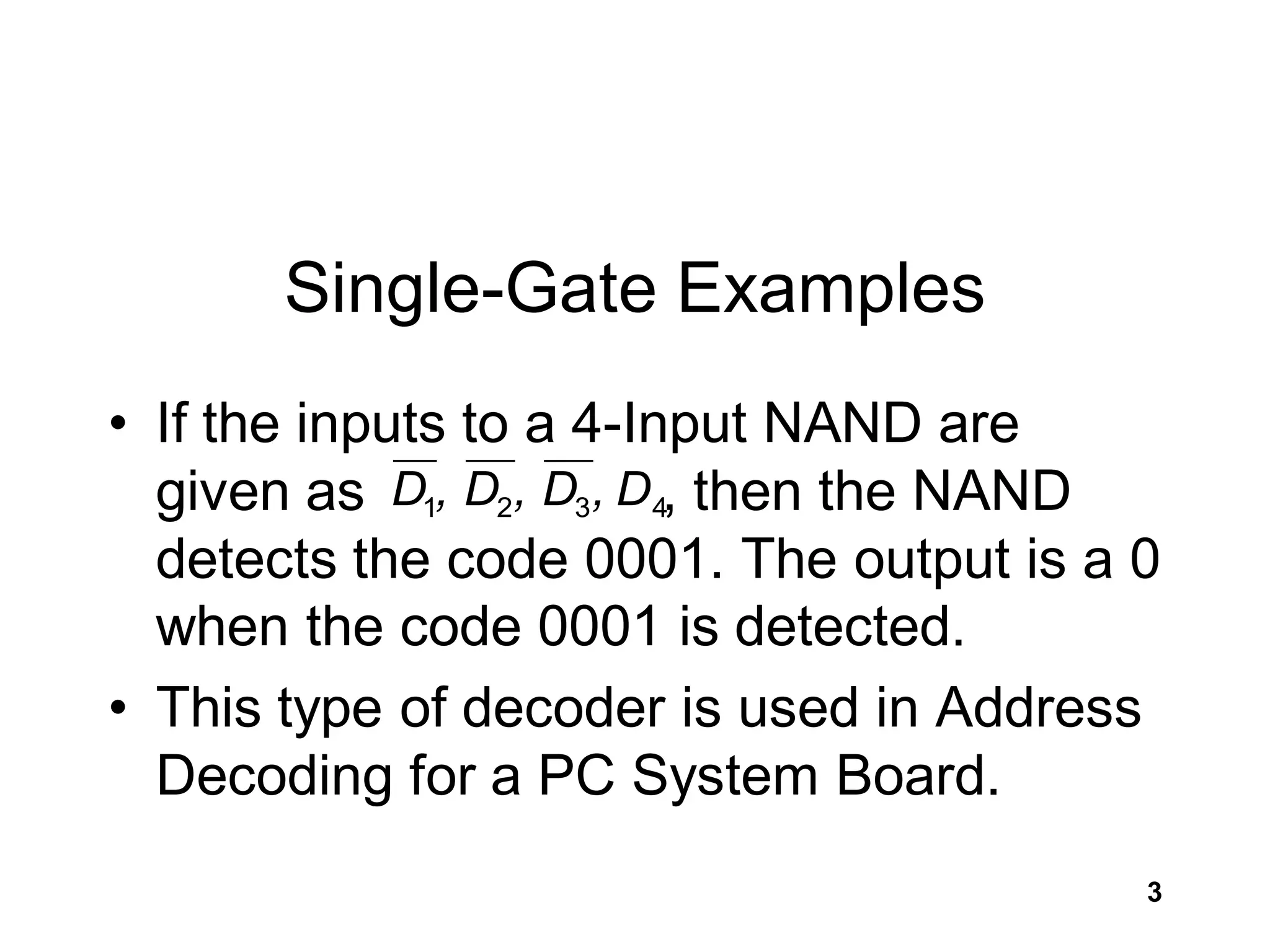
• If the inputs to a 4-Input NAND are
given as , then the NAND
detects the code 0001. The output is a 0
when the code 0001 is detected.
• This type of decoder is used in Address
Decoding for a PC System Board.
4321 , DD,D,D
4
Multiple Output Decoders
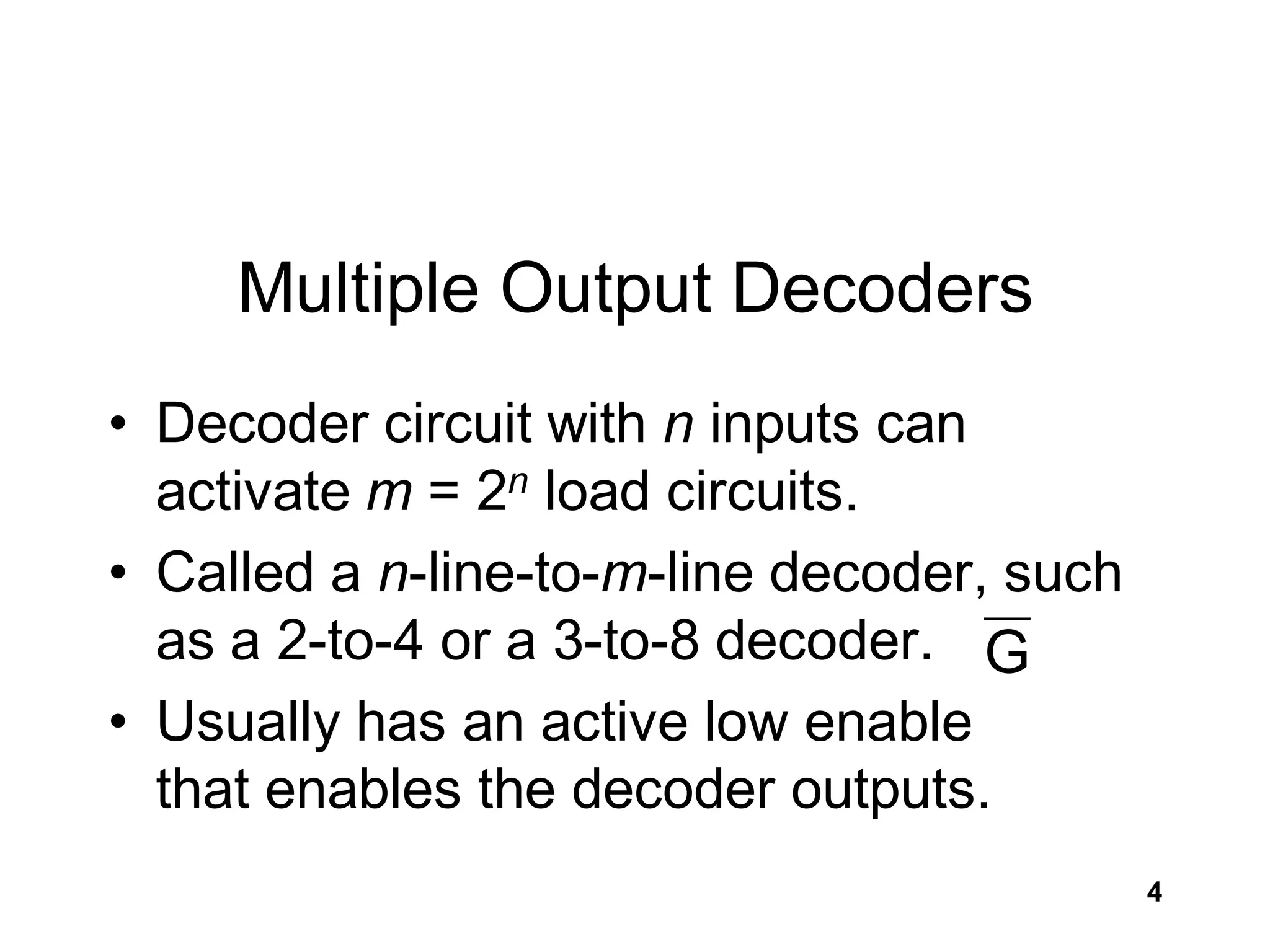
• Decoder circuit with n inputs can
activate m = 2n load circuits.
• Called a n-line-to-m-line decoder, such
as a 2-to-4 or a 3-to-8 decoder.
• Usually has an active low enable
that enables the decoder outputs.
G
5
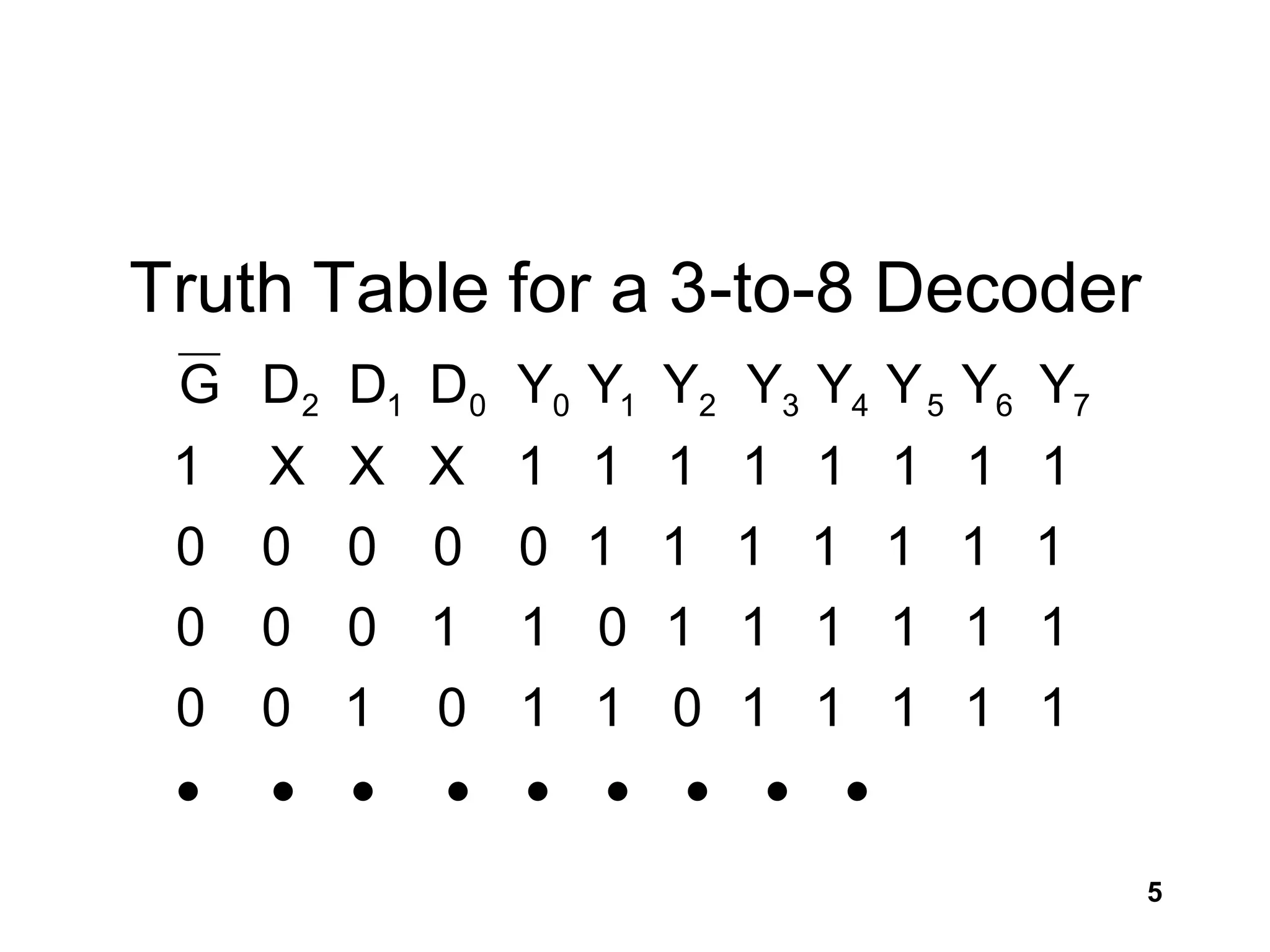
Truth Table for a 3-to-8 Decoder
111110110100
111111011000
111111100000
11111111XXX1
YYYYYYYYDDDG 76543210012

6
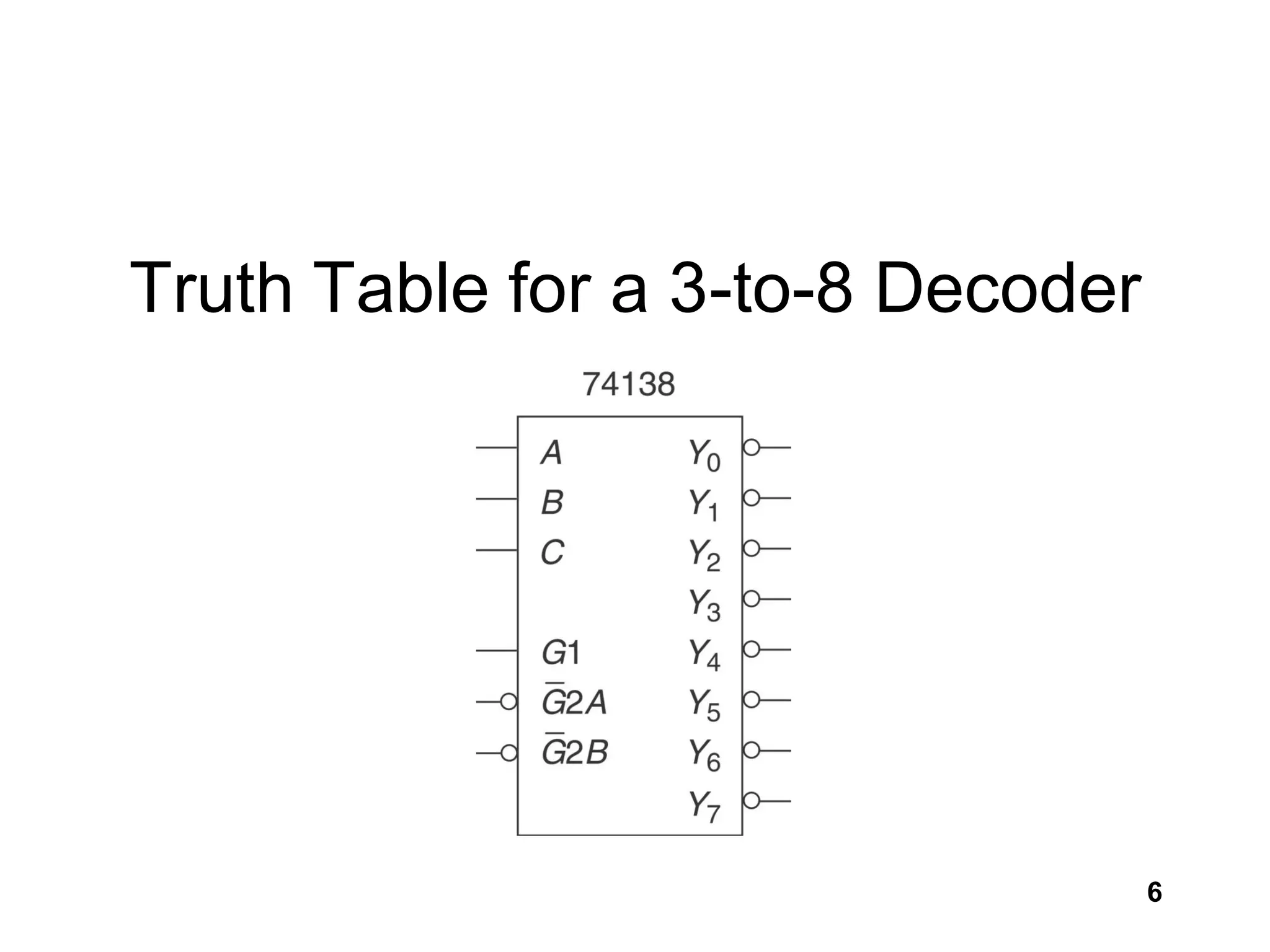
Truth Table for a 3-to-8 Decoder
7
Simulation
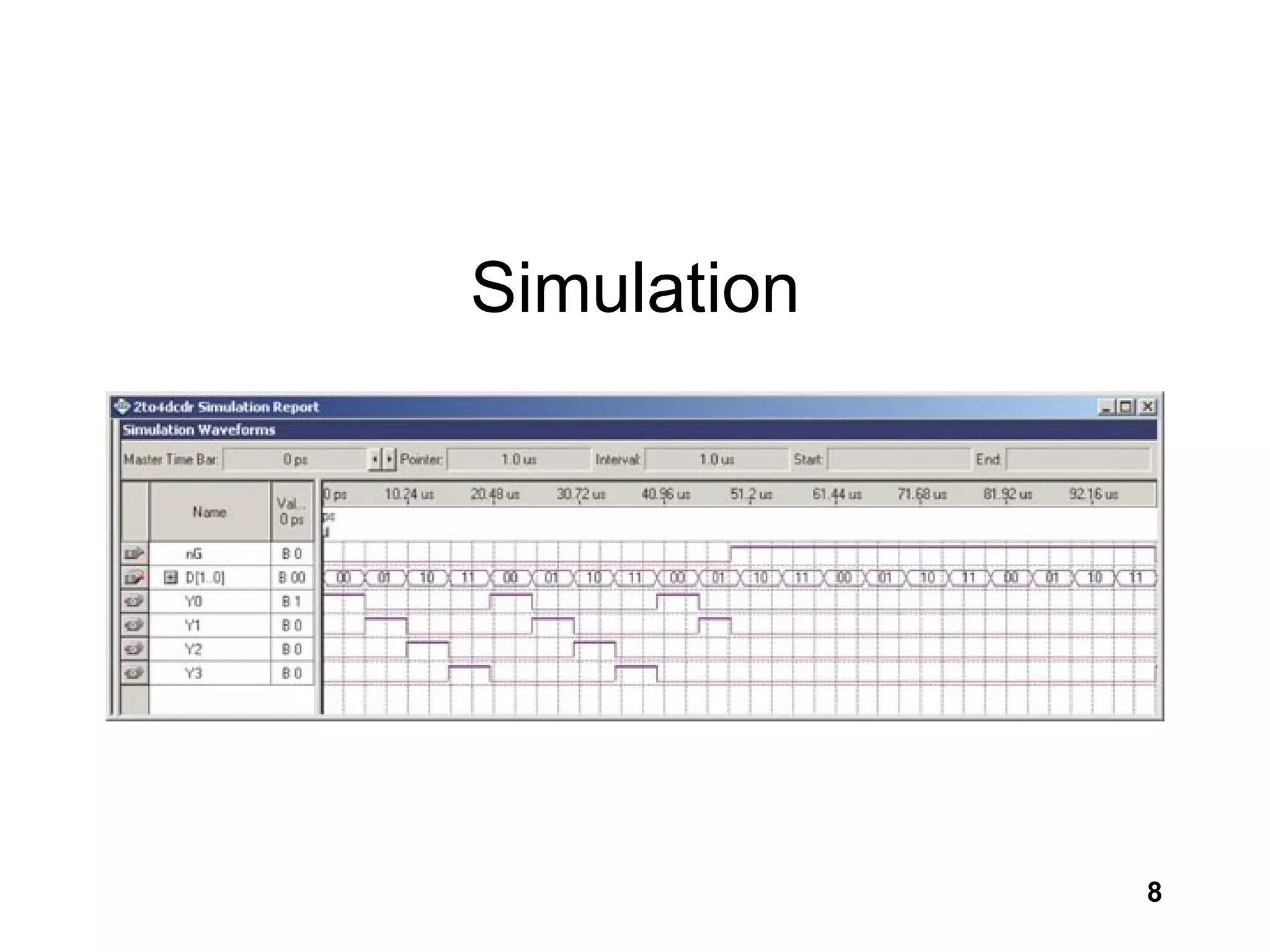
• Simulation: The verification of a digital
design using a timing diagram before
programming the design in a CPLD.
• Used to check the Output Response of
a design to an Input Stimulus using a
timing diagram.
8
Simulation
9
VHDL Binary Decoder
• Use select signal assignment
statements constructs or conditional
signal assignment statements
constructs.
10
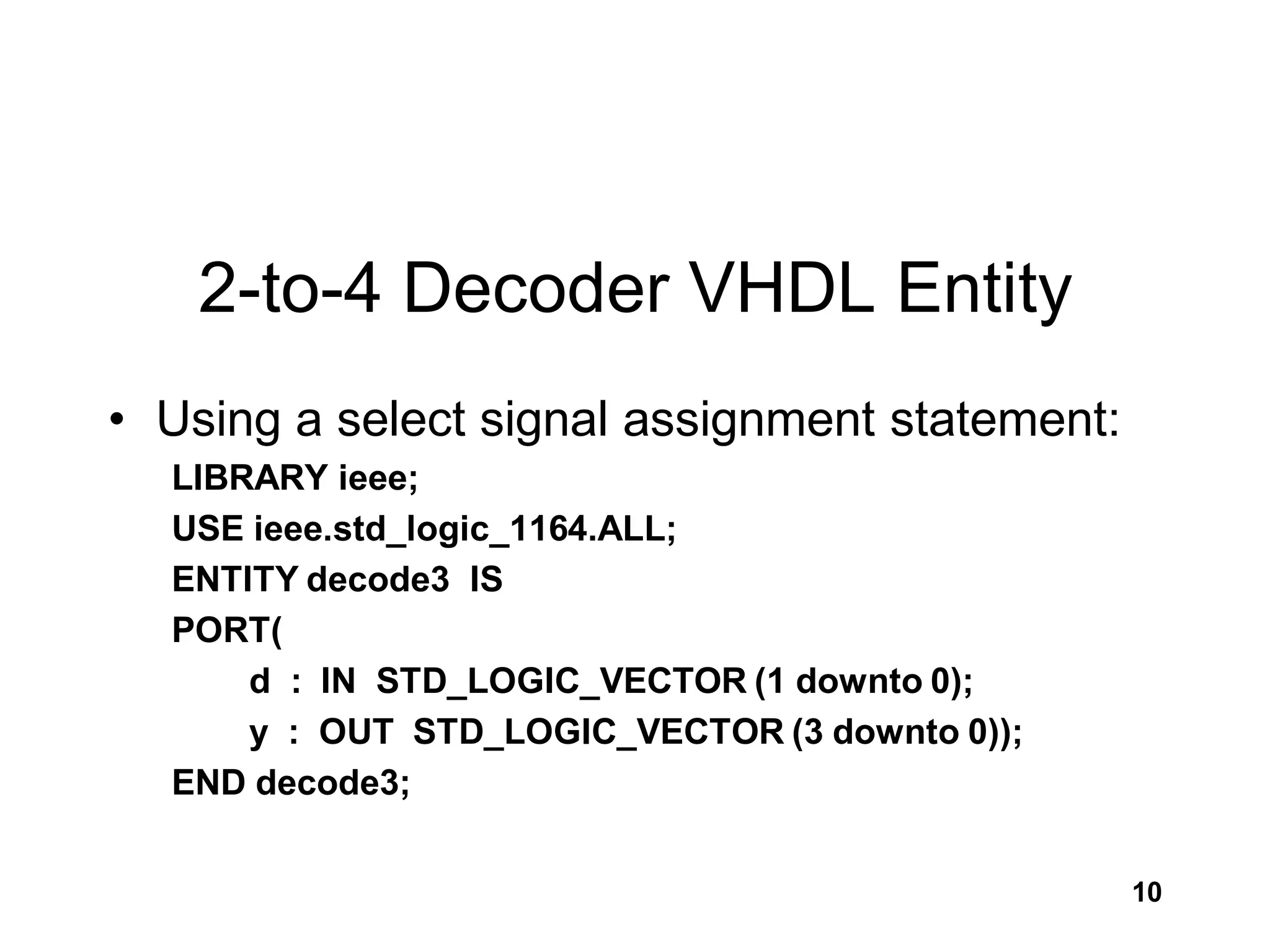
2-to-4 Decoder VHDL Entity
• Using a select signal assignment statement:
LIBRARY ieee;
USE ieee.std_logic_1164.ALL;
ENTITY decode3 IS
PORT(
d : IN STD_LOGIC_VECTOR (1 downto 0);
y : OUT STD_LOGIC_VECTOR (3 downto 0));
END decode3;
11
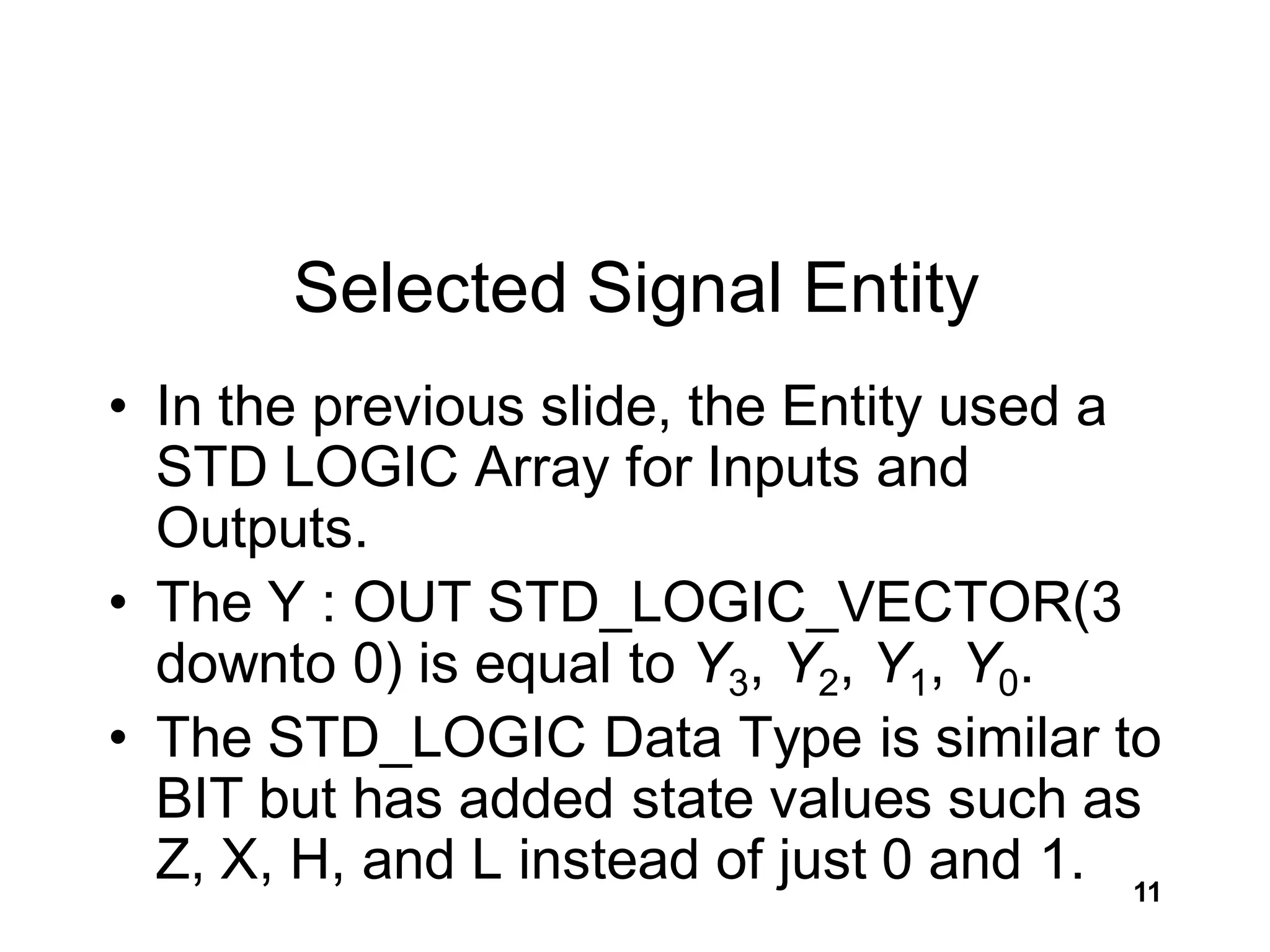
Selected Signal Entity
• In the previous slide, the Entity used a
STD LOGIC Array for Inputs and
Outputs.
• The Y : OUT STD_LOGIC_VECTOR(3
downto 0) is equal to Y3, Y2, Y1, Y0.
• The STD_LOGIC Data Type is similar to
BIT but has added state values such as
Z, X, H, and L instead of just 0 and 1.
12
Selected Signal Assignments
• Uses a VHDL Architecture construct
called WITH SELECT.
• Format is:
– WITH (signal input(s)) SELECT.
– Signal input states are used to define the
output state changes.
13
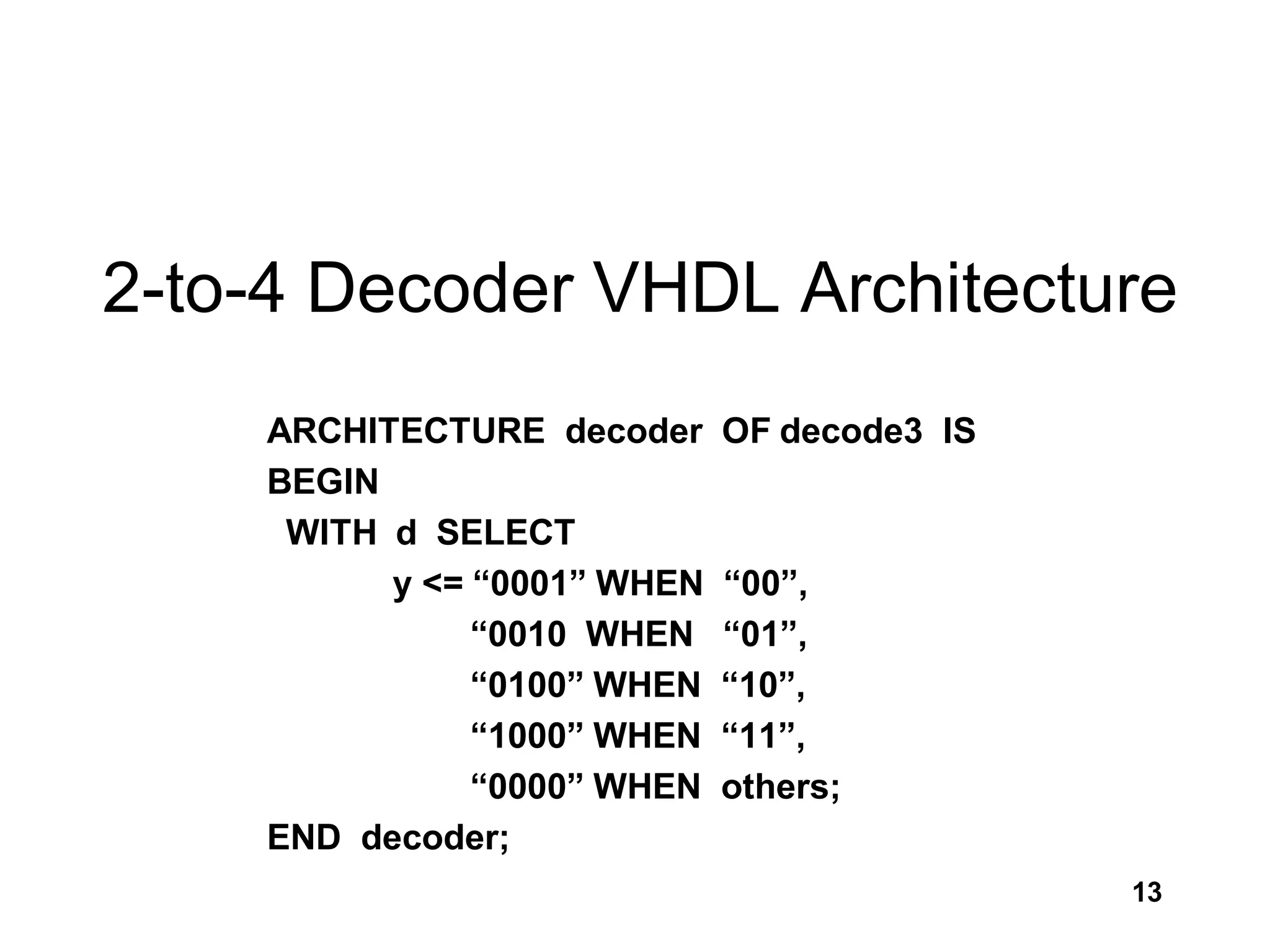
2-to-4 Decoder VHDL Architecture
ARCHITECTURE decoder OF decode3 IS
BEGIN
WITH d SELECT
y <= “0001” WHEN “00”,
“0010 WHEN “01”,
“0100” WHEN “10”,
“1000” WHEN “11”,
“0000” WHEN others;
END decoder;
14
Decoder Architecture
• The decoder Architecture used a
SELECT to evaluate d to determine the
Output y.
• Both d and y are defined as an Array
(or bus or vector) Data Type.
• The last state for WHEN OTHERS is
added for the other logic states (Z, X, H,
L, etc.).
15
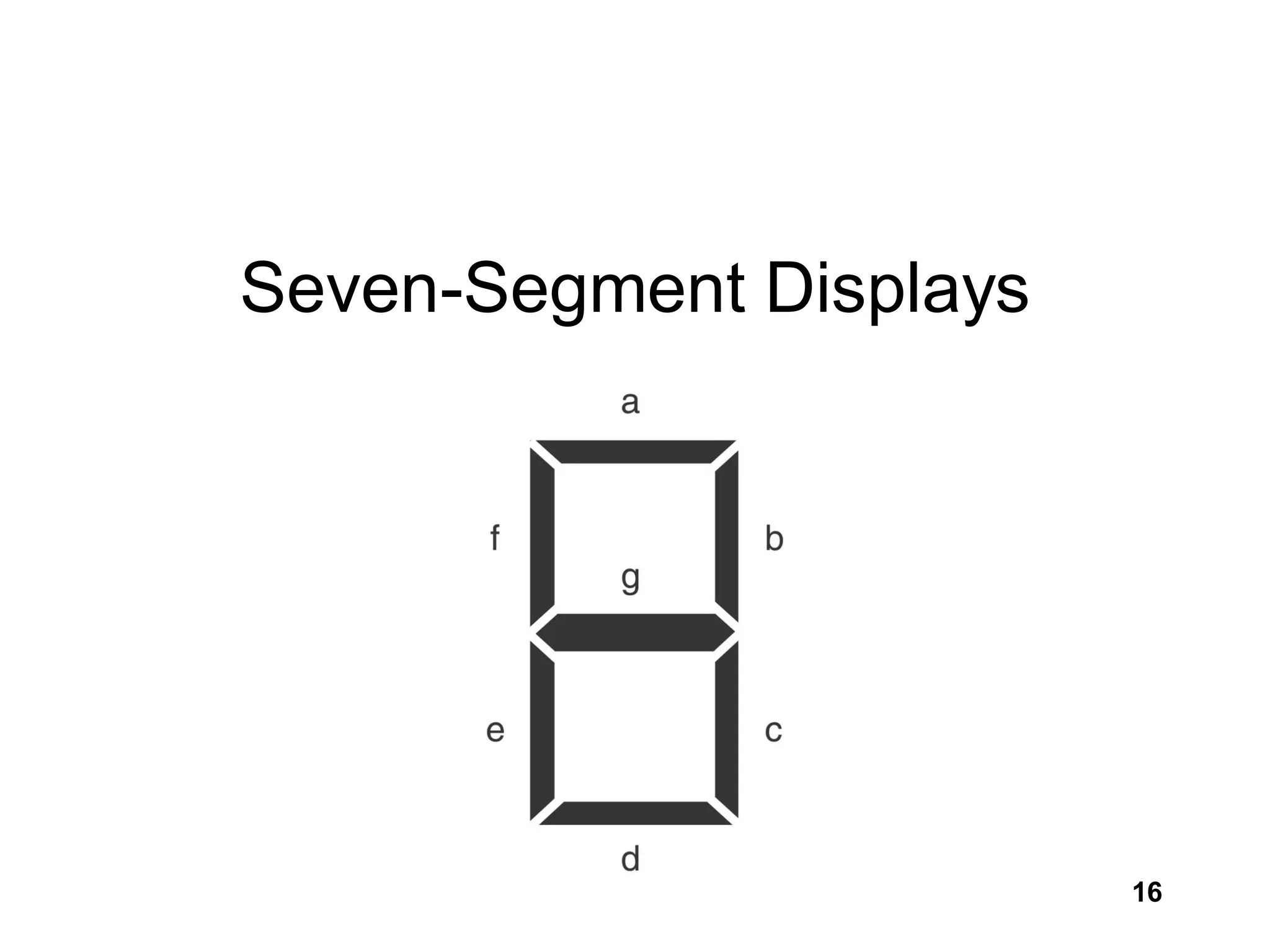
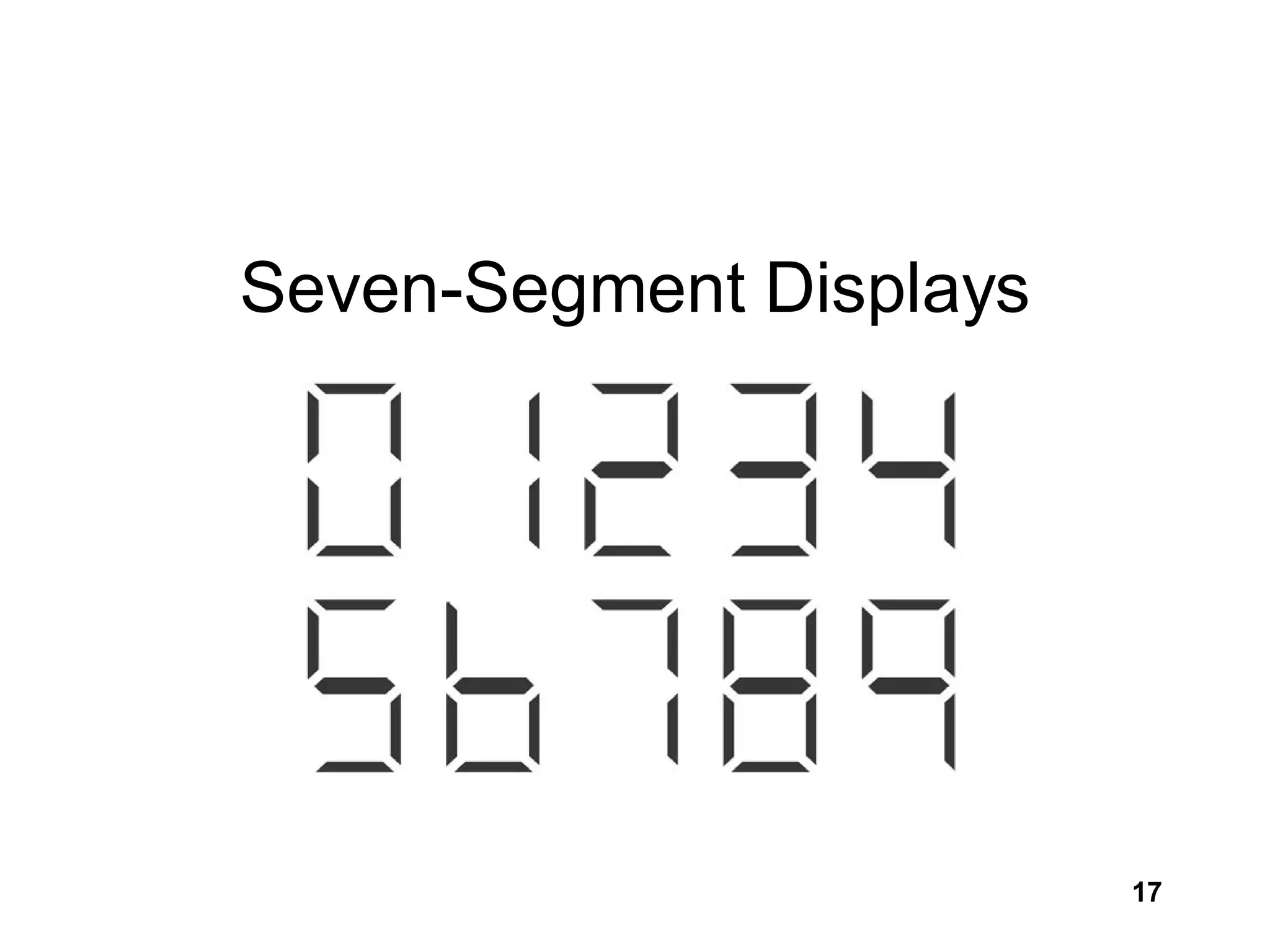
Seven-Segment Displays
• Seven-Segment Display: An array of
seven independently controlled LEDs
shaped like an 8 that can be used to
display decimal digits.
16
Seven-Segment Displays
17
Seven-Segment Displays
18
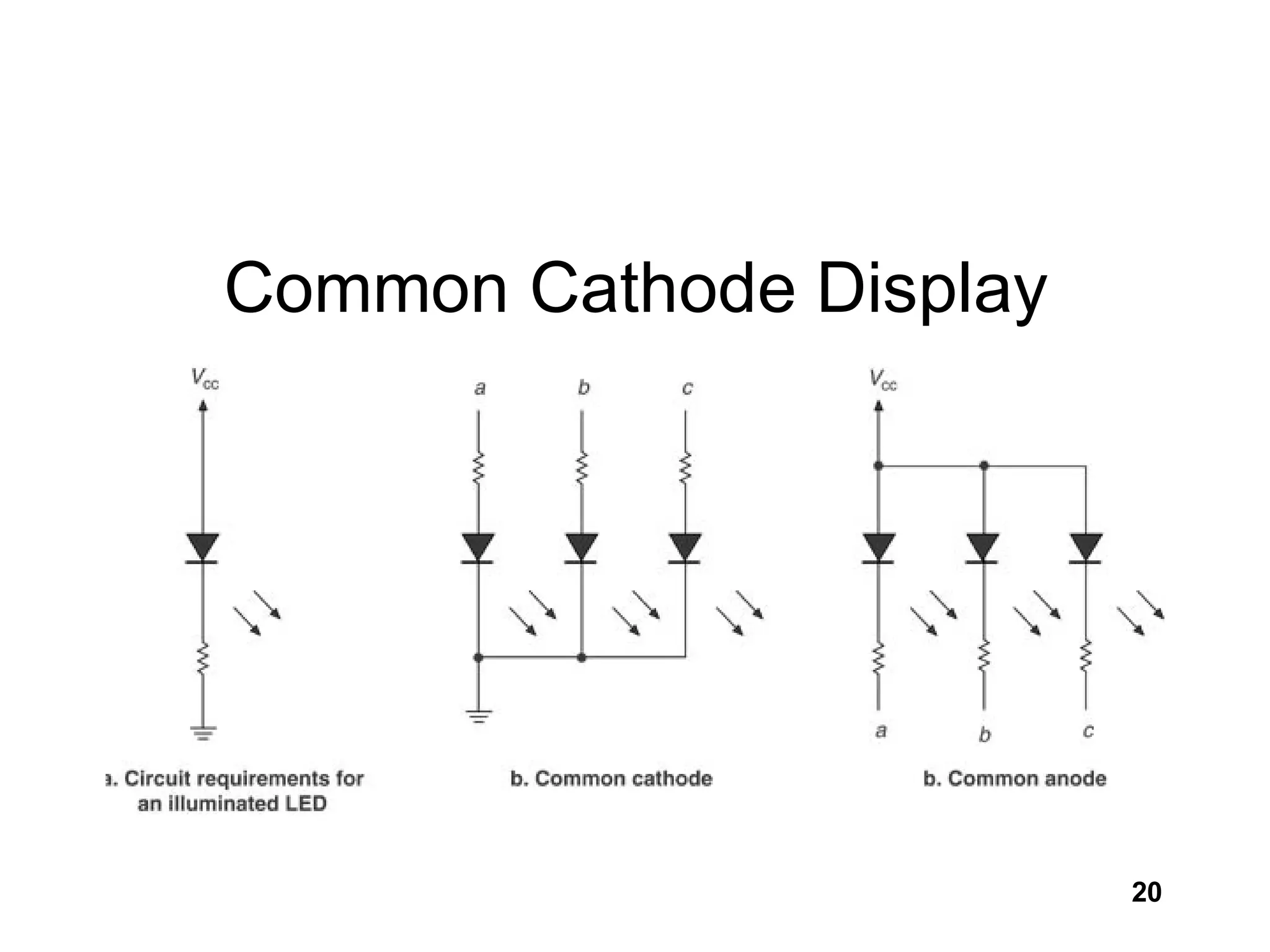
Common Anode Display
• Common Anode Display (CA): A seven-
segment display where the anodes of all
the LEDs are connected together to VCC
and a ‘0’ turns on a segment (a to g).
19
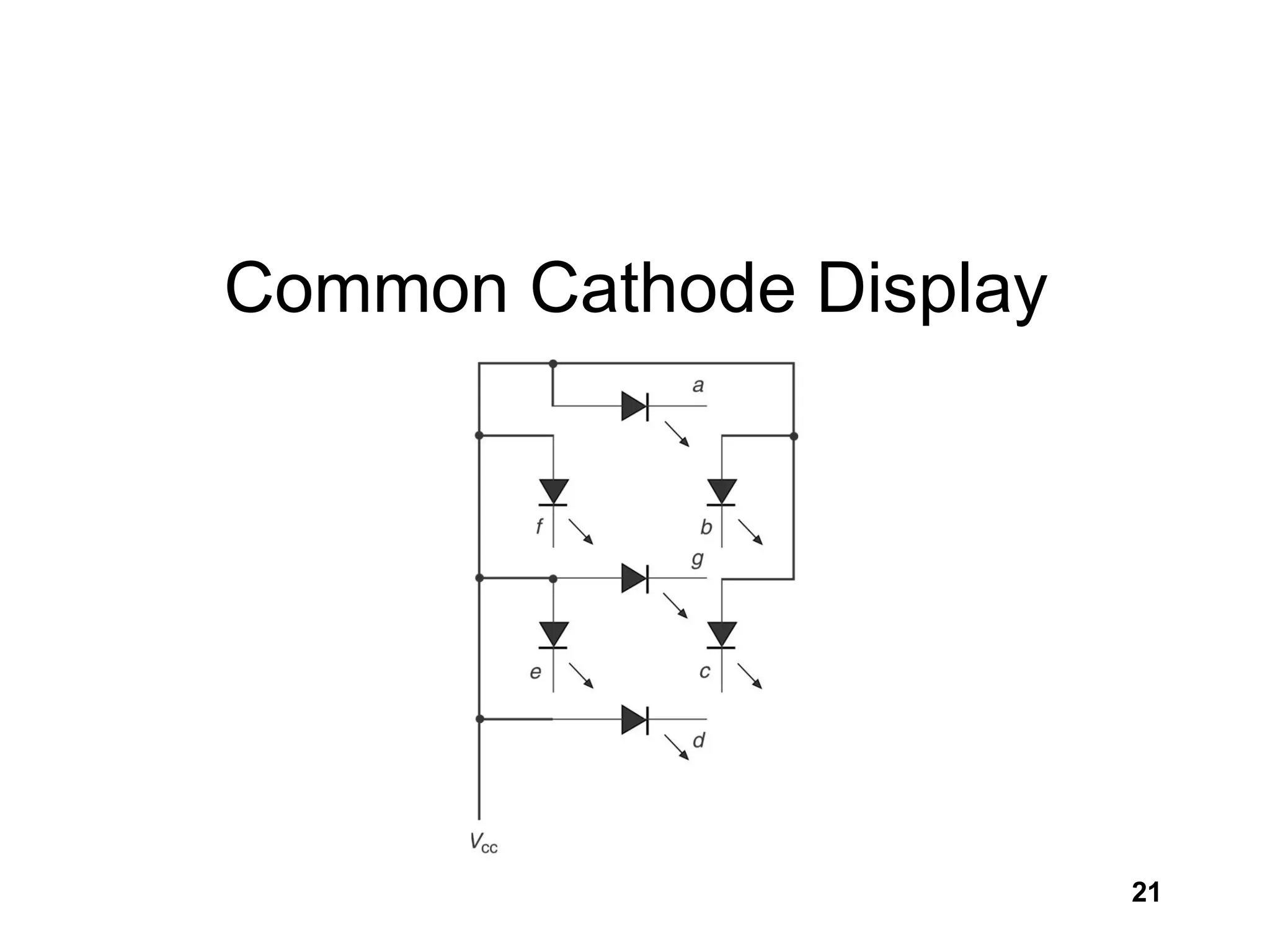
Common Cathode Display
• Common Cathode Display (CC): A
seven-segment display where all the
cathodes are connected and tied to
ground, and a ‘1’ turns on a segment.
20
Common Cathode Display
21
Common Cathode Display
22
Seven-Segment Decoder/Driver – 1
• Receives a BCD (Binary Coded
Decimal) 4-Bit input, outputs a BCD
digit 0000 – 1001 (0 through 9).
• Generates Outputs (a–g) for each of the
display LEDs.
• Requires a current limit series resistor
for each segment.
23
Seven-Segment Decoder/Driver – 2
• Decoders for a CC-SS have active high
outputs while decoders for a CA-SS have
active low outputs (a to g).
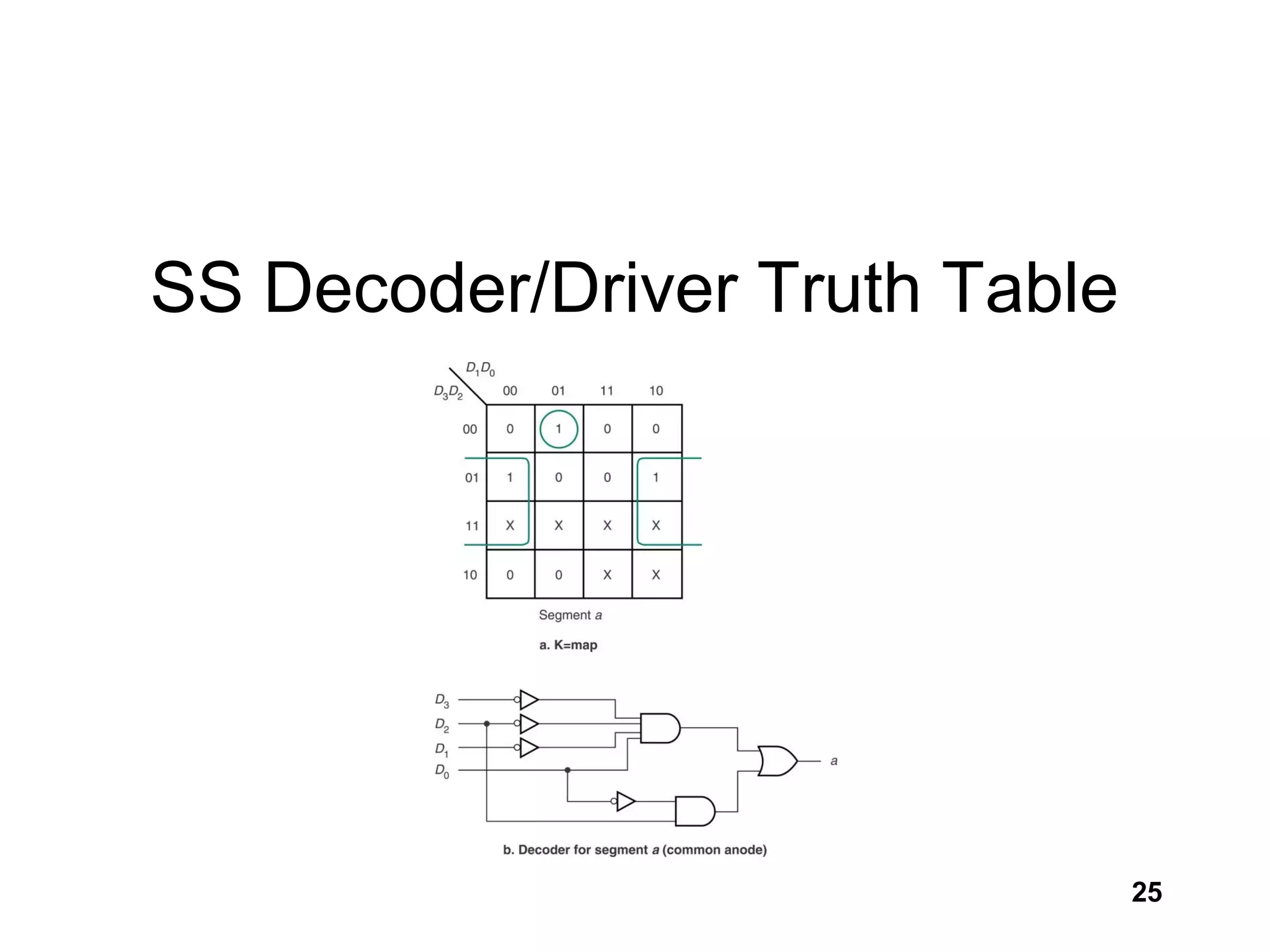
• The outputs generated for the binary input
combinations of 1010 to 1111 are “don’t
cares”.
• The decoder can be designed with VHDL or
MSI Logic (7447, 7448).
24
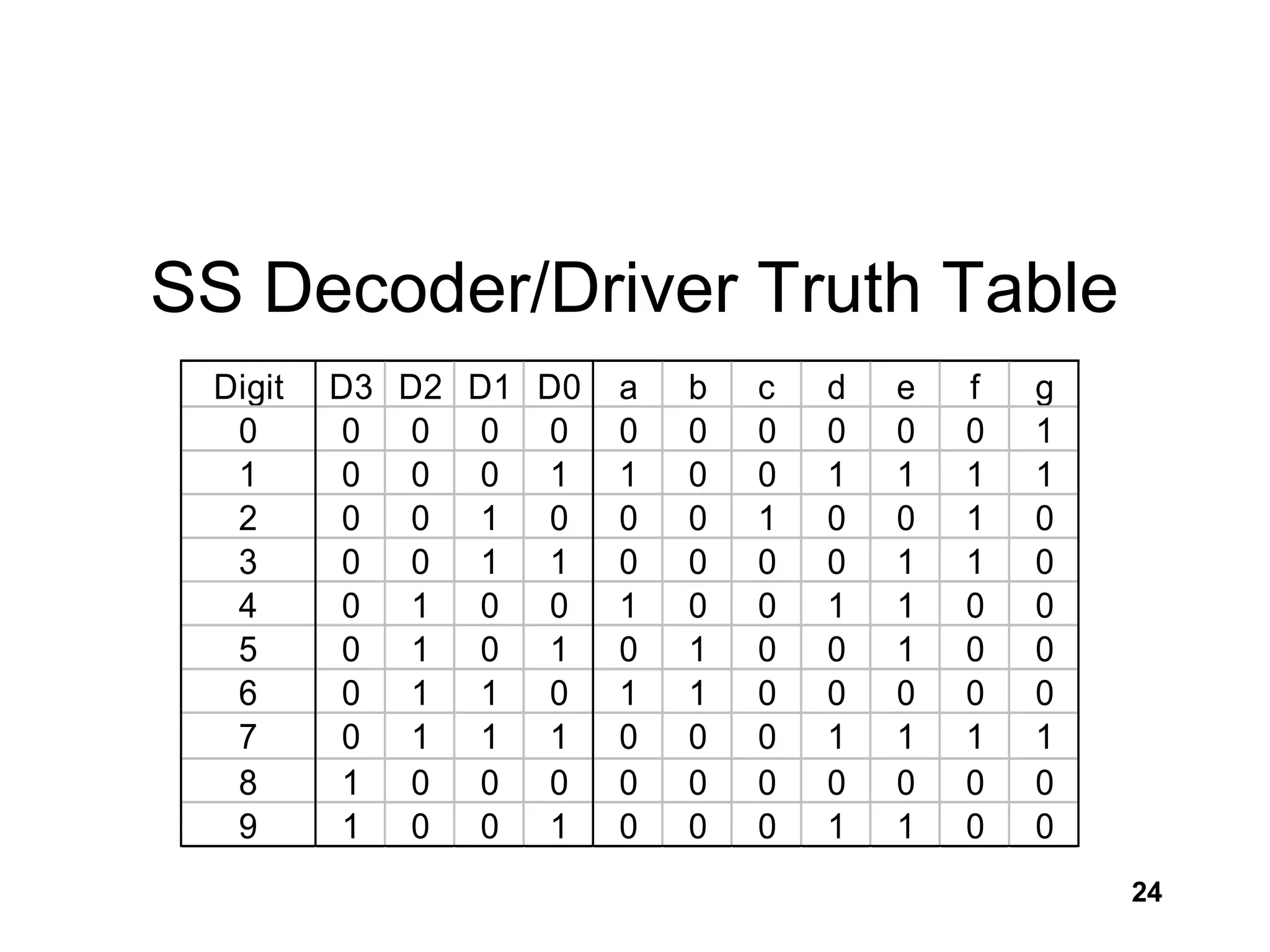
Digit D3 D2 D1 D0 a b c d e f g
0 0 0 0 0 0 0 0 0 0 0 1
1 0 0 0 1 1 0 0 1 1 1 1
2 0 0 1 0 0 0 1 0 0 1 0
3 0 0 1 1 0 0 0 0 1 1 0
4 0 1 0 0 1 0 0 1 1 0 0
5 0 1 0 1 0 1 0 0 1 0 0
6 0 1 1 0 1 1 0 0 0 0 0
7 0 1 1 1 0 0 0 1 1 1 1
8 1 0 0 0 0 0 0 0 0 0 0
9 1 0 0 1 0 0 0 1 1 0 0
SS Decoder/Driver Truth Table
25
SS Decoder/Driver Truth Table
26
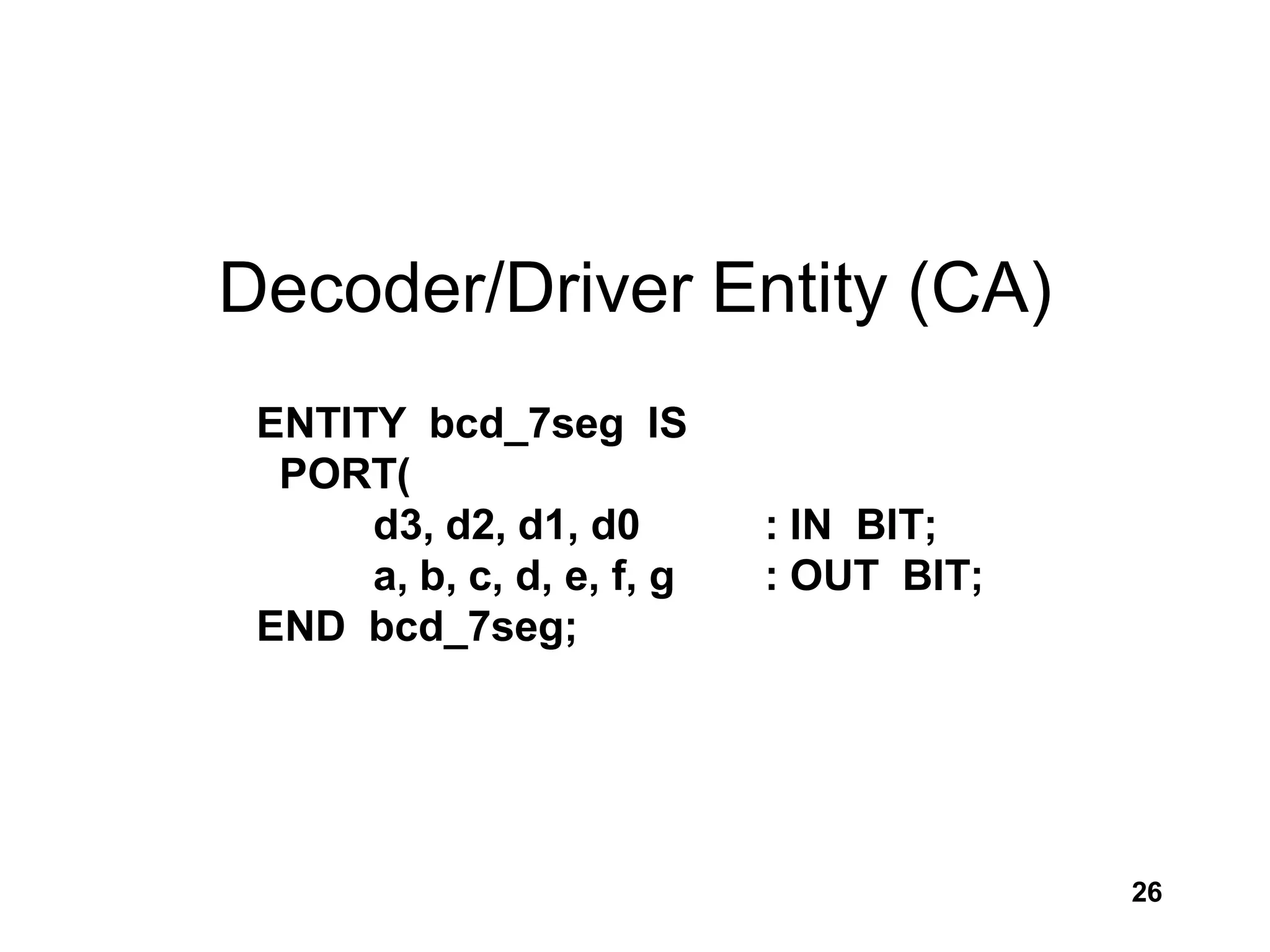
Decoder/Driver Entity (CA)
ENTITY bcd_7seg IS
PORT(
d3, d2, d1, d0 : IN BIT;
a, b, c, d, e, f, g : OUT BIT;
END bcd_7seg;
27
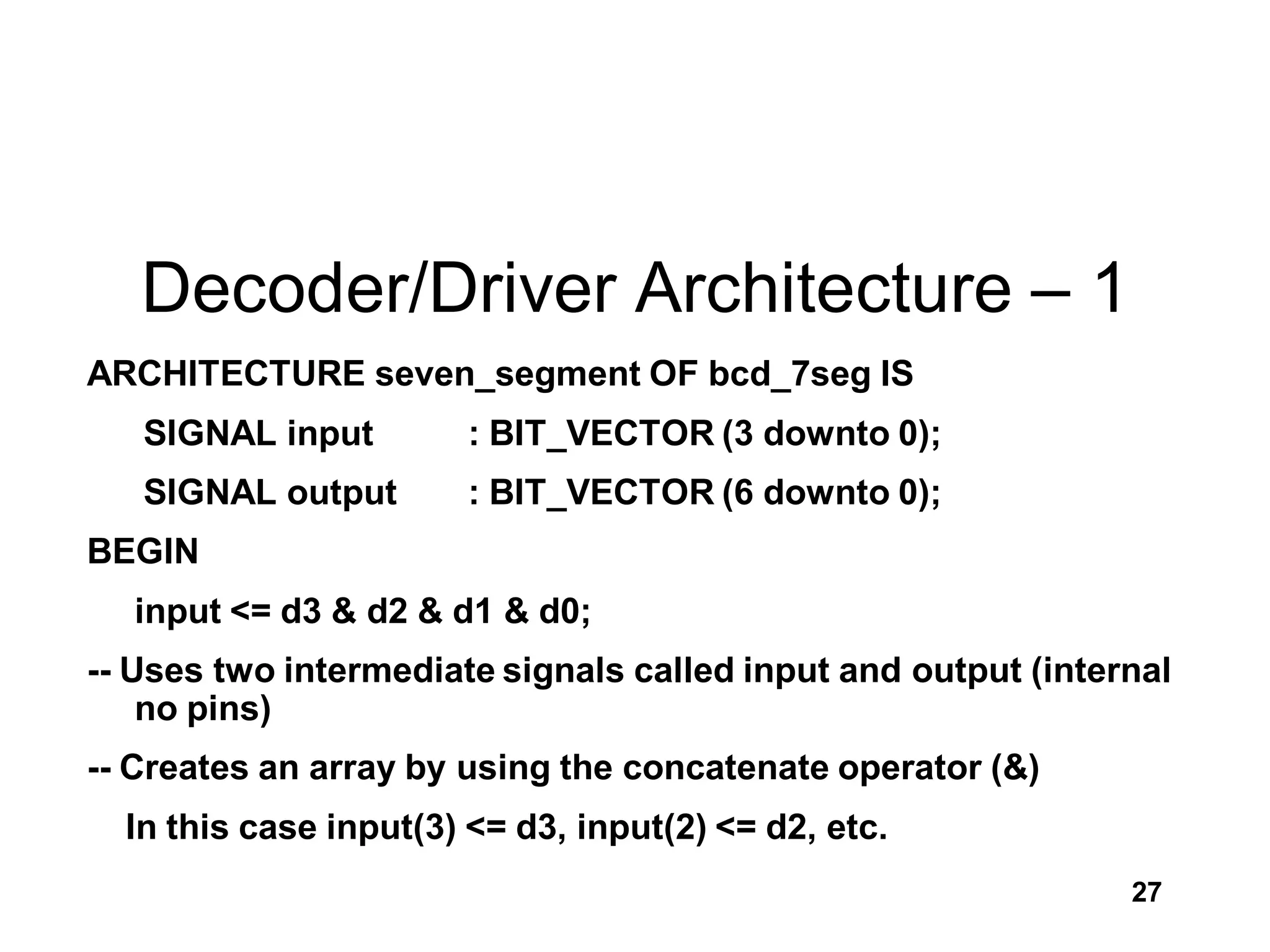
Decoder/Driver Architecture – 1
ARCHITECTURE seven_segment OF bcd_7seg IS
SIGNAL input : BIT_VECTOR (3 downto 0);
SIGNAL output : BIT_VECTOR (6 downto 0);
BEGIN
input <= d3 & d2 & d1 & d0;
-- Uses two intermediate signals called input and output (internal
no pins)
-- Creates an array by using the concatenate operator (&)
In this case input(3) <= d3, input(2) <= d2, etc.
28
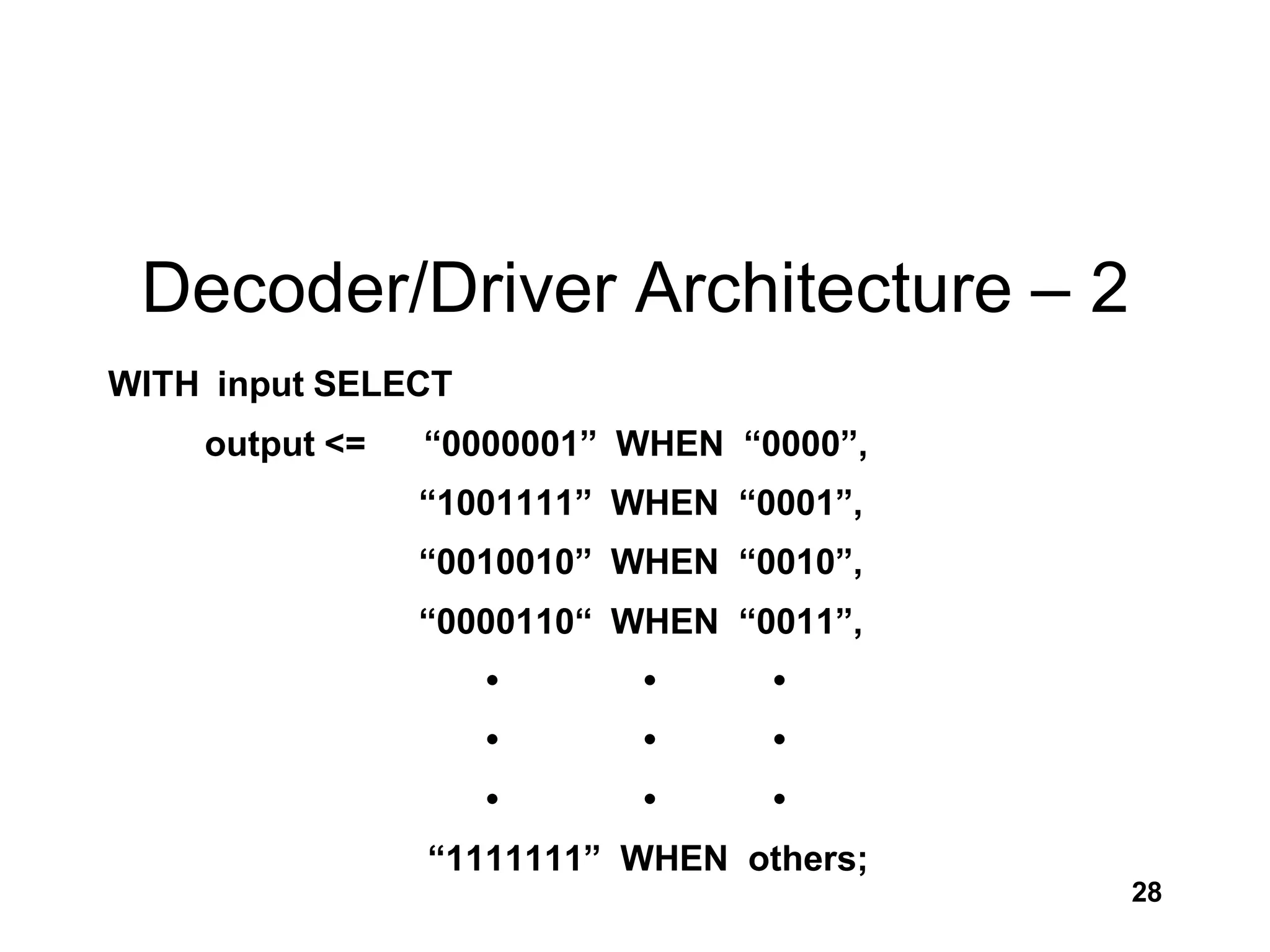
Decoder/Driver Architecture – 2
WITH input SELECT
output <= “0000001” WHEN “0000”,
“1001111” WHEN “0001”,
“0010010” WHEN “0010”,
“0000110“ WHEN “0011”,
• • •
• • •
• • •
“1111111” WHEN others;
29
Decoder/Driver Architecture – 3
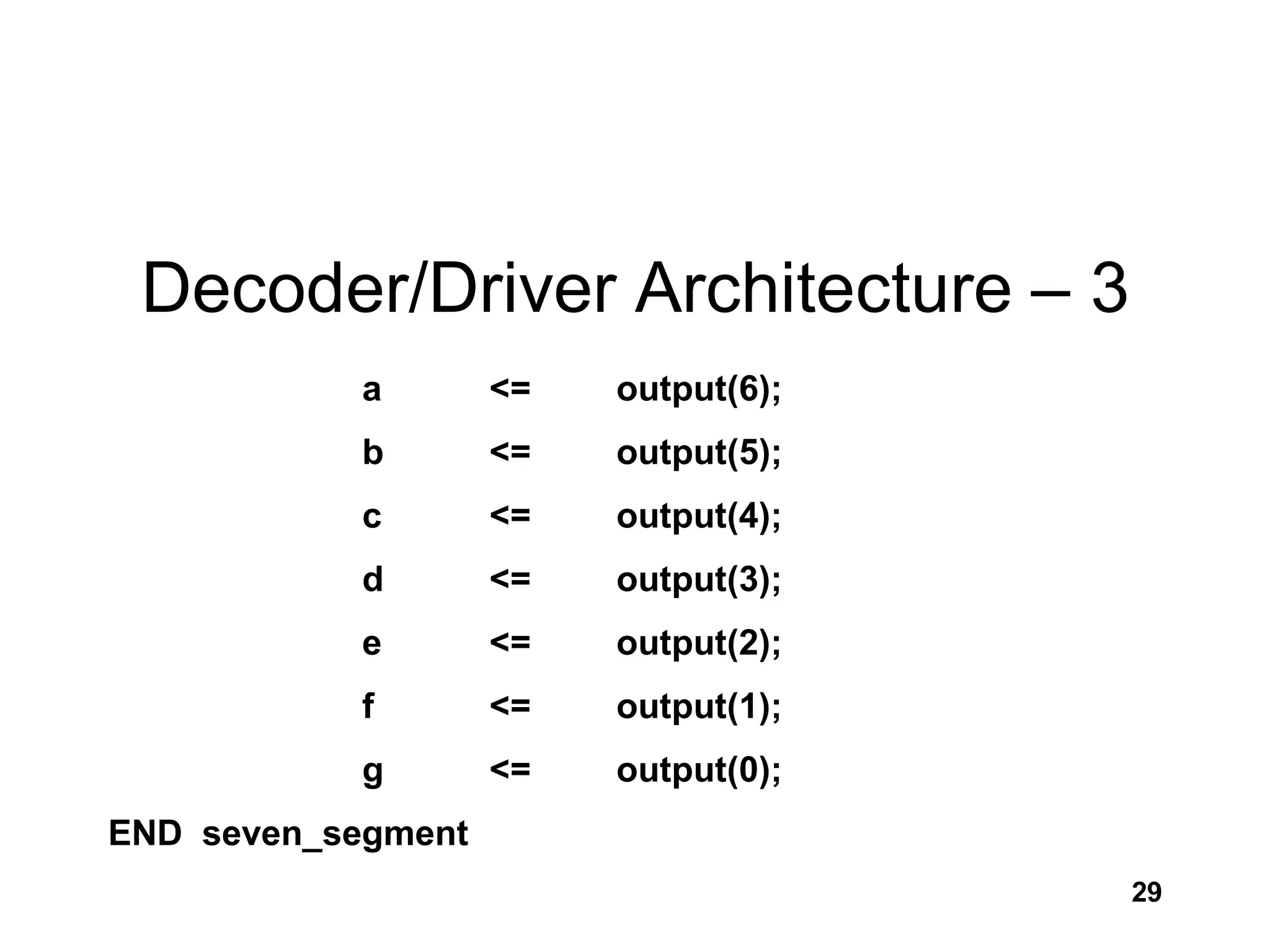
a <= output(6);
b <= output(5);
c <= output(4);
d <= output(3);
e <= output(2);
f <= output(1);
g <= output(0);
END seven_segment
30
SS VHDL File Description
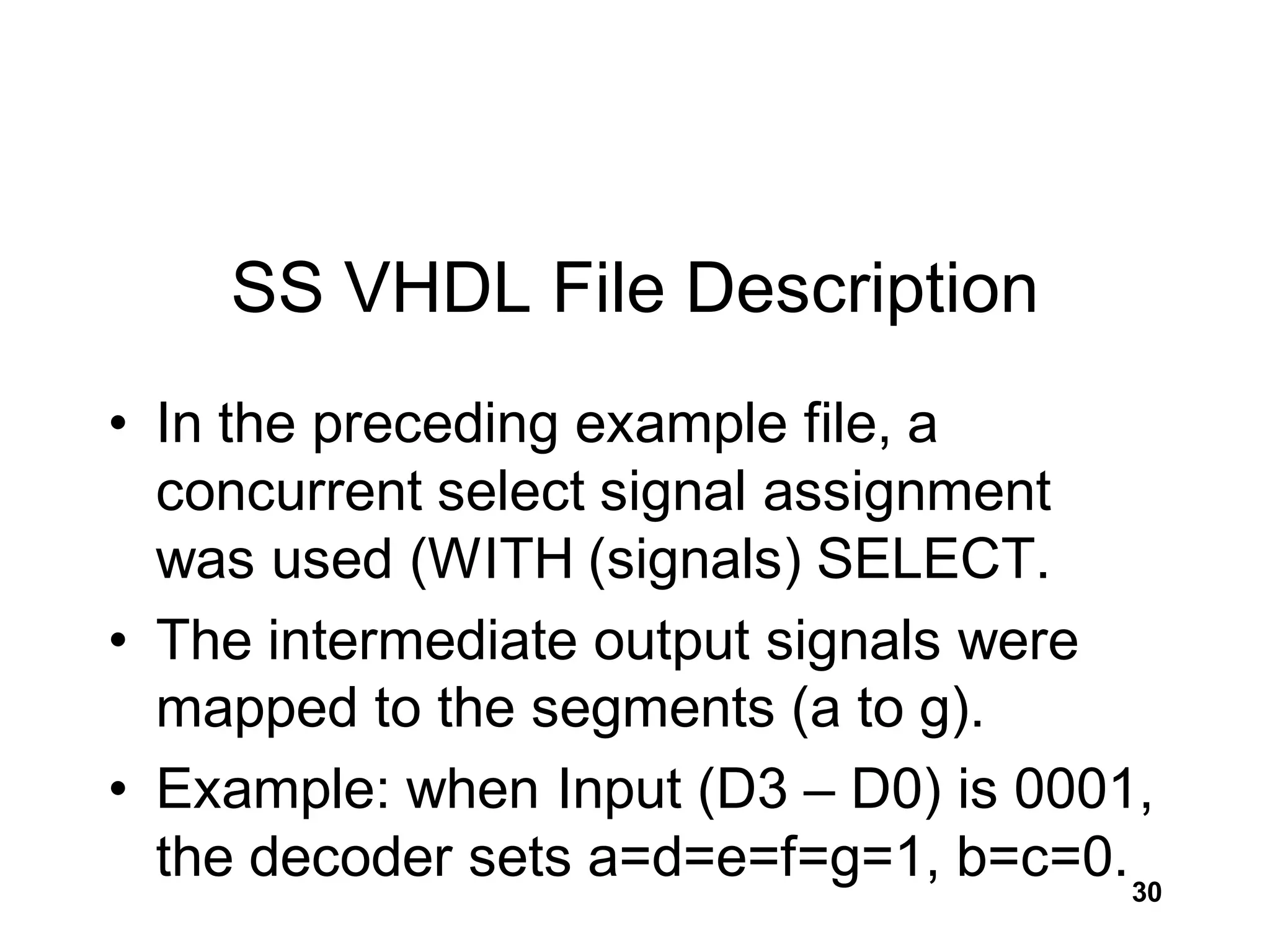
• In the preceding example file, a
concurrent select signal assignment
was used (WITH (signals) SELECT.
• The intermediate output signals were
mapped to the segments (a to g).
• Example: when Input (D3 – D0) is 0001,
the decoder sets a=d=e=f=g=1, b=c=0.
31
Sequential Process in VHDL
• A VHDL Process is a construct that
encloses sequential statements that are
executed when a signal in a sensitivity
list changes.
32
Sequential Process Basic Format
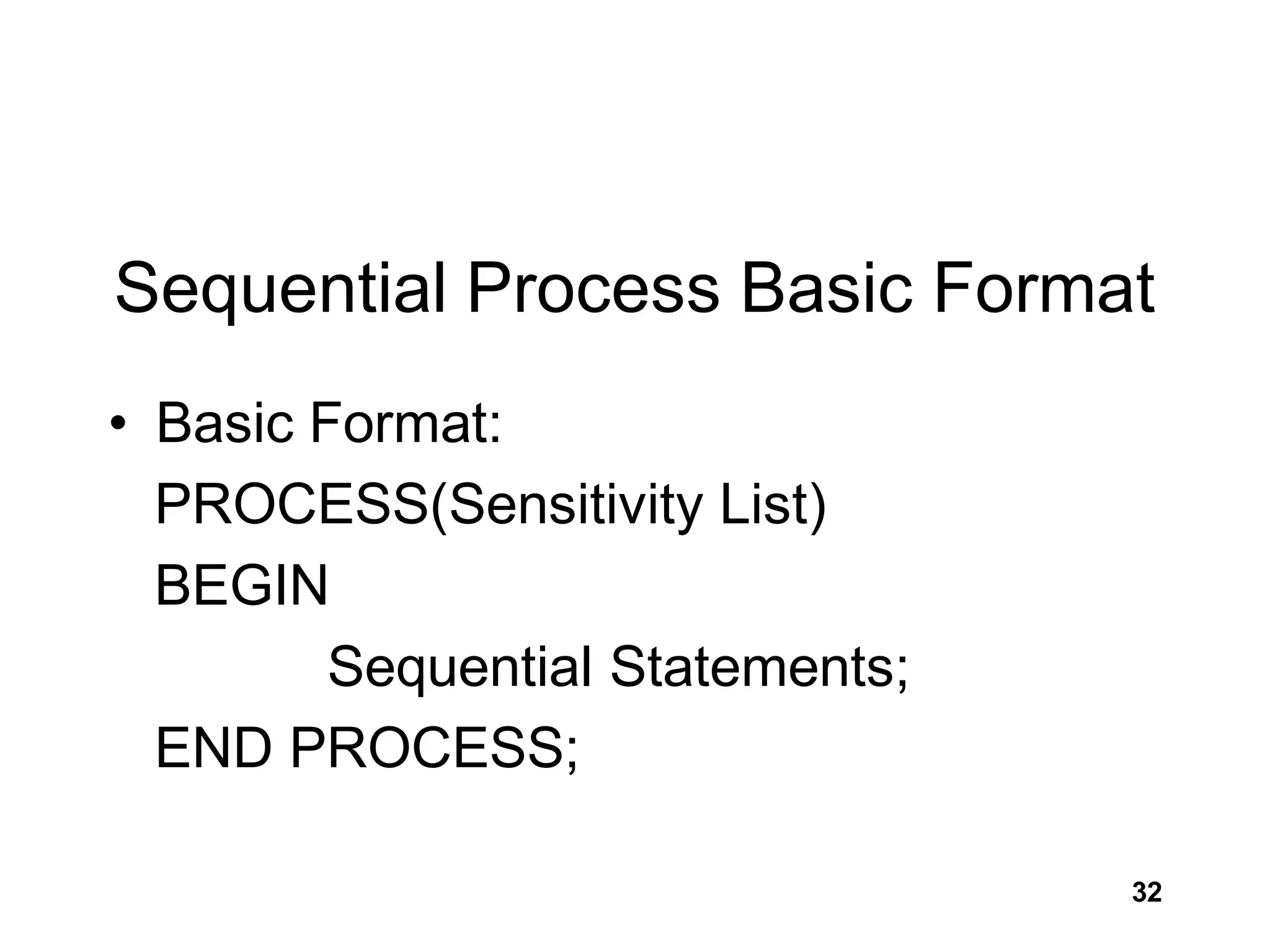
• Basic Format:
PROCESS(Sensitivity List)
BEGIN
Sequential Statements;
END PROCESS;
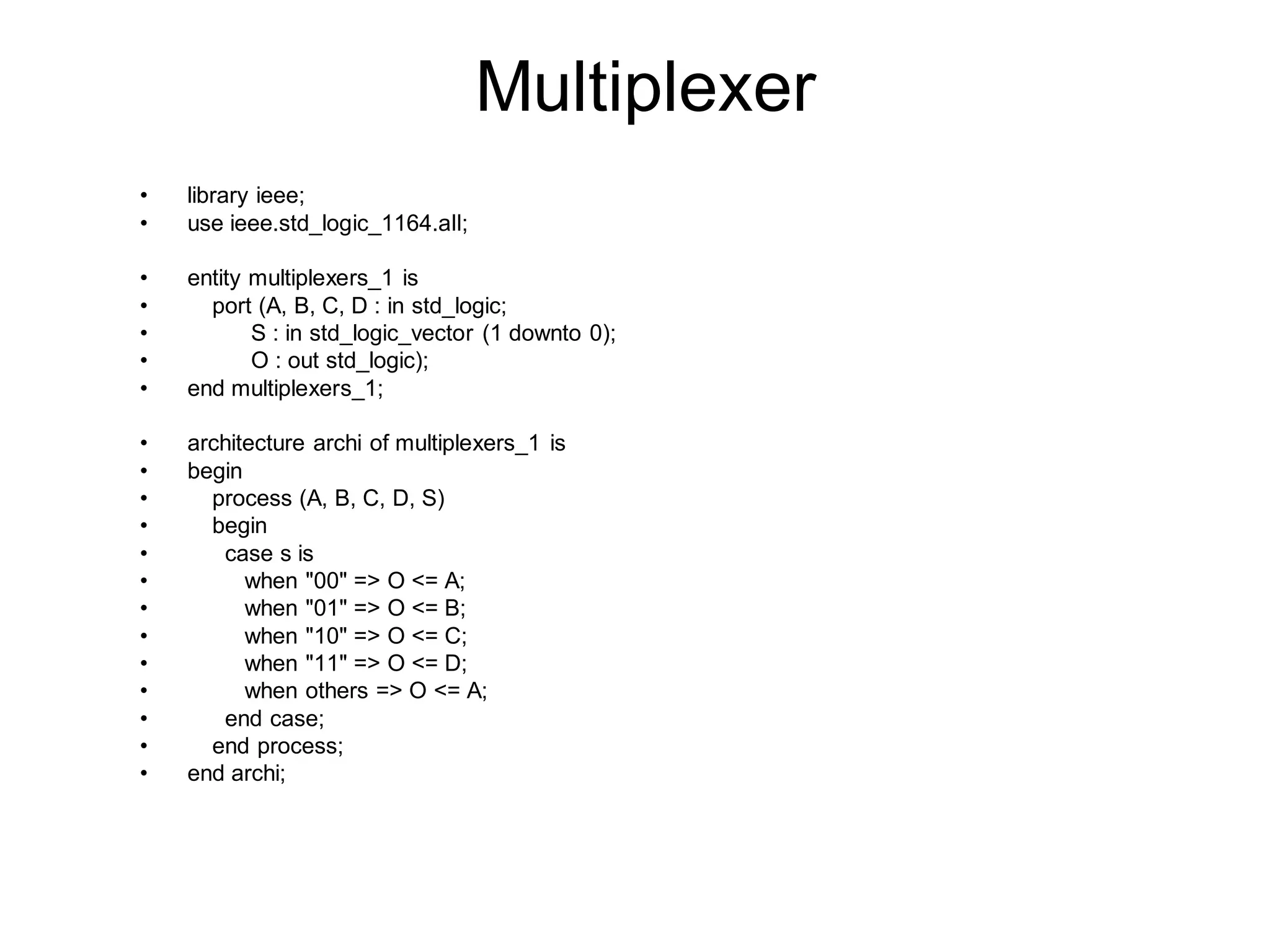
Multiplexer
• library ieee;
• use ieee.std_logic_1164.all;
• entity multiplexers_1 is
• port (A, B, C, D : in std_logic;
• S : in std_logic_vector (1 downto 0);
• O : out std_logic);
• end multiplexers_1;
• architecture archi of multiplexers_1 is
• begin
• process (A, B, C, D, S)
• begin
• case s is
• when "00" => O <= A;
• when "01" => O <= B;
• when "10" => O <= C;
• when "11" => O <= D;
• when others => O <= A;
• end case;
• end process;
• end archi;
34
IF THEN ELSE
• The IF THEN ELSE Statements were
used for conditional testing of some
inputs.
• IF the data is this value THEN do these
statements ELSE do this.
• This is a very simple statement that is
used a great deal in sequential logic.
35
Encoders
• Encoder: A digital circuit that generates
a specific code at its outputs in
response to one or more active inputs.
• It is complementary in function to a
decoder.
• Output codes are usually Binary or
BCD.
36
Priority Encoders
• Priority Encoder: An encoder that
generates a code based on the highest-
priority input.
• For example, if input D3 = input D5, then
the output is 101, not 011. D5 has a
higher priority than D3 and the output
will respond accordingly.
37
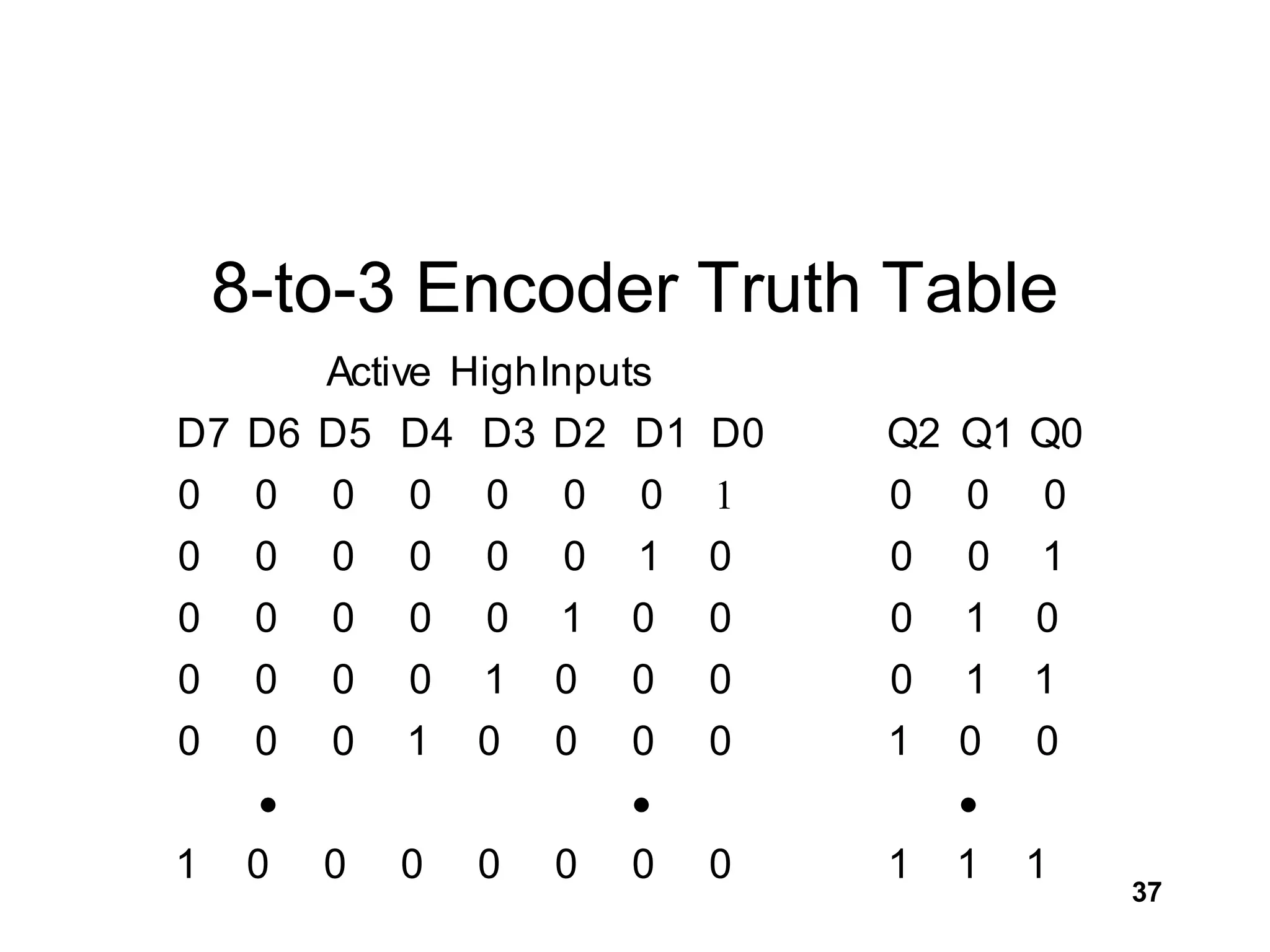
8-to-3 Encoder Truth Table
11100000001
00100001000
11000010000
01000100000
10001000000
0000000000
Q0Q1Q2D0D1D2D3D4D5D6D7
InputsHighActive

1
38
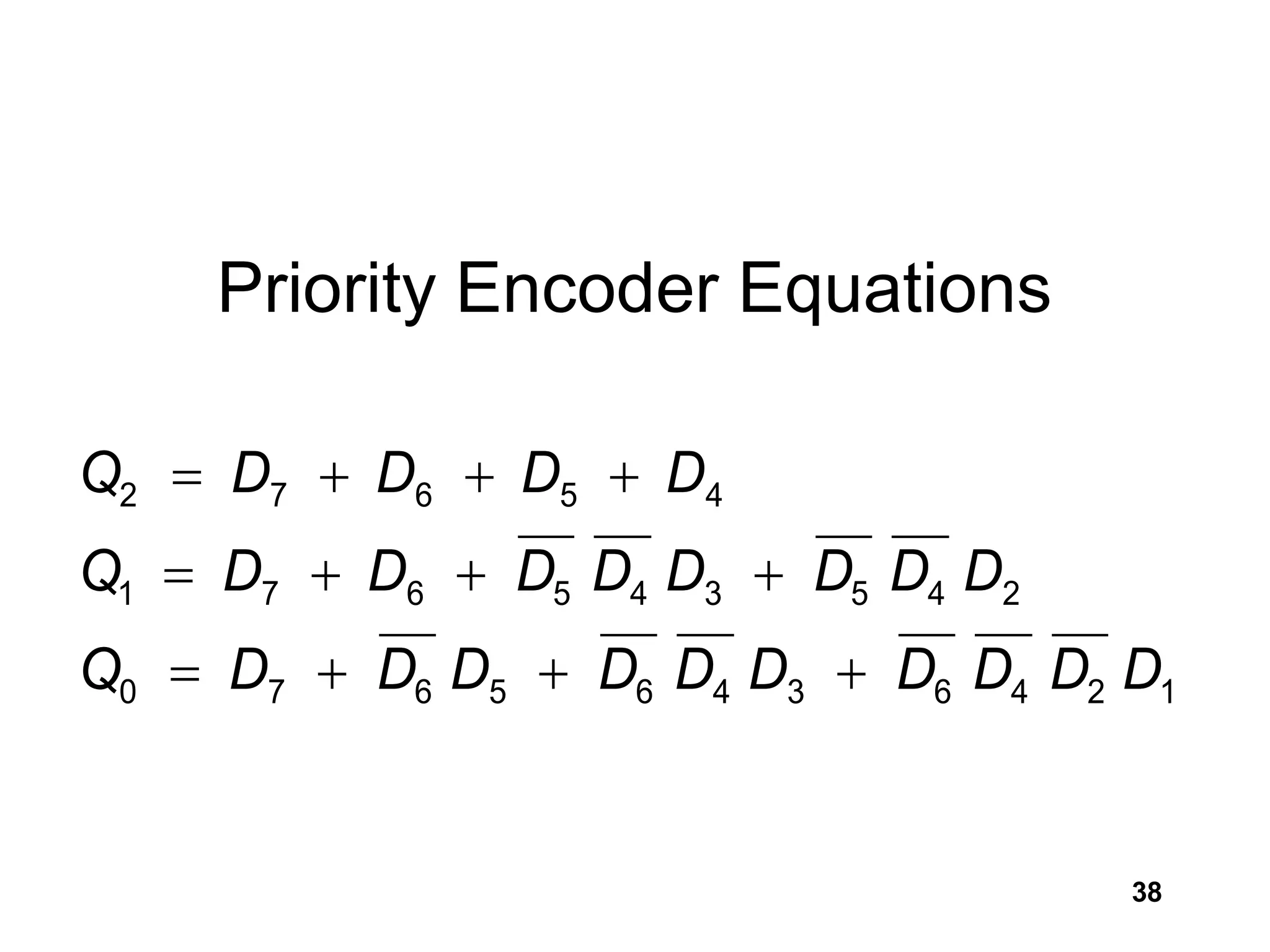
Priority Encoder Equations
DDDDDDDDDDQ
DDDDDDDDQ
DDDDQ
12463465670
245345671
45672



39
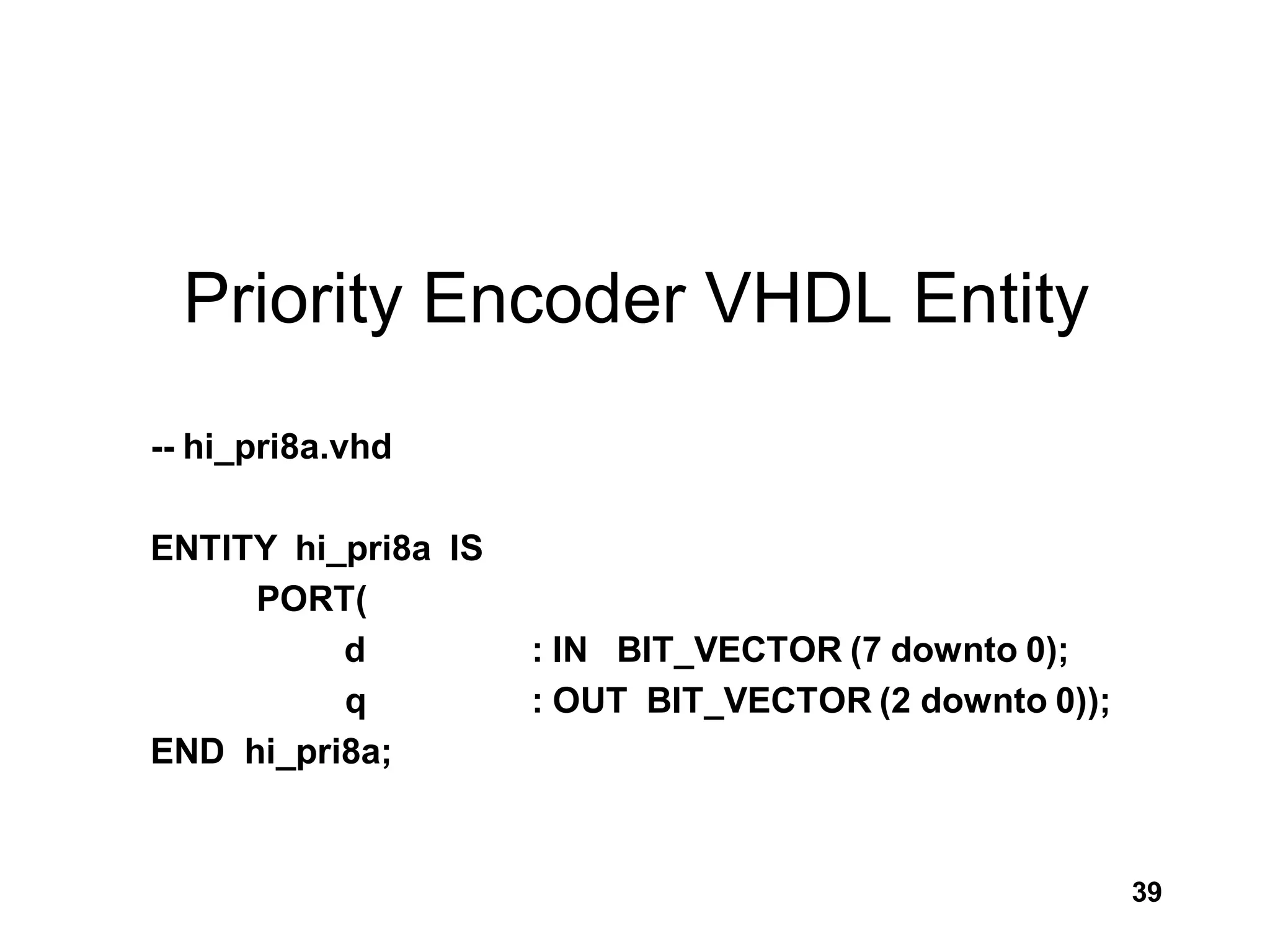
Priority Encoder VHDL Entity
-- hi_pri8a.vhd
ENTITY hi_pri8a IS
PORT(
d : IN BIT_VECTOR (7 downto 0);
q : OUT BIT_VECTOR (2 downto 0));
END hi_pri8a;
40
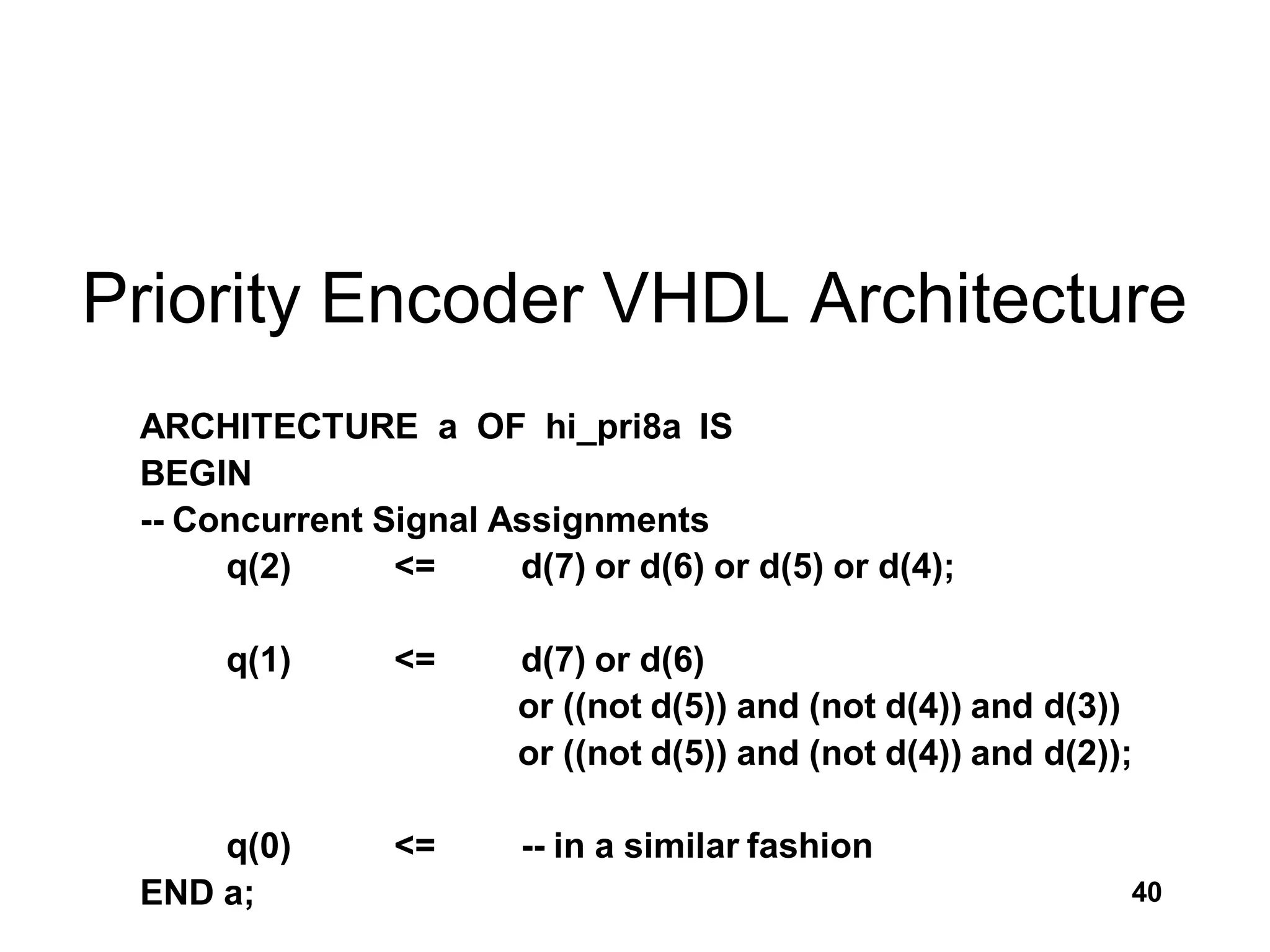
Priority Encoder VHDL Architecture
ARCHITECTURE a OF hi_pri8a IS
BEGIN
-- Concurrent Signal Assignments
q(2) <= d(7) or d(6) or d(5) or d(4);
q(1) <= d(7) or d(6)
or ((not d(5)) and (not d(4)) and d(3))
or ((not d(5)) and (not d(4)) and d(2));
q(0) <= -- in a similar fashion
END a;
41
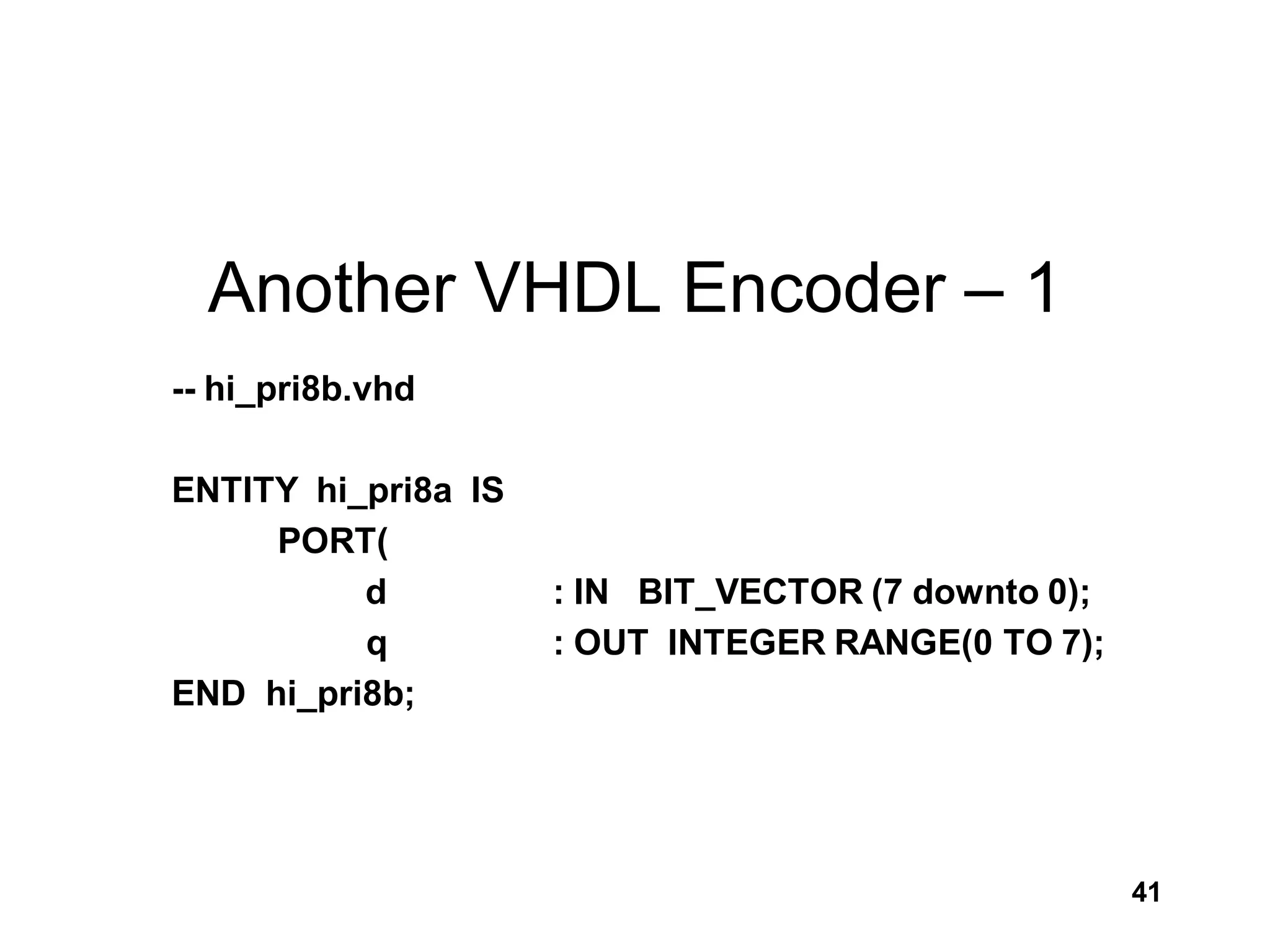
Another VHDL Encoder – 1
-- hi_pri8b.vhd
ENTITY hi_pri8a IS
PORT(
d : IN BIT_VECTOR (7 downto 0);
q : OUT INTEGER RANGE(0 TO 7);
END hi_pri8b;
42
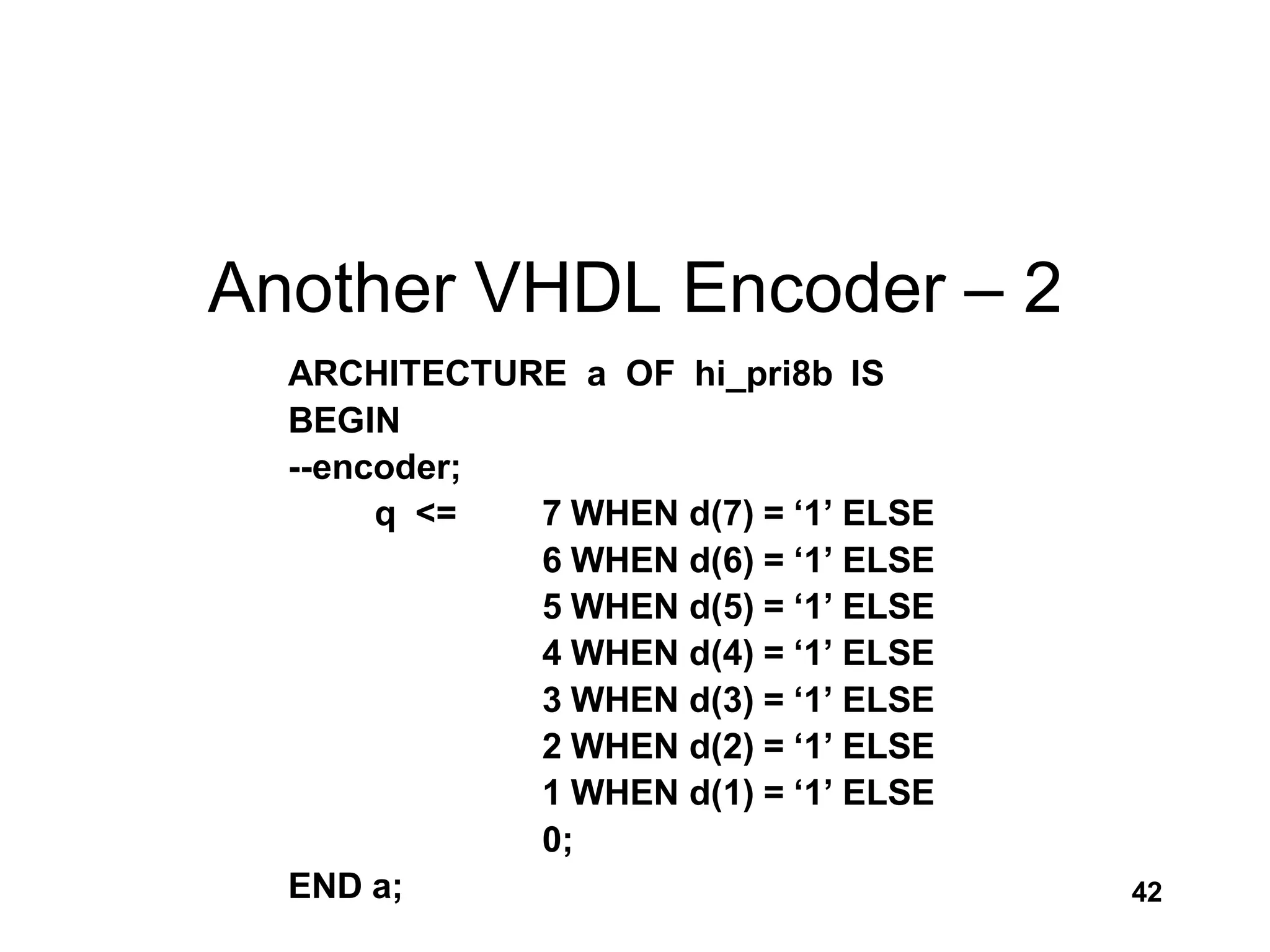
Another VHDL Encoder – 2
ARCHITECTURE a OF hi_pri8b IS
BEGIN
--encoder;
q <= 7 WHEN d(7) = ‘1’ ELSE
6 WHEN d(6) = ‘1’ ELSE
5 WHEN d(5) = ‘1’ ELSE
4 WHEN d(4) = ‘1’ ELSE
3 WHEN d(3) = ‘1’ ELSE
2 WHEN d(2) = ‘1’ ELSE
1 WHEN d(1) = ‘1’ ELSE
0;
END a;
43
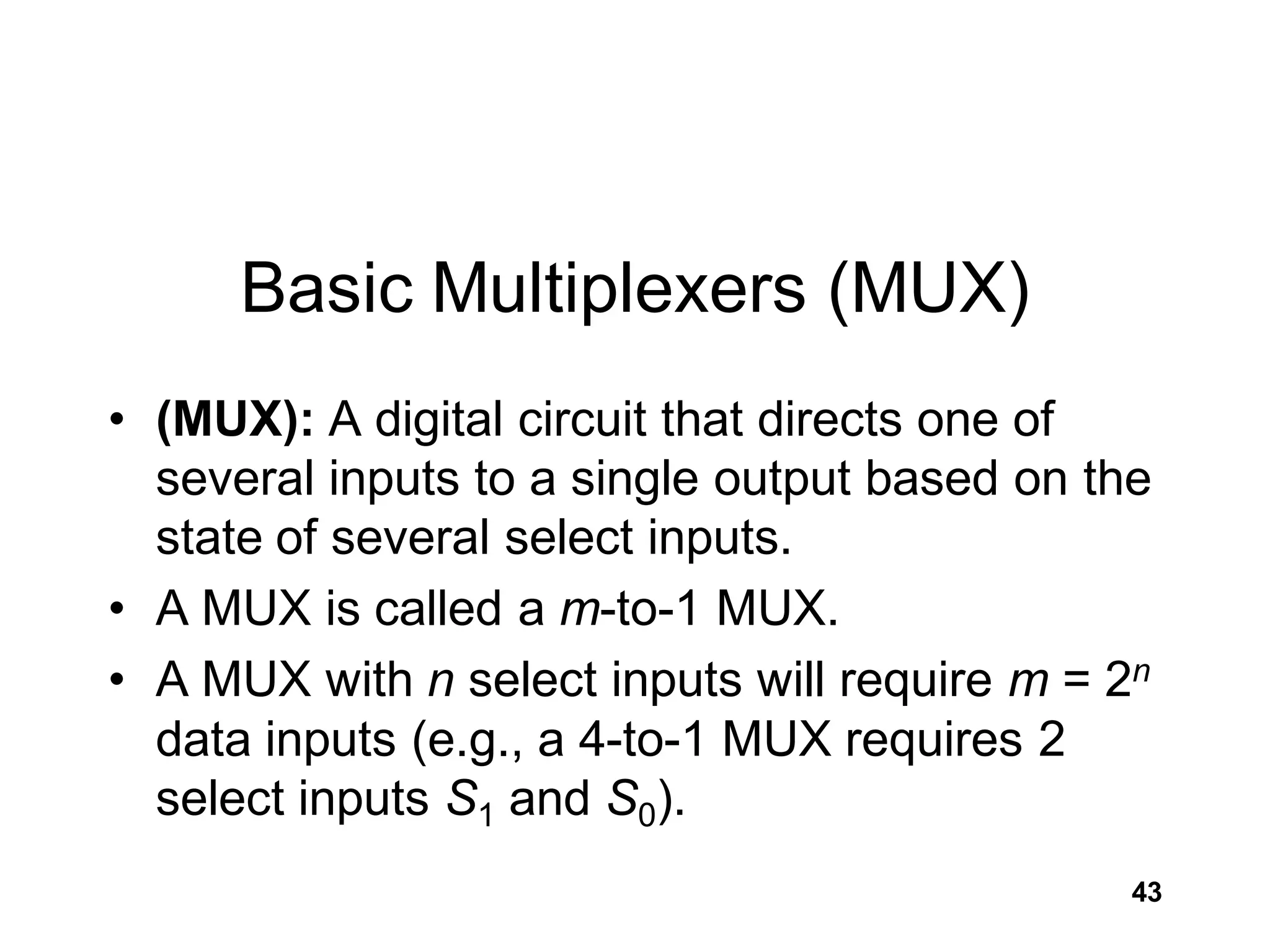
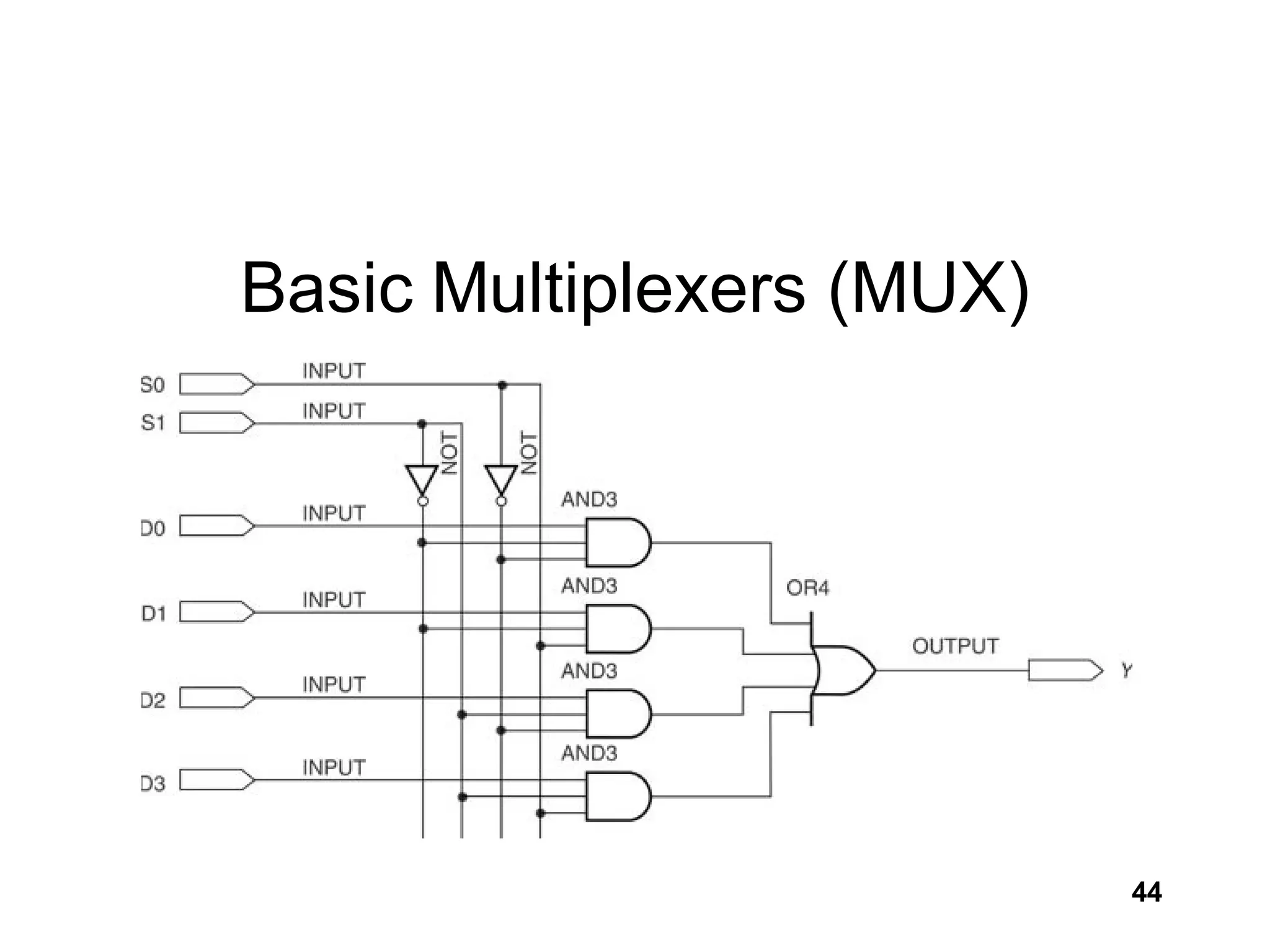
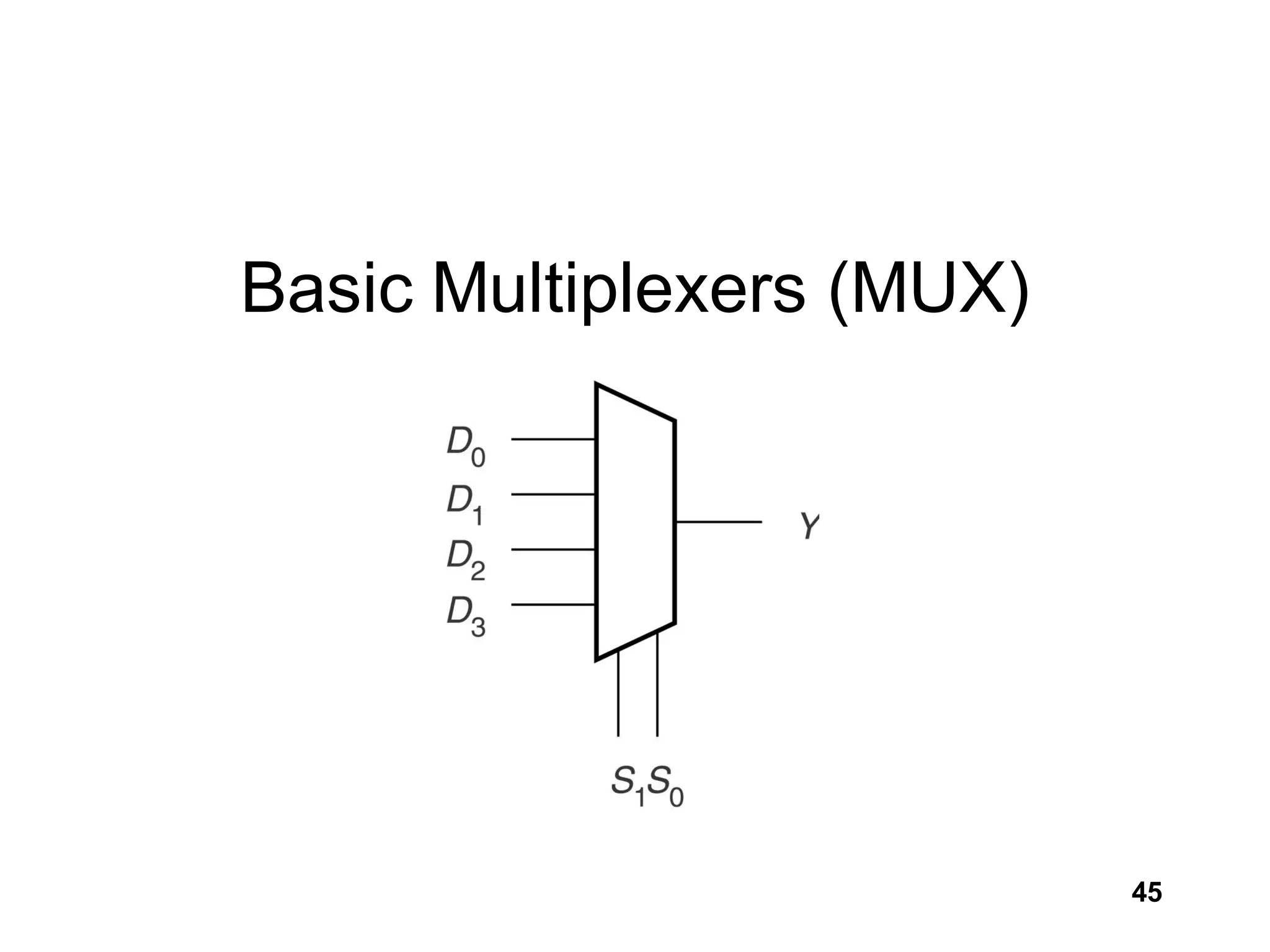
Basic Multiplexers (MUX)
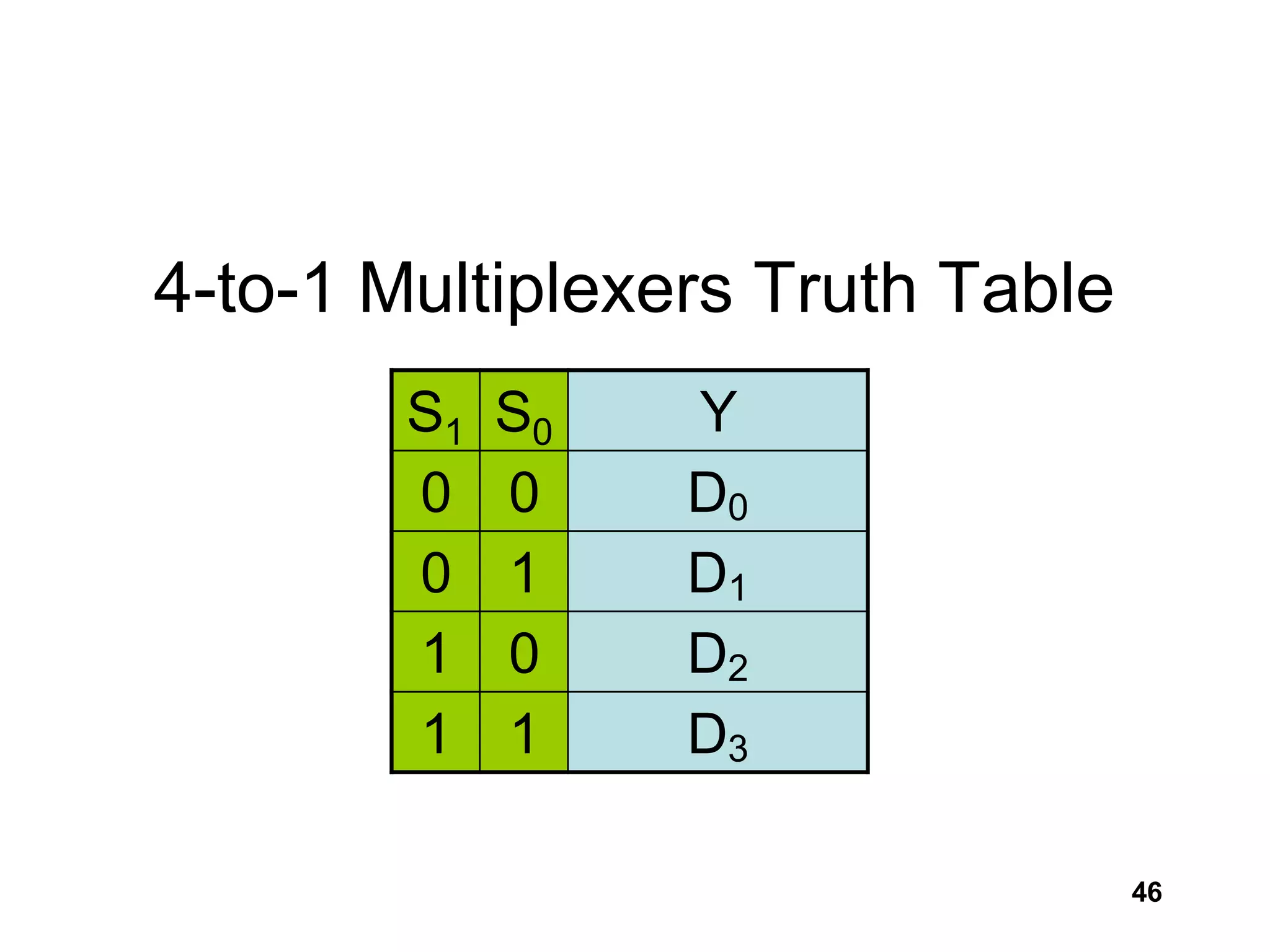
• (MUX): A digital circuit that directs one of
several inputs to a single output based on the
state of several select inputs.
• A MUX is called a m-to-1 MUX.
• A MUX with n select inputs will require m = 2n
data inputs (e.g., a 4-to-1 MUX requires 2
select inputs S1 and S0).
44
Basic Multiplexers (MUX)
45
Basic Multiplexers (MUX)
46
4-to-1 Multiplexers Truth Table
S1 S0 Y
0 0 D0
0 1 D1
1 0 D2
1 1 D3
47
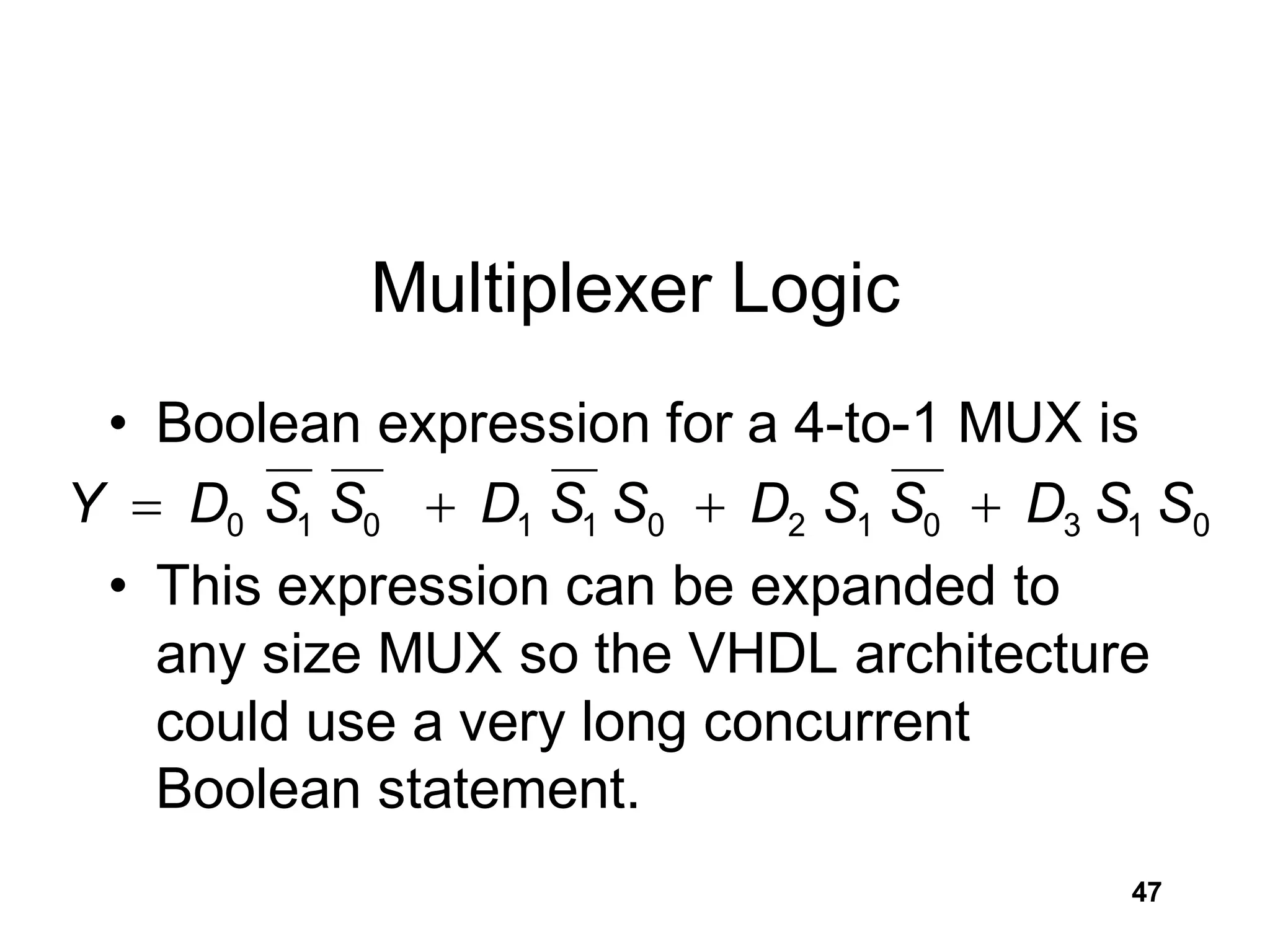
Multiplexer Logic
• Boolean expression for a 4-to-1 MUX is
• This expression can be expanded to
any size MUX so the VHDL architecture
could use a very long concurrent
Boolean statement.
013012011010 SSDSSDSSDSSDY 
48
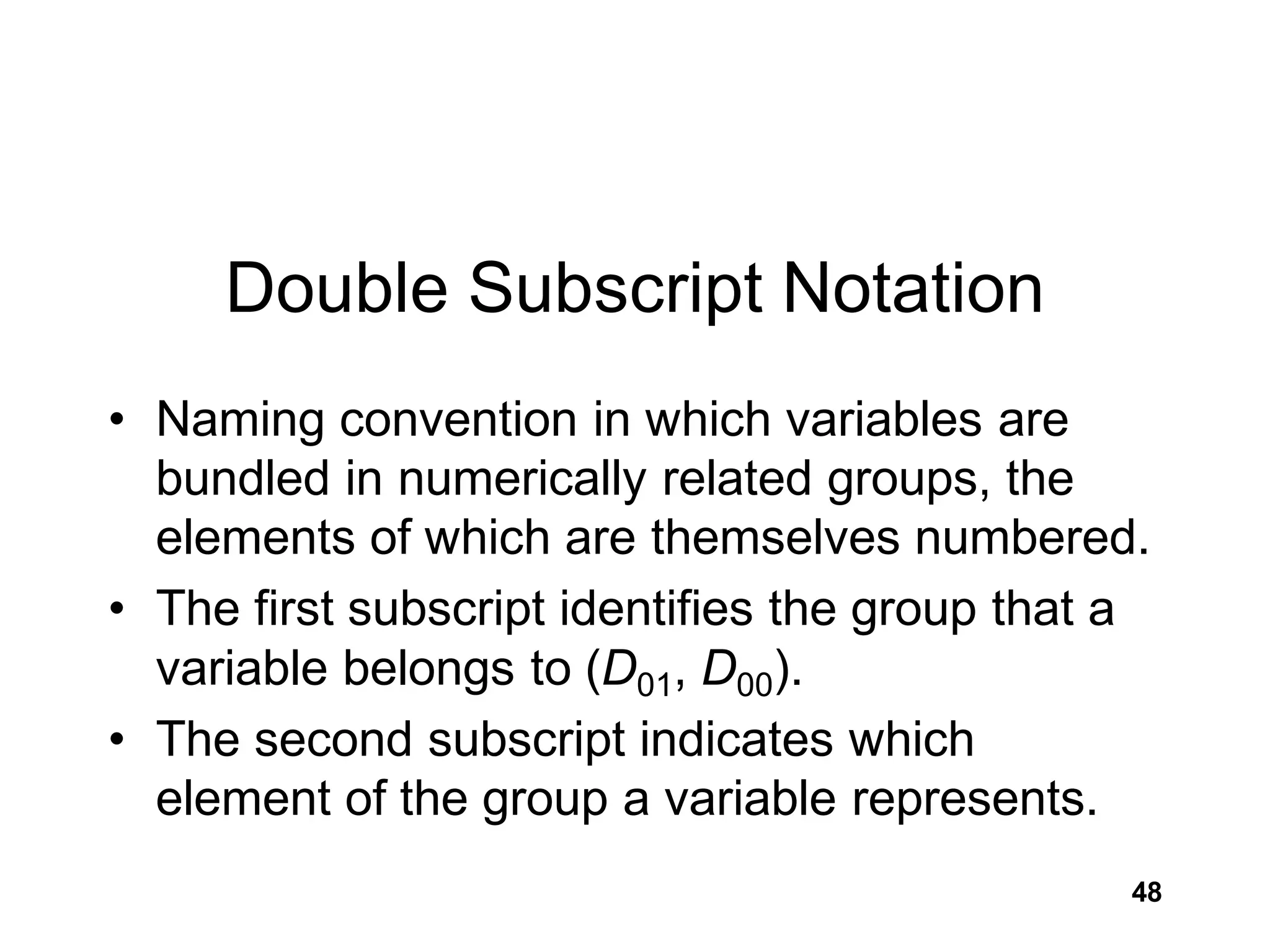
Double Subscript Notation
• Naming convention in which variables are
bundled in numerically related groups, the
elements of which are themselves numbered.
• The first subscript identifies the group that a
variable belongs to (D01, D00).
• The second subscript indicates which
element of the group a variable represents.
49
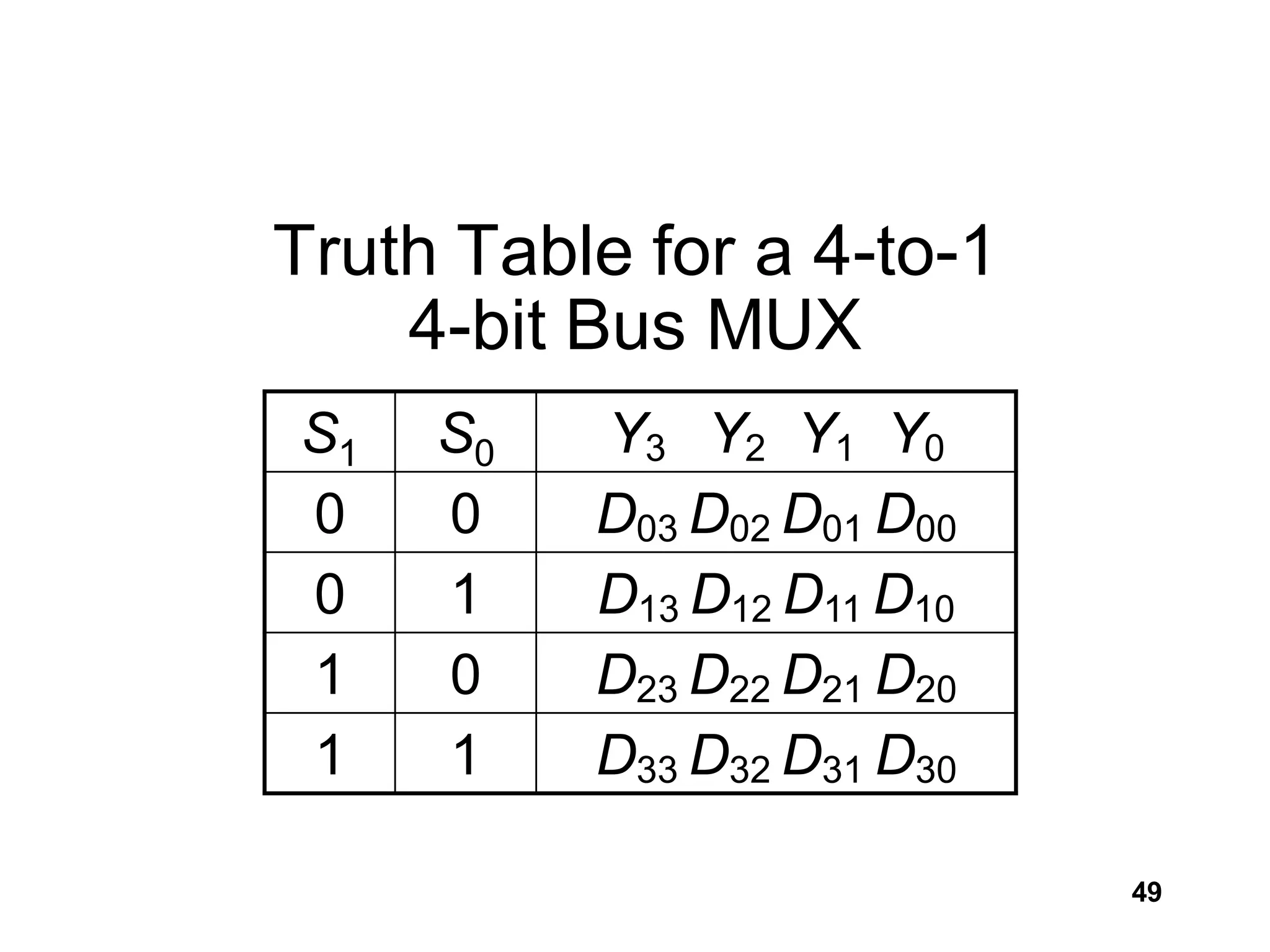
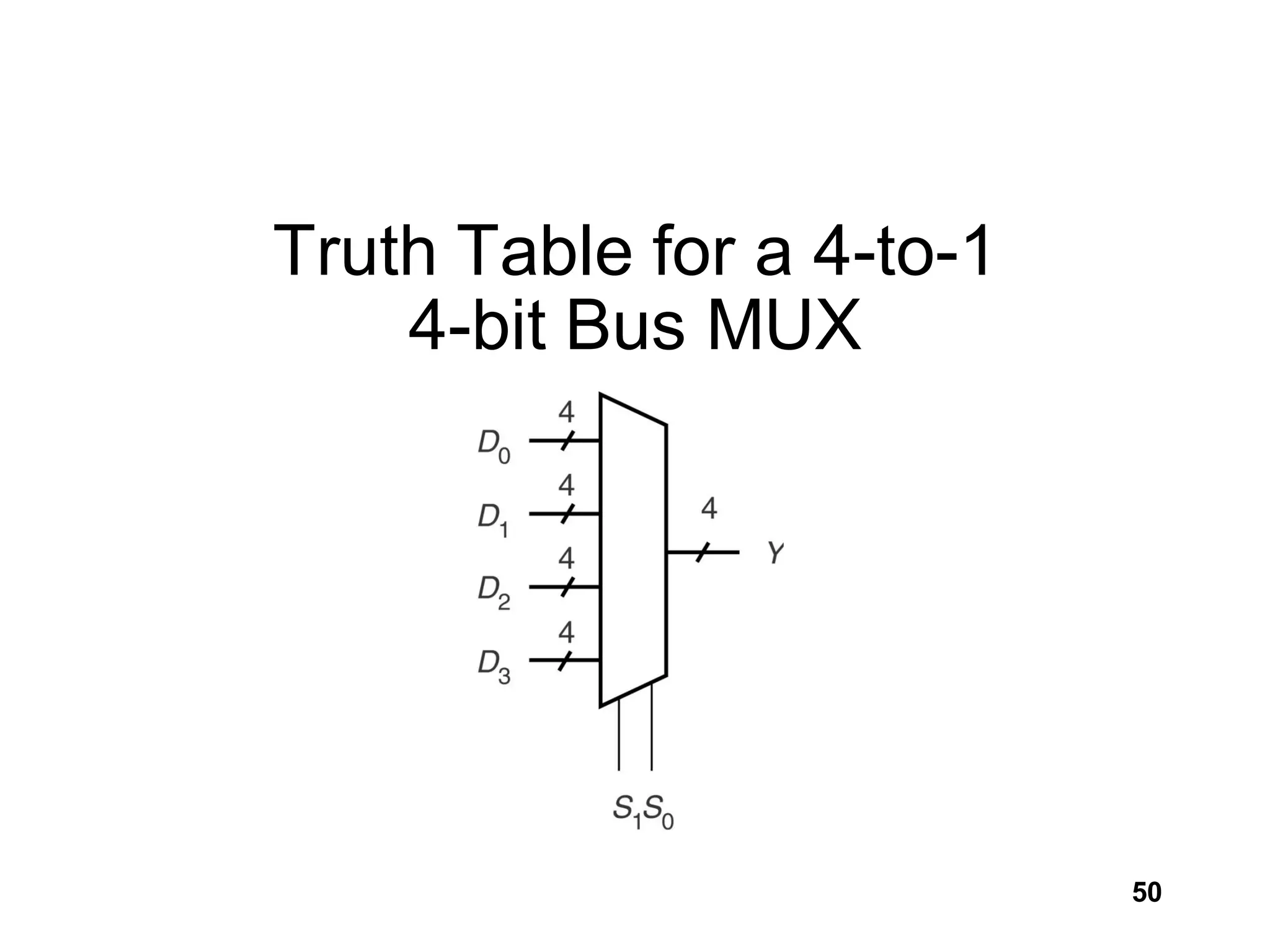
Truth Table for a 4-to-1
4-bit Bus MUX
S1 S0 Y3 Y2 Y1 Y0
0 0 D03 D02 D01 D00
0 1 D13 D12 D11 D10
1 0 D23 D22 D21 D20
1 1 D33 D32 D31 D30
50
Truth Table for a 4-to-1
4-bit Bus MUX
51
VHDL Constructs For MUXs
• The following three VHDL constructs
can be used to describe the Multiplexer:
– Concurrent Signal Assignment Statement
– Select Signal Assignment Statement
– CASE Statement
52
PROCESS and Sensitivity List
• PROCESS: A VHDL construct that
contains statements that are executed if
a signal in its sensitivity list changes.
• Sensitivity list: A list of signals in a
PROCESS statement that are
monitored to determine whether the
Process should be executed.
53
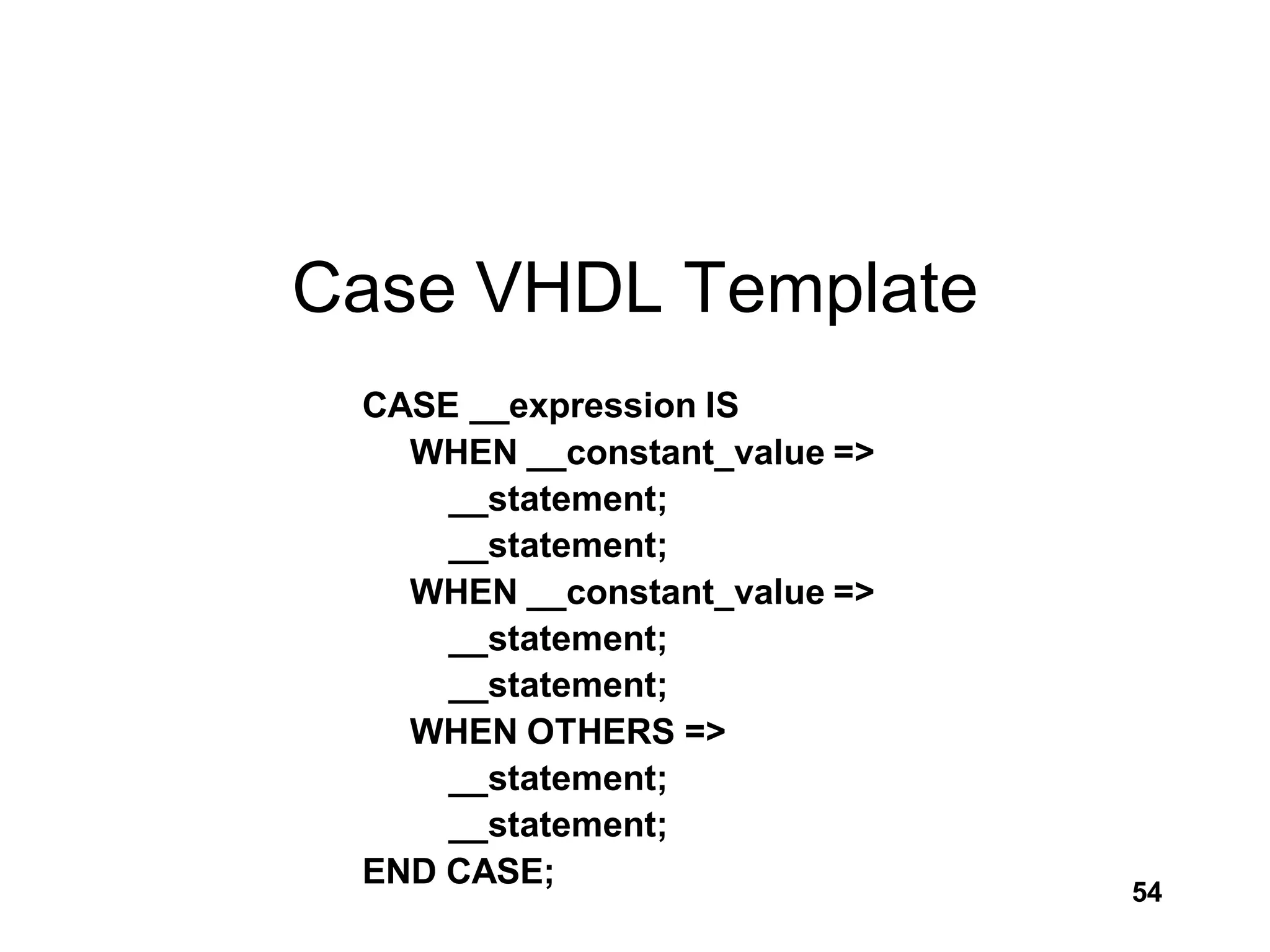
Case Statement
• A case statement is a VHDL construct
in which there is a choice of statements
to be executed, depending on the value
of a signal or variable.
54
Case VHDL Template
CASE __expression IS
WHEN __constant_value =>
__statement;
__statement;
WHEN __constant_value =>
__statement;
__statement;
WHEN OTHERS =>
__statement;
__statement;
END CASE;
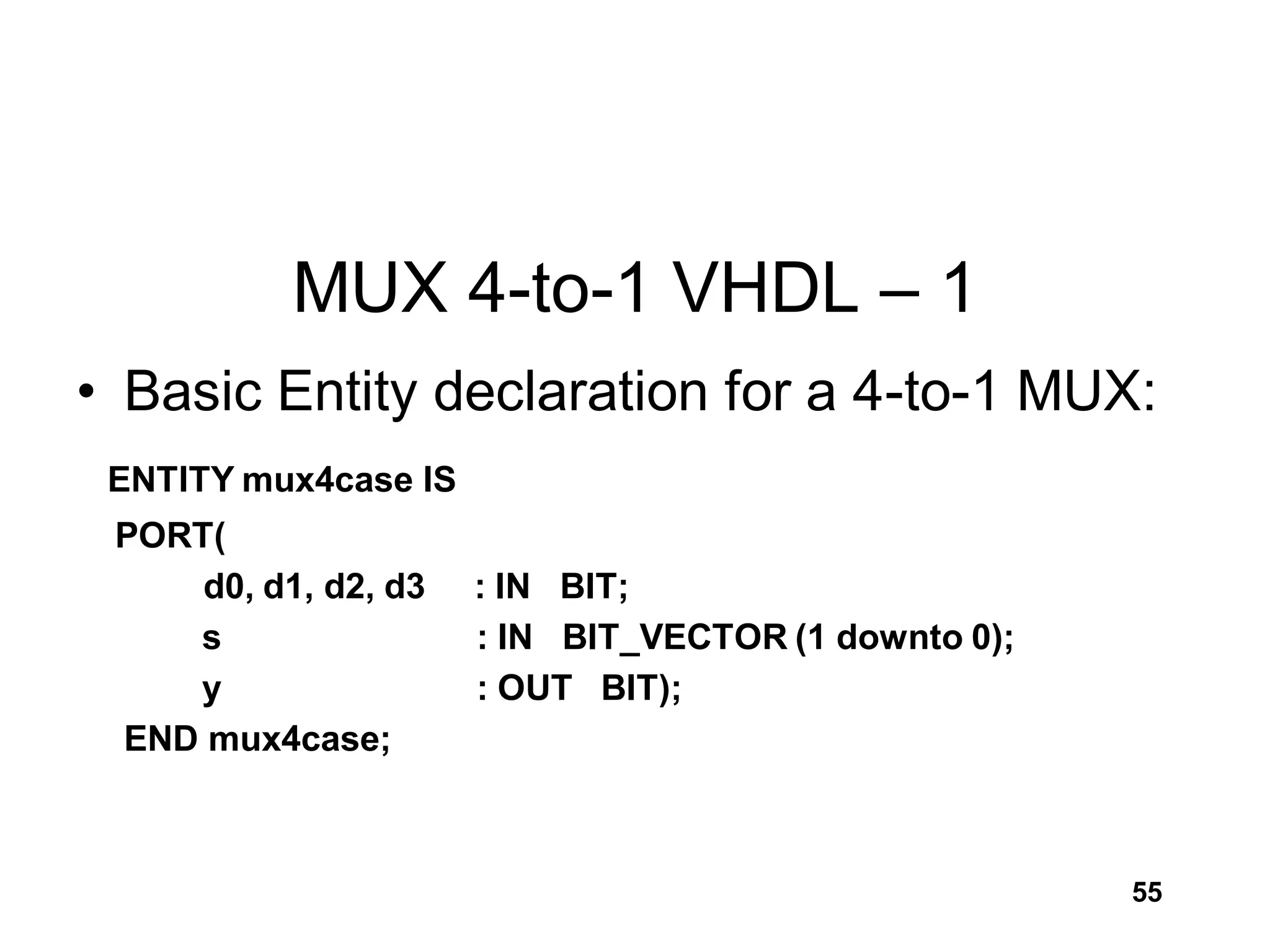
55
MUX 4-to-1 VHDL – 1
• Basic Entity declaration for a 4-to-1 MUX:
ENTITY mux4case IS
PORT(
d0, d1, d2, d3 : IN BIT;
s : IN BIT_VECTOR (1 downto 0);
y : OUT BIT);
END mux4case;
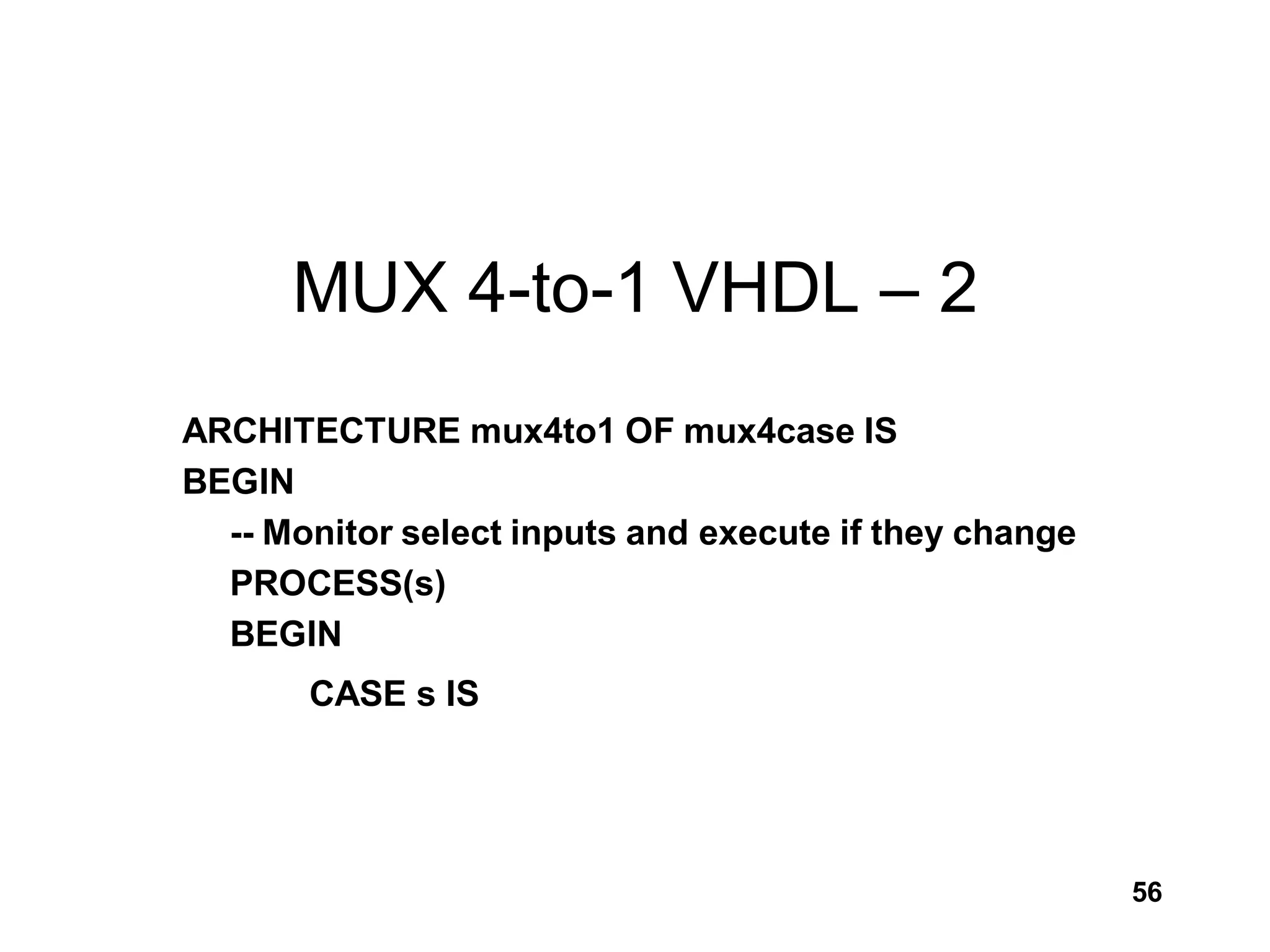
56
MUX 4-to-1 VHDL – 2
ARCHITECTURE mux4to1 OF mux4case IS
BEGIN
-- Monitor select inputs and execute if they change
PROCESS(s)
BEGIN
CASE s IS
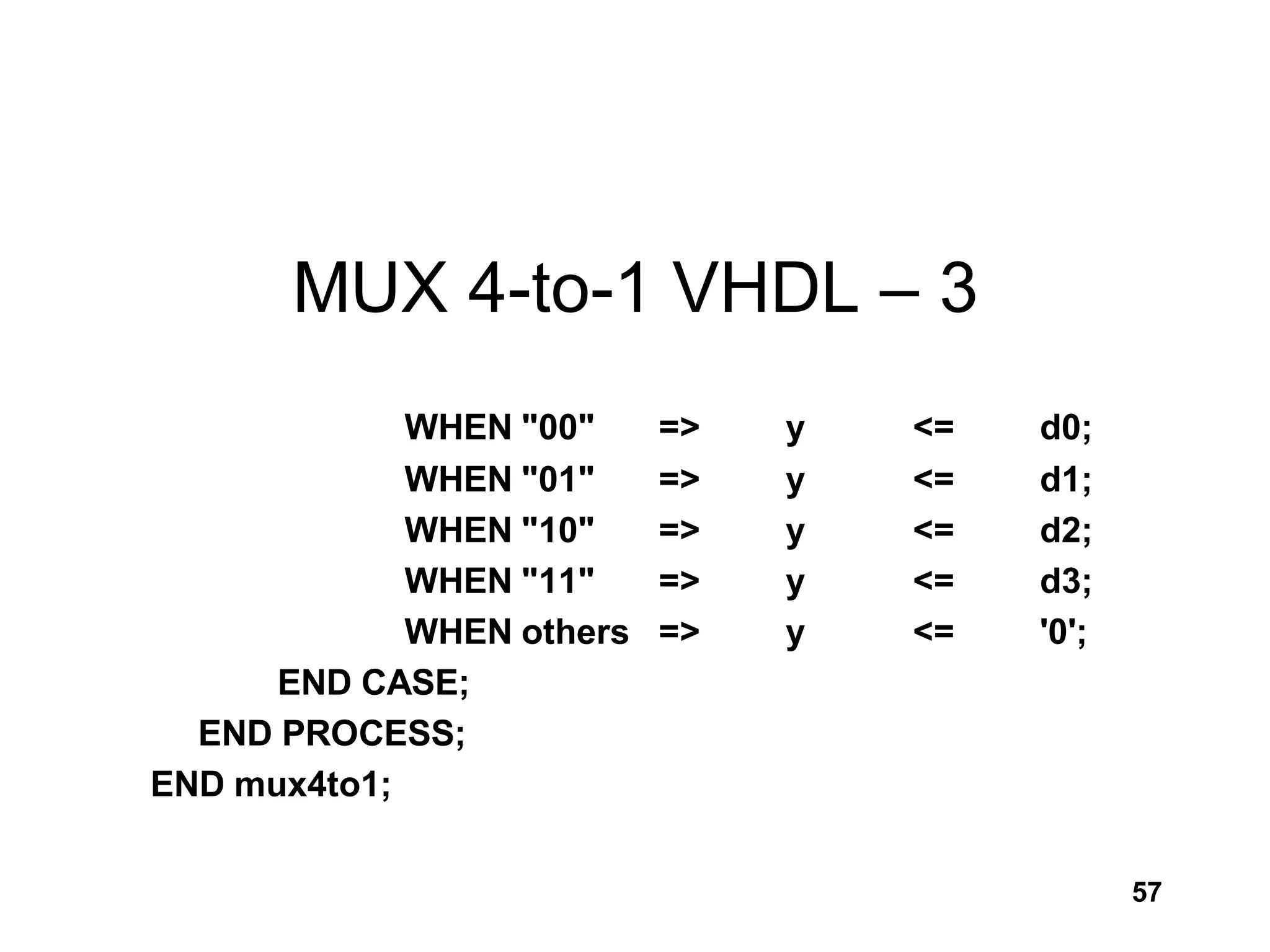
57
MUX 4-to-1 VHDL – 3
WHEN "00" => y <= d0;
WHEN "01" => y <= d1;
WHEN "10" => y <= d2;
WHEN "11" => y <= d3;
WHEN others => y <= '0';
END CASE;
END PROCESS;
END mux4to1;
58
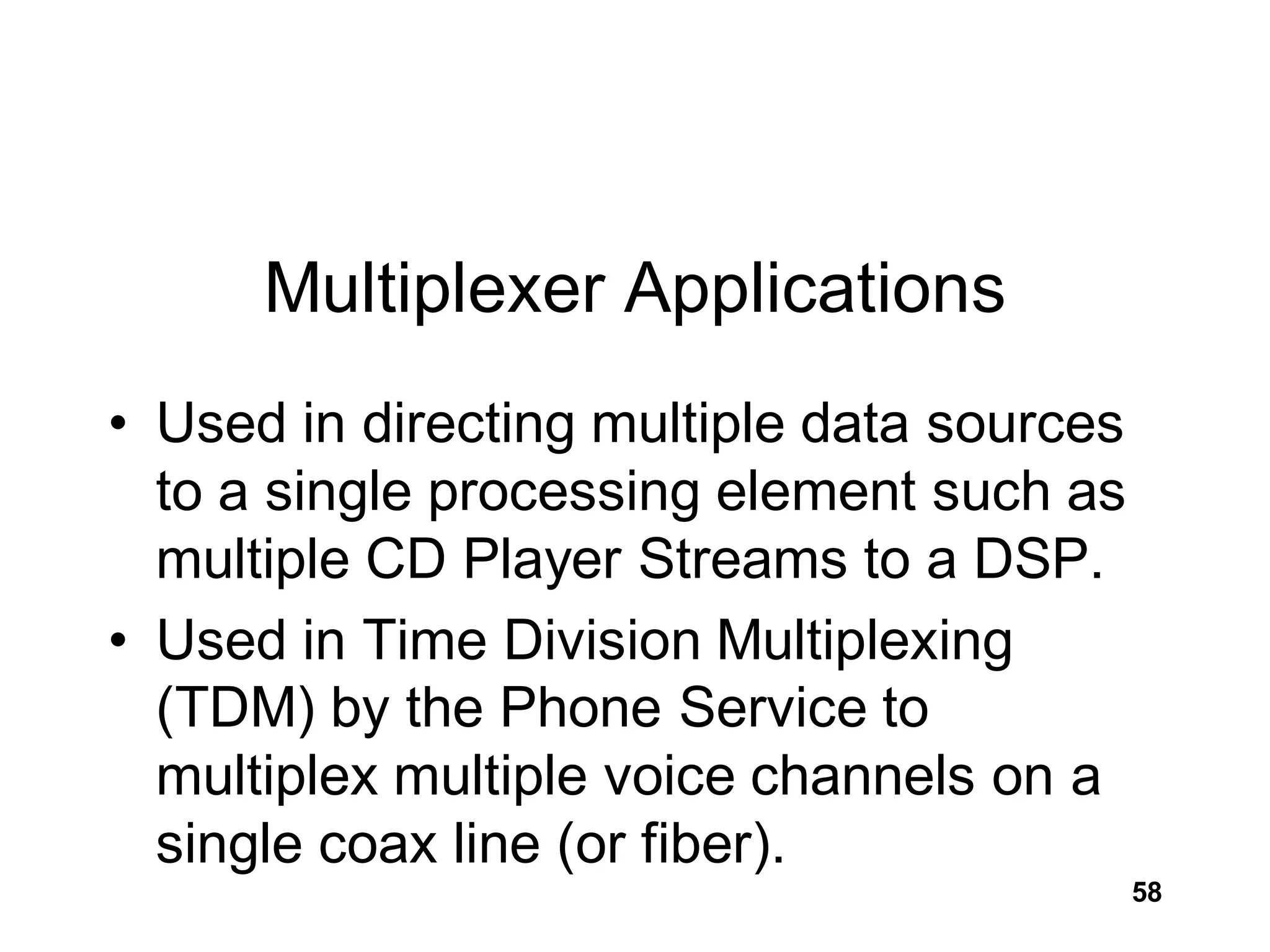
Multiplexer Applications
• Used in directing multiple data sources
to a single processing element such as
multiple CD Player Streams to a DSP.
• Used in Time Division Multiplexing
(TDM) by the Phone Service to
multiplex multiple voice channels on a
single coax line (or fiber).
59
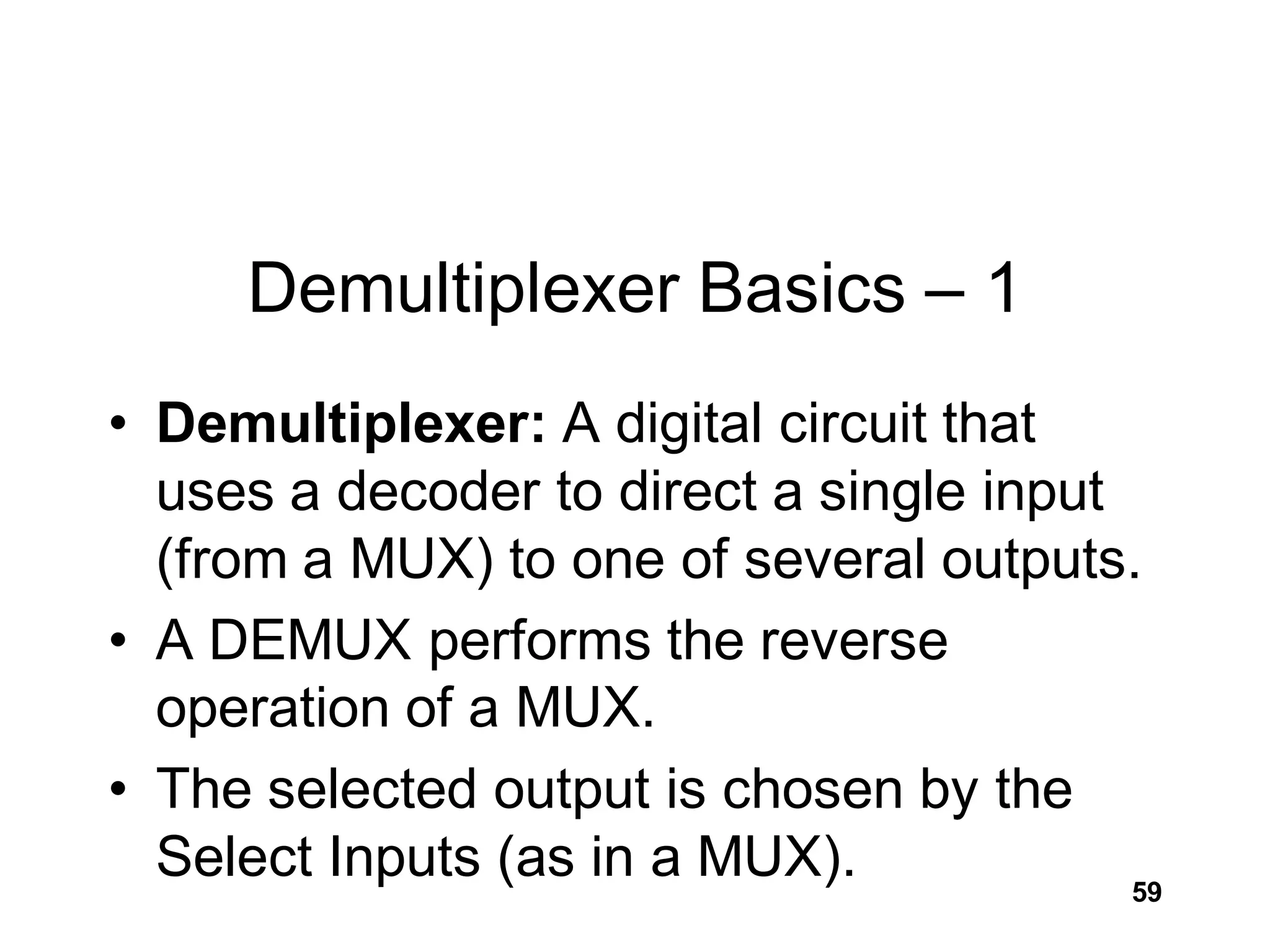
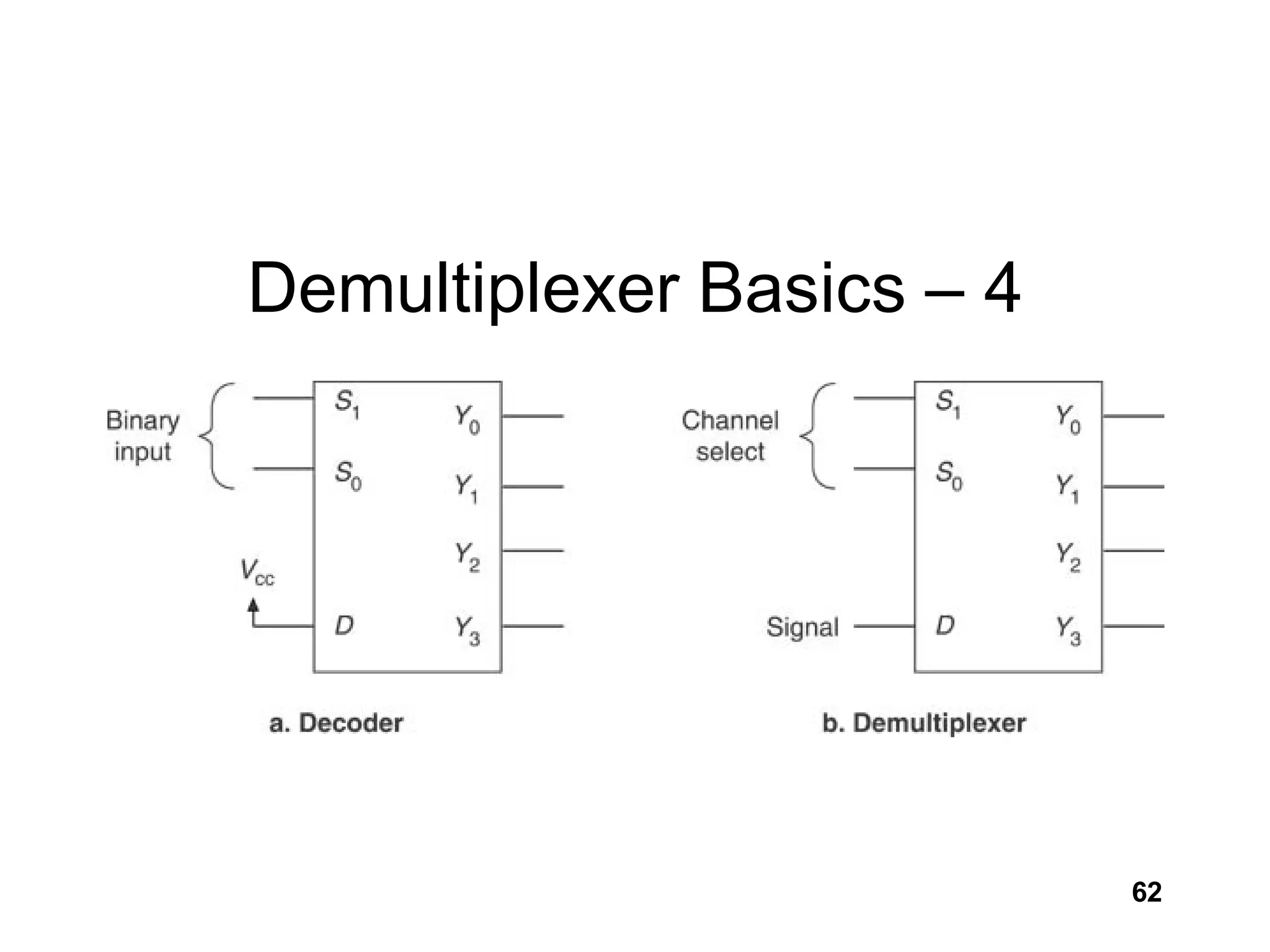
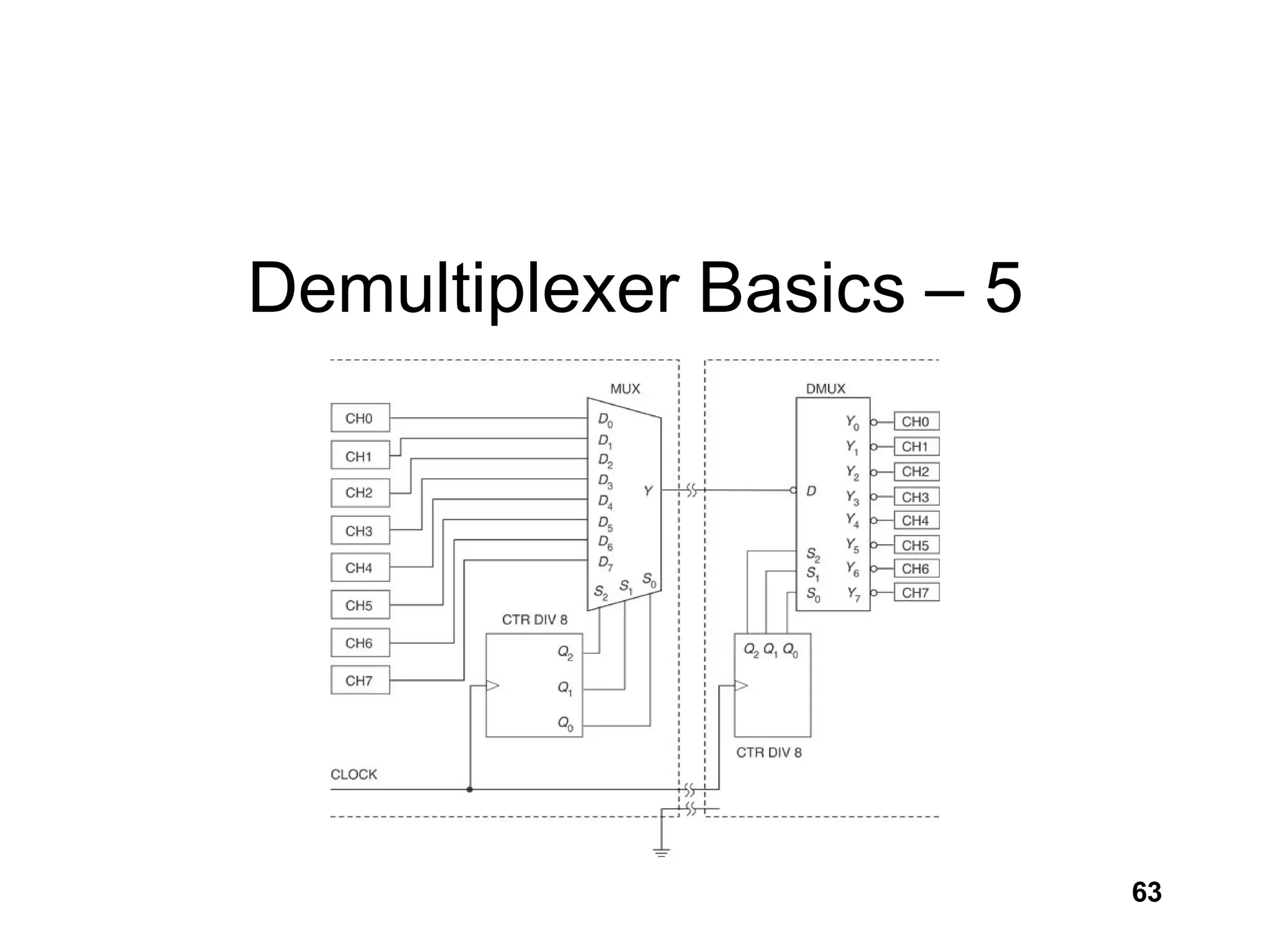
Demultiplexer Basics – 1
• Demultiplexer: A digital circuit that
uses a decoder to direct a single input
(from a MUX) to one of several outputs.
• A DEMUX performs the reverse
operation of a MUX.
• The selected output is chosen by the
Select Inputs (as in a MUX).
60
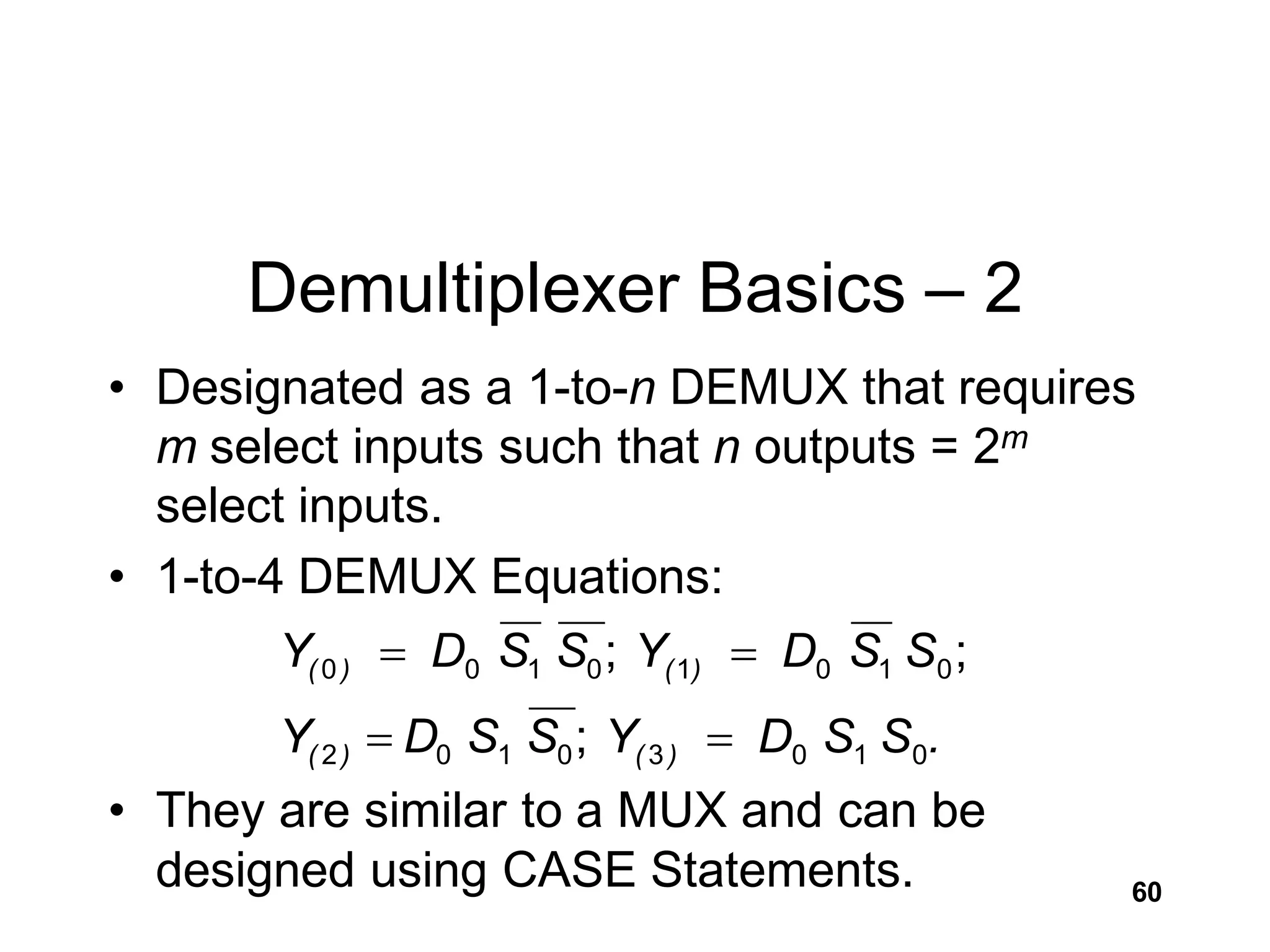
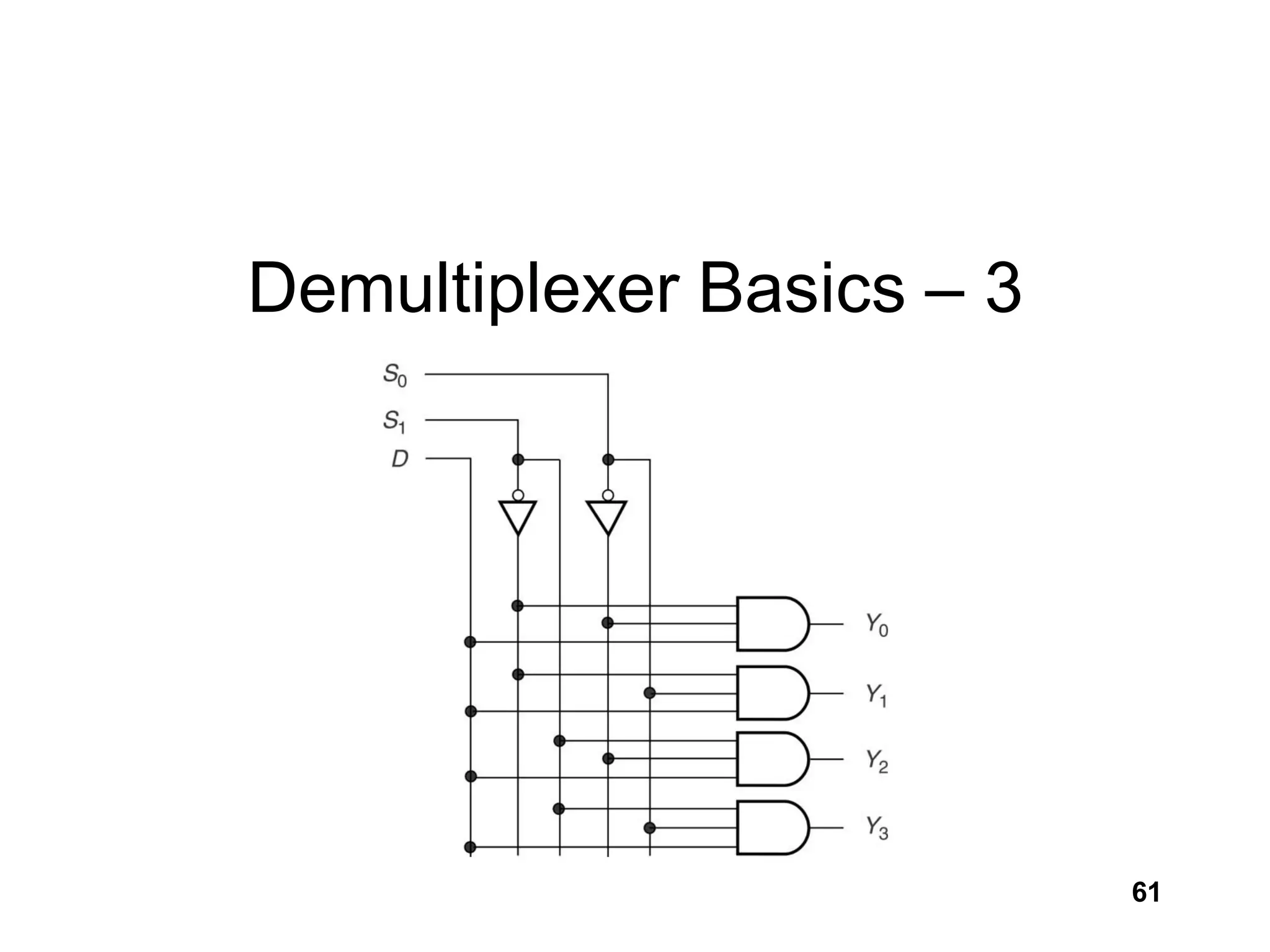
Demultiplexer Basics – 2
• Designated as a 1-to-n DEMUX that requires
m select inputs such that n outputs = 2m
select inputs.
• 1-to-4 DEMUX Equations:
• They are similar to a MUX and can be
designed using CASE Statements.
.SSDYSSDY
SSDYSSDY
)()(
)()(
01030102
01010100
;
;;


61
Demultiplexer Basics – 3
62
Demultiplexer Basics – 4
63
Demultiplexer Basics – 5
64
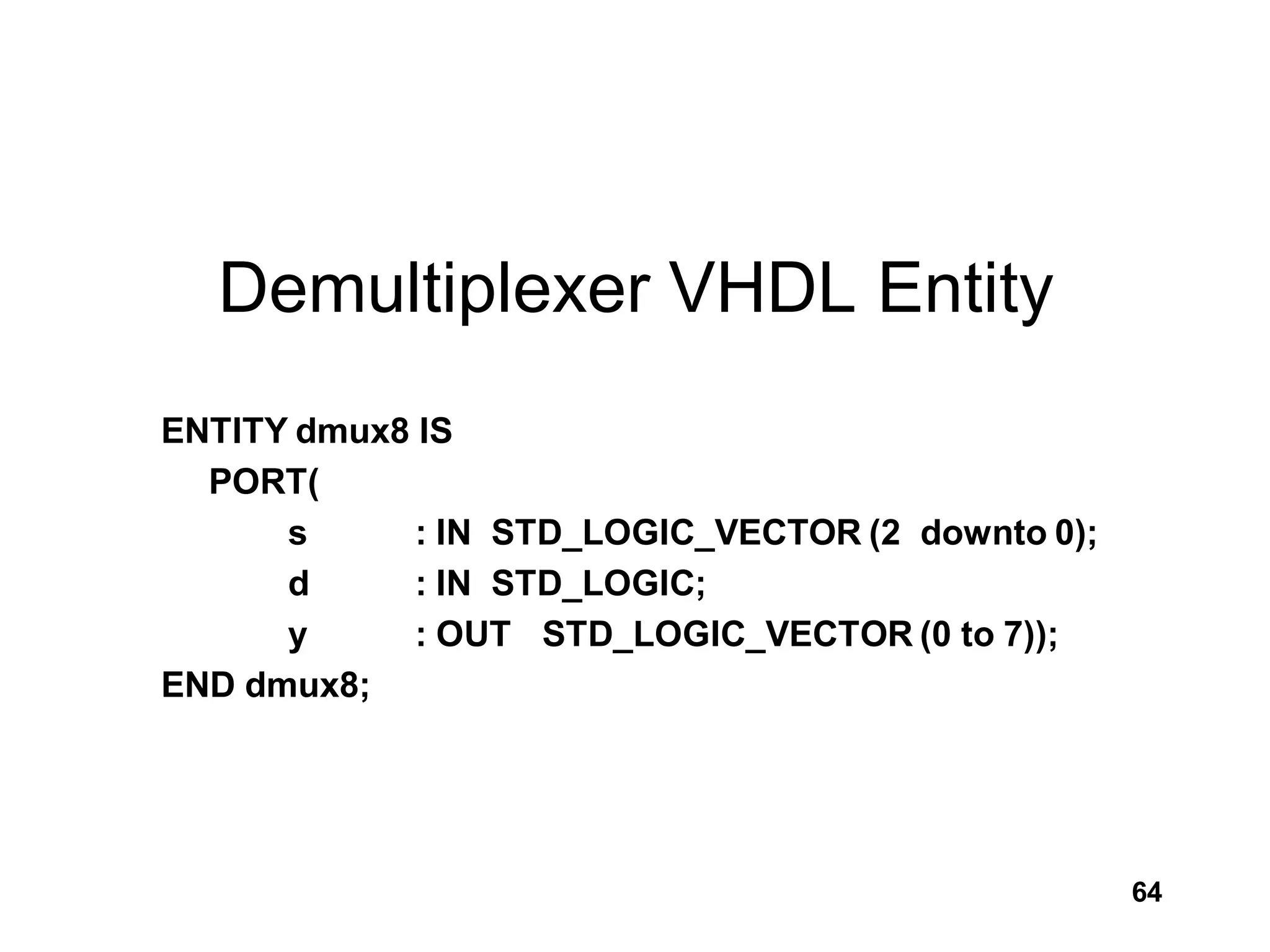
Demultiplexer VHDL Entity
ENTITY dmux8 IS
PORT(
s : IN STD_LOGIC_VECTOR (2 downto 0);
d : IN STD_LOGIC;
y : OUT STD_LOGIC_VECTOR (0 to 7));
END dmux8;
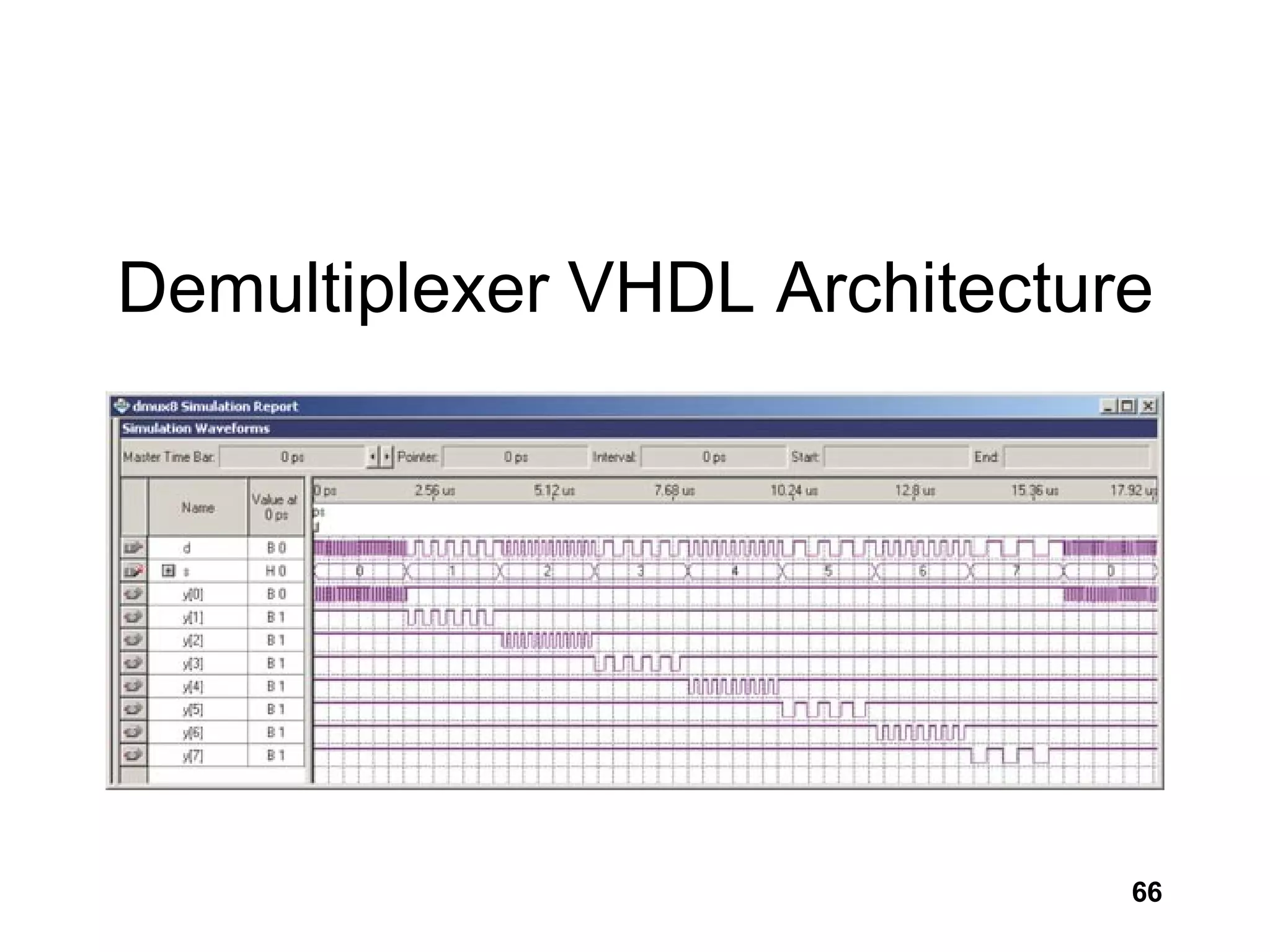
65
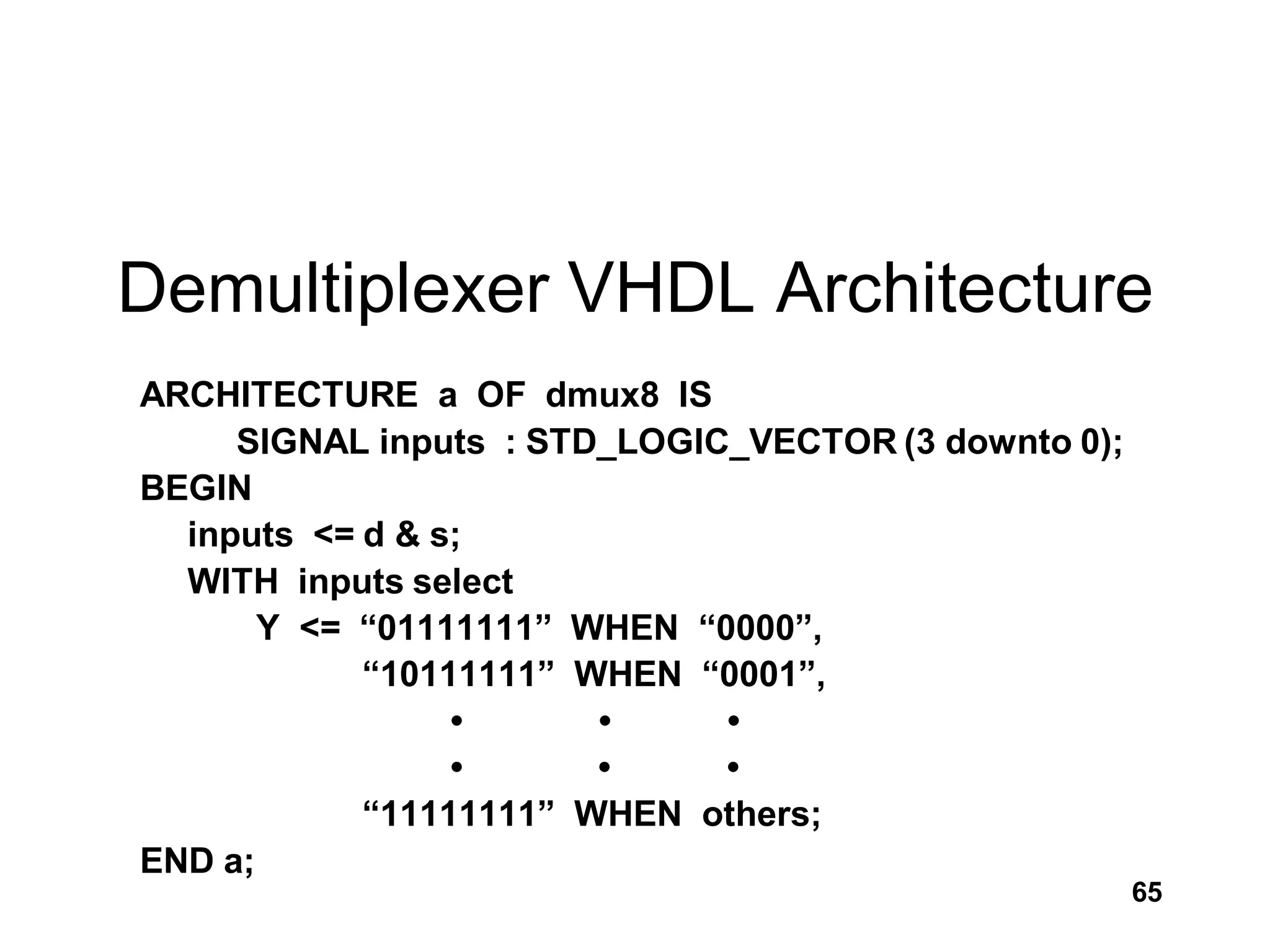
Demultiplexer VHDL Architecture
ARCHITECTURE a OF dmux8 IS
SIGNAL inputs : STD_LOGIC_VECTOR (3 downto 0);
BEGIN
inputs <= d & s;
WITH inputs select
Y <= “01111111” WHEN “0000”,
“10111111” WHEN “0001”,
• • •
• • •
“11111111” WHEN others;
END a;
66
Demultiplexer VHDL Architecture
67
Parity Basics – 1
• Parity: A digital system that checks for errors
in a n-Bit Binary Number or Code.
• Even Parity: A parity system that requires the
binary number and the parity bit to have an
even # of 1s.
• Odd Parity: A parity system that requires the
binary number and the parity bit to have an
Odd # of 1s.
68
Parity Basics – 2
• Parity Bit: A bit appended on the end of
a binary number or code to make the #
of 1s odd or even depending on the
type of parity in the system.
• Parity is used in transmitting and
receiving data by devices in a PC called
UARTs, that are on the COM Port.
69
Parity Basics – 3
70
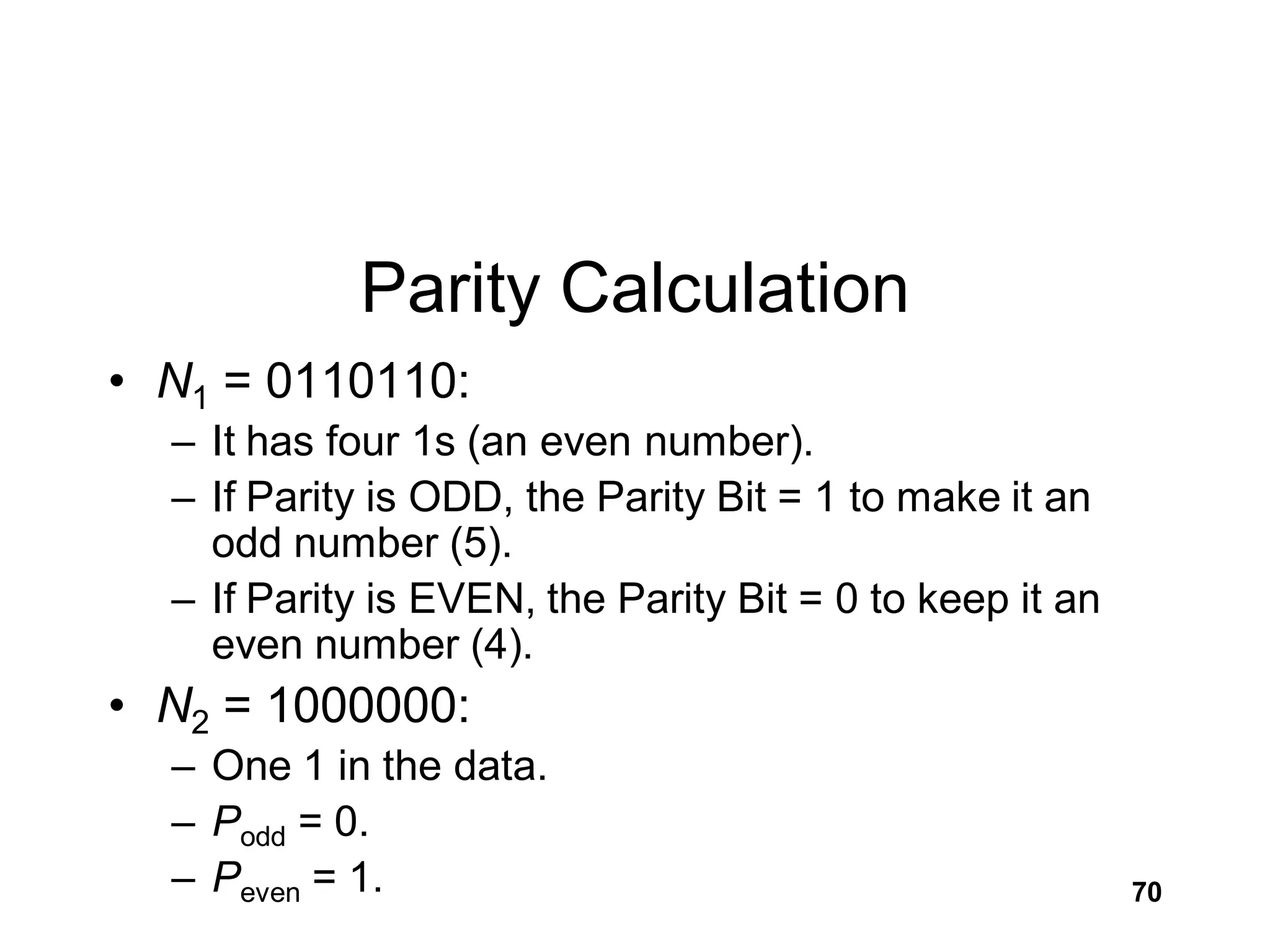
Parity Calculation
• N1 = 0110110:
– It has four 1s (an even number).
– If Parity is ODD, the Parity Bit = 1 to make it an
odd number (5).
– If Parity is EVEN, the Parity Bit = 0 to keep it an
even number (4).
• N2 = 1000000:
– One 1 in the data.
– Podd = 0.
– Peven = 1.
71
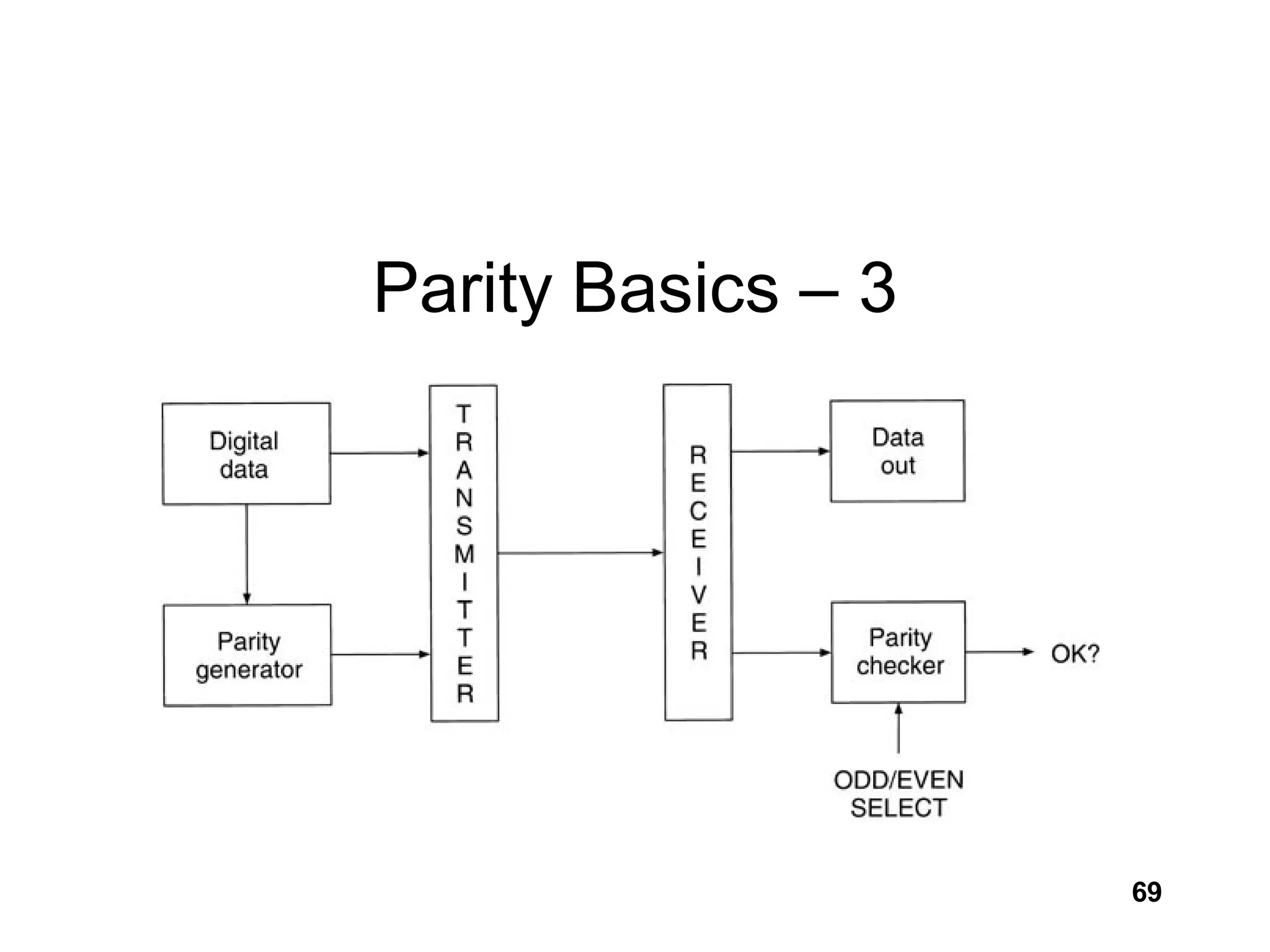
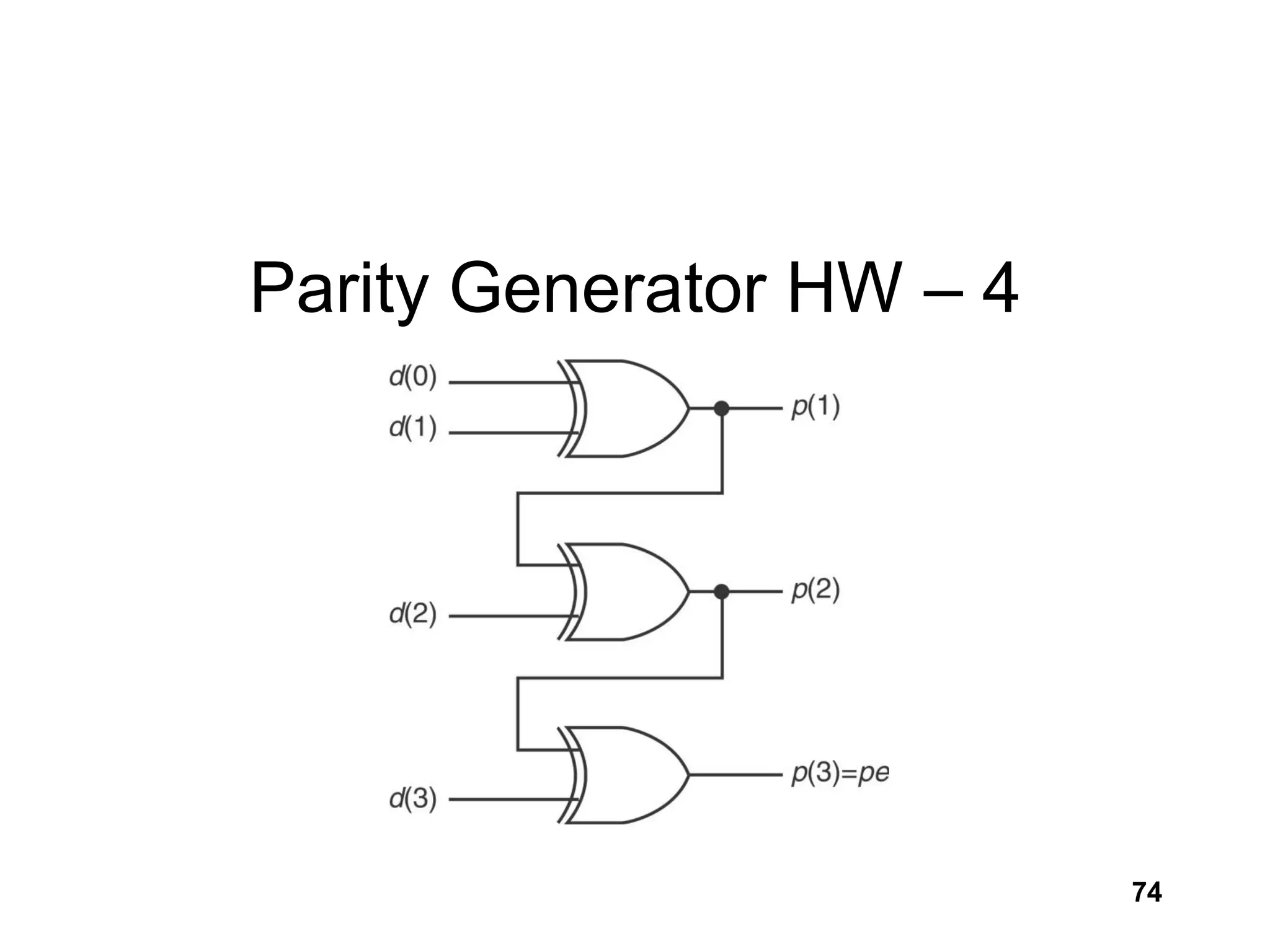
Parity Generation HW – 1
• A basic two-bit parity generator can be
constructed from a XOR Gate.
• When the two inputs are 01 or 10, the
output is a 1 (so this is even parity).
• When the two inputs are 00 or 11, the
output is a 0.
• For a parity generator of n bits, add
more gates.
72
Parity Generator HW – 2
• Cascading a long chain of XOR gates
could cause excessive propagation
delays.
• To check for a Parity error, the receiver
(RX) just generates a new Parity Bit (P1)
based on the received parallel data and
then compares it to the parity bit
transmitted (P2).
73
Parity Generator HW – 3
• If there is an error, the two bits (P1 and P2)
will not be equal, and we can use a two-bit
magnitude comparator to check this (an XOR
gate).
• This check is called syndrome.
– If there are no errors, the syndrome output (Perr) is
0.
• Parity is not a foolproof system.
– If two bits are in error, the error is not detected.
74
Parity Generator HW – 4
75
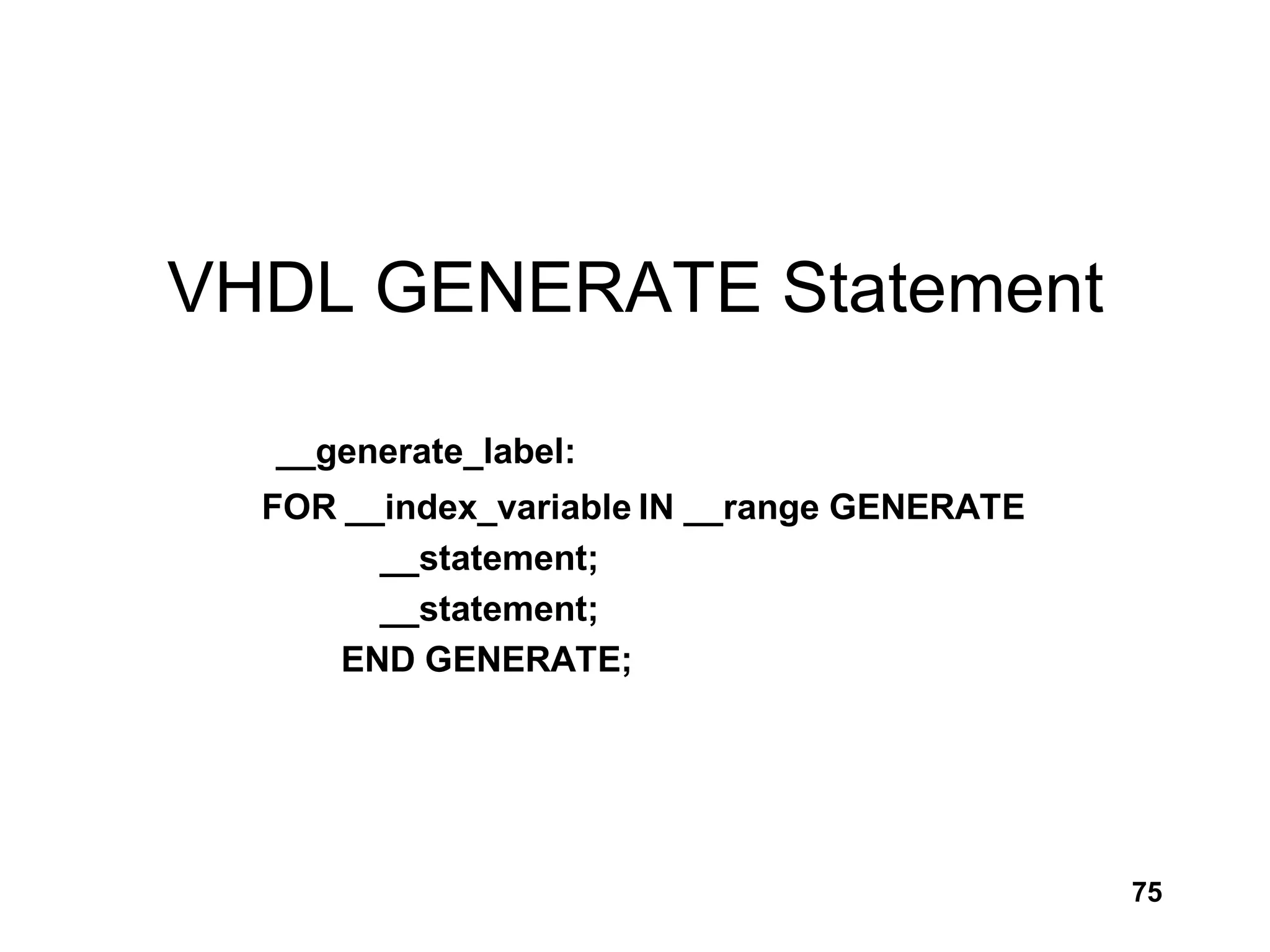
VHDL GENERATE Statement
__generate_label:
FOR __index_variable IN __range GENERATE
__statement;
__statement;
END GENERATE;
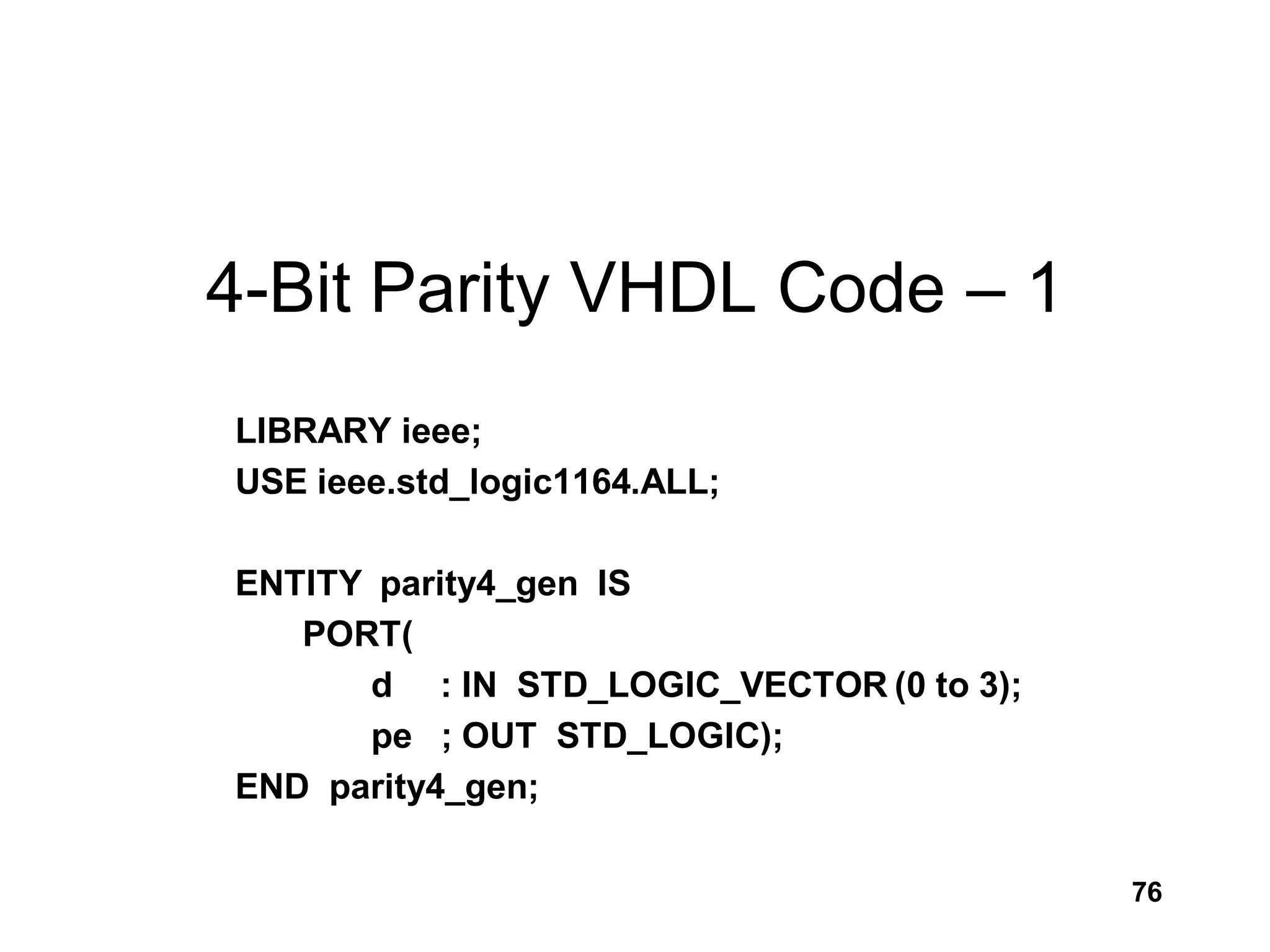
76
4-Bit Parity VHDL Code – 1
LIBRARY ieee;
USE ieee.std_logic1164.ALL;
ENTITY parity4_gen IS
PORT(
d : IN STD_LOGIC_VECTOR (0 to 3);
pe ; OUT STD_LOGIC);
END parity4_gen;
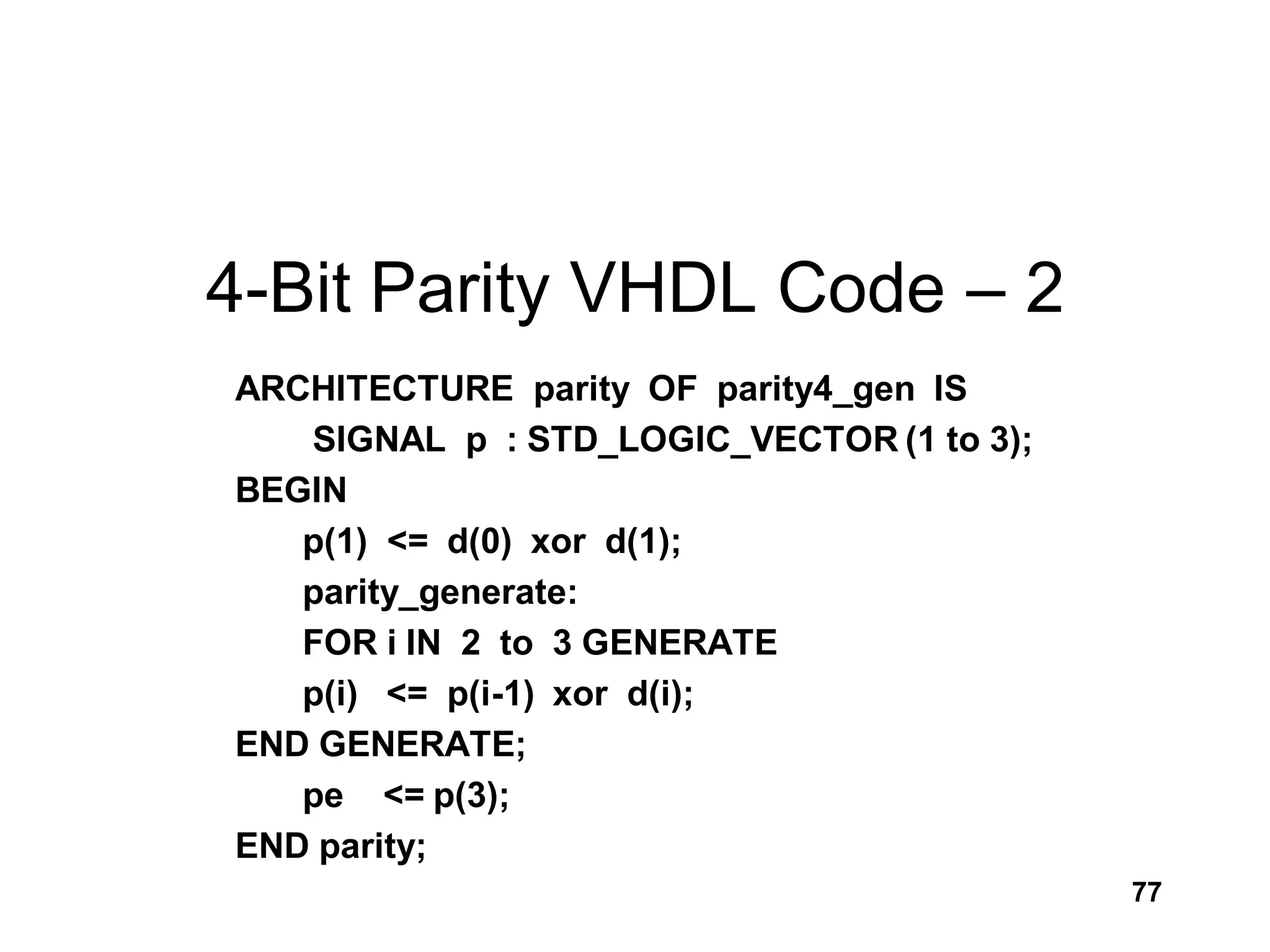
77
4-Bit Parity VHDL Code – 2
ARCHITECTURE parity OF parity4_gen IS
SIGNAL p : STD_LOGIC_VECTOR (1 to 3);
BEGIN
p(1) <= d(0) xor d(1);
parity_generate:
FOR i IN 2 to 3 GENERATE
p(i) <= p(i-1) xor d(i);
END GENERATE;
pe <= p(3);
END parity;

Chapter 06 Combinational Logic Functions

  • 1.
  • 2.
    2 Basic Decoder • Decoder:A digital circuit designed to detect the presence of a particular digital state. • Can have one output or multiple outputs. • Example: 2-Input NAND Gate detects the presence of ‘11’ on the inputs to generate a ‘0’ output.
  • 3.
    3 Single-Gate Examples • Ifthe inputs to a 4-Input NAND are given as , then the NAND detects the code 0001. The output is a 0 when the code 0001 is detected. • This type of decoder is used in Address Decoding for a PC System Board. 4321 , DD,D,D
  • 4.
    4 Multiple Output Decoders •Decoder circuit with n inputs can activate m = 2n load circuits. • Called a n-line-to-m-line decoder, such as a 2-to-4 or a 3-to-8 decoder. • Usually has an active low enable that enables the decoder outputs. G
  • 5.
    5 Truth Table fora 3-to-8 Decoder 111110110100 111111011000 111111100000 11111111XXX1 YYYYYYYYDDDG 76543210012 
  • 6.
    6 Truth Table fora 3-to-8 Decoder
  • 7.
    7 Simulation • Simulation: Theverification of a digital design using a timing diagram before programming the design in a CPLD. • Used to check the Output Response of a design to an Input Stimulus using a timing diagram.
  • 8.
  • 9.
    9 VHDL Binary Decoder •Use select signal assignment statements constructs or conditional signal assignment statements constructs.
  • 10.
    10 2-to-4 Decoder VHDLEntity • Using a select signal assignment statement: LIBRARY ieee; USE ieee.std_logic_1164.ALL; ENTITY decode3 IS PORT( d : IN STD_LOGIC_VECTOR (1 downto 0); y : OUT STD_LOGIC_VECTOR (3 downto 0)); END decode3;
  • 11.
    11 Selected Signal Entity •In the previous slide, the Entity used a STD LOGIC Array for Inputs and Outputs. • The Y : OUT STD_LOGIC_VECTOR(3 downto 0) is equal to Y3, Y2, Y1, Y0. • The STD_LOGIC Data Type is similar to BIT but has added state values such as Z, X, H, and L instead of just 0 and 1.
  • 12.
    12 Selected Signal Assignments •Uses a VHDL Architecture construct called WITH SELECT. • Format is: – WITH (signal input(s)) SELECT. – Signal input states are used to define the output state changes.
  • 13.
    13 2-to-4 Decoder VHDLArchitecture ARCHITECTURE decoder OF decode3 IS BEGIN WITH d SELECT y <= “0001” WHEN “00”, “0010 WHEN “01”, “0100” WHEN “10”, “1000” WHEN “11”, “0000” WHEN others; END decoder;
  • 14.
    14 Decoder Architecture • Thedecoder Architecture used a SELECT to evaluate d to determine the Output y. • Both d and y are defined as an Array (or bus or vector) Data Type. • The last state for WHEN OTHERS is added for the other logic states (Z, X, H, L, etc.).
  • 15.
    15 Seven-Segment Displays • Seven-SegmentDisplay: An array of seven independently controlled LEDs shaped like an 8 that can be used to display decimal digits.
  • 16.
  • 17.
  • 18.
    18 Common Anode Display •Common Anode Display (CA): A seven- segment display where the anodes of all the LEDs are connected together to VCC and a ‘0’ turns on a segment (a to g).
  • 19.
    19 Common Cathode Display •Common Cathode Display (CC): A seven-segment display where all the cathodes are connected and tied to ground, and a ‘1’ turns on a segment.
  • 20.
  • 21.
  • 22.
    22 Seven-Segment Decoder/Driver –1 • Receives a BCD (Binary Coded Decimal) 4-Bit input, outputs a BCD digit 0000 – 1001 (0 through 9). • Generates Outputs (a–g) for each of the display LEDs. • Requires a current limit series resistor for each segment.
  • 23.
    23 Seven-Segment Decoder/Driver –2 • Decoders for a CC-SS have active high outputs while decoders for a CA-SS have active low outputs (a to g). • The outputs generated for the binary input combinations of 1010 to 1111 are “don’t cares”. • The decoder can be designed with VHDL or MSI Logic (7447, 7448).
  • 24.
    24 Digit D3 D2D1 D0 a b c d e f g 0 0 0 0 0 0 0 0 0 0 0 1 1 0 0 0 1 1 0 0 1 1 1 1 2 0 0 1 0 0 0 1 0 0 1 0 3 0 0 1 1 0 0 0 0 1 1 0 4 0 1 0 0 1 0 0 1 1 0 0 5 0 1 0 1 0 1 0 0 1 0 0 6 0 1 1 0 1 1 0 0 0 0 0 7 0 1 1 1 0 0 0 1 1 1 1 8 1 0 0 0 0 0 0 0 0 0 0 9 1 0 0 1 0 0 0 1 1 0 0 SS Decoder/Driver Truth Table
  • 25.
  • 26.
    26 Decoder/Driver Entity (CA) ENTITYbcd_7seg IS PORT( d3, d2, d1, d0 : IN BIT; a, b, c, d, e, f, g : OUT BIT; END bcd_7seg;
  • 27.
    27 Decoder/Driver Architecture –1 ARCHITECTURE seven_segment OF bcd_7seg IS SIGNAL input : BIT_VECTOR (3 downto 0); SIGNAL output : BIT_VECTOR (6 downto 0); BEGIN input <= d3 & d2 & d1 & d0; -- Uses two intermediate signals called input and output (internal no pins) -- Creates an array by using the concatenate operator (&) In this case input(3) <= d3, input(2) <= d2, etc.
  • 28.
    28 Decoder/Driver Architecture –2 WITH input SELECT output <= “0000001” WHEN “0000”, “1001111” WHEN “0001”, “0010010” WHEN “0010”, “0000110“ WHEN “0011”, • • • • • • • • • “1111111” WHEN others;
  • 29.
    29 Decoder/Driver Architecture –3 a <= output(6); b <= output(5); c <= output(4); d <= output(3); e <= output(2); f <= output(1); g <= output(0); END seven_segment
  • 30.
    30 SS VHDL FileDescription • In the preceding example file, a concurrent select signal assignment was used (WITH (signals) SELECT. • The intermediate output signals were mapped to the segments (a to g). • Example: when Input (D3 – D0) is 0001, the decoder sets a=d=e=f=g=1, b=c=0.
  • 31.
    31 Sequential Process inVHDL • A VHDL Process is a construct that encloses sequential statements that are executed when a signal in a sensitivity list changes.
  • 32.
    32 Sequential Process BasicFormat • Basic Format: PROCESS(Sensitivity List) BEGIN Sequential Statements; END PROCESS;
  • 33.
    Multiplexer • library ieee; •use ieee.std_logic_1164.all; • entity multiplexers_1 is • port (A, B, C, D : in std_logic; • S : in std_logic_vector (1 downto 0); • O : out std_logic); • end multiplexers_1; • architecture archi of multiplexers_1 is • begin • process (A, B, C, D, S) • begin • case s is • when "00" => O <= A; • when "01" => O <= B; • when "10" => O <= C; • when "11" => O <= D; • when others => O <= A; • end case; • end process; • end archi;
  • 34.
    34 IF THEN ELSE •The IF THEN ELSE Statements were used for conditional testing of some inputs. • IF the data is this value THEN do these statements ELSE do this. • This is a very simple statement that is used a great deal in sequential logic.
  • 35.
    35 Encoders • Encoder: Adigital circuit that generates a specific code at its outputs in response to one or more active inputs. • It is complementary in function to a decoder. • Output codes are usually Binary or BCD.
  • 36.
    36 Priority Encoders • PriorityEncoder: An encoder that generates a code based on the highest- priority input. • For example, if input D3 = input D5, then the output is 101, not 011. D5 has a higher priority than D3 and the output will respond accordingly.
  • 37.
    37 8-to-3 Encoder TruthTable 11100000001 00100001000 11000010000 01000100000 10001000000 0000000000 Q0Q1Q2D0D1D2D3D4D5D6D7 InputsHighActive  1
  • 38.
  • 39.
    39 Priority Encoder VHDLEntity -- hi_pri8a.vhd ENTITY hi_pri8a IS PORT( d : IN BIT_VECTOR (7 downto 0); q : OUT BIT_VECTOR (2 downto 0)); END hi_pri8a;
  • 40.
    40 Priority Encoder VHDLArchitecture ARCHITECTURE a OF hi_pri8a IS BEGIN -- Concurrent Signal Assignments q(2) <= d(7) or d(6) or d(5) or d(4); q(1) <= d(7) or d(6) or ((not d(5)) and (not d(4)) and d(3)) or ((not d(5)) and (not d(4)) and d(2)); q(0) <= -- in a similar fashion END a;
  • 41.
    41 Another VHDL Encoder– 1 -- hi_pri8b.vhd ENTITY hi_pri8a IS PORT( d : IN BIT_VECTOR (7 downto 0); q : OUT INTEGER RANGE(0 TO 7); END hi_pri8b;
  • 42.
    42 Another VHDL Encoder– 2 ARCHITECTURE a OF hi_pri8b IS BEGIN --encoder; q <= 7 WHEN d(7) = ‘1’ ELSE 6 WHEN d(6) = ‘1’ ELSE 5 WHEN d(5) = ‘1’ ELSE 4 WHEN d(4) = ‘1’ ELSE 3 WHEN d(3) = ‘1’ ELSE 2 WHEN d(2) = ‘1’ ELSE 1 WHEN d(1) = ‘1’ ELSE 0; END a;
  • 43.
    43 Basic Multiplexers (MUX) •(MUX): A digital circuit that directs one of several inputs to a single output based on the state of several select inputs. • A MUX is called a m-to-1 MUX. • A MUX with n select inputs will require m = 2n data inputs (e.g., a 4-to-1 MUX requires 2 select inputs S1 and S0).
  • 44.
  • 45.
  • 46.
    46 4-to-1 Multiplexers TruthTable S1 S0 Y 0 0 D0 0 1 D1 1 0 D2 1 1 D3
  • 47.
    47 Multiplexer Logic • Booleanexpression for a 4-to-1 MUX is • This expression can be expanded to any size MUX so the VHDL architecture could use a very long concurrent Boolean statement. 013012011010 SSDSSDSSDSSDY 
  • 48.
    48 Double Subscript Notation •Naming convention in which variables are bundled in numerically related groups, the elements of which are themselves numbered. • The first subscript identifies the group that a variable belongs to (D01, D00). • The second subscript indicates which element of the group a variable represents.
  • 49.
    49 Truth Table fora 4-to-1 4-bit Bus MUX S1 S0 Y3 Y2 Y1 Y0 0 0 D03 D02 D01 D00 0 1 D13 D12 D11 D10 1 0 D23 D22 D21 D20 1 1 D33 D32 D31 D30
  • 50.
    50 Truth Table fora 4-to-1 4-bit Bus MUX
  • 51.
    51 VHDL Constructs ForMUXs • The following three VHDL constructs can be used to describe the Multiplexer: – Concurrent Signal Assignment Statement – Select Signal Assignment Statement – CASE Statement
  • 52.
    52 PROCESS and SensitivityList • PROCESS: A VHDL construct that contains statements that are executed if a signal in its sensitivity list changes. • Sensitivity list: A list of signals in a PROCESS statement that are monitored to determine whether the Process should be executed.
  • 53.
    53 Case Statement • Acase statement is a VHDL construct in which there is a choice of statements to be executed, depending on the value of a signal or variable.
  • 54.
    54 Case VHDL Template CASE__expression IS WHEN __constant_value => __statement; __statement; WHEN __constant_value => __statement; __statement; WHEN OTHERS => __statement; __statement; END CASE;
  • 55.
    55 MUX 4-to-1 VHDL– 1 • Basic Entity declaration for a 4-to-1 MUX: ENTITY mux4case IS PORT( d0, d1, d2, d3 : IN BIT; s : IN BIT_VECTOR (1 downto 0); y : OUT BIT); END mux4case;
  • 56.
    56 MUX 4-to-1 VHDL– 2 ARCHITECTURE mux4to1 OF mux4case IS BEGIN -- Monitor select inputs and execute if they change PROCESS(s) BEGIN CASE s IS
  • 57.
    57 MUX 4-to-1 VHDL– 3 WHEN "00" => y <= d0; WHEN "01" => y <= d1; WHEN "10" => y <= d2; WHEN "11" => y <= d3; WHEN others => y <= '0'; END CASE; END PROCESS; END mux4to1;
  • 58.
    58 Multiplexer Applications • Usedin directing multiple data sources to a single processing element such as multiple CD Player Streams to a DSP. • Used in Time Division Multiplexing (TDM) by the Phone Service to multiplex multiple voice channels on a single coax line (or fiber).
  • 59.
    59 Demultiplexer Basics –1 • Demultiplexer: A digital circuit that uses a decoder to direct a single input (from a MUX) to one of several outputs. • A DEMUX performs the reverse operation of a MUX. • The selected output is chosen by the Select Inputs (as in a MUX).
  • 60.
    60 Demultiplexer Basics –2 • Designated as a 1-to-n DEMUX that requires m select inputs such that n outputs = 2m select inputs. • 1-to-4 DEMUX Equations: • They are similar to a MUX and can be designed using CASE Statements. .SSDYSSDY SSDYSSDY )()( )()( 01030102 01010100 ; ;;  
  • 61.
  • 62.
  • 63.
  • 64.
    64 Demultiplexer VHDL Entity ENTITYdmux8 IS PORT( s : IN STD_LOGIC_VECTOR (2 downto 0); d : IN STD_LOGIC; y : OUT STD_LOGIC_VECTOR (0 to 7)); END dmux8;
  • 65.
    65 Demultiplexer VHDL Architecture ARCHITECTUREa OF dmux8 IS SIGNAL inputs : STD_LOGIC_VECTOR (3 downto 0); BEGIN inputs <= d & s; WITH inputs select Y <= “01111111” WHEN “0000”, “10111111” WHEN “0001”, • • • • • • “11111111” WHEN others; END a;
  • 66.
  • 67.
    67 Parity Basics –1 • Parity: A digital system that checks for errors in a n-Bit Binary Number or Code. • Even Parity: A parity system that requires the binary number and the parity bit to have an even # of 1s. • Odd Parity: A parity system that requires the binary number and the parity bit to have an Odd # of 1s.
  • 68.
    68 Parity Basics –2 • Parity Bit: A bit appended on the end of a binary number or code to make the # of 1s odd or even depending on the type of parity in the system. • Parity is used in transmitting and receiving data by devices in a PC called UARTs, that are on the COM Port.
  • 69.
  • 70.
    70 Parity Calculation • N1= 0110110: – It has four 1s (an even number). – If Parity is ODD, the Parity Bit = 1 to make it an odd number (5). – If Parity is EVEN, the Parity Bit = 0 to keep it an even number (4). • N2 = 1000000: – One 1 in the data. – Podd = 0. – Peven = 1.
  • 71.
    71 Parity Generation HW– 1 • A basic two-bit parity generator can be constructed from a XOR Gate. • When the two inputs are 01 or 10, the output is a 1 (so this is even parity). • When the two inputs are 00 or 11, the output is a 0. • For a parity generator of n bits, add more gates.
  • 72.
    72 Parity Generator HW– 2 • Cascading a long chain of XOR gates could cause excessive propagation delays. • To check for a Parity error, the receiver (RX) just generates a new Parity Bit (P1) based on the received parallel data and then compares it to the parity bit transmitted (P2).
  • 73.
    73 Parity Generator HW– 3 • If there is an error, the two bits (P1 and P2) will not be equal, and we can use a two-bit magnitude comparator to check this (an XOR gate). • This check is called syndrome. – If there are no errors, the syndrome output (Perr) is 0. • Parity is not a foolproof system. – If two bits are in error, the error is not detected.
  • 74.
  • 75.
    75 VHDL GENERATE Statement __generate_label: FOR__index_variable IN __range GENERATE __statement; __statement; END GENERATE;
  • 76.
    76 4-Bit Parity VHDLCode – 1 LIBRARY ieee; USE ieee.std_logic1164.ALL; ENTITY parity4_gen IS PORT( d : IN STD_LOGIC_VECTOR (0 to 3); pe ; OUT STD_LOGIC); END parity4_gen;
  • 77.
    77 4-Bit Parity VHDLCode – 2 ARCHITECTURE parity OF parity4_gen IS SIGNAL p : STD_LOGIC_VECTOR (1 to 3); BEGIN p(1) <= d(0) xor d(1); parity_generate: FOR i IN 2 to 3 GENERATE p(i) <= p(i-1) xor d(i); END GENERATE; pe <= p(3); END parity;