Combinational Circuits
Dr.Sonali Vyas
Combinational circuits
• A combinational logic circuit is one in which
the present state of the combination of the
logic inputs decides the output .
• The term combination logic means combining
of two or more logic gates to form a required
function where the output at a given time
depends only on the input.
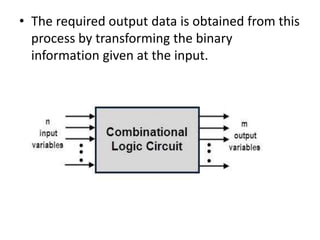
• The required output data is obtained from this
process by transforming the binary
information given at the input.
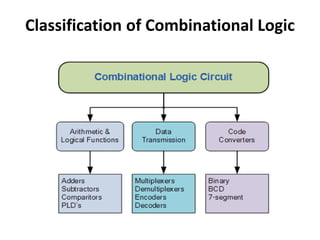
Classification of Combinational Logic
Characterstics:
• The output of combinational circuit at any
instant of time, depends only on the levels
present at input terminals.
• The combinational circuit do not use any
memory. The previous state of input does not
have any effect on the present state of the
circuit.
• A combinational circuit can have an n number
of inputs and m number of outputs.
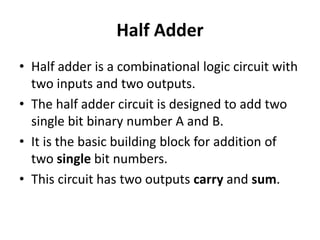
Half Adder
• Half adder is a combinational logic circuit with
two inputs and two outputs.
• The half adder circuit is designed to add two
single bit binary number A and B.
• It is the basic building block for addition of
two single bit numbers.
• This circuit has two outputs carry and sum.
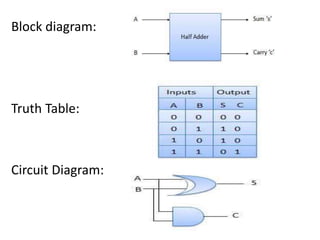
Block diagram:
Truth Table:
Circuit Diagram:
11 November 2016 8
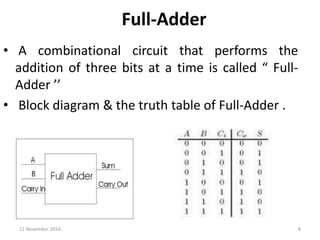
Full-Adder
• A combinational circuit that performs the
addition of three bits at a time is called “ Full-
Adder ’’
• Block diagram & the truth table of Full-Adder .
11 November 2016 9
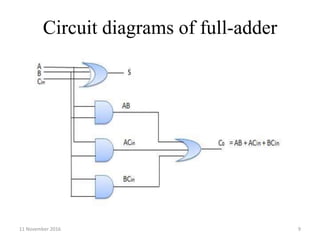
Circuit diagrams of full-adder
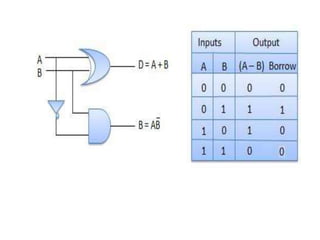
Half Subtractor
• Half subtractor is a combination circuit with two inputs and
two outputs (difference and borrow).
• It produces the difference between the two binary bits at the
input and also produces a output (Borrow) to indicate if a 1
has been borrowed. In the subtraction (A-B), A is called as
Minuend bit and B is called as Subtrahend bit.
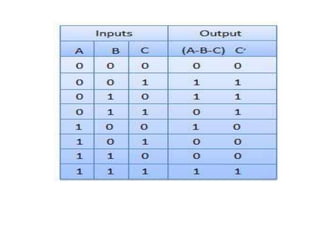
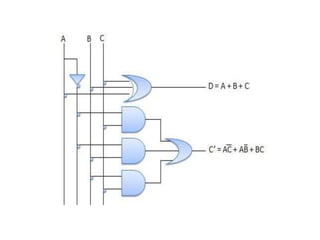
Full Subtractor
• The full subtractor is a combinational circuit
with three inputs A,B,C and two output D
and C'. A is the minuend, B is subtrahend, C
is the borrow produced by the previous
stage, D is the difference output and C' is
the borrow output.
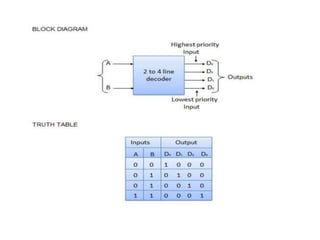
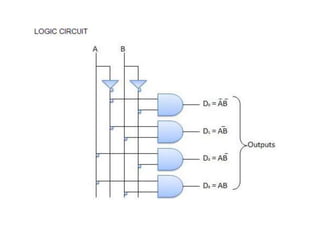
Decoder
• A decoder is a combinational circuit that has n input
and to a maximum m = 2n outputs.
• Decoder is identical to a demultiplexer without any
data input.
• It performs operations which are exactly opposite to
those of an encoder.
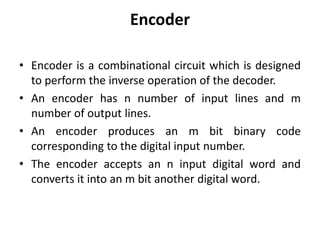
Encoder
• Encoder is a combinational circuit which is designed
to perform the inverse operation of the decoder.
• An encoder has n number of input lines and m
number of output lines.
• An encoder produces an m bit binary code
corresponding to the digital input number.
• The encoder accepts an n input digital word and
converts it into an m bit another digital word.
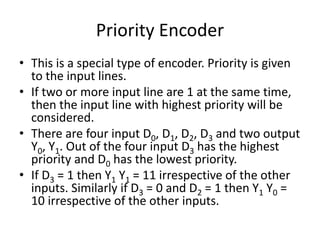
Priority Encoder
• This is a special type of encoder. Priority is given
to the input lines.
• If two or more input line are 1 at the same time,
then the input line with highest priority will be
considered.
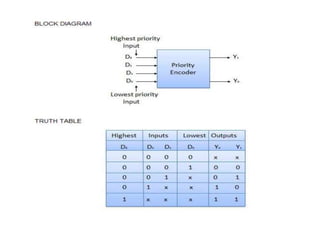
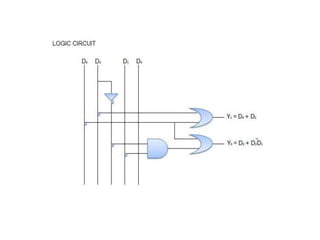
• There are four input D0, D1, D2, D3 and two output
Y0, Y1. Out of the four input D3 has the highest
priority and D0 has the lowest priority.
• If D3 = 1 then Y1 Y1 = 11 irrespective of the other
inputs. Similarly if D3 = 0 and D2 = 1 then Y1 Y0 =
10 irrespective of the other inputs.
Combinational circuits

Combinational circuits

  • 1.
  • 2.
    Combinational circuits • Acombinational logic circuit is one in which the present state of the combination of the logic inputs decides the output . • The term combination logic means combining of two or more logic gates to form a required function where the output at a given time depends only on the input.
  • 3.
    • The requiredoutput data is obtained from this process by transforming the binary information given at the input.
  • 4.
  • 5.
    Characterstics: • The outputof combinational circuit at any instant of time, depends only on the levels present at input terminals. • The combinational circuit do not use any memory. The previous state of input does not have any effect on the present state of the circuit. • A combinational circuit can have an n number of inputs and m number of outputs.
  • 6.
    Half Adder • Halfadder is a combinational logic circuit with two inputs and two outputs. • The half adder circuit is designed to add two single bit binary number A and B. • It is the basic building block for addition of two single bit numbers. • This circuit has two outputs carry and sum.
  • 7.
  • 8.
    11 November 20168 Full-Adder • A combinational circuit that performs the addition of three bits at a time is called “ Full- Adder ’’ • Block diagram & the truth table of Full-Adder .
  • 9.
    11 November 20169 Circuit diagrams of full-adder
  • 10.
    Half Subtractor • Halfsubtractor is a combination circuit with two inputs and two outputs (difference and borrow). • It produces the difference between the two binary bits at the input and also produces a output (Borrow) to indicate if a 1 has been borrowed. In the subtraction (A-B), A is called as Minuend bit and B is called as Subtrahend bit.
  • 12.
    Full Subtractor • Thefull subtractor is a combinational circuit with three inputs A,B,C and two output D and C'. A is the minuend, B is subtrahend, C is the borrow produced by the previous stage, D is the difference output and C' is the borrow output.
  • 15.
    Decoder • A decoderis a combinational circuit that has n input and to a maximum m = 2n outputs. • Decoder is identical to a demultiplexer without any data input. • It performs operations which are exactly opposite to those of an encoder.
  • 18.
    Encoder • Encoder isa combinational circuit which is designed to perform the inverse operation of the decoder. • An encoder has n number of input lines and m number of output lines. • An encoder produces an m bit binary code corresponding to the digital input number. • The encoder accepts an n input digital word and converts it into an m bit another digital word.
  • 19.
    Priority Encoder • Thisis a special type of encoder. Priority is given to the input lines. • If two or more input line are 1 at the same time, then the input line with highest priority will be considered. • There are four input D0, D1, D2, D3 and two output Y0, Y1. Out of the four input D3 has the highest priority and D0 has the lowest priority. • If D3 = 1 then Y1 Y1 = 11 irrespective of the other inputs. Similarly if D3 = 0 and D2 = 1 then Y1 Y0 = 10 irrespective of the other inputs.